
Leviticus 14:6

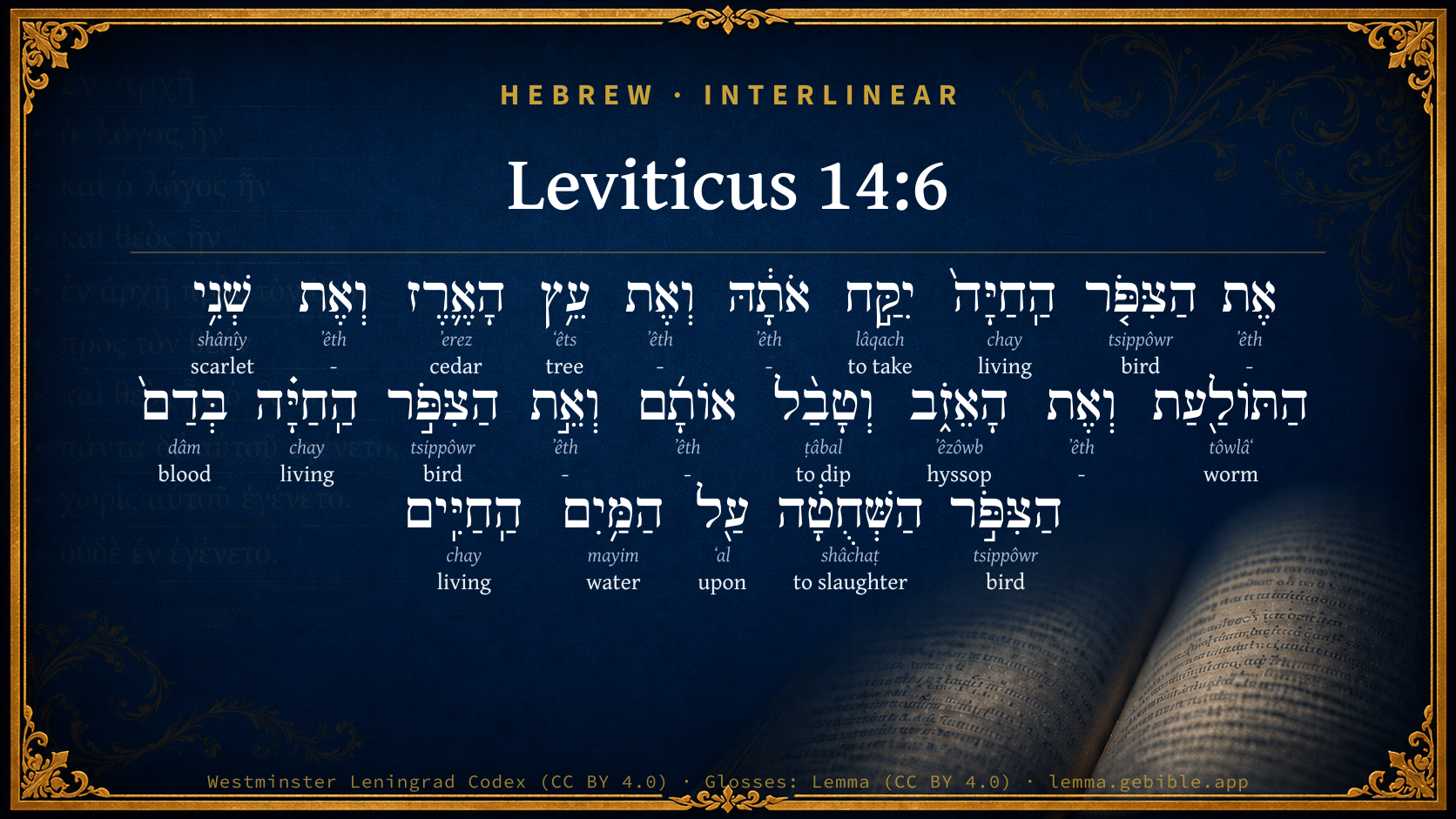
Hebrew (Westminster Leningrad Codex) Leviticus 14:6 appears in the Hebrew Old Testament. The text above is from the Westminster Leningrad Codex. Each word links to its Strong’s number, a concise gloss, and parsing drawn from the Open Scriptures Hebrew Bible morphology. Click any word for its full Brown-Driver-Briggs (BDB) entry.
Download image
Cite this verse

Leviticus 14:6 (World English Bible). Public Domain. Lemma interlinear Bible study tool, https://lemma.gebible.app/v/leviticus/14/6.

Show BibTeX & RIS
BibTeX
RIS
English Translation
As for the living bird, he shall take it, and the cedar wood, and the scarlet, and the hyssop, and shall dip them and the living bird in the blood of the bird that was killed over the running water.
World English Bible · Public Domain
Download a study sheet

One document with this verse’s original text, its word-by-word gloss line, the meaning frame, cross-references with their text, attributed commentary, and full source and license credits — printable, and it pastes into notes with its structure intact.

This verse Autodidact and up

Study sheet (.html) Plain text (.txt)

A passage Seminary Student

Up to 50 verses in one chapter. A passage sheet keeps up to 6 commentary sources and 12 cross-references per verse, in the order this page ranks them, and says so on the sheet whenever that leaves anything out. Ask for a single verse and you get the Autodidact verse sheet above.

Everything on this page stays free to read, with no account — the sheet is a download of what is already on screen, not access to it.

Want to remove ads? Support Godless Engineer
Compare translations 3

The same verse in 3 English versions, stacked beneath the original-language interlinear above. Click any original word for its lexicon entry.

Each is an independent rendering of the whole verse — the interlinear is not word-aligned to these translations.

Highlighted words mark where these versions differ — a whole-verse word diff, not a word-by-word alignment.

  • World English Bible Public Domain
    As for the living bird, he shall take it, and the cedar wood, and the scarlet, and the hyssop, and shall dip them and the living bird in the blood of the bird that was killed over the running water.
  • King James Version Public Domain
    As for the living bird, he shall take it, and the cedar wood, and the scarlet, and the hyssop, and shall dip them and the living bird in the blood of the bird that was killed over the running water:
  • unfoldingWord Literal Text CC BY-SA 4.0
    The live bird, he shall take it and the wood of cedar and the scarlet of worm and the hyssop, and he shall dip them and the live bird in the blood of the bird, the slaughtered one, over the living water.

unfoldingWord Literal Text — © unfoldingWord, licensed CC BY-SA 4.0. Word-aligned USFM3 via Door43 (git.door43.org/unfoldingWord/en_ult).

Versions to compare (up to 4)

3 of 4 selected

Show all 18 translations

Every available English version of this verse, each an independent rendering of the whole verse.

  • World English Bible Public Domain
    As for the living bird, he shall take it, and the cedar wood, and the scarlet, and the hyssop, and shall dip them and the living bird in the blood of the bird that was killed over the running water.
  • Berean Standard Bible Public Domain
    And he is to take the live bird together with the cedar wood, scarlet yarn, and hyssop, and dip them into the blood of the bird that was slaughtered over the fresh water.
  • Majority Standard Bible Public Domain
    And he is to take the live bird together with the cedar wood, scarlet yarn, and hyssop, and dip them into the blood of the bird that was slaughtered over the fresh water.
  • King James Version Public Domain
    As for the living bird, he shall take it, and the cedar wood, and the scarlet, and the hyssop, and shall dip them and the living bird in the blood of the bird that was killed over the running water:
  • American Standard Version (1901) Public Domain
    As for the living bird, he shall take it, and the cedar wood, and the scarlet, and the hyssop, and shall dip them and the living bird in the blood of the bird that was killed over the running water:
  • Revised Version (1885) Public Domain
    as for the living bird, he shall take it, and the cedar wood, and the scarlet, and the hyssop, and shall dip them and the living bird in the blood of the bird that was killed over the running water:
  • Geneva Bible (1599) Public Domain
    After, he shall take the liue sparowe with the cedar wood, and the skarlet lace, and the hyssope, and shall dip them and the liuing sparowe in the blood of the sparowe slaine, ouer the pure water,
  • Douay-Rheims (1899) Public Domain
    But the other that is alive he shall dip, with the cedar wood, and the scarlet and the hyssop, in the blood of the sparrow that is immolated:
  • Young's Literal Translation Public Domain
    `as to' the living bird, he taketh it, and the cedar wood, and the scarlet, and the hyssop, and hath dipped them and the living bird in the blood of the slaughtered bird, over the running water,
  • Literal Standard Version CC BY-SA 4.0
    [as for] the living bird, he takes it, and the cedar wood, and the scarlet, and the hyssop, and has dipped them and the living bird in the blood of the slaughtered bird, over the running water,
  • Unlocked Literal Bible CC BY-SA 4.0
    The priest will then take the live bird and the cedar wood, and the scarlet yarn and the hyssop, and he will dip all these things, including the live bird, in the blood of the bird that was killed over the fresh water.
  • unfoldingWord Literal Text CC BY-SA 4.0
    The live bird, he shall take it and the wood of cedar and the scarlet of worm and the hyssop, and he shall dip them and the live bird in the blood of the bird, the slaughtered one, over the living water.
  • Darby Bible Public Domain
    as to the living bird -- he shall take it, and the cedar-wood, and the scarlet, and the hyssop, and dip them and the living bird in the blood of the bird that was killed over the running water;
  • World Messianic Bible Public Domain
    As for the living bird, he shall take it, the cedar wood, the scarlet, and the hyssop, and shall dip them and the living bird in the blood of the bird that was killed over the running water.
  • Webster's Bible Public Domain
    As for the living bird, he shall take it, and the cedar-wood, and the scarlet, and the hyssop, and shall dip them, and the living bird, in the blood of the bird that was killed over the running water.
  • Free Bible Version CC BY-SA 4.0
    He will take the live bird together with the cedar wood, crimson thread, and hyssop, and dip them in the blood of the bird that was killed over the fresh water.
  • Bible in Basic English Public Domain
    And he will take the living bird and the wood and the red thread and the hyssop and put them in the blood of the bird which was put to death over flowing water.
  • JPS Tanakh (1917) Public Domain
    As for the living bird, he shall take it, and the cedar-wood, and the scarlet, and the hyssop, and shall dip them and the living bird in the blood of the bird that was killed over the running water.

Literal Standard Version (2020), Covenant Press — licensed CC BY-SA 4.0. Text via the HelloAO Bible API (eBible.org). Unlocked Literal Bible (unfoldingWord) — licensed CC BY-SA 4.0. Text via the HelloAO Bible API (eBible.org). unfoldingWord Literal Text — © unfoldingWord, licensed CC BY-SA 4.0. Word-aligned USFM3 via Door43 (git.door43.org/unfoldingWord/en_ult). Free Bible Version, Dr. Jonathan Gallagher — licensed CC BY-SA 4.0. Text via the HelloAO Bible API (eBible.org).

Word by word

More ways to search: Search by grammar → Find every occurrence → Compare this word →

Practice this passage: Drill this verse → Learn its vocabulary →

הָאֵזֹ֑ב
ʼêzôwb
H231
“the · hyssop”
Particle, Definite Article + Noun, Common, Masculine, Singular, Absolute
Part of Speech
Particle + Noun
Type
Common
Gender
Masculine
Number
Singular
State
Absolute
Full BDB Definition

Origin: probably of foreign derivation

TWOT: 55

hyssop, a plant used for medicinal and religious purposes
  1. אֶת ʼêth H853 “-” Particle, Direct Object
  2. הַצִּפֹּ֤ר tsippôwr H6833 “the · bird” Particle, Definite Article + Noun, Common, Both, Singular, Absolute
  3. הַֽחַיָּה֙ chay H2416 “the · living” Particle, Definite Article + Adjective, Adjective, Feminine, Singular, Absolute
  4. יִקַּ֣ח lâqach H3947 “to take” Verb, Qal, Imperfect, 3rd Person, Masculine, Singular
  5. אֹתָ֔הּ ʼêth H853 “- · her” Particle, Direct Object + Suffix, Personal, 3rd Person, Feminine, Singular
  6. וְאֶת ʼêth H853 “and · -” Conjunction + Particle, Direct Object
  7. עֵ֥ץ ʻêts H6086 “tree of” Noun, Common, Masculine, Singular, Construct
  8. הָאֶ֛רֶז ʼerez H730 “the · cedar” Particle, Definite Article + Noun, Common, Masculine, Singular, Absolute
  9. וְאֶת ʼêth H853 “and · -” Conjunction + Particle, Direct Object
  10. שְׁנִ֥י shânîy H8144 “scarlet of” Noun, Common, Masculine, Singular, Construct
  11. הַתּוֹלַ֖עַת tôwlâʻ H8438 “the · worm” Particle, Definite Article + Noun, Common, Feminine, Singular, Absolute
  12. וְאֶת ʼêth H853 “and · -” Conjunction + Particle, Direct Object
  13. וְטָבַ֨ל ṭâbal H2881 “and · to dip” Conjunction + Verb, Qal, Sequential Perfect, 3rd Person, Masculine, Singular
  14. אוֹתָ֜ם ʼêth H853 “- · them” Particle, Direct Object + Suffix, Personal, 3rd Person, Masculine, Plural
  15. וְאֵ֣ת ʼêth H853 “and · -” Conjunction + Particle, Direct Object
  16. הַצִּפֹּ֣ר tsippôwr H6833 “the · bird” Particle, Definite Article + Noun, Common, Both, Singular, Absolute
  17. הַֽחַיָּ֗ה chay H2416 “the · living” Particle, Definite Article + Adjective, Adjective, Feminine, Singular, Absolute
  18. בְּדַם֙ dâm H1818 “in/at · blood of” Preposition + Noun, Common, Masculine, Singular, Construct
  19. הַצִּפֹּ֣ר tsippôwr H6833 “the · bird” Particle, Definite Article + Noun, Common, Both, Singular, Absolute
  20. הַשְּׁחֻטָ֔ה shâchaṭ H7819 “the · slaughtered” Particle, Definite Article + Verb, Qal, Participle Passive, Feminine, Singular, Absolute
  21. עַ֖ל ʻal H5921 “upon” Preposition
  22. הַמַּ֥יִם mayim H4325 “the · water(s)” Particle, Definite Article + Noun, Common, Masculine, Plural, Absolute
  23. הַֽחַיִּֽים chay H2416 “the · living” Particle, Definite Article + Adjective, Adjective, Masculine, Plural, Absolute

About this verse

These counts appear in no published source. They are computed here, from the morphology-tagged text and Lemma’s own curated glosses. What Lemma adds →

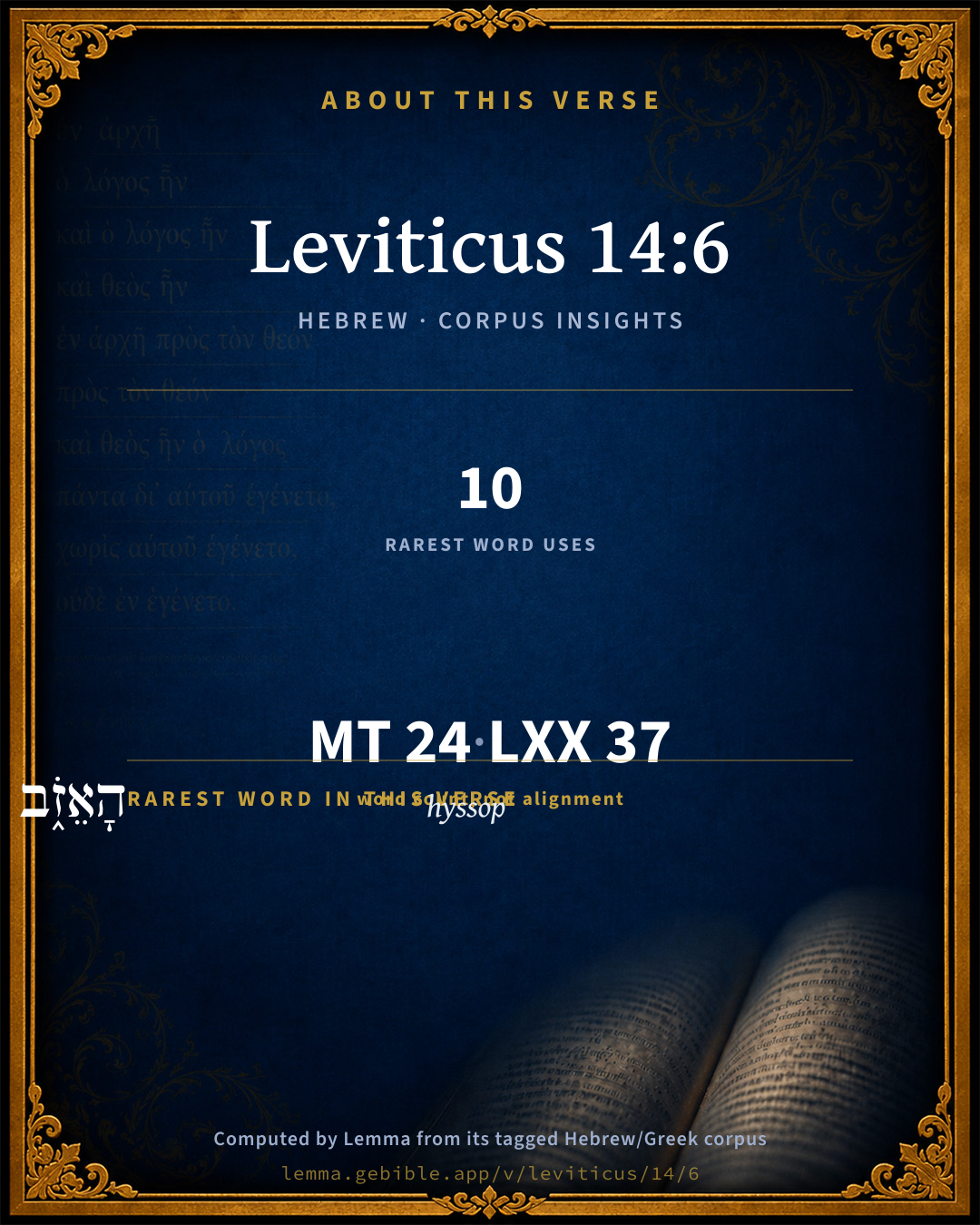
24
words
14
distinct lemmas
Pentateuch
section

Notable vocabulary

The rarest word here is הָאֵזֹ֑ב hyssop H231 — appearing just 10 times in the whole Hebrew Bible.

Shared distinctive vocabulary

הָאֵזֹ֑ב hyssop H231 occurs in 10 verses of the Hebrew Bible. Also found in:

Grammatical profile

  • 3 verbs
  • 10 nouns
  • 3 adjectives
  • 1 preposition
  • 7 particles

Verb forms

  • יִקַּ֣ח Qal · Imperfect
  • וְטָבַ֨ל Qal · Sequential Perfect
  • הַשְּׁחֻטָ֔ה Qal · Participle Passive

Repetition

Words recur within this verse — often emphatic in Hebrew:

  • הַצִּפֹּ֤ר bird H6833 ×3
  • הַֽחַיָּה֙ living H2416 ×3

Hebrew & Septuagint length

In English translation the verse runs 40 words from the Hebrew and 42 from the Septuagint (LXX English) — closely comparable.

A rough comparison of the two English renderings, which tokenize alike — not a word-level alignment.

Word counts can differ between the Hebrew and the Greek without any difference in meaning — e.g. the Hebrew direct-object marker אֵת has no separate Greek word, and Greek often adds the article ὁ.

In the original languages it is 24 Hebrew tokens and 37 Greek tokens — but the two are counted differently (Hebrew bundles its prefixes and suffixes into one token; the Greek is in lemma form), so that isn’t a like-for-like length.

Cross-references

10

Topical passages linked to Leviticus 14:6 in the Treasury of Scripture Knowledge — connected by theme and wording, ordered by reader-vote popularity; previews shown in the World English Bible.

  • Leviticus 14:4 then the priest shall command them to take for him who is to be cleansed two living clean birds, and cedar wood, and scarlet, and hyssop.
  • Leviticus 14:51–53 He shall take the cedar wood, and the hyssop, and the scarlet, and the living bird, and dip them in the blood of the slain bird, and in the running water, and sprinkle the house seven times.
  • Zechariah 13:1 "In that day there will be a spring opened to the house of David and to the inhabitants of Jerusalem, for sin and for uncleanness.
  • John 14:19 Yet a little while, and the world will see me no more; but you will see me. Because I live, you will live also.
  • Romans 4:25 who was delivered up for our trespasses, and was raised for our justification.
  • Romans 5:10 For if, while we were enemies, we were reconciled to God through the death of his Son, much more, being reconciled, we will be saved by his life.
  • Philippians 2:9–11 Therefore God also highly exalted him, and gave to him the name which is above every name;
  • Hebrews 1:3 His Son is the radiance of his glory, the very image of his substance, and upholding all things by the word of his power, when he had by himself made purification for our sins, sat down on the right hand of the Majesty on high;
  • Revelation 1:5 and from Jesus Christ, the faithful witness, the firstborn of the dead, and the ruler of the kings of the earth. To him who loves us, and washed us from our sins by his blood;
  • Revelation 1:18 and the Living one. I was dead, and behold, I am alive forevermore. Amen. I have the keys of Death and of Hades.

Cross-references courtesy of OpenBible.info (CC BY 4.0).

Hebrew and Greek witnesses Masoretic Hebrew ↔ Greek Septuagint

The same verse in the two great witnesses to the Old Testament, shown verse-for-verse.

These are two independent witnesses, not word-aligned to each other, and the Septuagint is shown in lemma (dictionary) form.

Hebrew Leviticus 14:6 Masoretic · Westminster Leningrad Codex

אֶת הַצִּפֹּ֤ר הַֽחַיָּה֙ יִקַּ֣ח אֹתָ֔הּ וְאֶת עֵ֥ץ הָאֶ֛רֶז וְאֶת שְׁנִ֥י הַתּוֹלַ֖עַת וְאֶת הָאֵזֹ֑ב וְטָבַ֨ל אוֹתָ֜ם וְאֵ֣ת הַצִּפֹּ֣ר הַֽחַיָּ֗ה בְּדַם֙ הַצִּפֹּ֣ר הַשְּׁחֻטָ֔ה עַ֖ל הַמַּ֥יִם הַֽחַיִּֽים

As for the living bird, he shall take it, and the cedar wood, and the scarlet, and the hyssop, and shall dip them and the living bird in the blood of the bird that was killed over the running water.

World English Bible · Public Domain

Greek LXX Leviticus 14:6 Septuagint · lemma form

καί ὁ ὀρνίθιον ὁ ζάω λαμβάνω αὐτός καί ὁ ξύλον ὁ κέδρινος καί ὁ κλωστός κόκκινος καί ὁ ὕσσωπος καί βάπτω αὐτός καί ὁ ὀρνίθιον ὁ ζάω εἰς ὁ αἷμα ὁ ὀρνίθιον ὁ σφάζω ἐπί ὕδωρ ζάω

And as for the living bird he shall take it, and the cedar wood, and the spun scarlet, and the hyssop, and he shall dip them and the living bird into the blood of the bird that was slain over running water.

LXX2012 (modern English Septuagint) · Public Domain

Hebrew: Westminster Leningrad Codex (CC BY 4.0). Greek: Septuagint (public domain); English from LXX2012 (modern English Septuagint) (Public Domain). How the Septuagint differs from the Hebrew →

Targum (Aramaic paraphrase)

2

The Targum is the ancient Jewish Aramaic paraphrase of the Hebrew Scriptures — an interpretive translation, not the Hebrew text itself. Onkelos (literal) and Pseudo-Jonathan (expansive) render the Torah, and Jonathan the Prophets. Coverage is partial: where no permissively-licensed English translation exists for a verse, only the Aramaic is shown. This is verse-level text, not a word-by-word alignment to the Hebrew.

  1. Targum Onkelos Torah (Genesis–Deuteronomy)
    יָת צִפְּרָא חַיְתָא יִסַב יָתַהּ וְיָת אָעָא דְאַרְזָא וְיָת צְבַע זְהוֹרִי וְיָת אֵזוֹבָא וְיִטְבּוֹל יָתְהוֹן וְיָת צִפְּרָא חַיְתָא בִּדְמָא דְצִפְּרָא דִנְכִיסָא עַל מֵי מַבּוּעַ

    (no public-domain English translation for this verse)

    Targum Onkelos — Aramaic: “Onkelos Genesis” (public domain); “Onkelos Exodus” (public domain); “Onkelos Leviticus” (public domain); “Onkelos Numbers” (public domain); “Onkelos Deuteronomy” (public domain). English: “Sefaria Community Translation” (CC0 1.0 (public-domain dedication)); “J.W. Etheridge. The Targums of Onkelos and Jonathan Ben Uzziel on the Pentateuch. London: Longmans, Green, 1862” (public domain). Text via Sefaria.

  2. Targum Pseudo-Jonathan Torah (Genesis–Deuteronomy)
    יַת צִפְּרָא חַיְיתָא יִסַב יָתָהּ וְיַת קֵיסָא דְאַרְזָא וְיַת צְבַע זְהוֹרֵי וְיַת אֵזוֹבָא וִיטַמֵשׁ יַתְהוֹן וְיַת צִפְרָא חַיְיתָא בְּאַדְמָא דְצִפּוֹרָא דִנְכִיסָא וּבְמֵי מַבּוּעַ

    Let him take the living bird with the cedar wood, and the scarlet, and the hyssop, and dip them and the living bird in the blood of the bird that had been killed, and in the spring water.

    Targum Pseudo-Jonathan — Aramaic: “Targum Jonathan on Genesis” (public domain); “Targum Jonathan on Exodus” (public domain); “Targum Jonathan on Leviticus” (public domain); “Targum Jonathan on Numbers” (public domain); “Targum Jonathan on Deuteronomy” (public domain). English: “The Targum of Jonathan ben Uzziel, trans. J. W. Etheridge, London, 1862” (public domain). Text via Sefaria.

Commentary

Notes on Leviticus 14:6 from classic Christian and Jewish commentators (each source and its license shown beneath its notes). The classic Christian expositions comment on the surrounding passage and are grouped to its opening verse, so a note may address several verses; the Jewish commentaries on the Tanakh (Rashi and others) are per-verse, so they appear only where the commentator wrote on this verse.

Lemma curates 59 commentaries, every one of them public domain or Creative Commons licensed, each selected and text-cleaned for this edition rather than reprinted as found. About our sources →

Trapp's Complete Commentary

John Trapp

Lev 14:6 As for the living bird, he shall take it, and the cedar wood, and the scarlet, and the hyssop, and shall dip them and the living bird in the blood of the bird [that was] killed over the running water:

Ver. 6. That was killed over the running water.] Pointing at Christ, who "came not by water only, but by water and blood." {1Jn 5:6} {See Trapp on "1Jn 5:6"} {See Trapp on "1Co 6:11"}

John Trapp, A Commentary or Exposition upon All the Books of the Old and New Testament (1647–1656) — public domain. Text from a community e-Sword module.

Ellicott's Commentary for English Readers

(6) And shall dip them and the living bird.—With the crimson thread the priest tied together lengthwise the bundle of hyssop and the cedar wood, extended about them the wings and the tail of the living bird, and then dipped all the four in the mixture of blood and water which was in the earthen vessel.

A Bible Commentary for English Readers, edited by Charles John Ellicott (1878–1897) — public domain. Text from a community e-Sword module.

John Gill's Exposition

As for the living bird, he shall take it,.... And dispose of it as after directed; for there was an use for that:

and the cedar wood, and the scarlet, and the hyssop; which were all bound up in one bundle, but whether the living bird was joined to them is a question; according to Jarchi they were separate, the bird by itself, and the cedar wood, &c. by themselves; they were neither bound together nor dipped together; and Ben Gersom is very distinct and expressive; we learn from hence, says he, that three were bound up in one bundle, but the living bird was not comprehended in that bundle; but according to the Misnah (c) they were all joined together, for there it is said, he (the priest) takes the cedar wood, scarlet, and hyssop, and rolls them up with the rest of the scarlet thread, and joins to them the extreme parts of the wings and of the tail of the second bird and dips them; and this seems best to agree with the text, as follows:

and shall dip them and the living bird in the blood of the bird that was killed over the running water; that is, into the blood of it as mixed with the running water in the earthen vessel, which together made a sufficient quantity for all these to be dipped into it; whether separately, first the living bird, and then the cedar wood, and scarlet, and hyssop, or all together: the bird that was kept alive was a type of Christ, who as a divine Person always alive, and ever will; he is the living God, and impassable: the dipping of this living bird in the blood of the slain one denotes the union of the two natures in Christ, divine and human, and which union remained at the death of Christ; and also shows that the virtue of Christ's blood arises from his being the living God: the dipping of the cedar wood, scarlet, and hyssop, into the same blood, signifies the exercise of the several graces of the Spirit upon Christ, as crucified and slain, and their dealing with his blood for pardon and cleansing, as faith and hope do, and from whence love receives fresh ardour and rigour.

(c) Ebr. Concord. part. 64. No. 318. & Bartenora in ib.

John Gill's Exposition of the Whole Bible (1746–1763) — public domain (CC PDM 1.0). Text via the HelloAO Bible API.

Whedon's Commentary on the Bible

Daniel D. Whedon

6, 7. The living bird — This was tied to the end of the cedar wood or juniper in such a way that the tips of its wings and of its tail, bound with the crimson fillet cord or cloth, might be dipped with the hyssop into the vessel of blood and water. Then the whole was used as a brush with which to sprinkle upon him that is to be cleansed from the leprosy seven times, thereby indicating the perfectness of the first cleansing. Lev_4:6, note. The cedar, crimson, and hyssop are symbols of the instrumental cause of spiritual cleansing, faith, by which the Spirit applies the blood and the water for our justification and entire sanctification. Both are necessary. Heb_12:14.

Pronounce him clean — Next in value to the purification is the divine authentication to the consciousness of the sanctified soul cleansed from the root of all depravity, the leprosy of inbred sin. 1Co_2:12.

Let the living bird loose — With blood-stained wings he mounts the skies warbling in gladness at his release from the cedar wood to which he was painfully bound, and from the blood and water into which he had been plunged. It was not released until after the death of its companion; “for the two birds typify one Christ in two stages of his atoning work — death and resurrection.” Since, under the reign of natural law the dead bird could not be restored to life, the living bird, reddened with the blood, the life of its sacrificed fellow, per-sonates him, winging its upward way a living witness of the leper’s cleansing through blood. But our Sacrifice, having power to lay down his life and to take it again, needs no one to personate his continued life, for “He ever liveth to make intercession for us.”

“Thy offering still continues new;

Thy vesture keeps its crimson hue;

Thou art the ever-slaughtered Lamb,

Thy priesthood still remains the same.”

The Targum of Palestine adds, “And it will be that if that man is again to be stricken with leprosy, the living bird will come back to his house on that day, and may be held fit to be eaten.” The same is said of the bird let loose for the cleansing of a house. See Lev_14:53.

Daniel D. Whedon (gen. ed.), Commentary on the Old and New Testaments (1874–1909) — public domain. Text from a community e-Sword module.

The Pulpit Commentary

As for the living bird, he shall take it. The wings and tail of the bird were extended, and in this position it was dipped into the blood and water in the earthenware dish, and with it, the bunch made up of cedar, hyssop, and scarlet wool.

The Pulpit Commentary (1880–1919), ed. H.D.M. Spence-Jones & Joseph S. Exell — public domain. Text from a community e-Sword module.

unfoldingWord translationNotes

Door43 World Missions Community

General Information:

Yahweh continues telling Moses and Aaron what the people must do when someone is cleansed of a skin disease.

the bird that was killed

This can be translated in active form. AT: "the bird that the person killed" (See: Active or Passive)

the person who is to be cleansed

This can be translated in active form. AT: "the person he is cleansing" (See: Active or Passive)

the priest will pronounce him to be clean

The person whom other people may touch and who is acceptable for God's purposes is spoken of as if he were physically clean. (See: Metaphor)

translationWords

priest

life

cedar

blood

water

clean

unfoldingWord translationNotes — © Distant Shores Media and the Door43 World Missions Community, licensed CC BY-SA 4.0. Source: git.door43.org/Door43/en_tn.

Rashi

Rabbi Shlomo Yitzchaki (Rashi)

את הצפור החיה יקח אתה AS FOR THE LIVING BIRD HE SHALL‎ TAKE IT — The phrasing (since it does not state ‘‘the living bird and the cedar wood etc. he shall take”, but, “the living bird, he shall take it, and the cedar stick etc.”) informs us that he does not bind it (the bird) together with them (the cedar wood etc.) but keeps it apart by itself. The cedar stick, however, and the hyssop are tied together by the crimson slip, just as it is stated: “and the cedar wood and the crimson slip and the hyssop” — one “taking” for the three (since these three are grouped together after the word יקח). One might think that just as it (the bird) does not come under the regulation as regards binding, so, too, it does not come under the regulation as regards “dipping”; it therefore states “and he shall dip them and the living bird” — thus it (Scripture) mentions the bird again in connection with them to bring it, too, under the regulation of dipping (cf. Sifra, Metzora, Chapter 1 6).

Rashi on the Tanakh — English translations: “The Judaica Press complete Tanach with Rashi, translated by A. J. Rosenberg” (CC BY 4.0); “Pentateuch with Rashi's commentary by M. Rosenbaum and A.M. Silbermann, 1929-1934” (public domain); “The Metsudah Tanach series, Lakewood, N.J” (CC BY 4.0); and “The Book of Joshua, Metsudah Publications, 1997” (CC BY 4.0). Text via Sefaria.

Lesson kit

Teaching starters — assembled from the data on this page, not authored interpretation. Every prompt links to the verse data it draws on. Edit before teaching.

Leviticus, in the Pentateuch, opens this verse with 24 words (14 distinct Hebrew lemmas). Its most distinctive word is ʼêzôwb (“hyssop”). A historical commentator’s framing appears above. Read the whole chapter for the surrounding context.

Discussion questions

  1. The word ʼêzôwb carries the sense “hyssop.” How does it shape the verse?
  2. How does Exodus 12:22, which shares the word «hyssop», read alongside this verse?
  3. What does the repetition of “bird” (3× in this one verse) do in this verse?
  4. These translations render this verse differently; the difference is in the English rendering, not the original. What questions does that raise?
  5. «יִקַּ֣ח» is a Qal Imperfect verb. How does that grammatical form shape the action described?
  6. Compare how Trapp's Complete Commentary and Ellicott's Commentary for English Readers read this verse. Where do they agree or differ?

Things to notice

Reading settings

Reading text

Shown beneath each verse's original-language words.

Old Testament
Old Testament edition

Read the OT as the Masoretic Hebrew (MT) or the Greek Septuagint (LXX).

English shown for the Greek Septuagint (in the Hebrew ↔ Greek comparison).

Comparing translations? Open the Compare panel on any verse page to stack up to four side by side.