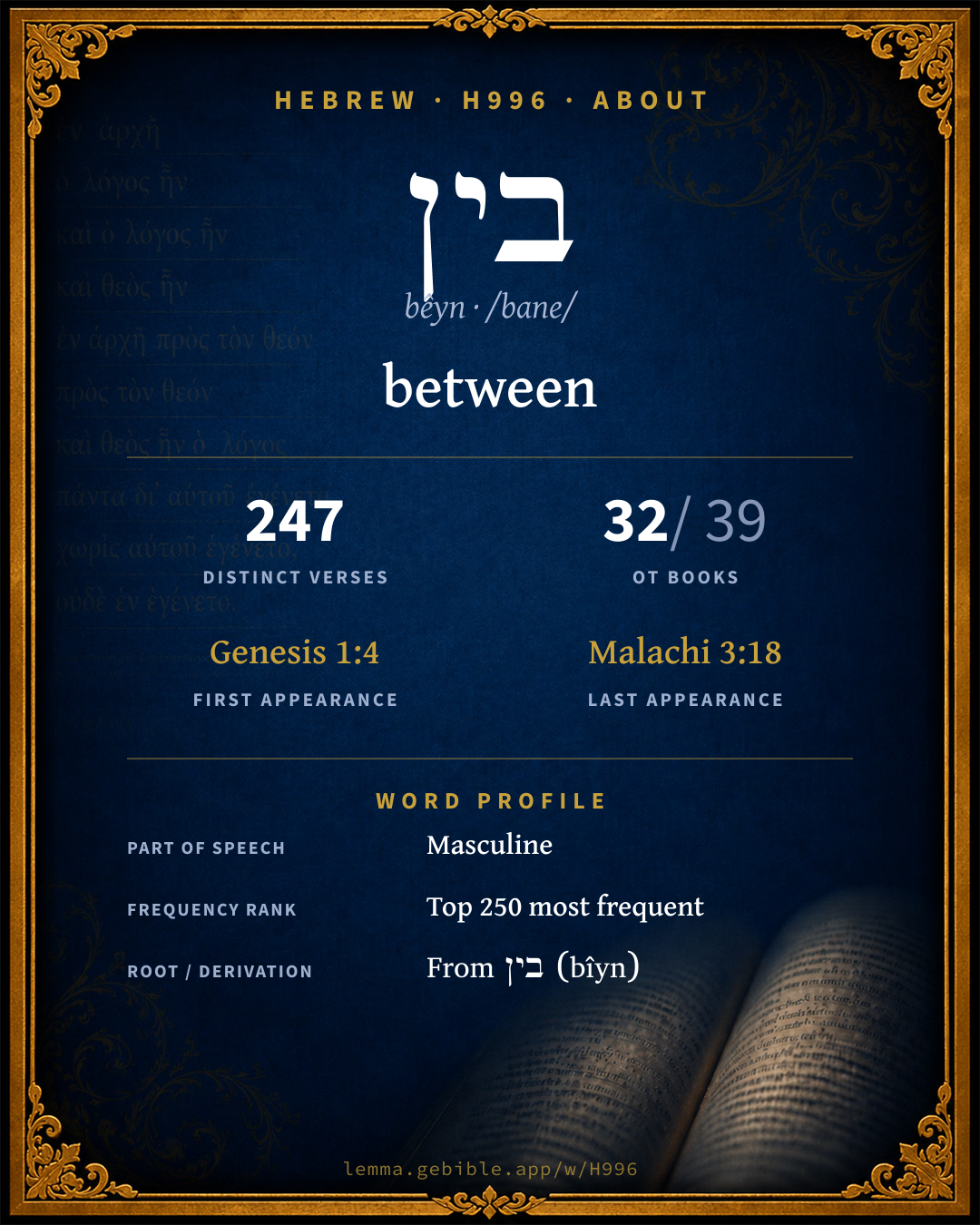
בֵּין
between
Full lexicon entry — Brown-Driver-Briggs (BDB)
From Brown-Driver-Briggs (BDB)
Where this word appears
Grammar key — what these labels mean
Part of speech
- Preposition
- A relational word (e.g. “in,” “to,” “from”) governing a noun.
- Noun
- A naming word — a person, place, thing, or idea.
Noun type
- Common
- A common noun — a general class of person, place, or thing (“king,” “city,” “water”), not a specific name.
State
- Construct
- A noun bound to a following noun in a possessive / “of” relationship (the construct chain).
Gender
- Masculine
- Grammatically masculine.
Number
- Singular
- One.
Grammatical forms
- Preposition 405 times (100%)
- Noun, Common, Masculine, Singular, Construct 1 time (0%)
Parsed forms decoded from the imported morphology (morphhb / Westminster Leningrad Codex — WLC text public domain, morphhb tagging CC BY 4.0), counted across 406 parsed occurrences — not distinct verses.
Page 1 of 2 — showing verses 1–200 of 247 distinct verses where H996 appears, across 32 books. Click any verse to open its interlinear word-by-word view. Verse text shown in the World English Bible for context — . Each verse’s Hebrew form is shown with its reference; the English is not keyword-highlighted, since the data carries no word-level English alignment. Use “Compare translations” on any verse to read it across multiple English versions. This concordance covers the Hebrew Bible; Septuagint (Greek Old Testament) occurrences are not indexed here.
Genesis 37 verses
- Genesis 1:4 בֵּ֥ין וּ/בֵ֥ין prep conj + prep God saw the light, and saw that it was good. God divided the light from the darkness.
- Genesis 1:6 בֵּ֥ין prep God said, "Let there be an expanse in the midst of the waters, and let it divide the waters from the waters."
- Genesis 1:7 בֵּ֤ין וּ/בֵ֣ין prep conj + prep God made the expanse, and divided the waters which were under the expanse from the waters which were above the expanse, and it was so.
- Genesis 1:14 בֵּ֥ין וּ/בֵ֣ין prep conj + prep God said, "Let there be lights in the expanse of sky to divide the day from the night; and let them be for signs, and for seasons, and for days and years;
- Genesis 1:18 בֵּ֥ין וּ/בֵ֣ין prep conj + prep and to rule over the day and over the night, and to divide the light from the darkness. God saw that it was good.
- Genesis 3:15 בֵּֽינְ/ךָ֙ וּ/בֵ֣ין וּ/בֵ֥ין וּ/בֵ֣ין prep + sfx pers 2ms conj + prep conj + prep conj + prep I will put enmity between you and the woman, and between your offspring and her offspring. He will bruise your head, and you will bruise his heel."
- Genesis 9:12 בֵּינִ/י֙ וּ/בֵ֣ינֵי/כֶ֔ם וּ/בֵ֛ין prep + sfx pers 1cs conj + prep + sfx pers 2mp conj + prep God said, "This is the token of the covenant which I make between me and you and every living creature that is with you, for perpetual generations:
- Genesis 9:13 בֵּינִ֖/י וּ/בֵ֥ין prep + sfx pers 1cs conj + prep I set my rainbow in the cloud, and it will be for a sign of a covenant between me and the earth.
- Genesis 9:15 בֵּינִ/י֙ וּ/בֵ֣ינֵי/כֶ֔ם וּ/בֵ֛ין prep + sfx pers 1cs conj + prep + sfx pers 2mp conj + prep and I will remember my covenant, which is between me and you and every living creature of all flesh, and the waters will no more become a flood to destroy all flesh.
- Genesis 9:16 בֵּ֣ין וּ/בֵין֙ prep conj + prep The rainbow will be in the cloud. I will look at it, that I may remember the everlasting covenant between God and every living creature of all flesh that is on the earth."
- Genesis 9:17 בֵּינִ֕/י וּ/בֵ֥ין prep + sfx pers 1cs conj + prep God said to Noah, "This is the token of the covenant which I have established between me and all flesh that is on the earth."
- Genesis 10:12 בֵּ֥ין וּ/בֵ֣ין prep conj + prep and Resen between Nineveh and Calah (the same is the great city).
- Genesis 13:3 בֵּ֥ין וּ/בֵ֥ין prep conj + prep He went on his journeys from the South even to Bethel, to the place where his tent had been at the beginning, between Bethel and Ai,
- Genesis 13:7 בֵּ֚ין וּ/בֵ֖ין prep conj + prep There was a strife between the herdsmen of Abram's cattle and the herdsmen of Lot's cattle: and the Canaanite and the Perizzite lived then in the land.
- Genesis 13:8 בֵּינִ֣/י וּ/בֵינֶ֔י/ךָ וּ/בֵ֥ין וּ/בֵ֣ין prep + sfx pers 1cs conj + prep + sfx pers 2ms conj + prep conj + prep Abram said to Lot, "Please, let there be no strife between me and you, and between my herdsmen and your herdsmen; for we are relatives.
- Genesis 15:17 בֵּ֖ין prep It came to pass that, when the sun went down, and it was dark, behold, a smoking furnace, and a flaming torch passed between these pieces.
- Genesis 16:5 בֵּינִ֥/י וּ/בֵינֶֽיׄ/ךָ prep + sfx pers 1cs conj + prep + sfx pers 2ms Sarai said to Abram, "This wrong is your fault. I gave my handmaid into your bosom, and when she saw that she had conceived, I was despised in her eyes. Yahweh judge between me and you."
- Genesis 16:14 בֵין וּ/בֵ֥ין prep conj + prep Therefore the well was called Beer Lahai Roi. Behold, it is between Kadesh and Bered.
- Genesis 17:2 בֵּינִ֣/י וּ/בֵינֶ֑/ךָ prep + sfx pers 1cs conj + prep + sfx pers 2ms I will make my covenant between me and you, and will multiply you exceedingly."
- Genesis 17:7 בֵּינִ֣/י וּ/בֵינֶ֗/ךָ וּ/בֵ֨ין prep + sfx pers 1cs conj + prep + sfx pers 2ms conj + prep I will establish my covenant between me and you and your seed after you throughout their generations for an everlasting covenant, to be a God to you and to your seed after you.
- Genesis 17:10 בֵּינִ/י֙ וּ/בֵ֣ינֵי/כֶ֔ם וּ/בֵ֥ין prep + sfx pers 1cs conj + prep + sfx pers 2mp conj + prep This is my covenant, which you shall keep, between me and you and your seed after you. Every male among you shall be circumcised.
- Genesis 17:11 בֵּינִ֖/י וּ/בֵינֵי/כֶֽם prep + sfx pers 1cs conj + prep + sfx pers 2mp You shall be circumcised in the flesh of your foreskin. It will be a token of a covenant between me and you.
- Genesis 20:1 בֵּין וּ/בֵ֣ין prep conj + prep Abraham traveled from there toward the land of the South, and lived between Kadesh and Shur. He lived as a foriegner in Gerar.
- Genesis 23:15 בֵּינִ֥/י וּ/בֵֽינְ/ךָ֖ prep + sfx pers 1cs conj + prep + sfx pers 2ms "My lord, listen to me. What is a piece of land worth four hundred shekels of silver between me and you? Therefore bury your dead."
- Genesis 26:28 בֵּינוֹתֵ֖י/נוּ בֵּינֵ֣י/נוּ וּ/בֵינֶ֑/ךָ prep + sfx pers 1cp prep + sfx pers 1cp conj + prep + sfx pers 2ms They said, "We saw plainly that Yahweh was with you. We said, 'Let there now be an oath between us, even between us and you, and let us make a covenant with you,
- Genesis 30:36 בֵּינ֖/וֹ וּ/בֵ֣ין prep + sfx pers 3ms conj + prep He set three days' journey between himself and Jacob, and Jacob fed the rest of Laban's flocks.
- Genesis 31:37 בֵּ֥ין prep Now that you have felt around in all my stuff, what have you found of all your household stuff? Set it here before my relatives and your relatives, that they may judge between us two.
- Genesis 31:44 בֵּינִ֥/י וּ/בֵינֶֽ/ךָ prep + sfx pers 1cs conj + prep + sfx pers 2ms Now come, let us make a covenant, you and I; and let it be for a witness between me and you."
- Genesis 31:48 בֵּינִ֥/י וּ/בֵינְ/ךָ֖ prep + sfx pers 1cs conj + prep + sfx pers 2ms Laban said, "This heap is witness between me and you this day." Therefore it was named Galeed
- Genesis 31:49 בֵּינִ֣/י וּ/בֵינֶ֑/ךָ prep + sfx pers 1cs conj + prep + sfx pers 2ms and Mizpah, for he said, "Yahweh watch between me and you, when we are absent one from another.
- Genesis 31:50 בֵּינִ֥/י וּ/בֵינֶֽ/ךָ prep + sfx pers 1cs conj + prep + sfx pers 2ms If you will afflict my daughters, and if you will take wives besides my daughters, no man is with us; behold, God is witness between me and you."
- Genesis 31:51 בֵּינִ֥/י וּ/בֵינֶֽ/ךָ prep + sfx pers 1cs conj + prep + sfx pers 2ms Laban said to Jacob, "See this heap, and see the pillar, which I have set between me and you.
- Genesis 31:53 בֵינֵ֔י/נוּ prep + sfx pers 1cp The God of Abraham, and the God of Nahor, the God of their father, judge between us." Then Jacob swore by the fear of his father, Isaac.
- Genesis 32:16 בֵּ֥ין וּ/בֵ֥ין prep conj + prep He delivered them into the hands of his servants, every herd by itself, and said to his servants, "Pass over before me, and put a space between herd and herd."
- Genesis 42:23 בֵּינֹתָֽ/ם prep + sfx pers 3mp They didn't know that Joseph understood them; for there was an interpreter between them.
- Genesis 49:10 מִ/בֵּ֣ין prep + prep The scepter will not depart from Judah, Nor the ruler's staff from between his feet, Until he comes to whom it belongs. To him will the obedience of the peoples be.
- Genesis 49:14 בֵּ֥ין prep "Issachar is a strong donkey, Lying down between the saddlebags.
Exodus 22 verses
- Exodus 8:23 בֵּ֥ין וּ/בֵ֣ין prep conj + prep I will put a division between my people and your people: by tomorrow shall this sign be."'"
- Exodus 9:4 בֵּ֚ין וּ/בֵ֖ין prep conj + prep Yahweh will make a distinction between the cattle of Israel and the cattle of Egypt; and there shall nothing die of all that belongs to the children of Israel."'"
- Exodus 11:7 בֵּ֥ין וּ/בֵ֥ין prep conj + prep But against any of the children of Israel a dog won't even bark or move its tongue, against man or animal; that you may know that Yahweh makes a distinction between the Egyptians and Israel.
- Exodus 12:6 בֵּ֥ין prep and you shall keep it until the fourteenth day of the same month; and the whole assembly of the congregation of Israel shall kill it at evening.
- Exodus 13:9 בֵּ֣ין prep It shall be for a sign to you on your hand, and for a memorial between your eyes, that the law of Yahweh may be in your mouth; for with a strong hand Yahweh has brought you out of Egypt.
- Exodus 13:16 בֵּ֣ין prep It shall be for a sign on your hand, and for symbols between your eyes: for by strength of hand Yahweh brought us forth out of Egypt."
- Exodus 14:2 בֵּ֥ין וּ/בֵ֣ין prep conj + prep "Speak to the children of Israel, that they turn back and encamp before Pihahiroth, between Migdol and the sea, before Baal Zephon. You shall encamp opposite it by the sea.
- Exodus 14:20 בֵּ֣ין וּ/בֵין֙ prep conj + prep It came between the camp of Egypt and the camp of Israel; and there was the cloud and the darkness, yet gave it light by night: and the one didn't come near the other all the night.
- Exodus 16:1 בֵּין וּ/בֵ֣ין prep conj + prep They took their journey from Elim, and all the congregation of the children of Israel came to the wilderness of Sin, which is between Elim and Sinai, on the fifteenth day of the second month after their departing out of the land of Egypt.
- Exodus 16:12 בֵּ֤ין prep "I have heard the murmurings of the children of Israel. Speak to them, saying, 'At evening you shall eat meat, and in the morning you shall be filled with bread: and you shall know that I am Yahweh your God.'"
- Exodus 18:16 בֵּ֥ין וּ/בֵ֣ין prep conj + prep When they have a matter, they come to me, and I judge between a man and his neighbor, and I make them know the statutes of God, and his laws."
- Exodus 22:11 בֵּ֣ין prep the oath of Yahweh shall be between them both, whether he hasn't put his hand to his neighbor's goods; and the owner of it shall accept it, and he shall not make restitution.
- Exodus 25:22 מִ/בֵּין֙ prep + prep There I will meet with you, and I will tell you from above the mercy seat, from between the two cherubim which are on the ark of the testimony, all that I command you for the children of Israel.
- Exodus 26:33 בֵּ֣ין וּ/בֵ֖ין prep conj + prep You shall hang up the veil under the clasps, and shall bring the ark of the testimony in there within the veil: and the veil shall separate the holy place from the most holy for you.
- Exodus 29:39 בֵּ֥ין prep The one lamb you shall offer in the morning; and the other lamb you shall offer at evening:
- Exodus 29:41 בֵּ֣ין prep The other lamb you shall offer at evening, and shall do to it according to the meal-offering of the morning, and according to its drink-offering, for a sweet savor, an offering made by fire to Yahweh.
- Exodus 30:8 בֵּ֥ין prep When Aaron lights the lamps at evening, he shall burn it, a perpetual incense before Yahweh throughout your generations.
- Exodus 30:18 בֵּֽין וּ/בֵ֣ין prep conj + prep "You shall also make a basin of brass, and the base of it of brass, in which to wash. You shall put it between the tent of meeting and the altar, and you shall put water in it.
- Exodus 31:13 בֵּינִ֤/י וּ/בֵֽינֵי/כֶם֙ prep + sfx pers 1cs conj + prep + sfx pers 2mp "Speak also to the children of Israel, saying, 'Most assuredly you shall keep my Sabbaths: for it is a sign between me and you throughout your generations; that you may know that I am Yahweh who sanctifies you.
- Exodus 31:17 בֵּינִ֗/י וּ/בֵין֙ prep + sfx pers 1cs conj + prep It is a sign between me and the children of Israel forever; for in six days Yahweh made heaven and earth, and on the seventh day he rested, and was refreshed.'"
- Exodus 40:7 בֵּֽין וּ/בֵ֣ין prep conj + prep You shall set the basin between the tent of meeting and the altar, and shall put water therein.
- Exodus 40:30 בֵּֽין וּ/בֵ֣ין prep conj + prep He set the basin between the tent of meeting and the altar, and put water therein, with which to wash.
Leviticus 8 verses
- Leviticus 10:10 בֵּ֥ין וּ/בֵ֣ין וּ/בֵ֥ין וּ/בֵ֥ין prep conj + prep conj + prep conj + prep and that you are to make a distinction between the holy and the common, and between the unclean and the clean;
- Leviticus 11:47 בֵּ֥ין וּ/בֵ֣ין וּ/בֵ֤ין וּ/בֵין֙ prep conj + prep conj + prep conj + prep to make a distinction between the unclean and the clean, and between the living thing that may be eaten and the living thing that may not be eaten.'"
- Leviticus 20:25 בֵּֽין וּ/בֵין prep conj + prep "'You shall therefore make a distinction between the clean animal and the unclean, and between the unclean fowl and the clean: and you shall not make yourselves abominable by animal, or by bird, or by anything with which the ground teems, which I have separated from you as unclean for you.
- Leviticus 23:5 בֵּ֣ין prep In the first month, on the fourteenth day of the month in the evening, is Yahweh's Passover.
- Leviticus 26:46 בֵּינ֕/וֹ וּ/בֵ֖ין prep + sfx pers 3ms conj + prep These are the statutes, ordinances and laws, which Yahweh made between him and the children of Israel in Mount Sinai by Moses.
- Leviticus 27:12 בֵּ֥ין וּ/בֵ֣ין prep conj + prep and the priest shall value it, whether it is good or bad. As you the priest values it, so shall it be.
- Leviticus 27:14 בֵּ֥ין וּ/בֵ֣ין prep conj + prep "'When a man dedicates his house to be holy to Yahweh, then the priest shall evaluate it, whether it is good or bad: as the priest shall evaluate it, so shall it stand.
- Leviticus 27:33 בֵּֽין prep He shall not search whether it is good or bad, neither shall he change it: and if he changes it at all, then both it and that for which it is changed shall be holy. It shall not be redeemed.'"
Numbers 14 verses
- Numbers 7:89 מִ/בֵּ֖ין prep + prep When Moses went into the Tent of Meeting to speak with Yahweh, he heard his voice speaking to him from above the mercy seat that was on the ark of the Testimony, from between the two cherubim: and he spoke to him.
- Numbers 9:3 בֵּ֧ין prep On the fourteenth day of this month, at evening, you shall keep it in its appointed season-- according to all its statutes, and according to all its ordinances, you shall keep it."
- Numbers 9:5 בֵּ֥ין prep They kept the Passover in the first month, on the fourteenth day of the month, at evening, in the wilderness of Sinai. According to all that Yahweh commanded Moses, so the children of Israel did.
- Numbers 9:11 בֵּ֥ין prep In the second month, on the fourteenth day at evening they shall keep it; they shall eat it with unleavened bread and bitter herbs.
- Numbers 11:33 בֵּ֣ין prep While the flesh was yet between their teeth, before it was chewed, the anger of Yahweh was kindled against the people, and Yahweh struck the people with a very great plague.
- Numbers 16:37 מִ/בֵּ֣ין prep + prep Speak to Eleazar the son of Aaron the priest, that he take up the censers out of the burning, and scatter you the fire yonder; for they are holy,
- Numbers 16:48 בֵּֽין וּ/בֵ֣ין prep conj + prep He stood between the dead and the living; and the plague was stayed.
- Numbers 21:13 בֵּ֥ין וּ/בֵ֥ין prep conj + prep From there they traveled, and encamped on the other side of the Arnon, which is in the wilderness, that comes out of the border of the Amorites: for the Arnon is the border of Moab, between Moab and the Amorites.
- Numbers 26:56 בֵּ֥ין prep According to the lot shall their inheritance be divided between the more and the fewer.
- Numbers 28:4 בֵּ֥ין prep The one lamb shall you offer in the morning, and the other lamb shall you offer at even;
- Numbers 28:8 בֵּ֣ין prep The other lamb shall you offer at even: as the meal-offering of the morning, and as the drink-offering of it, you shall offer it, an offering made by fire, of a sweet savor to Yahweh.
- Numbers 30:16 בֵּ֥ין בֵּֽין prep prep These are the statutes, which Yahweh commanded Moses, between a man and his wife, between a father and his daughter, being in her youth, in her father's house.
- Numbers 31:27 בֵּ֚ין וּ/בֵ֖ין prep conj + prep and divide the prey into two parts: between the men skilled in war, who went out to battle, and all the congregation.
- Numbers 35:24 בֵּ֚ין וּ/בֵ֖ין prep conj + prep then the congregation shall judge between the striker and the avenger of blood according to these ordinances;
Deuteronomy 10 verses
- Deuteronomy 1:1 בֵּֽין וּ/בֵֽין prep conj + prep These are the words which Moses spoke to all Israel beyond the Jordan in the wilderness, in the Arabah over against Suph, between Paran, and Tophel, and Laban, and Hazeroth, and Dizahab.
- Deuteronomy 1:16 בֵּין בֵּֽין וּ/בֵין וּ/בֵ֥ין prep prep conj + prep conj + prep I charged your judges at that time, saying, Hear [the causes] between your brothers, and judge righteously between a man and his brother, and the foreigner who is living with him.
- Deuteronomy 5:5 בֵּין וּ/בֵֽינֵי/כֶם֙ prep conj + prep + sfx pers 2mp (I stood between Yahweh and you at that time, to show you the word of Yahweh: for you were afraid because of the fire, and didn't go up onto the mountain;) saying,
- Deuteronomy 6:8 בֵּ֥ין prep You shall bind them for a sign on your hand, and they shall be for symbols between your eyes.
- Deuteronomy 11:18 בֵּ֥ין prep Therefore shall you lay up these my words in your heart and in your soul; and you shall bind them for a sign on your hand, and they shall be for symbols between your eyes.
- Deuteronomy 14:1 בֵּ֥ין prep You are the children of Yahweh your God: you shall not cut yourselves, nor make any baldness between your eyes for the dead.
- Deuteronomy 17:8 בֵּֽין בֵּֽין וּ/בֵ֥ין prep prep conj + prep If there arise a matter too hard for you in judgment, between blood and blood, between plea and plea, and between stroke and stroke, being matters of controversy within your gates; then shall you arise, and go up to the place which Yahweh your God shall choose;
- Deuteronomy 25:1 בֵּ֣ין prep If there be a controversy between men, and they come to judgment, and [the judges] judge them; then they shall justify the righteous, and condemn the wicked;
- Deuteronomy 28:57 מִ/בֵּ֣ין prep + prep and toward her young one who comes out from between her feet, and toward her children whom she shall bear; for she shall eat them for want of all things secretly, in the siege and in the distress with which your enemy shall distress you in your gates.
- Deuteronomy 33:12 וּ/בֵ֥ין conj + prep Of Benjamin he said, The beloved of Yahweh shall dwell in safety by him; He covers him all the day long, He dwells between his shoulders.
Joshua 10 verses
- Joshua 3:4 בֵּֽינֵי/כֶם֙ ו/בינ/ו וּ/בֵינָ֔י/ו prep + sfx pers 2mp conj + prep + sfx pers 3ms conj + prep + sfx pers 3ms Yet there shall be a space between you and it, about two thousand cubits by measure: don't come near to it, that you may know the way by which you must go; for you have not passed this way heretofore.
- Joshua 8:9 בֵּ֧ין וּ/בֵ֥ין prep conj + prep Joshua sent them forth; and they went to set up the ambush, and stayed between Bethel and Ai, on the west side of Ai: but Joshua lodged that night among the people.
- Joshua 8:11 בינ/ו בֵּינָ֥י/ו וּ/בֵין prep + sfx pers 3ms prep + sfx pers 3ms conj + prep All the people, [even] the [men of] war who were with him, went up, and drew near, and came before the city, and encamped on the north side of Ai: now there was a valley between him and Ai.
- Joshua 8:12 בֵּ֧ין וּ/בֵ֥ין prep conj + prep He took about five thousand men, and set them in ambush between Bethel and Ai, on the west side of the city.
- Joshua 18:11 בֵּ֚ין וּ/בֵ֖ין prep conj + prep The lot of the tribe of the children of Benjamin came up according to their families: and the border of their lot went out between the children of Judah and the children of Joseph.
- Joshua 22:25 בֵּינֵ֨/נוּ וּ/בֵינֵי/כֶ֜ם prep + sfx pers 1cp conj + prep + sfx pers 2mp for Yahweh has made the Jordan a border between us and you, you children of Reuben and children of Gad; you have no portion in Yahweh: so might your children make our children cease from fearing Yahweh.
- Joshua 22:27 בֵּינֵ֣י/נוּ וּ/בֵינֵי/כֶ֗ם וּ/בֵ֣ין prep + sfx pers 1cp conj + prep + sfx pers 2mp conj + prep but it shall be a witness between us and you, and between our generations after us, that we may do the service of Yahweh before him with our burnt offerings, and with our sacrifices, and with our peace-offerings; that your children may not tell our children in time to come, You have no portion in Yahweh.
- Joshua 22:28 בֵּינֵ֖י/נוּ וּ/בֵינֵי/כֶֽם prep + sfx pers 1cp conj + prep + sfx pers 2mp Therefore said we, It shall be, when they so tell us or to our generations in time to come, that we shall say, Behold the pattern of the altar of Yahweh, which our fathers made, not for burnt offering, nor for sacrifice; but it is a witness between us and you.
- Joshua 22:34 בֵּֽינֹתֵ֔י/נוּ prep + sfx pers 1cp The children of Reuben and the children of Gad called the altar [Ed]: For, [said they], it is a witness between us that Yahweh is God.
- Joshua 24:7 בֵּינֵי/כֶ֣ם וּ/בֵ֣ין prep + sfx pers 2mp conj + prep When they cried out to Yahweh, he put darkness between you and the Egyptians, and brought the sea on them, and covered them; and your eyes saw what I did in Egypt: and you lived in the wilderness many days.
Judges 12 verses
- Judges 4:5 בֵּ֧ין וּ/בֵ֥ין prep conj + prep She lived under the palm tree of Deborah between Ramah and Bethel in the hill-country of Ephraim: and the children of Israel came up to her for judgment.
- Judges 4:17 בֵּ֚ין וּ/בֵ֕ין prep conj + prep However Sisera fled away on his feet to the tent of Jael the wife of Heber the Kenite; for there was peace between Jabin the king of Hazor and the house of Heber the Kenite.
- Judges 5:11 בֵּ֚ין prep Far from the noise of archers, in the places of drawing water, There shall they rehearse the righteous acts of Yahweh, [Even] the righteous acts of his rule in Israel. Then the people of Yahweh went down to the gates.
- Judges 5:16 בֵּ֚ין prep Why sat you among the sheepfolds, To hear the whistling for the flocks? At the watercourses of Reuben There were great searchings of heart.
- Judges 5:27 בֵּ֣ין בֵּ֤ין prep prep At her feet he bowed, he fell, he lay; At her feet he bowed, he fell; Where he bowed, there he fell down dead.
- Judges 9:23 בֵּ֣ין וּ/בֵ֖ין prep conj + prep God sent an evil spirit between Abimelech and the men of Shechem; and the men of Shechem dealt treacherously with Abimelech:
- Judges 11:10 בֵּֽינוֹתֵ֔י/נוּ prep + sfx pers 1cp The elders of Gilead said to Jephthah, Yahweh shall be witness between us; surely according to your word so will we do.
- Judges 11:27 בֵּ֚ין וּ/בֵ֖ין prep conj + prep I therefore have not sinned against you, but you do me wrong to war against me: Yahweh, the Judge, be judge this day between the children of Israel and the children of Ammon.
- Judges 13:25 בֵּ֥ין וּ/בֵ֥ין prep conj + prep The Spirit of Yahweh began to move him in Mahaneh-dan, between Zorah and Eshtaol.
- Judges 15:4 בֵּין prep Samson went and caught three hundred foxes, and took firebrands, and turned tail to tail, and put a firebrand in the midst between every two tails.
- Judges 16:25 בֵּ֥ין prep It happened, when their hearts were merry, that they said, Call for Samson, that he may make us sport. They called for Samson out of the prison-house; and he made sport before them. They set him between the pillars:
- Judges 16:31 בֵּ֤ין וּ/בֵ֣ין prep conj + prep Then his brothers and all the house of his father came down, and took him, and brought him up, and buried him between Zorah and Eshtaol in the burying-place of Manoah his father. He judged Israel twenty years.
Ruth 2 verses
- Ruth 1:17 בֵּינִ֥/י וּ/בֵינֵֽ/ךְ prep + sfx pers 1cs conj + prep + sfx pers 2fs where you die, will I die, and there will I be buried: Yahweh do so to me, and more also, if anything but death part you and me."
- Ruth 2:15 בֵּ֧ין prep When she was risen up to glean, Boaz commanded his young men, saying, Let her glean even among the sheaves, and don't reproach her.
1 Samuel 12 verses
- 1 Samuel 7:12 בֵּֽין וּ/בֵ֣ין prep conj + prep Then Samuel took a stone, and set it between Mizpah and Shen, and called the name of it Ebenezer, saying, Hitherto has Yahweh helped us.
- 1 Samuel 7:14 בֵּ֥ין וּ/בֵ֥ין prep conj + prep The cities which the Philistines had taken from Israel were restored to Israel, from Ekron even to Gath; and the border of it did Israel deliver out of the hand of the Philistines. There was peace between Israel and the Amorites.
- 1 Samuel 14:4 וּ/בֵ֣ין conj + prep Between the passes, by which Jonathan sought to go over to the Philistines' garrison, there was a rocky crag on the one side, and a rocky crag on the other side: and the name of the one was Bozez, and the name of the other Seneh.
- 1 Samuel 14:42 בֵּינִ֕/י וּ/בֵ֖ין prep + sfx pers 1cs conj + prep Saul said, Cast [lots] between me and Jonathan my son. Jonathan was taken.
- 1 Samuel 17:1 בֵּין וּ/בֵין prep conj + prep Now the Philistines gathered together their armies to battle; and they were gathered together at Socoh, which belongs to Judah, and encamped between Socoh and Azekah, in Ephesdammim.
- 1 Samuel 17:3 בֵּינֵי/הֶֽם prep + sfx pers 3mp The Philistines stood on the mountain on the one side, and Israel stood on the mountain on the other side: and there was a valley between them.
- 1 Samuel 17:6 בֵּ֥ין prep He had brass shin-armor on his legs, and a javelin of brass between his shoulders.
- 1 Samuel 20:3 בֵּינִ֖/י וּ/בֵ֥ין prep + sfx pers 1cs conj + prep David swore moreover, and said, Your father knows well that I have found favor in your eyes; and he says, Don't let Jonathan know this, lest he be grieved: but truly as Yahweh lives, and as your soul lives, there is but a step between me and death.
- 1 Samuel 20:23 בֵּינִ֥/י וּ/בֵינְ/ךָ֖ prep + sfx pers 1cs conj + prep + sfx pers 2ms As touching the matter which you and I have spoken of, behold, Yahweh is between you and me forever.
- 1 Samuel 24:12 בֵּינִ֣/י וּ/בֵינֶ֔/ךָ prep + sfx pers 1cs conj + prep + sfx pers 2ms Yahweh judge between me and you, and Yahweh avenge me of you; but my hand shall not be on you.
- 1 Samuel 24:15 בֵּינִ֣/י וּ/בֵינֶ֑/ךָ prep + sfx pers 1cs conj + prep + sfx pers 2ms Yahweh therefore be judge, and give sentence between me and you, and see, and plead my cause, and deliver me out of your hand.
- 1 Samuel 26:13 בֵּינֵי/הֶֽם prep + sfx pers 3mp Then David went over to the other side, and stood on the top of the mountain afar off; a great space being between them;
2 Samuel 7 verses
- 2 Samuel 3:1 בֵּ֚ין וּ/בֵ֖ין prep conj + prep Now there was long war between the house of Saul and the house of David: and David grew stronger and stronger, but the house of Saul grew weaker and weaker.
- 2 Samuel 3:6 בֵּ֚ין וּ/בֵ֖ין prep conj + prep It happened, while there was war between the house of Saul and the house of David, that Abner made himself strong in the house of Saul.
- 2 Samuel 14:6 בֵּֽינֵי/הֶ֑ם prep + sfx pers 3mp Your handmaid had two sons, and they two strove together in the field, and there was none to part them, but the one struck the other, and killed him.
- 2 Samuel 18:9 בֵּ֤ין וּ/בֵ֣ין prep conj + prep Absalom happened to meet the servants of David. Absalom was riding on his mule, and the mule went under the thick boughs of a great oak, and his head caught hold of the oak, and he was taken up between the sky and earth; and the mule that was under him went on.
- 2 Samuel 18:24 בֵּין prep Now David was sitting between the two gates: and the watchman went up to the roof of the gate to the wall, and lifted up his eyes, and looked, and, behold, a man running alone.
- 2 Samuel 19:35 בֵּין prep I am this day eighty years old: can I discern between good and bad? can your servant taste what I eat or what I drink? can I hear any more the voice of singing men and singing women? why then should your servant be yet a burden to my lord the king?
- 2 Samuel 21:7 בֵּֽינֹתָ֔/ם בֵּ֣ין וּ/בֵ֖ין prep + sfx pers 3mp prep conj + prep But the king spared Mephibosheth, the son of Jonathan the son of Saul, because of Yahweh's oath that was between them, between David and Jonathan the son of Saul.
1 Kings 14 verses
- 1 Kings 3:9 בֵּֽין prep Give your servant therefore an understanding heart to judge your people, that I may discern between good and evil; for who is able to judge this your great people?
- 1 Kings 5:12 בֵּ֤ין וּ/בֵ֣ין prep conj + prep Yahweh gave Solomon wisdom, as he promised him; and there was peace between Hiram and Solomon; and they two made a league together.
- 1 Kings 7:28 בֵּ֥ין prep The work of the bases was on this manner: they had panels; and there were panels between the ledges;
- 1 Kings 7:29 בֵּ֣ין prep and on the panels that were between the ledges were lions, oxen, and cherubim; and on the ledges there was a pedestal above; and beneath the lions and oxen were wreaths of hanging work.
- 1 Kings 7:46 בֵּ֥ין וּ/בֵ֥ין prep conj + prep In the plain of the Jordan did the king cast them, in the clay ground between Succoth and Zarethan.
- 1 Kings 14:30 בֵין וּ/בֵ֥ין prep conj + prep There was war between Rehoboam and Jeroboam continually.
- 1 Kings 15:6 בֵין וּ/בֵ֥ין prep conj + prep Now there was war between Rehoboam and Jeroboam all the days of his life.
- 1 Kings 15:7 בֵּ֥ין וּ/בֵ֥ין prep conj + prep The rest of the acts of Abijam, and all that he did, aren't they written in the book of the chronicles of the kings of Judah? There was war between Abijam and Jeroboam.
- 1 Kings 15:16 בֵּ֣ין וּ/בֵ֛ין prep conj + prep There was war between Asa and Baasha king of Israel all their days.
- 1 Kings 15:19 בֵּינִ֣/י וּ/בֵינֶ֔/ךָ בֵּ֥ין וּ/בֵ֣ין prep + sfx pers 1cs conj + prep + sfx pers 2ms prep conj + prep [There is] a league between me and you, between my father and your father: behold, I have sent to you a present of silver and gold; go, break your league with Baasha king of Israel, that he may depart from me.
- 1 Kings 15:32 בֵּ֣ין וּ/בֵ֛ין prep conj + prep There was war between Asa and Baasha king of Israel all their days.
- 1 Kings 18:42 בֵּ֥ין prep So Ahab went up to eat and to drink. Elijah went up to the top of Carmel; and he bowed himself down on the earth, and put his face between his knees.
- 1 Kings 22:1 בֵּ֥ין וּ/בֵ֥ין prep conj + prep They continued three years without war between Syria and Israel.
- 1 Kings 22:34 בֵּ֥ין וּ/בֵ֣ין prep conj + prep A certain man drew his bow at a venture, and struck the king of Israel between the joints of the armor: therefore he said to the driver of his chariot, Turn your hand, and carry me out of the host; for I am severely wounded.
2 Kings 5 verses
- 2 Kings 2:11 בֵּ֣ין prep It happened, as they still went on, and talked, that behold, [there appeared] a chariot of fire, and horses of fire, which parted them both apart; and Elijah went up by a whirlwind into heaven.
- 2 Kings 9:24 בֵּ֣ין prep Jehu drew his bow with his full strength, and struck Joram between his arms; and the arrow went out at his heart, and he sunk down in his chariot.
- 2 Kings 11:17 בֵּ֤ין וּ/בֵ֤ין וּ/בֵ֣ין וּ/בֵ֥ין וּ/בֵ֥ין prep conj + prep conj + prep conj + prep conj + prep Jehoiada made a covenant between Yahweh and the king and the people, that they should be Yahweh's people; between the king also and the people.
- 2 Kings 16:14 מִ/בֵּין֙ וּ/מִ/בֵּ֖ין prep + prep conj + prep + Preposition The brazen altar, which was before Yahweh, he brought from the forefront of the house, from between his altar and the house of Yahweh, and put it on the north side of his altar.
- 2 Kings 25:4 בֵּ֣ין prep Then a breach was made in the city, and all the men of war [fled] by night by the way of the gate between the two walls, which was by the king's garden (now the Chaldeans were against the city round about); and [the king] went by the way of the Arabah.
1 Chronicles 1 verse
2 Chronicles 7 verses
- 2 Chronicles 4:17 בֵּ֥ין וּ/בֵ֥ין prep conj + prep In the plain of the Jordan did the king cast them, in the clay ground between Succoth and Zeredah.
- 2 Chronicles 13:2 בֵּ֥ין וּ/בֵ֥ין prep conj + prep Three years reigned he in Jerusalem: and his mother's name was Micaiah the daughter of Uriel of Gibeah. There was war between Abijah and Jeroboam.
- 2 Chronicles 14:11 בֵּ֥ין prep Asa cried to Yahweh his God, and said, Yahweh, there is none besides you to help, between the mighty and him who has no strength: help us, Yahweh our God; for we rely on you, and in your name are we come against this multitude. Yahweh, you are our God; don't let man prevail against you.
- 2 Chronicles 16:3 בֵּינִ֣/י וּ/בֵינֶ֔/ךָ וּ/בֵ֥ין וּ/בֵ֣ין prep + sfx pers 1cs conj + prep + sfx pers 2ms conj + prep conj + prep [There is] a league between me and you, as [there was] between my father and your father: behold, I have sent you silver and gold; go, break your league with Baasha king of Israel, that he may depart from me.
- 2 Chronicles 18:33 בֵּ֥ין וּ/בֵ֣ין prep conj + prep A certain man drew his bow at a venture, and struck the king of Israel between the joints of the armor. Therefore he said to the driver of the chariot, Turn your hand, and carry me out of the host; for I am sore wounded.
- 2 Chronicles 19:10 בֵּֽין בֵּין prep prep Whenever any controversy shall come to you from your brothers who dwell in their cities, between blood and blood, between law and commandment, statutes and ordinances, you shall warn them, that they not be guilty towards Yahweh, and so wrath come on you and on your brothers: this do, and you shall not be guilty.
- 2 Chronicles 23:16 בֵּינ֕/וֹ וּ/בֵ֥ין וּ/בֵ֣ין prep + sfx pers 3ms conj + prep conj + prep Jehoiada made a covenant between himself, and all the people, and the king, that they should be Yahweh's people.
Nehemiah 2 verses
- Nehemiah 3:32 וּ/בֵ֨ין conj + prep Between the ascent of the corner and the sheep gate repaired the goldsmiths and the merchants.
- Nehemiah 5:18 וּ/בֵ֨ין conj + prep Now that which was prepared for one day was one ox and six choice sheep; also fowls were prepared for me, and once in ten days store of all sorts of wine: yet for all this I didn't demand the bread of the governor, because the bondage was heavy on this people.
Esther 1 verse
Job 7 verses
- Job 9:33 בֵּינֵ֣י/נוּ prep + sfx pers 1cp There is no umpire between us, That might lay his hand on us both.
- Job 24:11 בֵּין prep They make oil within the walls of these men. They tread wine presses, and suffer thirst.
- Job 30:7 בֵּין prep Among the bushes they bray; And under the nettles they are gathered together.
- Job 34:4 בֵינֵ֣י/נוּ prep + sfx pers 1cp Let us choose for us that which is right. Let us know among ourselves what is good.
- Job 34:37 בֵּינֵ֣י/נוּ prep + sfx pers 1cp For he adds rebellion to his sin. He claps his hands among us, And multiplies his words against God."
- Job 41:6 בֵּ֣ין prep Will traders barter for him? Will they part him among the merchants?
- Job 41:16 בֵֽינֵי/הֶֽם prep + sfx pers 3mp One is so near to another, That no air can come between them.
Psalms 3 verses
- Psalms 68:13 בֵּ֪ין prep While you sleep among the campfires, The wings of a dove sheathed with silver, Her feathers with shining gold.
- Psalms 104:10 בֵּ֥ין prep He sends forth springs into the valleys. They run among the mountains.
- Psalms 104:12 מִ/בֵּ֥ין prep + prep The birds of the sky nest by them. They sing among the branches.
Proverbs 4 verses
- Proverbs 6:19 בֵּ֣ין prep A false witness who utters lies, And he who sows discord among brothers.
- Proverbs 14:9 וּ/בֵ֖ין conj + prep Fools mock at making atonement for sins, But among the upright there is good will.
- Proverbs 18:18 וּ/בֵ֖ין conj + prep The lot settles disputes, And keeps strong ones apart.
- Proverbs 26:13 בֵּ֣ין prep The sluggard says, "There is a lion in the road! A fierce lion roams the streets!"
Song of Solomon 3 verses
- Song of Solomon 1:13 בֵּ֥ין prep My beloved is to me a sachet of myrrh, That lies between my breasts.
- Song of Solomon 2:2 בֵּ֣ין בֵּ֥ין prep prep As a lily among thorns, So is my love among the daughters. Beloved
- Song of Solomon 2:3 בֵּ֣ין prep As the apple tree among the trees of the wood, So is my beloved among the sons. I sat down under his shadow with great delight, His fruit was sweet to my taste.
Isaiah 5 verses
- Isaiah 2:4 בֵּ֣ין prep He will judge between the nations, And will decide concerning many peoples; And they shall beat their swords into plowshares, And their spears into pruning-hooks. Nation shall not lift up sword against nation, Neither shall they learn war any more.
- Isaiah 5:3 בֵּינִ֖/י וּ/בֵ֥ין prep + sfx pers 1cs conj + prep "Now, inhabitants of Jerusalem and men of Judah, Please judge between me and my vineyard.
- Isaiah 22:11 בֵּ֚ין prep you made also a reservoir between the two walls for the water of the old pool. But you didn't look to him who had done this, neither did you have respect for him who purposed it long ago.
- Isaiah 44:4 בְּ/בֵ֣ין prep + prep and they shall spring up among the grass, as willows by the watercourses.
- Isaiah 59:2 בֵּינֵ/כֶ֕ם לְ/בֵ֖ין prep + sfx pers 2mp prep + prep but your iniquities have separated between you and your God, and your sins have hidden his face from you, so that he will not hear.
Jeremiah 8 verses
- Jeremiah 7:5 בֵּ֥ין וּ/בֵ֥ין prep conj + prep For if you thoroughly amend your ways and your doings; if you thoroughly execute justice between a man and his neighbor;
- Jeremiah 25:16 בֵּינֹתָֽ/ם prep + sfx pers 3mp They shall drink, and reel back and forth, and be mad, because of the sword that I will send among them.
- Jeremiah 25:27 בֵּינֵי/כֶֽם prep + sfx pers 2ms You shall tell them, Thus says Yahweh of Hosts, the God of Israel: Drink you, and be drunken, and spew, and fall, and rise no more, because of the sword which I will send among you.
- Jeremiah 34:18 בֵּ֥ין prep I will give the men who have transgressed my covenant, who have not performed the words of the covenant which they made before me, when they cut the calf in two and passed between the parts of it;
- Jeremiah 34:19 בֵּ֖ין prep the princes of Judah, and the princes of Jerusalem, the eunuchs, and the priests, and all the people of the land, who passed between the parts of the calf;
- Jeremiah 39:4 בֵּ֣ין prep It happened that, when Zedekiah the king of Judah and all the men of war saw them, then they fled, and went forth out of the city by night, by the way of the king's garden, through the gate between the two walls; and he went out toward the Arabah.
- Jeremiah 48:45 מִ/בֵּ֣ין prep + prep Those who fled stand without strength under the shadow of Heshbon; for a fire is gone forth out of Heshbon, and a flame from the midst of Sihon, and has devoured the corner of Moab, and the crown of the head of the tumultuous ones.
- Jeremiah 52:7 בֵּין prep Then a breach was made in the city, and all the men of war fled, and went forth out of the city by night by the way of the gate between the two walls, which was by the king's garden; (now the Chaldeans were against the city round about;) and they went toward the Arabah.
Lamentations 2 verses
- Lamentations 1:3 בֵּ֥ין prep Judah is gone into captivity because of affliction, and because of great servitude; She dwells among the nations, she finds no rest: All her persecutors overtook her within the straits.
- Lamentations 1:17 בֵּינֵי/הֶֽם prep + sfx pers 3mp Zion spreads forth her hands; there is none to comfort her; Yahweh has commanded concerning Jacob, that those who are round about him should be his adversaries: Jerusalem is among them as an unclean thing.
Ezekiel 29 verses
- Ezekiel 1:13 בֵּ֣ין prep As for the likeness of the living creatures, their appearance was like burning coals of fire, like the appearance of torches: [the fire] went up and down among the living creatures; and the fire was bright, and out of the fire went forth lightning.
- Ezekiel 4:3 בֵּינְ/ךָ֖ וּ/בֵ֣ין prep + sfx pers 2ms conj + prep Take for yourself an iron pan, and set it for a wall of iron between you and the city: and set your face toward it, and it shall be besieged, and you shall lay siege against it. This shall be a sign to the house of Israel.
- Ezekiel 8:3 בֵּֽין וּ/בֵ֣ין prep conj + prep He put forth the form of a hand, and took me by a lock of my head; and the Spirit lifted me up between earth and the sky, and brought me in the visions of God to Jerusalem, to the door of the gate of the inner [court] that looks toward the north; where was the seat of the image of jealousy, which provokes to jealousy.
- Ezekiel 8:16 בֵּ֤ין וּ/בֵ֣ין prep conj + prep He brought me into the inner court of Yahweh's house; and see, at the door of the temple of Yahweh, between the porch and the altar, were about twenty-five men, with their backs toward the temple of Yahweh, and their faces toward the east; and they were worshipping the sun toward the east.
About this entry
At a glance — auto-summarized from this page’s data, not written by a person. Every figure links to its source below. This summary describes the numbers; it doesn’t interpret them.
The Hebrew word בין centers on the idea of “between.” First canonically at Genesis 1:4, it enters the text early. It turns up in 247 verses across 32 books, a common footprint. It clusters with בין, בינה and מבון under a shared root. For the data behind this summary, explore the sense tree and the renderings breakdown below.
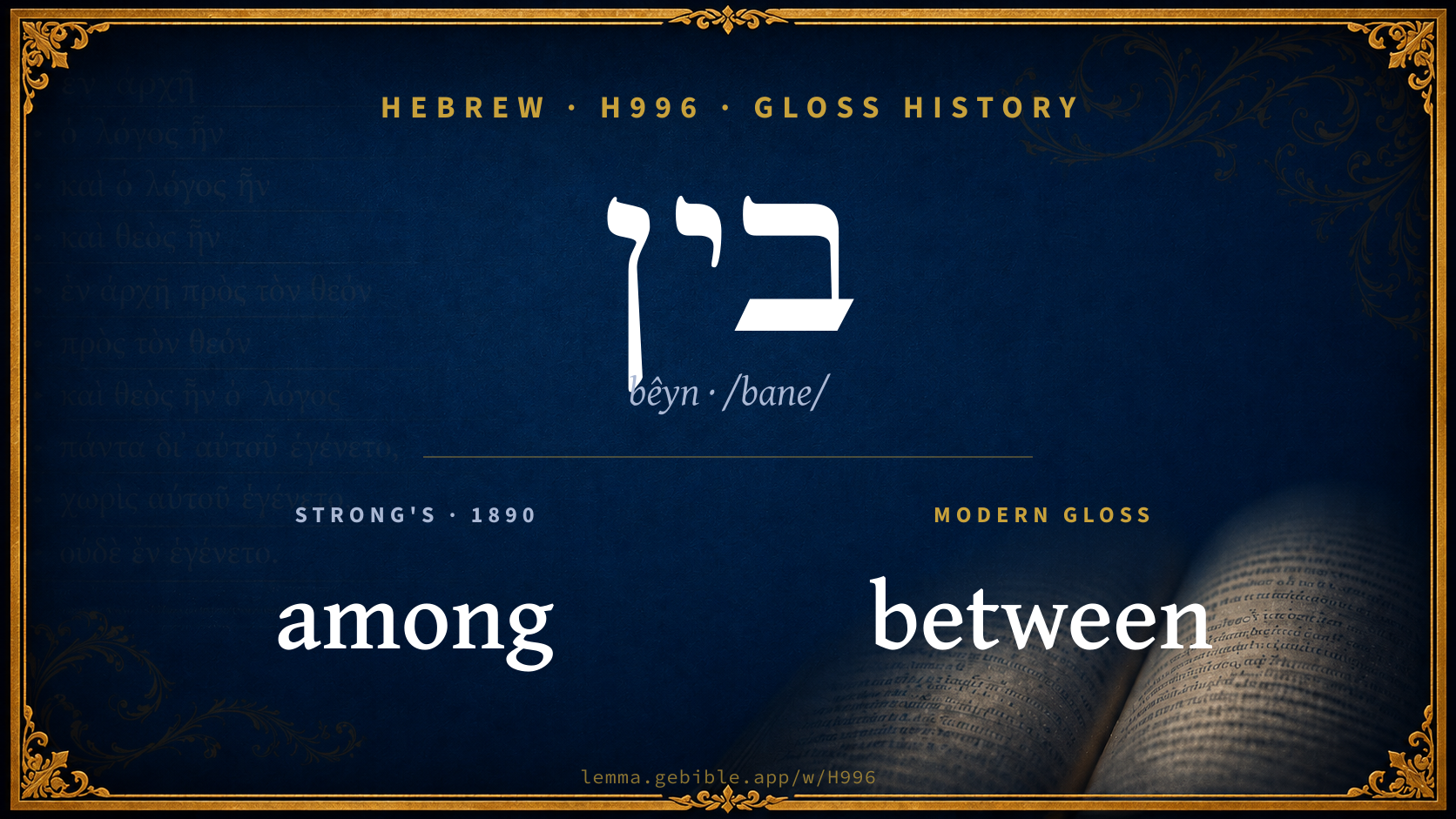
Gloss history
Strong's 1890 vs modern scholarship
About this word
Strong's H996 catalogs a Hebrew word from the Hebrew Old Testament.
These counts are not copied from any lexicon or concordance. They are computed here, from the morphology-tagged Hebrew Old Testament. What Lemma adds →
- 247
- distinct verses
- The word appears in 247 distinct verses.
- 32 / 39
- OT books
- The word appears in 32 of 39 Old Testament books.
- #121
- by frequency
- Top 250 most frequent Hebrew words (rank 121 of 8,640 Hebrew words by occurrence).
View all 247 occurrences in the concordance →
By section of the Old Testament
By traditional corpus
Conventional, traditional groupings — biblical authorship is debated, so this is a traditional corpus grouping, not an authorship claim. Each share is this word’s portion of its verses in that division of the Hebrew canon. Each figure is a share of the word’s 247 distinct verses.
- Prophets (Nevi'im) 120 verses · 49%
- Torah (Pentateuch) 91 verses · 37%
- Writings (Ketuvim) 36 verses · 15%
How translations render this word
Counts come from each version’s own published word-to-Strong’s tagging or interlinear alignment — an approximate guide to how each version renders this word, not a word-level alignment the data otherwise carries. Because each total is that version’s own tagged count, the per-version totals vary from one another and need not match the appearance or distinct-verse counts above. These counts may also differ from a printed concordance because Lemma counts each distinctly tagged rendering and does not collapse phrase taggings into a single head-word total. This is a fixed set of word-tagged versions (KJV, ASV, BSB, ULT) and does not change with the reading translation you choose elsewhere. Each version’s license is shown beside its name below (and on Sources).
BDB lists this Strong’s number as 3 distinct words (homographs). Each count above pools all of them and is not split by sense — see the Senses section below. A low-frequency rendering may belong to a different one of those words, not the primary meaning.
- King James Version†: Between 6×, From 5×, Betwixt 4×
- American Standard Version†: Between 8×, And 4×, Among 3×
- Berean Standard Bible†: Between 120×, And 30×, Among 25×
- unfoldingWord Literal Text†: Between 225×, And 54×, Between me 24×
King James Version Public Domain
Renders H996 across 31† tagged occurrences — most commonly:
Plus 9 renderings that appear only once — usually multi-word phrases or single function words the recovered tagging swept in, not distinct renderings. Not rendered by a distinct English word in 1 further occurrence.
American Standard Version Public Domain
Renders H996 across 31† tagged occurrences — most commonly:
Plus 11 renderings that appear only once — usually multi-word phrases or single function words the recovered tagging swept in, not distinct renderings.
Berean Standard Bible Public Domain
Renders H996 across 296† tagged occurrences — most commonly:
Plus other, less common renderings. Plus 32 renderings that appear only once — usually multi-word phrases or single function words the recovered tagging swept in, not distinct renderings. Not rendered by a distinct English word in 111 further occurrences.
unfoldingWord Literal Text CC BY-SA 4.0
Renders H996 across 413† tagged occurrences — most commonly:
Plus other, less common renderings. Plus 24 renderings that appear only once — usually multi-word phrases or single function words the recovered tagging swept in, not distinct renderings.
32 senses and sub-senses in the full BDB
What do BDB’s symbols mean?
BDB uses these scholarly abbreviations:
| Symbol | Meaning |
|---|---|
| 𝔊 | the Septuagint (the ancient Greek translation, LXX) |
| 𝔙 | the Vulgate (the Latin translation) |
| 𝔖 | the Syriac version (the Peshitta) |
| 𝔗 | the Targum (the Aramaic translation) |
| ψ | the Psalms |
| √ | root (the underlying root or stem) |
| ‖ | parallel passage (a synonymous or contrasted parallel) |
| † | the dagger: every passage where the word occurs is cited |
The 32 senses and sub-senses the full Brown-Driver-Briggs lexicon distinguishes for this word, in lexicon order (not ranked by frequency), with BDB’s own verbatim wording and sub-sense lettering. Shown in Hebrew script with BDB’s own scholarly abbreviations. The condensed entry is in the Lexicon Entry tab. See also the Forms in the corpus table below.
בין I
- 1. house,
- a. as dwelling, habitation Gn 19:2, 3, 4, 11; 27:15 33:17 (obj. of בָּנָה) Ex 12:7 + often; בּ׳ מוֹשַׁב Lv 25:29 (cf. בַּיִת לְשִׁבְתִּי 2 S 7:5); בֵּית = in the house of, when modifying word follows, cf. DrSm 29, n. 2 (after st. cstr. מוֹלֶדֶת בַּיִת אוֹ מוֹלֶדֶת הוּץ Lv 19:9); e.g. בּ׳ אָבִיךָ Gn 24:23; בּ׳ אִישָׁהּ Nu 30:11; בּ׳ יהוה 2 K 23:24; so in n.pr. ביתאל Am 7:13; (ה)בַּ֫יְתָה into the house, home Ex 9:19 (of man & beast) cf. Ju 19:18 1 S 6:7 (cf. v 10) 1 K 13:7, 15 ψ 68:7 Is 14:17 etc.; cf. sub 7 infr.; partic. (α) in J occasionally of tent Gn 27:15 cf. 33:17 c.בנה; here of nomad’s hut); usually (β) house of solid materials, with doorposts, etc. Ex 12:7 Dt 6:9; 11:20, walls Lv 14:37, 39, of stones, timber & mortar v 45 (cf. v 40, 42, 43); so also Jos 2:15; supported by pillars Ju 16:26 f.; with roof on which one could walk 2 S 11:12 etc.; v. especially temple and king’s house in Jerusalem 1 K 5–7 etc.; cf. Ct 1:17 Je 22:14; of Ezekiel’s temple Ez 40f.; בָּֽתֵּכֶם סְפוּנִים of luxurious houses Hg 1:4; בנה בָּֽתִּים טֹבִים Dt 8:12; בּנה בַּיִת־חָדָשׁ Dt 20:5 cf. 22:8; also c. בנה Dt 28:30 + often; (γ) cstr. before word of material, בּ׳ אֲרָזִים 2 S 7:2, 7 = 1 Ch 17:1 (בּ׳ הָא׳) v 6; בּ׳ הַשֵׁן 1 K 22:39 cf. Am 3:15; בּ׳ גָּזִית house of hewn stone Am 5:11; cf. בֵּית יַעַר הַלְּבָנוֹן 1 K 7:2 2 Ch 9:20, בֵּית הַיַּעַר Is 22:8; (δ) also before word of quality or characteristic, בֵּית אֵבֶל Ec 7:2 ‖ בּ׳ מִשְׁתֶּה; v 4 ‖ בּ׳ שִׂמְחָה; בּ׳ מַרְזֵחַ Je 16:5; בּ׳ מִשְׁתֶּה Je 16:8; בָּֽתֵּי חֶמְדָּתֵךְ Ez 26:12; בֵּית תַּעֲנֻנֶי֑הָ Mi 2:9; cf. בּ׳ מְרִי rebellious house sub 5. d infr.; (ε) in combinations, of structures for various purposes:—(1) בֵּית הַמֶּלֶךְ = palace 1 K 9:1, 10; 10:12 +, etc.; בֵּית מַמְלָכָה Am 7:13 cf. sub 2 infr.; בּ׳ הַמַּלְכוּת Est 5:1 cf. 2:16; בּ׳ לְמַלְכוּתוֹ 2 Ch 1:18; (2) בֵּית הַסֹּהַר = the prison Gn 39:20(×2), 21, 22(×2), 23(×2); 40:3, 5; cf. בּ׳ מִשְׁמַרְכֶם Gn 42:19; בּ׳ מִשְׁמֶרֶת 2 S 20:3; בּ׳ הָאָסוּר Je 37:15; בּ׳ הָאֲסיּרים Ju 16:21, 25; בּ׳ הָסֿוּרִים Ec 4:14; בּ׳ הַכֶּלֶא 1 K 22:27 2 K 17:4 2 Ch 18:26 Je 37:15, 18 cf. Is 42:7; בּ׳ כֶּלֶא 2 K 25:27; בּ׳ הַמַּהְפֶּכֶת 2 Ch 16:10; בּ׳ הַכְּליּ֯א Je 37:4; 52:31; בָּֽתֵּי כְלָאִים Is 42:22; בֵּית־הַבּוֹר Je 37:16; בּ׳ הַפְּקֻדּוֹת Je 52:31; (3) בֵּית הַנָּשִׁים house of the women, harem Est 2:9, 11, 13, 14; (4) בּ׳ מִשְׁתֵּה הַיַּיִן Est 7:8; בּ׳ הַיָּ֑ין Ct 2:4; cf. מָשׂוֹשׂ בָּֽתֵּי Is 32:13; (5) בֵּית הַחֹרֶף Am 3:15 Je 36:22; בּ׳ הַקָּ֑יִץ Am 3:15; (6) בֵּית נְכֹתֹה & בֵּית כֵּלָיו 2 K 20:13 = Is 39:2; (7) בֵּית הַגָּן garden-h. (or n.pr.? cf. p. 111) 2 K 9:27; (8) בֵּית־עֵקֶד binding-h. (or n.pr.?) 2 K 10:12, 14; (9) בֵּיתעֲבָדִים h. of slaves (where slaves live), only fig. of Egypt Ex 13:3, 14; 20:2 Dt 5:6; 6:12; 7:8; 8:14; 13:6, 11 Jos 24:17 Ju 6:8 Mi 6:4 Je 34:13;—on בּ׳ הַחָפְשִׁית 2 K 15:5 = 2 Ch 26:21 cf. חפשׁית; especially (10) בֵּית י׳ = temple 1 K 7:12, 40, 45, 51 & very often; also (mostly late) בֵּית הָאֱלֹהִים 1 Ch 9:11, 13, 26 + often; but also of earlier tent of worship Ju 18:31; v. also בּ׳ הָאֹהֶל 1 Ch 9:23; cf. בּ׳ אֱלֹהִים of local shrine 17:5; & also in mouth of Jacob, as explanation of name of Bethel Gn 28:17 (cf. v 19), & as name of stone, or Mac̦c̦eba v 22 (all E); also ב׳ י׳ of earlier tent of worship Ju 19:18 1 S 1:7, 24 2 S 12:20 (cf. further אֱלֹהִים, יהוה); בּ׳ הָאוֹצָר Mal 3:10; cf. הֵיכַל הַבַּיִת 1 K 6:3, & בּ׳ alone in same sense, especially 1 K 6 cf. 2 Ch 1:18; 2:3, 11 +; v. 1 Ch 28:2 בּ׳ מְנוּחָה לַאֲרוֹן בְּרִית־י׳ וְלַהֲדֹם רַגְלֵי אֱלֹהֵינוּ; also בֵּית הַקֹּדֶשׁ 29:3; בּ׳ קֹדֶשׁ הַקֳּדָשִׁים 2 Ch 3:8, 10; בּ׳ קָדְשֵׁנוּ וְתִפְאַרְתֵּנוּ Is 64:10; בֵּית־זְבֻל 2 Ch 6:2; בֵּית זָ֑בַח 2 Ch 7:12; בֵּית מִקְדָּשָׁם 2 Ch 36:17; בּ׳ תְּפִלָּה Is 56:7(×2); בּ׳ תִּפְאַרְתִּי 60:7; also of heathen temples ב׳ בַּעַל־בְּרִית Ju 9:4; ב׳־דָּגוֹן 1 S 5:5; ב׳ עַשְׁתָּרוֹת 1 S 31:10; ב׳ רִמּוֹן 2 K 5:18(×3); ב׳ הַבַּעַל 2 K 10:21(×2), 23, 25, 26, 27; 11:18; בּ׳ עֲצַבֵּיהֶם 1 S 31:9 (but read rather את־עצביהם as in ‖ 1 Ch 10:9 so 𝔊 We Dr); בֵּית בָּמוֹת 1 K 12:31 (cf. MI בת במת), v. also 13:32 2 K 17:29, 32; בֵּית אוֹצַר אֱלֹהָיו Dn 1:2, etc.; made of woven material 2 K 23:7; אֲשֶׁד הַנָּשִׁים אֹרְגוֹת שָׁם בָּֽתִּים לָאֲשֵׁרָה perhaps = tent-shrines but textdub. 𝔊 χεττιεῖν (כתנות?); 𝔊L στολάς; cf. EwH iii. 718 & Klo; (ζ) of portion of larger building (late), so pl. בָּֽתָּיו 1 Ch 28:11 i.e. of the temple (‖ גַּנְזַכָּיו, עֲלִיֹּתָיו, חֲדָרָיו); cf. בּ׳ הַכַּפֹּרֶת ib.; בּ׳ הַמְֿבַשְּׁלִים Ez 46:24. e.g. Genesis 19:2
- b. as shelter or abode of animals 1 S 6:7, 10 cf. Ex 9:19; בֵּית עַכָּבִישׁ Jb 8:14 spider’s web (cf. בָּנָה כָעָשׁ בֵּיתוֹ 27:18); of wild ass Jb 39:6 שַׂמְתִּי עֲרָבָה בֵיתוֹ; צִפּוֹר מָֽצְאָה בַּיִת ψ 84:4 (‖ קֵן); חֲסִידָה בְּרוֹשִׁים בֵּיתָהּ ψ 104:17 (cf. ‖ & Che); Pr 30:26 (of the שְׁפַנִּים ‘conies’). e.g. 1 Samuel 6:7
- c. fig. of human bodies בָּֽתֵּי־חֹמֶר Jb 4:19 houses of clay, cf. in phr. שֹׁמְרֵי הַבַּיִת Ec 12:3 keepers of the house, i.e. the arms; v. further בֵּית מְגוּרָ֑י ψ 119:54. e.g. Job 4:19
- d. of She’ôl, שְׁאוֹל בֵּיתִי Jb 17:13, cf. בֵּית מוֹעֵד לְכָל־חָ֑י 30:23 (‖ מָוֶת); בֵּית עוֹלָמוֹ Ec 12:5 (perhaps = tomb, v. De). e.g. Job 17:13
- e. of abode of light & darkness Jb 38:20. e.g. Job 38:20
- f. Ephraim as בּ׳ יהוה Ho 8:1; 9:15 (cf. אֶרֶץ י׳ 9:3); cf. Zc 9:8. e.g. Hosea 8:1
- 2. place, of Jerusalem בֵית קִבְרוֹת אֲבֹתַי Ne 2:3 (‖ עִיר v 5), cf. also n.pr. cpd. with בֵּית, infr., & בֵּית מַמְלָכָה Am 7:13 (pred. of Bethel); בֵּית נְתִיבוֹת Pr 8:2 i.e. where paths meet RV; בּ׳ אֲבָנִים Jb 8:17; on both these v. בֵּית sub [בַּיִן] בֵּין p. 108. e.g. Nehemiah 2:3
- 3. receptacle, תְּעָלָה כְּבֵית סָאתַיִם 1 K 18:32 a trench like a receptacle of two seahs; בָּֽתֵּי נֶפֶשׁ Is 3:20 i.e. vials of perfume; especially בָּֽתִּים לְבַדִּים Ex 25:27 holders for the staves, i.e. rings, טַבָּעֹת ib.; so 37:14, 27; 38:5; cf. בָּֽתִּים לַבְּרִיחִם 26:29; 36:34 holders for the bars (all P, & all expl. by טבעת); בֵּית־לָהּ סָבִיב Ez 1:27 (si vera l.) its [cstr. as ψ 58:5] house (= enclosing cage) was round about (del. BHi Co). e.g. 1 Kings 18:32
- 4. of house as containing a family, hence in phr. of slaves belonging to household יְלִידֵי בֵיתוֹ Gn 14:14 cf. 17:12 (opp. מִקְנַת־כֶּסֶף) v 13 (all ‖ id.); fig. of Israel Je 2:14 (‖ עֶבֶד); cf. בֶּן־בֵּיתִי Gn 15:3; בְּנֵי־בַיִת הָיָה לִי Ec 2:7 (as token of wealth & prosperity); also of one’s sister מוֹלֶדֶת בַּיִת Lv 18:19 (‖ מ׳ חוּץ cf. infr.); אַנְשֵׁי בֵיתוֹ Gn 17:27; נַפְשׁוֹת בּ׳ Gn 36:6; כָּל־הַנֶּפֶשׁ לְבֵית־יַעֲקֹב Gn 46:27. Hence e.g. Genesis 14:14
- 5. household, family (592 times)
- a. ordinary sense, those belonging to the same household Gn 7:1; 12:1, 17 +, Dt 6:22; 11:6 +; Hex mostly JD; E Gn 35:2; 42:33; 50:22 cf. Ex 1:21 infr.; P Gn 36:6 Ex 1:1; 12:4 Lv 16:6, 11, 17 Nu 16:32; 18:31 Jos 22:15; even where expressly said to inhabit tents Nu 16:32 Dt 11:6 אֶת־בָּֽתֵּיהֶם וְאֶת־אָהֳלֵיהֶם; specif. זְקַן־בּ׳ Gn 24:2 cf. 50:7 (of rank & dignity in household); of a family of handicraftsmen מִשְׁפְּחוֹת בֵּית־עֲבֹדַת הַבֻּץ 1 Ch 4:21 (v. בוץ); also, with fig. of house clearly in mind מִשְׁקֹלֶת בּ׳ 2 K 21:13; מַפְתֵּחַ בּ׳ Is 22:22. e.g. Genesis 7:1
- b. family of descendants, descendants as organized body Gn 18:19 (J ‖ בָּנִים) +, & so c. בָּנָה (q.v.) יִבְנֶה בּ׳ אחיו Dt 25:9 cf. Ru 4:11 &, subj. י׳, בָּנָה בּ׳ לְ 2 S 7:27 = 1 Ch 17:10, 25; also 1 S 2:35 1 K 11:38 (both בּ׳ נֶאֱמָן), so עשׂה בּ׳ לְ 2 S 7:11 1 K 2:24; also pl. וַיַּעַשׂ לָהֶם בָּֽתִּים Ex 1:21; עשׂה ב׳ נֶאֱמָן לְ 1 S 25:28; cf. especially c. n.pr., e.g. e.g. Genesis 18:19
- c. †בֵּית שָׁאוּל 2 S 3:1(×2), 6(×2), 8, 10; 9:1, 2, 3, 9; 16:5 (משׁפחת בּ׳ שׁ׳), v 8; 19:18 (cf. 21:1 where read וְאֶל־בֵּיתֹה דָמִים, so 𝔊 We Dr) 1 Ch 12:29; †בֵּית דָּוִד 2 S 3:1, 6; 7:26 = 1 Ch 17:24 (cf. context in both), 1 K 12:19 = 2 Ch 10:19, v 20, 26; 13:2; 14:8 2 K 17:21 Is 7:2, 13; 22:22 Je 21:12 Zc 12:7, 8, 10, 12 (משׁפחת בּ׳ דּ׳) 2 Ch 21:7 ψ 122:5; †בּ׳ יָרָבְעָם 1 K 13:34; 14:10(×2), 13, 14; 15:29; 16:3 21:22 2 K 9:9; 13:6; †בּ׳ אַחְאָב 2 K 8:18, 27(×3) (of Ahaziah חֲתַן בּ׳ א׳), 9:7, 8, 9; 10:10, 11; 21:13 Mi 6:16 2 Ch 21:6, 13; 22:3, 4, 7, 8; etc. e.g. 2 Samuel 3:1
- d. especially of Hebrew people & subdivisions: (α) †בֵּית יִשְׂחָ֑ק Am 7:16; (β) †בּ׳ עֵשָׂו Ob 18(×2); (γ) †בֵּית יַעֲקֹב Gn 46:27 (P) Ex 19:3 (E) Am 3:13; 9:8 Mi 2:7; 3:9 Ob 17, 18 Is 8:17; 10:20; 14:1; 29:22; 46:3; 48:1; 58:1 Je 2:4; 5:20 ψ 114:1; also זֶרַע בּ׳ יעקב Ez 20:5 (del. Co); most frequently (δ) בֵּית יִשְׂרָאֵל (Vrss & var. sometimes בני v. בֵּן) †Hex Ex 16:31; 40:38 Lv 10:6 Nu 20:29 (all P) Lv 17:3, 8, 10; 22:18 (H) Jos 21:43 (D) †; 1 S 7:2 + 8 times S K; Ho 1:4, 6; 5:1; 6:10; 12:1; Am 5:1 + 7 times Am; † Mi 1:5; 3:1, 9 Is 5:7; 14:2, also 46:3; 63:7 Zc 8:13†; but especially Je 2:4, 26 + 17 times Je; Ez 3:1, 4, 5, 7(×2), 17 + 75 times Ez; also זֶרַע בּ׳ יִשְׂרָאֵל Je 23:8 Ez 44:22 (Co del. בּ׳); +שְׁנֵי בָֽתֵּי יִשְׂרָאֵל Is 8:14; בֵּית יִשְׂרָאֵל וִיהוּדָה Ez 9:9 + 25:8 Co; further בֵּית מְרִי rebellious house (of Isr.) Ez 2:5, 6; 3:9, 26, 27; 12:2, 3, & בּ׳ הַמֶּ֑רִי Ez 2:8; 12:2, 9, 25; 17:12; 24:3 [+ 44:6 Co]; (ε) בֵּית יְהוּדָה 2 S 2:4, 7, 10, 11 1 K 12:21 = 2 Ch 11:1, 2 K 19:30 = Is 37:31, Is 22:21 Ho 1:7; 5:12, 14 Zp 2:7 Zc 8:13, 15, 19; 10:3, 6; 12:4, & especially Je 3:18 + 9 times Je; Ez 4:6 + 4 times Ez + 9:9 supr. also †בּ׳ יְהוּדָה וּבִנְיָמִן 1 K 12:23; †בּ׳ מֶלֶךְ יְהוּדָה Je 21:11; 22:6; (ζ) †בּ׳ יוֹסֵף Gn 50:8 Jos 17:17; 18:5 (all JE) Ju 1:22, 23, 35 2 S 19:21 1 K 11:28 Am 5:6 Ob 18 Zc 10:6; (η) †בּ׳ אֶפְרַיִם Ju 10:9; (θ) בּ׳ בִּנְיָמִן 2 S 3:19 cf. 1 K 12:23 supr.; (ι) †בּ׳ יִּשָּׂשכָר 1 K 15:27; (κ) †בּ׳ לֵוִי Ex 2:1 (E) Nu 17:23 (P) Zc 12:13 (משׁפחת ב׳ ל׳), ψ 135:20; & (λ) בּ׳ אַהֲרֹן ψ 115:10, 12; 118:3; 135:19. e.g. Amos 7:16
- e. technically, yet with some looseness of usage, בֵּית אָב father’s house, of family or clan, pl. בֵּית אָבוֹת father-houses, families (e.g. Nu 1:2) (79 times; only P & Chr) Ex 6:14; 12:3 Nu 1:2, 4, 18 + 41 times Nu; Jos 22:14(×2) 1 Ch 4:38; 5:13 + 25 times Ch; Ezr 2:59; 10:16 Ne 7:61; 10:35; = tribe Nu 17:17(×2), 18, 21; = main division of tribe Nu 3:20, 24 +, cf. 34:14(×2) etc.; further subdivision Ex 12:3 1 Ch 7:2, 7 +; cf. especially 1 Ch 23:11 Jeush and Beriah had not many sons, therefore they became לְבֵית אָב לִפְקֻדָּה אֶחָ֑ת (cf. ראשׁי אבות, sub אב). e.g. Numbers 1:2
- 6. house, including household affairs, persons, property, etc. וַיַּפְקִדֵהוּ עַל־בֵּיתוֹ Gn 39:4 cf. בְּבֵיתוֹ v 5; אֲשֶׁר עַל־בֵּיתוֹ Gn 44:1, 4; hence אשׁר על הבית as title of governor of the palace (EwH iii. 269) Is 22:15; 36:3 cf. 1 K 4:6 2 K 15:5; in Israel 1 K 16:9; 18:3 2 K 10:5: further 2 S 17:23 2 K 20:1 = Is 38:1; hence of personal property 1 K 13:8 אִם־תִּתֶּן־לִי אֶת־חֲצִי בֵּיהֶ֑ךָ; family and property (everything on which one depends) Jb 8:15. e.g. Genesis 39:4
- 7. בַּ֫יְתָה, בָּ֑יְתָה, lit. housewards, hence metaph. inwards, †Ex 28:26 = 39:19 (sc. of the ephod), 1 K 7:25 = 2 Ch 4:4 (sc. of the circle of oxen supporting the molten sea); 2 S 5:9 מִן־הַמִּלּוֹא וָבָ֑יְתָה from the Millo and inward, Ez 44:17. e.g. Exodus 28:26
- 8. מִבַּיִת
- a. adv. on the inside (of a building, chest, etc.: opp. מִחוּץ) †Gn 6:14 Ex 25:11 = 37:2 Lv 14:41 1 K 6:15, 16; 7:9 2 K 6:30 (of a person’s clothes), Ez 7:15; so with ה loc. מִבַּ֫יְתָה †1 K 6:15. e.g. Genesis 6:14
- b. †מִבֵּית לְ (cstr. Ges§ 130, 1 n.) prep. within (opp. מִחוּץ לְ), מִבֵּית לַפָּרֹכֶת within the veil Ex 26:33 Lv 16:2, 12 Nu 18:7 לְכָל־דְּבַר הַמִּזִבֵּחַ וּלְמִבֵּית לַפָּרֹכֶת for everything of the altar, and for (that) within the veil; 1 K 7:8, 31 (read לַכְּתֵפֹת; see VB & StaZAW 1883, 165); אֶל־מִבֵּית לְ (after a verb of motion) in within Lv 16:15 2 K 11:15 = 2 Ch 23:14. Note.—בית perhaps occurs abbrev. into בּ in n.pr. בְּעֶשְׁתְּרָה q.v. so Thes al.; cf. also Aramaic בא = בית in like usage LagArmen. Stud. § 339; Se i. 51; GGA 1884, 276. On בְּ as abbrev. בית v. Wetzst Hauran 110 KampffmeyerZPV xv (1892), 111. e.g. Exodus 26:33
בין II c. art. הַבַּיִת Is 15
בין III subst. proposes interval, space between (بَيْنٌ id.)
- 1. always (except dual) as prep. in the interval of, between (so Aramaic בֵּין, & pl. בֵּינֵי, ܒܰܝܢܰܝ, ܒܰܝܢܳܬ; በበይናት: ), as Gn 15:17 בֵּין הַגְּזָרִים between the pieces, Ex 13:9 al. בֵּין עֵינֶיךָ between thy eyes (v. עַיִן), Is 22:11 al. between the two walls (v. חוֹמָה), Jb 24:11; 30:7; 40:30 part him between merchants; more gen. among Ho 13:15 Ct 2:2, 3 Ez 19:2; 31:3 Jb 34:37; less exactly within Ju 5:11 Pr 26:13 a lion is בֵּין הָֽרְחֹבוֹת within the broad places (cf. 23:13 בְּתוֹךְ): once with a sing. (unusual) Dn 8:16 אוּלַי בֵּין between the Ulai, i.e. between its banks. When the space separating two distinct objects is to be indicated, this is done e.g. Genesis 15:17
- a. most commonly by repeating בין, as Gn 13:3 בֵּין בֵּיתְאֵל וּבֵין הָעָ֑י lit. in the interval of Bethel, and in the interval of ʿAi, i.e. between Bethel and ʿAi, 16:14; 17:7; 31:50, 51 + often e.g. Genesis 13:3
- b. more rarely by בֵּין … לְ, Gn 1:6 dividing בֵּין מַיִם לָמָ֑יִם lit. in the interval of waters with reference to waters, i.e. between the waters and the waters, Lv 20:25; 27:33 Dt 17:8(×3) 2 S 19:36 1 K 3:9 Ez 41:18; 42:20; 44:23(×2) Jon 4:11 Mal 3:18(×2) 2 Ch 14:10. e.g. Genesis 1:6
- c. by בֵּין … וּלְ †Jo 2:17. e.g. Joel 2:17
- d. by בֵּין … לְבֵין †Is 59:2. בֵּין is used not only of actual locality, but also with verbs of dividing (fig.) Gn 1:14 Lv 10:10, and of judging, knowing, teaching, etc., if the idea of distinguishing be involved, as Gn 16:5 2 S 19:36 הַאֵדַע בֵּין מוֹב לְרָע can I discern between good and evil? 1 K 3:9 Jon 4:11; Gn 31:49 (watch between), Ju 11:10 (hear), Jos 22:27 (witness), Is 2:4 and he shall judge (arbitrate) between the nations, 5:3; Lv 27:33; Ez 44:23; Mal 3:18; 2 Ch 14:10 (see RV); and in other metaph. applications, as of a covenant or sign between two contracting parties, Gn 9:12, 15 Ex 31:13 +; or an oath Gn 26:28 2 S 21:7; enmity or strife Gn 3:15; 13:7 Dt 25:1 Pr 6:19; peace 1 K 5:26; good-will Pr 14:9.—It is used of time in the phrase of P בֵּין הָעַרְבַּיִם (v. sub עֶרֶב), & Ne 5:18 בֵּין עֲשֶׂרֶת יָמִים during the interval of ten days, i.e. every ten days (unusual). e.g. Isaiah 59:2
With other prepositions:—
- a. †אֶל־בֵּין, after a verb implying motion, in between, in among Ez 31:10, 14. So אֶל־בֵּינוֹת לְ †ib. 10:2. e.g. Ezekiel 31:10
- b. †בְּבֵן Is 44:4 in the midst of, amongst (𝔊 Ew Di Che כְּבֵין מַיִם חָצִיר). e.g. Isaiah 44:4
- c. †עַל־בֵּין nearly as אֶל־בֵּין Ez 19:11. e.g. Ezekiel 19:11
- d. †מִבֵּין from between: Gn 49:10 nor the ruler’s staff מִבֵּין רַגְלָיו from between his feet (where, as the king sits in state, he holds it), Ex 25:22 from between the cherubim (so Nu 7:89), Ho 2:4 Zc 6:1; 9:7; Dt 28:57 the after-birth הַיּוֹצֵת מִבֵּין רַגְלֶיהָ that cometh forth from between her feet, i.e. from her womb (cf. Il. 19. 10 πεσεῖν μετὰ ποσσὶ γυναικός). Repeated 2 K 16:14 to specify the two objects from between which a thing is moved. Ez 47:18 is difficult and uncertain: v. Comm. Less precisely from the midst of: Nu 17:2 מִבֵּין הַשְּׂרֵפָה out of the midst of the burning, ψ 104:12 מִבֵּין עֳפָאִים from amongst the branches they utter their song, Je 48:45 and a flame מִבֵּין סִיחוֹן from the midst of Sihon (Sihon representing his people: but expression is singular; read perhaps מִבֵּית ס׳, cf. Nu 21:28 מִקִּרְיַת ס׳: ‖ in both passages מֵחֶשְׁבּוֹן), Ez 37:21. e.g. Genesis 49:10
- e. †מִבֵּינוֹת לְ from between Ez 10:2, 6(×2), 7. e.g. Ezekiel 10:2
- 2. †Dual בֵּנַ֫יִם space between two armies (= Gk. μεταίχμιον), 1 S 17:4, 23 אִישׁ הַבֵּנַיִם man of the μεταίχμιον, i.e. champion (of Goliath). e.g. 1 Samuel 17:4
Senses from the full Brown-Driver-Briggs lexicon (Brown, Driver, Briggs; Oxford 1906 — public domain), digitized via Sefaria, supplemented by the OpenScriptures HebrewLexicon (CC BY 4.0). Full attribution on Sources.
Word origin
I. n.m. Dt 8:12 house (Ph. בת, MI. בת, sf. ביתה, Arabic بَيْتٌ, Aramaic בַּיְתָא, ܒܰܝܬܳܐ, Assyrian bîtu, COTGloss., Sab. בית, בת, fortress DHMZMG 1883, 387; temple Hal257 DHMZMG 1876, 697, Ethiopic ቤት: Palm. in בת עלמא, בת מקברתא sepulchre Vog32, 64 al.; etym. dub.; Thes √ בות, Aramaic בּוּת, ܒܳܬ spend the night, Arabic بَاتَ, Ethiopic ቤተ: but this perhaps denom., & בית from √ ל״י c. ת afform. cf. Sta§ 187 a)—abs. בַּיִת Ex 12:30 +; בָּ֑יִת Gn 33:17 +; בַּ֫יְתָה (ָה loc.) ψ 68:7 +; cstr. בֵּית Gn 12:15 +; sf. בֵּיתִי Gn 15:2 +; בֵּיתְךָ Gn 7:1 +, etc.; הַבַּ֫יְתָה, בַּיְתָה (in) to the house, homeward, Gn 19:10 ψ 68:7 +; also בֵּ֫יתָה (in) to the house of …; pl. בָּֽתִּים Ex 1:21 + (i.e. bâttîm, v. Nö in MeArchaeology i. 456 f., cf. Ges§ 96); cstr. בָּתֵּי Ex 8:17 +; sf. בָּתֶּיךָ Ex 10:6; בָּֽתָּיו 1 Ch 28:11; בָּתֵּינוּ Ex 12:27 +; בָּֽתֵּיכֶם Gn 42:19; בָּתֵּיהֶם Nu 16:32 +; (בָּֽתֵּ֫ימוֹ ψ 49:12), etc.;—
II. c. art. הַבַּיִת Is 15:2 according to Ew Brd Di al. n.pr.loc. but abbrev.; perhaps for בֵּית דִּבְלָתַיִם Je 48:22 (so Ew al.) or בֵּית בָּמוֹת cf. MI27 (cf. De Di); others (Ges De Che Or) take הַבּ׳ here = the house, i.e. temple or shrine.
I. subst. proposes interval, space between (بَيْنٌ id.)—cstr. בֵּין, once Is 44:4 (Baer) בֵּן, בֵּינִי, בֵּֽינְךָ, בֵינֵךְ, בֵּינוֹ (בֵּינָיו †Jos 3:4; 8:11 Qr); with pl. sf. in pl. form בֵּינֵינוּ (בֵּנֵינוּ), etc.; also בֵּינוֹת †Ez 10:2(×2), 6(×2), 7(×2) (+ 1:13 𝔊 Hi Ew etc. for דְּמוּת), בֵּינוֹתֵינוּ †Gn 26:28 Jos 22:34 Ju 11:10, בֵּינוֹתָם †Gn 42:23 2 S 21:7 Je 25:16; dual בֵּנַיִם (v. infr.);—
— Brown-Driver-Briggs (Oxford 1906, public domain), digitized via Sefaria, supplemented by the OpenScriptures HebrewLexicon (CC BY 4.0). See Sources.
Derived from בין (bîyn) (H995) — to understand.
Jastrow Dictionary
A second Hebrew/Aramaic lexicon for comparison, covering Aramaic and post-biblical (Talmudic, Targumic, Midrashic) usage that the biblical-Hebrew BDB does not. Matched by lemma rather than by Strong’s number, so a lemma may carry more than one Jastrow headword (shown separately below), and the entries cover usage well beyond the Bible.
בִּין
- , v. בוא) to pierce, split, penetrate; whence, to discern, understand; v. Hif.
- (cmp. בֵּין) to cause to penetrate, to saturate. Sifra Vayikra, N’dab., Par. 12, ch. XIV (ref. to Lev. II, 13) יכול תְּבוֹנֵּהוּ from bammelaḥ I might judge, ‘thou must thoroughly saturate it, ת"ל תמלח therefore it says, ‘timlaḥ’ (thou shalt strew). Men. 21ᵃ (quoting Sifra l. c.) מאי תבונהו what does the word t’bonnehu mean? Said R. b. U. ה"ק יכול יִתְבֹּונֶנּוּ כתבן (taking ת as radical, as if imperat. of a verb תבן, denom. of תֶּבֶן) it means, I might suppose, he must mix it up like straw in clay (v. infra). Said A. to him א"ה יתבוננו מיבעי ליה if so, then it ought to read (in the Sifra) yithbonennu (third person). But said A. (taking it fr. בנה) יכול יעשנו כבניין I might suppose, he shall heap the salt upon it like a building (a pile). Said R. to him, א"ה יבננו מיבעי ליה then it ought to read yibnennu. But said R. (you must correct the Sifra so as to read) יכול תבוניהו (corr. תָּבִינֵיהוּ) thou shalt make it savory … יתן בו טעם כבינה he shall put a taste into it as does understanding into a man, v. טַעַם. [Yalk. Lev. 454: מאי יתבנהו … יכול יתבלנו כתבן וטיט … תבלנו מ"ל … יכול יעשנו כבנין … א"ה.יבנהו מ"ל … יכול תבינהו … יכול יתן בו טעם בבינה—Ar. ed. Koh.: יכול תבניהו … מאי תבניהו … יכול יתבלנו (הרבה במלח) כתבן בטיט … יכול יתן בו טעם, correct: יכול תבינהו יתן וכ׳.] e.g. Leviticus 2:13
- (cmp. הוֹבִיר, s. v. בּוּר) (denomin. of בֵּין) to mediate, to be interpreter. Ab. Zar. III, 5 (45ᵃ) אני אוֹבִין לפניך (v. Rabb. D. S. a. l. note 8) let me be thy interpreter (let me explain what you mean) כל מקום וכ׳ (the words על ההרים וכ׳, Deut. XII, 2, are explanatory) wherever thou findest a high mountain &c., know there must be an idol. [In the version אני אהיה אובין וכ׳, אוֹבֵין is used as a part. of a verb אָבֵין, denomin. of בֵּין, to act as a mediator or interpreter.] 2) הֵבִין (b. h.) to perceive, make intelligible, esp. to find analogies (between two cases). ה׳ דבר מתוך דבר prop. to bring out one thing from between another, i.e. to form a conclusion by analogy. Sabb. 31ᵃ הֵבַנְתָּה וכ׳ hast thou cultivated thy mind to conclude &c. (ref. to דעת Is. XXXIII, 6). Snh. 93ᵇ; a. fr. Ḥag. II, 1 (11ᵇ) חכם מֵבִין מדעתו (not ומבין, v. Rabb. D. S. a. l. note) a student able to speculate by himself, a thinker.—Ib. 13ᵃ bot. היה מֵבִין בהשמל speculated over the ḥashmal (Ezek. I, 27); a. fr. e.g. Deuteronomy 12:2
- to understand one’s self, to be careful, to reflect. B. Kam. 27ᵇ להתבונן בדרכים to look around on roads (to be prepared for something in their way against which they might strike). Gen. R. s. 34 ויבן כתי׳ נתבונן the word ויבן (he built, Gen. VIII, 20) may be read vayaben, i.e. he reflected, argued. e.g. Genesis 8:20
בִּין ²
- ; v. infra.—Pa. בַּיֵּין, בַּיֵּן to teach, make wise. Targ. Ps. CXIX, 27. Targ. Job XXXII, 8. Ib. v. 9 יְבַיְּנוּן דינא explain the law (ed. Vienn. יְבִינוּן, Pe., understand).
- to reflect upon, to understand. Targ. Job XXXII, 12. Ib. XXVIII, 23; a. fr.
- to be considerate, cautious. Lam. R. to I, 16, beg., v. בְּחִי.
בַּיִן
- , only in constr. בֵּין, בינת־ (b. h.; preced., cmp. ביין, באיין) something split, or placed between; prep. between, among.—אין בין … ל there is no difference betw. … and … Meg. I, 5; a. fr.—בין השמשות (abbr. בה"ש) at twilight, dusk; v. בֵּי. Ab. V, 6; a. fr.—… ב׳ … ב׳ both … as well as … B. Kam. IV, 3; a. fr.—Yeb. 23ᵃ ב׳ אומרים לו וכ׳ whether the law says to thy father …, or &c. Koh. R. to VII, 11 בין ווי לוה וכ׳ owing to the difference between vay (woe) and vah (ah), R. J. escaped.—דברים שֶׁבֵּינוֹ לְבֵינָהּ private affairs concerning him (the husband) and her (the wife). Ned. 79ᵇ; a. fr.—Du. בֵּינַיִים, בֵּנַיִים, בֵּינְתַּיִים, בֵּנְתַּיִם (for בֵּינוֹתַיִם) between two, among, amid. Gen. R. s. 4 ביניים ובינתיים in the very centre. Y. Ber. II, 5ᵇ top. Y. Maasr. I, beg. 48ᶜ טול מבנת׳ take from what is between the two, i.e. qualifications common to both; a. fr.—Constr. בֵּינֵי־. Nidd. 67ᵇ מפסקת בֵּינֵיהֶן intervening between; a. fr.
בֵּין
- usu. pl. בֵּינֵי ch. same. Targ. Gen. I, 6; a. fr.—Ḥull. 114ᵃ; Sabb. 132ᵇ אתיא מִבֵּינַיָּיא from between the two (from both cases combined) it may be concluded.—מאי בֵינַיְיהוּ (abbr. מ"ב) wherein do they differ? איכא בינייהו (abbr. א"ב) they differ as to … B. Mets. 15ᵇ; a. v. fr.—ביני וביני a) in the meantime. Yeb. 71ᵇ; a. fr.—b) the difference between (these and other goods). Bets. 7ᵃ; a. fr.—Ḥull. 47ᵃ ההוא ב׳ וב׳ a case (of an abnormal lobe) between the normal lungs. [Targ. Am. IX, 9 מִבֵּינָהּ, Var. מבינא, read מִבֵּינֵיה from between its meshes.]
A Dictionary of the Targumim, the Talmud Babli and Yerushalmi, and the Midrashic Literature (Marcus Jastrow; London, Luzac, 1903) — Public Domain. Digitized via Sefaria. Digitized via Sefaria. Full attribution on Sources.
Forms in the corpus
The 83 distinct written forms H996 takes in the Hebrew Bible, most frequent first — each parse links to that state’s occurrences in the concordance. Hebrew forms include their vowel points and cantillation, so a single lemma takes many written forms.
| Form | Parsing | Example | Uses |
|---|---|---|---|
| בֵּ֥ין | Preposition | Daniel 8:5 | 64 |
| וּ/בֵ֣ין | Preposition | Exodus 8:23 | 40 |
| וּ/בֵ֥ין | Preposition | Deuteronomy 1:16 | 39 |
| בֵּ֣ין | Preposition | Daniel 8:16 | 36 |
| בֵּֽין | Preposition | Deuteronomy 1:1 | 18 |
| בֵּין | Preposition | Daniel 8:21 | 17 |
| וּ/בֵ֖ין | Preposition | Exodus 9:4 | 16 |
| בֵּ֚ין | Preposition | Exodus 9:4 | 14 |
| בֵּ֤ין | Preposition | Exodus 16:12 | 10 |
| בֵּינִ֣/י | Preposition | Ezekiel 20:20 | 10 |
| בֵּינִ֥/י | Preposition | Genesis 16:5 | 8 |
| וּ/בֵין | Preposition | Deuteronomy 1:16 | 6 |
| מִ/בֵּ֣ין | Preposition | Deuteronomy 28:57 | 6 |
| בֵּ֧ין | Preposition | Joshua 8:9 | 5 |
| בֵּינִ֖/י | Preposition | Ezekiel 20:12 | 5 |
| וּ/בֵין֙ | Preposition | Exodus 14:20 | 5 |
| בֵּינֵ֣י/נוּ | Preposition | Genesis 26:28 | 4 |
| וּ/בֵ֛ין | Preposition | Genesis 9:12 | 4 |
| וּ/בֵ֨ין | Preposition | Ezekiel 41:10 | 4 |
| וּ/בֵינֶ֑/ךָ | Preposition | Genesis 17:2 | 4 |
| בֵין | Preposition | Genesis 16:14 | 3 |
| בֵּינִ/י֙ | Preposition | Genesis 9:12 | 3 |
| בֵּינֵי/הֶֽם | Preposition | 1 Samuel 17:3 | 3 |
| וּ/בֵ֣ינֵי/כֶ֔ם | Preposition | Genesis 9:12 | 3 |
| וּ/בֵינֶ֔/ךָ | Preposition | 1 Kings 15:19 | 3 |
| וּ/בֵינֶֽ/ךָ | Preposition | Genesis 31:44 | 3 |
| מִ/בֵּ֥ין | Preposition | Ezekiel 37:21 | 3 |
| מִ/בֵּינ֣וֹת | Preposition | Ezekiel 10:2 | 3 |
| בֵּ֖ין | Preposition | Genesis 15:17 | 2 |
| בֵּינ֕/וֹ | Preposition | 2 Chronicles 23:16 | 2 |
| בֵּינִ֕/י | Preposition | Genesis 9:17 | 2 |
| בֵּינֹתָֽ/ם | Preposition | Genesis 42:23 | 2 |
| וּ/בֵ֤ין | Preposition | 2 Kings 11:17 | 2 |
| וּ/בֵֽינֵי/הֶ֑ם | Preposition | Ezekiel 20:12 | 2 |
| וּ/בֵֽינֵי/כֶם֙ | Preposition | Deuteronomy 5:5 | 2 |
| וּ/בֵינְ/ךָ֖ | Preposition | Genesis 31:48 | 2 |
| וּ/בֵינֵי/כֶֽם | Preposition | Genesis 17:11 | 2 |
| וּ/מִ/בֵּ֨ין | Preposition | Ezekiel 47:18 | 2 |
| מִ/בֵּ֖ין | Preposition | Numbers 7:89 | 2 |
| מִ/בֵּין֙ | Preposition | Exodus 25:22 | 2 |
| בֵֽינֵי/הֶֽם | Preposition | Job 41:16 | 1 |
| בֵינֵ֔י/נוּ | Preposition | Genesis 31:53 | 1 |
| בֵינֵ֣י/נוּ | Preposition | Job 34:4 | 1 |
| בְּ/בֵ֣ין | Preposition | Isaiah 44:4 | 1 |
| בֵּ֥ן | Noun, Common, Masculine, Singular, Construct | Hosea 13:15 | 1 |
| בֵּ֪ין | Preposition | Psalms 68:13 | 1 |
| בֵּֽינְ/ךָ֙ | Preposition | Genesis 3:15 | 1 |
| בֵּֽינֵי/הֶ֑ם | Preposition | 2 Samuel 14:6 | 1 |
| בֵּֽינֵי/כֶם֙ | Preposition | Joshua 3:4 | 1 |
| בֵּֽינֹתֵ֔י/נוּ | Preposition | Joshua 22:34 | 1 |
| בֵּֽינֹתָ֔/ם | Preposition | 2 Samuel 21:7 | 1 |
| בֵּֽינוֹתֵ֔י/נוּ | Preposition | Judges 11:10 | 1 |
| בֵּינ֖/וֹ | Preposition | Genesis 30:36 | 1 |
| בֵּינ֣וֹת | Preposition | Ezekiel 10:7 | 1 |
| בֵּינ֨וֹת | Preposition | Ezekiel 10:2 | 1 |
| בֵּינְ/ךָ֖ | Preposition | Ezekiel 4:3 | 1 |
| בֵּינְ/ךָ֜ | Preposition | Malachi 2:14 | 1 |
| בֵּינִ֗/י | Preposition | Exodus 31:17 | 1 |
| בֵּינִ֤/י | Preposition | Exodus 31:13 | 1 |
| בֵּינֵ/כֶ֕ם | Preposition | Isaiah 59:2 | 1 |
The 60 most common forms are shown; 23 rarer forms follow in the full concordance.
Same root — word family
Other BDB entries built from the same root as H996, grouped by Strong’s listed origin. These share a root / origin per the lexicon — not necessarily a shared meaning. Each links to that word’s own entry.
Derives from
Shares the same root
- בינה bîynâh H998 understanding
- מבון mâbôwn H4000 ones who taught, ones who gave
- תבון tâbûwn H8394 understanding
Derived from this word
Proper names from this root
People and places named from this root — a name, not an additional meaning of the word.
Compare all same-root words → Showing 4 of 9 — not the complete family. 2 of the same-root words are proper names (people or places). They share a root, not necessarily a meaning.
Septuagint verse parallels
This word appears in 236 verses that also exist in the Greek Old Testament (Septuagint), out of the 247 Hebrew verses it occurs in. You can read those verses in Greek by switching the Old Testament edition to the Septuagint.
Read these verses in the Septuagint
- Genesis 1:4
- Exodus 8:23
- Leviticus 10:10
- Numbers 7:89
- Deuteronomy 1:1
- Joshua 3:4
- Judges 4:5
- Ruth 1:17
- 1 Samuel 7:12
- 2 Samuel 3:1
- 1 Kings 3:9
- 2 Kings 2:11
This is a verse-level parallel only — the same verses exist in both the Hebrew and Greek Old Testaments. No word-level Hebrew↔Greek correspondence is claimed: the data carries no such alignment, so no Greek word is shown as this Hebrew word’s translation. Coverage is not total — the Septuagint omits the deuterocanon and renumbers the Psalms, so some Hebrew verses have no direct Greek parallel.