
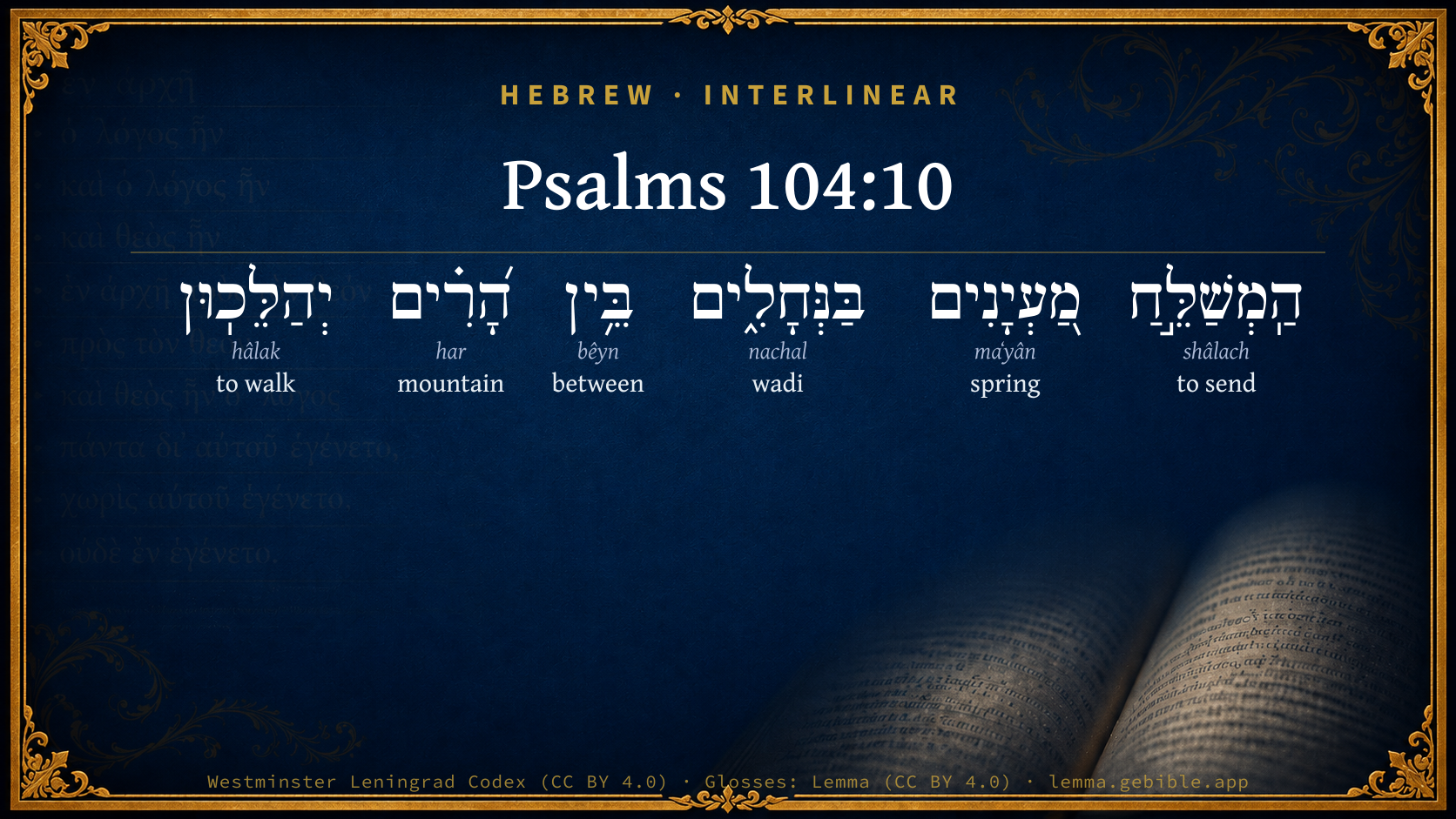
Psalms 104:10

Hebrew (Westminster Leningrad Codex) Psalms 104:10 appears in the Hebrew Old Testament. The text above is from the Westminster Leningrad Codex. Each word links to its Strong’s number, a concise gloss, and parsing drawn from the Open Scriptures Hebrew Bible morphology. Click any word for its full Brown-Driver-Briggs (BDB) entry.
Download image
Cite this verse

Psalms 104:10 (World English Bible). Public Domain. Lemma interlinear Bible study tool, https://lemma.gebible.app/v/psalms/104/10.

Show BibTeX & RIS
BibTeX
RIS
English Translation
He sends forth springs into the valleys. They run among the mountains.
World English Bible · Public Domain
Download a study sheet

One document with this verse’s original text, its word-by-word gloss line, the meaning frame, cross-references with their text, attributed commentary, and full source and license credits — printable, and it pastes into notes with its structure intact.

This verse Autodidact and up

Study sheet (.html) Plain text (.txt)

A passage Seminary Student

Up to 50 verses in one chapter. A passage sheet keeps up to 6 commentary sources and 12 cross-references per verse, in the order this page ranks them, and says so on the sheet whenever that leaves anything out. Ask for a single verse and you get the Autodidact verse sheet above.

Everything on this page stays free to read, with no account — the sheet is a download of what is already on screen, not access to it.

Want to remove ads? Support Godless Engineer
Compare translations 3

The same verse in 3 English versions, stacked beneath the original-language interlinear above. Click any original word for its lexicon entry.

Each is an independent rendering of the whole verse — the interlinear is not word-aligned to these translations.

Highlighted words mark where these versions differ — a whole-verse word diff, not a word-by-word alignment.

  • World English Bible Public Domain
    He sends forth springs into the valleys. They run among the mountains.
  • King James Version Public Domain
    He sendeth the springs into the valleys, which run among the hills.
  • unfoldingWord Literal Text CC BY-SA 4.0
    The one sending springs into the wadis— between the mountains they flow.

unfoldingWord Literal Text — © unfoldingWord, licensed CC BY-SA 4.0. Word-aligned USFM3 via Door43 (git.door43.org/unfoldingWord/en_ult).

Versions to compare (up to 4)

3 of 4 selected

Show all 18 translations

Every available English version of this verse, each an independent rendering of the whole verse.

  • World English Bible Public Domain
    He sends forth springs into the valleys. They run among the mountains.
  • Berean Standard Bible Public Domain
    He sends forth springs in the valleys; they flow between the mountains.
  • Majority Standard Bible Public Domain
    He sends forth springs in the valleys; they flow between the mountains.
  • King James Version Public Domain
    He sendeth the springs into the valleys, which run among the hills.
  • American Standard Version (1901) Public Domain
    He sendeth forth springs into the valleys; They run among the mountains;
  • Revised Version (1885) Public Domain
    He sendeth forth springs into the valleys; they run among the mountains:
  • Geneva Bible (1599) Public Domain
    He sendeth the springs into the valleis, which runne betweene the mountaines.
  • Douay-Rheims (1899) Public Domain
    Thou sendest forth springs in the vales: between the midst of the hills the waters shall pass.
  • Young's Literal Translation Public Domain
    Who is sending forth fountains in valleys, Between hills they go on.
  • Literal Standard Version CC BY-SA 4.0
    He is sending forth fountains in valleys, || They go on between hills.
  • Unlocked Literal Bible CC BY-SA 4.0
    He made springs flow into the valleys; the streams flow between the mountains.
  • unfoldingWord Literal Text CC BY-SA 4.0
    The one sending springs into the wadis— between the mountains they flow.
  • Darby Bible Public Domain
    He sendeth the springs into the valleys: they run among the mountains;
  • World Messianic Bible Public Domain
    He sends springs into the valleys. They run among the mountains.
  • Webster's Bible Public Domain
    He sendeth the springs into the valleys, which run among the hills.
  • Free Bible Version CC BY-SA 4.0
    You make springs flow into the streams, running down between the hills.
  • Bible in Basic English Public Domain
    You sent the springs into the valleys; they are flowing between the hills.
  • JPS Tanakh (1917) Public Domain
    Who sendest forth springs into the valleys; they run between the mountains;

Literal Standard Version (2020), Covenant Press — licensed CC BY-SA 4.0. Text via the HelloAO Bible API (eBible.org). Unlocked Literal Bible (unfoldingWord) — licensed CC BY-SA 4.0. Text via the HelloAO Bible API (eBible.org). unfoldingWord Literal Text — © unfoldingWord, licensed CC BY-SA 4.0. Word-aligned USFM3 via Door43 (git.door43.org/unfoldingWord/en_ult). Free Bible Version, Dr. Jonathan Gallagher — licensed CC BY-SA 4.0. Text via the HelloAO Bible API (eBible.org).

Word by word

More ways to search: Search by grammar → Find every occurrence → Compare this word →

Practice this passage: Drill this verse → Learn its vocabulary →

About this verse

These counts appear in no published source. They are computed here, from the morphology-tagged text and Lemma’s own curated glosses. What Lemma adds →

6
words
6
distinct lemmas
Wisdom
section

Notable vocabulary

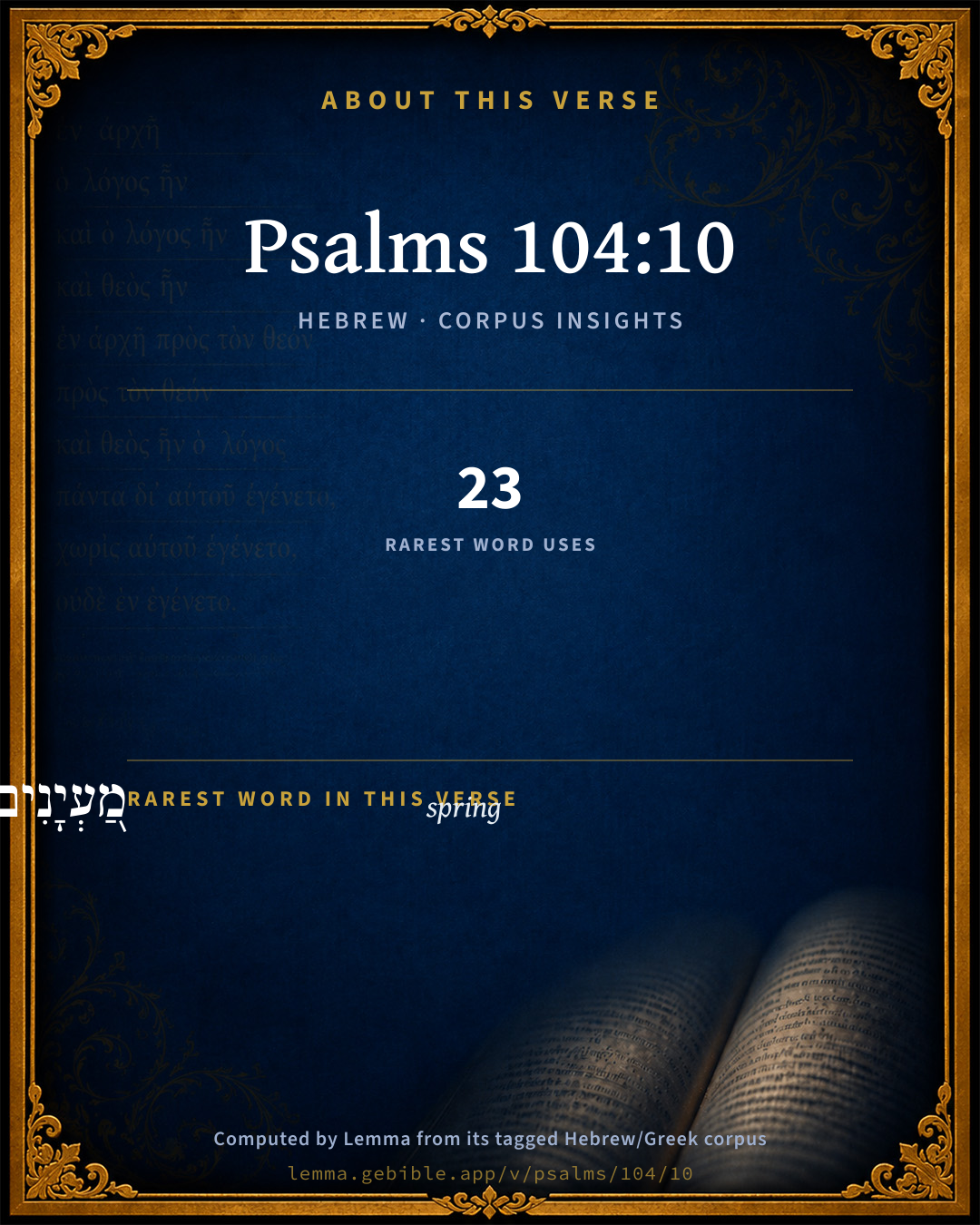
The rarest word here is מַ֭עְיָנִים spring H4599 — appearing just 23 times in the whole Hebrew Bible.

Shared distinctive vocabulary

מַ֭עְיָנִים spring H4599 occurs in 23 verses of the Hebrew Bible. Also found in:

Grammatical profile

  • 2 verbs
  • 3 nouns
  • 1 preposition

Verb forms

  • הַֽמְשַׁלֵּ֣חַ Piel · Participle Active
  • יְהַלֵּכֽוּן Piel · Imperfect

Hebrew & Septuagint length

In English translation the verse runs 12 words from the Hebrew and 15 from the Septuagint (LXX English) — closely comparable.

A rough comparison of the two English renderings, which tokenize alike — not a word-level alignment.

Word counts can differ between the Hebrew and the Greek without any difference in meaning — e.g. the Hebrew direct-object marker אֵת has no separate Greek word, and Greek often adds the article ὁ.

Cross-references

4

Topical passages linked to Psalms 104:10 in the Treasury of Scripture Knowledge — connected by theme and wording, ordered by reader-vote popularity; previews shown in the World English Bible.

  • Isaiah 41:18 I will open rivers on the bare heights, and springs in the midst of the valleys; I will make the wilderness a pool of water, and the dry land springs of water.
  • Psalms 107:35 He turns a desert into a pool of water, And a dry land into water springs.
  • Isaiah 35:7 The glowing sand shall become a pool, and the thirsty ground springs of water: in the habitation of jackals, where they lay, shall be grass with reeds and rushes.
  • Deuteronomy 8:7 For Yahweh your God brings you into a good land, a land of brooks of water, of springs and springs, flowing forth in valleys and hills;

Cross-references courtesy of OpenBible.info (CC BY 4.0).

Hebrew and Greek witnesses Masoretic Hebrew ↔ Greek Septuagint

The same verse in the two great witnesses to the Old Testament, shown verse-for-verse.

You’re reading Greek Psalm 103 (Hebrew Psalm 104). The Septuagint counts the superscription, so verse numbers can differ from the Hebrew — chapter-level alignment, not verse-by-verse. Numbering follows Rahlfs.

These are two independent witnesses, not word-aligned to each other, and the Septuagint is shown in lemma (dictionary) form.

Hebrew Psalms 104:10 Masoretic · Westminster Leningrad Codex

הַֽמְשַׁלֵּ֣חַ מַ֭עְיָנִים בַּנְּחָלִ֑ים בֵּ֥ין הָ֝רִ֗ים יְהַלֵּכֽוּן

He sends forth springs into the valleys. They run among the mountains.

World English Bible · Public Domain

Greek LXX Greek Psalm 103:10 Septuagint · lemma form

ὁ ἐκ ἀποστέλλω πηγή ἐν φάραγξ ἀνά μέσος ὁ ὄρος διαἔρχομαι ὕδωρ

He sends forth his fountains among the valleys: the waters shall run between the mountains.

LXX2012 (modern English Septuagint) · Public Domain

On this verse, Keil & Delitzsch discusses the Septuagint’s reading. Read the note in Commentary ↓

Hebrew: Westminster Leningrad Codex (CC BY 4.0). Greek: Septuagint (public domain); English from LXX2012 (modern English Septuagint) (Public Domain). How the Septuagint differs from the Hebrew →

Commentary

Notes on Psalms 104:10 from classic Christian and Jewish commentators (each source and its license shown beneath its notes). The classic Christian expositions comment on the surrounding passage and are grouped to its opening verse, so a note may address several verses; the Jewish commentaries on the Tanakh (Rashi and others) are per-verse, so they appear only where the commentator wrote on this verse.

Lemma curates 59 commentaries, every one of them public domain or Creative Commons licensed, each selected and text-cleaned for this edition rather than reprinted as found. About our sources →

Matthew Henry's Commentary

Having given glory to God as the powerful protector of this earth, in saving it from being deluged, here he comes to acknowledge him as its bountiful benefactor, who provides conveniences for all the creatures.

I. He provides fresh water for their drink: He sends the springs into the valleys, Psa 104:10. There is water enough indeed in the sea, that is, enough to drown us, but not one drop to refresh us, be we ever so thirsty - it is all so salt; and therefore God has graciously provided water fit to drink. Naturalists dispute about the origin of fountains; but, whatever are their second causes, here is their first cause; it is God that sends the springs into the brooks, which walk by easy steps between the hills, and receive increase from the rain-water that descends from them. These give drink, not only to man, and those creatures that are immediately useful to him, but to every beast of the field (Psa 104:11); for where God has given life he provides a livelihood and takes care of all the creatures. Even the wild asses, though untameable and therefore of no use to man, are welcome to quench their thirst; and we have no reason to grudge it them, for we are better provided for, though born like the wild ass's colt. We have reason to thank God for the plenty of fair water with which he has provided the habitable part of his earth, which otherwise would not be habitable. That ought to be reckoned a great mercy the want of which would be a great affliction; and the more common it is the greater mercy it is. Usus communis aquarum - water is common for all.

II. He provides food convenient for them, both for man and beast: The heavens drop fatness; they hear the earth, but God hears them, Hos 2:21. He waters the hills from his chambers (Psa 104:13), from those chambers spoken of (Psa 104:3), the beams of which he lays in the waters, those store-chambers, the clouds that distil fruitful showers. The hills that are not watered by the rivers, as Egypt was by the Nile, are watered by the rain from heaven, which is called the river of God (Psa 65:9), as Canaan was, Deu 11:11, Deu 11:12. Thus the earth is satisfied with the fruit of his works, either with the rain it drinks in (the earth knows when it has enough; it is a pity that any man should not) or with the products it brings forth. It is a satisfaction to the earth to bear the fruit of God's works for the benefit of man, for thus it answers the end of its creation. The food which God brings forth out of the earth (Psa 104:14) is the fruit of his works, which the earth is satisfied with. Observe how various and how valuable its products are.

1. For the cattle there is grass, and the beasts of prey, that live not on grass, feed on those that do; for man there is herb, a better sort of grass (and a dinner of herbs and roots is not to be despised); nay, he is furnished with wine, and oil, and bread, Psa 104:15. We may observe here, concerning our food, that which will help to make us both humble and thankful. (1.) To make us humble let us consider that we have a necessary dependence upon God for all the supports of this life (we live upon alms; we are at his finding, for our own hands are not sufficient for us), - that our food comes all out of the earth, to remind us whence we ourselves were taken and whither we must return, - and that therefore we must not think to live by bread alone, for that will feed the body only, but must look into the word of God for the meat that endures to eternal life. Let us also consider that we are in this respect fellow-commoners with the beasts; the same earth, the same spot of ground, that brings grass for the cattle, brings corn for man. (2.) To make us thankful let us consider, [1.] That God not only provides for us, but for our servants. The cattle that are of use to man are particularly taken care of; grass is made to grow in great abundance for them, when the young lions, that are not for the service of man, often lack and suffer hunger. [2.] That our food is nigh us, and ready to us. Having our habitation on the earth, there we have our storehouse, and depend not on the merchant-ships that bring food from afar, Pro 31:14. [3.] That we have even from the products of the earth, not only for necessity, but for ornament and delight, so good a Master do we serve. First, Does nature call for something to support it, and repair its daily decays? Here is bread, which strengthens man's heart, and is therefore called the staff of life; let none who have that complain of want. Secondly, Does nature go further, and covet something pleasant? Here is wine, that makes glad the heart, refreshes the spirits, and exhilarates them, when it is soberly and moderately used, that we may not only go through our business, but go through it cheerfully. It is a pity that that should be abused to overcharge the heart, and unfit men for their duty, which was given to revive their heart and quicken them in their duty. Thirdly, Is nature yet more humoursome, and does it crave something for ornament too? Here is that also out of the earth - oil to make the face to shine, that the countenance may not only be cheerful but beautiful, and we may be the more acceptable to one another.

2. Nay, the divine providence not only furnishes animals with their proper food, but vegetables also with theirs (Psa 104:16): The trees of the Lord are full of sap, not only men's trees, which they take care of and have an eye to, in their orchards, and parks, and other enclosures, but God's trees, which grow in the wildernesses, and are taken care of only by his providence; they are full of sap and want no nourishment. Even the cedars of Lebanon, an open forest, though they are high and bulky, and require a great deal of sap to feed them, have enough from the earth; they are trees which he has planted, and which therefore he will protect and provide for. We may apply this to the trees of righteousness, which are the planting of the Lord, planted in his vineyard; these are full of sap, for what God plants he will water, and those that are planted in the house of the Lord shall flourish in the courts of our God, Psa 92:13.

III. He takes care that they shall have suitable habitations to dwell in. To men God has given discretion to build for themselves and for the cattle that are serviceable to them; but there are some creatures which God more immediately provides a settlement for. 1. The birds. Some birds, by instinct, make their nests in the bushes near rivers (Psa 104:12): By the springs that run among the hills some of the fowls of heaven have their habitation, which sing among the branches. They sing, according to their capacity, to the honour of their Creator and benefactor, and their singing may shame our silence. Our heavenly Father feeds them (Mat 6:26), and therefore they are easy and cheerful, and take no thought for the morrow. The birds being made to fly above the earth (as we find, Gen 1:20), they make their nests on high, in the tops of trees (Psa 104:17); it should seem as if nature had an eye to this in planting the cedars of Lebanon, that they might be receptacles for the birds. Those that fly heavenward shall not want resting-places. The stork is particularly mentioned; the fir-trees, which are very high, are her house, her castle. 2. The smaller sort of beasts (Psa 104:18): The wild goats, having neither strength nor swiftness to secure themselves, are guided by instinct to the high hills, which are a refuge to them; and the rabbits, which are also helpless animals, find shelter in the rocks, where they can set the beasts of prey at defiance. Does God provide thus for the inferior creatures; and will he not himself be a refuge and dwelling-place to his own people?

Matthew Henry's Commentary on the Whole Bible (1708–1710) — public domain (CC PDM 1.0). Text via the HelloAO Bible API.

Trapp's Complete Commentary

John Trapp

Psa 104:10 He sendeth the springs into the valleys, [which] run among the hills.

Ver. 10. He sendeth the springs into the valleys] God doth this; he by certain issues or vents sendeth forth the waves of the sea (which here and there break out in springs, leaving their saltness behind them), that men and other earthly creatures might have that υδωρ μεν αριστον (as Pindarus styleth it), for the satisfying of their thirst and for other necessary uses. This is David’s philosophy, and his son Solomon saith the same, Ecc 1:7; though Aristotle assign another cause of the perennity of the fountains and rivers.

John Trapp, A Commentary or Exposition upon All the Books of the Old and New Testament (1647–1656) — public domain. Text from a community e-Sword module.

The Biblical Illustrator

Joseph S. Exell

Psa_104:10-18

He seneth the springs into the valleys.

The furnishing of the earth

1. Because the use of fresh waters was necessary for man, and necessary it was that man should have it nigh at hand unto him, for the more commodious use, the Lord broke up wells of water in several places, and made brooks and waters, and rivers and floods, like veins in a mans body, to carry from them water along to all habitable places of the earth, where God had appointed men to dwell (verse 10).

2. Not only where men do dwell, but also where mens ordinary resort is not, the Lord hath set drinking vessels full of water, for the use of travelling men and other creatures, appointed to attend man, and some way to serve his use.

3. For the furnishing of mans house on earth, God hath provided him with parks for beasts to feed in, and trees for fowls and birds to live in, and ponds for fishes, as we will hear afterward; and these beasts and fowls, and singing birds, have their drinking vessels set for them (verse 11).

4. The Lord hath adorned the habitation of man, with trees growing beside the waters; not only for his own proper use, but also for the use of fowls and singing birds (verse 12).

5. Where wells and rivers are not, as in hills and high places, it is seen for the most part; there the Lord supplieth the lack of waters, by rain from the clouds. He watereth the hills from His chambers, that is, from the clouds, wherein as in chambers He hath stored up great waters.

6. The Lord doth not dissolve the clouds all at once, but by little and little maketh them distil smaller or greater drops only.

7. There is no part of the earth, whereupon God bestoweth not so much of the fruit of His operation, as may fill it full of His glory (verse 13).

8. The grass and herbs, and the divers sorts of them, serving for the use of beasts and men, are worthy of a room in our meditation of Gods provident care for man and beast (verse 14).

9. The Lords allowance upon man is very large, not only for necessity, but also for delectation (verse 15).

10. The right use of Gods creatures is not to surfeit, and bury the memory of God and of the excellency of man above beasts, in gluttony and drunkenness, but to give him strength and gladness in such a measure as may encourage him cheerfully to serve his Maker.

11. God will have His excellency taken notice of in everything which is great, notable, excellent: upon which ground, great trees are called here, The trees of the Lord.

12. The Lord hath furnished trees, not only with so much sap as might make them grow; but also with so much sap as might serve man for meat and drink and medicine, and other uses.

13. Among the trees the Lord will have us take notice of the cedars, as of a special plant of His husbandry on the earth, for their height and greatness, and durableness of the timber, and namely of those of Lebanon, designed for the use of His people.

14. It is worthy of our marking, that for the nests of birds He hath provided high trees, where they might breed and lodge, and bring forth their young more safely and securely (verse 17).

15. It is worthy of our observation for glorifying of God, that God hath taught weak creatures naturally to draw themselves to strong defences; and sundry sorts of them to have their several sorts of refuge (verse 18). (D. Dickson.)

Mountain springs

My little girl gazing one day upon the brown freckled ripples of a streamlet, suddenly said to me, Why does the water always run? This is a question that is apt to puzzle many older minds. It seems a great mystery why hour after hour the stream should continue to flow without any diminution. You sit beside it a whole forenoon and watch a stone in its bed, and you see that the water keeps the same level along its sides. Day after day its voice is as full-toned and its sparkle as bright as ever; and you wonder from what perennial fountain comes the inexhaustible supply. Let us ascend to the source of the stream, and we shall obtain an explanation of the mystery. We see in the cushions of moss around its source the explanation of the ceaseless flow of the streamlet down in the valley. Nearly all our mountain tops have large spaces covered with dense carpets of moss. On these the snow appears early and lingers late; and during the rest of the year the clouds and mists are constantly distilling their moisture into them. They are therefore thoroughly charged with water, and give rise, wherever the ground forms a sloping hollow, to tiny rills, which drain the mossy sides of the hill, and nourish large quantities of moss along their course; and these in their turn imbibe more moisture from the clouds and mists, and conserve the gathering waters, until at last they acquire some volume, and in well-defined channels flow down to the valley in a series of snowy cascades and sparkling pools. Moss serves on our mountains which are below the snow-line the same purpose which the glacier serves on the mountains of other lands that are above the snow-line. They each afford one of the most striking examples of those marvellous adjustments which pervade the whole economy of nature. Without the intervention of the glacier and the moss the moisture that falls on the mountain summits would speedily run off in raging torrents, inundating the plains, scattering over the cultivated fields the barren debris of the mountains, and leaving behind after their subsidence a dry white wilderness of stones and mud. But the moss and the glacier retain the moisture of the clouds, and part with it gradually and safely, allowing it to descend to the plains so gently and continuously that, instead of destroying, it imparts beauty and fertility to the fields. Associated with the glacier and the moss in the formation of the springs that run among the hills, is the tree. The Chinese have a proverb that the grandest rivers are cradled in the leaves of the pine. Artificial springs may be created among the foldings of the hills by simply digging a hole in the ground, and sheltering it from the suns rays by planting around it trees and bushes, when the rain that falls will drain towards this hole, and in a short time make it a source of living water. The rod of Moses, smiting the rock and producing the miraculous water from it, is thus in a line with the natural way in which the growth of the tree on the arid rock gives birth to a fountain. Periodical rains, however abundant they may be, speedily pass away and descend into the valleys with unrestrained violence, doing infinite harm. But the alpine woods retain the fallen moisture long after the storm has abated, and the surface of the hill is dried up under the scorching sun. The continued existence of moisture in these woods, and the constant evaporation from them, produce a cooler atmosphere, which in its turn attracts and condenses the vapour of the clouds and thus replenishes the springs. Nor must we omit from this wonderful partnership in the circulation of the vital fluid of the earth, the agency of rocks. Layers of sand alternating with rocky strata imbibe and retain an immense quantity of water, which supplies the source of springs. Ordinary building stones contain a large percentage of moisture. Granite and marble are highly absorbent. Limestone contains two pints of water in every cubic foot, and as it is more pierced and more easily dissolved by the carbonic acid which the rain-water holds in solution, it forms the best of all mediums for the formation of springs and wells. Hence the abundance of fountains in the Holy Land, whose geological structure is almost entirely limestone. Even the driest rock has its pores filled with moisture like a sponge. Mountain rocks are thus vast storehouses of water, which husband and equalize the supply, and replenish the springs with unfailing regularity, independently of the varying rainfall. Very mysterious seems the origin of a spring as it sparkles up from the bosom of the mountain, from the heart of the rock into the sunshine. We do not wonder that in ancient times it should be regarded as the local haunt of some Divine presence, the sites of the Grecian oracles were always beside springs, whose water gushing up from the dark depths of the earth expressively symbolized the Divine voice speaking from the unseen world. And in harmony with the same idea, the Hebrew name of a prophet was derived from the bubbling forth of the waters of a spring, implying that his utterances were the irresistible overflowings of the Divine fountain of inspiration in his soul. Beside the well of Sychar, incarnate in human form, in visible manifestation to the eyes of men, was the great Reality to whom all these myths and symbols pointed, who thirsted Himself that He might give us to drink. And if our eyes be purged with spiritual eye-salve, we too shall see beside every spring the True Oracle, the Great Prophet, the Divinity of the waters who sendeth the springs into the valleys which run among the hills. (H. Macmillan, D.D.)

The Biblical Illustrator, edited by Joseph S. Exell (c. 1880s–1900s) — public domain. Text from a community e-Sword module.

Joseph Benson's Commentary

Psa 104:10-11. He sendeth the springs — “The waters of the sea are not only prevented from destroying the earth, but, by a wonderful machinery, are rendered the means of preserving every living thing which moveth thereon. Partly ascending from the great deep, through the strata of the earth, partly exhaled in vapour, from the surface of the ocean, into the air, and from thence falling in rain, especially on the tops and by the sides of the mountains, they break forth in fresh springs, having left their salts behind them; they trickle through the valleys, between the hills, receiving new supplies as they go; they become large rivers, and, after watering, by their innumerable turnings and windings, immense tracts of country, they return to the place from whence they came.” — Horne. Thus they give drink to every beast of the field — Not only to man, and those creatures that are immediately useful to him, but to every animal which needs that refreshment, for God’s mercies are over all his works; where he has given life he provides for its support, and takes care of all creatures. The wild asses quench their thirst — Which he mentions, because they live in dry and desolate wildernesses, and are neither ruled nor regarded by men, yet are plentifully provided for by the bounty of Divine Providence, by which, dull and stupid as they are, they are taught the way to the waters, in those sandy and parched deserts, so perfectly, that “there is no better guide for the thirsty traveller to follow than to observe the herds of them descending to the streams.” The reader of taste will easily observe, that “the description here is very picturesque, of fine springs in the midst of valleys frequented by a variety of beasts and birds, allured thither by the place, and giving a kind of society to it.” — Dodd.

Joseph Benson's Commentary on the Old and New Testaments (1811–1818) — public domain. Text from a community e-Sword module.

Keil & Delitzsch

C. F. Keil & F. Delitzsch

The third decastich, passing on to the third day of creation, sings the benefit which the shore-surrounded waters are to the animal creation and the growth of the plants out of the earth, which is irrigated from below and moistened from above. God, the blessed One, being the principal subject of the Psalm, the poet (in Psa 104:10 and further on) is able to go on in attributive and predicative participles: Who sendeth springs בּנּחלים, into the wads (not: בּנחלים, as brooks). נחל, as Psa 104:10 shows, is here a synonym of בּקעה, and there is no need for saying that, flowing on in the plains, they grow into rivers. The lxx has ἐν φάραγξιν. חיתו שׂדי is doubly poetic for חיּת השּׂדה. God has also provided for all the beasts that roam far from men; and the wild ass, swift as an arrow, difficult to be hunted, and living in troops (פּרא, Arabic ferâ, root פר, Arab. fr, to move quickly, to whiz, to flee; the wild ass, the onager, Arabic himr el-wahs, whose home is on the steppes), is made prominent by way of example. The phrase "to break the thirst" occurs only here. עליהם, Psa 104:12, refers to the מעינים, which are also still the subject in Psa 104:11. The pointing עפאים needlessly creates a hybrid form in addition to עפאים (like לבאים) and עפיים. From the tangled branches by the springs the poet insensibly reaches the second half of the third day. The vegetable kingdom at the same time reminds him of the rain which, descending out of the upper chambers of the heavens, waters the waterless mountain-tops. Like the Talmud (B. Ta‛anı̂th, 10a), by the "fruit of Thy work" (מעשׂיך as singular) Hitzig understands the rain; but rain is rather that which fertilizes; and why might not the fruit be meant which God's works (מעשׂיך, plural) here below (Psa 104:24), viz., the vegetable creations, bear, and from which the earth, i.e., its population, is satisfied, inasmuch as vegetable food springs up as much for the beasts as for man? In connection with עשׂב the poet is thinking of cultivated plants, more especially wheat; לעבדת, however, does not signify: for cultivation by man, since, according to Hitzig's correct remonstrance, they do not say עבד העשׂב, and להוציא has not man, but rather God, as its subject, but as in Ch1 26:30, for the service (use) of man.

Keil & Delitzsch — Biblical Commentary on the Old Testament (1861–1891) — public domain (CC PDM 1.0). Text via the HelloAO Bible API. (Old Testament only.)

J. A. Alexander on Psalms

Joseph Addison Alexander

10. (Psa 104:10) Sending springs into the valleys; between hills they go. The participial construction, interrupted by the parenthetical account of the flood, is here resumed, the participle, like the others, agreeing directly with Jehovah understood, as the (one) sending, which is the precise form of the original. See above, on Psa 103:3-6. Springs or fountains, not in the restricted sense, but comprehending both the source and stream, as in Joe 3:18. The word translated valleys is restricted in usage to such as have streams flowing through them. The last word is the one translated walketh by the English Bible in ver. 3 (Psa 104:3) above, but here run, although walk is given in the margin, as a more precise and literal translation, while Jerome inserts it in his text, ut inter medios montes ambulent.

Joseph Addison Alexander, The Psalms Translated and Explained (1850) — public domain. Text from a community e-Sword module.

Adam Clarke's Commentary

Verse 10. He sendeth the springs into the valleys] Evaporation is guided and regulated by Divine Providence. The sun has a certain power to raise a certain portion of vapours from a given space. God has apportioned the aqueous to the terrene surface, and the solar attraction to both. There is just as much aqueous surface as affords a sufficiency of vapours to be raised by the solar attraction to water the earthy surface. Experiments have been instituted which prove that it requires a given space of aqueous surface to provide vapours for a given space of terrene surface; and the proportion appears ordinarily to be seventeen of water to three of earth; and this is the proportion that the aqueous bears to the terrene surface of the globe. See Ray's three Physico-theological Discourses.

Adam Clarke's Commentary on the Bible (1810–1826) — public domain. Text from a community e-Sword/MySword module.

John Calvin's Commentaries

10. Sending out springs by the valleys The Psalmist here describes another instance both of the power and goodness of God, which is, that he makes fountains to gush out in the mountains, and to run down through the midst of the valleys. Although it is necessary for the earth to be dry, to render it a fit habitation for us, yet, unless we had water to drink, and unless the earth opened her veins, all kinds of living creatures would perish. The prophet, therefore, speaks in commendation of that arrangement by which the earth, though dry, yet supplies us with water by its moisture. The word נחלים, nechalim, which I have rendered springs, is by some translated, torrents or rivers; but springs is more appropriate. In the same sense it is added immediately after, that they run among the hills; and yet, it is scarcely credible that fountains could spring forth from rocks and stony places. But here it may be asked, why the prophet says that the beasts of the field quench their thirst, rather than men, for whose sake the world was created? I would observe, in reply, that he obviously spake in this manner, for the purpose of enhancing the goodness of God, who vouchsafes to extend his care to the brute creation, yea, even to the wild asses, under which species are included all other kinds of wild beasts. And he purposely refers to desert places, that each of us may compare with them the more pleasant, and the cultivated parts of the earth, afterwards mentioned. Rivers run even through great and desolate wildernesses, where the wild beasts enjoy some blessing of God; and no country is so barren as not to have trees growing here and there, on which birds make the air to resound with the melody of their singing. Since even those regions where all lies waste and uncultivated, furnish manifest tokens of the Divine goodness and power, with what admiration ought we to regard that most abundant supply of all good things, which is to be seen in cultivated and favorable regions? Surely in countries where not only one river flows, or where not only grass grows for the feeding of wild beasts, or where the singing of birds is heard not only from a few trees, but where a manifold and varied abundance of good things everywhere presents itself to our view, our stupidity is more than brutish, if our minds, by such manifestations of the goodness of God, are not fixed in devout meditation on his glory.

John Calvin's Commentaries (1540-1563) — public domain. Text from the Calvin Translation Society English edition (1840s-50s) via the Christian Classics Ethereal Library (ccel.org). Calvin's coverage is partial (roughly two-thirds of the Bible); uncommented books and verses are honest gaps, never fabricated. The 19th-century editor's footnotes and remarks are omitted so the notes are faithfully Calvin's own voice.

Ellicott's Commentary for English Readers

(10) Springs.—The account in Genesis goes on abruptly from the appearance of the dry land to speak of the vegetation which covers it, apparently without any physical means for its production. But a poet, especially an Oriental poet, thinks first of the springs and rivers on which fertility and life depend. And such is his sympathy with nature that in disregard of the original record he hastens at once to people his world with creatures to share the Creator’s joy in its beauty and goodness.

Valleys—i.e., the torrent beds, the “wadys” as the Arabs now call them.

Which run.—Better, they flow between the hills. The LXX. supply the subject “waters.”

A Bible Commentary for English Readers, edited by Charles John Ellicott (1878–1897) — public domain. Text from a community e-Sword module.

The Cambridge Bible for Schools and Colleges

gen. ed. J. J. S. Perowne

10. Who sendeth forth springs into the valleys;

They run among the mountains.

Cp. the description of Palestine in Deu_8:7.

10–18. While He confines the great mass of waters to its appointed place, He fertilises the land by springs and rain, and makes bountiful provision for the wants of men and animals.

The Cambridge Bible for Schools and Colleges (gen. ed. J. J. S. Perowne; Cambridge University Press, 1878–1918) — public domain. Text from a community e-Sword module.

John Gill's Exposition

He sendeth the springs into the valleys,.... The Targum is,

"who sendeth fountains into the rivers.''

Either from the waters of the sea, which being drained through the sand, become sweet and drinkable; or from the hills and mountains. This is an instance of divine goodness, that having removed the waters from the earth, and shut them up in the sea, and which, through the saltness of them, not being proper drink for men and beasts, he has been pleased to form and open springs, fountains, wells, and rivers of fresh water in the valleys, for the supply of both. Though this is not to be compared with the wells of salvation, and springs and fountains of grace, which he has opened for his chosen people. God himself is a spring or fountain of living water; his love is a river, whose streams delight the city of God; his covenant a source and spring of all blessings and promises. Christ is the fountain of gardens; his fulness is a supply for all his people: the Spirit of God and his grace are a well of living water, springing up unto eternal life. The word and ordinances are the springs in Zion,

which run among the hills, the several congregated churches, to the watering and refreshing of them; just as springs and rivers of water run in the dales and valleys among the hills, by which they are bounded.

John Gill's Exposition of the Whole Bible (1746–1763) — public domain (CC PDM 1.0). Text via the HelloAO Bible API.

Albert Barnes' Notes on the Bible

He sendeth the springs into the valleys - Though the waters are gathered together into seas, yet God has taken care that the earth shall not be dry, parched, and barren. He has made provision for watering it, and by a most wise, wonderful, and benevolent arrangement, he has formed springs among the valleys and the hills. It is now animated nature which comes before the eye of the psalmist; and all this he traces to the fact that the earth is “watered,” and that it is not a waste of rocks and sands. The allusion in this part of the psalm (see the Introduction) is to the earth as covered with vegetation - or, to the third day of the week of creation Gen 1:9-13, which, in Genesis, is connected with the gathering of the waters into seas. This description continues in Psa 104:18. The literal rendering here would be, “sending springs into the valleys.” He conducts the waters from the great reservoirs - lakes and seas - in such a way that they form springs in the valleys. The way in which this is done is among the most wonderful and the most benevolent in nature - by that power, derived from heat, by which the waters of the ocean, contrary to the natural law of gravitation, are lifted up in small particles - in vapor - and carried by the clouds where they are needed, and let fall upon the earth, to water the plants, and to form fountains, rivulets, and streams - and borne thus to the highest mountains, to be filtered through the ground to form springs and streams below.

Which run among the hills - Margin, “walk.” That is, they go between the hills. The streams of water flow along in the natural valleys which have been made for them.

Albert Barnes' Notes on the Bible (1834–1885) — public domain. Text from a community e-Sword/MySword module.

Matthew Poole's English Annotations

The springs, and the rivers which come from them.

The hills; wherewith God hath shut in the rivers where he saw fit, that they might not overflow the land.

Matthew Poole's English Annotations on the Holy Bible (1683–1685) — public domain. Text from a community e-Sword/MySword module.

The Treasury of David

Charles H. Spurgeon

Ver. 10. He sendeth the springs into the valleys, which run among the hills. This is a beautiful part of the Lord's arrangement of the subject waters: they find vents through which they leap into liberty where their presence will be beneficial in the highest degree. Depressions exist in the sides of the mountains, and down these the water brooks are made to flow, often taking their rise at bubbling fountains which issue from the bowels of the earth. It is God who sends these springs even as a gardener makes the water courses, and turns the current with his foot. When the waters are confined in the abyss the Lord sets their bound, and when they sport at liberty he sends them forth.

Ver. 10. He sendeth the springs into the valleys, etc. Having spoken of the salt waters, he treats afterwards of the sweet and potable, commending the wisdom and providence of God, that from the lower places of the earth and the hidden veins of the mountains, he should cause the fountains of water to gush forth. Lorinus.

Ver. 10. He sendeth the springs into the valleys. The more of humility the more of grace; if in valleys some hollows are deeper than others the waters collect in them. Martin Luther.

Ver. 10. He sendeth the springs into the valleys. Men cut places for rivers to run in, but none but God can cut a channel to bring spiritual streams into the soul. The psalmist speaks of the sending forth of springs as one great act of the providence of God. It is a secret mystery which those that have searched deepest into nature cannot resolve us in, how those springs are fed, how they are maintained and nourished, so as to run without ceasing in such great streams as many of them make. Philosophy cannot show the reason of it. The Psalmist doth it well: God sends them into the valleys, his providence and power keeps them continually running: he that would have his soul watered must go to God in prayer. Ralph Robinson.

Ver. 10. Which run among the hills. That is, the streams or springs run. In many a part of the world can be found a Sault, a dancing water, and a Minne-ha-ha, a laughing water. The mountain streams walk, and run, and leap, and praise the Lord. William S. Plumer.

Ver. 10. "HE." "HE." "HE."

All things are here of Him;from the black pines,

Which are his shade on high, and the loud roar

Of torrents, where he listens, to the vines

Which slope his green path downward to the shore,

Where the bowed waters meet him, and adore,

Kissing his feet with murmurs. Byron.

Ver. 10. The thoughtfulness of God for those who, like the valleys, are lowly, hidden, and needy: the abiding character of his supplies: and the joyous results of his care.

Ver. 10. God's care for wild creatures, reflections from it.

1. Shall he not much more care for his people?

2. Will he not look after wild, wandering men?

3. Ought we not also to care for all that live?

Ver. 10. From the fertility, life and music which mark the course of a stream, illustrate the beneficial influences of the Gospel. C.A. Davis.

Psalms 104:11*

Charles H. Spurgeon's The Treasury of David (1869–1885) — public domain. Psalms only. Text from a community e-Sword/MySword module.

Whedon's Commentary on the Bible

Daniel D. Whedon

10. He sendeth the springs into the valleys—The poet here suspends his direct notice of the “six days’ work,” to speak of the works of providence.

After the ocean, it is fit that he should speak of springs in the mountains and hills, for these proceed from the ocean through evaporation and the containing and carrying power of the atmosphere. Of this hydraulic system of nature the Hebrews had knowledge. Ecc_1:7; Gen_2:6; Amo_9:6. נהלים, (nehaleem,) generally means rivers, but sometimes wadys, or valleys. It may here take either sense. “He sendeth,” refers the origin and uses of springs and fountains directly to the act of God, who “sendeth” the waters of the ocean to the elevated lands of the continents to create fountains, which he causeth to flow down and irrigate the valleys, or to empty into the larger streams.

Daniel D. Whedon (gen. ed.), Commentary on the Old and New Testaments (1874–1909) — public domain. Text from a community e-Sword module.

The Pulpit Commentary

He sendeth the springs into the valleys; rather, into the water courses, or torrent beds dry for the greater part of the year, but deriving life and beauty from the springs which, after rain has fallen, flow into them. Which run among the hills; literally, between the hills (i.e. the hill slopes on either side) they wend their way.

The Pulpit Commentary (1880–1919), ed. H.D.M. Spence-Jones & Joseph S. Exell — public domain. Text from a community e-Sword module.

unfoldingWord translationNotes

Door43 World Missions Community

streams

small rivers

the wild donkeys quench their thirst

It can be stated clearly that they quench their thirst by drinking the water. AT: "the wild donkeys drink the water to quench their thirst" (See: Assumed Knowledge and Implicit Information)

riverbanks

the ground at the edges of a river

they sing among the branches

Here David describes birds chirping as if they were singing. AT: "they chirp among the tree branches" (See: Metaphor)

translationWords

fountain

donkey

quench

unfoldingWord translationNotes — © Distant Shores Media and the Door43 World Missions Community, licensed CC BY-SA 4.0. Source: git.door43.org/Door43/en_tn.

Lesson kit

Teaching starters — assembled from the data on this page, not authored interpretation. Every prompt links to the verse data it draws on. Edit before teaching.

Psalms, in the Wisdom, opens this verse with 6 words (6 distinct Hebrew lemmas). Its most distinctive word is maʻyân (“spring”). A historical commentator’s framing appears above. Read the whole chapter for the surrounding context.

Discussion questions

  1. How does “spring” (maʻyân) shape what this verse is saying?
  2. Genesis 7:11 shares the word «spring» with this verse. How do the two illuminate each other?
  3. The translations on this page render this verse differently — a whole-verse word diff, not a word-by-word alignment. What might account for the different wordings?
  4. The verb «הַֽמְשַׁלֵּ֣חַ» is Piel Participle Active. How does its form color the action?
  5. Reading how Matthew Henry's Commentary and Trapp's Complete Commentary read this verse, where do the two commentators agree and where do they part?

Things to notice

Reading settings

Reading text

Shown beneath each verse's original-language words.

Old Testament
Old Testament edition

Read the OT as the Masoretic Hebrew (MT) or the Greek Septuagint (LXX).

English shown for the Greek Septuagint (in the Hebrew ↔ Greek comparison).

Comparing translations? Open the Compare panel on any verse page to stack up to four side by side.