Genesis 1:18

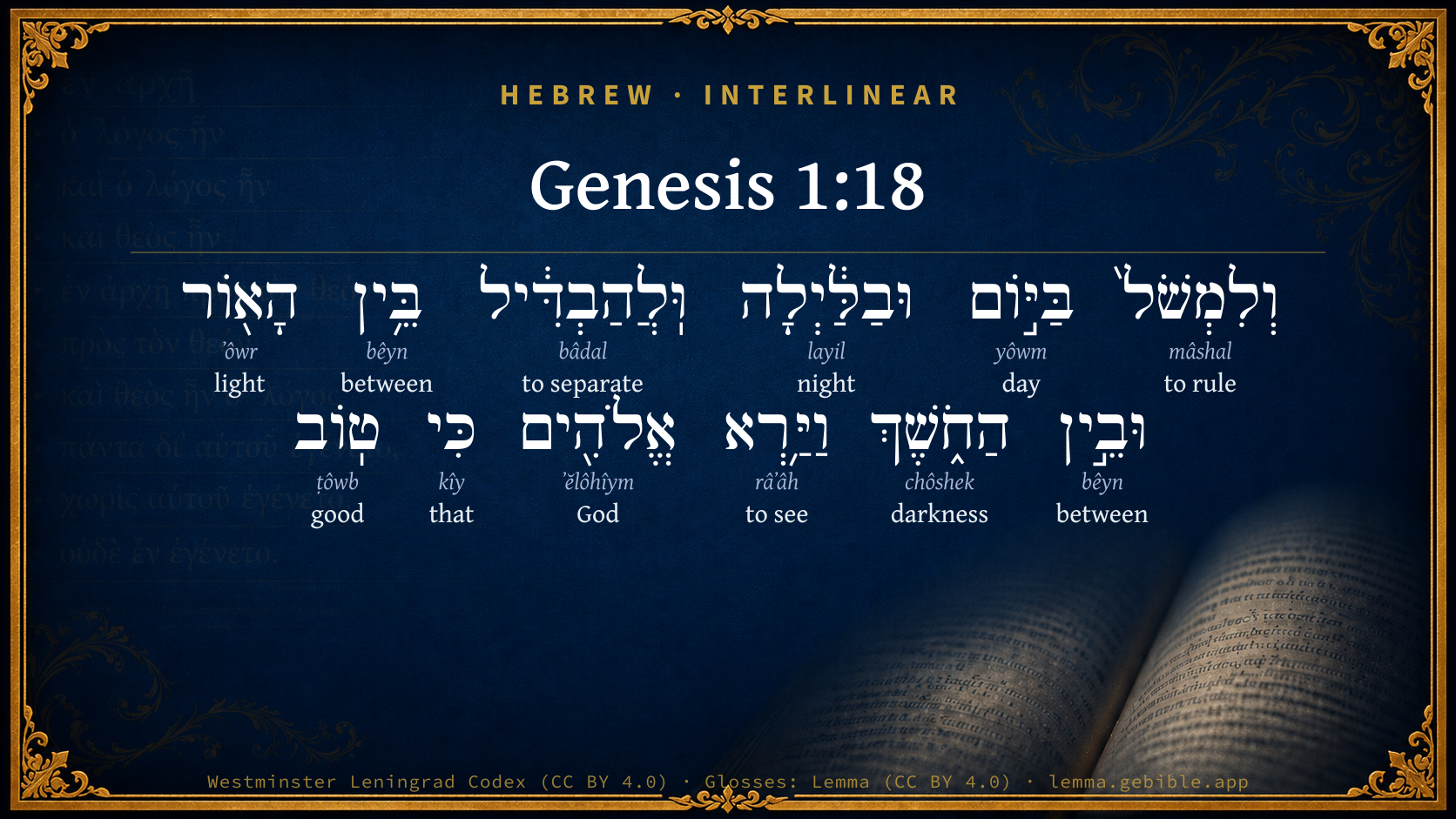
Hebrew (Westminster Leningrad Codex) Genesis 1:18 appears in the Hebrew Old Testament. The text above is from the Westminster Leningrad Codex. Each word links to its Strong’s number, a concise gloss, and parsing drawn from the Open Scriptures Hebrew Bible morphology. Click any word for its full Brown-Driver-Briggs (BDB) entry.
Download image
Cite this verse

Genesis 1:18 (World English Bible). Public Domain. Lemma interlinear Bible study tool, https://lemma.gebible.app/v/genesis/1/18.

Show BibTeX & RIS
BibTeX
RIS
English Translation
and to rule over the day and over the night, and to divide the light from the darkness. God saw that it was good.
World English Bible · Public Domain
Highlights
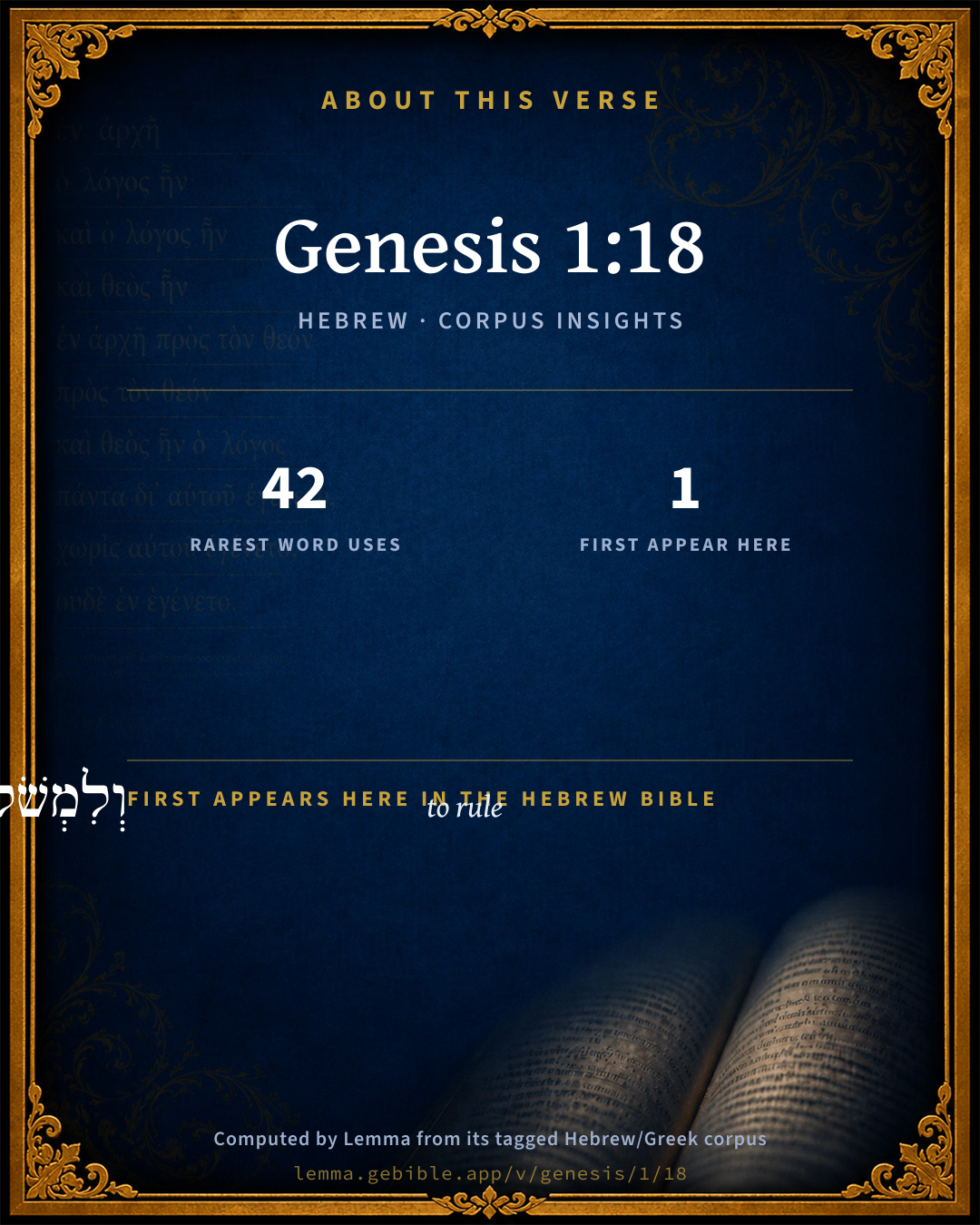
  • 1 first appearance in the Hebrew Bible
Full analysis ↓
Download a study sheet

One document with this verse’s original text, its word-by-word gloss line, the meaning frame, cross-references with their text, attributed commentary, and full source and license credits — printable, and it pastes into notes with its structure intact.

This verse Autodidact and up

Study sheet (.html) Plain text (.txt)

A passage Seminary Student

Up to 50 verses in one chapter. A passage sheet keeps up to 6 commentary sources and 12 cross-references per verse, in the order this page ranks them, and says so on the sheet whenever that leaves anything out. Ask for a single verse and you get the Autodidact verse sheet above.

Everything on this page stays free to read, with no account — the sheet is a download of what is already on screen, not access to it.

Want to remove ads? Support Godless Engineer
Compare translations 3

The same verse in 3 English versions, stacked beneath the original-language interlinear above. Click any original word for its lexicon entry.

Each is an independent rendering of the whole verse — the interlinear is not word-aligned to these translations.

Highlighted words mark where these versions differ — a whole-verse word diff, not a word-by-word alignment.

  • World English Bible Public Domain
    and to rule over the day and over the night, and to divide the light from the darkness. God saw that it was good.
  • King James Version Public Domain
    And to rule over the day and over the night, and to divide the light from the darkness: and God saw that it was good.
  • unfoldingWord Literal Text CC BY-SA 4.0
    and to rule over the day and over the night, and to separate between the light and the darkness. And God saw that good.

unfoldingWord Literal Text — © unfoldingWord, licensed CC BY-SA 4.0. Word-aligned USFM3 via Door43 (git.door43.org/unfoldingWord/en_ult).

Versions to compare (up to 4)

3 of 4 selected

Show all 18 translations

Every available English version of this verse, each an independent rendering of the whole verse.

  • World English Bible Public Domain
    and to rule over the day and over the night, and to divide the light from the darkness. God saw that it was good.
  • Berean Standard Bible Public Domain
    to preside over the day and the night, and to separate the light from the darkness. And God saw that it was good.
  • Majority Standard Bible Public Domain
    to preside over the day and the night, and to separate the light from the darkness. And God saw that it was good.
  • King James Version Public Domain
    And to rule over the day and over the night, and to divide the light from the darkness: and God saw that it was good.
  • American Standard Version (1901) Public Domain
    and to rule over the day and over the night, and to divide the light from the darkness: and God saw that it was good.
  • Revised Version (1885) Public Domain
    and to rule over the day and over the night, and to divide the light from the darkness: and God saw that it was good.
  • Geneva Bible (1599) Public Domain
    And to rule in the day, and in the night, and to separate the light from the darkenesse: and God saw that it was good.
  • Douay-Rheims (1899) Public Domain
    And to rule the day and the night, and to divide the light and the darkness. And God saw that it was good.
  • Young's Literal Translation Public Domain
    and to rule over day and over night, and to make a separation between the light and the darkness; and God seeth that `it is' good;
  • Literal Standard Version CC BY-SA 4.0
    and to rule over day and over night, and to make a separation between the light and the darkness; and God sees that [it is] good;
  • Unlocked Literal Bible CC BY-SA 4.0
    to rule over the day and over the night, and to divide the light from the darkness. God saw that it was good.
  • unfoldingWord Literal Text CC BY-SA 4.0
    and to rule over the day and over the night, and to separate between the light and the darkness. And God saw that good.
  • Darby Bible Public Domain
    and to rule during the day and during the night, and to divide between the light and the darkness. And God saw that it was good.
  • World Messianic Bible Public Domain
    and to rule over the day and over the night, and to divide the light from the darkness. God saw that it was good.
  • Webster's Bible Public Domain
    And to rule over the day, and over the night, and to divide the light from the darkness: and God saw that it was good.
  • Free Bible Version CC BY-SA 4.0
    to be in charge of the day and in charge of the night, and to separate light from darkness. God saw that it was good.
  • Bible in Basic English Public Domain
    To have rule over the day and the night, and for a division between the light and the dark: and God saw that it was good.
  • JPS Tanakh (1917) Public Domain
    and to rule over the day and over the night, and to divide the light from the darkness; and God saw that it was good.

Literal Standard Version (2020), Covenant Press — licensed CC BY-SA 4.0. Text via the HelloAO Bible API (eBible.org). Unlocked Literal Bible (unfoldingWord) — licensed CC BY-SA 4.0. Text via the HelloAO Bible API (eBible.org). unfoldingWord Literal Text — © unfoldingWord, licensed CC BY-SA 4.0. Word-aligned USFM3 via Door43 (git.door43.org/unfoldingWord/en_ult). Free Bible Version, Dr. Jonathan Gallagher — licensed CC BY-SA 4.0. Text via the HelloAO Bible API (eBible.org).

Word by word

More ways to search: Search by grammar → Find every occurrence → Compare this word →

Practice this passage: Drill this verse → Learn its vocabulary →

וּֽלֲהַבְדִּ֔יל
bâdal
H914
“and · to separate”
Conjunction + Preposition + Verb, Hiphil, Infinitive Construct
Part of Speech
Conjunction + Preposition + Verb
Stem
Hiphil
Form
Infinitive Construct
Full BDB Definition

Origin: a primitive root

TWOT: 203

to divide, separate - (Hiphil) - to divide, separate, sever - to separate, set apart - to make a distinction, difference - to divide into parts - (Niphal) - to separate oneself from (reflexive of 1a2) - to withdraw from - to separate oneself unto - to be separated - to be excluded - to be set apart
  1. וְלִמְשֹׁל֙ mâshal H4910 “and · to rule” Conjunction + Preposition + Verb, Qal, Infinitive Construct
  2. בַּיּ֣וֹם yôwm H3117 “in/at the · day” Preposition, Determined + Noun, Common, Masculine, Singular, Absolute
  3. וּבַלַּ֔יְלָה layil H3915 “and · in/at the · night” Conjunction + Preposition, Determined + Noun, Common, Masculine, Singular, Absolute
  4. בֵּ֥ין bêyn H996 “between” Preposition
  5. הָא֖וֹר ʼôwr H216 “the · light” Particle, Definite Article + Noun, Common, Both, Singular, Absolute
  6. וּבֵ֣ין bêyn H996 “and · between” Conjunction + Preposition
  7. הַחֹ֑שֶׁךְ chôshek H2822 “the · darkness” Particle, Definite Article + Noun, Common, Masculine, Singular, Absolute
  8. וַיַּ֥רְא râʼâh H7200 “and · to see” Conjunction + Verb, Qal, Sequential Imperfect, 3rd Person, Masculine, Singular
  9. אֱלֹהִ֖ים ʼĕlôhîym H430 “God(s)” Noun, Common, Masculine, Plural, Absolute
  10. כִּי kîy H3588 “that” Conjunction
  11. טֽוֹב ṭôwb H2896 “good” Adjective, Adjective, Masculine, Singular, Absolute

About this verse

These counts appear in no published source. They are computed here, from the morphology-tagged text and Lemma’s own curated glosses. What Lemma adds →

12
words
11
distinct lemmas
Pentateuch
section

First appearance in Scripture

This word makes its first canonical appearance in the Hebrew Bible here:

  • וְלִמְשֹׁל֙ to rule H4910

Shared distinctive vocabulary

וּֽלֲהַבְדִּ֔יל to separate H914 occurs in 40 verses of the Hebrew Bible. Also found in:

Grammatical profile

  • 3 verbs
  • 5 nouns
  • 1 adjective
  • 2 prepositions
  • 1 conjunction

Verb forms

  • וְלִמְשֹׁל֙ Qal · Infinitive Construct
  • וּֽלֲהַבְדִּ֔יל Hiphil · Infinitive Construct
  • וַיַּ֥רְא Qal · Sequential Imperfect

Repetition

A word recurs within this verse — often emphatic in Hebrew:

  • בֵּ֥ין between H996 ×2

Hebrew & Septuagint length

In English translation the verse runs 24 words from the Hebrew and 22 from the Septuagint (LXX English) — closely comparable.

A rough comparison of the two English renderings, which tokenize alike — not a word-level alignment.

Word counts can differ between the Hebrew and the Greek without any difference in meaning — e.g. the Hebrew direct-object marker אֵת has no separate Greek word, and Greek often adds the article ὁ.

Cross-references

2

Topical passages linked to Genesis 1:18 in the Treasury of Scripture Knowledge — connected by theme and wording, ordered by reader-vote popularity; previews shown in the World English Bible.

  • Jeremiah 31:35 Thus says Yahweh, who gives the sun for a light by day, and the ordinances of the moon and of the stars for a light by night, who stirs up the sea, so that the waves of it roar; Yahweh of hosts is his name:
  • Psalms 19:6 His going forth is from the end of the heavens, His circuit to its ends; There is nothing hidden from its heat.

Cross-references courtesy of OpenBible.info (CC BY 4.0).

Hebrew and Greek witnesses Masoretic Hebrew ↔ Greek Septuagint

The same verse in the two great witnesses to the Old Testament, shown verse-for-verse.

These are two independent witnesses, not word-aligned to each other, and the Septuagint is shown in lemma (dictionary) form.

Hebrew Genesis 1:18 Masoretic · Westminster Leningrad Codex

וְלִמְשֹׁל֙ בַּיּ֣וֹם וּבַלַּ֔יְלָה וּֽלֲהַבְדִּ֔יל בֵּ֥ין הָא֖וֹר וּבֵ֣ין הַחֹ֑שֶׁךְ וַיַּ֥רְא אֱלֹהִ֖ים כִּי טֽוֹב

and to rule over the day and over the night, and to divide the light from the darkness. God saw that it was good.

World English Bible · Public Domain

Greek LXX Genesis 1:18 Septuagint · lemma form

καί ἄρχω ὁ ἡμέρα καί ὁ νύξ καί διαχωρίζω ἀνά μέσος ὁ φῶς καί ἀνά μέσος ὁ σκότος καί ὁράω ὁ θεός ὅτι καλός

and to regulate day and night, and to divide between the light and the darkness. And God saw that it was good.

LXX2012 (modern English Septuagint) · Public Domain

Hebrew: Westminster Leningrad Codex (CC BY 4.0). Greek: Septuagint (public domain); English from LXX2012 (modern English Septuagint) (Public Domain). How the Septuagint differs from the Hebrew →

Targum (Aramaic paraphrase)

2

The Targum is the ancient Jewish Aramaic paraphrase of the Hebrew Scriptures — an interpretive translation, not the Hebrew text itself. Onkelos (literal) and Pseudo-Jonathan (expansive) render the Torah, and Jonathan the Prophets. Coverage is partial: where no permissively-licensed English translation exists for a verse, only the Aramaic is shown. This is verse-level text, not a word-by-word alignment to the Hebrew.

  1. Targum Onkelos Torah (Genesis–Deuteronomy)
    וּלְמִשְׁלַט בִּימָמָא וּבְלֵילְיָא וּלְאַפְרָשָׁא בֵּין נְהוֹרָא וּבֵין חֲשׁוֹכָא וַחֲזָא יְיָ אֲרֵי טָב

    (no public-domain English translation for this verse)

    Targum Onkelos — Aramaic: “Onkelos Genesis” (public domain); “Onkelos Exodus” (public domain); “Onkelos Leviticus” (public domain); “Onkelos Numbers” (public domain); “Onkelos Deuteronomy” (public domain). English: “Sefaria Community Translation” (CC0 1.0 (public-domain dedication)); “J.W. Etheridge. The Targums of Onkelos and Jonathan Ben Uzziel on the Pentateuch. London: Longmans, Green, 1862” (public domain). Text via Sefaria.

  2. Targum Pseudo-Jonathan Torah (Genesis–Deuteronomy)
    וּלְמִשַׁמְשָׁא בִּימָמָא וּבְלֵילְיָא וּלְמַפְרָשָׁא בֵּין נְהוֹרָא דִימָמָא וּבֵין חֲשׁוֹךְ לֵילְיָא וַחֲמָא יְיָ אֲרוּם טָב

    and to minister by day and by night, to distinguish between the light of the day and the darkness of the night. And the Lord beheld that it was good.

    Targum Pseudo-Jonathan — Aramaic: “Targum Jonathan on Genesis” (public domain); “Targum Jonathan on Exodus” (public domain); “Targum Jonathan on Leviticus” (public domain); “Targum Jonathan on Numbers” (public domain); “Targum Jonathan on Deuteronomy” (public domain). English: “The Targum of Jonathan ben Uzziel, trans. J. W. Etheridge, London, 1862” (public domain). Text via Sefaria.

Commentary

Notes on Genesis 1:18 from classic Christian and Jewish commentators (each source and its license shown beneath its notes). The classic Christian expositions comment on the surrounding passage and are grouped to its opening verse, so a note may address several verses; the Jewish commentaries on the Tanakh (Rashi and others) are per-verse, so they appear only where the commentator wrote on this verse.

Lemma curates 59 commentaries, every one of them public domain or Creative Commons licensed, each selected and text-cleaned for this edition rather than reprinted as found. About our sources →

John Gill's Exposition

And to rule over the day, and over the night,.... The one, namely the sun, or greater light, to rule over the day, and the moon and stars, the lesser lights, to rule over the night: this is repeated from Gen 1:16 to show the certainty of it, and that the proper uses of these lights might be observed, and that a just value might be put upon them, but not carried beyond due bounds:

and to divide the light from the darkness; as the day from the night, which is done by the sun, Gen 1:14 and to dissipate and scatter the darkness of the night, and give some degree of light, though in a more feeble manner, which is done by the moon and stars:

and God saw that it was good; or foresaw it would be, that there should be such lights in the heaven, which would be exceeding beneficial to the inhabitants of the earth, as they find by good experience it is, and therefore have great reason to be thankful, and to adore the wisdom and goodness of God; see Psa 136:1. See Gill on Gen 1:4.

John Gill's Exposition of the Whole Bible (1746–1763) — public domain (CC PDM 1.0). Text via the HelloAO Bible API.

Matthew Poole's English Annotations

This clause was omitted in the first day’s work, but is added here, because the light was then but glimmering and imperfect, which now was made more clear and complete.

Matthew Poole's English Annotations on the Holy Bible (1683–1685) — public domain. Text from a community e-Sword/MySword module.

Ramban (Nachmanides)

Rabbi Moshe ben Nachman (Ramban / Nachmanides)

AND TO RULE OVER THE DAY AND OVER THE NIGHT. The matter of rulership is a different matter from the function of light which He mentioned, since it includes that which He stated at first, And they shall be for signs, and seasons. Their rulership over the earth comprises the changes which they cause in it and the power of bringing about the existence and deterioration of all things in the lower world since the sun, by its rule during the day, causes the sprouting, the propagation and the growth of all the warm and dry things, while the moon by its rule increases the springs and the oceans, and all liquid and cold things. Therefore He said in a general way, And to rule over the day and over the night, because theirs is the dominion over things in the lower world.It is possible that the rulership given to them contains also a power of emanation for they are the leaders of things in the lower world, and with their power, every ruling power in nature holds sway. Thus the constellation which comes up by day rules during it, even as it is written, The sun and the moon and the stars… which the Eternal thy G-d hath allotted unto all the peoples. And this is what Scripture means when it says, He counteth the number of the stars; He giveth them all their names, likewise, He calleth them all by name. For the calling of names signifies the differentiation in their respective powers, giving to this one the power of justice and righteousness, and to that one the power of blood and the sword, and similarly all other powers, as is known in astrology. And all is done by the power of the Most High and in accordance with His Will. Therefore it says, Great is our Lord, and mighty in power, for He is greatest of all and mightiest in power over them. And similarly it says, He calleth them all by name by the greatness of His might and the strength of His power. In accord with the secret I have hinted to you, the matter of rulership is completely true.

AND TO DIVIDE THE LIGHT FROM THE DARKNESS. Rabbi Abraham ibn Ezra said: “By the coming forth of the sun at daytime and the light of the moon at night, they shall divide the light from the darkness.” (and to divide) refers to both the sun and moon, that each in coming forth separates between light and darkness. (Tur.) In my opinion, the light mentioned here refers to the day, and the darkness is the night for such are their names, as it says, And G-d called the light Day, and the darkness He called Night. from the night,” meaning, that light is to serve at daytime and darkness at night. (Tur.)Now in connection with all the works of creation, Scripture mentions the Divine command and then tells of the deed. And here too He commanded, And they shall be for lights, and then it relates, And G-d set them. He further said, And to rule over the day and over the night, meaning that one is to rule by day and the other by night, the rulership being that which He commanded when He said, And they shall be for signs, and for seasons. And now He related that the rulership of the two is not alike but instead consists of dividing the darkness from the light. The greater luminary will rule by day and light will be everywhere, even where the sun does not reach, and the smaller luminary will rule by night, and there will be darkness except that the moon will lighten its darkness. This then is the command He gave in order to divide the day from the night, as it says, And G-d divided the light from the darkness.

Ramban (Nachmanides) on the Tanakh — English translation: “Commentary on the Torah by Ramban (Nachmanides). Translated and annotated by Charles B. Chavel. New York, Shilo Pub. House, 1971-1976” (CC BY 4.0). Text via Sefaria.

Radak

Rabbi David Kimhi (Radak)

ולמשול ביום ובלילה, the one, i.e. the sun by day, and the other, i.e. the moon, to govern by night.

ולהבדיל, from the time the sun rises it is light, day, and the domain of the sun, whereas from the time the stars become visible in the sky, it is nighttime, the moon’s domain. The night is called “darkness,” even though there is some light in the sky illuminating parts of the earth in a fashion.

Radak on the Tanakh — English translations: “Sefaria Community Translation” (CC0 1.0 (public-domain dedication)); “Eliyahu Munk, HaChut Hameshulash” (CC BY 4.0); “Rabbi Mike Feuer, Jerusalem Anthology” (CC BY 4.0); and “R. David Kimhi on the first book of Psalms, Translated by R.G. Finch, London, 1919” (public domain). Text via Sefaria.

Lesson kit

Teaching starters — assembled from the data on this page, not authored interpretation. Every prompt links to the verse data it draws on. Edit before teaching.

Genesis, in the Pentateuch, opens this verse with 12 words (11 distinct Hebrew lemmas). Its most distinctive word is bâdal (“to separate”). A historical commentator’s framing appears above. Read the whole chapter for the surrounding context.

Discussion questions

  1. The word bâdal carries the sense “to separate.” How does it shape the verse?
  2. The word “to rule” first appears here in Scripture. What is being introduced at this debut?
  3. Genesis 1:4 shares the word «to separate» with this verse. How do the two illuminate each other?
  4. “between” occurs 2× in this one verse. What is the effect of the repetition?
  5. The translations on this page render this verse differently — a whole-verse word diff, not a word-by-word alignment. What might account for the different wordings?
  6. The verb «וְלִמְשֹׁל֙» is Qal Infinitive Construct. How does its form color the action?
  7. Reading how John Gill's Exposition and Matthew Poole's English Annotations read this verse, where do the two commentators agree and where do they part?

Things to notice

  • 1 word makes its first canonical appearance in Scripture here.
  • These translations choose different wording for 3 words in this verse.
  • “between” occurs 2× in this single verse.
  • 11 distinct Hebrew lemmas span 12 words in this verse.

Reading settings

Reading text

Shown beneath each verse's original-language words.

Old Testament
Old Testament edition

Read the OT as the Masoretic Hebrew (MT) or the Greek Septuagint (LXX).

English shown for the Greek Septuagint (in the Hebrew ↔ Greek comparison).

Comparing translations? Open the Compare panel on any verse page to stack up to four side by side.