
Judges 16:25

Hebrew (Westminster Leningrad Codex) Judges 16:25 appears in the Hebrew Old Testament. The text above is from the Westminster Leningrad Codex. Each word links to its Strong’s number, a concise gloss, and parsing drawn from the Open Scriptures Hebrew Bible morphology. Click any word for its full Brown-Driver-Briggs (BDB) entry.
Download image
Cite this verse

Judges 16:25 (World English Bible). Public Domain. Lemma interlinear Bible study tool, https://lemma.gebible.app/v/judges/16/25.

Show BibTeX & RIS
BibTeX
RIS
English Translation
It happened, when their hearts were merry, that they said, Call for Samson, that he may make us sport. They called for Samson out of the prison-house; and he made sport before them. They set him between the pillars:
World English Bible · Public Domain
Highlights
  • 1 first appearance in the Hebrew Bible
Full analysis ↓
Download a study sheet

One document with this verse’s original text, its word-by-word gloss line, the meaning frame, cross-references with their text, attributed commentary, and full source and license credits — printable, and it pastes into notes with its structure intact.

This verse Autodidact and up

Study sheet (.html) Plain text (.txt)

A passage Seminary Student

Up to 50 verses in one chapter. A passage sheet keeps up to 6 commentary sources and 12 cross-references per verse, in the order this page ranks them, and says so on the sheet whenever that leaves anything out. Ask for a single verse and you get the Autodidact verse sheet above.

Everything on this page stays free to read, with no account — the sheet is a download of what is already on screen, not access to it.

Want to remove ads? Support Godless Engineer
Compare translations 3

The same verse in 3 English versions, stacked beneath the original-language interlinear above. Click any original word for its lexicon entry.

Each is an independent rendering of the whole verse — the interlinear is not word-aligned to these translations.

Highlighted words mark where these versions differ — a whole-verse word diff, not a word-by-word alignment.

  • World English Bible Public Domain
    It happened, when their hearts were merry, that they said, Call for Samson, that he may make us sport. They called for Samson out of the prison-house; and he made sport before them. They set him between the pillars:
  • King James Version Public Domain
    And it came to pass, when their hearts were merry, that they said, Call for Samson, that he may make us sport. And they called for Samson out of the prison house; and he made them sport: and they set him between the pillars.
  • unfoldingWord Literal Text CC BY-SA 4.0
    And it happened, when their heart good, that they said, “Call for Samson, that he may make us laugh.” So they called for Samson from the house of prisoners, and he caused laughter to their faces. And they made him stand between the columns.

unfoldingWord Literal Text — © unfoldingWord, licensed CC BY-SA 4.0. Word-aligned USFM3 via Door43 (git.door43.org/unfoldingWord/en_ult).

Versions to compare (up to 4)

3 of 4 selected

Show all 18 translations

Every available English version of this verse, each an independent rendering of the whole verse.

  • World English Bible Public Domain
    It happened, when their hearts were merry, that they said, Call for Samson, that he may make us sport. They called for Samson out of the prison-house; and he made sport before them. They set him between the pillars:
  • Berean Standard Bible Public Domain
    And while their hearts were merry, they said, “Call for Samson to entertain us.” So they called Samson out of the prison to entertain them. And they stationed him between the pillars.
  • Majority Standard Bible Public Domain
    And while their hearts were merry, they said, “Call for Samson to entertain us.” So they called Samson out of the prison to entertain them. And they stationed him between the pillars.
  • King James Version Public Domain
    And it came to pass, when their hearts were merry, that they said, Call for Samson, that he may make us sport. And they called for Samson out of the prison house; and he made them sport: and they set him between the pillars.
  • American Standard Version (1901) Public Domain
    And it came to pass, when their hearts were merry, that they said, Call for Samson, that he may make us sport. And they called for Samson out of the prison-house; and he made sport before them. And they set him between the pillars:
  • Revised Version (1885) Public Domain
    And it came to pass, when their hearts were merry, that they said, Call for Samson, that he may make us sport. And they called for Samson out of the prison house; and he made sport before them: and they set him between the pillars.
  • Geneva Bible (1599) Public Domain
    And when their heartes were merie, they said, Call Samson, that he may make vs pastime. So they called Samson out of the prison house, and he was a laughing stocke vnto them, and they set him betweene the pillars.
  • Douay-Rheims (1899) Public Domain
    And rejoicing in their feasts, when they had now taken their good cheer, they commanded that Samson should be called, and should play before them. And being brought out of prison he played before them, and they made him stand between two pillars.
  • Young's Literal Translation Public Domain
    And it cometh to pass, when their heart `is' glad, that they say, `Call for Samson, and he doth play before us;' and they call for Samson out of the prison-house, and he playeth before them, and they cause him to stand between the pillars.
  • Literal Standard Version CC BY-SA 4.0
    And it comes to pass, when their heart [is] glad, that they say, “Call for Samson, and he entertains for us”; and they call for Samson out of the prison-house, and he entertains their faces, and they cause him to stand between the pillars.
  • Unlocked Literal Bible CC BY-SA 4.0
    When they were celebrating, they said, “Call for Samson, that he may make us laugh.” They called for Samson out of the prison and he made them laugh. They made him stand between the pillars.
  • unfoldingWord Literal Text CC BY-SA 4.0
    And it happened, when their heart good, that they said, “Call for Samson, that he may make us laugh.” So they called for Samson from the house of prisoners, and he caused laughter to their faces. And they made him stand between the columns.
  • Darby Bible Public Domain
    And when their hearts were merry, they said, "Call Samson, that he may make sport for us." So they called Samson out of the prison, and he made sport before them. They made him stand between the pillars;
  • World Messianic Bible Public Domain
    When their hearts were merry, they said, “Call for Samson, that he may entertain us.” They called for Samson out of the prison; and he performed before them. They set him between the pillars;
  • Webster's Bible Public Domain
    And it came to pass, when their hearts were merry, that they said, Call for Samson that he may make us sport. And they called for Samson out of the prison-house; and he made them sport: and they set him between the pillars.
  • Free Bible Version CC BY-SA 4.0
    As they began to get drunk, they shouted, “Summon Samson so he can entertain us!” So they summoned Samson from the prison to entertain them, and made him stand between the two main pillars of the building.
  • Bible in Basic English Public Domain
    Now when their hearts were full of joy, they said, Send for Samson to make sport for us. And they sent for Samson out of the prison-house, and he made sport before them; and they put him between the pillars.
  • JPS Tanakh (1917) Public Domain
    And it came to pass, when their hearts were merry, that they said: 'Call for Samson, that he may make us sport.' And they called for Samson out of the prison-house; and he made sport before them; and they set him between the pillars.

Literal Standard Version (2020), Covenant Press — licensed CC BY-SA 4.0. Text via the HelloAO Bible API (eBible.org). Unlocked Literal Bible (unfoldingWord) — licensed CC BY-SA 4.0. Text via the HelloAO Bible API (eBible.org). unfoldingWord Literal Text — © unfoldingWord, licensed CC BY-SA 4.0. Word-aligned USFM3 via Door43 (git.door43.org/unfoldingWord/en_ult). Free Bible Version, Dr. Jonathan Gallagher — licensed CC BY-SA 4.0. Text via the HelloAO Bible API (eBible.org).

Word by word

More ways to search: Search by grammar → Find every occurrence → Compare this word →

Practice this passage: Drill this verse → Learn its vocabulary →

האסירים
ʼâçîyr
H615
“the · captives”
Particle, Definite Article + Noun, Common, Masculine, Plural, Absolute
Part of Speech
Particle + Noun
Type
Common
Gender
Masculine
Number
Plural
State
Absolute
Full BDB Definition

Origin: from H631

TWOT: 141b

prisoner, captive, bondman
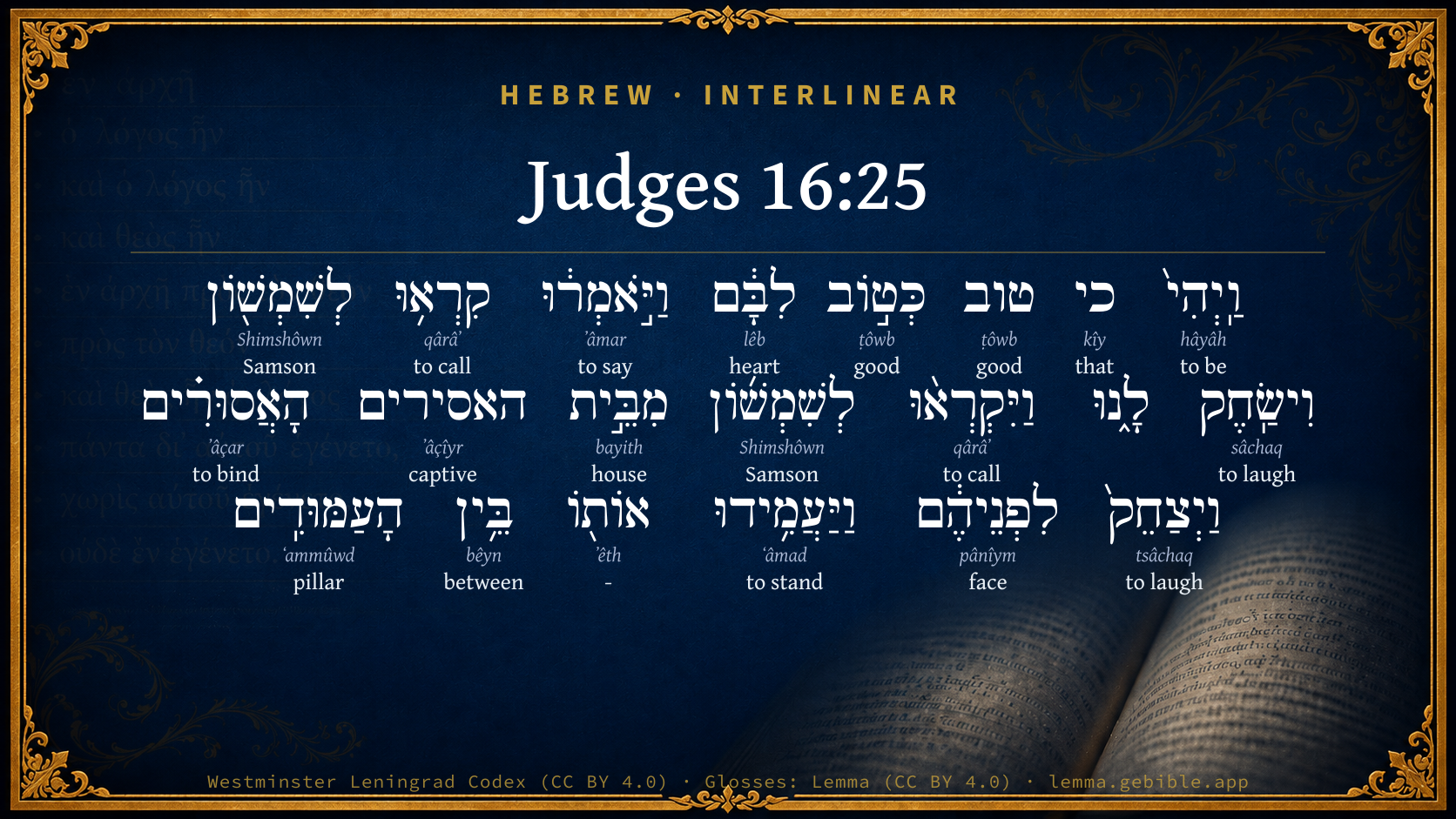
  1. וַֽיְהִי֙ hâyâh H1961 “and · to be” Conjunction + Verb, Qal, Sequential Imperfect, 3rd Person, Masculine, Singular
  2. כי kîy H3588 “that” Conjunction
  3. טוב ṭôwb H2896 “good” Verb, Qal, Perfect, 3rd Person, Masculine, Singular
  4. כְּט֣וֹב ṭôwb H2896 “like/as · good” Preposition + Verb, Qal, Infinitive Construct
  5. לִבָּ֔ם lêb H3820 “heart · their” Noun, Common, Masculine, Singular, Construct + Suffix, Personal, 3rd Person, Masculine, Plural
  6. וַיֹּ֣אמְר֔וּ ʼâmar H559 “and · to say” Conjunction + Verb, Qal, Sequential Imperfect, 3rd Person, Masculine, Plural
  7. קִרְא֥וּ qârâʼ H7121 “call” Verb, Qal, Imperative, 2nd Person, Masculine, Plural
  8. לְשִׁמְשׁ֖וֹן Shimshôwn H8123 “to/for · Samson” Preposition + Noun, Proper
  9. וִישַֽׂחֶק sâchaq H7832 “and · to laugh” Conjunction + Verb, Piel, Imperfect, 3rd Person, Masculine, Singular
  10. וַיִּקְרְא֨וּ qârâʼ H7121 “and · to call” Conjunction + Verb, Qal, Sequential Imperfect, 3rd Person, Masculine, Plural
  11. לְשִׁמְשׁ֜וֹן Shimshôwn H8123 “to/for · Samson” Preposition + Noun, Proper
  12. מִבֵּ֣ית bayith H1004 “from · house of” Preposition + Noun, Common, Masculine, Singular, Construct
  13. הָאֲסוּרִ֗ים ʼâçar H631 “the · bound” Particle, Definite Article + Verb, Qal, Participle Passive, Masculine, Plural, Absolute
  14. וַיְצַחֵק֙ tsâchaq H6711 “and · to laugh” Conjunction + Verb, Piel, Sequential Imperfect, 3rd Person, Masculine, Singular
  15. לִפְנֵיהֶ֔ם pânîym H6440 “to/for · face(s) · their” Preposition + Noun, Common, Both, Plural, Construct + Suffix, Personal, 3rd Person, Masculine, Plural
  16. וַיַּעֲמִ֥ידוּ ʻâmad H5975 “and · to stand” Conjunction + Verb, Hiphil, Sequential Imperfect, 3rd Person, Masculine, Plural
  17. אוֹת֖וֹ ʼêth H853 “- · him” Particle, Direct Object + Suffix, Personal, 3rd Person, Masculine, Singular
  18. בֵּ֥ין bêyn H996 “between” Preposition
  19. הָעַמּוּדִֽים ʻammûwd H5982 “the · pillars” Particle, Definite Article + Noun, Common, Masculine, Plural, Absolute

About this verse

These counts appear in no published source. They are computed here, from the morphology-tagged text and Lemma’s own curated glosses. What Lemma adds →

21
words
17
distinct lemmas
Historical
section

Notable vocabulary

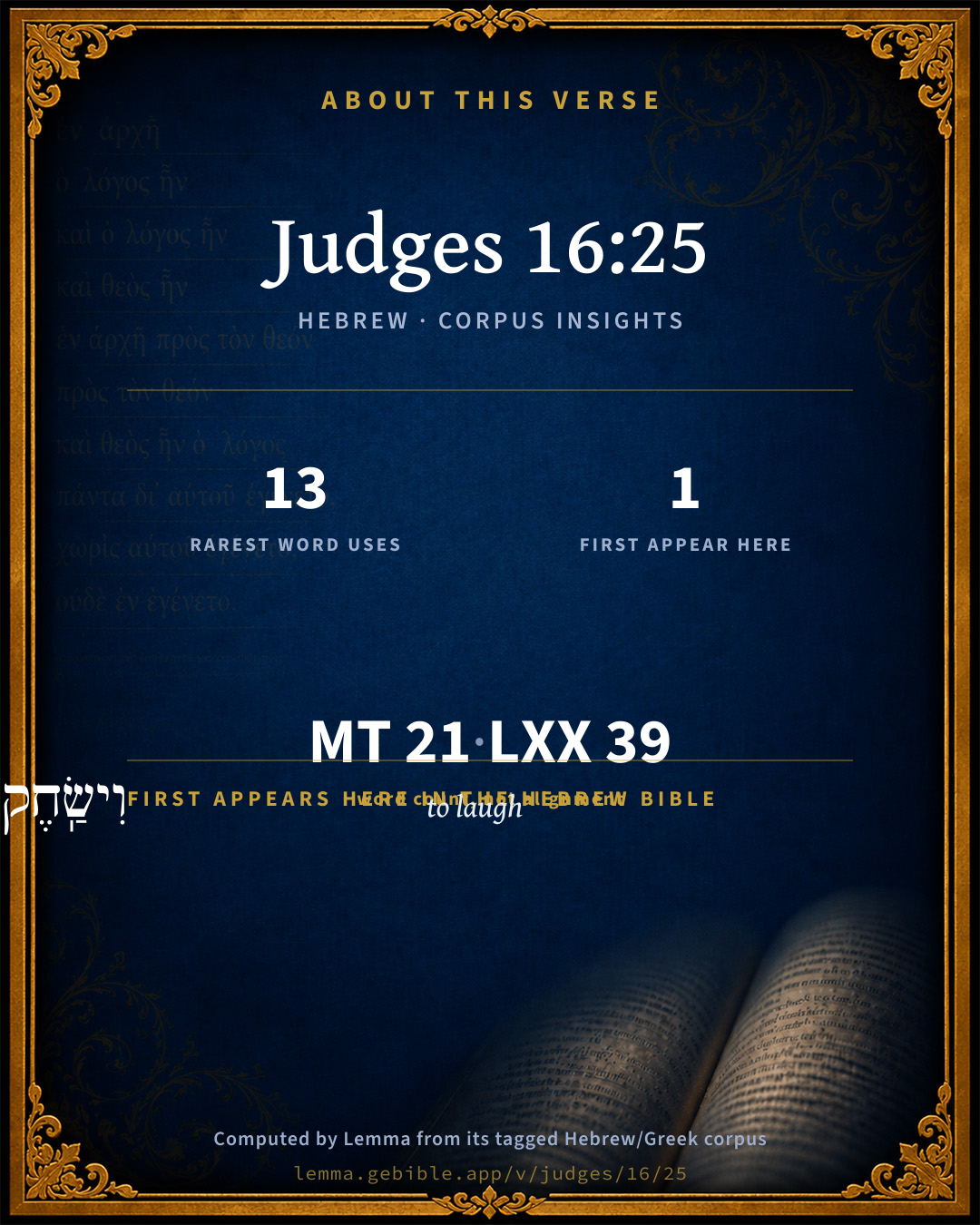
The rarest word here is האסירים captive H615 — appearing just 13 times in the whole Hebrew Bible.

First appearance in Scripture

This word makes its first canonical appearance in the Hebrew Bible here:

  • וִישַֽׂחֶק to laugh H7832

Shared distinctive vocabulary

האסירים captive H615 occurs in 13 verses of the Hebrew Bible. Also found in:

Grammatical profile

  • 10 verbs
  • 7 nouns
  • 2 prepositions
  • 1 conjunction
  • 1 particle

Verb forms

  • וַֽיְהִי֙ Qal · Sequential Imperfect
  • טוב Qal · Perfect
  • כְּט֣וֹב Qal · Infinitive Construct
  • וַיֹּ֣אמְר֔וּ Qal · Sequential Imperfect
  • קִרְא֥וּ Qal · Imperative
  • וִישַֽׂחֶק Piel · Imperfect
  • וַיִּקְרְא֨וּ Qal · Sequential Imperfect
  • הָאֲסוּרִ֗ים Qal · Participle Passive
  • וַיְצַחֵק֙ Piel · Sequential Imperfect
  • וַיַּעֲמִ֥ידוּ Hiphil · Sequential Imperfect

Repetition

Words recur within this verse — often emphatic in Hebrew:

  • טוב good H2896 ×2
  • קִרְא֥וּ to call H7121 ×2
  • לְשִׁמְשׁ֖וֹן Samson H8123 ×2

Hebrew & Septuagint length

In English translation the verse runs 39 words from the Hebrew and 50 from the Septuagint (LXX English) — closely comparable.

A rough comparison of the two English renderings, which tokenize alike — not a word-level alignment.

Word counts can differ between the Hebrew and the Greek without any difference in meaning — e.g. the Hebrew direct-object marker אֵת has no separate Greek word, and Greek often adds the article ὁ.

In the original languages it is 21 Hebrew tokens and 39 Greek tokens — but the two are counted differently (Hebrew bundles its prefixes and suffixes into one token; the Greek is in lemma form), so that isn’t a like-for-like length.

Cross-references

20

Topical passages linked to Judges 16:25 in the Treasury of Scripture Knowledge — connected by theme and wording, ordered by reader-vote popularity; previews shown in the World English Bible.

  • Judges 9:27 They went out into the field, and gathered their vineyards, and trod [the grapes], and held festival, and went into the house of their god, and did eat and drink, and cursed Abimelech.
  • Judges 19:6 So they sat down, and ate and drink, both of them together: and the young lady's father said to the man, Please be pleased to stay all night, and let your heart be merry.
  • 2 Samuel 13:28 Absalom commanded his servants, saying, Mark you now, when Amnon's heart is merry with wine; and when I tell you, Smite Amnon, then kill him; don't be afraid; haven't I commanded you? be courageous, and be valiant.
  • Psalms 35:15–16 But in my adversity, they rejoiced, and gathered themselves together. The attackers gathered themselves together against me, and I didn't know it. They tore at me, and didn't cease.
  • Hebrews 11:36 Others were tried by mocking and scourging, yes, moreover by bonds and imprisonment.
  • Judges 18:20 The priest's heart was glad, and he took the ephod, and the teraphim, and the engraved image, and went in the midst of the people.
  • Judges 19:9 When the man rose up to depart, he, and his concubine, and his servant, his father-in-law, the young lady's father, said to him, Behold, now the day draws toward evening, please stay all night: behold, the day grows to an end, lodge here, that your heart may be merry; and tomorrow get you early on your way, that you may go home.
  • 1 Kings 20:12 It happened, when [Ben Hadad] heard this message, as he was drinking, he and the kings, in the pavilions, that he said to his servants, Set [yourselves in array]. They set [themselves in array] against the city.
  • Esther 3:15 The posts went forth in haste by the king's commandment, and the decree was given out in Shushan the palace. The king and Haman sat down to drink; but the city of Shushan was perplexed.
  • Job 30:9–10 "Now I have become their song. Yes, I am a byword to them.
  • Psalms 69:12 Those who sit in the gate talk about me. I am the song of the drunkards.
  • Psalms 69:26 For they persecute him whom you have wounded. They tell of the sorrow of those whom you have hurt.
  • Proverbs 24:17–18 Don't rejoice when your enemy falls. Don't let your heart be glad when he is overthrown;
  • Isaiah 22:13 and behold, joy and gladness, killing oxen and killing sheep, eating flesh and drinking wine: let us eat and drink, for tomorrow we shall die.
  • Daniel 5:2–3 Belshazzar, while he tasted the wine, commanded to bring the golden and silver vessels which Nebuchadnezzar his father had taken out of the temple which was in Jerusalem; that the king and his lords, his wives and his concubines, might drink from it.
  • Matthew 14:6–7 But when Herod's birthday came, the daughter of Herodias danced among them and pleased Herod.
  • Matthew 26:67–68 Then they spit in his face and beat him with their fists, and some slapped him,
  • Matthew 27:29 They braided a crown of thorns and put it on his head, and a reed in his right hand; and they kneeled down before him, and mocked him, saying, "Hail, King of the Jews!"
  • Matthew 27:39–44 Those who passed by blasphemed him, wagging their heads,
  • Micah 7:8–10 Don't rejoice against me, my enemy. When I fall, I will arise. When I sit in darkness, Yahweh will be a light to me.

Cross-references courtesy of OpenBible.info (CC BY 4.0).

Hebrew and Greek witnesses Masoretic Hebrew ↔ Greek Septuagint

The same verse in the two great witnesses to the Old Testament, shown verse-for-verse.

These are two independent witnesses, not word-aligned to each other, and the Septuagint is shown in lemma (dictionary) form.

Hebrew Judges 16:25 Masoretic · Westminster Leningrad Codex

וַֽיְהִי֙ כי טוב כְּט֣וֹב לִבָּ֔ם וַיֹּ֣אמְר֔וּ קִרְא֥וּ לְשִׁמְשׁ֖וֹן וִישַֽׂחֶק לָ֑נוּ וַיִּקְרְא֨וּ לְשִׁמְשׁ֜וֹן מִבֵּ֣ית האסירים הָאֲסוּרִ֗ים וַיְצַחֵק֙ לִפְנֵיהֶ֔ם וַיַּעֲמִ֥ידוּ אוֹת֖וֹ בֵּ֥ין הָעַמּוּדִֽים

It happened, when their hearts were merry, that they said, Call for Samson, that he may make us sport. They called for Samson out of the prison-house; and he made sport before them. They set him between the pillars:

World English Bible · Public Domain

Greek LXX Judges 16:25 Septuagint · lemma form

καί ὅτε ἀγαθύνω ὁ καρδία αὐτός καί εἶπον καλέω ὁ σαμψων ἐκ οἶκος φυλακή καί παίζω ἐνώπιον ἐγώ καί καλέω ὁ σαμψων ἀπό οἶκος δεσμωτήριον καί παίζω ἐνώπιον αὐτός καί ῥαπίζω αὐτός καί ἵστημι αὐτός ἀνά μέσος ὁ κίων

And when their heart was merry, then they said, Call Sampson out of the prison-house, and let him play before us: and they called Sampson out of the prison-house, and he played before them; and they struck him with the palms of their hands, and set him between the pillars.

LXX2012 (modern English Septuagint) · Public Domain

On this verse, Adam Clarke's Commentary discusses the Septuagint’s reading. Read the note in Commentary ↓

Hebrew: Westminster Leningrad Codex (CC BY 4.0). Greek: Septuagint (public domain); English from LXX2012 (modern English Septuagint) (Public Domain). How the Septuagint differs from the Hebrew →

Targum (Aramaic paraphrase)

1

The Targum is the ancient Jewish Aramaic paraphrase of the Hebrew Scriptures — an interpretive translation, not the Hebrew text itself. Onkelos (literal) and Pseudo-Jonathan (expansive) render the Torah, and Jonathan the Prophets. Coverage is partial: where no permissively-licensed English translation exists for a verse, only the Aramaic is shown. This is verse-level text, not a word-by-word alignment to the Hebrew.

  1. Targum Jonathan Prophets (Joshua–Malachi)
    וַהֲוָה כַּד שְׁפַר לִבְּהוֹן וַאֲמַרוּ קְרוּ לְשִׁמְשׁוֹן וִיחַיִךְ לָנָא וּקְרוֹ לְשִׁמְשׁוֹן מִבֵּית אֲסִירַיָא וְחַיִיךְ קֳדָמֵיהוֹן וַאֲקִימוּ יָתֵיהּ בֵּין עַמוּדַיָא:

    (no public-domain English translation for this verse)

    Targum Jonathan — Aramaic: “Mikraot Gedolot” (public domain). English: “Sefaria Community Translation” (CC0 1.0 (public-domain dedication)); “London "Chaldee Paraphrase," 1871” (public domain). Text via Sefaria.

Commentary

Notes on Judges 16:25 from classic Christian and Jewish commentators (each source and its license shown beneath its notes). The classic Christian expositions comment on the surrounding passage and are grouped to its opening verse, so a note may address several verses; the Jewish commentaries on the Tanakh (Rashi and others) are per-verse, so they appear only where the commentator wrote on this verse.

Lemma curates 59 commentaries, every one of them public domain or Creative Commons licensed, each selected and text-cleaned for this edition rather than reprinted as found. About our sources →

Trapp's Complete Commentary

John Trapp

Jdg 16:25 And it came to pass, when their hearts were merry, that they said, Call for Samson, that he may make us sport. And they called for Samson out of the prison house; and he made them sport: and they set him between the pillars.

Ver. 25. Call for Samson, that he may make us sport.] At feasts they had their γελωτοποιοι, such as made them merry. The Emperors of Rome presented the people with strange sights, as of lions, bears, panthers, tigers, &c., to exhilarate them: they also led their enemies before them in triumph: which Cleopatra not able to endure, killed herself: So did not Samson, but became the subject of his enemies’ scorn and malice, as did likewise Christ. {Mat 27:29-31}

And they set him between the pillars.] Where he might best be seen: but God had a holy hand in it, for a further mischief unto them.

John Trapp, A Commentary or Exposition upon All the Books of the Old and New Testament (1647–1656) — public domain. Text from a community e-Sword module.

Joseph Benson's Commentary

Jdg 16:25. Call for Samson, that he may make us sport — May be the subject of our mirth and derision. Thus Christ was made the subject of the sport and derision of the chief priests and elders, Mat 26:67-68, and of the Roman soldiers, Mat 27:29. No doubt they loaded him with bitter scoffs and indignities, and perhaps required of him some proofs of the more than ordinary strength yet remaining in him, like the ruins of a great and goodly building. By this, it seems, he lulled them asleep, until, through this complaisance, he prepared the way for that which he designed.

Joseph Benson's Commentary on the Old and New Testaments (1811–1818) — public domain. Text from a community e-Sword module.

Geneva Bible (1599)

Geneva Bible translators

Thus by God’s just judgments they are made slaves to infidels which neglect their vocation in defending the faithful.

Geneva Bible (1599) marginal notes — public domain. Text via Bolls.life.

Adam Clarke's Commentary

Verse 25. Call for Samson, that he may make us sport] What the sport was we cannot tell; probably it was an exhibition of his prodigious strength. This seems to be intimated by what is said, Jdg 16:22, of the restoration of his hair; and the exertions he was obliged to make will account for the weariness which gave him the pretence to ask for leave to lean against the pillars. Some think he was brought out to be a laughing-stock, and that he was variously insulted by the Philistines; hence the version of the Septuagint: και ερραπιζον αυτον, and they buffeted him. Josephus, Antiq. Jud. lib. v., cap. 8, s. 12, says: He was brought out, ὁπως ενυβρισωσιν αυτον παρα τον ποτον, that they might insult him in their cups.

Adam Clarke's Commentary on the Bible (1810–1826) — public domain. Text from a community e-Sword/MySword module.

Ellicott's Commentary for English Readers

(25) When their hearts were merry.—Comp. Jdg_9:27; 1Sa_25:36; Est_1:10.

That he may make us sport.—Whether by his forced jests, or by feats of strength, or merely by being made to submit to insults, we cannot tell. Josephus says that they sent for Samson “that they might insult him over their wine.”

He made them sport.—The LXX says (Cod. B), “And he played before them, and they beat him with rods.”

A Bible Commentary for English Readers, edited by Charles John Ellicott (1878–1897) — public domain. Text from a community e-Sword module.

The Cambridge Bible for Schools and Colleges

gen. ed. J. J. S. Perowne

25. he made sport before them] in the court, we may suppose, in front of the house, i.e. the temple of Dagon. When the sport was over, Samson was set among the pillars of the open hall or porch of the temple, where the crowd could satisfy their curiosity by a nearer view.

The Cambridge Bible for Schools and Colleges (gen. ed. J. J. S. Perowne; Cambridge University Press, 1878–1918) — public domain. Text from a community e-Sword module.

John Gill's Exposition

And it came to pass when their hearts were merry,.... With wine, for which Gaza is famous in many writers (w); with eating and drinking, dancing, and music; for it was usual for the Heathens to feast in their temples, and especially no doubt they would on such an occasion as this:

and they said, call for Samson, that he may make us sport; by which it seems that what is before said, "when the people saw him", Jdg 16:24 is said by anticipation; for as yet he was not in the temple, but in the prison; and therefore a motion was made by some of the great personages, that he might be fetched from thence, and they might have some diversion with him:

and they called for Samson out of the prison house; sent some messengers to fetch him from thence:

and he made them sport; not actively, but passively; it cannot well be thought, that a man of so great a spirit as Samson was, and in such circumstances as he now was, would ever, either by words or gestures, do anything on purpose to divert his enemies, and make them laugh; but he was the object of their sport and scorn, and he bore it patiently, their cruel mockings, buffetings, and spittings; in which he was a type of Christ. It was a diversion to them to see him in his rattling chains, groping, and blundering along from post to pillar, one perhaps giving him a box of the ear, or a slap of the face, another plucking him by his nose or beard, and another spitting in his face, and others taunting at him, and reproaching him:

and they set him between the pillars; that he might be the better seen, and in which there was the direction of Providence to bring about what follows.

(w) Vid. Rivinum de Majumis, &c. c. 6. sect. 13.

John Gill's Exposition of the Whole Bible (1746–1763) — public domain (CC PDM 1.0). Text via the HelloAO Bible API.

Albert Barnes' Notes on the Bible

That he may make us sport - Rather, “that he may play for us,” i. e. dance and make music. At an idolatrous feast, dancing was always accompanied with vocal and instrumental music.

Albert Barnes' Notes on the Bible (1834–1885) — public domain. Text from a community e-Sword/MySword module.

Haydock's Catholic Bible Commentary

Played. Dancing in a ridiculous manner, (Montanus) running against the walls, or falling down, so as to make the people laugh, (Lyranus) or rather (Haydock) Serarius gathers from the Septuagint that "they buffetted him," and made a sport of him. (Menochius) --- It is not at all probable that Samson would act the ape before the Philistines; but, in attempting to keep off the rabble with many a fruitless blow, against his will he might make them merry. (Calmet) --- He appeared before them in the garb of a slave, covered with the dust of the mill, (Salien) like our Saviour in a fool’s garment. (Haydock) --- Two pillars. The temples of Hercules, at Tyre and in Africa, had the same number. (Porphyrius, Abst. 2.) --- The temple of Dagon was supported on wooden pillars standing near each other. People might see down from the roof. (Serarius) --- We read that the theatre of Rome rested on one pivot, and the amphitheatre on two. Ecce populus Romanus universus, says Pliny, ([Natural History?] xxxvi. 15,) binis cardinibus sustinetur. (Calmet) --- The roofs of the Philistine temples were flat, and galleries all around them, so that an immense crowd might be collected, (Menochius) to gaze on this terror of their country, now their prey. They had forgotten how he had formerly carried off their gates, or they concluded that his amazing strength was gone for ever. (Haydock)

George Leo Haydock (1774–1849), Haydock's Catholic Family Bible and Commentary, 1859 edition — public domain. Excludes Psalms (Douay-Rheims chapter numbering differs from Protestant) and Deuterocanonical books (Catholic canon only).

Matthew Poole's English Annotations

He made them sport; either, first, Passively, being made by them the matter of their sport and derision, and of many bitter scoffs, and other indignities or injuries; or, secondly Actively, by some ridiculous actions, or some proofs of more than ordinary strength yet remaining in him, like the ruins of a great and goodly building; whereby he halted them asleep in security, until by this seeming complaisance he prepared the way for that which he designed; otherwise his generous soul would never have been forced to make them sport, save in order to their destruction.

Matthew Poole's English Annotations on the Holy Bible (1683–1685) — public domain. Text from a community e-Sword/MySword module.

Whedon's Commentary on the Bible

Daniel D. Whedon

25. When their hearts were merry — By songs and dances, eating and drinking. “They were in high spirits over a victory for which they had not fought.” — Cassel.

Made them sport — Probably by exhibitions of strength, but especially by the awkward movements caused by his blindness, and exhibitions of his natural wit and buffoonery. “The closing scenes of his life,” observes Stanley, who gives special prominence to this characteristic of Samson, “breathe throughout the same terrible yet grotesque irony. When the captive warrior is called forth, in the merriment of his persecutors, to exercise for the last time the well known raillery of his character, he appears as the great jester or buffoon of the nation; the word employed expresses alike the roars of laughter and the wild gambols with which he made them sport; and as he puts forth the last energy of his vengeance, the final effort of his expiring strength, it is in a stroke of broad and savage humour that his indignant spirit passes away. ‘Strengthen me now, only this once, O God, that I may be avenged of the Philistines (not for both of my lost eyes — but) for one of my two eyes.’ That grim playfulness, strong in death, lends its paradox even to the act of destruction itself, and overflows into the touch of triumphant satire with which the pleased historian closes the story: ‘The dead which he slew at his death were more than they which he slew in his life.’”

Set him between the pillars — To rest awhile from the fatigue of his exertions.

Daniel D. Whedon (gen. ed.), Commentary on the Old and New Testaments (1874–1909) — public domain. Text from a community e-Sword module.

The Pulpit Commentary

When their hearts were merry. They would not have acted so imprudently as to bring Samson out of his prison had not their judgment been clouded with drink. That he may make us sport. And he made them sport. The two verbs are not the same in Hebrew, but they have much the same meaning. It is not certain whether the idea conveyed is that of the A.V, that Samson was brought there to be as it were baited by the populace, jeered and jested at, reviled and reproached, perhaps struck or pelted; or whether the words do not simply mean to dance with music, which is certainly the meaning of the latter verb (he made sport before them, A.V and margin) in 1Sa_18:7 (played, A.V; see ver. 6); 2Sa_6:5, 21 1Ch_13:8 1Ch_15:29. They set him between the pillars, i.e. when he had done dancing; because he must have been dancing outside the house for the people on the roof to see him.

The Pulpit Commentary (1880–1919), ed. H.D.M. Spence-Jones & Joseph S. Exell — public domain. Text from a community e-Sword module.

John Wesley's Explanatory Notes

Made sport - Either being made by them the matter of their sport and derision, of bitter scoffs, and other indignities: or, by some proofs of more than ordinary strength yet remaining in him, like the ruins of a great and goodly building: whereby he lulled them asleep, until by this complaisance he prepared the way for that which he designed.

John Wesley, Explanatory Notes Upon the Whole Bible (1754–1765) — public domain. Text via the GEBible commentary corpus.

unfoldingWord translationNotes

Door43 World Missions Community

Call for Samson ... They called for Samson

Since Samson was a prisoner, he would not be called directly, but rather the people were asking for the men in charge of the prison to bring him to them. AT: "Call for them to bring out Samson ... They brought Samson" (See: Assumed Knowledge and Implicit Information)

the boy

"the young man" This was not a young child, but rather a youth.

Permit me to touch the pillars on which the building rests

"Allow me to touch the pillars which hold up the building"

translationWords

call

Samson

prison

column

unfoldingWord translationNotes — © Distant Shores Media and the Door43 World Missions Community, licensed CC BY-SA 4.0. Source: git.door43.org/Door43/en_tn.

Rashi

Rabbi Shlomo Yitzchaki (Rashi)

Between the pillars which supported the building.

Rashi on the Tanakh — English translations: “The Judaica Press complete Tanach with Rashi, translated by A. J. Rosenberg” (CC BY 4.0); “Pentateuch with Rashi's commentary by M. Rosenbaum and A.M. Silbermann, 1929-1934” (public domain); “The Metsudah Tanach series, Lakewood, N.J” (CC BY 4.0); and “The Book of Joshua, Metsudah Publications, 1997” (CC BY 4.0). Text via Sefaria.

Lesson kit

Teaching starters — assembled from the data on this page, not authored interpretation. Every prompt links to the verse data it draws on. Edit before teaching.

Judges, in the Historical, opens this verse with 21 words (17 distinct Hebrew lemmas). Its most distinctive word is ʼâçîyr (“captive”). A historical commentator’s framing appears above. Read the whole chapter for the surrounding context.

Discussion questions

  1. The word ʼâçîyr carries the sense “captive.” How does it shape the verse?
  2. The word “to laugh” first appears here in Scripture. What is being introduced at this debut?
  3. Genesis 39:20 shares the word «captive» with this verse. How do the two illuminate each other?
  4. “good” occurs 2× in this one verse. What is the effect of the repetition?
  5. These translations render this verse differently; the difference is in the English rendering, not the original. What questions does that raise?
  6. The verb «וַֽיְהִי֙» is Qal Sequential Imperfect. How does its form color the action?
  7. Reading how Trapp's Complete Commentary and Joseph Benson's Commentary read this verse, where do the two commentators agree and where do they part?

Things to notice

Reading settings

Reading text

Shown beneath each verse's original-language words.

Old Testament
Old Testament edition

Read the OT as the Masoretic Hebrew (MT) or the Greek Septuagint (LXX).

English shown for the Greek Septuagint (in the Hebrew ↔ Greek comparison).

Comparing translations? Open the Compare panel on any verse page to stack up to four side by side.