
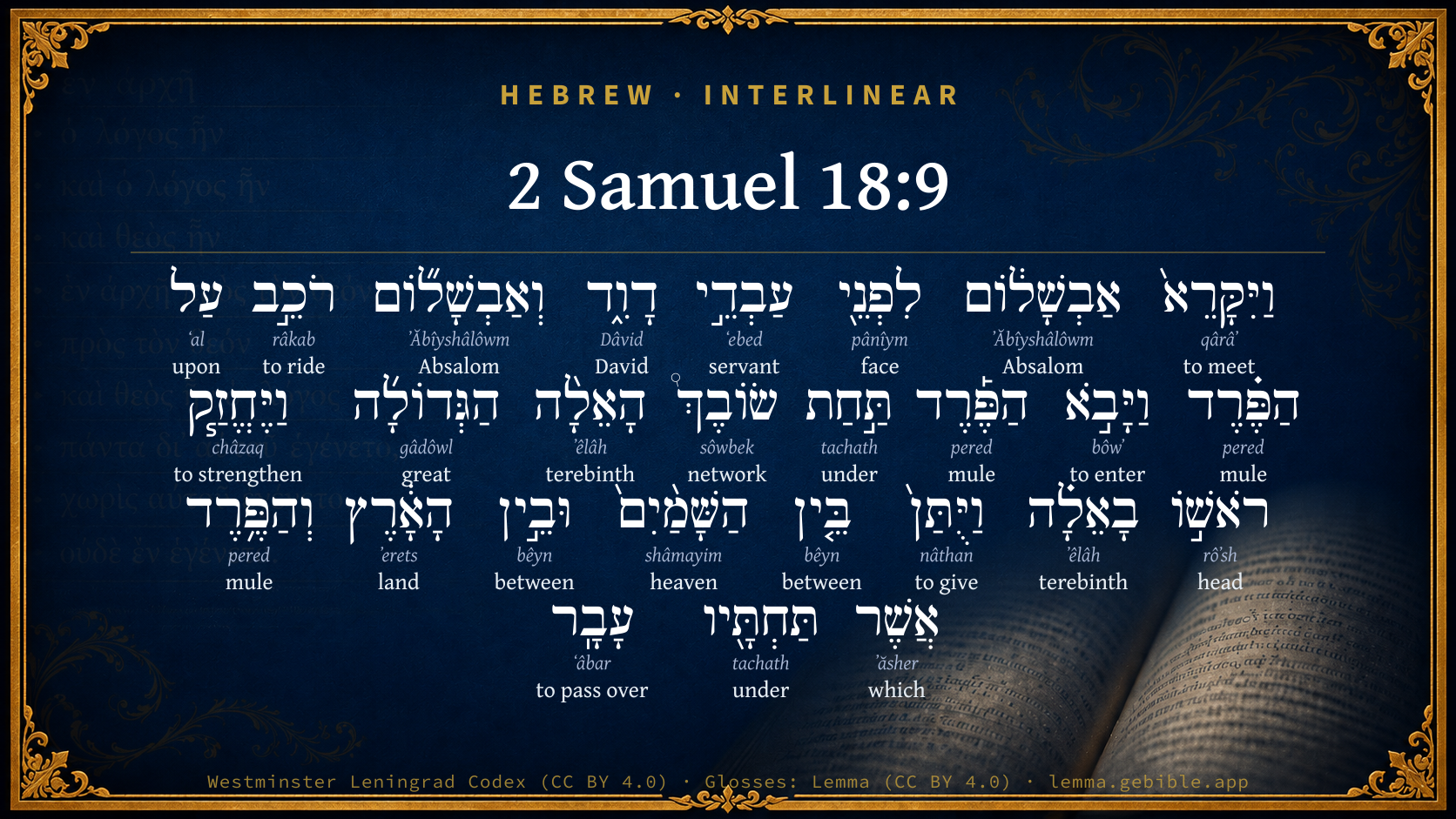
2 Samuel 18:9

Hebrew (Westminster Leningrad Codex) 2 Samuel 18:9 appears in the Hebrew Old Testament. The text above is from the Westminster Leningrad Codex. Each word links to its Strong’s number, a concise gloss, and parsing drawn from the Open Scriptures Hebrew Bible morphology. Click any word for its full Brown-Driver-Briggs (BDB) entry.
Download image
Cite this verse

2 Samuel 18:9 (World English Bible). Public Domain. Lemma interlinear Bible study tool, https://lemma.gebible.app/v/2-samuel/18/9.

Show BibTeX & RIS
BibTeX
RIS
English Translation
Absalom happened to meet the servants of David. Absalom was riding on his mule, and the mule went under the thick boughs of a great oak, and his head caught hold of the oak, and he was taken up between the sky and earth; and the mule that was under him went on.
World English Bible · Public Domain
Highlights
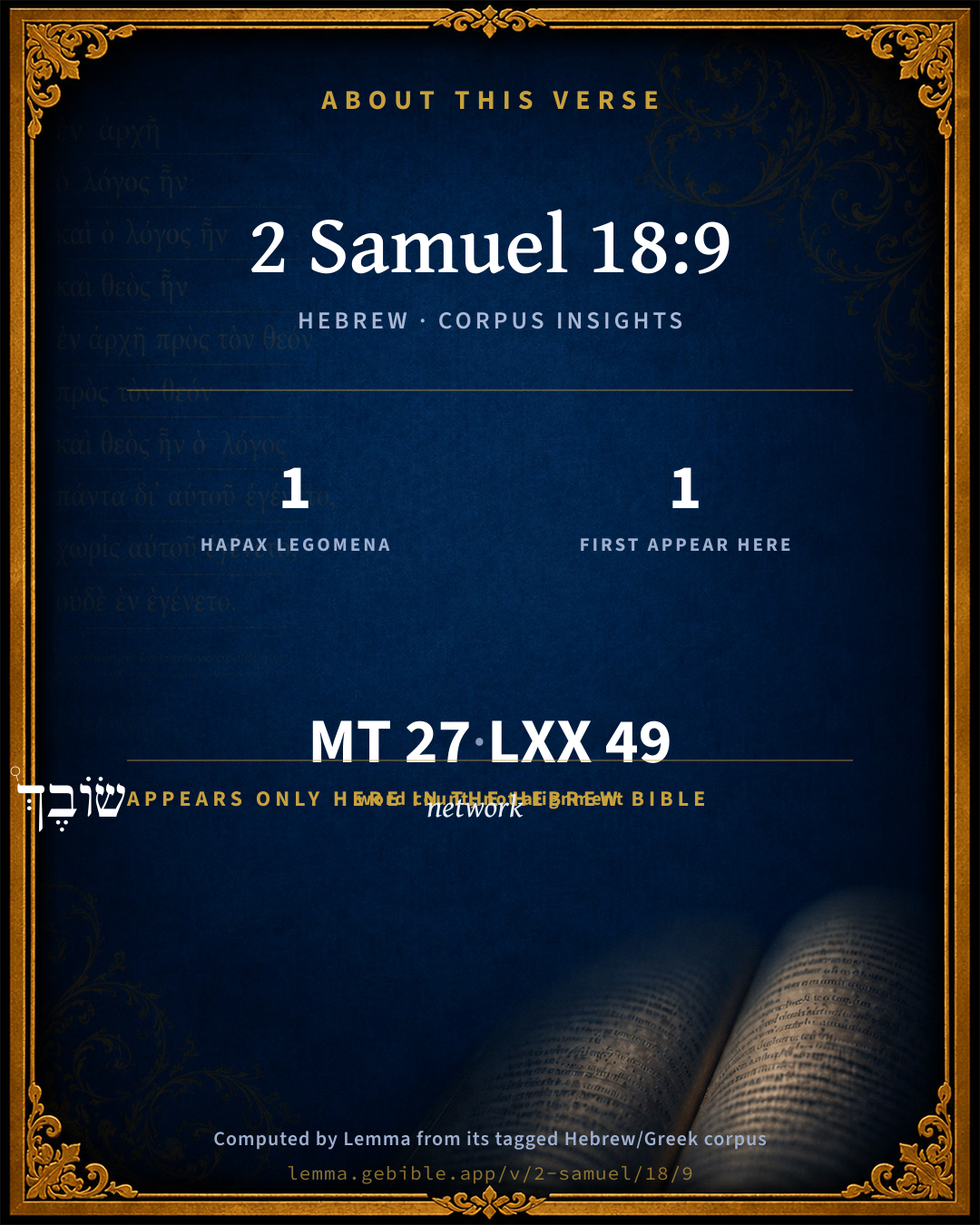
  • 1 hapax legomenon — only here in the Hebrew Bible
  • 1 first appearance in the Hebrew Bible
Full analysis ↓
Download a study sheet

One document with this verse’s original text, its word-by-word gloss line, the meaning frame, cross-references with their text, attributed commentary, and full source and license credits — printable, and it pastes into notes with its structure intact.

This verse Autodidact and up

Study sheet (.html) Plain text (.txt)

A passage Seminary Student

Up to 50 verses in one chapter. A passage sheet keeps up to 6 commentary sources and 12 cross-references per verse, in the order this page ranks them, and says so on the sheet whenever that leaves anything out. Ask for a single verse and you get the Autodidact verse sheet above.

Everything on this page stays free to read, with no account — the sheet is a download of what is already on screen, not access to it.

Want to remove ads? Support Godless Engineer
Compare translations 3

The same verse in 3 English versions, stacked beneath the original-language interlinear above. Click any original word for its lexicon entry.

Each is an independent rendering of the whole verse — the interlinear is not word-aligned to these translations.

Highlighted words mark where these versions differ — a whole-verse word diff, not a word-by-word alignment.

  • World English Bible Public Domain
    Absalom happened to meet the servants of David. Absalom was riding on his mule, and the mule went under the thick boughs of a great oak, and his head caught hold of the oak, and he was taken up between the sky and earth; and the mule that was under him went on.
  • King James Version Public Domain
    And Absalom met the servants of David. And Absalom rode upon a mule, and the mule went under the thick boughs of a great oak, and his head caught hold of the oak, and he was taken up between the heaven and the earth; and the mule that was under him went away.
  • unfoldingWord Literal Text CC BY-SA 4.0
    And Absalom was met to the face of the servants of David. Now Absalom was riding on the mule, and the mule came under the branches of a great oak tree, and his head was caught in the oak tree, and he was put between the heavens and between the earth, and the mule that under him passed on.

unfoldingWord Literal Text — © unfoldingWord, licensed CC BY-SA 4.0. Word-aligned USFM3 via Door43 (git.door43.org/unfoldingWord/en_ult).

Versions to compare (up to 4)

3 of 4 selected

Show all 18 translations

Every available English version of this verse, each an independent rendering of the whole verse.

  • World English Bible Public Domain
    Absalom happened to meet the servants of David. Absalom was riding on his mule, and the mule went under the thick boughs of a great oak, and his head caught hold of the oak, and he was taken up between the sky and earth; and the mule that was under him went on.
  • Berean Standard Bible Public Domain
    Now Absalom was riding on his mule when he met the servants of David, and as the mule went under the thick branches of a large oak, Absalom’s head was caught fast in the tree. The mule under him kept going, so that he was suspended in midair.
  • Majority Standard Bible Public Domain
    Now Absalom was riding on his mule when he met the servants of David, and as the mule went under the thick branches of a large oak, Absalom’s head was caught fast in the tree. The mule under him kept going, so that he was suspended in midair.
  • King James Version Public Domain
    And Absalom met the servants of David. And Absalom rode upon a mule, and the mule went under the thick boughs of a great oak, and his head caught hold of the oak, and he was taken up between the heaven and the earth; and the mule that was under him went away.
  • American Standard Version (1901) Public Domain
    And Absalom chanced to meet the servants of David. And Absalom was riding upon his mule, and the mule went under the thick boughs of a great oak, and his head caught hold of the oak, and he was taken up between heaven and earth; and the mule that was under him went on.
  • Revised Version (1885) Public Domain
    And Absalom chanced to meet the servants of David. And Absalom rode upon his mule, and the mule went under the thick boughs of a great oak, and his head caught hold of the oak, and he was taken up between the heaven and the earth; and the mule that was under him went on.
  • Geneva Bible (1599) Public Domain
    Nowe Absalom met the seruants of Dauid, and Absalom rode vpon a mule, and the mule came vnder a great thicke oke: and his head caught holde of the oke, and he was taken vp betweene the heauen and the earth: and the mule that was vnder him went away.
  • Douay-Rheims (1899) Public Domain
    And it happened that Absalom met he servants of David, riding on a mule: and as the mule went under a thick and large oak, his head stuck in the oak: and while he hung between the heaven and he earth, the mule on which he rode passed on.
  • Young's Literal Translation Public Domain
    And Absalom meeteth before the servants of David, and Absalom is riding on the mule, and the mule cometh in under an entangled bough of the great oak, and his head taketh hold on the oak, and he is placed between the heavens and the earth, and the mule that `is' under him hath passed on.
  • Literal Standard Version CC BY-SA 4.0
    And Absalom meets before the servants of David, and Absalom is riding on the mule, and the mule comes in under an entangled bough of the great oak, and his head takes hold on the oak, and he is placed between the heavens and the earth, and the mule that [is] under him has passed on.
  • Unlocked Literal Bible CC BY-SA 4.0
    Absalom happened to meet some of David's soldiers. Absalom was riding his mule, and the mule went under the thick branches of a large oak tree, and his head was caught up in the tree branches. He was left dangling between the ground and the sky while the mule he was riding kept going.
  • unfoldingWord Literal Text CC BY-SA 4.0
    And Absalom was met to the face of the servants of David. Now Absalom was riding on the mule, and the mule came under the branches of a great oak tree, and his head was caught in the oak tree, and he was put between the heavens and between the earth, and the mule that under him passed on.
  • Darby Bible Public Domain
    And Absalom found himself in the presence of David's servants. And Absalom was riding upon a mule, and the mule went under the thick boughs of the great terebinth, and his head caught in the terebinth, and he was taken up between the heaven and the earth; and the mule that was under him went away.
  • World Messianic Bible Public Domain
    Absalom happened to meet David’s servants. Absalom was riding on his mule, and the mule went under the thick boughs of a great oak; and his head caught hold of the oak, and he was hanging between the sky and earth; and the mule that was under him went on.
  • Webster's Bible Public Domain
    And Absalom met the servants of David. And Absalom rode upon a mule, and the mule went under the thick boughs of a great oak, and his head caught hold of the oak, and he was suspended between the heaven and the earth; and the mule that was under him went away.
  • Free Bible Version CC BY-SA 4.0
    Absalom ran into some of David's men while he was riding on his mule. As the mule went under the twisted branches of a large oak tree, Absalom's hair got caught in the tree. The mule he was riding kept going, leaving him hanging between earth and sky.
  • Bible in Basic English Public Domain
    And Absalom came across some of David's men. And Absalom was seated on his mule, and the mule went under the thick branches of a great tree, and his head became fixed in the tree and he was lifted up between earth and heaven, and the beast under him went on.
  • JPS Tanakh (1917) Public Domain
    And Absalom chanced to meet the servants of David. And Absalom was riding upon his mule, and the mule went under the thick boughs of a great terebinth, and his head caught hold of the terebinth, and he was taken up between the heaven and the earth; and the mule that was under him went on.

Literal Standard Version (2020), Covenant Press — licensed CC BY-SA 4.0. Text via the HelloAO Bible API (eBible.org). Unlocked Literal Bible (unfoldingWord) — licensed CC BY-SA 4.0. Text via the HelloAO Bible API (eBible.org). unfoldingWord Literal Text — © unfoldingWord, licensed CC BY-SA 4.0. Word-aligned USFM3 via Door43 (git.door43.org/unfoldingWord/en_ult). Free Bible Version, Dr. Jonathan Gallagher — licensed CC BY-SA 4.0. Text via the HelloAO Bible API (eBible.org).

Word by word

More ways to search: Search by grammar → Find every occurrence → Compare this word →

Practice this passage: Drill this verse → Learn its vocabulary →

שׂוֹבֶךְ֩
sôwbek
H7730
“network of”
Noun, Common, Masculine, Singular, Construct
Part of Speech
Noun
Type
Common
Gender
Masculine
Number
Singular
State
Construct
Full BDB Definition

Origin: for H5441

TWOT: 2230a

network (of boughs)
  1. וַיִּקָּרֵא֙ qârâʼ H7122 “and · to meet” Conjunction + Verb, Niphal, Sequential Imperfect, 3rd Person, Masculine, Singular
  2. אַבְשָׁל֔וֹם ʼĂbîyshâlôwm H53 “Absalom” Noun, Proper
  3. לִפְנֵ֖י pânîym H6440 “to/for · face(s) of” Preposition + Noun, Common, Both, Plural, Construct
  4. עַבְדֵ֣י ʻebed H5650 “servants of” Noun, Common, Masculine, Plural, Construct
  5. דָוִ֑ד Dâvid H1732 “David” Noun, Proper
  6. וְאַבְשָׁל֞וֹם ʼĂbîyshâlôwm H53 “and · Absalom” Conjunction + Noun, Proper
  7. רֹכֵ֣ב râkab H7392 “riding” Verb, Qal, Participle Active, Masculine, Singular, Absolute
  8. עַל ʻal H5921 “upon” Preposition
  9. הַפֶּ֗רֶד pered H6505 “the · mule” Particle, Definite Article + Noun, Common, Masculine, Singular, Absolute
  10. וַיָּבֹ֣א bôwʼ H935 “and · to enter” Conjunction + Verb, Qal, Sequential Imperfect, 3rd Person, Masculine, Singular
  11. הַפֶּ֡רֶד pered H6505 “the · mule” Particle, Definite Article + Noun, Common, Masculine, Singular, Absolute
  12. תַּ֣חַת tachath H8478 “under” Preposition
  13. הָאֵלָ֨ה ʼêlâh H424 “the · terebinth” Particle, Definite Article + Noun, Common, Feminine, Singular, Absolute
  14. הַגְּדוֹלָ֜ה gâdôwl H1419 “the · great” Particle, Definite Article + Adjective, Adjective, Feminine, Singular, Absolute
  15. וַיֶּחֱזַ֧ק châzaq H2388 “and · to strengthen” Conjunction + Verb, Qal, Sequential Imperfect, 3rd Person, Masculine, Singular
  16. רֹאשׁ֣וֹ rôʼsh H7218 “head · his” Noun, Common, Masculine, Singular, Construct + Suffix, Personal, 3rd Person, Masculine, Singular
  17. בָאֵלָ֗ה ʼêlâh H424 “in/at the · terebinth” Preposition, Determined + Noun, Common, Feminine, Singular, Absolute
  18. וַיֻּתַּן֙ nâthan H5414 “and · to give” Conjunction + Verb, Hophal, Sequential Imperfect, 3rd Person, Masculine, Singular
  19. בֵּ֤ין bêyn H996 “between” Preposition
  20. הַשָּׁמַ֨יִם֙ shâmayim H8064 “the · heaven(s)” Particle, Definite Article + Noun, Common, Masculine, Plural, Absolute
  21. וּבֵ֣ין bêyn H996 “and · between” Conjunction + Preposition
  22. הָאָ֔רֶץ ʼerets H776 “the · land” Particle, Definite Article + Noun, Common, Both, Singular, Absolute
  23. וְהַפֶּ֥רֶד pered H6505 “and · the · mule” Conjunction + Particle, Definite Article + Noun, Common, Masculine, Singular, Absolute
  24. אֲשֶׁר ʼăsher H834 “which” Particle, Relative
  25. תַּחְתָּ֖יו tachath H8478 “under · him” Preposition + Suffix, Personal, 3rd Person, Masculine, Singular
  26. עָבָֽר ʻâbar H5674 “to pass over” Verb, Qal, Perfect, 3rd Person, Masculine, Singular

About this verse

These counts appear in no published source. They are computed here, from the morphology-tagged text and Lemma’s own curated glosses. What Lemma adds →

27
words
21
distinct lemmas
Historical
section

Notable vocabulary

1 hapax legomenon — a word that appears only here in the entire Hebrew Bible:

  • שׂוֹבֶךְ֩ network H7730

First appearance in Scripture

This word makes its first canonical appearance in the Hebrew Bible here:

  • שׂוֹבֶךְ֩ network H7730

Shared distinctive vocabulary

הָאֵלָ֨ה terebinth H424 occurs in 12 verses of the Hebrew Bible. Also found in:

Grammatical profile

  • 6 verbs
  • 14 nouns
  • 1 adjective
  • 5 prepositions
  • 1 particle

Verb forms

  • וַיִּקָּרֵא֙ Niphal · Sequential Imperfect
  • רֹכֵ֣ב Qal · Participle Active
  • וַיָּבֹ֣א Qal · Sequential Imperfect
  • וַיֶּחֱזַ֧ק Qal · Sequential Imperfect
  • וַיֻּתַּן֙ Hophal · Sequential Imperfect
  • עָבָֽר Qal · Perfect

Repetition

Words recur within this verse — often emphatic in Hebrew:

  • הַפֶּ֗רֶד mule H6505 ×3
  • אַבְשָׁל֔וֹם Absalom H53 ×2
  • תַּ֣חַת under H8478 ×2
  • הָאֵלָ֨ה terebinth H424 ×2
  • בֵּ֤ין between H996 ×2

Hebrew & Septuagint length

In English translation the verse runs 53 words from the Hebrew and 52 from the Septuagint (LXX English) — closely comparable.

A rough comparison of the two English renderings, which tokenize alike — not a word-level alignment.

Word counts can differ between the Hebrew and the Greek without any difference in meaning — e.g. the Hebrew direct-object marker אֵת has no separate Greek word, and Greek often adds the article ὁ.

In the original languages it is 27 Hebrew tokens and 49 Greek tokens — but the two are counted differently (Hebrew bundles its prefixes and suffixes into one token; the Greek is in lemma form), so that isn’t a like-for-like length.

Cross-references

15

Topical passages linked to 2 Samuel 18:9 in the Treasury of Scripture Knowledge — connected by theme and wording, ordered by reader-vote popularity; previews shown in the World English Bible.

  • 2 Samuel 14:26 When he cut the hair of his head (now it was at every year's end that he cut it; because it was heavy on him, therefore he cut it); he weighed the hair of his head at two hundred shekels, after the king's weight.
  • Job 31:3 Is it not calamity to the unrighteous, And disaster to the workers of iniquity?
  • Proverbs 30:17 The eye that mocks at his father, And scorns obedience to his mother: The ravens of the valley shall pick it out, The young eagles shall eat it.
  • Deuteronomy 21:23 his body shall not remain all night on the tree, but you shall surely bury him the same day; for he who is hanged is accursed of God; that you don't defile your land which Yahweh your God gives you for an inheritance.
  • Deuteronomy 27:16 Cursed be he who sets light by his father or his mother. All the people shall say, Amen.
  • Deuteronomy 27:20 Cursed be he who lies with his father's wife, because he has uncovered his father's skirt. All the people shall say, Amen.
  • 2 Samuel 17:23 When Ahithophel saw that his counsel was not followed, he saddled his donkey, and arose, and got him home, to his city, and set his house in order, and hanged himself; and he died, and was buried in the tomb of his father.
  • 2 Samuel 18:14 Then said Joab, I may not wait thus with you. He took three darts in his hand, and thrust them through the heart of Absalom, while he was yet alive in the midst of the oak.
  • Job 18:8–10 For he is cast into a net by his own feet, And he wanders into its mesh.
  • Psalms 63:9–10 But those who seek my soul, to destroy it, Shall go into the lower parts of the earth.
  • Proverbs 20:20 Whoever curses his father or his mother, His lamp shall be put out in blackness of darkness.
  • Jeremiah 48:44 He who flees from the fear shall fall into the pit; and he who gets up out of the pit shall be taken in the snare: for I will bring on him, even on Moab, the year of their visitation, says Yahweh.
  • Mark 7:10 For Moses said, 'Honor your father and your mother;' and, 'He who speaks evil of father or mother, let him be put to death.'
  • Galatians 3:13 Christ redeemed us from the curse of the law, having become a curse for us. For it is written, "Cursed is everyone who hangs on a tree,"
  • Matthew 27:5 He threw down the pieces of silver in the sanctuary, and departed. He went away and hanged himself.

Cross-references courtesy of OpenBible.info (CC BY 4.0).

Hebrew and Greek witnesses Masoretic Hebrew ↔ Greek Septuagint

The same verse in the two great witnesses to the Old Testament, shown verse-for-verse.

These are two independent witnesses, not word-aligned to each other, and the Septuagint is shown in lemma (dictionary) form.

Hebrew 2 Samuel 18:9 Masoretic · Westminster Leningrad Codex

וַיִּקָּרֵא֙ אַבְשָׁל֔וֹם לִפְנֵ֖י עַבְדֵ֣י דָוִ֑ד וְאַבְשָׁל֞וֹם רֹכֵ֣ב עַל הַפֶּ֗רֶד וַיָּבֹ֣א הַפֶּ֡רֶד תַּ֣חַת שׂוֹבֶךְ֩ הָאֵלָ֨ה הַגְּדוֹלָ֜ה וַיֶּחֱזַ֧ק רֹאשׁ֣וֹ בָאֵלָ֗ה וַיֻּתַּן֙ בֵּ֤ין הַשָּׁמַ֨יִם֙ וּבֵ֣ין הָאָ֔רֶץ וְהַפֶּ֥רֶד אֲשֶׁר תַּחְתָּ֖יו עָבָֽר

Absalom happened to meet the servants of David. Absalom was riding on his mule, and the mule went under the thick boughs of a great oak, and his head caught hold of the oak, and he was taken up between the sky and earth; and the mule that was under him went on.

World English Bible · Public Domain

Greek LXX 2 Samuel 18:9 Septuagint · lemma form

καί συνἀντάω αβεσσαλωμ ἐνώπιον ὁ παῖς δαυίδ καί αβεσσαλωμ ἐπιβαίνω ἐπί ὁ ἡμίονος αὐτός καί εἰςἔρχομαι ὁ ἡμίονος ὑπό ὁ δάσος ὁ δρῦς ὁ μέγας καί κρεμάζω ὁ κεφαλή αὐτός ἐν ὁ δρῦς καί κρεμάζω ἀνά μέσος ὁ οὐρανός καί ἀνά μέσος ὁ γῆ καί ὁ ἡμίονος αὐτός παραἔρχομαι

And Abessalom went to meet the servants of David: and Abessalom was mounted on his mule, and the mule came under the thick boughs of a great oak; and his head was entangled in the oak, and he was suspended between heaven and earth; and the mule passed on from under him.

LXX2012 (modern English Septuagint) · Public Domain

Hebrew: Westminster Leningrad Codex (CC BY 4.0). Greek: Septuagint (public domain); English from LXX2012 (modern English Septuagint) (Public Domain). How the Septuagint differs from the Hebrew →

Targum (Aramaic paraphrase)

1

The Targum is the ancient Jewish Aramaic paraphrase of the Hebrew Scriptures — an interpretive translation, not the Hebrew text itself. Onkelos (literal) and Pseudo-Jonathan (expansive) render the Torah, and Jonathan the Prophets. Coverage is partial: where no permissively-licensed English translation exists for a verse, only the Aramaic is shown. This is verse-level text, not a word-by-word alignment to the Hebrew.

  1. Targum Jonathan Prophets (Joshua–Malachi)
    וְאִתְעֲרַע אַבְשָׁלוֹם קֳדָם עַבְדֵי דָוִד וְאַבְשָׁלוֹם רָכִיב עַל כּוּדַנְתָּא וְעָלַת כּוּדַנְתָּא תְּחוֹת סוֹכָא דְבוּטְמָא רַבָּא וְאִתְאֲחַד רֵישֵׁיהּ בְּבוּטְמָא וְאִתְּלֵי בֵּין שְׁמַיָא וּבֵין אַרְעָא וְכוּדַנְתָּא דִי תְּחוֹתוֹהִי עֲבָרַת:

    (no public-domain English translation for this verse)

    Targum Jonathan — Aramaic: “Mikraot Gedolot” (public domain). English: “Sefaria Community Translation” (CC0 1.0 (public-domain dedication)); “London "Chaldee Paraphrase," 1871” (public domain). Text via Sefaria.

Commentary

Notes on 2 Samuel 18:9 from classic Christian and Jewish commentators (each source and its license shown beneath its notes). The classic Christian expositions comment on the surrounding passage and are grouped to its opening verse, so a note may address several verses; the Jewish commentaries on the Tanakh (Rashi and others) are per-verse, so they appear only where the commentator wrote on this verse.

Lemma curates 59 commentaries, every one of them public domain or Creative Commons licensed, each selected and text-cleaned for this edition rather than reprinted as found. About our sources →

Matthew Henry's Commentary

Here is Absalom quite at a loss, at his wit's end first, and then at his life's end. He that began the fight, big with the expectation of triumphing over David himself, with whom, if he had had him in his power, he would not have dealt gently, is now in the greatest consternation, when he meets the servants of David, Sa2 18:9. Though they were forbidden to meddle with him, he durst not look them in the face; but, finding they were near him, he clapped spurs to his mule and made the best of his way, through thick and thin, and so rode headlong upon his own destruction. Thus he that fleeth from the fear shall fall into the pit, and he that getteth up out of the pit shall be taken in the snare, Jer 48:44. David is inclined to spare him, but divine justice passes sentence upon him as a traitor, and sees it executed - that he hang by the neck, be caught alive, be embowelled, and his body dispose of disgracefully.

I. He is hanged by the neck. Riding furiously, neck or nothing, under the thick boughs of a great oak which hung low and had never been cropped, either the twisted branches, or some one forked bough of the oak, caught hold of his head, either by his neck, or, as some think, by his long hair, which had been so much his pride, and was now justly made a halter for him, and there he hung, so astonished that he could not use his hands to help himself or so entangled that his hands could not help him, but the more he struggled the more he was embarrassed. This set him up for a fair mark to the servants of David, and he had the terror and shame of seeing himself thus exposed, while he could do nothing for his own relief, neither fight nor fly. Observe concerning this, 1. That his mule went away from under him, as if glad to get clear of such a burden, and resign it to the ignominious tree. Thus the whole creation groans under the burden of man's corruption, but shall shortly be delivered from its load, Rom 8:21, Rom 8:22. 2. The he hung between heaven and earth, as unworthy of either, as abandoned of both; earth would not keep him, heaven would not take him, hell therefore opens her mouth to receive him. 3. That this was a very surprising unusual thing. It was fit that it should be so, his crime being so monstrous: if, in his flight, his mule had thrown him, and left him half-dead upon the ground, till the servants of David had come up and dispatched him, the same thing would have been done as effectually; but that would have been too common a fate for so uncommon a criminal. God will here, as in the case of those other rebels, Dathan and Abiram, create a new thing, that it may be understood how much this man has provoked the Lord, Num 16:29, Num 16:30. Absalom is here hung up, in terrorem - to frighten children from disobedience to their parents. See Pro 30:17.

II. He is caught alive by one of the servants of David, who goes directly and tells Joab in what posture he found that archrebel, Sa2 18:10. Thus was he set up for a spectacle, as well as a mark, that the righteous might see him and laugh at him (Psa 52:6), while he had this further vexation in his breast, that of all the friends he had courted and confided in, and thought he had sure in his interest, though he hung long enough to have been relieved, yet he had none at hand to disentangle him. Joab chides the man for not dispatching him (Sa2 18:11), telling him, if he had given that bold stroke, he would have rewarded him with ten half-crowns and a girdle, that is, a captain's commission, which perhaps was signified by the delivery of a belt or girdle; see Isa 22:21. But the man, though zealous enough against Absalom, justified himself in not doing it: "Dispatch him!" says he, "not for all the world: it would have cost my head: and thou thyself wast witness to the king's charge concerning him (Sa2 18:12), and, for all thy talk, wouldst have been my prosecutor if I had done it," Sa2 18:13. Those that love the treason hate the traitor. Joab could not deny this, nor blame the man for his caution, and therefore makes him no answer, but breaks off the discourse, under colour of haste (Sa2 18:14): I may not tarry thus with thee. Superiors should consider a reproof before they give it, lest they be ashamed of it afterwards, and find themselves unable to make it good.

III. He is (as I may say) embowelled and quartered, as traitors are, so pitifully mangled is he as he hangs there, and receives his death in such a manner as to see all its terrors and feel all its pain. 1. Joab throws three darts into his body, which put him, no doubt, to exquisite torment, while he is yet alive in the midst of the oak, Sa2 18:14. I know not whether Joab can be justified in this direct disobedience to the command of his sovereign; was this to deal gently with the young man? Would David have suffered him to do it if he had been upon the spot? Yet this may be said for him, that, while he broke the order of a too indulgent father, he did real service both to his king and country, and would have endangered welfare of both if he had not done it. Salus populi suprema lex - The safety of the people is the supreme law. 2. Joab's young men, ten of them, smite him, before he is dispatched, Sa2 18:15. They surrounded him, made a ring about him in triumph, and then smote him and slew him. So let all they enemies perish, O Lord! Joab hereupon sounds a retreat, Sa2 18:16. The danger is over, now that Absalom is slain; the people will soon return to their allegiance to David, and therefore no more blood shall be spilt; no prisoners are taken, to be tried as traitors and made examples; let every man return to his tent; they are all the king's subjects, all his good subjects again.

IV. His body is disposed of disgracefully (Sa2 18:17, Sa2 18:18): They cast it into a great pit in the wood; they would not bring it to his father (for that circumstance would but have added to his grief), nor would they preserve it to be buried, according to his order, but threw it into the next pit with indignation. Now where is the beauty he had been so proud of and for which he had been so much admired? Where are his aspiring projects, and the castles he had built in the air? His thoughts perish, and he with them. And, to signify how heavy his iniquity lay upon his bones, as the prophet speaks (Eze 32:27), they raised a great heap of stones upon him, to be a monument of his villany, and to signify that he ought to have been stoned as a rebellious son, Deu 21:21. Travelers say that the place is taken note of to this day, and that it is common for passengers to throw a stone to this heap, with words to this purport: Cursed be the memory of rebellious Absalom, and cursed for ever be all wicked children that rise up in rebellion against their parents. To aggravate the ignominy of Absalom's burial, the historian takes notice of a pillar he had erected in the valley of Kidron, near Jerusalem, to be a monument for himself, and keep his name in remembrance (Sa2 18:18), at the foot of which, it is probable, he designed to be buried. What foolish insignificant projects do proud men fill their heads with! And what care do many people take about the disposal of their bodies, when they are dead, that have no care at all what shall become of their precious souls! Absalom had three sons (Sa2 14:27), but, it seems, now he had none; God had taken them away by death; and justly is a rebellious son written childless. To make up the want, he erects this pillar for a memorial; yet in this also Providence crosses him, and a rude heap of stones shall be his monument, instead of this marble pillar. Thus those that exalt themselves shall be abased. His care was to have his name kept in remembrance, and it is so, to his everlasting dishonour. He could not be content in the obscurity of the rest of David's sons, of whom nothing is recorded but their names, but would be famous, and is therefore justly made for ever infamous. The pillar shall bear his name, but not to his credit; it was designed for Absalom's glory, but proved Absalom's folly.

Matthew Henry's Commentary on the Whole Bible (1708–1710) — public domain (CC PDM 1.0). Text via the HelloAO Bible API.

Trapp's Complete Commentary

John Trapp

2Sa 18:9 And Absalom met the servants of David. And Absalom rode upon a mule, and the mule went under the thick boughs of a great oak, and his head caught hold of the oak, and he was taken up between the heaven and the earth; and the mule that [was] under him went away.

Ver. 9. And his head caught hold of the oak.] His head was catched in a crotch or forked branch of the oak, {a} and so he hung by the neck between heaven and earth, as rejected of both.

“ Abslon Marte furens pensilis arbore obit. ”

By that head he hanged, which had plotted treason against so good a father; and by the hair of his head twisted and wound about the boughs, as most expositors hold. God making his hair his halter: those tresses that had formerly hanged loosely dishevelled on his shoulders, now he hangs by them. He had wont to weigh his hair, and was proud to find it so heavy: now his hair poiseth the weight of his body, and makes his burden his torment. But what meant Gretser, the Jesuit, to call this oak a cross, and a manifest figure of Christ’s cross? in qua Absalom pendens Christum praefiguravit? {b} Was the man in his right mind?

And the mule that was under him went away.] False hopes of God’s mercy will one day serve men as Absalom’s mule did his master: when those that are rightly grounded, will do as Bucephalus, Alexander’s great horse, of which Gellius reporteth, that though deeply wounded in both neck and sides in a battle, yet he carried his master with great speed from out the danger of his enemies, and when he had set him in safety, fell down and died.

{a} Henry, grandchild to William the Conqueror, while he hotly pursued the chase in New Forest, was struck by a bough into the jaws, and, as Absalom, left hanging until he died. - Speed, l45.

{b} Lib. i., De Cruce, cap. 6.

John Trapp, A Commentary or Exposition upon All the Books of the Old and New Testament (1647–1656) — public domain. Text from a community e-Sword module.

Joseph Benson's Commentary

2Sa 18:9. Absalom met the servants of David — Who, according to David’s command, spared him, and gave him an opportunity to escape. But whom they would not arrest, the divine vengeance arrested. For the mule, on which he rode, went under the thick boughs of a great oak, and his head caught hold of the oak — Probably he was entangled by the hair of his head, which, being long and thick, might easily catch hold of a bough. For it is likely he either wore no helmet, or he had thrown it away, as well as his other arms, to hasten his flight. Thus the matter of his pride was made the instrument of his ruin. Some think his neck stuck fast between two boughs, or arms, of this oak, and was so wedged in by the swift motion of his mule that he was not able to disentangle himself; but yet, that, by the help of his hands, he so supported himself as not to be strangled.

Joseph Benson's Commentary on the Old and New Testaments (1811–1818) — public domain. Text from a community e-Sword module.

Tyndale Open Study Notes

Tyndale Open Resources

18:9 Absalom, who took such pride in his hair, died because of it. He who had built “a monument to himself” (18:18) was then thrown into a pit after his death (18:17) and denied the dignity of a proper burial. These ironies highlight the difference between Absalom’s aspirations and his destiny.

Tyndale Open Study Notes — © Tyndale Open Resources, licensed CC BY-SA 4.0. Text via the HelloAO Bible API.

Geneva Bible (1599)

Geneva Bible translators

This is a terrible example of God’s vengeance against them that are rebels or disobedient to their parents.

Geneva Bible (1599) marginal notes — public domain. Text via Bolls.life.

Jamieson, Fausset & Brown

Robert Jamieson, A. R. Fausset & David Brown

Absalom met the servants of David--or was overtaken. "It is necessary to be continually on one's guard against the branches of trees; and when the hair is worn in large locks floating down the back, as was the case with a young man of the party to which I belonged, any thick boughs interposing in the path might easily dislodge a rider from his seat, and catch hold of his flowing hair" [HARTLEY]. Some, however, think that the sacred historian points not so much to the hair, as to the head of Absalom, which, being caught while running between two branches, was enclosed so firmly that he could not disengage himself from the hold, nor make use of his hands.

the mule that was under him went away--The Orientals, not having saddles as we do, do not sit so firmly on the beasts they ride. Absalom quitting his hold of the bridle, apparently to release himself when caught in the oak, the mule escaped.

Jamieson, Fausset & Brown — Commentary Critical and Explanatory on the Whole Bible (1871) — public domain (CC PDM 1.0). Text via the HelloAO Bible API.

Adam Clarke's Commentary

Verse 9. And his head caught hold of the oak] It has been supposed that Absalom was caught by the hair, but no such thing is intimated in the text. Probably his neck was caught in the fork of a strong bough, and he was nearly dead when Joab found him; for it is said, 2Sa 18:14, he was yet alive, an expression which intimates he was nearly dead.

Adam Clarke's Commentary on the Bible (1810–1826) — public domain. Text from a community e-Sword/MySword module.

Ellicott's Commentary for English Readers

(9) His head caught hold of the oak.—Absalom in his flight found himself among his enemies, and sought to escape into the denser parts of the forest. As he did so his head caught between the branches of a tree, his mule went from under him, and he hung there helpless. There is nothing said to support the common idea (which seems to have originated with Josephus), that he hung by his long hair, though this may doubtless have helped to entangle his head.

A Bible Commentary for English Readers, edited by Charles John Ellicott (1878–1897) — public domain. Text from a community e-Sword module.

The Cambridge Bible for Schools and Colleges

gen. ed. J. J. S. Perowne

9–18. Absalom’s Death

9. And Absalom, &c.] And Absalom happened to find himself in the presence of David’s servants: now Absalom was riding upon his mule, and the mule, &c. In the course of the flight, Absalom found himself among enemies: he turned to escape into the denser part of the forest. The mule which he rode—perhaps David’s own—was a mark of royalty (1Ki_1:33; 1Ki_1:38).

a great oak] The great terebinth; the article seems to shew that the tree was well known in after times. The Heb. êlah is generally said to denote the terebinth or turpentine tree, which is not unlike the oak in general appearance: but in the forests on the E. of Jordan, oaks are far more common than terebinths, and some kind of oak may be meant.

his head caught hold of the oak] His head was caught in the forked boughs of the tree, and he hung there, stunned and helpless. Perhaps his long thick hair got entangled, but there is nothing to support the common idea that he was suspended merely by his hair.

The Cambridge Bible for Schools and Colleges (gen. ed. J. J. S. Perowne; Cambridge University Press, 1878–1918) — public domain. Text from a community e-Sword module.

John Gill's Exposition

And Absalom met the servants of David,.... When his army was routed, he was in such a fright that he knew not which way to flee, and instead of flying from David's men, he fled in the way of them; but none of them attempted to slay him, nor even to stop him, but let him pass by them, knowing David's charge concerning him:

and Absalom rode upon a mule; as was common for great personages to do in those days, Sa2 13:29,

and the mule went under the thick boughs of a great oak; and running full speed, Absalom could not guide him, nor stop, nor divert him from going under it:

and his head caught hold of the oak; either the hair of his head was twisted and entangled in the thick boughs of the oak; or rather his head was jammed into a forked branch of the oak:

and he was taken up between the heaven and the earth; hung in the air between both, as unworthy to live in either:

and the mule that was under him went away; and left him hanging in the oak.

John Gill's Exposition of the Whole Bible (1746–1763) — public domain (CC PDM 1.0). Text via the HelloAO Bible API.

Albert Barnes' Notes on the Bible

would seem that the two things which his vain-glory boasted in, the royal mule, and the magnificent head of hair by which he was caught in the “oak” (rather, terebinth or turpentine tree), both contributed to his untimely death.

Albert Barnes' Notes on the Bible (1834–1885) — public domain. Text from a community e-Sword/MySword module.

Haydock's Catholic Bible Commentary

Oak, between the branches, which hindered him from escaping. (Calmet) --- His beautiful curls got also entangled. (Menochius)

George Leo Haydock (1774–1849), Haydock's Catholic Family Bible and Commentary, 1859 edition — public domain. Excludes Psalms (Douay-Rheims chapter numbering differs from Protestant) and Deuterocanonical books (Catholic canon only).

Matthew Poole's English Annotations

Absalom met the servants of David, who, according to David’s command, spared him, and gave him an opportunity to escape.

His head caught hold of the oak; in which probably he was entangled by the hair of the head, which being very long and thick, might easily catch hold of a bough, especially when the great God directed it. Either he wore no helmet, or his helmet was such as left much of his hair visible; or he had thrown away his helmet as well as his other arms, to hasten his flight, or because of the heat of the season. Thus the matter of his pride was the instrument of his ruin, as also Asahel’s swiftness, 2Sa 2:18, and Ahithophel’s policy, 2Sa 17:23, were the occasions of their destruction.

The mule that was under him went away; which might easily happen, because being in flight the mule passed along very swiftly.

Matthew Poole's English Annotations on the Holy Bible (1683–1685) — public domain. Text from a community e-Sword/MySword module.

Whedon's Commentary on the Bible

Daniel D. Whedon

9. In some pit — Some cave, as in the time of his persecution by Saul. Compare 1Sa_24:3.

When some of them be overthrown — Rather, when he (that is, David) falls upon them. The sense of this verse and that following is, that David, being concealed from his pursuers, could slily sally forth and fall upon them unawares, and then the report of such a sudden attack would rapidly spread, and cause among the followers of Absalom a panic, in which the most lion-hearted hero would be likely to quail.

9. Absalom met the servants of David — And probably darted rapidly one side through the forest to avoid them, when he met with the accident which exposed him helpless to his enemy.

His head caught hold of the oak — Probably entangled by his hair, (compare 2Sa_14:26,) and so Josephus affirms.

Daniel D. Whedon (gen. ed.), Commentary on the Old and New Testaments (1874–1909) — public domain. Text from a community e-Sword module.

The Pulpit Commentary

Absalom met the servants of David. The verb means that he came upon them by chance. Evidently in the intricacies of the forest, Absalom. had lost his way, and, finding himself suddenly in damager of being captured by some of David"s men, he urged his mule through a thicket, as the open ground was blocked by his pursuers. But in the attempt his head was jammed between the boughs of a great terebinth, and the mule, struggling onward, left him hanging in mid-air. Nothing is said about his hair having caused the accident, and apparently it was his neck which became fixed. Probably, too, he was half stunned by the blow, and choked by the pressure; and then his hair would make it very difficult for him to extricate himself. And so, after one or two efforts, in which he would be in danger of dislocating his neck, he would remain suspended to await his fate. Now, this adventure makes the whole affair perfectly plain. Absalom was riding his mule, evidently unprepared for battle. The chariot and horses, with fifty men as his body guard, used by him at Jerusalem, (2Sa 15:50) are nowhere near him. Chariots, of course, would have been useless on such rough ground, but Absalom would have had a picked body of young men round him in the battle; and mules were only for use on the march, and were sent into the rear when the fighting began. But the last thing that Absalom expected was that he should be attacked on the march. He was advancing with an army infinitely more numerous than that of David, and assumed that David would wait at Mahanaim, and, if he fought at all, would fight under its walls. His defeat he regarded as certain, and then the vain glorious prince and all Israel would drag the city into the nearest ravine. In this over confidence he was riding in advance of his army, which was struggling on over most difficult ground. For "rising as the country does suddenly from the deep valley of the Jordan, it is naturally along its whole western border deeply furrowed by the many streams which drain the district; and our ride," says Canon Tristram, "was up and down concealed glens, which we only perceived when on their brink, and mounting from which on the other side, a short canter soon brought us to the edge of the next" (Tristram, p. 462). Struggling along over such ground, Absalom"s men were not merely tired and weary, but had lost all order, and "become a scattering," and probably Absalom had cantered on in order to find some suitable spot for reforming them. Suddenly he sees at a little distance before him one of the three detachments of David"s army, which had marched out a few miles from Mahanaim, and posted themselves on some fit spot to attack the rebels on their march. Apparently they caught no glimpse of him, but he immediately became aware of the tactics of the king"s generals, and discerned the extreme danger of his position. Everything depended upon celerity. If he could warn his men, the foremost would halt until the others came up, and a sufficient force be gathered to resist Joab"s onslaught. There was no cowardice on his part, but simply the discharge of his duty as a general. He turns his mule round, and dashes away in order to halt and form his men, keeping to the wood that he may not be seen. In his great haste he is not careful in picking his route, and possibly his mule was stubborn, and swerved; and so, in attempting to force his way through the thicket, he is stunned by a blow from a branch of a terebinth tree, and so entangled in its boughs that he cannot free himself; and as none of David"s men had seen him, he might have hung there to be the prey of the vultures, and only his riderless mule have been left to bear witness to his having met with some disaster. Meanwhile his followers struggle on, until they come upon David"s men, who put them to the sword. There is no battle, but the three divisions, advancing in order, make merciless slaughter of their opponents. For some time Absalom"s forces, extended over many miles of march, do not even learn what is going on in their front, and twenty thousand men had fallen before, becoming aware of their defeat, they fly in wild confusion, to lose more men in their panic than had fallen in fighting. Their loss would even have been greater had not Joab stopped the pursuit upon Absalom"s death. But where was Amasa, and what was he doing? He had led his troops miserably, had taken no precautions against surprise, and did nothing to rally them. Had Absalom got back in safety to the van, he might have saved his men from so disastrous a defeat; but Amasa, doubtless a brave soldier, proved himself quite incompetent to the duties of a commander-in-chief, and no match for the sagacious Joab.

Vers. 9-14. (THE WOOD OF EPHRAIM.)

A faithful soldier.

I should receive literally, "weigh" a thousand pieces of silver in mine hand, yet would I not put forth mine hand against the king"s son" (ver. 12). While pursuing the enemy, a brave soldier came upon their leader, suspended from "the entangled branches of the great terebinth," in which his head was fastened so that he could not extricate himself. He forthwith reported what he had seen to Joab, who asked him why he had not despatched him, and said that he would have given him ten pieces of silver and a military girdle for doing so. A less scrupulous man might have sought even yet to secure the reward. But he replied that nothing would induce him to disobey the king. "So genuine was the reverence with which the loyalty of even a common soldier then invested the royal dignity" (Ewald). His fidelity may serve to illustrate that of "a good soldier of Jesus Christ", (2Ti_2:3) as it appears in

I HIS RESPECT FOR THE KING"S COMMANDMENT; which, unlike that of an earthly ruler, is always wise, just, and good.

1. He reverences the authority by which it is given, as rightful, all-powerful, supreme.

2. He regards it as obligatory on each and all to whom it is given (ver. 12).

3. He remembers it constantly in the absence as well as the presence of theKing, from whom "there is no matter hid" (ver. 13).

4. He is resolved on performing it with all his might. "Thou hastcommanded us to keep thy precepts diligently". (Psa_119:4, Psa_119:11, Psa_119:106)

II HIS REJECTION OF STRONG TEMPTATION. He will not disobey the order received, though urged to do so by:

1. The impulse of resentment against the common enemy.

2. The plea of expediency, or what may seem to be for the common good.

3. The approval of a fellow soldier, or the sanction of any "captain" inferiorto the King.

4. The promise of reward, certain, immediate, and great. "The Law of thymouth is better unto me than thousands of gold and silver". (Psa_119:72, Psa_119:31, Psa_119:36)

III HIS REBUKE OF ANOTHER"S PRESUMPTION. Joab must have felt himself reproved by this faithful and honest soldier; though he turned away contemptuously, recklessly, and presumptuously to do the deprecated deed. A dutiful soldier may and ought to rebuke the undutifulness of another by:

1. Reminding him of the word which has been spoken by the King.

2. Avowing his own determination to obey it in spite of all inducements tothe contrary.

3. Predicting the certainty of the King"s displeasure, which outweighs allpresent gain. (Pro_16:14 Pro_19:12) "What is a man profited," etc.? "In the King"s favour is life.

4. Intimating the unreliability of one who favours disobedience and presumes on impunity. "Thou thyself wouldest have set thyself against me;" leaving me alone to bear the blame and suffer the penalty. "He must be a very bad man who is not attracted to what is good by the good example of his subordinates" (S. Schmid). "Then shall I not be ashamed when I have respect to all thy commandments". D. (Psa_119:6, Psa_119:29, Psa_119:51, Psa_119:53)

The Pulpit Commentary (1880–1919), ed. H.D.M. Spence-Jones & Joseph S. Exell — public domain. Text from a community e-Sword module.

John Wesley's Explanatory Notes

The servants of David - Who, according to David's command, spared him, and gave him an opportunity to escape. His head - In which probably he was entangled by the hair of the head, which being very long and thick, might easily catch hold of a bough, especially when the great God directed it. Either he wore no helmet, or he had thrown it away as well as his other arms, to hasten his flight. Thus the matter of his pride was the instrument of his ruin.

John Wesley, Explanatory Notes Upon the Whole Bible (1754–1765) — public domain. Text via the GEBible commentary corpus.

Keil & Delitzsch

C. F. Keil & F. Delitzsch

"And Absalom was lighted upon (יקּרא = יקּרה) by the servants of David, riding upon the mule; and the mule had come under the thick branches of the great terebinth, and his head fastened itself (remained hanging) on the terebinth, so that he was held (hung) between heaven and earth, as the mule under him went away." The imperfects, ויּבא, ויּחזק, and ויּתּן, are only a combination of the circumstantial clause רכב ואבשׁ. With regard to the fact itself, it is not clearly stated in the words that Absalom hung only by his hair, but simply that his hair entangled him in the thick branches, and his head was fastened in the terebinth, namely, by being jammed between the strong boughs.

Keil & Delitzsch — Biblical Commentary on the Old Testament (1861–1891) — public domain (CC PDM 1.0). Text via the HelloAO Bible API. (Old Testament only.)

unfoldingWord translationNotes

Door43 World Missions Community

Absalom happened to meet some of David's soldiers

This is an event that happened during the battle. This can be stated clearly. AT: "During the battle, Absalom happened to meet some of David's soldiers" (See: Assumed Knowledge and Implicit Information)

his head was caught up in the tree branches

Absalom had long hair that got caught in the tree branches. AT: "his hair was caught in the tree branches" (See: Metonymy)

dangling

hanging or swinging loosely

between the ground and the sky

"in the air"

Look

Here this word is used to draw a person's attention to what is said next. AT: "Listen"

Why did you not strike him down to the ground?

This rhetorical question means that he should have killed him. This question can be written as a statement. The phrase "strike down" means to kill. AT: "You should have struck him down to the ground!" or "You should have killed him immediately!" (See: Rhetorical Question and Euphemism)

ten silver shekels

This can be written in modern units. AT: "ten silver coins" or "110 grams of silver" (See: Biblical Money)

belt

This is a special belt that shows people that someone is a great soldier and should be honored.

translationWords

donkey

oak

heaven

silver

unfoldingWord translationNotes — © Distant Shores Media and the Door43 World Missions Community, licensed CC BY-SA 4.0. Source: git.door43.org/Door43/en_tn.

Rashi

Rabbi Shlomo Yitzchaki (Rashi)

Avsholom happenned. Denoting something that just happened, a chance meeting.

He was hanging between the sky and the earth. Our Rabbis said He unsheathed his sword to cut his hair and saw Gehennom open beneath him.

Rashi on the Tanakh — English translations: “The Judaica Press complete Tanach with Rashi, translated by A. J. Rosenberg” (CC BY 4.0); “Pentateuch with Rashi's commentary by M. Rosenbaum and A.M. Silbermann, 1929-1934” (public domain); “The Metsudah Tanach series, Lakewood, N.J” (CC BY 4.0); and “The Book of Joshua, Metsudah Publications, 1997” (CC BY 4.0). Text via Sefaria.

Lesson kit

Teaching starters — assembled from the data on this page, not authored interpretation. Every prompt links to the verse data it draws on. Edit before teaching.

2 Samuel, in the Historical, opens this verse with 27 words (21 distinct Hebrew lemmas). Its most distinctive word is sôwbek (“network”). A historical commentator’s framing appears above. Read the whole chapter for the surrounding context.

Discussion questions

  1. The word sôwbek carries the sense “network.” How does it shape the verse?
  2. 1 word here appears nowhere else in the Hebrew Bible. Why might the author reach for such rare wording?
  3. This is the first place “network” appears in Scripture (first appears here). What does its debut here establish?
  4. How does Genesis 35:4, which shares the word «terebinth», read alongside this verse?
  5. What does the repetition of “mule” (3× in this one verse) do in this verse?
  6. These translations render this verse differently. What is at stake in choosing one wording over another?
  7. «וַיִּקָּרֵא֙» is a Niphal Sequential Imperfect verb. How does that grammatical form shape the action described?
  8. Compare how Matthew Henry's Commentary and Trapp's Complete Commentary read this verse. Where do they agree or differ?

Things to notice

  • 1 word in this verse appears nowhere else in the Hebrew Bible.
  • 1 word makes its first canonical appearance in Scripture here.
  • This verse counts 27 Hebrew ↔ 49 Greek words.
  • These translations choose different wording for 23 words in this verse.
  • “mule” occurs 3× in this single verse.

Reading settings

Reading text

Shown beneath each verse's original-language words.

Old Testament
Old Testament edition

Read the OT as the Masoretic Hebrew (MT) or the Greek Septuagint (LXX).

English shown for the Greek Septuagint (in the Hebrew ↔ Greek comparison).

Comparing translations? Open the Compare panel on any verse page to stack up to four side by side.