
Joshua 18:11

Hebrew (Westminster Leningrad Codex) Joshua 18:11 appears in the Hebrew Old Testament. The text above is from the Westminster Leningrad Codex. Each word links to its Strong’s number, a concise gloss, and parsing drawn from the Open Scriptures Hebrew Bible morphology. Click any word for its full Brown-Driver-Briggs (BDB) entry.
Download image
Cite this verse

Joshua 18:11 (World English Bible). Public Domain. Lemma interlinear Bible study tool, https://lemma.gebible.app/v/joshua/18/11.

Show BibTeX & RIS
BibTeX
RIS
English Translation
The lot of the tribe of the children of Benjamin came up according to their families: and the border of their lot went out between the children of Judah and the children of Joseph.
World English Bible · Public Domain
Download a study sheet

One document with this verse’s original text, its word-by-word gloss line, the meaning frame, cross-references with their text, attributed commentary, and full source and license credits — printable, and it pastes into notes with its structure intact.

This verse Autodidact and up

Study sheet (.html) Plain text (.txt)

A passage Seminary Student

Up to 50 verses in one chapter. A passage sheet keeps up to 6 commentary sources and 12 cross-references per verse, in the order this page ranks them, and says so on the sheet whenever that leaves anything out. Ask for a single verse and you get the Autodidact verse sheet above.

Everything on this page stays free to read, with no account — the sheet is a download of what is already on screen, not access to it.

Want to remove ads? Support Godless Engineer
Compare translations 3

The same verse in 3 English versions, stacked beneath the original-language interlinear above. Click any original word for its lexicon entry.

Each is an independent rendering of the whole verse — the interlinear is not word-aligned to these translations.

Highlighted words mark where these versions differ — a whole-verse word diff, not a word-by-word alignment.

  • World English Bible Public Domain
    The lot of the tribe of the children of Benjamin came up according to their families: and the border of their lot went out between the children of Judah and the children of Joseph.
  • King James Version Public Domain
    And the lot of the tribe of the children of Benjamin came up according to their families: and the coast of their lot came forth between the children of Judah and the children of Joseph.
  • unfoldingWord Literal Text CC BY-SA 4.0
    And the lot of the tribe of the sons of Benjamin according to their clans came up. And the border of their lot went out between the sons of Judah and between the sons of Joseph.

unfoldingWord Literal Text — © unfoldingWord, licensed CC BY-SA 4.0. Word-aligned USFM3 via Door43 (git.door43.org/unfoldingWord/en_ult).

Versions to compare (up to 4)

3 of 4 selected

Show all 18 translations

Every available English version of this verse, each an independent rendering of the whole verse.

  • World English Bible Public Domain
    The lot of the tribe of the children of Benjamin came up according to their families: and the border of their lot went out between the children of Judah and the children of Joseph.
  • Berean Standard Bible Public Domain
    The first lot came up for the clans of the tribe of Benjamin. Their allotted territory lay between the tribes of Judah and Joseph:
  • Majority Standard Bible Public Domain
    The first lot came up for the clans of the tribe of Benjamin. Their allotted territory lay between the tribes of Judah and Joseph:
  • King James Version Public Domain
    And the lot of the tribe of the children of Benjamin came up according to their families: and the coast of their lot came forth between the children of Judah and the children of Joseph.
  • American Standard Version (1901) Public Domain
    And the lot of the tribe of the children of Benjamin came up according to their families: and the border of their lot went out between the children of Judah and the children of Joseph.
  • Revised Version (1885) Public Domain
    And the lot of the tribe of the children of Benjamin came up according to their families: and the border of their lot went out between the children of Judah and the children of Joseph.
  • Geneva Bible (1599) Public Domain
    And the lot of the tribe of the children of Beniamin came foorth according to their families, and the cost of their lot lay betweene the children of Iudah, and the children of Ioseph.
  • Douay-Rheims (1899) Public Domain
    And he cast lots before the Lord in Silo, and divided the land to the children of Israel into seven parts.
  • Young's Literal Translation Public Domain
    And a lot goeth up `for' the tribe of the sons of Benjamin, for their families; and the border of their lot goeth out between the sons of Judah and the sons of Joseph.
  • Literal Standard Version CC BY-SA 4.0
    And a lot goes up [for] the tribe of the sons of Benjamin, for their families; and the border of their lot goes out between the sons of Judah and the sons of Joseph.
  • Unlocked Literal Bible CC BY-SA 4.0
    The assignment of land for the tribe of Benjamin clan by clan. The territory of their assigned land was located between the descendants of Judah and the descendants of Joseph.
  • unfoldingWord Literal Text CC BY-SA 4.0
    And the lot of the tribe of the sons of Benjamin according to their clans came up. And the border of their lot went out between the sons of Judah and between the sons of Joseph.
  • Darby Bible Public Domain
    And the lot of the tribe of the children of Benjamin came up according to their families. And the territory of their lot came forth between the children of Judah and the children of Joseph.
  • World Messianic Bible Public Domain
    The lot of the tribe of the children of Benjamin came up according to their families. The border of their lot went out between the children of Judah and the children of Joseph.
  • Webster's Bible Public Domain
    And the lot of the tribe of the children of Benjamin came up according to their families: and the border of their lot came forth between the children of Judah and the children of Joseph.
  • Free Bible Version CC BY-SA 4.0
    The first lot cast went to the tribe of Benjamin, by families. The land allotted lay between that of the tribe of Judah and the tribe of Joseph.
  • Bible in Basic English Public Domain
    And the first heritage came out for the tribe of Benjamin by their families: and the limit of their heritage went between the children of Judah and the children of Joseph.
  • JPS Tanakh (1917) Public Domain
    And the lot of the tribe of the children of Benjamin came up according to their families; and the border of their lot went out between the children of Judah and the children of Joseph.

Literal Standard Version (2020), Covenant Press — licensed CC BY-SA 4.0. Text via the HelloAO Bible API (eBible.org). Unlocked Literal Bible (unfoldingWord) — licensed CC BY-SA 4.0. Text via the HelloAO Bible API (eBible.org). unfoldingWord Literal Text — © unfoldingWord, licensed CC BY-SA 4.0. Word-aligned USFM3 via Door43 (git.door43.org/unfoldingWord/en_ult). Free Bible Version, Dr. Jonathan Gallagher — licensed CC BY-SA 4.0. Text via the HelloAO Bible API (eBible.org).

Word by word

More ways to search: Search by grammar → Find every occurrence → Compare this word →

Practice this passage: Drill this verse → Learn its vocabulary →

גּוֹרַ֛ל
gôwrâl
H1486
“lot of”
Noun, Common, Masculine, Singular, Construct
Part of Speech
Noun
Type
Common
Gender
Masculine
Number
Singular
State
Construct
Full BDB Definition

Origin: from an unused root meaning to be rough (as stone)

TWOT: 381a

lot - lot - pebbles used for systematically making decisions - portion - lot, portion (thing assigned by casting lots) - recompense, retribution
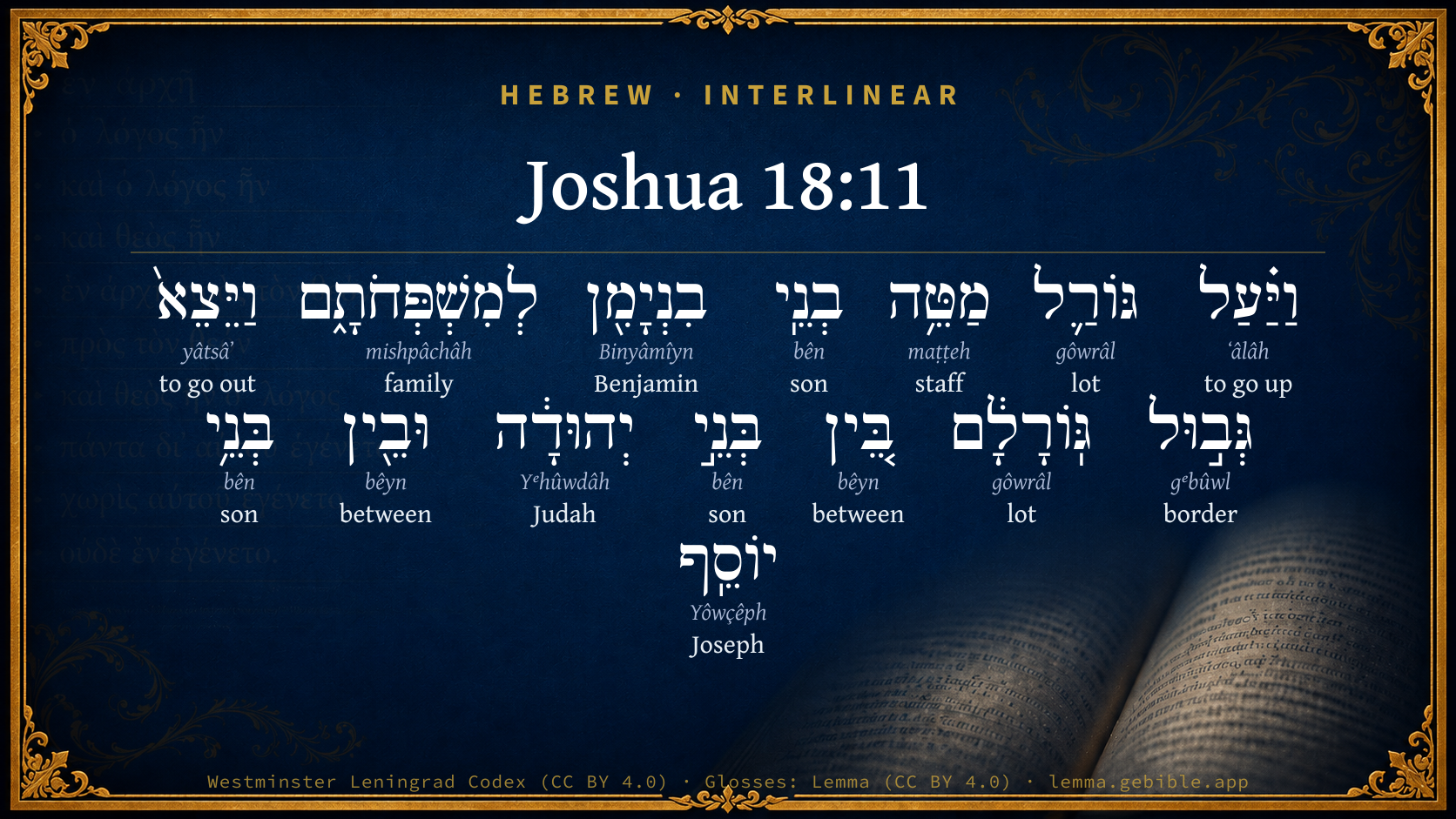
  1. וַיַּ֗עַל ʻâlâh H5927 “and · to go up” Conjunction + Verb, Qal, Sequential Imperfect, 3rd Person, Masculine, Singular
  2. מַטֵּ֥ה maṭṭeh H4294 “staff of” Noun, Common, Masculine, Singular, Construct
  3. בְנֵֽי bên H1121 “sons of” Noun, Common, Masculine, Plural, Construct
  4. בִנְיָמִ֖ן Binyâmîyn H1144 “Benjamin” Noun, Proper
  5. לְמִשְׁפְּחֹתָ֑ם mishpâchâh H4940 “to/for · families · their” Preposition + Noun, Common, Feminine, Plural, Construct + Suffix, Personal, 3rd Person, Masculine, Plural
  6. וַיֵּצֵא֙ yâtsâʼ H3318 “and · to go out” Conjunction + Verb, Qal, Sequential Imperfect, 3rd Person, Masculine, Singular
  7. גְּב֣וּל gᵉbûwl H1366 “border of” Noun, Common, Masculine, Singular, Construct
  8. גּֽוֹרָלָ֔ם gôwrâl H1486 “lot · their” Noun, Common, Masculine, Singular, Construct + Suffix, Personal, 3rd Person, Masculine, Plural
  9. בֵּ֚ין bêyn H996 “between” Preposition
  10. בְּנֵ֣י bên H1121 “sons of” Noun, Common, Masculine, Plural, Construct
  11. יְהוּדָ֔ה Yᵉhûwdâh H3063 “Judah” Noun, Proper
  12. וּבֵ֖ין bêyn H996 “and · between” Conjunction + Preposition
  13. בְּנֵ֥י bên H1121 “sons of” Noun, Common, Masculine, Plural, Construct
  14. יוֹסֵֽף Yôwçêph H3130 “Joseph” Noun, Proper

About this verse

These counts appear in no published source. They are computed here, from the morphology-tagged text and Lemma’s own curated glosses. What Lemma adds →

15
words
11
distinct lemmas
Historical
section

Grammatical profile

  • 2 verbs
  • 11 nouns
  • 2 prepositions

Verb forms

  • וַיַּ֗עַל Qal · Sequential Imperfect
  • וַיֵּצֵא֙ Qal · Sequential Imperfect

Repetition

Words recur within this verse — often emphatic in Hebrew:

  • בְנֵֽי son H1121 ×3
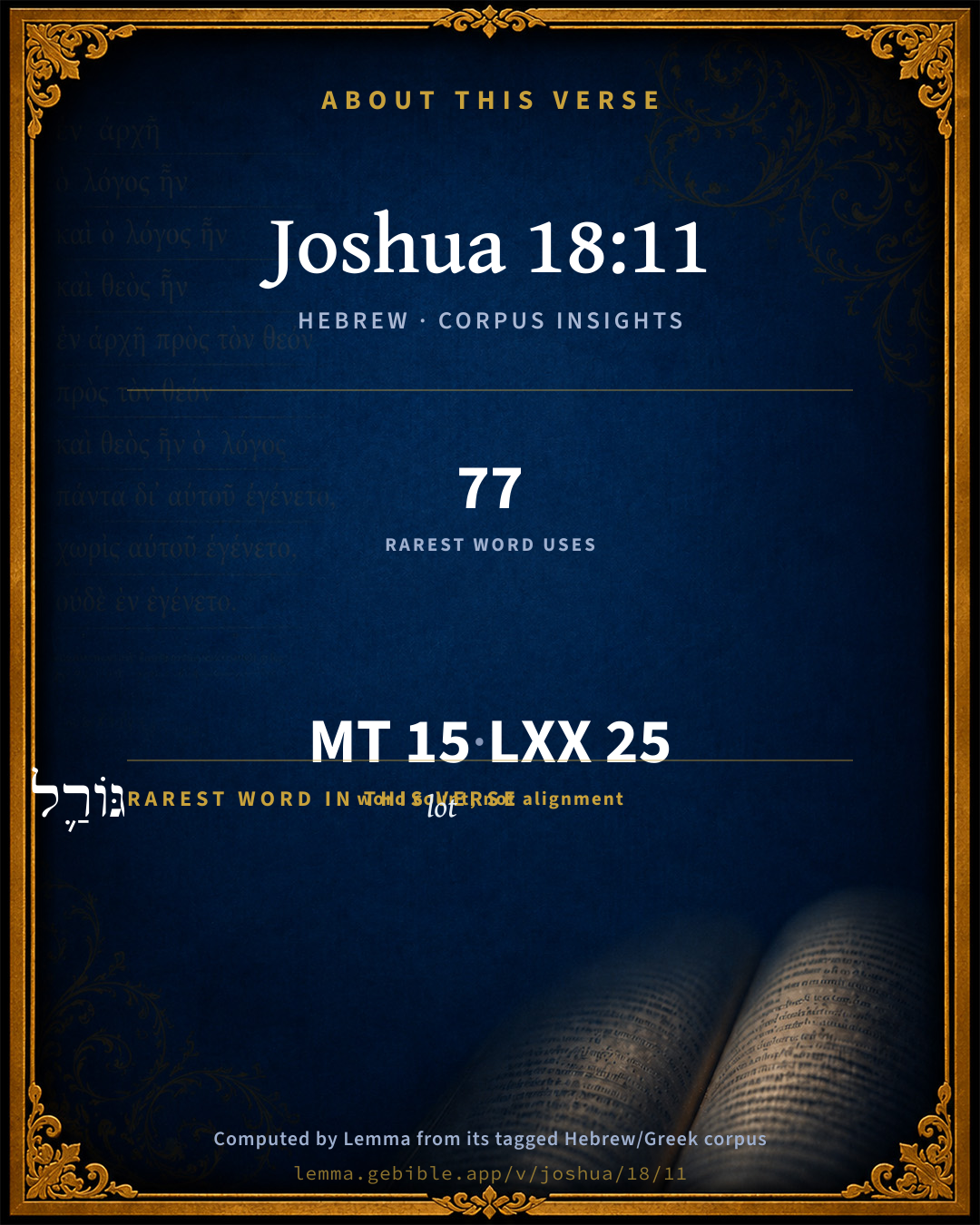
  • גּוֹרַ֛ל lot H1486 ×2
  • בֵּ֚ין between H996 ×2

Hebrew & Septuagint length

In English translation the verse runs 34 words from the Hebrew and 33 from the Septuagint (LXX English) — closely comparable.

A rough comparison of the two English renderings, which tokenize alike — not a word-level alignment.

Word counts can differ between the Hebrew and the Greek without any difference in meaning — e.g. the Hebrew direct-object marker אֵת has no separate Greek word, and Greek often adds the article ὁ.

In the original languages it is 15 Hebrew tokens and 25 Greek tokens — but the two are counted differently (Hebrew bundles its prefixes and suffixes into one token; the Greek is in lemma form), so that isn’t a like-for-like length.

Cross-references

4

Topical passages linked to Joshua 18:11 in the Treasury of Scripture Knowledge — connected by theme and wording, ordered by reader-vote popularity; previews shown in the World English Bible.

  • Deuteronomy 10:1–22 At that time Yahweh said to me, Hew you two tables of stone like the first, and come up to me onto the mountain, and make an ark of wood.
  • Deuteronomy 13:12 If you shall hear tell concerning one of your cities, which Yahweh your God gives you to dwell there, saying,
  • Joshua 15:1–8 The lot for the tribe of the children of Judah according to their families was to the border of Edom, even to the wilderness of Zin southward, at the uttermost part of the south.
  • Joshua 16:1–10 The lot came out for the children of Joseph from the Jordan at Jericho, at the waters of Jericho on the east, even the wilderness, going up from Jericho through the hill-country to Bethel;

Cross-references courtesy of OpenBible.info (CC BY 4.0).

Hebrew and Greek witnesses Masoretic Hebrew ↔ Greek Septuagint

The same verse in the two great witnesses to the Old Testament, shown verse-for-verse.

These are two independent witnesses, not word-aligned to each other, and the Septuagint is shown in lemma (dictionary) form.

Hebrew Joshua 18:11 Masoretic · Westminster Leningrad Codex

וַיַּ֗עַל גּוֹרַ֛ל מַטֵּ֥ה בְנֵֽי בִנְיָמִ֖ן לְמִשְׁפְּחֹתָ֑ם וַיֵּצֵא֙ גְּב֣וּל גּֽוֹרָלָ֔ם בֵּ֚ין בְּנֵ֣י יְהוּדָ֔ה וּבֵ֖ין בְּנֵ֥י יוֹסֵֽף

The lot of the tribe of the children of Benjamin came up according to their families: and the border of their lot went out between the children of Judah and the children of Joseph.

World English Bible · Public Domain

Greek LXX Joshua 18:11 Septuagint · lemma form

καί ἐκἔρχομαι ὁ κλῆρος φυλή βενιαμίν πρῶτος κατά δῆμος αὐτός καί ἐκἔρχομαι ὅριον ὁ κλῆρος αὐτός ἀνά μέσος ιουδα καί ἀνά μέσος ὁ υἱός ιωσηφ

And the lot of the tribe of Benjamin came forth first according to their families: and the borders of their lot came forth between the children of Juda and the children of Joseph.

LXX2012 (modern English Septuagint) · Public Domain

Hebrew: Westminster Leningrad Codex (CC BY 4.0). Greek: Septuagint (public domain); English from LXX2012 (modern English Septuagint) (Public Domain). How the Septuagint differs from the Hebrew →

Targum (Aramaic paraphrase)

1

The Targum is the ancient Jewish Aramaic paraphrase of the Hebrew Scriptures — an interpretive translation, not the Hebrew text itself. Onkelos (literal) and Pseudo-Jonathan (expansive) render the Torah, and Jonathan the Prophets. Coverage is partial: where no permissively-licensed English translation exists for a verse, only the Aramaic is shown. This is verse-level text, not a word-by-word alignment to the Hebrew.

  1. Targum Jonathan Prophets (Joshua–Malachi)
    וּסְלִיק עַדְבָא שִׁבְטָא דִבְנֵי בִנְיָמִן לְזַרְעֲיַתְהוֹן וּנְפַק תְּחוּם עַדְבֵיהוֹן בֵּין בְּנֵי יְהוּדָה וּבֵין בְּנֵי יוֹסֵף:

    (no public-domain English translation for this verse)

    Targum Jonathan — Aramaic: “Mikraot Gedolot” (public domain). English: “Sefaria Community Translation” (CC0 1.0 (public-domain dedication)); “London "Chaldee Paraphrase," 1871” (public domain). Text via Sefaria.

Commentary

Notes on Joshua 18:11 from classic Christian and Jewish commentators (each source and its license shown beneath its notes). The classic Christian expositions comment on the surrounding passage and are grouped to its opening verse, so a note may address several verses; the Jewish commentaries on the Tanakh (Rashi and others) are per-verse, so they appear only where the commentator wrote on this verse.

Lemma curates 59 commentaries, every one of them public domain or Creative Commons licensed, each selected and text-cleaned for this edition rather than reprinted as found. About our sources →

Trapp's Complete Commentary

John Trapp

Jos 18:11 And the lot of the tribe of the children of Benjamin came up according to their families: and the coast of their lot came forth between the children of Judah and the children of Joseph.

Ver. 11. Between the children of Judah and the children of Joseph.] This was as well as heart could wish; what could God do more for Jacob’s darling, and for the fulfilling of Moses’s prophecy? {Deu 33:12} It is a great happiness doubtless to be well neighboured; and yet a greater to be near the place where God’s honour dwelleth. The league betwixt Judah and Benjamin lasted, as if they had been but one tribe, when the rest revolted with Jeroboam. The city of Jerusalem was divided betwixt them, though the greater part of it belonged to Benjamin, and when the Jebusites were to be thence expelled, both these tribes joined their forces together, {Jdg 1:8; Jdg 1:21} as Judah and Simeon did in a like case. {Jdg 1:3}

John Trapp, A Commentary or Exposition upon All the Books of the Old and New Testament (1647–1656) — public domain. Text from a community e-Sword module.

Joseph Benson's Commentary

Jos 18:11. The lot of Benjamin came up — No doubt it was by peculiar direction of Providence that the children of Benjamin should have the first lot of these seven, next to the children of Joseph, they two being the only sons of Rachel, the beloved wife of Jacob. For thus it happened that their coast, or the portion assigned them, lay between the children of Judah, who were on the south of them, and the children of Joseph, the Ephraimites in particular, who lay on the north of them; the only place in which the prophecy contained in Deu 33:12, could have been accomplished. And it is observable, that, in that blessing of Moses, Benjamin is placed between Judah and Joseph, Levi having no inheritance among them. But Providence placed Benjamin here, not only that he might be next to Joseph, his own and only brother, on the one hand; but that, being next to Judah on the other, this tribe might hereafter unite with Judah, in an adherence to the throne of David, and the temple of Jerusalem.

Joseph Benson's Commentary on the Old and New Testaments (1811–1818) — public domain. Text from a community e-Sword module.

Whedon's Commentary on the Bible

Daniel D. Whedon

BENJAMIN’S LOT, Jos_18:11-28.

Benjamin’s lot lay on the south of the sons of Joseph, so that the descendants of Rachel were all adjoining, and in the very heart of the land. As Benjamin’s lot included Mount Moriah, the site of the sacred edifice, we find here a remarkable fulfilment of the prophecy in Deu_33:12. “Hemmed in as it was between the two powerful neighbours of Ephraim and Judah, the tribe of Benjamin, nevertheless, retained a character of its own, eminently indomitable and insubordinate. The wolf which nursed the founders of Rome was not more evidently repeated in the martial qualities of the people of Romulus, than the wolf to which Benjamin is compared in his father’s blessing, (Gen_49:27,) appears in the eager, restless character of his descendants.” — Stanley.

11. Lot… of Benjamin came up — “The lot comes up when it is drawn out of the urn.” — Masius.

Daniel D. Whedon (gen. ed.), Commentary on the Old and New Testaments (1874–1909) — public domain. Text from a community e-Sword module.

Keil & Delitzsch

C. F. Keil & F. Delitzsch

Inheritance of the Tribe of Benjamin. - Jos 18:11-20. Boundaries of the inheritance. - Jos 18:11. The territory of their lot (i.e., the territory assigned to the Benjaminites by lot) came out (through the falling out of the lot) between the sons of Judah and the sons of Joseph.

Jos 18:12-14

The northern boundary ("the boundary towards the north side") therefore coincided with the southern boundary of Ephraim as far as Lower Beth-horon, and has already been commented upon in the exposition of Jos 16:1-3. The western boundary follows in Jos 18:14. At Beth-horon the boundary curved round and turned southwards on the western side, namely from the mountain before (in front of) Beth-horon southwards; and "the going out thereof were at Kirjath-baal, which is Kirjath-jearim," the town of the Judaeans mentioned in Jos 15:60, the present Kureyet el Enab (see at Jos 9:17).

Jos 18:15-19

"As for the southern boundary from the end of Kirjath-jearim onwards, the (southern) boundary went out on the west (i.e., it started from the west), and went out (terminated) at the fountain of the water of Nephtoah." Consequently it coincided with the northern boundary of Judah, as described in Jos 15:5-9, except that it is given there from east to west, and here from west to east (see at Jos 15:5-9). In the construction haגּבוּל תּוצאותיו, the noun הגּבוּל is in apposition to the suffix: the outgoings of it, namely of the border (see Ewald, 291, b.).

Jos 18:20

The eastern boundary was the Jordan.

Jos 18:21-28

The towns of Benjamin are divided into two groups. The first group (Jos 18:21-24) contains twelve towns in the eastern portion of the territory. Jericho: the present Riha (see at Jos 2:1). Beth-hoglah, now Ain Hajla (see Jos 15:6). Emek-keziz: the name has been preserved in the Wady el Kaziz, on the road from Jerusalem to Jericho, on the south-east of the Apostle's Well (see Van de Velde, Mem. p. 328).

Jos 18:22

Beth-arabah: see at Jos 15:6. Zemaraim, probably the ruins of es Sumrah, on the road from Jerusalem to Jericho, to the east of Khan Hadhur, on Van de Velde's map. Bethel: now Beitin (see Jos 7:2).

Jos 18:23

Avvim (i.e., ruins) is unknown. Phara has been preserved in the ruins of Fara, on Wady Fara, three hours to the north-east of Jerusalem, and the same distance to the west of Jericho. Ophrah is mentioned again in Sa1 13:17, but it is a different place from the Ophrah of Gideon in Manasseh (Jdg 6:11, Jdg 6:24; Jdg 8:27). According to the Onom. (s. v. Aphra), it was a κώμη Ἀφρήλ in the time of Eusebius (Jer. vicus Effrem), five Roman miles to the east of Bethel; and according to Van de Velde, v. Raumer, and others, it is probably the same place as Ephron or Ephrain, which Abijah took from Jeroboam along with Jeshanah and Bethel (Ch2 13:19), also the same as Ephraim, the city to which Christ went when He withdrew into the desert (Joh 11:54), as the Onom. (s. v. Ephron) speaks of a villa praegrandis Ephraea nomine (Ἐφρα̈́́ι in Euseb.), although the distance given there, viz., twenty Roman miles to the north of Jerusalem, reaches far beyond the limits of Benjamin.

Jos 18:24

Chephar-haammonai and Ophni are only mentioned here, and are still unknown. Gaba, or Geba of Benjamin (Sa1 13:16; Kg1 15:22) which was given up to the Levites (Jos 21:17; Ch1 6:45), was in the neighbourhood of Ramah (Kg1 15:22; Ch2 16:6). It is mentioned in Kg2 23:8; Zac 14:10, as the northern boundary of the kingdom of Judah, and was still inhabited after the captivity (Neh 7:30). It is a different place from Gibea, and is not to be found, as I formerly supposed, in the Moslem village of Jibia, by the Wady el Jib, between Beitin and Sinjil (Rob. iii. p. 80), but in the small village of Jeba, which is lying half in ruins, and where there are relics of antiquity, three-quarters of an hour to the north-east of er-Rm (Ramah), and about three hours to the north of Jerusalem, upon a height from which there is an extensive prospect (vid., Rob. ii. pp. 113ff.). This eastern group also included the two other towns Anathoth and Almon (Jos 21:18), which were given up by Benjamin to the Levites. Anathoth, the home of the prophet Jeremiah (Jer 1:1; Jer 11:21.), which was still inhabited by Benjaminites after the captivity (Neh 11:32), is the present village of Anta, where there are ruins of great antiquity, an hour and a quarter to the north of Jerusalem (Rob. ii. pp. 109ff.). Almon, called Allemeth in Ch1 6:45, has been preserved in the ruins of Almt (Rob. Bibl. Res. pp. 287ff.), or el-Mid (Tobler, Denkbl. p. 631), on the south-east of Anta.

Jos 18:25-28

The second group of fourteen towns in the western portion of Benjamin. - Jos 18:25. Gibeon, the present Jib: see at Jos 9:3. Ramah, in the neighbourhood of Gibeah and Geba (Jdg 19:13; Isa 10:29; Kg1 15:17; Ezr 2:26), most probably the Ramah of Samuel (Sa1 1:19; Sa1 2:11; Sa1 25:1; Sa1 28:3), is the present village of er-Rm, upon a mountain with ruins between Gibeon and Geba, half an hour to the west of the latter, two hours to the north of Jerusalem (see Rob. ii. p. 315). Beeroth, the present Bireh: see at Jos 9:17.

Jos 18:26-27

Mizpeh, commonly called Mizpah, where the war with Benjamin was decided upon (Judg 20-21), and where Samuel judged the people, and chose Saul as king (Sa1 7:5., Jos 10:17), was afterwards the seat of the Babylonian governor Gedaliah (Kg2 25:23; Jer 40:6.). According to the Onom. (s. v. Massepha), it was near Kirjath-jearim, and Robinson (ii. p. 139) is no doubt correct in supposing it to be the present Neby Samvil (i.e., prophet Samuel), an hour and a quarter to the east of Kureyet Enab (Kirjath-jearim), two hours to the north-west of Jerusalem, half an hour to the south of Gibeon, a place which stands like a watch-tower upon the highest point in the whole region, and with a mosque, once a Latin church, which is believed alike by Jews, Christians, and Mahometans to cover the tomb of the prophet Samuel (see Rob. ii. pp. 135ff.). Chephirah, i.e., Kefir: see at Jos 9:17. Mozah is only mentioned here, and is still unknown. Jos 18:27. This also applies to Rekem, Irpeel, and Taralah.

Jos 18:28

Zelah, the burial-place of Saul and his family (Sa2 21:14), is otherwise unknown. Gibeath or Gibeah, i.e., Gibeah of Benjamin, which was destroyed by the other tribes of Israel in the time of the judges, on account of the flagrant crime which had been committed there (Judg 19-20), is also called Gibeah of Saul, as being the home and capital of Saul (Sa1 10:26; Sa1 11:4, etc.), and was situated, according to Jdg 19:13 and Isa 10:29, between Jerusalem and Ramah, according to Josephus (Bell. Jud. v. 2, 1, 8) about twenty or thirty stadia from Jerusalem. These statements point to the Tell or Tuleil el Phul, i.e., bean-mountain, a conical peak about an hour from Jerusalem, on the road to er-Rm, with a large heap of stones upon the top, probably the ruins of a town that was built of unhewn stones, from which there is a very extensive prospect in all directions (Rob. ii. p. 317). Consequently modern writers have very naturally agreed in the conclusion, that the ancient Gibeah of Benjamin or Saul was situated either by the side of or upon this Tell (see Rob. Bibl. Res. p. 286; Strauss, Sinai, etc., p. 331, ed. 6; v. Raumer, Pal. p. 196). Kirjath has not yet been discovered, and must not be confounded with Kirjath-jearim, which belonged to the tribe of Judah (Jos 18:14; cf. Jos 15:60).

Keil & Delitzsch — Biblical Commentary on the Old Testament (1861–1891) — public domain (CC PDM 1.0). Text via the HelloAO Bible API. (Old Testament only.)

Tyndale Open Study Notes

Tyndale Open Resources

18:11 Benjamin was Jacob’s twelfth and last son, and the second son of Rachel, Jacob’s favorite wife. The land received by his descendants reflected this favored position; they received a small but central portion between . . . Judah and Joseph.

Tyndale Open Study Notes — © Tyndale Open Resources, licensed CC BY-SA 4.0. Text via the HelloAO Bible API.

Geneva Bible (1599)

Geneva Bible translators

Their inheritance bordered upon Judah and Joseph.

Geneva Bible (1599) marginal notes — public domain. Text via Bolls.life.

Matthew Henry's Commentary

We have here the lot of the tribe of Benjamin, which Providence cast next to Joseph on the one hand, because Benjamin was own and only brother to Joseph, and was little Benjamin (Psa 68:27), that needed the protection of great Joseph, and yet had a better protector, for the Lord shall cover him all the day long, Deu 33:12. And it was next to Judah on the other hand, that this tribe might hereafter unite with Judah in an adherence to the throne of David and the temple at Jerusalem. Here we have, 1. The exact borders and limits of this tribe, which we need not be exact in the explication of. As it had Judah on the south and Joseph on the north, so it had Jordan on the east and Dan on the west. The western border is said to compass the corner of the sea southward (Jos 18:14), whereas no part of the lot of this tribe came near to the great sea. Bishop Patrick thinks the meaning is that it ran along in a parallel line to the great sea, though at a distance. Dr. Fuller suggests that since it is not called the great sea, but only the sea, which often signifies any lake or mere, it may be meant of the pool of Gibeon, which may be called a corner or canton of the sea; it is called the great waters of Gibeon (Jer 41:12), and it is compassed by the western border of this tribe. 2. The particular cities in this tribe, not all, but the most considerable. Twenty-six are here named. Jericho is put first, though dismantled, and forbidden to be rebuilt as a city with gates and walls, because it might be built and inhabited as a country village, and so was not useless to this tribe. Gilgal, where Israel first encamped when Saul was made king (Sa1 11:15), was in this tribe. It was afterwards a very profane place. Hos 9:15, All their wickedness is in Gilgal. Beth-el was in this tribe, a famous place. Though Benjamin adhered to the house of David, yet Beth-el, it seems, was in the possession of the house of Joseph (Jdg 1:23-25), and there Jeroboam set up one of his calves. In this tribe was Gibeon, where the altar was in the beginning of Solomon's time, Ch2 1:3. Gibeah likewise, that infamous place where the Levite's concubine was abused. Mizpeh, and near it Samuel's Ebenezer, and also Anathoth, Jeremiah's city, were in this tribe, as was the northern part of Jerusalem. Paul was the honour of this tribe (Rom 11:1; Phi 3:5); but where his land lay we know not: he sought the better country.

Matthew Henry's Commentary on the Whole Bible (1708–1710) — public domain (CC PDM 1.0). Text via the HelloAO Bible API.

Jamieson, Fausset & Brown

Robert Jamieson, A. R. Fausset & David Brown

the lot of . . . Benjamin came up--It has been supposed that there were two urns or vessels, from which the lots were drawn: one containing the names of the tribes, the other containing those of the seven portions; and that the two were drawn out simultaneously.

the coast of their lot came forth between the children of Judah and the children of Joseph--Thus the prophecy of Moses respecting the inheritance of Benjamin was remarkably accomplished. (See on Deu 33:12).

Next: Joshua Chapter 19

Jamieson, Fausset & Brown — Commentary Critical and Explanatory on the Whole Bible (1871) — public domain (CC PDM 1.0). Text via the HelloAO Bible API.

Adam Clarke's Commentary

Verse 11. And the lot - of Benjamin came up] On the manner of casting the lot, see on Jos 14:2, and Nu 26:55. There were probably two urns, one of which contained the names of the seven tribes, and the other that of the seven portions. They therefore took out one name out of the first urn, and one portion out of the second, and thus the portion was adjudged to that tribe.

Adam Clarke's Commentary on the Bible (1810–1826) — public domain. Text from a community e-Sword/MySword module.

John Calvin's Commentaries

In the lot of Benjamin nothing occurs particularly deserving of notice, unless that a small tribe takes precedence of the others. I admit, indeed, that its limits were narrowed in proportion to the fewness of its numbers, because it obtained only twenty-six cities; but still an honor was bestowed upon it in the mere circumstance of its receiving its inheritance before more distinguished tribes. We may add, that in this way they were conjoined and made neighbors to the other children of Joseph, with whom their relationship was more immediate. For they were placed in the middle between the children of Ephraim and Manasseh on the one side, and those of Judah on the other. They had also the distinguished honor of including Jerusalem in their inheritance, though they afterwards granted it by a kind of precarious tenure to the children of Judah for a royal residence.

It is strange, however, that having obtained such a quiet locality, they did not live on peaceful and friendly terms with their neighbors. But we possess the prophecy of Jacob,

“Benjamin shall ravin as a wolf; in the morning he shall devour the prey, and at night he shall divide the spoil.” (Genesis 49:27)

They must, therefore, have been by nature of a covetous and turbulent disposition, or from some necessity not now known to us, they must have been impelled to live upon plunder. In regard to the city of Luz, the other name is added, (“the same is Bethel,”) because then only did the name given by Jacob come into common use. (Genesis 28:19) It was at no great distance from Beth-Aven, whose name, as it was opprobrious and infamous, was transferred to Bethel itself, after it was corrupted and polluted by impious superstitions. It is probable that Ciriath-Baal was called Ciriath-Jeharim, to take away the name of the idol, which would have been a stain on its true piety. For it certainly would have been base and shameful that the lips of the people should have been polluted by the name of a protector who was an enemy to the true God.

John Calvin's Commentaries (1540-1563) — public domain. Text from the Calvin Translation Society English edition (1840s-50s) via the Christian Classics Ethereal Library (ccel.org). Calvin's coverage is partial (roughly two-thirds of the Bible); uncommented books and verses are honest gaps, never fabricated. The 19th-century editor's footnotes and remarks are omitted so the notes are faithfully Calvin's own voice.

Ellicott's Commentary for English Readers

THE INHERITANCE OF BENJAMIN.

(11-28) The lot of the tribe of the children of Benjamin.—It can have been by no accident that their lot came forth “between Judah and Joseph.” No wiser method could have been devised to secure an united Israel than thus to make Benjamin the link between the two most powerful and naturally rival tribes. In the story of Joseph, the brethren are reconciled through the mutual affection of Judah and Joseph for Benjamin as their father’s youngest and best-loved son.

The position thus given to Benjamin under Joshua was still further developed by circumstances. The tribe was almost exterminated in the time of the judges; the survivors were united in marriage with women of Ephraim and Manasseh (?). On the other hand, the city of Jerusalem, although assigned by Joshua to Benjamin, was first a joint possession of Judah and Benjamin (1Ch_8:28; 1Ch_8:32; Jdg_1:8; Jdg_1:21), then the royal city of the kings of the house of Judah. The selection of the first king of Israel from Benjamin, and the ultimate planting of the religious and political centre of all the tribes on the confines of Judah and Benjamin in Jerusalem, would have been two masterstrokes of policy if they had been schemes of man’s devising. They were really links in the long chain of God’s providential dealing with the chosen people.

(12) And their border.—This is first described on the north side, where it coincided with the southern border of Ephraim. Conder draws it from El ‘Aujeh (sheet 15), five miles north of Jericho, towards Beth-el (Beitin), perhaps going along the Wâdy’ Aujeh, Beth-el lying within the territory of Benjamin (Jos_18:22), and so on to Archi (Jos_16:2), now Ain ‘Arik (near the top of sheet 17), and thence to Ataroth-addar (Ed-Dârieh), near Beth-horon the nether (Beit- ûr-et-Tahta). This line is from east to west.

(14) And the border was drawn thence . . .—At this point it turns southward, and runs from the neighbourhood of Beth-horon to Kirjath-jearim (Khurbet ‘Erma, in sheet 17: very small, and not easily found).

Corner of the sea.—Ph’ath Yâm, “the west side.”

(15) And the south quarter.—Here the borderline again turns to the east, and runs to Ain Atân (the waters of Nephtoah), near Bethlehem. Thence it turns to the north-east, and follows the line described above (Jos_15:6-8) as the northern boundary of Judah.

(17) The stone of Bohan the son of Reuben must have been near the Jordan. Is it possible that Bohan, the son of Reuben, did on his own account what was done for all Israel by the command of Joshua? (Jos_4:8).

(21) The cities of the tribe of . . . Benjamin.—The following are identified: viz., in Jos_18:21, ‘Ain-es-Sultan,’ Ain Hajlah (sheet 18); Jos_18:22, Khurbet es-Súmnrah, Beitin (sheet 18); Jos_18:23, Fâtah (sheet 18), Taiyibeh (sheet 14); Jos_18:24, Jeb ‘a (sheet 17).

(22) Beth-el seems to have passed into the hands of Ephraim without question when the tribe of Benjamin was all but exterminated. In the division of the kingdoms, though the tribe of Benjamin followed the house of Judah, the town of Bethel was regarded as part of the kingdom of Israel, and Jeroboam’s southern boundary. He set up two golden calves, one in Bethel and the other in Dan, at the northern and southern extremities of his kingdom.

(25) El-Jêb, Er-Râm, Bireh (all in sheet 17).

(26) Sh’afât, Kejîreh, Beit Mizzeh (Kefireh, i.e., Kefriyeh, sheet 14); the others are in sheet 17

(27) Râfât (sheet 17).

(28) Lifta, El-Kuds, Jebî’a, Kuriet-el-’ anab (all in sheet 17).

(28) Jebusi, which is Jerusalem.—When “Jerusalem, Jerusalem, which killed the prophets, and stoned them that were sent unto her,” was called to account for “all the righteous blood shed upon the earth,” the cup was found in Benjamin’s sack, having been put there, as we see, by Joshua, the steward (after Moses) of the true Joseph’s house. (See Names on the Gates of Pearl—Benjamin, p. 191.) Jerusalem is always thought of as the capital of Judah. Probably few readers of the Bible would answer, if asked for its position, that it was originally a Benjamite city. And we may add that no later writer than Joshua would be likely to have placed it in the territory of Benjamin.

A Bible Commentary for English Readers, edited by Charles John Ellicott (1878–1897) — public domain. Text from a community e-Sword module.

The Cambridge Bible for Schools and Colleges

gen. ed. J. J. S. Perowne

11–20. Boundaries of the Tribe of Benjamin

11. between the children of Judah and the children of Joseph] When the lots were now cast “before the Lord,” the lot of Benjamin came forth first, and we have an account of (a) the boundaries, and then (b) of the cities of this tribe, which, we are here told, lay between the sons of Judah on the south and the sons of Joseph on the north.

The Cambridge Bible for Schools and Colleges (gen. ed. J. J. S. Perowne; Cambridge University Press, 1878–1918) — public domain. Text from a community e-Sword module.

John Gill's Exposition

And the lot of the tribe of the children of Benjamin came up according to their families,.... This was the first lot of the seven that came up; it was but a small lot, and therefore called "little Benjamin", Psa 68:27; but the land was very pleasant and fruitful. Josephus (h) says, this lot was very strait, because of the goodness of the soil, for it took in Jericho, and the city of Jerusalem:

and the coast of their lot came forth between the children of Judah and the children of Joseph; having Judah on the south, and Joseph on the north; this was so ordered by the providence of God, that Benjamin should lie close to Joseph, being own brothers, and the only children of Rachel, Jacob's beloved wife; and that it should be next to Judah, with whom it was to unite, both in religious and civil affairs, and both met in and had a part of Jerusalem, the metropolis of Israel; and this lot fell exactly according to the prediction of Moses, and the order of it, who places Benjamin between Judah and Joseph, the tribe of Levi having no share in the division of the land, Deu 33:7.

(h) Antiqu. l. 5. c. 1. sect. 22.

John Gill's Exposition of the Whole Bible (1746–1763) — public domain (CC PDM 1.0). Text via the HelloAO Bible API.

Albert Barnes' Notes on the Bible

See the marginal references. There are many indications found in this and the next chapter that the text is in great disorder, and many of the places are still unknown.

Jos 18:14

And compassed the corner ... - Render “and turned on the west side southward.” The meaning is, that at lower Beth-horon the northern boundary-line of Benjamin curved round and ran southward - Beth-horon being its extreme westerly point.

Jos 18:21

The “Valley of Keziz,” or “Emek-Keziz,” is perhaps the “Wady el Kaziz,” at no great distance east of Jerusalem.

Jos 18:22

Zemaraim, i. e. “two wooded hills,” is supposed to be the ruins called “Es-Sumrah,” on the road from Jerusalem to Jericho.

Jos 18:23

Ophrah (Jos 15:9 note), to be distinguished here and in 1Sa 13:17 from the Ophrah of Jdg 6:11, is probably the Ephrain of 2Ch 13:19, and the Ephraim of Joh 11:54. It is conjecturally identified with “Et-Taiyibeh,” on the road from Jerusalem to Bethel.

Jos 18:24

Gaba - This name, like Gibeah, Gibeon, etc. Jos 9:3, indicates a town placed on a hill, and occurs repeatedly in various forms in the topography of Palestine. Gaba is the Gibeah (if 1Sa 13:15-16; 1Sa 14:5, where the Hebrew has גבע Geba‛, which is undoubtedly the correct reading throughout. The city was one of those assigned to the Levites Jos 21:17, and lay on the northern border of Judah. It is identified with the modern “Jeba,” lying on the side of a deep ravine opposite to Michmash (“Mukhmas”). The famous “Gibeah of Saul,” or “Giheah of Benjamin” (the Gibeath of Jos 18:28) lay at no great distance southwest of Geba, on the high road from Jerusalem to Bethel, and is probably to be looked for in the lofty and isolated “Tulcil-el-Ful.”

Jos 18:25

Ramah - i. e. “lofty;” probably the native town and abode of Samuel 1Sa 1:19; 1Sa 25:1. Its exact site is uncertain.

Jos 18:26

Mizpeh - See Jos 11:3. Not the Mizpeh of Jos 15:38, but the place where Samuel judged the people and called them together for the election of a king 1Sa 7:5-16; 1Sa 10:17. In the Chaldaean times it was the residence of Gedaliah 2Ki 25:22; Jer 40:14. Its site is identified with “Neby Samwil,” about five miles northwest of Jerusalem.

Albert Barnes' Notes on the Bible (1834–1885) — public domain. Text from a community e-Sword/MySword module.

Haydock's Catholic Bible Commentary

First. A person might proclaim that the tribe, whose name was drawn first out of the urn, should have the territory which was described in the book by the land surveyors; or the names of the seven tribes might be in one urn, and seven parcels of land in another. (Calmet)

George Leo Haydock (1774–1849), Haydock's Catholic Family Bible and Commentary, 1859 edition — public domain. Excludes Psalms (Douay-Rheims chapter numbering differs from Protestant) and Deuterocanonical books (Catholic canon only).

Matthew Poole's English Annotations

Wherein we see the wisdom of Divine Providence, this being the only place in which that prophecy, Deu 33:12, could have been accomplished.

Matthew Poole's English Annotations on the Holy Bible (1683–1685) — public domain. Text from a community e-Sword/MySword module.

The Pulpit Commentary

The children of Benjamin. Lying as their inheritance did between that of Ephraim and Judah, the chief places of note on their border have been already mentioned either in Jos 15 or in Jos 16.

The Pulpit Commentary (1880–1919), ed. H.D.M. Spence-Jones & Joseph S. Exell — public domain. Text from a community e-Sword module.

John Wesley's Explanatory Notes

And the children of Joseph - Wherein we see the wisdom of Divine Providence, this being the only place in which that prophecy, Deut. xxxiii, 12, could have been accomplished. Providence cast Benjamin next to Joseph on the one hand, because Benjamin was own and only brother to Joseph, and next to Judah on the other hand, that this tribe might hereafter unite with Judah, in an adherence to the throne of David, and the temple at Jerusalem.

John Wesley, Explanatory Notes Upon the Whole Bible (1754–1765) — public domain. Text via the GEBible commentary corpus.

unfoldingWord translationNotes

Door43 World Missions Community

between the descendants of Judah and the descendants of Joseph

"between the land that belonged to the descendants of Judah and the land that belonged to the descendants of Joseph"

the descendants of Joseph

This refers to the tribes of Ephraim and Manasseh. (See: Assumed Knowledge and Implicit Information)

Beth Aven

This is the name of a place. (See: How to Translate Names)

translationWords

tribe

Benjamin

clan

descend

Judah

Joseph (OT)

Jericho

desert

unfoldingWord translationNotes — © Distant Shores Media and the Door43 World Missions Community, licensed CC BY-SA 4.0. Source: git.door43.org/Door43/en_tn.

Lesson kit

Teaching starters — assembled from the data on this page, not authored interpretation. Every prompt links to the verse data it draws on. Edit before teaching.

Joshua, in the Historical, opens this verse with 15 words (11 distinct Hebrew lemmas). Its most distinctive word is gôwrâl (“lot”). A historical commentator’s framing appears above. Read the whole chapter for the surrounding context.

Discussion questions

  1. The word gôwrâl carries the sense “lot.” How does it shape the verse?
  2. How does Deuteronomy 10:1–22, which shares this passage’s theme, read alongside this verse?
  3. What does the repetition of “son” (3× in this one verse) do in this verse?
  4. These translations render this verse differently. What is at stake in choosing one wording over another?
  5. «וַיַּ֗עַל» is a Qal Sequential Imperfect verb. How does that grammatical form shape the action described?
  6. Compare how Trapp's Complete Commentary and Joseph Benson's Commentary read this verse. Where do they agree or differ?

Things to notice

Reading settings

Reading text

Shown beneath each verse's original-language words.

Old Testament
Old Testament edition

Read the OT as the Masoretic Hebrew (MT) or the Greek Septuagint (LXX).

English shown for the Greek Septuagint (in the Hebrew ↔ Greek comparison).

Comparing translations? Open the Compare panel on any verse page to stack up to four side by side.