Genesis 31:51

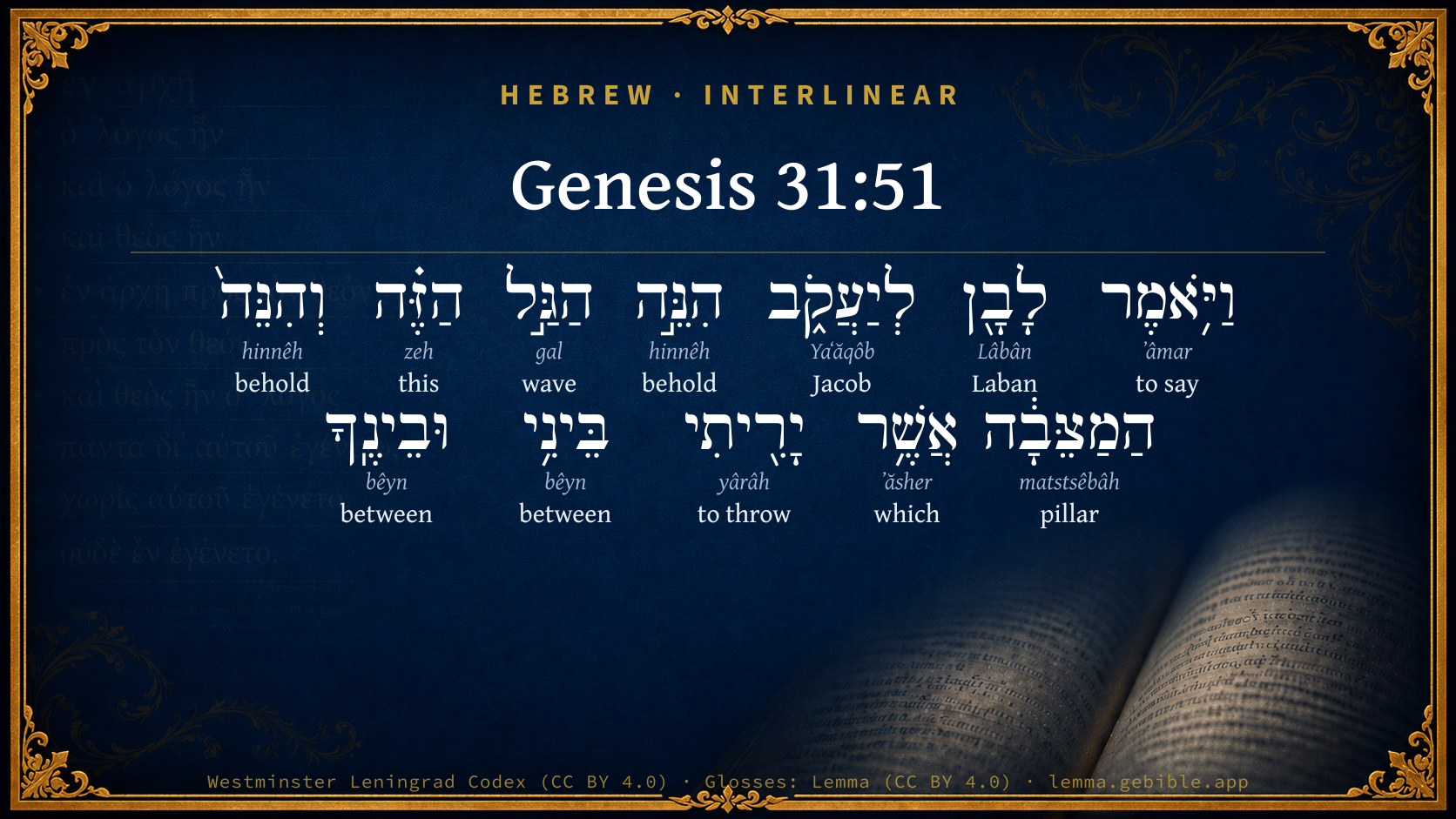
Hebrew (Westminster Leningrad Codex) Genesis 31:51 appears in the Hebrew Old Testament. The text above is from the Westminster Leningrad Codex. Each word links to its Strong’s number, a concise gloss, and parsing drawn from the Open Scriptures Hebrew Bible morphology. Click any word for its full Brown-Driver-Briggs (BDB) entry.
Download image
Cite this verse

Genesis 31:51 (World English Bible). Public Domain. Lemma interlinear Bible study tool, https://lemma.gebible.app/v/genesis/31/51.

Show BibTeX & RIS
BibTeX
RIS
English Translation
Laban said to Jacob, "See this heap, and see the pillar, which I have set between me and you.
World English Bible · Public Domain
Highlights
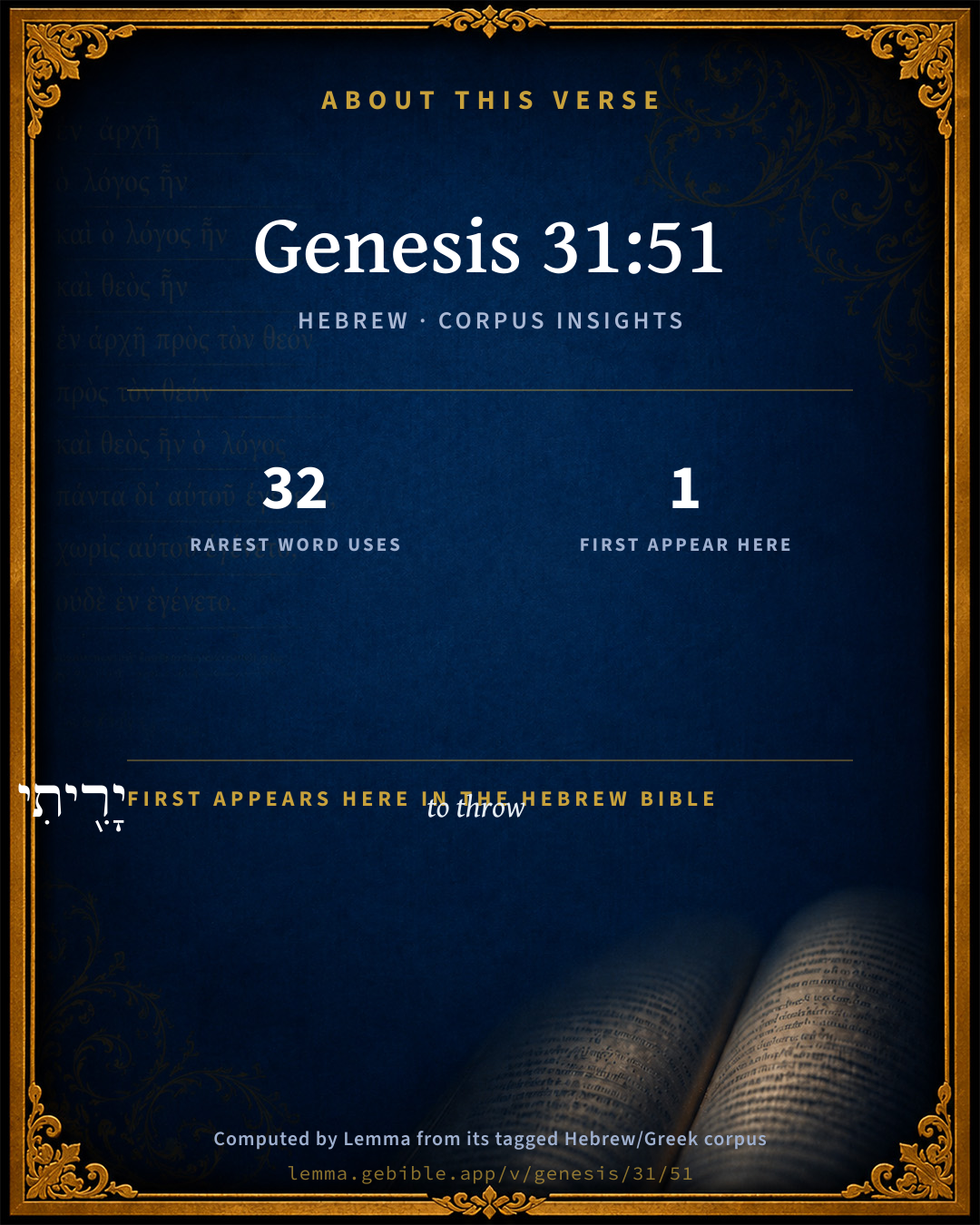
  • 1 first appearance in the Hebrew Bible
Full analysis ↓
Download a study sheet

One document with this verse’s original text, its word-by-word gloss line, the meaning frame, cross-references with their text, attributed commentary, and full source and license credits — printable, and it pastes into notes with its structure intact.

This verse Autodidact and up

Study sheet (.html) Plain text (.txt)

A passage Seminary Student

Up to 50 verses in one chapter. A passage sheet keeps up to 6 commentary sources and 12 cross-references per verse, in the order this page ranks them, and says so on the sheet whenever that leaves anything out. Ask for a single verse and you get the Autodidact verse sheet above.

Everything on this page stays free to read, with no account — the sheet is a download of what is already on screen, not access to it.

Want to remove ads? Support Godless Engineer
Compare translations 3

The same verse in 3 English versions, stacked beneath the original-language interlinear above. Click any original word for its lexicon entry.

Each is an independent rendering of the whole verse — the interlinear is not word-aligned to these translations.

Highlighted words mark where these versions differ — a whole-verse word diff, not a word-by-word alignment.

  • World English Bible Public Domain
    Laban said to Jacob, "See this heap, and see the pillar, which I have set between me and you.
  • King James Version Public Domain
    And Laban said to Jacob, Behold this heap, and behold this pillar, which I have cast betwixt me and thee:
  • unfoldingWord Literal Text CC BY-SA 4.0
    Then Laban said to Jacob, “Behold this heap, and behold the pillar which I set up between me and you.

unfoldingWord Literal Text — © unfoldingWord, licensed CC BY-SA 4.0. Word-aligned USFM3 via Door43 (git.door43.org/unfoldingWord/en_ult).

Versions to compare (up to 4)

3 of 4 selected

Show all 18 translations

Every available English version of this verse, each an independent rendering of the whole verse.

  • World English Bible Public Domain
    Laban said to Jacob, "See this heap, and see the pillar, which I have set between me and you.
  • Berean Standard Bible Public Domain
    Laban also said to Jacob, “Here is the mound, and here is the pillar I have set up between you and me.
  • Majority Standard Bible Public Domain
    Laban also said to Jacob, “Here is the mound, and here is the pillar I have set up between you and me.
  • King James Version Public Domain
    And Laban said to Jacob, Behold this heap, and behold this pillar, which I have cast betwixt me and thee:
  • American Standard Version (1901) Public Domain
    And Laban said to Jacob, Behold this heap, and behold the pillar, which I have set betwixt me and thee.
  • Revised Version (1885) Public Domain
    And Laban said to Jacob, Behold this heap, and behold the pillar, which I have set betwixt me and thee.
  • Geneva Bible (1599) Public Domain
    Moreouer Laban sayd to Iaakob, Beholde this heape, and behold the pillar, which I haue set betweene me and thee,
  • Douay-Rheims (1899) Public Domain
    And he said again to Jacob: Behold, this heap, and the stone which I have set up between me and thee,
  • Young's Literal Translation Public Domain
    And Laban saith to Jacob, `Lo, this heap, and lo, the standing pillar which I have cast between me and thee;
  • Literal Standard Version CC BY-SA 4.0
    And Laban says to Jacob, “Behold, this heap, and behold, the standing pillar which I have cast between me and you;
  • Unlocked Literal Bible CC BY-SA 4.0
    Laban said to Jacob, “Look at this pile, and look at the pillar, which I have set between you and me.
  • unfoldingWord Literal Text CC BY-SA 4.0
    Then Laban said to Jacob, “Behold this heap, and behold the pillar which I set up between me and you.
  • Darby Bible Public Domain
    And Laban said to Jacob, Behold this heap, and behold the pillar which I have set up between me and thee:
  • World Messianic Bible Public Domain
    Laban said to Jacob, “See this heap, and see the pillar, which I have set between me and you.
  • Webster's Bible Public Domain
    And Laban said to Jacob, Behold this heap, and behold this pillar, which I have cast betwixt me and thee;
  • Free Bible Version CC BY-SA 4.0
    Then Laban told Jacob, “Look at this pile of stones and this pillar that I have set up as a memorial of the agreement between you and me.
  • Bible in Basic English Public Domain
    And Laban said, See these stones and this pillar which I have put between you and me;
  • JPS Tanakh (1917) Public Domain
    And Laban said to Jacob: 'Behold this heap, and behold the pillar, which I have set up betwixt me and thee.

Literal Standard Version (2020), Covenant Press — licensed CC BY-SA 4.0. Text via the HelloAO Bible API (eBible.org). Unlocked Literal Bible (unfoldingWord) — licensed CC BY-SA 4.0. Text via the HelloAO Bible API (eBible.org). unfoldingWord Literal Text — © unfoldingWord, licensed CC BY-SA 4.0. Word-aligned USFM3 via Door43 (git.door43.org/unfoldingWord/en_ult). Free Bible Version, Dr. Jonathan Gallagher — licensed CC BY-SA 4.0. Text via the HelloAO Bible API (eBible.org).

Word by word

More ways to search: Search by grammar → Find every occurrence → Compare this word →

Practice this passage: Drill this verse → Learn its vocabulary →

הַמַצֵּבָ֔ה
matstsêbâh
H4676
“the · pillar”
Particle, Definite Article + Noun, Common, Feminine, Singular, Absolute
Part of Speech
Particle + Noun
Type
Common
Gender
Feminine
Number
Singular
State
Absolute
Full BDB Definition

Origin: (causatively) participle of H5324

TWOT: 1398g

pillar, mastaba, stump - pillar - as monument, personal memorial - with an altar - (Hophal) stock, stump (of tree)
  1. וַיֹּ֥אמֶר ʼâmar H559 “and · to say” Conjunction + Verb, Qal, Sequential Imperfect, 3rd Person, Masculine, Singular
  2. לָבָ֖ן Lâbân H3837 “Laban” Noun, Proper
  3. לְיַעֲקֹ֑ב Yaʻăqôb H3290 “to/for · Jacob” Preposition + Noun, Proper
  4. הִנֵּ֣ה hinnêh H2009 “behold” Particle, Demonstrative
  5. הַגַּ֣ל gal H1530 “the · wave” Particle, Definite Article + Noun, Common, Masculine, Singular, Absolute
  6. הַזֶּ֗ה zeh H2088 “the · this” Particle, Definite Article + Pronoun, Demonstrative, Masculine, Singular
  7. וְהִנֵּה֙ hinnêh H2009 “and · behold” Conjunction + Particle, Demonstrative
  8. אֲשֶׁ֥ר ʼăsher H834 “which” Particle, Relative
  9. יָרִ֖יתִי yârâh H3384 “to throw” Verb, Qal, Perfect, 1st Person, Common, Singular
  10. בֵּינִ֥י bêyn H996 “between · me” Preposition + Suffix, Personal, 1st Person, Common, Singular
  11. וּבֵינֶֽךָ bêyn H996 “and · between · you” Conjunction + Preposition + Suffix, Personal, 2nd Person, Masculine, Singular

About this verse

These counts appear in no published source. They are computed here, from the morphology-tagged text and Lemma’s own curated glosses. What Lemma adds →

12
words
10
distinct lemmas
Pentateuch
section

First appearance in Scripture

This word makes its first canonical appearance in the Hebrew Bible here:

  • יָרִ֖יתִי to throw H3384

Shared distinctive vocabulary

הַמַצֵּבָ֔ה pillar H4676 occurs in 31 verses of the Hebrew Bible. Also found in:

Grammatical profile

  • 2 verbs
  • 4 nouns
  • 1 pronoun
  • 2 prepositions
  • 3 particles

Verb forms

  • וַיֹּ֥אמֶר Qal · Sequential Imperfect
  • יָרִ֖יתִי Qal · Perfect

Repetition

Words recur within this verse — often emphatic in Hebrew:

  • הִנֵּ֣ה behold H2009 ×2
  • בֵּינִ֥י between H996 ×2

Hebrew & Septuagint length

In English translation the verse runs 19 words from the Hebrew and 14 from the Septuagint (LXX English) — closely comparable.

A rough comparison of the two English renderings, which tokenize alike — not a word-level alignment.

Word counts can differ between the Hebrew and the Greek without any difference in meaning — e.g. the Hebrew direct-object marker אֵת has no separate Greek word, and Greek often adds the article ὁ.

Hebrew and Greek witnesses Masoretic Hebrew ↔ Greek Septuagint

The same verse in the two great witnesses to the Old Testament, shown verse-for-verse.

These are two independent witnesses, not word-aligned to each other, and the Septuagint is shown in lemma (dictionary) form.

Hebrew Genesis 31:51 Masoretic · Westminster Leningrad Codex

וַיֹּ֥אמֶר לָבָ֖ן לְיַעֲקֹ֑ב הִנֵּ֣ה הַגַּ֣ל הַזֶּ֗ה וְהִנֵּה֙ הַמַצֵּבָ֔ה אֲשֶׁ֥ר יָרִ֖יתִי בֵּינִ֥י וּבֵינֶֽךָ

Laban said to Jacob, "See this heap, and see the pillar, which I have set between me and you.

World English Bible · Public Domain

Greek LXX Genesis 31:51 Septuagint · lemma form
And Laban said to Jacob, Behold, this heap, and this pillar are a witness.

LXX2012 (modern English Septuagint) · Public Domain

Hebrew: Westminster Leningrad Codex (CC BY 4.0). Greek: Septuagint (public domain); English from LXX2012 (modern English Septuagint) (Public Domain). How the Septuagint differs from the Hebrew →

Targum (Aramaic paraphrase)

2

The Targum is the ancient Jewish Aramaic paraphrase of the Hebrew Scriptures — an interpretive translation, not the Hebrew text itself. Onkelos (literal) and Pseudo-Jonathan (expansive) render the Torah, and Jonathan the Prophets. Coverage is partial: where no permissively-licensed English translation exists for a verse, only the Aramaic is shown. This is verse-level text, not a word-by-word alignment to the Hebrew.

  1. Targum Onkelos Torah (Genesis–Deuteronomy)
    וַאֲמַר לָבָן לְיַעֲקֹב הָא דְּגוֹרָא הָדֵין וְהָא קַמְתָא דִּי אֲקֵימִית בֵּינִי וּבֵינָךְ

    (no public-domain English translation for this verse)

    Targum Onkelos — Aramaic: “Onkelos Genesis” (public domain); “Onkelos Exodus” (public domain); “Onkelos Leviticus” (public domain); “Onkelos Numbers” (public domain); “Onkelos Deuteronomy” (public domain). English: “Sefaria Community Translation” (CC0 1.0 (public-domain dedication)); “J.W. Etheridge. The Targums of Onkelos and Jonathan Ben Uzziel on the Pentateuch. London: Longmans, Green, 1862” (public domain). Text via Sefaria.

  2. Targum Pseudo-Jonathan Torah (Genesis–Deuteronomy)
    וַאֲמַר לָבָן לְיַעֲקב הָא אוֹגַר הָדֵין וְהָא קָמָא דְאַקֵימִית בֵּינָא וּבֵינָךְ

    And Laban said to Jakob, Behold this mound, and behold the pillar which thou hast reared between me and thee.

    Targum Pseudo-Jonathan — Aramaic: “Targum Jonathan on Genesis” (public domain); “Targum Jonathan on Exodus” (public domain); “Targum Jonathan on Leviticus” (public domain); “Targum Jonathan on Numbers” (public domain); “Targum Jonathan on Deuteronomy” (public domain). English: “The Targum of Jonathan ben Uzziel, trans. J. W. Etheridge, London, 1862” (public domain). Text via Sefaria.

Commentary

Notes on Genesis 31:51 from classic Christian and Jewish commentators (each source and its license shown beneath its notes). The classic Christian expositions comment on the surrounding passage and are grouped to its opening verse, so a note may address several verses; the Jewish commentaries on the Tanakh (Rashi and others) are per-verse, so they appear only where the commentator wrote on this verse.

Lemma curates 59 commentaries, every one of them public domain or Creative Commons licensed, each selected and text-cleaned for this edition rather than reprinted as found. About our sources →

Adam Clarke's Commentary

Verse 51. And Laban said to Jacob - behold this pillar, which I have cast betwixt me and thee] But this pillar, not cast but set up, was certainly set up by Jacob; for in Ge 31:45 we read, And Jacob took a stone, and set it up for a pillar: it is therefore for the honour of one Hebrew and one Samaritan MS. that they have preserved the true reading in Ge 31:51, ירית yaritha, THOU hast set up. - Kennicott. Instead of either of the above readings the Samaritan text has [Samaritan] yarata, The pillar which thou SEEST betwixt me and thee.

Adam Clarke's Commentary on the Bible (1810–1826) — public domain. Text from a community e-Sword/MySword module.

Trapp's Complete Commentary

John Trapp

Gen 31:51 And Laban said to Jacob, Behold this heap, and behold [this] pillar, which I have cast betwixt me and thee;

Ver. 51. {See Trapp on "Gen 31:44"}

John Trapp, A Commentary or Exposition upon All the Books of the Old and New Testament (1647–1656) — public domain. Text from a community e-Sword module.

The Cambridge Bible for Schools and Colleges

gen. ed. J. J. S. Perowne

51. heap … set] Jacob had caused the heap to be collected; Laban had erected the pillar: see note on Gen_31:45. Two compacts are made: (1) Jacob will not ill-treat Laban’s daughters, Gen_31:50; (2) neither Laban nor Jacob will pass the boundary heap of stones to do the other harm, Gen_31:52. The heap of stones and the pillar are the witness of the agreement.

The Cambridge Bible for Schools and Colleges (gen. ed. J. J. S. Perowne; Cambridge University Press, 1878–1918) — public domain. Text from a community e-Sword module.

John Gill's Exposition

Then Jacob offered sacrifice upon the mount,.... On Mount Gilead, not in a religious way, in which he could not join with Laban, or admit him to it; but in a civil way he "slew a slaughter" (s), or rather made one; that is, as Jarchi explains it, he slew cattle for a feast, as it was usual to make feasts for the several parties concerned in covenant, see Gen 26:30,

and called his brethren, to eat bread; the, men that came with Laban, and him also, these he invited to his feast, for all sorts of food is called bread:

and they did eat bread, and tarried all night in the mount; this affair between Laban and Jacob had took up the whole day, at evening they feasted together upon the covenant being made, and then tarried all night to take their rest.

(s) "et mactavit mactationem", Drusius, Cartwright, Schmidt, Ainsworth.

John Gill's Exposition of the Whole Bible (1746–1763) — public domain (CC PDM 1.0). Text via the HelloAO Bible API.

Haydock's Catholic Bible Commentary

I have, &c. One Samaritan copy reads very properly, "thou hast set up," (yarithi), ver. 45. (Kennicott).

George Leo Haydock (1774–1849), Haydock's Catholic Family Bible and Commentary, 1859 edition — public domain. Excludes Psalms (Douay-Rheims chapter numbering differs from Protestant) and Deuterocanonical books (Catholic canon only).

The Pulpit Commentary

Vers 51-53. And Laban said to Jacob, according to Ewald the last narrator has transposed the names of Laban and Jacob (vide "History of Israel," vol. 1. p. 346)Behold this heap, and behold this pillar, which I have cast (same word as in ver. 45. The Arabic version and Samaritan text read yaritha, thou hast erected, instead of yarithi, I have erected or cast up) betwixt me and thee; this heap be witness, and this pillar be witness, that (literally, if, here = that) I will not pass over this heap to thee, and that thou shalt not pass over this heap and this pillar (Laban bound himself never to pass over the heap which he had erected as his witness; whereas Jacob was required to swear that he would never cross the pillar and the pile, both of which were witnesses for him) unto me, for harm. The emphatic word closes the sentence. The God of Abraham, and the God of Nahor, the God of their father, judge the verb is plural, either because Laban regarded the Elohim of Nahor as different from the Elohim of Abraham (Rosenm Keil, Kalisch, Wordsworth, "Speaker"s Commentary"), or because, though acknowledging only one Elohim, he viewed him as maintaining several and distinct relations to the persons named (cf. Quarry, p. 499)betwixt us. Laban here invokes his own hereditary Elohim, the Elohim of Abraham"s father, to guard his rights and interests under the newly-formed covenant; while Jacob in his adjuration appeals to the Elohim of Abraham"s son. And Jacob sware by the fear of his father Isaac (vide supra, ver. 42).

HOMILIES BY R.A. REDFORD

Vers. 51-55.

Final covenant between Jacob and Laban.

I ENTIRE SEPARATION FROM TEMPTATION IS THE ONLY SAFETY. Very imperfect knowledge in the Mesopotamian family. Rachel"s theft of the household gods a sign of both moral and spiritual deficiency. The religion of Jacob and his descendants must be preserved from contamination. Intercourse with the unenlightened and unsanctified, though necessary for a time and in some degree, must not be suffered to obscure the higher light, or surround us with practical entanglements which hinder our faithfulness to God.

II WHEREVER THE SPIRITUAL LIFE IS FEEBLE IT IS WELL THAT THERE SHOULD BE SOLEMN PUBLIC ACTS OF COVENANT AND TESTIMONY. We want the Galeed and the Mizpah, the heap of witness and the watch-tower of faith. Many united together in the covenant, and thus became witnesses in whose presence the oath was taken. We are helped to faithfulness by the publicity of our vows. But the higher the spiritual life, the less we shall call in material things to support it. Jacob with Laban is not the true Jacob. All dependence upon the symbol and rite is more or less compromise.

III THE CONTACT OF THE HIGHER FORM OF RELIGION WITH THE LOWER ONE, OF THE MEANS OF PREPARING THE WORLD FOR THE TRUTH. Laban and his family types of the lower order of religious knowledge and life. The covenant between the father-in-law and son-in-law in the name of the God of Abraham and the God of Nahor points to a rising light in the Mesopotamian family. We may be sure that the influence of Christianity will be supreme wherever it is brought face to face with men"s religions. That influence may be embodied in matters of common life, in covenants between man and man, in laws and commercial regulations and social arrangements.

IV THE SEED OF THE DIVINE LIFE IS PLANTED IN THE SOIL OF NATURE, BUT REVEALS ITS SUPERIORITY TO NATURE BY BRINGING ALL THINGS AND MEN INTO SUBJECTION TO ITSELF. Jacob, Rachel, and afterwards Joseph, present to the Spirit of God elements of character which require both elevation and renovation. The grace is given. On a natural foundation inherited from others God rears by his grace a lofty structure. The crafty and the thoughtful are often nearly allied. It is one of the spiritual dangers to which specially energetic and subtle minds are exposed, that they may so easily fall into an abuse of their superior mental quickness to the injury of their moral purity and simplicity. Jacob and Laban making their covenant together, and erecting their witnessing monuments, are another illustration of the homage which even very imperfect characters pay to the God of truth. They appeal to him, and they do so in the presence of a world which they know will justify God, and not the sinner. The God of Abraham, the God of Nahor, the God of Isaac, judged between them. Jacob offered sacrifice upon the mount, and invited his brethren to a sacrificial banquet; and it was in that atmosphere of mingled reverence for God and human affection that the heir of the covenant bade farewell to all that held him in restraint. and set his face once more towards the land of promise. R.

The Pulpit Commentary (1880–1919), ed. H.D.M. Spence-Jones & Joseph S. Exell — public domain. Text from a community e-Sword module.

unfoldingWord translationNotes

Door43 World Missions Community

This pile is a witness, and the pillar is a witness

These piles of stones were to act as a remembrance and a boundary marker for Jacob and Laban regarding their peace agreement. They are spoken of as if they are human witnesses. (See: Personification)

May the God of Abraham, and the god of Nahor, the gods of their father, judge between us

Abraham is Jacob's grandfather. Nahor is Laban's grandfather. The father of Abraham and Nahor is Terah. Not all of them worshipped Yahweh.

the Fear of his father Isaac

Here the word "Fear" refers to Yahweh, who Isaac deeply respected and showed that respect by obeying him.

translationWords

column

testimony

Abraham

Nahor

ancestor

judge

oath

Isaac

fear

unfoldingWord translationNotes — © Distant Shores Media and the Door43 World Missions Community, licensed CC BY-SA 4.0. Source: git.door43.org/Door43/en_tn.

Rashi

Rabbi Shlomo Yitzchaki (Rashi)

יריתי I HAVE SET UP (by casting stones down); the word has the same meaning as (Exodus 15:4) “He cast (ירה) into the sea”. Laban speaks like a person who casts (יורה) one arrow (Midrash Rabbah has “one spear”) and boasts of his prowess.

Rashi on the Tanakh — English translations: “The Judaica Press complete Tanach with Rashi, translated by A. J. Rosenberg” (CC BY 4.0); “Pentateuch with Rashi's commentary by M. Rosenbaum and A.M. Silbermann, 1929-1934” (public domain); “The Metsudah Tanach series, Lakewood, N.J” (CC BY 4.0); and “The Book of Joshua, Metsudah Publications, 1997” (CC BY 4.0). Text via Sefaria.

Radak

Rabbi David Kimhi (Radak)

ויאמר...אשר יריתי ביני וביניך, the words להיותם עד, “to serve as witness” are presumed to be part of this verse. It is also possible that the line as it is written means “shall be between me and you,” as a warning not to trespass, i.e. violate any of the conditions agreed to. Crossing the boundary established for aggressive purposes was outlawed by mutual agreement. Lavan added the words אשר יריתי, “which I have set up,” to emphasise that although Yaakov had in fact erected this pile of stones, this was a joint undertaking and obligated both of them to keep the peace. After all, he, Lavan had first broached the subject of entering into a covenant. This meant that when Yaakov had erected the pile and the monument he had done so at the initiative and suggestion of Lavan, making it a joint enterprise. We have already explained on verse 46 that in fact Lavan’s sons and brothers had collected the rocks which later formed the גל, the heap. [I believe that seeing they had no mortar the monument was called a גל, suggesting that it was not as permanent as a wall with its stones held in place by mortar. Ed.] The meaning of the words אשר יריתי could be: “at my instruction.” We have such a meaning of the root in Job 27,11 אורה אתכם ביד א-ל,”I will teach you what is in G’d’s power.”

Radak on the Tanakh — English translations: “Sefaria Community Translation” (CC0 1.0 (public-domain dedication)); “Eliyahu Munk, HaChut Hameshulash” (CC BY 4.0); “Rabbi Mike Feuer, Jerusalem Anthology” (CC BY 4.0); and “R. David Kimhi on the first book of Psalms, Translated by R.G. Finch, London, 1919” (public domain). Text via Sefaria.

Lesson kit

Teaching starters — assembled from the data on this page, not authored interpretation. Every prompt links to the verse data it draws on. Edit before teaching.

Genesis, in the Pentateuch, opens this verse with 12 words (10 distinct Hebrew lemmas). Its most distinctive word is matstsêbâh (“pillar”). A historical commentator’s framing appears above. Read the whole chapter for the surrounding context.

Discussion questions

  1. How does “pillar” (matstsêbâh) shape what this verse is saying?
  2. The word “to throw” first appears here in Scripture. What is being introduced at this debut?
  3. Genesis 28:18 shares the word «pillar» with this verse. How do the two illuminate each other?
  4. “behold” occurs 2× in this one verse. What is the effect of the repetition?
  5. These translations render this verse differently; the difference is in the English rendering, not the original. What questions does that raise?
  6. The verb «וַיֹּ֥אמֶר» is Qal Sequential Imperfect. How does its form color the action?
  7. Reading how Adam Clarke's Commentary and Trapp's Complete Commentary read this verse, where do the two commentators agree and where do they part?

Things to notice

  • 1 word makes its first canonical appearance in Scripture here.
  • These translations choose different wording for 9 words in this verse.
  • “behold” occurs 2× in this single verse.
  • 10 distinct Hebrew lemmas span 12 words in this verse.

Reading settings

Reading text

Shown beneath each verse's original-language words.

Old Testament
Old Testament edition

Read the OT as the Masoretic Hebrew (MT) or the Greek Septuagint (LXX).

English shown for the Greek Septuagint (in the Hebrew ↔ Greek comparison).

Comparing translations? Open the Compare panel on any verse page to stack up to four side by side.