Ruth 1:17

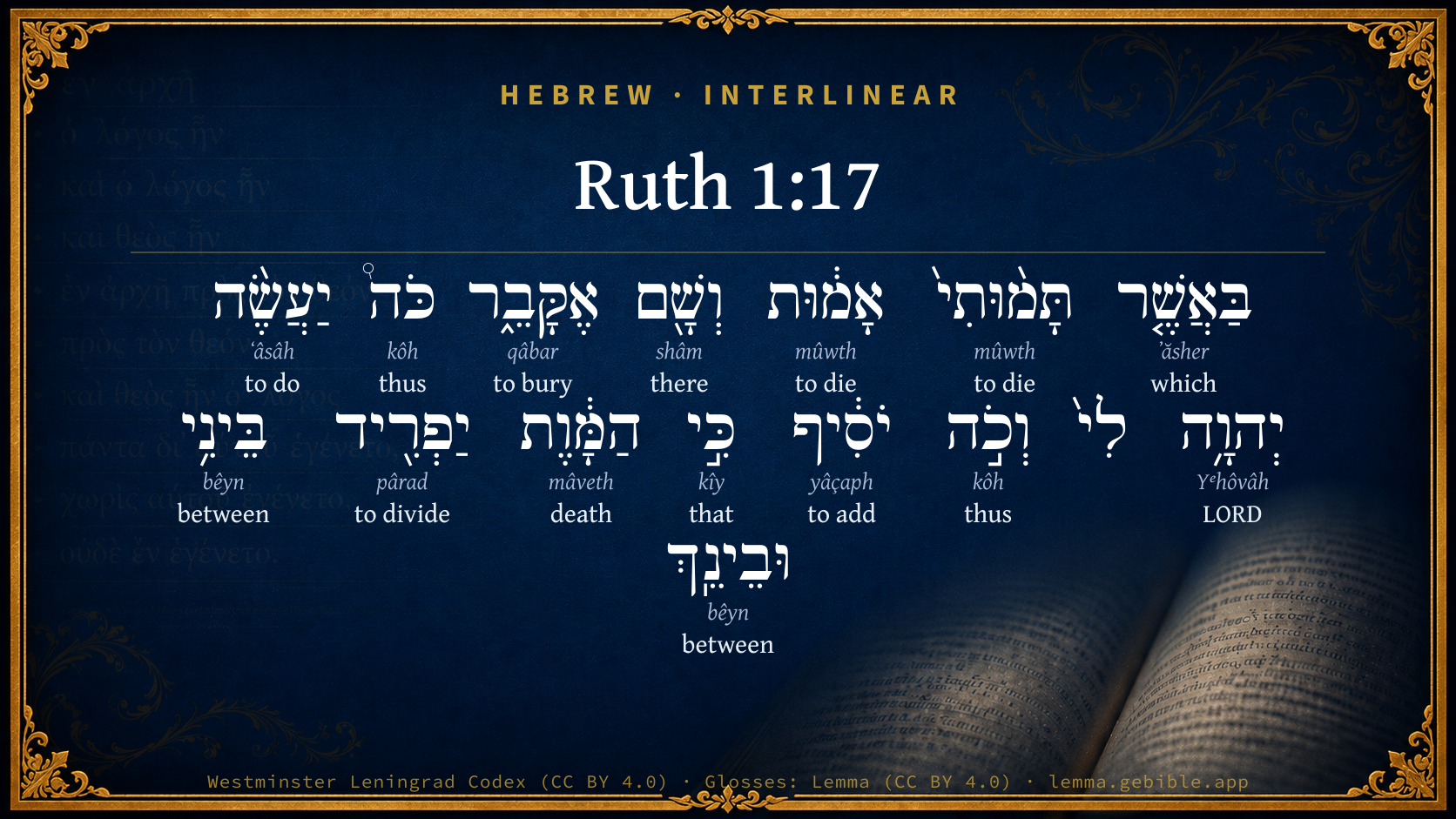
Hebrew (Westminster Leningrad Codex) Ruth 1:17 appears in the Hebrew Old Testament. The text above is from the Westminster Leningrad Codex. Each word links to its Strong’s number, a concise gloss, and parsing drawn from the Open Scriptures Hebrew Bible morphology. Click any word for its full Brown-Driver-Briggs (BDB) entry.
Download image
Cite this verse

Ruth 1:17 (World English Bible). Public Domain. Lemma interlinear Bible study tool, https://lemma.gebible.app/v/ruth/1/17.

Show BibTeX & RIS
BibTeX
RIS
English Translation
where you die, will I die, and there will I be buried: Yahweh do so to me, and more also, if anything but death part you and me."
World English Bible · Public Domain
Download a study sheet

One document with this verse’s original text, its word-by-word gloss line, the meaning frame, cross-references with their text, attributed commentary, and full source and license credits — printable, and it pastes into notes with its structure intact.

This verse Autodidact and up

Study sheet (.html) Plain text (.txt)

A passage Seminary Student

Up to 50 verses in one chapter. A passage sheet keeps up to 6 commentary sources and 12 cross-references per verse, in the order this page ranks them, and says so on the sheet whenever that leaves anything out. Ask for a single verse and you get the Autodidact verse sheet above.

Everything on this page stays free to read, with no account — the sheet is a download of what is already on screen, not access to it.

Want to remove ads? Support Godless Engineer
Compare translations 3

The same verse in 3 English versions, stacked beneath the original-language interlinear above. Click any original word for its lexicon entry.

Each is an independent rendering of the whole verse — the interlinear is not word-aligned to these translations.

Highlighted words mark where these versions differ — a whole-verse word diff, not a word-by-word alignment.

  • World English Bible Public Domain
    where you die, will I die, and there will I be buried: Yahweh do so to me, and more also, if anything but death part you and me."
  • King James Version Public Domain
    Where thou diest, will I die, and there will I be buried: the LORD do so to me, and more also, if ought but death part thee and me.
  • unfoldingWord Literal Text CC BY-SA 4.0
    In the place where you die, I will die, and there I will be buried. May Yahweh do thus to me, and thus may he add, if death separates between me and between you.”

unfoldingWord Literal Text — © unfoldingWord, licensed CC BY-SA 4.0. Word-aligned USFM3 via Door43 (git.door43.org/unfoldingWord/en_ult).

Versions to compare (up to 4)

3 of 4 selected

Show all 18 translations

Every available English version of this verse, each an independent rendering of the whole verse.

  • World English Bible Public Domain
    where you die, will I die, and there will I be buried: Yahweh do so to me, and more also, if anything but death part you and me."
  • Berean Standard Bible Public Domain
    Where you die, I will die, and there I will be buried. May the LORD punish me, and ever so severely, if anything but death separates you and me.”
  • Majority Standard Bible Public Domain
    Where you die, I will die, and there I will be buried. May the LORD punish me, and ever so severely, if anything but death separates you and me.”
  • King James Version Public Domain
    Where thou diest, will I die, and there will I be buried: the LORD do so to me, and more also, if ought but death part thee and me.
  • American Standard Version (1901) Public Domain
    where thou diest, will I die, and there will I be buried: Jehovah do so to me, and more also, if aught but death part thee and me.
  • Revised Version (1885) Public Domain
    where thou diest, will I die, and there will I be buried: the LORD do so to me, and more also, if aught but death part thee and me.
  • Geneva Bible (1599) Public Domain
    Where thou diest, will I die, and there will I be buried. the Lord do so to me and more also, if ought but death depart thee and me.
  • Douay-Rheims (1899) Public Domain
    The land that shall receive thee dying, in the same will I die: and there will I be buried. The Lord do so and so to me, and add more also, if aught but death part me and thee.
  • Young's Literal Translation Public Domain
    Where thou diest I die, and there I am buried; thus doth Jehovah to me, and thus doth He add -- for death itself doth part between me and thee.'
  • Literal Standard Version CC BY-SA 4.0
    Where you die I die, and there I am buried; thus does YHWH to me, and thus He adds—for death itself parts between me and you.”
  • Unlocked Literal Bible CC BY-SA 4.0
    Where you die, I will die, and there I will be buried. May Yahweh punish me, and even more, if anything but death ever separates us.”
  • unfoldingWord Literal Text CC BY-SA 4.0
    In the place where you die, I will die, and there I will be buried. May Yahweh do thus to me, and thus may he add, if death separates between me and between you.”
  • Darby Bible Public Domain
    where thou diest will I die, and there will I be buried. Jehovah do so to me, and more also, if aught but death part me and thee!
  • World Messianic Bible Public Domain
    Where you die, I will die, and there I will be buried. May the LORD do so to me, and more also, if anything but death parts you and me.”
  • Webster's Bible Public Domain
    Where thou diest, will I die, and there will I be buried: the LORD do so to me, and more also, if aught but death shall part thee and me.
  • Free Bible Version CC BY-SA 4.0
    Where you die, I will die, and there I will be buried. May the Lord punish me harshly if I let anything but death separate us!”
  • Bible in Basic English Public Domain
    Wherever death comes to you, death will come to me, and there will be my last resting-place; the Lord do so to me and more if we are parted by anything but death.
  • JPS Tanakh (1917) Public Domain
    where thou diest, will I die, and there will I be buried; the LORD do so to me, and more also, if aught but death part thee and me.'

Literal Standard Version (2020), Covenant Press — licensed CC BY-SA 4.0. Text via the HelloAO Bible API (eBible.org). Unlocked Literal Bible (unfoldingWord) — licensed CC BY-SA 4.0. Text via the HelloAO Bible API (eBible.org). unfoldingWord Literal Text — © unfoldingWord, licensed CC BY-SA 4.0. Word-aligned USFM3 via Door43 (git.door43.org/unfoldingWord/en_ult). Free Bible Version, Dr. Jonathan Gallagher — licensed CC BY-SA 4.0. Text via the HelloAO Bible API (eBible.org).

Word by word

More ways to search: Search by grammar → Find every occurrence → Compare this word →

Practice this passage: Drill this verse → Learn its vocabulary →

יַפְרִ֖יד
pârad
H6504
“to divide”
Verb, Hiphil, Imperfect, 3rd Person, Masculine, Singular
Part of Speech
Verb
Stem
Hiphil
Form
Imperfect
Person
3rd Person
Gender
Masculine
Number
Singular
Full BDB Definition

Origin: a primitive root

TWOT: 1806

to separate, divide - (Qal) to divide - (Niphal) - to divide, separate - to be divided, be separated - (Piel) to be separated - (Pual) to be divided - (Hiphil) - to divide, separate - to make a division, make a separation - (Hithpael) to be divided, be separated, get separated
  1. בַּאֲשֶׁ֤ר ʼăsher H834 “in/at · which” Preposition + Particle, Relative
  2. תָּמ֨וּתִי֙ mûwth H4191 “to die” Verb, Qal, Imperfect, 2nd Person, Feminine, Singular
  3. אָמ֔וּת mûwth H4191 “to die” Verb, Qal, Imperfect, 1st Person, Common, Singular
  4. וְשָׁ֖ם shâm H8033 “and · there” Conjunction + Adverb
  5. אֶקָּבֵ֑ר qâbar H6912 “to bury” Verb, Niphal, Imperfect, 1st Person, Common, Singular
  6. כֹּה֩ kôh H3541 “thus” Adverb
  7. יַעֲשֶׂ֨ה ʻâsâh H6213 “to do” Verb, Qal, Imperfect, 3rd Person, Masculine, Singular
  8. יְהוָ֥ה Yᵉhôvâh H3068 “LORD” Noun, Proper
  9. וְכֹ֣ה kôh H3541 “and · thus” Conjunction + Adverb
  10. יֹסִ֔יף yâçaph H3254 “to add” Verb, Hiphil, Imperfect, 3rd Person, Masculine, Singular
  11. כִּ֣י kîy H3588 “that” Conjunction
  12. הַמָּ֔וֶת mâveth H4194 “the · death” Particle, Definite Article + Noun, Common, Masculine, Singular, Absolute
  13. בֵּינִ֥י bêyn H996 “between · me” Preposition + Suffix, Personal, 1st Person, Common, Singular
  14. וּבֵינֵֽךְ bêyn H996 “and · between · you” Conjunction + Preposition + Suffix, Personal, 2nd Person, Feminine, Singular

About this verse

These counts appear in no published source. They are computed here, from the morphology-tagged text and Lemma’s own curated glosses. What Lemma adds →

16
words
12
distinct lemmas
Historical
section

Shared distinctive vocabulary

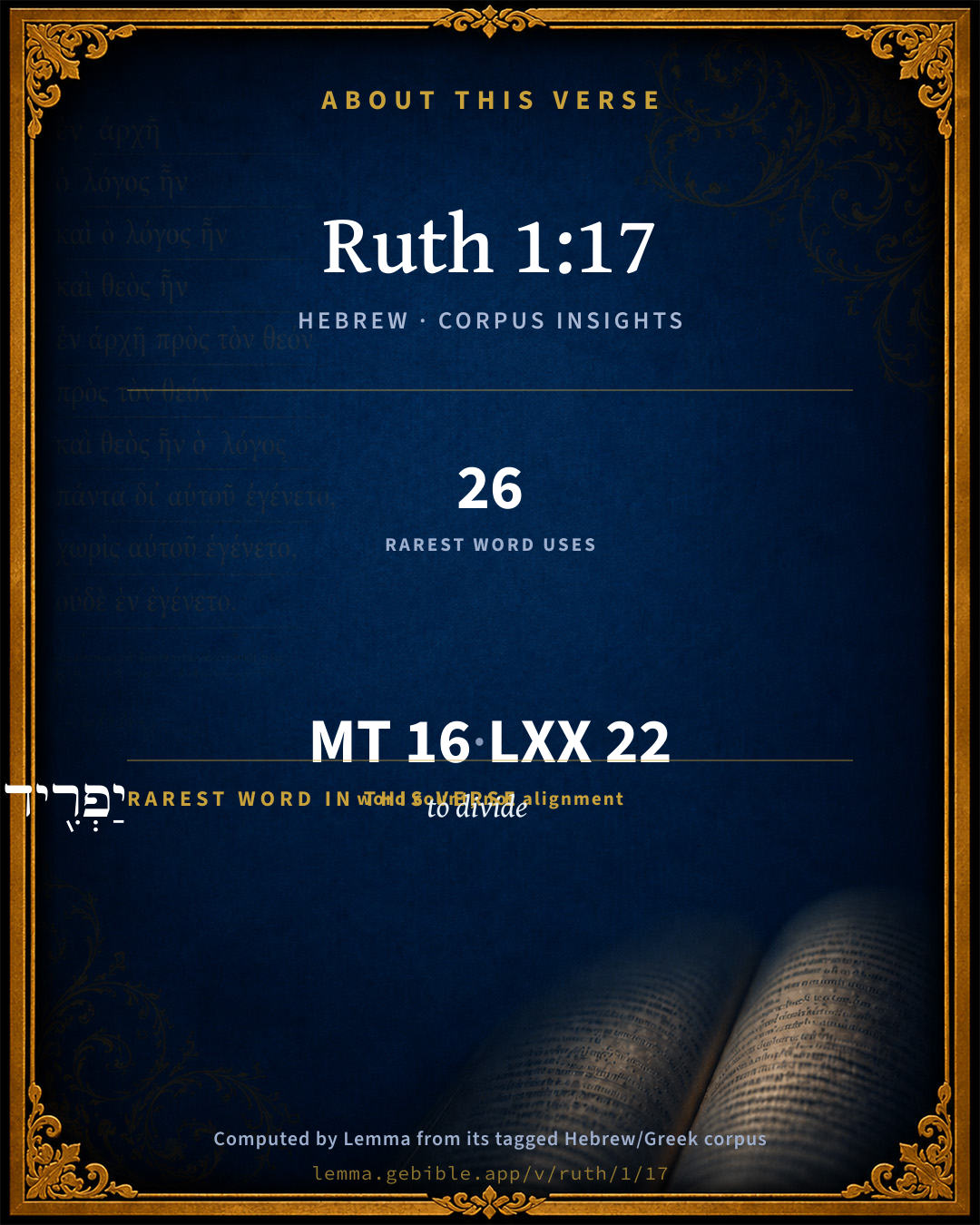
יַפְרִ֖יד to divide H6504 occurs in 26 verses of the Hebrew Bible. Also found in:

Grammatical profile

  • 6 verbs
  • 2 nouns
  • 3 prepositions
  • 1 conjunction
  • 3 adverbs
  • 1 particle

Verb forms

  • תָּמ֨וּתִי֙ Qal · Imperfect
  • אָמ֔וּת Qal · Imperfect
  • אֶקָּבֵ֑ר Niphal · Imperfect
  • יַעֲשֶׂ֨ה Qal · Imperfect
  • יֹסִ֔יף Hiphil · Imperfect
  • יַפְרִ֖יד Hiphil · Imperfect

Repetition

Words recur within this verse — often emphatic in Hebrew:

  • תָּמ֨וּתִי֙ to die H4191 ×2
  • כֹּה֩ thus H3541 ×2
  • בֵּינִ֥י between H996 ×2

Hebrew & Septuagint length

In English translation the verse runs 28 words from the Hebrew and 35 from the Septuagint (LXX English) — closely comparable.

A rough comparison of the two English renderings, which tokenize alike — not a word-level alignment.

Word counts can differ between the Hebrew and the Greek without any difference in meaning — e.g. the Hebrew direct-object marker אֵת has no separate Greek word, and Greek often adds the article ὁ.

In the original languages it is 16 Hebrew tokens and 22 Greek tokens — but the two are counted differently (Hebrew bundles its prefixes and suffixes into one token; the Greek is in lemma form), so that isn’t a like-for-like length.

Cross-references

11

Topical passages linked to Ruth 1:17 in the Treasury of Scripture Knowledge — connected by theme and wording, ordered by reader-vote popularity; previews shown in the World English Bible.

  • 1 Samuel 3:17 He said, "What is the thing that [Yahweh] has spoken to you? Please don't hide it from me. God do so to you, and more also, if you hide anything from me of all the things that he spoke to you."
  • 2 Samuel 19:13 Say you to Amasa, Aren't you my bone and my flesh? God do so to me, and more also, if you aren't captain of the host before me continually in the room of Joab.
  • 1 Kings 2:23 Then king Solomon swore by Yahweh, saying, God do so to me, and more also, if Adonijah has not spoken this word against his own life.
  • 2 Kings 6:31 Then he said, God do so to me, and more also, if the head of Elisha the son of Shaphat shall stand on him this day.
  • 1 Samuel 25:22 God do so to the enemies of David, and more also, if I leave of all that belongs to him by the morning light so much as one man-child.
  • 1 Kings 20:10 Ben Hadad sent to him, and said, The gods do so to me, and more also, if the dust of Samaria shall suffice for handfuls for all the people who follow me.
  • 2 Samuel 3:35 All the people came to cause David to eat bread while it was yet day; but David swore, saying, God do so to me, and more also, if I taste bread, or anything else, until the sun be down.
  • 2 Samuel 3:9 God do so to Abner, and more also, if, as Yahweh has sworn to David, I don't do even so to him;
  • 1 Kings 19:2 Then Jezebel send a messenger to Elijah, saying, So let the gods do to me, and more also, if I don't make your life as the life of one of them by tomorrow about this time.
  • Acts 11:23 who, when he had come, and had seen the grace of God, was glad. He exhorted them all, that with purpose of heart they should remain near to the Lord.
  • Acts 20:24 But these things don't count; nor do I hold my life dear to myself, so that I may finish my race with joy, and the ministry which I received from the Lord Jesus, to fully testify to the Gospel of the grace of God.

Cross-references courtesy of OpenBible.info (CC BY 4.0).

Hebrew and Greek witnesses Masoretic Hebrew ↔ Greek Septuagint

The same verse in the two great witnesses to the Old Testament, shown verse-for-verse.

These are two independent witnesses, not word-aligned to each other, and the Septuagint is shown in lemma (dictionary) form.

Hebrew Ruth 1:17 Masoretic · Westminster Leningrad Codex

בַּאֲשֶׁ֤ר תָּמ֨וּתִי֙ אָמ֔וּת וְשָׁ֖ם אֶקָּבֵ֑ר כֹּה֩ יַעֲשֶׂ֨ה יְהוָ֥ה לִי֙ וְכֹ֣ה יֹסִ֔יף כִּ֣י הַמָּ֔וֶת יַפְרִ֖יד בֵּינִ֥י וּבֵינֵֽךְ

where you die, will I die, and there will I be buried: Yahweh do so to me, and more also, if anything but death part you and me."

World English Bible · Public Domain

Greek LXX Ruth 1:17 Septuagint · lemma form

καί ὅς ἐάν ἀποθνήσκω ἀποθνήσκω καΐἐκεῖ θάπτω ὅδε ποιέω ἐγώ κύριος καί ὅδε προςτίθημι ὅτι θάνατος διαστέλλω ἀνά μέσος ἐγώ καί σύ

And wherever you die, I will die, and there will I be buried: the Lord do so to me, and more also, if I leave you, for death only shall divide between me and you.

LXX2012 (modern English Septuagint) · Public Domain

Hebrew: Westminster Leningrad Codex (CC BY 4.0). Greek: Septuagint (public domain); English from LXX2012 (modern English Septuagint) (Public Domain). How the Septuagint differs from the Hebrew →

Commentary

Notes on Ruth 1:17 from classic Christian and Jewish commentators (each source and its license shown beneath its notes). The classic Christian expositions comment on the surrounding passage and are grouped to its opening verse, so a note may address several verses; the Jewish commentaries on the Tanakh (Rashi and others) are per-verse, so they appear only where the commentator wrote on this verse.

Lemma curates 59 commentaries, every one of them public domain or Creative Commons licensed, each selected and text-cleaned for this edition rather than reprinted as found. About our sources →

Trapp's Complete Commentary

John Trapp

Rth 1:17 Where thou diest, will I die, and there will I be buried: the LORD do so to me, and more also, [if ought] but death part thee and me.

Ver. 17. Where thou diest, &c] That both she and her mother should once die, she doubted not. {Heb 9:27} This many seem to do, whilst they so live as if their lives were riveted upon eternity. See Psa 49:10-11; Psa 49:13.

There will I be buried.] Burial is one of the dues of the dead; and dear friends desire to be buried together. {2Sa 19:37} Mezentius in Virgil begs to be buried by his son Lausus. {a}

The Lord do so to me, and more also.] Let him double and treble the evil wished upon me, which is here not mentioned by a usual aposiopesis, not unlike that of the prophet Amos in Amo 4:12; "And because I will do thus unto thee," Ubi non nominat mala, ut omnia timeant, {b} he nameth not any, that they may fear all. This is an oath bound with a curse, which yet is not particularly named, but left unto God. Indeed, every oath is with an execration, either understood or expressed.

{a} Aeneid., lib. x.

{b} Ribera.

John Trapp, A Commentary or Exposition upon All the Books of the Old and New Testament (1647–1656) — public domain. Text from a community e-Sword module.

Adam Clarke's Commentary

Verse 17. The Lord do so to me, and more] May he inflict any of those punishments on me, and any worse punishment, if I part from thee till death. And it appears that she was true to her engagement; for Naomi was nourished in the house of Boaz in her old age, and became the fosterer and nurse of their son Obed, Ru 4:15-16.

Adam Clarke's Commentary on the Bible (1810–1826) — public domain. Text from a community e-Sword/MySword module.

Ellicott's Commentary for English Readers

(17) The Lord do so to me.—Ruth clinches her resolutions with a solemn oath, in which, if we are to take the words literally, she swears by the name of the God of Israel. With this Naomi yields; after so solemn a protest she can urge no more.

A Bible Commentary for English Readers, edited by Charles John Ellicott (1878–1897) — public domain. Text from a community e-Sword module.

The Cambridge Bible for Schools and Colleges

gen. ed. J. J. S. Perowne

17. will I die … be buried] According to ancient thought union in life meant union in death and in the grave; the members of a family had a common burying-place, Gen_47:30; Gen_49:29. In the underworld they lived together, as families and by nations; cf. the expression ‘he was gathered to his people,’ i.e. his fellow tribesmen, and see Eze_32:17-32.

the Lord do so to me, and more also] Jehovah has already become the God of Ruth, and she uses the name of Israel’s God in a solemn imprecation, which occurs only here and in the books of Samuel and Kings. When heathen utter this oath, Elohim is used instead of Jehovah, and the verbs are plural, 1Ki_19:2; 1Ki_20:10. Lit. the phrase here runs ‘Jehovah do so to me, and more also—(only) death shall separate me from thee’; the substance of the oath is an assertion, not a negation; similarly 1Sa_14:44; 1Sa_20:13, 1Ki_2:23 etc. in the Hebr.

The Cambridge Bible for Schools and Colleges (gen. ed. J. J. S. Perowne; Cambridge University Press, 1878–1918) — public domain. Text from a community e-Sword module.

John Gill's Exposition

Where thou diest will I die, and there will I be buried,.... She was determined to abide with her unto death, and not only was desirous to die as she did, but where she should die; in the same country, cottage, and bed, and be laid in the same grave, in hope of rising together at the resurrection of the just; having no regard at all to the sepulchres of her fathers, which people in all ages and countries have been fond of being laid in, as an honour and happiness. So with the Greeks and Romans, not only relations, but intimate friends, and such as had a strong affection for each other, were sometimes buried in the same grave, as Crates and Polemon (i), Paris and Oenome (k), and others (l); see Gal 2:20,

the Lord do so to me, and more also, if ought but death part thee and me; this is the form of oath she used for confirmation of what she had said, and to put an end to the debate on this subject; what she imprecates upon herself is not expressed, should she otherwise do than what she swears to; leaving Naomi to supply it in her own mind, and as being what was not fit to be named, and the greatest evil that could be thought to befall a perjured person.

(i) Lart. in Vita Cratet. (k) Strabo. Geograph. l. 13. p. 410. (l) Vid. Kirchman. de Funer. Roman. l. 3. c. 14. p. 433.

John Gill's Exposition of the Whole Bible (1746–1763) — public domain (CC PDM 1.0). Text via the HelloAO Bible API.

Haydock's Catholic Bible Commentary

The Lord do so and so, &c. A form of swearing usual in the history of the Old Testament, by which the person wished such and such evils to fall upon them, if they did not do what they said. (Challoner) --- It is not certain that they expressed what particular evils. (Calmet) --- They might be willing to undergo any punishment, if they should transgress. (Haydock) --- The pagans used a similar form of imprecation, 3 Kings xix., and 4 Kings xx. 10. (Calmet)

George Leo Haydock (1774–1849), Haydock's Catholic Family Bible and Commentary, 1859 edition — public domain. Excludes Psalms (Douay-Rheims chapter numbering differs from Protestant) and Deuterocanonical books (Catholic canon only).

Whedon's Commentary on the Bible

Daniel D. Whedon

17. The Lord do so to me — Here is the first occurrence of that common formula of an oath by which the person swearing called down upon himself a stroke of Divine judgment in case he kept not his word, nor carried out his resolution. Compare marginal references.

Daniel D. Whedon (gen. ed.), Commentary on the Old and New Testaments (1874–1909) — public domain. Text from a community e-Sword module.

The Pulpit Commentary

Where thou diest, will I die, and there will I be buried. She wished to be naturalized for life in Naomi"s fatherland. Nor did she wish her remains to be conveyed back for burial to the land of her nativity. So may Yahveh do to me, and still more, but death only shall part me and thee. She appeals to the God of the Israelites, the one universal God. She puts herself on oath, and invokes his severest penal displeasure if she should suffer anything less uncontrollable than death to part her from her mother-in-law. "So may Yahveh do to me." It was thus that the Hebrews made their most awful appeals to Yahveh. They signified their willingness to suffer some dire calamity if they should either do the evil deed repudiated or fail to do the good deed promised. So stands in misty indefiniteness; not, as Fuller supposes, by way of "leaving it to the discretion of God Almighty to choose that arrow out of his quiver which he shall think it most fit to shoot," but as a kind of euphemism, or cloudy veil, two-thirds concealing, and one-third revealing, whatever horrid infliction could by dramatic sign be represented or hinted. And still more a thoroughly Semitic idiom, and so may he add (to do) There was first of all a full imprecation, and then an additional "bittock," to lend intensity to the asseveration. But death only shall sever between me and thee!" Ruth"s language is broken. Two formulas of imprecation are flung together. One, if complete, would have been to this effect: "So may Yahveh do to me, and so may he add to do, if ( aught but death sever between me and thee!

The other, if complete, would have run thus: I swear by Yahveh "that" (yKi) death, death only, shall part thee and me. In the original the word death has the article, death emphatically. It is as if she had said death, the great divider. The full idea is in substance death alone. This divider alone, says Ruth, shall sever between me and thee;" literally, between me and between thee," a Hebrew idiom, repeating for emphasis" sake the two-sided relationship, but taking the repetition in reverse order, between me (and thee) and between thee (and me).

The Pulpit Commentary (1880–1919), ed. H.D.M. Spence-Jones & Joseph S. Exell — public domain. Text from a community e-Sword module.

John Wesley's Explanatory Notes

There will I be buried - Not desiring to have so much as her dead body carried back into the land of Moab: but Naomi and she having joined souls, she desires they may mingle dust, in hopes of rising together, and remaining together forver. 18. Left speaking unto her - See the power of resolution! Those who are half- resolved, are like a door a-jar, which invites a thief. But resolution shuts and bolts he door, and then the devil flees from us.

John Wesley, Explanatory Notes Upon the Whole Bible (1754–1765) — public domain. Text via the GEBible commentary corpus.

Rashi

Rabbi Shlomo Yitzchaki (Rashi)

So may the Lord do to me as He has commenced to harm [me], for His hand has gone forth against me to slay my husband and to cause me to lose my property.

and so may He continue if anything but death separates me from you.

Rashi on the Tanakh — English translations: “The Judaica Press complete Tanach with Rashi, translated by A. J. Rosenberg” (CC BY 4.0); “Pentateuch with Rashi's commentary by M. Rosenbaum and A.M. Silbermann, 1929-1934” (public domain); “The Metsudah Tanach series, Lakewood, N.J” (CC BY 4.0); and “The Book of Joshua, Metsudah Publications, 1997” (CC BY 4.0). Text via Sefaria.

Lesson kit

Teaching starters — assembled from the data on this page, not authored interpretation. Every prompt links to the verse data it draws on. Edit before teaching.

Ruth, in the Historical, opens this verse with 16 words (12 distinct Hebrew lemmas). Its most distinctive word is pârad (“to divide”). A historical commentator’s framing appears above. Read the whole chapter for the surrounding context.

Discussion questions

  1. The word pârad carries the sense “to divide.” How does it shape the verse?
  2. Genesis 2:10 shares the word «to divide» with this verse. How do the two illuminate each other?
  3. “to die” occurs 2× in this one verse. What is the effect of the repetition?
  4. The translations on this page render this verse differently — a whole-verse word diff, not a word-by-word alignment. What might account for the different wordings?
  5. The verb «תָּמ֨וּתִי֙» is Qal Imperfect. How does its form color the action?
  6. Reading how Trapp's Complete Commentary and Adam Clarke's Commentary read this verse, where do the two commentators agree and where do they part?

Things to notice

Reading settings

Reading text

Shown beneath each verse's original-language words.

Old Testament
Old Testament edition

Read the OT as the Masoretic Hebrew (MT) or the Greek Septuagint (LXX).

English shown for the Greek Septuagint (in the Hebrew ↔ Greek comparison).

Comparing translations? Open the Compare panel on any verse page to stack up to four side by side.