
Job 30:7

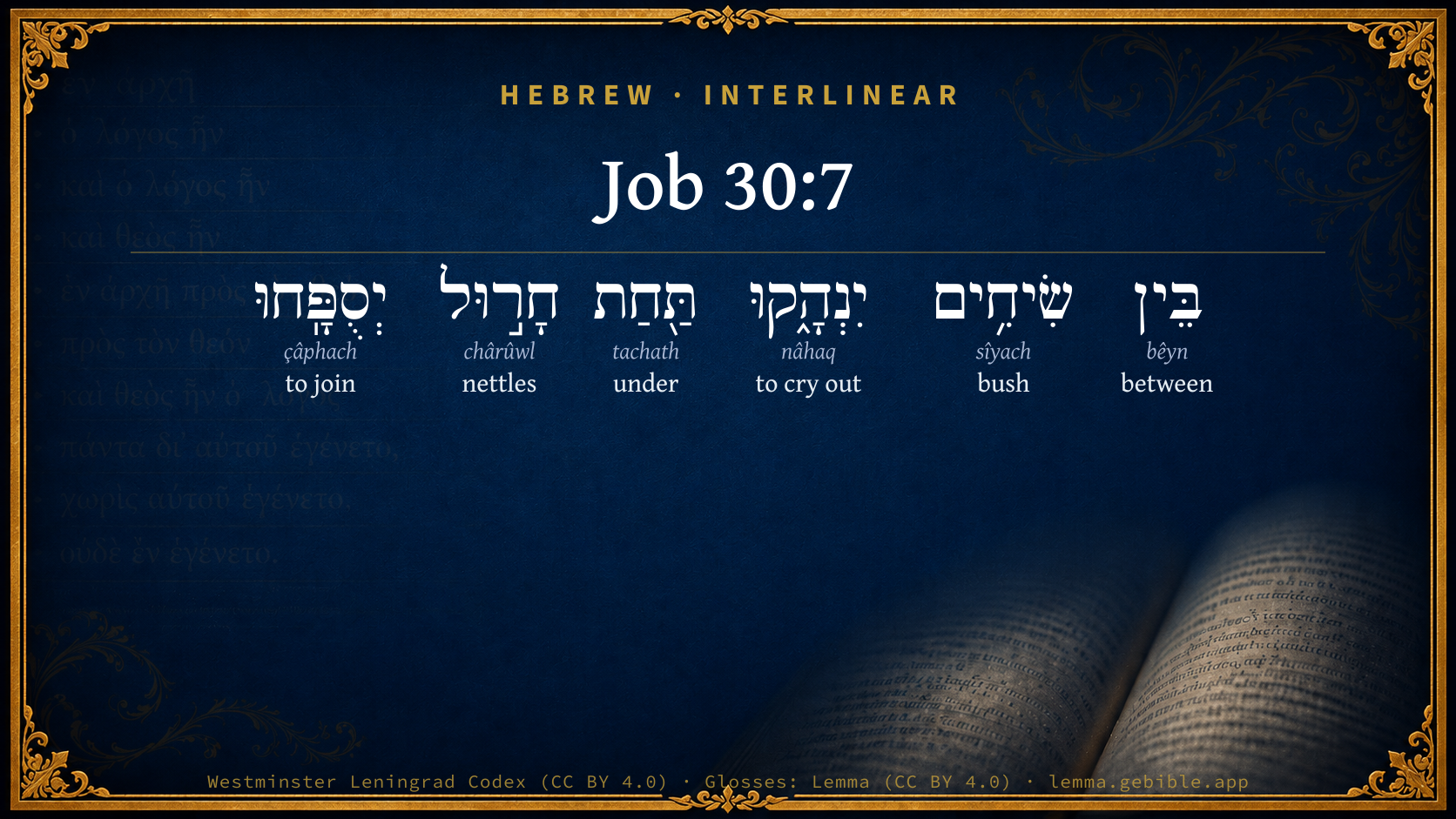
Hebrew (Westminster Leningrad Codex) Job 30:7 appears in the Hebrew Old Testament. The text above is from the Westminster Leningrad Codex. Each word links to its Strong’s number, a concise gloss, and parsing drawn from the Open Scriptures Hebrew Bible morphology. Click any word for its full Brown-Driver-Briggs (BDB) entry.
Download image
Cite this verse

Job 30:7 (World English Bible). Public Domain. Lemma interlinear Bible study tool, https://lemma.gebible.app/v/job/30/7.

Show BibTeX & RIS
BibTeX
RIS
English Translation
Among the bushes they bray; And under the nettles they are gathered together.
World English Bible · Public Domain
Highlights Full analysis ↓
Download a study sheet

One document with this verse’s original text, its word-by-word gloss line, the meaning frame, cross-references with their text, attributed commentary, and full source and license credits — printable, and it pastes into notes with its structure intact.

This verse Autodidact and up

Study sheet (.html) Plain text (.txt)

A passage Seminary Student

Up to 50 verses in one chapter. A passage sheet keeps up to 6 commentary sources and 12 cross-references per verse, in the order this page ranks them, and says so on the sheet whenever that leaves anything out. Ask for a single verse and you get the Autodidact verse sheet above.

Everything on this page stays free to read, with no account — the sheet is a download of what is already on screen, not access to it.

Want to remove ads? Support Godless Engineer
Compare translations 3

The same verse in 3 English versions, stacked beneath the original-language interlinear above. Click any original word for its lexicon entry.

Each is an independent rendering of the whole verse — the interlinear is not word-aligned to these translations.

Highlighted words mark where these versions differ — a whole-verse word diff, not a word-by-word alignment.

  • World English Bible Public Domain
    Among the bushes they bray; And under the nettles they are gathered together.
  • King James Version Public Domain
    Among the bushes they brayed; under the nettles they were gathered together.
  • unfoldingWord Literal Text CC BY-SA 4.0
    Among the shrubs they bray; they are gathered together under thorn bushes.

unfoldingWord Literal Text — © unfoldingWord, licensed CC BY-SA 4.0. Word-aligned USFM3 via Door43 (git.door43.org/unfoldingWord/en_ult).

Versions to compare (up to 4)

3 of 4 selected

Show all 18 translations

Every available English version of this verse, each an independent rendering of the whole verse.

  • World English Bible Public Domain
    Among the bushes they bray; And under the nettles they are gathered together.
  • Berean Standard Bible Public Domain
    They cried out among the shrubs and huddled beneath the nettles.
  • Majority Standard Bible Public Domain
    They cried out among the shrubs and huddled beneath the nettles.
  • King James Version Public Domain
    Among the bushes they brayed; under the nettles they were gathered together.
  • American Standard Version (1901) Public Domain
    Among the bushes they bray; Under the nettles they are gathered together.
  • Revised Version (1885) Public Domain
    Among the bushes they bray; under the nettles they are gathered together.
  • Geneva Bible (1599) Public Domain
    They roared among the bushes, and vnder the thistles they gathered themselues.
  • Douay-Rheims (1899) Public Domain
    They pleased themselves among these kind of things, and counted it delightful to be under the briers.
  • Young's Literal Translation Public Domain
    Among shrubs they do groan, Under nettles they are gathered together.
  • Literal Standard Version CC BY-SA 4.0
    They groan among shrubs, || They are gathered together under nettles.
  • Unlocked Literal Bible CC BY-SA 4.0
    Among the bushes they brayed like donkeys and they gathered together under the nettles.
  • unfoldingWord Literal Text CC BY-SA 4.0
    Among the shrubs they bray; they are gathered together under thorn bushes.
  • Darby Bible Public Domain
    They bray among the bushes; under the brambles they are gathered together:
  • World Messianic Bible Public Domain
    They bray among the bushes. They are gathered together under the nettles.
  • Webster's Bible Public Domain
    Among the bushes they brayed; under the nettles they were collected.
  • Free Bible Version CC BY-SA 4.0
    They shout out like animals among the bushes; they huddle together in the weeds for shelter.
  • Bible in Basic English Public Domain
    They make noises like asses among the brushwood; they get together under the thorns.
  • JPS Tanakh (1917) Public Domain
    Among the bushes they bray; under the nettles they are gathered together.

Literal Standard Version (2020), Covenant Press — licensed CC BY-SA 4.0. Text via the HelloAO Bible API (eBible.org). Unlocked Literal Bible (unfoldingWord) — licensed CC BY-SA 4.0. Text via the HelloAO Bible API (eBible.org). unfoldingWord Literal Text — © unfoldingWord, licensed CC BY-SA 4.0. Word-aligned USFM3 via Door43 (git.door43.org/unfoldingWord/en_ult). Free Bible Version, Dr. Jonathan Gallagher — licensed CC BY-SA 4.0. Text via the HelloAO Bible API (eBible.org).

Word by word

More ways to search: Search by grammar → Find every occurrence → Compare this word →

Practice this passage: Drill this verse → Learn its vocabulary →

About this verse

These counts appear in no published source. They are computed here, from the morphology-tagged text and Lemma’s own curated glosses. What Lemma adds →

6
words
6
distinct lemmas
Wisdom
section

Notable vocabulary

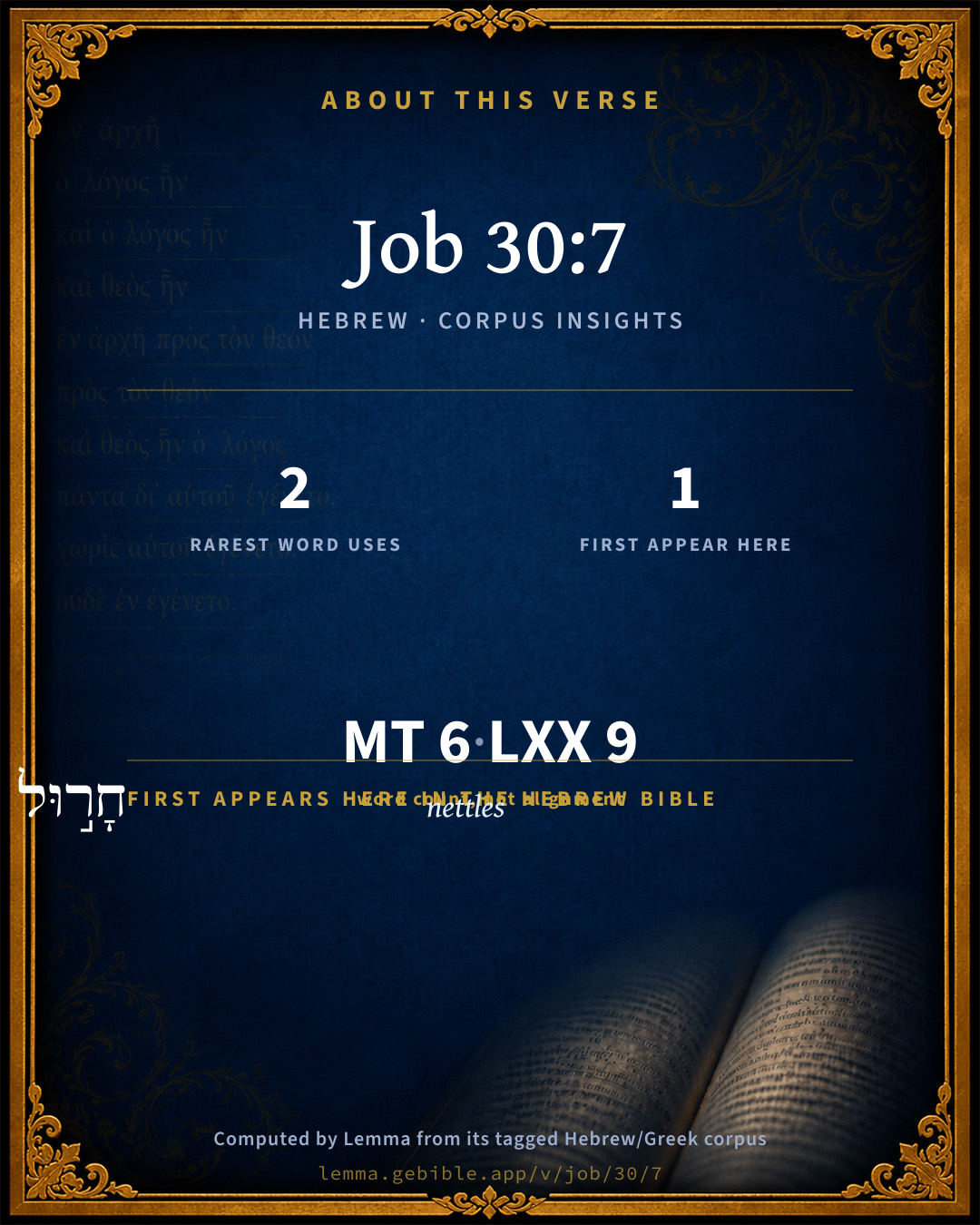
The rarest word here is יִנְהָ֑קוּ to cry out H5101 — appearing just 2 times in the whole Hebrew Bible.

First appearance in Scripture

This word makes its first canonical appearance in the Hebrew Bible here:

  • חָר֣וּל nettles H2738

Shared distinctive vocabulary

יִנְהָ֑קוּ to cry out H5101 occurs in 2 verses of the Hebrew Bible. Also found in:

Grammatical profile

  • 2 verbs
  • 2 nouns
  • 2 prepositions

Verb forms

  • יִנְהָ֑קוּ Qal · Imperfect
  • יְסֻפָּֽחוּ Pual · Imperfect

Hebrew & Septuagint length

In English translation the verse runs 13 words from the Hebrew and 8 from the Septuagint (LXX English) — the Septuagint runs noticeably shorter here. See the side-by-side →

A rough comparison of the two English renderings, which tokenize alike — not a word-level alignment.

Word counts can differ between the Hebrew and the Greek without any difference in meaning — e.g. the Hebrew direct-object marker אֵת has no separate Greek word, and Greek often adds the article ὁ.

In the original languages it is 6 Hebrew tokens and 9 Greek tokens — but the two are counted differently (Hebrew bundles its prefixes and suffixes into one token; the Greek is in lemma form), so that isn’t a like-for-like length.

Cross-references

3

Topical passages linked to Job 30:7 in the Treasury of Scripture Knowledge — connected by theme and wording, ordered by reader-vote popularity; previews shown in the World English Bible.

  • Genesis 16:12 He will be like a wild donkey among men. His hand will be against every man, and every man's hand against him. He will live opposite all of his brothers."
  • Job 6:5 Does the wild donkey bray when he has grass? Or does the ox low over his fodder?
  • Job 11:12 But vain man can become wise If a man can be born as a wild donkey's colt.

Cross-references courtesy of OpenBible.info (CC BY 4.0).

Hebrew and Greek witnesses Masoretic Hebrew ↔ Greek Septuagint

The same verse in the two great witnesses to the Old Testament, shown verse-for-verse.

Here the Septuagint runs noticeably shorter than the Hebrew — LXX2012 (modern English Septuagint) 8 words vs World English Bible 13. A rough length comparison of the two English translations, not a word-level alignment — read both below.

These are two independent witnesses, not word-aligned to each other, and the Septuagint is shown in lemma (dictionary) form.

Hebrew Job 30:7 Masoretic · Westminster Leningrad Codex

בֵּין שִׂיחִ֥ים יִנְהָ֑קוּ תַּ֖חַת חָר֣וּל יְסֻפָּֽחוּ

Among the bushes they bray; And under the nettles they are gathered together.

World English Bible · Public Domain

Greek LXX Job 30:7 Septuagint · lemma form

ἀνά μέσος εὐήχης βοάω ὅς ὑπό φρύγανον ἄγριος διααἰτάω

They will cry out among the rustling bushes.

LXX2012 (modern English Septuagint) · Public Domain

On this verse, Joseph Benson's Commentary discusses the Septuagint’s reading. Read the note in Commentary ↓

Hebrew: Westminster Leningrad Codex (CC BY 4.0). Greek: Septuagint (public domain); English from LXX2012 (modern English Septuagint) (Public Domain). How the Septuagint differs from the Hebrew →

Commentary

Notes on Job 30:7 from classic Christian and Jewish commentators (each source and its license shown beneath its notes). The classic Christian expositions comment on the surrounding passage and are grouped to its opening verse, so a note may address several verses; the Jewish commentaries on the Tanakh (Rashi and others) are per-verse, so they appear only where the commentator wrote on this verse.

Lemma curates 59 commentaries, every one of them public domain or Creative Commons licensed, each selected and text-cleaned for this edition rather than reprinted as found. About our sources →

Ellicott's Commentary for English Readers

(7) Among the bushes they brayed.—Herodotus says their language was like the screeching of bats, others say it was like the whistling of birds. This whole description is of the mockers of Job, and therefore should be in the present tense in Job_30:5; Job_30:7-8, as it may be in the Authorised Version of Job_30:4.

A Bible Commentary for English Readers, edited by Charles John Ellicott (1878–1897) — public domain. Text from a community e-Sword module.

Trapp's Complete Commentary

John Trapp

Job 30:7 Among the bushes they brayed; under the nettles they were gathered together.

Ver. 7. Among the bushes they brayed] Through grief and discontent at their low condition and many miseries; which yet they would rather bootlessly bewail than take a right course to remedy. They lust, and have not; they kill (themselves through idleness), and desire to have (if it would come without labour), but cannot obtain, Jas 4:2. And hence they bray like the wild ass when empty, and roar as the lion when bitten with hunger.

Under the nettles they were gathered together] Or they were pricked, whealed, as we call it. Urtica ab urendo, they were nettle stung, while they got under those weeds for shelter and warmth. All this Job relateth of those that derided him; not to be even with them, or out of a desire to disparage them, but to aggravate the indignity of his misusage, and to comfort himself, as Seneca in like case did: Male de me loquuntur, sed mali, They speak evil of me, but who are they? base persons, and wicked above measure; and oh how easy a thing it is to wag a wicked tongue! especially when the devil hath the doing of it, as he hath in this kind of men qui revera os aperiunt, et diabolum loqui sinunt, whose mouth the devil borroweth to vent the language of hell by (Lavater).

John Trapp, A Commentary or Exposition upon All the Books of the Old and New Testament (1647–1656) — public domain. Text from a community e-Sword module.

Joseph Benson's Commentary

Job 30:7. Among the bushes they brayed — Like the wild asses, (Job 6:5,) for hunger or thirst. They brayed, seems to be an improper translation here; because, though נהק, nahak, signifies to bray, when applied to an ass, yet when spoken of men in difficult circumstances, as in this verse, we should rather say with the Targum and LXX., they sighed, cried out, or made their moan. So Heath and Houbigant render it. Under the nettles they were gathered — The word חרול, charul, here rendered nettles, is by some translated thorns, or thistles, the nettle being too small a plant, as Bochart observes, for men to gather themselves under. Dr. Waterland, however, renders it, Among the nettles were they tormented, or burned. The meaning is, that they hid themselves under the thorns, or among the nettles, that they might not be discovered when they were sought out for justice.

Joseph Benson's Commentary on the Old and New Testaments (1811–1818) — public domain. Text from a community e-Sword module.

Jamieson, Fausset & Brown

Robert Jamieson, A. R. Fausset & David Brown

brayed--like the wild ass (Job 6:5 for food). The inarticulate tones of this uncivilized rabble are but little above those of the beast of the field.

gathered together--rather, sprinkled here and there. Literally, "poured out," graphically picturing their disorderly mode of encampment, lying up and down behind the thorn bushes.

nettles--or brambles [UMBREIT].

Jamieson, Fausset & Brown — Commentary Critical and Explanatory on the Whole Bible (1871) — public domain (CC PDM 1.0). Text via the HelloAO Bible API.

Adam Clarke's Commentary

Verse 7. Among the bushes they brayed] They cried out among the bushes, seeking for food, as the wild ass when he is in want of provender. Two MSS. read ינאקו yinaku, they groaned, instead of ינהקו yinhaku, they brayed.

Under the nettles] חרול charul, the briers or brambles, under the brushwood in the thickest parts of the underwood; they huddled together like wild beasts.

Adam Clarke's Commentary on the Bible (1810–1826) — public domain. Text from a community e-Sword/MySword module.

The Cambridge Bible for Schools and Colleges

gen. ed. J. J. S. Perowne

7. they brayed] Rather, they bray.

were gathered] Better, are gathered, or perhaps rather, stretch themselves, i. e. fling themselves down. Their cries are like those of the wild ass seeking for food (ch. Job_6:5), and they throw themselves down like wild beasts under the bushes in the desert.

The Cambridge Bible for Schools and Colleges (gen. ed. J. J. S. Perowne; Cambridge University Press, 1878–1918) — public domain. Text from a community e-Sword module.

John Gill's Exposition

Among the bushes they brayed,.... Like wild asses; so Sephorno, to which wicked men are fitly compared, Job 11:12; or they "cried", or "groaned" (m), and "moaned" among the bushes, where they lay lurking; either they groaned through cold, or want of food; for the wild ass brays not but when in want, Job 6:5;

under the nettles they were gathered together; or "under thistles" (n), as some, or "under thorns", as (o) others; under thorn hedges, where they lay either for shelter, or to hide themselves, or to seize upon a prey that might pass by; and so were such sort of persons as in the parable in Luk 14:23; it not being usual for nettles to grow so high as to cover persons, at least they are not a proper shelter, and much less an eligible one; though some render the words, they were "pricked" (p), blistered and wounded, a word derived from this being used for the scab of leprosy, Lev 13:6; and so pustules and blisters are raised by the sting of nettles: the Targum is,

"under thorns they were associated together;''

under thorn hedges, as before observed; and if the juniper tree is meant in Job 30:4, they might be said to be gathered under thorns when under that; since, as Pliny (q) says, it has thorns instead of leaves; and the shadow of it, according to the poet (r), is very noxious and disagreeable.

(m) "clamabant", Vatablus, Mercerus; so Ben Gerson; "gemebant", Michaelis; so Broughton. (n) "sub carduis", Vatablus. (o) "Sub sentibus", V. L. "sub vepreto aliquo", Tigurine version; "sub vepribus", Cocceius; "sub spina", Noldius, p. 193. Schultens. (p) "pungebantur", Junius & Tremellius; "se ulcerant", Gussetius, p. 565. so Ben Gersom; "they smarted", Broughton. (q) Nat. Hist. l. 16. c. 24. (r) "Juniperi gravis umbra----" Virgil. Bucolic. Eclog. 10.

John Gill's Exposition of the Whole Bible (1746–1763) — public domain (CC PDM 1.0). Text via the HelloAO Bible API.

Albert Barnes' Notes on the Bible

Among the bushes - Coverdale, “Upon the dry heath went they about crying.” The Hebrew word is the same which occurs in Job 30:4, and means bushes in general. They were heard in the shrubbery that grew in the desert.

They brayed - ינהקו yinâhaqû. The Vulgate renders this, “They were concealed.” The Septuagint, “Amidst sweet sounds they cry out.” Noyes, “They utter their cries.” The Hebrew word properly means to “bray.” It occurs only here and in Job 6:5, where it is applied to the ass. The sense here is, that the voices of this vagrant and wretched multitude was heard in the desert like the braying of asses.

Under the nettles - Dr. Good, “Under the briers.” Prof. Lee, “Beneath the broom-pea.” Noyes, “Under the thorns.” The Hebrew word חרול chârûl, occurs only here and in Zep 2:9, and Pro 24:31, in each of which places it is rendered “nettles.” It is probably derived from חרל = חרר, to burn, to glow, and is given to nettles from the burning or prickling sensation which they produce. Either the word nettles, thistles, or thorns, would sufficiently answer to its derivation. It does not occur in the Arabic. Castell. Umbreit renders it, “unter Dornen - under thorns.”

They were gathered together - Vulgate, “They accounted it a delicacy to be in a thorn-hedge.” The word used here (ספח sâphach) means “to add;” and then to be added or assembled together. The idea is, that they were huddled together quite promiscuously in the wild-growing bushes of the desert. They had no home; no separate habitation. This description is interesting, not only as denoting the depth to which Job had been reduced when he was the object of contempt by such vagrants, but as illustrative of a state of society existing then.

Albert Barnes' Notes on the Bible (1834–1885) — public domain. Text from a community e-Sword/MySword module.

Haydock's Catholic Bible Commentary

Pleased. Hebrew, "brayed." (Calmet) --- Briars. Protestants, "nettles." They were driven from the society of men and forced to abscond. (Haydock)

George Leo Haydock (1774–1849), Haydock's Catholic Family Bible and Commentary, 1859 edition — public domain. Excludes Psalms (Douay-Rheims chapter numbering differs from Protestant) and Deuterocanonical books (Catholic canon only).

Matthew Poole's English Annotations

They brayed, like the wild asses, Job 6:5, for hunger or thirst.

Under the nettles, which seem not proper for that use. This Hebrew word is used but twice in Scripture, and it is acknowledged both by Jewish and Christian writers, that the signification of the Hebrew words which express plants, or beasts, or stones, &c. is very uncertain; and therefore this is by others, and may well be, understood of some kind of thorns; and so this is the same thing with the bushes in the former branch of the verse, under which they hid themselves, that they might not be discovered when they were sought out for justice.

Matthew Poole's English Annotations on the Holy Bible (1683–1685) — public domain. Text from a community e-Sword/MySword module.

Whedon's Commentary on the Bible

Daniel D. Whedon

7. Brayed — Their inarticulate notes sounded like those of the ass, Job_24:5. Herodotus (iv, 183) compares the language of the Troglodyte Ethiopian to the screech of the night-owl. The bray which Job deftly imputes to this human rabble tells the genus to which, in his estimate, they belong.

Nettles — Denoted probably some kind of thistle or thorn, (Rosenmuller;) according to others, some species of wild mustard.

They were gathered together — The Arabic seems to justify Taylor Lewis (compare Gesenius, Thes., s.v.) in rendering יספחו, herd together like beasts. In illustration of meaning, consult Herodotus 1:216, and Larcher’s “Notes on Herodotus,” vol. i, page 196.

Daniel D. Whedon (gen. ed.), Commentary on the Old and New Testaments (1874–1909) — public domain. Text from a community e-Sword module.

The Pulpit Commentary

Among the bushes they brayed. The sounds which came from their mouths sounded to Job less like articulate speech than like the braying of asses. Compare what Herodotus says of his Troglodytes: "Their language is unlike that of any other people; it sounds like the screeching of bats." Under the nettles (or, wild vetches) they were gathered together; rather, huddled together.

The Pulpit Commentary (1880–1919), ed. H.D.M. Spence-Jones & Joseph S. Exell — public domain. Text from a community e-Sword module.

John Wesley's Explanatory Notes

Brayed - Like the wild asses, for hunger or thirst. Thorns - Under which they hide themselves, that they might not be discovered when they are sought out for justice.

John Wesley, Explanatory Notes Upon the Whole Bible (1754–1765) — public domain. Text via the GEBible commentary corpus.

unfoldingWord translationNotes

Door43 World Missions Community

Connecting Statement:

Job continues to talk about the fathers of the mockers.

brayed like donkeys

Job speaks of the men crying out in hunger as if they were wild donkeys making a loud noise. AT: "cried out like wild donkeys because they were hungry" (See: Simile)

they gathered together under the nettles

"Nettles" are bushes with sharp thorns. This implies that they did not have a home.

They were the sons of fools

Here "were the sons of fools" represents having the characteristics fools. AT: "They were like fools" or "they were fools" (See: Metaphor)

indeed, sons of nameless people

The word "indeed" shows that what follows strengthens the previous thought. Here "sons of nameless people" represents having the characteristics of nameless people. AT: "indeed, they were nameless people" or "indeed, they were worthless" (See: Metaphor)

nameless people

Here being "nameless" represents having no honor or respect. It means that they are worthless. AT: "worthless people" (See: Metaphor)

They were driven out of the land with whips

This can be stated in active form. Possible meanings are 1) the idea of whips implies that they were being treated like criminals. AT: "People treated them like criminals and forced them to leave the land" or 2) people actually used whips to force them out. AT: "People whipped them and forced them to leave the land" (See: Metonymy)

They were driven out of the land

Here "the land" refers to the land where they lived before they were forced to go out to the wilderness.

translationWords

descend

fool

son

unfoldingWord translationNotes — © Distant Shores Media and the Door43 World Missions Community, licensed CC BY-SA 4.0. Source: git.door43.org/Door43/en_tn.

Rashi

Rabbi Shlomo Yitzchaki (Rashi)

under the nettles they gather (Orties in French), nettles. They would gather, as in (Isa. 14:1), “and join (ונספחו) the house of Jacob.”

Rashi on the Tanakh — English translations: “The Judaica Press complete Tanach with Rashi, translated by A. J. Rosenberg” (CC BY 4.0); “Pentateuch with Rashi's commentary by M. Rosenbaum and A.M. Silbermann, 1929-1934” (public domain); “The Metsudah Tanach series, Lakewood, N.J” (CC BY 4.0); and “The Book of Joshua, Metsudah Publications, 1997” (CC BY 4.0). Text via Sefaria.

Lesson kit

Teaching starters — assembled from the data on this page, not authored interpretation. Every prompt links to the verse data it draws on. Edit before teaching.

Job, in the Wisdom, opens this verse with 6 words (6 distinct Hebrew lemmas). Its most distinctive word is nâhaq (“to cry out”). The Greek Septuagint runs shorter here. A historical commentator’s framing appears above. Read the whole chapter for the surrounding context.

Discussion questions

  1. The word nâhaq carries the sense “to cry out.” How does it shape the verse?
  2. This is the first place “nettles” appears in Scripture (first appears here). What does its debut here establish?
  3. How does Job 6:5, which shares the word «to cry out», read alongside this verse?
  4. The Septuagint runs shorter here than the Hebrew. What might account for the difference?
  5. These translations render this verse differently. What is at stake in choosing one wording over another?
  6. «יִנְהָ֑קוּ» is a Qal Imperfect verb. How does that grammatical form shape the action described?
  7. Compare how Ellicott's Commentary for English Readers and Trapp's Complete Commentary read this verse. Where do they agree or differ?

Things to notice

Reading settings

Reading text

Shown beneath each verse's original-language words.

Old Testament
Old Testament edition

Read the OT as the Masoretic Hebrew (MT) or the Greek Septuagint (LXX).

English shown for the Greek Septuagint (in the Hebrew ↔ Greek comparison).

Comparing translations? Open the Compare panel on any verse page to stack up to four side by side.