
Ezekiel 8:3

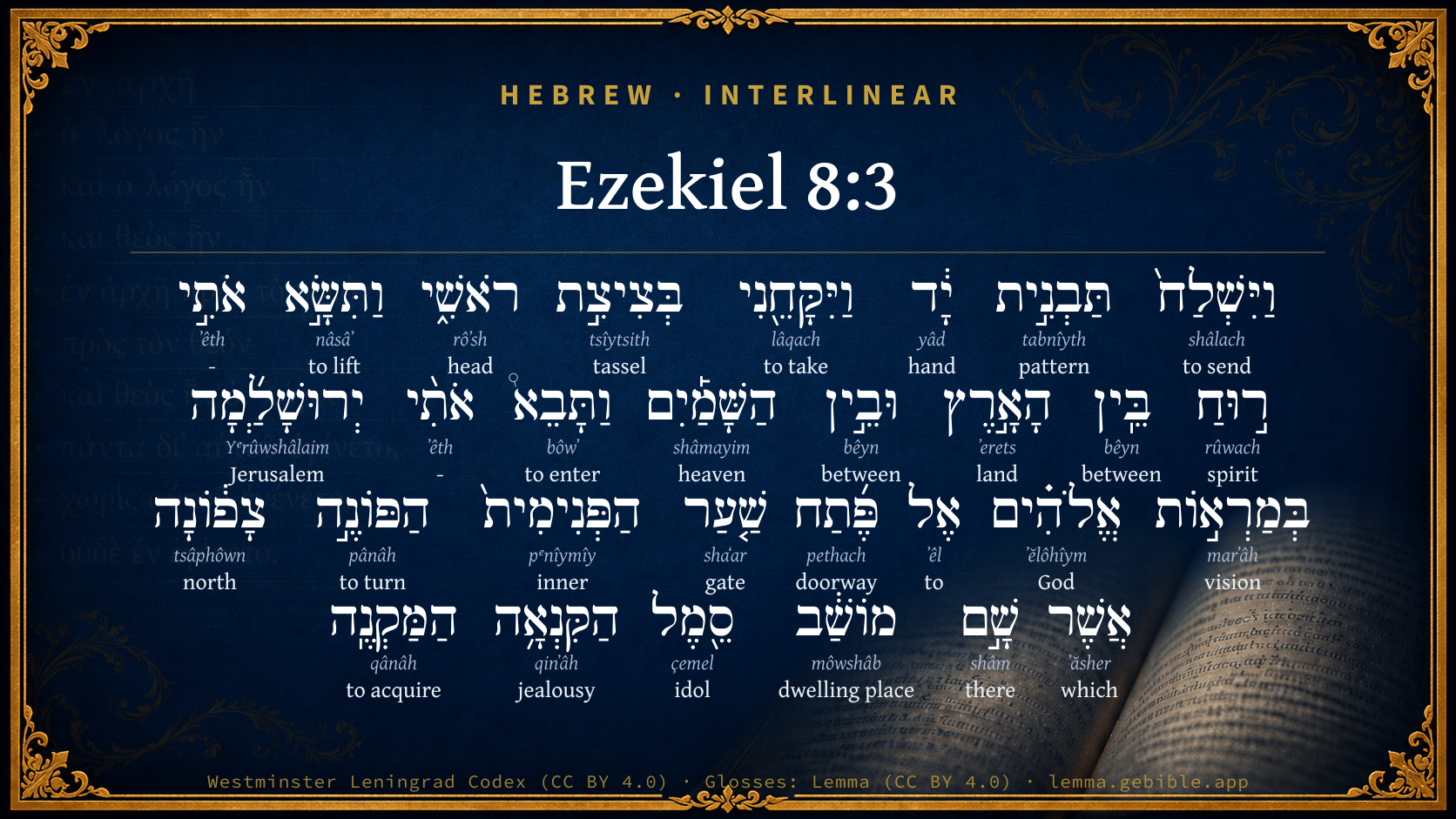
Hebrew (Westminster Leningrad Codex) Ezekiel 8:3 appears in the Hebrew Old Testament. The text above is from the Westminster Leningrad Codex. Each word links to its Strong’s number, a concise gloss, and parsing drawn from the Open Scriptures Hebrew Bible morphology. Click any word for its full Brown-Driver-Briggs (BDB) entry.
Download image
Cite this verse

Ezekiel 8:3 (World English Bible). Public Domain. Lemma interlinear Bible study tool, https://lemma.gebible.app/v/ezekiel/8/3.

Show BibTeX & RIS
BibTeX
RIS
English Translation
He put forth the form of a hand, and took me by a lock of my head; and the Spirit lifted me up between earth and the sky, and brought me in the visions of God to Jerusalem, to the door of the gate of the inner [court] that looks toward the north; where was the seat of the image of jealousy, which provokes to jealousy.
World English Bible · Public Domain
Download a study sheet

One document with this verse’s original text, its word-by-word gloss line, the meaning frame, cross-references with their text, attributed commentary, and full source and license credits — printable, and it pastes into notes with its structure intact.

This verse Autodidact and up

Study sheet (.html) Plain text (.txt)

A passage Seminary Student

Up to 50 verses in one chapter. A passage sheet keeps up to 6 commentary sources and 12 cross-references per verse, in the order this page ranks them, and says so on the sheet whenever that leaves anything out. Ask for a single verse and you get the Autodidact verse sheet above.

Everything on this page stays free to read, with no account — the sheet is a download of what is already on screen, not access to it.

Want to remove ads? Support Godless Engineer
Compare translations 3

The same verse in 3 English versions, stacked beneath the original-language interlinear above. Click any original word for its lexicon entry.

Each is an independent rendering of the whole verse — the interlinear is not word-aligned to these translations.

Highlighted words mark where these versions differ — a whole-verse word diff, not a word-by-word alignment.

  • World English Bible Public Domain
    He put forth the form of a hand, and took me by a lock of my head; and the Spirit lifted me up between earth and the sky, and brought me in the visions of God to Jerusalem, to the door of the gate of the inner [court] that looks toward the north; where was the seat of the image of jealousy, which provokes to jealousy.
  • King James Version Public Domain
    And he put forth the form of an hand, and took me by a lock of mine head; and the spirit lifted me up between the earth and the heaven, and brought me in the visions of God to Jerusalem, to the door of the inner gate that looketh toward the north; where was the seat of the image of jealousy, which provoketh to jealousy.
  • unfoldingWord Literal Text CC BY-SA 4.0
    Then he reached out the form of a hand and took me by the hair of my head; the Spirit lifted me up between earth and heaven, and in visions from God, he brought me to Jerusalem, to the entrance of the inner northern gate, where the idol that provokes great jealousy was standing.

unfoldingWord Literal Text — © unfoldingWord, licensed CC BY-SA 4.0. Word-aligned USFM3 via Door43 (git.door43.org/unfoldingWord/en_ult).

Versions to compare (up to 4)

3 of 4 selected

Show all 18 translations

Every available English version of this verse, each an independent rendering of the whole verse.

  • World English Bible Public Domain
    He put forth the form of a hand, and took me by a lock of my head; and the Spirit lifted me up between earth and the sky, and brought me in the visions of God to Jerusalem, to the door of the gate of the inner [court] that looks toward the north; where was the seat of the image of jealousy, which provokes to jealousy.
  • Berean Standard Bible Public Domain
    He stretched out what looked like a hand and took me by the hair of my head. Then the Spirit lifted me up between earth and heaven and carried me in visions of God to Jerusalem, to the entrance of the north gate of the inner court, where the idol that provokes jealousy was seated.
  • Majority Standard Bible Public Domain
    He stretched out what looked like a hand and took me by the hair of my head. Then the Spirit lifted me up between earth and heaven and carried me in visions of God to Jerusalem, to the entrance of the north gate of the inner court, where the idol that provokes jealousy was seated.
  • King James Version Public Domain
    And he put forth the form of an hand, and took me by a lock of mine head; and the spirit lifted me up between the earth and the heaven, and brought me in the visions of God to Jerusalem, to the door of the inner gate that looketh toward the north; where was the seat of the image of jealousy, which provoketh to jealousy.
  • American Standard Version (1901) Public Domain
    And he put forth the form of a hand, and took me by a lock of my head; and the Spirit lifted me up between earth and heaven, and brought me in the visions of God to Jerusalem, to the door of the gate of the inner `court' that looketh toward the north; where was the seat of the image of jealousy, which provoketh to jealousy.
  • Revised Version (1885) Public Domain
    And he put forth the form of an hand, and took me by a lock of mine head; and the spirit lifted me up between the earth and the heaven, and brought me in the visions of God to Jerusalem, to the door of the gate of the inner court that looketh toward the north; where was the seat of the image of jealousy, which provoketh to jealousy.
  • Geneva Bible (1599) Public Domain
    And he stretched out the likenes of an had, and tooke me by an hearie locke of mine head, and the Spirit lift me vp betweene the earth, and the heauen, and brought mee by a Diuine vision to Ierusalem, into the entry of ye inner gate that lieth toward the North, where remained the idole of indignation, which prouoked indignation.
  • Douay-Rheims (1899) Public Domain
    And the likeness of a hand was put forth and took me by a lock of my head: and the spirit lifted me up between the earth and the heaven, and brought me in the vision of God into Jerusalem, near the inner gate, that looked toward the north, where was set the idol of jealousy to provoke to jealousy.
  • Young's Literal Translation Public Domain
    And He putteth forth a form of a hand, and taketh me by a lock of my head, and lift me up doth a spirit between the earth and the heavens, and it bringeth me in to Jerusalem in visions of God, unto the opening of the inner gate that is facing the north, where `is' the seat of the figure of jealousy that is making jealous,
  • Literal Standard Version CC BY-SA 4.0
    And He puts forth a form of a hand, and takes me by a lock of my head, and [the] Spirit lifts me up between the earth and the heavens, and brings me to Jerusalem in visions of God, to the opening of the inner gate that is facing the north, where the seat of the figure of jealousy [is] that is making jealous,
  • Unlocked Literal Bible CC BY-SA 4.0
    Then he reached out the form of a hand and took me by the hair of my head; the Spirit lifted me up between earth and heaven, and in visions from God, he brought me to Jerusalem, to the entrance of the inner northern gate, where the idol that provokes great jealousy was standing.
  • unfoldingWord Literal Text CC BY-SA 4.0
    Then he reached out the form of a hand and took me by the hair of my head; the Spirit lifted me up between earth and heaven, and in visions from God, he brought me to Jerusalem, to the entrance of the inner northern gate, where the idol that provokes great jealousy was standing.
  • Darby Bible Public Domain
    And he stretched forth the form of a hand, and took me by a lock of my head; and the Spirit lifted me up between the earth and the heavens, and brought me in the visions of God to Jerusalem, to the entry of the inner gate that looketh toward the north, where was the seat of the image of jealousy, which provoketh to jealousy.
  • World Messianic Bible Public Domain
    He stretched out the form of a hand, and took me by a lock of my head; and the Spirit lifted me up between earth and the sky, and brought me in the visions of God to Jerusalem, to the door of the gate of the inner court that looks toward the north, where there was the seat of the image of jealousy, which provokes to jealousy.
  • Webster's Bible Public Domain
    And he put forth the form of a hand, and took me by a lock of my head; and the spirit lifted me up between the earth and the heaven, and brought me in the visions of God to Jerusalem, to the door of the inner gate that looketh towards the north; where was the seat of the image of jealousy, which provoketh to jealousy.
  • Free Bible Version CC BY-SA 4.0
    He reached out what seemed to be a hand and picked me up by my hair. The Spirit took me up into the sky, and in the vision God was giving me he carried me to Jerusalem, to the entrance of the north gate of the Temple's inner courtyard, where the offensive idol that made God angry had been placed.
  • Bible in Basic English Public Domain
    And he put out the form of a hand and took me by the hair of my head; and the wind, lifting me up between the earth and the heaven, took me in the visions of God to Jerusalem, to the way into the inner door facing to the north; where was the seat of the image of envy.
  • JPS Tanakh (1917) Public Domain
    And the form of a hand was put forth, and I was taken by a lock of my head; and a spirit lifted me up between the earth and the heaven, and brought me in the visions of God to Jerusalem, to the door of the gate of the inner court that looketh toward the north; where was the seat of the image of jealousy, which provoketh to jealousy.

Literal Standard Version (2020), Covenant Press — licensed CC BY-SA 4.0. Text via the HelloAO Bible API (eBible.org). Unlocked Literal Bible (unfoldingWord) — licensed CC BY-SA 4.0. Text via the HelloAO Bible API (eBible.org). unfoldingWord Literal Text — © unfoldingWord, licensed CC BY-SA 4.0. Word-aligned USFM3 via Door43 (git.door43.org/unfoldingWord/en_ult). Free Bible Version, Dr. Jonathan Gallagher — licensed CC BY-SA 4.0. Text via the HelloAO Bible API (eBible.org).

Word by word

More ways to search: Search by grammar → Find every occurrence → Compare this word →

Practice this passage: Drill this verse → Learn its vocabulary →

בְּצִיצִ֣ת
tsîytsith
H6734
“in/at · tassel of”
Preposition + Noun, Common, Feminine, Singular, Construct
Part of Speech
Preposition + Noun
Type
Common
Gender
Feminine
Number
Singular
State
Construct
Full BDB Definition

Origin: from H6731

TWOT: 1912

fringe, tassel, lock
  1. וַיִּשְׁלַח֙ shâlach H7971 “and · to send” Conjunction + Verb, Qal, Sequential Imperfect, 3rd Person, Masculine, Singular
  2. תַּבְנִ֣ית tabnîyth H8403 “pattern of” Noun, Common, Feminine, Singular, Construct
  3. יָ֔ד yâd H3027 “hand” Noun, Common, Both, Singular, Absolute
  4. וַיִּקָּחֵ֖נִי lâqach H3947 “and · to take · me” Conjunction + Verb, Qal, Sequential Imperfect, 3rd Person, Masculine, Singular + Suffix, Personal, 1st Person, Common, Singular
  5. רֹאשִׁ֑י rôʼsh H7218 “head · my” Noun, Common, Masculine, Singular, Construct + Suffix, Personal, 1st Person, Common, Singular
  6. וַתִּשָּׂ֣א nâsâʼ H5375 “and · to lift” Conjunction + Verb, Qal, Sequential Imperfect, 3rd Person, Feminine, Singular
  7. אֹתִ֣י ʼêth H853 “- · me” Particle, Direct Object + Suffix, Personal, 1st Person, Common, Singular
  8. ר֣וּחַ rûwach H7307 “spirit” Noun, Common, Both, Singular, Absolute
  9. בֵּֽין bêyn H996 “between” Preposition
  10. הָאָ֣רֶץ ʼerets H776 “the · land” Particle, Definite Article + Noun, Common, Both, Singular, Absolute
  11. וּבֵ֣ין bêyn H996 “and · between” Conjunction + Preposition
  12. הַשָּׁמַ֡יִם shâmayim H8064 “the · heaven(s)” Particle, Definite Article + Noun, Common, Masculine, Plural, Absolute
  13. וַתָּבֵא֩ bôwʼ H935 “and · to enter” Conjunction + Verb, Hiphil, Sequential Imperfect, 3rd Person, Feminine, Singular
  14. אֹתִ֨י ʼêth H853 “- · me” Particle, Direct Object + Suffix, Personal, 1st Person, Common, Singular
  15. יְרוּשָׁלְַ֜מָה Yᵉrûwshâlaim H3389 “Jerusalem · toward” Noun, Proper + Suffix, Demonstrative
  16. בְּמַרְא֣וֹת marʼâh H4759 “in/at · visions of” Preposition + Noun, Common, Feminine, Plural, Construct
  17. אֱלֹהִ֗ים ʼĕlôhîym H430 “God(s)” Noun, Common, Masculine, Plural, Absolute
  18. אֶל ʼêl H413 “to” Preposition
  19. פֶּ֜תַח pethach H6607 “doorway of” Noun, Common, Masculine, Singular, Construct
  20. שַׁ֤עַר shaʻar H8179 “gate of” Noun, Common, Masculine, Singular, Construct
  21. הַפְּנִימִית֙ pᵉnîymîy H6442 “the · inner” Particle, Definite Article + Adjective, Adjective, Feminine, Singular, Absolute
  22. הַפּוֹנֶ֣ה pânâh H6437 “the · turning” Particle, Definite Article + Verb, Qal, Participle Active, Masculine, Singular, Absolute
  23. צָפ֔וֹנָה tsâphôwn H6828 “north · toward” Noun, Common, Feminine, Singular, Absolute + Suffix, Demonstrative
  24. אֲשֶׁר ʼăsher H834 “which” Particle, Relative
  25. שָׁ֣ם shâm H8033 “there” Adverb
  26. מוֹשַׁ֔ב môwshâb H4186 “dwelling place of” Noun, Common, Masculine, Singular, Construct
  27. סֵ֖מֶל çemel H5566 “idol of” Noun, Common, Masculine, Singular, Construct
  28. הַקִּנְאָ֥ה qinʼâh H7068 “the · jealousy” Particle, Definite Article + Noun, Common, Feminine, Singular, Absolute
  29. הַמַּקְנֶֽה qânâh H7069 “the · acquiring” Particle, Definite Article + Verb, Hiphil, Participle Active, Masculine, Singular, Absolute

About this verse

These counts appear in no published source. They are computed here, from the morphology-tagged text and Lemma’s own curated glosses. What Lemma adds →

30
words
28
distinct lemmas
Prophets
section

Notable vocabulary

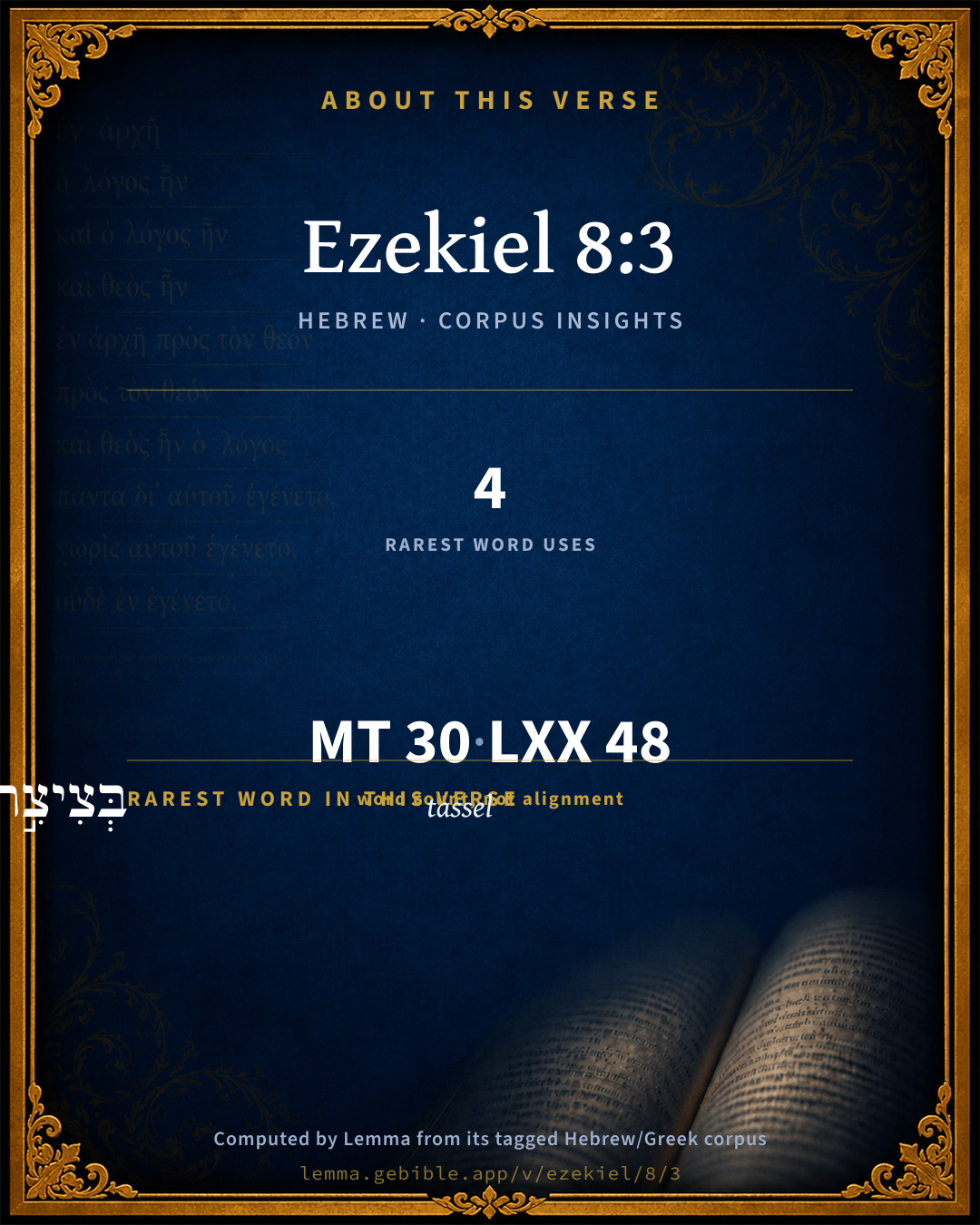
The rarest word here is בְּצִיצִ֣ת tassel H6734 — appearing just 4 times in the whole Hebrew Bible.

Shared distinctive vocabulary

בְּצִיצִ֣ת tassel H6734 occurs in 3 verses of the Hebrew Bible. Also found in:

Grammatical profile

  • 6 verbs
  • 16 nouns
  • 1 adjective
  • 3 prepositions
  • 1 adverb
  • 3 particles

Verb forms

  • וַיִּשְׁלַח֙ Qal · Sequential Imperfect
  • וַיִּקָּחֵ֖נִי Qal · Sequential Imperfect
  • וַתִּשָּׂ֣א Qal · Sequential Imperfect
  • וַתָּבֵא֩ Hiphil · Sequential Imperfect
  • הַפּוֹנֶ֣ה Qal · Participle Active
  • הַמַּקְנֶֽה Hiphil · Participle Active

Repetition

A word recurs within this verse — often emphatic in Hebrew:

  • בֵּֽין between H996 ×2

Hebrew & Septuagint length

In English translation the verse runs 66 words from the Hebrew and 57 from the Septuagint (LXX English) — closely comparable.

A rough comparison of the two English renderings, which tokenize alike — not a word-level alignment.

Word counts can differ between the Hebrew and the Greek without any difference in meaning — e.g. the Hebrew direct-object marker אֵת has no separate Greek word, and Greek often adds the article ὁ.

In the original languages it is 30 Hebrew tokens and 48 Greek tokens — but the two are counted differently (Hebrew bundles its prefixes and suffixes into one token; the Greek is in lemma form), so that isn’t a like-for-like length.

Cross-references

32

Topical passages linked to Ezekiel 8:3 in the Treasury of Scripture Knowledge — connected by theme and wording, ordered by reader-vote popularity; previews shown in the World English Bible.

  • Deuteronomy 32:16 They moved him to jealousy with strange [gods]; With abominations provoked they him to anger.
  • Ezekiel 11:1 Moreover the Spirit lifted me up, and brought me to the east gate of Yahweh's house, which looks eastward: and see, at the door of the gate twenty-five men; and I saw in the midst of them Jaazaniah the son of Azzur, and Pelatiah the son of Benaiah, princes of the people.
  • Deuteronomy 5:9 you shall not bow down yourself to them, nor serve them; for I, Yahweh, your God, am a jealous God, visiting the iniquity of the fathers on the children, and on the third and on the fourth generation of those who hate me;
  • Ezekiel 5:11 Therefore, as I live, says the Lord Yahweh, surely, because you have defiled my sanctuary with all your detestable things, and with all your abominations, therefore will I also diminish [you]; neither shall my eye spare, and I also will have no pity.
  • Exodus 20:5 you shall not bow yourself down to them, nor serve them, for I, Yahweh your God, am a jealous God, visiting the iniquity of the fathers on the children, on the third and on the fourth generation of those who hate me,
  • Deuteronomy 4:24 For Yahweh your God is a devouring fire, a jealous God.
  • Deuteronomy 6:15 for Yahweh your God in the midst of you is a jealous God; lest the anger of Yahweh your God be kindled against you, and he destroy you from off the face of the earth.
  • Deuteronomy 32:21 They have moved me to jealousy with that which is not God; They have provoked me to anger with their vanities: I will move them to jealousy with those who are not a people; I will provoke them to anger with a foolish nation.
  • Ezekiel 2:9 When I looked, behold, a hand was put forth to me; and, behold, a scroll of a book was therein;
  • Ezekiel 11:24 The Spirit lifted me up, and brought me in the vision by the Spirit of God into Chaldea, to them of the captivity. So the vision that I had seen went up from me.
  • Ezekiel 40:2 In the visions of God brought he me into the land of Israel, and set me down on a very high mountain, whereon was as it were the frame of a city on the south.
  • Daniel 5:5 In the same hour came forth the fingers of a man's hand, and wrote over against the lampstand on the plaster of the wall of the king's palace: and the king saw the part of the hand that wrote.
  • Exodus 34:14 for you shall worship no other god: for Yahweh, whose name is Jealous, is a jealous God.
  • Joshua 24:19 Joshua said to the people, You can't serve Yahweh; for he is a holy God; he is a jealous God; he will not forgive your disobedience nor your sins.
  • 1 Kings 18:12 It will happen, as soon as I am gone from you, that the Spirit of Yahweh will carry you I don't know where; and so when I come and tell Ahab, and he can't find you, he will kill me: but I your servant fear Yahweh from my youth.
  • 2 Kings 2:16 They said to him, See now, there are with your servants fifty strong men; let them go, we pray you, and seek your master, lest the Spirit of Yahweh has taken him up, and cast him on some mountain, or into some valley. He said, You shall not send.
  • 2 Kings 16:14 The brazen altar, which was before Yahweh, he brought from the forefront of the house, from between his altar and the house of Yahweh, and put it on the north side of his altar.
  • 2 Kings 21:7 He set the engraved image of Asherah, that he had made, in the house of which Yahweh said to David and to Solomon his son, In this house, and in Jerusalem, which I have chosen out of all the tribes of Israel, will I put my name forever;
  • Psalms 78:58 For they provoked him to anger with their high places, And moved him to jealousy with their engraved images.
  • Jeremiah 7:30 For the children of Judah have done that which is evil in my sight, says Yahweh: they have set their abominations in the house which is called by my name, to defile it.
  • Jeremiah 32:34 But they set their abominations in the house which is called by my name, to defile it.
  • Ezekiel 3:12 Then the Spirit lifted me up, and I heard behind me the voice of a great rushing, [saying], Blessed be the glory of Yahweh from his place.
  • Ezekiel 3:14 So the Spirit lifted me up, and took me away; and I went in bitterness, in the heat of my spirit; and the hand of Yahweh was strong on me.
  • Ezekiel 7:20 As for the beauty of his ornament, he set it in majesty; but they made the images of their abominations [and] their detestable things therein: therefore have I made it to them as an unclean thing.
  • Ezekiel 8:5 Then said he to me, Son of man, lift up your eyes now the way toward the north. So I lifted up my eyes the way toward the north, and see, northward of the gate of the altar this image of jealousy in the entry.
  • Daniel 10:10 Behold, a hand touched me, which set me on my knees and on the palms of my hands.
  • Daniel 10:18 Then there touched me again one like the appearance of a man, and he strengthened me.
  • Acts 8:39 When they came up out of the water, the Spirit of the Lord caught Philip away, and the eunuch didn't see him any more, for he went on his way rejoicing.
  • 1 Corinthians 10:21–22 You can't both drink the cup of the Lord and the cup of demons. You can't both partake of the table of the Lord, and of the table of demons.
  • 2 Corinthians 12:2–4 I know a man in Christ, fourteen years ago (whether in the body, I don't know, or whether out of the body, I don't know; God knows), such a one caught up into the third heaven.
  • Revelation 1:10–20 I was in the Spirit on the Lord's day, and I heard behind me a loud voice, like a trumpet
  • Revelation 4:2–11 Immediately I was in the Spirit. Behold, there was a throne set in heaven, and one sitting on the throne

Cross-references courtesy of OpenBible.info (CC BY 4.0).

Hebrew and Greek witnesses Masoretic Hebrew ↔ Greek Septuagint

The same verse in the two great witnesses to the Old Testament, shown verse-for-verse.

These are two independent witnesses, not word-aligned to each other, and the Septuagint is shown in lemma (dictionary) form.

Hebrew Ezekiel 8:3 Masoretic · Westminster Leningrad Codex

וַיִּשְׁלַח֙ תַּבְנִ֣ית יָ֔ד וַיִּקָּחֵ֖נִי בְּצִיצִ֣ת רֹאשִׁ֑י וַתִּשָּׂ֣א אֹתִ֣י ר֣וּחַ בֵּֽין הָאָ֣רֶץ וּבֵ֣ין הַשָּׁמַ֡יִם וַתָּבֵא֩ אֹתִ֨י יְרוּשָׁלְַ֜מָה בְּמַרְא֣וֹת אֱלֹהִ֗ים אֶל פֶּ֜תַח שַׁ֤עַר הַפְּנִימִית֙ הַפּוֹנֶ֣ה צָפ֔וֹנָה אֲשֶׁר שָׁ֣ם מוֹשַׁ֔ב סֵ֖מֶל הַקִּנְאָ֥ה הַמַּקְנֶֽה

He put forth the form of a hand, and took me by a lock of my head; and the Spirit lifted me up between earth and the sky, and brought me in the visions of God to Jerusalem, to the door of the gate of the inner [court] that looks toward the north; where was the seat of the image of jealousy, which provokes to jealousy.

World English Bible · Public Domain

Greek LXX Ezekiel 8:3 Septuagint · lemma form

καί ἐκτείνω ὁμοίωμα χείρ καί ἀναλαμβάνω ἐγώ ὁ κορυφή ἐγώ καί ἀναλαμβάνω ἐγώ πνεῦμα ἀνά μέσος ὁ γῆ καί ἀνά μέσος ὁ οὐρανός καί ἄγω ἐγώ εἰς ἰερουσαλήμ ἐν ὅρασις θεός ἐπί ὁ πρόθυρον ὁ πύλη ὁ ἐσώτερος ὁ βλέπω πρός βορέας ὅς εἰμί ὁ στήλη ὁ κτάομαι

And he stretched forth the likeness of a hand, and took me by the crown of my head; and the Spirit lifted me up between the earth and sky, and brought me to Jerusalem in a vision of God, to the porch of the gate that looks to the north, where was the pillar of the Purchaser.

LXX2012 (modern English Septuagint) · Public Domain

On this verse, The Cambridge Bible for Schools and Colleges discusses the Septuagint’s reading. Read the note in Commentary ↓

Hebrew: Westminster Leningrad Codex (CC BY 4.0). Greek: Septuagint (public domain); English from LXX2012 (modern English Septuagint) (Public Domain). How the Septuagint differs from the Hebrew →

Targum (Aramaic paraphrase)

1

The Targum is the ancient Jewish Aramaic paraphrase of the Hebrew Scriptures — an interpretive translation, not the Hebrew text itself. Onkelos (literal) and Pseudo-Jonathan (expansive) render the Torah, and Jonathan the Prophets. Coverage is partial: where no permissively-licensed English translation exists for a verse, only the Aramaic is shown. This is verse-level text, not a word-by-word alignment to the Hebrew.

  1. Targum Jonathan Prophets (Joshua–Malachi)
    וְאוֹשִׁיט דְמוּת יַד וְאַחֲדַנִי בִּסְעַר רֵישִׁי וּנְטָלַת יָתִי רוּחָא בֵּין אַרְעָא וּבֵין שְׁמַיָא וְאָעֲלַת יָתִי לִירוּשְׁלֵם בְּחֵיזוּ נְבוּאָה דִשְׁרַת עֲלֵי מִן קֳדָם יְיָ בְּמַעֲלָנָא דְתַרְעָא גַוָאָה דִפְתִיחַ לְצִפּוּנָא דְתַמָן מוֹתַב צְלַם קִנְאֲתָא דְמַרְגְזִין:

    (no public-domain English translation for this verse)

    Targum Jonathan — Aramaic: “Mikraot Gedolot” (public domain). English: “Sefaria Community Translation” (CC0 1.0 (public-domain dedication)); “London "Chaldee Paraphrase," 1871” (public domain). Text via Sefaria.

Commentary

Notes on Ezekiel 8:3 from classic Christian and Jewish commentators (each source and its license shown beneath its notes). The classic Christian expositions comment on the surrounding passage and are grouped to its opening verse, so a note may address several verses; the Jewish commentaries on the Tanakh (Rashi and others) are per-verse, so they appear only where the commentator wrote on this verse.

Lemma curates 59 commentaries, every one of them public domain or Creative Commons licensed, each selected and text-cleaned for this edition rather than reprinted as found. About our sources →

Trapp's Complete Commentary

John Trapp

Eze 8:3 And he put forth the form of an hand, and took me by a lock of mine head; and the spirit lifted me up between the earth and the heaven, and brought me in the visions of God to Jerusalem, to the door of the inner gate that looketh toward the north; where [was] the seat of the image of jealousy, which provoketh to jealousy.

Ver. 3. And he put forth his hand.] As to me, it seemed; for all was visional, not real.

And took me by a lock of mine head.] Tanquam herus inofficiosum servum. The prophet seemeth to have had no great mind to the matter, but there was no remedy. Ducunt volentem fata, nolentem trahunt.

Where was the seat of the image of jealousy.] Of Baal, likely, for whom wicked Ahaz had been so zealous {2Ki 16:14} and against whom God was ever so jealous, as to devour whole lands by the fire of his jealousy. {Zep 3:8}

John Trapp, A Commentary or Exposition upon All the Books of the Old and New Testament (1647–1656) — public domain. Text from a community e-Sword module.

Joseph Benson's Commentary

Eze 8:3-6. And he put forth the form of a hand — He appeared so to do. This, and all that follows, to the end of Eze 8:16, was done in vision only, as appears from the expression here used: and brought me in the visions of God, &c. — In a similar manner, it was represented to the Prophet Elisha’s mind, (2Ki 5:26,) what Gehazi was doing when he took the presents from Naaman, which the prophet there calls being present with Gehazi. To Jerusalem, to the door of the inner gate — To the entrance that goes into the inner court, called the court of the priests, where the altar of burnt-offerings stood; where was the seat of the image of jealousy — “An image set up within the precincts of the temple, to provoke God to jealousy, by setting up a rival against him in the place dedicated to his own worship.” This was most probably an image of Baal, for that, we find, was the idol they chiefly worshipped. As it was exceedingly provoking to God to set up another object of worship besides him; so it was still more so to do this in the place which had been built for, and was dedicated to, his worship only. To speak in the figurative sense in which God is spoken of, with regard to the Jewish nation, namely, as being a husband to it, it was just the same as if the adulterer were brought into the house of the husband whom he had injured, in his very sight; therefore it is very properly called here, the image of jealousy, or that exciteth jealousy. That I should go far off from my sanctuary — Which are provocations sufficient to cause me to forsake my sanctuary, and deliver it up to be profaned by the heathen, Eze 7:21-22. This is significantly represented by the departing of the divine glory from the threshold of the temple, Eze 10:18.

Joseph Benson's Commentary on the Old and New Testaments (1811–1818) — public domain. Text from a community e-Sword module.

Tyndale Open Study Notes

Tyndale Open Resources

8:3-16 God showed Ezekiel four scenes of increasing abomination from the false worship that the people of Israel were performing in the Lord’s Temple. The comprehensiveness of Jerusalem’s defilement may be seen from the varied locations of their acts of idolatry, the kinds of people involved, the deities worshiped, and the varied cultures from which these deities had been imported. It was the ultimate eclectic worship service, with abomination piled upon abomination.

8:3-6 In the first abomination, the large idol was probably an image of the Canaanite goddess Asherah that had been placed at this gate to guard the city from attack. Most of Jerusalem’s historic enemies came against her from the north, which would explain the idol’s location at the north gate. This idol had made the Lord very jealous because the Lord deserved all honor and worship as Israel’s protector (Ps 121:1-4). The Lord was offended by this idol that purported to protect the Lord’s chosen city.

Tyndale Open Study Notes — © Tyndale Open Resources, licensed CC BY-SA 4.0. Text via the HelloAO Bible API.

Geneva Bible (1599)

Geneva Bible translators

Which was the porch or the court where the people assembled.

Hebrew, in the visions of God.

Meaning, that he was thus carried in spirit, and not in body.

So called, because it provoked God’s indignation, which was the idol of Baal.

Geneva Bible (1599) marginal notes — public domain. Text via Bolls.life.

Jamieson, Fausset & Brown

Robert Jamieson, A. R. Fausset & David Brown

Instead of prompting him to address directly the elders before him, the Spirit carried him away in vision (not in person bodily) to the temple at Jerusalem; he proceeds to report to them what he witnessed: his message thus falls into two parts: (1) The abominations reported in Eze. 8:1-18. (2) The dealings of judgment and mercy to be adopted towards the impenitent and penitent Israelites respectively (Eze. 9:1-11:25). The exiles looked hopefully towards Jerusalem and, so far from believing things there to be on the verge of ruin, expected a return in peace; while those left in Jerusalem eyed the exiles with contempt, as if cast away from the Lord, whereas they themselves were near God and ensured in the possessions of the land (Eze 11:15). Hence the vision here of what affected those in Jerusalem immediately was a seasonable communication to the exiles away from it.

door of the inner gate--facing the north, the direction in which he came from Chebar, called the "altar-gate" (Eze 8:5); it opened into the inner court, wherein stood the altar of burnt offering; the inner court (Kg1 6:36) was that of the priests; the outer court (Eze 10:5), that of the people, where they assembled.

seat--the pedestal of the image.

image of jealousy--Astarte, or Asheera (as the Hebrew for "grove" ought to be translated, Kg2 21:3, Kg2 21:7; Kg2 23:4, Kg2 23:7), set up by Manasseh as a rival to Jehovah in His temple, and arresting the attention of all worshippers as they entered; it was the Syrian Venus, worshipped with licentious rites; the "queen of heaven," wife of Phœnician Baal. HAVERNICK thinks all the scenes of idolatry in the chapter are successive portions of the festival held in honor of Tammuz or Adonis (Eze 8:14). Probably, however, the scenes are separate proofs of Jewish idolatry, rather than restricted to one idol.

provoketh to jealousy--calleth for a visitation in wrath of the "jealous God," who will not give His honor to another (compare the second commandment, Exo 20:5). JEROME refers this verse to a statue of Baal, which Josiah had overthrown and his successors had replaced.

Jamieson, Fausset & Brown — Commentary Critical and Explanatory on the Whole Bible (1871) — public domain (CC PDM 1.0). Text via the HelloAO Bible API.

Adam Clarke's Commentary

Verse 3. The image of jealousy] סמל הקנאה semel hakkinah. We do not know certainly of what form this image was, nor what god it represented. Some say it was the image of Baal, which was placed in the temple by Manasses; others, that it was the image of Mars; and others, that it was the image of Tammuz or Adonis. Calmet supports this opinion by the following reasons: -

1. The name agrees perfectly with him. He was represented as a beautiful youth, beloved by Venus; at which Mars, her paramour, being incensed and filled with jealousy, sent a large boar against Adonis, which killed him with his tusks. Hence it was the image of him who fell a victim to jealousy.

2. The prophet being returned towards the northern gate, where he had seen the image of jealousy, Eze 8:14, there saw the women lamenting for Tammuz. Now Tammuz, all agree, signifies Adonis; it was that therefore which was called the image of jealousy.

3. The Scripture often gives to the heathen idols names of degradation; as Baal-zebub, god of flies; Baal-zebul; god of dung. It is likely that it was Adonis who is called The dead, Le 19:27-28; De 14:9, because he was worshipped as one dead. And the women represented as worshipping him were probably adulteresses, and had suffered through the jealousy of their husbands. And this worship of the image of jealousy provoked God to jealousy, to destroy this bad people.

Adam Clarke's Commentary on the Bible (1810–1826) — public domain. Text from a community e-Sword/MySword module.

John Calvin's Commentaries

The Prophet here relates that he was carried to Jerusalem that he might behold the foul superstitions by which the Jews had defiled the temple. But first he says, that the form of a hand was put forth Whence again we collect that the body was not solid or substantial which the Prophet had seen; but was only a visible figure as a symbol of God’s presence. This explains the word likeness or figure, for it was not a real hand which seized the Prophet by the locks or hair of the head, but it was the likeness of a hand, and therefore he adds, in the visions of God it was done. He says indeed that he was carried up between heaven and earth, but let no one imagine that this was really done, for he explains himself and says, in the visions of God By visions of God he understands a revelation free from all doubt: for there is a silent opposition between these divine revelations and the spectres which often deceive men’s senses. Those who interpret “visions of God” simply as prophecy weaken what the Prophet wished to express emphatically; and those who think God’s name used here as an epithet, (as the Hebrews call anything remarkable, divine,) also depart from the genuine sense of the Prophet. There is no doubt, therefore, that he opposes the visions of God to all spectres: for Satan as we know deludes men’s senses with his prodigies and his wonderful arts of fascination: for it happens that the children of God are sometimes deluded: hence the Prophet, to take away all doubt from his teaching, says that he was carried to Jerusalem in visions of God, and adds, that he was carried to the northern gate. We know that there were many gates of the large area, so that the people’s entrance should be more commodious. For if there had been only one gate open, they would have been more tumultuous, as a multitude usually is. The area of the temple then had an eastern and a northern gate: then it had other gates, which gave an easy entrance to the people as well as to the priests. The priests indeed had an inner area which was distinct, but when they offered victims on the altar, they mingled with the people. This therefore was the reason why the floor of the temple had different gates. Now the Prophet says, that he was carried to the porch of the gate, so that he did not penetrate directly into the secret part of the temple, but seemed to himself to be standing before the doors, till God informed him of what was doing within. He says, there was the seat of the idol. We know not what the idol was, except that the Prophet says it was abominable. He first calls it the idol of jealousy, and then adds the participle, provoking God to jealousy But although the noun as well as the verb is often taken in a bad sense, yet God transfers the affection of jealousy to himself, and in this sense he says in Deuteronomy,

“They provoked me: they made me jealous with what is not God: therefore will I make them jealous,” (Deuteronomy 32:21.)

He alludes to the jealousy of husband and wife, for if the woman prostitutes herself, the husband burns with indignation, and that outbreak of his anger is most flagrant, So also when the wife in her turn knows that her husband is an adulterer, she is carried away with intemperance and excess. Hence God, when he shows how he esteems his glory and worship, compares himself to a jealous man, when we turn aside to idolatrous and adulterous worship. In this sense the idol which was in the porch or entrance of the temple is called the idol of jealousy, and the idol which causes jealousy. Although we may also translate, it was the seat of the idol causing jealousy, since the noun, קנאה, kenah, is taken in the ablative case. It is said that this idol provoked to jealousy, because the Jews by erecting this idol trod under foot their God, or at least endeavored to prostrate his glory. Now it follows —

John Calvin's Commentaries (1540-1563) — public domain. Text from the Calvin Translation Society English edition (1840s-50s) via the Christian Classics Ethereal Library (ccel.org). Calvin's coverage is partial (roughly two-thirds of the Bible); uncommented books and verses are honest gaps, never fabricated. The 19th-century editor's footnotes and remarks are omitted so the notes are faithfully Calvin's own voice.

Ellicott's Commentary for English Readers

(3) Took me by a lock of mine head.—Not, of course, literally, in the body, but in vision. Ezekiel did not actually leave Chaldæa at all, as is shown by Eze_11:24.

The door of the inner gate.—This is one of the gates which led from the court of the people to the court of the priests which was on a higher level. In the account of the building of the temple there is no mention of gates leading from the one to the other, but they would naturally have been placed there, as we know they were in the later temple of Herod. The particular gate was the one “which looketh toward the north,” as the one by which the priests went directly to the great altar.

The image of jealousy is explained in the following clause, “which provoketh to jealousy.” It is not necessary to consider “jealousy” as a proper name—the name of any particular heathen divinity—but rather as a descriptive name, an image which aroused the Divine indignation. It has even been thought that it is not meant to indicate any particular idol, but is only a picture to set forth the prevailing idolatry. It is, however, altogether probable that at this time there actually were heathen idols set up in the temple, and nothing could give a more vivid picture of the corruption of priests and people alike than the mention of their presence. Idolatry had been growing more general and more bold from the time of Solomon. He built places of worship for the various idols of his wives “in the hill that is before Jerusalem” (1Ki_11:7); but Ahaz, under the influence of the Assyrian king, had placed an idolatrous altar in the temple itself, removing the brazen altar to make room (2Ki_16:10-16), and Manasseh afterwards did the same (2Ki_21:4). All the subsequent kings of Judah, except Josiah, were wicked men, and although this particular sin is not distinctly recorded of Zedekiah, yet it seems altogether likely that he too made use of the temple for idolatrous worship, and that Ezekiel in vision now saw his idols standing in the court.

A Bible Commentary for English Readers, edited by Charles John Ellicott (1878–1897) — public domain. Text from a community e-Sword module.

The Cambridge Bible for Schools and Colleges

gen. ed. J. J. S. Perowne

3. He does not even say that it was the divine hand that carried him; spirit carried him, the form of the divine hand was merely symbolical.

the visions of God] i.e. shewn him by God, ch. Eze_1:1.

door of the inner gate] Rather: door of the gate of the inner court looking toward the north, i.e. the northern gate of the inner court. The word “inner” is wanting in LXX. The general opinion has been that the prophet was set down in the inner court, at the inner door of the northern gateway into that court. The term “door,” however, seems in usage to mean the outside entrance; and if the prophet had stood in the inner court he would have had to look northward through the gateway in order to see the image of jealousy, which was certainly not in the inner court. It is more natural to suppose him set down in the outer court, in front of the gateway leading into the inner court. In front of this gateway, in the outer court, stood the image of jealousy, near the entrance. Having seen this the prophet is next brought into the gateway (Eze_8:7), where he enters the chamber of imagery, some one of the cells in the gateway building. From there he is carried outside the sacred enclosure altogether to the north door of the outer court (Eze_8:14), where he finds the women bewailing Tammuz. And finally he is transported into the inner court where he beholds the sun-worship practised in front of the temple-house itself. Previous to this he had not been in the inner court, for when being shewn the idolatries he is always taken to the precise place where they are practised.

image of jealousy] Not an image of “jealousy” itself, considered as a deity, but an image which because it provoked to jealousy was named image of jealousy. The “jealousy” of God is a violent emotion or resentment arising from the feeling of being injured (Deu_32:21). It is uncertain what this image was. The word occurs again, Deu_4:16, in the sense of similitude or “figure,” and in Phenician with the meaning of “statue,” e.g. in an inscription from Idalion (Corp. Ins. Sem., vol. i. 88, 3, 7, &c.). According to 2Ki_21:7 Manasseh put a graven image of Ashera in the house of the Lord, which Josiah brought out and burnt (2Ki_23:6; 2Ch_33:7; 2Ch_33:15). In earlier times the Ashera (A.V. grove) was a tree or pole planted beside an altar. It is not quite certain whether the pole or stock was a substitute for the evergreen tree, when this could not be had, or whether like the sun-image it was the symbol of a goddess. In later times the term seems used as the name of a goddess. The expression “in the house of the Lord” is hardly to be pressed so far as to imply that Manasseh placed the Ashera in the temple proper, “house” is used of the whole temple buildings, including the courts. The image here may be this Ashera, whether we are to suppose it replaced after Josiah had burnt it, or whether the prophet be here taking a comprehensive view of the idolatries of Israel, including the time of Manasseh. In 2Ki_23:11 reference is made to the horses of the sun placed “at the entering in of the house of the Lord,” but these would scarcely be called an “image.”

The Cambridge Bible for Schools and Colleges (gen. ed. J. J. S. Perowne; Cambridge University Press, 1878–1918) — public domain. Text from a community e-Sword module.

John Gill's Exposition

And he put forth the form of an hand,.... That is, he that appeared in the likeness of a man, and with so much glory and splendour, out of the midst of the fire and brightness which were about him, put forth the form of a hand, that looked like a man's hand; for this appearance was not real, only visionary; and this seems to design the Spirit of God sent forth by Christ, sometimes called the finger of God, Luk 11:20; as appears by what follows:

and took me by a lock of mine head; without hurting him, showing his power over him; and by this means raising him from his seat, as it seemed to the prophet:

and the spirit lifted me up between the earth and heaven; took him off of his seat, and out of his house, lifted him up in the air, and carried him through it, as he thought; for this was not real and local; in like manner as the spirit caught away Philip, Act 8:39; but in vision, as follows:

and brought me in the visions of God to Jerusalem; so it was represented to him in a true vision, which was of God, and not of Satan, that he was carried from Chaldea to Jerusalem; not that he really was, for he was still in Chaldea; and here in vision was he brought again, and found himself to be when that vision was over, Eze 11:24; but things so appeared to him, as if he was actually brought to Jerusalem by the power of the Spirit of God:

to the door of the inner gate: not of Jerusalem, but the temple, or rather the court, the inner court; see Eze 10:3; and so it should be rendered "to the door of the gate of the inner court" (s); and thus it is explained by Jarchi, Kimchi, and Ben Melech:

that looketh toward the north; for there were gates on every side:

where was the seat of the image of jealousy, which provoketh to jealousy; some graven image, perhaps the image of Baal; so called, because it provoked the Lord to jealousy, Deu 32:21. Gussetius (t) suggests, that "Semel", here may be the same with Semele; who, in the opinion of the Heathens, made Juno jealous.

(s) "ad ostium portae interioris, sub. atrii", Pagninus, Vatablus, Piscator. (t) Ebr. Comment. p. 903.

John Gill's Exposition of the Whole Bible (1746–1763) — public domain (CC PDM 1.0). Text via the HelloAO Bible API.

Albert Barnes' Notes on the Bible

In the visions of God - Ezekiel was not transported “in the body,” but rapt “in spirit,” while he still sat amidst the elders of Judah.

The inner gate - Or, the gate of the inner court. This gate, leading from the outer to the inner court (the court of the priests), is called Eze 8:5 “the gate of the altar,” because it was from this side that the priests approached the brass altar. The prophet is on the “outside” of this gate, so that the “image of jealousy” was set up in the outer or people’s court over against the northern entrance to the priest’s court. This image was the image of a false god provoking Yahweh to “jealousy” Deu 32:16, Deu 32:21; 1Ki 14:22. It may be doubted whether the scenes described in this chapter are intended to represent what actually occurred. They may be ideal pictures to indicate the idolatrous corruption of priests and people. And this is in accordance with the symbolic character of the number “four;” the four idolatries representing the idolatries in all the four quarters of the world. The false gods of pagandom are brought into the temple in order that they may be detected and exposed by being brought face to face with the God of revelation. Still history proves that the ideal picture was supported by actual facts which had occurred and were occurring.

Albert Barnes' Notes on the Bible (1834–1885) — public domain. Text from a community e-Sword/MySword module.

Haydock's Catholic Bible Commentary

Lock, like Habacuc; (Daniel xiv. 35.) or by a bandage, on which parts of the law were written. (Hebrew) (Calmet) --- Of jealousy; Baal, (St. Jerome) or any other idol, (Haydock) particularly Adonis, ver. 14. He fell a victim to the jealousy of Mars.

George Leo Haydock (1774–1849), Haydock's Catholic Family Bible and Commentary, 1859 edition — public domain. Excludes Psalms (Douay-Rheims chapter numbering differs from Protestant) and Deuterocanonical books (Catholic canon only).

Matthew Poole's English Annotations

He put forth a hand; Christ. This was acted visionally, not corporally or actually, and so all that is here spoken of to the end of the 16th verse.

The spirit; which indeed is the hand which took him by the head, gently, but with mighty strength.

Lifted me up; very probably in the sight of the elders who were with him.

Between the earth and the heaven; he seemed to fly as a swift bird through the air.

Brought me in the visions of God to Jerusalem; carried me to see Jerusalem, where in visions strange and glorious I beheld what was done there. This was no delusion, but a revelation from heaven; though all was done in an ecstasy, yet he was fully assured of every particular he saw done in the temple, whither he was carried in his spirit, not body, by the hand or Spirit of Christ.

To the door of the inner gate; to the door of the gate of the inner court, or court of the priests, 2Ch 4:9. The temple courts had four gates towards the four quarters of the world, and this was the north gate, which opened into the great court, where Ahaz had set up his Damascene altar, 2Ki 16:11, and where the idols were set up too.

The image, Baal, which Manasseh had set up, 2Ki 21:7, and Josiah had destroyed, and succeeding kings had again set up.

Of jealousy; because it was so notorious an affront to God, who had married Israel to himself, that above all other it provoked him to anger against this people.

Matthew Poole's English Annotations on the Holy Bible (1683–1685) — public domain. Text from a community e-Sword/MySword module.

Whedon's Commentary on the Bible

Daniel D. Whedon

3. Took me by a lock of mine head — This also was an appearance. This was a part of the vision. Ezekiel does not only see God, but feels his touch upon his head and can never forget it. Ezekiel does not suppose himself to be carried by a lock of hair; he distinctly says that it was a “spirit” that lifted him up and brought him to Jerusalem “in the visions of God.”

Visions of God — See notes Eze_1:1; Eze_3:12; Ezekiel 10. All great souls have moments of supernatural ecstasy. Handel said he did not know whether he was in the body or out of the body when composing the Hallelujah Chorus of “The Messiah.” “The heavens are nearer to us than we think, and may open to pious souls in moments of transcendent spiritual exaltation more frequently than we imagine.” — Geikie.

To the door of the inner gate — Literally, to the door of the gate of the inner court. This probably means that he was set down in the outer court, just in front of the gateway leading into the inner court. “In front of the gateway in the outer court stood the image of jealousy, near the entrance. Having seen this the prophet is next brought into the gateway (Eze_8:7) where he enters the chambers of imagery, some one of the cells in the gateway building.” — Davidson.

The image of jealousy, which provoketh to jealousy — It is not certain what this statue was. It was, no doubt, some idol; perhaps the pillar of Asherah (2Ki_21:7; 2Ki_23:6), which certainly had previously been set up in the temple and may have been there again in this day of apostasy. “Jealousy” was not the name of the idol, but it was called “image of jealousy,” because in a peculiar manner this particular image seems to have been drawing the people from the worship of Jehovah and therefore provoking him to jealousy. (See note Eze_5:13.) The Polychrome Bible freely renders, “the image which provoked the just indignation of Jhvh.”

Daniel D. Whedon (gen. ed.), Commentary on the Old and New Testaments (1874–1909) — public domain. Text from a community e-Sword module.

The Pulpit Commentary

The form of a hand. (comp. Eze_2:9; Dan_5:5) For the mode of transit, see Bel and the Dragon, ver. 36. as probably a direct imitation. The touch of the "hand" was followed by the action of the Spirit, in visions which he knew to be more than dreams, visions that came from God. (comp. Eze_1:1 Eze_40:2) The word is not the same as that commonly used by Daniel (chazon), and often by Ezekiel himself, (Eze_7:13 Eze_12:22, Eze_12:23, et al. ) but mareh, which implies a more direct act of intuition. The word appears again in Eze_11:24 Eze_43:3; Dan_8:26, Dan_8:27, et al. To the door of the gate, etc. From the first we trace the priest"s familiarity with the structure of the temple. He is brought, as it were, after his journey in the spirit, to the door of the gate of the inner court that looketh towards the north (Revised Version) This is identified in ver. 5 with the "gate of the altar." It may probably also be identified with the "upper gate" of Eze_9:2; the "high gate" of Jer_20:2; the "higher gate" of 2Ki_15:35, built by Jotham; the "new gate" of Jer_36:10. Obviously it was one of the most conspicuous portions of the temple, where the people gathered in large numbers. And here the prophet sees what he calls the image of jealousy. The words that follow probably give his explanation of the strange phrase, not found elsewhere, though it might naturally be suggested by Deu_32:16, Deu_32:21; Psa_78:58. What this image was we can only conjecture. The word for "image" is a rare one, and is found only here Deu_4:16; 2Ch_33:7, 2Ch_33:15. It may have been the Asherah (the "grove" of the Authorized Version) or conical stone, such as Manasseh had made and placed, with an altar dedicated to it, in the house of the Lord (2Ki_21:3; 2Ch_33:3) or one of Baal, or of Ashtaroth, or even of Tammuz (see ver. 14). As the word "grove" does not occur in Ezekiel, it may be sufficient to state that the Ashera was a pillar symbolical either of a goddess of the same name, or, as some think, of the Phoenician Astarte. The worship seems to have first become popular under Jezebel, (1Ki_18:19) and took deep root both in Israel and Judah. The cultus, as in 2Ki_23:7, seems to have been connected with the foulest licence, like that of the Babylonian Mylitta. (Herod., 1:199 RAPC Bar 6:43) The work of Josiah had clearly had but a temporary success, and the people had gone back to the confluent polytheism of the reign of Manasseh. In such a state of things the worst was possible. For recent discussions on the Ashera, see Kuenen. "Relig. Isr." (Eng. transl.), 1:88; Schrader; Robertson Smith, "Relig. of Semites," p. 172; and T.K. Cheyne, in the Academy of December 14, 1889.

The image of jealousy.

Ezekiel in vision imagines himself plucked up by a lock of hair and carried from the land of his exile back to Jerusalem, there to behold the abominations that are being practised in the temple of Solomon. In the sacred enclosure he sees an idol that provokes the jealousy of the true God.

I GOD IS JUSTLY JEALOUS. The Old Testament idea of the jealousy of God has been grossly misapprehended. It has been taken as meaning that God was regarded as narrow, self-seeking, harsh. Such criticisms reveal a total misapprehension of the Old Testament position, according to which the jealousy of God is a necessity of his nature and righteousness.

1. A necessity of Gods nature. There is but one God who fills all things. When he is represented as jealous, thin cannot be because he grudges a certain amount of honour to a rival as Zeus might be jealous of Apollo for God has no possible rivals. The supposed rivals are not gods at all.The worship of them is the worship of empty names. God is calling men back from delusion to fact when he is jealous of heathenish worship.

2. A necessity of righteousness. Forsaking Jehovah for false gods is not merely leaving one deity for another, nor even only turning aside to vanity and a delusion. It is turning from holiness to sin. The worship of God involves purity of heart and life; idolatry means a lower moral life. For the sake of holiness God cannot endure the lower worship. It might be said that God could be worshipped under various names as "Jehovah, Jove, or Lord." But if the lower forms of worship involve false thoughts of God and evil practices in morals, they are degrading and unendurable.

II AN IDOL PROVOKES THE JEALOUSY OF GOD. The idol takes the place of God, sits on his throne, defiles his temple, usurps his Name and authority and worship. Anything that works in this way is an idol, and needs to be visited with the just indignation of God. Let us note some of these "images of jealousy.

1. Pleasure. If men set pleasure first, guiding their lives by its gaudy radiance, pleasure presides over the altar of their souls. "Love not pleasure, love God," says Carlyle; for the supreme love of the one excludes the supreme love of the other.

2. Money. This idol of gold is the modern representative of Nebuchadnezzar"s statue on the plain of Shinar a hard, helpless idol, which the man who lives for money enshrines in the temple of his soul.

3. Earthly love. God does not require us to abandon human affection; on the contrary, we cannot love God unless we love man, and weearn to love God best through the exercise of human affections. (1Jn_4:20) But when a human affection is supreme and will not yield in submission to the will of God, the object of it becomes an "image of jealousy.

4. Self-will. We may think we serve God and yet we may refuse to obey him, only working according to our own will. This also is idolatry.

5. Fixed opinions. Instead of loving truth, we are tempted to love our own ideas; wishing them to be true, we are led to regard them as such, and so to shut our minds against the correcting voice of Divine revelation. All these images of jealousy are just so many embodiments of self, the monster idol of the soul and rival of God. To cast out these images we need the true Image of the invisible God, Jesus Christ, to come and take possession of our hearts.

The Pulpit Commentary (1880–1919), ed. H.D.M. Spence-Jones & Joseph S. Exell — public domain. Text from a community e-Sword module.

John Wesley's Explanatory Notes

And - This, and all the passages to the end of the 16th verse, was done in vision only. Inner gate - To the door of the gate of the inner court. The north - The temple courts had four gates towards the four quarters, and this was the north gate, which opened into the great court where Ahaz had set up his Damascen altar, and where the idols were set up. The image - Baal, which Manasseh had set up, Josiah had destroyed, but succeeding kings had again set it up. Jealousy - Because it was so notorious an affront to God, who had married Israel to himself.

John Wesley, Explanatory Notes Upon the Whole Bible (1754–1765) — public domain. Text via the GEBible commentary corpus.

Scofield Reference Notes

C. I. Scofield

visions

Visions, that is, of former profanations of the temple, and of the wickedness because of which Israel was then in Babylon, show the prophet that he might justify to the new generation born in Assyria and Babylonia during the captivity, the righteousness of God in the present national chastening. The visions are retrospective; Israel had done these things, hence the captivities. This strain continues to Eze 33:20. It is the divine view of the national sinfulness and apostasy, revealed to Ezekiel in a series of visions so vivid that though the prophet was by the river Chebar,; Eze 1:1; Eze 1:3; Eze 3:23; Eze 10:15; Eze 10:20; Eze 10:22; Eze 43:3 It was as if he were transported back to Jerusalem, and to the time when these things were occurring. These visions of the sinfulness of Israel are interspersed with promises of restoration and blessing which are yet to be fulfilled. See "Israel"; Gen 12:2; Gen 12:3; Rom 11:26. Also "Kingdom, (O.T.)"; Gen 1:26-28; Zec 12:8.

The Scofield Reference Bible (1917 edition), notes by C. I. Scofield — public domain. Text from a community e-Sword module.

unfoldingWord translationNotes

Door43 World Missions Community

General Information:

Ezekiel continues telling about the vision from God.

he reached out

The word "he" probably refers to the "figure like a man" (Ezekiel 8:2).

between earth and heaven

"between the ground and the sky"

in visions from God, he brought me to Jerusalem

The words "in visions" mean that this experience is happening in Ezekiel's thoughts. His body would still be in his home while God shows him these things.

the inner northern gate

"the inner northern gate of the temple." The temple was surrounded by two walls, one inside the other. This gate was on the north side of the inner wall. (See: Assumed Knowledge and Implicit Information)

the idol that provokes great jealousy

"the idol that causes God to be very jealous"

according to the vision I had seen on the plain

Possible meanings are 1) "who looked the same as what I had seen in the vision that I saw when I was on the plain" or 2) "who looked the same as what I saw when I was on the plain."

the plain

a large area of flat land that has few trees.

translationWords

Holy Spirit

heaven

vision

God

Jerusalem

gate

false god

jealous

glory

Israel

unfoldingWord translationNotes — © Distant Shores Media and the Door43 World Missions Community, licensed CC BY-SA 4.0. Source: git.door43.org/Door43/en_tn.

Rashi

Rabbi Shlomo Yitzchaki (Rashi)

by a lock of my hair Heb. צִיצִיתרֹאשִּׁי [lit. fringes of my head.] By the hair of my head, flozel in Old French, a lock of hair.

in the visions of God He showed me [a vision looking] as if He were carrying me and bringing me to Jerusalem.

the inner gate that faces north The gate to the court, which is within the Temple Mount, [and] which had gates to all its sides.

the image of jealousy The image of jealousy would make the Holy One, blessed be He, jealous and provoke Him, for they put it there to make the Holy One, blessed be He, jealous; to anger Him, and so did Jonathan render: the image of jealousy, which they provoked.

Rashi on the Tanakh — English translations: “The Judaica Press complete Tanach with Rashi, translated by A. J. Rosenberg” (CC BY 4.0); “Pentateuch with Rashi's commentary by M. Rosenbaum and A.M. Silbermann, 1929-1934” (public domain); “The Metsudah Tanach series, Lakewood, N.J” (CC BY 4.0); and “The Book of Joshua, Metsudah Publications, 1997” (CC BY 4.0). Text via Sefaria.

Lesson kit

Teaching starters — assembled from the data on this page, not authored interpretation. Every prompt links to the verse data it draws on. Edit before teaching.

Ezekiel, in the Prophets, opens this verse with 30 words (28 distinct Hebrew lemmas). Its most distinctive word is tsîytsith (“tassel”). A historical commentator’s framing appears above. Read the whole chapter for the surrounding context.

Discussion questions

  1. How does “tassel” (tsîytsith) shape what this verse is saying?
  2. Numbers 15:38 shares the word «tassel» with this verse. How do the two illuminate each other?
  3. “between” occurs 2× in this one verse. What is the effect of the repetition?
  4. These translations render this verse differently. What is at stake in choosing one wording over another?
  5. The verb «וַיִּשְׁלַח֙» is Qal Sequential Imperfect. How does its form color the action?
  6. Reading how Trapp's Complete Commentary and Joseph Benson's Commentary read this verse, where do the two commentators agree and where do they part?

Things to notice

Reading settings

Reading text

Shown beneath each verse's original-language words.

Old Testament
Old Testament edition

Read the OT as the Masoretic Hebrew (MT) or the Greek Septuagint (LXX).

English shown for the Greek Septuagint (in the Hebrew ↔ Greek comparison).

Comparing translations? Open the Compare panel on any verse page to stack up to four side by side.