2 Samuel 3:6

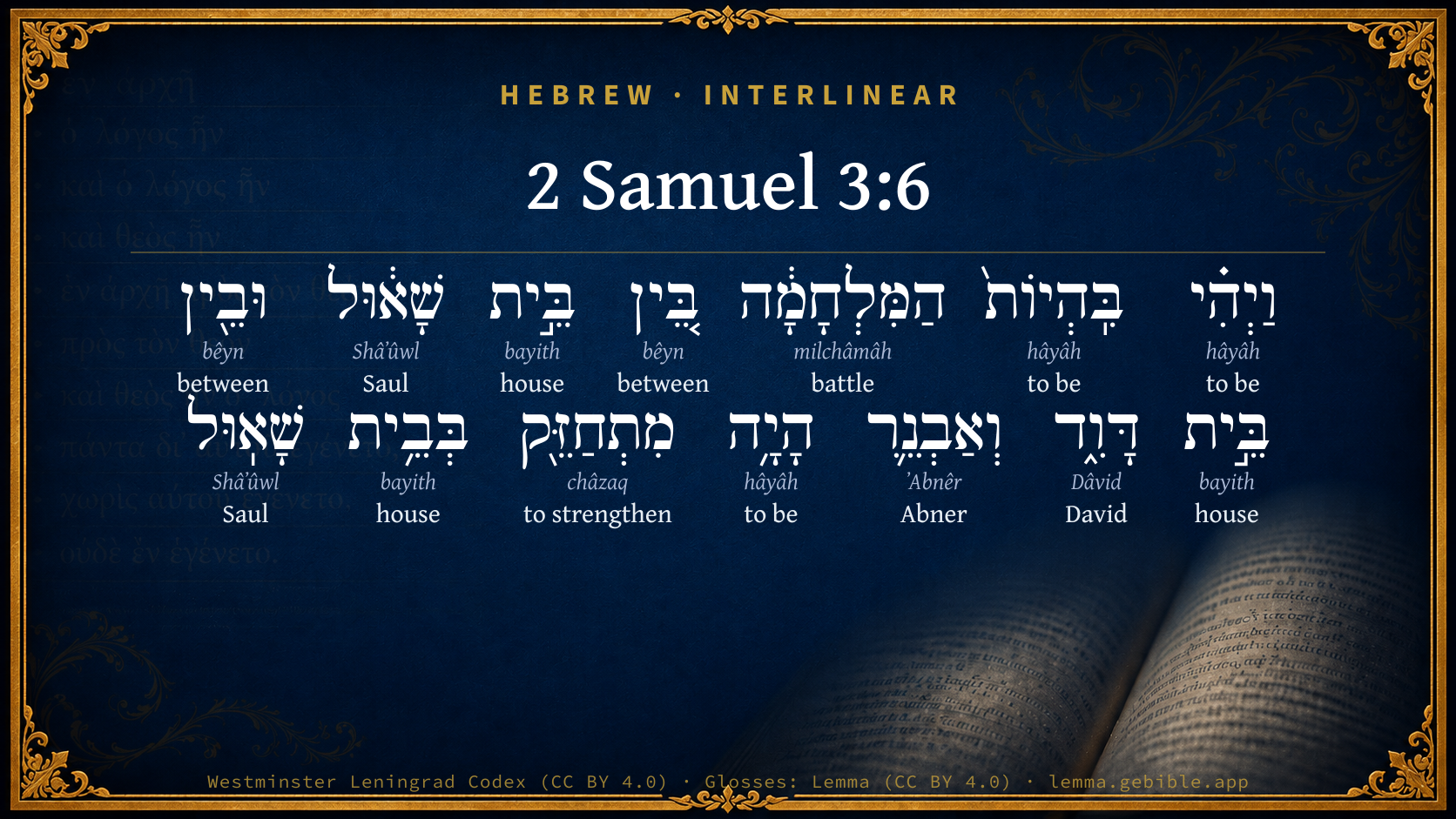
Hebrew (Westminster Leningrad Codex) 2 Samuel 3:6 appears in the Hebrew Old Testament. The text above is from the Westminster Leningrad Codex. Each word links to its Strong’s number, a concise gloss, and parsing drawn from the Open Scriptures Hebrew Bible morphology. Click any word for its full Brown-Driver-Briggs (BDB) entry.
Download image
Cite this verse

2 Samuel 3:6 (World English Bible). Public Domain. Lemma interlinear Bible study tool, https://lemma.gebible.app/v/2-samuel/3/6.

Show BibTeX & RIS
BibTeX
RIS
English Translation
It happened, while there was war between the house of Saul and the house of David, that Abner made himself strong in the house of Saul.
World English Bible · Public Domain
Download a study sheet

One document with this verse’s original text, its word-by-word gloss line, the meaning frame, cross-references with their text, attributed commentary, and full source and license credits — printable, and it pastes into notes with its structure intact.

This verse Autodidact and up

Study sheet (.html) Plain text (.txt)

A passage Seminary Student

Up to 50 verses in one chapter. A passage sheet keeps up to 6 commentary sources and 12 cross-references per verse, in the order this page ranks them, and says so on the sheet whenever that leaves anything out. Ask for a single verse and you get the Autodidact verse sheet above.

Everything on this page stays free to read, with no account — the sheet is a download of what is already on screen, not access to it.

Want to remove ads? Support Godless Engineer
Compare translations 3

The same verse in 3 English versions, stacked beneath the original-language interlinear above. Click any original word for its lexicon entry.

Each is an independent rendering of the whole verse — the interlinear is not word-aligned to these translations.

Highlighted words mark where these versions differ — a whole-verse word diff, not a word-by-word alignment.

  • World English Bible Public Domain
    It happened, while there was war between the house of Saul and the house of David, that Abner made himself strong in the house of Saul.
  • King James Version Public Domain
    And it came to pass, while there was war between the house of Saul and the house of David, that Abner made himself strong for the house of Saul.
  • unfoldingWord Literal Text CC BY-SA 4.0
    And it happened, when the war was between the house of Saul and between the house of David, that Abner was strengthening himself in the house of Saul.

unfoldingWord Literal Text — © unfoldingWord, licensed CC BY-SA 4.0. Word-aligned USFM3 via Door43 (git.door43.org/unfoldingWord/en_ult).

Versions to compare (up to 4)

3 of 4 selected

Show all 18 translations

Every available English version of this verse, each an independent rendering of the whole verse.

  • World English Bible Public Domain
    It happened, while there was war between the house of Saul and the house of David, that Abner made himself strong in the house of Saul.
  • Berean Standard Bible Public Domain
    During the war between the house of Saul and the house of David, Abner had continued to strengthen his position in the house of Saul.
  • Majority Standard Bible Public Domain
    During the war between the house of Saul and the house of David, Abner had continued to strengthen his position in the house of Saul.
  • King James Version Public Domain
    And it came to pass, while there was war between the house of Saul and the house of David, that Abner made himself strong for the house of Saul.
  • American Standard Version (1901) Public Domain
    And it came to pass, while there was war between the house of Saul and the house of David, that Abner made himself strong in the house of Saul.
  • Revised Version (1885) Public Domain
    And it come to pass, while there was war between the house of Saul and the house of David, that Abner made himself strong in the house of Saul.
  • Geneva Bible (1599) Public Domain
    Nowe while there was warre betweene the house of Saul and the house of Dauid, Abner made all his power for the house of Saul.
  • Douay-Rheims (1899) Public Domain
    Now while there was war between the house of Saul and the house of David, Abner the son of Ner ruled the house of Saul.
  • Young's Literal Translation Public Domain
    And it cometh to pass, in the war being between the house of Saul and the house of David, that Abner hath been strengthening himself in the house of Saul,
  • Literal Standard Version CC BY-SA 4.0
    And it comes to pass, in the war being between the house of Saul and the house of David, that Abner has been strengthening himself in the house of Saul,
  • Unlocked Literal Bible CC BY-SA 4.0
    It came about during the war between the house of Saul and the house of David that Abner made himself strong in the house of Saul.
  • unfoldingWord Literal Text CC BY-SA 4.0
    And it happened, when the war was between the house of Saul and between the house of David, that Abner was strengthening himself in the house of Saul.
  • Darby Bible Public Domain
    And it came to pass while there was war between the house of Saul and the house of David, that Abner made himself strong for the house of Saul.
  • World Messianic Bible Public Domain
    While there was war between Saul’s house and David’s house, Abner made himself strong in Saul’s house.
  • Webster's Bible Public Domain
    And it came to pass, while there was war between the house of Saul and the house of David, that Abner made himself strong for the house of Saul.
  • Free Bible Version CC BY-SA 4.0
    Abner had been strengthening his position among the supporters of Saul's dynasty during the war between those on the side of Saul and those on the side of David.
  • Bible in Basic English Public Domain
    Now while there was war between Saul's people and David's people, Abner was making himself strong among the supporters of Saul.
  • JPS Tanakh (1917) Public Domain
    And it came to pass, while there was war between the house of Saul and the house of David, that Abner showed himself strong in the house of Saul.

Literal Standard Version (2020), Covenant Press — licensed CC BY-SA 4.0. Text via the HelloAO Bible API (eBible.org). Unlocked Literal Bible (unfoldingWord) — licensed CC BY-SA 4.0. Text via the HelloAO Bible API (eBible.org). unfoldingWord Literal Text — © unfoldingWord, licensed CC BY-SA 4.0. Word-aligned USFM3 via Door43 (git.door43.org/unfoldingWord/en_ult). Free Bible Version, Dr. Jonathan Gallagher — licensed CC BY-SA 4.0. Text via the HelloAO Bible API (eBible.org).

Word by word

More ways to search: Search by grammar → Find every occurrence → Compare this word →

Practice this passage: Drill this verse → Learn its vocabulary →

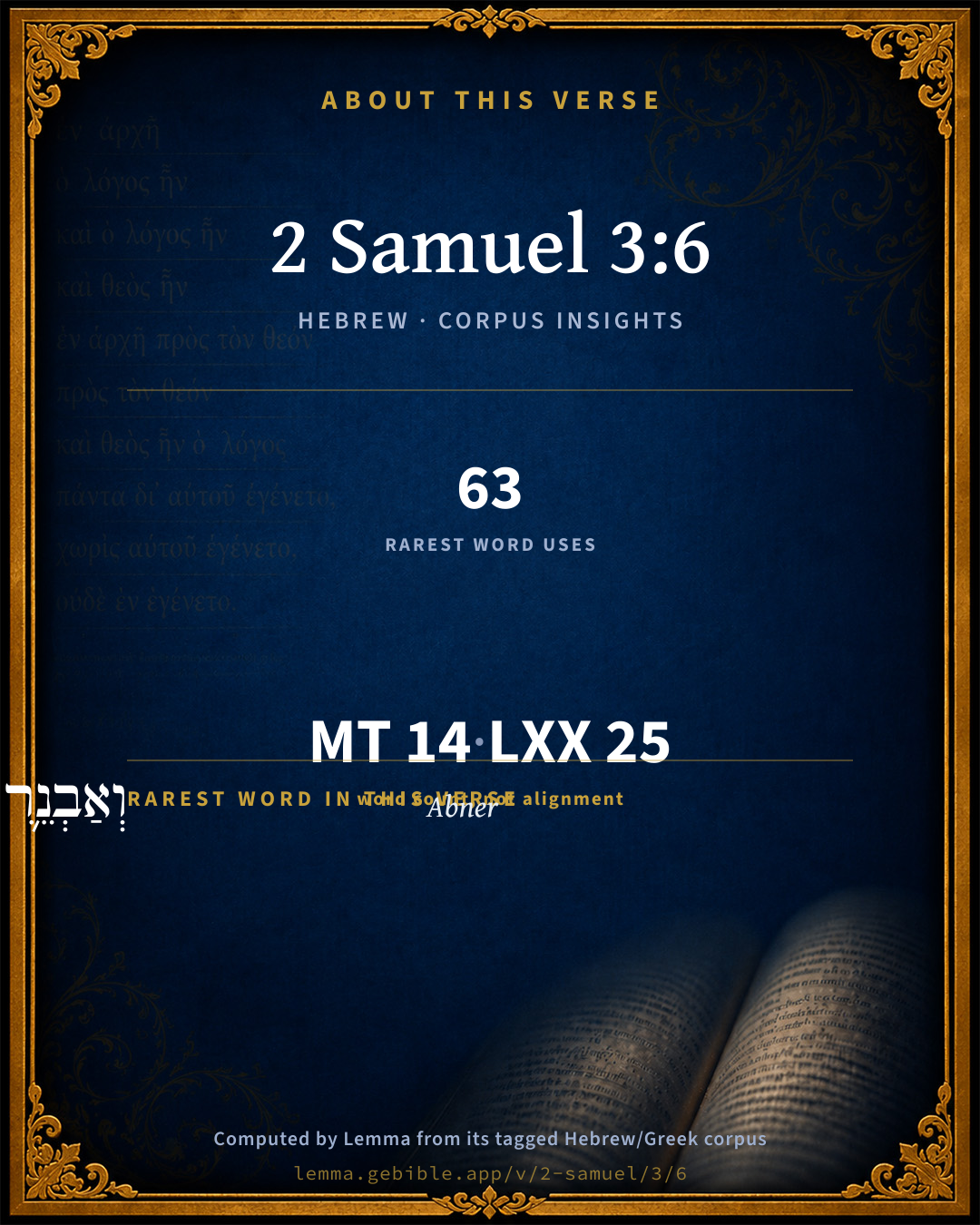
וְאַבְנֵ֛ר
ʼAbnêr
H74
“and · Abner”
Conjunction + Noun, Proper
Part of Speech
Conjunction + Noun
Type
Proper
Full BDB Definition

Origin: from H1 and H5216

TWOT: None

Abner = "my father is a lamp" - Saul's cousin and army captain, treacherously slain by Joab
  1. וַיְהִ֗י hâyâh H1961 “and · to be” Conjunction + Verb, Qal, Sequential Imperfect, 3rd Person, Masculine, Singular
  2. בִּֽהְיוֹת֙ hâyâh H1961 “in/at · to be” Preposition + Verb, Qal, Infinitive Construct
  3. הַמִּלְחָמָ֔ה milchâmâh H4421 “the · battle” Particle, Definite Article + Noun, Common, Feminine, Singular, Absolute
  4. בֵּ֚ין bêyn H996 “between” Preposition
  5. בֵּ֣ית bayith H1004 “house of” Noun, Common, Masculine, Singular, Construct
  6. שָׁא֔וּל Shâʼûwl H7586 “Saul” Noun, Proper
  7. וּבֵ֖ין bêyn H996 “and · between” Conjunction + Preposition
  8. בֵּ֣ית bayith H1004 “house of” Noun, Common, Masculine, Singular, Construct
  9. דָּוִ֑ד Dâvid H1732 “David” Noun, Proper
  10. הָיָ֥ה hâyâh H1961 “to be” Verb, Qal, Perfect, 3rd Person, Masculine, Singular
  11. מִתְחַזֵּ֖ק châzaq H2388 “strengthening” Verb, Hithpael, Participle Active, Masculine, Singular, Absolute
  12. בְּבֵ֥ית bayith H1004 “in/at · house of” Preposition + Noun, Common, Masculine, Singular, Construct
  13. שָׁאֽוּל Shâʼûwl H7586 “Saul” Noun, Proper

About this verse

These counts appear in no published source. They are computed here, from the morphology-tagged text and Lemma’s own curated glosses. What Lemma adds →

14
words
8
distinct lemmas
Historical
section

Grammatical profile

  • 4 verbs
  • 8 nouns
  • 2 prepositions

Verb forms

  • וַיְהִ֗י Qal · Sequential Imperfect
  • בִּֽהְיוֹת֙ Qal · Infinitive Construct
  • הָיָ֥ה Qal · Perfect
  • מִתְחַזֵּ֖ק Hithpael · Participle Active

Repetition

Words recur within this verse — often emphatic in Hebrew:

  • וַיְהִ֗י to be H1961 ×3
  • בֵּ֣ית house H1004 ×3
  • בֵּ֚ין between H996 ×2
  • שָׁא֔וּל Saul H7586 ×2

Hebrew & Septuagint length

In English translation the verse runs 26 words from the Hebrew and 27 from the Septuagint (LXX English) — closely comparable.

A rough comparison of the two English renderings, which tokenize alike — not a word-level alignment.

Word counts can differ between the Hebrew and the Greek without any difference in meaning — e.g. the Hebrew direct-object marker אֵת has no separate Greek word, and Greek often adds the article ὁ.

In the original languages it is 14 Hebrew tokens and 25 Greek tokens — but the two are counted differently (Hebrew bundles its prefixes and suffixes into one token; the Greek is in lemma form), so that isn’t a like-for-like length.

Cross-references

7

Topical passages linked to 2 Samuel 3:6 in the Treasury of Scripture Knowledge — connected by theme and wording, ordered by reader-vote popularity; previews shown in the World English Bible.

  • 2 Samuel 2:8–9 Now Abner the son of Ner, captain of Saul's host, had taken Ish-bosheth the son of Saul, and brought him over to Mahanaim;
  • 2 Kings 10:23 Jehu went, and Jehonadab the son of Rechab, into the house of Baal; and he said to the worshippers of Baal, Search, and look that there be here with you none of the servants of Yahweh, but the worshippers of Baal only.
  • 2 Chronicles 25:8 But if you will go, do [valiantly], be strong for the battle: God will cast you down before the enemy; for God has power to help, and to cast down.
  • Proverbs 21:30 There is no wisdom nor understanding Nor counsel against Yahweh.
  • Isaiah 8:9–10 Make an uproar, O you peoples, and be broken in pieces! And give ear, all you of far countries: gird yourselves, and be broken in pieces! Gird yourselves, and be broken in pieces!
  • Joel 3:9–13 Proclaim this among the nations: Prepare war. Stir up the mighty men. Let all the warriors draw near. Let them come up.
  • Matthew 12:30 "He who is not with me is against me, and he who doesn't gather with me, scatters.

Cross-references courtesy of OpenBible.info (CC BY 4.0).

Hebrew and Greek witnesses Masoretic Hebrew ↔ Greek Septuagint

The same verse in the two great witnesses to the Old Testament, shown verse-for-verse.

These are two independent witnesses, not word-aligned to each other, and the Septuagint is shown in lemma (dictionary) form.

Hebrew 2 Samuel 3:6 Masoretic · Westminster Leningrad Codex

וַיְהִ֗י בִּֽהְיוֹת֙ הַמִּלְחָמָ֔ה בֵּ֚ין בֵּ֣ית שָׁא֔וּל וּבֵ֖ין בֵּ֣ית דָּוִ֑ד וְאַבְנֵ֛ר הָיָ֥ה מִתְחַזֵּ֖ק בְּבֵ֥ית שָׁאֽוּל

It happened, while there was war between the house of Saul and the house of David, that Abner made himself strong in the house of Saul.

World English Bible · Public Domain

Greek LXX 2 Samuel 3:6 Septuagint · lemma form

καί γίγνομαι ἐν ὁ εἰμί ὁ πόλεμος ἀνά μέσος ὁ οἶκος σαούλ καί ἀνά μέσος ὁ οἶκος δαυίδ καί αβεννηρ εἰμί κρατέω ὁ οἶκος σαούλ

And it came to pass while there was war between the house of Saul and the house of David, that Abenner was governing the house of Saul.

LXX2012 (modern English Septuagint) · Public Domain

On this verse, Keil & Delitzsch discusses the Septuagint’s reading. Read the note in Commentary ↓

Hebrew: Westminster Leningrad Codex (CC BY 4.0). Greek: Septuagint (public domain); English from LXX2012 (modern English Septuagint) (Public Domain). How the Septuagint differs from the Hebrew →

Targum (Aramaic paraphrase)

1

The Targum is the ancient Jewish Aramaic paraphrase of the Hebrew Scriptures — an interpretive translation, not the Hebrew text itself. Onkelos (literal) and Pseudo-Jonathan (expansive) render the Torah, and Jonathan the Prophets. Coverage is partial: where no permissively-licensed English translation exists for a verse, only the Aramaic is shown. This is verse-level text, not a word-by-word alignment to the Hebrew.

  1. Targum Jonathan Prophets (Joshua–Malachi)
    וַהֲוָה כַּד הֲוָת קְרָבָא בֵּין בֵּית שָׁאוּל וּבֵין בֵּית דָוִד וְאַבְנֵר הֲוָה מַתְקֵף בְּבֵית שָׁאוּל:

    (no public-domain English translation for this verse)

    Targum Jonathan — Aramaic: “Mikraot Gedolot” (public domain). English: “Sefaria Community Translation” (CC0 1.0 (public-domain dedication)); “London "Chaldee Paraphrase," 1871” (public domain). Text via Sefaria.

Commentary

Notes on 2 Samuel 3:6 from classic Christian and Jewish commentators (each source and its license shown beneath its notes). The classic Christian expositions comment on the surrounding passage and are grouped to its opening verse, so a note may address several verses; the Jewish commentaries on the Tanakh (Rashi and others) are per-verse, so they appear only where the commentator wrote on this verse.

Lemma curates 59 commentaries, every one of them public domain or Creative Commons licensed, each selected and text-cleaned for this edition rather than reprinted as found. About our sources →

Jamieson, Fausset & Brown

Robert Jamieson, A. R. Fausset & David Brown

ABNER REVOLTS TO DAVID. (Sa2 3:6-12)

Abner made himself strong for the house of Saul--In the East, the wives and concubines of a king are the property of his successor to this extent, that for a private person to aspire to marry one of them would be considered a virtual advance of pretensions to the crown (see Kg1 2:17). It is not clear whether the accusation against Abner was well or ill founded. But he resented the charge as an indignity, and, impelled by revenge, determined to transfer all the weight of his influence to the opposite party. He evidently set a full value on his services, and seems to have lorded it over his weak nephew in a haughty, overbearing manner.

Jamieson, Fausset & Brown — Commentary Critical and Explanatory on the Whole Bible (1871) — public domain (CC PDM 1.0). Text via the HelloAO Bible API.

Trapp's Complete Commentary

John Trapp

2Sa 3:6 And it came to pass, while there was war between the house of Saul and the house of David, that Abner made himself strong for the house of Saul.

Ver. 6. Abner made himself strong.] See 2Sa 2:8-9.

John Trapp, A Commentary or Exposition upon All the Books of the Old and New Testament (1647–1656) — public domain. Text from a community e-Sword module.

Joseph Benson's Commentary

2Sa 3:6. Abner made himself strong, &c. — He used his utmost endeavours to support Saul’s house, going up and down through all the tribes of Israel to strengthen Ish-bosheth’s interest, and confirm the people in their allegiance to him: which is mentioned to show the reason of Abner’s deep resentment of the following aspersion.

Joseph Benson's Commentary on the Old and New Testaments (1811–1818) — public domain. Text from a community e-Sword module.

Keil & Delitzsch

C. F. Keil & F. Delitzsch

Decline of the House of Saul. - Sa2 3:6-11. Abner's quarrel with Ishbosheth. - During the war between the house of Saul and the house of David, Abner adhered firmly to the house of Saul, but he appropriated one of Saul's concubines to himself. When Ishbosheth charged him with this, he fell into so violent a rage, that he at once announced to Ishbosheth his intention to hand over the kingdom to David. Abner had certainly perceived the utter incapacity of Ishbosheth for a very long time, if not from the very outset, and had probably made him king after the death of Saul, merely that he might save himself from the necessity of submitting to David, and might be able to rule in Ishbosheth's name, and possibly succeed in paving his own way to the throne. His appropriation of the concubine of the deceased monarch was at any rate a proof, according to Israelitish notions, and in fact those generally prevalent in the East, that he was aiming at the throne (vid., Sa2 16:21; Kg1 2:21). But it may gradually have become obvious to him, that the house of Saul could not possibly retain the government in opposition to David; and this may have led to his determination to persuade all the Israelites to acknowledge David, and thereby to secure for himself an influential post under his government. This will explain in a very simple manner Abner's falling away from Ishbosheth and going over to David.

Sa2 3:6-7

Sa2 3:6 and Sa2 3:7 constitute one period, expanded by the introduction of circumstantial clauses, the ויהי (it came to pass) of the protasis being continued in the ויּאמר (he said) of Sa2 3:7. "It came to pass, when there was war between the house of Saul and the house of David, and Abner showed himself strong for the house of Saul, and Saul had a concubine named Rizpah, the daughter of Aiah, that he (Ishbosheth) said to Abner, Why hast thou gone to my father's concubine?" The subject to "said" is omitted in the apodosis; but it is evident from Sa2 3:8, and the expression "my father," that Ishbosheth is to be supplied. Even in the second circumstantial clause, "and Saul had a concubine," the reason why this is mentioned is only to be gathered from Ishbosheth's words. בּ התחזק: to prove one's self strong for, or with, a person, i.e., to render him powerful help. אל בּוא means "to cohabit with." It was the exclusive right of the successor to the throne to cohabit with the concubines of the deceased king, who came down to him as part of the property which he inherited.

Sa2 3:8

Abner was so enraged at Ishbosheth's complaint, that he replied, "Am I a dog's head, holding with Judah? To-day (i.e., at present) I show affection to the house of Saul thy father, towards his brethren and his friends, and did not let thee fall into the hand of David, and thou reproachest me to-day with the fault with the woman?" "Dog's head" is something thoroughly contemptible. ליהוּדה עשׁר, lit. which (belongs) to Judah, i.e., holds with Judah.

Sa2 3:9-10

"God do so to Abner, ... as Jehovah hath sworn to David, so will I do to him." The repetition of כּי serves to introduce the oath, as in Sa2 2:27. "To take away the kingdom from the house of Saul, and set up the throne of David over Israel and over Judah, from Dan to Beersheba." We do not know of any oath with which God had promised the kingdom to David; but the promise of God in itself is equivalent to an oath, as God is the true God, who can neither lie nor deceive (Sa1 15:29; Num 23:19). This promise was generally known in Israel. "From Dan to Beersheba" (as in Jdg 20:1).

Sa2 3:11

Ishbosheth could make no reply to these words of Abner, "because he was afraid of him."

Sa2 3:12-21

Abner goes over to David. - Sa2 3:12. Abner soon carried out his threat to Ishbosheth. He sent messengers to David in his stead (not "on the spot," or immediately, a rendering adopted by the Chaldee and Symmachus, but for which no support can be found) with this message: "Whose is the land?" i.e., to whom does it belong except to thee? and, "Make a covenant with me; behold, so is my hand with thee (i.e., so will I stand by thee), to turn all Israel to thee."

Sa2 3:13

David assented to the proposal on this condition: "Only one thing do I require of thee, namely, Thou shalt not see my face, unless thou first of all bringest me Michal, the daughter of Saul, when thou comest to see my face." הביאך אם־לפני כּי, "except before thy bringing," i.e., unless when thou hast first of all brought or delivered "Michal to me." This condition was imposed by David, not only because Michal had been unjustly taken away from him by Saul, after he had rightfully acquired her for his wife by paying the dowry demanded, and in spite of her love to him (Sa1 18:27; Sa1 19:11-12), and given to another man (Sa1 25:44), so that he could demand her back again with perfect justice, and Ishbosheth could not refuse to give her up to him, but probably on political grounds also, namely, because the renewal of his marriage to the king's daughter would show to all Israel that he cherished no hatred in his heart towards the fallen king.

Sa2 3:14

Thereupon, namely when Abner had assented to this condition, David sent messengers to Ishbosheth with this demand: "Give (me) my wife Michal, whom I espoused to me for a hundred foreskins of the Philistines" (see Sa1 18:25, Sa1 18:27). David sent to Ishbosheth to demand the restoration of Michal, that her return might take place in a duly legal form, "that it might be apparent that he had dealt justly with Paltiel in the presence of his king, and that he had received his wife back again, and had not taken her by force from her husband" (Seb. Schmidt).

Sa2 3:15

Ishbosheth probably sent Abner to Gallim (Sa1 25:44) to fetch Michal from her husband Paltiel (see at Sa1 25:44), and take her back to David. The husband was obliged to consent to this separation.

Sa2 3:16

When he went with his wife, weeping behind her, to Bahurim, Abner commanded him to turn back; "and he returned." Bahurim, Shimei's home (Sa2 19:17; Kg1 2:8), was situated, according to Sa2 16:1, Sa2 16:5, and Sa2 17:18, upon the road from Jerusalem to Gilgal, in the valley of the Jordan, not far from the Mount of Olives, and is supposed by v. Schubert (R. iii. p. 70) to have stood upon the site of the present Abu Dis, though in all probability it is to be sought for farther north (see Rob. Pal. ii. p. 103). Paltiel had therefore followed his wife to the border of the tribe of Judah, or of the kingdom of David.

Sa2 3:17-18

But before Abner set out to go to David, he had spoken to the elders of Israel (the tribes generally, with the exception of Benjamin see Sa2 3:19 and Judah): "Both yesterday and the day before yesterday (i.e., a long time ago), ye desired to have David as king over you. Now carry out your wish: for Jehovah hath spoken concerning David, Through my servant David will I save my people Israel out of the power of the Philistines and all their enemies." הושׁיע is an evident mistake in writing for אושׁיע, which is found in many MSS, and rendered in all the ancient versions.

Sa2 3:19-20

Abner had spoken in the same way in the ears of Benjamin. He spoke to the Benjaminites more especially, because the existing royal family belonged to that tribe, and they had reaped many advantages in consequence (vid., Sa1 22:7). The verb היה in the circumstantial clause (Sa2 3:17), and the verb וידבּר in Sa2 3:19, which serves as a continuation of the circumstantial clause, must be translated as pluperfects, since Abner's interview with the elders of Israel and with Benjamin preceded his interview with David at Hebron. We may see from Abner's address to the elders, that even among the northern tribes the popular voice had long since decided for David. In 1 Chron 12 we have historical proofs of this. The word of Jehovah concerning David, which is mentioned in Sa2 3:18, is not met with anywhere in this precise form in the history of David as it has come down to us. Abner therefore had either some expression used by one of the prophets (Samuel or Gad) in his mind, which he described as the word of Jehovah, or else he regarded the anointing of David by Samuel in accordance with the command of the Lord, and the marvellous success of all that David attempted against the enemies of Israel, as a practical declaration on the part of God, that David, as the appointed successor of Saul, would perform what the Lord had spoken to Samuel concerning Saul (Sa1 9:16), but what Saul had not fulfilled on account of his rebellion against the commandments of the Lord.

Sa2 3:19-20

When Abner had gained over the elders of Israel and Benjamin to recognise David as king, he went to Hebron to speak in the ears of David "all that had pleased Israel and the whole house of Benjamin," i.e., to make known to him their determination to acknowledge him as king. There went with him twenty men as representatives of all Israel, to confirm Abner's statements by their presence; and David prepared a meal for them all.

Sa2 3:21

After the meal, Abner said to David, "I will raise and go and gather together all Israel to my lord the king, that they may make a covenant with thee (i.e., do homage to thee before God as king), and thou mayest become king over all that thy soul desireth," i.e., over all the nation of God; whereupon David took leave of him, and Abner went away in peace. The expression "in peace" serves to prepare the way for what follows. It is not stated, however, that David sent him away in peace (without avenging himself upon him), but that "David sent him away, and he went in peace." Apart altogether from the mildness of David's own character, he had no reason whatever for treating Abner as an enemy, now that he had given up all opposition to his reigning, and had brought all the Israelites over to him. What Abner had done for Ishbosheth, including his fighting against David, was indeed a sinful act of resistance to the will of Jehovah, which was not unknown to him, and according to which Samuel had both called and anointed David king over the nation; but for all that, it was not an ordinary act of rebellion against the person of David and his rightful claim to the throne, because Jehovah had not yet caused David to be set before the nation as its king by Samuel or any other prophet, and David had not yet asserted the right to reign over all Israel, which had been secured to him by the Lord and guaranteed by his anointing, as one which the nation was bound to recognise; but, like a true servant of God, he waited patiently till the Lord should give him the dominion over all His people.

Sa2 3:22-30

Abner assassinated by Joab. - Sa2 3:22. After Abner's departure, the servants of David returned with much booty from a marauding expedition, and Joab at their head. The singular בּא may be explained from the fact that Joab was the principal person in the estimation of the writer. מהגּדוּד, lit. from the marauding host, i.e., from the work of a marauding host, or from a raid, which they had been making upon one of the tribes bordering upon Judah.

Sa2 3:23-25

When Joab learned. Lit. they told him) that Abner had been with David, and he had sent him away again, he went to David to reproach him for having done so. "What hast thou done? Behold, Abner came to thee; why then hast thou sent him away, and he is gone quite away?" i.e., so that he could go away again without being detained (for this meaning of the inf. abs., see Ewald, 280, b.). "Thou knowest (or more correctly as a question, Dost thou know?) Abner, the son of Ner, that he came to persuade thee (i.e., to make thee certain of his intentions), and to learn thy going out and in (i.e., all thine undertakings), and to learn all that thou wilt do" (i.e., all thy plans). Joab hoped in this way to prejudice David against Abner, to make him suspected as a traitor, that he might then be able to gratify his own private revenge with perfect impunity.

Sa2 3:26

For Abner had only just gone away from David, when Joab sent messengers after him, no doubt in David's name, though without his knowledge, and had him fetched back "from Bor-hasirah, i.e., the cistern of Sirah." Sirah is a place which is quite unknown to us. According to Josephus (Ant. vii. 1, 5), it was twenty stadia from Hebron, and called Βησιρά.

Sa2 3:27

When he came back, Joab "took him aside into the middle of the gate, to talk with him in the stillness," i.e., in private, and there thrust him through the body, so that he died "for the blood of Asahel his brother," i.e., for having put Asahel to death (Sa2 2:23).

Sa2 3:28-30

When David heard this, he said, "I and my kingdom are innocent before Jehovah for ever of the blood of Abner. Let it turn (חוּל, to twist one's self, to turn or fall, irruit) upon the head of Joab and all his father's house (or so-called family)! Never shall there be wanting (יכּרת אל, let there not be cut off, so that there shall not be, as in Jos 9:23) in the house of Joab one that hath an issue (vid., Lev 15:2), and a leper, and one who leans upon a stick (i.e., a lame person or cripple; פּלך, according to the lxx σκυτάλη, a thick round staff), and who falls by the sword, and who is in want of bread," The meaning is: May God avenge the murder of Abner upon Joab and his family, by punishing them continually with terrible diseases, violent death, and poverty. To make the reason for this fearful curse perfectly clear, the historian observes in Sa2 3:30, that Joab and his brother Abishai had murdered Abner, "because he had slain their brother Asahel at Gibeon in the battle" (Sa2 2:23). This act of Joab, in which Abishai must have been in some way concerned, was a treacherous act of assassination, which could not even be defended as blood-revenge, since Abner had slain Asahel in battle after repeated warnings, and only for the purpose of saving his own life. The principal motive for Joab's act was the most contemptible jealousy, or the fear lest Abner's reconciliation to David should diminish his own influence with the king, as was the case again at a later period with the murder of Amasa (Sa2 20:10).

Sa2 3:31-39

David's mourning for Abner's death. - Sa2 3:31, Sa2 3:32. To give a public proof of his grief at this murder, and his displeasure at the crime in the sight of all the nation, David commanded Joab, and all the people with him (David), i.e., all his courtiers, and the warriors who returned with Joab, to institute a public mourning for the deceased, by tearing their clothes, putting on sackcloth, i.e., coarse hairy mourning and penitential clothes, and by a funeral dirge for Abner; i.e., he commanded them to walk in front of Abner's bier mourning and in funeral costume, and to accompany the deceased to his resting-place, whilst David as king followed the bier.

Sa2 3:32

Thus they buried Abner at Hebron; and David wept aloud at his grave, and all the people with him.

Sa2 3:33-34

Although the appointment of such a funeral by David, and his tears at Abner's grave, could not fail to divest the minds of his opponents of all suspicion that Joab had committed the murder with his cognizance (see at Sa2 3:37), he gave a still stronger proof of his innocence, and of the sincerity of his grief, by the ode which he composed for Abner's death:

33 Like an ungodly man must Abner die!

34 Thy hands were not bound, and thy feet were not placed in fetters.

As one falls before sinners, so hast thou fallen!

Sa2 3:34

The first strophe (Sa2 3:33) is an expression of painful lamentation at the fact that Abner had died a death which he did not deserve. "The fool" (nabal) is "the ungodly," according to Israelitish ideas (vid., Psa 14:1). The meaning of Sa2 3:34 is: Thou hadst not made thyself guilty of any crime, so as to have to die like a malefactor, in chains and bonds; but thou hast been treacherously murdered. This dirge made such an impression upon all the people (present), that they wept still more for the dead.

Sa2 3:35

But David mourned so bitterly, that when all the people called upon him to take some food during the day, he declared with an oath that he would not taste bread or anything else before the setting of the sun. לחם הברות does not mean, as in Sa2 13:5, to give to eat, on account of the expression "all the people," as it can hardly be imagined that all the people, i.e., all who were present, could have come to bring David food, but it signifies to make him eat, i.e., call upon him to eat; whilst it is left uncertain whether David was to eat with the people (cf. Sa2 12:17), i.e., to take part in the funeral meal that was held after the burial, or whether the people simply urged him to take some food, for the purpose of soothing his own sorrow. אם כּי are to be taken separately: כּי, ὅτι, introducing the oath, and אם being the particle used in an oath: "if," i.e., assuredly not.

Sa2 3:36

"And all the people perceived it (i.e., his trouble), and it pleased them, as everything that the king did pleased all the people."

Sa2 3:37

All the people (sc., who were with the king) and all Israel discerned on that day (from David's deep and heartfelt trouble), that the death of Abner had not happened (proceeded) from the king, as many may probably at first have supposed, since Joab had no doubt fetched Abner back in David's name.

Sa2 3:38-39

Finally, David said to his (confidential) servants: "Know ye not (i.e., surely perceive) that a prince and great man has this day fallen in Israel?" This sentence shows how thoroughly David could recognise the virtues possessed by his opponents, and how very far he was from looking upon Abner as a traitor, because of his falling away from Ishbosheth and coming over to him, that on the contrary he hoped to find in him an able general and a faithful servant. He would at once have punished the murderer of such a man, if he had only possessed the power. "But," he adds, "I am this day (still) weak, and only anointed king; and these men, the sons of Zeruiah, are too strong for me. The Lord reward the doer of evil according to his wickedness." The expression "to-day" not only applies to the word "weak," or tender, but also to "anointed" (to-day, i.e., only just anointed). As David was still but a young sovereign, and felt himself unable to punish a man like Joab according to his deserts, he was obliged to restrict himself at first to the utterance of a curse upon the deed (Sa2 3:29), and to leave the retribution to God. He could not and durst not forgive; and consequently, before he died, he charged Solomon, his son and successor, to punish Joab for the murder of Abner and Amasa (Kg1 2:5).

Keil & Delitzsch — Biblical Commentary on the Old Testament (1861–1891) — public domain (CC PDM 1.0). Text via the HelloAO Bible API. (Old Testament only.)

Adam Clarke's Commentary

Verse 6. Abner made himself strong] This strengthening of himself, and going in to the late king's concubine, were most evident proofs that he wished to seize upon the government. See 1Kg 2:21-2:22; 1Kg 12:8; 1Kg 16:21.

Adam Clarke's Commentary on the Bible (1810–1826) — public domain. Text from a community e-Sword/MySword module.

Ellicott's Commentary for English Readers

(6) Abner made himself strong.—It has already been noticed that the fortunes of the house of Saul depended entirely upon Abner, but the fact of Ish-bosheth’s great obligation to him is again mentioned here in explanation of the following story.

A Bible Commentary for English Readers, edited by Charles John Ellicott (1878–1897) — public domain. Text from a community e-Sword module.

The Cambridge Bible for Schools and Colleges

gen. ed. J. J. S. Perowne

6–11. Quarrel between Abner and Ish-bosheth

6. made himself strong] Or, shewed himself strong. Ish-bosheth was evidently weak and incapable, a mere puppet in the hands of Abner, who had made himself the mainstay of Saul’s house, partly from his family connexion, partly with a view to secure the greatest amount of influence, possibly with the hope of eventually becoming king himself. At length foreseeing the impossibility of continuing a successful opposition to David’s growing power, he took the opportunity of a quarrel with Ish-bosheth to make such overtures to David as might secure him favourable terms and an influential position.

The Cambridge Bible for Schools and Colleges (gen. ed. J. J. S. Perowne; Cambridge University Press, 1878–1918) — public domain. Text from a community e-Sword module.

John Gill's Exposition

And it came to pass, while there was war between the house of Saul and the house of David,.... As long as that continued, as it did until the following quarrel happened between Ishbosheth and Abner:

that Abner made himself strong for the house of Saul; or was strongly in the interest of that house, and used his utmost endeavours to support and confirm it.

John Gill's Exposition of the Whole Bible (1746–1763) — public domain (CC PDM 1.0). Text via the HelloAO Bible API.

Albert Barnes' Notes on the Bible

Render, “And it came to pass, while the war between the house of Saul and the house of David lasted, that Abner assisted the house of Saul.”

Albert Barnes' Notes on the Bible (1834–1885) — public domain. Text from a community e-Sword/MySword module.

Matthew Poole's English Annotations

He used all his endeavours to support Saul’s house; which is mentioned, to show the reason of his deep resentment of the following aspersion. Or, he strengthened himself in the house of Saul, i.e. he so managed all affairs, as to get all the riches and power into his own hands; which made Ish-bosheth suspect that he aimed at the kingdom, and sought to marry the king’s concubine in order to it, as the manner was. See 2Sa 12:8; 16:21; 1Ki 1:17.

Matthew Poole's English Annotations on the Holy Bible (1683–1685) — public domain. Text from a community e-Sword/MySword module.

Whedon's Commentary on the Bible

Daniel D. Whedon

6. Abner made himself strong for the house of Saul — Rather, in the house of Saul. He used his high official position in Saul’s court for purposes of self-aggrandizement and power. He seems to have regarded Ishbosheth as an incompetent ruler, and actually reigned in his name. By thus strengthening himself in the kingdom he was, perhaps designedly, paving his own way to the throne.

Daniel D. Whedon (gen. ed.), Commentary on the Old and New Testaments (1874–1909) — public domain. Text from a community e-Sword module.

The Pulpit Commentary

Abner made himself strong for the house of Saul. The Hebrew really means that until this miserable quarrel about Rizpah, Abner had been the mainstay of Ishbosheth"s throne and dynasty. She is proved to have been a noble woman, with a warm and devoted heart, by the narrative. (2Sa_21:8-11) But the harem of a deceased king was looked upon as the special inheritance of his successor; and Absalom, by taking David"s concubines, (2Sa_16:21, 2Sa_16:22) treated his father as a dead man, and committed so overt an act of treason as made reconciliation impossible. So Solomon put his brother Adonijah to death for asking Abishag to wife. (1Ki_2:23-25) Still, as Bathsheba there saw no impropriety in Adonijah"s request, and as Solomon deposed Abiathar and put Joab to death for complicity, as we must conclude, in Adonijah"s request, it was probably part of some scheme of conspiracy, and that, if granted, it would have been used by Adonijah as a proof that the kingdom really was his. Here there was no plot, and as Rizpah had probably always lived apart from Ishbosheth, Abner may have expected that the king would see no difficulty in the matter.

Ver. 6. (MAHANAIM.)

The character of Abner.

Abner, son of Net, was first cousin of Saul, probably about the same age, commander-in-chief of his army, (1Sa_14:50) and contributed greatly to his early successes. He introduced David to the king after his victory over Goliath, sat at the royal table, (1Sa_20:25) was well acquainted with their relations to each other, took part in the persecution, (1Sa_26:14) and, after the battle of Gilbea, became the main support of the house of Saul. (2Sa_2:8) made himself strong for the house of Saul," but God strengthened David, whom Abner knew to have been designed for the kingdom by God" (Wordsworth). Notice:

1. His eminent abilities military skill, prudence, energy, courage, and perseverance; as shown by the honourable position he so long held in the service of Saul, and his successful efforts after his death. (2Sa_2:8-12) "Abner"s act was not an ordinary act of rebellion against the person of David and his rightful claim to the throne; because Jehovah had not yet caused David to be set before the nation as its king by Samuel or any other prophet, and David had not yet asserted the right to reign over all Israel, which had been secured to him by the Lord, and guaranteed by his anointing as one whom the nation was bound to recognize" (Keil). Nor was he destitute of generous sentiments. If he could not be called a good man, he was "a prince and a great man (ver. 38).

2. His worldly ambition and carnal selfishness. This was probably the main, if not the only, motive of his opposition to the Divine purpose; and to it Ishbesheth evidently attributed the conduct with which he charged him, regarding his act as an assertion of royal rights (ver. 7). His pride and self-esteem are also apparent in his haughty answer (ver. 8).

Ambition"s like a circle on the water, Which never ceases to enlarge itself, Till by broad spreading it disperse to nought.

1. His passionate resentment, which, as is commonly the case, was an indication of the truth of the charge brought against him; nor did he deny it, but contemptuously declared that he was too great a man and had rendered too many services to be accused of such a "fault;" and then took an oath to avenge the insult by translating the kingdom to David, "as the Lord had sworn" to him (vers. 9, 10). "This was Abner"s arrogancy to beast such great things of himself, as if he had carried a king in his pocket, as that great Earl of Warwick in Edward IV"s time, is said to have done" (Trapp). "No man ever heard Abner godly till now; neither had he been so at this time if he had not intended a revengeful departure from Ishbosheth. Nothing is more odious than to make religion a stalking horse to policy" (Hall).

2. His altered purposes. The change, although right and good in itself, was due to a passionate impulse and probably the desire of personal advantage; and, in its announcement, Abner betrayed his previous ungodliness and present hypocrisy. "Alas! how eloquently can hypocrites employ the Name of God, and take the sanction of religion, when by such means they think to advance their present interests!" (Lindsay). But, on the other hand, it may be said that his sudden wrath was only the occasion of his open avowal of an irrepressible and growing conviction of duty, and of his taking the decisive step which he had been long contemplating; and that he henceforth faithfully endeavoured to make amends for his former errors and sincerely sought the welfare of the nation. "When an opposer of God"s Word honestly turns, we should, without reluctance, give him the hand, without undertaking to pass judgment on the motives that are hidden in his heart" (Erdmann). David, unlike Joab (ver. 25), put the best construction on Abner"s conduct.

1. His energetic action and extensive influence. He sent messengers "immediately" (LXX) to David, recognizing his authority, etc. (ver. 12); had communication with the elders of Israel (ver. 18); spake in the ears of Benjamin (ver. 19), who might be jealous of the transfer of sovereignty to Judah; and, having obtained their consent, came himself to Hebron with twenty men, "representatives of Israel, to confirm his overtures by their presence," partook of an entertainment "of the nature of a league," and went away in peace. "David believed that in this offer of Abner a Divine

2. providence was to be observed which would make, as he hoped, a full end to the unhappy civil war" (Krummacher).

3. His cruel fate. "Now is Ishbosheth"s wrong avenged by an enemy" (Hall). Even though his present course was in fulfilment of the Divine purpose, it averted not the consequences of his former conduct; and retribution came upon him suddenly, unexpectedly, and by a wicked hand. "One wicked man is made to be another"s scourge." "Human sin must serve the purposes of God"s kingdom". (Psa_76:10) "David"s kingdom is not promoted by Abner"s treason, as David so expected, but rather by the taking away of Abner; thus the Lord, in the promotion of his kingdom, chooseth not the instruments nor alloweth even the means which appear good to men; but, by the contrary, he taketh away the same instruments and means in which men have most confidence, and by others more unlikely, and without men"s expectation, he advanceth the cause of the Church and worketh great things" (Guild). D.

The Pulpit Commentary (1880–1919), ed. H.D.M. Spence-Jones & Joseph S. Exell — public domain. Text from a community e-Sword module.

John Wesley's Explanatory Notes

Strong - He used all his endeavours to support Saul's house: which is mentioned, to shew the reason of his deep resentment of the following aspersion.

John Wesley, Explanatory Notes Upon the Whole Bible (1754–1765) — public domain. Text via the GEBible commentary corpus.

unfoldingWord translationNotes

Door43 World Missions Community

It came about

This introduces a new event in the story of the struggle between David's supporters and Saul's family. (See: Introduction of a New Event)

house of Saul

This refers to Saul's family and supporters who assumed control of his estate after he died.

house of David

This refers to the supporters of David.

Abner made himself strong in the house of Saul

Abner's increasing power over Saul's family is spoken of as if he became physically stronger. AT: "Abner gained more power over the family and supporters of Saul" (See: Metaphor)

Rizpah ... Aiah

These are names of women. (See: How to Translate Names)

Ishbosheth

This is a male name, a son of Saul. (See: How to Translate Names)

Why have you slept with my father's concubine?

Ishbosheth asked this question to rebuke Abner who was acting like he was the king. AT: "You did not have the right to sleep with my father's concubine!" (See: Rhetorical Question)

slept with

This is a euphemism for sexual relations. (See: Euphemism)

translationWords

Saul (OT)

house of David

Abner

concubine

name

unfoldingWord translationNotes — © Distant Shores Media and the Door43 World Missions Community, licensed CC BY-SA 4.0. Source: git.door43.org/Door43/en_tn.

Rashi

Rabbi Shlomo Yitzchaki (Rashi)

Was strengthening. With all his might over the house of Shaul, to establish its monarchy.

Rashi on the Tanakh — English translations: “The Judaica Press complete Tanach with Rashi, translated by A. J. Rosenberg” (CC BY 4.0); “Pentateuch with Rashi's commentary by M. Rosenbaum and A.M. Silbermann, 1929-1934” (public domain); “The Metsudah Tanach series, Lakewood, N.J” (CC BY 4.0); and “The Book of Joshua, Metsudah Publications, 1997” (CC BY 4.0). Text via Sefaria.

Lesson kit

Teaching starters — assembled from the data on this page, not authored interpretation. Every prompt links to the verse data it draws on. Edit before teaching.

2 Samuel, in the Historical, opens this verse with 14 words (8 distinct Hebrew lemmas). Its most distinctive word is ʼAbnêr (“Abner”). A historical commentator’s framing appears above. Read the whole chapter for the surrounding context.

Discussion questions

  1. How does “Abner” (ʼAbnêr) shape what this verse is saying?
  2. 2 Samuel 2:8–9 shares this passage’s theme. How do the two illuminate each other?
  3. “to be” occurs 3× in this one verse. What is the effect of the repetition?
  4. These translations render this verse differently. What is at stake in choosing one wording over another?
  5. The verb «וַיְהִ֗י» is Qal Sequential Imperfect. How does its form color the action?
  6. Reading how Jamieson, Fausset & Brown and Trapp's Complete Commentary read this verse, where do the two commentators agree and where do they part?

Things to notice

Reading settings

Reading text

Shown beneath each verse's original-language words.

Old Testament
Old Testament edition

Read the OT as the Masoretic Hebrew (MT) or the Greek Septuagint (LXX).

English shown for the Greek Septuagint (in the Hebrew ↔ Greek comparison).

Comparing translations? Open the Compare panel on any verse page to stack up to four side by side.