
Exodus 14:2

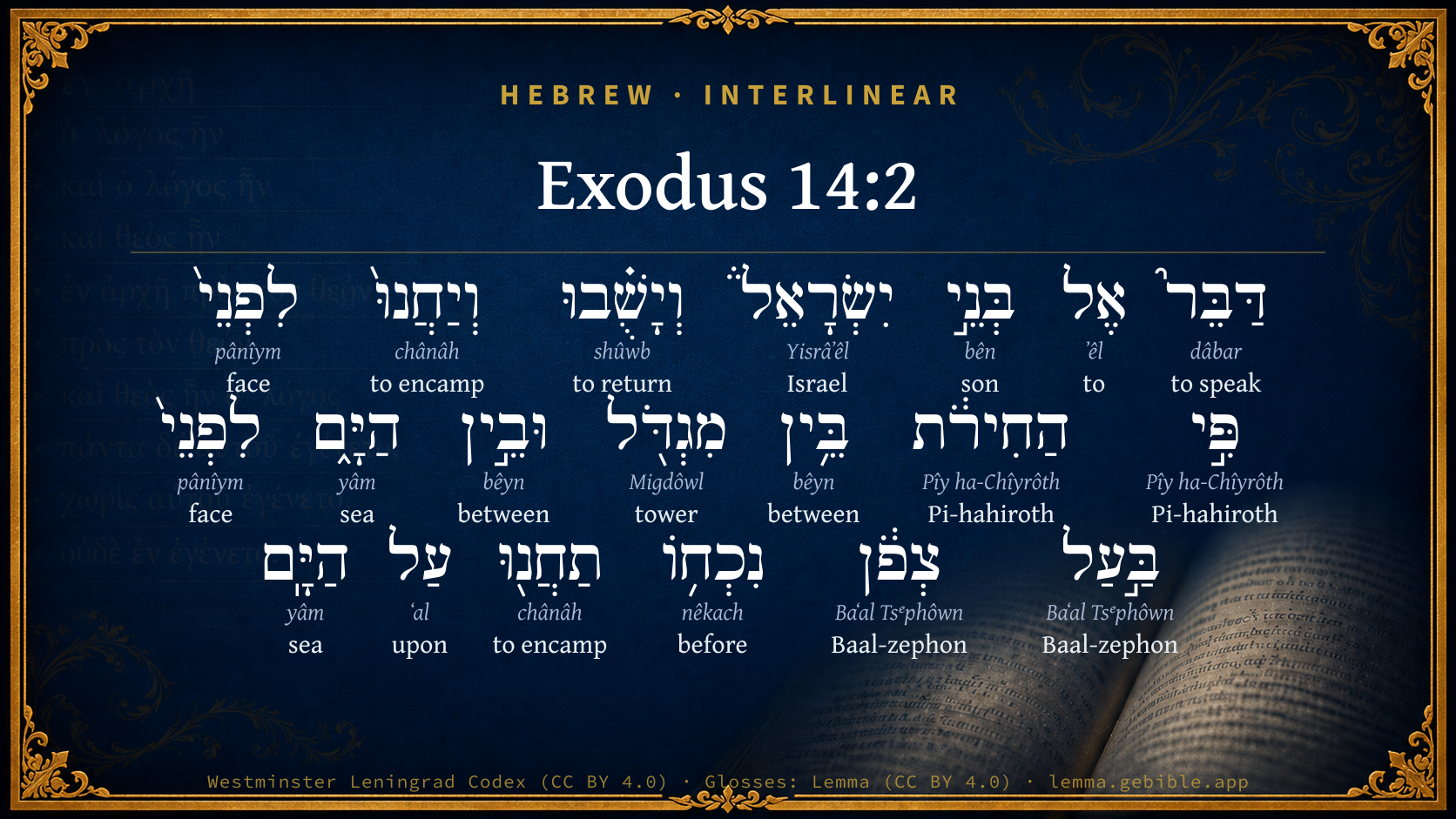
Hebrew (Westminster Leningrad Codex) Exodus 14:2 appears in the Hebrew Old Testament. The text above is from the Westminster Leningrad Codex. Each word links to its Strong’s number, a concise gloss, and parsing drawn from the Open Scriptures Hebrew Bible morphology. Click any word for its full Brown-Driver-Briggs (BDB) entry.
Download image
Cite this verse

Exodus 14:2 (World English Bible). Public Domain. Lemma interlinear Bible study tool, https://lemma.gebible.app/v/exodus/14/2.

Show BibTeX & RIS
BibTeX
RIS
English Translation
"Speak to the children of Israel, that they turn back and encamp before Pihahiroth, between Migdol and the sea, before Baal Zephon. You shall encamp opposite it by the sea.
World English Bible · Public Domain
Highlights
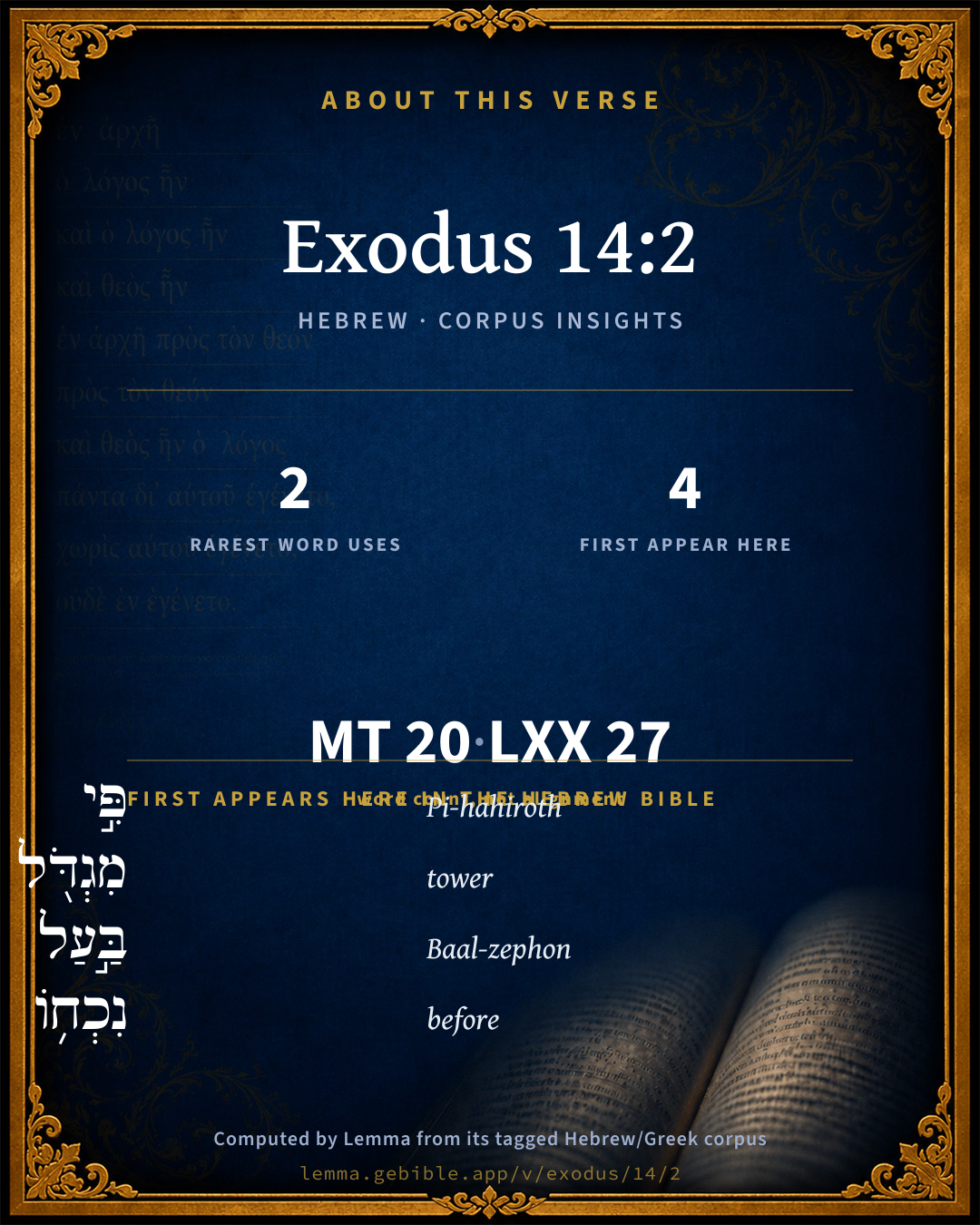
  • 4 first appearances in the Hebrew Bible
Full analysis ↓
Download a study sheet

One document with this verse’s original text, its word-by-word gloss line, the meaning frame, cross-references with their text, attributed commentary, and full source and license credits — printable, and it pastes into notes with its structure intact.

This verse Autodidact and up

Study sheet (.html) Plain text (.txt)

A passage Seminary Student

Up to 50 verses in one chapter. A passage sheet keeps up to 6 commentary sources and 12 cross-references per verse, in the order this page ranks them, and says so on the sheet whenever that leaves anything out. Ask for a single verse and you get the Autodidact verse sheet above.

Everything on this page stays free to read, with no account — the sheet is a download of what is already on screen, not access to it.

Want to remove ads? Support Godless Engineer
Compare translations 3

The same verse in 3 English versions, stacked beneath the original-language interlinear above. Click any original word for its lexicon entry.

Each is an independent rendering of the whole verse — the interlinear is not word-aligned to these translations.

Highlighted words mark where these versions differ — a whole-verse word diff, not a word-by-word alignment.

  • World English Bible Public Domain
    "Speak to the children of Israel, that they turn back and encamp before Pihahiroth, between Migdol and the sea, before Baal Zephon. You shall encamp opposite it by the sea.
  • King James Version Public Domain
    Speak unto the children of Israel, that they turn and encamp before Pihahiroth, between Migdol and the sea, over against Baalzephon: before it shall ye encamp by the sea.
  • unfoldingWord Literal Text CC BY-SA 4.0
    “Say to the sons of Israel that they should turn and camp before the face of Pi Hahiroth, between Migdol and the sea, before the face of Baal Zephon. You are to camp by the sea opposite it.

unfoldingWord Literal Text — © unfoldingWord, licensed CC BY-SA 4.0. Word-aligned USFM3 via Door43 (git.door43.org/unfoldingWord/en_ult).

Versions to compare (up to 4)

3 of 4 selected

Show all 18 translations

Every available English version of this verse, each an independent rendering of the whole verse.

  • World English Bible Public Domain
    "Speak to the children of Israel, that they turn back and encamp before Pihahiroth, between Migdol and the sea, before Baal Zephon. You shall encamp opposite it by the sea.
  • Berean Standard Bible Public Domain
    “Tell the Israelites to turn back and encamp before Pi-hahiroth, between Migdol and the sea. You are to encamp by the sea, directly opposite Baal-zephon.
  • Majority Standard Bible Public Domain
    “Tell the Israelites to turn back and encamp before Pi-hahiroth, between Migdol and the sea. You are to encamp by the sea, directly opposite Baal-zephon.
  • King James Version Public Domain
    Speak unto the children of Israel, that they turn and encamp before Pihahiroth, between Migdol and the sea, over against Baalzephon: before it shall ye encamp by the sea.
  • American Standard Version (1901) Public Domain
    Speak unto the children of Israel, that they turn back and encamp before Pihahiroth, between Migdol and the sea, before Baal-zephon: over against it shall ye encamp by the sea.
  • Revised Version (1885) Public Domain
    Speak unto the children of Israel, that they turn back and encamp before Pi-hahiroth, between Migdol and the sea, before Baal-zephon: over against it shall ye encamp by the sea.
  • Geneva Bible (1599) Public Domain
    Speake to the children of Israel, that they returne and campe before Pi-hahiroth, betweene Migdol and the Sea, ouer against Baal-zephon: about it shall ye campe by the Sea.
  • Douay-Rheims (1899) Public Domain
    Speak to the children of Israel: Let them turn and encamp over against Phihahiroth which is between Magdal and the sea over against Beelsephon: you shall encamp before it upon the sea.
  • Young's Literal Translation Public Domain
    `Speak unto the sons of Israel, and they turn back and encamp before Pi-Hahiroth, between Migdol and the sea, before Baal-Zephon; over-against it ye do encamp by the sea,
  • Literal Standard Version CC BY-SA 4.0
    “Speak to the sons of Israel, and they turn back and encamp before Pi-Hahiroth, between Migdol and the sea, before Ba‘al-Zephon; you encamp in front of it by the sea,
  • Unlocked Literal Bible CC BY-SA 4.0
    “Say to the Israelites that they should turn and camp before Pi Hahiroth, between Migdol and the sea, before Baal Zephon. You are to camp by the sea opposite Pi Hahiroth.
  • unfoldingWord Literal Text CC BY-SA 4.0
    “Say to the sons of Israel that they should turn and camp before the face of Pi Hahiroth, between Migdol and the sea, before the face of Baal Zephon. You are to camp by the sea opposite it.
  • Darby Bible Public Domain
    Speak unto the children of Israel, that they turn and encamp before Pi-hahiroth, between Migdol and the sea: before Baal-Zephon, opposite to it, shall ye encamp by the sea.
  • World Messianic Bible Public Domain
    “Speak to the children of Israel, that they turn back and encamp before Pihahiroth, between Migdol and the sea, before Baal Zephon. You shall encamp opposite it by the sea.
  • Webster's Bible Public Domain
    Speak to the children of Israel, that they turn and encamp before Pi-hahiroth, between Migdol and the sea, over against Baal-zephon: before it shall ye encamp by the sea.
  • Free Bible Version CC BY-SA 4.0
    “Tell the Israelites to turn back and set up camp near Pi-hahiroth, between Migdol and the sea. You are to camp beside the sea, opposite Baal-zephon.
  • Bible in Basic English Public Domain
    Give orders to the children of Israel to go back and put up their tents before Pi-hahiroth, between Migdol and the sea, in front of Baal-zephon, opposite to which you are to put up your tents by the sea.
  • JPS Tanakh (1917) Public Domain
    'Speak unto the children of Israel, that they turn back and encamp before Pi-hahiroth, between Migdol and the sea, before Baal-zephon, over against it shall ye encamp by the sea.

Literal Standard Version (2020), Covenant Press — licensed CC BY-SA 4.0. Text via the HelloAO Bible API (eBible.org). Unlocked Literal Bible (unfoldingWord) — licensed CC BY-SA 4.0. Text via the HelloAO Bible API (eBible.org). unfoldingWord Literal Text — © unfoldingWord, licensed CC BY-SA 4.0. Word-aligned USFM3 via Door43 (git.door43.org/unfoldingWord/en_ult). Free Bible Version, Dr. Jonathan Gallagher — licensed CC BY-SA 4.0. Text via the HelloAO Bible API (eBible.org).

Word by word

More ways to search: Search by grammar → Find every occurrence → Compare this word →

Practice this passage: Drill this verse → Learn its vocabulary →

נִכְח֥וֹ
nêkach
H5226
“before · him”
Preposition + Suffix, Personal, 3rd Person, Masculine, Singular
Part of Speech
Preposition
Full BDB Definition

Origin: from an unused root meaning to be straightforward

TWOT: 1365a

be in front of - in front of, opposite to, in the sight of, before, to the front, right on - towards the front of, in front of, on behalf of, as far as in front of
  1. דַּבֵּר֮ dâbar H1696 “speak” Verb, Piel, Imperative, 2nd Person, Masculine, Singular
  2. אֶל ʼêl H413 “to” Preposition
  3. בְּנֵ֣י bên H1121 “sons of” Noun, Common, Masculine, Plural, Construct
  4. יִשְׂרָאֵל֒ Yisrâʼêl H3478 “Israel” Noun, Proper
  5. וְיָשֻׁ֗בוּ shûwb H7725 “and · to return” Conjunction + Verb, Qal, Jussive, 3rd Person, Masculine, Plural
  6. וְיַחֲנוּ֙ chânâh H2583 “and · to encamp” Conjunction + Verb, Qal, Jussive, 3rd Person, Masculine, Plural
  7. לִפְנֵי֙ pânîym H6440 “to/for · face(s) of” Preposition + Noun, Common, Both, Plural, Construct
  8. פִּ֣י Pîy ha-Chîyrôth H6367 “Pi-hahiroth” Noun, Proper
  9. הַחִירֹ֔ת Pîy ha-Chîyrôth H6367 “Pi-hahiroth” Noun, Proper
  10. בֵּ֥ין bêyn H996 “between” Preposition
  11. מִגְדֹּ֖ל Migdôwl H4024 “tower” Noun, Proper
  12. וּבֵ֣ין bêyn H996 “and · between” Conjunction + Preposition
  13. הַיָּ֑ם yâm H3220 “the · sea” Particle, Definite Article + Noun, Common, Masculine, Singular, Absolute
  14. לִפְנֵי֙ pânîym H6440 “to/for · face(s) of” Preposition + Noun, Common, Both, Plural, Construct
  15. בַּ֣עַל Baʻal Tsᵉphôwn H1189 “Baal-zephon” Noun, Proper
  16. צְפֹ֔ן Baʻal Tsᵉphôwn H1189 “Baal-zephon” Noun, Proper
  17. תַחֲנ֖וּ chânâh H2583 “to encamp” Verb, Qal, Imperfect, 2nd Person, Masculine, Plural
  18. עַל ʻal H5921 “upon” Preposition
  19. הַיָּֽם yâm H3220 “the · sea” Particle, Definite Article + Noun, Common, Masculine, Singular, Absolute

About this verse

These counts appear in no published source. They are computed here, from the morphology-tagged text and Lemma’s own curated glosses. What Lemma adds →

20
words
14
distinct lemmas
Pentateuch
section

Notable vocabulary

The rarest word here is נִכְח֥וֹ before H5226 — appearing just 2 times in the whole Hebrew Bible.

First appearance in Scripture

These words make their first canonical appearance in the Hebrew Bible here:

  • פִּ֣י Pi-hahiroth H6367
  • מִגְדֹּ֖ל tower H4024
  • בַּ֣עַל Baal-zephon H1189
  • נִכְח֥וֹ before H5226

Shared distinctive vocabulary

נִכְח֥וֹ before H5226 occurs in 2 verses of the Hebrew Bible. Also found in:

Grammatical profile

  • 4 verbs
  • 11 nouns
  • 5 prepositions

Verb forms

  • דַּבֵּר֮ Piel · Imperative
  • וְיָשֻׁ֗בוּ Qal · Jussive
  • וְיַחֲנוּ֙ Qal · Jussive
  • תַחֲנ֖וּ Qal · Imperfect

Repetition

Words recur within this verse — often emphatic in Hebrew:

  • וְיַחֲנוּ֙ to encamp H2583 ×2
  • לִפְנֵי֙ face H6440 ×2
  • פִּ֣י Pi-hahiroth H6367 ×2
  • בֵּ֥ין between H996 ×2
  • הַיָּ֑ם sea H3220 ×2
  • בַּ֣עַל Baal-zephon H1189 ×2

Hebrew & Septuagint length

In English translation the verse runs 30 words from the Hebrew and 30 from the Septuagint (LXX English) — the same length.

A rough comparison of the two English renderings, which tokenize alike — not a word-level alignment.

Word counts can differ between the Hebrew and the Greek without any difference in meaning — e.g. the Hebrew direct-object marker אֵת has no separate Greek word, and Greek often adds the article ὁ.

In the original languages it is 20 Hebrew tokens and 27 Greek tokens — but the two are counted differently (Hebrew bundles its prefixes and suffixes into one token; the Greek is in lemma form), so that isn’t a like-for-like length.

Cross-references

6

Topical passages linked to Exodus 14:2 in the Treasury of Scripture Knowledge — connected by theme and wording, ordered by reader-vote popularity; previews shown in the World English Bible.

  • Numbers 33:7–8 They traveled from Etham, and turned back to Pihahiroth, which is before Baal Zephon: and they encamped before Migdol.
  • Jeremiah 44:1 The word that came to Jeremiah concerning all the Jews who lived in the land of Egypt, who lived at Migdol, and at Tahpanhes, and at Memphis, and in the country of Pathros, saying,
  • Exodus 13:17–18 It happened, when Pharaoh had let the people go, that God didn't lead them by the way of the land of the Philistines, although that was near; for God said, "Lest perhaps the people change their minds when they see war, and they return to Egypt;"
  • Exodus 14:9 The Egyptians pursued after them: all the horses and chariots of Pharaoh, his horsemen, and his army; and overtook them encamping by the sea, beside Pihahiroth, before Baal Zephon.
  • Jeremiah 46:14 Declare you in Egypt, and publish in Migdol, and publish in Memphis and in Tahpanhes: say you, Stand forth, and prepare you; for the sword has devoured round about you.
  • Ezekiel 29:10 therefore, behold, I am against you, and against your rivers, and I will make the land of Egypt an utter waste and desolation, from the tower of Seveneh even to the border of Ethiopia.

Cross-references courtesy of OpenBible.info (CC BY 4.0).

Hebrew and Greek witnesses Masoretic Hebrew ↔ Greek Septuagint

The same verse in the two great witnesses to the Old Testament, shown verse-for-verse.

These are two independent witnesses, not word-aligned to each other, and the Septuagint is shown in lemma (dictionary) form.

Hebrew Exodus 14:2 Masoretic · Westminster Leningrad Codex

דַּבֵּר֮ אֶל בְּנֵ֣י יִשְׂרָאֵל֒ וְיָשֻׁ֗בוּ וְיַחֲנוּ֙ לִפְנֵי֙ פִּ֣י הַחִירֹ֔ת בֵּ֥ין מִגְדֹּ֖ל וּבֵ֣ין הַיָּ֑ם לִפְנֵי֙ בַּ֣עַל צְפֹ֔ן נִכְח֥וֹ תַחֲנ֖וּ עַל הַיָּֽם

"Speak to the children of Israel, that they turn back and encamp before Pihahiroth, between Migdol and the sea, before Baal Zephon. You shall encamp opposite it by the sea.

World English Bible · Public Domain

Greek LXX Exodus 14:2 Septuagint · lemma form

λαλέω ὁ υἱός ἰσραήλ καί ἀποστρέφω στρατοπεδεύω ἀπέναντι ὁ ἔπαυλις ἀνά μέσος μαγδώλος καί ἀνά μέσος ὁ θάλασσα ἐκ ἐναντίος βεελσεπφων ἐνώπιον αὐτός στρατοπεδεύω ἐπί ὁ θάλασσα

Speak to the children of Israel, and let them turn and encamp before the village, between Magdol and the sea, opposite Beel-sepphon: before them shall you encamp by the sea.

LXX2012 (modern English Septuagint) · Public Domain

On this verse, The Pulpit Commentary discusses the Septuagint’s reading. Read the note in Commentary ↓

Hebrew: Westminster Leningrad Codex (CC BY 4.0). Greek: Septuagint (public domain); English from LXX2012 (modern English Septuagint) (Public Domain). How the Septuagint differs from the Hebrew →

Targum (Aramaic paraphrase)

2

The Targum is the ancient Jewish Aramaic paraphrase of the Hebrew Scriptures — an interpretive translation, not the Hebrew text itself. Onkelos (literal) and Pseudo-Jonathan (expansive) render the Torah, and Jonathan the Prophets. Coverage is partial: where no permissively-licensed English translation exists for a verse, only the Aramaic is shown. This is verse-level text, not a word-by-word alignment to the Hebrew.

  1. Targum Onkelos Torah (Genesis–Deuteronomy)
    מַלֵיל עִם בְּנֵי יִשְׂרָאֵל וִיתוּבּוּן וְיִשְׁרוּן קֳדָם פּוּם חִירָתָא בֵּין מִגְדוֹל וּבֵין יַמָא קֳדָם בְּעֵיל צְפוֹן לְקִבְלֵהּ תִּשְׁרוּן עַל יַמָא:

    (no public-domain English translation for this verse)

    Targum Onkelos — Aramaic: “Onkelos Genesis” (public domain); “Onkelos Exodus” (public domain); “Onkelos Leviticus” (public domain); “Onkelos Numbers” (public domain); “Onkelos Deuteronomy” (public domain). English: “Sefaria Community Translation” (CC0 1.0 (public-domain dedication)); “J.W. Etheridge. The Targums of Onkelos and Jonathan Ben Uzziel on the Pentateuch. London: Longmans, Green, 1862” (public domain). Text via Sefaria.

  2. Targum Pseudo-Jonathan Torah (Genesis–Deuteronomy)
    מַלֵיל עִם בְּנֵי יִשְרָאֵל וִיתוּבוּן לַאֲחוֹרֵיהוֹן וְיִשְׁרוּן קֳדָם פּוּמֵי חִירָתָא מַרְבִּיעָתָא דְאִתְבְּרִיוּ בְּגַוְונֵי בְּנֵי נְשָׁא דְכַר וְנוּקְבָא וְעַיְינִין פְּתִיחַן לְהוֹן הוּא אַתְרָא דְטָנֵיס דְּבֵינֵי מִגְדוֹל וּבֵינֵי יַמָּא קֳדָם טַעֲוַת צְפוֹן דְּמִשְׁתַּיֵּיר מִכָּל טַעֲוָון דְּמִצְרָיִם בְּגִין דְּיֵמְרוּן מִצְרָאֵי בָּחִיר הוּא בַּעַל צְפוֹן מִכָּל טַעֲוָותָא דְאִשְׁתַּיֵּיר וְלָא לָקָא דְיֵיתוּן לְמִסְגוֹד לֵיהּ וְיִשְׁכְּחוּן יַתְכוֹן דְּאַתּוּן שְׁרָן לְקִבְלֵיהּ עַל גֵּיף יַמָּא

    Speak to the sons of Israel, that they return back, and encamp before the Mouths of Hiratha, as they lie, created after the manner (likeness) of the children of men, male and female, and their eyes open to them: it is the place of Tanes, which is between Migdol and the sea, before the idol Zephon (Typhon), that is left of all the idols of Mizraim. For the Mizraee will say, More excellent is Baal Zephon than all idols, because it is left, and not smitten; and therefore will they come to worship it, and will find that you are encamped nigh unto it, on the border of the sea.

    Targum Pseudo-Jonathan — Aramaic: “Targum Jonathan on Genesis” (public domain); “Targum Jonathan on Exodus” (public domain); “Targum Jonathan on Leviticus” (public domain); “Targum Jonathan on Numbers” (public domain); “Targum Jonathan on Deuteronomy” (public domain). English: “The Targum of Jonathan ben Uzziel, trans. J. W. Etheridge, London, 1862” (public domain). Text via Sefaria.

Commentary

Notes on Exodus 14:2 from classic Christian and Jewish commentators (each source and its license shown beneath its notes). The classic Christian expositions comment on the surrounding passage and are grouped to its opening verse, so a note may address several verses; the Jewish commentaries on the Tanakh (Rashi and others) are per-verse, so they appear only where the commentator wrote on this verse.

Lemma curates 59 commentaries, every one of them public domain or Creative Commons licensed, each selected and text-cleaned for this edition rather than reprinted as found. About our sources →

The Cambridge Bible for Schools and Colleges

gen. ed. J. J. S. Perowne

2. turn back] viz. from the route past Etham, straight on to Palestine. The ‘turn’ is the same as that mentioned by E in Exo_13:18. The motive assigned for it is however a different one: in Exo_13:17 fear lest the Israelites should shrink from facing the Philistines; here (v. 4), that Jehovah might get Himself glory by the overthrow of the Egyptians. See further the last note on v. 4.

Pi-haḥiroth, &c.] None of these places have been as yet identified: they consequently afford no help in determining the place where the passage of the Red Sea took place. M. Naville’s identification of Pi-haḥiroth, with Piḳereḥet, which he argues was on the SW. edge of Lake Timsâḥ, depends upon most precarious grounds (see p. 122). And no independent data whatever exist for determining the sites of Migdol and Baal-ẓìphön: their sites can only be fixed conjecturally, after the place of the passage has been already fixed upon other grounds.

On the sites of Pi-haḥiroth, Migdol, and Baal-ẓĕphôn (Exo_14:2)

(1) Pi-haḥiroth. M. Naville identifies Pi-haḥiroth with the Egypt. Piḳereḥet or Piḳeḥeret. In lists of the ‘nomes’ of Egypt (Naville, Pithom, ed. 4, p. 24b, cf. pp. 6b, 8a), sometimes the temple of Pithom, sometimes that of Piḳereḥet or Piḳeḥeret, is mentioned as the principal sanctuary of the 8th nome of lower Egypt, in the ‘region of Thukke’ (Succoth: Exo_12:37); and in the Inscription of Ptolemy II, found by M. Naville at Pithom (ibid. p. 18b), this temple of Piḳeḥeret is mentioned as an abode of Osiris; and it is stated (l. 7; ibid. p. 19b) that Ptolemy, in his 6th year, went to Nefer ab (i.e., probably, the capital of the nome, Heroopolis), visited the temple of Piḳereḥet, and dedicated it to ‘his father Etôm (see on Exo_1:11), the great living god of Thukke, at the festival of the god.’ A temple of Osiris would be called by the Greeks a Serapeum; and as the Itinerary of Antonine mentions a Serapiu, 18 miles from Heroopolis, and 50 from Klysma (Kolzum, a little N. of the modern Suez), M. Naville identifies the temple of Piḳereḥet with this, and places it at the foot of Jebel Mariam, on the SW. edge of L. Timsâḥ, 12 miles E. of Pithom (p. 25; cf. p. 22a, and see the Map at the end of his volume). Not only, however, does Piḳereḥet not agree phonetically with Pi-haḥiroth as closely as could be desired; but the arguments by which M. Naville seeks to fix its site are anything but cogent: in fact (Griffith) such data as we possess all tend to shew that the temple of Piḳereḥet was the shrine of a serpentine god (Ḳerḥ(et) = ‘serpent’) in Pithom itself, and not 12 miles E. of it (cf. W. M. Müller in DB. ii. 1439, n. 5)1[139]

[139] The identification (Kn. al.) of Pi-haḥiroth with ‘Ajrûd (12 m. NW. of Suez) is quite out of the question: the phonetic equation implied is, as Di. justly objects, too ‘grässlich’ (‘frightful’).

(2) Migdol is a Heb. word meaning tower; and in the Egypt, form Mektol occurs frequently in the inscriptions; but the situation of these ‘towers’ is mostly either uncertain, or unsuited to the present context1[140]. There is however one which, if the Israelites really crossed the sea at or near L. Timsâḥ, may be the ‘Migdol’ here mentioned. In the reign of Merenptah’s successor, Seti II, an officer who had been sent to overtake two fugitive slaves tells us that he followed them first to the sgr (fortified enclosure) of Thukke (see on Exo_12:37), then, turning to the S., to the khetem, or castle (see on Exo_13:20), of Thukke, and afterwards to ‘the northern wall of the mektol of Seti’ (see Authority and Archaeology, p. 60f.; W. Max Müller, Migdol in EB.)2[141] This mektol must certainly have been somewhere E. of Thukke (or Pithom): it might therefore well be near L. Timsâḥ, and so would fulfil all conditions for those assuming that the ‘sea’ which the Israelites crossed was a northern extension of the Gulf of Suez, at a point a little S. of this lake.

[140] The Migdol of Eze_29:10; Eze_30:6, mentioned as a frontier-city of Egypt (render each time as RVm.), is probably the Magdolo of the Itin. Anton., 12 m. S. of Pelusium: but this is far too N. for the present ‘Migdol’. See Migdol in EB.

[141] The ‘khetem which is in Thukke near the lakes of Pithom’ (L. Timsâḥ and the Bitter Lakes?) is mentioned also in another inscription: see Auth. and Arch. p. 59.

(3) The site of Baal-ẓĕphôn is quite unknown; all that can be said of it is that as the Israelites were to encamp over against it, i.e. (as we should now say) opposite to it, it will have been on the Asiatic side of the sea, opposite to Migdol (wherever ‘Migdol’ was).

The name ‘Ba‘al-ẓephon’ is interesting. We know that there were many local Baals (Ba‘al of Lebanon, of Tarsus, &c.), some of whom gave their names to places (as ‘Ba‘al of Peor’). Ba‘al-ẓephon either means ‘Baal of the North,’ or is a combination of Baal with the Phoen. god Ẓaphon (Rel. Sem.2[142], p. 95); cf. Baal-Gad. We know, now, from a treaty between Esarhaddon (b.c. 681–668) and the Phoenicians, that there was a Tyrian god, bearing the same name, viz. Baal-ṣapûna (KAT.3[143] 357), and also, from the annals of Tiglath-pileser and Sargon (ib. p. 479), that there was a mountain Ba’li-ṣapûnah, evidently so named from this deity. The place, Ba‘al-ẓephon, no doubt, either was, or had been, a sanctuary of the same deity. In Egypt itself, also, among the deities worshipped at Memphis, mention is made of a goddess Ba‘alath-ẓaphon (EB. s.v. Baal-zephon; W. M. Mülller, As. u. Eur. 315), who may have had some connexion with the corresponding male deity.

[142] W. R. Smith, The Religion of the Semites, ed. 2, 1894.

[143] Die Keilinschriften und das A T., 1903, by H. Zimmern (pp. 345–653) and H. Winckler (pp. 1–342).

The Cambridge Bible for Schools and Colleges (gen. ed. J. J. S. Perowne; Cambridge University Press, 1878–1918) — public domain. Text from a community e-Sword module.

Trapp's Complete Commentary

John Trapp

Exo 14:2 Speak unto the children of Israel, that they turn and encamp before Pihahiroth, between Migdol and the sea, over against Baalzephon: before it shall ye encamp by the sea.

Ver. 2. That they turn,] i.e., Return. In passing the Red Sea, the Israelites made a semicircle. Compare Exo 13:20 Num 33:8. God must be followed, though he lead us through a maze or labyrinth.

John Trapp, A Commentary or Exposition upon All the Books of the Old and New Testament (1647–1656) — public domain. Text from a community e-Sword module.

Tyndale Open Study Notes

Tyndale Open Resources

14:2 The precise locations of Pi-hahiroth, Migdol, and Baal-zephon are unknown. • the sea: See study note on 13:18.

Tyndale Open Study Notes — © Tyndale Open Resources, licensed CC BY-SA 4.0. Text via the HelloAO Bible API.

Geneva Bible (1599)

Geneva Bible translators

So the Sea was before them, mountains on either side, and the enemies at their back: yet they obeyed God, and were delivered.

From toward the country of the Philistines.

Geneva Bible (1599) marginal notes — public domain. Text via Bolls.life.

Adam Clarke's Commentary

Verse 2. Encamp before Pi-hahiroth] פי ההירת pi hachiroth, the mouth, strait, or bay of Chiroth. Between Migdol, מגדל migdol, the tower, probably a fortress that served to defend the bay. Over against Baal-zephon, בעל צפן baal tsephon, the lord or master of the watch, probably an idol temple, where a continual guard, watch, or light was kept up for the defence of one part of the haven, or as a guide to ships. Dr. Shaw thinks that chiroth may denote the valley which extended itself from the wilderness of Etham to the Red Sea, and that the part in which the Israelites encamped was called Pi-hachiroth, i.e., the mouth or bay of Chiroth. See his Travels, p. 310, and his account at the end of Exodus.

Adam Clarke's Commentary on the Bible (1810–1826) — public domain. Text from a community e-Sword/MySword module.

Ellicott's Commentary for English Readers

XIV.

THE PURSUIT BY PHARAOH AND THE PASSAGE OF THE RED SEA.

(2) Speak unto the children of Israel, that they turn.—The march of the Israelites had been hitherto almost due south-east. They had reached the edge of the desert (Exo_13:20), near the head of the Bitter Lakes. If this direction had been maintained, their next day’s march would have taken them out of Egypt into the “wilderness of Etham”—a desolate tract, in which there was no water, and probably scarcely any herbage. The Bitter Lakes would have been upon their right hand, and, so far as the Egyptians were concerned, they would have been in safety. But at this point an express command was given them to “turn.” Kaiisch, Rosenmüller, and others understand this as a command to “return,” or “retrace their steps;” but this is clearly not what was intended, since their march was to bring them to “the sea,” which they had not reached previously. The question arises, What sea? Brugsch suggests the Mediterranean; but it is against this that the Mediterranean has not yet been mentioned in Exodus, and that, when mentioned, it is not as “the sea,” but as “the sea of the Philistines” (Exo_23:31). “The sea” of this verse can scarcely be different from “the Red Sea” of Exo_13:18, the only sea previously mentioned by the writer. To reach this sea it was necessary that they should deflect their course to the right, from south-east to south, so keeping within the limits of Egypt, and placing the Bitter Lakes on their left hand.

Pi-hahiroth . . . Migdol . . . Baal-zephon.—These places cannot be identified. They were Egyptian towns or villages of no importance, near the head of the Gulf of Suez, situated on its western shores. The names nearest to Pi-hahiroth in Egyptian geography are Pehir and Pehuret. Migdol would, in Egyptian, be Maktal; and there was an Egyptian town of that name near Pelusium, which, however, cannot be intended in this place. Baal-zephon was probably a Semitic settlement, which had received its name from some worshippers of the god Baal. Eastern Egypt contained many such settlements. The accumulation of names indicates an accurate acquaintance with Egyptian topography, such as no Israelite but one who had accompanied the expedition is likely to have possessed.

A Bible Commentary for English Readers, edited by Charles John Ellicott (1878–1897) — public domain. Text from a community e-Sword module.

John Gill's Exposition

Speak unto the children of Israel, that they turn,.... Not return to Egypt, or to the place, or towards the place from whence they came, but turn off, out of the road in which they were; for, as a late traveller says (a),"there were two roads, through which the Israelites might have been conducted from Cairo (which he supposes may be Rameses) to Pihahiroth. One of them lies through the valleys, as they are now called, of Jendily, Rumaleah, and Baideah, bounded on each side by the mountains of the lower Thebais; the other lies higher, having the northern range of these mountains (the mountains of Mocattee) running parallel with it on the right hand, and the desert of the Egyptian Arabia, which lies all the way open to the land of the Philistines, on the left, (see Exo 13:17) about the middle of this range we may turn short on our right hand into the valley of Baideah, through a remarkable breach or discontinuation, in which we afterwards continued to the very banks of the Red sea; this road then, through the valley of Baideah, which is some hours longer than the other open road, which leads directly from Cairo to Suez, was in all probability the very road which the Israelites took to Pihahiroth, on the banks of the Red sea.''And again he says (b), this valley ends at the sea in a small bay, made by the eastern extremities of the mountains, and is called "Tiah beni Israel", i.e. the road of the Israelites, from a tradition of the Arabs, of their having passed through it; as it is also called Baideah from the new and unheard of miracle that was wrought near it, by dividing the Red sea, and destroying therein Pharaoh, his chariots and horsemen:

and encamp before Pihahiroth: which was sixteen miles from Etham (c), and by some (d) thought to be the same with the city of Heroes (or Heroopolis), on the extreme part of the Arabic gulf, or the Phagroriopolis, placed by Strabo (e) near the same place: according to the above traveller (f), Pihahiroth was the mouth, or the most advanced part of the valley of Baideah to the eastward toward the Red sea; with which Jarchi in some measure agrees, who says Pihahiroth is Pithom, now so called, because the Israelites became free: they (Hahiroth) are two rocks, and the valley between them is called (Pi) the mouth of the rocks: so Dr. Shaw observes (g); the word may be deduced from "a hole" or "gullet", and by a latitude common in those cases, be rendered a narrow "defile", road or passage, such as the valley of Baideah has been described: but as the Israelites were properly delivered at this place from their captivity and fear of the Egyptians, Exo 14:13 we may rather suppose that Hhiroth denotes the place where they were restored to their liberty; as Hhorar and Hhiroth are words of the like sort in the Chaldee: but another very learned man (h) says, that in the Egyptian language Pihahiroth signifies a place where grew great plenty of grass and herbs, and was contiguous to the Red sea, and was like that on the other shore of the sea, the Arabian, which Diodorus Siculus (i) speaks of as a pleasant green field:

between Migdol and the sea; which signifies a tower, and might be one: there was a city of this name in Egypt, and in those parts, but whether the same with this is not certain, Jer 44:1.

over against Baalzephon; which the Targums of Jonathan and Jerusalem take to be an "idol": and so does Jarchi, and say it was the only one left of the idols of Egypt; see Exo 12:12 and so some Christian as well as Jewish writers suppose it to be; and that it was as a watch, or guard, or amulet, to keep fugitives from going out of the land: but by Ezekiel the tragedian (k) it is called a city; and so by Josephus (l), who says they came to Baalzephon the third day, a place situated by the Red sea; which is most likely, and it is highly probable that this and Migdol were two fortified places, which guarded the mouth of the valley, or the straits which led to the Red sea: Artapanus (m) the Heathen historian agrees with Josephus in saying it was the third day when they came to the Red sea:

before it shall ye encamp by the sea; and there wait till Pharaoh came up to them.

(a) Dr. Shaw's Travels, p. 307. Ed. 2. (b) lb. p. 309. (c) Bunting's Travels, p. 82. (d) See the Universal History, vol. 3. p. 387. (e) Geograph. l. 17. p. 553. (f) Shaw, ib. p. 310. (g) Ut supra. (a)) (h) Jablonski de Terra Goshen, Dissert. 5. sect. 9. (i) Bibliothec. c. 3. p. 175. (k) Apud Euseb. Praepar. Evangel. l. 9. c. 29. p. 444. (l) Antiqu. l. 2. c. 15. sect. 1. (m) Apud Euseb. ib. c. 27. p. 436.

John Gill's Exposition of the Whole Bible (1746–1763) — public domain (CC PDM 1.0). Text via the HelloAO Bible API.

Albert Barnes' Notes on the Bible

That they turn - i. e. away from the wilderness, and go southwards, to the west of the Bitter Lakes, which completely separated them from the desert.

Pi-hahiroth - The place is generally identified with Ajrud, a fortress with a very large well of good water, situated at the foot of an elevation commanding the plain which extends to Suez, at a distance of four leagues. The journey from Etham might occupy two, or even three days.

Migdol - A tower, or fort, the “Maktal” of Egyptian monuments; it is probably to be identified with Bir Suweis, about two miles from Suez.

Baal-zephon - The name under which the Phoenicians, who had a settlement in Lower Egypt at a very ancient period, worshipped their chief Deity. There can be no doubt it was near Kolsum, or Suez. From the text it is clear that the encampment of the Israelites extended over the plain from Pi-hahiroth: their headquarters being between Bir Suweis and the sea opposite to Baal-Zephon. At Ajrud the road branches off in two directions, one leading to the wilderness by a tract, now dry, but in the time of Moses probably impassable (see next note); the other leading to Suez, which was doubtless followed by the Israelites.

Albert Barnes' Notes on the Bible (1834–1885) — public domain. Text from a community e-Sword/MySword module.

Matthew Poole's English Annotations

Pi-hahiroth, Heb. the month of Hiroth, i.e. the entrance or straits of Hiroth, two great mountains, between which they marched, and were enclosed on both sides.

Migdol, a city in Egypt, Jer 44:1, wherein it is thought there was a garrison.

Baal-zephon, another place of note, situated in a high place, and having a fair and large prospect, and possibly a garrison too.

Matthew Poole's English Annotations on the Holy Bible (1683–1685) — public domain. Text from a community e-Sword/MySword module.

The Pulpit Commentary

Speak unto the children of Israel that they turn. Kalisch translates return i.e., retrace their steps," and supposes that Etham lay far south of Pihahiroth, on the west coast of the Gulf of Suez. But the Hebrew word means either turn back" or turn aside," and is translated here ajpostreyantev and not ajnastreyantev by the LXX Dr. Brugsch supposes that the turn made was to the north, and the sea" reached the Mediterranean; but all other writers, regarding the sea spoken of as the Red Sea, (compare Exo_13:18) believe the divergence from the previous route to have been towards the south, and place Pihahiroth, Migdol, and Baal-Zephon in this quarter. Pihahiroth. The exact position is nnknown. Neither the Egyptian remains nor the writings of the Greeks or Romans present us with any similar geographic name. If Semitic, the word should mean the entrance to the caves," but it is quite possible that it may be Egyptian. Migdol. There was undoubtedly a famous Migdol, or Maktal, on the eastern frontier of Egypt, which was a strong fortified post, and which is often mentioned. Hecataeus called it Magdolos (Fr. 282). In the Itinerary of Antonine it is said to be twelve Roman miles from Pelusium (p. 76). But this is too northern a position for the Migdol of the present passage; which must represent a tower" or fortified post" not very remote from the modern Suez. Over against Baal-Zephon. The accumulation of names, otherwise unknown to the sacred writers, is a strong indication of the familiarity possessed by the author of Exodus with the geography of the country. No late writer could have ventured on such local details. A name resembling Baal-Zephon" is said to occur in the Egyptian monuments. Dr. Brugsch reads it as Baal-Zapuna. " He regards it as the designation of a Phoenician god, and compares Baal-Zebub. " Others have compared the Zephon" with the Graeco-Egyptian form Typhon," and have supposed Baal-Zephon" to be equivalent to Baal-Set" or Baal. Sutech a personification of the principle of evil.

The Pulpit Commentary (1880–1919), ed. H.D.M. Spence-Jones & Joseph S. Exell — public domain. Text from a community e-Sword module.

John Wesley's Explanatory Notes

They were got to the edge of the wilderness, chap. xiii, 20, and one stage or two would have brought them to Horeb, the place appointed for their serving God, but instead of going forward, they are ordered to turn short off, on the right-hand from Canaan, and to march towards the Red-sea. When they were at Etham, there was no sea in their way to obstruct their passage; but God himself orders them into straits, which might give them an assurance, that when his purposes were served, he would bring them out of those straits. Before Pi-hahiroth - Or the straits of Hiroth, two great mountains, between which they marched. Migdol and Baal-zephon were cities of Egypt and probably garrison'd.

John Wesley, Explanatory Notes Upon the Whole Bible (1754–1765) — public domain. Text via the GEBible commentary corpus.

Rashi

Rabbi Shlomo Yitzchaki (Rashi)

וישבו THAT THEY TURN backwards; all the third day they were moving nearer towards the Egyptians, in order to mislead Pharaoh, so that he should say: They have lost their way, as it is said, (v. 3) “so that Pharaoh will say of the children of Israel, [They are entangled in the land]”.

ויחנו לפני פי החירת AND ENCAMP BEFORE PI-HAHIROTH — This is identical with Pithom (Mekhilta), but now it obtained the name of פי החירת, because there they became בני חורין free-men (חירת is explained as חרות freedom). This was two high, precipitous rocks and the valley between them was called פי הסלעים the mouth (opening) of the rocks.

לפני בעל צפון BEFORE BAAL-ZEPHON — It (the idol of this name) alone had been left by God of all the gods of Egypt and, this, too, in order to mislead them — that they should say that their god was a difficult one to overcome. It was with reference to this that Job expressly said, (Job 12:23) “He causes the nations to err (מַשְׂגִיא, is taken in the sense of מַשְׁגִיא from root שגה to err) and then destroyeth them” (Mekhilta; cf. Rashi on this passage).

Rashi on the Tanakh — English translations: “The Judaica Press complete Tanach with Rashi, translated by A. J. Rosenberg” (CC BY 4.0); “Pentateuch with Rashi's commentary by M. Rosenbaum and A.M. Silbermann, 1929-1934” (public domain); “The Metsudah Tanach series, Lakewood, N.J” (CC BY 4.0); and “The Book of Joshua, Metsudah Publications, 1997” (CC BY 4.0). Text via Sefaria.

Lesson kit

Teaching starters — assembled from the data on this page, not authored interpretation. Every prompt links to the verse data it draws on. Edit before teaching.

Exodus, in the Pentateuch, opens this verse with 20 words (14 distinct Hebrew lemmas). Its most distinctive word is nêkach (“before”). A historical commentator’s framing appears above. Read the whole chapter for the surrounding context.

Discussion questions

  1. How does “before” (nêkach) shape what this verse is saying?
  2. 4 words make their first appearance in Scripture here. What does this debut establish?
  3. How does Ezekiel 46:9, which shares the word «before», read alongside this verse?
  4. What does the repetition of “to encamp” (2× in this one verse) do in this verse?
  5. The translations on this page render this verse differently — a whole-verse word diff, not a word-by-word alignment. What might account for the different wordings?
  6. «דַּבֵּר֮» is a Piel Imperative verb. How does that grammatical form shape the action described?
  7. Compare how The Cambridge Bible for Schools and Colleges and Trapp's Complete Commentary read this verse. Where do they agree or differ?

Things to notice

Reading settings

Reading text

Shown beneath each verse's original-language words.

Old Testament
Old Testament edition

Read the OT as the Masoretic Hebrew (MT) or the Greek Septuagint (LXX).

English shown for the Greek Septuagint (in the Hebrew ↔ Greek comparison).

Comparing translations? Open the Compare panel on any verse page to stack up to four side by side.