
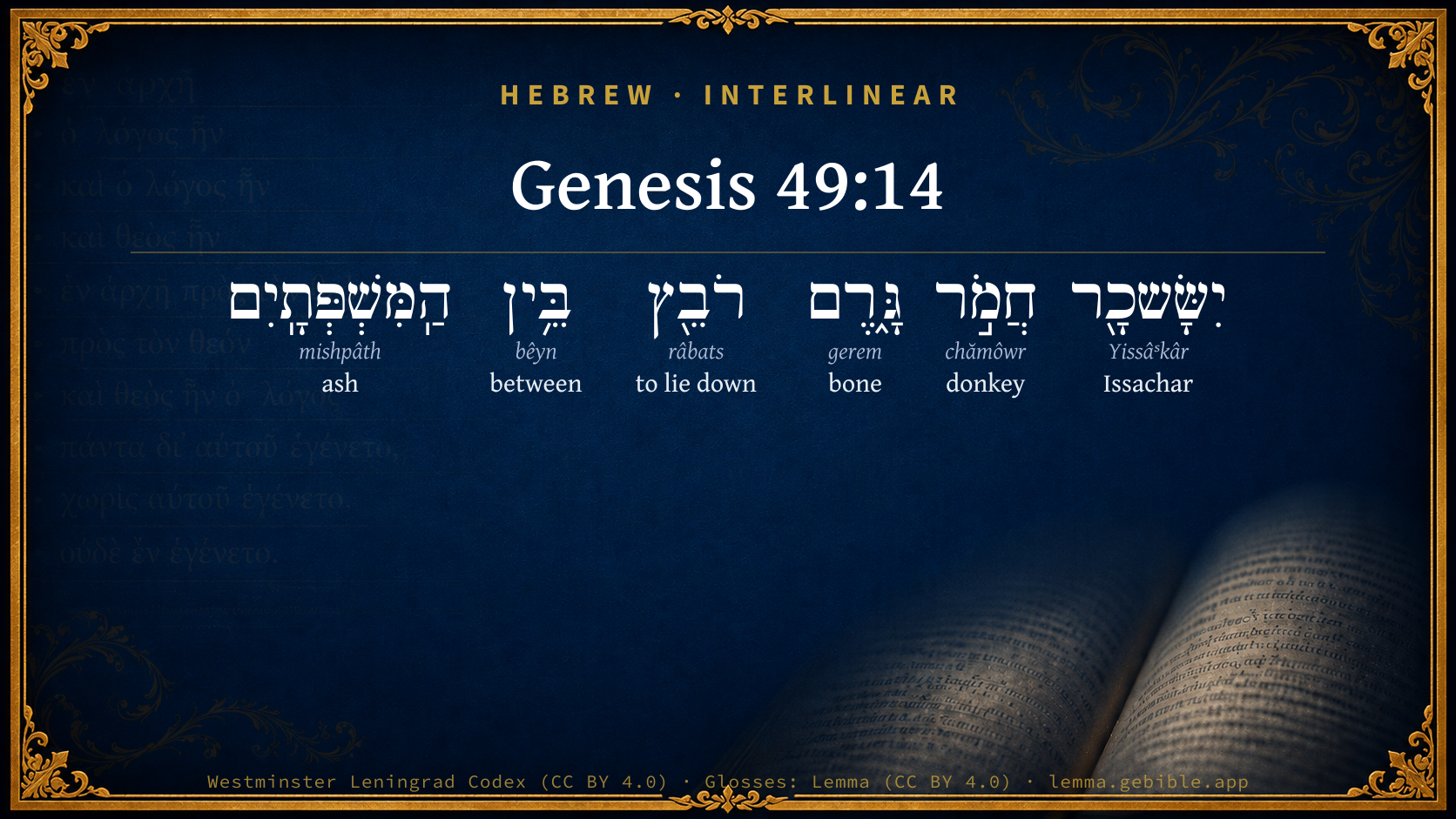
Genesis 49:14

Hebrew (Westminster Leningrad Codex) Genesis 49:14 appears in the Hebrew Old Testament. The text above is from the Westminster Leningrad Codex. Each word links to its Strong’s number, a concise gloss, and parsing drawn from the Open Scriptures Hebrew Bible morphology. Click any word for its full Brown-Driver-Briggs (BDB) entry.
Download image
Cite this verse

Genesis 49:14 (World English Bible). Public Domain. Lemma interlinear Bible study tool, https://lemma.gebible.app/v/genesis/49/14.

Show BibTeX & RIS
BibTeX
RIS
English Translation
"Issachar is a strong donkey, Lying down between the saddlebags.
World English Bible · Public Domain
Highlights
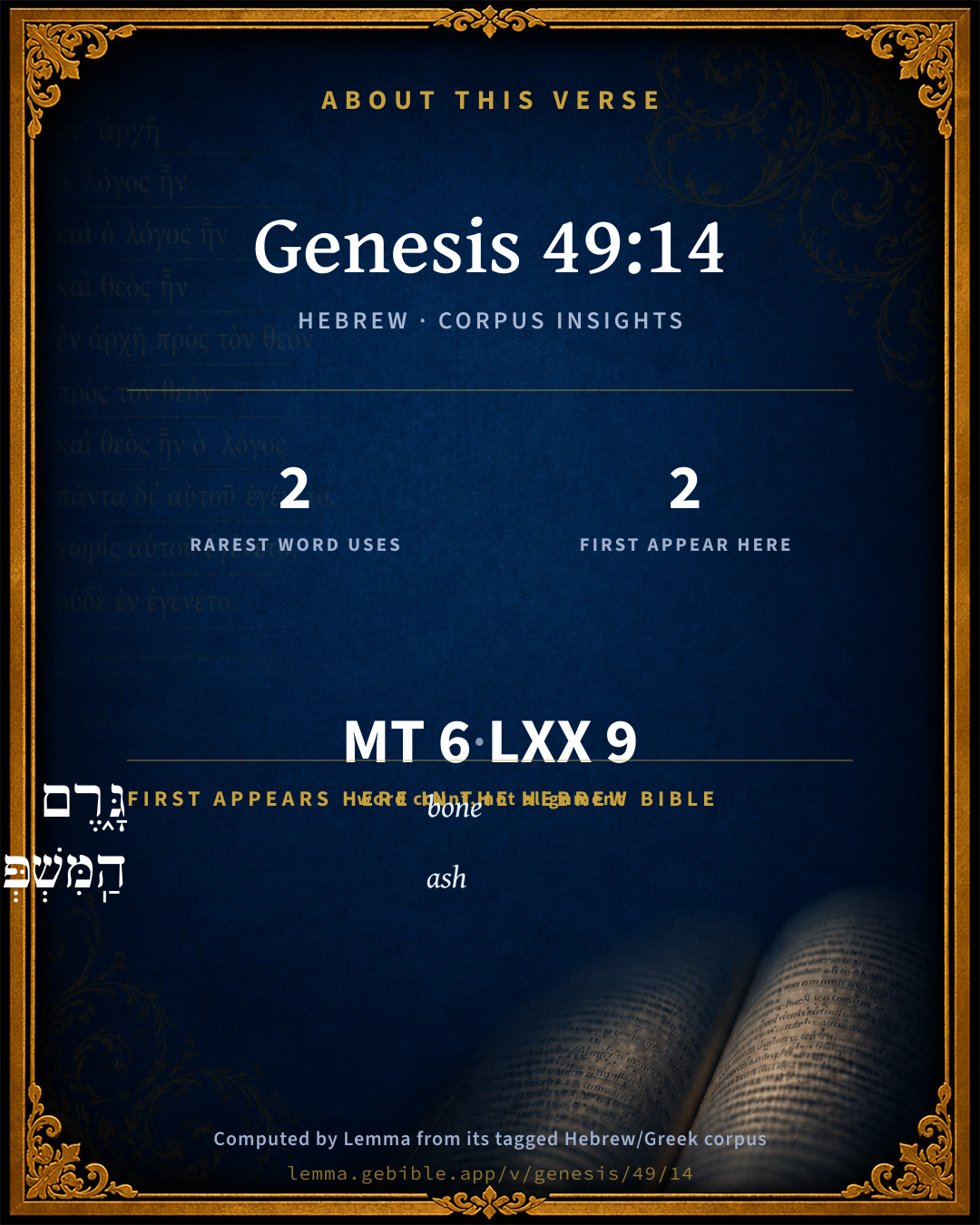
  • 2 first appearances in the Hebrew Bible
Full analysis ↓
Download a study sheet

One document with this verse’s original text, its word-by-word gloss line, the meaning frame, cross-references with their text, attributed commentary, and full source and license credits — printable, and it pastes into notes with its structure intact.

This verse Autodidact and up

Study sheet (.html) Plain text (.txt)

A passage Seminary Student

Up to 50 verses in one chapter. A passage sheet keeps up to 6 commentary sources and 12 cross-references per verse, in the order this page ranks them, and says so on the sheet whenever that leaves anything out. Ask for a single verse and you get the Autodidact verse sheet above.

Everything on this page stays free to read, with no account — the sheet is a download of what is already on screen, not access to it.

Want to remove ads? Support Godless Engineer
Compare translations 3

The same verse in 3 English versions, stacked beneath the original-language interlinear above. Click any original word for its lexicon entry.

Each is an independent rendering of the whole verse — the interlinear is not word-aligned to these translations.

Highlighted words mark where these versions differ — a whole-verse word diff, not a word-by-word alignment.

  • World English Bible Public Domain
    "Issachar is a strong donkey, Lying down between the saddlebags.
  • King James Version Public Domain
    Issachar is a strong ass couching down between two burdens:
  • unfoldingWord Literal Text CC BY-SA 4.0
    Issachar a strong donkey lying down between two saddlebags.

unfoldingWord Literal Text — © unfoldingWord, licensed CC BY-SA 4.0. Word-aligned USFM3 via Door43 (git.door43.org/unfoldingWord/en_ult).

Versions to compare (up to 4)

3 of 4 selected

Show all 18 translations

Every available English version of this verse, each an independent rendering of the whole verse.

  • World English Bible Public Domain
    "Issachar is a strong donkey, Lying down between the saddlebags.
  • Berean Standard Bible Public Domain
    Issachar is a strong donkey, lying down between the sheepfolds.
  • Majority Standard Bible Public Domain
    Issachar is a strong donkey, lying down between the sheepfolds.
  • King James Version Public Domain
    Issachar is a strong ass couching down between two burdens:
  • American Standard Version (1901) Public Domain
    Issachar is a strong ass, Couching down between the sheepfolds:
  • Revised Version (1885) Public Domain
    Issachar is a strong ass, Couching down between the sheepfolds:
  • Geneva Bible (1599) Public Domain
    Issachar shalbe a strong asse, couching downe betweene two burdens:
  • Douay-Rheims (1899) Public Domain
    Issachar shall be a strong ass lying down between the borders.
  • Young's Literal Translation Public Domain
    Issacher `is' a strong ass, Crouching between the two folds;
  • Literal Standard Version CC BY-SA 4.0
    Issachar [is] a strong donkey, || Crouching between the two folds;
  • Unlocked Literal Bible CC BY-SA 4.0
    Issachar is a strong donkey, lying down between the sheepfolds.
  • unfoldingWord Literal Text CC BY-SA 4.0
    Issachar a strong donkey lying down between two saddlebags.
  • Darby Bible Public Domain
    Issachar is a bony ass, Crouching down between two hurdles.
  • World Messianic Bible Public Domain
    “Issachar is a strong donkey, lying down between the saddlebags.
  • Webster's Bible Public Domain
    Issachar is a strong ass, couching down between two burdens:
  • Free Bible Version CC BY-SA 4.0
    Issachar is a strong donkey, lying down between two saddle bags.
  • Bible in Basic English Public Domain
    Issachar is a strong ass stretched out among the flocks:
  • JPS Tanakh (1917) Public Domain
    Issachar is a large-boned ass, couching down between the sheep-folds.

Literal Standard Version (2020), Covenant Press — licensed CC BY-SA 4.0. Text via the HelloAO Bible API (eBible.org). Unlocked Literal Bible (unfoldingWord) — licensed CC BY-SA 4.0. Text via the HelloAO Bible API (eBible.org). unfoldingWord Literal Text — © unfoldingWord, licensed CC BY-SA 4.0. Word-aligned USFM3 via Door43 (git.door43.org/unfoldingWord/en_ult). Free Bible Version, Dr. Jonathan Gallagher — licensed CC BY-SA 4.0. Text via the HelloAO Bible API (eBible.org).

Word by word

More ways to search: Search by grammar → Find every occurrence → Compare this word →

Practice this passage: Drill this verse → Learn its vocabulary →

About this verse

These counts appear in no published source. They are computed here, from the morphology-tagged text and Lemma’s own curated glosses. What Lemma adds →

6
words
6
distinct lemmas
Pentateuch
section

Notable vocabulary

The rarest word here is הַֽמִּשְׁפְּתָֽיִם ash H4942 — appearing just 2 times in the whole Hebrew Bible.

First appearance in Scripture

These words make their first canonical appearance in the Hebrew Bible here:

  • גָּ֑רֶם bone H1634
  • הַֽמִּשְׁפְּתָֽיִם ash H4942

Shared distinctive vocabulary

הַֽמִּשְׁפְּתָֽיִם ash H4942 occurs in 2 verses of the Hebrew Bible. Also found in:

Grammatical profile

  • 1 verb
  • 4 nouns
  • 1 preposition

Verb forms

  • רֹבֵ֖ץ Qal · Participle Active

Hebrew & Septuagint length

In English translation the verse runs 10 words from the Hebrew and 11 from the Septuagint (LXX English) — closely comparable.

A rough comparison of the two English renderings, which tokenize alike — not a word-level alignment.

Word counts can differ between the Hebrew and the Greek without any difference in meaning — e.g. the Hebrew direct-object marker אֵת has no separate Greek word, and Greek often adds the article ὁ.

In the original languages it is 6 Hebrew tokens and 9 Greek tokens — but the two are counted differently (Hebrew bundles its prefixes and suffixes into one token; the Greek is in lemma form), so that isn’t a like-for-like length.

Cross-references

6

Topical passages linked to Genesis 49:14 in the Treasury of Scripture Knowledge — connected by theme and wording, ordered by reader-vote popularity; previews shown in the World English Bible.

  • Genesis 30:18 Leah said, "God has given me my hire, because I gave my handmaid to my husband." She named him Issachar.
  • 1 Chronicles 12:32 Of the children of Issachar, men who had understanding of the times, to know what Israel ought to do, the heads of them were two hundred; and all their brothers were at their commandment.
  • Deuteronomy 33:18 Of Zebulun he said, Rejoice, Zebulun, in your going out; Issachar, in your tents.
  • Joshua 19:17–23 The fourth lot came out for Issachar, even for the children of Issachar according to their families.
  • Judges 5:15–16 The princes of Issachar were with Deborah; As was Issachar, so was Barak; Into the valley they rushed forth at his feet. By the watercourses of Reuben There were great resolves of heart.
  • Judges 10:1 After Abimelech there arose to save Israel Tola the son of Puah, the son of Dodo, a man of Issachar; and he lived in Shamir in the hill-country of Ephraim.

Cross-references courtesy of OpenBible.info (CC BY 4.0).

Hebrew and Greek witnesses Masoretic Hebrew ↔ Greek Septuagint

The same verse in the two great witnesses to the Old Testament, shown verse-for-verse.

These are two independent witnesses, not word-aligned to each other, and the Septuagint is shown in lemma (dictionary) form.

Hebrew Genesis 49:14 Masoretic · Westminster Leningrad Codex

יִשָּׂשכָ֖ר חֲמֹ֣ר גָּ֑רֶם רֹבֵ֖ץ בֵּ֥ין הַֽמִּשְׁפְּתָֽיִם

"Issachar is a strong donkey, Lying down between the saddlebags.

World English Bible · Public Domain

Greek LXX Genesis 49:14 Septuagint · lemma form

ισσαχαρ ὁ καλός ἐπιθυμέω ἀναπαύω ἀνά μέσος ὁ κλῆρος

Issachar has desired that which is good; resting between the inheritances.

LXX2012 (modern English Septuagint) · Public Domain

On this verse, The Cambridge Bible for Schools and Colleges discusses the Septuagint’s reading. Read the note in Commentary ↓

Hebrew: Westminster Leningrad Codex (CC BY 4.0). Greek: Septuagint (public domain); English from LXX2012 (modern English Septuagint) (Public Domain). How the Septuagint differs from the Hebrew →

Targum (Aramaic paraphrase)

2

The Targum is the ancient Jewish Aramaic paraphrase of the Hebrew Scriptures — an interpretive translation, not the Hebrew text itself. Onkelos (literal) and Pseudo-Jonathan (expansive) render the Torah, and Jonathan the Prophets. Coverage is partial: where no permissively-licensed English translation exists for a verse, only the Aramaic is shown. This is verse-level text, not a word-by-word alignment to the Hebrew.

  1. Targum Onkelos Torah (Genesis–Deuteronomy)
    יִשָּׂשׂכָר עַתִּיר בְּנִכְסִין וְאַחֲסַנְתֵּהּ בֵּין תְּחוּמַיָּא

    (no public-domain English translation for this verse)

    Targum Onkelos — Aramaic: “Onkelos Genesis” (public domain); “Onkelos Exodus” (public domain); “Onkelos Leviticus” (public domain); “Onkelos Numbers” (public domain); “Onkelos Deuteronomy” (public domain). English: “Sefaria Community Translation” (CC0 1.0 (public-domain dedication)); “J.W. Etheridge. The Targums of Onkelos and Jonathan Ben Uzziel on the Pentateuch. London: Longmans, Green, 1862” (public domain). Text via Sefaria.

  2. Targum Pseudo-Jonathan Torah (Genesis–Deuteronomy)
    יִשָשׁכָר חֲמִיר בְּאוֹרַיְיתָא וְשֵׁבֶט תַּקִיף יְדַע כַּווֹנֵי בְּזִימְנַיָא וְהוּא מַרְבַּע בֵּינֵי תְּחוּמֵי אָחוֹי

    Issakar is an ass in the law; a strong tribe, knowing the order of the times; and he lieth down between the limits of his brethren.

    Targum Pseudo-Jonathan — Aramaic: “Targum Jonathan on Genesis” (public domain); “Targum Jonathan on Exodus” (public domain); “Targum Jonathan on Leviticus” (public domain); “Targum Jonathan on Numbers” (public domain); “Targum Jonathan on Deuteronomy” (public domain). English: “The Targum of Jonathan ben Uzziel, trans. J. W. Etheridge, London, 1862” (public domain). Text via Sefaria.

Commentary

Notes on Genesis 49:14 from classic Christian and Jewish commentators (each source and its license shown beneath its notes). The classic Christian expositions comment on the surrounding passage and are grouped to its opening verse, so a note may address several verses; the Jewish commentaries on the Tanakh (Rashi and others) are per-verse, so they appear only where the commentator wrote on this verse.

Lemma curates 59 commentaries, every one of them public domain or Creative Commons licensed, each selected and text-cleaned for this edition rather than reprinted as found. About our sources →

Jamieson, Fausset & Brown

Robert Jamieson, A. R. Fausset & David Brown

ISSACHAR-- (Gen 49:14-15)

a strong ass couching down between two burdens--that is, it was to be active, patient, given to agricultural labors. It was established in lower Galilee--a "good land," settling down in the midst of the Canaanites, where, for the sake of quiet, they "bowed their shoulder to bear, and became a servant unto tribute."

Jamieson, Fausset & Brown — Commentary Critical and Explanatory on the Whole Bible (1871) — public domain (CC PDM 1.0). Text via the HelloAO Bible API.

Trapp's Complete Commentary

John Trapp

Gen 49:14 Issachar [is] a strong ass couching down between two burdens:

Ver. 14. Issachar is a strong ass, &c.] He so commends his strength, that, with it, he condemns his dulness. This Christ can so little abide, that he said even to Judas, "That thou doest, do quickly." God utterly refused an ass in sacrifice. The firstling of an ass must either be redeemed, or have his neck broke. Bellarmine gives the reason, and it is a very good one, quia tardum et pigrum animal, because it is a slow sluggish creature, segnis quasi seignls, without fire; slow to action, which God, who is himself a pure act [spirit?], cannot abide.

John Trapp, A Commentary or Exposition upon All the Books of the Old and New Testament (1647–1656) — public domain. Text from a community e-Sword module.

Joseph Benson's Commentary

Gen 49:14. Issachar is a strong ass, couching down between two burdens — The men of that tribe shall be strong and industrious, fit for and inclined to labour, particularly the toil of husbandry; like the ass that patiently carries his burden. Issachar submitted to two burdens, tillage and tribute.

Joseph Benson's Commentary on the Old and New Testaments (1811–1818) — public domain. Text from a community e-Sword module.

Tyndale Open Study Notes

Tyndale Open Resources

49:14-15 Like a sturdy donkey, the tribe of Issachar would be forced to work for others. Issachar was often subjugated by invading armies.

Tyndale Open Study Notes — © Tyndale Open Resources, licensed CC BY-SA 4.0. Text via the HelloAO Bible API.

Geneva Bible (1599)

Geneva Bible translators

His force shall be great, but he shall want courage to resist his enemies.

Hebrew, an ass of great bones.

Geneva Bible (1599) marginal notes — public domain. Text via Bolls.life.

Adam Clarke's Commentary

14. Issachar is a strong ass

Couching between two burdens.

15. And he saw the resting place that it was good,

And the land that it was pleasant;

And he inclined his shoulder to the load,

And he became a servant unto tribute.

Verse 14. Issachar is a strong ass] חמר גרם chamor garem is properly a strong-limbed ass; couching between two burdens - bearing patiently, as most understand it, the fatigues of agriculture, and submitting to exorbitant taxes rather that exert themselves to drive out the old inhabitants.

The two burdens literally mean the two sacks or panniers, one on each side of the animal's body; and couching down between these refers to the well-known propensity of the ass, whenever wearied or overloaded, to lie down even with its burden on its back.

Adam Clarke's Commentary on the Bible (1810–1826) — public domain. Text from a community e-Sword/MySword module.

John Calvin's Commentaries

14. Issachar. Here mention is partly made of the inheritance, and an indication is partly given of the future condition of this tribe. Although he is called a bony ass on account of his strength, which would enable him to endure labors, especially such as were rustic, yet at the same time his sloth is indicated: for it is added a little afterwards, that he should be of servile disposition. Wherefore the meaning is, that the sons of Issachar, though possessed of strength, were yet quiet rather than courageous, and were as ready to bear the burden of servitude as mules are to submit their backs to the packsaddle and the load. The reason given is, that, being content with their fertile and pleasant country, they do not refuse to pay tribute to their neighbors, provided they may enjoy repose. And although this submissiveness is not publicly mentioned either to their praise or their condemnation, it is yet probable that their indolence is censured, because their want of energy hindered them from remaining in possession of that liberty which had been divinely granted unto them.

John Calvin's Commentaries (1540-1563) — public domain. Text from the Calvin Translation Society English edition (1840s-50s) via the Christian Classics Ethereal Library (ccel.org). Calvin's coverage is partial (roughly two-thirds of the Bible); uncommented books and verses are honest gaps, never fabricated. The 19th-century editor's footnotes and remarks are omitted so the notes are faithfully Calvin's own voice.

Ellicott's Commentary for English Readers

(14) Issachar.—The description of Issachar’s lot is derived partly from the cognizance he had chosen for his signet, and partly from his personal character, He had taken for his symbol the ass—a very noble, active, spirited, and enduring animal in the East. (See Gen_16:12, where Ishmael is compared to the wild ass, which adds to these qualities the love of freedom.) His real character was slothful, inactive, and commonplace. Jacob therefore likens him to a “strong ass;” Heb., an ass of bone, that is, one coarsely bred, as animals of high parentage have small bones. He is thus fit only to be a drudge, and with the laziness of a cart-horse lies down “between two burdens.” The word occurs again in Jdg_5:16, and is there more correctly rendered sheepfolds. More exactly it means the pens in which the cattle were folded during the nights of summer; and it is in the dual form, because these pens were divided into two parts for the larger and smaller cattle. Thus Issachar, stretched at ease between his cattle-pens, gives us the idea of a tribe occupied with pastoral pursuits, and destitute of all higher aspirations.

A Bible Commentary for English Readers, edited by Charles John Ellicott (1878–1897) — public domain. Text from a community e-Sword module.

The Cambridge Bible for Schools and Colleges

gen. ed. J. J. S. Perowne

14. a strong ass] Lit. “a bony ass,” as Aquila ὄνος ὀστώδης; Lat. asinus fortis. Issachar is compared, not to the wild ass, high spirited and swift, but to the strong domestic beast of burden. The territory of Issachar included the southern part of Galilee and the Valley of Jezreel. Slightly different readings are represented by the Sam. gêrim (instead of gerem), i.e. “the ass of strangers,” “bearing the burdens imposed by foreigners,” “a tributary.” The LXX τὸ καλὸν ἐπεθύμησεν = “he desired the beautiful,” gives an entirely different turn to the sense.

between the sheepfolds] For this word, see Jdg_5:16, “why satest thou among the sheepfolds?,” and Psa_68:13. Issachar is represented as lying contentedly among his flocks, regardless of his brethren. Instead of “sheepfolds,” the versions give “boundaries.” Thus LXX ἀνὰ μέσον τῶν κλήρων = “between the lots”; Lat. inter terminos. Another proposed rendering is “dung-heaps” or “ash-heaps.” Skinner conjectures “panniers,” which would be more appropriate to the metaphor.

The Cambridge Bible for Schools and Colleges (gen. ed. J. J. S. Perowne; Cambridge University Press, 1878–1918) — public domain. Text from a community e-Sword module.

John Gill's Exposition

Issachar is a strong ass,.... Or as one, the note of similitude being wanting, as Ben Melech observes; "a bony" (e) one, as the word signifies; not one that is lean, and nothing but skin and bones, as some interpret it, but that is strong and robust, able to carry burdens; and this tribe is compared to an ass, not for stupidity and sluggishness, but for its strength, and its use in husbandry, in which this tribe was chiefly occupied: the Targums of Jonathan and Jarchi interpret this figuratively, of his being strong to bear the yoke of the law: and it is a notion of the Jews, that this tribe were skilful in the doctrines of the law, and the intercalation of years, &c. from Ch1 12:32 couching down between two burdens: one hanging on one side, and another on the other; which Kimchi and Ben Melech interpret of bales of goods; and may as well be understood of sacks of corn, or anything else, carried by these creatures, which, when they come into a good pasture, and for the sake of that and ease, will lie down with their burdens on them, and rise up again with them: the Targums of Onkelos and Jerusalem paraphrase it, "between two borders" (f), or the borders of his brethren, as Jonathan, Zebulun and Dan, between which this tribe lay; and this is the reason Aben Ezra gives why Issachar, who was older than Zebulun, is mentioned after him, and between him and Dan, because his land lay between them; and so it may be observed, that in the division of the land in Joshua's time, Issachar's lot came up after Zebulun's, Jos 19:10 but Doctor Lightfoot thinks (g) it refers to the two kingdoms, between which it lay, that of Phoenicia on one side, and that of Samaria on the other.

(e) "Asinus osseus", Montanus, Tigurine version, Munster, Vatablus, Drusius, Piscator, Cartwright. (f) "inter terminos", V. L. "inter terminos duos", Pagninus, Montanus, Drusius, Cartwright; so Ainsworth, "inter duos finos", Tigurine version. (g) Works, vol. 1. p. 698.

John Gill's Exposition of the Whole Bible (1746–1763) — public domain (CC PDM 1.0). Text via the HelloAO Bible API.

Haydock's Catholic Bible Commentary

Strong. Hebrew, "bony ass." Many of Jacob’s children are compared to animals, which was customary in the eastern style. Homer compares Ajax with the ass, for his strength and patience, Iliad xii. Jacob thus indicates the laborious disposition of Issachar’s tribe, which did not delight in war. Their country was the most fruitful of all Galilee. (Calmet)

George Leo Haydock (1774–1849), Haydock's Catholic Family Bible and Commentary, 1859 edition — public domain. Excludes Psalms (Douay-Rheims chapter numbering differs from Protestant) and Deuterocanonical books (Catholic canon only).

Matthew Poole's English Annotations

A strong ass, Heb. an ass of bone, i.e. of great bulk and bones, and strength of body, but of little spirit and courage,

couching down between two burdens, which are laid upon his back, and which he is contented to bear. Or, lying down, i.e. enjoying his ease and rest, between the borders, to wit, of the other tribes, with which he was encompassed and secured from foreign enemies, which made him more secure and slothful. Or, between the borders or folds of cattle; as a word very near akin to it, and proceeding from the same root, signifies, Jdg 5:16, to the feeding and minding whereof he wholly gave himself, neglecting more generous things.

Matthew Poole's English Annotations on the Holy Bible (1683–1685) — public domain. Text from a community e-Sword/MySword module.

Whedon's Commentary on the Bible

Daniel D. Whedon

14. Ass of bone — Or, bony ass; that is, strongly built and fit for carrying burdens. See Gen_30:18, on the origin of the name Issachar. Issachar’s characteristic was a disposition to look for a reward or hire rather than liberty and honour. Like a beast of burden, he loves to lie down and rest between the double sheepfolds; that is the inclosures made of hurdles, and open at the top. The word is dual, probably because these folds were generally divided into two parts. Comp. Jdg_5:16, note.

Daniel D. Whedon (gen. ed.), Commentary on the Old and New Testaments (1874–1909) — public domain. Text from a community e-Sword module.

The Pulpit Commentary

Vers. 14, 15. Issachar is a strong ass couching down between two burdens literally, an ass of bone hence a strong, powerful animal, asinus fortis (Vulgate), asinus walidi corporis (Gesenius), asinus robustus (Rosenmuller) lying down between the folds, or cattle-pens, which received and protected the flocks by night, the dual being used probably because such pens were divided into two parts for different kinds of cattle (Gesenius, Keil, Kalisch, Murphy, "Speaker s Commentary," &c.), though the word ;mishpetaim has been also rendered ajnason twn klhrwn (LXX), inter terminos (Vulgate, Rosenm "within their own boundaries" (Onkelos, Targums of Jerusalem and Jonathan), "between two burdens" (A. V, Lange, Murphy, &c.). ;And he saw that rest was good, and the land that it was pleasant. Issachar was to manifest a keen appreciation of the land or portion of territory that should be assigned to him, and to renounce the warlike spirit and military enterprises of his brethren for the indolent and luxurious repose of his fat pastures, crouching between his sheep-folds, or rejoicing within his tents, like a lazy ass, capable indeed of mighty efforts, but too self-satisfied to put forth much exertion, devoting himself to agriculture and pastoral pursuits, and preferring rather to pay tribute to his.brethren, in order to secure their protection, than to leave his ploughshare and cast aside his shepherd"s crook to follow them into the tented field of war, as the patriarch next describes. And bowed his shoulder to bear, and became a servant unto tribute or a tributary servant. The phrase dbeOAsm, though sometimes used of servitude under a foreign sovereignty (Deu_20:11; Jos_16:10) commonly refers to tribute rendered by labor (1Ki_9:21; 2Ch_8:8) and is correctly rendered anqrwpov eiv foron douleuwn (Aquila), factusque est tributo serviens (Vulgate). The translation kaiqh ajnho gewrgov (LXX) discovers in the clause an allusion to Issachar"s agricultural pursuits.

The Pulpit Commentary (1880–1919), ed. H.D.M. Spence-Jones & Joseph S. Exell — public domain. Text from a community e-Sword module.

John Wesley's Explanatory Notes

Issachar is a strong ass, couching down between two burdens - The men of that tribe shall be strong and industrious, fit for and inclined to labour, particularly the toil of husbandry, like the ass that patiently carries his burden. Issachar submitted to two burdens, tillage and tribute.

John Wesley, Explanatory Notes Upon the Whole Bible (1754–1765) — public domain. Text via the GEBible commentary corpus.

Keil & Delitzsch

C. F. Keil & F. Delitzsch

"Issachar is a bony ass, lying between the hurdles. He saw that rest was a good (טוב subst.), and the land that it was pleasant; and bowed his shoulder to bear, and became a servant unto tribute." The foundation of this award also lies in the name שׂכר ישּׂא, which is probably interpreted with reference to the character of Issachar, and with an allusion to the relation between שׂכר and שׂכיר, a daily labourer, as an indication of the character and fate of his tribe. "Ease at the cost of liberty will be the characteristic of the tribe of Issachar" (Delitzsch). The simile of a bony, i.e., strongly-built ass, particularly adapted for carrying burdens, pointed to the fact that this tribe would content itself with material good, devote itself to the labour and burden of agriculture, and not strive after political power and rule. The figure also indicated "that Issachar would become a robust, powerful race of men, and receive a pleasant inheritance which would invite to comfortable repose." (According to Jos. de bell. jud. iii. 3, 2, Lower Galilee, with the fruitful table land of Jezreel, was attractive even to τὸν ἥκιστα γῆς φιλόπονον). Hence, even if the simile of a bony ass contained nothing contemptible, it did not contribute to Issachar's glory. Like an idle beast of burden, he would rather submit to the yoke and be forced to do the work of a slave, than risk his possessions and his peace in the struggle for liberty. To bend the shoulder to the yoke, to come down to carrying burdens and become a mere serf, was unworthy of Israel, the nation of God that was called to rule, however it might befit its foes, especially the Canaanites upon whom the curse of slavery rested (Deu 20:11; Jos 16:10; Kg1 9:20-21; Isa 10:27). This was probably also the reason why Issachar was noticed last among the sons of Leah. In the time of the Judges, however, Issachar acquired renown for heroic bravery in connection with Zebulun (Jdg 5:14-15, Jdg 5:18). The sons of Leah are followed by the four sons of the two maids, arranged, not according to their mothers or their ages, but according to the blessing pronounced upon them, so that the two warlike tribes stand first.

Keil & Delitzsch — Biblical Commentary on the Old Testament (1861–1891) — public domain (CC PDM 1.0). Text via the HelloAO Bible API. (Old Testament only.)

unfoldingWord translationNotes

Door43 World Missions Community

Issachar is a strong donkey

Jacob speaks about Issachar and his descendants as if they are a donkey. This emphasizes that they will work very hard. AT: "The descendants of Issachar will be like a strong donkey" (See: Metaphor)

Issachar is

Often in prophecy events that will happen in the future are described as something that is already happening. This emphasizes that the event will certainly happen. It can be stated in the future tense. AT: "Issachar will be" or "The descendants of Issachar will be"

Issachar ... He sees ... He will

Here "Issachar" is a metonym that stands for his descendants. AT: "The descendants of Issachar ... They see ... They will" (See: Metonymy)

lying down between the sheepfolds

Possible meanings are 1) "lying down between the packs they were carrying" or 2) "lying down between two sheep pens." Either way, Jacob speaks about Issachar's descendants as if they are donkeys that have worked hard and are lying down to rest. (See: Metaphor)

a good resting place and the pleasant land

"a resting place that is good and that the land is pleasant"

He will bend his shoulder to the burden

The phrase "bend his shoulder to the burden" is a way of saying "work very hard to carry the load" (See: Idiom)

become a servant for the task

"will work for others as slaves"

translationWords

Issachar

donkey

burden

servant

unfoldingWord translationNotes — © Distant Shores Media and the Door43 World Missions Community, licensed CC BY-SA 4.0. Source: git.door43.org/Door43/en_tn.

Rashi

Rabbi Shlomo Yitzchaki (Rashi)

יששכר חמר גרם means ISSACHAR IS A BONY ASS — he bears the yoke of the Torah (i.e. obligations) like a strong ass upon which may be placed a heavy load (Genesis Rabbah 99:9).

רבץ בין המשפתים CROUCHING BETWEEN THE FOLDS — Like an ass that travels day and night and has no permanent stable of its own, so that when it wishes to rest it croucheth down between the borders — i.e. at the bounds of the cities whither it is earring merchandise.

Rashi on the Tanakh — English translations: “The Judaica Press complete Tanach with Rashi, translated by A. J. Rosenberg” (CC BY 4.0); “Pentateuch with Rashi's commentary by M. Rosenbaum and A.M. Silbermann, 1929-1934” (public domain); “The Metsudah Tanach series, Lakewood, N.J” (CC BY 4.0); and “The Book of Joshua, Metsudah Publications, 1997” (CC BY 4.0). Text via Sefaria.

Radak

Rabbi David Kimhi (Radak)

יששכר חמור גרם, like a strong donkey possessing strong bones. He is able to lie down while carrying his load and to get up again while still having his load on his back.

המשפתים, a reference to the load the donkey carries. Yaakov uses the word in the plural mode, to indicate that Issachar will be loaded with not only one burden but two, carrying one on his right side, the other on his left. His soil will be extremely good, as if to say that he will not join battle formations in war but will belong to the troops bringing the supplies to the front lines. He will pay a special tax to the king to be allowed this arrangement, hence ויהי למס עובד. This is what Yaakov had in mind when he said of Issachar וירא מנוחה כי טוב. Our sages in Bereshit Rabbah 98,12, and 99,10 explain the entire blessing as a prophecy that Issachar would make his primary occupation the study of Torah, and Yaakov depicting such a way of life as something lovely and rewarding for those who pursue it. The more one labours and immerses oneself deeply in Torah study the greater the ultimate sense of serenity, מנוחה, constructive peace of mind one will experience. All the expressions used here such as וירא מנוחה כי טוב ואת הארץ כי נעמה ויט שכמו לסבול ויהי למס עובד, describe, step by step the immersion in Torah study, the difficulties in mastering that discipline, and the eventual satisfaction it yields the person who stays the course. As proof that Yaakov’s blessing for Issachar did indeed come true, consider that the tribe of Issachar sent only 200 representatives to attend the crowning of David as King, whereas all the other tribes sent delegations numbering between 10,000 and 120,000. The 200 men from Issachar however, are described as יודעי בינה לעתים, “knowing how to interpret the signs of the times.” They were all Torah scholars. (compare Chronicles I 12,24-38)

Radak on the Tanakh — English translations: “Sefaria Community Translation” (CC0 1.0 (public-domain dedication)); “Eliyahu Munk, HaChut Hameshulash” (CC BY 4.0); “Rabbi Mike Feuer, Jerusalem Anthology” (CC BY 4.0); and “R. David Kimhi on the first book of Psalms, Translated by R.G. Finch, London, 1919” (public domain). Text via Sefaria.

Lesson kit

Teaching starters — assembled from the data on this page, not authored interpretation. Every prompt links to the verse data it draws on. Edit before teaching.

Genesis, in the Pentateuch, opens this verse with 6 words (6 distinct Hebrew lemmas). Its most distinctive word is mishpâth (“ash”). A historical commentator’s framing appears above. Read the whole chapter for the surrounding context.

Discussion questions

  1. The word mishpâth carries the sense “ash.” How does it shape the verse?
  2. 2 words here appear for the first time in Scripture. What is being introduced at this debut?
  3. Judges 5:16 shares the word «ash» with this verse. How do the two illuminate each other?
  4. These translations render this verse differently. What is at stake in choosing one wording over another?
  5. The verb «רֹבֵ֖ץ» is Qal Participle Active. How does its form color the action?
  6. Reading how Jamieson, Fausset & Brown and Trapp's Complete Commentary read this verse, where do the two commentators agree and where do they part?

Things to notice

Reading settings

Reading text

Shown beneath each verse's original-language words.

Old Testament
Old Testament edition

Read the OT as the Masoretic Hebrew (MT) or the Greek Septuagint (LXX).

English shown for the Greek Septuagint (in the Hebrew ↔ Greek comparison).

Comparing translations? Open the Compare panel on any verse page to stack up to four side by side.