
Isaiah 22:11

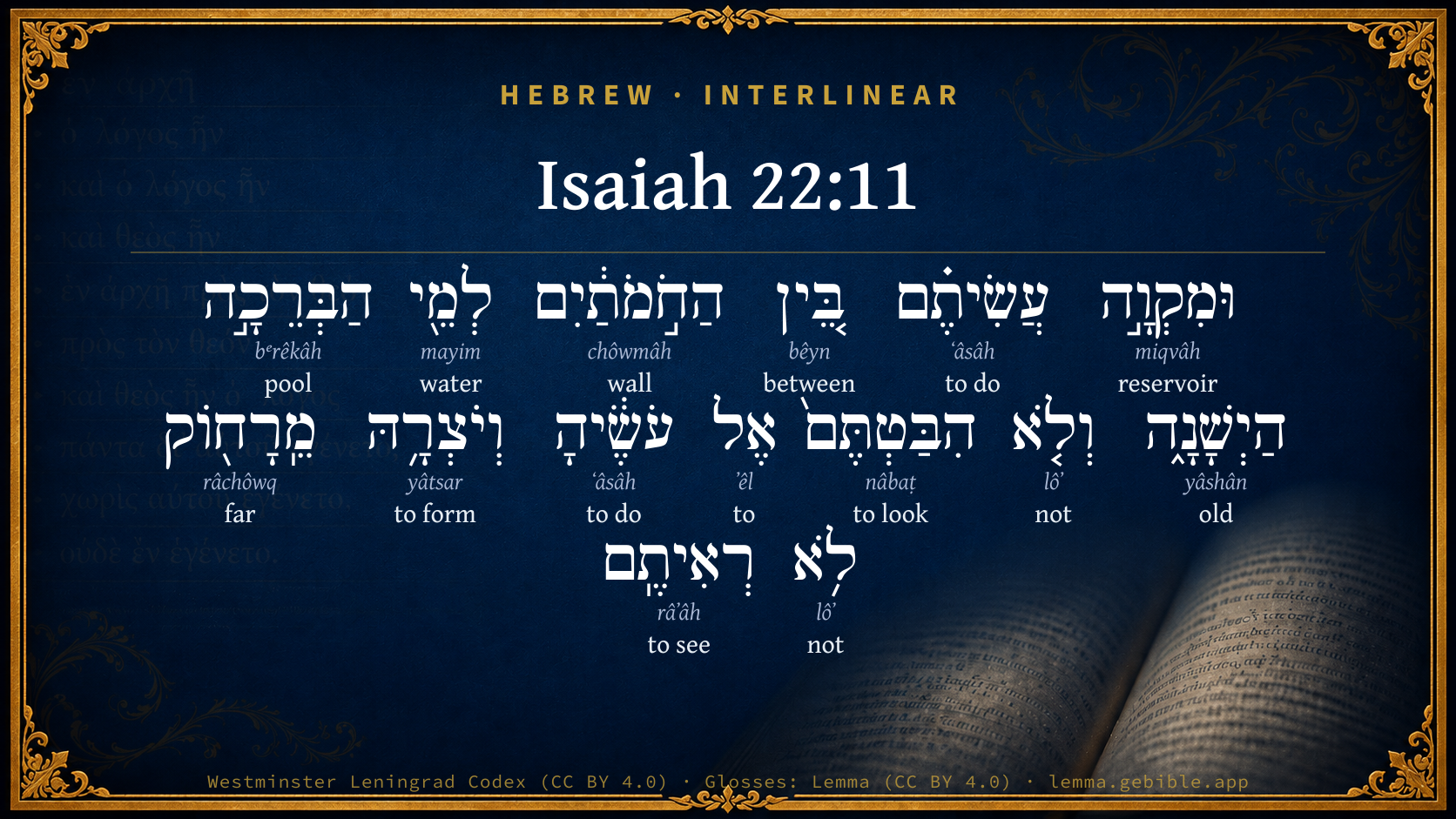
Hebrew (Westminster Leningrad Codex) Isaiah 22:11 appears in the Hebrew Old Testament. The text above is from the Westminster Leningrad Codex. Each word links to its Strong’s number, a concise gloss, and parsing drawn from the Open Scriptures Hebrew Bible morphology. Click any word for its full Brown-Driver-Briggs (BDB) entry.
Download image
Cite this verse

Isaiah 22:11 (World English Bible). Public Domain. Lemma interlinear Bible study tool, https://lemma.gebible.app/v/isaiah/22/11.

Show BibTeX & RIS
BibTeX
RIS
English Translation
you made also a reservoir between the two walls for the water of the old pool. But you didn't look to him who had done this, neither did you have respect for him who purposed it long ago.
World English Bible · Public Domain
Highlights
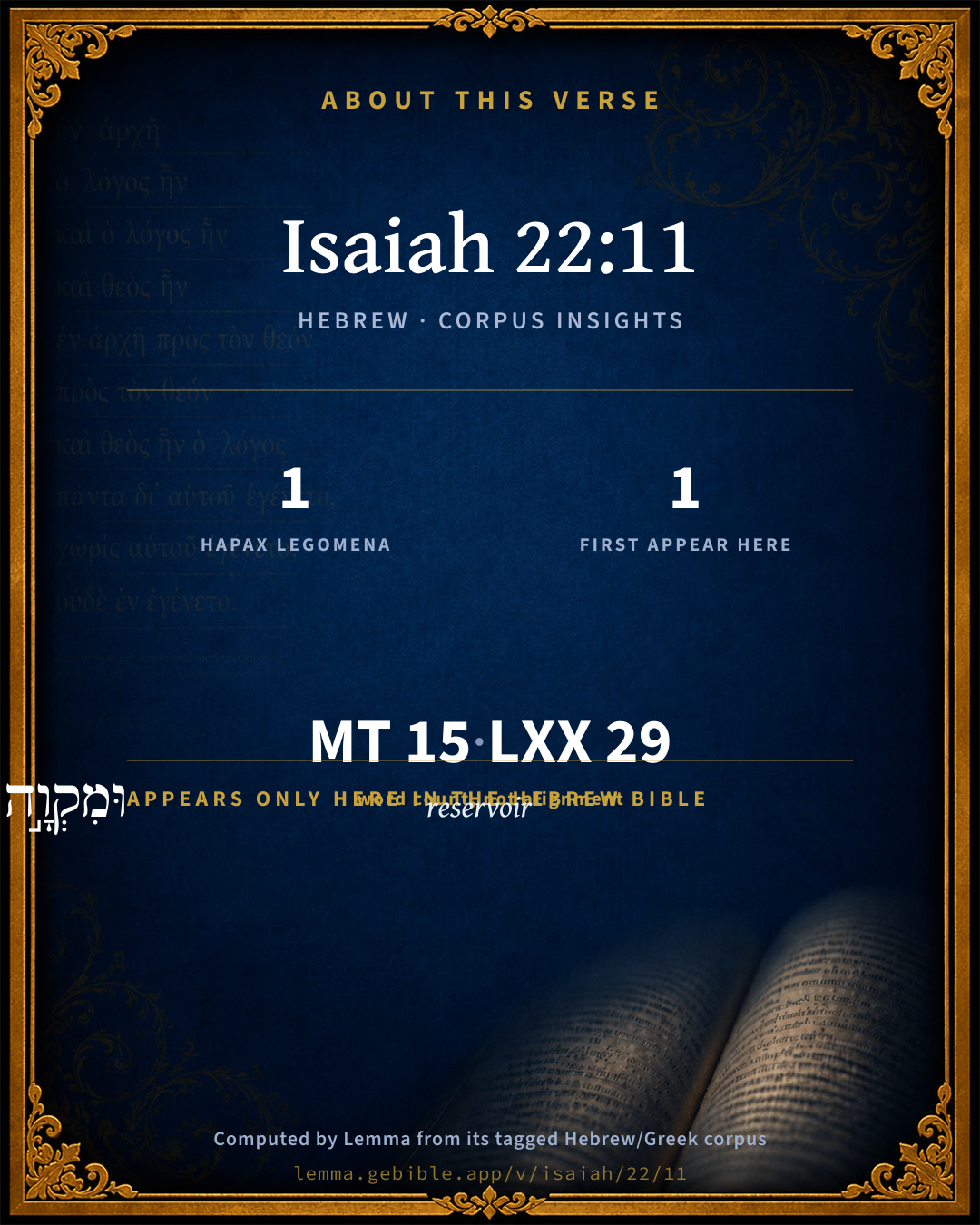
  • 1 hapax legomenon — only here in the Hebrew Bible
  • 1 first appearance in the Hebrew Bible
Full analysis ↓
Download a study sheet

One document with this verse’s original text, its word-by-word gloss line, the meaning frame, cross-references with their text, attributed commentary, and full source and license credits — printable, and it pastes into notes with its structure intact.

This verse Autodidact and up

Study sheet (.html) Plain text (.txt)

A passage Seminary Student

Up to 50 verses in one chapter. A passage sheet keeps up to 6 commentary sources and 12 cross-references per verse, in the order this page ranks them, and says so on the sheet whenever that leaves anything out. Ask for a single verse and you get the Autodidact verse sheet above.

Everything on this page stays free to read, with no account — the sheet is a download of what is already on screen, not access to it.

Want to remove ads? Support Godless Engineer
Compare translations 3

The same verse in 3 English versions, stacked beneath the original-language interlinear above. Click any original word for its lexicon entry.

Each is an independent rendering of the whole verse — the interlinear is not word-aligned to these translations.

Highlighted words mark where these versions differ — a whole-verse word diff, not a word-by-word alignment.

  • World English Bible Public Domain
    you made also a reservoir between the two walls for the water of the old pool. But you didn't look to him who had done this, neither did you have respect for him who purposed it long ago.
  • King James Version Public Domain
    Ye made also a ditch between the two walls for the water of the old pool: but ye have not looked unto the maker thereof, neither had respect unto him that fashioned it long ago.
  • unfoldingWord Literal Text CC BY-SA 4.0
    And you made a reservoir between the two walls for the waters of the old pool. But you did not look to its maker, and you did not regard the one having formed it long ago.

unfoldingWord Literal Text — © unfoldingWord, licensed CC BY-SA 4.0. Word-aligned USFM3 via Door43 (git.door43.org/unfoldingWord/en_ult).

Versions to compare (up to 4)

3 of 4 selected

Show all 18 translations

Every available English version of this verse, each an independent rendering of the whole verse.

  • World English Bible Public Domain
    you made also a reservoir between the two walls for the water of the old pool. But you didn't look to him who had done this, neither did you have respect for him who purposed it long ago.
  • Berean Standard Bible Public Domain
    You built a reservoir between the walls for the waters of the ancient pool, but you did not look to the One who made it, or consider Him who planned it long ago.
  • Majority Standard Bible Public Domain
    You built a reservoir between the walls for the waters of the ancient pool, but you did not look to the One who made it, or consider Him who planned it long ago.
  • King James Version Public Domain
    Ye made also a ditch between the two walls for the water of the old pool: but ye have not looked unto the maker thereof, neither had respect unto him that fashioned it long ago.
  • American Standard Version (1901) Public Domain
    ye made also a reservoir between the two walls for the water of the old pool. But ye looked not unto him that had done this, neither had ye respect unto him that purposed it long ago.
  • Revised Version (1885) Public Domain
    ye made also a reservoir between the two walls for the water of the old pool: but ye looked not unto him that had done this, neither had ye respect unto him that fashioned it long ago.
  • Geneva Bible (1599) Public Domain
    And haue also made a ditche betweene the two walles, for the waters of the olde poole, and haue not looked vnto the maker thereof, neither had respect vnto him that formed it of olde.
  • Douay-Rheims (1899) Public Domain
    And you made a ditch between the two walls for the water of the old pool: and you have not looked up to the maker thereof, nor regarded him even at a distance, that wrought it long ago.
  • Young's Literal Translation Public Domain
    And a ditch ye made between the two walls, For the waters of the old pool, And ye have not looked unto its Maker, And its Framer of old ye have not seen.
  • Literal Standard Version CC BY-SA 4.0
    And you made a ditch between the two walls, || For the waters of the old pool, || And you have not looked to its Maker, || And you have not seen its Framer of old.
  • Unlocked Literal Bible CC BY-SA 4.0
    You made a reservoir between the two walls for the water of the old pool. But you did not consider the city's maker, who had planned it long ago.
  • unfoldingWord Literal Text CC BY-SA 4.0
    And you made a reservoir between the two walls for the waters of the old pool. But you did not look to its maker, and you did not regard the one having formed it long ago.
  • Darby Bible Public Domain
    and ye have made a reservoir between the two walls for the water of the old pool: but ye have not had regard unto the maker thereof, neither have ye looked unto him that fashioned it long ago.
  • World Messianic Bible Public Domain
    You also made a reservoir between the two walls for the water of the old pool. But you didn’t look to him who had done this, neither did you have respect for him who planned it long ago.
  • Webster's Bible Public Domain
    Ye made also a ditch between the two walls for the water of the old pool: but ye have not looked to its maker, neither had respect to him that fashioned it long ago.
  • Free Bible Version CC BY-SA 4.0
    You built a reservoir inside the walls for the waters from the old pool, but you did not respect its Maker or think about the One who planned it long ago.
  • Bible in Basic English Public Domain
    And you made a place between the two walls for storing the waters of the old pool: but you gave no thought to him who had done this, and were not looking to him by whom it had been purposed long before.
  • JPS Tanakh (1917) Public Domain
    ye made also a basin between the two walls for the water of the old pool — but ye looked not unto Him that had done this, neither had ye respect unto Him that fashioned it long ago.

Literal Standard Version (2020), Covenant Press — licensed CC BY-SA 4.0. Text via the HelloAO Bible API (eBible.org). Unlocked Literal Bible (unfoldingWord) — licensed CC BY-SA 4.0. Text via the HelloAO Bible API (eBible.org). unfoldingWord Literal Text — © unfoldingWord, licensed CC BY-SA 4.0. Word-aligned USFM3 via Door43 (git.door43.org/unfoldingWord/en_ult). Free Bible Version, Dr. Jonathan Gallagher — licensed CC BY-SA 4.0. Text via the HelloAO Bible API (eBible.org).

Word by word

More ways to search: Search by grammar → Find every occurrence → Compare this word →

Practice this passage: Drill this verse → Learn its vocabulary →

וּמִקְוָ֣ה
miqvâh
H4724
“and · reservoir”
Conjunction + Noun, Common, Feminine, Singular, Absolute
Part of Speech
Conjunction + Noun
Type
Common
Gender
Feminine
Number
Singular
State
Absolute
Full BDB Definition

Origin: from H4723

TWOT: 1995a

reservoir - (TWOT) collection, collected mass
  1. עֲשִׂיתֶ֗ם ʻâsâh H6213 “to do” Verb, Qal, Perfect, 2nd Person, Masculine, Plural
  2. בֵּ֚ין bêyn H996 “between” Preposition
  3. הַחֹ֣מֹתַ֔יִם chôwmâh H2346 “the · walls” Particle, Definite Article + Noun, Common, Feminine, Dual, Absolute
  4. לְמֵ֖י mayim H4325 “to/for · water(s) of” Preposition + Noun, Common, Masculine, Plural, Construct
  5. הַבְּרֵכָ֣ה bᵉrêkâh H1295 “the · pool” Particle, Definite Article + Noun, Common, Feminine, Singular, Absolute
  6. הַיְשָׁנָ֑ה yâshân H3465 “the · old” Particle, Definite Article + Adjective, Adjective, Feminine, Singular, Absolute
  7. וְלֹ֤א lôʼ H3808 “and · not” Conjunction + Particle, Negative
  8. הִבַּטְתֶּם֙ nâbaṭ H5027 “to look” Verb, Hiphil, Perfect, 2nd Person, Masculine, Plural
  9. אֶל ʼêl H413 “to” Preposition
  10. עֹשֶׂ֔יהָ ʻâsâh H6213 “doing · her” Verb, Qal, Participle Active, Masculine, Singular, Construct + Suffix, Personal, 3rd Person, Feminine, Singular
  11. וְיֹצְרָ֥הּ yâtsar H3335 “and · forming · her” Conjunction + Verb, Qal, Participle Active, Masculine, Singular, Construct + Suffix, Personal, 3rd Person, Feminine, Singular
  12. מֵֽרָח֖וֹק râchôwq H7350 “from · far” Preposition + Adjective, Adjective, Masculine, Singular, Absolute
  13. לֹ֥א lôʼ H3808 “not” Particle, Negative
  14. רְאִיתֶֽם râʼâh H7200 “to see” Verb, Qal, Perfect, 2nd Person, Masculine, Plural

About this verse

These counts appear in no published source. They are computed here, from the morphology-tagged text and Lemma’s own curated glosses. What Lemma adds →

15
words
13
distinct lemmas
Prophets
section

Notable vocabulary

1 hapax legomenon — a word that appears only here in the entire Hebrew Bible:

  • וּמִקְוָ֣ה reservoir H4724

First appearance in Scripture

This word makes its first canonical appearance in the Hebrew Bible here:

  • וּמִקְוָ֣ה reservoir H4724

Shared distinctive vocabulary

הַיְשָׁנָ֑ה old H3465 occurs in 5 verses of the Hebrew Bible. Also found in:

Grammatical profile

  • 5 verbs
  • 4 nouns
  • 2 adjectives
  • 2 prepositions
  • 2 particles

Verb forms

  • עֲשִׂיתֶ֗ם Qal · Perfect
  • הִבַּטְתֶּם֙ Hiphil · Perfect
  • עֹשֶׂ֔יהָ Qal · Participle Active
  • וְיֹצְרָ֥הּ Qal · Participle Active
  • רְאִיתֶֽם Qal · Perfect

Repetition

Words recur within this verse — often emphatic in Hebrew:

  • עֲשִׂיתֶ֗ם to do H6213 ×2
  • וְלֹ֤א not H3808 ×2

Hebrew & Septuagint length

In English translation the verse runs 38 words from the Hebrew and 33 from the Septuagint (LXX English) — closely comparable.

A rough comparison of the two English renderings, which tokenize alike — not a word-level alignment.

Word counts can differ between the Hebrew and the Greek without any difference in meaning — e.g. the Hebrew direct-object marker אֵת has no separate Greek word, and Greek often adds the article ὁ.

In the original languages it is 15 Hebrew tokens and 29 Greek tokens — but the two are counted differently (Hebrew bundles its prefixes and suffixes into one token; the Greek is in lemma form), so that isn’t a like-for-like length.

Cross-references

13

Topical passages linked to Isaiah 22:11 in the Treasury of Scripture Knowledge — connected by theme and wording, ordered by reader-vote popularity; previews shown in the World English Bible.

  • Jeremiah 33:2–3 Thus says Yahweh who does it, Yahweh who forms it to establish it; Yahweh is his name:
  • Micah 7:7 But as for me, I will look to Yahweh. I will wait for the God of my salvation. My God will hear me.
  • 2 Kings 25:4 Then a breach was made in the city, and all the men of war [fled] by night by the way of the gate between the two walls, which was by the king's garden (now the Chaldeans were against the city round about); and [the king] went by the way of the Arabah.
  • Isaiah 17:7 In that day shall men look to their Maker, and their eyes shall have respect to the Holy One of Israel.
  • Isaiah 31:1 Woe to those who go down to Egypt for help, and rely on horses, and trust in chariots because they are many, and in horsemen because they are very strong, but they don't look to the Holy One of Israel, neither seek Yahweh!
  • 2 Kings 20:20 Now the rest of the acts of Hezekiah, and all his might, and how he made the pool, and the conduit, and brought water into the city, aren't they written in the book of the chronicles of the kings of Judah?
  • 2 Chronicles 6:6 but I have chosen Jerusalem, that my name might be there; and have chosen David to be over my people Israel.
  • 2 Chronicles 16:7–9 At that time Hanani the seer came to Asa king of Judah, and said to him, Because you have relied on the king of Syria, and have not relied on Yahweh your God, therefore is the host of the king of Syria escaped out of your hand.
  • 2 Chronicles 32:3–4 he took counsel with his princes and his mighty men to stop the waters of the springs which were outside of the city; and they helped him.
  • Nehemiah 3:16 After him repaired Nehemiah the son of Azbuk, the ruler of half the district of Beth Zur, to the place over against the tombs of David, and to the pool that was made, and to the house of the mighty men.
  • Isaiah 8:17 I will wait for Yahweh, who hides his face from the house of Jacob, and I will look for him.
  • Isaiah 37:26 Have you not heard how I have done it long ago, and formed it of ancient times? now have I brought it to pass, that it should be your to lay waste fortified cities into ruinous heaps.
  • Jeremiah 39:4 It happened that, when Zedekiah the king of Judah and all the men of war saw them, then they fled, and went forth out of the city by night, by the way of the king's garden, through the gate between the two walls; and he went out toward the Arabah.

Cross-references courtesy of OpenBible.info (CC BY 4.0).

Hebrew and Greek witnesses Masoretic Hebrew ↔ Greek Septuagint

The same verse in the two great witnesses to the Old Testament, shown verse-for-verse.

These are two independent witnesses, not word-aligned to each other, and the Septuagint is shown in lemma (dictionary) form.

Hebrew Isaiah 22:11 Masoretic · Westminster Leningrad Codex

וּמִקְוָ֣ה עֲשִׂיתֶ֗ם בֵּ֚ין הַחֹ֣מֹתַ֔יִם לְמֵ֖י הַבְּרֵכָ֣ה הַיְשָׁנָ֑ה וְלֹ֤א הִבַּטְתֶּם֙ אֶל עֹשֶׂ֔יהָ וְיֹצְרָ֥הּ מֵֽרָח֖וֹק לֹ֥א רְאִיתֶֽם

you made also a reservoir between the two walls for the water of the old pool. But you didn't look to him who had done this, neither did you have respect for him who purposed it long ago.

World English Bible · Public Domain

Greek LXX Isaiah 22:11 Septuagint · lemma form

καί ποιέω ἑαυτοῦ ὕδωρ ἀνά μέσος ὁ δύο τεῖχος ἐσώτερον ὁ κολυμβήθρα ὁ ἀρχαῖος καί οὐ ἐνβλέπω εἰς ὁ ἀπό ἀρχή ποιέω αὐτός καί ὁ κτίζω αὐτός οὐ ὁράω

And you⌃ procured to yourselves water between the two walls within the ancient pool: but you⌃ looked not to him that made it from the beginning, and regarded not him that created it.

LXX2012 (modern English Septuagint) · Public Domain

Hebrew: Westminster Leningrad Codex (CC BY 4.0). Greek: Septuagint (public domain); English from LXX2012 (modern English Septuagint) (Public Domain). How the Septuagint differs from the Hebrew →

Targum (Aramaic paraphrase)

1

The Targum is the ancient Jewish Aramaic paraphrase of the Hebrew Scriptures — an interpretive translation, not the Hebrew text itself. Onkelos (literal) and Pseudo-Jonathan (expansive) render the Torah, and Jonathan the Prophets. Coverage is partial: where no permissively-licensed English translation exists for a verse, only the Aramaic is shown. This is verse-level text, not a word-by-word alignment to the Hebrew.

  1. Targum Jonathan Prophets (Joshua–Malachi)
    וּמִקְוַיָא עֲבַדְתּוּן בֵּין שׁוּרַיָא לְמֵי בְּרֵכְתָּא עַתִּיקְתָּא וְלָא אִסְתַּכַּלְתּוּן בִּדְעָבְדָהּ וְדֵי בְרָאָהּ מִלְקָדְמִין לָא חֲזֵיתוּן:

    And ye shall make a lake between the walls of the water of the old pool: but ye have not looked unto the maker thereof, neither had respect unto him that created it of old.

    Targum Jonathan — Aramaic: “Mikraot Gedolot” (public domain). English: “Sefaria Community Translation” (CC0 1.0 (public-domain dedication)); “London "Chaldee Paraphrase," 1871” (public domain). Text via Sefaria.

Commentary

Notes on Isaiah 22:11 from classic Christian and Jewish commentators (each source and its license shown beneath its notes). The classic Christian expositions comment on the surrounding passage and are grouped to its opening verse, so a note may address several verses; the Jewish commentaries on the Tanakh (Rashi and others) are per-verse, so they appear only where the commentator wrote on this verse.

Lemma curates 59 commentaries, every one of them public domain or Creative Commons licensed, each selected and text-cleaned for this edition rather than reprinted as found. About our sources →

Trapp's Complete Commentary

John Trapp

Isa 22:11 Ye made also a ditch between the two walls for the water of the old pool: but ye have not looked unto the maker thereof, neither had respect unto him that fashioned it long ago.

Ver. 11. Ye made a ditch also.] A new ditch, lest the old one should not suffice, to hold water for the besieged. All this was well and wisely done, had not the main matter been left undone. See 2Ch 32:3; 2Ch 32:5 2Ki 18:14; 2Ki 18:16. The community of the Jews were carnal, and trusted in the arm of flesh. Hezekiah also himself faltered, &c.

But ye have not looked unto the maker thereof,] i.e., To the author of that trouble, treading down, and perplexity {a} {Isa 22:5} or, to the founder of Jerusalem, which, say the Rabbis, was one of those seven things which God had in his thoughts before he made the world.

{a} Oecolamp.

John Trapp, A Commentary or Exposition upon All the Books of the Old and New Testament (1647–1656) — public domain. Text from a community e-Sword module.

The Biblical Illustrator

Joseph S. Exell

Isa_22:11

Ye have not looked unto the Maker thereof

A godless prudence

They take measures to supply the city with water during its siege, and to cut it off, if possible, from the besiegers.

Why, as it is written in the history which gives us the fulfilment of this prophecy, should the kings of Assyria come and find much water? Where this fails everything fails, for water, next to the air we breathe, is the first necessity of human life. There are, it seems, certain streams or pools of water fed with springs outside the city, and these they manage to divert, so that they flow now away from the besiegers and in favour of the besieged. The city has two watts, and between these two--the inner and the outer--a ditch or trench is dug, and the water of the old pool made to flow into it, forming at once as a moat some kind of protection for the inner wall, should the outer be broken down, and also a supply for the use of the inhabitants. All this was right and reasonable, and no blame could be laid upon the authorities for taking these precautions. But there is blame in this, that notwithstanding they are the Lords chosen people, and have ever been taught that they owe all they have to Him, yet they do not recognise Him as the bountiful Lord and gracious Giver. (J. W. Lance.)

Mans use of Gods gifts

We have here a kind of type and pattern of the infirmity so common to human nature, namely, forgetfulness of God in the use and appropriation of those things which He has provided for us.

I. Look, e.g., at the Divine provisions in THE GREAT STOREHOUSES OF NATURE. See how by invention and discovery we turn these to account, perceiving in some instances forces which, though old, are new to us, and in others ingeniously applying old and well-known forces to new purposes in the advancement of civilisation and for the comfort and convenience of life. It is written concerning man in the Book of Psalms, Thou madest him to have dominion over the works of Thy hands.

II. Let us take up the more familiar theme of DAILY PROVIDENCE. We can see God in clouds, we can hear Him in the wind; He is sometimes near to us in the earthquake and the fire, as well as in the still small voice; but we often fail to see Him in those common mercies which are yet new every morning and fresh every evening. Consider that loaf of bread on your table. It should be to you a revelation; and that it may be so, find out its genesis. It was flour yesterday or the day before, and it came, perhaps, from France, or Spain, or America, where it was grown as wheat--came to you across the ocean, Gods own highway in the wilderness of waters. Long ago He fashioned those grains of wheat, and put into them such force of life that a handful or less, found in an Egyptian mummy three thousand years old, when planted in English soil, have grown and brought forth thirty, sixty, or a hundred fold. Givens this day our daily bread, simplest of all prayers as it seems, is really asking that natures forces may continue to be filled and sustained by Him who made them; and that the industries of life may go on working harmoniously with the gracious providence of God, for without these links human and Divine in the great golden chain, our daily bread would cease.

III. IN RELIGION, too, we may see how the Divine gifts have been used, and, alas! too often abused, in blind forgetfulness of the Divine Giver. Man is a creature who can no more do without religion than he can do without money, without clothing, without houses, or without food. But though naturally religious, it does not follow that he is godly. We may make to ourselves a religion without God. One of the charges brought by the apostle Paul against those who had formed the most elaborate and complex religious systems was, that they did not like to retain God in their knowledge. The religious faculty, God-given, in some sort they exercised, but they lost sight of Him the Giver. They lost His unity among their myriad gods and goddesses, and so Israels mission was to declare, Hear, O Israel, the Lord our God is one Lord. They lost sight, too, of His justice; for though they said, The gods are just, yet when we read the story of their lives, their vices, and their crimes, every idea of justice is shocked and revolted; and as to these gods, they that make them are like unto them. It may be, too, that in our own theologies we have not been in this respect free from fault. Even in Christian theology the Theos, the personal God, may have been too much lost sight of. It may ye, as is sometimes charged upon us, that we think of God as a bundle of attributes, rather than as a living Father revealed to us in the Christ.

IV. IN CHRISTIAN ORDINANCES let us always see the Giver. Unless we do so, use in them there is none. (J. W. Lance.)

The Biblical Illustrator, edited by Joseph S. Exell (c. 1880s–1900s) — public domain. Text from a community e-Sword module.

Geneva Bible (1599)

Geneva Bible translators

To provide if need should be of water.

To God that made Jerusalem: that is, they trusted more in these worldly means, than in God.

Geneva Bible (1599) marginal notes — public domain. Text via Bolls.life.

Jamieson, Fausset & Brown

Robert Jamieson, A. R. Fausset & David Brown

Ye made . . . a ditch--rather, "Ye shall make a reservoir" for receiving the water. Hezekiah surrounded Siloah, from which the old (or king's, or upper) pool took its rise, with a wall joined to the wall of Zion on both sides; between these two walls he made a new pool, into which he directed the waters of the former, thus cutting off the foe from his supply of water also. The opening from which the upper pool received its water was nearer Zion than the other from which the lower pool took its rise, so that the water which flowed from the former could easily be shut in by a wall, whereas that which flowed from the latter could only be brought in by subterranean conduits (compare see on Isa 22:9; Isa 7:3; Kg2 20:20; Ch2 32:3-5, Ch2 32:30; Ecclesiasticus 48:17). Both were southwest of Jerusalem.

have not looked . . . neither had respect--answering by contrast to "Thou didst look to the armor, ye have seen ('had respect', or 'regard to') the breaches" (Isa 22:8-9).

maker thereof--God, by whose command and aid these defenses were made, and who gave this fountain "long ago." G. V. SMITH translates, "Him who doeth it," that is, has brought this danger on you--"Him who hath prepared it from afar," that is, planned it even from a distant time.

Jamieson, Fausset & Brown — Commentary Critical and Explanatory on the Whole Bible (1871) — public domain (CC PDM 1.0). Text via the HelloAO Bible API.

Adam Clarke's Commentary

Verse 11. Unto the maker thereof - "To him that hath disposed this"] That is, to God the Author and Disposer of this visitation, the invasion with which he now threatens you. The very same expressions are applied to God, and upon the same occasion, Isa 37:26: -

"Hast thou not heard of old, that I have disposed it;

And of ancient times, that I have formed it?"

Adam Clarke's Commentary on the Bible (1810–1826) — public domain. Text from a community e-Sword/MySword module.

Ellicott's Commentary for English Readers

(11) Ye made also a ditch between the two walls.—Better, a pond or pool, to form a reservoir for the supply of the city. This was probably identical with the “pool of Hezekiah,” known also as the Birket-el-Batrak (“pool of the patriarchs”), between two walls, that to the north of Zaon, and that which runs to the north-east round the Acra. During the rainy season this is supplied by the small conduit which runs from the upper pool along the surface of the ground, and then under the wall near the Joppa gate (Robinson, Researches, i., 437-439). The “old pool” was probably the pool of Siloam (Joh_9:7), or the king’s pool (Neh_2:14).

Ye have not looked unto the maker thereof.—These material defences, the prophet affirms, will avail but little if they forget Him who was the true “builder and maker” of the city, and who alone can secure its safety.

A Bible Commentary for English Readers, edited by Charles John Ellicott (1878–1897) — public domain. Text from a community e-Sword module.

The Cambridge Bible for Schools and Colleges

gen. ed. J. J. S. Perowne

11. For ditch read reservoir as R.V. The “old pool” is very probably the pool of Siloam (though this is not certain) and the “reservoir” would be intended to retain its surplus water.

between the two walls] a part of the city adjoining the royal gardens, where there was a gate (see 2Ki_25:4; Jer_39:4; Jer_52:7). The locality is doubtless the entrance of the Tyropœon Valley, where the wall of the Western Hill and that of Zion (and Ophel) met at a sharp angle. The space so designated was of course outside the city; whether it was protected by a third wall crossing the valley we do not know.

but ye have not looked …] but ye looked not. This clause carries us back to Isa_22:8-9, where the same two verbs (“looked,” “saw”) are employed.

the Maker thereof] Better him that did it.

fashioned it long ago] lit. formed it from afar. The sin of the rulers of Jerusalem is that same indifference to the work of Jehovah with which the prophet had charged them many years before (see Isa_22:12). To Isaiah, history is the evolution of a consistent, pre-determined plan of Jehovah, to the men of his day it was merely a confused struggle between opposing forces. Their failure to discern the hand of God in the events that had befallen them was the crowning proof of their spiritual insensibility; their ill-timed frivolity on this occasion seemed to the prophet to seal their fate.

The Cambridge Bible for Schools and Colleges (gen. ed. J. J. S. Perowne; Cambridge University Press, 1878–1918) — public domain. Text from a community e-Sword module.

John Gill's Exposition

Ye made also a ditch between the two walls,.... The outward and the inward; for Hezekiah not only repaired the broken wall, but he built another without, Ch2 32:5 and between these two he made a ditch, or receptacle for water; for rain water, as Kimchi says; that the inhabitants might not want water during the siege; but the end for which it was made follows:

for the water of the old pool; which, being without the city, was by this means drained into this ditch or receptacle; and so the Assyrians were deprived of it, and the inhabitants of Jerusalem more abundantly supplied; this was wisely contrived to distress the enemy, and to enable themselves to hold out the siege the longer; and for this and other methods they took they are not blamed, but for what follows:

but ye have not looked unto the Maker thereof; either of the distress and calamity which came upon them for their sins, with the will and by the decree of God; or of the water of the pool, which is a creature of his; for who can give rain or water but himself? or rather of the city of Jerusalem, to build which he stirred up persons, and assisted them in it, and which he chose for the seat of his habitation and worship:

neither had respect unto him that fashioned it long ago; not in his own mind from eternity, which is the gloss of the Jewish Rabbins (p); Jerusalem being one of the seven things, which, before the world was, came into the mind of God to create; but in time, many years ago, in the times of David, who built some part of it; and before, it being the ancient city of Salem. Now this was their fault, that they trusted in their warlike preparations, and prudential care and caution, for the defence of themselves, and looked not unto, nor trusted in, the Lord their God; for though Hezekiah did, yet many of his people did not; and very probably his principal courtiers and officers about him, concerned in the above methods, and particularly Shebna, hereafter mentioned.

(p) Vid. Kimchi in loc.

John Gill's Exposition of the Whole Bible (1746–1763) — public domain (CC PDM 1.0). Text via the HelloAO Bible API.

Albert Barnes' Notes on the Bible

Ye made also a ditch - That is, they made a “reservoir” to retain the water. The word ‘ditch,’ however, will well describe the character of the pool of Gihon on the west side of the city (see the notes at Isa 7:3).

Between the two walls for the water of the old pool - Hezekiah built one of these walls himself (2Ch 32:5, 2Ch 32:30; compare 2Ki 25:5, and Jer 39:4). Between these two walls the water would be collected so as to be accessible to the inhabitants of the city in case of a siege. Before this, the water had flowed without the walls of the city, and in a time of siege the inhabitants would be cut off from it, and an enemy would be able easily to subdue them. To prevent this, Hezekiah appears to have performed two works, one of which was particularly adapted to the times of the siege, and the other was of permanent utility.

(1) He made a wall on the west side of Gihon, so as to make the pool accessible to the inhabitants of the city, as described here by Isaiah; and

(2) he ‘stopped the upper water-course of Gihon, and brought it straight down to the west side of the city of David’ 2Ch 32:30.

By this is not improbably meant that he constructed the pool which is now known as the ‘pool of Hezekiah.’ This reservoir lies within the walls of the city, some distance northeastward of the Yafa Gate, and just west of the street that leads to the church of the Holy Sepulchre. Its sides run toward the cardinal points. Its breadth at the north end is 144 feet, its length on the east side about 240 feet. The depth is not great. The bottom is rock, and is leveled and covered with cement. The reservoir is now supplied with water during the rainy season by the small aqueduct or drain brought down from the upper pool, along the surface of the ground and under the wall at or near the Yafa Gate (compare Robinson’s “Bib. Researches,” vol. i. p. 487). This was deemed a work of great utility, and was one of the acts which particularly distinguished the reign of Hezckiah. It is not only mentioned in the Books of Kings and Chronicles, but the son of Sirach has also mentioned it in his encomium on Hezekiah: ‘Hezekiah fortified his city, and brought in water into the midst thereof; he digged the hard rock with iron, and made wells for water’ (Ecclus. 48:17).

But ye have not looked - You have not relied on God. You have depended on your own resources; and on the defenses which you have been making against the enemy. This probably described the “general” character of the people. Hezekiah, however, was a pious man, and doubtless really depended on the aid of God.

The maker thereof - God; by whose command and aid all these defenses are made, and who has given you ability and skill to make them.

Long ago - God had made this fountain, and it had “long” been a supply to the city. He had a claim, therefore, to their gratitude and respect.

Albert Barnes' Notes on the Bible (1834–1885) — public domain. Text from a community e-Sword/MySword module.

Haydock's Catholic Bible Commentary

Walls. Manasses enclosed the pool within walls, forming a second town, 4 Kings xxii. 29. --- Ago. You have not imitated the piety of Ezechias.

George Leo Haydock (1774–1849), Haydock's Catholic Family Bible and Commentary, 1859 edition — public domain. Excludes Psalms (Douay-Rheims chapter numbering differs from Protestant) and Deuterocanonical books (Catholic canon only).

Matthew Poole's English Annotations

The two walls; either those 2Ki 25:4, or those 2Ch 32:5, in both which places we read of two walls.

For the water of the old pool; to receive the waters conveyed into it by pipes from the old pool.

The maker thereof; either,

1. Of the water; for both the springs and the rain which filleth the pools are from God alone: or,

2. Of Jerusalem, expressed in the foregoing verse, and easily understood here, because all these works were undertaken for Jerusalem’s defence and provision. And it is usual in Scripture for the pronoun relative to be put by itself, without any express mention of the person or thing to which it belongs, which is left to the reader to gather out of the foregoing or following words; of which See Poole "Psa 87:1", See Poole "Son 1:1".

Him that fashioned it, Heb. the former or framer of it, God; who made it a city, and the place of his special presence and worship; which also he had undertaken to protect, if the people would observe his commands; to whom therefore they should have resorted and trusted in this time of their distress.

Long ago; which clause may be added to aggravate their sin, in distrusting that God who had now for a long time given proof of his care and kindness in defending this city.

Matthew Poole's English Annotations on the Holy Bible (1683–1685) — public domain. Text from a community e-Sword/MySword module.

The Pulpit Commentary

Ye made also a ditch; rather, a lake, or reservoir (see the comment on ver. 9). But ye have not looked unto the maker thereof; i.e. you have not looked to God, who in his eternal counsels foreknew and decreed all the steps that you are taking for your defense. (see below, Isa_37:26)

The Pulpit Commentary (1880–1919), ed. H.D.M. Spence-Jones & Joseph S. Exell — public domain. Text from a community e-Sword module.

John Wesley's Explanatory Notes

Thereof - Of Jerusalem, expressed in the foregoing verse. Him - God, who made it a city, and the place of his special presence and worship. Long ago - Which may be added to aggravate their sin, in distrusting that God, who had now for a long time given proof of his care and kindness in defending this city.

John Wesley, Explanatory Notes Upon the Whole Bible (1754–1765) — public domain. Text via the GEBible commentary corpus.

J. A. Alexander on Isaiah

Joseph Addison Alexander

“And a reservoir ye made between the two walls (or the double wall) for the waters of the old pool, and ye did not look to the maker of it, and the former of it ye did not see.” The reference is probably to a wall built out from that of the city and returning to it, so as to enclose the tank or reservoir here mentioned. As this was a temporary measure, perhaps often repeated, there is no need of tracing it in other parts of history or in the present condition of Jerusalem. It is altogether probable, however, that the old pool here mentioned is the same with the upper pool of Isa 7:3. Some have identified it with the lower pool of the ninth verse, but this would hardly have been introduced so soon by another name. The last clause shows that the fault, with which the people of Jerusalem were chargeable, was not that of guarding themselves against attack, but that of relying upon human defenses, without regard to God. The verbs look and see are evidently used in allusion to the last clause of v. 8 and the first of v. 9. They looked to the arsenal but not to God. This seems to put the clause before us in antithesis to the whole foregoing context from v. 8. Maker and former are not distinctive terms referring to God’s purpose or decree on one hand, and the execution of it on the other, but poetical equivalents both denoting the efficient cause.

Joseph Addison Alexander, The Prophecies of Isaiah (1846–1847; New York: Scribner, 1870–1878) — public domain. Text from a community e-Sword module.

Rashi

Rabbi Shlomo Yitzchaki (Rashi)

And a ditch you made A pool of water, to be a defense (lit., strength) for the city.

between the two walls the double walls, the low wall and the high wall, and the water of the old pool.

but you did not look to its Maker Now, if you ask, Hezekiah, too, did so, as it is stated (in II Chron. 32:5) “And he strengthened himself, and he built up all the broken down wall, and he went up on the towers and outside the other wall, and he strengthened the Millo of the city of David,” the answer is that Hezekiah “trusted in the Lord God of Israel, etc.” (II Kings 18:5), but you, in the days of Jehoiakim and Zedekiah did not look to its Maker.

and Him Who fashioned it from afar From the time He created the world, Jerusalem and the Temple were His intention.

you did not see You did not think of Him.

Rashi on the Tanakh — English translations: “The Judaica Press complete Tanach with Rashi, translated by A. J. Rosenberg” (CC BY 4.0); “Pentateuch with Rashi's commentary by M. Rosenbaum and A.M. Silbermann, 1929-1934” (public domain); “The Metsudah Tanach series, Lakewood, N.J” (CC BY 4.0); and “The Book of Joshua, Metsudah Publications, 1997” (CC BY 4.0). Text via Sefaria.

Ibn Ezra

Rabbi Abraham ibn Ezra

ומקוה And a ditch. מקוה מים ═ מקוה A gathering of water (Lev. 2:36).

Unto the maker thereof. Unto God, who has decreed to bring Nebuchadnezzar against Jerusalem.

Unto him that fashioned it. That fashioned the decree.

מרחוק Long ago. Join מרחוק either with ויוצרה, he that fashioned it long ago, or with לא ראיתם, you have not seen for a long time.

Ibn Ezra on the Tanakh — English translations: “Sefaria Community Translation” (CC0 1.0 (public-domain dedication)); “Yalkut, Sifsei Chachomim Chumash, Metsudah Publications, 2009” (CC BY 4.0); and “Commentary of Ibn Ezra on Isaiah - trans. by M. Friedlander, 1873” (public domain). Text via Sefaria.

Lesson kit

Teaching starters — assembled from the data on this page, not authored interpretation. Every prompt links to the verse data it draws on. Edit before teaching.

Isaiah, in the Prophets, opens this verse with 15 words (13 distinct Hebrew lemmas). Its most distinctive word is miqvâh (“reservoir”). A historical commentator’s framing appears above. Read the whole chapter for the surrounding context.

Discussion questions

  1. The word miqvâh carries the sense “reservoir.” How does it shape the verse?
  2. 1 word here appears nowhere else in the Hebrew Bible. Why might the author reach for such rare wording?
  3. This is the first place “reservoir” appears in Scripture (first appears here). What does its debut here establish?
  4. How does Leviticus 25:22, which shares the word «old», read alongside this verse?
  5. What does the repetition of “to do” (2× in this one verse) do in this verse?
  6. These translations render this verse differently; the difference is in the English rendering, not the original. What questions does that raise?
  7. «עֲשִׂיתֶ֗ם» is a Qal Perfect verb. How does that grammatical form shape the action described?
  8. Compare how Trapp's Complete Commentary and The Biblical Illustrator read this verse. Where do they agree or differ?

Things to notice

  • 1 word in this verse appears nowhere else in the Hebrew Bible.
  • 1 word makes its first canonical appearance in Scripture here.
  • This verse counts 15 Hebrew ↔ 29 Greek words.
  • These translations choose different wording for 25 words in this verse.
  • “to do” occurs 2× in this single verse.

Reading settings

Reading text

Shown beneath each verse's original-language words.

Old Testament
Old Testament edition

Read the OT as the Masoretic Hebrew (MT) or the Greek Septuagint (LXX).

English shown for the Greek Septuagint (in the Hebrew ↔ Greek comparison).

Comparing translations? Open the Compare panel on any verse page to stack up to four side by side.