
Ezekiel 10:2

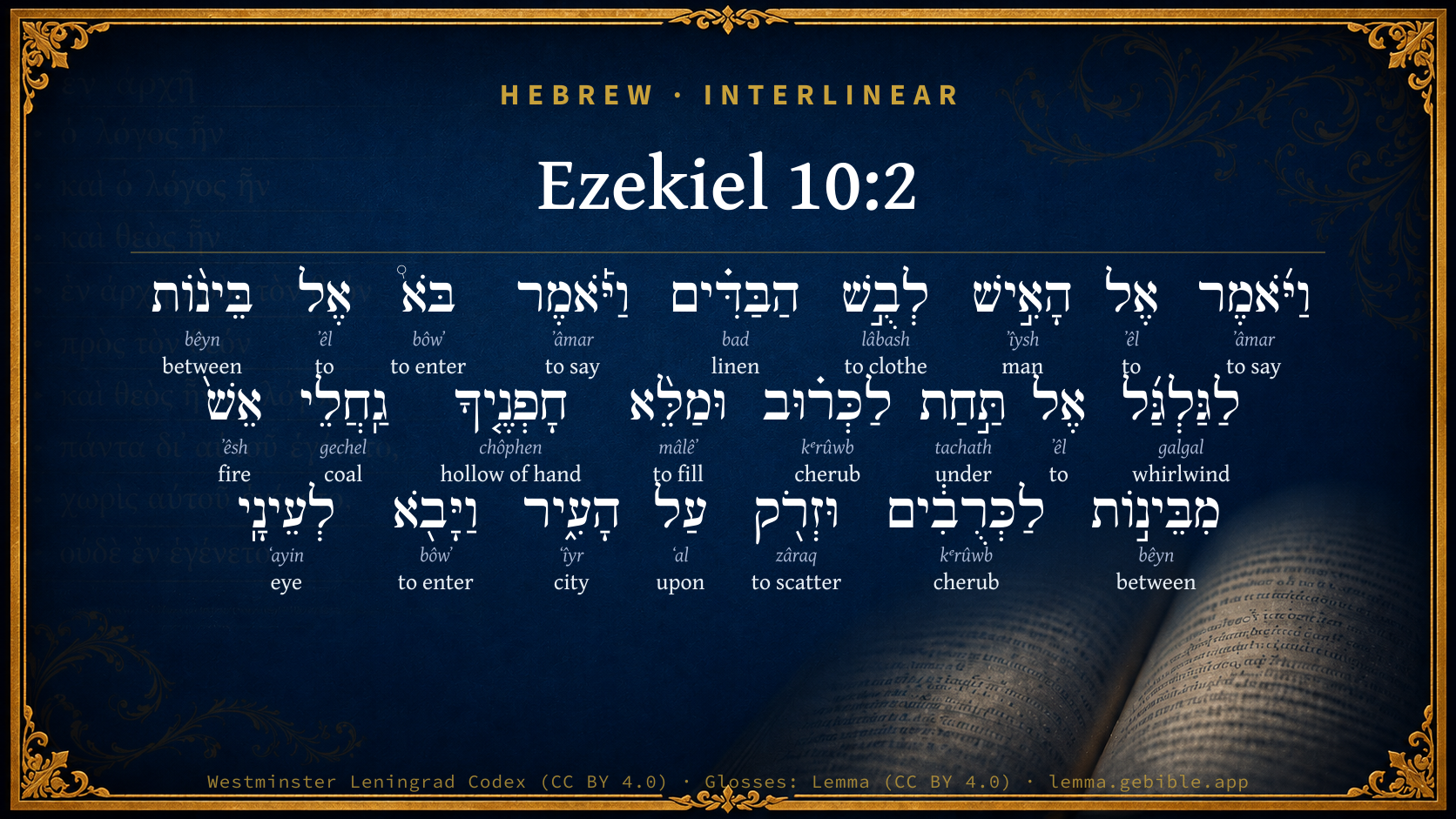
Hebrew (Westminster Leningrad Codex) Ezekiel 10:2 appears in the Hebrew Old Testament. The text above is from the Westminster Leningrad Codex. Each word links to its Strong’s number, a concise gloss, and parsing drawn from the Open Scriptures Hebrew Bible morphology. Click any word for its full Brown-Driver-Briggs (BDB) entry.
Download image
Cite this verse

Ezekiel 10:2 (World English Bible). Public Domain. Lemma interlinear Bible study tool, https://lemma.gebible.app/v/ezekiel/10/2.

Show BibTeX & RIS
BibTeX
RIS
English Translation
He spoke to the man clothed in linen, and said, Go in between the whirling [wheels], even under the cherub, and fill both your hands with coals of fire from between the cherubim, and scatter them over the city. He went in as I watched.
World English Bible · Public Domain
Download a study sheet

One document with this verse’s original text, its word-by-word gloss line, the meaning frame, cross-references with their text, attributed commentary, and full source and license credits — printable, and it pastes into notes with its structure intact.

This verse Autodidact and up

Study sheet (.html) Plain text (.txt)

A passage Seminary Student

Up to 50 verses in one chapter. A passage sheet keeps up to 6 commentary sources and 12 cross-references per verse, in the order this page ranks them, and says so on the sheet whenever that leaves anything out. Ask for a single verse and you get the Autodidact verse sheet above.

Everything on this page stays free to read, with no account — the sheet is a download of what is already on screen, not access to it.

Want to remove ads? Support Godless Engineer
Compare translations 3

The same verse in 3 English versions, stacked beneath the original-language interlinear above. Click any original word for its lexicon entry.

Each is an independent rendering of the whole verse — the interlinear is not word-aligned to these translations.

Highlighted words mark where these versions differ — a whole-verse word diff, not a word-by-word alignment.

  • World English Bible Public Domain
    He spoke to the man clothed in linen, and said, Go in between the whirling [wheels], even under the cherub, and fill both your hands with coals of fire from between the cherubim, and scatter them over the city. He went in as I watched.
  • King James Version Public Domain
    And he spake unto the man clothed with linen, and said, Go in between the wheels, even under the cherub, and fill thine hand with coals of fire from between the cherubims, and scatter them over the city. And he went in in my sight.
  • unfoldingWord Literal Text CC BY-SA 4.0
    Then Yahweh spoke to the man dressed in linen and said, “Go between the wheels underneath the cherubim, and fill both your hands with fiery coals from between the cherubim and scatter them over the city.” Then the man went in as I watched.

unfoldingWord Literal Text — © unfoldingWord, licensed CC BY-SA 4.0. Word-aligned USFM3 via Door43 (git.door43.org/unfoldingWord/en_ult).

Versions to compare (up to 4)

3 of 4 selected

Show all 18 translations

Every available English version of this verse, each an independent rendering of the whole verse.

  • World English Bible Public Domain
    He spoke to the man clothed in linen, and said, Go in between the whirling [wheels], even under the cherub, and fill both your hands with coals of fire from between the cherubim, and scatter them over the city. He went in as I watched.
  • Berean Standard Bible Public Domain
    And the LORD said to the man clothed in linen, “Go inside the wheelwork beneath the cherubim. Fill your hands with burning coals from among the cherubim and scatter them over the city.” And as I watched, he went in.
  • Majority Standard Bible Public Domain
    And the LORD said to the man clothed in linen, “Go inside the wheelwork beneath the cherubim. Fill your hands with burning coals from among the cherubim and scatter them over the city.” And as I watched, he went in.
  • King James Version Public Domain
    And he spake unto the man clothed with linen, and said, Go in between the wheels, even under the cherub, and fill thine hand with coals of fire from between the cherubims, and scatter them over the city. And he went in in my sight.
  • American Standard Version (1901) Public Domain
    And he spake unto the man clothed in linen, and said, Go in between the whirling `wheels', even under the cherub, and fill both thy hands with coals of fire from between the cherubim, and scatter them over the city. And he went in in my sight.
  • Revised Version (1885) Public Domain
    And he spake unto the man clothed in linen, and said, Go in between the whirling wheels, even under the cherub, and fill both thine hands with coals of fire from between the cherubim, and scatter them over the city. And he went in in my sight.
  • Geneva Bible (1599) Public Domain
    And he spake vnto the man clothed with linen, and said, Go in betweene the wheeles, euen vnder the Cherub, and fill thine hands with coales of fire from betweene the Cherubims, and scatter the ouer the citie. And he went in in my sight.
  • Douay-Rheims (1899) Public Domain
    And he spoke to the man, that was clothed with linen, and said: Go in between the wheels that are under the cherubims and fill thy hand with the coals of fire that are between the cherubims, and pour them out upon the city. And he went in, in my sight:
  • Young's Literal Translation Public Domain
    And He speaketh unto the man clothed with linen, and saith, `Go in unto the midst of the wheel, unto the place of the cherub, and fill thy hands with coals of fire from between the cherubs, and scatter over the city.' And he goeth in before mine eyes.
  • Literal Standard Version CC BY-SA 4.0
    And He speaks to the man clothed with linen and says, “Go into the midst of the wheel, to the place of the cherub, and fill your hands with coals of fire from between the cherubim, and scatter over the city.” And he goes in before my eyes.
  • Unlocked Literal Bible CC BY-SA 4.0
    Then Yahweh spoke to the man dressed in linen and said, “Go between the wheels underneath the cherubim, and fill both your hands with fiery coals from between the cherubim and scatter them over the city.” Then the man went in as I watched.
  • unfoldingWord Literal Text CC BY-SA 4.0
    Then Yahweh spoke to the man dressed in linen and said, “Go between the wheels underneath the cherubim, and fill both your hands with fiery coals from between the cherubim and scatter them over the city.” Then the man went in as I watched.
  • Darby Bible Public Domain
    And he spoke unto the man clothed with linen, and said, Come in between the wheels, under the cherub, and fill the hollow of thy hands with coals of fire from between the cherubim, and scatter them over the city. And he went in in my sight.
  • World Messianic Bible Public Domain
    He spoke to the man clothed in linen, and said, “Go in between the whirling wheels, even under the cherub, and fill both your hands with coals of fire from between the cherubim, and scatter them over the city.” He went in as I watched.
  • Webster's Bible Public Domain
    And he spoke to the man clothed with linen, and said, Go in between the wheels, even under the cherub, and fill thy hand with coals of fire from between the cherubim, and scatter them over the city. And he entered in my sight.
  • Free Bible Version CC BY-SA 4.0
    Speaking from there the Lord told the man in linen, “Go in between the wheels underneath the cherubim. Collect as many burning coals as you can. Carry them from among the cherubim and scatter them all over the city.” I watched as he went in.
  • Bible in Basic English Public Domain
    And he said to the man clothed in linen, Go in between the wheels, under the winged ones, and get your two hands full of burning coals from between the winged ones and send them in a shower over the town. And he went in before my eyes.
  • JPS Tanakh (1917) Public Domain
    And He spoke unto the man clothed in linen, and said: 'Go in between the wheelwork, even under the cherub, and fill both thy hands with coals of fire from between the cherubim, and dash them against the city.' And he went in in my sight.

Literal Standard Version (2020), Covenant Press — licensed CC BY-SA 4.0. Text via the HelloAO Bible API (eBible.org). Unlocked Literal Bible (unfoldingWord) — licensed CC BY-SA 4.0. Text via the HelloAO Bible API (eBible.org). unfoldingWord Literal Text — © unfoldingWord, licensed CC BY-SA 4.0. Word-aligned USFM3 via Door43 (git.door43.org/unfoldingWord/en_ult). Free Bible Version, Dr. Jonathan Gallagher — licensed CC BY-SA 4.0. Text via the HelloAO Bible API (eBible.org).

Word by word

More ways to search: Search by grammar → Find every occurrence → Compare this word →

Practice this passage: Drill this verse → Learn its vocabulary →

חָפְנֶ֤יךָ
chôphen
H2651
“handfuls · your”
Noun, Common, Masculine, Dual, Construct + Suffix, Personal, 2nd Person, Masculine, Singular
Part of Speech
Noun
Type
Common
Gender
Masculine
Number
Dual
State
Construct
Full BDB Definition

Origin: from an unused root of uncertain signification

TWOT: 709a

handfuls, hollow of the hand
  1. וַיֹּ֜אמֶר ʼâmar H559 “and · to say” Conjunction + Verb, Qal, Sequential Imperfect, 3rd Person, Masculine, Singular
  2. אֶל ʼêl H413 “to” Preposition
  3. הָאִ֣ישׁ ʼîysh H376 “the · man” Particle, Definite Article + Noun, Common, Masculine, Singular, Absolute
  4. לְבֻ֣שׁ lâbash H3847 “clothed” Verb, Qal, Participle Passive, Masculine, Singular, Absolute
  5. הַבַּדִּ֗ים bad H906 “the · linen” Particle, Definite Article + Noun, Common, Masculine, Plural, Absolute
  6. וַיֹּ֡אמֶר ʼâmar H559 “and · to say” Conjunction + Verb, Qal, Sequential Imperfect, 3rd Person, Masculine, Singular
  7. בֹּא֩ bôwʼ H935 “enter” Verb, Qal, Imperative, 2nd Person, Masculine, Singular
  8. אֶל ʼêl H413 “to” Preposition
  9. בֵּינ֨וֹת bêyn H996 “between” Preposition
  10. לַגַּלְגַּ֜ל galgal H1534 “to/for the · whirlwind” Preposition, Determined + Noun, Common, Masculine, Singular, Absolute
  11. אֶל ʼêl H413 “to” Preposition
  12. תַּ֣חַת tachath H8478 “under” Preposition
  13. לַכְּר֗וּב kᵉrûwb H3742 “to/for the · cherub” Preposition, Determined + Noun, Common, Masculine, Singular, Absolute
  14. וּמַלֵּ֨א mâlêʼ H4390 “and · fill” Conjunction + Verb, Piel, Imperative, 2nd Person, Masculine, Singular
  15. גַֽחֲלֵי gechel H1513 “coals of” Noun, Common, Both, Plural, Construct
  16. אֵשׁ֙ ʼêsh H784 “fire” Noun, Common, Both, Singular, Absolute
  17. מִבֵּינ֣וֹת bêyn H996 “from · between” Preposition + Preposition
  18. לַכְּרֻבִ֔ים kᵉrûwb H3742 “to/for the · cherubim” Preposition, Determined + Noun, Common, Masculine, Plural, Absolute
  19. וּזְרֹ֖ק zâraq H2236 “and · scatter” Conjunction + Verb, Qal, Imperative, 2nd Person, Masculine, Singular
  20. עַל ʻal H5921 “upon” Preposition
  21. הָעִ֑יר ʻîyr H5892 “the · city” Particle, Definite Article + Noun, Common, Feminine, Singular, Absolute
  22. וַיָּבֹ֖א bôwʼ H935 “and · to enter” Conjunction + Verb, Qal, Sequential Imperfect, 3rd Person, Masculine, Singular
  23. לְעֵינָֽי ʻayin H5869 “to/for · eyes · my” Preposition + Noun, Common, Both, Dual, Construct + Suffix, Personal, 1st Person, Common, Singular

About this verse

These counts appear in no published source. They are computed here, from the morphology-tagged text and Lemma’s own curated glosses. What Lemma adds →

24
words
18
distinct lemmas
Prophets
section

Notable vocabulary

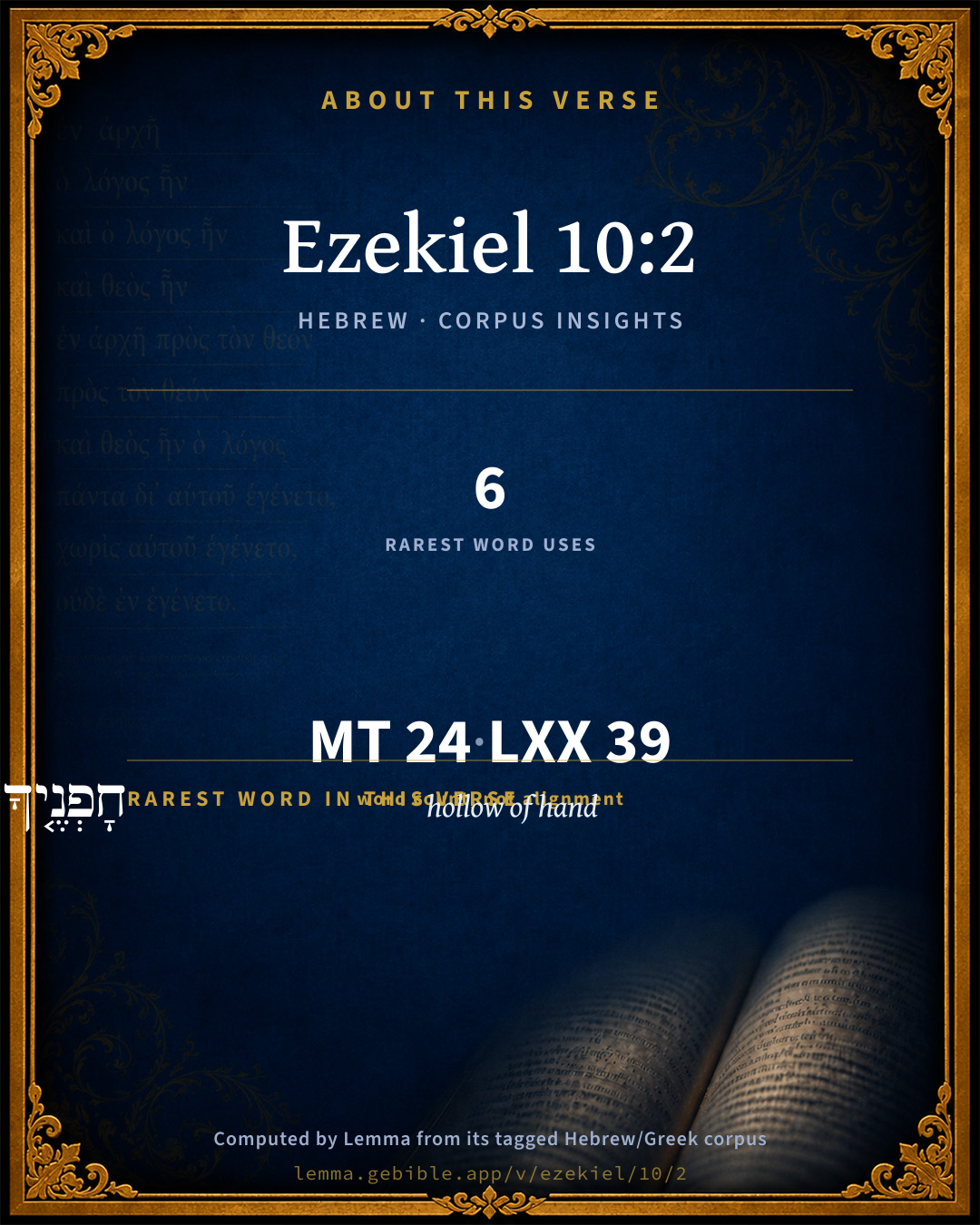
The rarest word here is חָפְנֶ֤יךָ hollow of hand H2651 — appearing just 6 times in the whole Hebrew Bible.

Shared distinctive vocabulary

חָפְנֶ֤יךָ hollow of hand H2651 occurs in 6 verses of the Hebrew Bible. Also found in:

Grammatical profile

  • 7 verbs
  • 10 nouns
  • 7 prepositions

Verb forms

  • וַיֹּ֜אמֶר Qal · Sequential Imperfect
  • לְבֻ֣שׁ Qal · Participle Passive
  • וַיֹּ֡אמֶר Qal · Sequential Imperfect
  • בֹּא֩ Qal · Imperative
  • וּמַלֵּ֨א Piel · Imperative
  • וּזְרֹ֖ק Qal · Imperative
  • וַיָּבֹ֖א Qal · Sequential Imperfect

Repetition

Words recur within this verse — often emphatic in Hebrew:

  • וַיֹּ֜אמֶר to say H559 ×2
  • בֹּא֩ to enter H935 ×2
  • בֵּינ֨וֹת between H996 ×2
  • לַכְּר֗וּב cherub H3742 ×2
  • אֶל to H413 ×3

Hebrew & Septuagint length

In English translation the verse runs 45 words from the Hebrew and 45 from the Septuagint (LXX English) — the same length.

A rough comparison of the two English renderings, which tokenize alike — not a word-level alignment.

Word counts can differ between the Hebrew and the Greek without any difference in meaning — e.g. the Hebrew direct-object marker אֵת has no separate Greek word, and Greek often adds the article ὁ.

In the original languages it is 24 Hebrew tokens and 39 Greek tokens — but the two are counted differently (Hebrew bundles its prefixes and suffixes into one token; the Greek is in lemma form), so that isn’t a like-for-like length.

Cross-references

16

Topical passages linked to Ezekiel 10:2 in the Treasury of Scripture Knowledge — connected by theme and wording, ordered by reader-vote popularity; previews shown in the World English Bible.

  • Revelation 8:5 The angel took the censer, and he filled it with the fire of the altar, and threw it on the earth. There followed thunders, sounds, lightnings, and an earthquake.
  • Ezekiel 1:13 As for the likeness of the living creatures, their appearance was like burning coals of fire, like the appearance of torches: [the fire] went up and down among the living creatures; and the fire was bright, and out of the fire went forth lightning.
  • Ezekiel 10:16 When the cherubim went, the wheels went beside them; and when the cherubim lifted up their wings to mount up from the earth, the wheels also didn't turn from beside them.
  • Exodus 9:8–10 Yahweh said to Moses and to Aaron, "Take to you handfuls of ashes of the furnace, and let Moses sprinkle it toward the sky in the sight of Pharaoh.
  • Psalms 18:12–13 At the brightness before him his thick clouds passed, Hailstones and coals of fire.
  • Psalms 140:10 Let burning coals fall on them. Let them be thrown into the fire, Into miry pits, from where they never rise.
  • Isaiah 6:6–7 Then one of the seraphim flew to me, having a live coal in his hand, which he had taken with the tongs from off the altar.
  • Isaiah 30:30 Yahweh will cause his glorious voice to be heard, and will show the lighting down of his arm, with the indignation of [his] anger, and the flame of a devouring fire, with a blast, and tempest, and hailstones.
  • Jeremiah 24:8–10 As the bad figs, which can't be eaten, they are so bad, surely thus says Yahweh, So will I give up Zedekiah the king of Judah, and his princes, and the residue of Jerusalem, who remain in this land, and those who dwell in the land of Egypt,
  • Ezekiel 1:15–20 Now as I saw the living creatures, behold, one wheel on the earth beside the living creatures, for each of the four faces of it.
  • Ezekiel 9:2–3 Behold, six men came from the way of the upper gate, which lies toward the north, every man with his slaughter weapon in his hand; and one man in the midst of them clothed in linen, with a writer's inkhorn by his side. They went in, and stood beside the brazen altar.
  • Ezekiel 10:7–13 The cherub stretched forth his hand from between the cherubim to the fire that was between the cherubim, and took [of it], and put it into the hands of him who was clothed in linen, who took it and went out.
  • Ezekiel 20:47–48 and tell the forest of the South, Hear the word of Yahweh: Thus says the Lord Yahweh, Behold, I will kindle a fire in you, and it shall devour every green tree in you, and every dry tree: the flaming flame shall not be quenched, and all faces from the south to the north shall be burnt thereby.
  • 2 Kings 25:9 He burnt the house of Yahweh, and the king's house; and all the houses of Jerusalem, even every great house, burnt he with fire.
  • Ezekiel 9:11 Behold, the man clothed in linen, who had the inkhorn by his side, reported the matter, saying, I have done as you have commanded me.
  • Ezekiel 24:9–14 Therefore thus says the Lord Yahweh: Woe to the bloody city! I also will make the pile great.

Cross-references courtesy of OpenBible.info (CC BY 4.0).

Hebrew and Greek witnesses Masoretic Hebrew ↔ Greek Septuagint

The same verse in the two great witnesses to the Old Testament, shown verse-for-verse.

These are two independent witnesses, not word-aligned to each other, and the Septuagint is shown in lemma (dictionary) form.

Hebrew Ezekiel 10:2 Masoretic · Westminster Leningrad Codex

וַיֹּ֜אמֶר אֶל הָאִ֣ישׁ לְבֻ֣שׁ הַבַּדִּ֗ים וַיֹּ֡אמֶר בֹּא֩ אֶל בֵּינ֨וֹת לַגַּלְגַּ֜ל אֶל תַּ֣חַת לַכְּר֗וּב וּמַלֵּ֨א חָפְנֶ֤יךָ גַֽחֲלֵי אֵשׁ֙ מִבֵּינ֣וֹת לַכְּרֻבִ֔ים וּזְרֹ֖ק עַל הָעִ֑יר וַיָּבֹ֖א לְעֵינָֽי

He spoke to the man clothed in linen, and said, Go in between the whirling [wheels], even under the cherub, and fill both your hands with coals of fire from between the cherubim, and scatter them over the city. He went in as I watched.

World English Bible · Public Domain

Greek LXX Ezekiel 10:2 Septuagint · lemma form

καί εἶπον πρός ὁ ἀνήρ ὁ ἐνδύω ὁ στολή εἰςἔρχομαι εἰς ὁ μέσος ὁ τροχός ὁ ὑποκάτω ὁ χερουβείμ καί πίμπλημι ὁ δράξ σύ ἄνθραξ πῦρ ἐκ μέσος ὁ χερουβείμ καί διασκορπίζω ἐπί ὁ πόλις καί εἰςἔρχομαι ἐνώπιον ἐγώ

And he said to the man clothed with the long robe, Go in between the wheels that are under the cherubs, and fill your hands with coals of fire from between the cherubs, and scatter them over the city. And he went in my sight.

LXX2012 (modern English Septuagint) · Public Domain

Hebrew: Westminster Leningrad Codex (CC BY 4.0). Greek: Septuagint (public domain); English from LXX2012 (modern English Septuagint) (Public Domain). How the Septuagint differs from the Hebrew →

Targum (Aramaic paraphrase)

1

The Targum is the ancient Jewish Aramaic paraphrase of the Hebrew Scriptures — an interpretive translation, not the Hebrew text itself. Onkelos (literal) and Pseudo-Jonathan (expansive) render the Torah, and Jonathan the Prophets. Coverage is partial: where no permissively-licensed English translation exists for a verse, only the Aramaic is shown. This is verse-level text, not a word-by-word alignment to the Hebrew.

  1. Targum Jonathan Prophets (Joshua–Malachi)
    וַאֲמַר לְגַבְרָא דְלָבֵישׁ לְבוּשַׁיָא וַאֲמַר עוּל לְבֵינֵי גִלְגְלַיָא לִתְחוֹת כְּרוּבָא וּמַלֵי חוּפְנָךְ גוּמְרִין דְאֶשָׁא מִבֵּינֵי כְרוּבַיָא וּזְרוֹק עַל קַרְתָּא וְעַל וַאֲנָא חָזֵי:

    (no public-domain English translation for this verse)

    Targum Jonathan — Aramaic: “Mikraot Gedolot” (public domain). English: “Sefaria Community Translation” (CC0 1.0 (public-domain dedication)); “London "Chaldee Paraphrase," 1871” (public domain). Text via Sefaria.

Commentary

Notes on Ezekiel 10:2 from classic Christian and Jewish commentators (each source and its license shown beneath its notes). The classic Christian expositions comment on the surrounding passage and are grouped to its opening verse, so a note may address several verses; the Jewish commentaries on the Tanakh (Rashi and others) are per-verse, so they appear only where the commentator wrote on this verse.

Lemma curates 59 commentaries, every one of them public domain or Creative Commons licensed, each selected and text-cleaned for this edition rather than reprinted as found. About our sources →

Trapp's Complete Commentary

John Trapp

Eze 10:2 And he spake unto the man clothed with linen, and said, Go in between the wheels, [even] under the cherub, and fill thine hand with coals of fire from between the cherubims, and scatter [them] over the city. And he went in in my sight.

Ver. 2. And he spake unto the man.] See Eze 9:2. Christ, who had marked the mourners, scattereth coals upon the rebellious city: "kiss the Son lest he be angry, and ye perish."

And scatter them over the city.] To show that Jerusalem was to be burnt by the Chaldees, as must likewise Rome by the kings of the earth; for strong is the Lord who judgeth her. {Rev 18:8}

And he went in my sight.] Saints see and foresee that which is often hid from others.

John Trapp, A Commentary or Exposition upon All the Books of the Old and New Testament (1647–1656) — public domain. Text from a community e-Sword module.

The Biblical Illustrator

Joseph S. Exell

Eze_10:2

Fill thy hand with coals of fire from between the cherubims and scatter them over the city.

Divine forces and human agents is retribution

I. There are in the economy of God, terrific forces for the destruction of evil. The whirling globe of fire was but a symbol of the manifold elements that, through processes of pain, and it may be throes of agony, have punished and will punish sin. And very often those elements are just those that have been guiltily used by man. It was true of these Jews that they had abused fire to maintain their gluttony, for fulness of bread was one of their sins; they burned incense to idols, and abused the altar fire which had been the greatest refreshing to their souls, and now even this fire kindled upon them. Thus, indeed, is it clearly taught in the prediction of Christ, They that take the sword shall perish by the sword, that the implements of our evil become the engines of our punishment. And such engines have terrific force.

1. To avoid sin ourselves.

2. To believe in the final victory of goodness.

II. The great forces provided against evil will often be used by the instrumentality of man. A mans hand was to scatter these coals of retribution. Thus it commonly is. As man is the tempter, so is man frequently the punisher of man. Chaldean armies are instruments of Divine righteousness. Human judges are often the swords of God: human revolutionists the vindicators of liberty against despots. It is for this hand sometimes to scatter the fires of retribution; but ever to scatter the fires of purification. The consuming of the sin--sin in thought, sin in feeling, sin in habit, rather than retribution, on the sinner, may perhaps be the higher and better teaching of this vision for all of us. (Urijah R. Thomas.)

The Biblical Illustrator, edited by Joseph S. Exell (c. 1880s–1900s) — public domain. Text from a community e-Sword module.

Geneva Bible (1599)

Geneva Bible translators

This signified, that the city should be burnt.

Geneva Bible (1599) marginal notes — public domain. Text via Bolls.life.

Jamieson, Fausset & Brown

Robert Jamieson, A. R. Fausset & David Brown

he--Jehovah; He who sat on the "throne."

the man--the Messenger of mercy becoming the Messenger of judgment (see on Eze 9:2). Human agents of destruction shall fulfil the will of "the Man," who is Lord of men.

wheels--Hebrew, galgal, implying quick revolution; so the impetuous onset of the foe (compare Eze 23:24; Eze 26:10); whereas "ophan," in Eze 1:15-16 implies mere revolution.

coals of fire--the wrath of God about to burn the city, as His sword had previously slain its guilty inhabitants. This "fire," how different from the fire on the altar never going out (Lev 6:12-13), whereby, in type, peace was made with God! Compare Isa 33:12, Isa 33:14. It is therefore not taken from the altar of reconciliation, but from between the wheels of the cherubim, representing the providence of God, whereby, and not by chance, judgment is to fall.

Jamieson, Fausset & Brown — Commentary Critical and Explanatory on the Whole Bible (1871) — public domain (CC PDM 1.0). Text via the HelloAO Bible API.

Adam Clarke's Commentary

Verse 2. Coals of fire] These were to signify the burning of the city by the Chaldeans. It seems that the space between the four wheels, which was all on fire, was that from which those coals were taken.

Adam Clarke's Commentary on the Bible (1810–1826) — public domain. Text from a community e-Sword/MySword module.

John Calvin's Commentaries

Now the end of the vision is related, which I just touched upon, since God determined utterly to destroy the city; but this is described by a visible and external symbol. God therefore is said to have commanded the wan who was clad in linen garments to fill his hands with coals, and to scatter them, on the city, namely, that he might cause a general burning. Here, indeed, God’s name is not expressed, but shortly afterwards the Prophet more clearly relates what he here touches so briefly and so obscurely. It is evident that the person seated on the throne is here spoken of, and we may collect from the context, that this command cannot be referred to any but to God. But we must observe, that the angel commanded to mark the elect now assumes a new character. And hence we collect that the angels were so the ministers of God’s favor toward the faithful, that at the same time, whenever they were commanded, they executed his vengeance; as a steward placed over a large family, not only sustains the office of providing for the family, in supplying it with food and clothing, but in chastising those who conduct themselves sinfully and wickedly. Such, therefore, is the duty of God’s angels. When God wishes to brand sinners with double shame, he often delivers them up to the devil as his executioner, and when we are delivered into the devil’s hand, this is a sign of extreme vengeance. But God by his angels often exercises judgment against the reprobate, as examples everywhere occur; but that is peculiarly remarkable, when the angel slew so many thousands in the army of Sennacherib, that he raised the siege by which the Assyrians oppressed Jerusalem. (2 Kings 19:35; Isaiah 37:36.) The same thing is now delivered by the Prophet. We saw the angel clad in the linen garments become the protector of the faithful, to preserve them from all injury. But now he is sent to scatter coals through the whole city, to consume the stones and the wood, as well as the men.

These things seem to be contrary to each other, but we show that there is nothing absurd in it, if God imposes a double character on his angels. He said, therefore, to the man who was clothed, enter within the wheel under the cherub Here there is a change of number, because the singular number cherub is put for cherubim. But I remarked before that this is usual, and God proposed nothing else than to mark the place where the fiery coals were taken which burnt up the city. The altar was never without fire; for it was not lawful to use any kind of fire, since in this way the sacrifices were contaminated. (Leviticus 6:12, 13.) But that perpetual fire, which God wished to burn upon the altar, regarded reconciliation to himself; for sins were expiated by sacrifices, and therefore the fire on the altar was as it were the people’s life. But now God signifies that he had a hidden fire within the wheels, which were near the cherubim, or the four animals. But we have said, and it will be necessary to repeat it again, that by wheels all agitations are represented which are discerned under heaven, or revolutions, as they are usually called. But he saw wheels under the angels, because when the wind rises, when the sky is covered with clouds and mists, when the rain descends, and the air is disturbed by lightnings, we think, when all these things happen, that such motions and agitations take place naturally. But before this God wished to teach us that great agitations are not blind, but are directed by secret instinct, and hence the notion or inspiration of the angels, always exists. Now, therefore, when God orders his angel to take fire from the midst of the wheel which was under the cherub, this only means that God has various means of destroying the city. Now the wheels, as we saw before, were carried in different directions, so that they flew throughout the city. Since, therefore, the fire was in the midst of the wheels, while the angels transferred the wheels by their own secret motion, hence we gather that the burning of the city was in the hand of God, and at the same time in the temple. For the Prophet does not now see the wheels near the river Chebar, but in the temple itself; and there is a tacit contrast, as I have reminded you, between the fire by whose incense God was reconciled, and whence also the sacrifices had their odor sweet and pleasing to God, and between this fire, which should be destructive to the whole people. But he says, the angel had entered, that we may know, as I have said before, as soon as God has pronounced what he wishes to be done, that the execution of it is at hand. Lastly, the Prophet here commends to us the effect of his command, when he says, that the angel entered immediately, as God had commanded. It follows —

John Calvin's Commentaries (1540-1563) — public domain. Text from the Calvin Translation Society English edition (1840s-50s) via the Christian Classics Ethereal Library (ccel.org). Calvin's coverage is partial (roughly two-thirds of the Bible); uncommented books and verses are honest gaps, never fabricated. The 19th-century editor's footnotes and remarks are omitted so the notes are faithfully Calvin's own voice.

Ellicott's Commentary for English Readers

(2) Unto the man clothed with linen.—Hitherto, in Ezekiel 9, he has been employed only in a work of mercy and protection. It is not without significance that now the same person is made the agent of judgment. As God’s love is turned to wrath by man’s impenitence, and as His blessings given to man become curses by their abuse, so those employed by Him as the instruments of His loving-kindness become the very executioners of his “fury.” The “coals of fire,” the symbols of Divine wrath, are represented as “between the cherubim.” In every possible way it is signified that the impending doom is not from man’s will, however men may be used as its instruments, or from any accident, but from God Himself.

Scatter them over the city.—For its destruction. Perhaps the imagery does not signify anything more than destruction, without especial reference to the means employed; but 2Ki_25:9 and 2Ch_36:19 show that the Temple and city were actually burned by the Chaldæans, as was often done with conquered cities that had resisted obstinately.

A Bible Commentary for English Readers, edited by Charles John Ellicott (1878–1897) — public domain. Text from a community e-Sword module.

The Cambridge Bible for Schools and Colleges

gen. ed. J. J. S. Perowne

2. between the wheels] The word is singular and occurs again Eze_10:13, being used as a collective to describe the whole wheel-work. There were four wheels (a different word) which are called here collectively wheelwork, lit. whirling. The word is used of the whirlwind or tempest (Psa_77:18), but also of chariot wheels (Isa_5:28; Eze_23:24; Eze_26:10).

The Cambridge Bible for Schools and Colleges (gen. ed. J. J. S. Perowne; Cambridge University Press, 1878–1918) — public domain. Text from a community e-Sword module.

John Gill's Exposition

And he spake unto the man clothed with linen,.... That is, the God of Israel, or the glory of the Lord, that sat upon the throne before described; he gave orders to the man clothed in linen, who appears in another character, and represents the Chaldean or Roman army:

and said, go in between the wheels, even under the cherub; the singular for the plural, the "cherubim"; the wheels were under these; the churches are under their ministers, their pastors, guides, and governors; or rather, since the wheels were by the cherubim, it should be rendered, as by some, "unto the cherub", or "cherubim" (a):

and fill thine hand with coals of fire from between the cherubim, and scatter them over the city; these "coals of fire" were an emblem of the wrath of God against Jerusalem, and of the destruction of it by fire; and these being fetched from between the cherubim, show that the cause of this wrath and ruin was the ill treatment of the prophets of the Lord; see Ch2 36:15; as the destruction of the same city afterwards by the Romans was owing, as to the rejection and killing of the Messiah, so to the prosecution of his apostles, Th1 2:15;

and he went in my sight; in the sight of the prophet, as it appeared to him in vision he saw him go in, as he was ordered, between the wheels, and under the cherubim; but as yet he did not see him take the coals of fire, and much less scatter them; these were afterwards done, as related in the other part of the vision.

(a) "in locum cerubinorum, vel cheruborum", Junius & Tremellius, Piscator; "ad cherubim", Tigurine version; which is approved by Noldius, p. 84. No. 398.

John Gill's Exposition of the Whole Bible (1746–1763) — public domain (CC PDM 1.0). Text via the HelloAO Bible API.

Albert Barnes' Notes on the Bible

He spake - The person enthroned.

The cherub - The particular cherub who was to hand the coals to destroy Psa 120:4; Isa 10:16; Rev 15:8.

Albert Barnes' Notes on the Bible (1834–1885) — public domain. Text from a community e-Sword/MySword module.

Haydock's Catholic Bible Commentary

Out, to purify (St. Jerome) or punish the city, (Theodoret) which would shortly be reduced to ashes. (Vatable) (Menochius)

George Leo Haydock (1774–1849), Haydock's Catholic Family Bible and Commentary, 1859 edition — public domain. Excludes Psalms (Douay-Rheims chapter numbering differs from Protestant) and Deuterocanonical books (Catholic canon only).

Matthew Poole's English Annotations

He spake that sat on the throne, i.e. God, who rules the world and church.

Unto the man; to Christ, as before, Eze 9:2.

Go in: it is said, Eze 1:18, that the rings of the wheels were dreadful, but here is a Divine command which encourageth, and insureth, and lessens the dread and terror.

Between the wheels; whether between the four, or between the two foremost, or hindermost, or either, between the wheels that made up one wheel, is not material to inquire.

Fill thine hand: this expresseth the fainess of vengeance which would overtake them, and the certainty and speediness of judgments; for such a quantity of coals in the hand ready to be scattered abroad will very soon set all in a flame.

From between the cherubims; either to intimate to us that this fire was the vengeance of God upon them; for he sits between the cherubims, and is consuming fire to sin; or to intimate that the vengeance was for sins against the grace of God, who sat between the cherubims, and thence gave out his grace toward Israel, Exo 25:20-22; Heb 9:5. But abused grace will kindle into fire.

Scatter them over the city, that it may take fire in all parts, and none may escape; so cast the fire, that the coals may fall on every part.

He went in in my sight; which assured the prophet of the certainty, and intimated too the speed of the effect, which will be within five years’ space.

Matthew Poole's English Annotations on the Holy Bible (1683–1685) — public domain. Text from a community e-Sword/MySword module.

Whedon's Commentary on the Bible

Daniel D. Whedon

2. Between the wheels — Literally, whirling; a different word from the one formerly used for wheel. It is used also in Eze_10:13, and signifies that the wheels are all the time moving like a whirlwind. (Compare also Psa_77:18; Eze_33:23.) It is used, not of a single wheel, but of the entire “wheelwork,” or chariot.

Coals of fire — That which previously the prophet had only ventured to describe as appearing like coals of fire (Eze_1:13) he now sees can be handled and used as powerful weapons of judgment.

Scatter them over the city — All this is symbolical of judgment to come. Josephus tells us how this prophecy was fulfilled by Nebuzaradan, who, having robbed the temple of its treasures, set fire to it “in the fifth month, the first day of the month, in the eleventh year of the reign of Zedekiah, and in the eighteenth year of Nebuchadnezzar he also burnt the palace and overthrew the city” (Ant., X, Eze_8:5).

Daniel D. Whedon (gen. ed.), Commentary on the Old and New Testaments (1874–1909) — public domain. Text from a community e-Sword module.

The Pulpit Commentary

Coals of fire.

The coals of fire which Ezekiel saw between the cherubim were to be poured forth in destruction upon the doomed city of Jerusalem. But there are various uses of Divine fire. Let us notice some of them.

I COALS OF FIRE FOR DESTRUCTION". This dreadful destiny of Divine fire must he considered first, as it was the one intended by the prophet. "Our God is a consuming Fire." There is not only punishment, there is destruction in the operation of fire. It hurts, but it also consumes; and its primary work is destruction. "The wages of sin is death." God does not only chastise with the rod; he destroys with his fire. The earlier chastisement is to save from the later destruction. We may be thankful for the sharp lash if it drives us from the burning fire.

II COALS OF FIRE FOR PURIFICATION. Fire does not only destroy; it refines. Refuse is burnt by it; silver is purified. God sends fiery trials to cleanse our souls by burning out the evil, and leaving the better nature freer and purged. Perhaps the fire which would be for destruction if we remained impenitent may be converted into a refiner"s furnace when we learn its burning lesson, and humble ourselves in the very flames of wrath. So let us use the fiery trials of life.

III COALS OF FIRE FOR CONSECRATION. The whole offering of Jewish sacrifice was burnt upon the altar. There is a consuming zeal of God which wholly takes possession of his consecrated servant, and burns through him, so that he is no longer a slave of the earth, but is lifted up as on Elijah"s chariot. Still living in this world, indeed, for the service of God, he feels that the old Adam has been killed, the evil of his nature has been burnt out of him, self has been slain, and now he belongs wholly to God. Alas! so perfect a consecration is not attained by any of us. But Christ"s baptism in fire leads us up to it. It is a supreme mistake to suppose that our Lord calls us only to ease and rest. He calls to the pilgrimage, the battle, the cross, perhaps to the furnace. Even when life outside is smooth, the consecration of will and passion means a fiery ordeal.

IV COALS OF FIRE FOR INSPIRATION. The engine is driven by coals of fire. Our physical energy is dependent on the burning up of the tissue of our bodies. The heat of enthusiasm is the inspiration and source of energy for mental and moral enterprises. Love is a great fire of burning coals, and when it becomes bright and warm, the soul grows strong for sacrifice and service. We may have false fires, indeed, fires of earthly passion that scorch and wither our better nature. No earth-born fire will kindle the devotion of the soul. For this live coals from off God"s altar are needed. The fire from between the cherubim kindles our fire. The great love of Christ coming like coals of fire can give us warmth of love and devotion, and inspire us fur the Christian life.

The Pulpit Commentary (1880–1919), ed. H.D.M. Spence-Jones & Joseph S. Exell — public domain. Text from a community e-Sword module.

John Wesley's Explanatory Notes

He - That sat on the throne. Scatter - That it may take fire in all parts, and none may escape.

John Wesley, Explanatory Notes Upon the Whole Bible (1754–1765) — public domain. Text via the GEBible commentary corpus.

Rashi

Rabbi Shlomo Yitzchaki (Rashi)

between the wheels Heb. (בֵּינוֹת לַגַלְגַל) [lit. between the wheel.] Wherever it says, “And he said...and he said,” it is meant only to be expounded upon. The Holy One, blessed be He, told Gabriel [to take the coals], but he [Gabriel] asked the cherub to [take them first and then] give them to him so that the coals would cool and the decree would be mitigated. And this is clearly stated in the chapter (verse 7): “and he picked up [the fire] and gave [it] into the hands of the one clothed in linen.”

and cast [them] upon the city He did not cast them immediately, and although the one clothed in linen received them, he did not cast them until six years after he had received them, for the coals were smoldering in his hand for all the six years. And you should know [that this is true] because this prophecy was said in the sixth year, and the city was destroyed in the eleventh year.

Rashi on the Tanakh — English translations: “The Judaica Press complete Tanach with Rashi, translated by A. J. Rosenberg” (CC BY 4.0); “Pentateuch with Rashi's commentary by M. Rosenbaum and A.M. Silbermann, 1929-1934” (public domain); “The Metsudah Tanach series, Lakewood, N.J” (CC BY 4.0); and “The Book of Joshua, Metsudah Publications, 1997” (CC BY 4.0). Text via Sefaria.

Lesson kit

Teaching starters — assembled from the data on this page, not authored interpretation. Every prompt links to the verse data it draws on. Edit before teaching.

Ezekiel, in the Prophets, opens this verse with 24 words (18 distinct Hebrew lemmas). Its most distinctive word is chôphen (“hollow of hand”). A historical commentator’s framing appears above. Read the whole chapter for the surrounding context.

Discussion questions

  1. The word chôphen carries the sense “hollow of hand.” How does it shape the verse?
  2. Exodus 9:8 shares the word «hollow of hand» with this verse. How do the two illuminate each other?
  3. “to say” occurs 2× in this one verse. What is the effect of the repetition?
  4. These translations render this verse differently; the difference is in the English rendering, not the original. What questions does that raise?
  5. The verb «וַיֹּ֜אמֶר» is Qal Sequential Imperfect. How does its form color the action?
  6. Reading how Trapp's Complete Commentary and The Biblical Illustrator read this verse, where do the two commentators agree and where do they part?

Things to notice

Reading settings

Reading text

Shown beneath each verse's original-language words.

Old Testament
Old Testament edition

Read the OT as the Masoretic Hebrew (MT) or the Greek Septuagint (LXX).

English shown for the Greek Septuagint (in the Hebrew ↔ Greek comparison).

Comparing translations? Open the Compare panel on any verse page to stack up to four side by side.