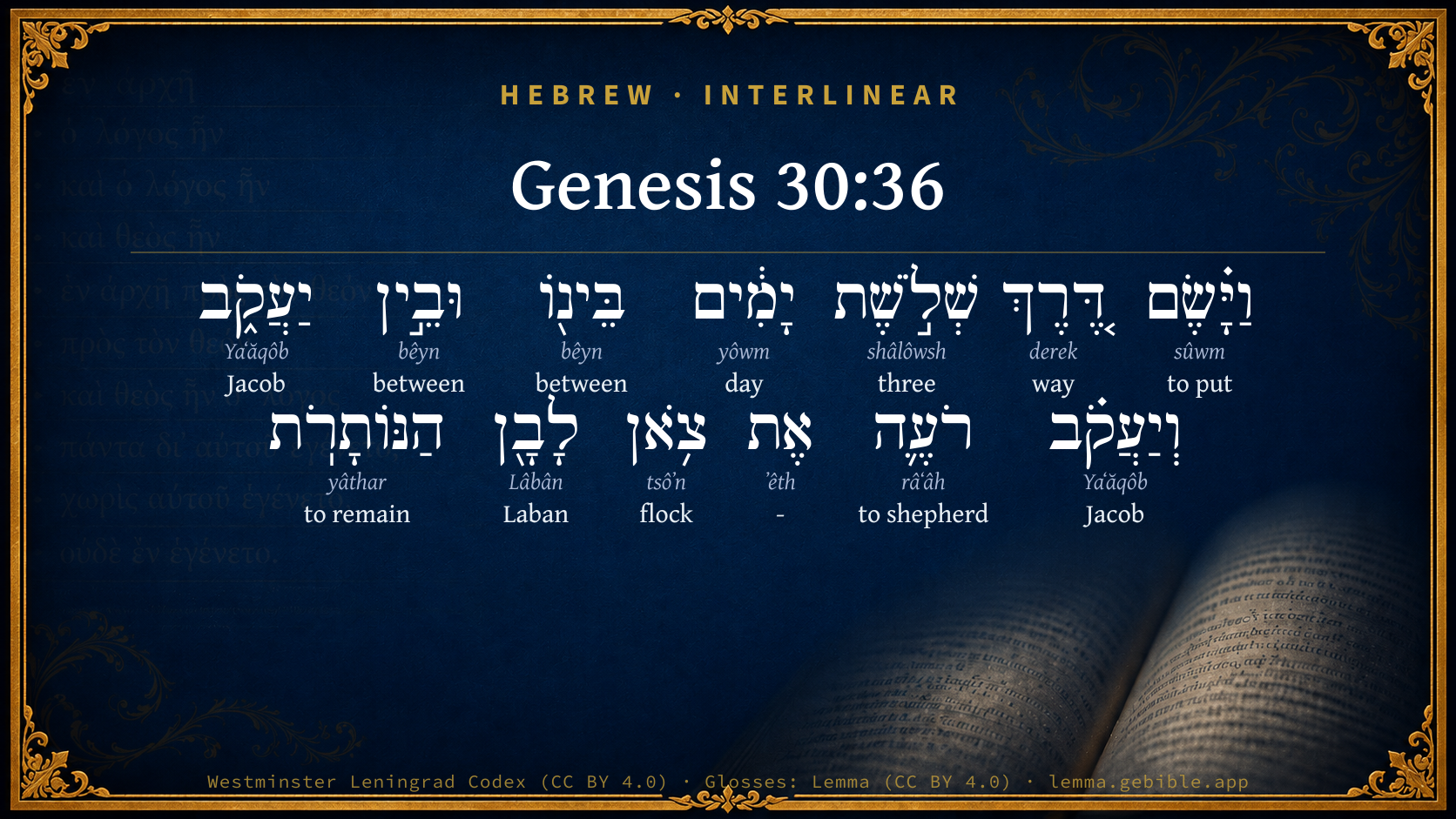
Genesis 30:36

Hebrew (Westminster Leningrad Codex) Genesis 30:36 appears in the Hebrew Old Testament. The text above is from the Westminster Leningrad Codex. Each word links to its Strong’s number, a concise gloss, and parsing drawn from the Open Scriptures Hebrew Bible morphology. Click any word for its full Brown-Driver-Briggs (BDB) entry.
Download image
Cite this verse

Genesis 30:36 (World English Bible). Public Domain. Lemma interlinear Bible study tool, https://lemma.gebible.app/v/genesis/30/36.

Show BibTeX & RIS
BibTeX
RIS
English Translation
He set three days' journey between himself and Jacob, and Jacob fed the rest of Laban's flocks.
World English Bible · Public Domain
Highlights Full analysis ↓
Download a study sheet

One document with this verse’s original text, its word-by-word gloss line, the meaning frame, cross-references with their text, attributed commentary, and full source and license credits — printable, and it pastes into notes with its structure intact.

This verse Autodidact and up

Study sheet (.html) Plain text (.txt)

A passage Seminary Student

Up to 50 verses in one chapter. A passage sheet keeps up to 6 commentary sources and 12 cross-references per verse, in the order this page ranks them, and says so on the sheet whenever that leaves anything out. Ask for a single verse and you get the Autodidact verse sheet above.

Everything on this page stays free to read, with no account — the sheet is a download of what is already on screen, not access to it.

Want to remove ads? Support Godless Engineer
Compare translations 3

The same verse in 3 English versions, stacked beneath the original-language interlinear above. Click any original word for its lexicon entry.

Each is an independent rendering of the whole verse — the interlinear is not word-aligned to these translations.

Highlighted words mark where these versions differ — a whole-verse word diff, not a word-by-word alignment.

  • World English Bible Public Domain
    He set three days' journey between himself and Jacob, and Jacob fed the rest of Laban's flocks.
  • King James Version Public Domain
    And he set three days' journey betwixt himself and Jacob: and Jacob fed the rest of Laban's flocks.
  • unfoldingWord Literal Text CC BY-SA 4.0
    and he put a three-day journey between himself and Jacob. And Jacob was tending the rest of Laban’s flock.

unfoldingWord Literal Text — © unfoldingWord, licensed CC BY-SA 4.0. Word-aligned USFM3 via Door43 (git.door43.org/unfoldingWord/en_ult).

Versions to compare (up to 4)

3 of 4 selected

Show all 18 translations

Every available English version of this verse, each an independent rendering of the whole verse.

  • World English Bible Public Domain
    He set three days' journey between himself and Jacob, and Jacob fed the rest of Laban's flocks.
  • Berean Standard Bible Public Domain
    Then he put a three-day journey between himself and Jacob, while Jacob was shepherding the rest of Laban’s flocks.
  • Majority Standard Bible Public Domain
    Then he put a three-day journey between himself and Jacob, while Jacob was shepherding the rest of Laban’s flocks.
  • King James Version Public Domain
    And he set three days' journey betwixt himself and Jacob: and Jacob fed the rest of Laban's flocks.
  • American Standard Version (1901) Public Domain
    and he set three days' journey betwixt himself and Jacob: and Jacob fed the rest of Laban's flocks.
  • Revised Version (1885) Public Domain
    and he set three days’ journey betwixt himself and Jacob: and Jacob fed the rest of Laban’s flocks.
  • Geneva Bible (1599) Public Domain
    And hee set three dayes iourney betweene himselfe and Iaakob. And Iaakob kept the rest of Labans sheepe.
  • Douay-Rheims (1899) Public Domain
    And he set the space of three days' journey betwixt himself and his son in law, who fed the rest of his flock.
  • Young's Literal Translation Public Domain
    and setteth a journey of three days between himself and Jacob; and Jacob is feeding the rest of the flock of Laban.
  • Literal Standard Version CC BY-SA 4.0
    and sets a journey of three days between himself and Jacob; and Jacob is feeding the rest of the flock of Laban.
  • Unlocked Literal Bible CC BY-SA 4.0
    Laban also put three days' journey between himself and Jacob. So Jacob kept tending the rest of Laban's flocks.
  • unfoldingWord Literal Text CC BY-SA 4.0
    and he put a three-day journey between himself and Jacob. And Jacob was tending the rest of Laban’s flock.
  • Darby Bible Public Domain
    And he put three days' journey between himself and Jacob. And Jacob fed the rest of Laban's flock.
  • World Messianic Bible Public Domain
    He set three days’ journey between himself and Jacob, and Jacob fed the rest of Laban’s flocks.
  • Webster's Bible Public Domain
    And he set three days' journey between himself and Jacob: and Jacob fed the rest of Laban's flocks.
  • Free Bible Version CC BY-SA 4.0
    a three day journey between them and Jacob, while Jacob was looking after the rest of Laban's flocks.
  • Bible in Basic English Public Domain
    And sent them three days' journey away: and Jacob took care of the rest of Laban's flock.
  • JPS Tanakh (1917) Public Domain
    And he set three days' journey betwixt himself and Jacob. And Jacob fed the rest of Laban's flocks.

Literal Standard Version (2020), Covenant Press — licensed CC BY-SA 4.0. Text via the HelloAO Bible API (eBible.org). Unlocked Literal Bible (unfoldingWord) — licensed CC BY-SA 4.0. Text via the HelloAO Bible API (eBible.org). unfoldingWord Literal Text — © unfoldingWord, licensed CC BY-SA 4.0. Word-aligned USFM3 via Door43 (git.door43.org/unfoldingWord/en_ult). Free Bible Version, Dr. Jonathan Gallagher — licensed CC BY-SA 4.0. Text via the HelloAO Bible API (eBible.org).

Word by word

More ways to search: Search by grammar → Find every occurrence → Compare this word →

Practice this passage: Drill this verse → Learn its vocabulary →

לָבָ֖ן
Lâbân
H3837
“Laban”
Noun, Proper
Part of Speech
Noun
Type
Proper
Full BDB Definition

Origin: the same as H3836

TWOT: None

Laban = "white" - son of Bethuel, brother of Rebekah, and father of Leah and Rachel (noun proper masculine) - a wilderness encampment of the Israelites (noun proper locative)
  1. וַיָּ֗שֶׂם sûwm H7760 “and · to put” Conjunction + Verb, Qal, Sequential Imperfect, 3rd Person, Masculine, Singular
  2. דֶּ֚רֶךְ derek H1870 “way of” Noun, Common, Both, Singular, Construct
  3. שְׁלֹ֣שֶׁת shâlôwsh H7969 “three” Adjective, Cardinal number, Masculine, Singular, Construct
  4. יָמִ֔ים yôwm H3117 “days” Noun, Common, Masculine, Plural, Absolute
  5. בֵּינ֖וֹ bêyn H996 “between · him” Preposition + Suffix, Personal, 3rd Person, Masculine, Singular
  6. וּבֵ֣ין bêyn H996 “and · between” Conjunction + Preposition
  7. יַעֲקֹ֑ב Yaʻăqôb H3290 “Jacob” Noun, Proper
  8. וְיַעֲקֹ֗ב Yaʻăqôb H3290 “and · Jacob” Conjunction + Noun, Proper
  9. רֹעֶ֛ה râʻâh H7462 “shepherding” Verb, Qal, Participle Active, Masculine, Singular, Absolute
  10. אֶת ʼêth H853 “-” Particle, Direct Object
  11. צֹ֥אן tsôʼn H6629 “flock of” Noun, Common, Both, Singular, Construct
  12. הַנּוֹתָרֹֽת yâthar H3498 “the · remaining” Particle, Definite Article + Verb, Niphal, Participle Active, Feminine, Plural, Absolute

About this verse

These counts appear in no published source. They are computed here, from the morphology-tagged text and Lemma’s own curated glosses. What Lemma adds →

13
words
11
distinct lemmas
Pentateuch
section

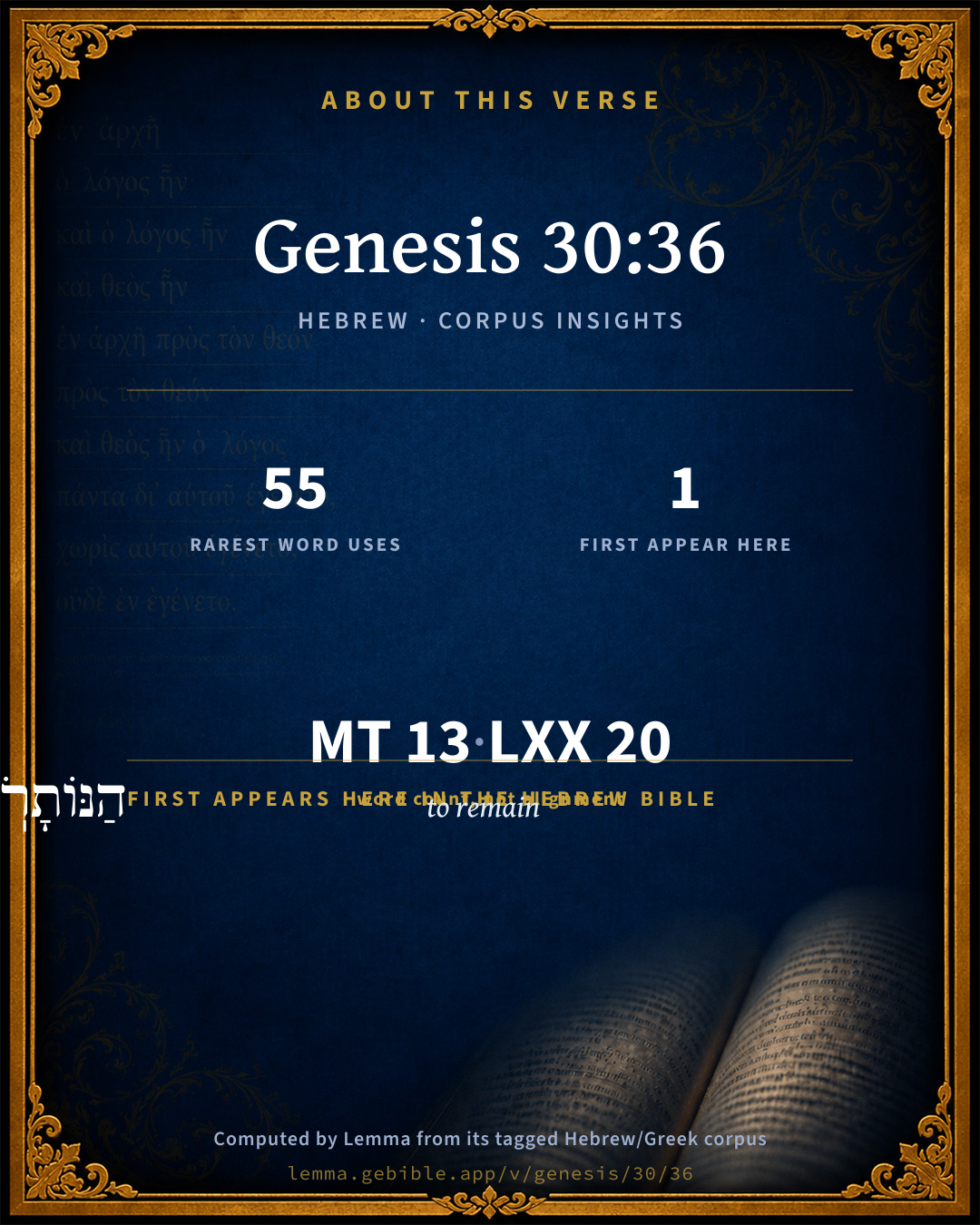
First appearance in Scripture

This word makes its first canonical appearance in the Hebrew Bible here:

  • הַנּוֹתָרֹֽת to remain H3498

Shared distinctive vocabulary

לָבָ֖ן Laban H3837 occurs in 47 verses of the Hebrew Bible. Also found in:

Grammatical profile

  • 3 verbs
  • 6 nouns
  • 1 adjective
  • 2 prepositions
  • 1 particle

Verb forms

  • וַיָּ֗שֶׂם Qal · Sequential Imperfect
  • רֹעֶ֛ה Qal · Participle Active
  • הַנּוֹתָרֹֽת Niphal · Participle Active

Repetition

Words recur within this verse — often emphatic in Hebrew:

  • בֵּינ֖וֹ between H996 ×2
  • יַעֲקֹ֑ב Jacob H3290 ×2

Hebrew & Septuagint length

In English translation the verse runs 17 words from the Hebrew and 25 from the Septuagint (LXX English) — the Septuagint runs noticeably longer here. See the side-by-side →

A rough comparison of the two English renderings, which tokenize alike — not a word-level alignment.

Word counts can differ between the Hebrew and the Greek without any difference in meaning — e.g. the Hebrew direct-object marker אֵת has no separate Greek word, and Greek often adds the article ὁ.

In the original languages it is 13 Hebrew tokens and 20 Greek tokens — but the two are counted differently (Hebrew bundles its prefixes and suffixes into one token; the Greek is in lemma form), so that isn’t a like-for-like length.

Hebrew and Greek witnesses Masoretic Hebrew ↔ Greek Septuagint

The same verse in the two great witnesses to the Old Testament, shown verse-for-verse.

Here the Septuagint runs noticeably longer than the Hebrew — LXX2012 (modern English Septuagint) 25 words vs World English Bible 17. A rough length comparison of the two English translations, not a word-level alignment — read both below.

These are two independent witnesses, not word-aligned to each other, and the Septuagint is shown in lemma (dictionary) form.

Hebrew Genesis 30:36 Masoretic · Westminster Leningrad Codex

וַיָּ֗שֶׂם דֶּ֚רֶךְ שְׁלֹ֣שֶׁת יָמִ֔ים בֵּינ֖וֹ וּבֵ֣ין יַעֲקֹ֑ב וְיַעֲקֹ֗ב רֹעֶ֛ה אֶת צֹ֥אן לָבָ֖ן הַנּוֹתָרֹֽת

He set three days' journey between himself and Jacob, and Jacob fed the rest of Laban's flocks.

World English Bible · Public Domain

Greek LXX Genesis 30:36 Septuagint · lemma form

καί ἀποἵστημι ὁδός τρεῖς ἡμέρα ἀνά μέσος αὐτός καί ἀνά μέσος ἰακώβ ἰακώβ δέ ποιμαίνω ὁ πρόβατον λαβαν ὁ ὑπολείπω

And he set a distance of a three days' journey between them and Jacob. And Jacob tended the cattle of Laban that were left behind.

LXX2012 (modern English Septuagint) · Public Domain

On this verse, Ellicott's Commentary for English Readers discusses the Septuagint’s reading. Read the note in Commentary ↓

Hebrew: Westminster Leningrad Codex (CC BY 4.0). Greek: Septuagint (public domain); English from LXX2012 (modern English Septuagint) (Public Domain). How the Septuagint differs from the Hebrew →

Targum (Aramaic paraphrase)

2

The Targum is the ancient Jewish Aramaic paraphrase of the Hebrew Scriptures — an interpretive translation, not the Hebrew text itself. Onkelos (literal) and Pseudo-Jonathan (expansive) render the Torah, and Jonathan the Prophets. Coverage is partial: where no permissively-licensed English translation exists for a verse, only the Aramaic is shown. This is verse-level text, not a word-by-word alignment to the Hebrew.

  1. Targum Onkelos Torah (Genesis–Deuteronomy)
    וְשַׁוִּי מַהֲלַךְ תְּלָתָא יוֹמִין בֵּינוֹהִי וּבֵין יַעֲקֹב וְיַעֲקֹב רָעֵי יָת עָנָא דְלָבָן דְּאִשְׁתָּאֳרָן

    (no public-domain English translation for this verse)

    Targum Onkelos — Aramaic: “Onkelos Genesis” (public domain); “Onkelos Exodus” (public domain); “Onkelos Leviticus” (public domain); “Onkelos Numbers” (public domain); “Onkelos Deuteronomy” (public domain). English: “Sefaria Community Translation” (CC0 1.0 (public-domain dedication)); “J.W. Etheridge. The Targums of Onkelos and Jonathan Ben Uzziel on the Pentateuch. London: Longmans, Green, 1862” (public domain). Text via Sefaria.

  2. Targum Pseudo-Jonathan Torah (Genesis–Deuteronomy)
    וְשַׁוִי מַהֲלַךְ תְּלָתָא יוֹמִין בֵּינֵי עָנֵיהּ וּבֵינֵי יַעֲקב וְיַעֲקב רָעֵי יַת עָנָא דְלָבָן סָבָאָן וּמַרְעָאָן דְאִשְׁתַּאֲרוּ

    And he set a journey of three days between his flocks and (those of) Jakob. And Jakob tended the flock of Laban, the old and the feeble which were left.

    Targum Pseudo-Jonathan — Aramaic: “Targum Jonathan on Genesis” (public domain); “Targum Jonathan on Exodus” (public domain); “Targum Jonathan on Leviticus” (public domain); “Targum Jonathan on Numbers” (public domain); “Targum Jonathan on Deuteronomy” (public domain). English: “The Targum of Jonathan ben Uzziel, trans. J. W. Etheridge, London, 1862” (public domain). Text via Sefaria.

Commentary

Notes on Genesis 30:36 from classic Christian and Jewish commentators (each source and its license shown beneath its notes). The classic Christian expositions comment on the surrounding passage and are grouped to its opening verse, so a note may address several verses; the Jewish commentaries on the Tanakh (Rashi and others) are per-verse, so they appear only where the commentator wrote on this verse.

Lemma curates 59 commentaries, every one of them public domain or Creative Commons licensed, each selected and text-cleaned for this edition rather than reprinted as found. About our sources →

Trapp's Complete Commentary

John Trapp

Gen 30:36 And he set three days’ journey betwixt himself and Jacob: and Jacob fed the rest of Laban’s flocks.

Ver. 36. And he set three days’ journey.] Hoping so to disappoint Jacob of having anything, and to make his own party good with him. For, naturally, the cattle would bring forth others like themselves; and so Jacob’s part should be little enough. Sed et hic fallitur sordidus impostor , saith Pareus. Laban was utterly out in his count, and crossed in his design.

John Trapp, A Commentary or Exposition upon All the Books of the Old and New Testament (1647–1656) — public domain. Text from a community e-Sword module.

Ellicott's Commentary for English Readers

(36) He set three days’ journey betwixt himself and Jacob.—This means that Laban required that there should be an interval of between thirty and forty miles between “himself,” that is, his flocks, and those of Jacob. His wealth in sheep and goats must have been enormous to require so large a separate feeding-ground; and this we learn from Gen_30:30 had been the result of Jacob’s care. The words “and Jacob fed,” &c., are added to correct the natural supposition that he would at least give some part of his time and care to his own flocks, whereas it was his personal duty to attend only to those of Laban. The verse, nevertheless, is awkward, and the Syriac has probably preserved the right-reading: “And he set three days’ journey between himself and Laban: and Jacob fed the flock of Laban that was left.” The Samaritan and LXX. read, “between them and Jacob.”

A Bible Commentary for English Readers, edited by Charles John Ellicott (1878–1897) — public domain. Text from a community e-Sword module.

The Cambridge Bible for Schools and Colleges

gen. ed. J. J. S. Perowne

36. three days’ journey] In order to prevent the least possibility of confusion or of intermingling, Laban separates his sons’ flocks by a great distance from those which Jacob is to tend.

The Cambridge Bible for Schools and Colleges (gen. ed. J. J. S. Perowne; Cambridge University Press, 1878–1918) — public domain. Text from a community e-Sword module.

John Gill's Exposition

And Jacob did separate the lambs,.... The ringstraked, speckled, and spotted:

and set the faces of the flocks, that were all white:

towards the ringstraked, and all the brown in the flock of Laban; either to go before those that were all white, that they by looking at them might conceive and bring forth such, which was another artifice of Jacob's to increase his own sheep; or else he set at the water troughs the white sheep on one side of them, and on the opposite side the speckled ones, &c. that the same effect might also be produced the more successfully both by the rods and by the speckled lambs:

and he put his own flocks by themselves, and put them not unto Laban's cattle; partly that they might not be mixed together, but kept distinct, that what was his property might be discerned from Laban's; and partly, lest his spotted ones, being mixed with Laban's white sheep, by continual looking at them, should conceive and bring forth such likewise, and so his flocks be lessened.

John Gill's Exposition of the Whole Bible (1746–1763) — public domain (CC PDM 1.0). Text via the HelloAO Bible API.

Matthew Poole's English Annotations

Three days’ journey; understand it of the journeying or travelling of sheep, not of men. He did this lest either Jacob should mingle and exchange the sheep, or the sheep, by the contemplation of the diverse coloured ones, should bring forth others like to them.

Matthew Poole's English Annotations on the Holy Bible (1683–1685) — public domain. Text from a community e-Sword/MySword module.

The Pulpit Commentary

And (as if to insure the impossibility of the two flocks mingling and breeding) he set three days journey betwixt himself (with his sons and the parti-colored animals) and Jacob: and Jacob fed the rest of Laban"s flocks out of which he was to pay himself as best he could in accordance with the contract.

The Pulpit Commentary (1880–1919), ed. H.D.M. Spence-Jones & Joseph S. Exell — public domain. Text from a community e-Sword module.

Rashi

Rabbi Shlomo Yitzchaki (Rashi)

הנותרות [THE FLOCK OF LABAN] THAT WAS LEFT — The defective animals amongst them, the sickly and the barren, which were nothing but the leavings — these he (Laban) handed over to him (Genesis Rabbah 73:9).

Rashi on the Tanakh — English translations: “The Judaica Press complete Tanach with Rashi, translated by A. J. Rosenberg” (CC BY 4.0); “Pentateuch with Rashi's commentary by M. Rosenbaum and A.M. Silbermann, 1929-1934” (public domain); “The Metsudah Tanach series, Lakewood, N.J” (CC BY 4.0); and “The Book of Joshua, Metsudah Publications, 1997” (CC BY 4.0). Text via Sefaria.

Radak

Rabbi David Kimhi (Radak)

וישם, Lavan instructed his sons to make the spotted and speckled sheep in his flocks graze 3 days away from the animals Yaakov was tending. Yaakov let the remainder of the flock graze in the areas he had been used to. Lavan was so concerned that some of the striped and spotted animals under his sons’ care might wander back to the meadows in which they had grazed previously, and become mixed with the animals Yaakov was now tending. Yaakov might then claim that these animals were his.

Radak on the Tanakh — English translations: “Sefaria Community Translation” (CC0 1.0 (public-domain dedication)); “Eliyahu Munk, HaChut Hameshulash” (CC BY 4.0); “Rabbi Mike Feuer, Jerusalem Anthology” (CC BY 4.0); and “R. David Kimhi on the first book of Psalms, Translated by R.G. Finch, London, 1919” (public domain). Text via Sefaria.

Lesson kit

Teaching starters — assembled from the data on this page, not authored interpretation. Every prompt links to the verse data it draws on. Edit before teaching.

Genesis, in the Pentateuch, opens this verse with 13 words (11 distinct Hebrew lemmas). Its most distinctive word is Lâbân (“Laban”). The Greek Septuagint runs longer here. A historical commentator’s framing appears above. Read the whole chapter for the surrounding context.

Discussion questions

  1. The word Lâbân carries the sense “Laban.” How does it shape the verse?
  2. The word “to remain” first appears here in Scripture. What is being introduced at this debut?
  3. Genesis 24:29 shares the word «Laban» with this verse. How do the two illuminate each other?
  4. “between” occurs 2× in this one verse. What is the effect of the repetition?
  5. Compared with the Hebrew, the Septuagint runs longer here. What questions does that raise?
  6. The translations on this page render this verse differently — a whole-verse word diff, not a word-by-word alignment. What might account for the different wordings?
  7. The verb «וַיָּ֗שֶׂם» is Qal Sequential Imperfect. How does its form color the action?
  8. Reading how Trapp's Complete Commentary and Ellicott's Commentary for English Readers read this verse, where do the two commentators agree and where do they part?

Things to notice

Reading settings

Reading text

Shown beneath each verse's original-language words.

Old Testament
Old Testament edition

Read the OT as the Masoretic Hebrew (MT) or the Greek Septuagint (LXX).

English shown for the Greek Septuagint (in the Hebrew ↔ Greek comparison).

Comparing translations? Open the Compare panel on any verse page to stack up to four side by side.