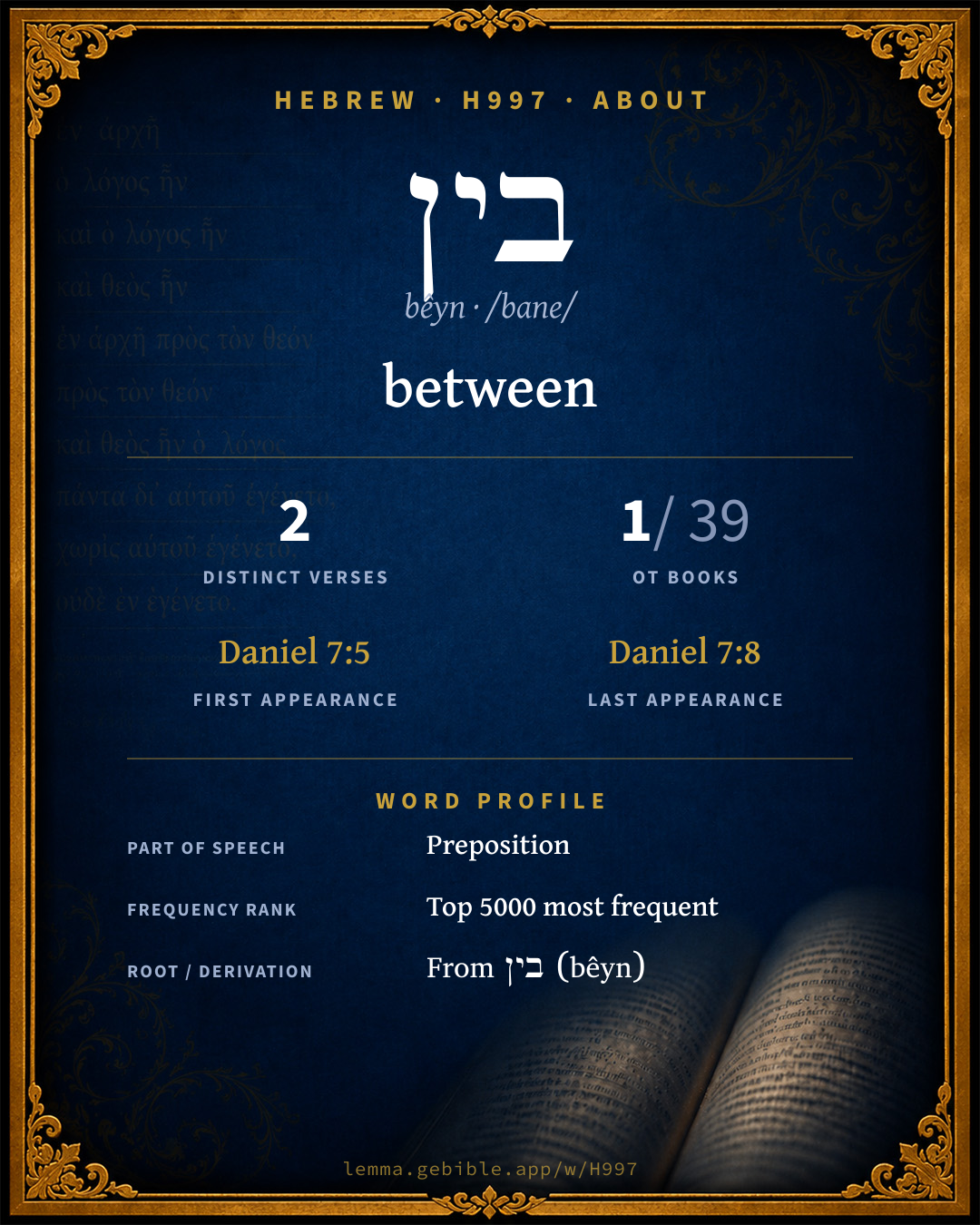
בֵּין
between
Full lexicon entry — Brown-Driver-Briggs (BDB)
From Brown-Driver-Briggs (BDB)
Where this word appears
Grammar key — what these labels mean
Part of speech
- Preposition
- A relational word (e.g. “in,” “to,” “from”) governing a noun.
Every verse where H997 appears — 2 distinct verses across 1 book. Click any verse to open its interlinear word-by-word view. Verse text shown in the World English Bible for context — . Each verse’s Hebrew form is shown with its reference; the English is not keyword-highlighted, since the data carries no word-level English alignment. Use “Compare translations” on any verse to read it across multiple English versions. This concordance covers the Hebrew Bible; Septuagint (Greek Old Testament) occurrences are not indexed here.
Daniel 2 verses
- Daniel 7:5 בֵּ֣ין prep Behold, another animal, a second, like a bear; and it was raised up on one side, and three ribs were in its mouth between its teeth: and they said thus to it, Arise, devour much flesh.
- Daniel 7:8 ביני/הון בֵּֽינֵי/הֵ֔ן prep + sfx pers 3mp prep + sfx pers 3fp I considered the horns, and, behold, there came up among them another horn, a little one, before which three of the first horns were plucked up by the roots: and, behold, in this horn were eyes like the eyes of a man, and a mouth speaking great things.
About this entry
At a glance — auto-summarized from this page’s data, not written by a person. Every figure links to its source below. This summary describes the numbers; it doesn’t interpret them.
“between” is the headline sense of the Hebrew preposition בין (bêyn). A scarce word — 2 verses in all of the Hebrew Bible. It clusters heavily in Daniel, which alone accounts for 100% of its uses. Its earliest occurrence is Daniel 7:5. It clusters with בין and בנים under a shared root. See the sense tree, 2-verse concordance, and the renderings breakdown below.
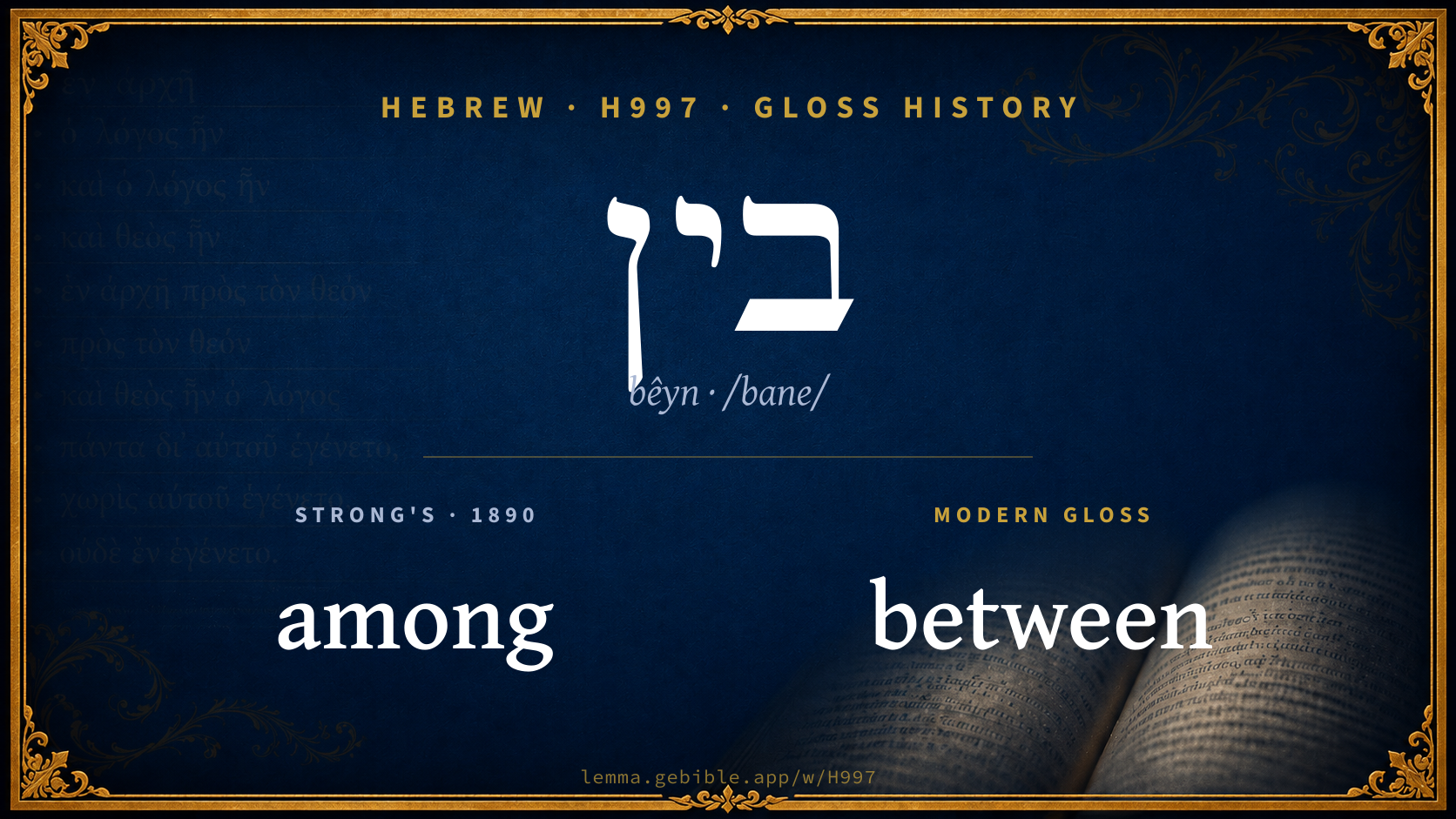
Gloss history
Strong's 1890 vs modern scholarship
About this word
Strong's H997 catalogs a Hebrew word from the Hebrew Old Testament.
These counts are not copied from any lexicon or concordance. They are computed here, from the morphology-tagged Hebrew Old Testament. What Lemma adds →
- 2
- distinct verses
- The word appears in 2 distinct verses.
- 1 / 39
- OT books
- The word appears in 1 of 39 Old Testament books.
- #4,179
- by frequency
- Top 5000 most frequent Hebrew words (rank 4,179 of 8,640 Hebrew words by occurrence).
View all 2 occurrences in the concordance →
Most concentrated in
- Daniel 2 verses 100%
By section of the Old Testament
By traditional corpus
Conventional, traditional groupings — biblical authorship is debated, so this is a traditional corpus grouping, not an authorship claim. Each share is this word’s portion of its verses in that division of the Hebrew canon. Each figure is a share of the word’s 2 distinct verses.
- Writings (Ketuvim) 2 verses · 100%
How translations render this word
Counts come from each version’s own published word-to-Strong’s tagging or interlinear alignment — an approximate guide to how each version renders this word, not a word-level alignment the data otherwise carries. Because each total is that version’s own tagged count, the per-version totals vary from one another and need not match the appearance or distinct-verse counts above. These counts may also differ from a printed concordance because Lemma counts each distinctly tagged rendering and does not collapse phrase taggings into a single head-word total. This is a fixed set of word-tagged versions (KJV, ASV, BSB, ULT) and does not change with the reading translation you choose elsewhere. Each version’s license is shown beside its name below (and on Sources).
- King James Version: Among 1×, Between 1×
- American Standard Version: Among 1×, Between 1×
- Berean Standard Bible: Among them 1×, Between 1×
- unfoldingWord Literal Text: Among them 1×, Between 1×
King James Version Public Domain
Renders H997 across 2 tagged occurrences — most commonly:
American Standard Version Public Domain
Renders H997 across 2 tagged occurrences — most commonly:
Berean Standard Bible Public Domain
Renders H997 across 2 tagged occurrences — most commonly:
unfoldingWord Literal Text CC BY-SA 4.0
Renders H997 across 2 tagged occurrences — most commonly:
Senses in BDB
The 1 sense BDB distinguishes for this word, in lexicon order (not ranked by frequency or importance). The full entry — with sub-senses — is in the Lexicon Entry tab.
- between
Word origin
בֵּין prep. between (BH [ בַּ֫יִן ])
— Brown-Driver-Briggs (Oxford 1906, public domain), digitized via Sefaria, supplemented by the OpenScriptures HebrewLexicon (CC BY 4.0). See Sources.
Derived from בין (bêyn) (H996) — between.
Jastrow Dictionary
A second Hebrew/Aramaic lexicon for comparison, covering Aramaic and post-biblical (Talmudic, Targumic, Midrashic) usage that the biblical-Hebrew BDB does not. Matched by lemma rather than by Strong’s number, so a lemma may carry more than one Jastrow headword (shown separately below), and the entries cover usage well beyond the Bible.
בִּין
- , v. בוא) to pierce, split, penetrate; whence, to discern, understand; v. Hif.
- (cmp. בֵּין) to cause to penetrate, to saturate. Sifra Vayikra, N’dab., Par. 12, ch. XIV (ref. to Lev. II, 13) יכול תְּבוֹנֵּהוּ from bammelaḥ I might judge, ‘thou must thoroughly saturate it, ת"ל תמלח therefore it says, ‘timlaḥ’ (thou shalt strew). Men. 21ᵃ (quoting Sifra l. c.) מאי תבונהו what does the word t’bonnehu mean? Said R. b. U. ה"ק יכול יִתְבֹּונֶנּוּ כתבן (taking ת as radical, as if imperat. of a verb תבן, denom. of תֶּבֶן) it means, I might suppose, he must mix it up like straw in clay (v. infra). Said A. to him א"ה יתבוננו מיבעי ליה if so, then it ought to read (in the Sifra) yithbonennu (third person). But said A. (taking it fr. בנה) יכול יעשנו כבניין I might suppose, he shall heap the salt upon it like a building (a pile). Said R. to him, א"ה יבננו מיבעי ליה then it ought to read yibnennu. But said R. (you must correct the Sifra so as to read) יכול תבוניהו (corr. תָּבִינֵיהוּ) thou shalt make it savory … יתן בו טעם כבינה he shall put a taste into it as does understanding into a man, v. טַעַם. [Yalk. Lev. 454: מאי יתבנהו … יכול יתבלנו כתבן וטיט … תבלנו מ"ל … יכול יעשנו כבנין … א"ה.יבנהו מ"ל … יכול תבינהו … יכול יתן בו טעם בבינה—Ar. ed. Koh.: יכול תבניהו … מאי תבניהו … יכול יתבלנו (הרבה במלח) כתבן בטיט … יכול יתן בו טעם, correct: יכול תבינהו יתן וכ׳.] e.g. Leviticus 2:13
- (cmp. הוֹבִיר, s. v. בּוּר) (denomin. of בֵּין) to mediate, to be interpreter. Ab. Zar. III, 5 (45ᵃ) אני אוֹבִין לפניך (v. Rabb. D. S. a. l. note 8) let me be thy interpreter (let me explain what you mean) כל מקום וכ׳ (the words על ההרים וכ׳, Deut. XII, 2, are explanatory) wherever thou findest a high mountain &c., know there must be an idol. [In the version אני אהיה אובין וכ׳, אוֹבֵין is used as a part. of a verb אָבֵין, denomin. of בֵּין, to act as a mediator or interpreter.] 2) הֵבִין (b. h.) to perceive, make intelligible, esp. to find analogies (between two cases). ה׳ דבר מתוך דבר prop. to bring out one thing from between another, i.e. to form a conclusion by analogy. Sabb. 31ᵃ הֵבַנְתָּה וכ׳ hast thou cultivated thy mind to conclude &c. (ref. to דעת Is. XXXIII, 6). Snh. 93ᵇ; a. fr. Ḥag. II, 1 (11ᵇ) חכם מֵבִין מדעתו (not ומבין, v. Rabb. D. S. a. l. note) a student able to speculate by himself, a thinker.—Ib. 13ᵃ bot. היה מֵבִין בהשמל speculated over the ḥashmal (Ezek. I, 27); a. fr. e.g. Deuteronomy 12:2
- to understand one’s self, to be careful, to reflect. B. Kam. 27ᵇ להתבונן בדרכים to look around on roads (to be prepared for something in their way against which they might strike). Gen. R. s. 34 ויבן כתי׳ נתבונן the word ויבן (he built, Gen. VIII, 20) may be read vayaben, i.e. he reflected, argued. e.g. Genesis 8:20
בִּין ²
- ; v. infra.—Pa. בַּיֵּין, בַּיֵּן to teach, make wise. Targ. Ps. CXIX, 27. Targ. Job XXXII, 8. Ib. v. 9 יְבַיְּנוּן דינא explain the law (ed. Vienn. יְבִינוּן, Pe., understand).
- to reflect upon, to understand. Targ. Job XXXII, 12. Ib. XXVIII, 23; a. fr.
- to be considerate, cautious. Lam. R. to I, 16, beg., v. בְּחִי.
בַּיִן
- , only in constr. בֵּין, בינת־ (b. h.; preced., cmp. ביין, באיין) something split, or placed between; prep. between, among.—אין בין … ל there is no difference betw. … and … Meg. I, 5; a. fr.—בין השמשות (abbr. בה"ש) at twilight, dusk; v. בֵּי. Ab. V, 6; a. fr.—… ב׳ … ב׳ both … as well as … B. Kam. IV, 3; a. fr.—Yeb. 23ᵃ ב׳ אומרים לו וכ׳ whether the law says to thy father …, or &c. Koh. R. to VII, 11 בין ווי לוה וכ׳ owing to the difference between vay (woe) and vah (ah), R. J. escaped.—דברים שֶׁבֵּינוֹ לְבֵינָהּ private affairs concerning him (the husband) and her (the wife). Ned. 79ᵇ; a. fr.—Du. בֵּינַיִים, בֵּנַיִים, בֵּינְתַּיִים, בֵּנְתַּיִם (for בֵּינוֹתַיִם) between two, among, amid. Gen. R. s. 4 ביניים ובינתיים in the very centre. Y. Ber. II, 5ᵇ top. Y. Maasr. I, beg. 48ᶜ טול מבנת׳ take from what is between the two, i.e. qualifications common to both; a. fr.—Constr. בֵּינֵי־. Nidd. 67ᵇ מפסקת בֵּינֵיהֶן intervening between; a. fr.
בֵּין
- usu. pl. בֵּינֵי ch. same. Targ. Gen. I, 6; a. fr.—Ḥull. 114ᵃ; Sabb. 132ᵇ אתיא מִבֵּינַיָּיא from between the two (from both cases combined) it may be concluded.—מאי בֵינַיְיהוּ (abbr. מ"ב) wherein do they differ? איכא בינייהו (abbr. א"ב) they differ as to … B. Mets. 15ᵇ; a. v. fr.—ביני וביני a) in the meantime. Yeb. 71ᵇ; a. fr.—b) the difference between (these and other goods). Bets. 7ᵃ; a. fr.—Ḥull. 47ᵃ ההוא ב׳ וב׳ a case (of an abnormal lobe) between the normal lungs. [Targ. Am. IX, 9 מִבֵּינָהּ, Var. מבינא, read מִבֵּינֵיה from between its meshes.]
A Dictionary of the Targumim, the Talmud Babli and Yerushalmi, and the Midrashic Literature (Marcus Jastrow; London, Luzac, 1903) — Public Domain. Digitized via Sefaria. Digitized via Sefaria. Full attribution on Sources.
Forms in the corpus
The 3 distinct written forms H997 takes in the Hebrew Bible, most frequent first — each parse links to that state’s occurrences in the concordance. Hebrew forms include their vowel points and cantillation, so a single lemma takes many written forms.
| Form | Parsing | Example | Uses |
|---|---|---|---|
| בֵּ֣ין | Preposition | Daniel 7:5 | 1 |
| בֵּֽינֵי/הֵ֔ן | Preposition | Daniel 7:8 | 1 |
| ביני/הון | Preposition | Daniel 7:8 | 1 |
Same root — word family
Other BDB entries built from the same root as H997, grouped by Strong’s listed origin. These share a root / origin per the lexicon — not necessarily a shared meaning. Each links to that word’s own entry.
Derives from
Shares the same root
Compare all same-root words → They share a root, not necessarily a meaning.
Septuagint verse parallels
This word appears in 2 verses that also exist in the Greek Old Testament (Septuagint), out of the 2 Hebrew verses it occurs in. You can read those verses in Greek by switching the Old Testament edition to the Septuagint.
Read these verses in the Septuagint
This is a verse-level parallel only — the same verses exist in both the Hebrew and Greek Old Testaments. No word-level Hebrew↔Greek correspondence is claimed: the data carries no such alignment, so no Greek word is shown as this Hebrew word’s translation. Coverage is not total — the Septuagint omits the deuterocanon and renumbers the Psalms, so some Hebrew verses have no direct Greek parallel.