Joshua 22:34

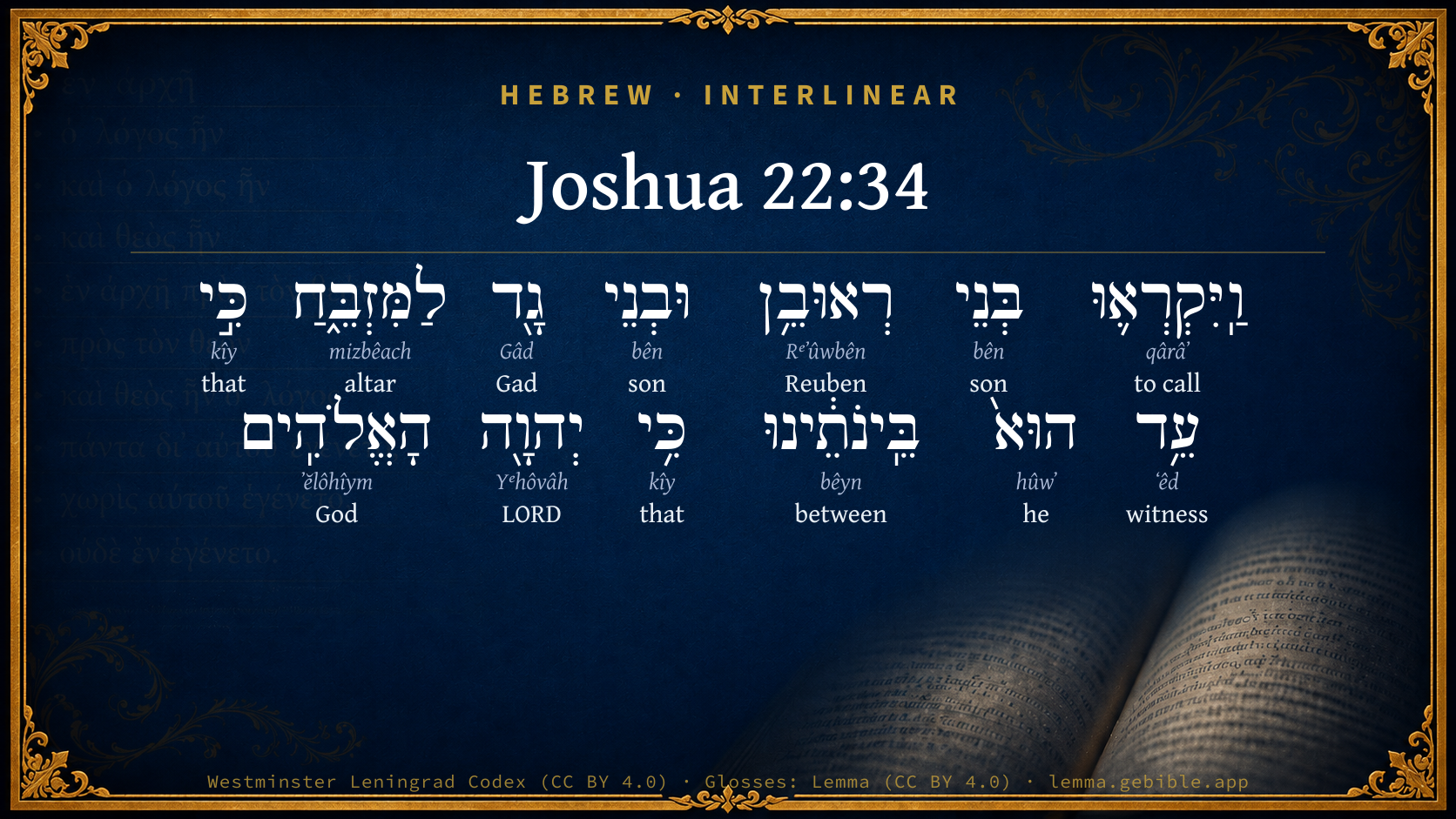
Hebrew (Westminster Leningrad Codex) Joshua 22:34 appears in the Hebrew Old Testament. The text above is from the Westminster Leningrad Codex. Each word links to its Strong’s number, a concise gloss, and parsing drawn from the Open Scriptures Hebrew Bible morphology. Click any word for its full Brown-Driver-Briggs (BDB) entry.
Download image
Cite this verse

Joshua 22:34 (World English Bible). Public Domain. Lemma interlinear Bible study tool, https://lemma.gebible.app/v/joshua/22/34.

Show BibTeX & RIS
BibTeX
RIS
English Translation
The children of Reuben and the children of Gad called the altar [Ed]: For, [said they], it is a witness between us that Yahweh is God.
World English Bible · Public Domain
Download a study sheet

One document with this verse’s original text, its word-by-word gloss line, the meaning frame, cross-references with their text, attributed commentary, and full source and license credits — printable, and it pastes into notes with its structure intact.

This verse Autodidact and up

Study sheet (.html) Plain text (.txt)

A passage Seminary Student

Up to 50 verses in one chapter. A passage sheet keeps up to 6 commentary sources and 12 cross-references per verse, in the order this page ranks them, and says so on the sheet whenever that leaves anything out. Ask for a single verse and you get the Autodidact verse sheet above.

Everything on this page stays free to read, with no account — the sheet is a download of what is already on screen, not access to it.

Want to remove ads? Support Godless Engineer
Compare translations 3

The same verse in 3 English versions, stacked beneath the original-language interlinear above. Click any original word for its lexicon entry.

Each is an independent rendering of the whole verse — the interlinear is not word-aligned to these translations.

Highlighted words mark where these versions differ — a whole-verse word diff, not a word-by-word alignment.

  • World English Bible Public Domain
    The children of Reuben and the children of Gad called the altar [Ed]: For, [said they], it is a witness between us that Yahweh is God.
  • King James Version Public Domain
    And the children of Reuben and the children of Gad called the altar Ed: for it shall be a witness between us that the LORD is God.
  • unfoldingWord Literal Text CC BY-SA 4.0
    For the sons of Reuben and the sons of Gad had called the altar, “For it a witness between us that Yahweh God.”

unfoldingWord Literal Text — © unfoldingWord, licensed CC BY-SA 4.0. Word-aligned USFM3 via Door43 (git.door43.org/unfoldingWord/en_ult).

Versions to compare (up to 4)

3 of 4 selected

Show all 18 translations

Every available English version of this verse, each an independent rendering of the whole verse.

  • World English Bible Public Domain
    The children of Reuben and the children of Gad called the altar [Ed]: For, [said they], it is a witness between us that Yahweh is God.
  • Berean Standard Bible Public Domain
    So the Reubenites and Gadites named the altar Witness, for they said, “It is a witness between us that the LORD is God.”
  • Majority Standard Bible Public Domain
    So the Reubenites and Gadites named the altar Witness, for they said, “It is a witness between us that the LORD is God.”
  • King James Version Public Domain
    And the children of Reuben and the children of Gad called the altar Ed: for it shall be a witness between us that the LORD is God.
  • American Standard Version (1901) Public Domain
    And the children of Reuben and the children of Gad called the altar `Ed': For, `said they', it is a witness between us that Jehovah is God.
  • Revised Version (1885) Public Domain
    And the children of Reuben and the children of Gad called the altar Ed: For, said they, it is a witness between us that the LORD is God.
  • Geneva Bible (1599) Public Domain
    Then the children of Reuben, and the children of Gad called the altar Ed: for it shall be a witnesse betweene vs, that the Lord is God.
  • Douay-Rheims (1899) Public Domain
    And the children of Ruben, and the children of Cad called the altar which they had built, Our testimony, that the Lord is God.
  • Young's Literal Translation Public Domain
    And the sons of Reuben and the sons of Gad proclaim concerning the altar, that `it `is' a witness between us that Jehovah `is' God.'
  • Literal Standard Version CC BY-SA 4.0
    And the sons of Reuben and the sons of Gad proclaim concerning the altar, that, “[It is] a witness between us that YHWH [is] God.”
  • Unlocked Literal Bible CC BY-SA 4.0
    The Reubenites and the Gadites named the altar “Witness,” for they said, “It is a witness between us that Yahweh is God.”
  • unfoldingWord Literal Text CC BY-SA 4.0
    For the sons of Reuben and the sons of Gad had called the altar, “For it a witness between us that Yahweh God.”
  • Darby Bible Public Domain
    And the children of Reuben and the children of Gad gave a name to the altar; for it is a witness between us that Jehovah is God.
  • World Messianic Bible Public Domain
    The children of Reuben and the children of Gad named the altar “A Witness Between Us that the LORD is God.”
  • Webster's Bible Public Domain
    And the children of Reuben and the children of Gad called the altar Ed: for it shall be a witness between us that the LORD is God.
  • Free Bible Version CC BY-SA 4.0
    The tribes of Reuben and Gad called the altar, “Witness,” because they said, “It is a witness between us that the Lord is also our God.”
  • Bible in Basic English Public Domain
    And the children of Reuben and the children of Gad gave to that altar the name of Ed. For, they said, It is a witness between us that the Lord is God.
  • JPS Tanakh (1917) Public Domain
    And the children of Reuben and the children of Gad called the altar —: 'for it is a witness between us that the LORD is God.'

Literal Standard Version (2020), Covenant Press — licensed CC BY-SA 4.0. Text via the HelloAO Bible API (eBible.org). Unlocked Literal Bible (unfoldingWord) — licensed CC BY-SA 4.0. Text via the HelloAO Bible API (eBible.org). unfoldingWord Literal Text — © unfoldingWord, licensed CC BY-SA 4.0. Word-aligned USFM3 via Door43 (git.door43.org/unfoldingWord/en_ult). Free Bible Version, Dr. Jonathan Gallagher — licensed CC BY-SA 4.0. Text via the HelloAO Bible API (eBible.org).

Word by word

More ways to search: Search by grammar → Find every occurrence → Compare this word →

Practice this passage: Drill this verse → Learn its vocabulary →

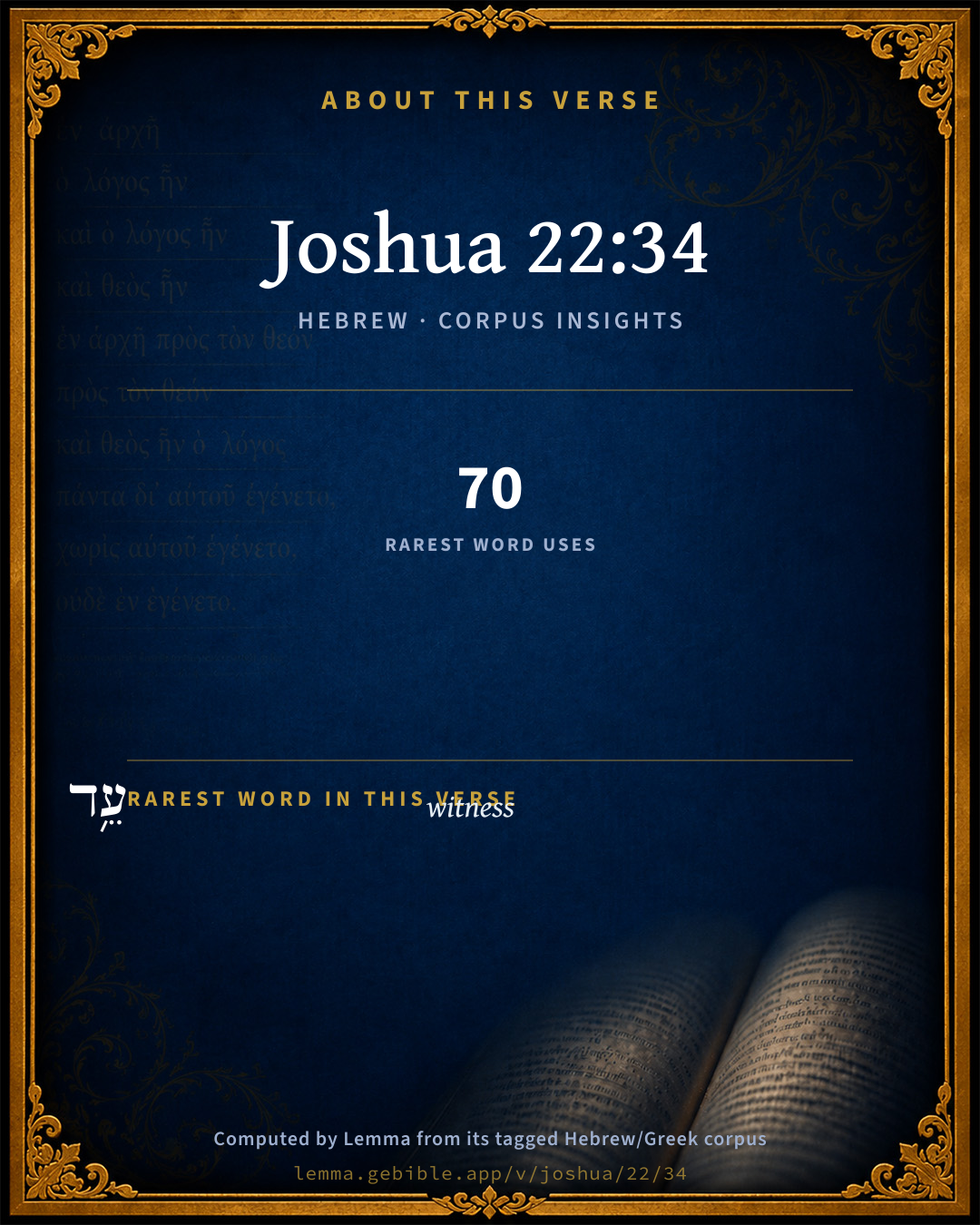
עֵ֥ד
ʻêd
H5707
“witness”
Noun, Common, Masculine, Singular, Absolute
Part of Speech
Noun
Type
Common
Gender
Masculine
Number
Singular
State
Absolute
Full BDB Definition

Origin: contracted from H5749

TWOT: 1576b

witness - witness, testimony, evidence (of things) - witness (of people)
  1. וַֽיִּקְרְא֛וּ qârâʼ H7121 “and · to call” Conjunction + Verb, Qal, Sequential Imperfect, 3rd Person, Masculine, Plural
  2. בְּנֵי bên H1121 “sons of” Noun, Common, Masculine, Plural, Construct
  3. רְאוּבֵ֥ן Rᵉʼûwbên H7205 “Reuben” Noun, Proper
  4. וּבְנֵי bên H1121 “and · sons of” Conjunction + Noun, Common, Masculine, Plural, Construct
  5. גָ֖ד Gâd H1410 “Gad” Noun, Proper
  6. לַמִּזְבֵּ֑חַ mizbêach H4196 “to/for the · altar” Preposition, Determined + Noun, Common, Masculine, Singular, Absolute
  7. כִּ֣י kîy H3588 “that” Conjunction
  8. הוּא֙ hûwʼ H1931 “he” Pronoun, Personal, 3rd Person, Masculine, Singular
  9. בֵּֽינֹתֵ֔ינוּ bêyn H996 “between · us” Preposition + Suffix, Personal, 1st Person, Common, Plural
  10. כִּ֥י kîy H3588 “that” Conjunction
  11. יְהוָ֖ה Yᵉhôvâh H3068 “LORD” Noun, Proper
  12. הָאֱלֹהִֽים ʼĕlôhîym H430 “the · God(s)” Particle, Definite Article + Noun, Common, Masculine, Plural, Absolute

About this verse

These counts appear in no published source. They are computed here, from the morphology-tagged text and Lemma’s own curated glosses. What Lemma adds →

13
words
11
distinct lemmas
Historical
section

Grammatical profile

  • 1 verb
  • 8 nouns
  • 1 pronoun
  • 1 preposition
  • 2 conjunctions

Verb forms

  • וַֽיִּקְרְא֛וּ Qal · Sequential Imperfect

Repetition

Words recur within this verse — often emphatic in Hebrew:

  • בְּנֵי son H1121 ×2
  • כִּ֣י that H3588 ×2

Hebrew & Septuagint length

In English translation the verse runs 26 words from the Hebrew and 41 from the Septuagint (LXX English) — the Septuagint runs noticeably longer here. See the side-by-side →

A rough comparison of the two English renderings, which tokenize alike — not a word-level alignment.

Word counts can differ between the Hebrew and the Greek without any difference in meaning — e.g. the Hebrew direct-object marker אֵת has no separate Greek word, and Greek often adds the article ὁ.

Cross-references

5

Topical passages linked to Joshua 22:34 in the Treasury of Scripture Knowledge — connected by theme and wording, ordered by reader-vote popularity; previews shown in the World English Bible.

  • Joshua 22:27 but it shall be a witness between us and you, and between our generations after us, that we may do the service of Yahweh before him with our burnt offerings, and with our sacrifices, and with our peace-offerings; that your children may not tell our children in time to come, You have no portion in Yahweh.
  • Isaiah 43:10 You are my witnesses, says Yahweh, and my servant whom I have chosen; that you may know and believe me, and understand that I am he: before me there was no God formed, neither shall there be after me.
  • Matthew 4:10 Then Jesus said to him, "Get behind me, Satan! For it is written, 'You shall worship the Lord your God, and him only shall you serve.'"
  • Joshua 24:27 Joshua said to all the people, Behold, this stone shall be a witness against us; for it has heard all the words of Yahweh which he spoke to us: it shall be therefore a witness against you, lest you deny your God.
  • 1 Kings 18:39 When all the people saw it, they fell on their faces: and they said, Yahweh, he is God; Yahweh, he is God.

Cross-references courtesy of OpenBible.info (CC BY 4.0).

Hebrew and Greek witnesses Masoretic Hebrew ↔ Greek Septuagint

The same verse in the two great witnesses to the Old Testament, shown verse-for-verse.

Here the Septuagint runs noticeably longer than the Hebrew — LXX2012 (modern English Septuagint) 41 words vs World English Bible 26. A rough length comparison of the two English translations, not a word-level alignment — read both below.

These are two independent witnesses, not word-aligned to each other, and the Septuagint is shown in lemma (dictionary) form.

Hebrew Joshua 22:34 Masoretic · Westminster Leningrad Codex

וַֽיִּקְרְא֛וּ בְּנֵי רְאוּבֵ֥ן וּבְנֵי גָ֖ד לַמִּזְבֵּ֑חַ כִּ֣י עֵ֥ד הוּא֙ בֵּֽינֹתֵ֔ינוּ כִּ֥י יְהוָ֖ה הָאֱלֹהִֽים

The children of Reuben and the children of Gad called the altar [Ed]: For, [said they], it is a witness between us that Yahweh is God.

World English Bible · Public Domain

Greek LXX Joshua 22:34 Septuagint · lemma form

καί ἐπιὀνομάζω ἰησοῦς ὁ βωμός ὁ ρουβην καί ὁ γαδ καί ὁ ἥμισυς φυλή μανασσή καί εἶπον ὅτι μαρτύριον εἰμί ἀνά μέσος αὐτός ὅτι κύριος ὁ θεός αὐτός εἰμί

And Joshua gave a name to the altar of the children of Ruben, and the children of Gad, and the half tribe of Manasse; and said, It is a testimony in the midst of them, that the Lord is their God.

LXX2012 (modern English Septuagint) · Public Domain

On this verse, The Cambridge Bible for Schools and Colleges discusses the Septuagint’s reading. Read the note in Commentary ↓

Hebrew: Westminster Leningrad Codex (CC BY 4.0). Greek: Septuagint (public domain); English from LXX2012 (modern English Septuagint) (Public Domain). How the Septuagint differs from the Hebrew →

Targum (Aramaic paraphrase)

1

The Targum is the ancient Jewish Aramaic paraphrase of the Hebrew Scriptures — an interpretive translation, not the Hebrew text itself. Onkelos (literal) and Pseudo-Jonathan (expansive) render the Torah, and Jonathan the Prophets. Coverage is partial: where no permissively-licensed English translation exists for a verse, only the Aramaic is shown. This is verse-level text, not a word-by-word alignment to the Hebrew.

  1. Targum Jonathan Prophets (Joshua–Malachi)
    וּקְרוֹ בְּנֵי רְאוּבֵן וּבְנֵי גָד לְמַדְבְּחָא אֲרֵי סָהִיד הוּא בֵּינָנָא אֲרֵי יְיָ הוּא אֱלֹהִים:

    (no public-domain English translation for this verse)

    Targum Jonathan — Aramaic: “Mikraot Gedolot” (public domain). English: “Sefaria Community Translation” (CC0 1.0 (public-domain dedication)); “London "Chaldee Paraphrase," 1871” (public domain). Text via Sefaria.

Commentary

Notes on Joshua 22:34 from classic Christian and Jewish commentators (each source and its license shown beneath its notes). The classic Christian expositions comment on the surrounding passage and are grouped to its opening verse, so a note may address several verses; the Jewish commentaries on the Tanakh (Rashi and others) are per-verse, so they appear only where the commentator wrote on this verse.

Lemma curates 59 commentaries, every one of them public domain or Creative Commons licensed, each selected and text-cleaned for this edition rather than reprinted as found. About our sources →

Joseph Benson's Commentary

Jos 22:34. They called the altar Ed — That is, a witness; a witness of the relation they stood in to God and Israel, and of their concurrence with the other tribes in the common faith, that Jehovah he is God. It was a witness to posterity of their care to transmit their religion pure and entire; and it would be a witness against them, if ever they should turn from following the Lord.

Joseph Benson's Commentary on the Old and New Testaments (1811–1818) — public domain. Text from a community e-Sword module.

Keil & Delitzsch

C. F. Keil & F. Delitzsch

The Reubenites and Gadites (half Manasseh is omitted in Jos 22:33, Jos 22:34, for the sake of brevity) called the altar "witness is it between us that Jehovah is God" (כּי introduces the words). This is at once a name and an explanation, namely in this sense: they gave the altar the name of "witness between us," because it was to be a witness that they also acknowledged and worshipped Jehovah as the true God.

Keil & Delitzsch — Biblical Commentary on the Old Testament (1861–1891) — public domain (CC PDM 1.0). Text via the HelloAO Bible API. (Old Testament only.)

Tyndale Open Study Notes

Tyndale Open Resources

22:34 Witness: Hebrew texts that include this word interpret the last statement as an explanation of the name. Texts that omit the word understand the last quotation to be the name of the altar.

Tyndale Open Study Notes — © Tyndale Open Resources, licensed CC BY-SA 4.0. Text via the HelloAO Bible API.

Geneva Bible (1599)

Geneva Bible translators

Or, witness, as verse 27.

Geneva Bible (1599) marginal notes — public domain. Text via Bolls.life.

Adam Clarke's Commentary

Verse 34. Called the altar Ed] The word עד ED, which signifies witness or testimony, is not found in the common editions of the Hebrew Bible, and is supplied in Italics by our translators, at least in our modern copies; for in the first edition of this translation it stands in the text without any note of this kind; and it is found in several of Kennicott's and De Rossi's MSS., and also in the Syriac and Arabic. Several also of the early printed editions of the Hebrew Bible have the word עד, either in the text or in the margin, and it must be allowed to be necessary to complete the sense. It is very probable that an inscription was put on this altar, which pointed out the purposes for which it was erected.

FROM the contents of this chapter we learn that the Israelites were dreadfully alarmed at the prospect of a schism in their own body, both as it related to ecclesiastical and civil matters. A few observations on this subject may not be useless.

Schism in religion is a dangerous thing, and should be carefully avoided by all who fear God. But this word should be well understood. Σχισμα, in theology, is generally allowed to signify a rent in, or departure from, the doctrine and practice of the apostles, especially among those who had been previously united in that doctrine and practice. A departure from human institutions in religion is no schism, for this reason that the WORD OF GOD alone is the sufficient rule of the faith and practice of Christians; and as to human institutions, forms, modes, c., those of one party may be as good as those of another.

When the majority of a nation agrees in some particular forms and modes in their religious service no conscientious man will lightly depart from these; nor depart at all, unless he find that they are not only not authorized by the word of God, but repugnant to it. It is an object greatly to be desired, that a whole people, living under the same laws may, as much as possible, glorify God, not only with one heart, but also with one mouth.

But there may be a dissent from established forms without schism; for if that dissent make no rent in the doctrines or practice of Christianity, as laid down in the New Testament, it is an abuse of terms to call it a schism; besides, there may be a dissent among religious people relative to certain points both in creed and practice, which, not affecting the essentials of Christianity, nor having any direct tendency to alienate the affections of Christians from each other, cannot be called a schism; but when professing Christians separate from each other, to set up one needless or non-essential form, c., in the place of others which they call needless or non-essential, they are highly culpable. This not only produces no good, but tends to much evil for both parties, in order to make the points of their difference of sufficient consequence to justify their dissension, magnify these non-essential matters beyond all reason, and sometimes beyond conscience itself: and thus mint and cummin are tithed, while the weightier matters of the law - judgment and the love of God - are utterly neglected. If Christians either cannot or will not think alike on all points, surely they can agree to disagree, and let each go to heaven his own way. "But should we take this advice, would it not lead to a total indifference about religion?" Not at all; for in the things which concern the essentials of Christianity, both in doctrine and practice, we should ever feel zealously affected, and earnestly contend for the faith once delivered to the saints.

Adam Clarke's Commentary on the Bible (1810–1826) — public domain. Text from a community e-Sword/MySword module.

Ellicott's Commentary for English Readers

(34) That the Lord (i.e., Jehovah) is God (of all the twelve tribes alike).

A Bible Commentary for English Readers, edited by Charles John Ellicott (1878–1897) — public domain. Text from a community e-Sword module.

The Cambridge Bible for Schools and Colleges

gen. ed. J. J. S. Perowne

34. called the altar Ed] The word Ed is not found after altar in the Hebrew, nor is it represented in the LXX. or Vulgate, nor are the words in the next clause, “shall be,” in the original. The words indicate the title which was placed upon the altar, “a witness between us that the Lord is God.” Wyclif renders the verse, “And the sones of Ruben and the sones of Gad clepen the auter, that thei hadden maad, Oure Witnessynge, that the Lord he be God.”

The Cambridge Bible for Schools and Colleges (gen. ed. J. J. S. Perowne; Cambridge University Press, 1878–1918) — public domain. Text from a community e-Sword module.

Albert Barnes' Notes on the Bible

The word עד ‛êd is not found after “altar” in the text of most manuscripts, nor is it represented in the Septuagint or Vulgate. The passage should probably run: “the children of Reuben and the children of Gad named the altar, that (as they said) it might be, etc.” The title placed on the altar was perhaps simply a witness between them that the Lord was God (Wordsworth).

Albert Barnes' Notes on the Bible (1834–1885) — public domain. Text from a community e-Sword/MySword module.

Haydock's Catholic Bible Commentary

God. Hebrew seems rather defective; (Calmet) "called the altar, (Syriac supplies the altar of witness) for it shall be a witness between us, that the Lord he is the God. Ed, "witness," is placed in the margin of Plantin’s edition (Kennicott) and the Protestants have inserted it in the text, though in a different character, (Haydock) as "it is confirmed by the Syriac, Arabic, and Vulgate versions." Kimchi quotes the Chaldean paraphrase, as having the word seid, "witness," twice, which if read in two places formerly, has been lately omitted in one, as many other alterations have perhaps been made in it, in conformity to the later copies of the Hebrew text. It is still found in one Chaldean manuscript and in that of Masius. Between the two last words of this verse, some Hebrew manuscripts read eva, "He." "The Lord, He is the God;" which not only gives an emphasis, but is expressly confirmed by the Chaldean; and indeed this seems to have been a common form of confessing the belief in the one true God, 3 Kings xviii. 39. (Kennicott, Diss. i.) --- Masius would translate, "They made an inscription upon the altar, declaring that it should be an eternal witness of their attachment to the Lord." Cora, in effect, sometimes means to write, as Alcoran, in the Arabic tongue, signifies "the scripture" (Calmet) of the Mahometans, which they hold in the utmost veneration, as containing the life and doctrine of their great prophet. The Septuagint (Grabe) insinuate that Josue approved of what had been done, "and Jesus gave a name to the altar,....and said, it is a witness in the midst of them, that the Lord God is their God." Thus, instead of war and destruction, which seemed to threaten Israel on all sides, all ended in peace and harmony. If Christians would imitate the conduct of the Israelites, they would not so rashly condemn their neighbours on every idle report; and, if our adversaries would condescend to examine seriously into the grounds of charging idolatry upon us, and on that account waging an eternal war against us, it is to be hoped they would pronounce our doctrine innocent, and reform their own iniquitous proceedings. (Haydock)

George Leo Haydock (1774–1849), Haydock's Catholic Family Bible and Commentary, 1859 edition — public domain. Excludes Psalms (Douay-Rheims chapter numbering differs from Protestant) and Deuterocanonical books (Catholic canon only).

Whedon's Commentary on the Bible

Daniel D. Whedon

34. Ed… shall be — These words are not in the original, nor need they be inserted in the translation. We may correctly render: The children of Gad named the altar that it might be a witness among us that Jehovah is the God. The lessons which this episode teaches are, first, That appearances do not always imply bad motives; second, That we should watch over each other and cautiously rebuke the first departure from God; third, That apostasy from God awakens in the truly pious great solicitude; and, finally, That a conscience void of offence is a great blessing.

Daniel D. Whedon (gen. ed.), Commentary on the Old and New Testaments (1874–1909) — public domain. Text from a community e-Sword module.

The Pulpit Commentary

Ed. This word is not in the original. It is found in some late MSS. and in the Syriac and Arabic versions, but not in the LXX or Chaldee. Even in the MSS. which have it, the word is found sometimes before and sometimes after the Hebrew word signifying "altar." This may either be because, once omitted, it was conjecturally supplied, but it is more probable that it was never there at all. The passage may be rendered, "And the sons of Reuben and the sons of Gad gave a name to the altar, "for it is a witness between us. But it seems more likely that the word "Ed," though not expressed, is in. tended to be understood. The LXX and Vulgate give incorrect renderings of the passage. The Lord is God. Rather, as in 1Ki_18:39, Jehovah is the God; that is, the one true God. Some MSS. have interpolated aWh here from the above cited passage.

Such altars, or mounds, of witness seem not to have been unusual among the Eastern nations. (see Gen_31:47-52)

The Pulpit Commentary (1880–1919), ed. H.D.M. Spence-Jones & Joseph S. Exell — public domain. Text from a community e-Sword module.

John Wesley's Explanatory Notes

The altar Ed - That is, a witness: a witness of the relation they stood in to God and Israel, and of their concurrence with the other tribes in the common faith, that Jehovah he is God. It was a witness to posterity, of their care to transmit their religion pure and entire; and would be a witness against them, if ever they should turn from following the Lord their God.

John Wesley, Explanatory Notes Upon the Whole Bible (1754–1765) — public domain. Text via the GEBible commentary corpus.

Scofield Reference Notes

C. I. Scofield

Ed

i.e. a witness; so Jos 24:27.

The Scofield Reference Bible (1917 edition), notes by C. I. Scofield — public domain. Text from a community e-Sword module.

unfoldingWord translationNotes

Door43 World Missions Community

for they said

This refers to the Reubenites and Gadites.

It is a witness between us

The altar is spoken of as if it were a witness that could testify for the three tribes. (See: Metaphor)

translationWords

testimony

Yahweh

God

unfoldingWord translationNotes — © Distant Shores Media and the Door43 World Missions Community, licensed CC BY-SA 4.0. Source: git.door43.org/Door43/en_tn.

Rashi

Rabbi Shlomo Yitzchaki (Rashi)

And the Bnei Reuvein and Bnei Gad called the altar, for it is a witness. This is one of the shortened verses. One more word should have been added: And the Bnei Reuven and Bnei Gad called the altar ‘witness,’ [for it is etc.]

Rashi on the Tanakh — English translations: “The Judaica Press complete Tanach with Rashi, translated by A. J. Rosenberg” (CC BY 4.0); “Pentateuch with Rashi's commentary by M. Rosenbaum and A.M. Silbermann, 1929-1934” (public domain); “The Metsudah Tanach series, Lakewood, N.J” (CC BY 4.0); and “The Book of Joshua, Metsudah Publications, 1997” (CC BY 4.0). Text via Sefaria.

Lesson kit

Teaching starters — assembled from the data on this page, not authored interpretation. Every prompt links to the verse data it draws on. Edit before teaching.

Joshua, in the Historical, opens this verse with 13 words (11 distinct Hebrew lemmas). Its most distinctive word is ʻêd (“witness”). The Greek Septuagint runs longer here. A historical commentator’s framing appears above. Read the whole chapter for the surrounding context.

Discussion questions

  1. How does “witness” (ʻêd) shape what this verse is saying?
  2. How does Joshua 22:27, which shares this passage’s theme, read alongside this verse?
  3. What does the repetition of “son” (2× in this one verse) do in this verse?
  4. The Septuagint runs longer here than the Hebrew. What might account for the difference?
  5. The translations on this page render this verse differently — a whole-verse word diff, not a word-by-word alignment. What might account for the different wordings?
  6. «וַֽיִּקְרְא֛וּ» is a Qal Sequential Imperfect verb. How does that grammatical form shape the action described?
  7. Compare how Joseph Benson's Commentary and Keil & Delitzsch read this verse. Where do they agree or differ?

Things to notice

Reading settings

Reading text

Shown beneath each verse's original-language words.

Old Testament
Old Testament edition

Read the OT as the Masoretic Hebrew (MT) or the Greek Septuagint (LXX).

English shown for the Greek Septuagint (in the Hebrew ↔ Greek comparison).

Comparing translations? Open the Compare panel on any verse page to stack up to four side by side.