
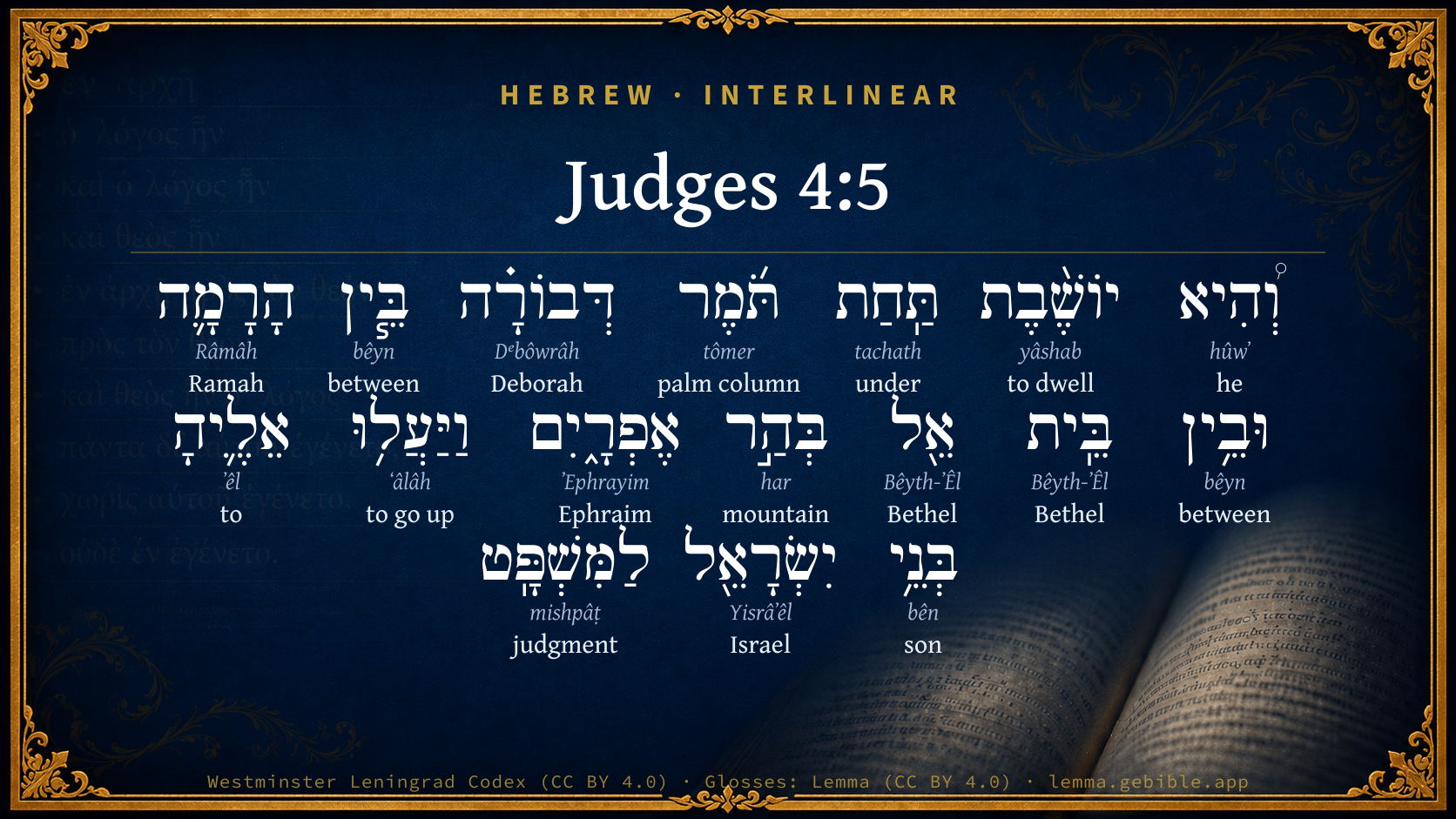
Judges 4:5

Hebrew (Westminster Leningrad Codex) Judges 4:5 appears in the Hebrew Old Testament. The text above is from the Westminster Leningrad Codex. Each word links to its Strong’s number, a concise gloss, and parsing drawn from the Open Scriptures Hebrew Bible morphology. Click any word for its full Brown-Driver-Briggs (BDB) entry.
Download image
Cite this verse

Judges 4:5 (World English Bible). Public Domain. Lemma interlinear Bible study tool, https://lemma.gebible.app/v/judges/4/5.

Show BibTeX & RIS
BibTeX
RIS
English Translation
She lived under the palm tree of Deborah between Ramah and Bethel in the hill-country of Ephraim: and the children of Israel came up to her for judgment.
World English Bible · Public Domain
Highlights
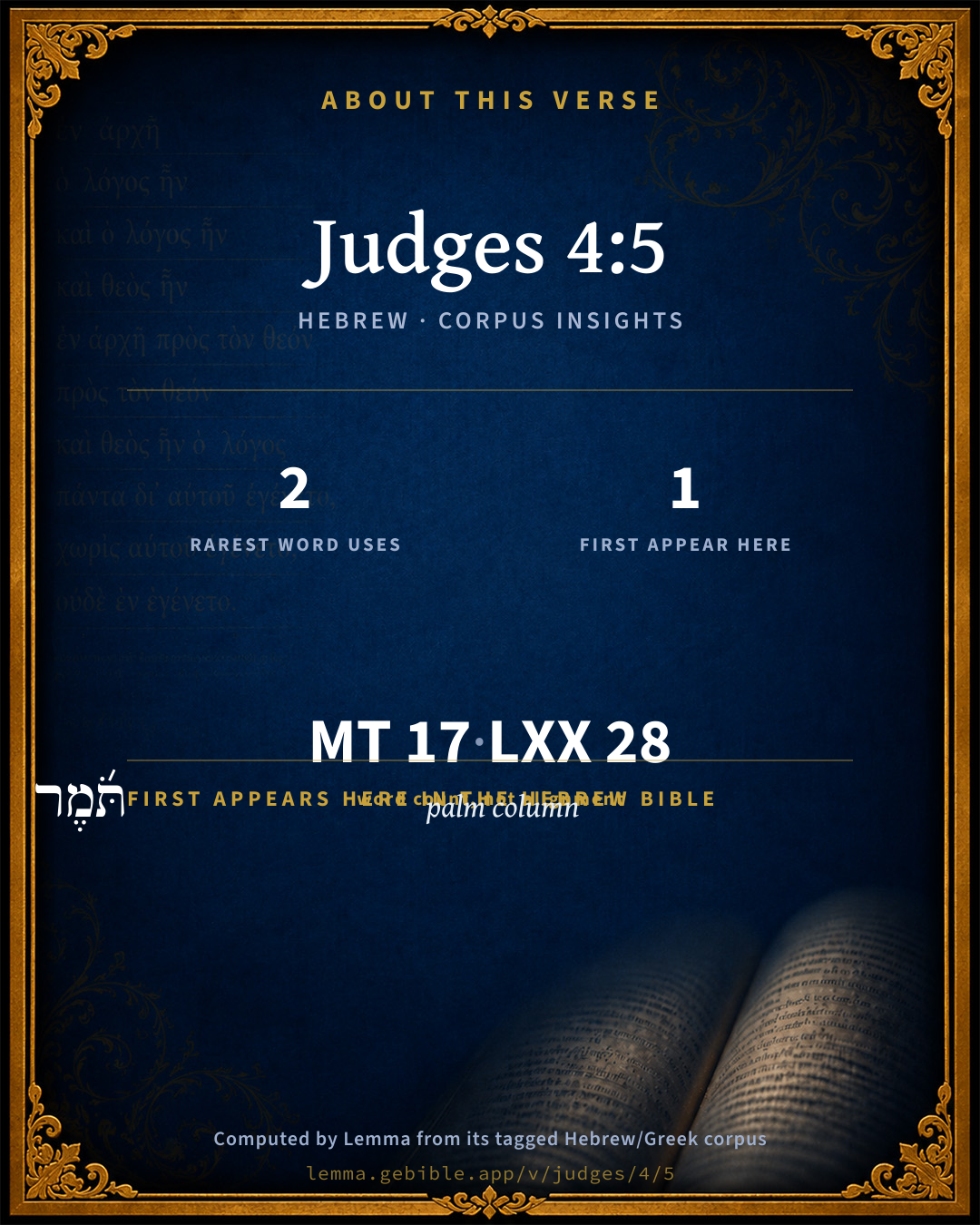
  • 1 first appearance in the Hebrew Bible
Full analysis ↓
Download a study sheet

One document with this verse’s original text, its word-by-word gloss line, the meaning frame, cross-references with their text, attributed commentary, and full source and license credits — printable, and it pastes into notes with its structure intact.

This verse Autodidact and up

Study sheet (.html) Plain text (.txt)

A passage Seminary Student

Up to 50 verses in one chapter. A passage sheet keeps up to 6 commentary sources and 12 cross-references per verse, in the order this page ranks them, and says so on the sheet whenever that leaves anything out. Ask for a single verse and you get the Autodidact verse sheet above.

Everything on this page stays free to read, with no account — the sheet is a download of what is already on screen, not access to it.

Want to remove ads? Support Godless Engineer
Compare translations 3

The same verse in 3 English versions, stacked beneath the original-language interlinear above. Click any original word for its lexicon entry.

Each is an independent rendering of the whole verse — the interlinear is not word-aligned to these translations.

Highlighted words mark where these versions differ — a whole-verse word diff, not a word-by-word alignment.

  • World English Bible Public Domain
    She lived under the palm tree of Deborah between Ramah and Bethel in the hill-country of Ephraim: and the children of Israel came up to her for judgment.
  • King James Version Public Domain
    And she dwelt under the palm tree of Deborah between Ramah and Bethel in mount Ephraim: and the children of Israel came up to her for judgment.
  • unfoldingWord Literal Text CC BY-SA 4.0
    And she sitting beneath the Palm Tree of Deborah, between Ramah and Bethel in the hill country of Ephraim, and the sons of Israel came up to her for justice.

unfoldingWord Literal Text — © unfoldingWord, licensed CC BY-SA 4.0. Word-aligned USFM3 via Door43 (git.door43.org/unfoldingWord/en_ult).

Versions to compare (up to 4)

3 of 4 selected

Show all 18 translations

Every available English version of this verse, each an independent rendering of the whole verse.

  • World English Bible Public Domain
    She lived under the palm tree of Deborah between Ramah and Bethel in the hill-country of Ephraim: and the children of Israel came up to her for judgment.
  • Berean Standard Bible Public Domain
    And she would sit under the Palm of Deborah between Ramah and Bethel in the hill country of Ephraim, where the Israelites would go up to her for judgment.
  • Majority Standard Bible Public Domain
    And she would sit under the Palm of Deborah between Ramah and Bethel in the hill country of Ephraim, where the Israelites would go up to her for judgment.
  • King James Version Public Domain
    And she dwelt under the palm tree of Deborah between Ramah and Bethel in mount Ephraim: and the children of Israel came up to her for judgment.
  • American Standard Version (1901) Public Domain
    And she dwelt under the palm-tree of Deborah between Ramah and Beth-el in the hill-country of Ephraim: and the children of Israel came up to her for judgment.
  • Revised Version (1885) Public Domain
    And she dwelt under the palm tree of Deborah between Ramah and Beth-el in the hill country of Ephraim: and the children of Israel came up to her for judgment.
  • Geneva Bible (1599) Public Domain
    And this Deborah dwelt vnder a palme tree, betweene Ramah and Beth-el in mount Ephraim, and the children of Israel came vp to her for iudgement.
  • Douay-Rheims (1899) Public Domain
    And she sat under a palm tree, which was called by her name, between Rama and Bethel in mount Ephraim: and the children of Israel came up to her for all judgment.
  • Young's Literal Translation Public Domain
    and she is dwelling under the palm-tree of Deborah, between Ramah and Beth-El, in the hill-country of Ephraim, and the sons of Israel go up unto her for judgment.
  • Literal Standard Version CC BY-SA 4.0
    and she is dwelling under the palm-tree of Deborah, between Ramah and Beth-El, in the hill-country of Ephraim, and the sons of Israel go up to her for judgment.
  • Unlocked Literal Bible CC BY-SA 4.0
    She used to sit under the palm of Deborah between Ramah and Bethel in the hill country of Ephraim, and the people of Israel came to her to settle their disputes.
  • unfoldingWord Literal Text CC BY-SA 4.0
    And she sitting beneath the Palm Tree of Deborah, between Ramah and Bethel in the hill country of Ephraim, and the sons of Israel came up to her for justice.
  • Darby Bible Public Domain
    She used to sit under the palm of Deb'orah between Ramah and Bethel in the hill country of E'phraim; and the people of Israel came up to her for judgment.
  • World Messianic Bible Public Domain
    She lived under Deborah’s palm tree between Ramah and Bethel in the hill country of Ephraim; and the children of Israel came up to her for judgment.
  • Webster's Bible Public Domain
    And she dwelt under the palm-tree of Deborah, between Ramah and Beth-el in mount Ephraim: and the children of Israel came up to her for judgment.
  • Free Bible Version CC BY-SA 4.0
    She would sit under Deborah's Palm between Ramah and Bethel in the hill country of Ephraim, and the Israelites would go to her for her decisions.
  • Bible in Basic English Public Domain
    (And she had her seat under the palm-tree of Deborah between Ramah and Beth-el in the hill-country of Ephraim; and the children of Israel came up to her to be judged.)
  • JPS Tanakh (1917) Public Domain
    And she sat under the palm-tree of Deborah between Ramah and Beth-el in the hill-country of Ephraim; and the children of Israel came up to her for judgment.

Literal Standard Version (2020), Covenant Press — licensed CC BY-SA 4.0. Text via the HelloAO Bible API (eBible.org). Unlocked Literal Bible (unfoldingWord) — licensed CC BY-SA 4.0. Text via the HelloAO Bible API (eBible.org). unfoldingWord Literal Text — © unfoldingWord, licensed CC BY-SA 4.0. Word-aligned USFM3 via Door43 (git.door43.org/unfoldingWord/en_ult). Free Bible Version, Dr. Jonathan Gallagher — licensed CC BY-SA 4.0. Text via the HelloAO Bible API (eBible.org).

Word by word

More ways to search: Search by grammar → Find every occurrence → Compare this word →

Practice this passage: Drill this verse → Learn its vocabulary →

תֹּ֜מֶר
tômer
H8560
“palm column of”
Noun, Common, Masculine, Singular, Construct
Part of Speech
Noun
Type
Common
Gender
Masculine
Number
Singular
State
Construct
Full BDB Definition

Origin: from the same root as H8558

TWOT: 2523a

palm tree, post, column
  1. וְ֠הִיא hûwʼ H1931 “and · he” Conjunction + Pronoun, Personal, 3rd Person, Feminine, Singular
  2. יוֹשֶׁ֨בֶת yâshab H3427 “dwelling” Verb, Qal, Participle Active, Feminine, Singular, Absolute
  3. תַּֽחַת tachath H8478 “under” Preposition
  4. דְּבוֹרָ֗ה Dᵉbôwrâh H1683 “Deborah” Noun, Proper
  5. בֵּ֧ין bêyn H996 “between” Preposition
  6. הָרָמָ֛ה Râmâh H7414 “the · Ramah” Particle, Definite Article + Noun, Proper
  7. וּבֵ֥ין bêyn H996 “and · between” Conjunction + Preposition
  8. בֵּֽית Bêyth-ʼÊl H1008 “Bethel” Noun, Proper
  9. אֵ֖ל Bêyth-ʼÊl H1008 “Bethel” Noun, Proper
  10. בְּהַ֣ר har H2022 “in/at · mountain of” Preposition + Noun, Common, Masculine, Singular, Construct
  11. אֶפְרָ֑יִם ʼEphrayim H669 “Ephraim” Noun, Proper
  12. וַיַּעֲל֥וּ ʻâlâh H5927 “and · to go up” Conjunction + Verb, Qal, Sequential Imperfect, 3rd Person, Masculine, Plural
  13. אֵלֶ֛יהָ ʼêl H413 “to · her” Preposition + Suffix, Personal, 3rd Person, Feminine, Singular
  14. בְּנֵ֥י bên H1121 “sons of” Noun, Common, Masculine, Plural, Construct
  15. יִשְׂרָאֵ֖ל Yisrâʼêl H3478 “Israel” Noun, Proper
  16. לַמִּשְׁפָּֽט mishpâṭ H4941 “to/for the · judgment” Preposition, Determined + Noun, Common, Masculine, Singular, Absolute

About this verse

These counts appear in no published source. They are computed here, from the morphology-tagged text and Lemma’s own curated glosses. What Lemma adds →

17
words
15
distinct lemmas
Historical
section

Notable vocabulary

The rarest word here is תֹּ֜מֶר palm column H8560 — appearing just 2 times in the whole Hebrew Bible.

First appearance in Scripture

This word makes its first canonical appearance in the Hebrew Bible here:

  • תֹּ֜מֶר palm column H8560

Shared distinctive vocabulary

תֹּ֜מֶר palm column H8560 occurs in 2 verses of the Hebrew Bible. Also found in:

Grammatical profile

  • 2 verbs
  • 10 nouns
  • 1 pronoun
  • 4 prepositions

Verb forms

  • יוֹשֶׁ֨בֶת Qal · Participle Active
  • וַיַּעֲל֥וּ Qal · Sequential Imperfect

Repetition

Words recur within this verse — often emphatic in Hebrew:

  • בֵּ֧ין between H996 ×2
  • בֵּֽית Bethel H1008 ×2

Hebrew & Septuagint length

In English translation the verse runs 28 words from the Hebrew and 27 from the Septuagint (LXX English) — closely comparable.

A rough comparison of the two English renderings, which tokenize alike — not a word-level alignment.

Word counts can differ between the Hebrew and the Greek without any difference in meaning — e.g. the Hebrew direct-object marker אֵת has no separate Greek word, and Greek often adds the article ὁ.

In the original languages it is 17 Hebrew tokens and 28 Greek tokens — but the two are counted differently (Hebrew bundles its prefixes and suffixes into one token; the Greek is in lemma form), so that isn’t a like-for-like length.

Cross-references

15

Topical passages linked to Judges 4:5 in the Treasury of Scripture Knowledge — connected by theme and wording, ordered by reader-vote popularity; previews shown in the World English Bible.

  • Exodus 18:19 Listen now to my voice. I will give you counsel, and God be with you. You represent the people before God, and bring the causes to God.
  • Genesis 35:8 Deborah, Rebekah's nurse, died, and she was buried below Bethel under the oak; and the name of it was called Allon Bacuth.
  • Exodus 18:13 It happened on the next day, that Moses sat to judge the people, and the people stood around Moses from the morning to the evening.
  • Deuteronomy 17:8–12 If there arise a matter too hard for you in judgment, between blood and blood, between plea and plea, and between stroke and stroke, being matters of controversy within your gates; then shall you arise, and go up to the place which Yahweh your God shall choose;
  • Joshua 16:2 and it went out from Bethel to Luz, and passed along to the border of the Archites to Ataroth;
  • Joshua 18:22 and Beth Arabah, and Zemaraim, and Bethel,
  • Joshua 18:25 Gibeon, and Ramah, and Beeroth,
  • 1 Samuel 1:1 Now there was a certain man of Ramathaim Zophim, of the hill-country of Ephraim, and his name was Elkanah, the son of Jeroham, the son of Elihu, the son of Tohu, the son of Zuph, an Ephraimite:
  • Jeremiah 31:15 Thus says Yahweh: A voice is heard in Ramah, lamentation, and bitter weeping, Rachel weeping for her children; she refuses to be comforted for her children, because they are no more.
  • Exodus 18:16 When they have a matter, they come to me, and I judge between a man and his neighbor, and I make them know the statutes of God, and his laws."
  • Exodus 18:26 They judged the people at all times. They brought the hard causes to Moses, but every small matter they judged themselves.
  • 1 Samuel 1:19 They rose up in the morning early, and worshiped before Yahweh, and returned, and came to their house to Ramah: and Elkanah knew Hannah his wife; and Yahweh remembered her.
  • 1 Samuel 6:16–17 When the five lords of the Philistines had seen it, they returned to Ekron the same day.
  • 1 Samuel 25:1 Samuel died; and all Israel gathered themselves together, and lamented him, and buried him in his house at Ramah. David arose, and went down to the wilderness of Paran.
  • 2 Samuel 15:2–6 Absalom rose up early, and stood beside the way of the gate: and it was so, that when any man had a suit which should come to the king for judgment, then Absalom called to him, and said, Of what city are you? He said, Your servant is of one of the tribes of Israel.

Cross-references courtesy of OpenBible.info (CC BY 4.0).

Hebrew and Greek witnesses Masoretic Hebrew ↔ Greek Septuagint

The same verse in the two great witnesses to the Old Testament, shown verse-for-verse.

These are two independent witnesses, not word-aligned to each other, and the Septuagint is shown in lemma (dictionary) form.

Hebrew Judges 4:5 Masoretic · Westminster Leningrad Codex

וְ֠הִיא יוֹשֶׁ֨בֶת תַּֽחַת תֹּ֜מֶר דְּבוֹרָ֗ה בֵּ֧ין הָרָמָ֛ה וּבֵ֥ין בֵּֽית אֵ֖ל בְּהַ֣ר אֶפְרָ֑יִם וַיַּעֲל֥וּ אֵלֶ֛יהָ בְּנֵ֥י יִשְׂרָאֵ֖ל לַמִּשְׁפָּֽט

She lived under the palm tree of Deborah between Ramah and Bethel in the hill-country of Ephraim: and the children of Israel came up to her for judgment.

World English Bible · Public Domain

Greek LXX Judges 4:5 Septuagint · lemma form

καί αὐτός καταἧμαι ὑπό φοῖνιξ δεββωρα ἀνά μέσος ὁ ραμα καί ἀνά μέσος ὁ βαιθηλ ἐν ὁ ὄρος ἐφράιμ καί ἀναβαίνω πρός αὐτός ὁ υἱός ἰσραήλ εἰς κρίσις

And she sat under the palm tree of Debbora between Rama and Baethel in mount Ephraim; and the children of Israel went up to her for judgment.

LXX2012 (modern English Septuagint) · Public Domain

On this verse, Trapp's Complete Commentary discusses the Septuagint’s reading. Read the note in Commentary ↓

Hebrew: Westminster Leningrad Codex (CC BY 4.0). Greek: Septuagint (public domain); English from LXX2012 (modern English Septuagint) (Public Domain). How the Septuagint differs from the Hebrew →

Targum (Aramaic paraphrase)

1

The Targum is the ancient Jewish Aramaic paraphrase of the Hebrew Scriptures — an interpretive translation, not the Hebrew text itself. Onkelos (literal) and Pseudo-Jonathan (expansive) render the Torah, and Jonathan the Prophets. Coverage is partial: where no permissively-licensed English translation exists for a verse, only the Aramaic is shown. This is verse-level text, not a word-by-word alignment to the Hebrew.

  1. Targum Jonathan Prophets (Joshua–Malachi)
    וְהִיא יַתְבָה בְּקַרְתָּא בַּעֲטָרוֹת דְבוֹרָה מִתְפַּרְנְסָא מִן דִילָהּ וְלָה דִקְלִין בִּירִיחוֹ פַּרְדְסִין בְּרָמָתָא זֵיתִין עָבְדִין מְשַׁח בְּבִקְעֲתָא בֵּית שַׁקְיָא בְּבֵית אֵל עֲפַר חִוַר בְּטוּר מַלְכָּא וְסַלְקִין לְוָתָהּ בְנֵי יִשְׂרָאֵל לְדִינָא:

    (no public-domain English translation for this verse)

    Targum Jonathan — Aramaic: “Mikraot Gedolot” (public domain). English: “Sefaria Community Translation” (CC0 1.0 (public-domain dedication)); “London "Chaldee Paraphrase," 1871” (public domain). Text via Sefaria.

Commentary

Notes on Judges 4:5 from classic Christian and Jewish commentators (each source and its license shown beneath its notes). The classic Christian expositions comment on the surrounding passage and are grouped to its opening verse, so a note may address several verses; the Jewish commentaries on the Tanakh (Rashi and others) are per-verse, so they appear only where the commentator wrote on this verse.

Lemma curates 59 commentaries, every one of them public domain or Creative Commons licensed, each selected and text-cleaned for this edition rather than reprinted as found. About our sources →

Trapp's Complete Commentary

John Trapp

Jdg 4:5 And she dwelt under the palm tree of Deborah between Ramah and Bethel in mount Ephraim: and the children of Israel came up to her for judgment.

Ver. 5. And she dwelt under the palm tree of Deborah.] Or, She sat under the palm tree, as the Septuagint and Vulgate render it. The kings of Persia sat under a golden plane tree, or under a vine of gold, that had bunches of smaragdes and other precious stones, when they sat in judgment {a}

“ O curas hominum! o quantum est in rebus inane! ”

{a} Athenaeus, lib. xii.

John Trapp, A Commentary or Exposition upon All the Books of the Old and New Testament (1647–1656) — public domain. Text from a community e-Sword module.

Joseph Benson's Commentary

Jdg 4:5. And she dwelt — Or, as the Septuagint and Vulgate understand it, she sat: she had her judgment-seat in the open air, under the shadow of that tree, which was an emblem of the justice she administered there: thriving and growing against opposition, as the palm-tree does under pressures. Came to her — To have their suits and causes determined by her sentence.

Joseph Benson's Commentary on the Old and New Testaments (1811–1818) — public domain. Text from a community e-Sword module.

Jamieson, Fausset & Brown

Robert Jamieson, A. R. Fausset & David Brown

she dwelt under the palm tree--or, collectively, "palm-grove." It is common still in the East to administer justice in the open air, or under the canopy of an umbrageous tree.

Jamieson, Fausset & Brown — Commentary Critical and Explanatory on the Whole Bible (1871) — public domain (CC PDM 1.0). Text via the HelloAO Bible API.

Adam Clarke's Commentary

Verse 5. The palm tree of Deborah] It is common for the Hindoos to plant trees in the names of themselves and their friends; and some religious mendicants live for a considerable time under trees. - Ward.

Adam Clarke's Commentary on the Bible (1810–1826) — public domain. Text from a community e-Sword/MySword module.

Ellicott's Commentary for English Readers

(5) She dwelt under the palm tree of Deborah.—Similarly Abraham is said to have lived under the oak of Mamre (Gen_14:13), and Saul under the pomegranate of Migron (1Sa_14:2). “Such tents the patriarchs loved “(Coleridge). Dean Stanley (Jewish Chron. i. 318) draws a fine contrast between the triumphant “mother of Israel” (Judges 5 under her palm, full of the fire of faith and energy,and Judæa Captiva, represented on the coins of Titus as a weeping woman sitting under a palm-tree, “with downcast eyes and folded hands, and extinguished hopes.” The words “she dwelt” are literally she was sitting, which may merely mean that she took her station under this well-known and solitary palm when she was giving her judgment (comp. Psa_9:3); just as St. Louis, under the oak-tree at Vincennes (Stanley, Jewish Chron. i. 218), and as Ethelbert received St. Austin and his monks under an oak. The tree won its name as the “Deborah palm” from her, and may also have originated the name Baal-Tamar, “the lord of the palm” (Jdg_20:33). Near it was another very famous tree—Allon-Bachuth—the oak or terebinth of weeping; so called from the weeping at the burial of the other Deborah (Gen_35:8), which is alluded to in 1Sa_10:3, if the true reading there be “the oak of Deborah,” and not of Tabor, as Thenius conjectures.

Between Ramah and Beth-el.—Both towns were on the confines of Benjamin and Ephraim (see Jos_18:25; Jos_16:2).

In mount Ephraim.—The one secure spot in Palestine. (See Note on Jdg_3:27.) The Chaldee prosaically amplifies this into “she lived in Ataroth (Jos_15:2), having independent means, and she had palm-trees in Jericho, gardens in Ramah, olive-yards in the valley, a well-watered land in Bethel, and white clay in the king’s mount.”

Came up.—A technical term for going before a superior (Num_16:12; Deu_25:7). Deborah, unlike the German Veleda—who lived in a tower, in awful seclusion—allowed the freest access to her presence as she sat beneath her palm.

A Bible Commentary for English Readers, edited by Charles John Ellicott (1878–1897) — public domain. Text from a community e-Sword module.

The Cambridge Bible for Schools and Colleges

gen. ed. J. J. S. Perowne

5. dwelt under the palm tree of Deborah] The marg. sat is better, cf. Jdg_6:11, 1Sa_14:2; 1Sa_22:6, lit. she was sitting, i.e. to declare the divine will in disputes and cases of difficulty; hence, it is implied, the palm tree of Deborah between Ramah (er-Râm) and Beth-el (Beitin), 5 and 12 m. respectively N. of Jerusalem, obtained its name. In the same neighbourhood, and associated with the same name, was the famous tree called Allon-bacuth, ‘tree (?oak) of mourning,’ under which Deborah the nurse of Rachel was buried, Gen_35:8. The conclusion seems to be irresistible that we have here and in Gen_35:8 two different ways of accounting for the name of the same tree. Of the two, that given in Gen. is perhaps preferable; for there is nothing elsewhere in the present narrative to suggest that Deborah’s home was in the S. of the hill country of Ephraim; Jdg_5:15, though it does not speak distinctly, appears to connect her with Issachar; and it is more likely that the deliverer arose where the need was the sorest, rather than from a district outside the area of the oppression. Moreover, Deborah with her head-quarters near Beth-el would have been too far apart from Barak for the conduct of the negotiations in Jdg_4:6-9.

The Cambridge Bible for Schools and Colleges (gen. ed. J. J. S. Perowne; Cambridge University Press, 1878–1918) — public domain. Text from a community e-Sword module.

John Gill's Exposition

And she dwelt under the palm tree of Deborah,.... Her dwelling house was under a palm tree, or rather she sat under one, in the open air, when the people came to her with their cases, and it was called from hence after her name; though some, as Abarbinel observes, think it was so called, because Deborah, the nurse of Rebekah, was buried here, and which was near Bethel, one of the places next mentioned, see Gen 35:8,

between Ramah and Bethel in Mount Ephraim; which places were in the tribe of Benjamin in the borders of Ephraim, see Jos 16:2. The Jews conclude, from the situation of her, that she was a very opulent woman; the Targum is,"she was dwelling in a city in Ataroth, Deborah was supported of her own; she had palm trees in Jericho, orchards in Ramah, olives producing oil in the valley, a place of watering in Bethel, and white dust in the kings mountain:"

and the children of Israel came up to her; from all parts of the land to the mount of Ephraim:

for judgment: to have her advice and counsel in matters of difficulty, and to have causes between contending parties heard and decided by her, so that she might be truly reckoned among the judges.

John Gill's Exposition of the Whole Bible (1746–1763) — public domain (CC PDM 1.0). Text via the HelloAO Bible API.

Albert Barnes' Notes on the Bible

She dwelt - Rather, “she sat,” namely, to judge the people Jdg 4:10, but not in the usual place, “the gate” Rth 4:1-2; Pro 22:22. It suited her character, and the wild unsafe times better, that she should sit under a palm-tree in the secure heights of Mount Ephraim, between Ramah and Bethel (Jdg 20:33 note). This verse shows that the Judges exercised the civil as well as military functions of rulers 1Sa 7:15-17.

Albert Barnes' Notes on the Bible (1834–1885) — public domain. Text from a community e-Sword/MySword module.

Haydock's Catholic Bible Commentary

Name. Hebrew, "she dwelt (or sat to judge) under the palm-tree of Debbora." "The oak of weeping," allon Bachuth, under which Debbora, the nurse of Rebecca, was interred, was also near Bethel, Genesis xxxv. 8. (Haydock) --- This city was on the confines of the tribes of Ephraim and of Benjamin, over which Debbora chiefly exercised her authority; and here she was consulted by the people. (Calmet)

George Leo Haydock (1774–1849), Haydock's Catholic Family Bible and Commentary, 1859 edition — public domain. Excludes Psalms (Douay-Rheims chapter numbering differs from Protestant) and Deuterocanonical books (Catholic canon only).

Matthew Poole's English Annotations

To have their suits and causes determined by her sentence.

Matthew Poole's English Annotations on the Holy Bible (1683–1685) — public domain. Text from a community e-Sword/MySword module.

Whedon's Commentary on the Bible

Daniel D. Whedon

5. Dwelt under the palm tree — This was her official seat or throne. “She sat under a large palm, public and free, accessible to all; not like the German Velleda, who, according to Tacitus, sat in a tower, and to whom no one was admitted, in order to increase the veneration in which she was held. The palm was the common symbol of Canaan; it adorned the coins of both the Phenicians and the Jews.” — Cassel. From its being the well known place where this prophetess judged, and being popularly called after her, it was still known to the historian as the palm tree of Deborah.

Between Ramah and Beth-el — These cities fell within the territory of Ephraim, and were about six miles apart. The great mountain range in which they lay early acquired the name of Mount Ephraim, from its being largely allotted to that tribe. Joshua 16.

Came up to her for judgment — They came unto the prophetess as unto a divine oracle, seeking to know the divine will and judgment in cases of difficulty or danger.

Daniel D. Whedon (gen. ed.), Commentary on the Old and New Testaments (1874–1909) — public domain. Text from a community e-Sword module.

The Pulpit Commentary

The palm tree of Deborah. The tree, which was probably still standing in the writer"s time, was known as "the palm tree of Deborah," just as a certain oak tree in the forest of Hoxne, in Suffolk, was known for many hundred years as King Edmund"s oak.

The Pulpit Commentary (1880–1919), ed. H.D.M. Spence-Jones & Joseph S. Exell — public domain. Text from a community e-Sword module.

John Wesley's Explanatory Notes

And she dwelt - Or, she sat: she had her judgment-seat in the open air, under the shadow of that tree; which was an emblem of the justice she administered there: thriving and growing against opposition, as the palm-tree does under pressures. Came to her - To have their suits and causes determined by her sentence.

John Wesley, Explanatory Notes Upon the Whole Bible (1754–1765) — public domain. Text via the GEBible commentary corpus.

Rashi

Rabbi Shlomo Yitzchaki (Rashi)

Under [Devorah's] date tree. She owned date trees in Yericho.

Between Ramah and Beis El, on Mount Ephrayim. From Yonasan's translation we infer that this passage is not meant literally—that these are not intended to identify her dwelling place. Rather, we learn that she was an affluent woman, with financial interests in these places. She lived in a city named Ataros.

Under [Devorah's] date tree. She owned date trees in Yericho, vineyards in Rama, olive trees in the Bethel plateau, a fertile area, and white soil in Mount Ephrayim, at Tur Malka. In my opinion, this was sold for ceramic use. Some interpret "white soil" as grain fields, as in "the grain [lit. "white"] field."

Rashi on the Tanakh — English translations: “The Judaica Press complete Tanach with Rashi, translated by A. J. Rosenberg” (CC BY 4.0); “Pentateuch with Rashi's commentary by M. Rosenbaum and A.M. Silbermann, 1929-1934” (public domain); “The Metsudah Tanach series, Lakewood, N.J” (CC BY 4.0); and “The Book of Joshua, Metsudah Publications, 1997” (CC BY 4.0). Text via Sefaria.

Radak

Rabbi David Kimhi (Radak)

Tomer: It is like, tamar (date). And Yonatan translated the verse (in the Targum) like this, "And she sat in the town, etc." And it can be said, according to its plain sense, that she had a house under a date palm. And that which it said, Devorah, (again) is additional identification, for she was already mentioned. And it stated, "And she," [because] we knew that it was speaking about her, and [since] it mentioned, Devorah, after this for additional identification. As this is the way of the language, as in (Genesis 6:9), "These are the generations of Noach, Noach," and others beside it.

And they went up: And the Children of Israel would go up to her for judgement, since she judged Israel in those days. But her prophecy was [only] for her time; as we have not found a prophecy of hers for the future (in the Bible).

Radak on the Tanakh — English translations: “Sefaria Community Translation” (CC0 1.0 (public-domain dedication)); “Eliyahu Munk, HaChut Hameshulash” (CC BY 4.0); “Rabbi Mike Feuer, Jerusalem Anthology” (CC BY 4.0); and “R. David Kimhi on the first book of Psalms, Translated by R.G. Finch, London, 1919” (public domain). Text via Sefaria.

Lesson kit

Teaching starters — assembled from the data on this page, not authored interpretation. Every prompt links to the verse data it draws on. Edit before teaching.

Judges, in the Historical, opens this verse with 17 words (15 distinct Hebrew lemmas). Its most distinctive word is tômer (“palm column”). A historical commentator’s framing appears above. Read the whole chapter for the surrounding context.

Discussion questions

  1. How does “palm column” (tômer) shape what this verse is saying?
  2. This is the first place “palm column” appears in Scripture (first appears here). What does its debut here establish?
  3. How does Jeremiah 10:5, which shares the word «palm column», read alongside this verse?
  4. What does the repetition of “between” (2× in this one verse) do in this verse?
  5. The translations on this page render this verse differently — a whole-verse word diff, not a word-by-word alignment. What might account for the different wordings?
  6. «יוֹשֶׁ֨בֶת» is a Qal Participle Active verb. How does that grammatical form shape the action described?
  7. Compare how Trapp's Complete Commentary and Joseph Benson's Commentary read this verse. Where do they agree or differ?

Things to notice

Reading settings

Reading text

Shown beneath each verse's original-language words.

Old Testament
Old Testament edition

Read the OT as the Masoretic Hebrew (MT) or the Greek Septuagint (LXX).

English shown for the Greek Septuagint (in the Hebrew ↔ Greek comparison).

Comparing translations? Open the Compare panel on any verse page to stack up to four side by side.