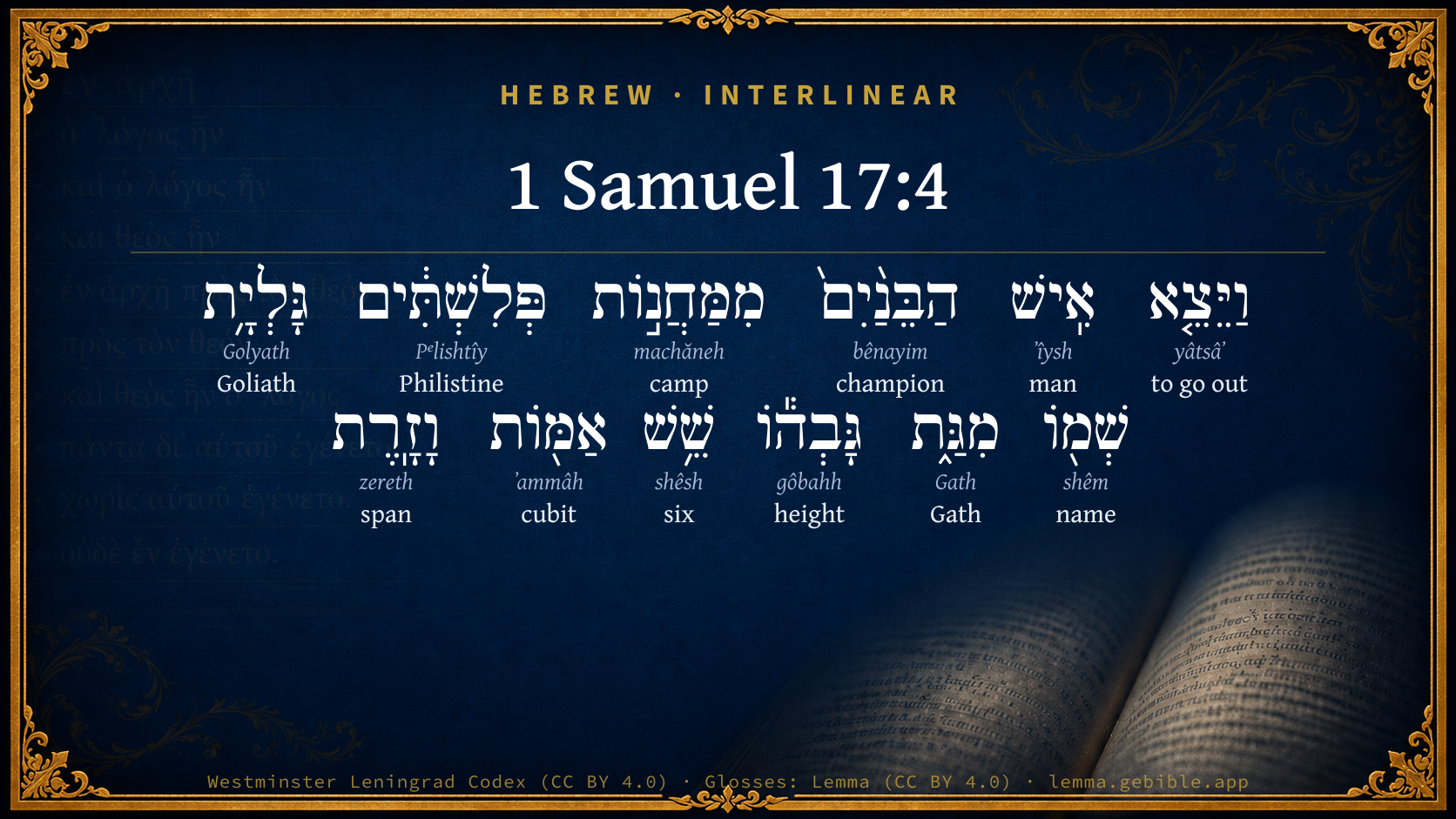
1 Samuel 17:4

Hebrew (Westminster Leningrad Codex) 1 Samuel 17:4 appears in the Hebrew Old Testament. The text above is from the Westminster Leningrad Codex. Each word links to its Strong’s number, a concise gloss, and parsing drawn from the Open Scriptures Hebrew Bible morphology. Click any word for its full Brown-Driver-Briggs (BDB) entry.
Download image
Cite this verse

1 Samuel 17:4 (World English Bible). Public Domain. Lemma interlinear Bible study tool, https://lemma.gebible.app/v/1-samuel/17/4.

Show BibTeX & RIS
BibTeX
RIS
English Translation
There went out a champion out of the camp of the Philistines, named Goliath, of Gath, whose height was six cubits and a span.
World English Bible · Public Domain
Highlights
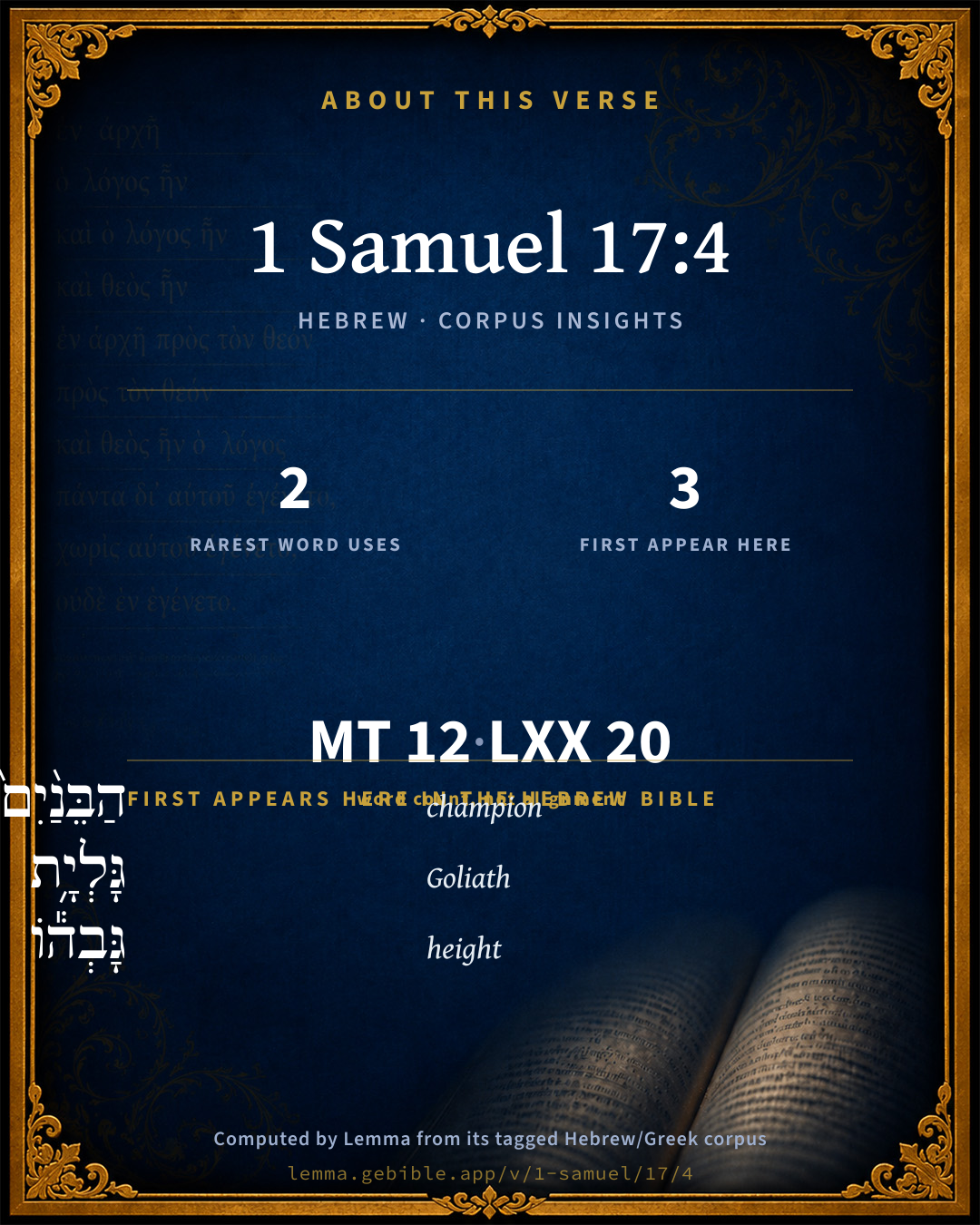
  • 3 first appearances in the Hebrew Bible
Full analysis ↓
Download a study sheet

One document with this verse’s original text, its word-by-word gloss line, the meaning frame, cross-references with their text, attributed commentary, and full source and license credits — printable, and it pastes into notes with its structure intact.

This verse Autodidact and up

Study sheet (.html) Plain text (.txt)

A passage Seminary Student

Up to 50 verses in one chapter. A passage sheet keeps up to 6 commentary sources and 12 cross-references per verse, in the order this page ranks them, and says so on the sheet whenever that leaves anything out. Ask for a single verse and you get the Autodidact verse sheet above.

Everything on this page stays free to read, with no account — the sheet is a download of what is already on screen, not access to it.

Want to remove ads? Support Godless Engineer
Compare translations 3

The same verse in 3 English versions, stacked beneath the original-language interlinear above. Click any original word for its lexicon entry.

Each is an independent rendering of the whole verse — the interlinear is not word-aligned to these translations.

Highlighted words mark where these versions differ — a whole-verse word diff, not a word-by-word alignment.

  • World English Bible Public Domain
    There went out a champion out of the camp of the Philistines, named Goliath, of Gath, whose height was six cubits and a span.
  • King James Version Public Domain
    And there went out a champion out of the camp of the Philistines, named Goliath, of Gath, whose height was six cubits and a span.
  • unfoldingWord Literal Text CC BY-SA 4.0
    And a man of the betweens came out from the camp of the Philistines, Goliath his name, from Gath. His height six cubits and a span.

unfoldingWord Literal Text — © unfoldingWord, licensed CC BY-SA 4.0. Word-aligned USFM3 via Door43 (git.door43.org/unfoldingWord/en_ult).

Versions to compare (up to 4)

3 of 4 selected

Show all 18 translations

Every available English version of this verse, each an independent rendering of the whole verse.

  • World English Bible Public Domain
    There went out a champion out of the camp of the Philistines, named Goliath, of Gath, whose height was six cubits and a span.
  • Berean Standard Bible Public Domain
    Then a champion named Goliath, who was from Gath, came out from the Philistine camp. He was six cubits and a span in height,
  • Majority Standard Bible Public Domain
    Then a champion named Goliath, who was from Gath, came out from the Philistine camp. He was six cubits and a span in height,
  • King James Version Public Domain
    And there went out a champion out of the camp of the Philistines, named Goliath, of Gath, whose height was six cubits and a span.
  • American Standard Version (1901) Public Domain
    And there went out a champion out of the camp of the Philistines, named Goliath, of Gath, whose height was six cubits and a span.
  • Revised Version (1885) Public Domain
    And there went out a champion out of the camp of the Philistines, named Goliath, of Gath, whose height was six cubits and a span.
  • Geneva Bible (1599) Public Domain
    Then came a man betweene them both out of the tents of the Philistims, named Goliath of Gath: his height was sixe cubites and an hande breadth,
  • Douay-Rheims (1899) Public Domain
    And there went out a man baseborn from the camp of the Philistines named Goliath, of Geth, whose height was six cubits and a span:
  • Young's Literal Translation Public Domain
    And there goeth out a man of the duellists from the camps of the Philistines, Goliath `is' his name, from Gath; his height `is' six cubits and a span,
  • Literal Standard Version CC BY-SA 4.0
    And a man goes out, the champion from the camps of the Philistines, his name [is] Goliath, from Gath; his height [is] six cubits and a span [[or four cubits and a span]],
  • Unlocked Literal Bible CC BY-SA 4.0
    A strong man came out of the Philistines' camp, a man named Goliath of Gath, whose height was six cubits and a span.
  • unfoldingWord Literal Text CC BY-SA 4.0
    And a man of the betweens came out from the camp of the Philistines, Goliath his name, from Gath. His height six cubits and a span.
  • Darby Bible Public Domain
    And there went out a champion from the camp of the Philistines, named Goliath, of Gath, whose height was six cubits and a span.
  • World Messianic Bible Public Domain
    A champion out of the camp of the Philistines named Goliath of Gath, whose height was six cubits and a span went out.
  • Webster's Bible Public Domain
    And there went out a champion from the camp of the Philistines, named Goliath, of Gath, whose hight was six cubits and a span.
  • Free Bible Version CC BY-SA 4.0
    Then a champion came out of the Philistine camp. His name was Goliath from Gath, and he was six cubits and a span tall.
  • Bible in Basic English Public Domain
    And a fighter came out from the tents of the Philistines, named Goliath of Gath; he was more than six cubits tall.
  • JPS Tanakh (1917) Public Domain
    And there went out a champion from the camp of the Philistines, named Goliath, of Gath, whose height was six cubits and a span.

Literal Standard Version (2020), Covenant Press — licensed CC BY-SA 4.0. Text via the HelloAO Bible API (eBible.org). Unlocked Literal Bible (unfoldingWord) — licensed CC BY-SA 4.0. Text via the HelloAO Bible API (eBible.org). unfoldingWord Literal Text — © unfoldingWord, licensed CC BY-SA 4.0. Word-aligned USFM3 via Door43 (git.door43.org/unfoldingWord/en_ult). Free Bible Version, Dr. Jonathan Gallagher — licensed CC BY-SA 4.0. Text via the HelloAO Bible API (eBible.org).

Word by word

More ways to search: Search by grammar → Find every occurrence → Compare this word →

Practice this passage: Drill this verse → Learn its vocabulary →

הַבֵּנַ֨יִם֙
bênayim
H1143
“the · champion”
Particle, Definite Article + Noun, Common, Masculine, Dual, Absolute
Part of Speech
Particle + Noun
Type
Common
Gender
Masculine
Number
Dual
State
Absolute
Full BDB Definition

Origin: dual of H996

TWOT: 239a

between, space between two armies - man of the space between armies, i.e. champion (of Goliath) (metonymy)
  1. וַיֵּצֵ֤א yâtsâʼ H3318 “and · to go out” Conjunction + Verb, Qal, Sequential Imperfect, 3rd Person, Masculine, Singular
  2. אִֽישׁ ʼîysh H376 “man of” Noun, Common, Masculine, Singular, Construct
  3. מִמַּחֲנ֣וֹת machăneh H4264 “from · camps of” Preposition + Noun, Common, Both, Plural, Construct
  4. פְּלִשְׁתִּ֔ים Pᵉlishtîy H6430 “Philistines” Noun, Gentilic, Masculine, Plural, Absolute
  5. גָּלְיָ֥ת Golyath H1555 “Goliath” Noun, Proper
  6. שְׁמ֖וֹ shêm H8034 “name · his” Noun, Common, Masculine, Singular, Construct + Suffix, Personal, 3rd Person, Masculine, Singular
  7. מִגַּ֑ת Gath H1661 “from · Gath” Preposition + Noun, Proper
  8. גָּבְה֕וֹ gôbahh H1363 “height · his” Noun, Common, Masculine, Singular, Construct + Suffix, Personal, 3rd Person, Masculine, Singular
  9. שֵׁ֥שׁ shêsh H8337 “six” Adjective, Cardinal number, Feminine, Singular, Absolute
  10. אַמּ֖וֹת ʼammâh H520 “cubits” Noun, Common, Feminine, Plural, Absolute
  11. וָזָֽרֶת zereth H2239 “and · span” Conjunction + Noun, Common, Feminine, Singular, Absolute

About this verse

These counts appear in no published source. They are computed here, from the morphology-tagged text and Lemma’s own curated glosses. What Lemma adds →

12
words
12
distinct lemmas
Historical
section

Notable vocabulary

The rarest word here is הַבֵּנַ֨יִם֙ champion H1143 — appearing just 2 times in the whole Hebrew Bible.

First appearance in Scripture

These words make their first canonical appearance in the Hebrew Bible here:

  • הַבֵּנַ֨יִם֙ champion H1143
  • גָּלְיָ֥ת Goliath H1555
  • גָּבְה֕וֹ height H1363

Shared distinctive vocabulary

הַבֵּנַ֨יִם֙ champion H1143 occurs in 2 verses of the Hebrew Bible. Also found in:

Grammatical profile

  • 1 verb
  • 10 nouns
  • 1 adjective

Verb forms

  • וַיֵּצֵ֤א Qal · Sequential Imperfect

Hebrew & Septuagint length

In English translation the verse runs 24 words from the Hebrew and 28 from the Septuagint (LXX English) — closely comparable.

A rough comparison of the two English renderings, which tokenize alike — not a word-level alignment.

Word counts can differ between the Hebrew and the Greek without any difference in meaning — e.g. the Hebrew direct-object marker אֵת has no separate Greek word, and Greek often adds the article ὁ.

In the original languages it is 12 Hebrew tokens and 20 Greek tokens — but the two are counted differently (Hebrew bundles its prefixes and suffixes into one token; the Greek is in lemma form), so that isn’t a like-for-like length.

Cross-references

9

Topical passages linked to 1 Samuel 17:4 in the Treasury of Scripture Knowledge — connected by theme and wording, ordered by reader-vote popularity; previews shown in the World English Bible.

  • Joshua 11:22 There was none of the Anakim left in the land of the children of Israel: only in Gaza, in Gath, and in Ashdod, did some remain.
  • 1 Samuel 17:23 As he talked with them, behold, there came up the champion, the Philistine of Gath, Goliath by name, out of the ranks of the Philistines, and spoke according to the same words: and David heard them.
  • 2 Samuel 21:16–22 and Ishbibenob, who was of the sons of the giant, the weight of whose spear was three hundred [shekels] of brass in weight, he being girded with a new [sword], thought to have slain David.
  • 1 Chronicles 20:4–8 It happened after this, that there arose war at Gezer with the Philistines: then Sibbecai the Hushathite killed Sippai, of the sons of the giant; and they were subdued.
  • Deuteronomy 3:11 (For only Og king of Bashan remained of the remnant of the Rephaim; behold, his bedstead was a bedstead of iron; isn't it in Rabbah of the children of Ammon? nine cubits was the length of it, and four cubits the breadth of it, after the cubit of a man.)
  • 1 Samuel 21:9–10 The priest said, The sword of Goliath the Philistine, whom you killed in the valley of Elah, behold, it is here wrapped in a cloth behind the ephod: if you will take that, take it; for there is no other except that here. David said, There is none like that; give it me.
  • 1 Samuel 27:4 It was told Saul that David was fled to Gath: and he sought no more again for him.
  • 1 Chronicles 11:23 He killed an Egyptian, a man of great stature, five cubits high; and in the Egyptian's hand was a spear like a weaver's beam; and he went down to him with a staff, and plucked the spear out of the Egyptian's hand, and killed him with his own spear.
  • Amos 2:9 Yet I destroyed the Amorite before them, Whose height was like the height of the cedars, And he was strong as the oaks; Yet I destroyed his fruit from above, and his roots from beneath.

Cross-references courtesy of OpenBible.info (CC BY 4.0).

Hebrew and Greek witnesses Masoretic Hebrew ↔ Greek Septuagint

The same verse in the two great witnesses to the Old Testament, shown verse-for-verse.

These are two independent witnesses, not word-aligned to each other, and the Septuagint is shown in lemma (dictionary) form.

Hebrew 1 Samuel 17:4 Masoretic · Westminster Leningrad Codex

וַיֵּצֵ֤א אִֽישׁ הַבֵּנַ֨יִם֙ מִמַּחֲנ֣וֹת פְּלִשְׁתִּ֔ים גָּלְיָ֥ת שְׁמ֖וֹ מִגַּ֑ת גָּבְה֕וֹ שֵׁ֥שׁ אַמּ֖וֹת וָזָֽרֶת

There went out a champion out of the camp of the Philistines, named Goliath, of Gath, whose height was six cubits and a span.

World English Bible · Public Domain

Greek LXX 1 Samuel 17:4 Septuagint · lemma form

καί ἐκἔρχομαι ἀνήρ δυνατός ἐκ ὁ παράταξις ὁ ἀλλόφυλος γολιαθ ὄνομα αὐτός ἐκ γεθ ὕψος αὐτός τέσσαρες πῆχυς καί σπιθαμή

And there went forth a mighty man out of the army of the Philistines, Goliath, by name, out of Geth, his height was four cubits and a span.

LXX2012 (modern English Septuagint) · Public Domain

On this verse, Adam Clarke's Commentary discusses the Septuagint’s reading. Read the note in Commentary ↓

Hebrew: Westminster Leningrad Codex (CC BY 4.0). Greek: Septuagint (public domain); English from LXX2012 (modern English Septuagint) (Public Domain). How the Septuagint differs from the Hebrew →

Targum (Aramaic paraphrase)

1

The Targum is the ancient Jewish Aramaic paraphrase of the Hebrew Scriptures — an interpretive translation, not the Hebrew text itself. Onkelos (literal) and Pseudo-Jonathan (expansive) render the Torah, and Jonathan the Prophets. Coverage is partial: where no permissively-licensed English translation exists for a verse, only the Aramaic is shown. This is verse-level text, not a word-by-word alignment to the Hebrew.

  1. Targum Jonathan Prophets (Joshua–Malachi)
    וּנְפַק גַבְרָא מִבֵּינֵיהוֹן מִמַשִׁרְיַת פְלִשְׁתָּאֵי גָלְיָת שְׁמֵיהּ מִגָת רוּמֵיהּ שִׁתָּא אַמִין וְזֵירְתָא:

    (no public-domain English translation for this verse)

    Targum Jonathan — Aramaic: “Mikraot Gedolot” (public domain). English: “Sefaria Community Translation” (CC0 1.0 (public-domain dedication)); “London "Chaldee Paraphrase," 1871” (public domain). Text via Sefaria.

Commentary

Notes on 1 Samuel 17:4 from classic Christian and Jewish commentators (each source and its license shown beneath its notes). The classic Christian expositions comment on the surrounding passage and are grouped to its opening verse, so a note may address several verses; the Jewish commentaries on the Tanakh (Rashi and others) are per-verse, so they appear only where the commentator wrote on this verse.

Lemma curates 59 commentaries, every one of them public domain or Creative Commons licensed, each selected and text-cleaned for this edition rather than reprinted as found. About our sources →

Jamieson, Fausset & Brown

Robert Jamieson, A. R. Fausset & David Brown

GOLIATH CHALLENGES A COMBAT. (Sa1 17:4-11)

a champion--Hebrew, a "man between two"; that is, a person who, on the part of his own people, undertook to determine the national quarrel by engaging in single combat with a chosen warrior in the hostile army.

Jamieson, Fausset & Brown — Commentary Critical and Explanatory on the Whole Bible (1871) — public domain (CC PDM 1.0). Text via the HelloAO Bible API.

Trapp's Complete Commentary

John Trapp

1Sa 17:4 And there went out a champion out of the camp of the Philistines, named Goliath, of Gath, whose height [was] six cubits and a span.

Ver. 4. And there went out a champion.] {a} Intermedius, sequester, duellio. The Vulgate calleth him a bastard: and it is held by some that those old giants were the devil’s brats, {b} and that there was none of them good, no not one, but all αντιθεοι, and θεομαχοι, fighters against God. This man was of the race of the Rephaims. See Jos 11:22.

Whose height was six cubits and a span.] Hence his presumption, which is the presage and cause of ruin -

“ Magna repente ruunt, summa cadunt subito. ”

{a} Dυνατος. - Sept.

{b} Josephus thinks they were begotten of Incubi devils.

John Trapp, A Commentary or Exposition upon All the Books of the Old and New Testament (1647–1656) — public domain. Text from a community e-Sword module.

Joseph Benson's Commentary

1Sa 17:4. Goliath of Gath — For to this city the Anakims fled when Joshua rooted them out of the land of Canaan, Jos 11:22. And here they propagated a race of giants; that is, people of great strength and stature. Whose height was six cubits and a span — At least nine feet nine inches. And this is not strange; for besides the giants mentioned in Scripture, Herodotus, Diodorus Siculus, and Pliny make mention of persons seven cubits high.

Joseph Benson's Commentary on the Old and New Testaments (1811–1818) — public domain. Text from a community e-Sword module.

Tyndale Open Study Notes

Tyndale Open Resources

17:4 champion: In ancient times, rival forces would sometimes agree to let selected individuals from each side decide a conflict. This reduced casualties and other costs. The same kind of combat is reflected in 2 Sam 2:12-17. • Gath was one of five Philistine cities with a reputation for having giants as citizens (2 Sam 21:15-22).

Tyndale Open Study Notes — © Tyndale Open Resources, licensed CC BY-SA 4.0. Text via the HelloAO Bible API.

Geneva Bible (1599)

Geneva Bible translators

Between the two camps.

Geneva Bible (1599) marginal notes — public domain. Text via Bolls.life.

Adam Clarke's Commentary

Verse 4. There went out a champion] Our word champion comes from campus, the field; Campio est enim ille qui pugnat in campo, hoc est, in castris, "Champion is he, properly, who fights in the field; i.e., in camps." A man well skilled in arms, strong, brave, and patriotic.

But is this the meaning of the original איש הבנים ish habbenayim, a middle man, the man between two; that is, as here, the man who undertakes to settle the disputes between two armies or nations. So our ancient champions settled disputes between contending parties by what was termed camp fight, hence the campio or champion. The versions know not well what to make of this man. The Vulgate calls him sir spurius, "a bastard;" the Septuagint, ανηρ δυνατος, "a strong or powerful man;" the Targum, גברא מביניהון gabra mibbeyneyhon, "a man from between them;" the Arabic, [Arabic] rujil jibar, "a great or gigantic man;" the Syriac is the same; and Josephus terms him ανηρ παμμεγεθιστατος, "an immensely great man." The Vulgate has given him the notation of spurius or bastard, because it considered the original as expressing a son of two, i.e., a man whose parents are unknown. Among all these I consider our word champion, as explained above, the best and most appropriate to the original terms.

Whose height was six cubits and a span.] The word cubit signifies the length from cubitus, the elbow, to the top of the middle finger, which is generally rated at one foot six inches. The span is the distance from the top of the middle finger to the end of the thumb, when extended as far as they can stretch on a plain; this is ordinarily nine inches. Were we sure that these were the measures, and their extent, which are intended in the original words, we could easily ascertain the height of this Philistine; it would then be nine feet nine inches, which is a tremendous height for a man.

But the versions are not all agreed in his height. The Septuagint read τεσσαρων πηχεων και σπιθαμης, four cubits and a span; and Josephus reads the same. It is necessary however to observe that the Septuagint, in the Codex Alexandrinus, read with the Hebrew text. But what was the length of the ancient cubit? This has been variously computed; eighteen inches, twenty inches and a half, and twenty-one inches. If we take the first measurement, he was nine feet nine; if the second, and read palm instead of span, with the Vulgate and others, he was ten feet seven inches and a half; if we take the last, which is the estimate of Graevius, with the span, he was eleven feet three inches; or if we go to the exactest measurement, as laid down in Bishop Cumberland's tables, where he computes the cubit at 21.888 inches, the span at 10.944 inches, and the palm at 3.684 inches, then the six cubits and the span will make exactly 11 feet 10.272 inches. If we take the palm instead of the span, then the height will be 11 feet 3.012 inches. But I still think that the nine feet nine inches is the most reasonable.

Adam Clarke's Commentary on the Bible (1810–1826) — public domain. Text from a community e-Sword/MySword module.

The Cambridge Bible for Schools and Colleges

gen. ed. J. J. S. Perowne

4–11. Goliath’s Challenge

4. a champion] Lit. “The (well-known) man of the interspaces,” or “interval between two camps” (Gr. μεταίχμιον: see Eur. Phoen. 1361, in the account of the combat between Eteocles and Polynices), in which single combats took place: so E. V. rightly “champion.”

Goliath of Gath] A survivor probably of the ancient race of Anakim, a remnant of which found refuge in Gaza, Gath, and Ashdod, when they were exterminated by Joshua from the mountains of Judah (Jos_11:21-22).

six cubits and a span] The cubit, or distance from the elbow to the extremity of the middle finger, is variously estimated at from eighteen to twenty-one inches: the span, or distance between the extremities of the thumb and little finger in the outstretched hand, is reckoned as half a cubit: so that Goliath’s height was between nine feet nine inches and eleven feet four inches. The most probable estimate is about ten feet three inches. Among parallel instances of gigantic stature may be quoted Pusio and Secundilla, who lived in the reign of Augustus, and are said by Pliny (Nat. Hist. VII. 16) to have been over ten feet high. Josephus says that a certain Eleazar the giant who was sent to the emperor Tiberius, was seven cubits high.

The Cambridge Bible for Schools and Colleges (gen. ed. J. J. S. Perowne; Cambridge University Press, 1878–1918) — public domain. Text from a community e-Sword module.

John Gill's Exposition

And there went out a champion out of the camp of the Philistines,.... Or a "middle person", or a man "between two" (y); meaning either one that went and stood between the two armies of Israel and the Philistines, as the Jewish writers generally interpret it: or a "dueller" (z), as others, with which our version agrees; one that proposed to fight a duel, and have the war decided by two persons, of which he would be one:

named Goliath of Gath; which was one of the places where the Anakims or giants were driven, and left, in the times of Joshua, and from whom this man descended, Jos 11:22.

whose height was six cubits and a span; and taking a cubit after the calculation of Bishop Cumberland (a) to be twenty one inches, and more, and a span to be half a cubit, the height of this man was eleven feet four inches, and somewhat more; which need not seem incredible, since the coffin of Orestea, the son of Agamemnon, is said (b) to be seven cubits long; and Eleazar, a Jew, who because of his size was called the giant, and was presented by Artabanus, king of the Parthians, to Tiberius Caesar, is said by Josephus (c) to be seven cubits high; and one Gabbara of Arabia, in the times of Claudius Caesar, measured nine feet nine inches, as Pliny (d) relates, and who elsewhere (e) speaks of a people in Ethiopia, called Syrbotae, who were eight cubits high; the Septuagint version makes Goliath to be only four cubits and a span high, and so Josephus (f); that is, about eight feet.

(y) "vir intermedius", Montanus; "inter duo", Vatablus; "vir medietatum", Noldius, p. 194. No. 283. (z) "Quidam duellator", Junius & Tremellius, Piscator. (a) Of Scripture Weights and Measures, c. 2. p. 57. (b) Herodot. Clio, sive, l. 1. c. 68. Plin. Nat. Hist. l. 7. c. 16. (c) Antiqu. l. 18. c. 5. sect. 5. (d) Nat. Hist. ib. (e) Ibid. l. 6. 30. (f) Antiqu. l. 6. c. 9. sect. 1.

John Gill's Exposition of the Whole Bible (1746–1763) — public domain (CC PDM 1.0). Text via the HelloAO Bible API.

Albert Barnes' Notes on the Bible

A champion - literally, “a man between the two camps:” i. e., one who did not fight in the ranks like an ordinary soldier, but came forth into the space between the hostile camps to challenge the mightiest man of his enemies to come and fight him.

Goliath of Gath - One of the places mentioned in Jos 11:22 as still retaining a remnant of the sons of Anak; Gaza and Ashdod being the others. The race of giants (the Rephaim, from רפא râphâ' ) is mentioned again in the account of David’s Philistine wars 2Sa 21:15-22; 1Ch 20:4-8. It appears from these passages that Goliath had a brother Lahmi. Four are named as being “born to the giant in Gath.” See Deu 2:10-11, Deu 2:20-21; Deu 3:11-13.

Six cubits ... - If the cubit, the length from the elbow to the tip of the middle finger, is about 1 12 feet; and the span, the distance from the thumb to the middle or little finger, when stretched apart to the full length, be half a cubit, six cubits and a span would equal about nine feet nine inches. The bed of Og king of Bashan was nine cubits long Deu 3:11.

Albert Barnes' Notes on the Bible (1834–1885) — public domain. Text from a community e-Sword/MySword module.

Haydock's Catholic Bible Commentary

Base-born. Hebrew, "of two sons," or of obscure origin. (Cornelius a Lapide) --- His parents are no where specified, as Arapha is not, as some pretend, the name of his mother, but denotes that he was of the race of the Raphaim, 2 Kings xxi. 16. Some translate, a man who challenges to fight a duel, or one who comes into the midst as "a champion," to decide the cause of all the rest. Thus the Gaul defied the most valiant of the Romans, but was slain by M. Torquatus, Livy vii. Septuagint, "A strong man went out from the station," &c. Chaldean, "There came out from them, out of the camp of the Philistines, a man named Goliath." But many able interpreters adhere to the Vulgate. --- Span, about 12½ feet, so that he was taller than two common men. Those who call in question the existence of giants, will surely have nothing to object to this formal proof from Scripture. (Calmet) --- The Vatican Septuagint and Josephus read, however, "four cubits and a span," or near eight feet. (Kennicott) --- Some reduce his height to 11 feet 3 inches, or even to 9 feet 9 inches, English. (Haydock) --- His helmet weighed 15 pounds, avoirdupois; his collar, or buckler, about 30; the head of his spear (26 feet long) weighed about 38 pounds; his sword 4; his greaves on his legs 30; and his coat of mail 156: total, 273 pounds. (Button.) (Haydock) --- Goliath was a figure of the devil, or of any arch-heretic, who provoketh the Church of God, but is slain by the humble with his own weapons. (Worthington)

George Leo Haydock (1774–1849), Haydock's Catholic Family Bible and Commentary, 1859 edition — public domain. Excludes Psalms (Douay-Rheims chapter numbering differs from Protestant) and Deuterocanonical books (Catholic canon only).

Matthew Poole's English Annotations

A champion, Heb. a man between two, either because he used to come forth, and stand between the two armies; or because he moved that the business should be decided between two, whereof he would be one.

Whose height was six cubits and a span; which is not strange, for besides the giants mentioned in Scripture, Herodotus, Diodorus Siculus, and Pliny, and others, make mention of persons seven cubits high, which is near double to an ordinary man’s height.

Matthew Poole's English Annotations on the Holy Bible (1683–1685) — public domain. Text from a community e-Sword/MySword module.

Whedon's Commentary on the Bible

Daniel D. Whedon

4. A champion — The Septuagint has, a mighty man; Vulgate, bastard; Syriac and Arabic, a giant. But the Hebrew, אישׁ הבנים, literally signifies a man between the two; that is, an arbitrator between the two armies, or one who was lord of the space between the two camps. Goliath, the pride of the Philistine hosts, stepped forth between the two armies and proposed by a personal contest with a chosen warrior from the Israelites, and according to the conditions stated in 1Sa_17:9, to decide the fortunes of the war. Such single combats at the head of armies were not unusual in ancient times, as is witnessed by the combats of Paris and Menelaus. (Homer, Iliad, book 3.)

Of Gath — And therefore probably a remnant of the Anakim that escaped the sword of Joshua. Jos_11:22.

Whose height… six cubits and a span — That is, if we reckon the cubit at twenty-one inches, about ten and one half feet. Josephus (“Antiquities,” 1Sa_18:4-5) mentions one Eleazar, a Jew by birth, whose height was seven cubits; and Pliny speaks of a giant Pusio, whose height exceeded ten Roman feet.

Daniel D. Whedon (gen. ed.), Commentary on the Old and New Testaments (1874–1909) — public domain. Text from a community e-Sword module.

The Pulpit Commentary

Vers. 4-7. A champion. Literally, "a man of the two middles," i.e. one who enters the space between the two armies in order to decide the contest by a single combat. Of Gath. In Jos_11:21 this town is mentioned, together with Gaza and Ashdod, as still having among its inhabitants men of the race of Anak. Whose height was six cubits and a span. In our measure his height was eight feet five and one-third inches; for the cubit is sixteen inches, and the span (really the hand-breadth) is five and one-third inches. A span, sit, is eight inches, but the word used here is zereth. See on these measures, Conder, "Handbook," p. 79. This height, though very great, has been attained to in modern times. Armed with a coat of mail. Literally, "clothed in a shirt of scales," i.e. a corselet made of metal scales sewn on cloth so as to overlap one another. It was flexible, and protected the back and sides as well as the kent. Five thousand shekels of brass. Really copper, as brass was then unknown. Conder gives the shekel as equal to two-thirds of an ounce. This would make the corselet weigh at least two hundred weight, an enormous load to carry even for a short time. Goliath"s other equipments correspond in heaviness, and largely exceed the weight of medieval suits of armour. Greaves of brass upon his legs. The thighs were protected by the corselet, so that only the legs required defensive armour. This would account for the weight of the corselet, as it was much longer than the cuirass, as worn by the Greeks and Romans. A target. Really, "a javelin." It was carried at the back, ready to be taken in the hand and thrown at the enemy when required. The versions have a different readingmagan, shield, for chidon, javelin. The shield was carried before him by an armour bearer. The staff. The written text has a word which usually signifies shaft, arrow, for which the Kri substitutes wood, the noun actually found in 2Sa_21:19; 1Ch_20:5; but most probably the word used here is an archaic name for the handle or staff of a spear. Six hundred shekels. The weight of the iron head of the spear would be about twenty-five pounds. However tall and strong Goliath may have been, yet with all this vast weight of metal his movements must have been slow and unready. He was got up, in bet, more to tell upon the imagination than for real fighting, and though, like a castle, he might have been invincible if attacked with sword and spear, he was much too encumbered with defensive armour to be capable of assuming the offensive against a light armed enemy. To David belongs the credit of seeing that the Philistine champion was a huge imposition.

The Pulpit Commentary (1880–1919), ed. H.D.M. Spence-Jones & Joseph S. Exell — public domain. Text from a community e-Sword module.

John Wesley's Explanatory Notes

Six cubits - At least, nine feet, nine inches high. And this is not strange; for besides the giants mentioned in Scripture, Herodotus, Diodourus Siculus, and Pliny, make mention of persons seven cubits high.

John Wesley, Explanatory Notes Upon the Whole Bible (1754–1765) — public domain. Text via the GEBible commentary corpus.

unfoldingWord translationNotes

Door43 World Missions Community

six cubits and a span

A cubit is a unit of measurement equal to about 46 centimeters. A span is a unit of measurement equal to about 23 centimeters. AT: "about 3 meters" (See: Biblical Distance)

he was armed with a coat of chainmail

A "coat of chainmail" is a flexible piece of body armor covered with protective scales or small plates. This can be stated in active form. AT: "he protected himself by wearing a coat of chainmail" or "he wore a coat of chainmail" (See: Active or Passive)

five thousand shekels

A shekel is a unit of weight equal to about 11 grams. AT: "about 55 kilograms" (See: Biblical Weight)

translationWords

Philistines

Goliath

Gath

bronze

unfoldingWord translationNotes — © Distant Shores Media and the Door43 World Missions Community, licensed CC BY-SA 4.0. Source: git.door43.org/Door43/en_tn.

Rashi

Rabbi Shlomo Yitzchaki (Rashi)

A champion. A mighty person who went out from his battalion, to stand between the two battalions.

Rashi on the Tanakh — English translations: “The Judaica Press complete Tanach with Rashi, translated by A. J. Rosenberg” (CC BY 4.0); “Pentateuch with Rashi's commentary by M. Rosenbaum and A.M. Silbermann, 1929-1934” (public domain); “The Metsudah Tanach series, Lakewood, N.J” (CC BY 4.0); and “The Book of Joshua, Metsudah Publications, 1997” (CC BY 4.0). Text via Sefaria.

Lesson kit

Teaching starters — assembled from the data on this page, not authored interpretation. Every prompt links to the verse data it draws on. Edit before teaching.

1 Samuel, in the Historical, opens this verse with 12 words (12 distinct Hebrew lemmas). Its most distinctive word is bênayim (“champion”). A historical commentator’s framing appears above. Read the whole chapter for the surrounding context.

Discussion questions

  1. What does “champion” (bênayim) contribute to the verse as a whole?
  2. 3 words here appear for the first time in Scripture. What is being introduced at this debut?
  3. 1 Samuel 17:23 shares the word «champion» with this verse. How do the two illuminate each other?
  4. The translations on this page render this verse differently — a whole-verse word diff, not a word-by-word alignment. What might account for the different wordings?
  5. The verb «וַיֵּצֵ֤א» is Qal Sequential Imperfect. How does its form color the action?
  6. Reading how Jamieson, Fausset & Brown and Trapp's Complete Commentary read this verse, where do the two commentators agree and where do they part?

Things to notice

Reading settings

Reading text

Shown beneath each verse's original-language words.

Old Testament
Old Testament edition

Read the OT as the Masoretic Hebrew (MT) or the Greek Septuagint (LXX).

English shown for the Greek Septuagint (in the Hebrew ↔ Greek comparison).

Comparing translations? Open the Compare panel on any verse page to stack up to four side by side.