
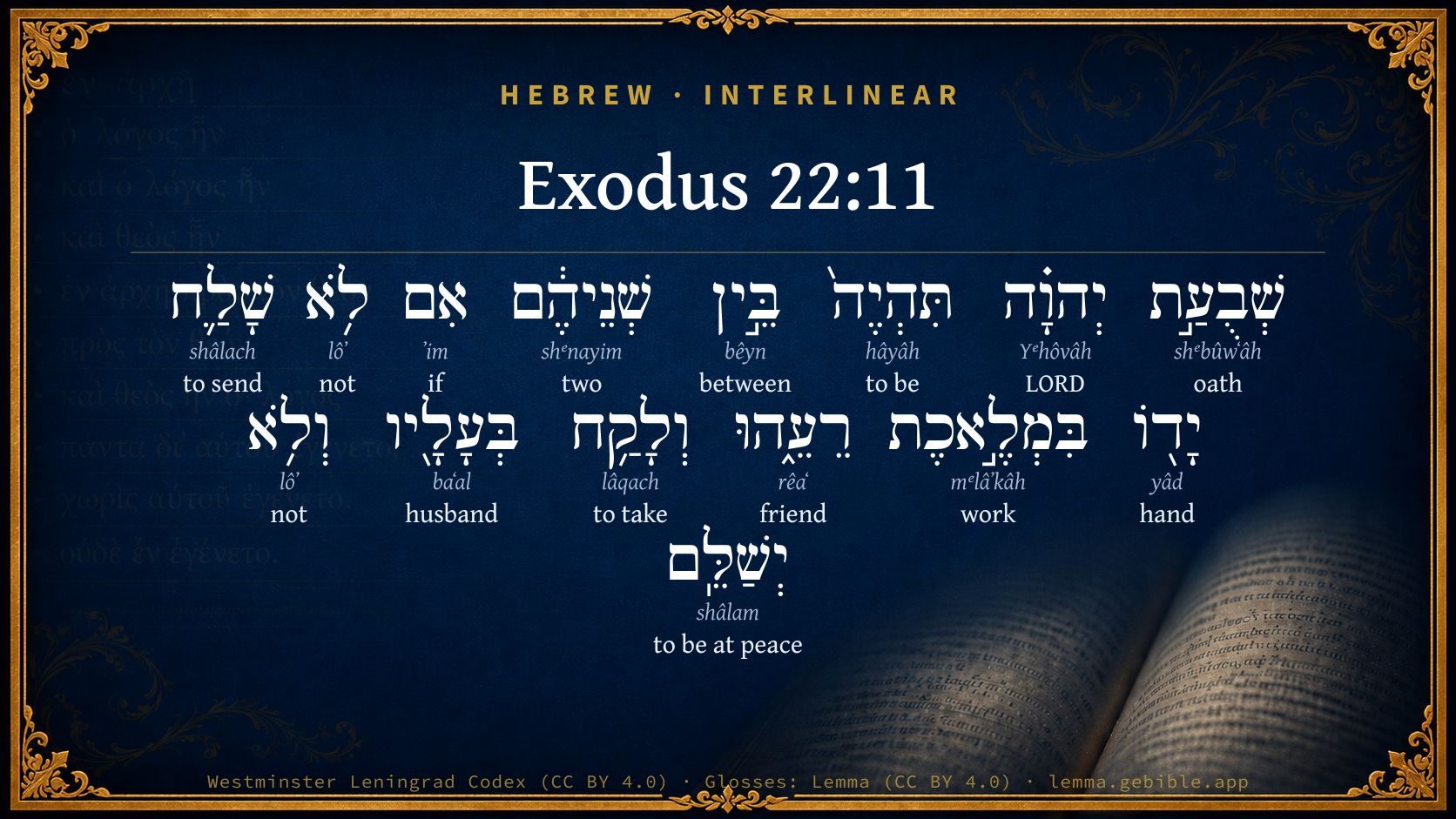
Exodus 22:11

Hebrew (Westminster Leningrad Codex) Exodus 22:11 appears in the Hebrew Old Testament. The text above is from the Westminster Leningrad Codex. Each word links to its Strong’s number, a concise gloss, and parsing drawn from the Open Scriptures Hebrew Bible morphology. Click any word for its full Brown-Driver-Briggs (BDB) entry.
Download image
Cite this verse

Exodus 22:11 (World English Bible). Public Domain. Lemma interlinear Bible study tool, https://lemma.gebible.app/v/exodus/22/11.

Show BibTeX & RIS
BibTeX
RIS
English Translation
the oath of Yahweh shall be between them both, whether he hasn't put his hand to his neighbor's goods; and the owner of it shall accept it, and he shall not make restitution.
World English Bible · Public Domain
Download a study sheet

One document with this verse’s original text, its word-by-word gloss line, the meaning frame, cross-references with their text, attributed commentary, and full source and license credits — printable, and it pastes into notes with its structure intact.

This verse Autodidact and up

Study sheet (.html) Plain text (.txt)

A passage Seminary Student

Up to 50 verses in one chapter. A passage sheet keeps up to 6 commentary sources and 12 cross-references per verse, in the order this page ranks them, and says so on the sheet whenever that leaves anything out. Ask for a single verse and you get the Autodidact verse sheet above.

Everything on this page stays free to read, with no account — the sheet is a download of what is already on screen, not access to it.

Want to remove ads? Support Godless Engineer
Compare translations 3

The same verse in 3 English versions, stacked beneath the original-language interlinear above. Click any original word for its lexicon entry.

Each is an independent rendering of the whole verse — the interlinear is not word-aligned to these translations.

Highlighted words mark where these versions differ — a whole-verse word diff, not a word-by-word alignment.

  • World English Bible Public Domain
    the oath of Yahweh shall be between them both, whether he hasn't put his hand to his neighbor's goods; and the owner of it shall accept it, and he shall not make restitution.
  • King James Version Public Domain
    Then shall an oath of the LORD be between them both, that he hath not put his hand unto his neighbor's goods; and the owner of it shall accept thereof, and he shall not make it good.
  • unfoldingWord Literal Text CC BY-SA 4.0
    there shall be an oath of Yahweh between both of them, whether or not he stretched out his hand against the property of his neighbor. Its owner must accept, and he shall not compensate.

unfoldingWord Literal Text — © unfoldingWord, licensed CC BY-SA 4.0. Word-aligned USFM3 via Door43 (git.door43.org/unfoldingWord/en_ult).

Versions to compare (up to 4)

3 of 4 selected

Show all 18 translations

Every available English version of this verse, each an independent rendering of the whole verse.

  • World English Bible Public Domain
    the oath of Yahweh shall be between them both, whether he hasn't put his hand to his neighbor's goods; and the owner of it shall accept it, and he shall not make restitution.
  • Berean Standard Bible Public Domain
    an oath before the LORD shall be made between the parties to determine whether or not the man has taken his neighbor’s property. The owner must accept the oath and require no restitution.
  • Majority Standard Bible Public Domain
    an oath before the LORD shall be made between the parties to determine whether or not the man has taken his neighbor’s property. The owner must accept the oath and require no restitution.
  • King James Version Public Domain
    Then shall an oath of the LORD be between them both, that he hath not put his hand unto his neighbor's goods; and the owner of it shall accept thereof, and he shall not make it good.
  • American Standard Version (1901) Public Domain
    the oath of Jehovah shall be between them both, whether he hath not put his hand unto his neighbor's goods; and the owner thereof shall accept it, and he shall not make restitution.
  • Revised Version (1885) Public Domain
    the oath of the LORD shall be between them both, whether he hath not put his hand unto his neighbour’s goods; and the owner thereof shall accept it, and he shall not make restitution.
  • Geneva Bible (1599) Public Domain
    An othe of the Lord shalbe betweene the twaine, that hee hath not put his hande vnto his neighbours good, and the owner of it shall take the othe, and he shall not make it good:
  • Douay-Rheims (1899) Public Domain
    There shall be an oath between them, that he did not put forth his hand to his neighbour's goods: and the owner shall accept of the oath; and he shall not be compelled to make restitution.
  • Young's Literal Translation Public Domain
    an oath of Jehovah is between them both, that he hath not put forth his hand against the work of his neighbour, and its owner hath accepted, and he doth not repay;
  • Literal Standard Version CC BY-SA 4.0
    an oath of YHWH is between them both, that he has not put forth his hand against the work of his neighbor, and its owner has accepted, and he does not repay;
  • Unlocked Literal Bible CC BY-SA 4.0
    an oath to Yahweh must be taken by them both, as to whether or not one person has put his hand on his neighbor's property. The owner must accept this, and the other will make no restitution.
  • unfoldingWord Literal Text CC BY-SA 4.0
    there shall be an oath of Yahweh between both of them, whether or not he stretched out his hand against the property of his neighbor. Its owner must accept, and he shall not compensate.
  • Darby Bible Public Domain
    an oath of Jehovah shall be between them both, that he hath not put his hand unto his neighbour's goods; and the owner of it shall accept it, and he shall not make [it] good.
  • World Messianic Bible Public Domain
    the oath of the LORD shall be between them both, he has not put his hand on his neighbor’s goods; and its owner shall accept it, and he shall not make restitution.
  • Webster's Bible Public Domain
    Then shall an oath of the LORD be between them both, that he hath not put his hand to his neighbor's goods; and the owner of it shall accept of it, and he shall not make restitution.
  • Free Bible Version CC BY-SA 4.0
    then an oath must be taken before the Lord to decide if the neighbor has taken the owner's property. The owner must accept the oath and not demand compensation.
  • Bible in Basic English Public Domain
    If he takes his oath before the Lord that he has not put his hand to his neighbour's goods, the owner is to take his word for it and he will not have to make payment for it.
  • JPS Tanakh (1917) Public Domain
    (22-10) the oath of the LORD shall be between them both, to see whether he have not put his hand unto his neighbour's goods; and the owner thereof shall accept it, and he shall not make restitution.

Literal Standard Version (2020), Covenant Press — licensed CC BY-SA 4.0. Text via the HelloAO Bible API (eBible.org). Unlocked Literal Bible (unfoldingWord) — licensed CC BY-SA 4.0. Text via the HelloAO Bible API (eBible.org). unfoldingWord Literal Text — © unfoldingWord, licensed CC BY-SA 4.0. Word-aligned USFM3 via Door43 (git.door43.org/unfoldingWord/en_ult). Free Bible Version, Dr. Jonathan Gallagher — licensed CC BY-SA 4.0. Text via the HelloAO Bible API (eBible.org).

Word by word

More ways to search: Search by grammar → Find every occurrence → Compare this word →

Practice this passage: Drill this verse → Learn its vocabulary →

שְׁבֻעַ֣ת
shᵉbûwʻâh
H7621
“oath of”
Noun, Common, Feminine, Singular, Construct
Part of Speech
Noun
Type
Common
Gender
Feminine
Number
Singular
State
Construct
Full BDB Definition

Origin: pass part of H7650

TWOT: 2319a

oath, curse - oath - attesting of innocence - curse - oath (of Jehovah)
  1. יְהוָ֗ה Yᵉhôvâh H3068 “LORD” Noun, Proper
  2. תִּהְיֶה֙ hâyâh H1961 “to be” Verb, Qal, Imperfect, 3rd Person, Feminine, Singular
  3. בֵּ֣ין bêyn H996 “between” Preposition
  4. שְׁנֵיהֶ֔ם shᵉnayim H8147 “two · their” Adjective, Cardinal number, Masculine, Dual, Construct + Suffix, Personal, 3rd Person, Masculine, Plural
  5. אִם ʼim H518 “if” Conjunction
  6. לֹ֥א lôʼ H3808 “not” Particle, Negative
  7. שָׁלַ֛ח shâlach H7971 “to send” Verb, Qal, Perfect, 3rd Person, Masculine, Singular
  8. יָד֖וֹ yâd H3027 “hand · his” Noun, Common, Both, Singular, Construct + Suffix, Personal, 3rd Person, Masculine, Singular
  9. בִּמְלֶ֣אכֶת mᵉlâʼkâh H4399 “in/at · work of” Preposition + Noun, Common, Feminine, Singular, Construct
  10. רֵעֵ֑הוּ rêaʻ H7453 “friend · his” Noun, Common, Masculine, Singular, Construct + Suffix, Personal, 3rd Person, Masculine, Singular
  11. וְלָקַ֥ח lâqach H3947 “and · to take” Conjunction + Verb, Qal, Sequential Perfect, 3rd Person, Masculine, Singular
  12. בְּעָלָ֖יו baʻal H1167 “husbands · his” Noun, Common, Masculine, Plural, Construct + Suffix, Personal, 3rd Person, Masculine, Singular
  13. וְלֹ֥א lôʼ H3808 “and · not” Conjunction + Particle, Negative
  14. יְשַׁלֵּֽם shâlam H7999 “to be at peace” Verb, Piel, Imperfect, 3rd Person, Masculine, Singular

About this verse

These counts appear in no published source. They are computed here, from the morphology-tagged text and Lemma’s own curated glosses. What Lemma adds →

15
words
14
distinct lemmas
Pentateuch
section

Shared distinctive vocabulary

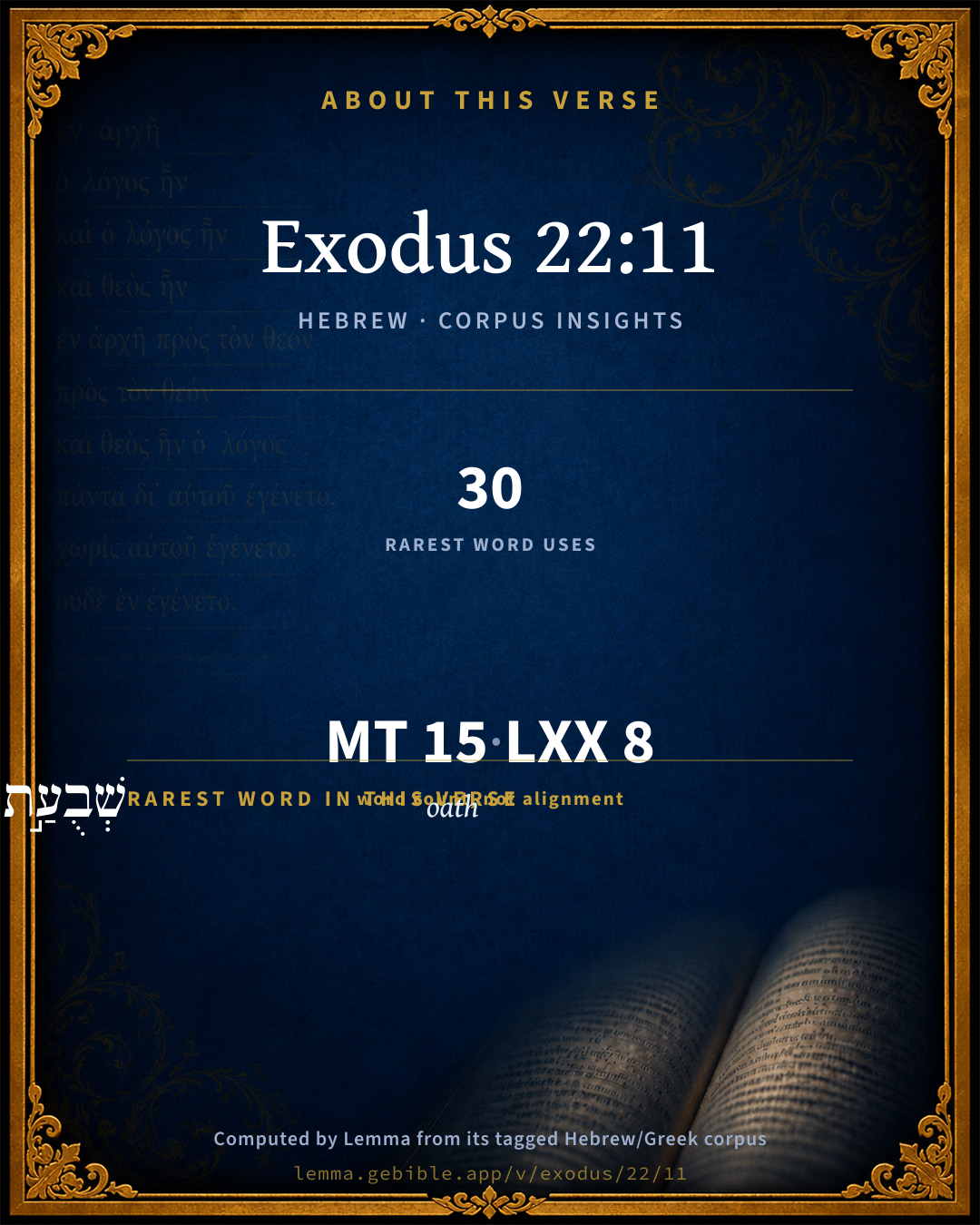
שְׁבֻעַ֣ת oath H7621 occurs in 29 verses of the Hebrew Bible. Also found in:

Grammatical profile

  • 4 verbs
  • 6 nouns
  • 1 adjective
  • 1 preposition
  • 1 conjunction
  • 2 particles

Verb forms

  • תִּהְיֶה֙ Qal · Imperfect
  • שָׁלַ֛ח Qal · Perfect
  • וְלָקַ֥ח Qal · Sequential Perfect
  • יְשַׁלֵּֽם Piel · Imperfect

Repetition

A word recurs within this verse — often emphatic in Hebrew:

Hebrew & Septuagint length

In English translation the verse runs 33 words from the Hebrew and 40 from the Septuagint (LXX English) — closely comparable.

A rough comparison of the two English renderings, which tokenize alike — not a word-level alignment.

Word counts can differ between the Hebrew and the Greek without any difference in meaning — e.g. the Hebrew direct-object marker אֵת has no separate Greek word, and Greek often adds the article ὁ.

In the original languages it is 15 Hebrew tokens and 8 Greek tokens — but the two are counted differently (Hebrew bundles its prefixes and suffixes into one token; the Greek is in lemma form), so that isn’t a like-for-like length.

Cross-references

7

Topical passages linked to Exodus 22:11 in the Treasury of Scripture Knowledge — connected by theme and wording, ordered by reader-vote popularity; previews shown in the World English Bible.

  • Hebrews 6:16 For men indeed swear by a greater one, and in every dispute of theirs the oath is final for confirmation.
  • Exodus 22:8 If the thief isn't found, then the master of the house shall come near to God, to find out if he hasn't put his hand to his neighbor's goods.
  • Exodus 23:1 "You shall not spread a false report. Don't join your hand with the wicked to be a malicious witness.
  • Leviticus 5:1 "'If anyone sins, in that he hears the voice of adjuration, he being a witness, whether he has seen or known, if he doesn't report it, then he shall bear his iniquity.
  • Leviticus 6:3 or has found that which was lost, and dealt falsely therein, and swearing to a lie; in any of all these things that a man does, sinning therein;
  • 1 Kings 2:42–43 The king sent and called for Shimei, and said to him, Didn't I adjure you by Yahweh, and protest to you, saying, Know for certain, that on the day you go out, and walk abroad any where, you shall surely die? and you said to me, The saying that I have heard is good.
  • Proverbs 30:9 Lest I be full, deny you, and say, 'Who is Yahweh?' Or lest I be poor, and steal, And so dishonor the name of my God.

Cross-references courtesy of OpenBible.info (CC BY 4.0).

Hebrew and Greek witnesses Masoretic Hebrew ↔ Greek Septuagint

The same verse in the two great witnesses to the Old Testament, shown verse-for-verse.

These are two independent witnesses, not word-aligned to each other, and the Septuagint is shown in lemma (dictionary) form.

Hebrew Exodus 22:11 Masoretic · Westminster Leningrad Codex

שְׁבֻעַ֣ת יְהוָ֗ה תִּהְיֶה֙ בֵּ֣ין שְׁנֵיהֶ֔ם אִם לֹ֥א שָׁלַ֛ח יָד֖וֹ בִּמְלֶ֣אכֶת רֵעֵ֑הוּ וְלָקַ֥ח בְּעָלָ֖יו וְלֹ֥א יְשַׁלֵּֽם

the oath of Yahweh shall be between them both, whether he hasn't put his hand to his neighbor's goods; and the owner of it shall accept it, and he shall not make restitution.

World English Bible · Public Domain

Greek LXX Exodus 22:11 Septuagint · lemma form

ἐάν δέ κλέπτω παρά αὐτός ἀποτίνω ὁ κύριος

an oath of God shall be between both, each swearing that he has surely not at all been guilty in the matter of his neighbor's deposit; and so his master shall hold him guiltless, and he shall not make compensation.

LXX2012 (modern English Septuagint) · Public Domain

Hebrew: Westminster Leningrad Codex (CC BY 4.0). Greek: Septuagint (public domain); English from LXX2012 (modern English Septuagint) (Public Domain). How the Septuagint differs from the Hebrew →

Targum (Aramaic paraphrase)

2

The Targum is the ancient Jewish Aramaic paraphrase of the Hebrew Scriptures — an interpretive translation, not the Hebrew text itself. Onkelos (literal) and Pseudo-Jonathan (expansive) render the Torah, and Jonathan the Prophets. Coverage is partial: where no permissively-licensed English translation exists for a verse, only the Aramaic is shown. This is verse-level text, not a word-by-word alignment to the Hebrew.

  1. Targum Onkelos Torah (Genesis–Deuteronomy)
    וְאִם אִתְגְנָבָא יִתְגְנֵב מֵעִמֵהּ יְשַׁלֵם לְמָרוֹהִי:

    (no public-domain English translation for this verse)

    Targum Onkelos — Aramaic: “Onkelos Genesis” (public domain); “Onkelos Exodus” (public domain); “Onkelos Leviticus” (public domain); “Onkelos Numbers” (public domain); “Onkelos Deuteronomy” (public domain). English: “Sefaria Community Translation” (CC0 1.0 (public-domain dedication)); “J.W. Etheridge. The Targums of Onkelos and Jonathan Ben Uzziel on the Pentateuch. London: Longmans, Green, 1862” (public domain). Text via Sefaria.

  2. Targum Pseudo-Jonathan Torah (Genesis–Deuteronomy)
    וְאִין יִתְגַנְבָא יִתְגַנֵּב מִנֵיהּ דַּהֲוָה לֵיהּ עִמֵּיהּ אֲגַר נְטִיר יְשַׁלֵם לְמָרוֹי

    But if it be stolen from him who was to receive recompense for the care, he shall make it good to its owner.

    Targum Pseudo-Jonathan — Aramaic: “Targum Jonathan on Genesis” (public domain); “Targum Jonathan on Exodus” (public domain); “Targum Jonathan on Leviticus” (public domain); “Targum Jonathan on Numbers” (public domain); “Targum Jonathan on Deuteronomy” (public domain). English: “The Targum of Jonathan ben Uzziel, trans. J. W. Etheridge, London, 1862” (public domain). Text via Sefaria.

Commentary

Notes on Exodus 22:11 from classic Christian and Jewish commentators (each source and its license shown beneath its notes). The classic Christian expositions comment on the surrounding passage and are grouped to its opening verse, so a note may address several verses; the Jewish commentaries on the Tanakh (Rashi and others) are per-verse, so they appear only where the commentator wrote on this verse.

Lemma curates 59 commentaries, every one of them public domain or Creative Commons licensed, each selected and text-cleaned for this edition rather than reprinted as found. About our sources →

Trapp's Complete Commentary

John Trapp

Exo 22:11 [Then] shall an oath of the LORD be between them both, that he hath not put his hand unto his neighbour’s goods; and the owner of it shall accept [thereof], and he shall not make [it] good.

Ver. 11. An oath of the Lord.] Who is called in as a witness and as an avenger. How hateful, then, is that Popish proverb and practice, Mercatorum est, non regum, stare iuramentis.

John Trapp, A Commentary or Exposition upon All the Books of the Old and New Testament (1647–1656) — public domain. Text from a community e-Sword module.

Geneva Bible (1599)

Geneva Bible translators

They should swear by the Name of the Lord.

Geneva Bible (1599) marginal notes — public domain. Text via Bolls.life.

Adam Clarke's Commentary

Verse 11. An oath of the Lord be between them] So solemn and awful were all appeals to God considered in those ancient times, that it was taken for granted that the man was innocent who could by an oath appeal to the omniscient God that he had not put his hand to his neighbour's goods. Since oaths have become multiplied, and since they have been administered on the most trifling occasions, their solemnity is gone, and their importance little regarded. Should the oath ever reacquire its weight and importance, it must be when administered only in cases of peculiar delicacy and difficulty, and as sparingly as in the days of Moses.

Adam Clarke's Commentary on the Bible (1810–1826) — public domain. Text from a community e-Sword/MySword module.

The Cambridge Bible for Schools and Colleges

gen. ed. J. J. S. Perowne

11. the oath of Yahweh] 2Sa_21:7, 1Ki_2:43. The person is whom the animal had been entrusted must swear solemnly that he has not appropriated it himself.

shall accept it] viz. the oath. Both Burckhardt (Bedouins, i. 126–9) and Doughty (Arab. Deserta, i. 267), state that among the Arabs now, if a person suspected of theft is willing to take certain specially solemn oaths, he is considered to be acquitted.

not make restitution] no reasonable precaution having been neglected. In primitive and semi-primitive societies an accused or suspected person is often allowed to clear himself by taking a solemn oath of purgation; there are several examples in the Code of Hạmmurabi (see p. 423; cf. also Exo 1Ki_8:31 f.). The practice was also common in the Middle Ages (see E. B. Tylor’s arts. Oath and Ordeal in the Encycl. Brit. and ‘Ordeals and Oaths’ in Macmillan’s Magazine, May, 1876). The oath might be followed by an ordeal (see Manu viii. 109–116, cited by Gray, Numbers, p. 45); or it might involve such curses upon the person taking it, if he did not speak the truth, that the act of taking it constituted itself the ordeal.

The Cambridge Bible for Schools and Colleges (gen. ed. J. J. S. Perowne; Cambridge University Press, 1878–1918) — public domain. Text from a community e-Sword module.

John Gill's Exposition

Then shall an oath of the Lord be between them both,.... Either by the one, the keeper, for the satisfaction of the owner, or by them both; by the owner, that he delivered such and such cattle to the keeper; and by the keeper, that he was no ways concerned in the death, hurt, or carrying off of the same: and this is called "the oath of the Lord", not only because in this law required by him, but because sworn by him, or in his name, and made before him, in his presence, who is hereby appealed unto; and who is called upon to take vengeance on the person that takes the oath of perjury; and such an oath only is a lawful one, men are to swear only by the Lord. But this oath was not tendered to anyone:"if a man was suspected of an oath (i.e. of perjury) they might not give him his oath, neither the oath of the law, nor the oath from their words (the scribes), nor the oath of imposition (imposed by the wise wen); and even though he that brought the action would have it, they might not hearken unto him: if a man has swore falsely a rash oath, or an oath of testimony, or an oath concerning anything deposited, or a vain oath, lo, he is suspected of an oath, and so everyone that is rejected for witness on account of any transgression (w).''The oath to be taken by the keeper, and who indeed seems to be the only person that was to take one, was, "that he hath not put his hand unto his neighbour's goods"; so as either to kill or maim, or drive away, or suffer to be driven away, any of the cattle committed to his care, or that he had not disposed of them to his own use and profit:

and the owner of it shall accept thereof; of the oath, as the Targum of Jonathan and Jarchi, and so be satisfied, and give no further trouble, such an oath being for the confirmation of the thing, and to put an end to strife; or he shall take the ass, ox, or sheep, as it was, and be content; but then, though he might take the dead or maimed one, he could not take that which was driven or carried away, wherefore the first sense, is best:

and he shall not make it good; or pay for it to the owner what it was worth.

(w) Maimon. Hilchot Toan Venitan, c. 2. sect. 1, 2.

John Gill's Exposition of the Whole Bible (1746–1763) — public domain (CC PDM 1.0). Text via the HelloAO Bible API.

Matthew Poole's English Annotations

An oath of the Lord; so called here, as also 1Ki 2:43, because it is taken by his authority and appointment, and for his honour, and in his name alone, God being made both witness, and judge, and avenger thereby. Shall be between them both, i.e. shall end the difference between them both; the one shall give his oath, and the other shall accept of it: or be taken by them both; by the one, that he did deliver them to him upon agreement and for hire; by the other, that he put not his hand to them.

Matthew Poole's English Annotations on the Holy Bible (1683–1685) — public domain. Text from a community e-Sword/MySword module.

Lesson kit

Teaching starters — assembled from the data on this page, not authored interpretation. Every prompt links to the verse data it draws on. Edit before teaching.

Exodus, in the Pentateuch, opens this verse with 15 words (14 distinct Hebrew lemmas). Its most distinctive word is shᵉbûwʻâh (“oath”). A historical commentator’s framing appears above. Read the whole chapter for the surrounding context.

Discussion questions

  1. The word shᵉbûwʻâh carries the sense “oath.” How does it shape the verse?
  2. Genesis 24:8 shares the word «oath» with this verse. How do the two illuminate each other?
  3. “not” occurs 2× in this one verse. What is the effect of the repetition?
  4. These translations render this verse differently. What is at stake in choosing one wording over another?
  5. The verb «תִּהְיֶה֙» is Qal Imperfect. How does its form color the action?
  6. Reading how Trapp's Complete Commentary and Geneva Bible (1599) read this verse, where do the two commentators agree and where do they part?

Things to notice

Reading settings

Reading text

Shown beneath each verse's original-language words.

Old Testament
Old Testament edition

Read the OT as the Masoretic Hebrew (MT) or the Greek Septuagint (LXX).

English shown for the Greek Septuagint (in the Hebrew ↔ Greek comparison).

Comparing translations? Open the Compare panel on any verse page to stack up to four side by side.