
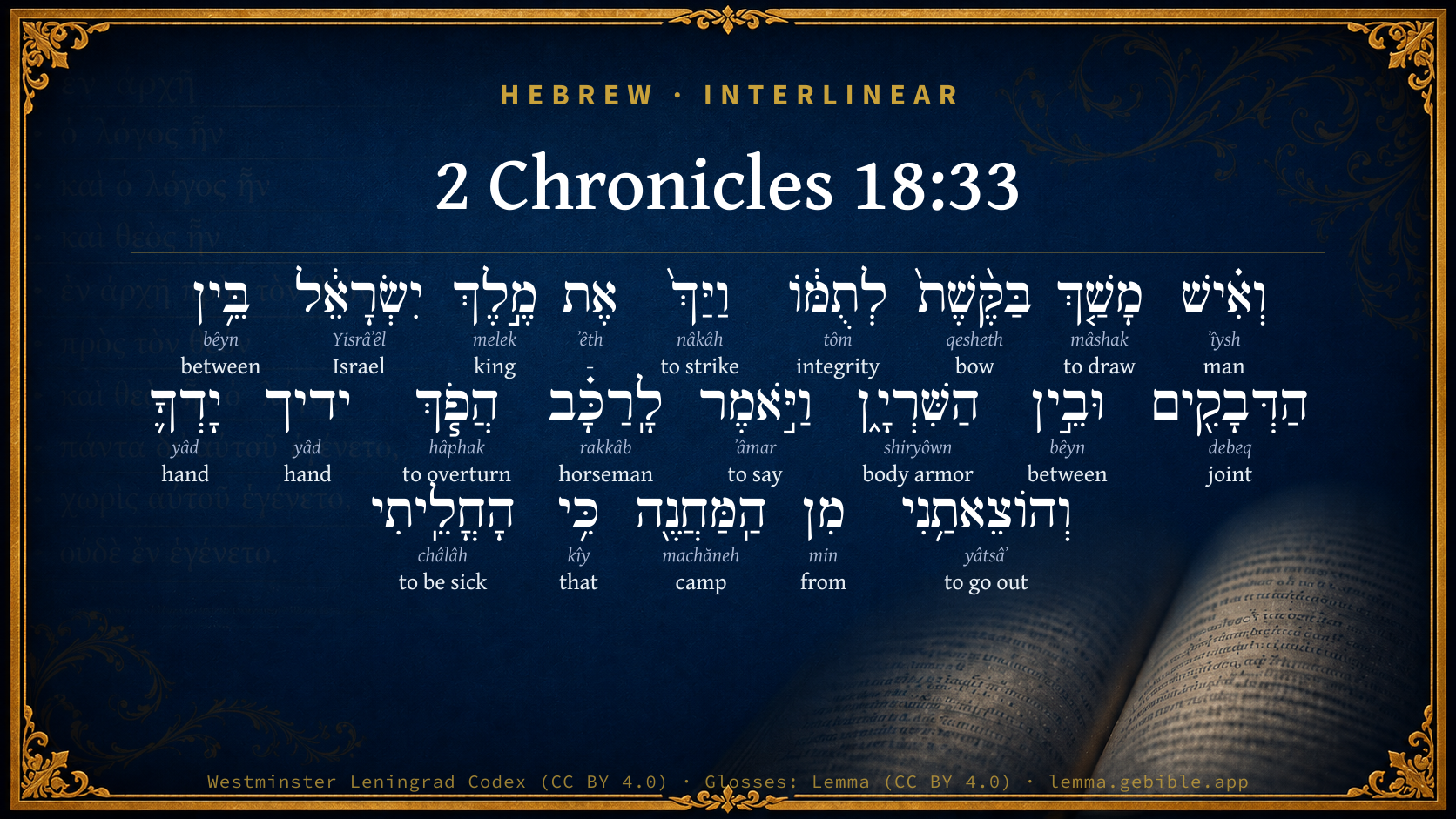
2 Chronicles 18:33

Hebrew (Westminster Leningrad Codex) 2 Chronicles 18:33 appears in the Hebrew Old Testament. The text above is from the Westminster Leningrad Codex. Each word links to its Strong’s number, a concise gloss, and parsing drawn from the Open Scriptures Hebrew Bible morphology. Click any word for its full Brown-Driver-Briggs (BDB) entry.
Download image
Cite this verse

2 Chronicles 18:33 (World English Bible). Public Domain. Lemma interlinear Bible study tool, https://lemma.gebible.app/v/2-chronicles/18/33.

Show BibTeX & RIS
BibTeX
RIS
English Translation
A certain man drew his bow at a venture, and struck the king of Israel between the joints of the armor. Therefore he said to the driver of the chariot, Turn your hand, and carry me out of the host; for I am sore wounded.
World English Bible · Public Domain
Download a study sheet

One document with this verse’s original text, its word-by-word gloss line, the meaning frame, cross-references with their text, attributed commentary, and full source and license credits — printable, and it pastes into notes with its structure intact.

This verse Autodidact and up

Study sheet (.html) Plain text (.txt)

A passage Seminary Student

Up to 50 verses in one chapter. A passage sheet keeps up to 6 commentary sources and 12 cross-references per verse, in the order this page ranks them, and says so on the sheet whenever that leaves anything out. Ask for a single verse and you get the Autodidact verse sheet above.

Everything on this page stays free to read, with no account — the sheet is a download of what is already on screen, not access to it.

Want to remove ads? Support Godless Engineer
Compare translations 3

The same verse in 3 English versions, stacked beneath the original-language interlinear above. Click any original word for its lexicon entry.

Each is an independent rendering of the whole verse — the interlinear is not word-aligned to these translations.

Highlighted words mark where these versions differ — a whole-verse word diff, not a word-by-word alignment.

  • World English Bible Public Domain
    A certain man drew his bow at a venture, and struck the king of Israel between the joints of the armor. Therefore he said to the driver of the chariot, Turn your hand, and carry me out of the host; for I am sore wounded.
  • King James Version Public Domain
    And a certain man drew a bow at a venture, and smote the king of Israel between the joints of the harness: therefore he said to his chariot man, Turn thine hand, that thou mayest carry me out of the host; for I am wounded.
  • unfoldingWord Literal Text CC BY-SA 4.0
    And a man drew the bow in his innocence and struck the king of Israel between the joinings and between the armor. And he said to the charioteer, “Turn your hand and bring me out from the camp, for I have been seriously wounded.”

unfoldingWord Literal Text — © unfoldingWord, licensed CC BY-SA 4.0. Word-aligned USFM3 via Door43 (git.door43.org/unfoldingWord/en_ult).

Versions to compare (up to 4)

3 of 4 selected

Show all 18 translations

Every available English version of this verse, each an independent rendering of the whole verse.

  • World English Bible Public Domain
    A certain man drew his bow at a venture, and struck the king of Israel between the joints of the armor. Therefore he said to the driver of the chariot, Turn your hand, and carry me out of the host; for I am sore wounded.
  • Berean Standard Bible Public Domain
    However, a certain man drew his bow without taking special aim, and he struck the king of Israel between the joints of his armor. So the king said to his charioteer, “Turn around and take me out of the battle, for I am badly wounded!”
  • Majority Standard Bible Public Domain
    However, a certain man drew his bow without taking special aim, and he struck the king of Israel between the joints of his armor. So the king said to his charioteer, “Turn around and take me out of the battle, for I am badly wounded!”
  • King James Version Public Domain
    And a certain man drew a bow at a venture, and smote the king of Israel between the joints of the harness: therefore he said to his chariot man, Turn thine hand, that thou mayest carry me out of the host; for I am wounded.
  • American Standard Version (1901) Public Domain
    And a certain man drew his bow at a venture, and smote the king of Israel between the joints of the armor: wherefore he said to the driver of the chariot, Turn thy hand, and carry me out of the host; for I am sore wounded.
  • Revised Version (1885) Public Domain
    And a certain man drew his bow at a venture, and smote the king of Israel between the joints of the harness: wherefore he said to the driver of the chariot, Turn thine hand, and carry me out of the host; for I am sore wounded.
  • Geneva Bible (1599) Public Domain
    Then a certaine man drewe a bowe mightily, and smote the King of Israel betweene the ioyntes of his brigandine: Therefore he saide to his charetman, Turne thine hand, and carie mee out of the host: for I am hurt.
  • Douay-Rheims (1899) Public Domain
    And it happened that one of the people shot an arrow at a venture, and struck the king of Israel between the neck and the shoulders, and he said to his chariot man: Turn thy hand, and carry me out of the battle, for I am wounded.
  • Young's Literal Translation Public Domain
    And a man hath drawn with a bow, in his simplicity, and smiteth the king of Israel between the joinings and the coat of mail, and he saith to the charioteer, `Turn thy hand, and thou hast brought me out of the camp, for I have become sick.'
  • Literal Standard Version CC BY-SA 4.0
    And a man has drawn with a bow in his simplicity, and strikes the king of Israel between the joinings and the coat of mail, and he says to the charioteer, “Turn your hand, and you have brought me out of the camp, for I have become [gravely] sick.”
  • Unlocked Literal Bible CC BY-SA 4.0
    But a certain man drew his bow at random and shot the king of Israel between the joints of his armor. Then Ahab said to the driver of his chariot, “Turn around and carry me out of the battle, for I am badly wounded.”
  • unfoldingWord Literal Text CC BY-SA 4.0
    And a man drew the bow in his innocence and struck the king of Israel between the joinings and between the armor. And he said to the charioteer, “Turn your hand and bring me out from the camp, for I have been seriously wounded.”
  • Darby Bible Public Domain
    And a man drew a bow at a venture, and smote the king of Israel between the fastenings and the corslet. And he said to the charioteer, Turn thy hand and drive me out of the camp; for I am wounded.
  • World Messianic Bible Public Domain
    A certain man drew his bow at random, and struck the king of Israel between the joints of the armor. Therefore he said to the driver of the chariot, “Turn around and carry me out of the battle, for I am severely wounded.”
  • Webster's Bible Public Domain
    And a certain man drew a bow at a venture, and smote the king of Israel between the joints of the harness: therefore he said to his chariot-man, Turn thy hand, that thou mayest carry me out of the host; for I am wounded.
  • Free Bible Version CC BY-SA 4.0
    However, an enemy archer shot an arrow at random, hitting the king of Israel between the joints of his armor by his breastplate. The king told his charioteer, “Turn around and get me out of the fight, because I've been wounded!”
  • Bible in Basic English Public Domain
    And a certain man sent an arrow from his bow without thought of its direction, and gave the king of Israel a wound where his breastplate was joined to his clothing; so he said to the driver of his war-carriage, Go to one side and take me away out of the army, for I am badly wounded.
  • JPS Tanakh (1917) Public Domain
    And a certain man drew his bow at a venture, and smote the king of Israel between the lower armour and the breastplate; wherefore he said to the driver of the chariot: 'Turn thy hand, and carry me out of the host; for I am sore wounded.'

Literal Standard Version (2020), Covenant Press — licensed CC BY-SA 4.0. Text via the HelloAO Bible API (eBible.org). Unlocked Literal Bible (unfoldingWord) — licensed CC BY-SA 4.0. Text via the HelloAO Bible API (eBible.org). unfoldingWord Literal Text — © unfoldingWord, licensed CC BY-SA 4.0. Word-aligned USFM3 via Door43 (git.door43.org/unfoldingWord/en_ult). Free Bible Version, Dr. Jonathan Gallagher — licensed CC BY-SA 4.0. Text via the HelloAO Bible API (eBible.org).

Word by word

More ways to search: Search by grammar → Find every occurrence → Compare this word →

Practice this passage: Drill this verse → Learn its vocabulary →

הַדְּבָקִ֖ים
debeq
H1694
“the · joints”
Particle, Definite Article + Noun, Common, Masculine, Plural, Absolute
Part of Speech
Particle + Noun
Type
Common
Gender
Masculine
Number
Plural
State
Absolute
Full BDB Definition

Origin: from H1692

TWOT: 398a

joints, soldering, joining, appendage - joining, soldering, riveting - appendage, open joints of a breastplate
  1. וְאִ֗ישׁ ʼîysh H376 “and · man” Conjunction + Noun, Common, Masculine, Singular, Absolute
  2. מָשַׁ֤ךְ mâshak H4900 “to draw” Verb, Qal, Perfect, 3rd Person, Masculine, Singular
  3. בַּקֶּ֨שֶׁת֙ qesheth H7198 “in/at the · bow” Preposition, Determined + Noun, Common, Feminine, Singular, Absolute
  4. לְתֻמּ֔וֹ tôm H8537 “to/for · integrity · his” Preposition + Noun, Common, Masculine, Singular, Construct + Suffix, Personal, 3rd Person, Masculine, Singular
  5. וַיַּךְ֙ nâkâh H5221 “and · to strike” Conjunction + Verb, Hiphil, Sequential Imperfect, 3rd Person, Masculine, Singular
  6. אֶת ʼêth H853 “-” Particle, Direct Object
  7. מֶ֣לֶךְ melek H4428 “king of” Noun, Common, Masculine, Singular, Construct
  8. יִשְׂרָאֵ֔ל Yisrâʼêl H3478 “Israel” Noun, Proper
  9. בֵּ֥ין bêyn H996 “between” Preposition
  10. וּבֵ֣ין bêyn H996 “and · between” Conjunction + Preposition
  11. הַשִּׁרְיָ֑ן shiryôwn H8302 “the · body armor” Particle, Definite Article + Noun, Common, Both, Singular, Absolute
  12. וַיֹּ֣אמֶר ʼâmar H559 “and · to say” Conjunction + Verb, Qal, Sequential Imperfect, 3rd Person, Masculine, Singular
  13. לָֽרַכָּ֗ב rakkâb H7395 “to/for the · horseman” Preposition, Determined + Noun, Common, Masculine, Singular, Absolute
  14. הֲפֹ֧ךְ hâphak H2015 “overturn” Verb, Qal, Imperative, 2nd Person, Masculine, Singular
  15. ידיך yâd H3027 “hands · your” Noun, Common, Both, Dual, Construct + Suffix, Personal, 2nd Person, Masculine, Singular
  16. יָדְךָ֛ yâd H3027 “hand · your” Noun, Common, Both, Singular, Construct + Suffix, Personal, 2nd Person, Masculine, Singular
  17. וְהוֹצֵאתַ֥נִי yâtsâʼ H3318 “and · to go out · me” Conjunction + Verb, Hiphil, Sequential Perfect, 2nd Person, Masculine, Singular + Suffix, Personal, 1st Person, Common, Singular
  18. מִן min H4480 “from” Preposition
  19. הַֽמַּחֲנֶ֖ה machăneh H4264 “the · camp” Particle, Definite Article + Noun, Common, Both, Singular, Absolute
  20. כִּ֥י kîy H3588 “that” Conjunction
  21. הָחֳלֵֽיתִי châlâh H2470 “to be sick” Verb, Hophal, Perfect, 1st Person, Common, Singular

About this verse

These counts appear in no published source. They are computed here, from the morphology-tagged text and Lemma’s own curated glosses. What Lemma adds →

22
words
20
distinct lemmas
Historical
section

Notable vocabulary

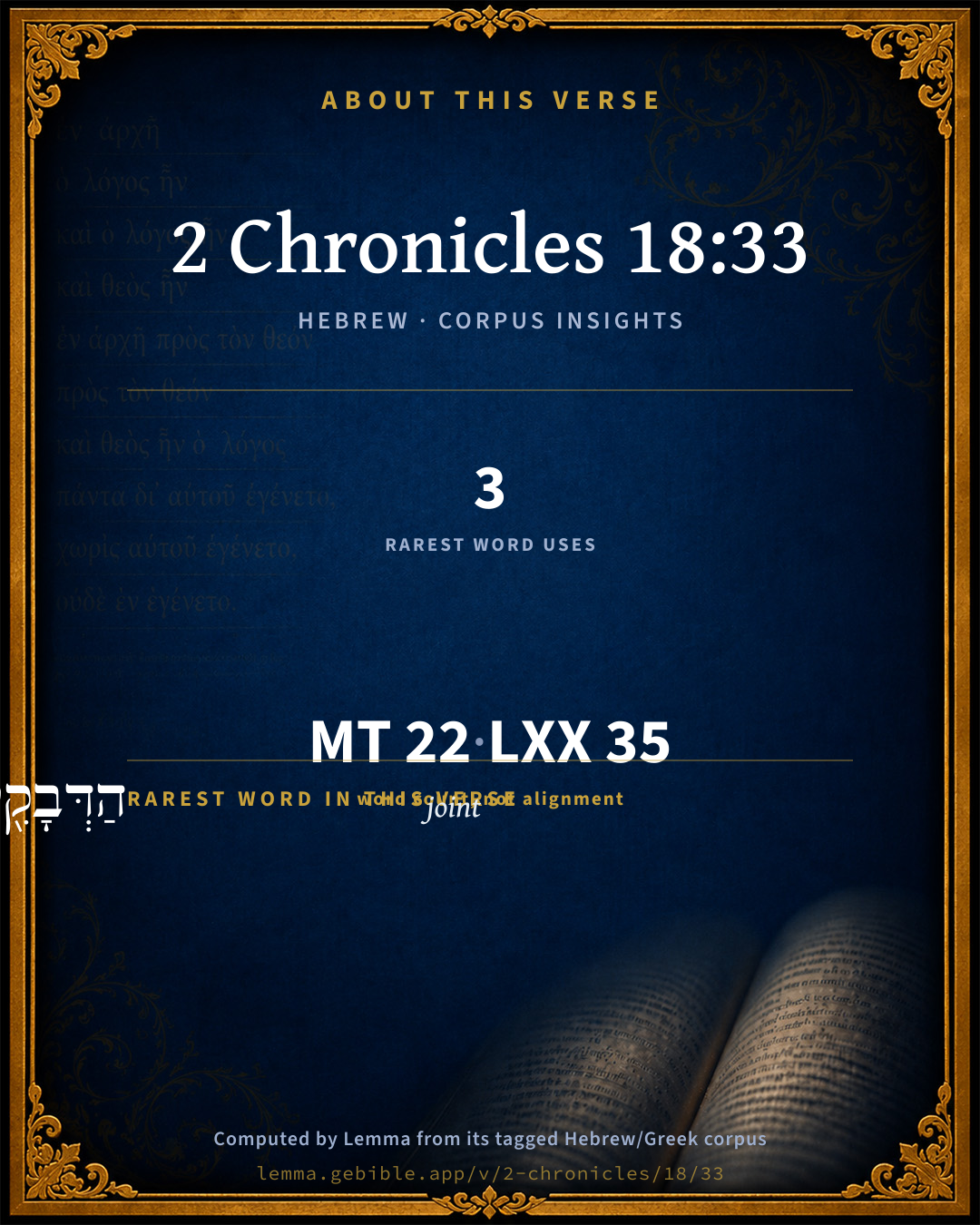
The rarest word here is הַדְּבָקִ֖ים joint H1694 — appearing just 3 times in the whole Hebrew Bible.

Shared distinctive vocabulary

הַדְּבָקִ֖ים joint H1694 occurs in 3 verses of the Hebrew Bible. Also found in:

Grammatical profile

  • 6 verbs
  • 11 nouns
  • 3 prepositions
  • 1 conjunction
  • 1 particle

Verb forms

  • מָשַׁ֤ךְ Qal · Perfect
  • וַיַּךְ֙ Hiphil · Sequential Imperfect
  • וַיֹּ֣אמֶר Qal · Sequential Imperfect
  • הֲפֹ֧ךְ Qal · Imperative
  • וְהוֹצֵאתַ֥נִי Hiphil · Sequential Perfect
  • הָחֳלֵֽיתִי Hophal · Perfect

Repetition

Words recur within this verse — often emphatic in Hebrew:

  • בֵּ֥ין between H996 ×2
  • ידיך hand H3027 ×2

Hebrew & Septuagint length

In English translation the verse runs 45 words from the Hebrew and 41 from the Septuagint (LXX English) — closely comparable.

A rough comparison of the two English renderings, which tokenize alike — not a word-level alignment.

Word counts can differ between the Hebrew and the Greek without any difference in meaning — e.g. the Hebrew direct-object marker אֵת has no separate Greek word, and Greek often adds the article ὁ.

In the original languages it is 22 Hebrew tokens and 35 Greek tokens — but the two are counted differently (Hebrew bundles its prefixes and suffixes into one token; the Greek is in lemma form), so that isn’t a like-for-like length.

Cross-references

3

Topical passages linked to 2 Chronicles 18:33 in the Treasury of Scripture Knowledge — connected by theme and wording, ordered by reader-vote popularity; previews shown in the World English Bible.

  • 2 Samuel 15:11 With Absalom went two hundred men out of Jerusalem, who were invited, and went in their simplicity; and they didn't know anything.
  • 1 Kings 22:34–35 A certain man drew his bow at a venture, and struck the king of Israel between the joints of the armor: therefore he said to the driver of his chariot, Turn your hand, and carry me out of the host; for I am severely wounded.
  • 2 Chronicles 35:23 The archers shot at king Josiah; and the king said to his servants, Have me away; for I am sore wounded.

Cross-references courtesy of OpenBible.info (CC BY 4.0).

Hebrew and Greek witnesses Masoretic Hebrew ↔ Greek Septuagint

The same verse in the two great witnesses to the Old Testament, shown verse-for-verse.

These are two independent witnesses, not word-aligned to each other, and the Septuagint is shown in lemma (dictionary) form.

Hebrew 2 Chronicles 18:33 Masoretic · Westminster Leningrad Codex

וְאִ֗ישׁ מָשַׁ֤ךְ בַּקֶּ֨שֶׁת֙ לְתֻמּ֔וֹ וַיַּךְ֙ אֶת מֶ֣לֶךְ יִשְׂרָאֵ֔ל בֵּ֥ין הַדְּבָקִ֖ים וּבֵ֣ין הַשִּׁרְיָ֑ן וַיֹּ֣אמֶר לָֽרַכָּ֗ב הֲפֹ֧ךְ ידיך יָדְךָ֛ וְהוֹצֵאתַ֥נִי מִן הַֽמַּחֲנֶ֖ה כִּ֥י הָחֳלֵֽיתִי

A certain man drew his bow at a venture, and struck the king of Israel between the joints of the armor. Therefore he said to the driver of the chariot, Turn your hand, and carry me out of the host; for I am sore wounded.

World English Bible · Public Domain

Greek LXX 2 Chronicles 18:33 Septuagint · lemma form

καί ἀνήρ ἐντείνω τόξον εὐστόχως καί πατάσσω ὁ βασιλεύς ἰσραήλ ἀνά μέσος ὁ πνεύμων καί ἀνά μέσος ὁ θώραξ καί εἶπον ὁ ἡνίοχος ἐπιστρέφω ὁ χείρ σύ καί ἐκἄγω ἐγώ ἐκ ὁ πόλεμος ὅτι πονέω

And a man drew a bow with a good aim, and struck the king of Israel between the lungs and the breast-plate: and he said to the charioteer, Turn your hand, drive me out of the battle, for I am wounded.

LXX2012 (modern English Septuagint) · Public Domain

On this verse, Ellicott's Commentary for English Readers discusses the Septuagint’s reading. Read the note in Commentary ↓

Hebrew: Westminster Leningrad Codex (CC BY 4.0). Greek: Septuagint (public domain); English from LXX2012 (modern English Septuagint) (Public Domain). How the Septuagint differs from the Hebrew →

Commentary

Notes on 2 Chronicles 18:33 from classic Christian and Jewish commentators (each source and its license shown beneath its notes). The classic Christian expositions comment on the surrounding passage and are grouped to its opening verse, so a note may address several verses; the Jewish commentaries on the Tanakh (Rashi and others) are per-verse, so they appear only where the commentator wrote on this verse.

Lemma curates 59 commentaries, every one of them public domain or Creative Commons licensed, each selected and text-cleaned for this edition rather than reprinted as found. About our sources →

Trapp's Complete Commentary

John Trapp

2Ch 18:33 And a [certain] man drew a bow at a venture, and smote the king of Israel between the joints of the harness: therefore he said to his chariot man, Turn thine hand, that thou mayest carry me out of the host; for I am wounded.

Ver. 33. Between the joints of the harness.] The hand of Heaven carrying the arrow to that very place. As when God will save a man, a book in his bosom, the money in his purse, the buckle of his girdle shall preserve him from the deadly thrust, or shot.

For I am wounded.] Heb., I am sick, or weary. Perhaps he would have concealed his deadly wound from his chariot man; but

“Eυρε Fεος τον αλιτρον.”

His "sin had now found him out"; and, as stout hearted as he was, death seized him. For,

John Trapp, A Commentary or Exposition upon All the Books of the Old and New Testament (1647–1656) — public domain. Text from a community e-Sword module.

The Biblical Illustrator

Joseph S. Exell

2Ch_18:33

And a certain man drew a bow at a venture.

The venturous aim

Now I would have you notice particularly the words: A certain man drew a bow at a venture. We take it that this was no distinguished warrior among the army of the Syrians, but simply one of the ordinary archers. He little thought that to him was the task committed of slaying the enemy of God and the king of His own nation. At a venture he drew his bow, or, in the words of the Revised Version, as given in the margin, In his simplicity--that is, never supposing at whom he was aiming the dart. We may be for year after year fighting the Lords battles, and seeking after some offender above other offenders, some Ahab in disguise; but our efforts shall in the end be rewarded with success--we may have mistaken some conspicuous fault as manifest as were the gorgeous robes of Jehoshaphat for the sin that doth so easily beset, bringing a host of others in its train; but at length Gods Spirit shall guide our words to the weak place in that souls armour. Some word spoken with no special purpose, perhaps in season, perhaps out of season, shall open the wound that means death to that besetting sin. But if what we have said applies to the case of those individual souls, the same rule holds good also as regards our pulpit ministrations. When we preach the Word we do not know who may be present before us; probably many faces are familiar to us, but we cannot see the inmost soul; we know not what has passed in the life of any single person since last we spoke. Therefore, to a great extent, our bow must be ever drawn at a venture. (J. Nepleton.)

A bow drawn at a venture

Mr. Spurgeon was wont to relate the following striking cases of drawing the bow at a venture: I supposed the case of a young man who had got into fast company, and once there meant to have his fling unfettered; so was on the eve of starting to India, in order to escape the restraint of a godly, widowed mothers influence. I pointed to him, and pleaded with him to retrace his steps ere yet he had broken his praying mothers heart. At the close of the Monday evening prayer-meeting a young man was shown into my room by William Olney. As soon as alone with me he wished to know who had informed me as to his movements. He could scarcely believe me when I told him I had received no information concerning him, and did not even know his name. The same week, after the Thursday evening service, another young man wished to see me alone; wanted to know who had been telling me about him. I asked, What about him? About his fast life, and his intention to leave the country and escape his praying mothers influence? He had been very distressed ever since. I pointed him out and appealed to him on Sunday evening; he wished to see me about it, but could not come on Monday evening as he had intended. But, said he, there is one mistake you made, Mr. Spurgeon; you told the people I was going to India, and it is China I am booked for.

Gospel archery

I. The hearts of the unsaved are encased in harness.

1. Indifference.

2. Pleasure.

3. Worldliness.

4. Religious formality.

II. Having these hearts for a mark, the gospel bow must be drawn. At some must be shot the arrows of--

1. Divine goodness.

2. Divine threatenings.

3. Divine love. (R. Berry.)

.

The Biblical Illustrator, edited by Joseph S. Exell (c. 1880s–1900s) — public domain. Text from a community e-Sword module.

Geneva Bible (1599)

Geneva Bible translators

Hebrew, in his simplicity, or ignorantly.

Or, between the habergeon.

Geneva Bible (1599) marginal notes — public domain. Text via Bolls.life.

Adam Clarke's Commentary

Verse 33. A certain man drew a bow] The Targum tells us who it was. "Now, Naaman, the captain of the host of the great king of Syria, drew a bow against him, (that the prophecy of Elijah the Tishbite, and of Micaiah the son of Imla, might be fulfilled,) and smote the king of Israel between the heart and the caul of the liver, through the place where the coat of mail is joined." 2Kg 5:1 for this tradition.

Adam Clarke's Commentary on the Bible (1810–1826) — public domain. Text from a community e-Sword/MySword module.

Ellicott's Commentary for English Readers

(33) Drew a bow.—With the bow.

At a venture.—See margin, and comp. 2Sa_15:11, where a similar phrase occurs, which Gesenius interprets “without thought of evil design.” The LXX. εὐστόχως, “with good aim,” is a bad guess. Syriac, “innocently straight before him.” But the explanation of Rashi seems best: “without knowing why he chose that particular man to shoot at.”

And smote.—See on 2Ch_18:23.

Between the joints of the harness.—Or, breastplate. So Syriac, “between the division of his mail”; the LXX. has “in the midst of the lungs and breast:; Vulgate, “between the neck and shoulders”; both mere guesses.

That thou mayst carry (literally, bring) me out.—Kings, and bring me out.

A Bible Commentary for English Readers, edited by Charles John Ellicott (1878–1897) — public domain. Text from a community e-Sword module.

The Cambridge Bible for Schools and Colleges

gen. ed. J. J. S. Perowne

33. And a certain man drew a bow] Render, But a certain man had drawn a bow. God had already brought about that which the Syrians were labouring to perform.

at a venture] Better, as mg., in his simplicity, i.e. without knowing that he was aiming at Ahab. Cp. 2Sa_15:11.

between the joints of the harness] Probably between the breastplate (or coat of mail) and the appendages to it; the wound would be in the lower part of the body.

that thou mayest carry me] R.V. and carry me (so 1 Kin.).

wounded] R.V. sore wounded (so 1 Kin., R.V.).

The Cambridge Bible for Schools and Colleges (gen. ed. J. J. S. Perowne; Cambridge University Press, 1878–1918) — public domain. Text from a community e-Sword module.

The Pulpit Commentary

At a venture; Hebrew, wOMtul; i.e. "in his innocence. " The root is the familiar root expressive of uprightness, perfectness, simplicity, and the meaning here is that the shooter was innocent of what a distinguished deed he was doing, of the personality of the man at whom he aimed (for it is not necessary to suppose his shot was quite at random), and of the skill that gave the arrow to reach its ultimate destiny. Between the joints of the harness; literally, between the joints and the harness, i.e. that part called the breastplate. The arrow went through, or by the side of one of the actual articulations of the armour-mail worn. Ahab"s direction to the chariot-driver at the spur of the first wounded moment to turn and carry him out of the host, was evidently qualified, when he found that the wound was not immediately fatal. As the heat of the battle grew, and victory did not at once turn one way or the other, he was the more anxious to give the moral support of his presence to the last to his army, and, unable to stand by himself, he was supported by his own orders (so our rendering is not inconsistent with that in the parallel was stayed" (1Ki_22:35) in the chariot till he died in the evening. Although the spirit of Ahab, and his fidelity to his own army, kingdom, and self, cannot but appear to advantage in these last incidents of his unworthy life, yet it is probable that they find their record here for the sake of giving clear statement to the fact, that in the chariot his life-bleed collected according to the saying of the parallel (ver. 35 compared with ver. 38). Note, therefore, particularly the truncated history of the writer of Chronicles in this instance. He, no doubt, consciously omitted, and with a purpose, his own usual purpose; but light is lost, and the cross light tends rather to misleading, except for that only correct user of Scripture, which teaches us to compare one Scripture with another, and balance one part against another a thing easy to do in matters of fact, but too often forgotten in the weightier matter of doctrine. Here our eighteenth chapter closes, less the mention of the proclamation for the self-disbanding of Ahab"s army (ver. 36 of the parallel chapter) which should fulfil the prophecy of our ver. 16, and less any mention of Ahab"s burial, of the washing of his chariot in the pool of Samaria, of the dogs licking up of the blood there, and of his ivory house, etc. (vers. 37-40 of the parallel chapter). All of which omittings accord well with the one clear ecclesiastical and religious intent of the Chronicles, in place of the pursuit of matters of general and merely graphic historic interest, however charged with instruction they too might be.

The Pulpit Commentary (1880–1919), ed. H.D.M. Spence-Jones & Joseph S. Exell — public domain. Text from a community e-Sword module.

unfoldingWord translationNotes

Door43 World Missions Community

drew his bow at random

Possible meanings are 1) he took aim to shoot a soldier without knowing that it was Ahab or 2) he drew his bow to shoot without any specific target in mind.

between the joints of his armor

This is a place where two pieces of armor meet and is susceptible to arrows and swords.

the king of Israel was held up in his chariot

This can be stated in active form. AT: "someone held the king of Israel up in his chariot" (See: Active or Passive)

translationWords

bow and arrow

armor

Aram

die

unfoldingWord translationNotes — © Distant Shores Media and the Door43 World Missions Community, licensed CC BY-SA 4.0. Source: git.door43.org/Door43/en_tn.

Rashi

Rabbi Shlomo Yitzchaki (Rashi)

And a man drew his bow An Israelite man intended to shoot at the camp of Aram, and inadvertently

and it hit The arrow [hit] the king of Israel.

between the scales and the coat of mail between the thong with which they attach the helmet on his head to the coat of mail. We cannot say that he was a heathen, because whom was he aiming at? Did not the king of Aram command, “Attack neither small nor great, except the king of Israel”? And he did not even aim at him, for it is written, “innocently.” Perforce, you must say that the archer was an Israelite who intended to shoot at the camp of Aram, and inadvertently hit the king of Israel.

and he said to the charioteer to the one who drives the chariot.

and carry me out of the camp i.e., away from these front lines, and take me to the rear lines.

Rashi on the Tanakh — English translations: “The Judaica Press complete Tanach with Rashi, translated by A. J. Rosenberg” (CC BY 4.0); “Pentateuch with Rashi's commentary by M. Rosenbaum and A.M. Silbermann, 1929-1934” (public domain); “The Metsudah Tanach series, Lakewood, N.J” (CC BY 4.0); and “The Book of Joshua, Metsudah Publications, 1997” (CC BY 4.0). Text via Sefaria.

Lesson kit

Teaching starters — assembled from the data on this page, not authored interpretation. Every prompt links to the verse data it draws on. Edit before teaching.

2 Chronicles, in the Historical, opens this verse with 22 words (20 distinct Hebrew lemmas). Its most distinctive word is debeq (“joint”). A historical commentator’s framing appears above. Read the whole chapter for the surrounding context.

Discussion questions

  1. What does “joint” (debeq) contribute to the verse as a whole?
  2. How does 1 Kings 22:34, which shares the word «joint», read alongside this verse?
  3. What does the repetition of “between” (2× in this one verse) do in this verse?
  4. The translations on this page render this verse differently — a whole-verse word diff, not a word-by-word alignment. What might account for the different wordings?
  5. «מָשַׁ֤ךְ» is a Qal Perfect verb. How does that grammatical form shape the action described?
  6. Compare how Trapp's Complete Commentary and The Biblical Illustrator read this verse. Where do they agree or differ?

Things to notice

Reading settings

Reading text

Shown beneath each verse's original-language words.

Old Testament
Old Testament edition

Read the OT as the Masoretic Hebrew (MT) or the Greek Septuagint (LXX).

English shown for the Greek Septuagint (in the Hebrew ↔ Greek comparison).

Comparing translations? Open the Compare panel on any verse page to stack up to four side by side.