Leviticus 26:46

Hebrew (Westminster Leningrad Codex) Leviticus 26:46 appears in the Hebrew Old Testament. The text above is from the Westminster Leningrad Codex. Each word links to its Strong’s number, a concise gloss, and parsing drawn from the Open Scriptures Hebrew Bible morphology. Click any word for its full Brown-Driver-Briggs (BDB) entry.
Download image
Cite this verse

Leviticus 26:46 (World English Bible). Public Domain. Lemma interlinear Bible study tool, https://lemma.gebible.app/v/leviticus/26/46.

Show BibTeX & RIS
BibTeX
RIS
English Translation
These are the statutes, ordinances and laws, which Yahweh made between him and the children of Israel in Mount Sinai by Moses.
World English Bible · Public Domain
Download a study sheet

One document with this verse’s original text, its word-by-word gloss line, the meaning frame, cross-references with their text, attributed commentary, and full source and license credits — printable, and it pastes into notes with its structure intact.

This verse Autodidact and up

Study sheet (.html) Plain text (.txt)

A passage Seminary Student

Up to 50 verses in one chapter. A passage sheet keeps up to 6 commentary sources and 12 cross-references per verse, in the order this page ranks them, and says so on the sheet whenever that leaves anything out. Ask for a single verse and you get the Autodidact verse sheet above.

Everything on this page stays free to read, with no account — the sheet is a download of what is already on screen, not access to it.

Want to remove ads? Support Godless Engineer
Compare translations 3

The same verse in 3 English versions, stacked beneath the original-language interlinear above. Click any original word for its lexicon entry.

Each is an independent rendering of the whole verse — the interlinear is not word-aligned to these translations.

Highlighted words mark where these versions differ — a whole-verse word diff, not a word-by-word alignment.

  • World English Bible Public Domain
    These are the statutes, ordinances and laws, which Yahweh made between him and the children of Israel in Mount Sinai by Moses.
  • King James Version Public Domain
    These are the statutes and judgments and laws, which the LORD made between him and the children of Israel in mount Sinai by the hand of Moses.
  • unfoldingWord Literal Text CC BY-SA 4.0
    These the statutes and the judgments and the laws which Yahweh gave between him and between the sons of Israel on Mount Sinai by the hand of Moses.

unfoldingWord Literal Text — © unfoldingWord, licensed CC BY-SA 4.0. Word-aligned USFM3 via Door43 (git.door43.org/unfoldingWord/en_ult).

Versions to compare (up to 4)

3 of 4 selected

Show all 17 translations

Every available English version of this verse, each an independent rendering of the whole verse.

  • World English Bible Public Domain
    These are the statutes, ordinances and laws, which Yahweh made between him and the children of Israel in Mount Sinai by Moses.
  • Berean Standard Bible Public Domain
    These are the statutes, ordinances, and laws that the LORD established between Himself and the Israelites through Moses on Mount Sinai.
  • Majority Standard Bible Public Domain
    These are the statutes, ordinances, and laws that the LORD established between Himself and the Israelites through Moses on Mount Sinai.
  • King James Version Public Domain
    These are the statutes and judgments and laws, which the LORD made between him and the children of Israel in mount Sinai by the hand of Moses.
  • American Standard Version (1901) Public Domain
    These are the statutes and ordinances and laws, which Jehovah made between him and the children of Israel in mount Sinai by Moses.
  • Revised Version (1885) Public Domain
    These are the statutes and judgments and laws, which the LORD made between him and the children of Israel in mount Sinai by the hand of Moses.
  • Geneva Bible (1599) Public Domain
    These are the ordinances, and the iudgements, and the lawes, which the Lord made betweene him, and the children of Israel in mount Sinai, by the hand of Moses.
  • Young's Literal Translation Public Domain
    These `are' the statutes, and the judgments, and the laws, which Jehovah hath given between Him and the sons of Israel, in mount Sinai, by the hand of Moses.
  • Literal Standard Version CC BY-SA 4.0
    These [are] the statutes, and the judgments, and the laws, which YHWH has given between Him and the sons of Israel in Mount Sinai, by the hand of Moses.
  • Unlocked Literal Bible CC BY-SA 4.0
    These are the commandments, decrees, and laws that Yahweh made between himself and the people of Israel at Mount Sinai through Moses.
  • unfoldingWord Literal Text CC BY-SA 4.0
    These the statutes and the judgments and the laws which Yahweh gave between him and between the sons of Israel on Mount Sinai by the hand of Moses.
  • Darby Bible Public Domain
    These are the statutes and ordinances and laws which Jehovah made between him and the children of Israel in mount Sinai, by the hand of Moses.
  • World Messianic Bible Public Domain
    These are the statutes, ordinances, and laws, which the LORD made between him and the children of Israel in Mount Sinai by Moses.
  • Webster's Bible Public Domain
    These are the statutes, and judgments, and laws, which the LORD made between him and the children of Israel in mount Sinai by the hand of Moses.
  • Free Bible Version CC BY-SA 4.0
    These are the rules, regulations, and laws that the Lord set up between himself and the Israelites through Moses on Mount Sinai.
  • Bible in Basic English Public Domain
    These are the rules, decisions, and laws, which the Lord made between himself and the children of Israel in Mount Sinai, by the hand of Moses.
  • JPS Tanakh (1917) Public Domain
    These are the statutes and ordinances and laws, which the LORD made between Him and the children of Israel in mount Sinai by the hand of Moses.

Literal Standard Version (2020), Covenant Press — licensed CC BY-SA 4.0. Text via the HelloAO Bible API (eBible.org). Unlocked Literal Bible (unfoldingWord) — licensed CC BY-SA 4.0. Text via the HelloAO Bible API (eBible.org). unfoldingWord Literal Text — © unfoldingWord, licensed CC BY-SA 4.0. Word-aligned USFM3 via Door43 (git.door43.org/unfoldingWord/en_ult). Free Bible Version, Dr. Jonathan Gallagher — licensed CC BY-SA 4.0. Text via the HelloAO Bible API (eBible.org).

Word by word

More ways to search: Search by grammar → Find every occurrence → Compare this word →

Practice this passage: Drill this verse → Learn its vocabulary →

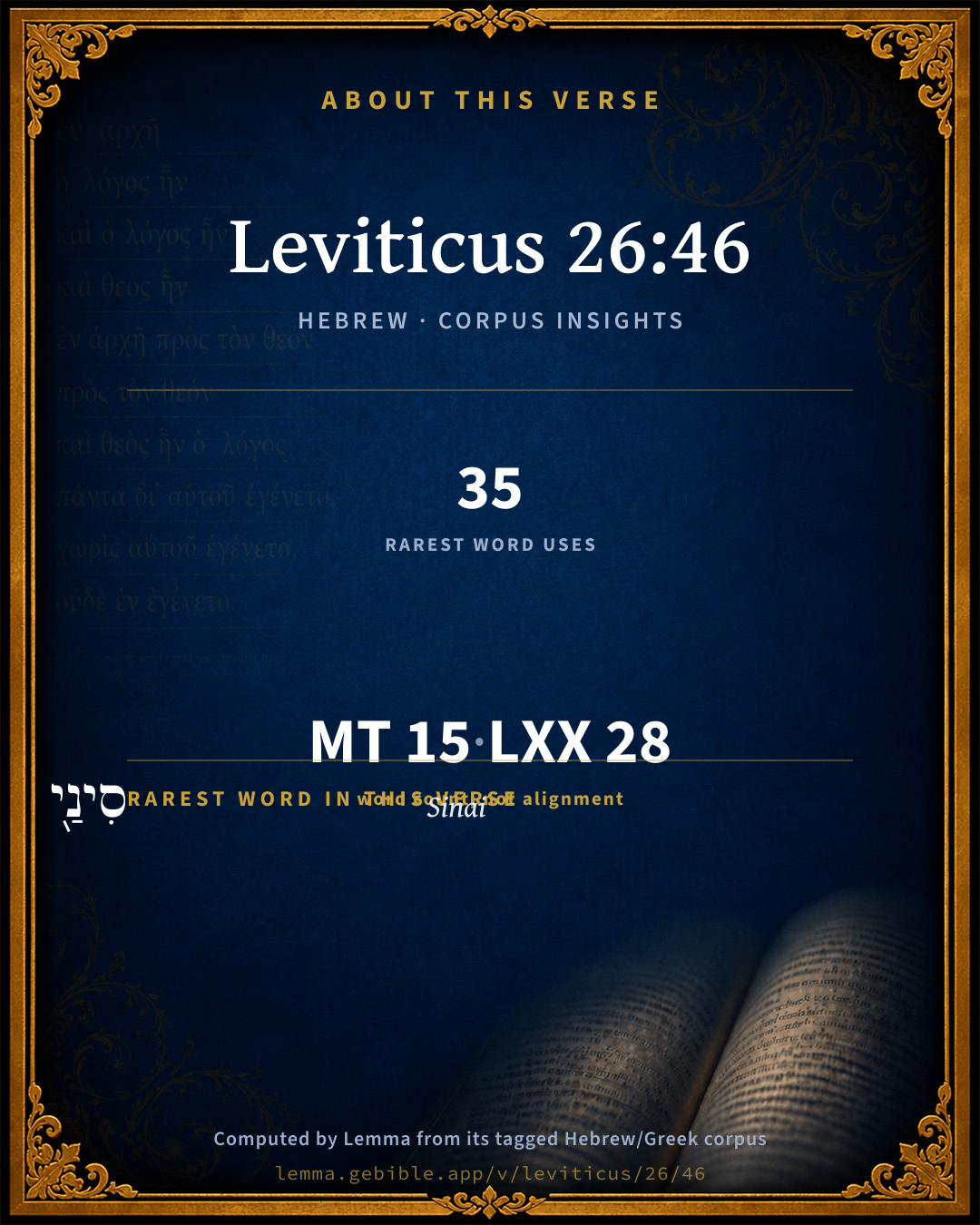
סִינַ֖י
Çîynay
H5514
“Sinai”
Noun, Proper
Part of Speech
Noun
Type
Proper
Full BDB Definition

Origin: of uncertain derivation

TWOT: 1488

Sinai = "thorny" - the mountain where Moses received the Law from Jehovah; located at the southern end of the Sinai peninsula between the horns of the Red Sea; exact site unknown
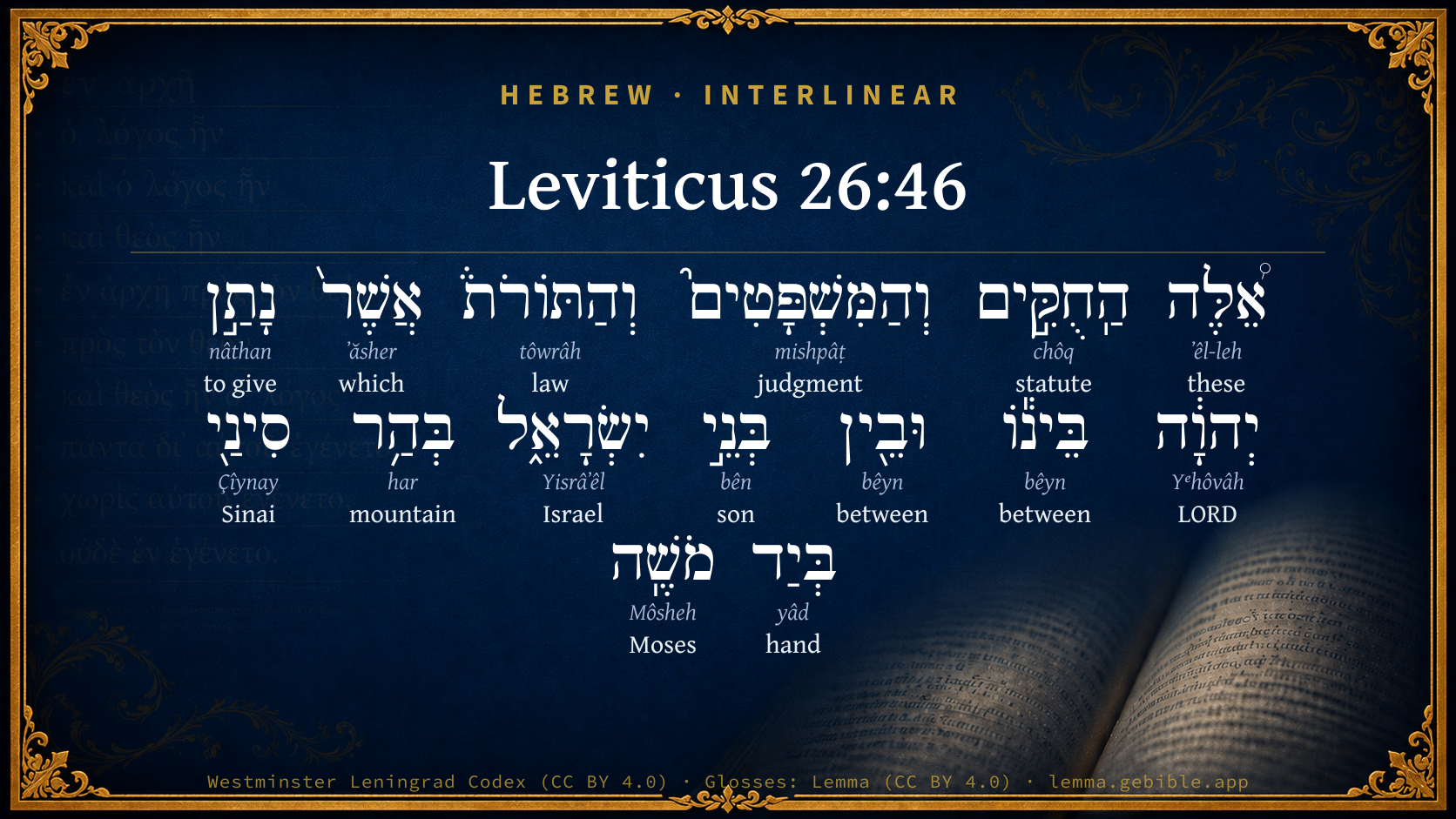
  1. אֵ֠לֶּה ʼêl-leh H428 “these” Pronoun, Demonstrative, Common, Plural
  2. הַֽחֻקִּ֣ים chôq H2706 “the · statutes” Particle, Definite Article + Noun, Common, Masculine, Plural, Absolute
  3. וְהַמִּשְׁפָּטִים֮ mishpâṭ H4941 “and · the · judgments” Conjunction + Particle, Definite Article + Noun, Common, Masculine, Plural, Absolute
  4. וְהַתּוֹרֹת֒ tôwrâh H8451 “and · the · laws” Conjunction + Particle, Definite Article + Noun, Common, Feminine, Plural, Absolute
  5. אֲשֶׁר֙ ʼăsher H834 “which” Particle, Relative
  6. נָתַ֣ן nâthan H5414 “to give” Verb, Qal, Perfect, 3rd Person, Masculine, Singular
  7. יְהוָ֔ה Yᵉhôvâh H3068 “LORD” Noun, Proper
  8. בֵּינ֕וֹ bêyn H996 “between · him” Preposition + Suffix, Personal, 3rd Person, Masculine, Singular
  9. וּבֵ֖ין bêyn H996 “and · between” Conjunction + Preposition
  10. בְּנֵ֣י bên H1121 “sons of” Noun, Common, Masculine, Plural, Construct
  11. יִשְׂרָאֵ֑ל Yisrâʼêl H3478 “Israel” Noun, Proper
  12. בְּהַ֥ר har H2022 “in/at · mountain of” Preposition + Noun, Common, Masculine, Singular, Construct
  13. בְּיַד yâd H3027 “in/at · hand of” Preposition + Noun, Common, Both, Singular, Construct
  14. מֹשֶֽׁה Môsheh H4872 “Moses” Noun, Proper

About this verse

These counts appear in no published source. They are computed here, from the morphology-tagged text and Lemma’s own curated glosses. What Lemma adds →

15
words
14
distinct lemmas
Pentateuch
section

Shared distinctive vocabulary

סִינַ֖י Sinai H5514 occurs in 34 verses of the Hebrew Bible. Also found in:

Grammatical profile

  • 1 verb
  • 10 nouns
  • 1 pronoun
  • 2 prepositions
  • 1 particle

Verb forms

  • נָתַ֣ן Qal · Perfect

Repetition

A word recurs within this verse — often emphatic in Hebrew:

  • בֵּינ֕וֹ between H996 ×2

Hebrew & Septuagint length

In English translation the verse runs 22 words from the Hebrew and 30 from the Septuagint (LXX English) — closely comparable.

A rough comparison of the two English renderings, which tokenize alike — not a word-level alignment.

Word counts can differ between the Hebrew and the Greek without any difference in meaning — e.g. the Hebrew direct-object marker אֵת has no separate Greek word, and Greek often adds the article ὁ.

In the original languages it is 15 Hebrew tokens and 28 Greek tokens — but the two are counted differently (Hebrew bundles its prefixes and suffixes into one token; the Greek is in lemma form), so that isn’t a like-for-like length.

Cross-references

10

Topical passages linked to Leviticus 26:46 in the Treasury of Scripture Knowledge — connected by theme and wording, ordered by reader-vote popularity; previews shown in the World English Bible.

  • Leviticus 27:34 These are the commandments which Yahweh commanded Moses for the children of Israel on Mount Sinai.
  • Deuteronomy 6:1 Now this is the commandment, the statutes, and the ordinances, which Yahweh your God commanded to teach you, that you might do them in the land where you go over to possess it;
  • Deuteronomy 12:1 These are the statutes and the ordinances which you shall observe to do in the land which Yahweh, the God of your fathers, has given you to possess it, all the days that you live on the earth.
  • Leviticus 25:1 Yahweh said to Moses in Mount Sinai,
  • Deuteronomy 13:4 You shall walk after Yahweh your God, and fear him, and keep his commandments, and obey his voice, and you shall serve him, and cleave to him.
  • Leviticus 7:38 which Yahweh commanded Moses in Mount Sinai, in the day that he commanded the children of Israel to offer their offerings to Yahweh, in the wilderness of Sinai.
  • Leviticus 8:36 Aaron and his sons did all the things which Yahweh commanded by Moses.
  • Numbers 4:37 These are those who were numbered of the families of the Kohathites, all who served in the Tent of Meeting, whom Moses and Aaron numbered according to the commandment of Yahweh by Moses.
  • Psalms 77:20 You led your people like a flock, By the hand of Moses and Aaron.
  • John 1:17 For the law was given through Moses. Grace and truth came through Jesus Christ.

Cross-references courtesy of OpenBible.info (CC BY 4.0).

Hebrew and Greek witnesses Masoretic Hebrew ↔ Greek Septuagint

The same verse in the two great witnesses to the Old Testament, shown verse-for-verse.

These are two independent witnesses, not word-aligned to each other, and the Septuagint is shown in lemma (dictionary) form.

Hebrew Leviticus 26:46 Masoretic · Westminster Leningrad Codex

אֵ֠לֶּה הַֽחֻקִּ֣ים וְהַמִּשְׁפָּטִים֮ וְהַתּוֹרֹת֒ אֲשֶׁר֙ נָתַ֣ן יְהוָ֔ה בֵּינ֕וֹ וּבֵ֖ין בְּנֵ֣י יִשְׂרָאֵ֑ל בְּהַ֥ר סִינַ֖י בְּיַד מֹשֶֽׁה

These are the statutes, ordinances and laws, which Yahweh made between him and the children of Israel in Mount Sinai by Moses.

World English Bible · Public Domain

Greek LXX Leviticus 26:46 Septuagint · lemma form

οὗτος ὁ κρίμα καί ὁ πρόσταγμα καί ὁ νόμος ὅς δίδωμι κύριος ἀνά μέσος αὐτός καί ἀνά μέσος ὁ υἱός ἰσραήλ ἐν ὁ ὄρος σινα ἐν χείρ μωυσῆς

These are my judgments and my ordinances, and the law which the Lord gave between himself and the children of Israel, in the mount Sina, by the hand of Moses.

LXX2012 (modern English Septuagint) · Public Domain

Hebrew: Westminster Leningrad Codex (CC BY 4.0). Greek: Septuagint (public domain); English from LXX2012 (modern English Septuagint) (Public Domain). How the Septuagint differs from the Hebrew →

Targum (Aramaic paraphrase)

2

The Targum is the ancient Jewish Aramaic paraphrase of the Hebrew Scriptures — an interpretive translation, not the Hebrew text itself. Onkelos (literal) and Pseudo-Jonathan (expansive) render the Torah, and Jonathan the Prophets. Coverage is partial: where no permissively-licensed English translation exists for a verse, only the Aramaic is shown. This is verse-level text, not a word-by-word alignment to the Hebrew.

  1. Targum Onkelos Torah (Genesis–Deuteronomy)
    אִלֵין קְיָמַיָא וְדִינַיָא וְאוֹרָיָתָא דִי יְהַב יְיָ בֵּין מֵימְרֵהּ וּבֵין בְּנֵי יִשְׂרָאֵל בְּטוּרָא דְסִינַי בִּידָא דְמֹשֶׁה

    (no public-domain English translation for this verse)

    Targum Onkelos — Aramaic: “Onkelos Genesis” (public domain); “Onkelos Exodus” (public domain); “Onkelos Leviticus” (public domain); “Onkelos Numbers” (public domain); “Onkelos Deuteronomy” (public domain). English: “Sefaria Community Translation” (CC0 1.0 (public-domain dedication)); “J.W. Etheridge. The Targums of Onkelos and Jonathan Ben Uzziel on the Pentateuch. London: Longmans, Green, 1862” (public domain). Text via Sefaria.

  2. Targum Pseudo-Jonathan Torah (Genesis–Deuteronomy)
    אִלֵין קְיָימַיָא וְסִדְרֵי דִינַיָיא וּגְזֵירַת אוֹרַיְיתָא דִיהַב יְיָ בֵּין מֵימְרֵיהּ וּבֵין בְּנֵי יִשְרָאֵל בְּטַוְורָא דְסִינַי עַל יְדָא דְמשֶׁה

    These are the statutes and the orders of the judgments and decrees of the law, which the Lord appointed between His Word and the sons of Israel, in the mountain of Sinai, by the hand of Mosheh.

    Targum Pseudo-Jonathan — Aramaic: “Targum Jonathan on Genesis” (public domain); “Targum Jonathan on Exodus” (public domain); “Targum Jonathan on Leviticus” (public domain); “Targum Jonathan on Numbers” (public domain); “Targum Jonathan on Deuteronomy” (public domain). English: “The Targum of Jonathan ben Uzziel, trans. J. W. Etheridge, London, 1862” (public domain). Text via Sefaria.

Commentary

Notes on Leviticus 26:46 from classic Christian and Jewish commentators (each source and its license shown beneath its notes). The classic Christian expositions comment on the surrounding passage and are grouped to its opening verse, so a note may address several verses; the Jewish commentaries on the Tanakh (Rashi and others) are per-verse, so they appear only where the commentator wrote on this verse.

Lemma curates 59 commentaries, every one of them public domain or Creative Commons licensed, each selected and text-cleaned for this edition rather than reprinted as found. About our sources →

Joseph Benson's Commentary

Lev 26:46. These are the statutes, &c. — This may reasonably refer to the whole body of laws contained in the preceding history from Exodus 20. And then the sense will be, that from that period to this, we have a complete detail of all the laws, with the promises and threatenings annexed to them, that were at that time delivered from God to the Israelites, at mount Sinai, by the ministry of Moses. Between him and the children of Israel — Hereby his communion with his church is kept up. He manifests not only his dominion over them, but his favour to them, by giving them his law. And they manifest not only their holy fear, but their holy love, by the observance of it. And thus it is made between them rather as a covenant than as a law: for he draws them with the cords of a man.

Joseph Benson's Commentary on the Old and New Testaments (1811–1818) — public domain. Text from a community e-Sword module.

Keil & Delitzsch

C. F. Keil & F. Delitzsch

Lev 26:46 contains the close of the entire book, or rather of the whole of the covenant legislation from Ex 25 onwards, although the expression "in Mount Sinai" points back primarily to Lev 25:1.

Keil & Delitzsch — Biblical Commentary on the Old Testament (1861–1891) — public domain (CC PDM 1.0). Text via the HelloAO Bible API. (Old Testament only.)

Geneva Bible (1599)

Geneva Bible translators

Fifty days after they came out of Egypt.

Geneva Bible (1599) marginal notes — public domain. Text via Bolls.life.

Jamieson, Fausset & Brown

Robert Jamieson, A. R. Fausset & David Brown

These are the statutes and judgments and laws--It has been thought by some that the last chapter was originally placed after the twenty-fifth [ADAM CLARKE], while others consider that the next chapter was added as an appendix, in consequence of many people being influenced by the promises and threats of the preceding one, to resolve that they would dedicate themselves and their possessions to the service of God [CALMET].

Next: Leviticus Chapter 27

Jamieson, Fausset & Brown — Commentary Critical and Explanatory on the Whole Bible (1871) — public domain (CC PDM 1.0). Text via the HelloAO Bible API.

Adam Clarke's Commentary

Verse 46. These are the statutes, and judgments, c.] See Clarke on Le 26:15. This verse appears to be the proper concluding verse of the whole book and I rather think that the 27th chapter originally followed the 25th. As the law was anciently written upon skins of parchment, sheep or goat skins, pasted or stitched together, and all rolled up in one roll, the matter being written in columns, one of those columns might have been very easily displaced, and thus whole chapters might have been readily interchanged. - It is likely that this might have been the case in the present instance. Others endeavour to solve this difficulty, by supposing that the 27th chapter was added after the book had been finished; and therefore there is apparently a double conclusion, one at the end of the 26th and the other at the end of the 27th chapter. However the above may have been, all the ancient versions agree in concluding both the chapters in nearly the same way; yet the 26th chapter must be allowed to be by far the most natural conclusion of the book.

THE most important points in this chapter have already been particularly noticed in the notes; and to those on the 15th, 34th, and 44th verses, the reader is especially referred. How unwilling is God to cast off his people! and yet how sure is their rejection if they refuse to obey and live to him! No nation has ever been so signally elected as the Jews; and yet no nation has ever been so signally and so awfully reprobated. O Britain, be not high-minded, but fear! Behold here the goodness and severity of God!

Adam Clarke's Commentary on the Bible (1810–1826) — public domain. Text from a community e-Sword/MySword module.

Ellicott's Commentary for English Readers

(46) These are the statutes and judgments.—That is, the statutes and judgments contained in Lev_25:1 to Lev_26:45.

In Mount Sinai.—That is, in the mountainous district of Sinai. This group of statutes therefore concludes with the very phrase with which it began (see Lev_25:1), thus showing that it forms a section by itself.

A Bible Commentary for English Readers, edited by Charles John Ellicott (1878–1897) — public domain. Text from a community e-Sword module.

The Cambridge Bible for Schools and Colleges

gen. ed. J. J. S. Perowne

46. the statutes and judgements and laws] This wording shews that the v. forms the conclusion not merely of this ch. but of the whole ‘Law of Holiness’ (Lev_26:17-26).

The Cambridge Bible for Schools and Colleges (gen. ed. J. J. S. Perowne; Cambridge University Press, 1878–1918) — public domain. Text from a community e-Sword module.

Whedon's Commentary on the Bible

Daniel D. Whedon

46. In mount Sinai — The whole Sinaitic peninsula is thus designated. It is not necessary to suppose that the whole of the ceremonial law was delivered on the summit of the mount where the decalogue was received.

By the hand of Moses — Says Dr. Green, in his reply to W. Robertson Smith: “The Mosaic origin of the Levitical laws is abundantly declared by the formulas with which they are introduced, and which occur over and over again: The LORD spake unto Moses, or the LORD spake unto Moses and Aaron; and the formulas by which they are often followed, for example, Lev_7:37-38; Lev_23:44; Lev_27:34.”

Daniel D. Whedon (gen. ed.), Commentary on the Old and New Testaments (1874–1909) — public domain. Text from a community e-Sword module.

The Pulpit Commentary

This is the closing paragraph of the Book of Leviticus; to which another chapter has been added, in the form of an appendix, on the subject of vows.

The Pulpit Commentary (1880–1919), ed. H.D.M. Spence-Jones & Joseph S. Exell — public domain. Text from a community e-Sword module.

John Wesley's Explanatory Notes

These are the laws which the Lord made between him and the children of Israel - Hereby his communion with his church is kept up. He manifests not only his dominion over them, but his favour to them, by giving them his law. And they manifest not only their holy fear, but their holy love by the observance of it. And thus it is made between them rather as a covenant than as a law: for he draws them with the cords of a man.

John Wesley, Explanatory Notes Upon the Whole Bible (1754–1765) — public domain. Text via the GEBible commentary corpus.

unfoldingWord translationNotes

Door43 World Missions Community

translationWords

command

decree

law

Sinai

unfoldingWord translationNotes — © Distant Shores Media and the Door43 World Missions Community, licensed CC BY-SA 4.0. Source: git.door43.org/Door43/en_tn.

Rashi

Rabbi Shlomo Yitzchaki (Rashi)

והתורת AND THE TORAHS… [WHICH GOD GAVE… IN MOUNT SINAI BY THE HAND OF MOSES] — (The plural is used because there are two Torahs:) one in writing and one by word of mouth (the Oral Law). This verse therefore tells us that all (both) of them were given by God to Moses on Sinai (Sifra, Bechukotai, Chapter 8 10).

Rashi on the Tanakh — English translations: “The Judaica Press complete Tanach with Rashi, translated by A. J. Rosenberg” (CC BY 4.0); “Pentateuch with Rashi's commentary by M. Rosenbaum and A.M. Silbermann, 1929-1934” (public domain); “The Metsudah Tanach series, Lakewood, N.J” (CC BY 4.0); and “The Book of Joshua, Metsudah Publications, 1997” (CC BY 4.0). Text via Sefaria.

Lesson kit

Teaching starters — assembled from the data on this page, not authored interpretation. Every prompt links to the verse data it draws on. Edit before teaching.

Leviticus, in the Pentateuch, opens this verse with 15 words (14 distinct Hebrew lemmas). Its most distinctive word is Çîynay (“Sinai”). A historical commentator’s framing appears above. Read the whole chapter for the surrounding context.

Discussion questions

  1. What does “Sinai” (Çîynay) contribute to the verse as a whole?
  2. Exodus 16:1 shares the word «Sinai» with this verse. How do the two illuminate each other?
  3. “between” occurs 2× in this one verse. What is the effect of the repetition?
  4. These translations render this verse differently. What is at stake in choosing one wording over another?
  5. The verb «נָתַ֣ן» is Qal Perfect. How does its form color the action?
  6. Reading how Joseph Benson's Commentary and Keil & Delitzsch read this verse, where do the two commentators agree and where do they part?

Things to notice

Reading settings

Reading text

Shown beneath each verse's original-language words.

Old Testament
Old Testament edition

Read the OT as the Masoretic Hebrew (MT) or the Greek Septuagint (LXX).

English shown for the Greek Septuagint (in the Hebrew ↔ Greek comparison).

Comparing translations? Open the Compare panel on any verse page to stack up to four side by side.