
Numbers 9:3

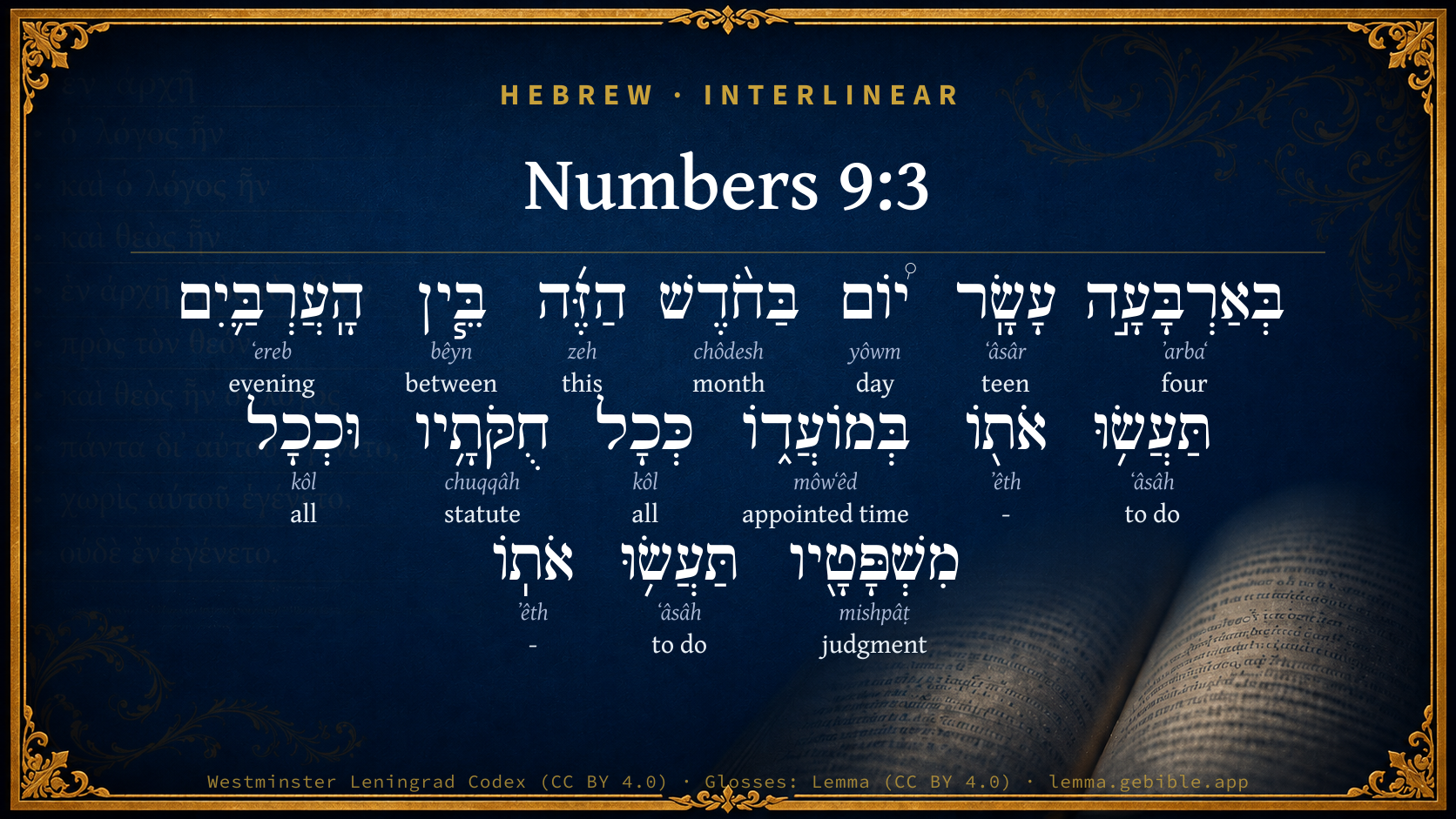
Hebrew (Westminster Leningrad Codex) Numbers 9:3 appears in the Hebrew Old Testament. The text above is from the Westminster Leningrad Codex. Each word links to its Strong’s number, a concise gloss, and parsing drawn from the Open Scriptures Hebrew Bible morphology. Click any word for its full Brown-Driver-Briggs (BDB) entry.
Download image
Cite this verse

Numbers 9:3 (World English Bible). Public Domain. Lemma interlinear Bible study tool, https://lemma.gebible.app/v/numbers/9/3.

Show BibTeX & RIS
BibTeX
RIS
English Translation
On the fourteenth day of this month, at evening, you shall keep it in its appointed season-- according to all its statutes, and according to all its ordinances, you shall keep it."
World English Bible · Public Domain
Download a study sheet

One document with this verse’s original text, its word-by-word gloss line, the meaning frame, cross-references with their text, attributed commentary, and full source and license credits — printable, and it pastes into notes with its structure intact.

This verse Autodidact and up

Study sheet (.html) Plain text (.txt)

A passage Seminary Student

Up to 50 verses in one chapter. A passage sheet keeps up to 6 commentary sources and 12 cross-references per verse, in the order this page ranks them, and says so on the sheet whenever that leaves anything out. Ask for a single verse and you get the Autodidact verse sheet above.

Everything on this page stays free to read, with no account — the sheet is a download of what is already on screen, not access to it.

Want to remove ads? Support Godless Engineer
Compare translations 3

The same verse in 3 English versions, stacked beneath the original-language interlinear above. Click any original word for its lexicon entry.

Each is an independent rendering of the whole verse — the interlinear is not word-aligned to these translations.

Highlighted words mark where these versions differ — a whole-verse word diff, not a word-by-word alignment.

  • World English Bible Public Domain
    On the fourteenth day of this month, at evening, you shall keep it in its appointed season-- according to all its statutes, and according to all its ordinances, you shall keep it."
  • King James Version Public Domain
    In the fourteenth day of this month, at even, ye shall keep it in his appointed season: according to all the rites of it, and according to all the ceremonies thereof, shall ye keep it.
  • unfoldingWord Literal Text CC BY-SA 4.0
    On day 14 in this month, between the evenings, you shall do it in its appointed time. According to all its statutes and according to all its ordinances you shall do it.”

unfoldingWord Literal Text — © unfoldingWord, licensed CC BY-SA 4.0. Word-aligned USFM3 via Door43 (git.door43.org/unfoldingWord/en_ult).

Versions to compare (up to 4)

3 of 4 selected

Show all 18 translations

Every available English version of this verse, each an independent rendering of the whole verse.

  • World English Bible Public Domain
    On the fourteenth day of this month, at evening, you shall keep it in its appointed season-- according to all its statutes, and according to all its ordinances, you shall keep it."
  • Berean Standard Bible Public Domain
    You are to observe it at the appointed time, at twilight on the fourteenth day of this month, in accordance with its statutes and ordinances.”
  • Majority Standard Bible Public Domain
    You are to observe it at the appointed time, at twilight on the fourteenth day of this month, in accordance with its statutes and ordinances.”
  • King James Version Public Domain
    In the fourteenth day of this month, at even, ye shall keep it in his appointed season: according to all the rites of it, and according to all the ceremonies thereof, shall ye keep it.
  • American Standard Version (1901) Public Domain
    In the fourteenth day of this month, at even, ye shall keep it in its appointed season: according to all the statutes of it, and according to all the ordinances thereof, shall ye keep it.
  • Revised Version (1885) Public Domain
    In the fourteenth day of this month, at even, ye shall keep it in its appointed season: according to all the statutes of it, and according to all the ordinances thereof, shall ye keep it.
  • Geneva Bible (1599) Public Domain
    In the fourtenth day of this moneth at euen, ye shall keepe it in his due season: according to all the ordinances of it, and according to all the ceremonies thereof shall ye keepe it.
  • Douay-Rheims (1899) Public Domain
    The fourteenth day of this month in the evening, according to all the ceremonies and justifications thereof.
  • Young's Literal Translation Public Domain
    in the fourteenth day of this month between the evenings ye prepare it in its appointed season; according to all its statutes, and according to all its ordinances ye prepare it.'
  • Literal Standard Version CC BY-SA 4.0
    in the fourteenth day of this month between the evenings you prepare it in its appointed time; you prepare it according to all its statutes and according to all its ordinances.”
  • Unlocked Literal Bible CC BY-SA 4.0
    On the fourteenth day of this month, at evening, you must keep the Passover at its fixed time of year. You must keep it, follow all the regulations, and obey all the decrees that are related to it.”
  • unfoldingWord Literal Text CC BY-SA 4.0
    On day 14 in this month, between the evenings, you shall do it in its appointed time. According to all its statutes and according to all its ordinances you shall do it.”
  • Darby Bible Public Domain
    on the fourteenth day in this month between the two evenings, ye shall hold it at its set time; according to all the rites of it, and according to all the ordinances thereof shall ye hold it.
  • World Messianic Bible Public Domain
    On the fourteenth day of this month, at evening, you shall keep it in its appointed season. You shall keep it according to all its statutes and according to all its ordinances.”
  • Webster's Bible Public Domain
    In the fourteenth day of this month, at evening, ye shall keep it in its appointed season: according to all its rites, and according to all its ceremonies, shall ye keep it.
  • Free Bible Version CC BY-SA 4.0
    Observe it at the time required—in the evening after sunset on the fourteenth day of this month, and do so in accordance with its rules and regulations.”
  • Bible in Basic English Public Domain
    In the fourteenth day of this month, at evening, you are to keep it at the regular time, and in the way ordered in the law.
  • JPS Tanakh (1917) Public Domain
    In the fourteenth day of this month, at dusk, ye shall keep it in its appointed season; according to all the statutes of it, and according to all the ordinances thereof, shall ye keep it.'

Literal Standard Version (2020), Covenant Press — licensed CC BY-SA 4.0. Text via the HelloAO Bible API (eBible.org). Unlocked Literal Bible (unfoldingWord) — licensed CC BY-SA 4.0. Text via the HelloAO Bible API (eBible.org). unfoldingWord Literal Text — © unfoldingWord, licensed CC BY-SA 4.0. Word-aligned USFM3 via Door43 (git.door43.org/unfoldingWord/en_ult). Free Bible Version, Dr. Jonathan Gallagher — licensed CC BY-SA 4.0. Text via the HelloAO Bible API (eBible.org).

Word by word

More ways to search: Search by grammar → Find every occurrence → Compare this word →

Practice this passage: Drill this verse → Learn its vocabulary →

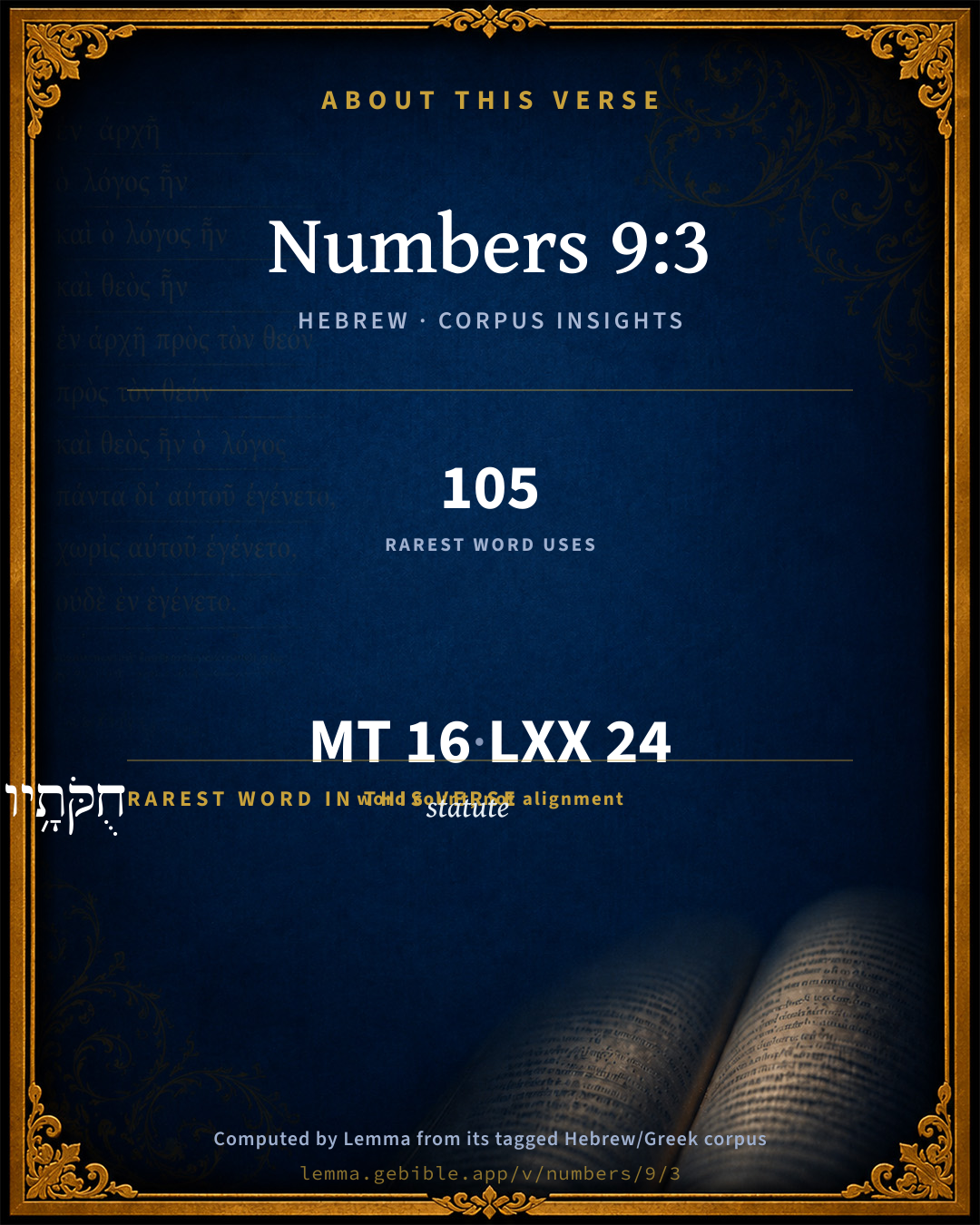
חֻקֹּתָ֥יו
chuqqâh
H2708
“statutes · his”
Noun, Common, Both, Plural, Construct + Suffix, Personal, 3rd Person, Masculine, Singular
Part of Speech
Noun
Type
Common
Gender
Both
Number
Plural
State
Construct
Full BDB Definition

Origin: from H2706

TWOT: 728b

statute, ordinance, limit, enactment, something prescribed - statute
  1. בְּאַרְבָּעָ֣ה ʼarbaʻ H702 “in/at · four” Preposition + Adjective, Cardinal number, Masculine, Singular, Absolute
  2. עָשָֽׂר ʻâsâr H6240 “teen” Adjective, Cardinal number, Masculine, Singular, Absolute
  3. י֠וֹם yôwm H3117 “day” Noun, Common, Masculine, Singular, Absolute
  4. בַּחֹ֨דֶשׁ chôdesh H2320 “in/at the · month” Preposition, Determined + Noun, Common, Masculine, Singular, Absolute
  5. הַזֶּ֜ה zeh H2088 “the · this” Particle, Definite Article + Pronoun, Demonstrative, Masculine, Singular
  6. בֵּ֧ין bêyn H996 “between” Preposition
  7. הָֽעֲרְבַּ֛יִם ʻereb H6153 “the · evenings” Particle, Definite Article + Noun, Common, Masculine, Dual, Absolute
  8. תַּעֲשׂ֥וּ ʻâsâh H6213 “to do” Verb, Qal, Imperfect, 2nd Person, Masculine, Plural
  9. אֹת֖וֹ ʼêth H853 “- · him” Particle, Direct Object + Suffix, Personal, 3rd Person, Masculine, Singular
  10. בְּמוֹעֲד֑וֹ môwʻêd H4150 “in/at · appointed time · his” Preposition + Noun, Common, Masculine, Singular, Construct + Suffix, Personal, 3rd Person, Masculine, Singular
  11. כְּכָל kôl H3605 “like/as · all of” Preposition + Noun, Common, Masculine, Singular, Construct
  12. וּכְכָל kôl H3605 “and · like/as · all of” Conjunction + Preposition + Noun, Common, Masculine, Singular, Construct
  13. מִשְׁפָּטָ֖יו mishpâṭ H4941 “judgments · his” Noun, Common, Masculine, Plural, Construct + Suffix, Personal, 3rd Person, Masculine, Singular
  14. תַּעֲשׂ֥וּ ʻâsâh H6213 “to do” Verb, Qal, Imperfect, 2nd Person, Masculine, Plural
  15. אֹתֽוֹ ʼêth H853 “- · him” Particle, Direct Object + Suffix, Personal, 3rd Person, Masculine, Singular

About this verse

These counts appear in no published source. They are computed here, from the morphology-tagged text and Lemma’s own curated glosses. What Lemma adds →

16
words
13
distinct lemmas
Pentateuch
section

Grammatical profile

  • 2 verbs
  • 8 nouns
  • 2 adjectives
  • 1 pronoun
  • 1 preposition
  • 2 particles

Verb forms

  • תַּעֲשׂ֥וּ Qal · Imperfect
  • תַּעֲשׂ֥וּ Qal · Imperfect

Repetition

Words recur within this verse — often emphatic in Hebrew:

  • תַּעֲשׂ֥וּ to do H6213 ×2
  • כְּכָל all H3605 ×2

Hebrew & Septuagint length

In English translation the verse runs 32 words from the Hebrew and 30 from the Septuagint (LXX English) — closely comparable.

A rough comparison of the two English renderings, which tokenize alike — not a word-level alignment.

Word counts can differ between the Hebrew and the Greek without any difference in meaning — e.g. the Hebrew direct-object marker אֵת has no separate Greek word, and Greek often adds the article ὁ.

In the original languages it is 16 Hebrew tokens and 24 Greek tokens — but the two are counted differently (Hebrew bundles its prefixes and suffixes into one token; the Greek is in lemma form), so that isn’t a like-for-like length.

Cross-references

6

Topical passages linked to Numbers 9:3 in the Treasury of Scripture Knowledge — connected by theme and wording, ordered by reader-vote popularity; previews shown in the World English Bible.

  • Exodus 12:6–11 and you shall keep it until the fourteenth day of the same month; and the whole assembly of the congregation of Israel shall kill it at evening.
  • Leviticus 23:5 In the first month, on the fourteenth day of the month in the evening, is Yahweh's Passover.
  • Numbers 9:11–12 In the second month, on the fourteenth day at evening they shall keep it; they shall eat it with unleavened bread and bitter herbs.
  • 2 Chronicles 30:2 For the king had taken counsel, and his princes, and all the assembly in Jerusalem, to keep the Passover in the second month.
  • 2 Chronicles 30:15 Then they killed the Passover on the fourteenth [day] of the second month: and the priests and the Levites were ashamed, and sanctified themselves, and brought burnt offerings into the house of Yahweh.
  • Hebrews 9:26 or else he must have suffered often since the foundation of the world. But now once at the end of the ages, he has been revealed to put away sin by the sacrifice of himself.

Cross-references courtesy of OpenBible.info (CC BY 4.0).

Hebrew and Greek witnesses Masoretic Hebrew ↔ Greek Septuagint

The same verse in the two great witnesses to the Old Testament, shown verse-for-verse.

These are two independent witnesses, not word-aligned to each other, and the Septuagint is shown in lemma (dictionary) form.

Hebrew Numbers 9:3 Masoretic · Westminster Leningrad Codex

בְּאַרְבָּעָ֣ה עָשָֽׂר י֠וֹם בַּחֹ֨דֶשׁ הַזֶּ֜ה בֵּ֧ין הָֽעֲרְבַּ֛יִם תַּעֲשׂ֥וּ אֹת֖וֹ בְּמוֹעֲד֑וֹ כְּכָל חֻקֹּתָ֥יו וּכְכָל מִשְׁפָּטָ֖יו תַּעֲשׂ֥וּ אֹתֽוֹ

On the fourteenth day of this month, at evening, you shall keep it in its appointed season-- according to all its statutes, and according to all its ordinances, you shall keep it."

World English Bible · Public Domain

Greek LXX Numbers 9:3 Septuagint · lemma form

ὁ οςτεσσαρεσκαιδέκατ ἡμέρα ὁ μήν ὁ πρῶτος πρός ἑσπέρα ποιέω αὐτός κατά καιρός κατά ὁ νόμος αὐτός καί κατά ὁ σύγκρισις αὐτός ποιέω αὐτός

On the fourteenth day of the first month at even, you shall keep it in its season; you shall keep it according to its law, and according to its ordinance.

LXX2012 (modern English Septuagint) · Public Domain

On this verse, Haydock's Catholic Bible Commentary discusses the Septuagint’s reading. Read the note in Commentary ↓

Hebrew: Westminster Leningrad Codex (CC BY 4.0). Greek: Septuagint (public domain); English from LXX2012 (modern English Septuagint) (Public Domain). How the Septuagint differs from the Hebrew →

Targum (Aramaic paraphrase)

2

The Targum is the ancient Jewish Aramaic paraphrase of the Hebrew Scriptures — an interpretive translation, not the Hebrew text itself. Onkelos (literal) and Pseudo-Jonathan (expansive) render the Torah, and Jonathan the Prophets. Coverage is partial: where no permissively-licensed English translation exists for a verse, only the Aramaic is shown. This is verse-level text, not a word-by-word alignment to the Hebrew.

  1. Targum Onkelos Torah (Genesis–Deuteronomy)
    בְּאַרְבַּעַת עַשְׂרָא יוֹמָא בְּיַרְחָא הָדֵין בֵּין שִׁמְשַׁיָא תַּעְבְּדוּן יָתֵהּ בְּזִמְנֵהּ כְּכָל גְזֵרָתֵהּ וּכְכָל דְחָזֵי לֵהּ תַּעְבְּדוּן יָתֵהּ

    (no public-domain English translation for this verse)

    Targum Onkelos — Aramaic: “Onkelos Genesis” (public domain); “Onkelos Exodus” (public domain); “Onkelos Leviticus” (public domain); “Onkelos Numbers” (public domain); “Onkelos Deuteronomy” (public domain). English: “Sefaria Community Translation” (CC0 1.0 (public-domain dedication)); “J.W. Etheridge. The Targums of Onkelos and Jonathan Ben Uzziel on the Pentateuch. London: Longmans, Green, 1862” (public domain). Text via Sefaria.

  2. Targum Pseudo-Jonathan Torah (Genesis–Deuteronomy)
    בְּאַרְבֵּיסַר יוֹמָא בְּיַרְחָא הָדֵין בֵּין שִׁמְשְׁתָא תַּעַבְדוּן יָתֵיהּ בִּזְמַנֵיהּ כְּכָל קְיָימוֹי וּכְכָל דִינוֹי תַּעַבְדוּן יָתֵיהּ

    On the fourteenth day of this mouth, between the suns, they shall perform it in its time; according to all its rites and all its statutes shall they do it.

    Targum Pseudo-Jonathan — Aramaic: “Targum Jonathan on Genesis” (public domain); “Targum Jonathan on Exodus” (public domain); “Targum Jonathan on Leviticus” (public domain); “Targum Jonathan on Numbers” (public domain); “Targum Jonathan on Deuteronomy” (public domain). English: “The Targum of Jonathan ben Uzziel, trans. J. W. Etheridge, London, 1862” (public domain). Text via Sefaria.

Commentary

Notes on Numbers 9:3 from classic Christian and Jewish commentators (each source and its license shown beneath its notes). The classic Christian expositions comment on the surrounding passage and are grouped to its opening verse, so a note may address several verses; the Jewish commentaries on the Tanakh (Rashi and others) are per-verse, so they appear only where the commentator wrote on this verse.

Lemma curates 59 commentaries, every one of them public domain or Creative Commons licensed, each selected and text-cleaned for this edition rather than reprinted as found. About our sources →

Trapp's Complete Commentary

John Trapp

Num 9:3 In the fourteenth day of this month, at even, ye shall keep it in his appointed season: according to all the rites of it, and according to all the ceremonies thereof, shall ye keep it.

Ver. 3. According to all the rites.] It was a true saying of Socrates in Xenophon, Deum eo cultus genere coli velle, quem ipse instituerit that God must be worshipped in his own way only. Whereunto agreeth that of Cicero, Deum non superstitione coli velle, sed pietate.

John Trapp, A Commentary or Exposition upon All the Books of the Old and New Testament (1647–1656) — public domain. Text from a community e-Sword module.

Geneva Bible (1599)

Geneva Bible translators

Even in all points as the Lord hath instituted it.

Geneva Bible (1599) marginal notes — public domain. Text via Bolls.life.

Adam Clarke's Commentary

Verse 3. According to all the rites of it] See all those rites and ceremonies largely explained in Clarke's notes on Ex 12:1-51.

Adam Clarke's Commentary on the Bible (1810–1826) — public domain. Text from a community e-Sword/MySword module.

Ellicott's Commentary for English Readers

(3) At even.—Hebrew, between the two evenings. (See Note on Exo_12:6.)

According to all the rites of it, and according to all the ceremonies thereof.—Better, according to all the statutes and ordinances thereof. It is obvious that some of the directions concerning the Egyptian Passover could not be observed in the wilderness. The reference must, therefore, be to those statutes and ordinances respecting the Passover which were of permanent obligation. (Comp. Num_9:12, where the ordinance respecting the time of observance is necessarily excluded.) Some of these are found in Exodus 12, whilst others of a later date are recorded in Leviticus 17 and Deuteronomy 16. It has been objected that three priests (for Nadab and Abihu were dead) could not sprinkle the blood of the large number of lambs which must have been slain. It must be remembered, however, (1) that there is no express injunction respecting the sprinkling of the blood on this occasion; and (2) that the priests were probably assisted at this time in the performance of some of their duties—as we are expressly informed that they were at the Passovers celebrated by Hezekiah and by Josiah (2Ch_30:16; 2Ch_35:11)—by the Levites.

A Bible Commentary for English Readers, edited by Charles John Ellicott (1878–1897) — public domain. Text from a community e-Sword module.

The Cambridge Bible for Schools and Colleges

gen. ed. J. J. S. Perowne

3. all the statutes of it] These were laid down in Exo_12:1-20; Exo_12:43-49 (P ), Exo_12:21–23 (J ). The feast is referred to as a type in 1Co_5:7 f.; cf. Col_1:14, Eph_1:7 (with Armitage Robinson’s note).

The Cambridge Bible for Schools and Colleges (gen. ed. J. J. S. Perowne; Cambridge University Press, 1878–1918) — public domain. Text from a community e-Sword module.

John Gill's Exposition

In the fourteenth day of this month,.... The first month, the month Nisan or Abib, answering to part of our March:

at even ye shall keep it, in his appointed season: between the two evenings, Exo 12:6; and even if it fall on the sabbath day, as Jarchi; and this was a sabbath day, according to the Jewish writers (y):

according to all the rites of it, and according to all the ceremonies thereof shall ye keep it; the former of these, according to Jarchi, respects the lamb, and the requisites of it, that it should be without blemish, a male, and of the first year; and the latter, according to him and others, the removal of the leaven, and the seven days of unleavened bread, and the eating of the lamb with bitter herbs: they take in no doubt all that were prescribed by the original law, except the sprinkling of the blood on the doorposts, and also eating the passover in haste, with their loins girt, and shoes on their feet, and staves in their hands; though some think these latter might be observed at this time, when they were unsettled.

(y) Seder Olam Rabba. c. 7.

John Gill's Exposition of the Whole Bible (1746–1763) — public domain (CC PDM 1.0). Text via the HelloAO Bible API.

Haydock's Catholic Bible Commentary

In the. Hebrew, "between the two evenings," Exodus xii. 6. Septuagint, "towards the evening, in its season, according to its law, and determination," sugkrisin, (ver. 14,) suntaxin, "arrangement;" in both places we have justifications. (Haydock) --- God’s law is so called, because nothing can be done right without it. (Menochius) --- The merit of human actions depends on their conformity with the will of God; (Du Hamel) and when he gives directions, we must comply exactly. (Haydock)

George Leo Haydock (1774–1849), Haydock's Catholic Family Bible and Commentary, 1859 edition — public domain. Excludes Psalms (Douay-Rheims chapter numbering differs from Protestant) and Deuterocanonical books (Catholic canon only).

Matthew Poole's English Annotations

So far as concerned the lamb and the unleavened bread, &c., for there were some things peculiar to the first passover in Egypt, as that they were to eat it in haste, with their loins girded, their shoes on their feet, and their staff in their hand, which were not properly rites or ceremonies of the passover, but circumstances of their present condition being the travellers and ready to depart, &c.

Quest. Whence had they meal to make unleavened bread

Answ. They were not now in haste, and so had time enough to procure it out of the land of Midian by the help of Moses’s father-in-law, who lived there, which land was not far from Horeb or Sinai, as appears from Exo 3:1.

Matthew Poole's English Annotations on the Holy Bible (1683–1685) — public domain. Text from a community e-Sword/MySword module.

Whedon's Commentary on the Bible

Daniel D. Whedon

3. At even — Hebrews, between the two evenings. The first evening began when the sun crossed the meridian, and the second at sunset. See Exo_12:6, note.

According to all the rites — R.V., “statutes.” The changed circumstances must have rendered some slight variations necessary. There is no express command, it is true, that the blood, instead of being smeared upon the lintel and posts of the doors or entrances to the tents, should be sprinkled upon the altar of burnt offering, but it is quite probable that this change was made, since there was no destroying angel about to pass through the camp, while there was a newly-consecrated altar upon which the blood of all animals slain for food, as well as in sacrifice, was to be poured out. See Lev_17:1-6, notes. The objection raised by Kurtz, that the priests, Aaron, Eleazar, and Ithamar, would be unable to perform this service, is relieved by the suggestion that they were assisted by the Levites in every thing but the act of sprinkling. See chap. Num_8:19, note. Assuming that one sheep a year old would furnish a supper for fifteen males and fifteen females, 80,000 lambs would be required. If it was possible in the time of the Emperor Nero to sprinkle upon the altar of the temple the blood of 256,500 paschal lambs in one afternoon by actual count, according to Josephus, it must have been possible in Moses’s time to sprinkle the blood of less than one third of that number upon an altar five cubits square. But this difficulty disappears if we suppose that the law of the passover takes the precedence of subsequent laws for the treatment of the blood. In this case each slayer of a lamb disposes of the blood at his own tent. A pastoral nation could easily furnish one sheep for every thirty of its population.

Daniel D. Whedon (gen. ed.), Commentary on the Old and New Testaments (1874–1909) — public domain. Text from a community e-Sword module.

The Pulpit Commentary

At even. See on Exo_12:6. According to all the rites of it, and according to all the ceremonies thereof. This must be understood only of the essential rites and ceremonies of the passover, as mentioned below (verses 11, 12). It is singular that no mention is made of the considerable departure which circumstances necessitated from the original institution. It was not possible, e.g., to strike the blood of the lamb upon the lintel and the side-posts of the doors, because in the wilderness they had no doors. In after ages this rite (which was of the essence of the institution) was represented by the sprinkling of the blood of the lambs on the altar, (2Ch_30:16) but no command is on record which expressly authorized the change. In Lev 17:8-6 there is indeed a general direction, applying apparently to all domestic animals slain for food, that they be brought to the tabernacle to be slain, and that the priest sprinkle the blood upon the altar; and in Deu_16:5-7 there is an order that in future times the passover was only to he slain at the place which the Lord should choose. The actual practice in later ages seems to have been founded partly upon the command in Deuteronomy, which restricted the killing of the passover to Jerusalem (not, however, to the temple), and partly on the command in Leviticus, which really applied (at any rate in the letter) to the time of wandering only. As the celebration of the paschal feast had apparently been neglected from the time of Joshua until that of the later kings, (Jos_5:10 2Ki_23:22) they were no doubt guided in the observance of it by the analogy of other sacrifices in the absence of express commands. It would, however, be an obvious source of error to assume that the practice of the age of Josiah or Hezekiah was the practice of the earliest passovers; so far as these necessarily differed from the original institution, it is absolutely uncertain how the difficulty was solved. Nothing perhaps better illustrates the mingled rigidity and elasticity of the Divine ordinances than the observance of the passover, in which so much of changed detail was united with so real and so unvarying a uniformity.

The Pulpit Commentary (1880–1919), ed. H.D.M. Spence-Jones & Joseph S. Exell — public domain. Text from a community e-Sword module.

Rashi

Rabbi Shlomo Yitzchaki (Rashi)

ככל חקותיו ACCORDING TO ALL RITES OF IT [… SHALL YE KEEP IT] — This refers to the laws relating to its body itself (i.e. the animal itself) while alive — that it must be “a lamb, without blemish, a male, one year old” (Exodus 12:5) (Sifrei Bamidbar 65).

וככל משפטיו AND ACCORDING TO ALL THE REGULATIONS THEREOF — This again refers to commands which have a bearing upon the animal itself but originating from another place (i.e. outside the animal itself), e.g. seven days for eating unleavened bread and during which the leaven must be removed from one’s home. [Some editions have (cf. Nachmanides): the laws relating to the animal itself are that it must be “a lamb, without blemish, a male and one year old”. Such as have to be practiced upon its body (note the difference in the meaning of this phrase, and the omission of ממקום אחר) are those mentioned in Exodus 12:9: “roasted with fire, its head with its legs and the inward parts thereof”; and finally such as go beyond the sacrifice itself: the eating of unleavened bread and the removal of leaven from the house].

Rashi on the Tanakh — English translations: “The Judaica Press complete Tanach with Rashi, translated by A. J. Rosenberg” (CC BY 4.0); “Pentateuch with Rashi's commentary by M. Rosenbaum and A.M. Silbermann, 1929-1934” (public domain); “The Metsudah Tanach series, Lakewood, N.J” (CC BY 4.0); and “The Book of Joshua, Metsudah Publications, 1997” (CC BY 4.0). Text via Sefaria.

Ramban (Nachmanides)

Rabbi Moshe ben Nachman (Ramban / Nachmanides)

ACCORDING TO ALL THE STATUTES OF IT, AND ACCORDING TO ALL THE ORDINANCES THEREOF, SHALL YE BRING IT [i.e., the Passover-offering]. Now it is written in the commentary of Rashi: “According to all the statutes of it — this refers to the laws concerning the animal itself, [that it should be] a lamb without blemish, a male of the first year., Verse 5. And according to all the ordinances thereof — this relates to the laws ‘upon’ the lamb, such as eating unleavened bread for seven days, and the removal of leavened bread.” But this is a copyist’s error. [For the laws which concern the animal itself are as stated above], a lamb without blemish, a male of the first year;, Verse 5. the laws “upon” the animal are that it should be roast with fire; its head with its legs and with the inwards thereof; whereas the laws which are “outside” the animal itself are [the duty to eat] unleavened bread [on the first evening of the festival] and the duty of removing leavened bread, concerning which Scripture does not speak here at all. Similarly, it is said of the second Passover that [it should be observed] according to the statute of the Passover, and according to the ordinance thereof, and a person may [then] have both unleavened bread and leavened bread with him in his house, and it applies for only one day. of the second Passover, since we have been taught that on the second Passover one may have both unleavened and leavened bread with one in the house! Furthermore, the second Passover applies only for one day; so how can there be a duty to eat unleavened bread for seven days included in “the ordinances that are upon the animal” [as our texts of Rashi have it]!Now Scripture spoke briefly, saying, at dusk, ye shall bring it in its appointed season; according to all the statutes of it, and according to all the ordinances thereof, shall ye bring it, thereby including the laws relating to eating it, that it should not be on the day mentioned by the verse [on which the offering is slaughtered], but it is to be eaten on the following night, since He already explained previously, And they shall eat the flesh in that night etc. Similarly, In the second month on the fourteenth day at dusk they shall bring it; they shall eat it with unleavened bread and bitter herbs, means they shall eat it at the time of eating mentioned in the command concerning the first Passover.

Ramban (Nachmanides) on the Tanakh — English translation: “Commentary on the Torah by Ramban (Nachmanides). Translated and annotated by Charles B. Chavel. New York, Shilo Pub. House, 1971-1976” (CC BY 4.0). Text via Sefaria.

Lesson kit

Teaching starters — assembled from the data on this page, not authored interpretation. Every prompt links to the verse data it draws on. Edit before teaching.

Numbers, in the Pentateuch, opens this verse with 16 words (13 distinct Hebrew lemmas). Its most distinctive word is chuqqâh (“statute”). A historical commentator’s framing appears above. Read the whole chapter for the surrounding context.

Discussion questions

  1. How does “statute” (chuqqâh) shape what this verse is saying?
  2. Exodus 12:6–11 shares this passage’s theme. How do the two illuminate each other?
  3. “to do” occurs 2× in this one verse. What is the effect of the repetition?
  4. The translations on this page render this verse differently — a whole-verse word diff, not a word-by-word alignment. What might account for the different wordings?
  5. The verb «תַּעֲשׂ֥וּ» is Qal Imperfect. How does its form color the action?
  6. Reading how Trapp's Complete Commentary and Geneva Bible (1599) read this verse, where do the two commentators agree and where do they part?

Things to notice

Reading settings

Reading text

Shown beneath each verse's original-language words.

Old Testament
Old Testament edition

Read the OT as the Masoretic Hebrew (MT) or the Greek Septuagint (LXX).

English shown for the Greek Septuagint (in the Hebrew ↔ Greek comparison).

Comparing translations? Open the Compare panel on any verse page to stack up to four side by side.