
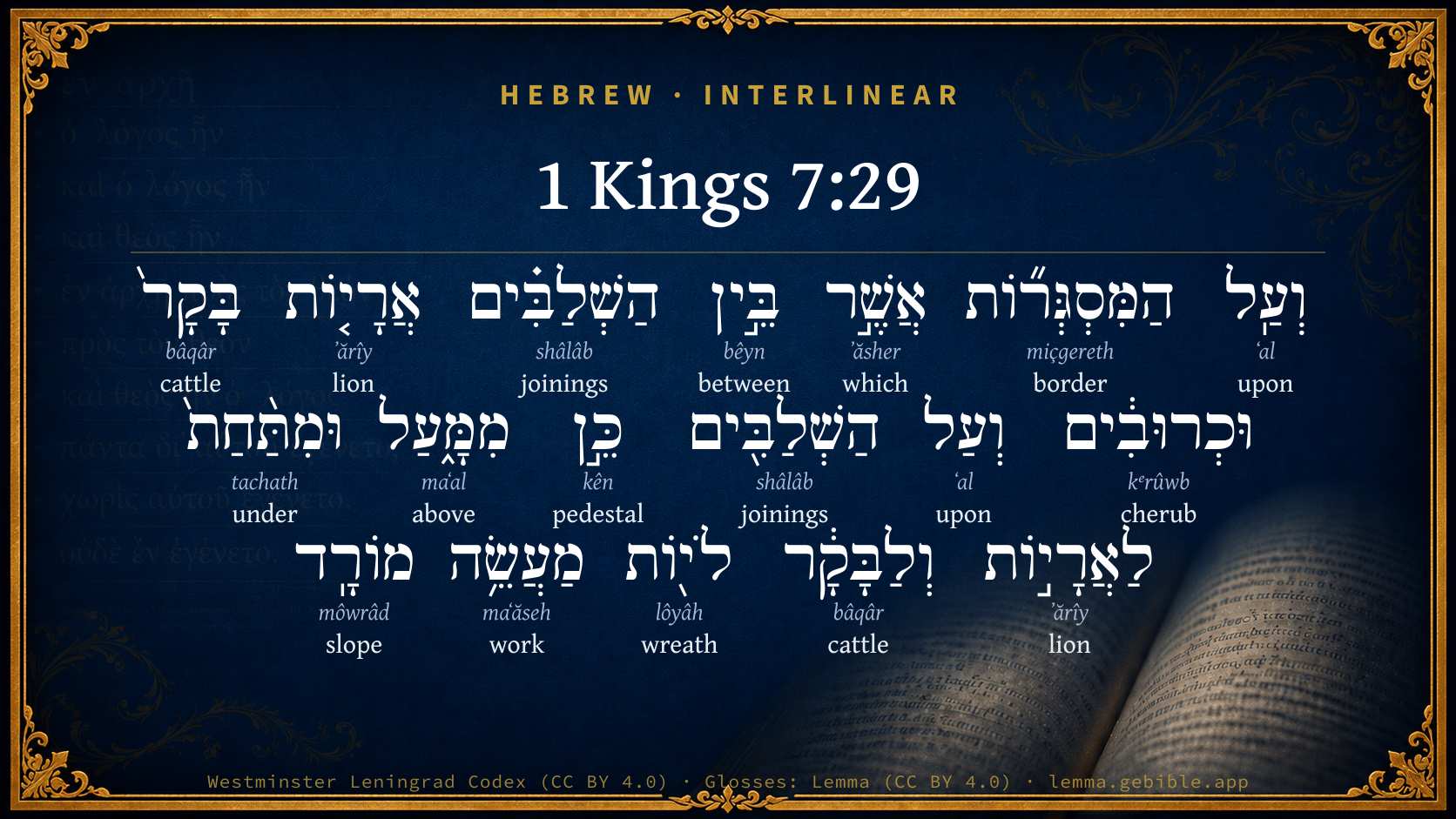
1 Kings 7:29

Hebrew (Westminster Leningrad Codex) 1 Kings 7:29 appears in the Hebrew Old Testament. The text above is from the Westminster Leningrad Codex. Each word links to its Strong’s number, a concise gloss, and parsing drawn from the Open Scriptures Hebrew Bible morphology. Click any word for its full Brown-Driver-Briggs (BDB) entry.
Download image
Cite this verse

1 Kings 7:29 (World English Bible). Public Domain. Lemma interlinear Bible study tool, https://lemma.gebible.app/v/1-kings/7/29.

Show BibTeX & RIS
BibTeX
RIS
English Translation
and on the panels that were between the ledges were lions, oxen, and cherubim; and on the ledges there was a pedestal above; and beneath the lions and oxen were wreaths of hanging work.
World English Bible · Public Domain
Highlights
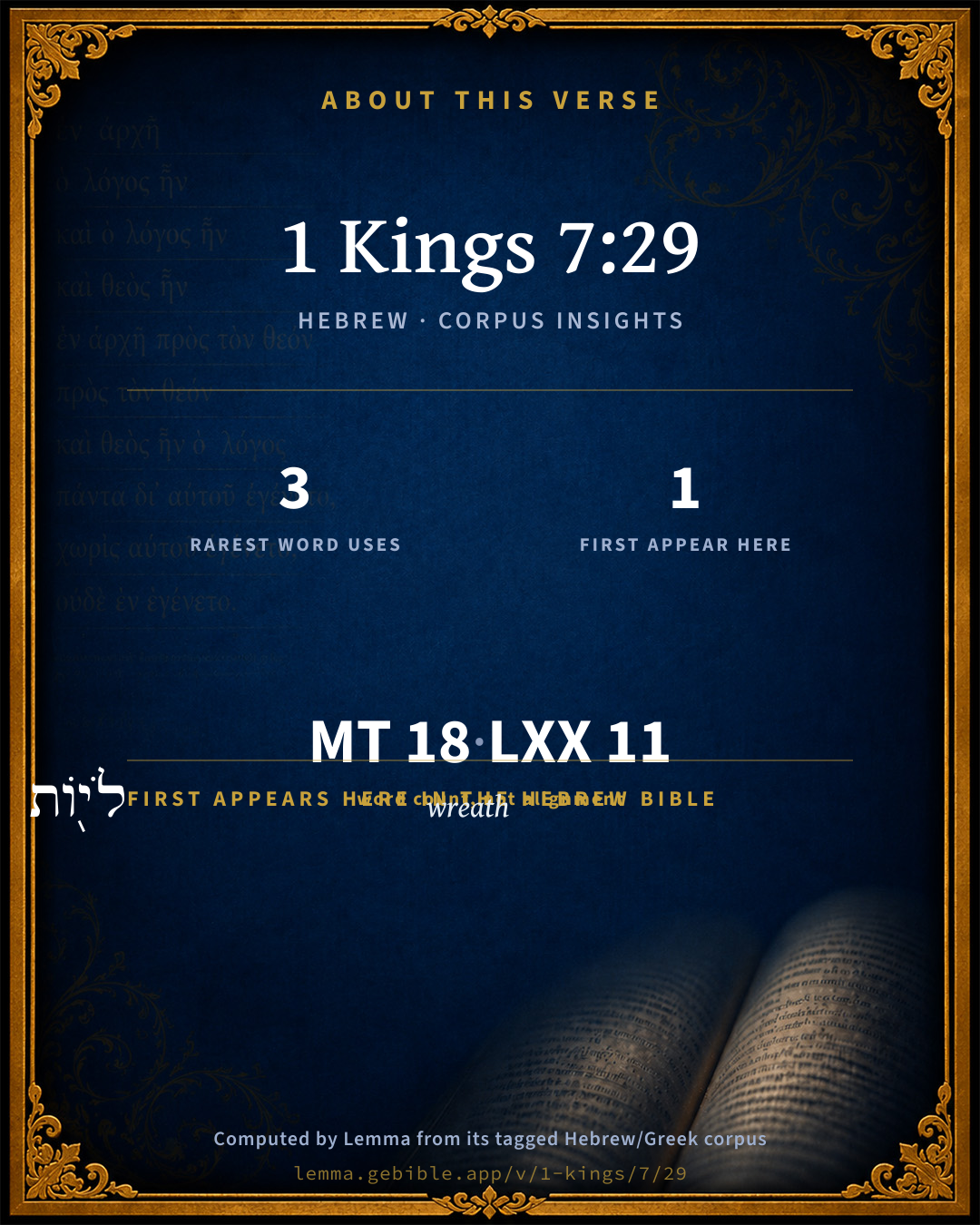
  • 1 first appearance in the Hebrew Bible
Full analysis ↓
Download a study sheet

One document with this verse’s original text, its word-by-word gloss line, the meaning frame, cross-references with their text, attributed commentary, and full source and license credits — printable, and it pastes into notes with its structure intact.

This verse Autodidact and up

Study sheet (.html) Plain text (.txt)

A passage Seminary Student

Up to 50 verses in one chapter. A passage sheet keeps up to 6 commentary sources and 12 cross-references per verse, in the order this page ranks them, and says so on the sheet whenever that leaves anything out. Ask for a single verse and you get the Autodidact verse sheet above.

Everything on this page stays free to read, with no account — the sheet is a download of what is already on screen, not access to it.

Want to remove ads? Support Godless Engineer
Compare translations 3

The same verse in 3 English versions, stacked beneath the original-language interlinear above. Click any original word for its lexicon entry.

Each is an independent rendering of the whole verse — the interlinear is not word-aligned to these translations.

Highlighted words mark where these versions differ — a whole-verse word diff, not a word-by-word alignment.

  • World English Bible Public Domain
    and on the panels that were between the ledges were lions, oxen, and cherubim; and on the ledges there was a pedestal above; and beneath the lions and oxen were wreaths of hanging work.
  • King James Version Public Domain
    And on the borders that were between the ledges were lions, oxen, and cherubim: and upon the ledges there was a base above: and beneath the lions and oxen were certain additions made of thin work.
  • unfoldingWord Literal Text CC BY-SA 4.0
    And on the panels that between the frames lions, cattle, and cherubs. And on the frames a pedestal from above, and from below to the lions and to the cattle wreaths, the work of descent.

unfoldingWord Literal Text — © unfoldingWord, licensed CC BY-SA 4.0. Word-aligned USFM3 via Door43 (git.door43.org/unfoldingWord/en_ult).

Versions to compare (up to 4)

3 of 4 selected

Show all 18 translations

Every available English version of this verse, each an independent rendering of the whole verse.

  • World English Bible Public Domain
    and on the panels that were between the ledges were lions, oxen, and cherubim; and on the ledges there was a pedestal above; and beneath the lions and oxen were wreaths of hanging work.
  • Berean Standard Bible Public Domain
    and on the panels between the uprights were lions, oxen, and cherubim. On the uprights was a pedestal above, and below the lions and oxen were wreaths of beveled work.
  • Majority Standard Bible Public Domain
    and on the panels between the uprights were lions, oxen, and cherubim. On the uprights was a pedestal above, and below the lions and oxen were wreaths of beveled work.
  • King James Version Public Domain
    And on the borders that were between the ledges were lions, oxen, and cherubim: and upon the ledges there was a base above: and beneath the lions and oxen were certain additions made of thin work.
  • American Standard Version (1901) Public Domain
    and on the panels that were between the ledges were lions, oxen, and cherubim; and upon the ledges there was a pedestal above; and beneath the lions and oxen were wreaths of hanging work.
  • Revised Version (1885) Public Domain
    and on the borders that were between the ledges were lions, oxen, and cherubim; and upon the ledges there was a pedestal above: and beneath the lions and oxen were wreaths of hanging work.
  • Geneva Bible (1599) Public Domain
    And on the borders that were betweene the ledges, were lyons, bulles and Cherubims: and vpon the ledges there was a base aboue: and beneath the lyons and bulles, were addicions made of thinne worke.
  • Douay-Rheims (1899) Public Domain
    And between the little crowns and the ledges were lions, and oxen, and cherubims: and in the joinings likewise above: and under the lions and oxen, as it were bands of brass hanging down.
  • Young's Literal Translation Public Domain
    and on the borders that `are' between the joinings `are' lions, oxen, and cherubs, and on the joinings a base above, and beneath the lions and the oxen `are' additions -- sloping work.
  • Literal Standard Version CC BY-SA 4.0
    and on the borders that [are] between the joinings [are] lions, oxen, and cherubim, and on the joinings a base above, and beneath the lions and the oxen [are] additions—sloping work.
  • Unlocked Literal Bible CC BY-SA 4.0
    and on the panels and on the frames were lions, oxen, and cherubim. Above and below the lions and oxen were wreaths of hammered work.
  • unfoldingWord Literal Text CC BY-SA 4.0
    And on the panels that between the frames lions, cattle, and cherubs. And on the frames a pedestal from above, and from below to the lions and to the cattle wreaths, the work of descent.
  • Darby Bible Public Domain
    And on the panels that were between the fillets were lions, oxen and cherubim; and over the fillets there was a base above; and beneath the lions and oxen were garlands of festoon-work.
  • World Messianic Bible Public Domain
    and on the panels that were between the ledges were lions, oxen, and cherubim; and on the ledges there was a pedestal above; and beneath the lions and oxen were wreaths of hanging work.
  • Webster's Bible Public Domain
    And on the borders that were between the ledges were lions, oxen, and cherubim: and upon the ledges there was a base above: and beneath the lions and oxen were certain additions made of thin work.
  • Free Bible Version CC BY-SA 4.0
    Both the side panels and the uprights were decorated with lions, bulls, and cherubim. Above and below the lions and the bulls were decorative wreaths.
  • Bible in Basic English Public Domain
    And on the square sides between the frames were lions, oxen, and winged ones; and the same on the frame; and over and under the lions and the oxen and the winged ones were steps.
  • JPS Tanakh (1917) Public Domain
    and on the borders that were between the stays were lions, oxen, and cherubim; and upon the stays it was in like manner above; and beneath the lions and oxen were wreaths of hanging work.

Literal Standard Version (2020), Covenant Press — licensed CC BY-SA 4.0. Text via the HelloAO Bible API (eBible.org). Unlocked Literal Bible (unfoldingWord) — licensed CC BY-SA 4.0. Text via the HelloAO Bible API (eBible.org). unfoldingWord Literal Text — © unfoldingWord, licensed CC BY-SA 4.0. Word-aligned USFM3 via Door43 (git.door43.org/unfoldingWord/en_ult). Free Bible Version, Dr. Jonathan Gallagher — licensed CC BY-SA 4.0. Text via the HelloAO Bible API (eBible.org).

Word by word

More ways to search: Search by grammar → Find every occurrence → Compare this word →

Practice this passage: Drill this verse → Learn its vocabulary →

הַשְׁלַבִּ֗ים
shâlâb
H7948
“the · joinings”
Particle, Definite Article + Noun, Common, Masculine, Plural, Absolute
Part of Speech
Particle + Noun
Type
Common
Gender
Masculine
Number
Plural
State
Absolute
Full BDB Definition

Origin: from H7947

TWOT: 2390a

joinings (of bases)
  1. וְעַֽל ʻal H5921 “and · upon” Conjunction + Preposition
  2. הַמִּסְגְּר֞וֹת miçgereth H4526 “the · borders” Particle, Definite Article + Noun, Common, Feminine, Plural, Absolute
  3. אֲשֶׁ֣ר ʼăsher H834 “which” Particle, Relative
  4. בֵּ֣ין bêyn H996 “between” Preposition
  5. אֲרָי֤וֹת ʼărîy H738 “lions” Noun, Common, Masculine, Plural, Absolute
  6. בָּקָר֙ bâqâr H1241 “cattle” Noun, Common, Both, Singular, Absolute
  7. וּכְרוּבִ֔ים kᵉrûwb H3742 “and · cherubim” Conjunction + Noun, Common, Masculine, Plural, Absolute
  8. וְעַל ʻal H5921 “and · upon” Conjunction + Preposition
  9. הַשְׁלַבִּ֖ים shâlâb H7948 “the · joinings” Particle, Definite Article + Noun, Common, Masculine, Plural, Absolute
  10. כֵּ֣ן kên H3653 “pedestal” Particle, Demonstrative
  11. מִמָּ֑עַל maʻal H4605 “from · above” Preposition + Adverb
  12. וּמִתַּ֨חַת֙ tachath H8478 “and · from · under” Conjunction + Preposition + Preposition
  13. לַאֲרָי֣וֹת ʼărîy H738 “to/for · lions” Preposition + Noun, Common, Masculine, Plural, Absolute
  14. וְלַבָּקָ֔ר bâqâr H1241 “and · to/for the · cattle” Conjunction + Preposition, Determined + Noun, Common, Both, Singular, Absolute
  15. לֹי֖וֹת lôyâh H3914 “wreaths” Noun, Common, Feminine, Plural, Absolute
  16. מַעֲשֵׂ֥ה maʻăseh H4639 “work of” Noun, Common, Masculine, Singular, Construct
  17. מוֹרָֽד môwrâd H4174 “slope” Noun, Common, Masculine, Singular, Absolute

About this verse

These counts appear in no published source. They are computed here, from the morphology-tagged text and Lemma’s own curated glosses. What Lemma adds →

18
words
14
distinct lemmas
Historical
section

Notable vocabulary

The rarest word here is הַשְׁלַבִּ֗ים joinings H7948 — appearing just 3 times in the whole Hebrew Bible.

First appearance in Scripture

This word makes its first canonical appearance in the Hebrew Bible here:

  • לֹי֖וֹת wreath H3914

Shared distinctive vocabulary

הַשְׁלַבִּ֗ים joinings H7948 occurs in 2 verses of the Hebrew Bible. Also found in:

Grammatical profile

  • 11 nouns
  • 4 prepositions
  • 1 adverb
  • 2 particles

Repetition

Words recur within this verse — often emphatic in Hebrew:

  • וְעַֽל upon H5921 ×2
  • הַשְׁלַבִּ֗ים joinings H7948 ×2
  • אֲרָי֤וֹת lion H738 ×2
  • בָּקָר֙ cattle H1241 ×2

Hebrew & Septuagint length

In English translation the verse runs 34 words from the Hebrew and 32 from the Septuagint (LXX English) — closely comparable.

A rough comparison of the two English renderings, which tokenize alike — not a word-level alignment.

Word counts can differ between the Hebrew and the Greek without any difference in meaning — e.g. the Hebrew direct-object marker אֵת has no separate Greek word, and Greek often adds the article ὁ.

In the original languages it is 18 Hebrew tokens and 11 Greek tokens — but the two are counted differently (Hebrew bundles its prefixes and suffixes into one token; the Greek is in lemma form), so that isn’t a like-for-like length.

Cross-references

13

Topical passages linked to 1 Kings 7:29 in the Treasury of Scripture Knowledge — connected by theme and wording, ordered by reader-vote popularity; previews shown in the World English Bible.

  • Genesis 3:24 So he drove out the man; and he placed Cherubs at the east of the garden of Eden, and the flame of a sword which turned every way, to guard the way to the tree of life.
  • Exodus 25:18 You shall make two cherubim of hammered gold. You shall make them at the two ends of the mercy seat.
  • Exodus 37:7 He made two cherubim of gold. He made them of beaten work them, at the two ends of the mercy seat;
  • 1 Kings 6:27 He set the cherubim within the inner house; and the wings of the cherubim were stretched forth, so that the wing of the one touched the one wall, and the wing of the other cherub touched the other wall; and their wings touched one another in the midst of the house.
  • 1 Kings 7:25 It stood on twelve oxen, three looking toward the north, and three looking toward the west, and three looking toward the south, and three looking toward the east; and the sea was set on them above, and all their hinder parts were inward.
  • Ezekiel 1:10 As for the likeness of their faces, they had the face of a man; and they four had the face of a lion on the right side; and they four had the face of an ox on the left side; they four had also the face of an eagle.
  • Ezekiel 10:14 Every one had four faces: the first face was the face of the cherub, and the second face was the face of a man, and the third face the face of a lion, and the fourth the face of an eagle.
  • Ezekiel 41:18–19 It was made with cherubim and palm trees; and a palm tree was between cherub and cherub, and every cherub had two faces;
  • Hosea 5:14 For I will be to Ephraim like a lion, And like a young lion to the house of Judah. I myself will tear in pieces and go away. I will carry off, and there will be no one to deliver.
  • Hebrews 9:5 and above it cherubim of glory overshadowing the mercy seat, of which things we can't now speak in detail.
  • 1 Peter 2:5 You also, as living stones, are built up as a spiritual house, to be a holy priesthood, to offer up spiritual sacrifices, acceptable to God through Jesus Christ.
  • Revelation 4:6–7 Before the throne was something like a sea of glass, similar to crystal. In the midst of the throne, and around the throne were four living creatures full of eyes before and behind.
  • Revelation 5:5 One of the elders said to me, "Don't weep. Behold, the Lion who is of the tribe of Judah, the Root of David, has overcome; he who opens the book and its seven seals."

Cross-references courtesy of OpenBible.info (CC BY 4.0).

Hebrew and Greek witnesses Masoretic Hebrew ↔ Greek Septuagint

The same verse in the two great witnesses to the Old Testament, shown verse-for-verse.

These are two independent witnesses, not word-aligned to each other, and the Septuagint is shown in lemma (dictionary) form.

Hebrew 1 Kings 7:29 Masoretic · Westminster Leningrad Codex

וְעַֽל הַמִּסְגְּר֞וֹת אֲשֶׁ֣ר בֵּ֣ין הַשְׁלַבִּ֗ים אֲרָי֤וֹת בָּקָר֙ וּכְרוּבִ֔ים וְעַל הַשְׁלַבִּ֖ים כֵּ֣ן מִמָּ֑עַל וּמִתַּ֨חַת֙ לַאֲרָי֣וֹת וְלַבָּקָ֔ר לֹי֖וֹת מַעֲשֵׂ֥ה מוֹרָֽד

and on the panels that were between the ledges were lions, oxen, and cherubim; and on the ledges there was a pedestal above; and beneath the lions and oxen were wreaths of hanging work.

World English Bible · Public Domain

Greek LXX 1 Kings 7:29 Septuagint · lemma form

καί ὁ μεχωνωθ δέκα καί ὁ χυτροκαύλος δέκα ἐπί ὁ μεχωνωθ

And upon their borders between the projection were lions, and oxen, and cherubs: and on the projections, even so above, and also below were the places of lions and oxen, hanging work.

LXX2012 (modern English Septuagint) · Public Domain

Hebrew: Westminster Leningrad Codex (CC BY 4.0). Greek: Septuagint (public domain); English from LXX2012 (modern English Septuagint) (Public Domain). How the Septuagint differs from the Hebrew →

Targum (Aramaic paraphrase)

1

The Targum is the ancient Jewish Aramaic paraphrase of the Hebrew Scriptures — an interpretive translation, not the Hebrew text itself. Onkelos (literal) and Pseudo-Jonathan (expansive) render the Torah, and Jonathan the Prophets. Coverage is partial: where no permissively-licensed English translation exists for a verse, only the Aramaic is shown. This is verse-level text, not a word-by-word alignment to the Hebrew.

  1. Targum Jonathan Prophets (Joshua–Malachi)
    וְעַל גְדַנְפַיָא דְבֵין שְׁלִיבַיָא צִיוֹר אַרְיְוָן תּוֹרִין וּכְרוּבִין וְעַל שְׁלִיבַיָא כַּנְתָּא מִלְעֵיל וּמִלְרַע לְאַרְיְוָן וּלְתוֹרִין מִדְבַּק עוֹבַד כִּבּוּשׁ:

    (no public-domain English translation for this verse)

    Targum Jonathan — Aramaic: “Mikraot Gedolot” (public domain). English: “Sefaria Community Translation” (CC0 1.0 (public-domain dedication)); “London "Chaldee Paraphrase," 1871” (public domain). Text via Sefaria.

Commentary

Notes on 1 Kings 7:29 from classic Christian and Jewish commentators (each source and its license shown beneath its notes). The classic Christian expositions comment on the surrounding passage and are grouped to its opening verse, so a note may address several verses; the Jewish commentaries on the Tanakh (Rashi and others) are per-verse, so they appear only where the commentator wrote on this verse.

Lemma curates 59 commentaries, every one of them public domain or Creative Commons licensed, each selected and text-cleaned for this edition rather than reprinted as found. About our sources →

John Gill's Exposition

And every base had four brasen wheels, and plates of brass,.... Flat pieces or planks of brass, on which the wheels stood, and not on the bare floor; so that these wheels seem only to serve as supporters, not to carry the laver from place to place, as is usually said; for they were not like chariot wheels, on two sides of the carriage, but set one at each square; and besides, when the lavers were placed upon them, they were fixed in a certain place, Kg1 7:39.

and the four corners thereof had undersetters; or "shoulders (a)", or pillars, which were placed on the plates of brass the wheels were; and served with them to support the lavers when laid upon the bases, and so were of the same use as men's shoulders, to bear burdens on them:

under the layer were undersetters molten; cast as, and when and where, the bases were, and the plates on which they stood; this explains the use they were of, being under the laver; these pillars stood at the four corners of the base:

at the side of every addition; made of thin work, Kg1 7:29 they stood by the side of, or within side, the sloping shelves.

(a) "humeri", Pagninus, Montanus, &c.

John Gill's Exposition of the Whole Bible (1746–1763) — public domain (CC PDM 1.0). Text via the HelloAO Bible API.

Trapp's Complete Commentary

John Trapp

1Ki 7:29 And on the borders that [were] between the ledges [were] lions, oxen, and cherubims: and upon the ledges [there was] a base above: and beneath the lions and oxen [were] certain additions made of thin work.

Ver. 29. See on 1Ki 7:28.

John Trapp, A Commentary or Exposition upon All the Books of the Old and New Testament (1647–1656) — public domain. Text from a community e-Sword module.

The Cambridge Bible for Schools and Colleges

gen. ed. J. J. S. Perowne

29. and upon the ledges there was a base above] The word here rendered ‘base’ differs from that in the two previous verses and so the R.V. has rendered a pedestal. It seems to denote some projection upward from the four shafts at the corners to act as a support for the lavers when they were put in position.

certain additions made of thin work] These words signify rather ‘festoons, work that hung down.’ So R.V. wreaths of hanging work.

The Cambridge Bible for Schools and Colleges (gen. ed. J. J. S. Perowne; Cambridge University Press, 1878–1918) — public domain. Text from a community e-Sword module.

Matthew Poole's English Annotations

A base; so he calls the uppermost part of the base; for though it was above, yet it was a base to the laver, which stood upon it.

Certain additions; either as bases for the feet of the said lions and oxen, or only as further ornaments.

Matthew Poole's English Annotations on the Holy Bible (1683–1685) — public domain. Text from a community e-Sword/MySword module.

Whedon's Commentary on the Bible

Daniel D. Whedon

29. Lions, oxen, and cherubim — Miniature representations of them, for the size of the panels would not permit other.

Upon the ledges… a base above — That is, an additional smaller base on the top of the other for the laver to stand upon. Its convex roof is called, in 1Ki_7:35, a round compass. (k k in figure.)

Certain additions — ליות, garlands, festoons. Such garlands adorned the upper as well as the lower portions of each base. Comp. 1Ki_7:36. (c c in figure.)

Made of thin work — מעשׂה מורדmeans, according to Furst, deepened work, and refers to all the ornaments mentioned in this verse as having been set into the metal in which they were engraved. According to the Vulgate and Gesenius, it means hanging work.

Daniel D. Whedon (gen. ed.), Commentary on the Old and New Testaments (1874–1909) — public domain. Text from a community e-Sword module.

The Pulpit Commentary

And on the borders panels that were between the ledges were lions i.e. , figures or bas-reliefs of lions, oxen, and cherubims "The lion and the ox are the two animal forms which occur most frequently in Assyrian decoration" (Rawlinson). They have also found a place through the cherubim, in the symbolism of Christianity: and upon the ledges there was a base above i.e., there was a pedestal or stand (Ke see ver. 31) of some sort for the laver upon the square basis: and beneath the lions and oxen were certain additions Heb. wreaths, festoons, hywli. (cf., Pro_1:9) corona) made of thin work. Heb. pensile or hanging work, drwOm from dry; descendit; Vulgate, dependentia. It would seem that on the panel, beneath the figures of animals, etc., were sculptured hanging festoons of flowers.

The Pulpit Commentary (1880–1919), ed. H.D.M. Spence-Jones & Joseph S. Exell — public domain. Text from a community e-Sword module.

John Wesley's Explanatory Notes

Base above - So he calls the upper-most part of the base: for though it was above, yet it was a base to the laver, which stood upon it. Additions - Either as bases for the feet of the said lions and oxen: or, only as farther ornaments.

John Wesley, Explanatory Notes Upon the Whole Bible (1754–1765) — public domain. Text via the GEBible commentary corpus.

Rashi

Rabbi Shlomo Yitzchaki (Rashi)

And on the frames that were between the rungs. Were decorated with forms of lions, oxen and cherubim.

And on the rungs there was a base. A base, to place the basin upon it, above the frame which was on their top.

And beneath the lions and oxen. Which were embroidered or attached on the outer frames which were between the ledges.

Joined together. לויות is form resembling a male and female embracing.

Thin strips of metal. Hammered, resembling the hammering of a thin metal plate. They did not protrude in its thickness nor were they engraved in a depression. And Yonoson rendered לויות מעשה מורד, “joined by welding,” souldriz, in O.F.

Rashi on the Tanakh — English translations: “The Judaica Press complete Tanach with Rashi, translated by A. J. Rosenberg” (CC BY 4.0); “Pentateuch with Rashi's commentary by M. Rosenbaum and A.M. Silbermann, 1929-1934” (public domain); “The Metsudah Tanach series, Lakewood, N.J” (CC BY 4.0); and “The Book of Joshua, Metsudah Publications, 1997” (CC BY 4.0). Text via Sefaria.

Lesson kit

Teaching starters — assembled from the data on this page, not authored interpretation. Every prompt links to the verse data it draws on. Edit before teaching.

1 Kings, in the Historical, opens this verse with 18 words (14 distinct Hebrew lemmas). Its most distinctive word is shâlâb (“joinings”). A historical commentator’s framing appears above. Read the whole chapter for the surrounding context.

Discussion questions

  1. How does “joinings” (shâlâb) shape what this verse is saying?
  2. This is the first place “wreath” appears in Scripture (first appears here). What does its debut here establish?
  3. How does 1 Kings 7:28, which shares the word «joinings», read alongside this verse?
  4. What does the repetition of “upon” (2× in this one verse) do in this verse?
  5. These translations render this verse differently; the difference is in the English rendering, not the original. What questions does that raise?
  6. Compare how John Gill's Exposition and Trapp's Complete Commentary read this verse. Where do they agree or differ?

Things to notice

Reading settings

Reading text

Shown beneath each verse's original-language words.

Old Testament
Old Testament edition

Read the OT as the Masoretic Hebrew (MT) or the Greek Septuagint (LXX).

English shown for the Greek Septuagint (in the Hebrew ↔ Greek comparison).

Comparing translations? Open the Compare panel on any verse page to stack up to four side by side.