
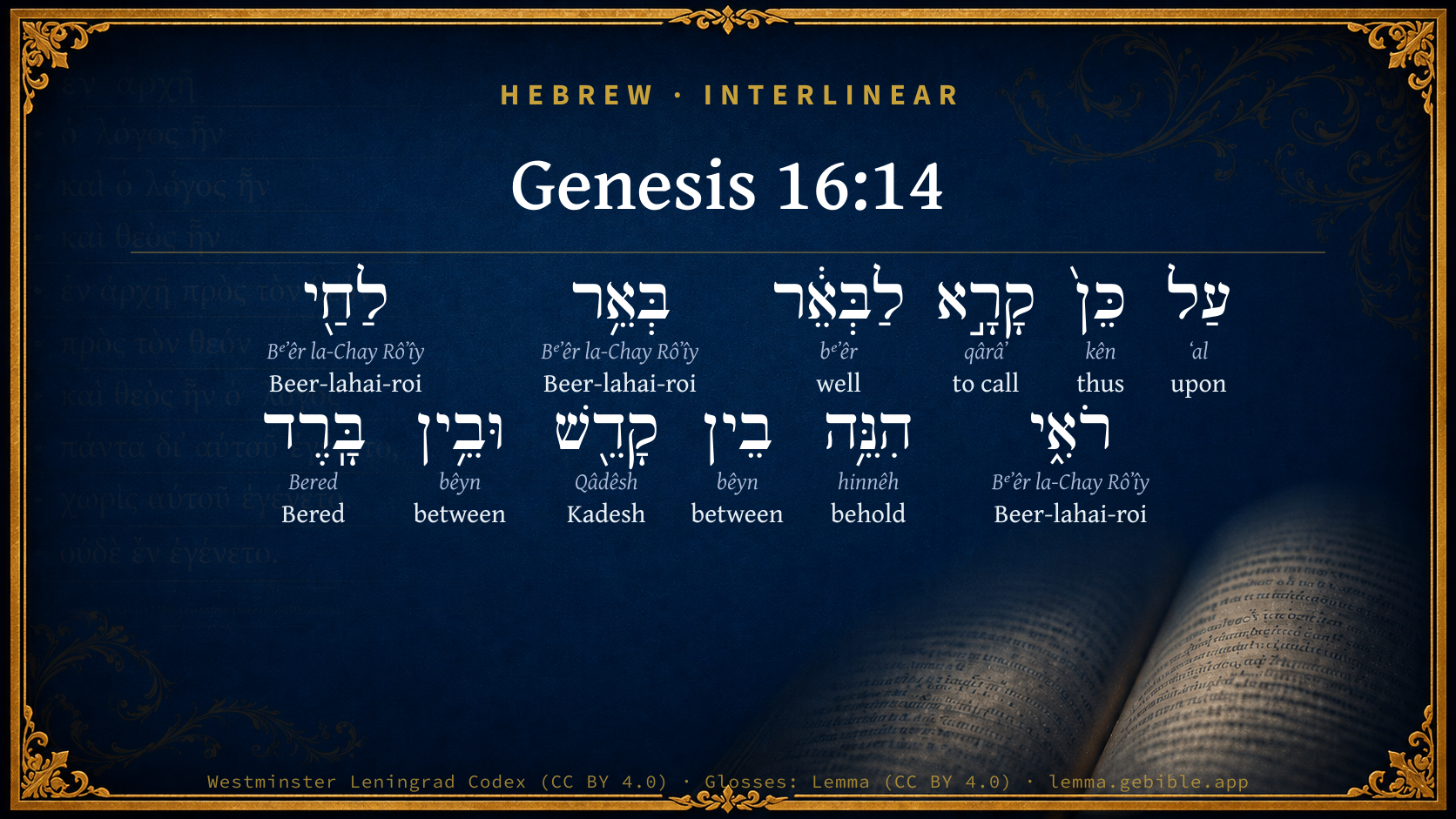
Genesis 16:14

Hebrew (Westminster Leningrad Codex) Genesis 16:14 appears in the Hebrew Old Testament. The text above is from the Westminster Leningrad Codex. Each word links to its Strong’s number, a concise gloss, and parsing drawn from the Open Scriptures Hebrew Bible morphology. Click any word for its full Brown-Driver-Briggs (BDB) entry.
Download image
Cite this verse

Genesis 16:14 (World English Bible). Public Domain. Lemma interlinear Bible study tool, https://lemma.gebible.app/v/genesis/16/14.

Show BibTeX & RIS
BibTeX
RIS
English Translation
Therefore the well was called Beer Lahai Roi. Behold, it is between Kadesh and Bered.
World English Bible · Public Domain
Highlights Full analysis ↓
Download a study sheet

One document with this verse’s original text, its word-by-word gloss line, the meaning frame, cross-references with their text, attributed commentary, and full source and license credits — printable, and it pastes into notes with its structure intact.

This verse Autodidact and up

Study sheet (.html) Plain text (.txt)

A passage Seminary Student

Up to 50 verses in one chapter. A passage sheet keeps up to 6 commentary sources and 12 cross-references per verse, in the order this page ranks them, and says so on the sheet whenever that leaves anything out. Ask for a single verse and you get the Autodidact verse sheet above.

Everything on this page stays free to read, with no account — the sheet is a download of what is already on screen, not access to it.

Want to remove ads? Support Godless Engineer
Compare translations 3

The same verse in 3 English versions, stacked beneath the original-language interlinear above. Click any original word for its lexicon entry.

Each is an independent rendering of the whole verse — the interlinear is not word-aligned to these translations.

Highlighted words mark where these versions differ — a whole-verse word diff, not a word-by-word alignment.

  • World English Bible Public Domain
    Therefore the well was called Beer Lahai Roi. Behold, it is between Kadesh and Bered.
  • King James Version Public Domain
    Wherefore the well was called Beerlahairoi; behold, it is between Kadesh and Bered.
  • unfoldingWord Literal Text CC BY-SA 4.0
    For that they call the well Beer Lahai Roi. Behold, between Kadesh and Bered.

unfoldingWord Literal Text — © unfoldingWord, licensed CC BY-SA 4.0. Word-aligned USFM3 via Door43 (git.door43.org/unfoldingWord/en_ult).

Versions to compare (up to 4)

3 of 4 selected

Show all 18 translations

Every available English version of this verse, each an independent rendering of the whole verse.

  • World English Bible Public Domain
    Therefore the well was called Beer Lahai Roi. Behold, it is between Kadesh and Bered.
  • Berean Standard Bible Public Domain
    Therefore the well was called Beer-lahai-roi. It is located between Kadesh and Bered.
  • Majority Standard Bible Public Domain
    Therefore the well was called Beer-lahai-roi. It is located between Kadesh and Bered.
  • King James Version Public Domain
    Wherefore the well was called Beerlahairoi; behold, it is between Kadesh and Bered.
  • American Standard Version (1901) Public Domain
    Wherefore the well was called Beer-lahai-roi; behold, it is between Kadesh and Bered.
  • Revised Version (1885) Public Domain
    Wherefore the well was called Beer-lahai-roi; behold, it is between Kadesh and Bered.
  • Geneva Bible (1599) Public Domain
    Wherefore the well was called, Beerlahai-roi. lo, it is betweene Kadesh and Bered.
  • Douay-Rheims (1899) Public Domain
    Therefore she called that well, The well of him that liveth and seeth me. The same is between Cades and Bared.
  • Young's Literal Translation Public Domain
    therefore hath one called the well, `The well of the Living One, my beholder;' lo, between Kadesh and Bered.
  • Literal Standard Version CC BY-SA 4.0
    Therefore has one called the well, “The well of the Living One, my beholder”; behold, between Kadesh and Bered.
  • Unlocked Literal Bible CC BY-SA 4.0
    Therefore the well was called Beer Lahai Roi; behold, it is between Kadesh and Bered.
  • unfoldingWord Literal Text CC BY-SA 4.0
    For that they call the well Beer Lahai Roi. Behold, between Kadesh and Bered.
  • Darby Bible Public Domain
    Therefore the well was named Beer-lahai-roi: behold, it is between Kadesh and Bered.
  • World Messianic Bible Public Domain
    Therefore the well was called Beer Lahai Roi. Behold, it is between Kadesh and Bered.
  • Webster's Bible Public Domain
    Wherefore the well was called Beer-la-hai-roi; behold, it is between Kadesh and Bered.
  • Free Bible Version CC BY-SA 4.0
    That's why the well is called “the Well of the Living One who Sees Me.” It's still there, between Kadesh and Bered.
  • Bible in Basic English Public Domain
    So that fountain was named, Fountain of Life and Vision: it is between Kadesh and Bered.
  • JPS Tanakh (1917) Public Domain
    Wherefore the well was called 'Beer-lahai-roi; behold, it is between Kadesh and Bered.

Literal Standard Version (2020), Covenant Press — licensed CC BY-SA 4.0. Text via the HelloAO Bible API (eBible.org). Unlocked Literal Bible (unfoldingWord) — licensed CC BY-SA 4.0. Text via the HelloAO Bible API (eBible.org). unfoldingWord Literal Text — © unfoldingWord, licensed CC BY-SA 4.0. Word-aligned USFM3 via Door43 (git.door43.org/unfoldingWord/en_ult). Free Bible Version, Dr. Jonathan Gallagher — licensed CC BY-SA 4.0. Text via the HelloAO Bible API (eBible.org).

Word by word

More ways to search: Search by grammar → Find every occurrence → Compare this word →

Practice this passage: Drill this verse → Learn its vocabulary →

About this verse

These counts appear in no published source. They are computed here, from the morphology-tagged text and Lemma’s own curated glosses. What Lemma adds →

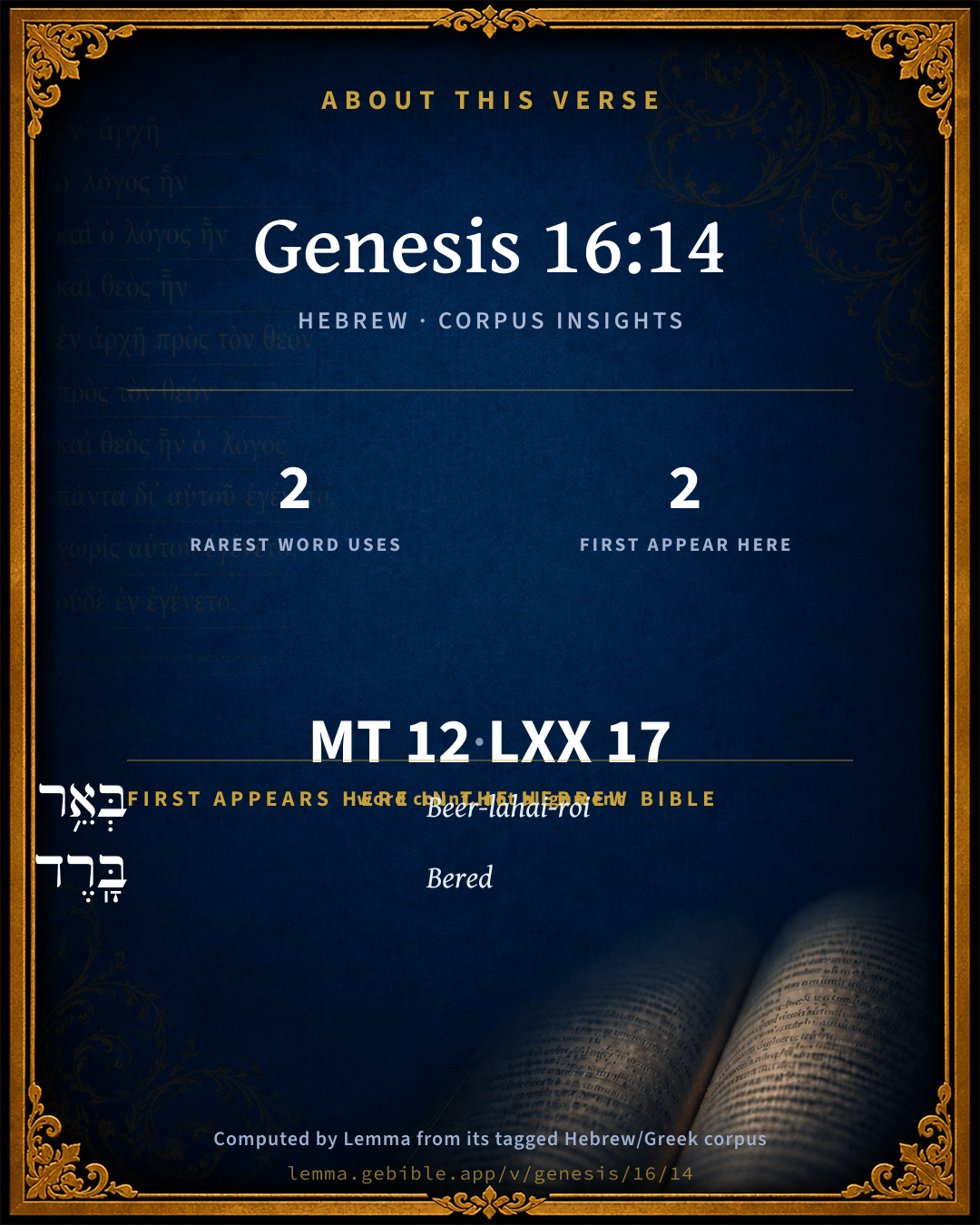
12
words
9
distinct lemmas
Pentateuch
section

Notable vocabulary

The rarest word here is בָּֽרֶד Bered H1260 — appearing just 2 times in the whole Hebrew Bible.

First appearance in Scripture

These words make their first canonical appearance in the Hebrew Bible here:

  • בְּאֵ֥ר Beer-lahai-roi H883
  • בָּֽרֶד Bered H1260

Shared distinctive vocabulary

בָּֽרֶד Bered H1260 occurs in 2 verses of the Hebrew Bible. Also found in:

Grammatical profile

  • 1 verb
  • 6 nouns
  • 3 prepositions
  • 2 particles

Verb forms

  • קָרָ֣א Qal · Perfect

Repetition

Words recur within this verse — often emphatic in Hebrew:

  • בְּאֵ֥ר Beer-lahai-roi H883 ×3
  • בֵין between H996 ×2

Hebrew & Septuagint length

In English translation the verse runs 15 words from the Hebrew and 21 from the Septuagint (LXX English) — the Septuagint runs noticeably longer here. See the side-by-side →

A rough comparison of the two English renderings, which tokenize alike — not a word-level alignment.

Word counts can differ between the Hebrew and the Greek without any difference in meaning — e.g. the Hebrew direct-object marker אֵת has no separate Greek word, and Greek often adds the article ὁ.

In the original languages it is 12 Hebrew tokens and 17 Greek tokens — but the two are counted differently (Hebrew bundles its prefixes and suffixes into one token; the Greek is in lemma form), so that isn’t a like-for-like length.

Cross-references

5

Topical passages linked to Genesis 16:14 in the Treasury of Scripture Knowledge — connected by theme and wording, ordered by reader-vote popularity; previews shown in the World English Bible.

  • Genesis 24:62 Isaac came from the way of Beer Lahai Roi. For he lived in the land of the South.
  • Genesis 25:11 It happened after the death of Abraham, that God blessed Isaac, his son. Isaac lived by Beer Lahai Roi.
  • Genesis 21:31 Therefore he called that place Beersheba, because they both swore there.
  • Numbers 13:26 They went and came to Moses, and to Aaron, and to all the congregation of the children of Israel, to the wilderness of Paran, to Kadesh; and brought back word to them, and to all the congregation, and shown them the fruit of the land.
  • Genesis 14:7 They returned, and came to En-mishpat (the same is Kadesh), and struck all the country of the Amalekites, and also the Amorites, that lived in Hazazon Tamar.

Cross-references courtesy of OpenBible.info (CC BY 4.0).

Hebrew and Greek witnesses Masoretic Hebrew ↔ Greek Septuagint

The same verse in the two great witnesses to the Old Testament, shown verse-for-verse.

Here the Septuagint runs noticeably longer than the Hebrew — LXX2012 (modern English Septuagint) 21 words vs World English Bible 15. A rough length comparison of the two English translations, not a word-level alignment — read both below.

These are two independent witnesses, not word-aligned to each other, and the Septuagint is shown in lemma (dictionary) form.

Hebrew Genesis 16:14 Masoretic · Westminster Leningrad Codex

עַל כֵּן֙ קָרָ֣א לַבְּאֵ֔ר בְּאֵ֥ר לַחַ֖י רֹאִ֑י הִנֵּ֥ה בֵין קָדֵ֖שׁ וּבֵ֥ין בָּֽרֶד

Therefore the well was called Beer Lahai Roi. Behold, it is between Kadesh and Bered.

World English Bible · Public Domain

Greek LXX Genesis 16:14 Septuagint · lemma form

ἕνεκεν οὗτος καλέω ὁ φρέαρ φρέαρ ὅς ἐνώπιον ὁράω ἰδού ἀνά μέσος καδης καί ἀνά μέσος βαραδ

Therefore she called the well, The well of him whom I have openly seen; behold it is between Cades and Barad.

LXX2012 (modern English Septuagint) · Public Domain

Hebrew: Westminster Leningrad Codex (CC BY 4.0). Greek: Septuagint (public domain); English from LXX2012 (modern English Septuagint) (Public Domain). How the Septuagint differs from the Hebrew →

Targum (Aramaic paraphrase)

2

The Targum is the ancient Jewish Aramaic paraphrase of the Hebrew Scriptures — an interpretive translation, not the Hebrew text itself. Onkelos (literal) and Pseudo-Jonathan (expansive) render the Torah, and Jonathan the Prophets. Coverage is partial: where no permissively-licensed English translation exists for a verse, only the Aramaic is shown. This is verse-level text, not a word-by-word alignment to the Hebrew.

  1. Targum Onkelos Torah (Genesis–Deuteronomy)
    עַל כֵּן קְרָא לִבְאֵרָא בְּאֵרָא דְמַלְאַךְ קַיָימָא אִתַּחֲזִי עֲלַהּ הָא הִיא בֵּין רְקָם וּבֵין חַגְרָא

    (no public-domain English translation for this verse)

    Targum Onkelos — Aramaic: “Onkelos Genesis” (public domain); “Onkelos Exodus” (public domain); “Onkelos Leviticus” (public domain); “Onkelos Numbers” (public domain); “Onkelos Deuteronomy” (public domain). English: “Sefaria Community Translation” (CC0 1.0 (public-domain dedication)); “J.W. Etheridge. The Targums of Onkelos and Jonathan Ben Uzziel on the Pentateuch. London: Longmans, Green, 1862” (public domain). Text via Sefaria.

  2. Targum Pseudo-Jonathan Torah (Genesis–Deuteronomy)
    בְּגִין כֵּן קָרָא לְבֵירָא בֵּירָא דְאִתְגְלֵי עֲלָהּ חַי וְקַיָם וְהָא הִיא יְהִיבָא בֵּין רְקַם וּבֵין חֲלוּצָה

    Wherefore she called the well, The Well at which the Living and Eternal One was revealed; and, behold, it is situate between Rekam and Chalutsa.

    Targum Pseudo-Jonathan — Aramaic: “Targum Jonathan on Genesis” (public domain); “Targum Jonathan on Exodus” (public domain); “Targum Jonathan on Leviticus” (public domain); “Targum Jonathan on Numbers” (public domain); “Targum Jonathan on Deuteronomy” (public domain). English: “The Targum of Jonathan ben Uzziel, trans. J. W. Etheridge, London, 1862” (public domain). Text via Sefaria.

Commentary

Notes on Genesis 16:14 from classic Christian and Jewish commentators (each source and its license shown beneath its notes). The classic Christian expositions comment on the surrounding passage and are grouped to its opening verse, so a note may address several verses; the Jewish commentaries on the Tanakh (Rashi and others) are per-verse, so they appear only where the commentator wrote on this verse.

Lemma curates 59 commentaries, every one of them public domain or Creative Commons licensed, each selected and text-cleaned for this edition rather than reprinted as found. About our sources →

Trapp's Complete Commentary

John Trapp

Gen 16:14 Wherefore the well was called Beerlahairoi; behold, [it is] between Kadesh and Bered.

Ver. 14. Beer-lahai-roi,] i.e., "The well of him that liveth and seeth me," that is, of the living God, who hath seen to my safety. So rich men are "charged" to "trust not in uncertain riches, but in God," who both "liveth" and "giveth". {1Ti 6:17}

John Trapp, A Commentary or Exposition upon All the Books of the Old and New Testament (1647–1656) — public domain. Text from a community e-Sword module.

Joseph Benson's Commentary

Gen 16:14. The well was called Beer-lahai-roi — The well of him that lives and sees me. It is likely Hagar put this name upon it, and it was retained long after. This was the place where the God of glory manifested the special care he took of a poor woman in distress. Those that are graciously admitted into communion with God, and receive seasonable comforts from him, should tell others what he has done for their souls, that they also may be encouraged to seek him and trust in him.

Joseph Benson's Commentary on the Old and New Testaments (1811–1818) — public domain. Text from a community e-Sword module.

Tyndale Open Study Notes

Tyndale Open Resources

16:14-15 The names Beer-lahai-roi, which means “well of the Living One who sees me,” and Ishmael (see 16:11) were a message and a rebuke for Abram and Sarai. God sees affliction and hears the cries of those in need. Sarai and Abram should have prayed rather than taking the fulfillment of the promise into their own hands by following social custom (cp. 25:21). Giving children to the barren woman is God’s work (Ps 113:9; cp. 1 Sam 1:1-28; Luke 1:1-25); impossible difficulties cannot be resolved by human intervention. The Lord hears the afflicted, sees them in their need, and will miraculously provide for them.

Tyndale Open Study Notes — © Tyndale Open Resources, licensed CC BY-SA 4.0. Text via the HelloAO Bible API.

Geneva Bible (1599)

Geneva Bible translators

Or, the well of the living, and seeing me.

Geneva Bible (1599) marginal notes — public domain. Text via Bolls.life.

Adam Clarke's Commentary

Verse 14. Wherefore the well was called Beer-lahai-roi] It appears, from Ge 16:7, that Hagar had sat down by a fountain or well of water in the wilderness of Shur, at which the Angel of the Lord found her; and, to commemorate the wonderful discovery which God had made of himself, she called the name of the well אר לחי ראי beer-lachai-roi, "A well to the Living One who seeth me." Two things seem implied here:

1. A dedication of the well to Him who had appeared to her; and,

2. Faith in the promise: for he who is the Living One, existing in all generations, must have it ever in his power to accomplish promises which are to be fulfilled through the whole lapse of time.

Adam Clarke's Commentary on the Bible (1810–1826) — public domain. Text from a community e-Sword/MySword module.

John Calvin's Commentaries

14. Wherefore the well was called I subscribe to the opinion of those who take the word יקרא (yekra,) indefinitely, which is usual enough in the Hebrew language. In order that the sense may be the clearer it is capable of being resolved into the passive voice, that ‘the well was called.’ Yet I think this common appellation originated with Hagar, who, not content with one simple confession, wished that the mercy of God should be attested in time to come; and therefore she transmitted her testimony, as from hand to hand. Hence we infer how useful it is, that they who do not freely humble themselves, should be subdued by stripes. Hagar, who had always been wild and rebellious, and who had, at length, entirely shaken off the yoke; now, when the hardness of her heart was broken by afflictions, appears altogether another person. She was not, however, reduced to order by stripes only; but a celestial vision was also added, which thoroughly arrested her. And the same thing is necessary for us; namely, that God, while chastising us with his hand, should also bring us into a state of submissive meekness by his Spirit. Some among the Hebrews say that the name of the well was given to it, as being a testimony of a twofold favor, because Ishmael was revived from death, and God had respect to Hagar, his mother. But they foolishly mutilate things joined together: for Hagar wished to testify that she had been favourably regarded by Him who was the Living God, or the Author of life.

John Calvin's Commentaries (1540-1563) — public domain. Text from the Calvin Translation Society English edition (1840s-50s) via the Christian Classics Ethereal Library (ccel.org). Calvin's coverage is partial (roughly two-thirds of the Bible); uncommented books and verses are honest gaps, never fabricated. The 19th-century editor's footnotes and remarks are omitted so the notes are faithfully Calvin's own voice.

Ellicott's Commentary for English Readers

(14) Beer-lahai-roi.—That is, Well of the living-seeing (of God), the well where God has been seen, and the beholder still lives. It became afterwards a favourite dwelling-place of Isaac (Gen_25:11), and was probably, therefore, surrounded by pastures, but its site has not been identified. For Kadesh see Gen_14:7. Bered is absolutely unknown.

A Bible Commentary for English Readers, edited by Charles John Ellicott (1878–1897) — public domain. Text from a community e-Sword module.

The Cambridge Bible for Schools and Colleges

gen. ed. J. J. S. Perowne

14. Beer-lahai-roi] The R.V. marg. the well of the living one who seeth me is an impossible translation of the text. Another rendering is, “Well of the Seeing alive,” i.e. “Where one sees God and remains alive.” The popular belief was, that he who saw God would die. See previous note.

Probably the name Beer-lahai-roi was explained by a popular etymology which connected its pronunciation with the sound of the Hebrew words ḥai = “living” and roi = “vision.” A well, or spring, in a desert was generally deemed by the early nomad peoples to be frequented by a Divine presence.

between Kadesh and Bered] For Kadesh, see note on Gen_14:7. Bered has not been identified. Hagar’s well is commonly supposed to be the same as Ain Muweileh, a spot where there are springs, S. of Beersheba, and on the caravan road to Egypt.

The Cambridge Bible for Schools and Colleges (gen. ed. J. J. S. Perowne; Cambridge University Press, 1878–1918) — public domain. Text from a community e-Sword module.

John Gill's Exposition

Wherefore the well was called Beerlahairoi,.... That is, the fountain where the angel found her, Gen 16:7; this, from the appearance of God to her at it, was afterwards called by her and others by this name, which signifies "the well of him that liveth and seeth me"; that is, of the living and all seeing God, and who had taken a special care of her, and favoured her with a peculiar discovery of his love to her: or this may have respect to herself, and be rendered, "the well of her that liveth and seeth"; that had had a sight of God, and yet was alive; lived though she had seen him, and after she had seen him, and was still indulged with a sight of him. Aben Ezra says, the name of this well, at the time he lived, was called Zemum, he doubtless means Zemzem, a well near Mecca, which the Arabs say (z) is the well by which Hagar sat down with Ishmael, and where she was comforted by the angel, Gen 21:19,

behold, it is between Kadesh and Bered; Kadesh is the same with Kadesh Barnea in the wilderness, Num 13:3. The Targums of Onkelos and Jonathan call it Rekam, the same with Petra, the chief city of Arabia Petraea, inhabited in later times by the Nabathaeans, the posterity of Ishmael: and Bered is nowhere else mentioned, it is called by Onkelos Chagra or Hagra, by which he interprets Shur, Gen 16:7; and by the Targum of Jonathan it is called Chaluza, a noted town in Idumea, the same with Chelus, mentioned with Kades in the Apocrypha;"And to all that were in Samaria and the cities thereof, and beyond Jordan unto Jerusalem, and Betane, and Chelus, and Kades, and the river of Egypt, and Taphnes, and Ramesse, and all the land of Gesem,'' (Judith 1:9)and so Jerom (a) speaks of a place called Elusa, near the wilderness of Kadesh, which in his times was inhabited by Saracens, the descendants of Ishmael; and this bids fair to the Bered here spoken of, and seems to be its Greek name, and both are of the same signification; for Bered signifies hail, as does Chalaza in Greek, which the Targumists here make Chaluza; between Kadesh and Barath, as Jerom (b) calls it, Hagar's well was shown in his days.

(z) See Pitts's Account of the Mahometans, c. 7. p. 103. (a) In Vita Hilarionis, fol. 84. 1. (b) De loc. Heb. fol. 89. E.

John Gill's Exposition of the Whole Bible (1746–1763) — public domain (CC PDM 1.0). Text via the HelloAO Bible API.

Matthew Poole's English Annotations

This name may have respect, either,

1. To God, The well of him that liveth (i.e. of the true and living God) and seeth me, i.e. taketh care of me. Or,

2. To Hagar, The well of her that liveth, i.e. who though she gave up herself for dead and lost, yet now is likely to live, both in her person and in her posterity, and seeth, or did see, namely, God present with her.

Matthew Poole's English Annotations on the Holy Bible (1683–1685) — public domain. Text from a community e-Sword/MySword module.

Whedon's Commentary on the Bible

Daniel D. Whedon

14. Beer-lahai-roi — באר לחי ראי, well of life of sight, or, well of living vision; that is: well where one saw God and remained alive after the vision. This well is mentioned again in Gen_24:62; Gen_25:11. Its location, between Kadesh and Bered, is now unknown. On the identification of Kadesh with Ain Qadees, see note on Gen_14:7. The spring el Muweileh, far to the south of Beer-sheba, has been suggested as Hagar’s well, but this suggestion has not been sufficiently confirmed.

Daniel D. Whedon (gen. ed.), Commentary on the Old and New Testaments (1874–1909) — public domain. Text from a community e-Sword module.

The Pulpit Commentary

Wherefore the well was called in all likelihood first by HagarBeer-lahai-roi, or the well of him that liveth and seeth me (A.V); but either

(1) the well of the living one of vision, i.e. of God, who appeared there (Onkeles, Rosenm Lange) or

(2) the well of the life of vision, i.e. where after seeing God life was preserved (Gesenius, Keil, Kalisch, Murphy), or where in consequence of seeing God a new life was imparted (Inglis). Behold, it is between Kadesh (vide Gen_14:7) and Bered. Of uncertain situation; but the well has probably been discovered in Ain Kades (called by the Arabs Moilahi Hagar), to the south of Beersheba, and about twelve miles from Kadesh (cf. Keil in lees).

The Pulpit Commentary (1880–1919), ed. H.D.M. Spence-Jones & Joseph S. Exell — public domain. Text from a community e-Sword module.

John Wesley's Explanatory Notes

The well was called Beer-lahai-roi - The well of him that lives and sees me. 'Tis likely Hagar put this name upon it, and it was retained long after. This was the place where the God of glory manifested the special care he took of a poor woman in distress. Those that are graciously admitted into communion with God, and receive seasonable comforts from him, should tell others what he has done for their souls, that they also may be encouraged to seek him and trust in him.

John Wesley, Explanatory Notes Upon the Whole Bible (1754–1765) — public domain. Text via the GEBible commentary corpus.

Scofield Reference Notes

C. I. Scofield

Beerlahairoi

i.e. The well of him that liveth and seeth me. Gen 24:62; Gen 25:11.

The Scofield Reference Bible (1917 edition), notes by C. I. Scofield — public domain. Text from a community e-Sword module.

Rashi

Rabbi Shlomo Yitzchaki (Rashi)

באר לחי ראי As the Targum takes it: the well at which the living angel had appeared to her.

Rashi on the Tanakh — English translations: “The Judaica Press complete Tanach with Rashi, translated by A. J. Rosenberg” (CC BY 4.0); “Pentateuch with Rashi's commentary by M. Rosenbaum and A.M. Silbermann, 1929-1934” (public domain); “The Metsudah Tanach series, Lakewood, N.J” (CC BY 4.0); and “The Book of Joshua, Metsudah Publications, 1997” (CC BY 4.0). Text via Sefaria.

Radak

Rabbi David Kimhi (Radak)

על כן קרא לבאר, this is why anyone who encounters the well where the angel had appeared to Hagar at the time the "באר לחי רואי". Seeing that an angel lives eternally, the word לחי "to the living one," is an apt description for such a creature. The fountain mentioned in this verse is the same as the one that had been described previously in verse 7.

הנה בין קדש ובין ברד, The Torah gives an indication of where this fountain can be seen, so that when a person encounters it he will acknowledge G'd's greatness in revealing Himself by dispatching an angel even to the errant maid-servant of Sarai. The matter is all the more remarkable seeing that Hagar was not in the act of performing a mission on G'd's behalf at the time. Bared is the same as the previously mentioned Shur. The location had been known by two names. This is why the Torah mentioned both of these names. Ths is also why Onkelos translates both Shur and Bared as חגרא.

Radak on the Tanakh — English translations: “Sefaria Community Translation” (CC0 1.0 (public-domain dedication)); “Eliyahu Munk, HaChut Hameshulash” (CC BY 4.0); “Rabbi Mike Feuer, Jerusalem Anthology” (CC BY 4.0); and “R. David Kimhi on the first book of Psalms, Translated by R.G. Finch, London, 1919” (public domain). Text via Sefaria.

Lesson kit

Teaching starters — assembled from the data on this page, not authored interpretation. Every prompt links to the verse data it draws on. Edit before teaching.

Genesis, in the Pentateuch, opens this verse with 12 words (9 distinct Hebrew lemmas). Its most distinctive word is Bered (“Bered”). The Greek Septuagint runs longer here. A historical commentator’s framing appears above. Read the whole chapter for the surrounding context.

Discussion questions

  1. What does “Bered” (Bered) contribute to the verse as a whole?
  2. 2 words here appear for the first time in Scripture. What is being introduced at this debut?
  3. 1 Chronicles 7:20 shares the word «Bered» with this verse. How do the two illuminate each other?
  4. “Beer-lahai-roi” occurs 3× in this one verse. What is the effect of the repetition?
  5. Compared with the Hebrew, the Septuagint runs longer here. What questions does that raise?
  6. These translations render this verse differently. What is at stake in choosing one wording over another?
  7. The verb «קָרָ֣א» is Qal Perfect. How does its form color the action?
  8. Reading how Trapp's Complete Commentary and Joseph Benson's Commentary read this verse, where do the two commentators agree and where do they part?

Things to notice

Reading settings

Reading text

Shown beneath each verse's original-language words.

Old Testament
Old Testament edition

Read the OT as the Masoretic Hebrew (MT) or the Greek Septuagint (LXX).

English shown for the Greek Septuagint (in the Hebrew ↔ Greek comparison).

Comparing translations? Open the Compare panel on any verse page to stack up to four side by side.