
Exodus 30:18

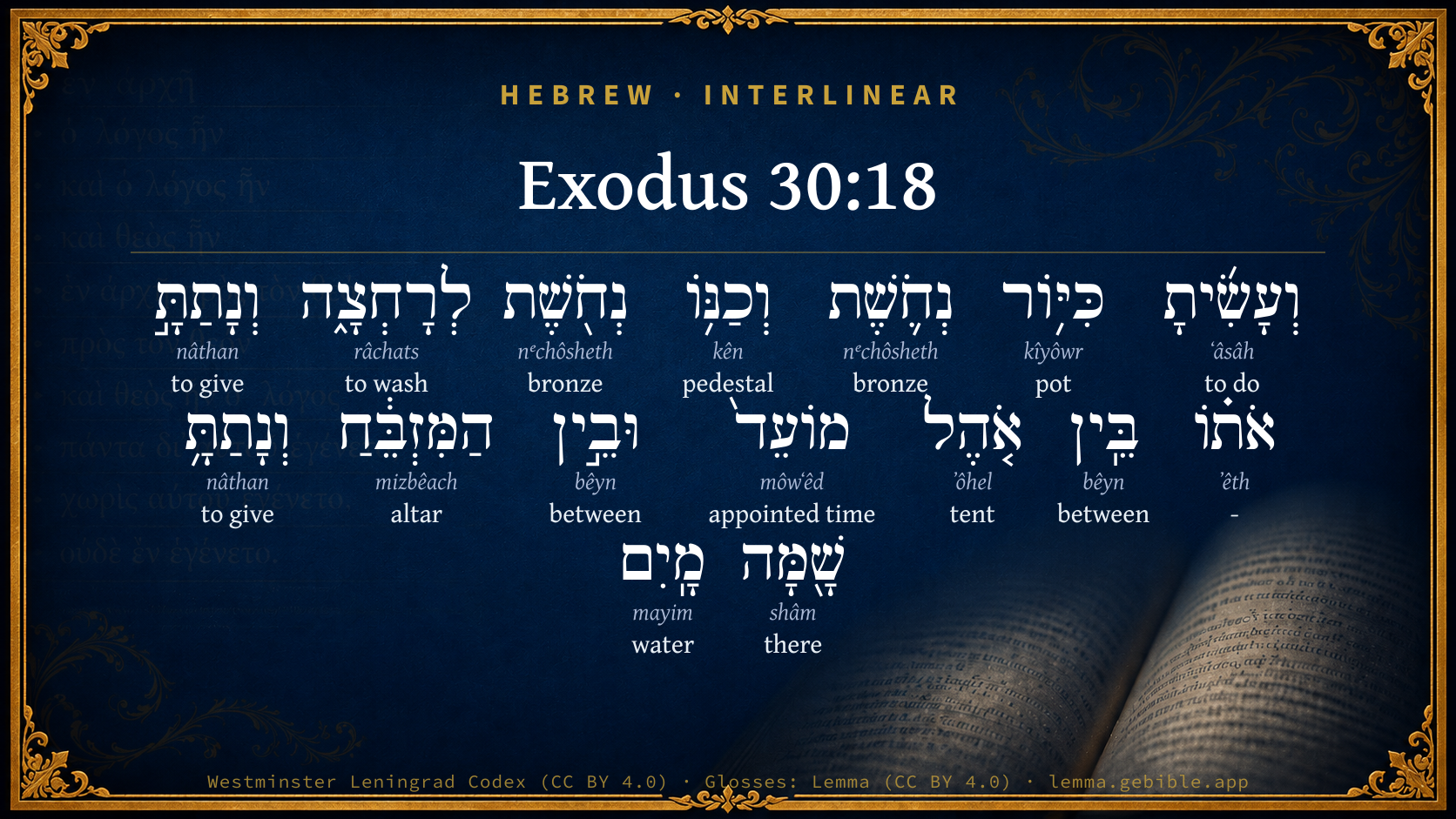
Hebrew (Westminster Leningrad Codex) Exodus 30:18 appears in the Hebrew Old Testament. The text above is from the Westminster Leningrad Codex. Each word links to its Strong’s number, a concise gloss, and parsing drawn from the Open Scriptures Hebrew Bible morphology. Click any word for its full Brown-Driver-Briggs (BDB) entry.
Download image
Cite this verse

Exodus 30:18 (World English Bible). Public Domain. Lemma interlinear Bible study tool, https://lemma.gebible.app/v/exodus/30/18.

Show BibTeX & RIS
BibTeX
RIS
English Translation
"You shall also make a basin of brass, and the base of it of brass, in which to wash. You shall put it between the tent of meeting and the altar, and you shall put water in it.
World English Bible · Public Domain
Highlights
  • 1 first appearance in the Hebrew Bible
Full analysis ↓
Download a study sheet

One document with this verse’s original text, its word-by-word gloss line, the meaning frame, cross-references with their text, attributed commentary, and full source and license credits — printable, and it pastes into notes with its structure intact.

This verse Autodidact and up

Study sheet (.html) Plain text (.txt)

A passage Seminary Student

Up to 50 verses in one chapter. A passage sheet keeps up to 6 commentary sources and 12 cross-references per verse, in the order this page ranks them, and says so on the sheet whenever that leaves anything out. Ask for a single verse and you get the Autodidact verse sheet above.

Everything on this page stays free to read, with no account — the sheet is a download of what is already on screen, not access to it.

Want to remove ads? Support Godless Engineer
Compare translations 3

The same verse in 3 English versions, stacked beneath the original-language interlinear above. Click any original word for its lexicon entry.

Each is an independent rendering of the whole verse — the interlinear is not word-aligned to these translations.

Highlighted words mark where these versions differ — a whole-verse word diff, not a word-by-word alignment.

  • World English Bible Public Domain
    "You shall also make a basin of brass, and the base of it of brass, in which to wash. You shall put it between the tent of meeting and the altar, and you shall put water in it.
  • King James Version Public Domain
    Thou shalt also make a laver of brass, and his foot also of brass, to wash withal: and thou shalt put it between the tabernacle of the congregation and the altar, and thou shalt put water therein.
  • unfoldingWord Literal Text CC BY-SA 4.0
    “And you shall make a basin of bronze and its base of bronze for washing. And you shall put it between the tent of meeting and the altar, and you shall put water in it.

unfoldingWord Literal Text — © unfoldingWord, licensed CC BY-SA 4.0. Word-aligned USFM3 via Door43 (git.door43.org/unfoldingWord/en_ult).

Versions to compare (up to 4)

3 of 4 selected

Show all 18 translations

Every available English version of this verse, each an independent rendering of the whole verse.

  • World English Bible Public Domain
    "You shall also make a basin of brass, and the base of it of brass, in which to wash. You shall put it between the tent of meeting and the altar, and you shall put water in it.
  • Berean Standard Bible Public Domain
    “You are to make a bronze basin with a bronze stand for washing. Set it between the Tent of Meeting and the altar, and put water in it,
  • Majority Standard Bible Public Domain
    “You are to make a bronze basin with a bronze stand for washing. Set it between the Tent of Meeting and the altar, and put water in it,
  • King James Version Public Domain
    Thou shalt also make a laver of brass, and his foot also of brass, to wash withal: and thou shalt put it between the tabernacle of the congregation and the altar, and thou shalt put water therein.
  • American Standard Version (1901) Public Domain
    Thou shalt also make a laver of brass, and the base thereof of brass, whereat to wash. And thou shalt put it between the tent of meeting and the altar, and thou shalt put water therein.
  • Revised Version (1885) Public Domain
    Thou shalt also make a laver of brass, and the base thereof of brass, to wash withal: and thou shalt put it between the tent of meeting and the altar, and thou shalt put water therein.
  • Geneva Bible (1599) Public Domain
    Thou shalt also make a lauer of brasse, and his foote of brasse to wash, and shalt put it betweene the Tabernacle of the Congregation and the Altar, and shalt put water therein.
  • Douay-Rheims (1899) Public Domain
    Thou shalt make also a brazen laver with its foot, to wash in: and thou shalt set it between the tabernacle of the testimony and the altar. And water being put into it,
  • Young's Literal Translation Public Domain
    `And thou hast made a laver of brass (and its base of brass), for washing; and thou hast put it between the tent of meeting and the altar, and hast put water there;
  • Literal Standard Version CC BY-SA 4.0
    “And you have made a laver of bronze (and its base of bronze), for washing; and you have put it between the Tent of Meeting and the altar, and have put water [in] there,
  • Unlocked Literal Bible CC BY-SA 4.0
    “You must also make a large bronze basin with a bronze stand, a basin for washing. You must put it between the tent of meeting and the altar, and you must put water in it.
  • unfoldingWord Literal Text CC BY-SA 4.0
    “And you shall make a basin of bronze and its base of bronze for washing. And you shall put it between the tent of meeting and the altar, and you shall put water in it.
  • Darby Bible Public Domain
    Thou shalt also make a laver of copper, and its stand of copper, for washing; and thou shalt put it between the tent of meeting and the altar, and shalt put water in it.
  • World Messianic Bible Public Domain
    “You shall also make a basin of bronze, and its base of bronze, in which to wash. You shall put it between the Tent of Meeting and the altar, and you shall put water in it.
  • Webster's Bible Public Domain
    Thou shalt also make a laver of brass, and its foot also of brass, to wash in: and thou shalt put it between the tabernacle of the congregation and the altar, and thou shalt put water therein.
  • Free Bible Version CC BY-SA 4.0
    “Make a bronze basin with a bronze stand for washing. Place it between the Tent of Meeting and the altar, and put water in it.
  • Bible in Basic English Public Domain
    You are to make a brass washing-vessel, with a brass base; and put it between the Tent of meeting and the altar, with water in it;
  • JPS Tanakh (1917) Public Domain
    'Thou shalt also make a laver of brass, and the base thereof of brass, whereat to wash; and thou shalt put it between the tent of meeting and the altar, and thou shalt put water therein.

Literal Standard Version (2020), Covenant Press — licensed CC BY-SA 4.0. Text via the HelloAO Bible API (eBible.org). Unlocked Literal Bible (unfoldingWord) — licensed CC BY-SA 4.0. Text via the HelloAO Bible API (eBible.org). unfoldingWord Literal Text — © unfoldingWord, licensed CC BY-SA 4.0. Word-aligned USFM3 via Door43 (git.door43.org/unfoldingWord/en_ult). Free Bible Version, Dr. Jonathan Gallagher — licensed CC BY-SA 4.0. Text via the HelloAO Bible API (eBible.org).

Word by word

More ways to search: Search by grammar → Find every occurrence → Compare this word →

Practice this passage: Drill this verse → Learn its vocabulary →

וְכַנּ֥וֹ
kên
H3653
“and · pedestal · his”
Conjunction + Noun, Common, Masculine, Singular, Construct + Suffix, Personal, 3rd Person, Masculine, Singular
Part of Speech
Conjunction + Noun
Type
Common
Gender
Masculine
Number
Singular
State
Construct
Full BDB Definition

Origin: the same as H3651 , used as a noun

TWOT: 998a

base, stand, pedestal, office, foot, place, estate - base, pedestal - office, place
  1. וְעָשִׂ֜יתָ ʻâsâh H6213 “and · to do” Conjunction + Verb, Qal, Sequential Perfect, 2nd Person, Masculine, Singular
  2. כִּיּ֥וֹר kîyôwr H3595 “pot” Noun, Common, Masculine, Singular, Absolute
  3. נְחֹ֛שֶׁת nᵉchôsheth H5178 “bronze” Noun, Common, Feminine, Singular, Absolute
  4. נְחֹ֖שֶׁת nᵉchôsheth H5178 “bronze” Noun, Common, Feminine, Singular, Absolute
  5. לְרָחְצָ֑ה râchats H7364 “to wash” Preposition + Verb, Qal, Infinitive Construct
  6. וְנָתַתָּ֣ nâthan H5414 “and · to give” Conjunction + Verb, Qal, Sequential Perfect, 2nd Person, Masculine, Singular
  7. אֹת֗וֹ ʼêth H853 “- · him” Particle, Direct Object + Suffix, Personal, 3rd Person, Masculine, Singular
  8. בֵּֽין bêyn H996 “between” Preposition
  9. אֹ֤הֶל ʼôhel H168 “tent of” Noun, Common, Masculine, Singular, Construct
  10. מוֹעֵד֙ môwʻêd H4150 “appointed time” Noun, Common, Masculine, Singular, Absolute
  11. וּבֵ֣ין bêyn H996 “and · between” Conjunction + Preposition
  12. הַמִּזְבֵּ֔חַ mizbêach H4196 “the · altar” Particle, Definite Article + Noun, Common, Masculine, Singular, Absolute
  13. וְנָתַתָּ֥ nâthan H5414 “and · to give” Conjunction + Verb, Qal, Sequential Perfect, 2nd Person, Masculine, Singular
  14. שָׁ֖מָּה shâm H8033 “there · toward” Adverb + Suffix, Demonstrative
  15. מָֽיִם mayim H4325 “water(s)” Noun, Common, Masculine, Plural, Absolute

About this verse

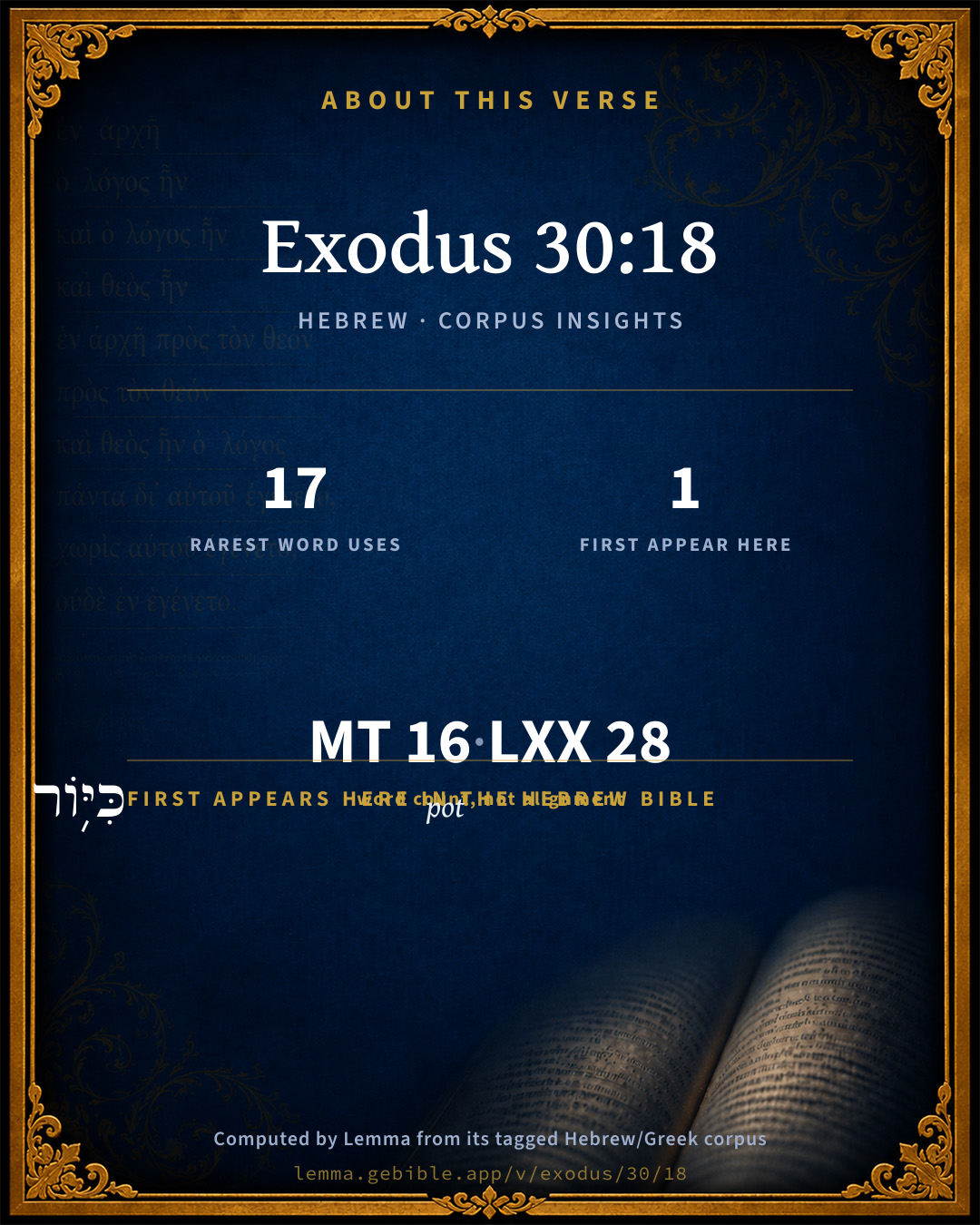
These counts appear in no published source. They are computed here, from the morphology-tagged text and Lemma’s own curated glosses. What Lemma adds →

16
words
13
distinct lemmas
Pentateuch
section

Notable vocabulary

The rarest word here is וְכַנּ֥וֹ pedestal H3653 — appearing just 17 times in the whole Hebrew Bible.

First appearance in Scripture

This word makes its first canonical appearance in the Hebrew Bible here:

  • כִּיּ֥וֹר pot H3595

Shared distinctive vocabulary

וְכַנּ֥וֹ pedestal H3653 occurs in 17 verses of the Hebrew Bible. Also found in:

Grammatical profile

  • 4 verbs
  • 8 nouns
  • 2 prepositions
  • 1 adverb
  • 1 particle

Verb forms

  • וְעָשִׂ֜יתָ Qal · Sequential Perfect
  • לְרָחְצָ֑ה Qal · Infinitive Construct
  • וְנָתַתָּ֣ Qal · Sequential Perfect
  • וְנָתַתָּ֥ Qal · Sequential Perfect

Repetition

Words recur within this verse — often emphatic in Hebrew:

  • נְחֹ֛שֶׁת bronze H5178 ×2
  • וְנָתַתָּ֣ to give H5414 ×2
  • בֵּֽין between H996 ×2

Hebrew & Septuagint length

In English translation the verse runs 38 words from the Hebrew and 33 from the Septuagint (LXX English) — closely comparable.

A rough comparison of the two English renderings, which tokenize alike — not a word-level alignment.

Word counts can differ between the Hebrew and the Greek without any difference in meaning — e.g. the Hebrew direct-object marker אֵת has no separate Greek word, and Greek often adds the article ὁ.

In the original languages it is 16 Hebrew tokens and 28 Greek tokens — but the two are counted differently (Hebrew bundles its prefixes and suffixes into one token; the Greek is in lemma form), so that isn’t a like-for-like length.

Cross-references

13

Topical passages linked to Exodus 30:18 in the Treasury of Scripture Knowledge — connected by theme and wording, ordered by reader-vote popularity; previews shown in the World English Bible.

  • Exodus 40:7 You shall set the basin between the tent of meeting and the altar, and shall put water therein.
  • Exodus 38:8 He made the basin of brass, and its base of brass, out of the mirrors of the ministering women who ministered at the door of the tent of meeting.
  • Exodus 40:30–32 He set the basin between the tent of meeting and the altar, and put water therein, with which to wash.
  • 1 Kings 7:23 He made the molten sea of ten cubits from brim to brim, round in compass, and the height of it was five cubits; and a line of thirty cubits compassed it round about.
  • 1 Kings 7:38 He made ten basins of brass: one basin contained forty baths; and every basin was four cubits; and on very one of the ten bases one basin.
  • 2 Chronicles 4:2 Also he made the molten sea of ten cubits from brim to brim, round in compass; and the height of it was five cubits; and a line of thirty cubits compassed it round about.
  • 2 Chronicles 4:14–15 He made also the bases, and the basins made he on the bases;
  • Leviticus 8:11 He sprinkled it on the altar seven times, and anointed the altar and all its vessels, and the basin and its base, to sanctify them.
  • 2 Chronicles 4:6 He made also ten basins, and put five on the right hand, and five on the left, to wash in them; such things as belonged to the burnt-offering they washed in them; but the sea was for the priests to wash in.
  • Zechariah 13:1 "In that day there will be a spring opened to the house of David and to the inhabitants of Jerusalem, for sin and for uncleanness.
  • Titus 3:5 not by works of righteousness, which we did ourselves, but according to his mercy, he saved us, through the washing of regeneration and renewing by the Holy Spirit,
  • 1 John 1:7 But if we walk in the light, as he is in the light, we have fellowship with one another, and the blood of Jesus Christ, his Son, cleanses us from all sin.
  • Exodus 31:9 the altar of burnt offering with all its vessels, the basin and its base,

Cross-references courtesy of OpenBible.info (CC BY 4.0).

Hebrew and Greek witnesses Masoretic Hebrew ↔ Greek Septuagint

The same verse in the two great witnesses to the Old Testament, shown verse-for-verse.

These are two independent witnesses, not word-aligned to each other, and the Septuagint is shown in lemma (dictionary) form.

Hebrew Exodus 30:18 Masoretic · Westminster Leningrad Codex

וְעָשִׂ֜יתָ כִּיּ֥וֹר נְחֹ֛שֶׁת וְכַנּ֥וֹ נְחֹ֖שֶׁת לְרָחְצָ֑ה וְנָתַתָּ֣ אֹת֗וֹ בֵּֽין אֹ֤הֶל מוֹעֵד֙ וּבֵ֣ין הַמִּזְבֵּ֔חַ וְנָתַתָּ֥ שָׁ֖מָּה מָֽיִם

"You shall also make a basin of brass, and the base of it of brass, in which to wash. You shall put it between the tent of meeting and the altar, and you shall put water in it.

World English Bible · Public Domain

Greek LXX Exodus 30:18 Septuagint · lemma form

ποιέω λουτήρ χαλκοῦς καί βάσις αὐτός χαλκοῦς ὥστε νίπτω καί τίθημι αὐτός ἀνά μέσος ὁ σκηνή ὁ μαρτύριον καί ἀνά μέσος ὁ θυσιαστήριον καί ἐκχέω εἰς αὐτός ὕδωρ

Make a brazen laver, and a brazen base for it, for washing; and you shall put it between the tabernacle of witness and the altar, and you shall pour forth water into it.

LXX2012 (modern English Septuagint) · Public Domain

Hebrew: Westminster Leningrad Codex (CC BY 4.0). Greek: Septuagint (public domain); English from LXX2012 (modern English Septuagint) (Public Domain). How the Septuagint differs from the Hebrew →

Targum (Aramaic paraphrase)

2

The Targum is the ancient Jewish Aramaic paraphrase of the Hebrew Scriptures — an interpretive translation, not the Hebrew text itself. Onkelos (literal) and Pseudo-Jonathan (expansive) render the Torah, and Jonathan the Prophets. Coverage is partial: where no permissively-licensed English translation exists for a verse, only the Aramaic is shown. This is verse-level text, not a word-by-word alignment to the Hebrew.

  1. Targum Onkelos Torah (Genesis–Deuteronomy)
    וְתַעְבֵּד כִּיוֹרָא דִנְחָשָׁא וּבְסִיסֵהּ נְחָשָׁא לְקִדוּשׁ וְתִתֵּן יָתֵהּ בֵּין מַשְׁכַּן זִמְנָא וּבֵין מַדְבְּחָא וְתִתֵּן תַּמָן מַיָא:

    (no public-domain English translation for this verse)

    Targum Onkelos — Aramaic: “Onkelos Genesis” (public domain); “Onkelos Exodus” (public domain); “Onkelos Leviticus” (public domain); “Onkelos Numbers” (public domain); “Onkelos Deuteronomy” (public domain). English: “Sefaria Community Translation” (CC0 1.0 (public-domain dedication)); “J.W. Etheridge. The Targums of Onkelos and Jonathan Ben Uzziel on the Pentateuch. London: Longmans, Green, 1862” (public domain). Text via Sefaria.

  2. Targum Pseudo-Jonathan Torah (Genesis–Deuteronomy)
    וְתַעֲבֵיד כִּיּוֹרָא דִנְחָשָׁא וּבְסִיסֵיהּ דִּנְחָשָׁא לְקִדּוּשׁ וּתְסַדֵּר יָתֵיהּ בֵּין מַשְׁכַּן זִימְנָא וּבֵין מַדְבְּחָא וְתִתֵּן תַּמָּן מוֹי

    And thou shalt make a laver of brass, and its foundation of brass, for purification; and shalt set it between the tabernacle of ordinance and the altar, and put water therein.

    Targum Pseudo-Jonathan — Aramaic: “Targum Jonathan on Genesis” (public domain); “Targum Jonathan on Exodus” (public domain); “Targum Jonathan on Leviticus” (public domain); “Targum Jonathan on Numbers” (public domain); “Targum Jonathan on Deuteronomy” (public domain). English: “The Targum of Jonathan ben Uzziel, trans. J. W. Etheridge, London, 1862” (public domain). Text via Sefaria.

Commentary

Notes on Exodus 30:18 from classic Christian and Jewish commentators (each source and its license shown beneath its notes). The classic Christian expositions comment on the surrounding passage and are grouped to its opening verse, so a note may address several verses; the Jewish commentaries on the Tanakh (Rashi and others) are per-verse, so they appear only where the commentator wrote on this verse.

Lemma curates 59 commentaries, every one of them public domain or Creative Commons licensed, each selected and text-cleaned for this edition rather than reprinted as found. About our sources →

Trapp's Complete Commentary

John Trapp

Exo 30:18 Thou shalt also make a laver [of] brass, and his foot [also of] brass, to wash [withal]: and thou shalt put it between the tabernacle of the congregation and the altar, and thou shalt put water therein.

Ver. 18. Between the tabernacle and the altar.] The laver and altar situated in the same court, signified the same; as the water and blood issuing out of Christ’s side, viz., the necessary concurrence of justification and sanctification in all that shall be saved.

John Trapp, A Commentary or Exposition upon All the Books of the Old and New Testament (1647–1656) — public domain. Text from a community e-Sword module.

Joseph Benson's Commentary

Exo 30:18. Thou shalt make a laver of brass — The laver, or font, was a large vessel, that would contain a good quantity of water. The foot of brass, it is supposed, was so contrived as to receive the water, which was let out of the laver by spouts or cocks. They then had a laver for the priests only to wash in; but to us now there is a fountain opened for Judah and Jerusalem, Zec 13:1, an inexhaustible fountain of living water, so that it is our own fault if we remain in our pollution. Aaron and his sons were to wash their hands and feet at this laver every time they went in to minister. For this purpose, clean water was put into the laver fresh every day. Though they washed themselves ever so clean at their own houses, that would not serve, they must wash at the laver. This was designed to teach them purity in all their ministrations, and to possess them with a reverence of God’s holiness, and a dread of the pollutions of sin. They must not only wash and be made clean when they were first consecrated, but they must wash and be kept clean whenever they went in to minister. He only shall stand in God’s holy place that hath clean hands and a pure heart, Psa 24:3-4. And it was to teach us, who are daily to attend upon God, daily to renew our repentance for sin, and our believing application of the blood of Christ to our souls for remission.

Joseph Benson's Commentary on the Old and New Testaments (1811–1818) — public domain. Text from a community e-Sword module.

Jamieson, Fausset & Brown

Robert Jamieson, A. R. Fausset & David Brown

Thou shalt . . . make a laver of brass--Though not actually forming a component part of the furniture of the tabernacle, this vase was closely connected with it; and though from standing at the entrance it would be a familiar object, it possessed great interest and importance from the baptismal purposes to which it was applied. No data are given by which its form and size can be ascertained; but it was probably a miniature pattern of Solomon's--a circular basin.

his foot--supposed not to be the pedestal on which it rested, but a trough or shallow receptacle below, into which the water, let out from a cock or spout, flowed; for the way in which all Eastern people wash their hands or feet is by pouring upon them the water which falls into a basin. This laver was provided for the priests alone. But in the Christian dispensation, all believers are priests, and hence the apostle exhorts them how to draw near to God (Joh 13:10; Heb 10:22).

Jamieson, Fausset & Brown — Commentary Critical and Explanatory on the Whole Bible (1871) — public domain (CC PDM 1.0). Text via the HelloAO Bible API.

Adam Clarke's Commentary

Verse 18. A laver of brass] כיור kiyor sometimes signifies a caldron, 1Sa 2:14; but it seems to signify any large round vessel or basin used for washing the hands and feet. There were doubtless cocks or spigots in it to draw off the water, as it is not likely the feet were put into it in order to be washed. The foot of the laver must mean the pedestal on which it stood.

Adam Clarke's Commentary on the Bible (1810–1826) — public domain. Text from a community e-Sword/MySword module.

Ellicott's Commentary for English Readers

THE BRAZEN LAVER.

(18) Thou shalt also make a laver of brass.—Rather, of bronze. (See Note on Exo_25:3.) Water was required for the ablutions of the priests (Exo_30:19-21), for the washing of certain parts of the victim, (Exo_29:27; Lev_1:9; Lev_1:13, &c.), and probably for the cleansing of the altar itself and the ground whereon it stood from blood stains and other defilements.

His foot.—The laver was probably in the shape of a large urn or vase, supported upon a comparatively slender stem, which rose from a pedestal. Vases of this kind are represented in the Assyrian bas-reliefs. (See Ancient Monarchies, vol. i., p. 481.)

Thou shalt put it between the tabernacle of the congregation and the altar.—It was essential that the laver should be near the altar, since on every occasion of their ministering at the altar the priests had to wash at it (Exo_30:20). It was also essential that it should be near the entrance into the tabernacle, since they had likewise to wash before they entered into the holy place. Jewish tradition says that its place was between the entrance and the brazen altar, not, however, exactly between them, but a little to the south.

A Bible Commentary for English Readers, edited by Charles John Ellicott (1878–1897) — public domain. Text from a community e-Sword module.

The Cambridge Bible for Schools and Colleges

gen. ed. J. J. S. Perowne

18. Thou shalt also make] Heb. And thou shalt make.

brass] bronze or copper, as always: see on Exo_25:3. The metal, according to Exo_38:8, was obtained from the mirrors of the women who ‘served in the host’ (see the note).

base] some kind of pedestal, upon which it rested.

The Cambridge Bible for Schools and Colleges (gen. ed. J. J. S. Perowne; Cambridge University Press, 1878–1918) — public domain. Text from a community e-Sword module.

John Gill's Exposition

Thou shalt also make a laver of brass, and his foot also of brass, to wash withal,.... For Aaron, and his sons, and the priests in succession, to wash at before their entrance on their ministry; and denotes in general the necessity of purity, in order to minister in the priestly office; and which was in its perfection in Christ, who being holy and harmless, was an high priest becoming us, and suitable to us, qualified to offer himself without spot to God, and to take away sin; of which purity his baptism in water might be a symbol, which he submitted to before he entered publicly on the execution of his office as a prophet and priest; and as this may respect the ministers of the Gospel, it shows that they should be pure and holy in their lives and conversations, and be examples in purity of conversation to others: and as this may chiefly respect all the saints who are priests unto God; it may be either typical of the laver of regeneration, in which grace, comparable to water, is given, and in which a clean heart is created; and which has an influence on purity of life and conversation, and secures from death: or rather of the blood of Christ, the laver and fountain to wash in for sin and uncleanness; which is large and capacious for all the priests of the Lord, and stands open and uncovered for all to come unto; and as this was made of brass, and that brass the looking glasses of the women, Exo 38:8 as it may respect the laver of regeneration, may denote the durableness of that grace, which is an immortal seed, a well of living water, springing up to everlasting life, and was a clear evidence of election of God, and redemption by Christ; and as it may be an emblem of the blood of Christ, it signifies the duration and continued virtue of that blood to cleanse from all sin; and that such who are washed in it, and cleansed by it, are not only beheld as clean and pure by the Lord, but in their own sight also, God having caused their iniquities to pass from them, and justified them from them by his blood:

and thou shalt put it between the tabernacle of the congregation and the altar; that is, the altar of burnt offering, which was by the door of the tabernacle; and between that and the tabernacle or tent of the congregation stood the laver for the priests to wash in, just as they entered into the tabernacle, Exo 40:29 it stood inclining to one of the sides, as Aben Ezra says; a little on the south side, as Jarchi observes:

and thou shall put water therein; or order it to be put in for the use next mentioned.

John Gill's Exposition of the Whole Bible (1746–1763) — public domain (CC PDM 1.0). Text via the HelloAO Bible API.

Haydock's Catholic Bible Commentary

Its foot also of brass, made of mirrors which the women gave, chap. xxxviii. 8. It was double; one vessel being shallower, to wash the feet &c., and the other containing a quantity of water, which was let out by pipes. The pagans had lavers also; and our holy-water vessels should remind us of that purity and holiness which became the house of God. (Haydock)

George Leo Haydock (1774–1849), Haydock's Catholic Family Bible and Commentary, 1859 edition — public domain. Excludes Psalms (Douay-Rheims chapter numbering differs from Protestant) and Deuterocanonical books (Catholic canon only).

Matthew Poole's English Annotations

See the accomplishment Exo 38:8; to wash both the priests and the parts of the sacrifices. The altar, to wit, of burnt-offerings.

Matthew Poole's English Annotations on the Holy Bible (1683–1685) — public domain. Text from a community e-Sword/MySword module.

Whedon's Commentary on the Bible

Daniel D. Whedon

18. Laver of brass — According to Exo_38:8, it was made of the mirrors of the women who were wont to assemble at the entrance of the tabernacle. The purpose of this laver was mainly for the priests to wash themselves when they entered upon their holy work; also for the washing of inwards and legs of victims. Lev_1:9. Its form is not described, but it rested upon a foot or pedestal, and the adjoining cuts represent two possible forms according to which it may have been constructed. For the temple there was a brazen sea resting upon twelve oxen, and also ten lavers resting upon as many bases. See notes and cuts at 1Ki_7:23-39. The laver was to be placed between the tabernacle… and the altar, probably as indicated in the cut of the tabernacle and court on page 522.

Daniel D. Whedon (gen. ed.), Commentary on the Old and New Testaments (1874–1909) — public domain. Text from a community e-Sword module.

The Pulpit Commentary

A laver. It is remarkable that nothing is said respecting either the shape or the size of the laver. In 1 Kings we have an elaborate description of the "molten sea," which replaced it in Solomon"s temple, as well as an almost equally elaborate one of ten other layers made by Hiram, Solomon"s artist, at the same time. We may perhaps assume from these examples that the brazen laver of the tabernacle was a large bronze vase or basin, standing upon a stem, which was fixed into a base. It was probably fitted up with an apparatus of taps and cocks. Between the tabernacle...and the altar. The Rabbinical commentators say that it was not exactly in the middle, but a little towards the south side.

Vers. 18-21. The Brazen Laver.

Primarily, the brazen altar has its antitype in THE CHRISTIAN FONT. "Baptism saves us," says St. Peter. (1Pe_3:21) "Arise and be baptised, and wash away thy sins," said Ananias. (Act_22:16) "There is one baptism for the remission of sins," said the Nicene Fathers. As the priests had to wash at the laver ere they might enter the sanctuary, so entrance into the Church, by the institution of Christ (Mat_28:19; Mar_16:16; Joh_3:5) is by baptism. To wash, of course, is by itself not enough each of us must "lead the rest of his life according to this beginning." So the priests, besides washing, had to observe all God"s other ordinances.

Ultimately, both the laver and the font, both the priestly ablutions and the Christian sacrament of baptism, are types of the true washing, which is WASHING IN THE BLOOD OF CHRIST. This washing is

I ABSOLUTELY, AND IN ALL CASES, NEEDFUL. Only "the blood of Jesus Christ cleanseth us from all sin". (1Jn_1:7) "If Christ wash us not, we have no part in him". (Joh_13:8) The saved in heaven are those who have "washed their robes and made them white in the blood of the Lamb". (Rev_7:14) Baptism is "generally necessary" since Christ came and instituted it; yet no one doubts that many unbaptized persons have entered heaven. But not one has entered, or will ever enter, whom the blood of Christ has not cleansed. "Wash me, Saviour, or I die," is the constantly repeated cry of every Christian heart.

II A SOVEREIGN REMEDY THAT NEVER, FAILS TO SAVE. Thus "washed," we are at once both "justified and sanctified"; (1Co_6:11) both pardoned and made pure. Thus washed, we have access to the Father; we are made fit to enter his courts; our robes are made white, and not only our robes, but our souls. God will never reject one who comes to him in the wedding garment of a robe that Christ has cleansed. Only we must be sure to keep our robes clean we must not "defile our garments" (Rev_3:4) we must wash them again and again in the purifying blood; we must look nowhere else for salvation, but only to the Cross, and we must look to that perpetually.

The Pulpit Commentary (1880–1919), ed. H.D.M. Spence-Jones & Joseph S. Exell — public domain. Text from a community e-Sword module.

John Wesley's Explanatory Notes

The laver, or font was a large vessel, that would contain a good quantity of water. The foot of brass, it is supposed, was so contrived as to receive the water, which was let out of the laver, by spouts or cocks. They then had a laver for the priests only to wash in, but to us now there is a fountain opened for Judah and Jerusalem, Zech. xiii, 1, an inexhaustible fountain of living water, so that it is our own fault if we remain in our pollution. Aaron and his sons were to wash their hands and feet at this laver every time they went in to minister. For this purpose clean water was put into the laver, fresh every day. Though they washed themselves ever so clean at their own houses, that would not serve, they must wash at the laver. This was designed, to teach them purity in all their ministrations, and to possess them with a reverence of God's holiness, and a dread of the pollutions of sin. They must not only wash and be made clean when they were first consecrated, but they must wash and be kept clean, whenever they went in to minister. He only shall stand in God's holy place that hath clean hands and a pure heart, Psalm xxiv, 3, 4. And it was to teach us, who are daily to attend upon God, daily to renew our repentance for sin, and our believing application of the blood of Christ to our souls for remission.

John Wesley, Explanatory Notes Upon the Whole Bible (1754–1765) — public domain. Text via the GEBible commentary corpus.

Scofield Reference Notes

C. I. Scofield

laver

Laver, type of Christ cleansing us from defilement, and from "every spot or wrinkle or any such thing" Joh 13:2-10; Eph 5:25-27. It is significant that the priests could not enter the holy place after serving at the brazen altar till hands and feet were cleansed.

The Scofield Reference Bible (1917 edition), notes by C. I. Scofield — public domain. Text from a community e-Sword module.

Rashi

Rabbi Shlomo Yitzchaki (Rashi)

כיור A LAVER — like a large pot with teats which discharged water by the way of their openings.

וכנו — Understand this as the Targum renders it: בסיסה ITS BASE, i. e. a stand specially made for the laver.

לרחצה TO LAVE WITHAL — This, of course, refers to the laver and not to the base.

ובין המזבח BETWEEN [THE APPOINTED TENT AND] THE ALTAR — the altar of burnt offering of which it is written, (Exodus 40:6) that is was to be set “before the entrance of the dwelling of the appointed tent”. The laver was drawn a little to the side and stood facing the open space which was between the altar and the Tabernacle, and it did not stand between them at all because it is stated (Exodus 40:29) “and he put the altar of burnt offering by the entrance of the dwelling of the appointed tent” which implies that the altar was in front of the entrance of the appointed tent, but that the laver was not in front of the entrance of the appointed tent. How was it arranged? It was drawn a little towards the south. Thus is it stated in Treatise Zevachim 59a.

Rashi on the Tanakh — English translations: “The Judaica Press complete Tanach with Rashi, translated by A. J. Rosenberg” (CC BY 4.0); “Pentateuch with Rashi's commentary by M. Rosenbaum and A.M. Silbermann, 1929-1934” (public domain); “The Metsudah Tanach series, Lakewood, N.J” (CC BY 4.0); and “The Book of Joshua, Metsudah Publications, 1997” (CC BY 4.0). Text via Sefaria.

Sforno

Rabbi Ovadia Sforno

Make a copper wash basin. This vessel is not mentioned in Parashas Terumah along with the others because its function was not to cause the Shechinah to dwell among them but only to prepare the kohanim for their service.

Sforno on the Tanakh — English translation: “Yalkut, Sifsei Chachomim Chumash, Metsudah Publications, 2009” (CC BY 4.0). Text via Sefaria.

Lesson kit

Teaching starters — assembled from the data on this page, not authored interpretation. Every prompt links to the verse data it draws on. Edit before teaching.

Exodus, in the Pentateuch, opens this verse with 16 words (13 distinct Hebrew lemmas). Its most distinctive word is kên (“pedestal”). A historical commentator’s framing appears above. Read the whole chapter for the surrounding context.

Discussion questions

  1. How does “pedestal” (kên) shape what this verse is saying?
  2. The word “pot” first appears here in Scripture. What is being introduced at this debut?
  3. Genesis 40:13 shares the word «pedestal» with this verse. How do the two illuminate each other?
  4. “bronze” occurs 2× in this one verse. What is the effect of the repetition?
  5. These translations render this verse differently; the difference is in the English rendering, not the original. What questions does that raise?
  6. The verb «וְעָשִׂ֜יתָ» is Qal Sequential Perfect. How does its form color the action?
  7. Reading how Trapp's Complete Commentary and Joseph Benson's Commentary read this verse, where do the two commentators agree and where do they part?

Things to notice

Reading settings

Reading text

Shown beneath each verse's original-language words.

Old Testament
Old Testament edition

Read the OT as the Masoretic Hebrew (MT) or the Greek Septuagint (LXX).

English shown for the Greek Septuagint (in the Hebrew ↔ Greek comparison).

Comparing translations? Open the Compare panel on any verse page to stack up to four side by side.