
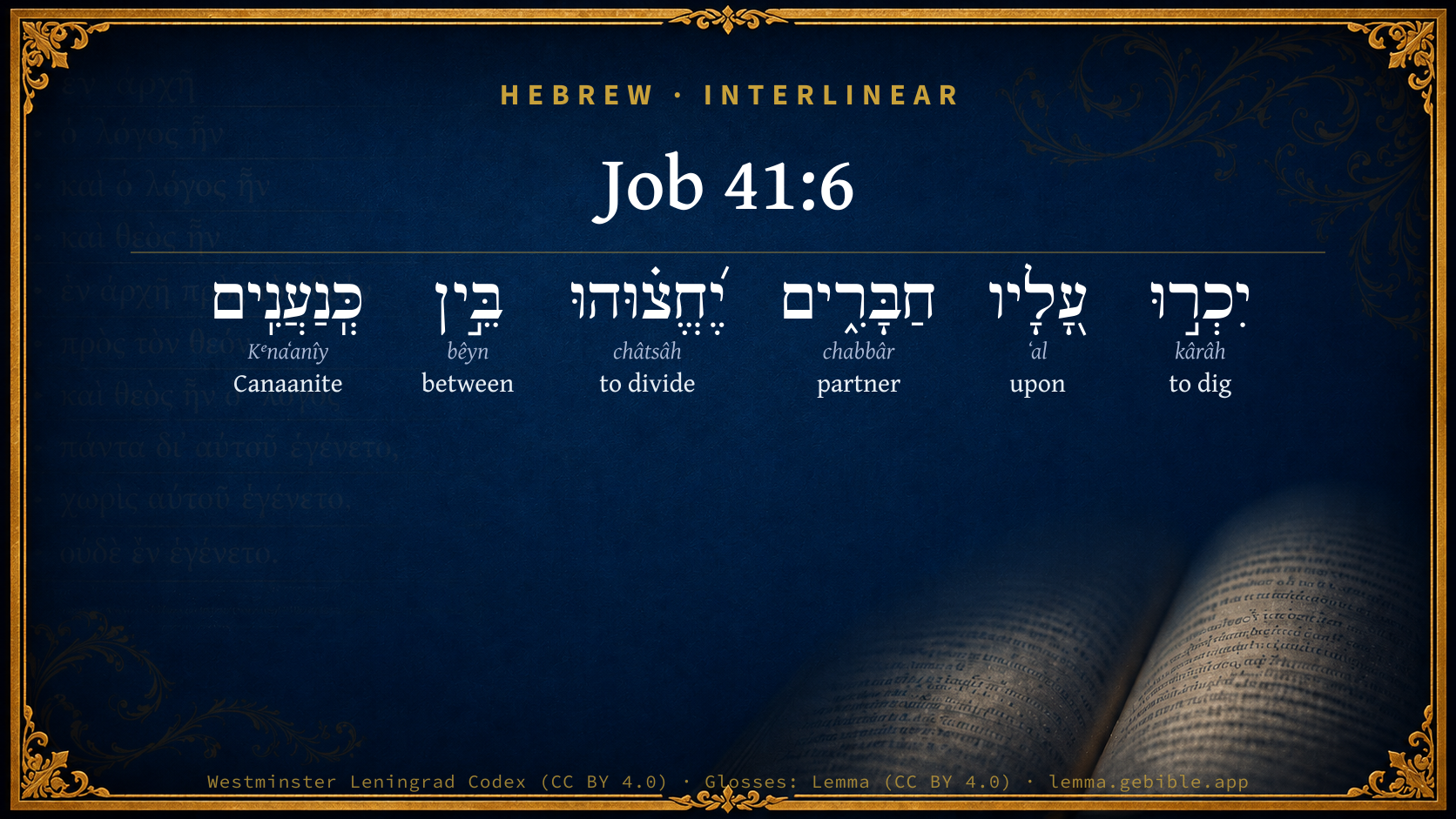
Job 41:6

Hebrew (Westminster Leningrad Codex) Job 41:6 appears in the Hebrew Old Testament. The text above is from the Westminster Leningrad Codex. Each word links to its Strong’s number, a concise gloss, and parsing drawn from the Open Scriptures Hebrew Bible morphology. Click any word for its full Brown-Driver-Briggs (BDB) entry.
Download image
Cite this verse

Job 41:6 (World English Bible). Public Domain. Lemma interlinear Bible study tool, https://lemma.gebible.app/v/job/41/6.

Show BibTeX & RIS
BibTeX
RIS
English Translation
Will traders barter for him? Will they part him among the merchants?
World English Bible · Public Domain
Highlights
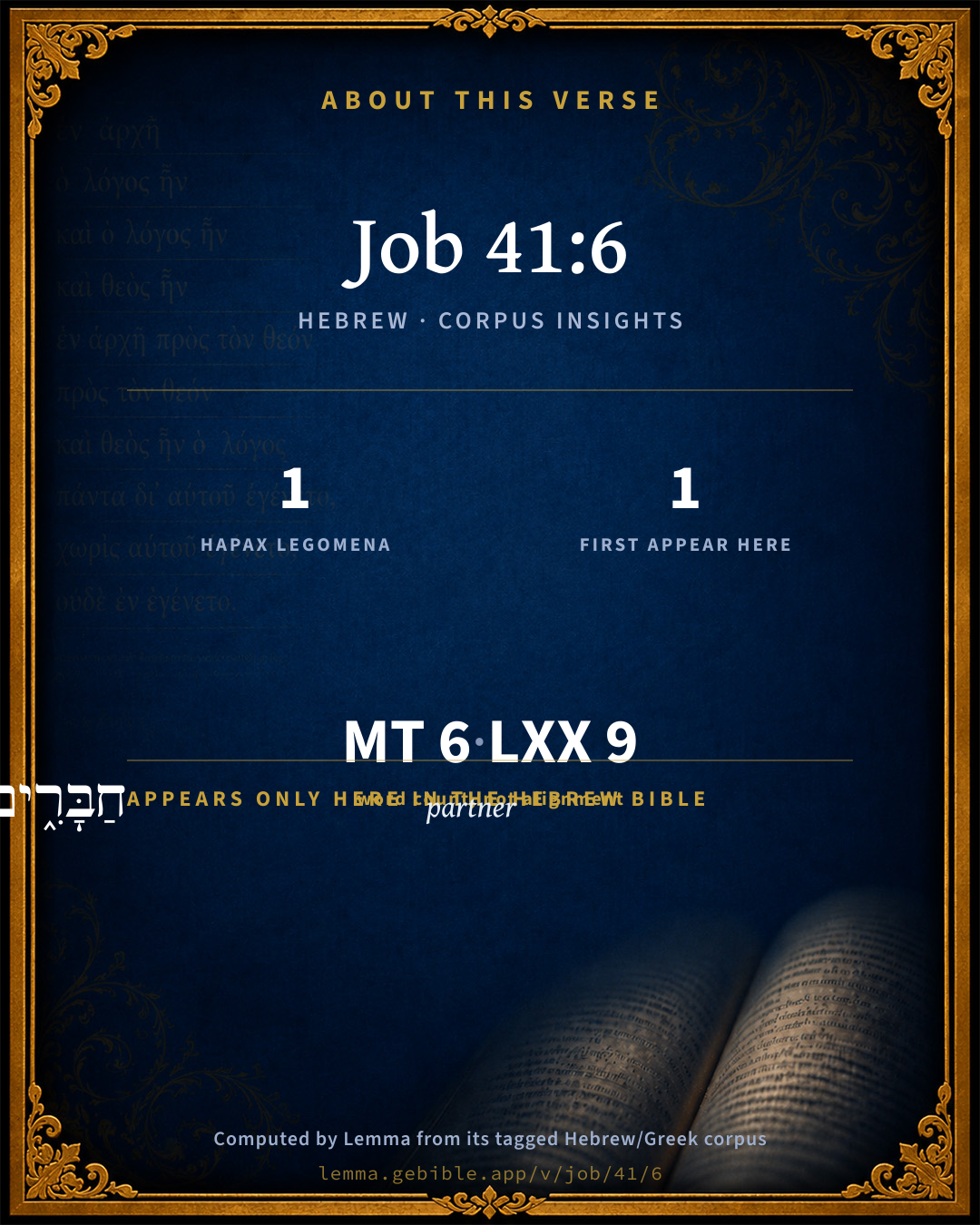
  • 1 hapax legomenon — only here in the Hebrew Bible
  • 1 first appearance in the Hebrew Bible
Full analysis ↓
Download a study sheet

One document with this verse’s original text, its word-by-word gloss line, the meaning frame, cross-references with their text, attributed commentary, and full source and license credits — printable, and it pastes into notes with its structure intact.

This verse Autodidact and up

Study sheet (.html) Plain text (.txt)

A passage Seminary Student

Up to 50 verses in one chapter. A passage sheet keeps up to 6 commentary sources and 12 cross-references per verse, in the order this page ranks them, and says so on the sheet whenever that leaves anything out. Ask for a single verse and you get the Autodidact verse sheet above.

Everything on this page stays free to read, with no account — the sheet is a download of what is already on screen, not access to it.

Want to remove ads? Support Godless Engineer
Compare translations 3

The same verse in 3 English versions, stacked beneath the original-language interlinear above. Click any original word for its lexicon entry.

Each is an independent rendering of the whole verse — the interlinear is not word-aligned to these translations.

Highlighted words mark where these versions differ — a whole-verse word diff, not a word-by-word alignment.

  • World English Bible Public Domain
    Will traders barter for him? Will they part him among the merchants?
  • King James Version Public Domain
    Shall the companions make a banquet of him? shall they part him among the merchants?
  • unfoldingWord Literal Text CC BY-SA 4.0
    Will partners bargain over it? Will they divide it among merchants?

unfoldingWord Literal Text — © unfoldingWord, licensed CC BY-SA 4.0. Word-aligned USFM3 via Door43 (git.door43.org/unfoldingWord/en_ult).

Versions to compare (up to 4)

3 of 4 selected

Show all 18 translations

Every available English version of this verse, each an independent rendering of the whole verse.

  • World English Bible Public Domain
    Will traders barter for him? Will they part him among the merchants?
  • Berean Standard Bible Public Domain
    Will traders barter for him or divide him among the merchants?
  • Majority Standard Bible Public Domain
    Will traders barter for him or divide him among the merchants?
  • King James Version Public Domain
    Shall the companions make a banquet of him? shall they part him among the merchants?
  • American Standard Version (1901) Public Domain
    Will the bands `of fishermen' make traffic of him? Will they part him among the merchants?
  • Revised Version (1885) Public Domain
    Shall the bands of fishermen make traffic of him? shall they part him among the merchants?
  • Geneva Bible (1599) Public Domain
    The maiestie of his scales is like strog shields, and are sure sealed.
  • Douay-Rheims (1899) Public Domain
    His body is like molten shields, shut close up with scales pressing upon one another.
  • Young's Literal Translation Public Domain
    (Feast upon him do companions, They divide him among the merchants!)
  • Literal Standard Version CC BY-SA 4.0
    (Companions feast on him, || They divide him among the merchants!)
  • Unlocked Literal Bible CC BY-SA 4.0
    Will the groups of fishermen bargain for him? Will they divide him up to trade among the merchants?
  • unfoldingWord Literal Text CC BY-SA 4.0
    Will partners bargain over it? Will they divide it among merchants?
  • Darby Bible Public Domain
    Shall partners make traffic of him, will they divide him among merchants?
  • World Messianic Bible Public Domain
    Will traders barter for him? Will they part him among the merchants?
  • Webster's Bible Public Domain
    \\41:15\\His scales are his pride, shut together as with a close seal.
  • Free Bible Version CC BY-SA 4.0
    Will your trading partners decide on a price for him, and divide him up among the merchants?
  • Bible in Basic English Public Domain
    His back is made of lines of plates, joined tight together, one against the other, like a stamp.
  • JPS Tanakh (1917) Public Domain
    (40-30) Will the bands of fishermen make a banquet of him? Will they part him among the merchants?

Literal Standard Version (2020), Covenant Press — licensed CC BY-SA 4.0. Text via the HelloAO Bible API (eBible.org). Unlocked Literal Bible (unfoldingWord) — licensed CC BY-SA 4.0. Text via the HelloAO Bible API (eBible.org). unfoldingWord Literal Text — © unfoldingWord, licensed CC BY-SA 4.0. Word-aligned USFM3 via Door43 (git.door43.org/unfoldingWord/en_ult). Free Bible Version, Dr. Jonathan Gallagher — licensed CC BY-SA 4.0. Text via the HelloAO Bible API (eBible.org).

Word by word

More ways to search: Search by grammar → Find every occurrence → Compare this word →

Practice this passage: Drill this verse → Learn its vocabulary →

About this verse

These counts appear in no published source. They are computed here, from the morphology-tagged text and Lemma’s own curated glosses. What Lemma adds →

6
words
6
distinct lemmas
Wisdom
section

Notable vocabulary

1 hapax legomenon — a word that appears only here in the entire Hebrew Bible:

  • חַבָּרִ֑ים partner H2271

First appearance in Scripture

This word makes its first canonical appearance in the Hebrew Bible here:

  • חַבָּרִ֑ים partner H2271

Shared distinctive vocabulary

יֶ֝חֱצ֗וּהוּ to divide H2673 occurs in 14 verses of the Hebrew Bible. Also found in:

Grammatical profile

  • 2 verbs
  • 2 nouns
  • 2 prepositions

Verb forms

  • יִכְר֣וּ Qal · Imperfect
  • יֶ֝חֱצ֗וּהוּ Qal · Imperfect

Hebrew & Septuagint length

In English translation the verse runs 12 words from the Hebrew and 16 from the Septuagint (LXX English) — closely comparable.

A rough comparison of the two English renderings, which tokenize alike — not a word-level alignment.

Word counts can differ between the Hebrew and the Greek without any difference in meaning — e.g. the Hebrew direct-object marker אֵת has no separate Greek word, and Greek often adds the article ὁ.

In the original languages it is 6 Hebrew tokens and 9 Greek tokens — but the two are counted differently (Hebrew bundles its prefixes and suffixes into one token; the Greek is in lemma form), so that isn’t a like-for-like length.

Cross-references

1

Topical passages linked to Job 41:6 in the Treasury of Scripture Knowledge — connected by theme and wording, ordered by reader-vote popularity; previews shown in the World English Bible.

  • Judges 14:11 It happened, when they saw him, that they brought thirty companions to be with him.

Cross-references courtesy of OpenBible.info (CC BY 4.0).

Hebrew and Greek witnesses Masoretic Hebrew ↔ Greek Septuagint

The same verse in the two great witnesses to the Old Testament, shown verse-for-verse.

These are two independent witnesses, not word-aligned to each other, and the Septuagint is shown in lemma (dictionary) form.

Hebrew Job 41:6 Masoretic · Westminster Leningrad Codex

יִכְר֣וּ עָ֭לָיו חַבָּרִ֑ים יֶ֝חֱצ֗וּהוּ בֵּ֣ין כְּֽנַעֲנִֽים

Will traders barter for him? Will they part him among the merchants?

World English Bible · Public Domain

Greek LXX Job 41:6 Septuagint · lemma form

πύλη πρόσωπον αὐτός τίς ἀναοἴγω κύκλος ὀδούς αὐτός φόβος

His inwards are as brazen plates, and the texture of his skin as a smyrite stone.

LXX2012 (modern English Septuagint) · Public Domain

On this verse, Keil & Delitzsch discusses the Septuagint’s reading. Read the note in Commentary ↓

Hebrew: Westminster Leningrad Codex (CC BY 4.0). Greek: Septuagint (public domain); English from LXX2012 (modern English Septuagint) (Public Domain). How the Septuagint differs from the Hebrew →

Commentary

Notes on Job 41:6 from classic Christian and Jewish commentators (each source and its license shown beneath its notes). The classic Christian expositions comment on the surrounding passage and are grouped to its opening verse, so a note may address several verses; the Jewish commentaries on the Tanakh (Rashi and others) are per-verse, so they appear only where the commentator wrote on this verse.

Lemma curates 59 commentaries, every one of them public domain or Creative Commons licensed, each selected and text-cleaned for this edition rather than reprinted as found. About our sources →

Trapp's Complete Commentary

John Trapp

Job 41:6 Shall the companions make a banquet of him? shall they part him among the merchants?

Ver. 6. Shall the companions make a banquet of him?] The Cetarii, whale fishers, who usually go out in companies. It was anciently held impossible, and is still perilous, to take the whale and make a banquet of him; as the tongue and some other parts of the whale are good meat. Or, Make a banquet for him; shall they feast those merchants they mean to sell him to, that they may get the better price for him?

Shall they part him among the merchants?] Who might sell him out for sundry uses. See Job 41:1.

John Trapp, A Commentary or Exposition upon All the Books of the Old and New Testament (1647–1656) — public domain. Text from a community e-Sword module.

Keil & Delitzsch

C. F. Keil & F. Delitzsch

6 Do fishermen trade with him,

Do they divide him among the Canaanites?

7 Canst thou fill his skin with darts,

And his head with fish-spears?

8 Only lay thy hand upon him

Remember the battle, thou wilt not do it again!

9 Behold, every hope becometh disappointment:

Is not one cast down even at the sight of him?

The fishermen form a guild (Arab. ṣunf, sunf), the associated members of which are called חבּרים (distinct from חברים). On כּרה על, vid., on Job 6:27. "When I came to the towns of the coast," says R. Akiba, b. Rosch ha-Schana, 26b, "they called selling, which we call מכירה, כירה, there," according to which, then, Gen 50:5 is understood, as by the Syriac; the word is Sanscrito-Semitic, Sanscr. kri, Persic chirı̂den (Jesurun, p. 178). lxx ἐνσιτούνται, according to Kg2 6:23, to which, however, עליו is not suitable. כּנענים are Phoenicians; and then, because they were the merchant race of the ancient world, directly traders or merchants. The meaning of the question is, whether one sells the crocodile among them, perhaps halved, or in general divided up. Further, Job 41:7 : whether one can kill it בּשׂכּות, with pointed missiles (Arab. shauke, a thorn, sting, dart), or with fish-spears (צלצל, so called from its whizzing, צלל, ). In Job 41:8 the accentuation is the right indication: only seize upon him - remember the battle, i.e., thou wilt be obliged to remember it, and thou wilt have no wish to repeat it. זכר .ti t is a so-called imperat. consec.: if thou doest it, thou wilt ... , Ges. 130, 2. תּוסף is the pausal form of תּוסף (once ͂, Pro 30:6), of which it is the original form.

The suff. of תּוהלתּו refers to the assailant, not objectively to the beast (the hope which he indulges concerning it). נכזבה, Job 41:9, is 3 praet., like נאלמה, Isa 53:7 (where also the participial accenting as Milra, occurs in Codd.); Frst's Concord. treats it as part., but the participial form נקטלה, to be assumed in connection with it, along with נקטלה and נקטלת, does not exist. הגם, Job 41:9, is, according to the sense, equivalent to הלא גם, vid., on Job 20:4. מראיו (according to Ges., Ew., and Olsh., sing., with the plural suff., without a plur. meaning, which is natural in connection with the primary form מראי; or what is more probable, from the plur. מראים with a sing. meaning, as פּנים) refers to the crocodile, and יטּל (according to a more accredited reading, יטּל = יוּטל) to the hunter to whom it is visible.

What is said in Job 41:6 is perfectly true; although the crocodile was held sacred in some parts of Egypt, in Elephantine and Apollonopolis, on the contrary, it was salted and eaten as food. Moreover, that there is a small species of crocodile, with which children can play, does not militate against Job 41:5. Everywhere here it is the creature in its primitive strength and vigour that is spoken of. But if they also knew how to catch it in very early times, by fastening a bait, perhaps a duck, on a barb with a line attached, and drew the animal to land, where they put an end to its life with a lance-thrust in the neck (Uhlemann, Thoth, S. 241): this was angling on the largest scale, as is not meant in Job 41:1. If, on the other hand, in very early times they harpooned the crocodile, this would certainly be more difficult of reconcilement with v. 31, than that mode of catching it by means of a fishing-hook of the greatest calibre with Job 41:1. But harpooning is generally only of use when the animal can be hit between the neck and head, or in the flank; and it is very questionable whether, in the ancient times, when the race was without doubt of an unmanageable size, that has now died out, the crocodile hunt (Job 7:12) was effected with harpoons. On the whole subject we have too little information for distinguishing between the different periods. So far as the questions of Jehovah have reference to man's relation to the two monsters, they concern the men of the present, and are shaped according to the measure of power which they have attained over nature. The strophe which follows shows what Jehovah intends by these questions.

Keil & Delitzsch — Biblical Commentary on the Old Testament (1861–1891) — public domain (CC PDM 1.0). Text via the HelloAO Bible API. (Old Testament only.)

Jamieson, Fausset & Brown

Robert Jamieson, A. R. Fausset & David Brown

Rather, "partners" (namely, in fishing).

make a banquet--The parallelism rather supports UMBREIT, "Do partners (in trade) desire to purchase him?" So the Hebrew (Deu 2:6).

merchants--literally, "Canaanites," who were great merchants (Hos 12:7, Margin).

Jamieson, Fausset & Brown — Commentary Critical and Explanatory on the Whole Bible (1871) — public domain (CC PDM 1.0). Text via the HelloAO Bible API.

Adam Clarke's Commentary

Verse 6. Shall thy companions make a banquet] Canst thou and thy friends feast on him as ye were wont to do on a camel sacrificed for this purpose? Or, canst thou dispose of his flesh to the merchants - to buyers, as thou wouldst do that of a camel or an ox? It is certain, according to Herodotus, lib. ii. c. 70, that they killed and ate crocodiles at Apollonople and Elephantis, in Egypt.

Adam Clarke's Commentary on the Bible (1810–1826) — public domain. Text from a community e-Sword/MySword module.

Ellicott's Commentary for English Readers

(6) Shall the companions make a banquet of him?—Or, Shall the bands of fishermen make traffic of him? or, dig a pit for him?—the former suiting the parallelism better.

A Bible Commentary for English Readers, edited by Charles John Ellicott (1878–1897) — public domain. Text from a community e-Sword module.

The Cambridge Bible for Schools and Colleges

gen. ed. J. J. S. Perowne

6. The first clause reads,

Will the partners bargain over him?

This sense is sustained by the second clause; comp. ch. Job_6:27. By “the partners” is meant the company of fishermen; comp. Luk_5:7; Luk_5:10.

the merchants] lit. the Canaanites. The Phoenicians were the great merchants of antiquity; comp. Isa_23:8; Zec_14:21; Pro_31:24.

The Cambridge Bible for Schools and Colleges (gen. ed. J. J. S. Perowne; Cambridge University Press, 1878–1918) — public domain. Text from a community e-Sword module.

John Gill's Exposition

Shall thy companions make a banquet of him?.... The fishermen that join together in catching fish, shall they make a feast for joy at taking the leviathan? which suggests that he is not to be taken by them, and so they have no opportunity or occasion for a feast: or will they feed on him? the flesh of crocodiles is by some eaten, and said (m) to be very savoury, but not the flesh of the whale;

shall they part him among the merchants? this seems to favour the crocodile, which is no part of merchandise, and to be against the whale, which, at least in our age, occasions a considerable trade for the sake of the bone and oil: but perhaps, in those times and countries in which Job lived, the use of them might not be known.

(m) Leo Africanus & Aelian. ut supra. (l. 10. c. 21.)

John Gill's Exposition of the Whole Bible (1746–1763) — public domain (CC PDM 1.0). Text via the HelloAO Bible API.

Albert Barnes' Notes on the Bible

Shall thy companions make a banquet of him? - This is one of the “vexed passages” about which there has been much difference of opinion. Gesenius renders it, “Do the companions (“i. e.” the fishermen in company) lay snares for him?” So Noyes renders it. Dr. Harris translates it, “Shall thy partners spread a banquet for him?” The Septuagint renders it, “Do the nations feed upon him?” The Vulgate, “Will friends cut him up?” that is, for a banquet. Rosenmuller renders it, “Will friends feast upon him?” The word rendered “thy companions” (חברים chabbâriym) means properly those joined or associated together for any purpose, whether for friendship or for business. It may refer here either to those associated for the purpose of fishing or feasting. The word “thy” is improperly introduced by our translators, and there is no evidence that the reference is to the companions or friends of Job, as that would seem to suppose. The word rendered “make a banquet” (יכרוּ yikârû) is from כרה kârâh, “to dig,” and then to make a plot or device against one - derived from the fact that a “pitfall” was dug to take animals (Psa 7:15; Psa 57:6; compare Job 6:27); and according to this it means, “Do the companions, “i. e.” the fishermen in company, lay snares for him?” The word, however, has another signification, meaning to buy, to purchase, and also to give a feast, to make a banquet, perhaps from the idea of “purchasing” the provisions necessary for a banquet. According to this, the meaning is, “Do the companions, “i. e.” those associated for the purpose of feasting, make a banquet of him?” Which is the true sense here it is not easy to determine. The majority of versions incline to the idea that it refers to a feast, and means that those associated for eating do not make a part of their entertainment of him. This interpretation is the most simple and obvious.

Shall they part him among the merchants? - That is, Shall they cut him up and expose him for sale? The word rendered “merchants” (כנענים kena‛anı̂ym) means properly “Canaanites.” It is used in the sense of “merchants, or traffickers,” because the Canaanites were commonly engaged in this employment; see the notes at Isa 23:8. The crocodile is never made a part of a banquet, or an article of traffic.

Albert Barnes' Notes on the Bible (1834–1885) — public domain. Text from a community e-Sword/MySword module.

Haydock's Catholic Bible Commentary

Body. Septuagint, "entrails are like brazen shields." Protestants, "His scales are his pride shut up together, as with a close seal." (Haydock)

George Leo Haydock (1774–1849), Haydock's Catholic Family Bible and Commentary, 1859 edition — public domain. Excludes Psalms (Douay-Rheims chapter numbering differs from Protestant) and Deuterocanonical books (Catholic canon only).

Matthew Poole's English Annotations

Thy companions; thy friends or assistants in the taking of him.

Make a banquet of him, i.e. feed upon him. Or, for him, i.e. for joy that thou hast taken him.

Shall they part him among the merchants? as is usual in such cases, that all who are partners in the labour amid hazard may partake of the profit also, and divide the spoil.

Matthew Poole's English Annotations on the Holy Bible (1683–1685) — public domain. Text from a community e-Sword/MySword module.

Whedon's Commentary on the Bible

Daniel D. Whedon

6. The companions — חברים. There can be but little question that the word refers to partners in trade. Compare Luk_5:7-10. Fishermen in ancient Egypt were banded together in fraternities or guilds. Ruppell (Reisen, 1:254) speaks of the existence of such fraternities in Abyssinia, even at the present day.

Make a banquet of him? — (Septuagint, Targum, Schultens;) but better, traffic in him, (Ewald, Delitzsch, Zockler,) a meaning for karah which corresponds with the Arabic kara, “to buy,” also with the Sanscrit kri, (kara;) and at the same time helps to confirm the rendering of the same word in Job_6:27, on which see note. The mention of “merchants” in the next clause substantiates such an interpretation, notwithstanding it is against the view of Gesenius and Conant, who, with Winer, (Lex., s.v.,) hold to the radical meaning of the word “to dig,” and read: “Will partners dig a pit for him?” But this substantially repeats what had been said before about catching the crocodile with a hook; and while it does violence to the parallelism, it gives an incongruous meaning. Carey follows Schultens in the speculation “that originally passing the contract of a purchase was signified or ratified by some such act as digging, as being perhaps significant that payment of a purchase was originally made in manual labor or tillage.”

Merchants — כנענים, literally, Canaanites; unquestionably Phoenicians, who were pre-eminently the merchants of the ancient world. Isaiah, (Isa_23:8,) speaking of the merchants of Tyre, calls them, in the Hebrew, “Canaanites.” In Hos_12:7, Canaan stands as the synonyme of merchant. Homer also speaks of the arrival of a Phoenician merchant, (Φοινιξ,) “skilled in wiles, a greedy knave, working much ill to men.” — Odys., 14:288, 289. These merchants were notorious in the ancient world as slave dealers and kidnappers. The Phoenicians called their primogenitor כנע, (Χνα,) chna, which, according to Sanchoniatho, was changed into Phoenix, thence “Phoenicians.” See Cory’s Anc. Frag., p. 16. A Phoenician coin is still extant bearing the inscription, “Laodicea, Mother in Canaan.” The Septuagint here, as well as frequently elsewhere, renders the word Canaanite, Phoenicians, Φοινικων εθνη. The reference in the text is to caravans like that of the Midianites, which in patriarchal times visited Egypt, bringing back with them various commodities taken in barter. “It is an evidence of the antiquity of this book, unless there is interposed the objection, which grows weaker the more it is studied, that the writer cunningly adapts every thing to the patriarchal times, without ever forgetting himself, or failing in any part of his picture.” — Tayler Lewis.

Daniel D. Whedon (gen. ed.), Commentary on the Old and New Testaments (1874–1909) — public domain. Text from a community e-Sword module.

The Pulpit Commentary

Shall the companions make a banquet of him? rather. Shall the companions make a traffic of him? By "the companions" we may understand either the guilds or companies of fishermen, which might be regarded as engaged in making the capture, or the travelling bands of merchants, who might be supposed willing to purchase him and carry him away. As no one of these last could be imagined rich enough to make the purchase alone, a further question is asked, Shall they part him among the merchants? i.e. allow a number to club together, each taking a share.

The Pulpit Commentary (1880–1919), ed. H.D.M. Spence-Jones & Joseph S. Exell — public domain. Text from a community e-Sword module.

Rashi

Rabbi Shlomo Yitzchaki (Rashi)

the doors of his face They are the lips when he closes his mouth; who can open them?

Around his teeth is terror That because of his fright and his terror, no creature can approach his teeth.

Rashi on the Tanakh — English translations: “The Judaica Press complete Tanach with Rashi, translated by A. J. Rosenberg” (CC BY 4.0); “Pentateuch with Rashi's commentary by M. Rosenbaum and A.M. Silbermann, 1929-1934” (public domain); “The Metsudah Tanach series, Lakewood, N.J” (CC BY 4.0); and “The Book of Joshua, Metsudah Publications, 1997” (CC BY 4.0). Text via Sefaria.

Lesson kit

Teaching starters — assembled from the data on this page, not authored interpretation. Every prompt links to the verse data it draws on. Edit before teaching.

Job, in the Wisdom, opens this verse with 6 words (6 distinct Hebrew lemmas). Its most distinctive word is chabbâr (“partner”). A historical commentator’s framing appears above. Read the whole chapter for the surrounding context.

Discussion questions

  1. What does “partner” (chabbâr) contribute to the verse as a whole?
  2. This verse holds 1 word here found nowhere else in the Hebrew Bible. What might the rare word draw attention to?
  3. The word “partner” first appears here in Scripture. What is being introduced at this debut?
  4. Genesis 32:7 shares the word «to divide» with this verse. How do the two illuminate each other?
  5. The translations on this page render this verse differently — a whole-verse word diff, not a word-by-word alignment. What might account for the different wordings?
  6. The verb «יִכְר֣וּ» is Qal Imperfect. How does its form color the action?
  7. Reading how Trapp's Complete Commentary and Keil & Delitzsch read this verse, where do the two commentators agree and where do they part?

Things to notice

Reading settings

Reading text

Shown beneath each verse's original-language words.

Old Testament
Old Testament edition

Read the OT as the Masoretic Hebrew (MT) or the Greek Septuagint (LXX).

English shown for the Greek Septuagint (in the Hebrew ↔ Greek comparison).

Comparing translations? Open the Compare panel on any verse page to stack up to four side by side.