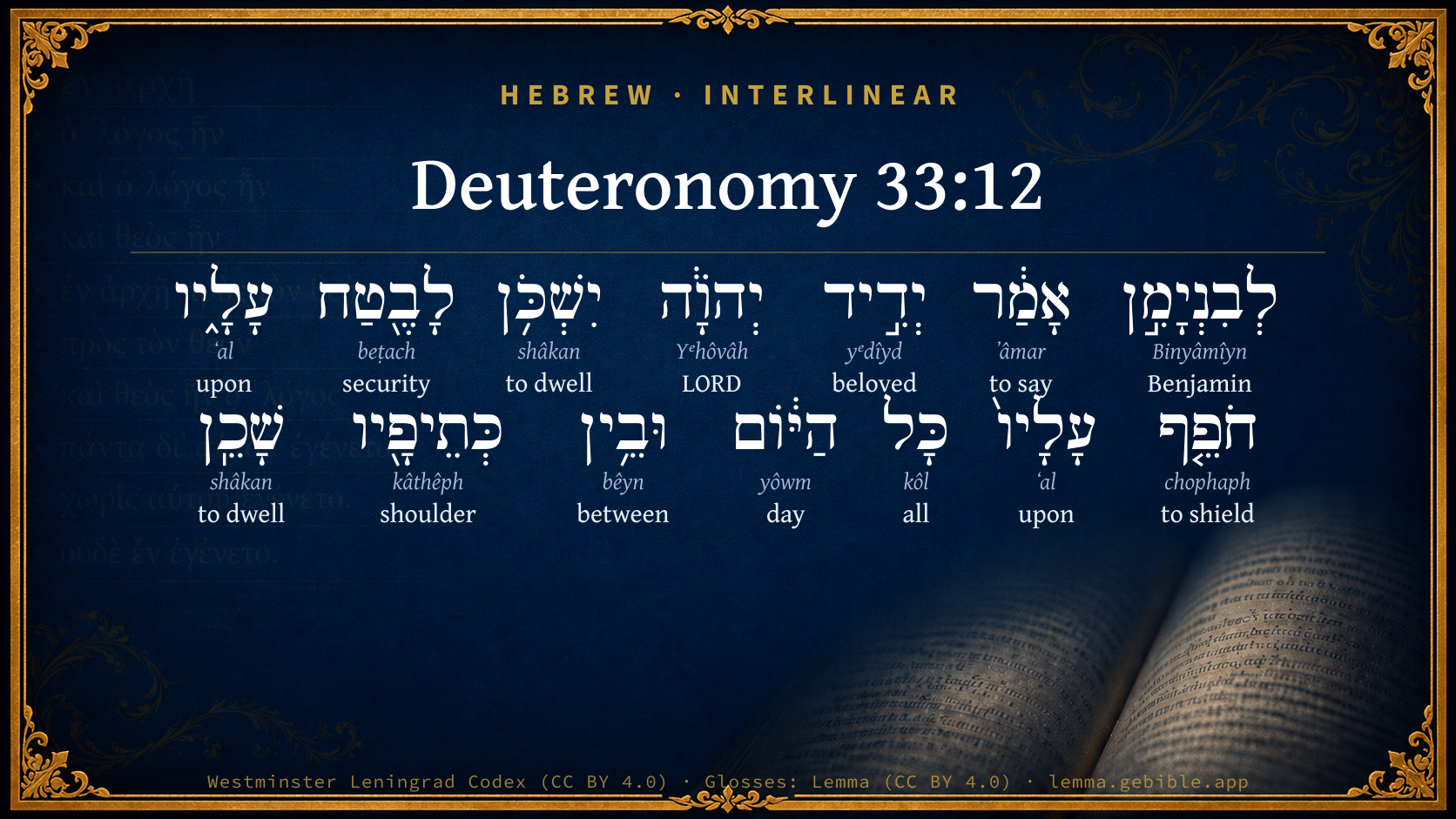
Deuteronomy 33:12

Hebrew (Westminster Leningrad Codex) Deuteronomy 33:12 appears in the Hebrew Old Testament. The text above is from the Westminster Leningrad Codex. Each word links to its Strong’s number, a concise gloss, and parsing drawn from the Open Scriptures Hebrew Bible morphology. Click any word for its full Brown-Driver-Briggs (BDB) entry.
Download image
Cite this verse

Deuteronomy 33:12 (World English Bible). Public Domain. Lemma interlinear Bible study tool, https://lemma.gebible.app/v/deuteronomy/33/12.

Show BibTeX & RIS
BibTeX
RIS
English Translation
Of Benjamin he said, The beloved of Yahweh shall dwell in safety by him; He covers him all the day long, He dwells between his shoulders.
World English Bible · Public Domain
Highlights
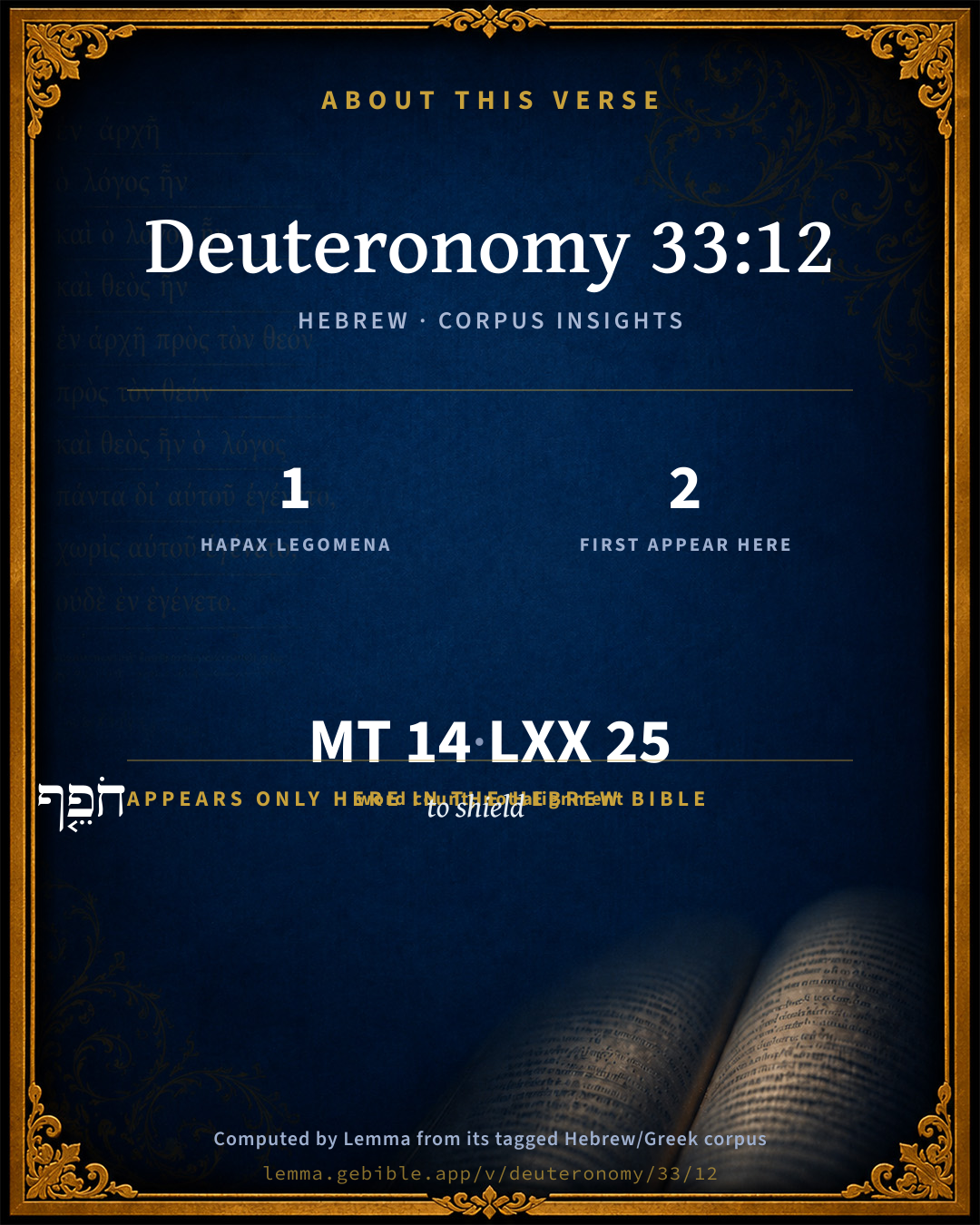
  • 1 hapax legomenon — only here in the Hebrew Bible
  • 2 first appearances in the Hebrew Bible
Full analysis ↓
Download a study sheet

One document with this verse’s original text, its word-by-word gloss line, the meaning frame, cross-references with their text, attributed commentary, and full source and license credits — printable, and it pastes into notes with its structure intact.

This verse Autodidact and up

Study sheet (.html) Plain text (.txt)

A passage Seminary Student

Up to 50 verses in one chapter. A passage sheet keeps up to 6 commentary sources and 12 cross-references per verse, in the order this page ranks them, and says so on the sheet whenever that leaves anything out. Ask for a single verse and you get the Autodidact verse sheet above.

Everything on this page stays free to read, with no account — the sheet is a download of what is already on screen, not access to it.

Want to remove ads? Support Godless Engineer
Compare translations 3

The same verse in 3 English versions, stacked beneath the original-language interlinear above. Click any original word for its lexicon entry.

Each is an independent rendering of the whole verse — the interlinear is not word-aligned to these translations.

Highlighted words mark where these versions differ — a whole-verse word diff, not a word-by-word alignment.

  • World English Bible Public Domain
    Of Benjamin he said, The beloved of Yahweh shall dwell in safety by him; He covers him all the day long, He dwells between his shoulders.
  • King James Version Public Domain
    And of Benjamin he said, The beloved of the LORD shall dwell in safety by him; and the Lord shall cover him all the day long, and he shall dwell between his shoulders.
  • unfoldingWord Literal Text CC BY-SA 4.0
    To Benjamin, he said, “The beloved of Yahweh lives in security beside him. He covers him all the day, and between his shoulders he lives.”

unfoldingWord Literal Text — © unfoldingWord, licensed CC BY-SA 4.0. Word-aligned USFM3 via Door43 (git.door43.org/unfoldingWord/en_ult).

Versions to compare (up to 4)

3 of 4 selected

Show all 18 translations

Every available English version of this verse, each an independent rendering of the whole verse.

  • World English Bible Public Domain
    Of Benjamin he said, The beloved of Yahweh shall dwell in safety by him; He covers him all the day long, He dwells between his shoulders.
  • Berean Standard Bible Public Domain
    Concerning Benjamin he said: “May the beloved of the LORD rest secure in Him; God shields him all day long, and upon His shoulders he rests.”
  • Majority Standard Bible Public Domain
    Concerning Benjamin he said: “May the beloved of the LORD rest secure in Him; God shields him all day long, and upon His shoulders he rests.”
  • King James Version Public Domain
    And of Benjamin he said, The beloved of the LORD shall dwell in safety by him; and the Lord shall cover him all the day long, and he shall dwell between his shoulders.
  • American Standard Version (1901) Public Domain
    Of Benjamin he said, The beloved of Jehovah shall dwell in safety by him; He covereth him all the day long, And he dwelleth between his shoulders.
  • Revised Version (1885) Public Domain
    Of Benjamin he said, The beloved of the LORD shall dwell in safety by him; He covereth him all the day long, And he dwelleth between his shoulders.
  • Geneva Bible (1599) Public Domain
    Of Beniamin he said, The beloued of the Lord shall dwell in safetie by him: the Lord shall couer him all the day long, and dwell betweene his shoulders.
  • Douay-Rheims (1899) Public Domain
    And to Benjamin he said: The best beloved of the Lord shall dwell confidently in him: as in a bride chamber shall he abide all the day long, and between his shoulders shall be rest.
  • Young's Literal Translation Public Domain
    Of Benjamin he said: -- The beloved of Jehovah doth tabernacle confidently by him, Covering him over all the day; Yea, between his shoulders He doth tabernacle.
  • Literal Standard Version CC BY-SA 4.0
    Of Benjamin he said: The beloved of YHWH dwells confidently by Him, || Covering him over every day; Indeed, he dwells between His shoulders.
  • Unlocked Literal Bible CC BY-SA 4.0
    About Benjamin, Moses said: The one loved by Yahweh lives in security beside him; Yahweh shields him all the day long, and he lives between Yahweh's arms.
  • unfoldingWord Literal Text CC BY-SA 4.0
    To Benjamin, he said, “The beloved of Yahweh lives in security beside him. He covers him all the day, and between his shoulders he lives.”
  • Darby Bible Public Domain
    Of Benjamin he said, The beloved of Jehovah, -- he shall dwell in safety by him; He will cover him all the day long, And dwell between his shoulders.
  • World Messianic Bible Public Domain
    About Benjamin he said, “The beloved of the LORD will dwell in safety by him. He covers him all day long. He dwells between his shoulders.”
  • Webster's Bible Public Domain
    And of Benjamin he said, The beloved of the LORD shall dwell in safety by him; and the LORD shall cover him all the day long, and he shall dwell between his shoulders.
  • Free Bible Version CC BY-SA 4.0
    To Benjamin he said: “May the one the Lord loves be kept safe and secure in the Lord. The Lord always protects him, letting him rest on his shoulders.”
  • Bible in Basic English Public Domain
    And of Benjamin he said, Benjamin is the loved one of the Lord, he will be kept safe at all times; he will be covered by the Most High, resting between his arms.
  • JPS Tanakh (1917) Public Domain
    Of Benjamin he said: The beloved of the LORD shall dwell in safety by Him; He covereth him all the day, and He dwelleth between his shoulders.

Literal Standard Version (2020), Covenant Press — licensed CC BY-SA 4.0. Text via the HelloAO Bible API (eBible.org). Unlocked Literal Bible (unfoldingWord) — licensed CC BY-SA 4.0. Text via the HelloAO Bible API (eBible.org). unfoldingWord Literal Text — © unfoldingWord, licensed CC BY-SA 4.0. Word-aligned USFM3 via Door43 (git.door43.org/unfoldingWord/en_ult). Free Bible Version, Dr. Jonathan Gallagher — licensed CC BY-SA 4.0. Text via the HelloAO Bible API (eBible.org).

Word by word

More ways to search: Search by grammar → Find every occurrence → Compare this word →

Practice this passage: Drill this verse → Learn its vocabulary →

חֹפֵ֤ף
chophaph
H2653
“shielding”
Verb, Qal, Participle Active, Masculine, Singular, Absolute
Part of Speech
Verb
Stem
Qal
Form
Participle Active
Gender
Masculine
Number
Singular
State
Absolute
Full BDB Definition

Origin: a primitive root (compare H2645 , H3182 )

TWOT: 710

(Qal) to cover, enclose, shelter, shield, surround
  1. לְבִנְיָמִ֣ן Binyâmîyn H1144 “to/for · Benjamin” Preposition + Noun, Proper
  2. אָמַ֔ר ʼâmar H559 “to say” Verb, Qal, Perfect, 3rd Person, Masculine, Singular
  3. יְדִ֣יד yᵉdîyd H3039 “beloved of” Adjective, Adjective, Masculine, Singular, Construct
  4. יְהֹוָ֔ה Yᵉhôvâh H3068 “LORD” Noun, Proper
  5. יִשְׁכֹּ֥ן shâkan H7931 “to dwell” Verb, Qal, Imperfect, 3rd Person, Masculine, Singular
  6. לָבֶ֖טַח beṭach H983 “to/for · security” Preposition + Noun, Common, Masculine, Singular, Absolute
  7. עָלָ֑יו ʻal H5921 “upon · him” Preposition + Suffix, Personal, 3rd Person, Masculine, Singular
  8. עָלָיו֙ ʻal H5921 “upon · him” Preposition + Suffix, Personal, 3rd Person, Masculine, Singular
  9. כָּל kôl H3605 “all of” Noun, Common, Masculine, Singular, Construct
  10. הַיּ֔וֹם yôwm H3117 “the · day” Particle, Definite Article + Noun, Common, Masculine, Singular, Absolute
  11. וּבֵ֥ין bêyn H996 “and · between” Conjunction + Preposition
  12. כְּתֵיפָ֖יו kâthêph H3802 “shoulders · his” Noun, Common, Feminine, Dual, Construct + Suffix, Personal, 3rd Person, Masculine, Singular
  13. שָׁכֵֽן shâkan H7931 “to dwell” Verb, Qal, Perfect, 3rd Person, Masculine, Singular

About this verse

These counts appear in no published source. They are computed here, from the morphology-tagged text and Lemma’s own curated glosses. What Lemma adds →

14
words
12
distinct lemmas
Pentateuch
section

Notable vocabulary

1 hapax legomenon — a word that appears only here in the entire Hebrew Bible:

  • חֹפֵ֤ף to shield H2653

First appearance in Scripture

These words make their first canonical appearance in the Hebrew Bible here:

  • יְדִ֣יד beloved H3039
  • חֹפֵ֤ף to shield H2653

Shared distinctive vocabulary

יְדִ֣יד beloved H3039 occurs in 8 verses of the Hebrew Bible. Also found in:

Grammatical profile

  • 4 verbs
  • 6 nouns
  • 1 adjective
  • 3 prepositions

Verb forms

  • אָמַ֔ר Qal · Perfect
  • יִשְׁכֹּ֥ן Qal · Imperfect
  • חֹפֵ֤ף Qal · Participle Active
  • שָׁכֵֽן Qal · Perfect

Repetition

Words recur within this verse — often emphatic in Hebrew:

  • יִשְׁכֹּ֥ן to dwell H7931 ×2
  • עָלָ֑יו upon H5921 ×2

Hebrew & Septuagint length

In English translation the verse runs 26 words from the Hebrew and 25 from the Septuagint (LXX English) — closely comparable.

A rough comparison of the two English renderings, which tokenize alike — not a word-level alignment.

Word counts can differ between the Hebrew and the Greek without any difference in meaning — e.g. the Hebrew direct-object marker אֵת has no separate Greek word, and Greek often adds the article ὁ.

In the original languages it is 14 Hebrew tokens and 25 Greek tokens — but the two are counted differently (Hebrew bundles its prefixes and suffixes into one token; the Greek is in lemma form), so that isn’t a like-for-like length.

Cross-references

15

Topical passages linked to Deuteronomy 33:12 in the Treasury of Scripture Knowledge — connected by theme and wording, ordered by reader-vote popularity; previews shown in the World English Bible.

  • 2 Chronicles 15:2 and he went out to meet Asa, and said to him, Hear you me, Asa, and all Judah and Benjamin: Yahweh is with you, while you are with him; and if you seek him, he will be found of you; but if you forsake him, he will forsake you.
  • Psalms 91:4 He will cover you with his feathers. Under his wings you will take refuge. His faithfulness is your shield and rampart.
  • Matthew 23:37 "Jerusalem, Jerusalem, who kills the prophets, and stones those who are sent to her! How often would I have gathered your children together, even as a hen gathers her chickens under her wings, and you would not!
  • Isaiah 51:16 I have put my words in your mouth, and have covered you in the shadow of my hand, that I may plant the heavens, and lay the foundations of the earth, and tell Zion, You are my people.
  • Deuteronomy 12:10 But when you go over the Jordan, and dwell in the land which Yahweh your God causes you to inherit, and he gives you rest from all your enemies round about, so that you dwell in safety;
  • 1 Kings 12:21 When Rehoboam was come to Jerusalem, he assembled all the house of Judah, and the tribe of Benjamin, a hundred and eighty thousand chosen men, who were warriors, to fight against the house of Israel, to bring the kingdom again to Rehoboam the son of Solomon.
  • 2 Chronicles 11:1 When Rehoboam was come to Jerusalem, he assembled the house of Judah and Benjamin, one hundred eighty thousand chosen men, who were warriors, to fight against Israel, to bring the kingdom again to Rehoboam.
  • 2 Chronicles 17:17–19 Of Benjamin: Eliada a mighty man of valor, and with him two hundred thousand armed with bow and shield;
  • Isaiah 37:22 this is the word which Yahweh has spoken concerning him: The virgin daughter of Zion has despised you and ridiculed you; the daughter of Jerusalem has shaken her head at you.
  • Isaiah 37:35 For I will defend this city to save it, for my own sake, and for my servant David's sake.
  • Exodus 28:12 You shall put the two stones on the shoulder-pieces of the ephod, to be stones of memorial for the children of Israel: and Aaron shall bear their names before Yahweh on his two shoulders for a memorial.
  • Deuteronomy 33:27–29 The eternal God is [your] dwelling-place, Underneath are the everlasting arms. He thrust out the enemy from before you, Said, Destroy.
  • Judges 1:21 The children of Benjamin did not drive out the Jebusites who inhabited Jerusalem; but the Jebusites dwell with the children of Benjamin in Jerusalem to this day.
  • Psalms 132:14 "This is my resting place forever. Here I will live, for I have desired it.
  • Joshua 18:11–28 The lot of the tribe of the children of Benjamin came up according to their families: and the border of their lot went out between the children of Judah and the children of Joseph.

Cross-references courtesy of OpenBible.info (CC BY 4.0).

Hebrew and Greek witnesses Masoretic Hebrew ↔ Greek Septuagint

The same verse in the two great witnesses to the Old Testament, shown verse-for-verse.

These are two independent witnesses, not word-aligned to each other, and the Septuagint is shown in lemma (dictionary) form.

Hebrew Deuteronomy 33:12 Masoretic · Westminster Leningrad Codex

לְבִנְיָמִ֣ן אָמַ֔ר יְדִ֣יד יְהֹוָ֔ה יִשְׁכֹּ֥ן לָבֶ֖טַח עָלָ֑יו חֹפֵ֤ף עָלָיו֙ כָּל הַיּ֔וֹם וּבֵ֥ין כְּתֵיפָ֖יו שָׁכֵֽן

Of Benjamin he said, The beloved of Yahweh shall dwell in safety by him; He covers him all the day long, He dwells between his shoulders.

World English Bible · Public Domain

Greek LXX Deuteronomy 33:12 Septuagint · lemma form

καί ὁ βενιαμίν εἶπον ἀγαπάω ὑπό κύριος κατασκηνόω πείθω καί ὁ θεός σκιάζω ἐπί αὐτός πᾶς ὁ ἡμέρα καί ἀνά μέσος ὁ ὦμος αὐτός καταπαύω

And to Benjamin he said, The beloved of the Lord shall dwell in confidence, and God overshadows him always, and he rested between his shoulders.

LXX2012 (modern English Septuagint) · Public Domain

On this verse, The Cambridge Bible for Schools and Colleges discusses the Septuagint’s reading. Read the note in Commentary ↓

Hebrew: Westminster Leningrad Codex (CC BY 4.0). Greek: Septuagint (public domain); English from LXX2012 (modern English Septuagint) (Public Domain). How the Septuagint differs from the Hebrew →

Targum (Aramaic paraphrase)

2

The Targum is the ancient Jewish Aramaic paraphrase of the Hebrew Scriptures — an interpretive translation, not the Hebrew text itself. Onkelos (literal) and Pseudo-Jonathan (expansive) render the Torah, and Jonathan the Prophets. Coverage is partial: where no permissively-licensed English translation exists for a verse, only the Aramaic is shown. This is verse-level text, not a word-by-word alignment to the Hebrew.

  1. Targum Onkelos Torah (Genesis–Deuteronomy)
    לְבִנְיָמִן אֲמַר רְחִימָא דַיְיָ יִשְׁרֵי לְרָחְצַן עֲלוֹהִי יְהֵי מָגֵן עֲלוֹהִי כָּל יוֹמַיָא וּבְאַרְעֵהּ תִּשְׁרֵי שְׁכִנְתָּא

    (no public-domain English translation for this verse)

    Targum Onkelos — Aramaic: “Onkelos Genesis” (public domain); “Onkelos Exodus” (public domain); “Onkelos Leviticus” (public domain); “Onkelos Numbers” (public domain); “Onkelos Deuteronomy” (public domain). English: “Sefaria Community Translation” (CC0 1.0 (public-domain dedication)); “J.W. Etheridge. The Targums of Onkelos and Jonathan Ben Uzziel on the Pentateuch. London: Longmans, Green, 1862” (public domain). Text via Sefaria.

  2. Targum Pseudo-Jonathan Torah (Genesis–Deuteronomy)
    לְשִׁבְטָא דְבִנְיָמִין בְּרִיךְ משֶׁה נְבִיָא וַאֲמַר חֲבִיבֵיהּ דַיְיָ יִשְׁרֵי לְרוֹחֲצָן עֲלוֹי יְהֵי מֵגִין עֲלוֹי כָּל יוֹמַיָא וּבְגוֹ תְּחוּמֵיהּ שְׁכִינְתֵּיהּ שַׁרְיָא

    Mosheh the prophet blessed the tribe of Benjamin, and said: The beloved of the Lord shall abide in safety with Him, He will protect him all the days, and His Shekinah will dwell within his borders.

    Targum Pseudo-Jonathan — Aramaic: “Targum Jonathan on Genesis” (public domain); “Targum Jonathan on Exodus” (public domain); “Targum Jonathan on Leviticus” (public domain); “Targum Jonathan on Numbers” (public domain); “Targum Jonathan on Deuteronomy” (public domain). English: “The Targum of Jonathan ben Uzziel, trans. J. W. Etheridge, London, 1862” (public domain). Text via Sefaria.

Commentary

Notes on Deuteronomy 33:12 from classic Christian and Jewish commentators (each source and its license shown beneath its notes). The classic Christian expositions comment on the surrounding passage and are grouped to its opening verse, so a note may address several verses; the Jewish commentaries on the Tanakh (Rashi and others) are per-verse, so they appear only where the commentator wrote on this verse.

Lemma curates 59 commentaries, every one of them public domain or Creative Commons licensed, each selected and text-cleaned for this edition rather than reprinted as found. About our sources →

Matthew Henry's Commentary

Here is, I. The blessing of Benjamin, Deu 33:12. Benjamin is put next to Levi, because the temple, where the priests' work lay, was just upon the edge of the lot of this tribe; and it is put before Joseph because of the dignity of Jerusalem (part of which was in this tribe) above Samaria, which was in the tribe of Ephraim, and because Benjamin adhered to the house of David, and to the temple of the Lord, when the rest of the tribes deserted both with Jeroboam. 1. Benjamin is here called the beloved of the Lord, and the father of this tribe was Jacob's beloved son, the son of his right hand. Note, Those are blessed indeed that are beloved of the Lord. Saul the first king, and Paul the great apostle, were both of this tribe. 2. He is here assured of the divine protection: he shall dwell safely. Note, Those are safe whom God loves, Psa 91:1. 3. It is here intimated that the temple in which God would dwell should be built in the borders of this tribe. Jerusalem the holy city was in the lot of this tribe (Jos 18:28); and though Zion, the city of David, is supposed to belong to Judah, yet Mount Moriah, on which the temple was built, was in Benjamin's lot. God is therefore said to dwell between his shoulders, because the temple stood on that mount, as the head of a man upon his shoulders. And by this means Benjamin was covered all the day long under the protection of the sanctuary (Psa 125:2), which is often spoken of as a place of refuge, Psa 27:4, Psa 27:5; Neh 6:10. Benjamin, dwelling by the temple of God, dwelt in safety by him. Note, It is a happy thing to be in the neighbourhood of the temple. This situation of Benjamin, it is likely, was the only thing that kept that tribe in adherence with Judah to the divine institutions, when the other ten tribes apostatized. Those have corrupt and wicked hearts indeed who, the nearer they are to the church, are so much the further from God.

II. The blessing of Joseph, including both Manasseh and Ephraim. In Jacob's blessing (Gen. 49) that of Joseph is the largest, and so it is here; and thence Moses here borrows the title he gives to Joseph (Deu 33:16), that he was separated from his brethren, or, as it might be read, a Nazarite among them, both in regard of his piety, wherein it appears, by many instances, he excelled them all, and of his dignity in Egypt, where he was both their ruler and benefactor. His brethren separated him from them by making him a slave, but God distinguished him from them by making him a prince. Now the blessings here prayed for, and prophesied of, for this tribe, are great plenty and great power.

1. Great plenty, Deu 33:13-16. In general: Blessed of the Lord be his land. Those were very fruitful countries that fell into the lot of Ephraim and Manasseh, yet Moses prays they might be watered with the blessing of God, which makes rich, and on which all fruitfulness depends. Now,

(1.) He enumerates many particulars which he prays may contribute to the wealth and abundance of those two tribes, looking up to the Creator for the benefit and serviceableness of all the inferior creatures, for they are all that to us which he makes them to be. He prays, [1.] For seasonable rains and dews, the precious things of heaven; and so precious they are, though but pure water, that without them the fruits of the earth would all fail and be cut off. [2.] For plentiful springs, which help to make the earth fruitful, called here the deep that coucheth beneath; both are the rivers of God (Psa 65:9), and he made particularly the fountains of waters, Rev 14:7. [3.] For the benign influences of the heavenly bodies (Deu 33:14), for the precious fruits (the word signifies that which is most excellent, and the best in its kind) put forth by the quickening heat of the sun, and the cooling moisture of the moon. "Let them have the yearly fruits in their several months, according to the course of nature, in one month olives, in another dates," etc. So some understand it. [4.] For the fruitfulness even of their hills and mountains, which in other countries used to be barren (Deu 33:15): Let them have the chief things of the ancient mountains; and, if the mountains be fruitful, the fruits on them will be first and best ripened. They are called ancient mountains, not because prior in time to other mountains, but because , like the first-born, they were superior in worth and excellency; and lasting hills, not only because as other mountains they were immovable (Hab 3:6), but because the fruitfulness of them should continue. [5.] For the productions of the lower grounds (Deu 33:16): For the precious things of the earth. Though the earth itself seems a useless worthless lump of matter, yet there are precious things produced out of it, for the support and comfort of human life. Job 28:5. Out of it cometh bread, because out of it came our bodies, and to it they must return. But what are the precious things of the earth to a soul that came from God and must return to him? Or what is its fulness to the fulness that is in Christ, whence we receive grace for grace? Some make these precious things here prayed for to be figures of spiritual blessings in heavenly things by Christ, the gifts, graces, and comforts of the Spirit.

(2.) He crowns all with the good-will, or favourable acceptance, of him that dwelt in the bush (Deu 33:16), that is, of God, that God who appeared to Moses in the bush that burned and was not consumed (Exo 3:2), to give him his commission for the bringing of Israel out of Egypt. Though God's glory appeared there but for a while, yet it is said to dwell there, because it continued as long as there was occasion for it: the good-will of the shechinah in the bush; so it might be read, for shechinah signifies that which dwelleth; and, though it was but a little while a dweller in the bush, yet it continued to dwell with the people of Israel. My dweller in the bush; so it should be rendered; that was an appearance of the divine Majesty to Moses only, in token of the particular interest he had in God, which he desires to improve for the good of this tribe. Many a time God has appeared to Moses, but now that he is just dying he seems to have the most pleasing remembrance of that which was the first time, when his acquaintance with the visions of the Almighty first began, and his correspondence with heaven was first settled: that was a time of love never to be forgotten. It was at the bush that God declared himself the God of Abraham, Isaac, and Jacob, and so confirmed the promise made to the fathers, that promise which reached as far as the resurrection of the body and eternal life, as appears by our Saviour's argument from it, Luk 20:37. So that, when he prays for the good-will of him that dwelt in the bush, he has an eye to the covenant then and there renewed, on which all our hopes of God's favour must be bottomed. Now he concludes this large blessing with a prayer for the favour or good-will of God, [1.] Because that is the fountain and spring-head of all these blessings; they are gifts of God's good-will; they are so to his own people, whatever they are to others. Indeed when Ephraim (a descendant from Joseph) slid back from God, as a backsliding heifer, those fruits of his country were so far from being the gifts of God's good-will that they were intended but to fatten him for the slaughter, as a lamb in a large place, Hos 4:16, Hos 4:17. [2.] Because that is the comfort and sweetness of all these blessings; then we have joy of them when we taste God's good-will in them. [3.] Because that is better than all these, infinitely better; for if we have but the favour and good-will of God we are happy, and may be easy in the want of all these things, and may rejoice in the God of our salvation though the fig-tree do not blossom, and there be no fruit in the vine, Hab 3:17, Hab 3:18.

2. Great power Joseph is here blessed with, Deu 33:17. Here are three instances of his power foretold: (1.) His authority among his brethren: His glory is like the firstling of his bullock, or young bull, which is a stately creature, and therefore was formerly used as an emblem of royal majesty. Joshua, who was to succeed Moses, was of the tribe of Ephraim the son of Joseph, and his glory was indeed illustrious, and he was an honour to his tribe. In Ephraim was the royal city of the ten tribes afterwards. And of Manasseh were Gideon, Jephthah, and Jair, who were all ornaments and blessings to their country. Some think he is compared to the firstling of the bullock because the birthright which Reuben lost devolved upon Joseph (Ch1 5:1, Ch1 5:2), and to the firstling of his bullock, because Bashan, which was in the lot of Manasseh, was famous for bulls and cows, Psa 22:12; Amo 4:1. (2.) His force against his enemies and victory over them: His horns are like the horn of a unicorn, that is, "The forces he shall bring into the field shall be very strong and formidable, and with them he shall push the people," that is, "He shall overcome all that stand in his way." It appears from the Ephraimites' contests, both with Gideon (Jdg 8:1) and with Jephthah (Jdg 12:1), that they were a warlike tribe and fierce. Yet we find the children of Ephraim, when they had forsaken the covenant of God, though they were armed, turning back in the day of battle (Psa 78:9, Psa 78:10); for, though here pronounced strong and bold as unicorns, when God had departed from them they became as weak as other men. (3.) The numbers of his people, in which Ephraim, though the younger house, exceeded, Jacob having, in the foresight of the same thing, crossed hands, Gen 48:19. They are the ten thousands of Ephraim, and the thousands of Manasseh. Jonathan's Targum applies it to the ten thousands of Canaanites conquered by Joshua, who was of the tribe of Manasseh. And the gloss of the Jerusalem Targum upon the former part of this verse is observable, that "as the firstlings of the bullock were never to be worked, nor could the unicorn ever be tamed, so Joseph should continue free; and they would have continued free if they had not by sin sold themselves."

Matthew Henry's Commentary on the Whole Bible (1708–1710) — public domain (CC PDM 1.0). Text via the HelloAO Bible API.

Trapp's Complete Commentary

John Trapp

Deu 33:12 [And] of Benjamin he said, The beloved of the LORD shall dwell in safety by him; [and the LORD] shall cover him all the day long, and he shall dwell between his shoulders.

Ver. 12. The beloved of the Lord.] The Lord’s corculum, deliciae, darling; as their father Benjamin was old Jacob’s. {Gen 42:4}

And he shall dwell between his shoulders.] These shoulders are those two holy hills, Moriah and Zion, whereon the Temple was built, four hundred and forty years after this prophecy.

John Trapp, A Commentary or Exposition upon All the Books of the Old and New Testament (1647–1656) — public domain. Text from a community e-Sword module.

The Biblical Illustrator

Joseph S. Exell

Deu_33:12

Of Benjamin he said, The beloved of the Lord shall dwell in safety by Him.

The safety of the Lords beloved

I. He was the special object of the Divine affection. God especially loves His spiritual children with a love of--

1. Approbation.

2. Manifestation.

3. Distinction.

II. He was to dwell near to the Lord.

1. By grace.

2. In providence.

3. In reference to His ordinances.

4. With regard to the prevailing impressions of the mind.

III. He was to abide in perfect security. Gods chosen dwell in safety from--

1. The curses of the Divine law.

2. The powers of darkness.

3. The perils of life.

4. The terrors of death and the judgment day. (J. Burns, D. D.)

Benjamin

The blessing of the tribes by Moses consisted largely in a prophetic foreshadowing of the lots which these tribes were severally to occupy in the conquered territory of Canaan. The first distinct example of this fact meets us in the case of Benjamin, who, although he was the youngest of all the sons of Jacob, stands fourth in this significant enumeration which the man of God was inspired to make before his death. It has been suggested that the spirit of prophecy caused Moses to look far beyond the merely temporal aspect of the history of Israel, and to recognise its typical relations with the spiritual kingdom of Messiah; and that the peculiar arrangement of the names was partly meant to indicate certain of these hidden mysteries. Such an opinion would be fully confirmed by a review of the order in which the tribes have been marshalled thus far. Reuben is mentioned first, not so much by courtesy and in remembrance of his birthright, as to mark with emphasis the mournful lessons of his fall. The real leader and head of Israel is Judah, and the blessing makes haste to rest on him with the first of its utterances in which no ambiguity lies. But the royal destinies of Judah are incomplete if separated from the priestly destinies of Levi. Messiah, that seed for whose sake Abraham, Isaac, and Jacob had received their divine election, was to be a priest upon his throne; and therefore the blessing of the third son is made by Moses to follow immediately upon the blessing of his sceptred brother. So the keynote of the entire prediction is struck in a spiritual rather than in a temporal sense; remembering which fact, we cease to wonder at finding the name of Benjamin next in the enumeration to that of Levi. For the local centre of Jehovahs spiritual kingdom in Israel was fixed in the lot of Benjamin. The famous temple of Solomon was built upon the hill between the city of David and the Mount of Olives; and was wholly in the territory of Benjamin, though, according to the Rabbins, a part of its outer courts fell within the lot of Judah. This fact furnishes the most exact and beautiful explanation of all the peculiar expressions which meet us in Benjamins blessing. For the God and King of Israel may be said literally to have thus dwelt between the two mountain ridges which formed the extremity of the lot of this tribe, and Benjamin dwelt alongside the holy spot; not around it, but stretching out from it as from the point where his safety and honour had their origin; all which is implied in the preposition which Moses uses when he says, The beloved of the Lord shall dwell in safety by Him. Further, the phrase, He will cover him all the day long, may very fairly be taken as referring to the cloud of glory which was inseparably associated with the earthly dwelling place of Jehovah, and which in the wilderness had been spread for a covering over all the tribes. That sign of the Divine protection was now to rest specially over Benjamin; and beneath the shadow of the Almighty he was to abide securely day and night. The history of the tribe of Benjamin from the time when the Temple was built upon his frontier hill of Moriah yields a very complete commentary upon the splendid promise of his blessing. This member of the Hebrew commonwealth did dwell in safety that was all the more noteworthy by contrast with the calamities which befell not only the tribes which cast in their lot with Ephraim, but also the outlying portions of the kingdom of Judah. A kind of charmed circle of peace and security was drawn around the towers of Salem, and all the land of Benjamin seemed to be within that happy region. Egypt might come up against Israel from the south, and Syria might invade his territory from the north; the tents of Edom and the Ishmaelites, Moab and the Hagarenes, might be confederate to assault it from the east; and these hostile floods more than once filled all the breadth of Immanuels land; but the tableland of Benjamin was ever the last to be overflowed, and often escaped even the spray of the angry tide. The spiritual application of this blessing must be self-evident to everyone who has received the assurance of Gods love toward himself in Jesus Christ. The Christian has joined himself to the Lords anointed King, even as Benjamin chose to unite his lot with Judah, and to acknowledge the right of Davids house to rule over him. He has accepted Christ to be his head, and has prepared Him a dwelling place in a nobler house than that of Moriah, even in his own renewed and adoring heart. Therefore does the Spirit of Christ bear witness to him of his adoption as Gods well-beloved child. He has found a dwelling place under the shadow of the Almighty; Jehovahs truth has become his shield and buckler. (T. G. Rooke, B. A.)

Benjamin as a figure of the true Church

1. In his birth--hard travail, sorrow, pain, and death, preceded and accompanied his birth. So in the spiritual birth, in the regeneration of the soul, there is great pain, sorrow, and anguish of mind, and even the death of all self-righteousness and legal hope in bringing the soul to spiritual birth.

2. In his name. The believer, in his moments of conviction, humiliation, and sorrow for sin, calls himself Benoni, the son of sorrow, but the Lord calls him Benjamin, the son of my right hand; witness Ephraim bemoaning himself, and the Lords declaration concerning him (Jer_31:18; Jer_31:20).

3. In the description given of him, the beloved of the Lord; loved from eternity, freely, indissolubly, everlastingly.

4. In his security. He shall dwell in safety by Him, or through His protecting hand and power; in battle the Lord shall cover him, as a hen covereth her chickens--as with a shield, and he shall dwell, his resting place shall be, between the shoulders, in the heart of his covenant God. (A. Hewlett, M. A.)

Safety near God

1. There is no safety like that which comes of dwelling near to God. For His best beloved the Lord can find no surer or safer place. O Lord, let me always abide under Thy shadow, close to Thy wounded side. Nearer and nearer would I come to Thee; and when once specially near Thee, I would abide there forever.

2. What a covering is that which the Lord gives to His chosen! Not a fair roof shall cover him, nor a bomb-proof casement, nor even an angels wing, but Jehovah Himself. Nothing can come at us when we are thus covered. This covering the Lord will grant us all the day long, however long the day. Lord, let me abide this day consciously beneath this canopy of love, this pavilion of sovereign power.

3. Does the third clause mean that the Lord in His temple would dwell among the mountains of Benjamin, or that the Lord would be where Benjamins burden should be placed, or that we are borne upon the shoulders of the Eternal? In any ease, the Lord is the support and strength of His saints. Lord, let me ever enjoy Thy help, and then my arms will be sufficient for me. (C. H. Spurgeon.)

The Biblical Illustrator, edited by Joseph S. Exell (c. 1880s–1900s) — public domain. Text from a community e-Sword module.

Joseph Benson's Commentary

Deu 33:12. Of Benjamin — Benjamin is put next to Levi, because the temple, where the work of the Levites lay, was upon the edge of the lot of this tribe. And it is put before Joseph, because of the dignity of Jerusalem (part of which was in this lot) above Samaria, which was in the tribe of Ephraim; likewise because Benjamin adhered to the house of David, and to the temple of God, when the rest of the tribes deserted both. The beloved of the Lord — So called in allusion to their father Benjamin, who was the beloved of his father Jacob; and because of the kindness of God to this tribe, which appeared both in this, that they dwelt in the best part of the land, as Josephus affirms, and in the following privilege. Shall dwell in safety by him — Shall have his lot nigh to God’s temple, which was both a singular comfort and safeguard to him. Shall cover — Shall protect that tribe continually while they cleave to him. He — The Lord; shall dwell — That is, his temple shall be placed; between his shoulders — That is, in his portion, or between his borders, as the word rendered shoulder is often used: see Num 24:11. And this was truly the situation of the temple, on both sides whereof was Benjamin’s portion. And though mount Sion was in the tribe of Judah, yet mount Moriah, on which the temple was built, was in the tribe of Benjamin.

Joseph Benson's Commentary on the Old and New Testaments (1811–1818) — public domain. Text from a community e-Sword module.

MacLaren's Expositions of Holy Scripture

Alexander MacLaren

Deuteronomy

ISRAEL THE BELOVED

Deu 33:12.

Benjamin was his father’s favourite child, and the imagery of this promise is throughout drawn from the relations between such a child and its father. So far as the future history of the tribes is shadowed in these ‘blessings’ of this great ode, the reference of the text may be to the tribe of Benjamin, as specially distinguished by Saul having been a member of it, and by the Temple having been built on its soil. But we find that each of the promises of the text is repeated elsewhere, with distinct reference to the whole nation. For example, the first one, of safe dwelling, reappears in Deu 33:28 in reference to Israel; the second one, of God’s protecting covering, is extended to the nation in many places; and the third, of dwelling between His shoulders, is in substance found again in Deu 1:31, ‘the Lord thy God bare thee, as a man doth bear his son.’ So that we may give the text a wider extension, and take it as setting forth under a lovely metaphor, and with a restricted reference, what is true of all God’s children everywhere and always.

I. Who are the ‘beloved of the Lord’?

The first answer to that question must be-all men. But these great blessings, so beautifully shadowed in this text, do not belong to all men; nor does the designation, ‘the beloved of the Lord,’ belong to all men, but to those who have entered into a special relation to Him. In these words of the Hebrew singer there sound the first faint tones of a music that was to swell into clear notes, when Jesus said: ‘If a man love Me, he will keep My Word, and My Father will love him, and We will come unto him, and make Our abode with him.’ They who are knit by faith and love to God’s only-begotten and beloved Son, by that union receive ‘power to become the sons of God,’ and share in the love which is ever pouring out from the Father’s heart on ‘the Son of His love.’

II. What are their blessed privileges?

The three clauses of the text express substantially the same idea, but with a striking variety of metaphors.

1. They have a sure dwelling-place.

There is a very slight change of rendering of the first clause, which greatly increases its ‘force, and preserves the figure that is obscured by the usual translation. We should read ‘shall dwell safely on,’ rather than ‘by, Him.’ And the effect of that small change in the preposition is to bring out the thought that God is regarded as the foundation on which His beloved build their house of life, and dwell in security and calm. If we are sons through the Son, we shall build our houses or pitch our tents on that firm ground, and, being founded on the Rock of ages, they will not fall when all created foundations reel to the overthrow of whatever is built on them. It is not companionship only, blessed as that is, that is promised here. We have a larger privilege than dwelling by Him, for if we love His Son, we build on God, and ‘God dwelleth in us and we in Him.’

What spiritual reality underlies the metaphor of dwelling or building on God? The fact of habitual communion.

Note the blessed results of such grounding of our lives on God through such habitual communion. We shall ‘dwell safely.’ We may think of that as being objective safety-that is, freedom from peril, or as being subjective-that is, freedom from care or fear, or as meaning ‘trustfully,’ confidently, as the expression is rendered in Psa 16:9 {margin}, which is for us the ground of both these. He who dwells in God trustfully dwells both safely and securely, and none else is free either from danger or from dread.

2. They have a sure shelter.

God is for His beloved not only the foundation on which they dwell in safety, but their perpetual covering. They dwell safely because He is so. There are many tender shapes in which this great promise is presented to our faith. Sometimes God is thought of as covering the weak fugitive, as the arching sides of His cave sheltered David from Saul. Sometimes He is represented as covering His beloved, who cower under His wings, ‘as the hen gathereth her chickens’ when hawks are in the sky. Sometimes He appears as covering them from tempest, ‘when the blast of the terrible ones is as a storm against the wall,’ and ‘the shadow of a great rock’ shields from its fury. Sometimes He is pictured as stretching out protection over His beloved’s heads, as the Pillar of cloud lay, long-drawn-out, over the Tabernacle when at rest, and ‘on all the Glory was a defence.’ But under whatever emblem the general idea of a covering shelter was conceived, there was always a correlative duty on our side. For the root-meaning of one of the Old Testament words for ‘faith’ is ‘fleeing to a refuge,’ and we shall not be safe in God unless by faith we flee for refuge to Him in Christ.

3. They have a Father who bears them on His shoulders.

The image is the same as in Deu 1:1 - Deu 1:46 already referred to. It recurs also in Isa 46:3 - Isa 46:4, ‘Even to hoar hairs will I carry you, and I have made and I will bear, yea, I will carry, and will deliver’; and in Hos 11:3, ‘I taught Ephraim to go; I took them on My arms.’

The image beautifully suggests the thought of the favourite child riding high and happy on the strong shoulder, which lifts it above rough places and miry ways. The prose reality is: ‘My grace is sufficient for thee, for My strength is made perfect in weakness.’

The Cross carries those who carry it. They who carry God in their hearts are carried by God through all the long pilgrimage of life. Because they are thus upheld by a strength not their own, ‘they shall run and not be weary, they shall walk and not faint,’ and though marches be long and limbs strained, they shall ‘go from strength to strength till every one of them appears before God in Zion.’

Alexander MacLaren, Expositions of Holy Scripture (1904–1910) — public domain. Text from a community e-Sword module.

Tyndale Open Study Notes

Tyndale Open Resources

33:12 Benjamin was Jacob’s youngest son (Gen 35:18; 49:27). Because Rachel was Jacob’s favorite wife, Benjamin was also favored. His tribe was blessed by the Lord’s special protection.

Tyndale Open Study Notes — © Tyndale Open Resources, licensed CC BY-SA 4.0. Text via the HelloAO Bible API.

Geneva Bible (1599)

Geneva Bible translators

Because the Temple should be built in Zion, which was in the tribe of Benjamin, he showeth that God should dwell with him there.

Geneva Bible (1599) marginal notes — public domain. Text via Bolls.life.

Jamieson, Fausset & Brown

Robert Jamieson, A. R. Fausset & David Brown

of Benjamin he said--A distinguishing favor was conferred on this tribe in having its portion assigned near the temple of God.

between his shoulders--that is, on his sides or borders. Mount Zion, on which stood the city of Jerusalem, belonged to Judah; but Mount Moriah, the site of the sacred edifice, lay in the confines of Benjamin.

Jamieson, Fausset & Brown — Commentary Critical and Explanatory on the Whole Bible (1871) — public domain (CC PDM 1.0). Text via the HelloAO Bible API.

Adam Clarke's Commentary

Verse 12. Of Benjamin - the beloved of the Lord] Alluding to his being particularly beloved of his father Jacob, Ge 49:27, c.

Shall dwell in safety by him] That is, by the Lord, whose temple, which is considered as his dwelling-place, was in the tribe of Benjamin, for a part of Jerusalem belonged to this tribe.

Shall cover him all the day] Be his continual protector and he shall dwell between his shoulders - within his coasts, or in his chief city, viz., Jerusalem, where the temple of God was built, on his mountains Zion and Moriah, here poetically termed his shoulders.

Some object to our translation of the Hebrew ידיד yedid by the term beloved, and think the original should be divided as it is in the Samaritan, יד יד yad yad, the hand, even the hand of the Lord shall dwell for safety or protection, עליו alaiv, upon him. This makes a good sense, and the reader may choose.

Adam Clarke's Commentary on the Bible (1810–1826) — public domain. Text from a community e-Sword/MySword module.

Ellicott's Commentary for English Readers

(12) And of Benjamin.—It is generally agreed that this blessing points to the site of the place which Jehovah chose out of all the tribes of Israel, Jerusalem, in the tribe of Benjamin. The Hebrew is divided thus:—

“Unto Benjamin he said. Beloved of Jehovah!

He (Jehovah) will dwell in security upon him,

Covering him over all the day.

And between his shoulders (mountain slopes) He

hath taken up His abode.”

A Bible Commentary for English Readers, edited by Charles John Ellicott (1878–1897) — public domain. Text from a community e-Sword module.

The Cambridge Bible for Schools and Colleges

gen. ed. J. J. S. Perowne

12. a place] Heb. hand, of Jabbok-side in Deu_2:37, a man’s place in the ranks, Num_2:17 (cp. Jer_6:3). Here perhaps a place aside.

12 And of Benjamin he said:—

[Benjamin (?)] beloved of the Lord,

He dwelleth securely always (?).

The Highest is a covert above him,

And dwelleth between his shoulders.

As the overloaded first line of the Heb., the want of a fourth line and the variants of the versions indicate, the text is probably corrupt. The above re-arrangement in a quatrain, though finding some support from the versions, is precarious like every emendation which rests mainly on efforts to regularise the rhythm.—The picture here given is very different from that in Gen_49:27, which reflects the valiant and even savage qualities of the tribe as described in Jdg_3:15 f., Jdg_5:14; Jdg_5:19, Jdg_20:21-25, while this reflects its religious privileges under the (divided) monarchy. (See Ryle.)

12. The beloved of the Lord] Heb. yedîd Yahweh; cp. Yedidiah of Solomon, 2Sa_12:25. Of all Israel, Jer_11:15.

dwell in safety] Cp. Deu_33:28, Deu_12:10. Above always (Heb. all the day) is (with some scholars) brought here from the next line.

by him] Heb. ‘alaw, more accurately upon him but superfluous both to the sense (and if three lines are read) to the metre; not found in Sam. or LXX; and so either a careless anticipation of ‘alaw in the next line, or to be read as the LXX apparently have done (for they introduce ὁ θεός at the beginning of the next line) ‘elyôn = the Most High. So Herder, Geddes, etc.

his shoulders] The ridges of Benjamin’s territory: cp. Jos_15:8; Jos_18:13. Since P, Jos_15:7; Jos_18:15 f., Jos_18:28, reckons Jerusalem as in Benjamin (while J, Jos_15:63 assigns it to Judah) this line has been interpreted as referring to the Temple. But in what is evidently a poem of N. Israel the reference is probably to Beth-el.

The Cambridge Bible for Schools and Colleges (gen. ed. J. J. S. Perowne; Cambridge University Press, 1878–1918) — public domain. Text from a community e-Sword module.

John Gill's Exposition

And of Joseph he said,.... The tribe of Joseph, as the Targums of Jonathan and Jerusalem:

blessed of the Lord be his land; as the lands inherited by his sons were extremely fruitful, the countries of lead and Bashan by Manasseh, and the fields of Samaria by Ephraim: Jarchi says,"there was not in the inheritance of the tribes a land so full of all good things as the land of Joseph;''typical of the church of Christ, the antitypical Joseph, which abounds with all good things through him, or of the better country in heaven:

for the precious things of heaven; that is, the pleasant, precious, and excellent fruits, reproduced by the influence of the heavens, particularly showers of rain which descend from thence; emblems of the grace of God, and Gospel of Christ, which bring spiritual blessings to the sons of men on earth, and make them fruitful in every good word and work: for the dew; which descends also from heaven, and is of unspeakable use to the fruits of the earth, and is sometimes used as an emblem of the favour and goodness of God to his people, Hos 14:5,

and for the deep that coucheth beneath; that is, beneath the earth, and breaks out upon it, and waters it, and makes it fruitful, which happiness the land of Joseph had, as well as the rain and dew of heaven: this is to be understood of springs and fountains that flow out of the earth to the enriching of it; and so the Targums of Jonathan and Jerusalem paraphrase the words, and may be applied to Christ and to his Gospel, Sol 4:15.

John Gill's Exposition of the Whole Bible (1746–1763) — public domain (CC PDM 1.0). Text via the HelloAO Bible API.

Albert Barnes' Notes on the Bible

He shall dwell between his shoulders - i. e., be supported by God as a son who is carried by his father (compare Deu 1:31). Benjamin was especially beloved of his father Gen 35:18; Gen 44:20; Moses now promises no less love to him from God Himself.

Albert Barnes' Notes on the Bible (1834–1885) — public domain. Text from a community e-Sword/MySword module.

Haydock's Catholic Bible Commentary

Shall dwell, &c. This seems to allude to the temple being built in the confines of the tribe of Benjamin, (Challoner) on the northern part of Jerusalem. The southern division of the city was in the territory of Juda; and hence Jerusalem is attributed to both, Josue xv. 63., and Judges i. 21. (Calmet) --- He rest. The temple was situated on Mount Moria, which was higher than the rest of the city, as the head is above the shoulders. (Menochius) --- Chaldean, "The majesty of the Lord shall dwell in his land." This was the sure ground of confidence to Benjamin. As long as God continued with his people, they had nothing to fear, no more than in a bride-chamber, being under the protection of the most High. (Haydock) --- As Benjamin had been the object of his father’s love, so God chose the first king out of his tribe; (Menochius) and by protecting his temple in a more particular manner, secured him. (Worthington)

George Leo Haydock (1774–1849), Haydock's Catholic Family Bible and Commentary, 1859 edition — public domain. Excludes Psalms (Douay-Rheims chapter numbering differs from Protestant) and Deuterocanonical books (Catholic canon only).

Matthew Poole's English Annotations

The beloved of the Lord, i.e. this beloved tribe: so called partly in allusion to their father Benjamin, who was the beloved of his father Jacob; and partly because of the love and kindness of God towards this tribe, which appeared both in this, that they dwelt in the fattest and best part of the land, as Josephus affirms and especially in the following privilege.

Shall dwell in safety by him, i.e. shall have his lot nigh unto God’s temple, which was both a singular comfort and safeguard to him.

The Lord may well be understood here, because he was expressed in the former member.

Shall cover him all the day long; shall protect that tribe continually while they cleave to him.

He shall dwell between his shoulders; the Lord shall dwell, i.e. his temple shall be placed, between his shoulders, i.e. in his portion, or between his borders, or sides, as the word shoulder is oft used, as Exo 28:7; Num 34:11; Jos 15:8,10; Eze 47:1,2. And this was truly the situation of the temple, on both sides whereof was Benjamin’s portion; and though Mount Sion was in the tribe of Judah, yet Mount Moriah, on which the temple was built, was in the tribe of Benjamin.

Matthew Poole's English Annotations on the Holy Bible (1683–1685) — public domain. Text from a community e-Sword/MySword module.

Whedon's Commentary on the Bible

Daniel D. Whedon

12. He shall dwell between his shoulders — The figure is that of a father carrying his son.

Daniel D. Whedon (gen. ed.), Commentary on the Old and New Testaments (1874–1909) — public domain. Text from a community e-Sword module.

The Pulpit Commentary

Benjamin, the beloved of his father, is also the beloved of the Lord, and would be cared for and protected by him. Shall dwell in safety by him; shall dwell securely upon him, i.e. resting on him. Shall cover him. The word rendered "cover" (ppj) occurs only here; construed with l, upon, it conveys the idea of sheltering: he continually is sheltering him. And he shall dwell between his shoulders. "To be between the shoulders" is to be carried on the back; (cf. 1Sa_17:6) and as a father might thus bear his child, so should Benjamin be borne of the Lord. There can be no doubt that Benjamin is the subject of this clause; to understand it of Jehovah dwelling on the shoulders of Benjamin, in the sense of having the temple, the place of his rest, within the territory of Benjamin, is too violent and far-fetched an interpretation to be admitted. In the change of subject in the three clauses of this verse, there is nothing strange, since such a change repeatedly occurs, and is found even in prose, as e.g. 2Sa_11:13. "To dwell upon God, and between his shoulders, means as much as to lean upon him; the similitude being taken from fathers who carry their sons while yet small and tender" (Calvin).

The blessing on Benjamin; or, safety in the sheltering care of Divine love.

Though not without difficulty in some points of detail, the general tenor of this blessing on Benjamin is tolerably clear. It is well known that Benjamin was the object of his father"s special love. The expiring lawgiver seems to see in that a reflection of a tenderer and mightier, yea, a Divine love, which, as it had been manifest to the head of his tribe in time past, would also be manifest to the tribe itself in the ages yet to come. Benjamin had been and would be "the beloved of the Lord." The words, "he shall dwell between his shoulders," are variously interpreted (see the Exposition; also Keil, Calvin, Jameson, the "Speaker"s Commentary," et al. in loc.). We prefer the simpler meaning accepted by Calvin, that the figure is that of a father carrying on his shoulders a young and feeble child. (see Deu_1:31) During all the changes of Israel"s history, a special luster shone forth from this tribe. From hence its first king was chosen. On or by its territory was God"s "foundation" in the holy mountains. And as far on as the time of the first century of the Christian era, Paul reckoned it as one of his points of native glorying that he was of the tribe of Benjamin. (Rom_11:1; Php_3:5) Our topic for meditation is Safety it, the sheltering care of Divine love, an inestimable blessing.

I THERE ARE THOSE WHOM GOD LOVES WITH A SPECIAL LOVE. They are, in a degree to which others are not, "the beloved of the Lord." No doubt there is a sense in which it is true that God loves all mankind. His love to our race is such that he has given us the noblest gift which even Heaven itself could bestow. (Joh_3:16; Rom_5:8; Eph_2:4) This is a love of benevolence. But our Lord speaks of something further in Joh_14:21, 23 16:27. And Paul the apostle, in describing the blessings of a justified life, speaks of the "love of God" being "shed abroad in the heart by the Holy Ghost," i.e. a pervading sense of that love.

But who are they who are thus specially loved of God? They do not belong, as such, to any nation, tribe, or tongue. They may be found in all of them. Those who are "in Christ," pardoned, renewed, accepted, justified, sanctified, these, these are "beloved of God, called to be saints.

II THEY CAN REJOICE "ALL THE DAY LONG" IN THAT NEW RELATIONSHIP WHICH IS THE CREATION OF REDEEMING LOVE. In the figure used in the text, and in a not dissimilar verse in Deu_1:31, there is the underlying thought of a gracious fatherly relation. That is also disclosed in the gospel; and in both cases it has its reciprocal that of son". (see Rom_8:14-17) This is not that general relation to God indicated in Act_17:28; that is common to man as man. This is peculiar to those who are born again. The former may be and is marred by sin. The latter will never be; it is roads possible through a propitiation for sin by the blood of Christ, and made actual through the destruction of sin by the power of the Holy Ghost. (1Jn_3:9) Hence in the perpetuity of this relationship there is matter of constant joy. (Rom_8:38, Rom_8:39)

III IN CONNECTION WITH THIS RELATION THERE IS A CORRESPONDING CARE ON THE PART OF JEHOVAH. The father carries the child "between his shoulders," not only because the child is too young or too weak to go alone true enough though that may be but because he feels that the child"s safety is its father"s care. And the parent would feel it a reproach to himself if the weal of the child were not the care of his heart. Now, we know how our Lord permits, yea, teaches us to look up from human tenderness to the Divine, as if the lower were but the reflection (and consequently the image) of the higher. (Mat_7:9-11) And St. Peter directly" teaches the positive truth, "he careth for you". (1Pe_5:7) And so does Peter"s Lord, in Luk_12:6, Luk_12:7, Luk_12:22-30; Mat_21:32, Mat_21:33. How much of loving care is indicated in Joh_6:38-40 Joh_10:1-29, words would fail to tell. The believer may meditate thereon to his heart"s delight, but he will find no words adequately to express the glories revealed to his faith in the infinite care for him of God the Father and the Son.

IV HENCE THE BELOVED OF THE LORD ARE IN PERPETUAL SAFETY. "The beloved of the Lord shall dwell in safety by himupon him" the word is: God bears him up; he rests safely on God. God is his Shelterer" all the day long, without let or pause. The Old Testament saints felt this, or they could never have penned Ps 23 Ps 91, and Ps 121.

1. They are safe in Divine love. None can wrest them thence.

2. They are safe at all hours. "He that keepeth Israel shall neither slumber nor sleep.

3. They are safe from all plots, snares, and fiery darts.

4. They are safe under all circumstances of duty, care, trial, affliction, bereavement, death. They may be tossed about on the Rock, but never from it.

IN CONCLUSION.

1. Let the believer rejoice in the Lord; yea, let him shout aloud for joy. (Psa_33:1; Php_3:1 4:1)

1. If any ask us this question the believer is so safe, how is it that one like Paul can write as he does in 1Co_9:23-27? the answer is, This is one way in which God secures the safety of loyal souls, by giving them to see the danger they are in from themselves, that they may look ever to the Rock that is higher than they are. For:

2. No such security is ever enjoyed as to warrant any departure from duty"s path, or any presuming on God"s providence. To a temptation in this direction, even our dear Lord was exposed, and his followers must not expect to be free therefrom yet awhile. (see Mat_4:5-7)

3. The great reason why God takes our cares on himself is that he may set us free for the one business of life, which is in loyalty and love to do the work of the day in the day, and to leave all else in his hands. Let us say

I have no cares, O Blessed Will; My cares thou makest thine. I live in triumph, Lord, for thou Hast made thy triumphs mine!

And sooner shall heaven and earth pass than one such beloved one of the Lord shall ever he put to shame.

Vers. 12-17. Benjamin and Joseph.

The name given to one of these sons of Rachel (ver. 12) would apply to both of the Lord.

I WHOM GOD CHOOSES TO PRESERVE NO FOE CAN INJURE. Benjamin would dwell in safety as between the shoulders of Jehovah (ver. 12). The Lord would cover him all the day long. This is true of every good man. No power can separate him from God"s love. No enemy can reach him to harm him. (Ps 121) Christ"s sheep are in the Father"s hand, whence no man can pluck them. (Joh_10:29)

II WHOM GOD CHOOSES TO BLESS ALL THINGS CONSPIRE TO POUR BLESSING UPON, (Vers. 13-16.) All things would "work together" for the good of Joseph would combine to fill his lap with treasures. They would unite to benefit and enrich him. Precious things of heaven and of the deep, precious things of sun and moon, precious things of the hills, precious things of the earth, and with these "the good will of him that dwelt in the bush a better portion than all, would be multiplied to this favored tribe. So all things in the spiritual respect work for the believer"s good, (Rom_8:28) even afflictions turning to his salvation through prayer and the supply of the Spirit of Christ Jesus. (Php_1:19)

III WHOM GOD CHOOSES TO HELP NO ADVERSARY CAN WITHSTAND. (Ver. 17.) J.O.

God"s fatherly interest in Benjamin.

The circumstance of Benjamin"s birth has a melancholy interest. His birth was the occasion of Rachel"s death. If we may argue back from the qualities of Rachel"s children to the qualities of Rachel, she must have been a woman deserving high esteem. Rare excellences embellish the characters of her sons. To Joseph and to Benjamin were assigned territory in the very heart of Canaan. In the benediction of Moses we have

I AN ENDEARING NAME. A name given by God is pregnant with meaning. It is no empty compliment. If God regarded Benjamin as his "beloved," there was sufficient ground and reason for it. This tribe may not have been conspicuous for robust energy or for martial enterprise, but it was distinguished for its genuine piety and its devout attachment to the cause of God. If we cannot all be great, we can all be good. To be consistently and thoroughly pious is within the reach of all. Each of us can be knighted and ennobled with this title, "The beloved of the Lord." We have indicated here

II THE BEST SOCIETY. "He shall dwell in safety by him." This promise, in all likelihood, alludes to the position of Benjamin"s inheritance. His portion in Canaan included the hill of Moriah, on which, in later days, the temple was erected. This was no insignificant honor no mean token of Jehovah"s favor. The successive generations of Benjamin would dwell in closest vicinity to the oracle of God, and would enjoy easy access to the public ordinances of worship. So long as man needs the aid and inspiration of external ordinances, so long will this vicinity to the temple be a real advantage. In our folly we may despise the privilege, but this foolish contempt no way derogates from its value. They who most prize the house of God most prize God himself. We have also

III COMPLETE PROTECTION PROMISED. "The Lord shall cover him all the day long." God was pleased, in a very remarkable manner, to disclose himself to the Hebrews by metaphors easily interpreted. In a climate where men suffered most from a scorching sun, a covert from the burning heat was most appreciated. Therefore God was to them just what they needed, "the shadow of a great rock in a weary land." The fervent heat was tempered with a cloud. From every evil thing God covers his saints from the heat of trial, sorrow, care, excessive prosperity. He never fails as does a passing cloud. He covers his chosen "all the day long." We have promised likewise

IV UNERRING GUIDANCE. "He shall dwell between his shoulders." As the temple of God was to rest on Moriah, and the visible Shechinah be enshrined within, this would properly seem as a crown of glory on the head of Benjamin; or, what the head is to the human body, that God would be to this favored tribe. The head informs, enlightens, directs the whole body; so, saith God, "I will guide thee with my eye." That man has reached the perfection of being when Christ dwells in him, as "wisdom, righteousness, sanctification," life. To be most godly is to be most manly. D.

The Pulpit Commentary (1880–1919), ed. H.D.M. Spence-Jones & Joseph S. Exell — public domain. Text from a community e-Sword module.

John Wesley's Explanatory Notes

Of Benjamin - Benjamin is put next to Levi, because the temple, where the work of the Levites lay, was upon the edge of the lot of this tribe. And 'tis put before Joseph, because of the dignity of Jerusalem, (part of which was in this lot) above Samaria, which was in the tribe of Ephraim: likewise because Benjamin adhered to the house of David and to the temple of God, when the rest of the tribes deserted both. The beloved of the Lord - So called in allusion to their father Benjamin who was the beloved of his father Jacob; and because of the kindness of God to this tribe which appeared both in this, that they dwelt in the best part of the land, as Josephus affirms, and in the following privilege. Shall dwell in safety by him - Shall have his lot nigh to God's temple, which was both a singular comfort and safeguard to him. Shall cover - Shall protect that tribe continually while they cleave to him. He - The Lord shall dwell, that is, his temple shall be placed, between his shoulders, that is, in his portion, or between his border's as the word shoulder is often used. And this was truly the situation of the temple, on both sides whereof was Benjamin's portion. And though Mount Zion was in the tribe of Judah, yet mount Moriah, on which the temple was built, was in the tribe of Benjamin.

John Wesley, Explanatory Notes Upon the Whole Bible (1754–1765) — public domain. Text via the GEBible commentary corpus.

Keil & Delitzsch

C. F. Keil & F. Delitzsch

Benjamin. - "The beloved of the Lord will dwell safely with Him; He shelters him at all times, and he dwells between His shoulders." Benjamin, the son of prosperity, and beloved of his father (Gen 35:18; Gen 44:20), should bear his name with right. He would be the beloved of the Lord, and as such would dwell in safety with the Lord (עליו, lit., founded upon Him). The Lord would shelter him continually. The participle expresses the permanence of the relation: is his shelterer. In the third clause Benjamin is the subject once more; he dwells between the shoulders of Jehovah. "Between the shoulders" is equivalent to "upon the back" (vid., Sa1 17:6). The expression is founded upon the figure of a father carrying his son (Deu 1:29). This figure is by no means so bold as that of the eagle's wings, upon which the Lord had carried His people, and brought them to Himself (Exo 19:4; vid., Deu 32:11). There is nothing strange in the change of subject in all three clauses, since it is met with repeatedly even in plain prose (e.g., Sa2 11:13); and here it follows simply enough from the thoughts contained in the different clauses, whilst the suffix in all three clauses refers to the same noun, i.e., to Jehovah.

(Note: "To dwell upon God and between His shoulders is the same as to repose upon Him: the simile being taken from fathers who carry their sons while delicate and young" (Calvin).)

There are some who regard Jehovah as the subject in the third clause, and explain the unheard-of figure which they thus obtain, viz., that of Jehovah dwelling between the shoulders of Benjamin, as referring to the historical fact that God dwelt in the temple at Jerusalem, which was situated upon the border of the tribes of Benjamin and Judah. To this application of the words Knobel has properly objected, that God did not dwell between ridges (= shoulders) of mountains there, but upon the top of Moriah; but, on the other hand, he has set up the much more untenable hypothesis, that the expression refers to Gibeon, where the tabernacle stood after the destruction of Nob by Saul. - Moreover, the whole nation participated in the blessing which Moses desired for Benjamin; and this applies to the blessings of the other tribes also. All Israel was, like Benjamin, the beloved of the Lord (vid., Jer 11:15; Psa 60:7), and dwelt with Him in safety (vid., Deu 33:28).

Keil & Delitzsch — Biblical Commentary on the Old Testament (1861–1891) — public domain (CC PDM 1.0). Text via the HelloAO Bible API. (Old Testament only.)

unfoldingWord translationNotes

Door43 World Missions Community

General Information:

Moses continues to bless the tribes of Israel; the blessings are short poems. (See: Parallelism)

The one loved by Yahweh lives

Here Moses is referring to the members of the tribe of Benjamin. This can be stated in active form. AT: "The ones whom Yahweh loves live" (See: Active or Passive)

lives in security

The abstact noun "security" can be translated using a verb phrase. AT: "lives where no one can harm him" (See: Abstract Nouns)

he lives between Yahweh's arms

Possible meanings are 1) Yahweh protects the tribe of Benjamin with his power or 2) Yahweh lives in the hill region of the tribe of Benjamin. In both translations, it means Yahweh takes care of them.

translationWords

Benjamin

Moses

love

unfoldingWord translationNotes — © Distant Shores Media and the Door43 World Missions Community, licensed CC BY-SA 4.0. Source: git.door43.org/Door43/en_tn.

Rashi

Rabbi Shlomo Yitzchaki (Rashi)

לבנימן אמר OF BENJAMIN HE SAID — Because the blessing given to Levi referred to the Temple service and that of Benjamin to the Temple being built in his territory he mentioned one after the other. He placed Joseph immediately after him (after Benjamin), for he too had a Sanctuary in his territory: the Tabernacle at Shiloh was erected in his territory, as it says, (Psalms 78:67) “And he rejected the Tabernacle of Joseph” (v. 60 speaks of God forsaking the Tabernacle of Shiloh, the two verses being parallel). Because the “Eternal House” (the Temple) was more endeared to God than the Tabernacle of Shiloh, therefore he mentions Benjamin before Joseph (although Joseph was the elder),

חפף עליו means, He covers him and protects him,

כל היום ALL THE DAY — i.e., forever. From the day that Jerusalem was chosen as the seat of the Temple, the Divine Glory has never dwelt at any other place.

ובין כתפיו שכן AND BETWEEN HIS SHOULDERS SHALL HE DWELL — On the highest spot of his (Benjamin’s) land was the Temple built (cf. Sifrei Devarim 352:9), except that it was twenty-three cubits lower than En Etam (Yoma 31a), and originally indeed David's intention was to build it there, as it is stated in the Treatise "on the slaughter of the holy sacrifices" (Zevachim 54b): People said him (David), Let us place it a little lower, because it states, "and between his shoulders (which are lower than the head) shall he dwell" – and you have no finer part of an ox than his shoulders.

Rashi on the Tanakh — English translations: “The Judaica Press complete Tanach with Rashi, translated by A. J. Rosenberg” (CC BY 4.0); “Pentateuch with Rashi's commentary by M. Rosenbaum and A.M. Silbermann, 1929-1934” (public domain); “The Metsudah Tanach series, Lakewood, N.J” (CC BY 4.0); and “The Book of Joshua, Metsudah Publications, 1997” (CC BY 4.0). Text via Sefaria.

Ramban (Nachmanides)

Rabbi Moshe ben Nachman (Ramban / Nachmanides)

THE BELOVED OF THE ETERNAL SHALL DWELL IN SAFETY BY HIM. He called Benjamin the beloved of the Eternal, saying: “Benjamin, who is the beloved of G-d, will dwell in his land in safety relying on G-d and G-d will shelter him always and cause His Divine Presence to rest in his land.” And He dwelleth between his shoulders — this alludes to what the Rabbis have derived from this expression., and the shoulders are lower than the head. (Zebachim 54 b).By the way of the Truth, [the mystic teachings of the Cabala], the verse states: the Beloved, the Eternal, (beloved) does not refer to Benjamin, describing him as “the beloved of G-d.” Instead it is a descriptive noun referring to G-d — “G-d, the beloved” — as in the verse, Let me sing of my Beloved (Isaiah 5:1 — Ha’kthav V’hakabalah). will dwell over Benjamin, and this is the assurance to the Benjaminites that they may trust in the Eternal forever, for the Eternal is G-d, an everlasting Rock. And He will shelter and protect Benjamin all the day, and they shall not be ashamed at the time of trouble, and between the shoulders of Benjamin He will dwell forever. It is from this verse that Solomon was called Yedidiah [i.e., the beloved of the Eternal], for the Eternal’s sake, and he built His lovely dwelling-place, just as he was called Shlomoh, also meaning to say that his nature was perfect (shleimah) in peace (shalom), and therefore it is spelled with the letter hei [at the end, in order to indicate that he is shleimah — “perfect”]. And the Rabbis said in the Midrash of Rabbi Nechunya ben Hakanah: “The Holy One, blessed be He, said to him [Solomon]: Since your name is like the name of My Glory I will give you My daughter, for it is written, And the Eternal gave Solomon wisdom etc. But it did not become manifest [to others]. And where did it become manifest? Further on, [where it is said], for they saw that the wisdom of the Eternal was in him, to do justice, 3:28. etc.”It is correct to interpret that with his three references in this verse to the Divine Presence, Moses alludes to the three Sanctuaries. Of the First Sanctuary he says, He shall dwell in safety by him, similar to what is stated, and the Glory of the Eternal filled the House. Of the Second Sanctuary he says, He covereth him all the day, since the Divine Presence did not dwell there, but only sheltered and protected it. Or it may be that it [the Divine Presence] literally “hovered” over it, as is mentioned in Pirkei Heichaloth. [The third reference,] and He dwelleth between his shoulders alludes to the days of the Messiah, for at that time they shall call Jerusalem The throne of the Eternal. It is interpreted in the Sifre in this manner. 352.

Ramban (Nachmanides) on the Tanakh — English translation: “Commentary on the Torah by Ramban (Nachmanides). Translated and annotated by Charles B. Chavel. New York, Shilo Pub. House, 1971-1976” (CC BY 4.0). Text via Sefaria.

Lesson kit

Teaching starters — assembled from the data on this page, not authored interpretation. Every prompt links to the verse data it draws on. Edit before teaching.

Deuteronomy, in the Pentateuch, opens this verse with 14 words (12 distinct Hebrew lemmas). Its most distinctive word is chophaph (“to shield”). A historical commentator’s framing appears above. Read the whole chapter for the surrounding context.

Discussion questions

  1. How does “to shield” (chophaph) shape what this verse is saying?
  2. This verse holds 1 word here found nowhere else in the Hebrew Bible. What might the rare word draw attention to?
  3. 2 words here appear for the first time in Scripture. What is being introduced at this debut?
  4. Psalms 45:1 shares the word «beloved» with this verse. How do the two illuminate each other?
  5. “to dwell” occurs 2× in this one verse. What is the effect of the repetition?
  6. These translations render this verse differently. What is at stake in choosing one wording over another?
  7. The verb «אָמַ֔ר» is Qal Perfect. How does its form color the action?
  8. Reading how Matthew Henry's Commentary and Trapp's Complete Commentary read this verse, where do the two commentators agree and where do they part?

Things to notice

  • 1 word in this verse appears nowhere else in the Hebrew Bible.
  • 2 words make their first canonical appearance in Scripture here.
  • This verse counts 14 Hebrew ↔ 25 Greek words.
  • These translations choose different wording for 12 words in this verse.
  • “to dwell” occurs 2× in this single verse.

Reading settings

Reading text

Shown beneath each verse's original-language words.

Old Testament
Old Testament edition

Read the OT as the Masoretic Hebrew (MT) or the Greek Septuagint (LXX).

English shown for the Greek Septuagint (in the Hebrew ↔ Greek comparison).

Comparing translations? Open the Compare panel on any verse page to stack up to four side by side.