
Exodus 31:17

Hebrew (Westminster Leningrad Codex) Exodus 31:17 appears in the Hebrew Old Testament. The text above is from the Westminster Leningrad Codex. Each word links to its Strong’s number, a concise gloss, and parsing drawn from the Open Scriptures Hebrew Bible morphology. Click any word for its full Brown-Driver-Briggs (BDB) entry.
Download image
Cite this verse

Exodus 31:17 (World English Bible). Public Domain. Lemma interlinear Bible study tool, https://lemma.gebible.app/v/exodus/31/17.

Show BibTeX & RIS
BibTeX
RIS
English Translation
It is a sign between me and the children of Israel forever; for in six days Yahweh made heaven and earth, and on the seventh day he rested, and was refreshed.'"
World English Bible · Public Domain
Download a study sheet

One document with this verse’s original text, its word-by-word gloss line, the meaning frame, cross-references with their text, attributed commentary, and full source and license credits — printable, and it pastes into notes with its structure intact.

This verse Autodidact and up

Study sheet (.html) Plain text (.txt)

A passage Seminary Student

Up to 50 verses in one chapter. A passage sheet keeps up to 6 commentary sources and 12 cross-references per verse, in the order this page ranks them, and says so on the sheet whenever that leaves anything out. Ask for a single verse and you get the Autodidact verse sheet above.

Everything on this page stays free to read, with no account — the sheet is a download of what is already on screen, not access to it.

Want to remove ads? Support Godless Engineer
Compare translations 3

The same verse in 3 English versions, stacked beneath the original-language interlinear above. Click any original word for its lexicon entry.

Each is an independent rendering of the whole verse — the interlinear is not word-aligned to these translations.

Highlighted words mark where these versions differ — a whole-verse word diff, not a word-by-word alignment.

  • World English Bible Public Domain
    It is a sign between me and the children of Israel forever; for in six days Yahweh made heaven and earth, and on the seventh day he rested, and was refreshed.'"
  • King James Version Public Domain
    It is a sign between me and the children of Israel for ever: for in six days the LORD made heaven and earth, and on the seventh day he rested, and was refreshed.
  • unfoldingWord Literal Text CC BY-SA 4.0
    is between me and the sons of Israel. It is a sign forever, for in six days Yahweh made heaven and earth, and on the seventh day he rested and was refreshed.”

unfoldingWord Literal Text — © unfoldingWord, licensed CC BY-SA 4.0. Word-aligned USFM3 via Door43 (git.door43.org/unfoldingWord/en_ult).

Versions to compare (up to 4)

3 of 4 selected

Show all 18 translations

Every available English version of this verse, each an independent rendering of the whole verse.

  • World English Bible Public Domain
    It is a sign between me and the children of Israel forever; for in six days Yahweh made heaven and earth, and on the seventh day he rested, and was refreshed.'"
  • Berean Standard Bible Public Domain
    It is a sign between Me and the Israelites forever; for in six days the LORD made the heavens and the earth, but on the seventh day He rested and was refreshed.’”
  • Majority Standard Bible Public Domain
    It is a sign between Me and the Israelites forever; for in six days the LORD made the heavens and the earth, but on the seventh day He rested and was refreshed.’”
  • King James Version Public Domain
    It is a sign between me and the children of Israel for ever: for in six days the LORD made heaven and earth, and on the seventh day he rested, and was refreshed.
  • American Standard Version (1901) Public Domain
    It is a sign between me and the children of Israel for ever: for in six days Jehovah made heaven and earth, and on the seventh day he rested, and was refreshed.
  • Revised Version (1885) Public Domain
    It is a sign between me and the children of Israel for ever: for in six days the LORD made heaven and earth, and on the seventh day he rested, and was refreshed.
  • Geneva Bible (1599) Public Domain
    It is a signe betweene me and the children of Israel for euer: for in sixe dayes the Lord made the heauen and the earth, and in the seuenth day he ceased, and rested.
  • Douay-Rheims (1899) Public Domain
    Between me and the children of Israel, and a perpetual sign. For in six days the Lord made heaven and earth, and in the seventh he ceased from work.
  • Young's Literal Translation Public Domain
    between Me and the sons of Israel it `is' a sign -- to the age; for six days Jehovah made the heavens and the earth, and in the seventh day He hath ceased, and is refreshed.'
  • Literal Standard Version CC BY-SA 4.0
    it [is] a sign between Me and the sons of Israel for all time; for [in] six days YHWH made the heavens and the earth, and in the seventh day He has ceased and is refreshed.”
  • Unlocked Literal Bible CC BY-SA 4.0
    The Sabbath will always be a sign between Yahweh and the Israelites, for in six days Yahweh made heaven and earth, and on the seventh day he rested and was refreshed.'”
  • unfoldingWord Literal Text CC BY-SA 4.0
    is between me and the sons of Israel. It is a sign forever, for in six days Yahweh made heaven and earth, and on the seventh day he rested and was refreshed.”
  • Darby Bible Public Domain
    It shall be a sign between me and the children of Israel for ever; for [in] six days Jehovah made the heavens and the earth, and on the seventh day he rested, and was refreshed.
  • World Messianic Bible Public Domain
    It is a sign between me and the children of Israel forever; for in six days the LORD made heaven and earth, and on the seventh day he rested, and was refreshed.’”
  • Webster's Bible Public Domain
    It is a sign between me and the children of Israel for ever: for in six days the LORD made heaven and earth, and on the seventh day he rested and was refreshed.
  • Free Bible Version CC BY-SA 4.0
    It's a sign between me and the Israelites forever, for the Lord made the heavens and the earth in six days, but on the seventh day he stopped and he rested.’”
  • Bible in Basic English Public Domain
    It is a sign between me and the children of Israel for ever; because in six days the Lord made heaven and earth, and on the seventh day he took his rest and had pleasure in it.
  • JPS Tanakh (1917) Public Domain
    It is a sign between Me and the children of Israel for ever; for in six days the LORD made heaven and earth, and on the seventh day He ceased from work and rested.'

Literal Standard Version (2020), Covenant Press — licensed CC BY-SA 4.0. Text via the HelloAO Bible API (eBible.org). Unlocked Literal Bible (unfoldingWord) — licensed CC BY-SA 4.0. Text via the HelloAO Bible API (eBible.org). unfoldingWord Literal Text — © unfoldingWord, licensed CC BY-SA 4.0. Word-aligned USFM3 via Door43 (git.door43.org/unfoldingWord/en_ult). Free Bible Version, Dr. Jonathan Gallagher — licensed CC BY-SA 4.0. Text via the HelloAO Bible API (eBible.org).

Word by word

More ways to search: Search by grammar → Find every occurrence → Compare this word →

Practice this passage: Drill this verse → Learn its vocabulary →

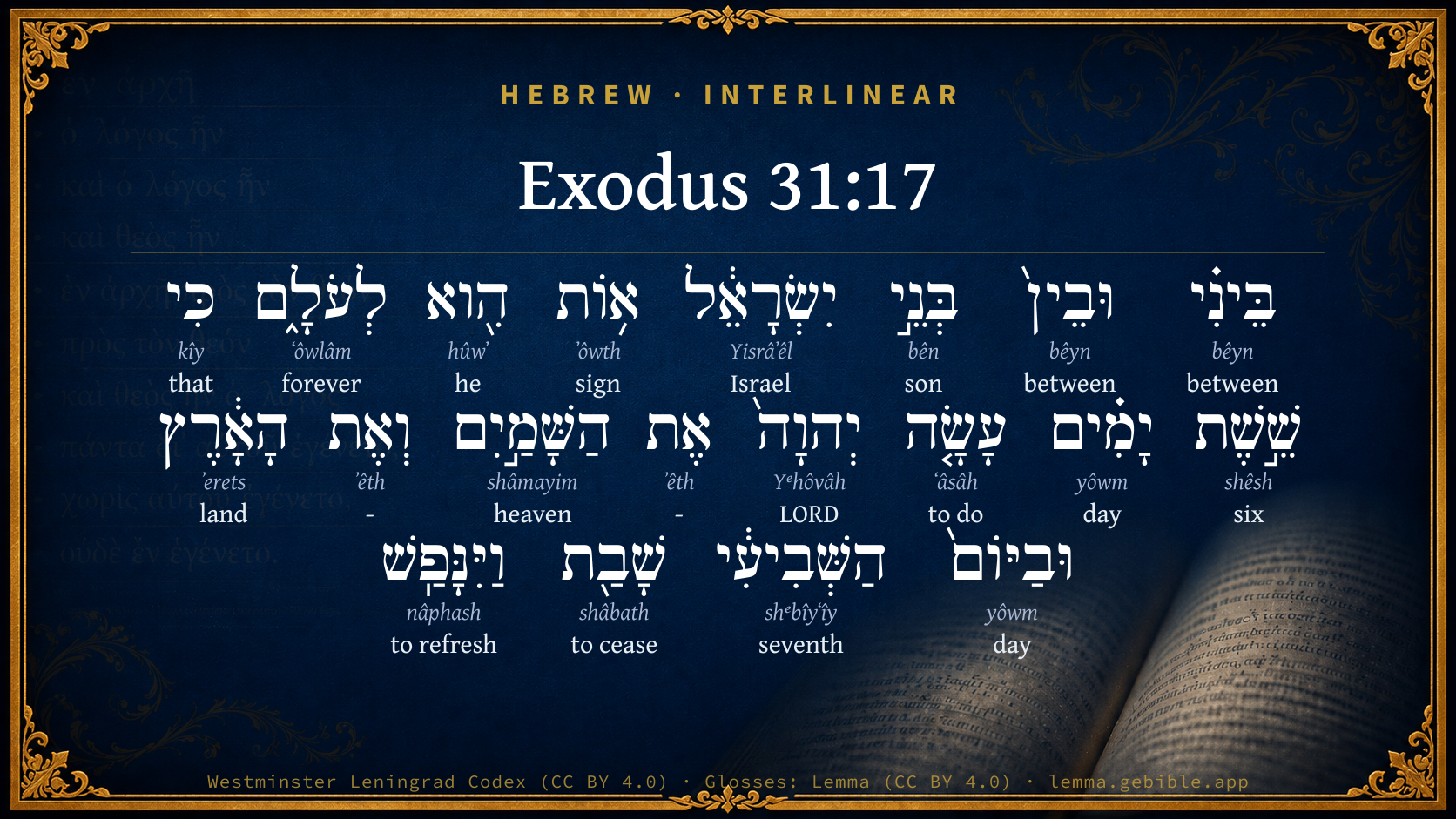
וַיִּנָּפַֽשׁ
nâphash
H5314
“and · to refresh”
Conjunction + Verb, Niphal, Sequential Imperfect, 3rd Person, Masculine, Singular
Part of Speech
Conjunction + Verb
Stem
Niphal
Form
Sequential Imperfect
Person
3rd Person
Gender
Masculine
Number
Singular
Full BDB Definition

Origin: a primitive root

TWOT: 1395

(Niphal) to take breath, refresh oneself
  1. בֵּינִ֗י bêyn H996 “between · me” Preposition + Suffix, Personal, 1st Person, Common, Singular
  2. וּבֵין֙ bêyn H996 “and · between” Conjunction + Preposition
  3. בְּנֵ֣י bên H1121 “sons of” Noun, Common, Masculine, Plural, Construct
  4. יִשְׂרָאֵ֔ל Yisrâʼêl H3478 “Israel” Noun, Proper
  5. א֥וֹת ʼôwth H226 “sign” Noun, Common, Both, Singular, Absolute
  6. הִ֖וא hûwʼ H1931 “he” Pronoun, Personal, 3rd Person, Feminine, Singular
  7. לְעֹלָ֑ם ʻôwlâm H5769 “to/for · forever” Preposition + Noun, Common, Masculine, Singular, Absolute
  8. כִּי kîy H3588 “that” Conjunction
  9. שֵׁ֣שֶׁת shêsh H8337 “six” Adjective, Cardinal number, Masculine, Singular, Construct
  10. יָמִ֗ים yôwm H3117 “days” Noun, Common, Masculine, Plural, Absolute
  11. עָשָׂ֤ה ʻâsâh H6213 “to do” Verb, Qal, Perfect, 3rd Person, Masculine, Singular
  12. יְהוָה֙ Yᵉhôvâh H3068 “LORD” Noun, Proper
  13. אֶת ʼêth H853 “-” Particle, Direct Object
  14. הַשָּׁמַ֣יִם shâmayim H8064 “the · heaven(s)” Particle, Definite Article + Noun, Common, Masculine, Plural, Absolute
  15. וְאֶת ʼêth H853 “and · -” Conjunction + Particle, Direct Object
  16. הָאָ֔רֶץ ʼerets H776 “the · land” Particle, Definite Article + Noun, Common, Both, Singular, Absolute
  17. וּבַיּוֹם֙ yôwm H3117 “and · in/at the · day” Conjunction + Preposition, Determined + Noun, Common, Masculine, Singular, Absolute
  18. הַשְּׁבִיעִ֔י shᵉbîyʻîy H7637 “the · seventh” Particle, Definite Article + Adjective, Ordinal number, Masculine, Singular, Absolute
  19. שָׁבַ֖ת shâbath H7673 “to cease” Verb, Qal, Perfect, 3rd Person, Masculine, Singular

About this verse

These counts appear in no published source. They are computed here, from the morphology-tagged text and Lemma’s own curated glosses. What Lemma adds →

20
words
17
distinct lemmas
Pentateuch
section

Notable vocabulary

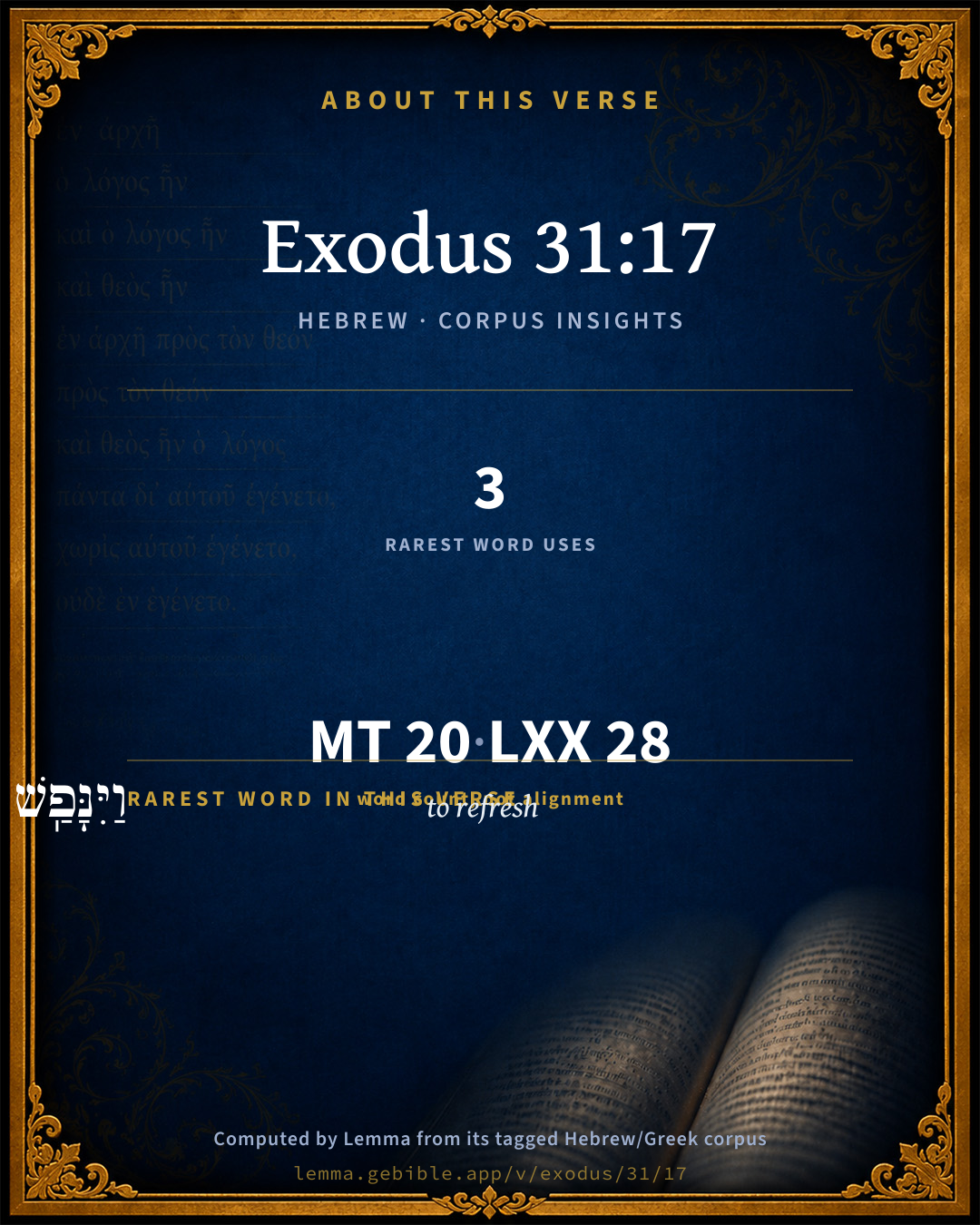
The rarest word here is וַיִּנָּפַֽשׁ to refresh H5314 — appearing just 3 times in the whole Hebrew Bible.

Shared distinctive vocabulary

וַיִּנָּפַֽשׁ to refresh H5314 occurs in 3 verses of the Hebrew Bible. Also found in:

Grammatical profile

  • 3 verbs
  • 9 nouns
  • 2 adjectives
  • 1 pronoun
  • 2 prepositions
  • 1 conjunction
  • 2 particles

Verb forms

  • עָשָׂ֤ה Qal · Perfect
  • שָׁבַ֖ת Qal · Perfect
  • וַיִּנָּפַֽשׁ Niphal · Sequential Imperfect

Repetition

Words recur within this verse — often emphatic in Hebrew:

  • בֵּינִ֗י between H996 ×2
  • יָמִ֗ים day H3117 ×2

Hebrew & Septuagint length

In English translation the verse runs 31 words from the Hebrew and 40 from the Septuagint (LXX English) — closely comparable.

A rough comparison of the two English renderings, which tokenize alike — not a word-level alignment.

Word counts can differ between the Hebrew and the Greek without any difference in meaning — e.g. the Hebrew direct-object marker אֵת has no separate Greek word, and Greek often adds the article ὁ.

In the original languages it is 20 Hebrew tokens and 28 Greek tokens — but the two are counted differently (Hebrew bundles its prefixes and suffixes into one token; the Greek is in lemma form), so that isn’t a like-for-like length.

Cross-references

10

Topical passages linked to Exodus 31:17 in the Treasury of Scripture Knowledge — connected by theme and wording, ordered by reader-vote popularity; previews shown in the World English Bible.

  • Genesis 1:31 God saw everything that he had made, and, behold, it was very good. There was evening and there was morning, the sixth day.
  • Exodus 31:13 "Speak also to the children of Israel, saying, 'Most assuredly you shall keep my Sabbaths: for it is a sign between me and you throughout your generations; that you may know that I am Yahweh who sanctifies you.
  • Genesis 2:2–3 On the seventh day God finished his work which he had made; and he rested on the seventh day from all his work which he had made.
  • Ezekiel 20:12 Moreover also I gave them my Sabbaths, to be a sign between me and them, that they might know that I am Yahweh who sanctifies them.
  • Hebrews 4:10 For he who has entered into his rest has himself also rested from his works, as God did from his.
  • Ezekiel 20:20 and make my Sabbaths holy; and they shall be a sign between me and you, that you may know that I am Yahweh your God.
  • Hebrews 4:3–4 For we who have believed do enter into that rest, even as he has said, "As I swore in my wrath, they will not enter into my rest;" although the works were finished from the foundation of the world.
  • Psalms 104:31 Let the glory of Yahweh endure forever. Let Yahweh rejoice in his works.
  • Jeremiah 32:41 Yes, I will rejoice over them to do them good, and I will plant them in this land assuredly with my whole heart and with my whole soul.
  • Job 38:7 When the morning stars sang together, And all the sons of God shouted for joy?

Cross-references courtesy of OpenBible.info (CC BY 4.0).

Hebrew and Greek witnesses Masoretic Hebrew ↔ Greek Septuagint

The same verse in the two great witnesses to the Old Testament, shown verse-for-verse.

These are two independent witnesses, not word-aligned to each other, and the Septuagint is shown in lemma (dictionary) form.

Hebrew Exodus 31:17 Masoretic · Westminster Leningrad Codex

בֵּינִ֗י וּבֵין֙ בְּנֵ֣י יִשְׂרָאֵ֔ל א֥וֹת הִ֖וא לְעֹלָ֑ם כִּי שֵׁ֣שֶׁת יָמִ֗ים עָשָׂ֤ה יְהוָה֙ אֶת הַשָּׁמַ֣יִם וְאֶת הָאָ֔רֶץ וּבַיּוֹם֙ הַשְּׁבִיעִ֔י שָׁבַ֖ת וַיִּנָּפַֽשׁ

It is a sign between me and the children of Israel forever; for in six days Yahweh made heaven and earth, and on the seventh day he rested, and was refreshed.'"

World English Bible · Public Domain

Greek LXX Exodus 31:17 Septuagint · lemma form

ἐν ἐγώ καί ὁ υἱός ἰσραήλ σημεῖον εἰμί αἰώνιος ὅτι ἐν ἕξ ἡμέρα ποιέω κύριος ὁ οὐρανός καί ὁ γῆ καί ὁ ἡμέρα ὁ ἕβδομος παύω καί καταπαύω

It is a perpetual covenant with me and the children of Israel, it is a perpetual sign with me; for in six days the Lord made the heaven and the earth, and on the seventh day he ceased, and rested.

LXX2012 (modern English Septuagint) · Public Domain

Hebrew: Westminster Leningrad Codex (CC BY 4.0). Greek: Septuagint (public domain); English from LXX2012 (modern English Septuagint) (Public Domain). How the Septuagint differs from the Hebrew →

Targum (Aramaic paraphrase)

2

The Targum is the ancient Jewish Aramaic paraphrase of the Hebrew Scriptures — an interpretive translation, not the Hebrew text itself. Onkelos (literal) and Pseudo-Jonathan (expansive) render the Torah, and Jonathan the Prophets. Coverage is partial: where no permissively-licensed English translation exists for a verse, only the Aramaic is shown. This is verse-level text, not a word-by-word alignment to the Hebrew.

  1. Targum Onkelos Torah (Genesis–Deuteronomy)
    בֵּין מֵימְרִי וּבֵין בְּנֵי יִשְׂרָאֵל אָת הִיא לְעָלָם אֲרֵי שִׁתָּא יוֹמִין עֲבַד יְיָ יָת שְׁמַיָא וְיָת אַרְעָא וּבְיוֹמָא שְׁבִיעָאָה שְׁבַת וְנַח:

    (no public-domain English translation for this verse)

    Targum Onkelos — Aramaic: “Onkelos Genesis” (public domain); “Onkelos Exodus” (public domain); “Onkelos Leviticus” (public domain); “Onkelos Numbers” (public domain); “Onkelos Deuteronomy” (public domain). English: “Sefaria Community Translation” (CC0 1.0 (public-domain dedication)); “J.W. Etheridge. The Targums of Onkelos and Jonathan Ben Uzziel on the Pentateuch. London: Longmans, Green, 1862” (public domain). Text via Sefaria.

  2. Targum Pseudo-Jonathan Torah (Genesis–Deuteronomy)
    בֵּין מֵימְרִי וּבֵין בְּנֵי יִשְרָאֵל אָת הִיא לְעַלָם אֲרוּם בְּשִׁיתָּא יוֹמִין בְּרָא יְיָ וְשַׁכְלֵיל יַת שְׁמַיָא וְיַת אַרְעָא וּבְיוֹמָא שְׁבִיעָאָה שְׁבָת וְנָח

    between My Word and the sons of Israel it is a sign for ever. For in six days the Lord created and perfected the heavens and the earth; and in the seventh day He rested and refreshed.

    Targum Pseudo-Jonathan — Aramaic: “Targum Jonathan on Genesis” (public domain); “Targum Jonathan on Exodus” (public domain); “Targum Jonathan on Leviticus” (public domain); “Targum Jonathan on Numbers” (public domain); “Targum Jonathan on Deuteronomy” (public domain). English: “The Targum of Jonathan ben Uzziel, trans. J. W. Etheridge, London, 1862” (public domain). Text via Sefaria.

Commentary

Notes on Exodus 31:17 from classic Christian and Jewish commentators (each source and its license shown beneath its notes). The classic Christian expositions comment on the surrounding passage and are grouped to its opening verse, so a note may address several verses; the Jewish commentaries on the Tanakh (Rashi and others) are per-verse, so they appear only where the commentator wrote on this verse.

Lemma curates 59 commentaries, every one of them public domain or Creative Commons licensed, each selected and text-cleaned for this edition rather than reprinted as found. About our sources →

Trapp's Complete Commentary

John Trapp

Exo 31:17 It [is] a sign between me and the children of Israel for ever: for [in] six days the LORD made heaven and earth, and on the seventh day he rested, and was refreshed.

Ver. 17. He rested, and was refreshed.] This is spoken to our apprehensions, and for our imitation.

John Trapp, A Commentary or Exposition upon All the Books of the Old and New Testament (1647–1656) — public domain. Text from a community e-Sword module.

Joseph Benson's Commentary

Exo 31:17. On the seventh day he rested, and was refreshed — And, as the work of creation is worthy to be thus commemorated, so the great Creator is worthy to be imitated by a holy rest on the seventh day. The expression, was refreshed, is spoken after the manner of men. It seems to signify that delight and complacency with which God surveyed all his works, and pronounced them good, Gen 1:31. Of this divine pleasure we may form some faint idea, by comparing it to that solace and refreshment which a benevolent mind enjoys upon bringing into execution some noble and arduous, some generous and well concerted plan for advancing the glory of God and good of mankind.

Joseph Benson's Commentary on the Old and New Testaments (1811–1818) — public domain. Text from a community e-Sword module.

Geneva Bible (1599)

Geneva Bible translators

From creating his creatures, but not from governing and preserving them.

Geneva Bible (1599) marginal notes — public domain. Text via Bolls.life.

Adam Clarke's Commentary

Verse 17. Rested, and was refreshed.] God, in condescension to human weakness, applies to himself here what belongs to man. If a man religiously rests on the Sabbath, both his body and soul shall be refreshed; he shall acquire new light and life.

Adam Clarke's Commentary on the Bible (1810–1826) — public domain. Text from a community e-Sword/MySword module.

Ellicott's Commentary for English Readers

(17) For in six days the Lord made heaven and earth.—Whatever other grounds there were for Sabbath observance, this idea always lay at its root. Man was through it to be made like unto his Maker—to have from time to time a rest from his labours, as God had had (Gen_2:2-3)—and thereby to realise the blessedness of that final rest which he may be sure “remaineth for the people of God.”

A Bible Commentary for English Readers, edited by Charles John Ellicott (1878–1897) — public domain. Text from a community e-Sword module.

The Cambridge Bible for Schools and Colleges

gen. ed. J. J. S. Perowne

17. for … earth] verbatim as Exo_20:11.

rested] desisted (from work), or kept sabbath: see on Exo_20:8.

was refreshed] lit. took breath,—a strong anthropomorphism: elsewhere used only of men, Exo_23:12, 2Sa_16:14†.

18a. communing] speaking. See on Exo_25:22.

tables of the testimony] i.e. of the Decalogue (see on Exo_25:16). So Exo_32:15; Exo_34:29 †.

18b. tables of stone] as Exo_24:12 (E), where see the note. E’s narrative in Exo_24:12-15 a must have been followed by a statement that Moses, after remaining some time on the mountain (Exo_32:1), received from God the tables of stone, of which these and the following words are the close. The intermediate part has been replaced by the narrative of P (Exo_24:15 b–32:18a).

written with the finger of God] hence Deu_9:10. The practice of inscribing laws on tables of metal or stone was very general in antiquity: Rome, Athens, Crete, Carthage, Palmyra, Babylonia, all supply examples; it would be no cause for surprise, if the original of some of the laws contained in the ‘Book of the Covenant’ were to be brought to light by excavation in Palestine. That the tables on which the Decalogue was written are said to have been inscribed by ‘the finger of God’ (cf. Exo_34:1) is an expression (Di.) of the sanctity and venerable antiquity attributed to them.

The Cambridge Bible for Schools and Colleges (gen. ed. J. J. S. Perowne; Cambridge University Press, 1878–1918) — public domain. Text from a community e-Sword module.

John Gill's Exposition

It is a sign between me and the children of Israel for ever,.... In like sense as the land of Canaan was given them for an everlasting possession; and the covenant of circumcision, and the ordinance of the passover, and the fast on the day of atonement, were for ever; that is, unto the end of the Jewish world and state, at the coming of Christ, when a new world and state of things began, see Gen 17:8.

for in six days the Lord made heaven and earth, and on the seventh day he rested, and was refreshed; which is to be understood figuratively after the manner of men, who ceasing from toil and labour find rest and refreshment; but not really and properly, for as not labour, and weariness, and fatigue, so neither rest nor refreshment can be properly said of God; but this denotes his cessation from the works of creation, though not of providence, and of the delight and pleasure he takes in a view of them; this is observed, not as the foundation of this law, and the reason of its being made, but as an illustration of it, and as an argument, showing the reasonableness of it, and the similarity of it with what God himself had done, and therefore the enjoining of it could not reasonably be objected to. See Gill on Exo 20:11.

John Gill's Exposition of the Whole Bible (1746–1763) — public domain (CC PDM 1.0). Text via the HelloAO Bible API.

Matthew Poole's English Annotations

It is a sign, a sign of the covenant between us, that I will be their God, and they will be my people; both which depends upon this amongst other duties, and upon this in an eminent degree.

Was refreshed; not as if he had been weary with working, which surely he could not be with speaking a few words, nor can God be weary with any thing, Isa 40:28; but it notes the pleasure or delight God took in reflecting upon his works, beholding that every thing he had made was very good, Gen 1:31.

Matthew Poole's English Annotations on the Holy Bible (1683–1685) — public domain. Text from a community e-Sword/MySword module.

The Pulpit Commentary

It is a sign. See above, ver. 13. For in six days the Lord made heaven and earth. See the comment on Exo_20:11. And was refreshed. Literally," and took breath." The metaphor is a bold one, but not bolder than others which occur in holy scripture. (Psa_44:23 Psa_78:65) It does but carry out a little further the idea implied in God"s "resting." We cannot speak of any of God"s acts or attributes without anthropomorphisms.

The Pulpit Commentary (1880–1919), ed. H.D.M. Spence-Jones & Joseph S. Exell — public domain. Text from a community e-Sword module.

John Wesley's Explanatory Notes

On the seventh day he rested - And as the work of creation is worthy to be thus commemorated, so the great Creator is worthy to be thus imitated, by a holy rest the seventh day.

John Wesley, Explanatory Notes Upon the Whole Bible (1754–1765) — public domain. Text via the GEBible commentary corpus.

Rashi

Rabbi Shlomo Yitzchaki (Rashi)

וינפש AND WAS REFRESHED — Take it as the Targum renders it: ונח “and He rested”. Every form of נפש is derived from the noun נֶפֶש, soul; the idea is, that one calms his soul and takes breath when one reposes after the toil of labour. — And He of Whom it is written, (Isaiah 40:28) “[… the Lord, the Creator of the ends of the earth] fainteth not nor is He weary”, and Whose every action is accomplished by His mere command had the term “repose” written of (ascribed to) Himself in order to make comprehensible to the human ear what it can understand.

Rashi on the Tanakh — English translations: “The Judaica Press complete Tanach with Rashi, translated by A. J. Rosenberg” (CC BY 4.0); “Pentateuch with Rashi's commentary by M. Rosenbaum and A.M. Silbermann, 1929-1934” (public domain); “The Metsudah Tanach series, Lakewood, N.J” (CC BY 4.0); and “The Book of Joshua, Metsudah Publications, 1997” (CC BY 4.0). Text via Sefaria.

Lesson kit

Teaching starters — assembled from the data on this page, not authored interpretation. Every prompt links to the verse data it draws on. Edit before teaching.

Exodus, in the Pentateuch, opens this verse with 20 words (17 distinct Hebrew lemmas). Its most distinctive word is nâphash (“to refresh”). A historical commentator’s framing appears above. Read the whole chapter for the surrounding context.

Discussion questions

  1. The word nâphash carries the sense “to refresh.” How does it shape the verse?
  2. Exodus 23:12 shares the word «to refresh» with this verse. How do the two illuminate each other?
  3. “between” occurs 2× in this one verse. What is the effect of the repetition?
  4. These translations render this verse differently; the difference is in the English rendering, not the original. What questions does that raise?
  5. The verb «עָשָׂ֤ה» is Qal Perfect. How does its form color the action?
  6. Reading how Trapp's Complete Commentary and Joseph Benson's Commentary read this verse, where do the two commentators agree and where do they part?

Things to notice

Reading settings

Reading text

Shown beneath each verse's original-language words.

Old Testament
Old Testament edition

Read the OT as the Masoretic Hebrew (MT) or the Greek Septuagint (LXX).

English shown for the Greek Septuagint (in the Hebrew ↔ Greek comparison).

Comparing translations? Open the Compare panel on any verse page to stack up to four side by side.