
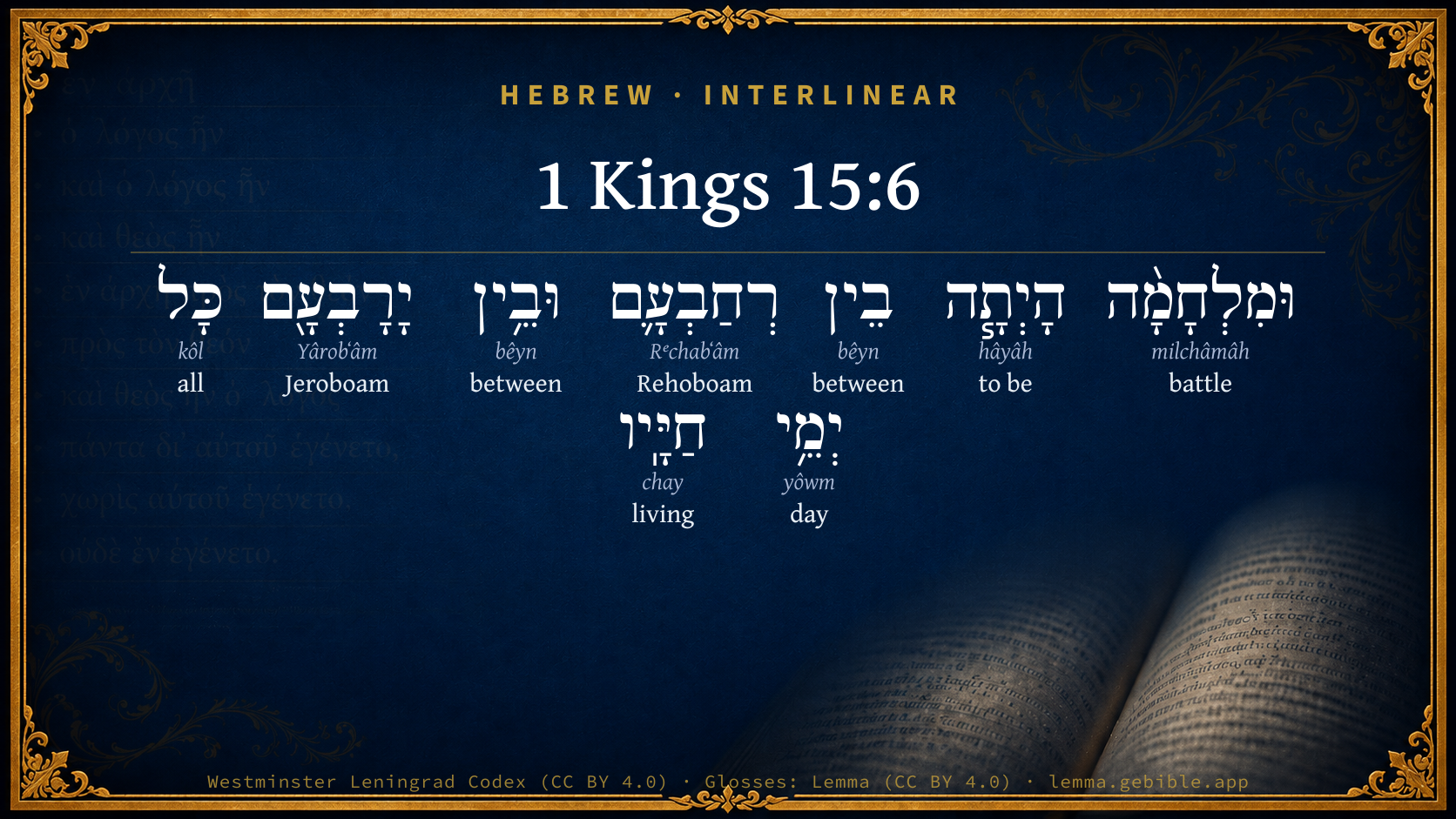
1 Kings 15:6

Hebrew (Westminster Leningrad Codex) 1 Kings 15:6 appears in the Hebrew Old Testament. The text above is from the Westminster Leningrad Codex. Each word links to its Strong’s number, a concise gloss, and parsing drawn from the Open Scriptures Hebrew Bible morphology. Click any word for its full Brown-Driver-Briggs (BDB) entry.
Download image
Cite this verse

1 Kings 15:6 (World English Bible). Public Domain. Lemma interlinear Bible study tool, https://lemma.gebible.app/v/1-kings/15/6.

Show BibTeX & RIS
BibTeX
RIS
English Translation
Now there was war between Rehoboam and Jeroboam all the days of his life.
World English Bible · Public Domain
Download a study sheet

One document with this verse’s original text, its word-by-word gloss line, the meaning frame, cross-references with their text, attributed commentary, and full source and license credits — printable, and it pastes into notes with its structure intact.

This verse Autodidact and up

Study sheet (.html) Plain text (.txt)

A passage Seminary Student

Up to 50 verses in one chapter. A passage sheet keeps up to 6 commentary sources and 12 cross-references per verse, in the order this page ranks them, and says so on the sheet whenever that leaves anything out. Ask for a single verse and you get the Autodidact verse sheet above.

Everything on this page stays free to read, with no account — the sheet is a download of what is already on screen, not access to it.

Want to remove ads? Support Godless Engineer
Compare translations 3

The same verse in 3 English versions, stacked beneath the original-language interlinear above. Click any original word for its lexicon entry.

Each is an independent rendering of the whole verse — the interlinear is not word-aligned to these translations.

Highlighted words mark where these versions differ — a whole-verse word diff, not a word-by-word alignment.

  • World English Bible Public Domain
    Now there was war between Rehoboam and Jeroboam all the days of his life.
  • King James Version Public Domain
    And there was war between Rehoboam and Jeroboam all the days of his life.
  • unfoldingWord Literal Text CC BY-SA 4.0
    And war was between Rehoboam and between Jeroboam all of the days of his life.

unfoldingWord Literal Text — © unfoldingWord, licensed CC BY-SA 4.0. Word-aligned USFM3 via Door43 (git.door43.org/unfoldingWord/en_ult).

Versions to compare (up to 4)

3 of 4 selected

Show all 18 translations

Every available English version of this verse, each an independent rendering of the whole verse.

  • World English Bible Public Domain
    Now there was war between Rehoboam and Jeroboam all the days of his life.
  • Berean Standard Bible Public Domain
    And there was war between the houses of Rehoboam and Jeroboam all the days of Abijam’s life.
  • Majority Standard Bible Public Domain
    And there was war between the houses of Rehoboam and Jeroboam all the days of Abijam’s life.
  • King James Version Public Domain
    And there was war between Rehoboam and Jeroboam all the days of his life.
  • American Standard Version (1901) Public Domain
    Now there was war between Rehoboam and Jeroboam all the days of his life.
  • Revised Version (1885) Public Domain
    Now there was war between Rehoboam and Jeroboam all the days of his life.
  • Geneva Bible (1599) Public Domain
    And there was warre betweene Rehoboam and Ieroboam as long as he liued.
  • Douay-Rheims (1899) Public Domain
    But there was war between Roboam and Jeroboam all the time of his life.
  • Young's Literal Translation Public Domain
    and war hath been between Rehoboam and Jeroboam all the days of his life.
  • Literal Standard Version CC BY-SA 4.0
    and there has been war between Rehoboam and Jeroboam all the days of his life.
  • Unlocked Literal Bible CC BY-SA 4.0
    Now there was war between Rehoboam and Jeroboam all the days of Abijah's life.
  • unfoldingWord Literal Text CC BY-SA 4.0
    And war was between Rehoboam and between Jeroboam all of the days of his life.
  • Darby Bible Public Domain
    And there had been war between Rehoboam and Jeroboam all the days of his life.
  • World Messianic Bible Public Domain
    Now there was war between Rehoboam and Jeroboam all the days of his life.
  • Webster's Bible Public Domain
    And there was war between Rehoboam and Jeroboam all the days of his life.
  • Free Bible Version CC BY-SA 4.0
    (Rehoboam and Jeroboam were always at war with each other.)
  • Bible in Basic English Public Domain
    ...
  • JPS Tanakh (1917) Public Domain
    Now there was war between Rehoboam and Jeroboam all the days of his life.

Literal Standard Version (2020), Covenant Press — licensed CC BY-SA 4.0. Text via the HelloAO Bible API (eBible.org). Unlocked Literal Bible (unfoldingWord) — licensed CC BY-SA 4.0. Text via the HelloAO Bible API (eBible.org). unfoldingWord Literal Text — © unfoldingWord, licensed CC BY-SA 4.0. Word-aligned USFM3 via Door43 (git.door43.org/unfoldingWord/en_ult). Free Bible Version, Dr. Jonathan Gallagher — licensed CC BY-SA 4.0. Text via the HelloAO Bible API (eBible.org).

Word by word

More ways to search: Search by grammar → Find every occurrence → Compare this word →

Practice this passage: Drill this verse → Learn its vocabulary →

About this verse

These counts appear in no published source. They are computed here, from the morphology-tagged text and Lemma’s own curated glosses. What Lemma adds →

9
words
8
distinct lemmas
Historical
section

Shared distinctive vocabulary

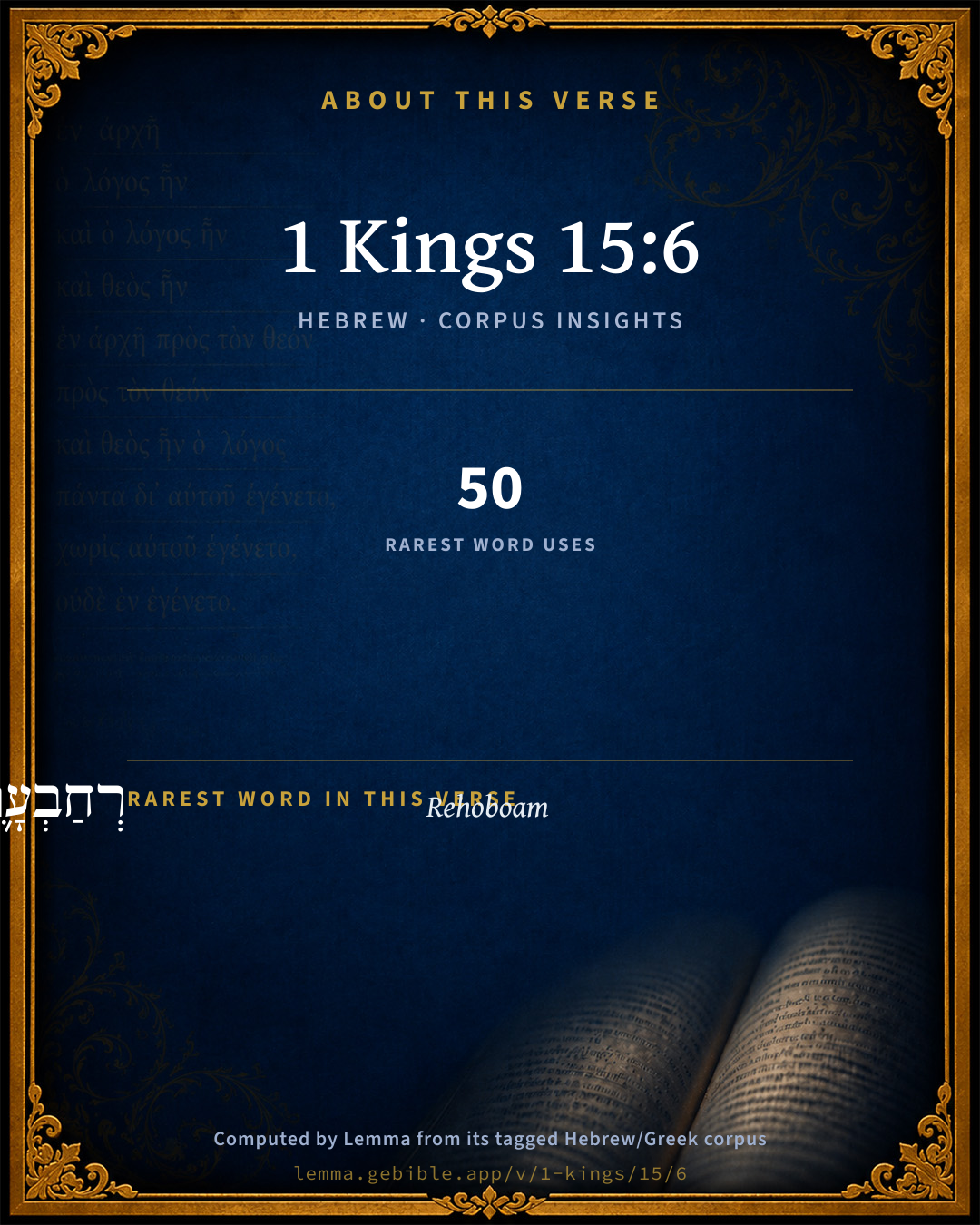
רְחַבְעָ֛ם Rehoboam H7346 occurs in 41 verses of the Hebrew Bible. Also found in:

Grammatical profile

  • 1 verb
  • 6 nouns
  • 2 prepositions

Verb forms

  • הָיְתָ֧ה Qal · Perfect

Repetition

A word recurs within this verse — often emphatic in Hebrew:

  • בֵין between H996 ×2

Cross-references

1

Topical passages linked to 1 Kings 15:6 in the Treasury of Scripture Knowledge — connected by theme and wording, ordered by reader-vote popularity; previews shown in the World English Bible.

  • 1 Kings 14:30 There was war between Rehoboam and Jeroboam continually.

Cross-references courtesy of OpenBible.info (CC BY 4.0).

Hebrew and Greek witnesses Masoretic Hebrew ↔ Greek Septuagint

The same verse in the two great witnesses to the Old Testament, shown verse-for-verse.

These are two independent witnesses, not word-aligned to each other, and the Septuagint is shown in lemma (dictionary) form.

Hebrew 1 Kings 15:6 Masoretic · Westminster Leningrad Codex

וּמִלְחָמָ֨ה הָיְתָ֧ה בֵין רְחַבְעָ֛ם וּבֵ֥ין יָרָבְעָ֖ם כָּל יְמֵ֥י חַיָּֽיו

Now there was war between Rehoboam and Jeroboam all the days of his life.

World English Bible · Public Domain

On this verse, Adam Clarke's Commentary discusses the Septuagint’s reading. Read the note in Commentary ↓

Hebrew: Westminster Leningrad Codex (CC BY 4.0). Greek: Septuagint (public domain); English from a public-domain English Septuagint. How the Septuagint differs from the Hebrew →

Targum (Aramaic paraphrase)

1

The Targum is the ancient Jewish Aramaic paraphrase of the Hebrew Scriptures — an interpretive translation, not the Hebrew text itself. Onkelos (literal) and Pseudo-Jonathan (expansive) render the Torah, and Jonathan the Prophets. Coverage is partial: where no permissively-licensed English translation exists for a verse, only the Aramaic is shown. This is verse-level text, not a word-by-word alignment to the Hebrew.

  1. Targum Jonathan Prophets (Joshua–Malachi)
    וּקְרָבָא הֲוַת בֵּין רְחַבְעָם וּבֵין יְרָבְעָם כָּל יוֹמֵי חַיוֹהִי:

    (no public-domain English translation for this verse)

    Targum Jonathan — Aramaic: “Mikraot Gedolot” (public domain). English: “Sefaria Community Translation” (CC0 1.0 (public-domain dedication)); “London "Chaldee Paraphrase," 1871” (public domain). Text via Sefaria.

Commentary

Notes on 1 Kings 15:6 from classic Christian and Jewish commentators (each source and its license shown beneath its notes). The classic Christian expositions comment on the surrounding passage and are grouped to its opening verse, so a note may address several verses; the Jewish commentaries on the Tanakh (Rashi and others) are per-verse, so they appear only where the commentator wrote on this verse.

Lemma curates 59 commentaries, every one of them public domain or Creative Commons licensed, each selected and text-cleaned for this edition rather than reprinted as found. About our sources →

Trapp's Complete Commentary

John Trapp

1Ki 15:6 And there was war between Rehoboam and Jeroboam all the days of his life.

Ver. 6. And there was war.] See 1Ki 14:30.

John Trapp, A Commentary or Exposition upon All the Books of the Old and New Testament (1647–1656) — public domain. Text from a community e-Sword module.

Joseph Benson's Commentary

1Ki 15:6. This was mentioned before, (1Ki 14:30,) and therefore may seem to come in here improperly, because the historian is not speaking of Rehoboam, but of his son Abijam. Bochart thinks that Rehoboam stands here for the son of Rehoboam. But the meaning of these words seems rather to be, that though God was pleased, for David’s sake, to continue a lamp, that is, a successor, to him in Jerusalem; yet these successors were vexed with continual wars, as appeared both in the reign of Rehoboam and of Abijam, and did not enjoy their kingdom peaceably.

Joseph Benson's Commentary on the Old and New Testaments (1811–1818) — public domain. Text from a community e-Sword module.

Tyndale Open Study Notes

Tyndale Open Resources

15:6 Abijam inherited the hostility between the northern and southern kingdoms. Like Rehoboam (14:30), he faced war with Jeroboam. During one notable battle (2 Chr 13:2-20), when Abijam and his outnumbered forces were surrounded by northern troops, they cried out to the Lord; God delivered them and enabled them to inflict a severe defeat on Jeroboam.

Tyndale Open Study Notes — © Tyndale Open Resources, licensed CC BY-SA 4.0. Text via the HelloAO Bible API.

Adam Clarke's Commentary

Verse 6. There was war between Rehoboam and Jeroboam] This was mentioned in the preceding chapter, 1Kg 14:30, and it can mean no more than this: there was a continual spirit of hostility kept up between the two kingdoms, and no doubt frequent skirmishing between bordering parties; but it never broke out into open war, for this was particularly forbidden. See 1Kg 12:24. Hostility did exist, and no doubt frequent skirmishes; but open war and pitched battles there were none.

But why is this circumstance repeated, and the history of Abijam interrupted by the repetition? There is some reason to believe that Rehoboam is not the true reading, and that it should be Abijam: "Now there was war between Abijam and Jeroboam all the days of his life." And this is the reading of fourteen of Kennicott's and De Rossi's MSS. The Syriac has Abia the son of Rehoboam; the Arabic has Abijam. In the Septuagint the whole verse is omitted in the London Polyglot, but it is extant in those of Complutum and Antwerp. Some copies of the Targum have Abijam also, and the Editio Princeps of the Vulgate has Abia. This is doubtless the true reading, as we know there was a very memorable war between Abia and Jeroboam; see it particularly described 2Ch 13:3, &c.

Adam Clarke's Commentary on the Bible (1810–1826) — public domain. Text from a community e-Sword/MySword module.

Ellicott's Commentary for English Readers

(6) And there was war.—In this verse (omitted in the Vatican MS. of the LXX.) the repetition of the notice of Rehoboam, in spite of some artificial explanations, seems inexplicable. Probably there is error in the text.

A Bible Commentary for English Readers, edited by Charles John Ellicott (1878–1897) — public domain. Text from a community e-Sword module.

The Cambridge Bible for Schools and Colleges

gen. ed. J. J. S. Perowne

6. And [R.V. Now] there was war between Rehoboam and Jeroboam &c.] The whole of this verse is omitted by the LXX. and it seems altogether out of place in a notice of the reign of Abijam, and has been already inserted [1Ki_14:30] in the history of Rehoboam, while the parallel statement in reference to Abijam comes in the next verse.

The Cambridge Bible for Schools and Colleges (gen. ed. J. J. S. Perowne; Cambridge University Press, 1878–1918) — public domain. Text from a community e-Sword module.

John Gill's Exposition

And Abijam slept with his fathers,.... That is, died as they did:

and they buried him in the city of David, in the sepulchre of his royal ancestors, David, Solomon, and Rehoboam:

and Asa his son reigned in his stead; who perhaps was the eldest of his twenty two sons, Ch2 13:21.

John Gill's Exposition of the Whole Bible (1746–1763) — public domain (CC PDM 1.0). Text via the HelloAO Bible API.

Albert Barnes' Notes on the Bible

The writer repeats what he had said in 1Ki 14:30, in order to remind the reader that Abijam inherited this war from his father. Abijam’s war is described in marginal reference That the author of Kings gives none of its details is agreeable to his common practice in mere military matters. Thus he gives no details of Shishak’s expedition, and omits Zerah’s expedition altogether.

Albert Barnes' Notes on the Bible (1834–1885) — public domain. Text from a community e-Sword/MySword module.

Haydock's Catholic Bible Commentary

Roboam. This had been remarked, chap. xiv. 30. (Haydock) --- There was a domestic quarrel between the two families. (Calmet) --- Some suspect that Roboam is placed to designate his successors, or that we ought to read, Abia. (Sanchez) --- Castalion rashly ventures to alter the text. (Calmet) --- Abiam gained a decisive victory over Jeroboam, ver. 7., and 2 Paralipomenon xiii. 3.

George Leo Haydock (1774–1849), Haydock's Catholic Family Bible and Commentary, 1859 edition — public domain. Excludes Psalms (Douay-Rheims chapter numbering differs from Protestant) and Deuterocanonical books (Catholic canon only).

Matthew Poole's English Annotations

Which was said 1Ki 14:30, and may be here repeated, to signify the cause and original of the war between Abijam and Jeroboam, which is implied here, and particularly described 2Ch 13. Abijam continued the war which Rehoboam had begun, and pushed it on to a decisive battle. But the place may be thus rendered, Yet there was war, &c., i.e. although God was pleased to show so much respect to David, as for his sake to continue the succession to the kingdom in his posterity, yet he thought fit to manifest his displeasure against David’s successors for their sins, and to mix their honour and happiness with wars and troubles.

Matthew Poole's English Annotations on the Holy Bible (1683–1685) — public domain. Text from a community e-Sword/MySword module.

Whedon's Commentary on the Bible

Daniel D. Whedon

6. War between Rehoboam and Jeroboam — This statement, repeated from 1Ki_14:30, is thought by some to be an interpolation here, others think, instead of Rehoboam we should read Abijam; but in that case the like statement in the next verse would be superfluous. The repetition is only in keeping with other similar repetitions common in Old Testament writers, and in connexion with the next verse is equivalent to saying that the wars and hostility of Rehoboam against Jeroboam were continued by his son Abijam.

Daniel D. Whedon (gen. ed.), Commentary on the Old and New Testaments (1874–1909) — public domain. Text from a community e-Sword module.

The Pulpit Commentary

And there was war between Rehoboam and Jeroboam all the days of his life. Practically identical with 1Ki_14:30, where see note. Thenius thinks the insertion of the words were due to the carelessness of some copyist, and Bahr admits that our present text is possibly not the original one. For Rehoboam, some MSS., with the Syriac and Arabic, read Abijah, but this is clearly an emendation, which in turn begets another repetition (ver. 7), and there is really no need either to alter or suspect the text. Such repetitions are quite in accordance with Eastern usage, and Rehoboam here stands for the house of Rehoboam, or the cause and kingdom which Rehoboam represented. The object of mentioning his name can hardly be "to remind the reader that Abijam inherited this war from his father" (Rawlinson), for it was only on Rehoboam"s death that the slumbering hostility blazed out into actual war. That there was warfare between Abi-jam and Jeroboam we know not only from ver. 7, but from 2Ch_13:3-20 also.

The Pulpit Commentary (1880–1919), ed. H.D.M. Spence-Jones & Joseph S. Exell — public domain. Text from a community e-Sword module.

John Wesley's Explanatory Notes

War between, &c. - Upon Jeroboam's invading him with a great army: acting then in his own defense, he totally routed Jeroboam, so that he was quiet the rest of his reign.

John Wesley, Explanatory Notes Upon the Whole Bible (1754–1765) — public domain. Text via the GEBible commentary corpus.

Keil & Delitzsch

C. F. Keil & F. Delitzsch

"And there was war between Rehoboam and Jeroboam all his life;" i.e., the state of hostility which had already existed between Rehoboam and Jeroboam continued "all the days of his life," or so long as Abijam lived and reigned. If we take חיּיו כּל־ימי in this manner (not כּל־ימיהם, Kg1 15:16), the statement loses the strangeness which it has at first sight, and harmonizes very well with that in Kg1 15:7, that there was also war between Abijam and Jeroboam. Under Abijam it assumed the form of a serious war, in which Jeroboam sustained a great defeat (see 2 Chron 13:3-20). - The other notices concerning Abijam in Kg1 15:7, Kg1 15:8 are the same as in the case of Rehoboam in Kg1 14:29, Kg1 14:31.

Keil & Delitzsch — Biblical Commentary on the Old Testament (1861–1891) — public domain (CC PDM 1.0). Text via the HelloAO Bible API. (Old Testament only.)

Lesson kit

Teaching starters — assembled from the data on this page, not authored interpretation. Every prompt links to the verse data it draws on. Edit before teaching.

1 Kings, in the Historical, opens this verse with 9 words (8 distinct Hebrew lemmas). Its most distinctive word is Rᵉchabʻâm (“Rehoboam”). A historical commentator’s framing appears above. Read the whole chapter for the surrounding context.

Discussion questions

  1. The word Rᵉchabʻâm carries the sense “Rehoboam.” How does it shape the verse?
  2. How does 1 Kings 11:43, which shares the word «Rehoboam», read alongside this verse?
  3. What does the repetition of “between” (2× in this one verse) do in this verse?
  4. These translations render this verse differently; the difference is in the English rendering, not the original. What questions does that raise?
  5. «הָיְתָ֧ה» is a Qal Perfect verb. How does that grammatical form shape the action described?
  6. Compare how Trapp's Complete Commentary and Joseph Benson's Commentary read this verse. Where do they agree or differ?

Things to notice

  • These translations choose different wording for 2 words in this verse.
  • “between” occurs 2× in this single verse.
  • 8 distinct Hebrew lemmas span 9 words in this verse.

Reading settings

Reading text

Shown beneath each verse's original-language words.

Old Testament
Old Testament edition

Read the OT as the Masoretic Hebrew (MT) or the Greek Septuagint (LXX).

English shown for the Greek Septuagint (in the Hebrew ↔ Greek comparison).

Comparing translations? Open the Compare panel on any verse page to stack up to four side by side.