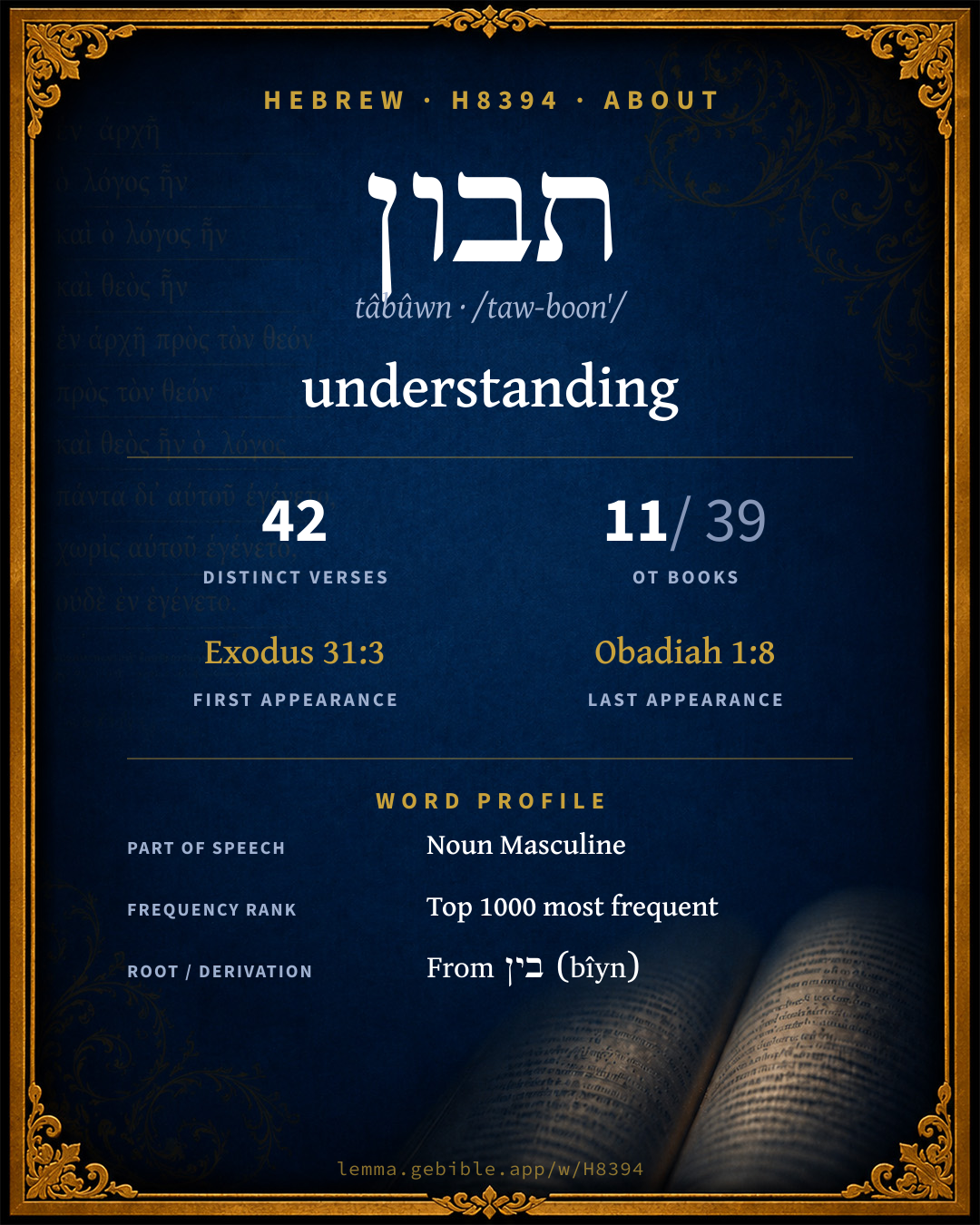
תְּבוּנָה
understanding
‘understanding’ is one of 5 main senses fuller range ↓
Full lexicon entry — Brown-Driver-Briggs (BDB)
From Brown-Driver-Briggs (BDB)
Where this word appears
See every Absolute-state word in the Hebrew Bible →
Grammar key — what these labels mean
Part of speech
- Noun
- A naming word — a person, place, thing, or idea.
Noun type
- Common
- A common noun — a general class of person, place, or thing (“king,” “city,” “water”), not a specific name.
State
- Absolute
- The independent form of a noun, not bound to a following word.
- Construct
- A noun bound to a following noun in a possessive / “of” relationship (the construct chain).
Gender
- Feminine
- Grammatically feminine.
Number
- Singular
- One.
- Plural
- More than one (in Hebrew, generally three or more).
Grammatical forms
- Noun, Common, Feminine, Singular, Absolute 28 times (65%)
- Noun, Common, Feminine, Singular, Construct 9 times (21%)
- Noun, Common, Feminine, Plural, Absolute 4 times (9%)
- Noun, Common, Feminine, Plural, Construct 2 times (5%)
Parsed forms decoded from the imported morphology (morphhb / Westminster Leningrad Codex — WLC text public domain, morphhb tagging CC BY 4.0), counted across 43 parsed occurrences — not distinct verses.
Every verse where H8394 appears — 42 distinct verses across 11 books. Click any verse to open its interlinear word-by-word view. Verse text shown in the World English Bible for context — . Each verse’s Hebrew form is shown with its reference; the English is not keyword-highlighted, since the data carries no word-level English alignment. Use “Compare translations” on any verse to read it across multiple English versions. This concordance covers the Hebrew Bible; Septuagint (Greek Old Testament) occurrences are not indexed here.
Exodus 3 verses
- Exodus 31:3 וּ/בִ/תְבוּנָ֥ה conj + prep + n c fs and I have filled him with the Spirit of God, in wisdom, and in understanding, and in knowledge, and in all manner of workmanship,
- Exodus 35:31 בִּ/תְבוּנָ֥ה prep + n c fs He has filled him with the Spirit of God, in wisdom, in understanding, in knowledge, and in all manner of workmanship;
- Exodus 36:1 וּ/תְבוּנָה֙ conj + n c fs "Bezalel and Oholiab shall work with every wise-hearted man, in whom Yahweh has put wisdom and understanding to know how to work all the work for the service of the sanctuary, according to all that Yahweh has commanded."
Deuteronomy 1 verse
1 Kings 2 verses
- 1 Kings 4:29 וּ/תְבוּנָ֖ה conj + n c fs God gave Solomon wisdom and understanding exceeding much, and very great understanding, even as the sand that is on the sea-shore.
- 1 Kings 7:14 הַ/תְּבוּנָה֙ ptcl def.art + n c fs He was the son of a widow of the tribe of Naphtali, and his father was a man of Tyre, a worker in brass; and he was filled with wisdom and understanding and skill, to work all works in brass. He came to king Solomon, and performed all his work.
Job 4 verses
- Job 12:12 תְּבוּנָֽה n c fs With aged men is wisdom, In length of days understanding.
- Job 12:13 וּ/תְבוּנָֽה conj + n c fs "With God is wisdom and might. He has counsel and understanding.
- Job 26:12 ו/ב/תובנת/ו וּ֝/בִ/תְבוּנָת֗/וֹ conj + prep + n c fs cs + sfx pers 3ms conj + prep + n c fs cs + sfx pers 3ms He stirs up the sea with his power, And by his understanding he strikes through Rahab.
- Job 32:11 תְּב֥וּנֹֽתֵי/כֶ֑ם n c fp cs + sfx pers 2mp "Behold, I waited for your words, And I listened for your reasoning, While you searched out what to say.
Psalms 4 verses
- Psalms 49:3 תְבוּנֽוֹת n c fp My mouth will speak words of wisdom. My heart shall utter understanding.
- Psalms 78:72 וּ/בִ/תְבוּנ֖וֹת conj + prep + n c fp cs So he was their shepherd according to the integrity of his heart, And guided them by the skillfulness of his hands.
- Psalms 136:5 בִּ/תְבוּנָ֑ה prep + n c fs To him who by understanding made the heavens; For his loving kindness endures forever:
- Psalms 147:5 לִ֝/תְבוּנָת֗/וֹ prep + n c fs cs + sfx pers 3ms Great is our Lord, and mighty in power. His understanding is infinite.
Proverbs 19 verses
- Proverbs 2:2 לַ/תְּבוּנָֽה prep det + n c fs So as to turn your ear to wisdom, And apply your heart to understanding;
- Proverbs 2:3 לַ֝/תְּבוּנָ֗ה prep det + n c fs Yes, if you call out for discernment, And lift up your voice for understanding;
- Proverbs 2:6 וּ/תְבוּנָֽה conj + n c fs For Yahweh gives wisdom. Out of his mouth comes knowledge and understanding.
- Proverbs 2:11 תְּבוּנָ֥ה n c fs Discretion will watch over you. Understanding will keep you,
- Proverbs 3:13 תְּבוּנָֽה n c fs Happy is the man who finds wisdom, The man who gets understanding.
- Proverbs 3:19 בִּ/תְבוּנָֽה prep + n c fs By wisdom Yahweh founded the earth. By understanding, he established the heavens.
- Proverbs 5:1 לִ֝/תְבוּנָתִ֗/י prep + n c fs cs + sfx pers 1cs My son, pay attention to my wisdom. Turn your ear to my understanding:
- Proverbs 8:1 וּ֝/תְבוּנָ֗ה conj + n c fs Doesn't wisdom cry out? Doesn't understanding raise her voice?
- Proverbs 10:23 תְּבוּנָֽה n c fs It is a fool's pleasure to do wickedness, But wisdom is a man of understanding's pleasure.
- Proverbs 11:12 תְּבוּנ֣וֹת n c fp One who despises his neighbor is void of wisdom, But a man of understanding holds his peace.
- Proverbs 14:29 תְּבוּנָ֑ה n c fs He who is slow to anger has great understanding, But he who has a quick temper displays folly.
- Proverbs 15:21 תְּ֝בוּנָ֗ה n c fs Folly is joy to one who is void of wisdom, But a man of understanding keeps his way straight.
- Proverbs 17:27 תְּבוּנָֽה n c fs He who spares his words has knowledge. He who is even tempered is a man of understanding.
- Proverbs 18:2 בִּ/תְבוּנָ֑ה prep + n c fs A fool has no delight in understanding, But only in revealing his own opinion.
- Proverbs 19:8 תְּ֝בוּנָ֗ה n c fs He who gets wisdom loves his own soul. He who keeps understanding shall find good.
- Proverbs 20:5 תְּבוּנָ֣ה n c fs Counsel in the heart of man is like deep water; But a man of understanding will draw it out.
- Proverbs 21:30 תְּבוּנָ֑ה n c fs There is no wisdom nor understanding Nor counsel against Yahweh.
- Proverbs 24:3 וּ֝/בִ/תְבוּנָ֗ה conj + prep + n c fs Through wisdom a house is built; By understanding it is established;
- Proverbs 28:16 תְּ֭בוּנוֹת n c fp A tyrannical ruler lacks judgment. One who hates ill-gotten gain will have long days.
Isaiah 3 verses
- Isaiah 40:14 תְּבוּנ֖וֹת n c fp With whom took he counsel, and who instructed him, and taught him in the path of justice, and taught him knowledge, and shown to him the way of understanding?
- Isaiah 40:28 לִ/תְבוּנָתֽ/וֹ prep + n c fs cs + sfx pers 3ms Have you not known? have you not heard? The everlasting God, Yahweh, the Creator of the ends of the earth, doesn't faint, neither is weary; there is no searching of his understanding.
- Isaiah 44:19 תְבוּנָה֮ n c fs None calls to mind, neither is there knowledge nor understanding to say, I have burned part of it in the fire; yes, also I have baked bread on the coals of it; I have roasted flesh and eaten it: and shall I make the residue of it an abomination? shall I fall down to the stock of a tree?
Jeremiah 2 verses
- Jeremiah 10:12 וּ/בִ/תְבוּנָת֖/וֹ conj + prep + n c fs cs + sfx pers 3ms He has made the earth by his power, he has established the world by his wisdom, and by his understanding has he stretched out the heavens:
- Jeremiah 51:15 וּ/בִ/תְבוּנָת֖/וֹ conj + prep + n c fs cs + sfx pers 3ms He has made the earth by his power, he has established the world by his wisdom, and by his understanding has he stretched out the heavens:
Ezekiel 1 verse
Hosea 1 verse
Obadiah 2 verses
- Obadiah 1:7 תְּבוּנָ֖ה n c fs All the men of your alliance have brought you on your way, even to the border. The men who were at peace with you have deceived you, and prevailed against you. Friends who eat your bread lay a snare under you. There is no understanding in him.
- Obadiah 1:8 וּ/תְבוּנָ֖ה conj + n c fs "Won't I in that day," says Yahweh, "destroy the wise men out of Edom, and understanding out of the mountain of Esau?
About this entry
At a glance — auto-summarized from this page’s data, not written by a person. Every figure links to its source below. This summary describes the numbers; it doesn’t interpret them.
תבון (tâbûwn) is a Hebrew noun most often rendered “understanding.” It is not a single-sense word — see its full sense range. With 42 verses in 11 books, it is a moderately common word in the Hebrew Bible. It concentrates in Proverbs, which alone accounts for 45% of its uses. Debuting at Exodus 31:3, it then recurs through the corpus. The sections below give every sense, occurrence, and version rendering.
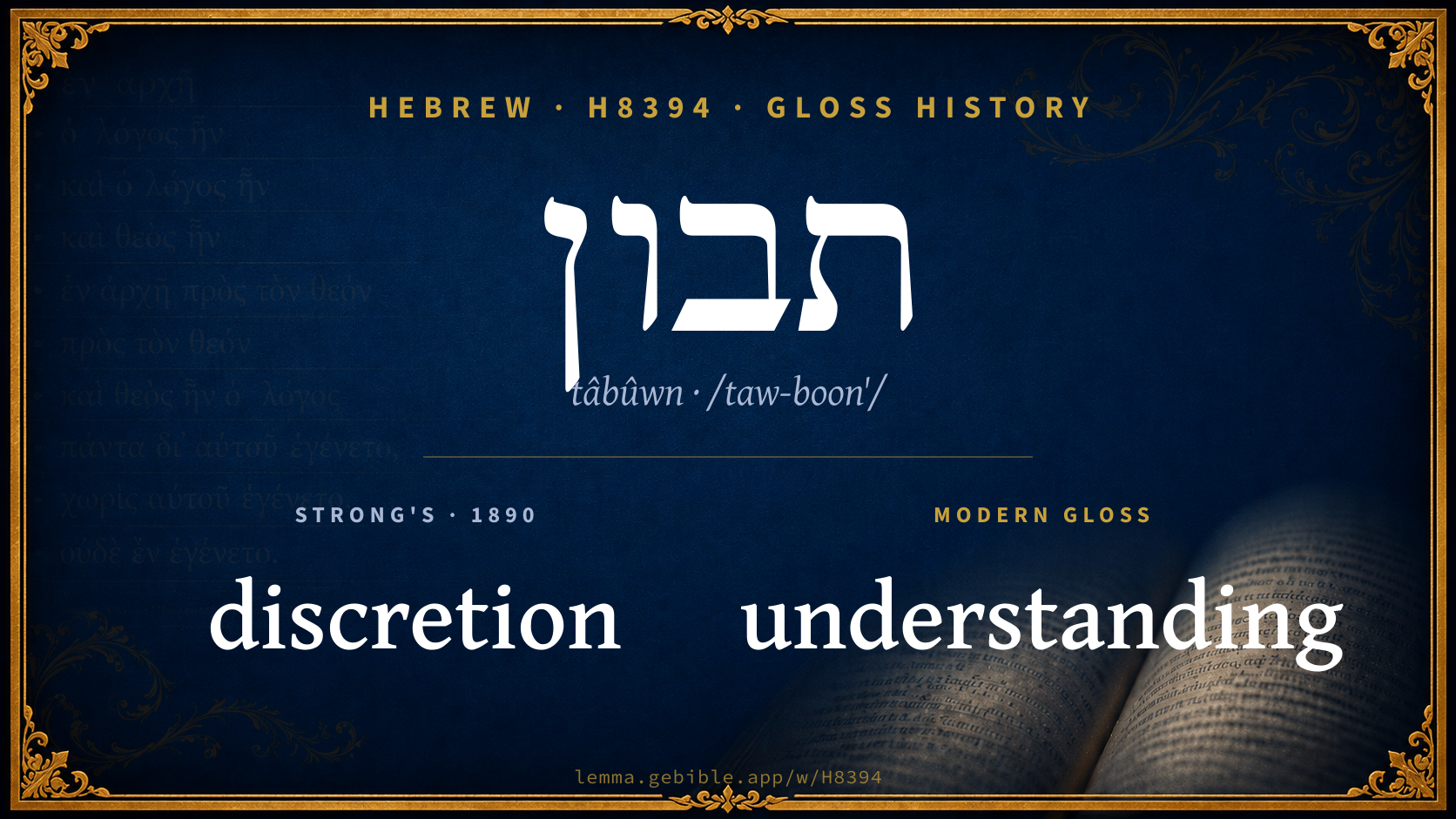
Gloss history
Strong's 1890 vs modern scholarship
About this word
Strong's H8394 catalogs a Hebrew word from the Hebrew Old Testament.
These counts are not copied from any lexicon or concordance. They are computed here, from the morphology-tagged Hebrew Old Testament. What Lemma adds →
- 42
- distinct verses
- The word appears in 42 distinct verses.
- 11 / 39
- OT books
- The word appears in 11 of 39 Old Testament books.
- #837
- by frequency
- Top 1000 most frequent Hebrew words (rank 837 of 8,640 Hebrew words by occurrence).
View all 42 occurrences in the concordance →
By section of the Old Testament
By traditional corpus
Conventional, traditional groupings — biblical authorship is debated, so this is a traditional corpus grouping, not an authorship claim. Each share is this word’s portion of its verses in that division of the Hebrew canon. Each figure is a share of the word’s 42 distinct verses.
- Writings (Ketuvim) 27 verses · 64%
- Prophets (Nevi'im) 11 verses · 26%
- Torah (Pentateuch) 4 verses · 10%
How translations render this word
Counts come from each version’s own published word-to-Strong’s tagging or interlinear alignment — an approximate guide to how each version renders this word, not a word-level alignment the data otherwise carries. Because each total is that version’s own tagged count, the per-version totals vary from one another and need not match the appearance or distinct-verse counts above. These counts may also differ from a printed concordance because Lemma counts each distinctly tagged rendering and does not collapse phrase taggings into a single head-word total. This is a fixed set of word-tagged versions (KJV, ASV, BSB, ULT) and does not change with the reading translation you choose elsewhere. Each version’s license is shown beside its name below (and on Sources).
- King James Version: Understanding 33×
- American Standard Version: Understanding 32×
- Berean Standard Bible: Understanding 27×, Ability 3×, Insight 3×
- unfoldingWord Literal Text: Understanding 35×, And 2×
King James Version Public Domain
Renders H8394 across 42 tagged occurrences — most commonly:
Plus 9 renderings that appear only once — usually multi-word phrases or single function words the recovered tagging swept in, not distinct renderings. Not rendered by a distinct English word in 1 further occurrence.
American Standard Version Public Domain
Renders H8394 across 39 tagged occurrences — most commonly:
Plus 7 renderings that appear only once — usually multi-word phrases or single function words the recovered tagging swept in, not distinct renderings.
Berean Standard Bible Public Domain
Renders H8394 across 42 tagged occurrences — most commonly:
Plus 9 renderings that appear only once — usually multi-word phrases or single function words the recovered tagging swept in, not distinct renderings.
unfoldingWord Literal Text CC BY-SA 4.0
Renders H8394 across 45 tagged occurrences — most commonly:
Plus 8 renderings that appear only once — usually multi-word phrases or single function words the recovered tagging swept in, not distinct renderings.
Senses in the full BDB
What do BDB’s symbols mean?
BDB uses these scholarly abbreviations:
| Symbol | Meaning |
|---|---|
| 𝔊 | the Septuagint (the ancient Greek translation, LXX) |
| 𝔙 | the Vulgate (the Latin translation) |
| 𝔖 | the Syriac version (the Peshitta) |
| 𝔗 | the Targum (the Aramaic translation) |
| ψ | the Psalms |
| √ | root (the underlying root or stem) |
| ‖ | parallel passage (a synonymous or contrasted parallel) |
| † | the dagger: every passage where the word occurs is cited |
The 4 senses and sub-senses the full Brown-Driver-Briggs lexicon distinguishes for this word, in lexicon order (not ranked by frequency), with BDB’s own verbatim wording and sub-sense lettering. Shown in Hebrew script with BDB’s own scholarly abbreviations. The condensed entry is in the Lexicon Entry tab. See also the Forms in the corpus table below.
- 1. the act
- 2. the faculty
- 3. the object of knowledge
- 4. personified as teacher.
Senses from the full Brown-Driver-Briggs lexicon (Brown, Driver, Briggs; Oxford 1906 — public domain), digitized via Sefaria, supplemented by the OpenScriptures HebrewLexicon (CC BY 4.0). Full attribution on Sources.
Word origin
Derived from בין (bîyn) (H995) — to understand.
Forms in the corpus
The 33 distinct written forms H8394 takes in the Hebrew Bible, most frequent first — each parse links to that state’s occurrences in the concordance. Hebrew forms include their vowel points and cantillation, so a single lemma takes many written forms.
Same root — word family
Other BDB entries built from the same root as H8394, grouped by Strong’s listed origin. These share a root / origin per the lexicon — not necessarily a shared meaning. Each links to that word’s own entry.
Derives from
Shares the same root
- בין bêyn H996 between
- בינה bîynâh H998 understanding
- מבון mâbôwn H4000 ones who taught, ones who gave
Proper names from this root
People and places named from this root — a name, not an additional meaning of the word.
Compare all same-root words → Showing 4 of 7 — not the complete family. 2 of the same-root words are proper names (people or places). They share a root, not necessarily a meaning.
Septuagint verse parallels
This word appears in 40 verses that also exist in the Greek Old Testament (Septuagint), out of the 42 Hebrew verses it occurs in. You can read those verses in Greek by switching the Old Testament edition to the Septuagint.
Read these verses in the Septuagint
- Exodus 31:3
- Deuteronomy 32:28
- 1 Kings 7:14
- Job 12:12
- Psalms 49:3
- Proverbs 2:2
- Isaiah 40:14
- Jeremiah 10:12
- Ezekiel 28:4
- Hosea 13:2
- Obadiah 1:7
This is a verse-level parallel only — the same verses exist in both the Hebrew and Greek Old Testaments. No word-level Hebrew↔Greek correspondence is claimed: the data carries no such alignment, so no Greek word is shown as this Hebrew word’s translation. Coverage is not total — the Septuagint omits the deuterocanon and renumbers the Psalms, so some Hebrew verses have no direct Greek parallel.