
Numbers 30:16

Hebrew (Westminster Leningrad Codex) Numbers 30:16 appears in the Hebrew Old Testament. The text above is from the Westminster Leningrad Codex. Each word links to its Strong’s number, a concise gloss, and parsing drawn from the Open Scriptures Hebrew Bible morphology. Click any word for its full Brown-Driver-Briggs (BDB) entry.
Download image
Cite this verse

Numbers 30:16 (World English Bible). Public Domain. Lemma interlinear Bible study tool, https://lemma.gebible.app/v/numbers/30/16.

Show BibTeX & RIS
BibTeX
RIS
English Translation
These are the statutes, which Yahweh commanded Moses, between a man and his wife, between a father and his daughter, being in her youth, in her father's house.
World English Bible · Public Domain
Download a study sheet

One document with this verse’s original text, its word-by-word gloss line, the meaning frame, cross-references with their text, attributed commentary, and full source and license credits — printable, and it pastes into notes with its structure intact.

This verse Autodidact and up

Study sheet (.html) Plain text (.txt)

A passage Seminary Student

Up to 50 verses in one chapter. A passage sheet keeps up to 6 commentary sources and 12 cross-references per verse, in the order this page ranks them, and says so on the sheet whenever that leaves anything out. Ask for a single verse and you get the Autodidact verse sheet above.

Everything on this page stays free to read, with no account — the sheet is a download of what is already on screen, not access to it.

Want to remove ads? Support Godless Engineer
Compare translations 3

The same verse in 3 English versions, stacked beneath the original-language interlinear above. Click any original word for its lexicon entry.

Each is an independent rendering of the whole verse — the interlinear is not word-aligned to these translations.

Highlighted words mark where these versions differ — a whole-verse word diff, not a word-by-word alignment.

  • World English Bible Public Domain
    These are the statutes, which Yahweh commanded Moses, between a man and his wife, between a father and his daughter, being in her youth, in her father's house.
  • King James Version Public Domain
    These are the statutes, which the LORD commanded Moses, between a man and his wife, between the father and his daughter, being yet in her youth in her father's house.
  • unfoldingWord Literal Text CC BY-SA 4.0
    These are the statutes that Yahweh commanded Moses, between a man and his wife, between a father and his daughter in her youth in the house of her father.

unfoldingWord Literal Text — © unfoldingWord, licensed CC BY-SA 4.0. Word-aligned USFM3 via Door43 (git.door43.org/unfoldingWord/en_ult).

Versions to compare (up to 4)

3 of 4 selected

Show all 18 translations

Every available English version of this verse, each an independent rendering of the whole verse.

  • World English Bible Public Domain
    These are the statutes, which Yahweh commanded Moses, between a man and his wife, between a father and his daughter, being in her youth, in her father's house.
  • Berean Standard Bible Public Domain
    These are the statutes that the LORD commanded Moses concerning the relationship between a man and his wife, and between a father and a young daughter still in his home.
  • Majority Standard Bible Public Domain
    These are the statutes that the LORD commanded Moses concerning the relationship between a man and his wife, and between a father and a young daughter still in his home.
  • King James Version Public Domain
    These are the statutes, which the LORD commanded Moses, between a man and his wife, between the father and his daughter, being yet in her youth in her father's house.
  • American Standard Version (1901) Public Domain
    These are the statutes, which Jehovah commanded Moses, between a man and his wife, between a father and his daughter, being in her youth, in her father's house.
  • Revised Version (1885) Public Domain
    These are the statutes, which the LORD commanded Moses, between a man and his wife, between a father and his daughter, being in her youth, in her father’s house.
  • Geneva Bible (1599) Public Domain
    But if he breake them after that he hath heard them, then shall he beare her iniquitie.
  • Douay-Rheims (1899) Public Domain
    But if he gainsay it after that he knew it, he shall bear her iniquity.
  • Young's Literal Translation Public Domain
    These `are' the statutes which Jehovah hath commanded Moses between a man and his wife, between a father and his daughter, in her youth, `in' the house of her father.
  • Literal Standard Version CC BY-SA 4.0
    These [are] the statutes which YHWH has commanded Moses between a man and his wife, between a father and his daughter, in her youth, [in] the house of her father.
  • Unlocked Literal Bible CC BY-SA 4.0
    These are the statutes that Yahweh commanded Moses to announce—statutes for what is between a man and his wife and between a father and his daughter when she is in her youth in her father's family.
  • unfoldingWord Literal Text CC BY-SA 4.0
    These are the statutes that Yahweh commanded Moses, between a man and his wife, between a father and his daughter in her youth in the house of her father.
  • Darby Bible Public Domain
    These are the statutes, which Jehovah commanded Moses, between a man and his wife, between a father and his daughter, in her youth in her father's house.
  • World Messianic Bible Public Domain
    These are the statutes which the LORD commanded Moses, between a man and his wife, between a father and his daughter, being in her youth, in her father’s house.
  • Webster's Bible Public Domain
    \\30:15\\But if he shall any way make them void after that he hath heard them; then he shall bear her iniquity.
  • Free Bible Version CC BY-SA 4.0
    These are the regulations that the Lord gave to Moses regarding the relationship between a man and his wife, and between a father and a daughter who is young and still living at home.
  • Bible in Basic English Public Domain
    But if at some time after hearing of them, he makes them without force, then he is responsible for her wrongdoing.
  • JPS Tanakh (1917) Public Domain
    (30-17) These are the statutes, which the LORD commanded Moses, between a man and his wife, between a father and his daughter, being in her youth, in her father's house.

Literal Standard Version (2020), Covenant Press — licensed CC BY-SA 4.0. Text via the HelloAO Bible API (eBible.org). Unlocked Literal Bible (unfoldingWord) — licensed CC BY-SA 4.0. Text via the HelloAO Bible API (eBible.org). unfoldingWord Literal Text — © unfoldingWord, licensed CC BY-SA 4.0. Word-aligned USFM3 via Door43 (git.door43.org/unfoldingWord/en_ult). Free Bible Version, Dr. Jonathan Gallagher — licensed CC BY-SA 4.0. Text via the HelloAO Bible API (eBible.org).

Word by word

More ways to search: Search by grammar → Find every occurrence → Compare this word →

Practice this passage: Drill this verse → Learn its vocabulary →

בִּנְעֻרֶ֖יהָ
nâʻûwr
H5271
“in/at · youth · her”
Preposition + Noun, Common, Both, Plural, Construct + Suffix, Personal, 3rd Person, Feminine, Singular
Part of Speech
Preposition + Noun
Type
Common
Gender
Both
Number
Plural
State
Construct
Full BDB Definition

Origin: properly, pass. participle from H5288 as denominative

TWOT: 1389d , 1389e

youth, early life
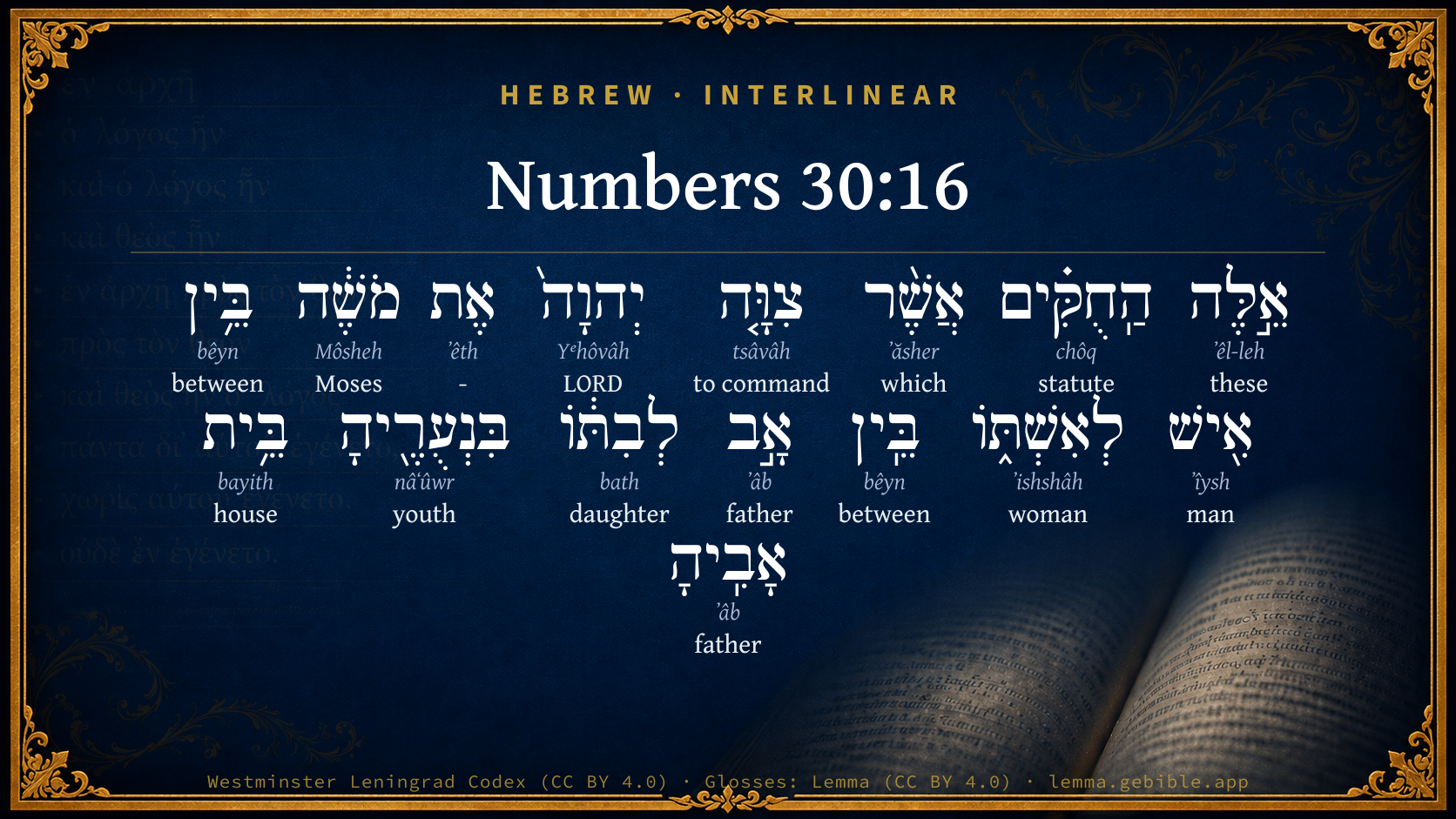
  1. אֵ֣לֶּה ʼêl-leh H428 “these” Pronoun, Demonstrative, Common, Plural
  2. הַֽחֻקִּ֗ים chôq H2706 “the · statutes” Particle, Definite Article + Noun, Common, Masculine, Plural, Absolute
  3. אֲשֶׁ֨ר ʼăsher H834 “which” Particle, Relative
  4. צִוָּ֤ה tsâvâh H6680 “to command” Verb, Piel, Perfect, 3rd Person, Masculine, Singular
  5. יְהוָה֙ Yᵉhôvâh H3068 “LORD” Noun, Proper
  6. אֶת ʼêth H853 “-” Particle, Direct Object
  7. מֹשֶׁ֔ה Môsheh H4872 “Moses” Noun, Proper
  8. בֵּ֥ין bêyn H996 “between” Preposition
  9. אִ֖ישׁ ʼîysh H376 “man” Noun, Common, Masculine, Singular, Absolute
  10. לְאִשְׁתּ֑וֹ ʼishshâh H802 “to/for · woman · his” Preposition + Noun, Common, Feminine, Singular, Construct + Suffix, Personal, 3rd Person, Masculine, Singular
  11. בֵּֽין bêyn H996 “between” Preposition
  12. אָ֣ב ʼâb H1 “father” Noun, Common, Masculine, Singular, Absolute
  13. לְבִתּ֔וֹ bath H1323 “to/for · daughter · his” Preposition + Noun, Common, Feminine, Singular, Construct + Suffix, Personal, 3rd Person, Masculine, Singular
  14. בֵּ֥ית bayith H1004 “house of” Noun, Common, Masculine, Singular, Construct
  15. אָבִֽיהָ ʼâb H1 “father · her” Noun, Common, Masculine, Singular, Construct + Suffix, Personal, 3rd Person, Feminine, Singular

About this verse

These counts appear in no published source. They are computed here, from the morphology-tagged text and Lemma’s own curated glosses. What Lemma adds →

16
words
14
distinct lemmas
Pentateuch
section

Shared distinctive vocabulary

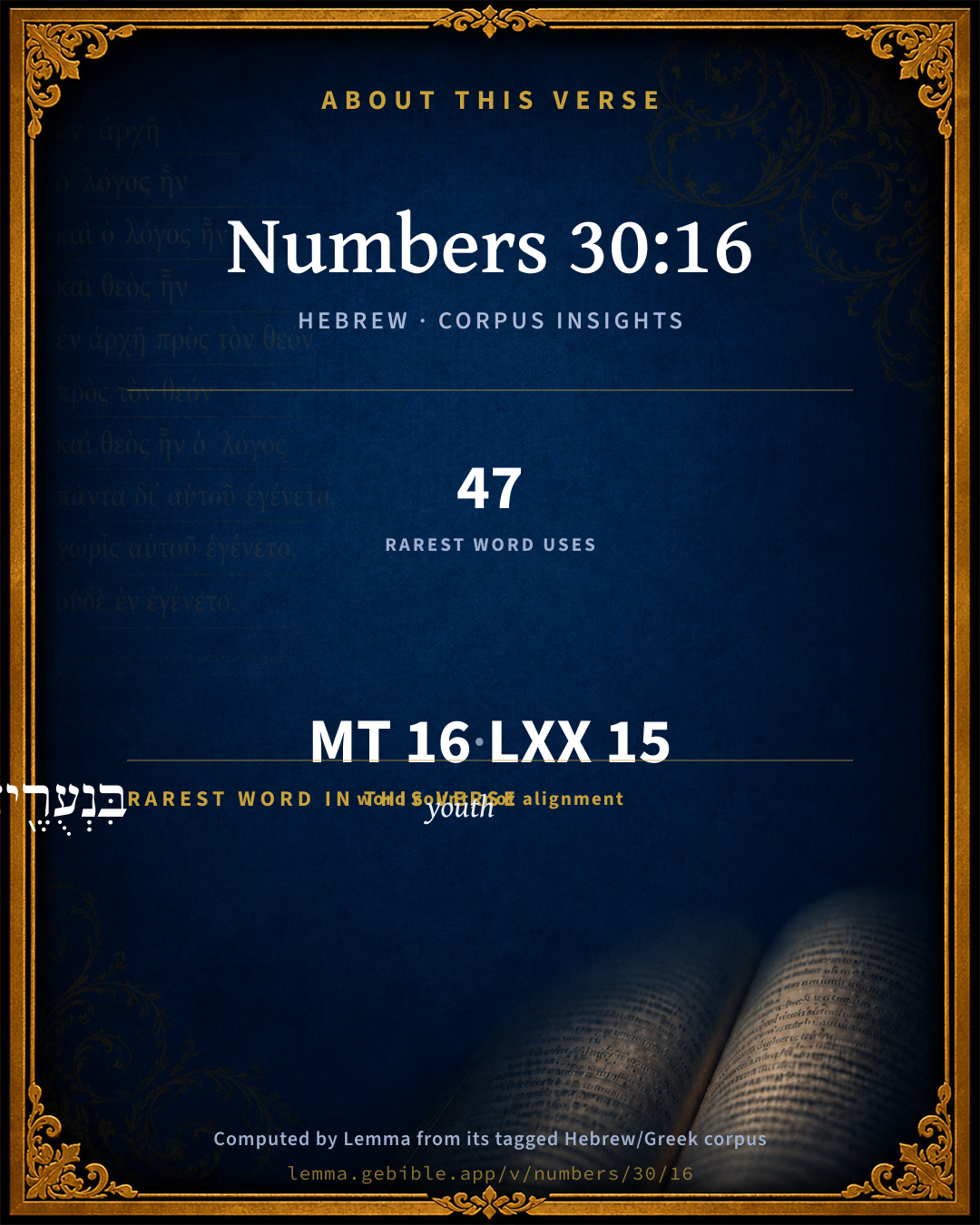
בִּנְעֻרֶ֖יהָ youth H5271 occurs in 46 verses of the Hebrew Bible. Also found in:

Grammatical profile

  • 1 verb
  • 10 nouns
  • 1 pronoun
  • 2 prepositions
  • 2 particles

Verb forms

  • צִוָּ֤ה Piel · Perfect

Repetition

Words recur within this verse — often emphatic in Hebrew:

  • בֵּ֥ין between H996 ×2
  • אָ֣ב father H1 ×2

Hebrew & Septuagint length

In English translation the verse runs 28 words from the Hebrew and 24 from the Septuagint (LXX English) — closely comparable.

A rough comparison of the two English renderings, which tokenize alike — not a word-level alignment.

Word counts can differ between the Hebrew and the Greek without any difference in meaning — e.g. the Hebrew direct-object marker אֵת has no separate Greek word, and Greek often adds the article ὁ.

In the original languages it is 16 Hebrew tokens and 15 Greek tokens — but the two are counted differently (Hebrew bundles its prefixes and suffixes into one token; the Greek is in lemma form), so that isn’t a like-for-like length.

Cross-references

5

Topical passages linked to Numbers 30:16 in the Treasury of Scripture Knowledge — connected by theme and wording, ordered by reader-vote popularity; previews shown in the World English Bible.

  • Leviticus 11:46–47 "'This is the law of the animal, and of the bird, and of every living creature that moves in the waters, and of every creature that creeps on the earth,
  • Leviticus 13:59 This is the law of the plague of mildew in a garment of wool or linen, either in the warp, or the woof, or in anything of skin, to pronounce it clean, or to pronounce it unclean.
  • Leviticus 14:54–57 This is the law for any plague of leprosy, and for an itch,
  • Leviticus 15:32–33 This is the law of him who has a discharge, and of him who has an emission of semen, so that he is unclean thereby;
  • Numbers 5:29–30 "This is the law of jealousy, when a wife, being under her husband, goes astray, and is defiled;

Cross-references courtesy of OpenBible.info (CC BY 4.0).

Hebrew and Greek witnesses Masoretic Hebrew ↔ Greek Septuagint

The same verse in the two great witnesses to the Old Testament, shown verse-for-verse.

These are two independent witnesses, not word-aligned to each other, and the Septuagint is shown in lemma (dictionary) form.

Hebrew Numbers 30:16 Masoretic · Westminster Leningrad Codex

אֵ֣לֶּה הַֽחֻקִּ֗ים אֲשֶׁ֨ר צִוָּ֤ה יְהוָה֙ אֶת מֹשֶׁ֔ה בֵּ֥ין אִ֖ישׁ לְאִשְׁתּ֑וֹ בֵּֽין אָ֣ב לְבִתּ֔וֹ בִּנְעֻרֶ֖יהָ בֵּ֥ית אָבִֽיהָ

These are the statutes, which Yahweh commanded Moses, between a man and his wife, between a father and his daughter, being in her youth, in her father's house.

World English Bible · Public Domain

Greek LXX Numbers 30:16 Septuagint · lemma form

ἐάν δέ περιαἱρέω περιαἱρέω αὐτός μετά ὁ ἡμέρα ὅς ἀκούω καί λαμβάνω ὁ ἁμαρτία αὐτός

And if her husband should in any wise cancel them after the day in which he heard them, then he shall bear his iniquity.

LXX2012 (modern English Septuagint) · Public Domain

On this verse, Haydock's Catholic Bible Commentary discusses the Septuagint’s reading. Read the note in Commentary ↓

Hebrew: Westminster Leningrad Codex (CC BY 4.0). Greek: Septuagint (public domain); English from LXX2012 (modern English Septuagint) (Public Domain). How the Septuagint differs from the Hebrew →

Targum (Aramaic paraphrase)

2

The Targum is the ancient Jewish Aramaic paraphrase of the Hebrew Scriptures — an interpretive translation, not the Hebrew text itself. Onkelos (literal) and Pseudo-Jonathan (expansive) render the Torah, and Jonathan the Prophets. Coverage is partial: where no permissively-licensed English translation exists for a verse, only the Aramaic is shown. This is verse-level text, not a word-by-word alignment to the Hebrew.

  1. Targum Onkelos Torah (Genesis–Deuteronomy)
    וְעִם בַּטָלָא יְבַטֵּל יָתְהוֹן בָּתַר דִשְׁמָע וִיקַבַּל יָת חוֹבַהּ

    (no public-domain English translation for this verse)

    Targum Onkelos — Aramaic: “Onkelos Genesis” (public domain); “Onkelos Exodus” (public domain); “Onkelos Leviticus” (public domain); “Onkelos Numbers” (public domain); “Onkelos Deuteronomy” (public domain). English: “Sefaria Community Translation” (CC0 1.0 (public-domain dedication)); “J.W. Etheridge. The Targums of Onkelos and Jonathan Ben Uzziel on the Pentateuch. London: Longmans, Green, 1862” (public domain). Text via Sefaria.

  2. Targum Pseudo-Jonathan Torah (Genesis–Deuteronomy)
    וְאִין מֵישְׁרָא יִשְׁרֵי לָהּ יוֹמָא חַד בָּתַר דְשָׁמַע לָא סַגְיָא לָהּ בְּשֵׁירוּתָא וְאִין מַפְסָא פִתְגָמָא בַּעֲלָהּ אוֹ אִיבָהּ מְקַבֵּל יַת חוֹבָהּ

    But if, absolving, he would absolve her one day after he had heard, there is no force in the absolution; and if he then nullify the word, her husband or her father shall bear her sin.

    Targum Pseudo-Jonathan — Aramaic: “Targum Jonathan on Genesis” (public domain); “Targum Jonathan on Exodus” (public domain); “Targum Jonathan on Leviticus” (public domain); “Targum Jonathan on Numbers” (public domain); “Targum Jonathan on Deuteronomy” (public domain). English: “The Targum of Jonathan ben Uzziel, trans. J. W. Etheridge, London, 1862” (public domain). Text via Sefaria.

Commentary

Notes on Numbers 30:16 from classic Christian and Jewish commentators (each source and its license shown beneath its notes). The classic Christian expositions comment on the surrounding passage and are grouped to its opening verse, so a note may address several verses; the Jewish commentaries on the Tanakh (Rashi and others) are per-verse, so they appear only where the commentator wrote on this verse.

Lemma curates 59 commentaries, every one of them public domain or Creative Commons licensed, each selected and text-cleaned for this edition rather than reprinted as found. About our sources →

Keil & Delitzsch

C. F. Keil & F. Delitzsch

Num 30:16, concluding formula.

Keil & Delitzsch — Biblical Commentary on the Old Testament (1861–1891) — public domain (CC PDM 1.0). Text via the HelloAO Bible API. (Old Testament only.)

Geneva Bible (1599)

Geneva Bible translators

Not the same day he heard them, but some day after, the sin shall be imputed to him and not to her.

Geneva Bible (1599) marginal notes — public domain. Text via Bolls.life.

Adam Clarke's Commentary

Verse 16. These are the statutes] It is very probable that this law, like that concerning the succession of daughters, (Nu 27:1-11), rose from the exigency of some particular case that had just then occurred.

Making vows, in almost any case, is a dangerous business; they seldom do any good, and often much evil. He who does not feel himself bound to do what is fit, right, and just, from the standing testimony of God's word, is not likely to do it from any obligation he may lay upon his own conscience. If God's word lack weight with him, his own will prove lighter than vanity. Every man who professes the Christian religion is under the most solemn obligation to devote body, soul, and spirit to God, not only to the utmost extent of his powers, but also as long as he exists. Being baptized, and receiving the sacrament of the Lord's Supper, are additional ratifications of the great, general, Christian vow; but every true follower of Christ should always remember, and frequently renew, his covenant with God.

Adam Clarke's Commentary on the Bible (1810–1826) — public domain. Text from a community e-Sword/MySword module.

John Gill's Exposition

These are the statutes which the Lord commanded Moses between a man and his wife,.... Relating to vows made by the wife, and confirmed or disannulled by the husband: Aben Ezra adds, if she is at age or in puberty, understanding it of a married and not a betrothed wife:

between the father and his daughter; if she is not at age, as the same writer observes; for if she is at age he has nothing to do with her vows:

being yet in her youth; not at age, being not twelve years and one day old:

in her father's house; in his power and jurisdiction, and at his disposal, and so could make her vows void or firm, as he pleased: this power of ratifying or disannulling vows an husband had over his wife, and a father over his daughter, to prevent imprudent and extravagant vows, and the too frequent use of them, the consequences of which might be bad in families.

Next: Numbers Chapter 31

John Gill's Exposition of the Whole Bible (1746–1763) — public domain (CC PDM 1.0). Text via the HelloAO Bible API.

Haydock's Catholic Bible Commentary

That. Septuagint, "the day." If he retract his consent, he shall incur all the guilt. (St. Augustine, q. 59.) The woman need not be under any disquietude, as the fault is not in her. (Calmet) --- If a person had made a rash vow, he might obtain a dispensation from the tribunal of three judges, or from a doctor of the law, who would enjoin him to offer the sacrifice for ignorance, to punish his levity. See Selden, Jur. vii. 2. Those who break their vow are to be scourged among the Jews, which shews that they do not, in general, approve the sentiments of those Rabbins whom Fagius, a Protestant, alleges, ver. 3. They make a distinction between vows and promises confirmed by an oath, ver. 11. The former change the nature of a thing, according to them; so that, if a person should vow not to wear the phylacteries ordained by Moses, he must comply, though not if he had only promised on oath to refrain. But this distinction is absurd. No vow or oath can bind any person to transgress the law of God. (Haydock)

George Leo Haydock (1774–1849), Haydock's Catholic Family Bible and Commentary, 1859 edition — public domain. Excludes Psalms (Douay-Rheims chapter numbering differs from Protestant) and Deuterocanonical books (Catholic canon only).

Rashi

Rabbi Shlomo Yitzchaki (Rashi)

אחרי שמעו [BUT IF HE SHALL AT ALL ANNUL THEM] AFTER HE HATH HEARD THEM i.e., after he has heard and confirmed them — that he had said, “I am content with it”, then if he turns and annuls it even on the same day (Sifrei Bamidbar 156:2).

ונשא את עונה HE SHALL BEAR HER INIQUITY — He takes her place. We learn from here that he who makes another take a false step takes his place in respect to all punishments which he would incur (Sifrei Bamidbar 156:2).

Rashi on the Tanakh — English translations: “The Judaica Press complete Tanach with Rashi, translated by A. J. Rosenberg” (CC BY 4.0); “Pentateuch with Rashi's commentary by M. Rosenbaum and A.M. Silbermann, 1929-1934” (public domain); “The Metsudah Tanach series, Lakewood, N.J” (CC BY 4.0); and “The Book of Joshua, Metsudah Publications, 1997” (CC BY 4.0). Text via Sefaria.

Ramban (Nachmanides)

Rabbi Moshe ben Nachman (Ramban / Nachmanides)

[BUT IF HE SHALL MAKE THEM NULL AFTER THAT HE HATH HEARD THEM], THEN HE SHALL BEAR HER INIQUITY — “he [the husband] takes her place.. Ramban presents another interpretation. Thus we learn that one who causes somebody else to commit an offense takes the place of that person with respect to all punishments [which that person would otherwise incur].” This is Rashi’s language, taken from the Sifre. 156. It would appear that this woman [broke her vow] in error or was misled, for Scripture speaks [here] of a husband who heard [his wife’s vow and did not annul it on that day], and the wife does not know about this, and after some time he “annulled” [the vow, although he in fact no longer had the power to do so], and told her that [he annulled it] in the day he heard it. Thus Scripture teaches us two things: that the husband bears her iniquity as if he had made a vow and profaned his word, and that she is totally free and not liable to any of the punishments [found elsewhere] for errors. But if the wife knows that he [her husband] did not annul it in the day he heard it, and she is versed in this law [that he only has a right to annul her vows on the day that he hears it, and not later, and nonetheless she breaks her vow], then she is the guilty one, and [since] the husband did not cause the offense, therefore his punishment is [only] like that of someone who can protest [at another person committing a sin] and does not protest.Now Scripture mentions this case with reference to a husband [misleading his wife to think that he annulled her vow in the day he heard it, when in actual fact he “annulled” it only afterwards when he no longer had the right to], although the same law applies to a father [and his daughter’s vows], because Scripture speaks of normal circumstances, that a father usually guards himself against doing this because of his love for his daughter, whereas a husband might perhaps hate his wife and think that he will make her guilty [by misleading her to break her vow]. Now Rabbi Abraham ibn Ezra wrote: “Then he shall bear her iniquity, because she is under his control.” If so, the verse is speaking of a case where he forces her to do that which she has bound herself [not to do, and it is then that he shall bear her iniquity]. But it is not correct [since the same laws obviously apply when he misleads her without actually forcing her].

Ramban (Nachmanides) on the Tanakh — English translation: “Commentary on the Torah by Ramban (Nachmanides). Translated and annotated by Charles B. Chavel. New York, Shilo Pub. House, 1971-1976” (CC BY 4.0). Text via Sefaria.

Sforno

Rabbi Ovadia Sforno

If he annuls them after having heard them. I.e., after the day in which he heard them, upon which he is no longer able to annul them.

He must bear her transgression. As the judgment of anyone who forces his fellow man to transgress or instructs him falsely and leads him astray.

Sforno on the Tanakh — English translation: “Yalkut, Sifsei Chachomim Chumash, Metsudah Publications, 2009” (CC BY 4.0). Text via Sefaria.

Lesson kit

Teaching starters — assembled from the data on this page, not authored interpretation. Every prompt links to the verse data it draws on. Edit before teaching.

Numbers, in the Pentateuch, opens this verse with 16 words (14 distinct Hebrew lemmas). Its most distinctive word is nâʻûwr (“youth”). A historical commentator’s framing appears above. Read the whole chapter for the surrounding context.

Discussion questions

  1. What does “youth” (nâʻûwr) contribute to the verse as a whole?
  2. Genesis 8:21 shares the word «youth» with this verse. How do the two illuminate each other?
  3. “between” occurs 2× in this one verse. What is the effect of the repetition?
  4. The translations on this page render this verse differently — a whole-verse word diff, not a word-by-word alignment. What might account for the different wordings?
  5. The verb «צִוָּ֤ה» is Piel Perfect. How does its form color the action?
  6. Reading how Keil & Delitzsch and Geneva Bible (1599) read this verse, where do the two commentators agree and where do they part?

Things to notice

Reading settings

Reading text

Shown beneath each verse's original-language words.

Old Testament
Old Testament edition

Read the OT as the Masoretic Hebrew (MT) or the Greek Septuagint (LXX).

English shown for the Greek Septuagint (in the Hebrew ↔ Greek comparison).

Comparing translations? Open the Compare panel on any verse page to stack up to four side by side.