
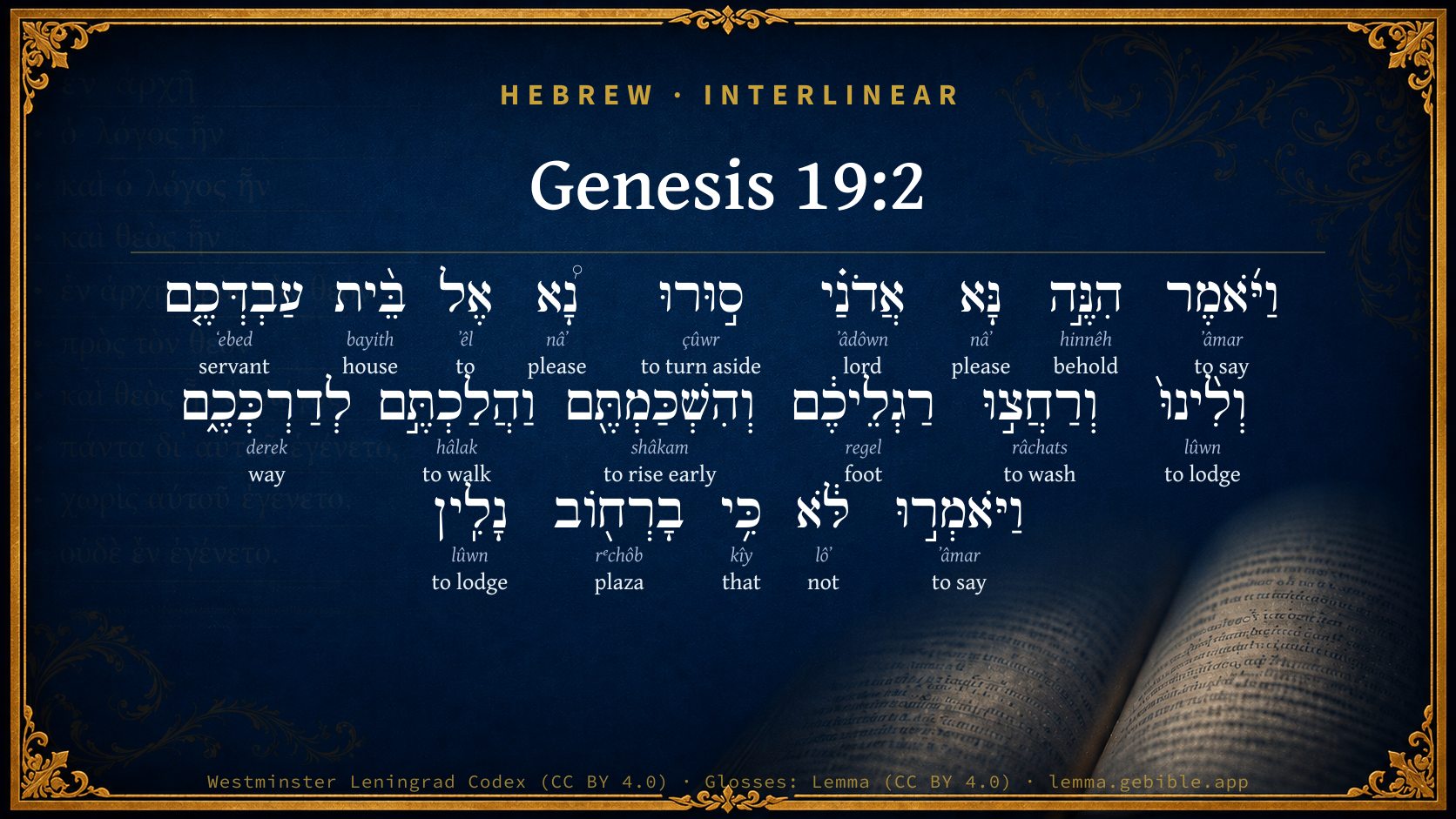
Genesis 19:2

Hebrew (Westminster Leningrad Codex) Genesis 19:2 appears in the Hebrew Old Testament. The text above is from the Westminster Leningrad Codex. Each word links to its Strong’s number, a concise gloss, and parsing drawn from the Open Scriptures Hebrew Bible morphology. Click any word for its full Brown-Driver-Briggs (BDB) entry.
Download image
Cite this verse

Genesis 19:2 (World English Bible). Public Domain. Lemma interlinear Bible study tool, https://lemma.gebible.app/v/genesis/19/2.

Show BibTeX & RIS
BibTeX
RIS
English Translation
and he said, "See now, my lords, please turn aside into your servant's house, stay all night, wash your feet, and you will rise up early, and go on your way." They said, "No, but we will stay in the street all night."
World English Bible · Public Domain
Highlights
  • 3 first appearances in the Hebrew Bible
Full analysis ↓
Download a study sheet

One document with this verse’s original text, its word-by-word gloss line, the meaning frame, cross-references with their text, attributed commentary, and full source and license credits — printable, and it pastes into notes with its structure intact.

This verse Autodidact and up

Study sheet (.html) Plain text (.txt)

A passage Seminary Student

Up to 50 verses in one chapter. A passage sheet keeps up to 6 commentary sources and 12 cross-references per verse, in the order this page ranks them, and says so on the sheet whenever that leaves anything out. Ask for a single verse and you get the Autodidact verse sheet above.

Everything on this page stays free to read, with no account — the sheet is a download of what is already on screen, not access to it.

Want to remove ads? Support Godless Engineer
Compare translations 3

The same verse in 3 English versions, stacked beneath the original-language interlinear above. Click any original word for its lexicon entry.

Each is an independent rendering of the whole verse — the interlinear is not word-aligned to these translations.

Highlighted words mark where these versions differ — a whole-verse word diff, not a word-by-word alignment.

  • World English Bible Public Domain
    and he said, "See now, my lords, please turn aside into your servant's house, stay all night, wash your feet, and you will rise up early, and go on your way." They said, "No, but we will stay in the street all night."
  • King James Version Public Domain
    And he said, Behold now, my lords, turn in, I pray you, into your servant's house, and tarry all night, and wash your feet, and ye shall rise up early, and go on your ways. And they said, Nay; but we will abide in the street all night.
  • unfoldingWord Literal Text CC BY-SA 4.0
    Then he said, “Behold, please, my lords: Please turn aside to the house of your servant and spend the night, and wash your feet. Then you can get up early and go on your way.” But they said, “No, rather we will spend the night in the street.”

unfoldingWord Literal Text — © unfoldingWord, licensed CC BY-SA 4.0. Word-aligned USFM3 via Door43 (git.door43.org/unfoldingWord/en_ult).

Versions to compare (up to 4)

3 of 4 selected

Show all 18 translations

Every available English version of this verse, each an independent rendering of the whole verse.

  • World English Bible Public Domain
    and he said, "See now, my lords, please turn aside into your servant's house, stay all night, wash your feet, and you will rise up early, and go on your way." They said, "No, but we will stay in the street all night."
  • Berean Standard Bible Public Domain
    and said, “My lords, please turn aside into the house of your servant; wash your feet and spend the night. Then you can rise early and go on your way.” “No,” they answered, “we will spend the night in the square.”
  • Majority Standard Bible Public Domain
    and said, “My lords, please turn aside into the house of your servant; wash your feet and spend the night. Then you can rise early and go on your way.” “No,” they answered, “we will spend the night in the square.”
  • King James Version Public Domain
    And he said, Behold now, my lords, turn in, I pray you, into your servant's house, and tarry all night, and wash your feet, and ye shall rise up early, and go on your ways. And they said, Nay; but we will abide in the street all night.
  • American Standard Version (1901) Public Domain
    and he said, Behold now, my lords, turn aside, I pray you, into your servant's house, and tarry all night, and wash your feet, and ye shall rise up early, and go on your way. And they said, Nay; but we will abide in the street all night.
  • Revised Version (1885) Public Domain
    and he said, Behold now, my lords, turn aside, I pray you, into your servant’s house, and tarry all night, and wash your feet, and ye shall rise up early, and go on your way. And they said, Nay; but we will abide in the street all night.
  • Geneva Bible (1599) Public Domain
    And he saide, See my Lords, I pray you turne in nowe into your seruants house, and tarie all night, and wash your feete, and ye shall rise vp early and goe your wayes. Who saide, Nay, but we will abide in the streete all night.
  • Douay-Rheims (1899) Public Domain
    And said: I beseech you, my lords, turn in to the house of your servant, and lodge there: wash your feet, and in the morning you shall go on your way. And they said: No, but we will abide in the street.
  • Young's Literal Translation Public Domain
    and he saith, `Lo, I pray you, my lords, turn aside, I pray you, unto the house of your servant, and lodge, and wash your feet -- then ye have risen early and gone on your way;' and they say, `Nay, but in the broad place we do lodge.'
  • Literal Standard Version CC BY-SA 4.0
    and he says, “Now behold, my lords, please turn aside to the house of your servant, and lodge, and wash your feet—then you have risen early and gone on your way”; and they say, “No, but we lodge in the broad place.”
  • Unlocked Literal Bible CC BY-SA 4.0
    He said, “Please my masters, I urge you to turn aside into your servant's house, stay for the night, and wash your feet. Then you can rise up early and go on your way.” They replied, “No, we will spend the night in the town square.”
  • unfoldingWord Literal Text CC BY-SA 4.0
    Then he said, “Behold, please, my lords: Please turn aside to the house of your servant and spend the night, and wash your feet. Then you can get up early and go on your way.” But they said, “No, rather we will spend the night in the street.”
  • Darby Bible Public Domain
    and he said, Behold now, my lords, turn in, I pray you, into your servant's house, and lodge, and wash your feet; and ye shall rise up early, and go on your way. And they said, No; but we will pass the night in the open place.
  • World Messianic Bible Public Domain
    and he said, “See now, my lords, please come into your servant’s house, stay all night, wash your feet, and you can rise up early, and go on your way.” They said, “No, but we will stay in the street all night.”
  • Webster's Bible Public Domain
    And he said, Behold now, my lords, turn, I pray you, into your servant's house, and tarry all night, and wash your feet, and ye shall rise early, and go on your ways. And they said, Nay; but we will abide in the street all night.
  • Free Bible Version CC BY-SA 4.0
    “Sirs, please come and stay with me for the night,” he said. “You can wash your feet and then be on your way early in the morning.” They replied, “No, it's fine. We'll spend the night here in the square.”
  • Bible in Basic English Public Domain
    And he said, My masters, come now into your servant's house and take your rest there for the night, and let your feet be washed; and early in the morning you may go on your way. And they said, Not so, but we will take our night's rest in the street.
  • JPS Tanakh (1917) Public Domain
    and he said: 'Behold now, my lords, turn aside, I pray you, into your servant's house, and tarry all night, and wash your feet, and ye shall rise up early, and go on your way.' And they said: 'Nay; but we will abide in the broad place all night.'

Literal Standard Version (2020), Covenant Press — licensed CC BY-SA 4.0. Text via the HelloAO Bible API (eBible.org). Unlocked Literal Bible (unfoldingWord) — licensed CC BY-SA 4.0. Text via the HelloAO Bible API (eBible.org). unfoldingWord Literal Text — © unfoldingWord, licensed CC BY-SA 4.0. Word-aligned USFM3 via Door43 (git.door43.org/unfoldingWord/en_ult). Free Bible Version, Dr. Jonathan Gallagher — licensed CC BY-SA 4.0. Text via the HelloAO Bible API (eBible.org).

Word by word

More ways to search: Search by grammar → Find every occurrence → Compare this word →

Practice this passage: Drill this verse → Learn its vocabulary →

בָרְח֖וֹב
rᵉchôb
H7339
“in/at the · plaza”
Preposition, Determined + Noun, Common, Feminine, Singular, Absolute
Part of Speech
Preposition + Noun
Type
Common
Gender
Feminine
Number
Singular
State
Absolute
Full BDB Definition

Origin: from H7337

TWOT: 2143d

broad or open place or plaza
  1. וַיֹּ֜אמֶר ʼâmar H559 “and · to say” Conjunction + Verb, Qal, Sequential Imperfect, 3rd Person, Masculine, Singular
  2. הִנֶּ֣ה hinnêh H2009 “behold” Particle, Demonstrative
  3. נָּא nâʼ H4994 “please” Particle, Interjection
  4. אֲדֹנַ֗י ʼâdôwn H113 “lords · my” Noun, Common, Masculine, Plural, Construct + Suffix, Personal, 1st Person, Common, Singular
  5. ס֣וּרוּ çûwr H5493 “turn aside” Verb, Qal, Imperative, 2nd Person, Masculine, Plural
  6. נָ֠א nâʼ H4994 “please” Particle, Exhortation
  7. אֶל ʼêl H413 “to” Preposition
  8. בֵּ֨ית bayith H1004 “house of” Noun, Common, Masculine, Singular, Construct
  9. עַבְדְּכֶ֤ם ʻebed H5650 “servant · your” Noun, Common, Masculine, Singular, Construct + Suffix, Personal, 2nd Person, Masculine, Plural
  10. וְלִ֨ינוּ֙ lûwn H3885 “and · lodge” Conjunction + Verb, Qal, Imperative, 2nd Person, Masculine, Plural
  11. וְרַחֲצ֣וּ râchats H7364 “and · wash” Conjunction + Verb, Qal, Imperative, 2nd Person, Masculine, Plural
  12. רַגְלֵיכֶ֔ם regel H7272 “feet · your” Noun, Common, Feminine, Dual, Construct + Suffix, Personal, 2nd Person, Masculine, Plural
  13. וְהִשְׁכַּמְתֶּ֖ם shâkam H7925 “and · to rise early” Conjunction + Verb, Hiphil, Perfect, 2nd Person, Masculine, Plural
  14. וַהֲלַכְתֶּ֣ם hâlak H1980 “and · to walk” Conjunction + Verb, Qal, Perfect, 2nd Person, Masculine, Plural
  15. לְדַרְכְּכֶ֑ם derek H1870 “to/for · way · your” Preposition + Noun, Common, Both, Singular, Construct + Suffix, Personal, 2nd Person, Masculine, Plural
  16. וַיֹּאמְר֣וּ ʼâmar H559 “and · to say” Conjunction + Verb, Qal, Sequential Imperfect, 3rd Person, Masculine, Plural
  17. לֹּ֔א lôʼ H3808 “not” Particle, Negative
  18. כִּ֥י kîy H3588 “that” Conjunction
  19. נָלִֽין lûwn H3885 “to lodge” Verb, Qal, Imperfect, 1st Person, Common, Plural

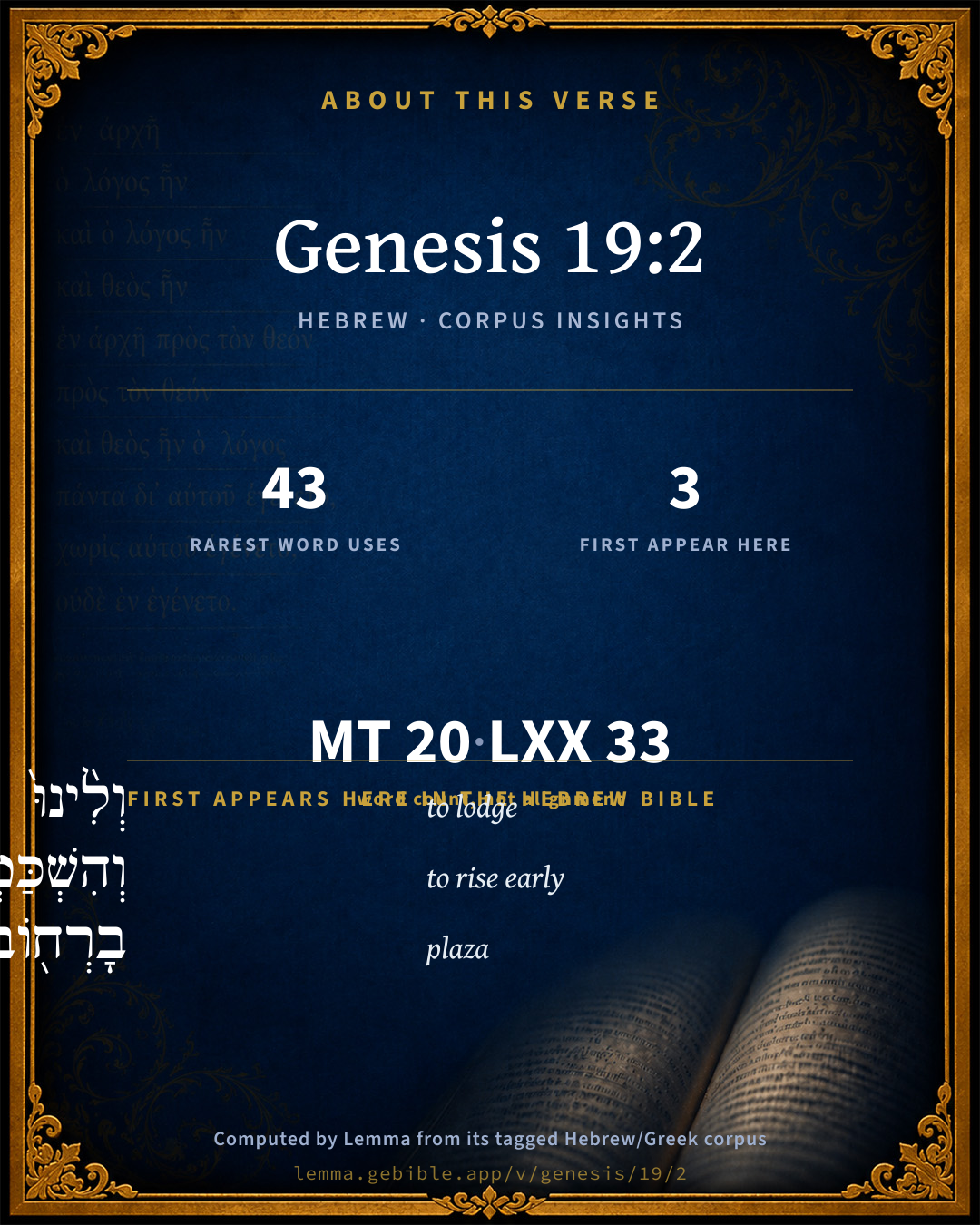
About this verse

These counts appear in no published source. They are computed here, from the morphology-tagged text and Lemma’s own curated glosses. What Lemma adds →

20
words
17
distinct lemmas
Pentateuch
section

First appearance in Scripture

These words make their first canonical appearance in the Hebrew Bible here:

  • וְלִ֨ינוּ֙ to lodge H3885
  • וְהִשְׁכַּמְתֶּ֖ם to rise early H7925
  • בָרְח֖וֹב plaza H7339

Shared distinctive vocabulary

בָרְח֖וֹב plaza H7339 occurs in 41 verses of the Hebrew Bible. Also found in:

Grammatical profile

  • 8 verbs
  • 6 nouns
  • 1 preposition
  • 1 conjunction
  • 4 particles

Verb forms

  • וַיֹּ֜אמֶר Qal · Sequential Imperfect
  • ס֣וּרוּ Qal · Imperative
  • וְלִ֨ינוּ֙ Qal · Imperative
  • וְרַחֲצ֣וּ Qal · Imperative
  • וְהִשְׁכַּמְתֶּ֖ם Hiphil · Perfect
  • וַהֲלַכְתֶּ֣ם Qal · Perfect
  • וַיֹּאמְר֣וּ Qal · Sequential Imperfect
  • נָלִֽין Qal · Imperfect

Repetition

Words recur within this verse — often emphatic in Hebrew:

  • וַיֹּ֜אמֶר to say H559 ×2
  • נָּא please H4994 ×2
  • וְלִ֨ינוּ֙ to lodge H3885 ×2

Hebrew & Septuagint length

In English translation the verse runs 43 words from the Hebrew and 44 from the Septuagint (LXX English) — closely comparable.

A rough comparison of the two English renderings, which tokenize alike — not a word-level alignment.

Word counts can differ between the Hebrew and the Greek without any difference in meaning — e.g. the Hebrew direct-object marker אֵת has no separate Greek word, and Greek often adds the article ὁ.

In the original languages it is 20 Hebrew tokens and 33 Greek tokens — but the two are counted differently (Hebrew bundles its prefixes and suffixes into one token; the Greek is in lemma form), so that isn’t a like-for-like length.

Cross-references

5

Topical passages linked to Genesis 19:2 in the Treasury of Scripture Knowledge — connected by theme and wording, ordered by reader-vote popularity; previews shown in the World English Bible.

  • Genesis 18:4 Now let a little water be fetched, wash your feet, and rest yourselves under the tree.
  • Luke 24:28–29 They drew near to the village, where they were going, and he acted like he would go further.
  • Acts 16:15 When she and her household were baptized, she begged us, saying, "If you have judged me to be faithful to the Lord, come into my house, and stay." So she persuaded us.
  • Hebrews 13:2 Don't forget to show hospitality to strangers, for in doing so, some have entertained angels without knowing it.
  • Judges 19:17–21 He lifted up his eyes, and saw the wayfaring man in the street of the city; and the old man said, Where go you? and whence come you?

Cross-references courtesy of OpenBible.info (CC BY 4.0).

Hebrew and Greek witnesses Masoretic Hebrew ↔ Greek Septuagint

The same verse in the two great witnesses to the Old Testament, shown verse-for-verse.

These are two independent witnesses, not word-aligned to each other, and the Septuagint is shown in lemma (dictionary) form.

Hebrew Genesis 19:2 Masoretic · Westminster Leningrad Codex

וַיֹּ֜אמֶר הִנֶּ֣ה נָּא אֲדֹנַ֗י ס֣וּרוּ נָ֠א אֶל בֵּ֨ית עַבְדְּכֶ֤ם וְלִ֨ינוּ֙ וְרַחֲצ֣וּ רַגְלֵיכֶ֔ם וְהִשְׁכַּמְתֶּ֖ם וַהֲלַכְתֶּ֣ם לְדַרְכְּכֶ֑ם וַיֹּאמְר֣וּ לֹּ֔א כִּ֥י בָרְח֖וֹב נָלִֽין

and he said, "See now, my lords, please turn aside into your servant's house, stay all night, wash your feet, and you will rise up early, and go on your way." They said, "No, but we will stay in the street all night."

World English Bible · Public Domain

Greek LXX Genesis 19:2 Septuagint · lemma form

καί εἶπον ἰδού κύριος ἐκκλίνω εἰς ὁ οἶκος ὁ παῖς σύ καί καταλύω καί νίπτω ὁ πούς σύ καί ὀρθρίζω ἀποἔρχομαι εἰς ὁ ὁδός σύ εἶπον δέ οὐ ἀλλά ἐν ὁ πλατύς καταλύω

Behold! my lords, turn aside to the house of your servant, and rest from your journey, and wash your feet, and having risen early in the morning you⌃ shall depart on your journey. And they said, Nay, but we will lodge in the street.

LXX2012 (modern English Septuagint) · Public Domain

Hebrew: Westminster Leningrad Codex (CC BY 4.0). Greek: Septuagint (public domain); English from LXX2012 (modern English Septuagint) (Public Domain). How the Septuagint differs from the Hebrew →

Targum (Aramaic paraphrase)

2

The Targum is the ancient Jewish Aramaic paraphrase of the Hebrew Scriptures — an interpretive translation, not the Hebrew text itself. Onkelos (literal) and Pseudo-Jonathan (expansive) render the Torah, and Jonathan the Prophets. Coverage is partial: where no permissively-licensed English translation exists for a verse, only the Aramaic is shown. This is verse-level text, not a word-by-word alignment to the Hebrew.

  1. Targum Onkelos Torah (Genesis–Deuteronomy)
    וַאֲמַר בְּבָעוּ כְעַן רִבּוֹנַי זוּרוּ כְעַן לְבֵית עַבְדְּכוֹן וּבִיתוּ וְאַסְחוּ רַגְלֵיכוֹן וּתְקַדְּמוּן וּתְהָכוּן לְאָרְחֲכוֹן וְאֲמָרוּ לָא אֶלָּהֵן בִּרְחוֹבָא נְבִית

    (no public-domain English translation for this verse)

    Targum Onkelos — Aramaic: “Onkelos Genesis” (public domain); “Onkelos Exodus” (public domain); “Onkelos Leviticus” (public domain); “Onkelos Numbers” (public domain); “Onkelos Deuteronomy” (public domain). English: “Sefaria Community Translation” (CC0 1.0 (public-domain dedication)); “J.W. Etheridge. The Targums of Onkelos and Jonathan Ben Uzziel on the Pentateuch. London: Longmans, Green, 1862” (public domain). Text via Sefaria.

  2. Targum Pseudo-Jonathan Torah (Genesis–Deuteronomy)
    וַאֲמַר בְּבָעוּ כְּדוֹן רִבּוֹנֵי זוֹרוּ כְּדוֹן מִיכָּא וְעוּלוּ לְבֵית עַבְדֵיכוֹן וּבִיתוּ וּשְׁזוּגוּ רִיגְלֵיכוֹן וּתְקַדְמוּן וְתֶהֱכוּן לְאַרְחַתְכוֹן וְאָמְרוּ לָא אֲרֵי בְּשׁוּקָא נְבִית

    and said, I beg now, my lords, turn now hither, and enter the house of your servant, and lodge, and wash your feet; and you will arise and proceed on your way. And they said to him, No; for in the street we will lodge.

    Targum Pseudo-Jonathan — Aramaic: “Targum Jonathan on Genesis” (public domain); “Targum Jonathan on Exodus” (public domain); “Targum Jonathan on Leviticus” (public domain); “Targum Jonathan on Numbers” (public domain); “Targum Jonathan on Deuteronomy” (public domain). English: “The Targum of Jonathan ben Uzziel, trans. J. W. Etheridge, London, 1862” (public domain). Text via Sefaria.

Commentary

Notes on Genesis 19:2 from classic Christian and Jewish commentators (each source and its license shown beneath its notes). The classic Christian expositions comment on the surrounding passage and are grouped to its opening verse, so a note may address several verses; the Jewish commentaries on the Tanakh (Rashi and others) are per-verse, so they appear only where the commentator wrote on this verse.

Lemma curates 59 commentaries, every one of them public domain or Creative Commons licensed, each selected and text-cleaned for this edition rather than reprinted as found. About our sources →

Trapp's Complete Commentary

John Trapp

Gen 19:2 And he said, Behold now, my lords, turn in, I pray you, into your servant’s house, and tarry all night, and wash your feet, and ye shall rise up early, and go on your ways. And they said, Nay; but we will abide in the street all night.

Ver. 2. Nay, but we will abide in the street.] They would have done so, but for Lot’s importunity. So our Saviour would have gone farther, but that the two disciples constrained him to stay. {Luk 24:29} This was no simulation; or if so, yet it was only exploratory, without deceit or hypocrisy. And if Solomon sinned not in making believe he would do that which was unlawful to be done, {1Ki 3:24} it can be no sin to do the like in things indifferent.

John Trapp, A Commentary or Exposition upon All the Books of the Old and New Testament (1647–1656) — public domain. Text from a community e-Sword module.

Joseph Benson's Commentary

Gen 19:2. They said, Nay, but we will abide in the street all night — So they said, not only to give Lot an opportunity of evincing the sincerity and cordiality of his invitation, but because it was their real intention to abide in the street, where they, no doubt, would have abode, if he had not so much urged them to lodge in his house.

Joseph Benson's Commentary on the Old and New Testaments (1811–1818) — public domain. Text from a community e-Sword module.

Jamieson, Fausset & Brown

Robert Jamieson, A. R. Fausset & David Brown

turn in, I pray you . . . tarry all night--offer of the same generous hospitalities as described in Gen 18:2-8, and which are still spontaneously practised in the small towns.

And they said, Nay; but we will abide in the street all night--Where there are no inns and no acquaintance, it is not uncommon for travellers to sleep in the street wrapped up in their cloaks.

Jamieson, Fausset & Brown — Commentary Critical and Explanatory on the Whole Bible (1871) — public domain (CC PDM 1.0). Text via the HelloAO Bible API.

Adam Clarke's Commentary

Verse 2. Nay; but we will abide in the street] Instead of לא lo, nay, some MSS. have לו lo, to him; "And they said unto him, for we lodge in the street." where, nevertheless, the negation is understood. Knowing the disposition of the inhabitants, and appearing in the mere character of travellers, they preferred the open street to any house; but as Lot pressed them vehemently, and they knew him to be a righteous man, not yet willing to make themselves known, they consented to take shelter under his hospitable roof. Our Lord, willing for the time being to conceal his person from the knowledge of the disciples going to Emmaus, made as though he would go farther, Lu 24:13; but at last, like the angels here, yielded to the importunity of his disciples, and went into their lodgings.

Adam Clarke's Commentary on the Bible (1810–1826) — public domain. Text from a community e-Sword/MySword module.

John Calvin's Commentaries

2. Nay, but we will abide in the street. The angels do not immediately assent, in order that they may the more fully investigate the disposition of the holy man. For he was about to bring them to his own house, not merely for the sake of supplying them with a supper, but for the purpose of defending them from the force and injury of the citizens. Therefore the angels act, as if it were safe to sleep on the highway; and thus conceal their knowledge of the abandoned wickedness of the whole people. For if the gates of cities are shut, to prevent the incursions of wild beasts and of enemies; how wrong and absurd it is that they who are within should be exposed to still more grievous dangers? Therefore the angels thus speak, in order to make the wickedness of the people appear the greater. And Lot, in urging the angels to come unto him, for the purpose of protecting them from the common violence of the people, the more clearly shows, how careful he was of his guests, lest they should suffer any dishonor or injury.

John Calvin's Commentaries (1540-1563) — public domain. Text from the Calvin Translation Society English edition (1840s-50s) via the Christian Classics Ethereal Library (ccel.org). Calvin's coverage is partial (roughly two-thirds of the Bible); uncommented books and verses are honest gaps, never fabricated. The 19th-century editor's footnotes and remarks are omitted so the notes are faithfully Calvin's own voice.

Ellicott's Commentary for English Readers

(2) In the street.—That is, the broad open space of the city. (Comp. Jdg_19:15; Jdg_19:20.) In a warm climate there is little hardship in passing the night in the open air; and as at this early date there were no caravanserais, travellers had to lodge in this way unless they found some hospitable entertainer.

A Bible Commentary for English Readers, edited by Charles John Ellicott (1878–1897) — public domain. Text from a community e-Sword module.

The Cambridge Bible for Schools and Colleges

gen. ed. J. J. S. Perowne

2. my lords] adonai. The Massoretic note upon this word is “profane,” i.e. not the Divine name: see note on Gen_18:3.

turn aside] Lot’s words are a good example of Eastern hospitality. Possibly to this passage and Gen_18:3 reference is made in Heb_13:2.

in the street] We must be careful not to connect the modern idea of a “street” with this word, which means rather a wide open space. Cf. Jdg_19:15; Ezr_10:9; Neh_8:1, “the broad place.”

The refusal of “the men” is partly to be explained as a piece of Oriental courtesy, but partly, also, to elicit the avowal that what would be safe in other towns could not be risked in Sodom.

The Cambridge Bible for Schools and Colleges (gen. ed. J. J. S. Perowne; Cambridge University Press, 1878–1918) — public domain. Text from a community e-Sword module.

John Gill's Exposition

And he said, behold now, my lords,.... Taking them to be, and bespeaking them as persons of quality, who appeared with majesty in their countenances, and looked as if they had been well brought up, and were upon their travels; not knowing them to be angels, whom he received and entertained unawares, as the apostle, referring to Lot and Abraham, observes, Heb 13:2,

turn in, I pray you, into your servant's house; meaning himself, who was their humble servant, and entreats them to turn in to his house, which perhaps was hard by, and take up their lodging with him: the ancient Jews (k) give the sense of the phrase thus, go a roundabout, winding, crooked way to my house, that the men of Sodom may not see you go in there, and know you are there. This is taken from the signification of the word to "turn in", which in a different construction signifies to decline, to go back; and so the Targum of Jonathan,"turn here, and there, and go into the house of your servant:"

and tarry all night, and wash your feet; the meaning is, that they would stay all night, and take up their lodging with him, when they had washed their feet, which was usually done before they laid down, and even before they supped; and indeed was the first thing that was done to a stranger upon his entering into the house, Gen 18:4,

and ye shall rise up early, and go on your ways: signifying that he would not detain them longer than they thought fit; they might rise as soon in the morning as they pleased, and pursue their journey, only he entreats they would accept of a night's lodging with him:

and they said, nay, but we will abide in the street all night; which they said partly out of modesty, it not becoming strangers to be too forward in accepting an invitation, and partly to try whether Lot was hearty in the invitation he gave them; and hereby also reigning ignorance of the manners and behaviour of the men of Sodom, as if they might be safe from their insults in the street in the night; and this made Lot the more pressing upon them, that they might not be exposed to his wicked neighbours.

(k) Bereshit Rabba, sect. 50. fol. 44. 4.

John Gill's Exposition of the Whole Bible (1746–1763) — public domain (CC PDM 1.0). Text via the HelloAO Bible API.

Haydock's Catholic Bible Commentary

My lords. He took them to be men. --- No. They refuse at first, that he may have the merit of pressing them to accept the invitation. (Haydock)

George Leo Haydock (1774–1849), Haydock's Catholic Family Bible and Commentary, 1859 edition — public domain. Excludes Psalms (Douay-Rheims chapter numbering differs from Protestant) and Deuterocanonical books (Catholic canon only).

Matthew Poole's English Annotations

Go on your ways, and so this will be no hinderance to your occasions.

We will abide in the street all night: this was no untruth, but really intended by them in the present state of things, and upon supposition that Lot should press them no further; but they also intended, if Lot was earnest with them, to comply with him. The first denial was but decent, and an act of civility, and in them it was a design to discover Lot’s piety and hospitality, and to manifest the great difference between him and the barbarous Sodomites, and the reason and justice of Lot’s deliverance, and their destruction.

Matthew Poole's English Annotations on the Holy Bible (1683–1685) — public domain. Text from a community e-Sword/MySword module.

Whedon's Commentary on the Bible

Daniel D. Whedon

2. My lords, turn in — He shows a hospitality like Abraham, and like him entertains angels unawares.

Wash your feet — See on Gen_18:4.

Nay… in the street — They make as though (comp. Luk_24:28) they would not accept his hospitality, thus testing him. By the street we are to understand the broad, open places of the city, which, in that warm climate, would not be an uncomfortable place to lodge.

Daniel D. Whedon (gen. ed.), Commentary on the Old and New Testaments (1874–1909) — public domain. Text from a community e-Sword module.

The Pulpit Commentary

And he said, Beheld new, my lords, Adonai. (vide Gen_18:3) As yet Lot only recognized them as menturn in, I pray you, into your servant"s house, and tarry all night, and wash your feet of Gen_18:4 and ye shall rise up early, and go on your ways. Though an act of kindness on the part of Lot, his invitation was not accepted by the angels obviously with a view to try his character. (Luk_24:28) And they said, Nay; but we will abide in the street all night. Literally, for in the broad open spaces (i.e. the streets of the town) we will pass the night; no great hardship in that climax.

The Pulpit Commentary (1880–1919), ed. H.D.M. Spence-Jones & Joseph S. Exell — public domain. Text from a community e-Sword module.

Rashi

Rabbi Shlomo Yitzchaki (Rashi)

רנה נא אדני BEHOLD NOW, MY LORDS — Behold now you are my lords since you have passed by me. Another explanation is: Behold now you should be careful with respect to these wicked people that they should not observe you, and, therefore this is the good advice that I give you, viz.:

סורו נא—take a circuitous route to my house — a round-about way, that people should not notice you entering it. For this reason he said: סורו turn aside (Genesis Rabbah 50:4).

ולינו ורחצו רגליכם AND LODGE OVER NIGHT AND LAVE YOUR FEET — Is it then customary for people first to tarry all night and then to wash? Furthermore, Abraham began by saying to them, “Wash your feet”! —But this is what Lot thought: If when the men of Sodom come they see that they have already washed their feet, they will make a charge against me saying, “Two or three days have already elapsed since these come to your house and you did not report it to us” — consequently he said: it is better that they should stay here with the dust on their feet so that they would seem to have just arrived. On this account he first said to them, “Lodge over night”, and afterwards “Wash [your feet]” (Genesis Rabbah 50:4).

ויאמרו לא AND THEY SAID, NAY — But to Abraham they had said, “So do [as thou hast said]”! Hence we may infer that one may readily decline an invitation from an inferior but one should not so readily decline an invitation from a superior (Genesis Rabbah 50:4).

כי ברחוב נלין BUT WE WILL ABIDE IN THE STREET — Here כי is used in the sense of but; they said: We will not turn aside into your house but we will abide in the street of the city all night.

Rashi on the Tanakh — English translations: “The Judaica Press complete Tanach with Rashi, translated by A. J. Rosenberg” (CC BY 4.0); “Pentateuch with Rashi's commentary by M. Rosenbaum and A.M. Silbermann, 1929-1934” (public domain); “The Metsudah Tanach series, Lakewood, N.J” (CC BY 4.0); and “The Book of Joshua, Metsudah Publications, 1997” (CC BY 4.0). Text via Sefaria.

Ramban (Nachmanides)

Rabbi Moshe ben Nachman (Ramban / Nachmanides)

BEHOLD NOW, MY LORDS. Rashi comments: “Behold now you are my lords since you have passed by me” The correct interpretation is that it is an expression of pleadings: “My lords, behold now your servant’s house; turn aside, I pray you, to me” The word suru (turn aside) is as in the expressions: Turn aside (‘surah’), sit down here; Turn in (‘surah’), my lord, turn in to me; fear not.

AND YE SHALL RISE UP EARLY, AND GO ON YOUR WAY. The purport of that was to tell them that they should not tarry in the city after the morning for Lot knew the nature of the men of the city and of their wickedness, but he thought, In the morning light they do it. It may be that he saw them as transients who would not tarry in the city, and so he said, And ye shall rise up early and go on your way if you desire.

Ramban (Nachmanides) on the Tanakh — English translation: “Commentary on the Torah by Ramban (Nachmanides). Translated and annotated by Charles B. Chavel. New York, Shilo Pub. House, 1971-1976” (CC BY 4.0). Text via Sefaria.

Radak

Rabbi David Kimhi (Radak)

הנה נא, א-דוני, the word נא always expresses a plea. In this instance the word הנה has the vowel segol, because of the dagesh (dot) in the letter נ of the word נא.

א-דני, the vowel under the נ is a patach instead of the kametz we might have expected. This proves that the word is not a sacred attribute of the name of G’d. Lot, at that stage, had assumed that these strangers were simply extraordinary important people, judging by their attire and their general demeanour. When looking at them at the beginning he had thought they looked like angels.

ולינו, he had to ask them to stay the night, seeing that had arrived in the evening.

ורחצו, the letter ר has the vowel patach, as the word is in the imperative mode. Its meaning is just as it was when the angels arrived at Avraham’s in chapter 18. The invitation to wash one’s feet is normally extended as the first step in inviting guests to partake in a meal. In this instance, Lot did not bother to announce that he would feed these angels, seeing that he had already invited them to spend the night, something which would include supper as a matter of course.

והשכמתם, if you want you may rise early and be on your way, a remark quite similar to that of Avraham in 18,5.

ויאמרו לא, from this verse our sages deduce that it is in order to decline invitations from insignificant people, whereas one must not turn down an invitation from prominent, highly placed people (quoted by Rashi) The same men, when visiting Avraham, had immediately accepted his invitation, whereas here, when an invitation seemed even more called for, they at first refused Lot’s offer of hospitality.

כי ברחוב, in the public street or square of the town. They were not prepared to be the guests of anyone else in the city either.

Radak on the Tanakh — English translations: “Sefaria Community Translation” (CC0 1.0 (public-domain dedication)); “Eliyahu Munk, HaChut Hameshulash” (CC BY 4.0); “Rabbi Mike Feuer, Jerusalem Anthology” (CC BY 4.0); and “R. David Kimhi on the first book of Psalms, Translated by R.G. Finch, London, 1919” (public domain). Text via Sefaria.

Lesson kit

Teaching starters — assembled from the data on this page, not authored interpretation. Every prompt links to the verse data it draws on. Edit before teaching.

Genesis, in the Pentateuch, opens this verse with 20 words (17 distinct Hebrew lemmas). Its most distinctive word is rᵉchôb (“plaza”). A historical commentator’s framing appears above. Read the whole chapter for the surrounding context.

Discussion questions

  1. How does “plaza” (rᵉchôb) shape what this verse is saying?
  2. 3 words here appear for the first time in Scripture. What is being introduced at this debut?
  3. Deuteronomy 13:16 shares the word «plaza» with this verse. How do the two illuminate each other?
  4. “to say” occurs 2× in this one verse. What is the effect of the repetition?
  5. These translations render this verse differently. What is at stake in choosing one wording over another?
  6. The verb «וַיֹּ֜אמֶר» is Qal Sequential Imperfect. How does its form color the action?
  7. Reading how Trapp's Complete Commentary and Joseph Benson's Commentary read this verse, where do the two commentators agree and where do they part?

Things to notice

Reading settings

Reading text

Shown beneath each verse's original-language words.

Old Testament
Old Testament edition

Read the OT as the Masoretic Hebrew (MT) or the Greek Septuagint (LXX).

English shown for the Greek Septuagint (in the Hebrew ↔ Greek comparison).

Comparing translations? Open the Compare panel on any verse page to stack up to four side by side.