Genesis 1:7

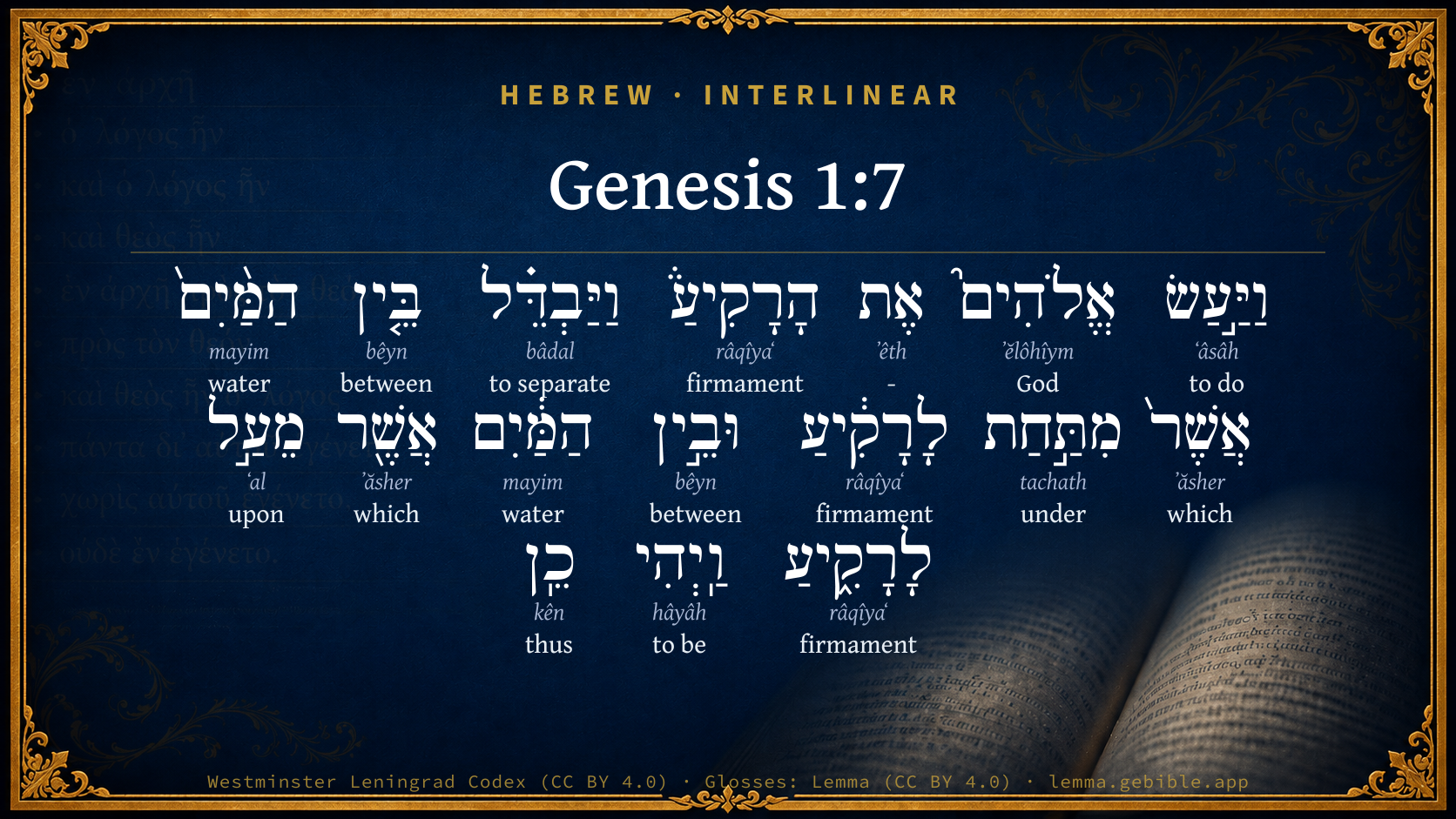
Hebrew (Westminster Leningrad Codex) Genesis 1:7 appears in the Hebrew Old Testament. The text above is from the Westminster Leningrad Codex. Each word links to its Strong’s number, a concise gloss, and parsing drawn from the Open Scriptures Hebrew Bible morphology. Click any word for its full Brown-Driver-Briggs (BDB) entry.
Download image
Cite this verse

Genesis 1:7 (World English Bible). Public Domain. Lemma interlinear Bible study tool, https://lemma.gebible.app/v/genesis/1/7.

Show BibTeX & RIS
BibTeX
RIS
English Translation
God made the expanse, and divided the waters which were under the expanse from the waters which were above the expanse, and it was so.
World English Bible · Public Domain
Highlights
  • 4 first appearances in the Hebrew Bible
Full analysis ↓
Download a study sheet

One document with this verse’s original text, its word-by-word gloss line, the meaning frame, cross-references with their text, attributed commentary, and full source and license credits — printable, and it pastes into notes with its structure intact.

This verse Autodidact and up

Study sheet (.html) Plain text (.txt)

A passage Seminary Student

Up to 50 verses in one chapter. A passage sheet keeps up to 6 commentary sources and 12 cross-references per verse, in the order this page ranks them, and says so on the sheet whenever that leaves anything out. Ask for a single verse and you get the Autodidact verse sheet above.

Everything on this page stays free to read, with no account — the sheet is a download of what is already on screen, not access to it.

Want to remove ads? Support Godless Engineer
Compare translations 3

The same verse in 3 English versions, stacked beneath the original-language interlinear above. Click any original word for its lexicon entry.

Each is an independent rendering of the whole verse — the interlinear is not word-aligned to these translations.

Highlighted words mark where these versions differ — a whole-verse word diff, not a word-by-word alignment.

  • World English Bible Public Domain
    God made the expanse, and divided the waters which were under the expanse from the waters which were above the expanse, and it was so.
  • King James Version Public Domain
    And God made the firmament, and divided the waters which were under the firmament from the waters which were above the firmament: and it was so.
  • unfoldingWord Literal Text CC BY-SA 4.0
    So God made the expanse and separated between the waters that under the expanse and the waters that above the expanse. And it was so.

unfoldingWord Literal Text — © unfoldingWord, licensed CC BY-SA 4.0. Word-aligned USFM3 via Door43 (git.door43.org/unfoldingWord/en_ult).

Versions to compare (up to 4)

3 of 4 selected

Show all 18 translations

Every available English version of this verse, each an independent rendering of the whole verse.

  • World English Bible Public Domain
    God made the expanse, and divided the waters which were under the expanse from the waters which were above the expanse, and it was so.
  • Berean Standard Bible Public Domain
    So God made the expanse and separated the waters beneath it from the waters above. And it was so.
  • Majority Standard Bible Public Domain
    So God made the expanse and separated the waters beneath it from the waters above. And it was so.
  • King James Version Public Domain
    And God made the firmament, and divided the waters which were under the firmament from the waters which were above the firmament: and it was so.
  • American Standard Version (1901) Public Domain
    And God made the firmament, and divided the waters which were under the firmament from the waters which were above the firmament: and it was so.
  • Revised Version (1885) Public Domain
    And God made the firmament, and divided the waters which were under the firmament from the waters which were above the firmament: and it was so.
  • Geneva Bible (1599) Public Domain
    Then God made the firmament, and separated the waters, which were vnder the firmament, from the waters which were aboue the firmament: and it was so.
  • Douay-Rheims (1899) Public Domain
    And God made a firmament, and divided the waters that were under the firmament, from those that were above the firmament, and it was so.
  • Young's Literal Translation Public Domain
    And God maketh the expanse, and it separateth between the waters which `are' under the expanse, and the waters which `are' above the expanse: and it is so.
  • Literal Standard Version CC BY-SA 4.0
    And God makes the expanse, and it separates between the waters which [are] under the expanse, and the waters which [are] above the expanse: and it is so.
  • Unlocked Literal Bible CC BY-SA 4.0
    God made the expanse and divided the waters which were under the expanse from the waters which were above the expanse. It was so.
  • unfoldingWord Literal Text CC BY-SA 4.0
    So God made the expanse and separated between the waters that under the expanse and the waters that above the expanse. And it was so.
  • Darby Bible Public Domain
    And God made the expanse, and divided between the waters that are under the expanse and the waters that are above the expanse; and it was so.
  • World Messianic Bible Public Domain
    God made the expanse, and divided the waters which were under the expanse from the waters which were above the expanse; and it was so.
  • Webster's Bible Public Domain
    And God made the firmament; and divided the waters which were under the firmament from the waters which were above the firmament: and it was so.
  • Free Bible Version CC BY-SA 4.0
    So God made an expanse to divide the waters that were above from the waters that were below. And that's what happened.
  • Bible in Basic English Public Domain
    And God made the arch for a division between the waters which were under the arch and those which were over it: and it was so.
  • JPS Tanakh (1917) Public Domain
    And God made the firmament, and divided the waters which were under the firmament from the waters which were above the firmament; and it was so.

Literal Standard Version (2020), Covenant Press — licensed CC BY-SA 4.0. Text via the HelloAO Bible API (eBible.org). Unlocked Literal Bible (unfoldingWord) — licensed CC BY-SA 4.0. Text via the HelloAO Bible API (eBible.org). unfoldingWord Literal Text — © unfoldingWord, licensed CC BY-SA 4.0. Word-aligned USFM3 via Door43 (git.door43.org/unfoldingWord/en_ult). Free Bible Version, Dr. Jonathan Gallagher — licensed CC BY-SA 4.0. Text via the HelloAO Bible API (eBible.org).

Word by word

More ways to search: Search by grammar → Find every occurrence → Compare this word →

Practice this passage: Drill this verse → Learn its vocabulary →

הָרָקִיעַ֒
râqîyaʻ
H7549
“the · firmament”
Particle, Definite Article + Noun, Common, Masculine, Singular, Absolute
Part of Speech
Particle + Noun
Type
Common
Gender
Masculine
Number
Singular
State
Absolute
Full BDB Definition

Origin: from H7554

TWOT: 2217a

extended surface (solid), expanse, firmament - expanse (flat as base, support) - firmament (of vault of heaven supporting waters above) - considered by Hebrews as solid and supporting 'waters' above
  1. וַיַּ֣עַשׂ ʻâsâh H6213 “and · to do” Conjunction + Verb, Qal, Sequential Imperfect, 3rd Person, Masculine, Singular
  2. אֱלֹהִים֮ ʼĕlôhîym H430 “God(s)” Noun, Common, Masculine, Plural, Absolute
  3. אֶת ʼêth H853 “-” Particle, Direct Object
  4. וַיַּבְדֵּ֗ל bâdal H914 “and · to separate” Conjunction + Verb, Hiphil, Sequential Imperfect, 3rd Person, Masculine, Singular
  5. בֵּ֤ין bêyn H996 “between” Preposition
  6. הַמַּ֨יִם֙ mayim H4325 “the · water(s)” Particle, Definite Article + Noun, Common, Masculine, Plural, Absolute
  7. אֲשֶׁר֙ ʼăsher H834 “which” Particle, Relative
  8. מִתַּ֣חַת tachath H8478 “from · under” Preposition + Preposition
  9. לָרָקִ֔יעַ râqîyaʻ H7549 “to/for the · firmament” Preposition, Determined + Noun, Common, Masculine, Singular, Absolute
  10. וּבֵ֣ין bêyn H996 “and · between” Conjunction + Preposition
  11. הַמַּ֔יִם mayim H4325 “the · water(s)” Particle, Definite Article + Noun, Common, Masculine, Plural, Absolute
  12. אֲשֶׁ֖ר ʼăsher H834 “which” Particle, Relative
  13. מֵעַ֣ל ʻal H5921 “from · upon” Preposition + Preposition
  14. לָרָקִ֑יעַ râqîyaʻ H7549 “to/for the · firmament” Preposition, Determined + Noun, Common, Masculine, Singular, Absolute
  15. וַֽיְהִי hâyâh H1961 “and · to be” Conjunction + Verb, Qal, Sequential Imperfect, 3rd Person, Masculine, Singular
  16. כֵֽן kên H3651 “thus” Adverb

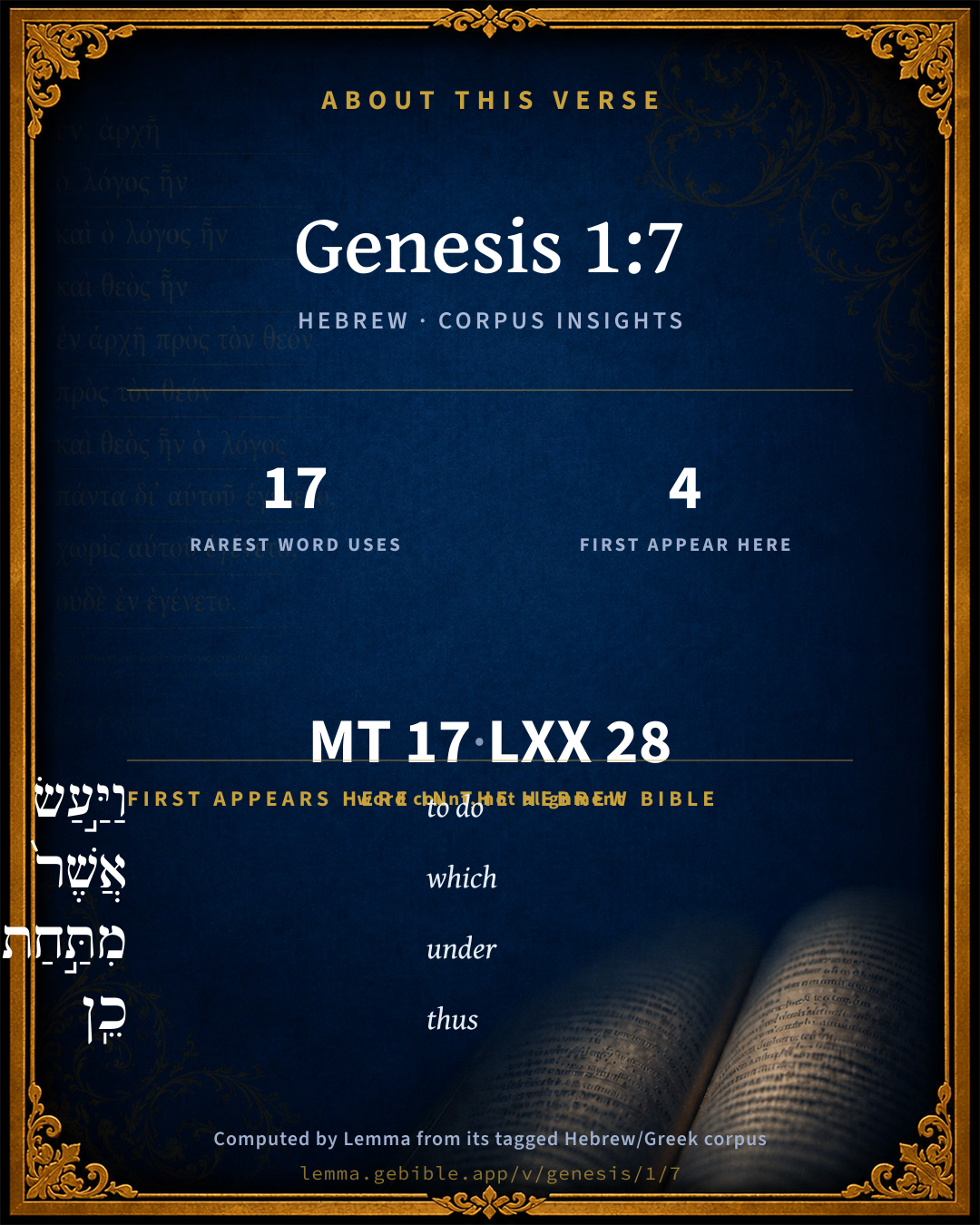
About this verse

These counts appear in no published source. They are computed here, from the morphology-tagged text and Lemma’s own curated glosses. What Lemma adds →

17
words
12
distinct lemmas
Pentateuch
section

Notable vocabulary

The rarest word here is הָרָקִיעַ֒ firmament H7549 — appearing just 17 times in the whole Hebrew Bible.

First appearance in Scripture

These words make their first canonical appearance in the Hebrew Bible here:

  • וַיַּ֣עַשׂ to do H6213
  • אֲשֶׁר֙ which H834
  • מִתַּ֣חַת under H8478
  • כֵֽן thus H3651

Shared distinctive vocabulary

הָרָקִיעַ֒ firmament H7549 occurs in 15 verses of the Hebrew Bible. Also found in:

Grammatical profile

  • 3 verbs
  • 6 nouns
  • 4 prepositions
  • 1 adverb
  • 3 particles

Verb forms

  • וַיַּ֣עַשׂ Qal · Sequential Imperfect
  • וַיַּבְדֵּ֗ל Hiphil · Sequential Imperfect
  • וַֽיְהִי Qal · Sequential Imperfect

Repetition

Words recur within this verse — often emphatic in Hebrew:

  • הָרָקִיעַ֒ firmament H7549 ×3
  • בֵּ֤ין between H996 ×2
  • הַמַּ֨יִם֙ water H4325 ×2
  • אֲשֶׁר֙ which H834 ×2

Hebrew & Septuagint length

In English translation the verse runs 25 words from the Hebrew and 24 from the Septuagint (LXX English) — closely comparable.

A rough comparison of the two English renderings, which tokenize alike — not a word-level alignment.

Word counts can differ between the Hebrew and the Greek without any difference in meaning — e.g. the Hebrew direct-object marker אֵת has no separate Greek word, and Greek often adds the article ὁ.

In the original languages it is 17 Hebrew tokens and 28 Greek tokens — but the two are counted differently (Hebrew bundles its prefixes and suffixes into one token; the Greek is in lemma form), so that isn’t a like-for-like length.

Cross-references

6

Topical passages linked to Genesis 1:7 in the Treasury of Scripture Knowledge — connected by theme and wording, ordered by reader-vote popularity; previews shown in the World English Bible.

  • Psalms 148:4 Praise him, you heavens of heavens, You waters that are above the heavens.
  • Proverbs 8:28–29 When he established the clouds above, When the springs of the deep became strong,
  • Matthew 8:27 The men marveled, saying, "What kind of man is this, that even the wind and the sea obey him?"
  • Job 38:8–11 "Or who shut up the sea with doors, When it broke forth from the womb,
  • Genesis 1:9 God said, "Let the waters under the sky be gathered together to one place, and let the dry land appear," and it was so.
  • Job 26:8 He binds up the waters in his thick clouds, And the cloud is not burst under them.

Cross-references courtesy of OpenBible.info (CC BY 4.0).

Hebrew and Greek witnesses Masoretic Hebrew ↔ Greek Septuagint

The same verse in the two great witnesses to the Old Testament, shown verse-for-verse.

These are two independent witnesses, not word-aligned to each other, and the Septuagint is shown in lemma (dictionary) form.

Hebrew Genesis 1:7 Masoretic · Westminster Leningrad Codex

וַיַּ֣עַשׂ אֱלֹהִים֮ אֶת הָרָקִיעַ֒ וַיַּבְדֵּ֗ל בֵּ֤ין הַמַּ֨יִם֙ אֲשֶׁר֙ מִתַּ֣חַת לָרָקִ֔יעַ וּבֵ֣ין הַמַּ֔יִם אֲשֶׁ֖ר מֵעַ֣ל לָרָקִ֑יעַ וַֽיְהִי כֵֽן

God made the expanse, and divided the waters which were under the expanse from the waters which were above the expanse, and it was so.

World English Bible · Public Domain

Greek LXX Genesis 1:7 Septuagint · lemma form

καί ποιέω ὁ θεός ὁ στερέωμα καί διαχωρίζω ὁ θεός ἀνά μέσος ὁ ὕδωρ ὅς εἰμί ὑποκάτω ὁ στερέωμα καί ἀνά μέσος ὁ ὕδωρ ὁ ἐπάνω ὁ στερέωμα

And God made the firmament, and God divided between the water which was under the firmament and the water which was above the firmament.

LXX2012 (modern English Septuagint) · Public Domain

Hebrew: Westminster Leningrad Codex (CC BY 4.0). Greek: Septuagint (public domain); English from LXX2012 (modern English Septuagint) (Public Domain). How the Septuagint differs from the Hebrew →

Targum (Aramaic paraphrase)

2

The Targum is the ancient Jewish Aramaic paraphrase of the Hebrew Scriptures — an interpretive translation, not the Hebrew text itself. Onkelos (literal) and Pseudo-Jonathan (expansive) render the Torah, and Jonathan the Prophets. Coverage is partial: where no permissively-licensed English translation exists for a verse, only the Aramaic is shown. This is verse-level text, not a word-by-word alignment to the Hebrew.

  1. Targum Onkelos Torah (Genesis–Deuteronomy)
    וַעֲבַד יְיָ יָת רְקִיעָא וְאַפְרֵישׁ בֵּין מַיָּא דִּי מִלְרַע לִרְקִיעָא וּבֵין מַיָּא דִּי מֵעַל לִרְקִיעָא וַהֲוָה כֵן

    (no public-domain English translation for this verse)

    Targum Onkelos — Aramaic: “Onkelos Genesis” (public domain); “Onkelos Exodus” (public domain); “Onkelos Leviticus” (public domain); “Onkelos Numbers” (public domain); “Onkelos Deuteronomy” (public domain). English: “Sefaria Community Translation” (CC0 1.0 (public-domain dedication)); “J.W. Etheridge. The Targums of Onkelos and Jonathan Ben Uzziel on the Pentateuch. London: Longmans, Green, 1862” (public domain). Text via Sefaria.

  2. Targum Pseudo-Jonathan Torah (Genesis–Deuteronomy)
    וַעֲבַד יְיָ יַת רְקִיעָא סוּמְכֵיהּ תְּלַת אֶצְבָּעָתָא בֵינֵי סִטְרֵי שְׁמַיָא לְמוֹי דְאוֹקְיָינוֹס וְאַפְרֵשׁ בֵּינֵי מַיָא דְמִלְרַע לִרְקִיעָא וּבֵינֵי מַיָא דִלְעֵיל בְּקוּבְתָא דִרְקִיעָא וַהֲוָה כֵן

    And the Lord made the expanse, upbearing it with three fingers, between the confines of the heavens and the waters of the ocean, and separated between the waters which were below the expanse, and the waters which were above, in the collection (or covering) of the expanse; and it was so.

    Targum Pseudo-Jonathan — Aramaic: “Targum Jonathan on Genesis” (public domain); “Targum Jonathan on Exodus” (public domain); “Targum Jonathan on Leviticus” (public domain); “Targum Jonathan on Numbers” (public domain); “Targum Jonathan on Deuteronomy” (public domain). English: “The Targum of Jonathan ben Uzziel, trans. J. W. Etheridge, London, 1862” (public domain). Text via Sefaria.

Commentary

Notes on Genesis 1:7 from classic Christian and Jewish commentators (each source and its license shown beneath its notes). The classic Christian expositions comment on the surrounding passage and are grouped to its opening verse, so a note may address several verses; the Jewish commentaries on the Tanakh (Rashi and others) are per-verse, so they appear only where the commentator wrote on this verse.

Lemma curates 59 commentaries, every one of them public domain or Creative Commons licensed, each selected and text-cleaned for this edition rather than reprinted as found. About our sources →

Trapp's Complete Commentary

John Trapp

Gen 1:7 And God made the firmament, and divided the waters which [were] under the firmament from the waters which [were] above the firmament: and it was so.

Ver. 7. Waters which were above the firmament.] That is the clouds, and watery meteors above the lower region of the air, where God’s "pavilion round about him is dark waters, and thick clouds of the skies". {Psa 18:11 Jer 10:13} These he "weighs by measure"; {Job 28:25} not a drop falls in vain, or in a wrong place. And this is the first heaven: as the second is the starry sky, which is firm and fast, "as a molten looking-glass". {Job 37:18} To this heaven, some that have calculated curiously, have found it five hundred years’ journey. Others say, that if a stone should fall from the eighth sphere, and should pass every hour a hundred miles, it would be sixty-five years or more, before it would come to ground. {a} Beyond this second heaven, Aristotle acknowledgeth none other. Beyond the movable heavens, saith he, there is neither body, nor time, nor place, nor vacuum. {b} But "we have a more sure word of prophecy." God’s blessed book assures us of a "third heaven," {2Co 12:2} called elsewhere "the heaven of heavens," {Deu 10:14} the "Paradise" of God, {Luk 22:43} the "bosom of Abraham," {Luk 16:22} the "Father’s house," {Joh 14:2} the "city of the living God," {Heb 12:22} the "country" of his pilgrims. {Heb 12:14} A body it is, for bodies are in it; but a subtile, fine, spiritual body; next in purity to the substance of angels and men’s souls. It is also, say some, {c} solid as stone, but "clear as crystal" {Rev 21:11 Job 37:18} A true firmament, indeed, not penetrable by any, no, not by angels, spirits, and bodies of just men made perfect; but by a miracle, God making way by His power, where there is no natural passage. It opens to the very angels, {Joh 1:51 Gen 28:12} who yet are able to penetrate all under it. The other two heavens are to be passed through by the grossest bodies.

{a} Burton. Of Melancholy

{b} ουδε τοπος ουδε κενον ουδε χρονος εστιν εξω του ουπονου - Arist. De Caelo, c. ix.

{c} Yates’s Model

John Trapp, A Commentary or Exposition upon All the Books of the Old and New Testament (1647–1656) — public domain. Text from a community e-Sword module.

Geneva Bible (1599)

Geneva Bible translators

As the sea and rivers, from those waters that are in the clouds, which are upheld by God’s power, lest they should overwhelm the world.

Geneva Bible (1599) marginal notes — public domain. Text via Bolls.life.

Ellicott's Commentary for English Readers

(7) God made the firmament.—This wide open expanse upon earth’s surface, supplied by the chemistry of nature—that is, of God—with that marvellous mixture of gases which form atmospheric air, was a primary necessity for man’s existence and activity. In each step of the narrative it is ever man that is in view; and even the weight of the superincumbent atmosphere is indispensable for the health and comfort of the human body, and for the keeping of all things in their place on earth. (See Note, Gen_1:8.) And in this secondary sense it may still rightly be called the firmament.

The waters which were under the firmament . . . the waters which were above the firmament.—While this is a popular description of what we daily see—namely, masses of running water congregated upon earth’s surface, and above a cloudland, into which the waters rise and float—it is not contrary to, but in accordance with, science. The atmosphere is the receptacle of the waters evaporated from the earth and ocean, and by means of electrical action it keeps these aqueous particles in a state of repulsion, and forms clouds, which the winds carry in their bosom. So full of thoughtful contrivance and arrangement are the laws by which rain is formed and the earth watered, that they are constantly referred to in the Bible as the chief natural proof of God’s wisdom and goodness. (See Act_14:17.) Moreover, were there not an open expanse next the earth, it would be wrapped in a perpetual mist, unvisited by sunshine. and the result would be such as is described in Gen_2:5, that man could not exist on earth to till the ground. The use, however, of popular language and ideas is confessedly the method of Holy Scripture, and we must not force upon the writer knowledge which man was to gain for himself. Even if the writer supposed that the rains were poured down from an upper reservoir, it would be no more an argument against his being inspired than St. Mark’s expression, “The sun did set” (Mar_1:32), disproves the inspiration of the Gospels. For the attainment of all such knowledge God has provided another way.

A Bible Commentary for English Readers, edited by Charles John Ellicott (1878–1897) — public domain. Text from a community e-Sword module.

The Cambridge Bible for Schools and Colleges

gen. ed. J. J. S. Perowne

7. and it was so] This formula is here out of place. See previous note.

The Cambridge Bible for Schools and Colleges (gen. ed. J. J. S. Perowne; Cambridge University Press, 1878–1918) — public domain. Text from a community e-Sword module.

John Gill's Exposition

And God made the firmament,.... By a word speaking, commanding it into being, producing it out of the chaos, and spreading it in that vast space between the heaven of heavens and our earth (z),

And divided the waters which were under the firmament from the waters which were above the firmament; the lower part of it, the atmosphere above, which are the clouds full of water, from whence rain descends upon the earth; and which divided between them and those that were left on the earth, and so under it, not yet gathered into one place; as it now does between the clouds of heaven and the waters of the sea. Though Mr. Gregory (a) is of opinion, that an abyss of waters above the most supreme orb is here meant; or a great deep between the heavens and the heaven of heavens, where, as in storehouses, the depth is laid up; and God has his treasures of snow, hail, and rain, and from whence he brought out the waters which drowned the world at the universal deluge. Others suppose the waters above to be the crystalline heaven, which for its clearness resembles water; and which Milton (b) calls the "crystalline ocean",

And it was so: the firmament was accordingly made, and answered this purpose, to divide the waters below it from those above it; or "it was firm" (c), stable and durable; and so it has continued.

(z) ------and God made The firmament, expanse of liquid, pure, Transparent, elemental air, diffused In circuit to the uttermost convex Of this great round.------ Milton, Paradise Lost, B. 7. l. 263, &c. (a) Notes and Observations, &c. c. 23. p. 110, &c. (b) Ibid. l. 291. (c) "et factum est firmum", Fagius & Nachmanides in ib.

John Gill's Exposition of the Whole Bible (1746–1763) — public domain (CC PDM 1.0). Text via the HelloAO Bible API.

Haydock's Catholic Bible Commentary

Above the firmament and stars, according to some of the Fathers; or these waters were vapours and clouds arising from the earth, and really divided from the lower waters contained in the sea. (Calmet)

George Leo Haydock (1774–1849), Haydock's Catholic Family Bible and Commentary, 1859 edition — public domain. Excludes Psalms (Douay-Rheims chapter numbering differs from Protestant) and Deuterocanonical books (Catholic canon only).

Matthew Poole's English Annotations

The firmament here is either,

1. The starry heaven; so called, not from its solidity, but from its fixed, durable, and, in a sort, incorruptible and unchangeable nature. Or,

2. The air; called here, the expansion, or extension, because it is extended far and wide, even from the earth to the third heaven; called also the firmament, because it is fixed in its proper place, from whence it cannot be moved, unless by force.

The waters under the firmament are seas, rivers, lakes, fountains, and other waters in the bowels of the earth.

The waters above the firmament, or above the heavens, as they are called, Psa 148:4, are either,

1. A collection or sea of waters placed by God above all the visible heavens, and there reserved for ends known to himself. Or rather,

2. The waters in the clouds; for the clouds are called waters, Psa 18:11; 104:3, and are said to be in heaven, 2Sa 21:10; Mat 24:30, and the production thereof is mentioned as an eminent work of God's creation, Job 35:5; 36:29; Psa 147:8; Pro 8:28; which therefore it is not credible that Moses in his history of the creation would admit, which he doth, if they be not here meant; and these are rightly said to be above the firmament, i.e. the air, because they are above a considerable part of it. As God commanded and ordered it, so it was done and settled.

Matthew Poole's English Annotations on the Holy Bible (1683–1685) — public domain. Text from a community e-Sword/MySword module.

Whedon's Commentary on the Bible

Daniel D. Whedon

7. God made the firmament — By his almighty fiat the dense mist that hung over the face of the deep, and was itself a vast expanse of waters, was lifted up to find a local habitation on high. Thus was formed the vast reservoir of the heavens, from which the rains descend to fertilize and refresh the land. “Next to the light,” says Jacobus, “is the law of the atmosphere, so essential to life in the vegetable and animal world. Here it is set forth as supporting the floating vapour, and keeping in suspense a fluid of greater specific gravity than itself. The formation of clouds is referred to by Job in language which reveals an acquaintance with the laws here established by the Creator: ‘He maketh small the drops of water: they pour down rain according to the vapour thereof; which the clouds do drop and distil upon man abundantly.… Dost thou know the balancings of the clouds?’” Job_36:27-28; Job_37:16; compare also Gen_2:6. “But why, it may be asked, did he not speak of this storehouse of waters as diffused through the firmament, instead of placing it above it? We answer: This would have been to convert the firmament of sense into the atmosphere of science, and phenomena into natural philosophy, which doubtless God could have done, but did not see fit to do.” — Barrows.

Daniel D. Whedon (gen. ed.), Commentary on the Old and New Testaments (1874–1909) — public domain. Text from a community e-Sword module.

The Pulpit Commentary

And God made the firmament. How the present atmosphere was evolved from the chaotic mass of waters the Mosaic narrative does not reveal. The primary intention of that record being not to teach science, but to discover religious truth, the thing of paramount importance to be communicated was that the firmament was of God"s construction. This, of course, does not prevent us from believing that the elimination of those gases (twenty-one parts of oxygen and seventy-nine of nitrogen, with a small proportion of carbonic acid gas and aqueous vapor) which compose our atmosphere was not effected by natural means; and how far it may have been assisted by the action of the light upon the condensing mass of the globe is a problem in the solution of which science may legitimately take an interest. And divided the waters which were under the firmament from the waters which were above the firmament. The upper waters are not the material of the stars (Delitzsch, Wordsworth), although Jupiter is of the same density as water, and Saturn only half its density; but the waters floating about in the higher spaces of the air. The under waters are not the lower atmospheric vapors, but the oceanic and terrestrial waters. How the waters are collected in the upper reaches of the atmosphere, Scripture, no less than science, explains to be by means of evaporation. (Gen_2:6; Job_36:27 Job_37:16) These latter passages suggest that the clouds are balanced, suspended, upheld by the buoyancy of the air in exact accordance with scientific principles. And it was so. Six times these words occur in the creation record. Sublimely suggestive of the resistless energy of the Divine word, which speaks, and it is done, commands, and it standeth fast, they likewise remind us of the sweet submissiveness of the creature to the all-wise Creator"s will, and, perhaps, are designed as well to intimate the fixed and permanent character of those arrangements to which they are attached.

Ver. 7.

The atmospheric firmament.

I THE CREATURE OF GOD.

1. From God it received its being (ver. 7). Not here alone, but in other parts, Scripture declares the firmament to be the Divine handiwork. (Psa_19:1 Psa_104:2) Whence we may note

(1) That not it, the creature, should receive our worship, but he, its Maker, who is God over all, blessed forever.

(2) That since the firmament was made by God, it must belong to him. If at the present moment it is the special abode of the prince of the power of the, (Eph_2:2) it must be a usurped dominion. The air with all its beams and showers, quite as much as the earth with all its trees and flowers, is God"s property (Gen_14:22; Psa_24:1, &c.);

(3) That in all its movements it only carries out the will of its Creator. The air does nothing of itself. Under the reign of law as all created things are, the law that reigns is itself beneath the rule of God. The Hebrew mind never mistook things for persons, or creatures for the Creator; (Psa_148:8) it is only modern science that degrades the Creator from his throne, and puts the creature in his seat.

2. From God it received its function (ver. 6), to divide between the upper and the lower waters, which was

(1) Simple, i.e. in the sense of not being complex. Though its uses are manifold, they are all contained in this, that it floats up and sustains the vapors rising from the earth at a sufficient distance from the terrestrial waters.

(2) Necessary. Without a clear body of atmospheric air between the waters, human life could not have existed. And equally without the watery clouds swimming in the atmosphere, both vegetable and animal life would perish. "Were the air absolutely dry, it would cause the water in plants to evaporate from their leaves more rapidly than it could be supplied to them by the soil and the roots. Thus they would speedily become flaccid, and the whole plant would droop, wither, and die." Similarly, were the air which man draws into his lungs entirely free from watery fluid, he would soon breathe out the fluids which fill up his tissues, and would dry up into a withered and ghastly mummy" ("Chemistry of Common Life," vol. 1. p. 13).

(3) Beneficent. Collecting the vapors of the earth in the form of clouds, it is thus enabled to throw-them down again in the shape of rain, snow, or dew, according as it is required.

3. From God it received its name.

(1) Suitable. "Heights," significant of the reality.

(2) Suggestive. The love, the power, the majesty of God, his thoughts, his ways, his purposes when compared with man"s, are set forth to us by the height of the heaven above the earth.

II THE SERVANT OF MAN.

1. Indispensable. Without the air, man could not live. His physical being would perish without its oxygen. Without its pressure his bodily structure would fall to pieces.

2. Valuable. The uses of the atmosphere to man as a resident on earth are manifold. It supports animal and vegetable life around him. It conveys, refracts, and decomposes light. It transmits sound. It draws up noxious vapors from the soil, and disperses them by its winds. It assists him in a variety of his mechanical, chemical, commercial, and scientific enterprises.

3. Willing. Great as are its powers of service and its capacities of rebellion when excited with tempest, for the most part it is meek and docile, ever ready to acknowledge man as its master, and to execute his slightest wish.

4. Unwearied. Eve, since it received its appointment from God to minister to the happiness of man is has unrestingly performed that task, and betrays no more signs of weariness to-day than it did at the first.

5. Gratuitous. It gives its services, as its great Creator gives his blessings, without money and without price.

Let us learn

1. To be thankful for the air we breathe.

2. To admire God"s wisdom in the wonderful adjustments of the air.

3. To make the best use we can of that life which the air supports and subserves.

The Pulpit Commentary (1880–1919), ed. H.D.M. Spence-Jones & Joseph S. Exell — public domain. Text from a community e-Sword module.

Rashi

Rabbi Shlomo Yitzchaki (Rashi)

ויעש אלהים את הרקיע AND GOD MADE THE EXPANSE — He put it in proper condition in its place: this is the meaning of “making” it. Similarly (Deuteronomy 21:12) ועשתה את צפרניה “And she shall let grow (literally, make) her nails”.

מעל לרקיע ABOVE THE EXPANSE — It is not said here על הרקיע “upon the firmament״, but מעל “hanging from above”, because they (the waters) were suspended in space (Genesis Rabbah 4:3). Why is it not stated in reference to the work of the second day “that it was good”? Because the work associated with water was not completed until the third day — He only began it on the second — and anything that is not completed is not in a state of perfection and at its best (and so cannot be termed “good”). Therefore on the third day when He completed the work associated with water and another work was commenced and finished, the words כי טוב are repeated, once in reference to the completion of the work of the second day, and again in reference to the completion of the work of that day (Genesis Rabbah 4:10).

Rashi on the Tanakh — English translations: “The Judaica Press complete Tanach with Rashi, translated by A. J. Rosenberg” (CC BY 4.0); “Pentateuch with Rashi's commentary by M. Rosenbaum and A.M. Silbermann, 1929-1934” (public domain); “The Metsudah Tanach series, Lakewood, N.J” (CC BY 4.0); and “The Book of Joshua, Metsudah Publications, 1997” (CC BY 4.0). Text via Sefaria.

Ramban (Nachmanides)

Rabbi Moshe ben Nachman (Ramban / Nachmanides)

AND G-D MADE THE FIRMAMENT. The word asi’yah (doing) always means adjusting something to its required proportion.

AND IT WAS SO. On the first day, And there was light is written after And G-d said, ‘Let there be light,’ in order to explain that after the command of G-d, it [the light] came forth into actuality and was as He decreed it to be. But here, after the command, Let there be a firmament, it is written, And G-d made the firmament, and divided, etc.; why then has Scripture added here, And it was so? It is to tell us that it was to be ever so, for all times.But Rabbi Abraham ibn Ezra explained that the expression and it was so is attached to the verse which follows, meaning when it was so, G-d called the firmament Heaven. That is not correct.In Bereshith Rabbah the Rabbis have said: “And G-d made the firmament. This is one of the verses which Ben Zoma found difficult: And G-d made, etc. But was not [the world created] by command, as it is written, By word of the Eternal were the heavens made?” Now Ben Zoma’s difficulty was not only on account of the word vaya’as (And He made), since on the fourth, fifth, is not found; only vayibra (and He created). and sixth day, vaya’as is also written. Rather, his difficulty was, as I have said, that on the other days, immediately after G-d’s command, it is written, And it was so, indicating that it came into being immediately after the command, but here on the second day, after it says, And G-d said — vaya’as (And He made) is written! This was his question. Perhaps Ben Zoma had some secret interpretation which he did not want to reveal. This is the explanation of the cause of his difficulty.

Ramban (Nachmanides) on the Tanakh — English translation: “Commentary on the Torah by Ramban (Nachmanides). Translated and annotated by Charles B. Chavel. New York, Shilo Pub. House, 1971-1976” (CC BY 4.0). Text via Sefaria.

Lesson kit

Teaching starters — assembled from the data on this page, not authored interpretation. Every prompt links to the verse data it draws on. Edit before teaching.

Genesis, in the Pentateuch, opens this verse with 17 words (12 distinct Hebrew lemmas). Its most distinctive word is râqîyaʻ (“firmament”). A historical commentator’s framing appears above. Read the whole chapter for the surrounding context.

Discussion questions

  1. How does “firmament” (râqîyaʻ) shape what this verse is saying?
  2. 4 words here appear for the first time in Scripture. What is being introduced at this debut?
  3. Genesis 1:6 shares the word «firmament» with this verse. How do the two illuminate each other?
  4. “firmament” occurs 3× in this one verse. What is the effect of the repetition?
  5. The translations on this page render this verse differently — a whole-verse word diff, not a word-by-word alignment. What might account for the different wordings?
  6. The verb «וַיַּ֣עַשׂ» is Qal Sequential Imperfect. How does its form color the action?
  7. Reading how Trapp's Complete Commentary and Geneva Bible (1599) read this verse, where do the two commentators agree and where do they part?

Things to notice

Reading settings

Reading text

Shown beneath each verse's original-language words.

Old Testament
Old Testament edition

Read the OT as the Masoretic Hebrew (MT) or the Greek Septuagint (LXX).

English shown for the Greek Septuagint (in the Hebrew ↔ Greek comparison).

Comparing translations? Open the Compare panel on any verse page to stack up to four side by side.