
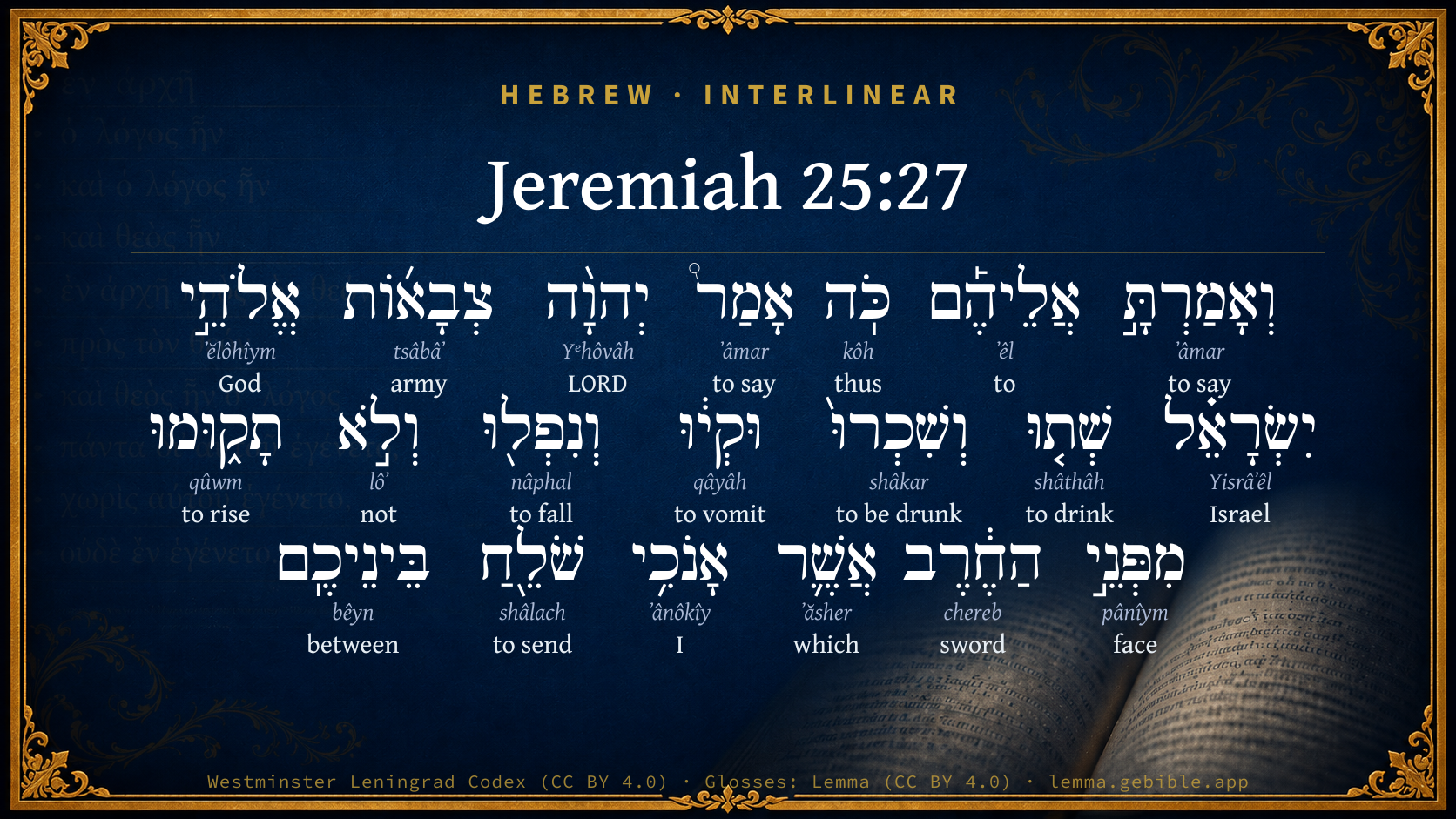
Jeremiah 25:27

Hebrew (Westminster Leningrad Codex) Jeremiah 25:27 appears in the Hebrew Old Testament. The text above is from the Westminster Leningrad Codex. Each word links to its Strong’s number, a concise gloss, and parsing drawn from the Open Scriptures Hebrew Bible morphology. Click any word for its full Brown-Driver-Briggs (BDB) entry.
Download image
Cite this verse

Jeremiah 25:27 (World English Bible). Public Domain. Lemma interlinear Bible study tool, https://lemma.gebible.app/v/jeremiah/25/27.

Show BibTeX & RIS
BibTeX
RIS
English Translation
You shall tell them, Thus says Yahweh of Hosts, the God of Israel: Drink you, and be drunken, and spew, and fall, and rise no more, because of the sword which I will send among you.
World English Bible · Public Domain
Highlights
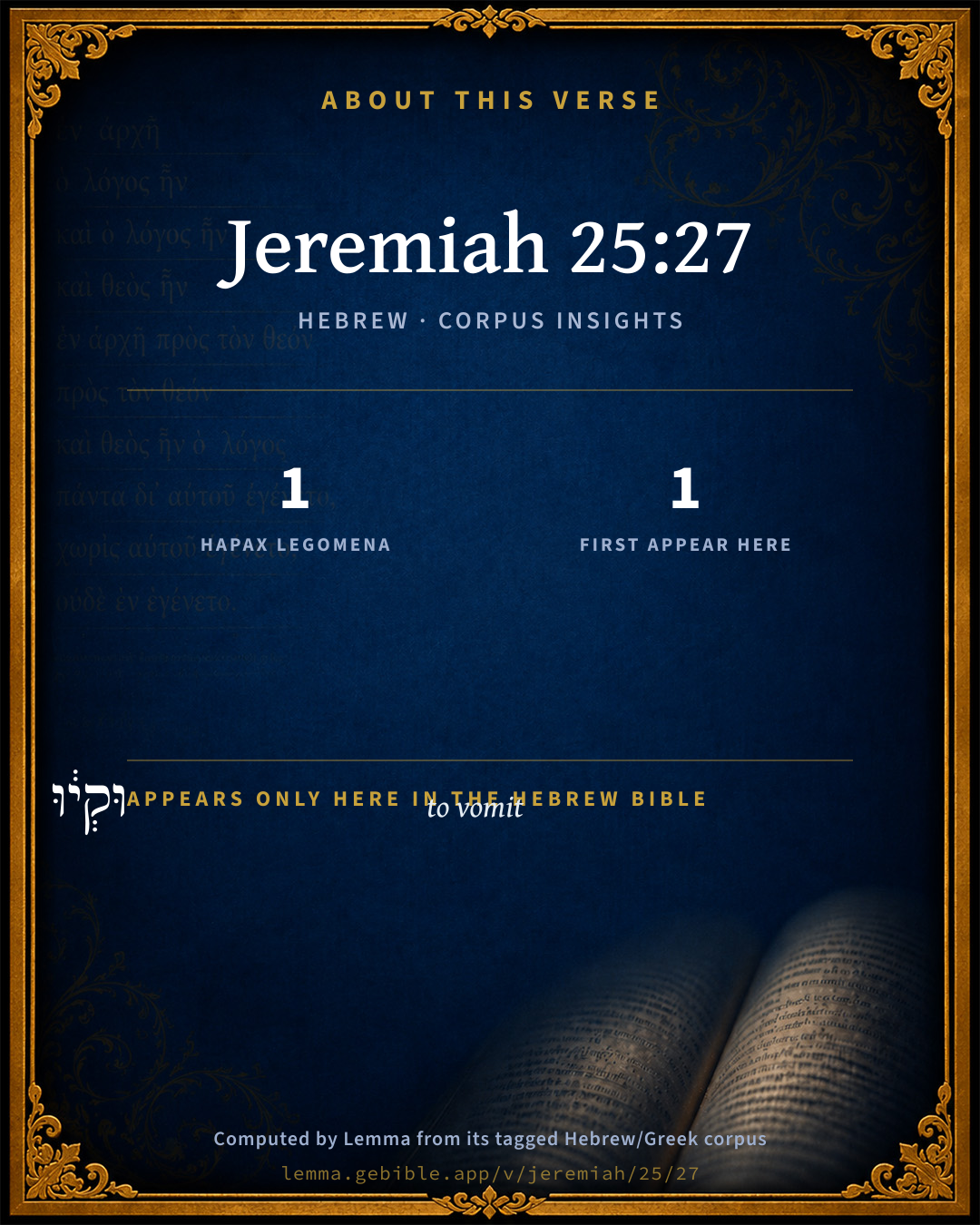
  • 1 hapax legomenon — only here in the Hebrew Bible
  • 1 first appearance in the Hebrew Bible
Full analysis ↓
Download a study sheet

One document with this verse’s original text, its word-by-word gloss line, the meaning frame, cross-references with their text, attributed commentary, and full source and license credits — printable, and it pastes into notes with its structure intact.

This verse Autodidact and up

Study sheet (.html) Plain text (.txt)

A passage Seminary Student

Up to 50 verses in one chapter. A passage sheet keeps up to 6 commentary sources and 12 cross-references per verse, in the order this page ranks them, and says so on the sheet whenever that leaves anything out. Ask for a single verse and you get the Autodidact verse sheet above.

Everything on this page stays free to read, with no account — the sheet is a download of what is already on screen, not access to it.

Want to remove ads? Support Godless Engineer
Compare translations 3

The same verse in 3 English versions, stacked beneath the original-language interlinear above. Click any original word for its lexicon entry.

Each is an independent rendering of the whole verse — the interlinear is not word-aligned to these translations.

Highlighted words mark where these versions differ — a whole-verse word diff, not a word-by-word alignment.

  • World English Bible Public Domain
    You shall tell them, Thus says Yahweh of Hosts, the God of Israel: Drink you, and be drunken, and spew, and fall, and rise no more, because of the sword which I will send among you.
  • King James Version Public Domain
    Therefore thou shalt say unto them, Thus saith the LORD of hosts, the God of Israel; Drink ye, and be drunken, and spue, and fall, and rise no more, because of the sword which I will send among you.
  • unfoldingWord Literal Text CC BY-SA 4.0
    “Then you shall say to them, ‘Thus says Yahweh of Armies, the God of Israel: Drink and be drunk and vomit and fall, and do not rise, from the face of the sword that I am sending among you.’

unfoldingWord Literal Text — © unfoldingWord, licensed CC BY-SA 4.0. Word-aligned USFM3 via Door43 (git.door43.org/unfoldingWord/en_ult).

Versions to compare (up to 4)

3 of 4 selected

Show all 18 translations

Every available English version of this verse, each an independent rendering of the whole verse.

  • World English Bible Public Domain
    You shall tell them, Thus says Yahweh of Hosts, the God of Israel: Drink you, and be drunken, and spew, and fall, and rise no more, because of the sword which I will send among you.
  • Berean Standard Bible Public Domain
    “Then you are to tell them that this is what the LORD of Hosts, the God of Israel, says: ‘Drink, get drunk, and vomit. Fall down and never get up again, because of the sword I will send among you.’
  • Majority Standard Bible Public Domain
    “Then you are to tell them that this is what the LORD of Hosts, the God of Israel, says: ‘Drink, get drunk, and vomit. Fall down and never get up again, because of the sword I will send among you.’
  • King James Version Public Domain
    Therefore thou shalt say unto them, Thus saith the LORD of hosts, the God of Israel; Drink ye, and be drunken, and spue, and fall, and rise no more, because of the sword which I will send among you.
  • American Standard Version (1901) Public Domain
    And thou shalt say unto them, Thus saith Jehovah of hosts, the God of Israel: Drink ye, and be drunken, and spew, and fall, and rise no more, because of the sword which I will send among you.
  • Revised Version (1885) Public Domain
    And thou shalt say unto them, Thus saith the LORD of hosts, the God of Israel: Drink ye, and be drunken, and spue, and fall, and rise no more, because of the sword which I will send among you.
  • Geneva Bible (1599) Public Domain
    Therefore say thou vnto them, Thus saith the Lord of hostes, the God of Israel, Drinke and bee drunken, and spewe and fall, and rise no more, because of the sworde, which I will sende among you.
  • Douay-Rheims (1899) Public Domain
    And thou shalt say to them: Thus saith the Lord of hosts the God of Israel: Dring ye, and be drunken, and vomit: and fall, and rise no more, because of the sword, which I shall send among you.
  • Young's Literal Translation Public Domain
    And thou hast said unto them: Thus said Jehovah of Hosts God of Israel, Drink ye, yea drink abundantly, And vomit, and fall, and rise not, Because of the sword that I am sending among you.
  • Literal Standard Version CC BY-SA 4.0
    “And you have said to them, Thus said YHWH of Hosts, God of Israel: Drink, indeed drink abundantly, || And vomit, and fall, and do not rise, || Because of the sword that I am sending among you.
  • Unlocked Literal Bible CC BY-SA 4.0
    Yahweh said to me, “Now you must say to them, 'Yahweh of hosts, God of Israel, says this: Drink and become drunk, then vomit, fall down, and do not rise before the sword that I am sending among you.'
  • unfoldingWord Literal Text CC BY-SA 4.0
    “Then you shall say to them, ‘Thus says Yahweh of Armies, the God of Israel: Drink and be drunk and vomit and fall, and do not rise, from the face of the sword that I am sending among you.’
  • Darby Bible Public Domain
    And thou shalt say unto them, Thus saith Jehovah of hosts, the God of Israel: Drink, and be drunken, and vomit, and fall, and rise no more, because of the sword that I will send among you.
  • World Messianic Bible Public Domain
    “You shall tell them, ‘The LORD of Hosts, the God of Israel says: “Drink, and be drunk, vomit, fall, and rise no more, because of the sword which I will send among you.”’
  • Webster's Bible Public Domain
    Therefore thou shalt say to them, Thus saith the LORD of hosts, the God of Israel; Drink ye, and be drunken, and vomit, and fall, and rise no more, because of the sword which I will send among you.
  • Free Bible Version CC BY-SA 4.0
    Tell them this is what the Lord Almighty, the God of Israel, says: Drink, make yourselves drunk, and vomit. Because of the war you'll be killed, falling down never to get up again.
  • Bible in Basic English Public Domain
    And you are to say to them, This is what the Lord of armies, the God of Israel, has said: Take of this cup and be overcome, and let it come out again from your lips, and from your fall you will never be lifted up again, because of the sword which I will send among you.
  • JPS Tanakh (1917) Public Domain
    And thou shalt say unto them: Thus saith the LORD of hosts, the God of Israel: Drink ye, and be drunken, and spew, and fall, and rise no more, because of the sword which I will send among you.

Literal Standard Version (2020), Covenant Press — licensed CC BY-SA 4.0. Text via the HelloAO Bible API (eBible.org). Unlocked Literal Bible (unfoldingWord) — licensed CC BY-SA 4.0. Text via the HelloAO Bible API (eBible.org). unfoldingWord Literal Text — © unfoldingWord, licensed CC BY-SA 4.0. Word-aligned USFM3 via Door43 (git.door43.org/unfoldingWord/en_ult). Free Bible Version, Dr. Jonathan Gallagher — licensed CC BY-SA 4.0. Text via the HelloAO Bible API (eBible.org).

Word by word

More ways to search: Search by grammar → Find every occurrence → Compare this word →

Practice this passage: Drill this verse → Learn its vocabulary →

וּקְי֔וּ
qâyâh
H7006
“and · vomit”
Conjunction + Verb, Qal, Imperative, 2nd Person, Masculine, Plural
Part of Speech
Conjunction + Verb
Stem
Qal
Form
Imperative
Person
2nd Person
Gender
Masculine
Number
Plural
Full BDB Definition

Origin: a primitive root

TWOT: 2013 , 2013b

(Qal) to vomit, vomit up, disgorge
  1. וְאָמַרְתָּ֣ ʼâmar H559 “and · to say” Conjunction + Verb, Qal, Sequential Perfect, 2nd Person, Masculine, Singular
  2. אֲלֵיהֶ֡ם ʼêl H413 “to · them” Preposition + Suffix, Personal, 3rd Person, Masculine, Plural
  3. כֹּֽה kôh H3541 “thus” Adverb
  4. אָמַר֩ ʼâmar H559 “to say” Verb, Qal, Perfect, 3rd Person, Masculine, Singular
  5. יְהוָ֨ה Yᵉhôvâh H3068 “LORD” Noun, Proper
  6. צְבָא֜וֹת tsâbâʼ H6635 “armies” Noun, Common, Both, Plural, Absolute
  7. אֱלֹהֵ֣י ʼĕlôhîym H430 “God(s) of” Noun, Common, Masculine, Plural, Construct
  8. יִשְׂרָאֵ֗ל Yisrâʼêl H3478 “Israel” Noun, Proper
  9. שְׁת֤וּ shâthâh H8354 “drink” Verb, Qal, Imperative, 2nd Person, Masculine, Plural
  10. וְשִׁכְרוּ֙ shâkar H7937 “and · be drunk” Conjunction + Verb, Qal, Imperative, 2nd Person, Masculine, Plural
  11. וְנִפְל֖וּ nâphal H5307 “and · fall” Conjunction + Verb, Qal, Imperative, 2nd Person, Masculine, Plural
  12. וְלֹ֣א lôʼ H3808 “and · not” Conjunction + Particle, Negative
  13. תָק֑וּמוּ qûwm H6965 “to rise” Verb, Qal, Imperfect, 2nd Person, Masculine, Plural
  14. מִפְּנֵ֣י pânîym H6440 “from · face(s) of” Preposition + Noun, Common, Both, Plural, Construct
  15. הַחֶ֔רֶב chereb H2719 “the · sword” Particle, Definite Article + Noun, Common, Feminine, Singular, Absolute
  16. אֲשֶׁ֛ר ʼăsher H834 “which” Particle, Relative
  17. אָנֹכִ֥י ʼânôkîy H595 “I” Pronoun, Personal, 1st Person, Common, Singular
  18. שֹׁלֵ֖חַ shâlach H7971 “sending” Verb, Qal, Participle Active, Masculine, Singular, Absolute
  19. בֵּינֵיכֶֽם bêyn H996 “between · you” Preposition + Suffix, Personal, 2nd Person, Masculine, Singular

About this verse

These counts appear in no published source. They are computed here, from the morphology-tagged text and Lemma’s own curated glosses. What Lemma adds →

20
words
19
distinct lemmas
Prophets
section

Notable vocabulary

1 hapax legomenon — a word that appears only here in the entire Hebrew Bible:

  • וּקְי֔וּ to vomit H7006

First appearance in Scripture

This word makes its first canonical appearance in the Hebrew Bible here:

  • וּקְי֔וּ to vomit H7006

Shared distinctive vocabulary

וְשִׁכְרוּ֙ to be drunk H7937 occurs in 19 verses of the Hebrew Bible. Also found in:

Grammatical profile

  • 8 verbs
  • 6 nouns
  • 1 pronoun
  • 2 prepositions
  • 1 adverb
  • 2 particles

Verb forms

  • וְאָמַרְתָּ֣ Qal · Sequential Perfect
  • אָמַר֩ Qal · Perfect
  • שְׁת֤וּ Qal · Imperative
  • וְשִׁכְרוּ֙ Qal · Imperative
  • וּקְי֔וּ Qal · Imperative
  • וְנִפְל֖וּ Qal · Imperative
  • תָק֑וּמוּ Qal · Imperfect
  • שֹׁלֵ֖חַ Qal · Participle Active

Repetition

A word recurs within this verse — often emphatic in Hebrew:

  • וְאָמַרְתָּ֣ to say H559 ×2

Cross-references

13

Topical passages linked to Jeremiah 25:27 in the Treasury of Scripture Knowledge — connected by theme and wording, ordered by reader-vote popularity; previews shown in the World English Bible.

  • Jeremiah 25:16 They shall drink, and reel back and forth, and be mad, because of the sword that I will send among them.
  • Habakkuk 2:16 You are filled with shame, and not glory. You will also drink, and be exposed! The cup of Yahweh's right hand will come around to you, and disgrace will cover your glory.
  • Isaiah 51:21 Therefore hear now this, you afflicted, and drunken, but now with wine:
  • Lamentations 4:21 Rejoice and be glad, daughter of Edom, that dwell in the land of Uz: The cup shall pass through to you also; you shall be drunken, and shall make yourself naked.
  • Ezekiel 21:4–5 Seeing then that I will cut off from you the righteous and the wicked, therefore shall my sword go forth out of its sheath against all flesh from the south to the north:
  • Deuteronomy 32:42 I will make my arrows drunk with blood, My sword shall devour flesh; With the blood of the slain and the captives, From the head of the leaders of the enemy.
  • Isaiah 63:6 I trod down the peoples in my anger, and made them drunk in my wrath, and I poured out their lifeblood on the earth.
  • Jeremiah 12:12 Destroyers are come on all the bare heights in the wilderness; for the sword of Yahweh devours from the one end of the land even to the other end of the land: no flesh has peace.
  • Jeremiah 46:10 For that day is [a day] of the Lord, Yahweh of Hosts, a day of vengeance, that he may avenge him of his adversaries: and the sword shall devour and be satiate, and shall drink its fill of their blood; for the Lord, Yahweh of hosts, has a sacrifice in the north country by the river Euphrates.
  • Jeremiah 46:14 Declare you in Egypt, and publish in Migdol, and publish in Memphis and in Tahpanhes: say you, Stand forth, and prepare you; for the sword has devoured round about you.
  • Jeremiah 47:6–7 You sword of Yahweh, how long will it be before you be quiet? put up yourself into your scabbard; rest, and be still.
  • Jeremiah 50:35 A sword is on the Chaldeans, says Yahweh, and on the inhabitants of Babylon, and on her princes, and on her wise men.
  • Ezekiel 24:21–25 Speak to the house of Israel, Thus says the Lord Yahweh: Behold, I will profane my sanctuary, the pride of your power, the desire of your eyes, and that which your soul pities; and your sons and your daughters whom you have left behind shall fall by the sword.

Cross-references courtesy of OpenBible.info (CC BY 4.0).

Hebrew and Greek witnesses Masoretic Hebrew ↔ Greek Septuagint

The same verse in the two great witnesses to the Old Testament, shown verse-for-verse.

These are two independent witnesses, not word-aligned to each other, and the Septuagint is shown in lemma (dictionary) form.

Hebrew Jeremiah 25:27 Masoretic · Westminster Leningrad Codex

וְאָמַרְתָּ֣ אֲלֵיהֶ֡ם כֹּֽה אָמַר֩ יְהוָ֨ה צְבָא֜וֹת אֱלֹהֵ֣י יִשְׂרָאֵ֗ל שְׁת֤וּ וְשִׁכְרוּ֙ וּקְי֔וּ וְנִפְל֖וּ וְלֹ֣א תָק֑וּמוּ מִפְּנֵ֣י הַחֶ֔רֶב אֲשֶׁ֛ר אָנֹכִ֥י שֹׁלֵ֖חַ בֵּינֵיכֶֽם

You shall tell them, Thus says Yahweh of Hosts, the God of Israel: Drink you, and be drunken, and spew, and fall, and rise no more, because of the sword which I will send among you.

World English Bible · Public Domain

Greek LXX Structure differs

In the Septuagint, Jeremiah is about an eighth shorter than the Hebrew and arranges its material differently — the Oracles Against the Nations (Hebrew chapters 46–51) appear in the middle of the Greek book, after 25:13. Because the chapter and verse boundaries do not line up, a verse-for-verse comparison with the Hebrew is not shown.

A verse-for-verse comparison isn’t shown here because the chapters and verses don’t line up. Switch to the LXX edition with the MT / LXX toggle above to read the Greek directly.

Hebrew: Westminster Leningrad Codex (CC BY 4.0). Greek: Septuagint (public domain); English from a public-domain English Septuagint. How the Septuagint differs from the Hebrew →

Targum (Aramaic paraphrase)

1

The Targum is the ancient Jewish Aramaic paraphrase of the Hebrew Scriptures — an interpretive translation, not the Hebrew text itself. Onkelos (literal) and Pseudo-Jonathan (expansive) render the Torah, and Jonathan the Prophets. Coverage is partial: where no permissively-licensed English translation exists for a verse, only the Aramaic is shown. This is verse-level text, not a word-by-word alignment to the Hebrew.

  1. Targum Jonathan Prophets (Joshua–Malachi)
    וְתֵימַר לְהוֹן כִּדְנַן אֲמַר יְיָ צְבָאוֹת אֱלָהָא דְיִשְׂרָאֵל שְׁתוֹ וּרְווֹ וְאִשְׁתַּגִישׁוּ וּנְפָלוּ וְלָא תְקוּמוּן מִן קֳדָם דְקַטְלִין בְּחַרְבָּא דַאֲנָא שְׁלַח בֵּינֵיכוֹן:

    (no public-domain English translation for this verse)

    Targum Jonathan — Aramaic: “Mikraot Gedolot” (public domain). English: “Sefaria Community Translation” (CC0 1.0 (public-domain dedication)); “London "Chaldee Paraphrase," 1871” (public domain). Text via Sefaria.

Commentary

Notes on Jeremiah 25:27 from classic Christian and Jewish commentators (each source and its license shown beneath its notes). The classic Christian expositions comment on the surrounding passage and are grouped to its opening verse, so a note may address several verses; the Jewish commentaries on the Tanakh (Rashi and others) are per-verse, so they appear only where the commentator wrote on this verse.

Lemma curates 59 commentaries, every one of them public domain or Creative Commons licensed, each selected and text-cleaned for this edition rather than reprinted as found. About our sources →

Trapp's Complete Commentary

John Trapp

Jer 25:27 Therefore thou shalt say unto them, Thus saith the LORD of hosts, the God of Israel; Drink ye, and be drunken, and spue, and fall, and rise no more, because of the sword which I will send among you.

Ver. 27. Drink ye, and be drunk, and spue, and fall.] Eckius, or Eccius, otherwise by some called Jeccius, from his casting or spuing, being nonplussed by Melanchthon, and well nigh madded, started drinking, for his own solace, and drank himself to death. {a} So should these do of the cup of God’s wrath, not only till they were mad drunk, {as Jer 25:16} but dead drunk.

{a} Manlii, Loc. Com. 89.

John Trapp, A Commentary or Exposition upon All the Books of the Old and New Testament (1647–1656) — public domain. Text from a community e-Sword module.

Joseph Benson's Commentary

Jer 25:27-29. Drink ye and be drunken — The imperative is here put for the future: see the like mode of speaking, Isa 2:9; Isa 6:9; Isa 23:16. The cup being metaphorically put for calamity, to be drunken with it, and fall, &c., must signify extreme calamity, or destruction. If they refuse to take the cup, &c. — “If they either do not believe thy threatenings, or disregard them, as thinking themselves sufficiently provided against any hostile invasion, thou shalt let them know that the judgments denounced against them are God’s irreversible decree,” which shall certainly be executed, and that it will be in vain for them to hope to escape the threatened ruin. For lo, I bring evil on the city called by my name, &c. — “Judgment often begins at the house of God, for the correction of his people, and to be a warning to others; but the heaviest strokes of it are reserved for the ungodly:” see Lowth, and Jer 49:12; 1Pe 4:17-18. And should ye be utterly unpunished? — No: if this be done in the green tree, what shall be done in the dry? If they that have some good in them smart so severely for the evil that is found in them, can they expect to escape that have worse evils and no good found among them? If Jerusalem be punished for learning idolatry of the nations, shall not the nations be punished of whom they learned it? No doubt they shall; for, says the Lord, I will call for a sword upon all the inhabitants of the earth — For they have helped to corrupt the inhabitants of Jerusalem.

Joseph Benson's Commentary on the Old and New Testaments (1811–1818) — public domain. Text from a community e-Sword module.

Keil & Delitzsch

C. F. Keil & F. Delitzsch

From Jer 25:27 onwards the commission from God (Jer 25:15.) is still more completely communicated to Jeremiah, so that the record of its fulfilment (Jer 25:17-26), together with the enumeration of the various peoples, is to be regarded as an explanatory parenthesis. These might the less unsuitably be inserted after Jer 25:16, inasmuch as what there is further of the divine command in Jer 25:27-29 is, if we examine its substance, little else than an enforcement of the command. The prophet is not merely to declare to them what is the meaning of this drinking of wrath (Hitz.), but is to tell them that they are to drink the cup of wrath to the bottom, so that they shall fall for drunkenness and not be able to stand again (Jer 25:27); and that they must drink, because when once Jahveh has begun judgment on His own people, He is determined not to spare any other people. קיוּ from קיה = קוא serves to strengthen the שׁכרוּ; in the second hemistich the figurative statement passes into the real, as at Jer 25:16. In Jer 25:28 שׁתו תשׁתּוּ is a peremptory command; ye shall = must drink. Jer 25:29 gives the reason; since God spares not His own people, then the heathen people need not count on immunity. "And ye think to go unpunished" is a question of surprise. Judgment is to be extended over all the inhabitants of the earth.

As to the fulfilment of this prophecy, see detail sin the exposition of the oracles against the nations, Jer 46-51. Hence it appears that most of the nations here mentioned were subject to Nebuchadnezzar. Only of Elam is no express mention there made; and as to Media, Jeremiah has given no special prophecy. As to both these peoples, it is very questionable whether Nebuchadnezzar ever subdued them. For more on this, see on Jer 49:34-39. Although it is said in Jer 25:9 of the present chapter and in Jer 27:5. that God has given all peoples, all the lands of the earth, into the hand of Nebuchadnezzar, yet it does not follow thence that Nebuchadnezzar really conquered all. The meaning of the prophetic announcement is simply that the king of Babylon will obtain dominion over the world for the coming period, and that when his time is run, he too must fall beneath the judgment. The judgment executed by Nebuchadnezzar on the nations is the beginning of that upon the whole earth, before which, in course of time, all inhabitants of the earth fall, even those whom Nebuchadnezzar's sword has not reached. In the beginning of the Chaldean judgment the prophet sees the beginning of judgment upon the whole earth.

Keil & Delitzsch — Biblical Commentary on the Old Testament (1861–1891) — public domain (CC PDM 1.0). Text via the HelloAO Bible API. (Old Testament only.)

Tyndale Open Study Notes

Tyndale Open Resources

25:27-29 These kingdoms had to drink from this cup of the Lord’s anger (see study note on 25:15). They would be unable to escape the disaster that would overwhelm them. Jerusalem experienced God’s judgment, and so would the surrounding nations.

Tyndale Open Study Notes — © Tyndale Open Resources, licensed CC BY-SA 4.0. Text via the HelloAO Bible API.

Jamieson, Fausset & Brown

Robert Jamieson, A. R. Fausset & David Brown

rise no more--The heathen nations in question should fall to rise no more. The Jews should fall but for a time, and then rise again. Therefore, the epithet is given, "the God of Israel."

Jamieson, Fausset & Brown — Commentary Critical and Explanatory on the Whole Bible (1871) — public domain (CC PDM 1.0). Text via the HelloAO Bible API.

Adam Clarke's Commentary

Verse 27. Be drunken, and spue] Why did we not use the word vomit, less offensive than the other, and yet of the same signification?

Adam Clarke's Commentary on the Bible (1810–1826) — public domain. Text from a community e-Sword/MySword module.

John Calvin's Commentaries

Here the Prophet returns to his former discourse. He had said that a cup was extended to him by God’s hand, that he might give it to all nations to drink. He now repeats and confirms the same thing, not indeed that he brought this message to all the nations; for we have said the benefit arising from these predictions belonged only to the Jews. Neither the Tyrians nor the Sidonians ever knew that they were punished by God’s hand when they were plundered by their enemies; this never came to their minds, nor had this been ever taught them. The Prophet had not been appointed their teacher; but his duty was only to warn his own nation.

However, the Prophet, that his predictions might have greater authority, is here introduced as God’s herald, denouncing ruin on all nations, Thou shalt therefore say to them, Thus saith Jehovah, etc. The true God was unknown to these heathens, except they had heard that God was worshipped in Judea; but at the same time they despised, yea, hated true religion. But, as I have already said, the Prophet addressed his own people, the Jews alone, though he spoke of aliens and distant nations. I cannot advance further now.

John Calvin's Commentaries (1540-1563) — public domain. Text from the Calvin Translation Society English edition (1840s-50s) via the Christian Classics Ethereal Library (ccel.org). Calvin's coverage is partial (roughly two-thirds of the Bible); uncommented books and verses are honest gaps, never fabricated. The 19th-century editor's footnotes and remarks are omitted so the notes are faithfully Calvin's own voice.

Ellicott's Commentary for English Readers

(27) Drink ye, and be drunken . . .—The bold imagery points, like that of Jer_25:16, to the terror and dismay which made joint action impossible, and reduced the nations whom it affected to a helpless impotence. The word most alien to our modern feeling—“spue”—is significant, as implying that the spoilers of Israel should be spoiled. They should be made, to use a word which expresses essentially the same thought, to disgorge their prey.

A Bible Commentary for English Readers, edited by Charles John Ellicott (1878–1897) — public domain. Text from a community e-Sword module.

The Cambridge Bible for Schools and Colleges

gen. ed. J. J. S. Perowne

27–29. There is some reason to consider these vv. a later insertion. For (i) the nations (Jer_25:17) had already been made to drink, (ii) Jehovah (“and thou shalt say”) suddenly becomes the speaker, instead of, as in the previous vv., the prophet himself, (iii) the implication (Jer_25:29) that the guilt of other nations is greater than that of Judah is inconsistent with such passages as Jer_2:10 f.

The Cambridge Bible for Schools and Colleges (gen. ed. J. J. S. Perowne; Cambridge University Press, 1878–1918) — public domain. Text from a community e-Sword module.

John Gill's Exposition

And it shall be, if they refuse to take the cup at thine hand to drink,.... To give credit to the prophecies of ruin and destruction delivered by the prophet, but say, these things shall not be:

then shalt thou say unto them, thus saith the Lord of hosts, ye shall certainly drink; or those judgments shall certainly be inflicted; there will be no possibility of escaping, whether they were believed or not; or how unwilling soever they were to believe the denunciations of them, or to have them come upon them; yet assuredly so it would be; for thus saith the Lord of hosts, who is omnipotent, and does what he pleases in the armies of heaven, and among the inhabitants of the earth, over whom he has a despotic power and government,

John Gill's Exposition of the Whole Bible (1746–1763) — public domain (CC PDM 1.0). Text via the HelloAO Bible API.

Albert Barnes' Notes on the Bible

The metaphors denote the helplessness to which the nations are reduced by drinking the wine-cup of fury Jer 25:15.

Albert Barnes' Notes on the Bible (1834–1885) — public domain. Text from a community e-Sword/MySword module.

Whedon's Commentary on the Bible

Daniel D. Whedon

27. Drink ye, etc. — Language which sets forth vividly and impressively the helplessness of the people under the divine inflictions.

Daniel D. Whedon (gen. ed.), Commentary on the Old and New Testaments (1874–1909) — public domain. Text from a community e-Sword module.

The Pulpit Commentary

Therefore thou shalt say, etc.; rather, And thou shalt say, etc. This verse is probably a continuation of vers. 16, 17, vers. 18-26 being apparently inserted by an afterthought. The message given to Jeremiah to deliver is that the judgment is both overpoweringly complete and irreversible. If God"s own people has not been spared, how should any other escape? (comp. Jer_49:12)

The Pulpit Commentary (1880–1919), ed. H.D.M. Spence-Jones & Joseph S. Exell — public domain. Text from a community e-Sword module.

unfoldingWord translationNotes

Door43 World Missions Community

Connecting Statement:

This passage continues the metaphor of Yahweh's extreme anger as wine that he causes the people of the nations to drink from a cup. (See: Metaphor)

Yahweh of hosts ... says this

Jeremiah often uses these words to introduce an important message from Yahweh. See how you translated this in Jeremiah 6:6.

before the sword that I am sending among you

Here the word "sword" represents war. AT: "before the wars that I am causing to happen among you" (See: Metonymy)

the city that is called by my name

This refers to Jerusalem and can be translated in active form. AT: "the city that I have called by my name" or "Jerusalem, which I have called by my name" (See: Metonymy)

and should you yourselves be free from punishment?

Yahweh asks this question to rebuke the people and to emphasize that he will certainly punish them. AT: "so do not think that you yourselves will be free from punishment." (See: Rhetorical Question)

I am calling a sword against all the inhabitants of the land

Here the word "sword" represents war. Yahweh speaks of declaring war against the people as if he were calling a sword against them. AT: "I am declaring war against all the inhabitants of the land" or "I am bringing war against all the inhabitants of the land" (See: Metonymy and Metaphor)

translationWords

Yahweh

Yahweh of hosts

God

Israel

sword

drunk

raise

call

name

free

punish

declare

unfoldingWord translationNotes — © Distant Shores Media and the Door43 World Missions Community, licensed CC BY-SA 4.0. Source: git.door43.org/Door43/en_tn.

Rashi

Rabbi Shlomo Yitzchaki (Rashi)

and vomit Like a person who drinks too much, who vomits.

the sword the strife of war.

Rashi on the Tanakh — English translations: “The Judaica Press complete Tanach with Rashi, translated by A. J. Rosenberg” (CC BY 4.0); “Pentateuch with Rashi's commentary by M. Rosenbaum and A.M. Silbermann, 1929-1934” (public domain); “The Metsudah Tanach series, Lakewood, N.J” (CC BY 4.0); and “The Book of Joshua, Metsudah Publications, 1997” (CC BY 4.0). Text via Sefaria.

Lesson kit

Teaching starters — assembled from the data on this page, not authored interpretation. Every prompt links to the verse data it draws on. Edit before teaching.

Jeremiah, in the Prophets, opens this verse with 20 words (19 distinct Hebrew lemmas). Its most distinctive word is qâyâh (“to vomit”). A historical commentator’s framing appears above. Read the whole chapter for the surrounding context.

Discussion questions

  1. The word qâyâh carries the sense “to vomit.” How does it shape the verse?
  2. 1 word here appears nowhere else in the Hebrew Bible. Why might the author reach for such rare wording?
  3. This is the first place “to vomit” appears in Scripture (first appears here). What does its debut here establish?
  4. How does Genesis 9:21, which shares the word «to be drunk», read alongside this verse?
  5. What does the repetition of “to say” (2× in this one verse) do in this verse?
  6. The translations on this page render this verse differently — a whole-verse word diff, not a word-by-word alignment. What might account for the different wordings?
  7. «וְאָמַרְתָּ֣» is a Qal Sequential Perfect verb. How does that grammatical form shape the action described?
  8. Compare how Trapp's Complete Commentary and Joseph Benson's Commentary read this verse. Where do they agree or differ?

Things to notice

  • 1 word in this verse appears nowhere else in the Hebrew Bible.
  • 1 word makes its first canonical appearance in Scripture here.
  • These translations choose different wording for 23 words in this verse.
  • “to say” occurs 2× in this single verse.
  • 19 distinct Hebrew lemmas span 20 words in this verse.

Reading settings

Reading text

Shown beneath each verse's original-language words.

Old Testament
Old Testament edition

Read the OT as the Masoretic Hebrew (MT) or the Greek Septuagint (LXX).

English shown for the Greek Septuagint (in the Hebrew ↔ Greek comparison).

Comparing translations? Open the Compare panel on any verse page to stack up to four side by side.