
Joshua 22:28

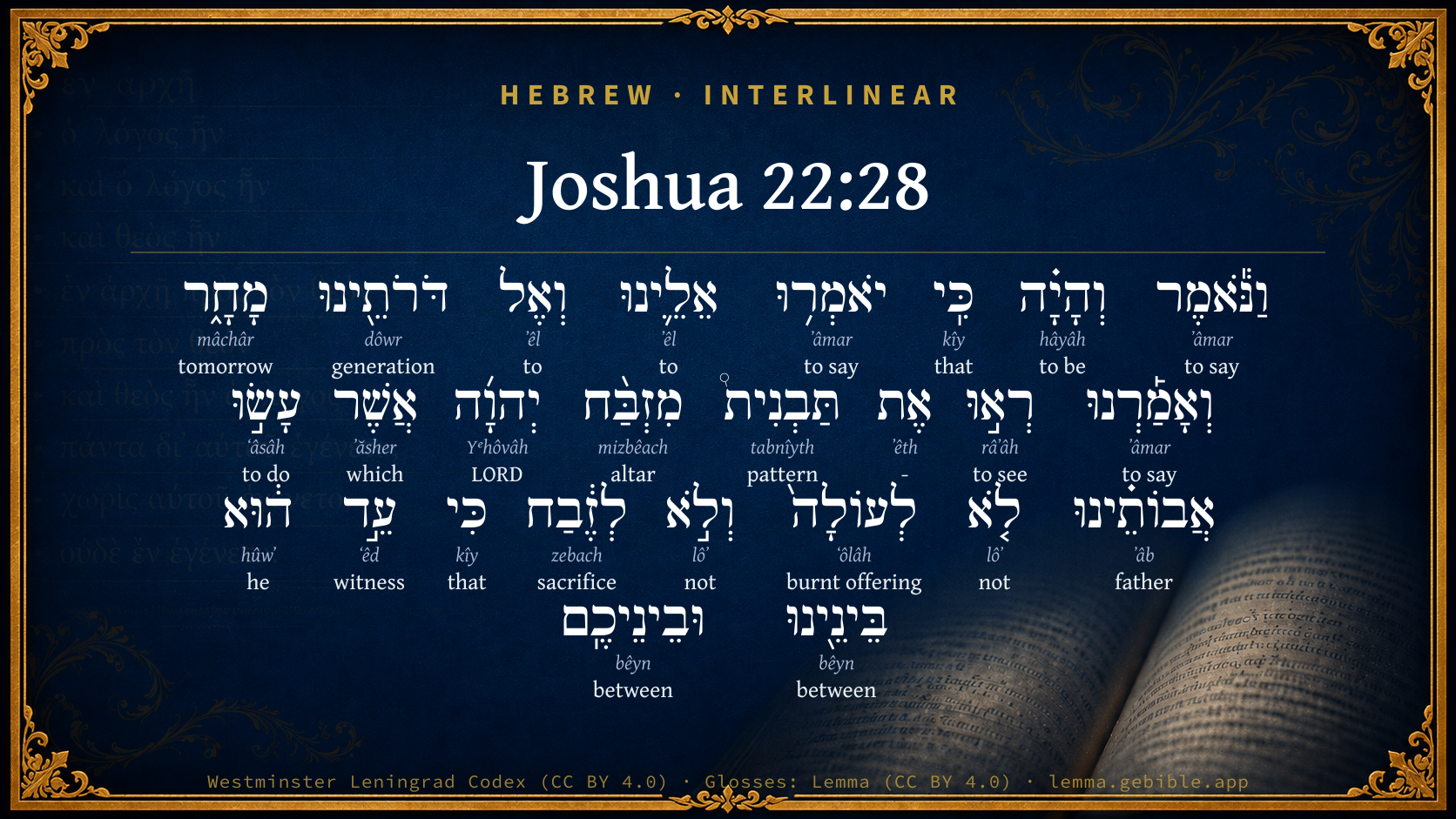
Hebrew (Westminster Leningrad Codex) Joshua 22:28 appears in the Hebrew Old Testament. The text above is from the Westminster Leningrad Codex. Each word links to its Strong’s number, a concise gloss, and parsing drawn from the Open Scriptures Hebrew Bible morphology. Click any word for its full Brown-Driver-Briggs (BDB) entry.
Download image
Cite this verse

Joshua 22:28 (World English Bible). Public Domain. Lemma interlinear Bible study tool, https://lemma.gebible.app/v/joshua/22/28.

Show BibTeX & RIS
BibTeX
RIS
English Translation
Therefore said we, It shall be, when they so tell us or to our generations in time to come, that we shall say, Behold the pattern of the altar of Yahweh, which our fathers made, not for burnt offering, nor for sacrifice; but it is a witness between us and you.
World English Bible · Public Domain
Download a study sheet

One document with this verse’s original text, its word-by-word gloss line, the meaning frame, cross-references with their text, attributed commentary, and full source and license credits — printable, and it pastes into notes with its structure intact.

This verse Autodidact and up

Study sheet (.html) Plain text (.txt)

A passage Seminary Student

Up to 50 verses in one chapter. A passage sheet keeps up to 6 commentary sources and 12 cross-references per verse, in the order this page ranks them, and says so on the sheet whenever that leaves anything out. Ask for a single verse and you get the Autodidact verse sheet above.

Everything on this page stays free to read, with no account — the sheet is a download of what is already on screen, not access to it.

Want to remove ads? Support Godless Engineer
Compare translations 3

The same verse in 3 English versions, stacked beneath the original-language interlinear above. Click any original word for its lexicon entry.

Each is an independent rendering of the whole verse — the interlinear is not word-aligned to these translations.

Highlighted words mark where these versions differ — a whole-verse word diff, not a word-by-word alignment.

  • World English Bible Public Domain
    Therefore said we, It shall be, when they so tell us or to our generations in time to come, that we shall say, Behold the pattern of the altar of Yahweh, which our fathers made, not for burnt offering, nor for sacrifice; but it is a witness between us and you.
  • King James Version Public Domain
    Therefore said we, that it shall be, when they should so say to us or to our generations in time to come, that we may say again, Behold the pattern of the altar of the LORD, which our fathers made, not for burnt offerings, nor for sacrifices; but it is a witness between us and you.
  • unfoldingWord Literal Text CC BY-SA 4.0
    And we said, ‘And it will happen, if they speak to us, or to our generations tomorrow, that we will say, “See, a copy of the altar of Yahweh that our fathers made, not for a burnt offering and not for a sacrifice, but it a witness between us and between you.”

unfoldingWord Literal Text — © unfoldingWord, licensed CC BY-SA 4.0. Word-aligned USFM3 via Door43 (git.door43.org/unfoldingWord/en_ult).

Versions to compare (up to 4)

3 of 4 selected

Show all 18 translations

Every available English version of this verse, each an independent rendering of the whole verse.

  • World English Bible Public Domain
    Therefore said we, It shall be, when they so tell us or to our generations in time to come, that we shall say, Behold the pattern of the altar of Yahweh, which our fathers made, not for burnt offering, nor for sacrifice; but it is a witness between us and you.
  • Berean Standard Bible Public Domain
    Therefore we said, ‘If they ever say this to us or to our descendants, we will answer: Look at the replica of the altar of the LORD that our fathers made, not for burnt offerings or sacrifices, but as a witness between us and you.’
  • Majority Standard Bible Public Domain
    Therefore we said, ‘If they ever say this to us or to our descendants, we will answer: Look at the replica of the altar of the LORD that our fathers made, not for burnt offerings or sacrifices, but as a witness between us and you.’
  • King James Version Public Domain
    Therefore said we, that it shall be, when they should so say to us or to our generations in time to come, that we may say again, Behold the pattern of the altar of the LORD, which our fathers made, not for burnt offerings, nor for sacrifices; but it is a witness between us and you.
  • American Standard Version (1901) Public Domain
    Therefore said we, It shall be, when they so say to us or to our generations in time to come, that we shall say, Behold the pattern of the altar of Jehovah, which our fathers made, not for burnt-offering, nor for sacrifice; but it is a witness between us and you.
  • Revised Version (1885) Public Domain
    Therefore said we, It shall be, when they so say to us or to our generations in time to come, that we shall say, Behold the pattern of the altar of the LORD, which our fathers made, not for burnt offering, nor for sacrifice; but it is a witness between us and you.
  • Geneva Bible (1599) Public Domain
    Therefore said we, If so be that they should so say to vs or to our generations in time to come, then will we answere, Beholde the facion of the altar of the Lord, which our fathers made, not for burnt offering nor for sacrifice, but it is a witnesse betweene vs and you.
  • Douay-Rheims (1899) Public Domain
    And if they will say so, they shall answer them: Behold the altar of the Lord, which our fathers made, not for holocausts, nor for sacrifice, but for a testimony between us and you.
  • Young's Literal Translation Public Domain
    `And we say, And it hath been, when they say `so' unto us, and unto our generations hereafter, that we have said, See the pattern of the altar of Jehovah, which our fathers made -- not for burnt-offering nor for sacrifice -- but a witness it `is' between us and you.
  • Literal Standard Version CC BY-SA 4.0
    And we say, And it has been, when they say [so] to us, and to our generations hereafter, that we have said, See the pattern of the altar of YHWH, which our fathers made—not for burnt-offering nor for sacrifice—but it [is] a witness between us and you.
  • Unlocked Literal Bible CC BY-SA 4.0
    So we said, 'If this should be said to us or to our descendants in time to come, we would say, “Look! This is a copy of the altar of Yahweh, which our ancestors made, not for burnt offerings, nor for sacrifices, but as a witness between us and you.”
  • unfoldingWord Literal Text CC BY-SA 4.0
    And we said, ‘And it will happen, if they speak to us, or to our generations tomorrow, that we will say, “See, a copy of the altar of Yahweh that our fathers made, not for a burnt offering and not for a sacrifice, but it a witness between us and between you.”
  • Darby Bible Public Domain
    And we said, If it shall be that in future they so say to us and to our generations, we will say, Behold the pattern of the altar of Jehovah which our fathers made, not for burnt-offering, nor for sacrifice, but as a witness between us and you.
  • World Messianic Bible Public Domain
    “Therefore we said, ‘It shall be, when they tell us or our generations this in time to come, that we shall say, “Behold the pattern of the LORD’s altar, which our fathers made, not for burnt offering, nor for sacrifice; but it is a witness between us and you.”’
  • Webster's Bible Public Domain
    Therefore said we, that it shall be, when they shall so say to us or to our generations in time to come, that we may say, Behold the pattern of the altar of the LORD, which our fathers made, not for burnt-offerings, nor for sacrifices; but it is a witness between us and you.
  • Free Bible Version CC BY-SA 4.0
    If they were to do so in the future, our descendants could reply, ‘Look at this copy of the Lord's altar which our forefathers made, not for burnt offerings or for sacrifices, but as a witness between us and you.’
  • Bible in Basic English Public Domain
    For we said to ourselves, If they say this to us or to future generations, then we will say, See this copy of the Lord's altar which our fathers made, not for burned offerings or offerings of beasts, but for a witness between us and you.
  • JPS Tanakh (1917) Public Domain
    Therefore said we: It shall be, when they so say to us or to our generations in time to come, that we shall say: Behold the pattern of the altar of the LORD, which our fathers made, not for burnt-offering, nor for sacrifice; but it is a witness between us and you.

Literal Standard Version (2020), Covenant Press — licensed CC BY-SA 4.0. Text via the HelloAO Bible API (eBible.org). Unlocked Literal Bible (unfoldingWord) — licensed CC BY-SA 4.0. Text via the HelloAO Bible API (eBible.org). unfoldingWord Literal Text — © unfoldingWord, licensed CC BY-SA 4.0. Word-aligned USFM3 via Door43 (git.door43.org/unfoldingWord/en_ult). Free Bible Version, Dr. Jonathan Gallagher — licensed CC BY-SA 4.0. Text via the HelloAO Bible API (eBible.org).

Word by word

More ways to search: Search by grammar → Find every occurrence → Compare this word →

Practice this passage: Drill this verse → Learn its vocabulary →

תַּבְנִית֩
tabnîyth
H8403
“pattern of”
Noun, Common, Feminine, Singular, Construct
Part of Speech
Noun
Type
Common
Gender
Feminine
Number
Singular
State
Construct
Full BDB Definition

Origin: from H1129

TWOT: 255d

pattern, plan, form, construction, figure - construction, structure - meaning dubious - pattern - figure, image (of idols)
  1. וַנֹּ֕אמֶר ʼâmar H559 “and · to say” Conjunction + Verb, Qal, Sequential Imperfect, 1st Person, Common, Plural
  2. וְהָיָ֗ה hâyâh H1961 “and · to be” Conjunction + Verb, Qal, Perfect, 3rd Person, Masculine, Singular
  3. כִּֽי kîy H3588 “that” Conjunction
  4. יֹאמְר֥וּ ʼâmar H559 “to say” Verb, Qal, Imperfect, 3rd Person, Masculine, Plural
  5. אֵלֵ֛ינוּ ʼêl H413 “to · us” Preposition + Suffix, Personal, 1st Person, Common, Plural
  6. וְאֶל ʼêl H413 “and · to” Conjunction + Preposition
  7. דֹּרֹתֵ֖ינוּ dôwr H1755 “generations · our” Noun, Common, Masculine, Plural, Construct + Suffix, Personal, 1st Person, Common, Plural
  8. מָחָ֑ר mâchâr H4279 “tomorrow” Noun, Common, Masculine, Singular, Absolute
  9. וְאָמַ֡רְנוּ ʼâmar H559 “and · to say” Conjunction + Verb, Qal, Sequential Perfect, 1st Person, Common, Plural
  10. רְא֣וּ râʼâh H7200 “see” Verb, Qal, Imperative, 2nd Person, Masculine, Plural
  11. אֶת ʼêth H853 “-” Particle, Direct Object
  12. מִזְבַּ֨ח mizbêach H4196 “altar of” Noun, Common, Masculine, Singular, Construct
  13. יְהוָ֜ה Yᵉhôvâh H3068 “LORD” Noun, Proper
  14. אֲשֶׁר ʼăsher H834 “which” Particle, Relative
  15. עָשׂ֣וּ ʻâsâh H6213 “to do” Verb, Qal, Perfect, 3rd Person, Common, Plural
  16. אֲבוֹתֵ֗ינוּ ʼâb H1 “fathers · our” Noun, Common, Masculine, Plural, Construct + Suffix, Personal, 1st Person, Common, Plural
  17. לֹ֤א lôʼ H3808 “not” Particle, Negative
  18. לְעוֹלָה֙ ʻôlâh H5930 “to/for · burnt offering” Preposition + Noun, Common, Feminine, Singular, Absolute
  19. וְלֹ֣א lôʼ H3808 “and · not” Conjunction + Particle, Negative
  20. לְזֶ֔בַח zebach H2077 “to/for · sacrifice” Preposition + Noun, Common, Masculine, Singular, Absolute
  21. כִּי kîy H3588 “that” Conjunction
  22. עֵ֣ד ʻêd H5707 “witness” Noun, Common, Masculine, Singular, Absolute
  23. ה֔וּא hûwʼ H1931 “he” Pronoun, Personal, 3rd Person, Masculine, Singular
  24. בֵּינֵ֖ינוּ bêyn H996 “between · us” Preposition + Suffix, Personal, 1st Person, Common, Plural
  25. וּבֵינֵיכֶֽם bêyn H996 “and · between · you” Conjunction + Preposition + Suffix, Personal, 2nd Person, Masculine, Plural

About this verse

These counts appear in no published source. They are computed here, from the morphology-tagged text and Lemma’s own curated glosses. What Lemma adds →

26
words
20
distinct lemmas
Historical
section

Notable vocabulary

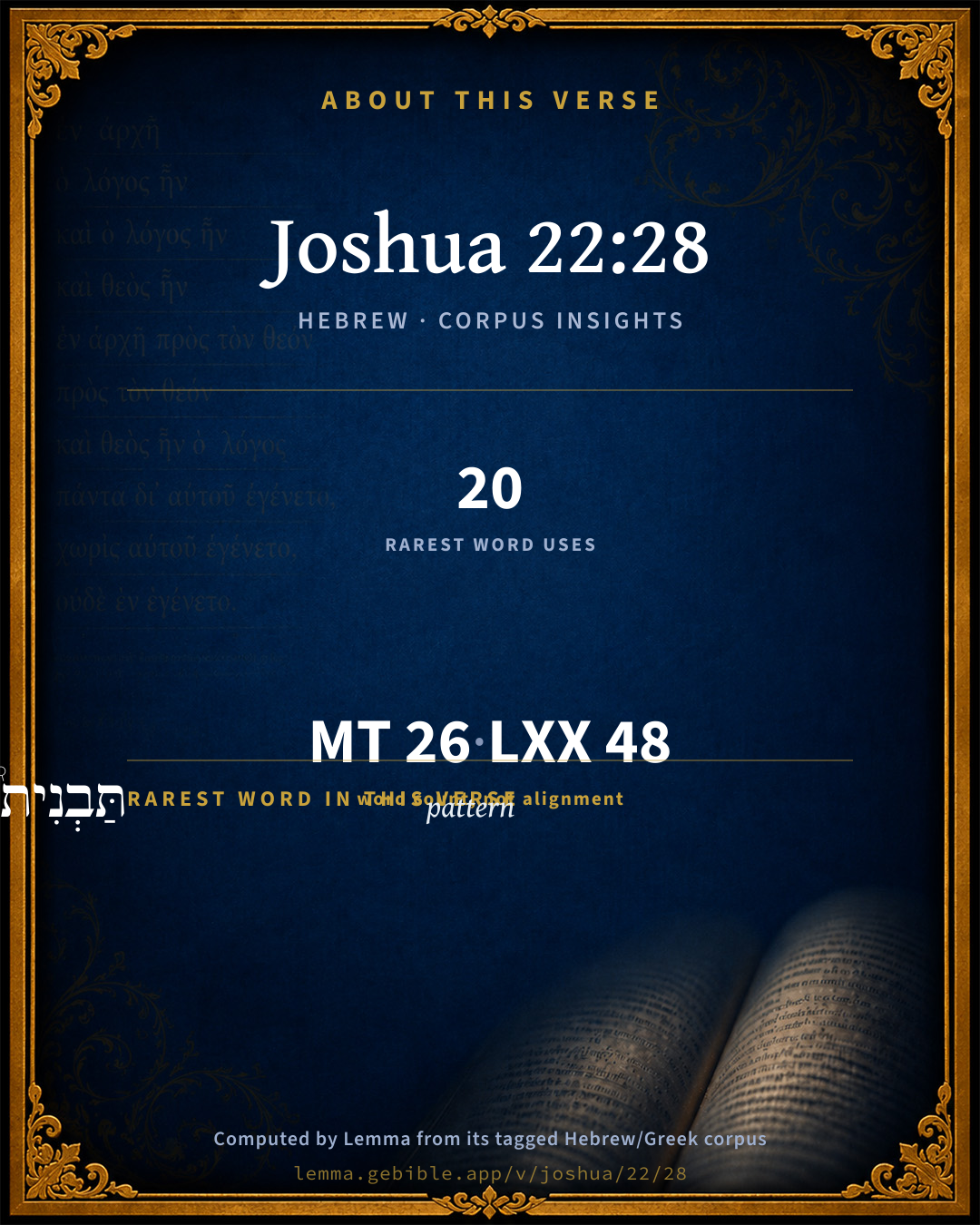
The rarest word here is תַּבְנִית֩ pattern H8403 — appearing just 20 times in the whole Hebrew Bible.

Shared distinctive vocabulary

תַּבְנִית֩ pattern H8403 occurs in 17 verses of the Hebrew Bible. Also found in:

Grammatical profile

  • 6 verbs
  • 9 nouns
  • 1 pronoun
  • 4 prepositions
  • 2 conjunctions
  • 4 particles

Verb forms

  • וַנֹּ֕אמֶר Qal · Sequential Imperfect
  • וְהָיָ֗ה Qal · Perfect
  • יֹאמְר֥וּ Qal · Imperfect
  • וְאָמַ֡רְנוּ Qal · Sequential Perfect
  • רְא֣וּ Qal · Imperative
  • עָשׂ֣וּ Qal · Perfect

Repetition

Words recur within this verse — often emphatic in Hebrew:

  • וַנֹּ֕אמֶר to say H559 ×3
  • בֵּינֵ֖ינוּ between H996 ×2
  • כִּֽי that H3588 ×2
  • אֵלֵ֛ינוּ to H413 ×2
  • לֹ֤א not H3808 ×2

Hebrew & Septuagint length

In English translation the verse runs 51 words from the Hebrew and 65 from the Septuagint (LXX English) — closely comparable.

A rough comparison of the two English renderings, which tokenize alike — not a word-level alignment.

Word counts can differ between the Hebrew and the Greek without any difference in meaning — e.g. the Hebrew direct-object marker אֵת has no separate Greek word, and Greek often adds the article ὁ.

In the original languages it is 26 Hebrew tokens and 48 Greek tokens — but the two are counted differently (Hebrew bundles its prefixes and suffixes into one token; the Greek is in lemma form), so that isn’t a like-for-like length.

Cross-references

4

Topical passages linked to Joshua 22:28 in the Treasury of Scripture Knowledge — connected by theme and wording, ordered by reader-vote popularity; previews shown in the World English Bible.

  • Exodus 25:40 See that you make them after their pattern, which has been shown to you on the mountain.
  • Ezekiel 43:10–11 You, son of man, show the house to the house of Israel, that they may be ashamed of their iniquities; and let them measure the pattern.
  • Hebrews 8:5 who serve a copy and shadow of the heavenly things, even as Moses was warned by God when he was about to make the tabernacle, for he said, "See, you shall make everything according to the pattern that was shown to you on the mountain."
  • 2 Kings 16:10 King Ahaz went to Damascus to meet Tiglath Pileser king of Assyria, and saw the altar that was at Damascus; and king Ahaz sent to Urijah the priest the fashion of the altar, and the pattern of it, according to all the workmanship of it.

Cross-references courtesy of OpenBible.info (CC BY 4.0).

Hebrew and Greek witnesses Masoretic Hebrew ↔ Greek Septuagint

The same verse in the two great witnesses to the Old Testament, shown verse-for-verse.

These are two independent witnesses, not word-aligned to each other, and the Septuagint is shown in lemma (dictionary) form.

Hebrew Joshua 22:28 Masoretic · Westminster Leningrad Codex

וַנֹּ֕אמֶר וְהָיָ֗ה כִּֽי יֹאמְר֥וּ אֵלֵ֛ינוּ וְאֶל דֹּרֹתֵ֖ינוּ מָחָ֑ר וְאָמַ֡רְנוּ רְא֣וּ אֶת תַּבְנִית֩ מִזְבַּ֨ח יְהוָ֜ה אֲשֶׁר עָשׂ֣וּ אֲבוֹתֵ֗ינוּ לֹ֤א לְעוֹלָה֙ וְלֹ֣א לְזֶ֔בַח כִּי עֵ֣ד ה֔וּא בֵּינֵ֖ינוּ וּבֵינֵיכֶֽם

Therefore said we, It shall be, when they so tell us or to our generations in time to come, that we shall say, Behold the pattern of the altar of Yahweh, which our fathers made, not for burnt offering, nor for sacrifice; but it is a witness between us and you.

World English Bible · Public Domain

Greek LXX Joshua 22:28 Septuagint · lemma form

καί εἶπον ἐάν γίγνομαι ποτέ καί λαλέω πρός ἐγώ καί ὁ γενεά ἐγώ αὔριον καί εἶπον ὁράω ὁμοίωμα ὁ θυσιαστήριον κύριος ὅς ποιέω ὁ πατήρ ἐγώ οὐ ἕνεκεν κάρπωμα οὐδέ ἕνεκεν θυσία ἀλλά μαρτύριον εἰμί ἀνά μέσος σύ καί ἀνά μέσος ἐγώ καί ἀνά μέσος ὁ υἱός ἐγώ

And we said, If ever it should come to pass that they should speak so to us, or to our posterity hereafter; then shall they say, Behold the likeness of the altar of the Lord, which our fathers made, not for the sake of burnt offerings, nor for the sake of meat-offerings, but it is a witness between you and us, and between our sons.

LXX2012 (modern English Septuagint) · Public Domain

Hebrew: Westminster Leningrad Codex (CC BY 4.0). Greek: Septuagint (public domain); English from LXX2012 (modern English Septuagint) (Public Domain). How the Septuagint differs from the Hebrew →

Targum (Aramaic paraphrase)

1

The Targum is the ancient Jewish Aramaic paraphrase of the Hebrew Scriptures — an interpretive translation, not the Hebrew text itself. Onkelos (literal) and Pseudo-Jonathan (expansive) render the Torah, and Jonathan the Prophets. Coverage is partial: where no permissively-licensed English translation exists for a verse, only the Aramaic is shown. This is verse-level text, not a word-by-word alignment to the Hebrew.

  1. Targum Jonathan Prophets (Joshua–Malachi)
    וַאֲמַרְנָא וִיהֵי אֲרֵי יֵימְרוּן לָנָא וּלְדָרָנָא מְחַר וְנֵימַר חֲזוֹ יַת דְמוּת מַדְבְּחָא דַייָ דִי עֲבַדוּ אַבְהָתָנָא לָא לַעֲלָתָא וְלֹא לְנִכְסַת קוּדְשַׁיָא אֲרֵי סָהִיד הוּא בֵּינָנָא וּבֵינֵיכוֹן:

    (no public-domain English translation for this verse)

    Targum Jonathan — Aramaic: “Mikraot Gedolot” (public domain). English: “Sefaria Community Translation” (CC0 1.0 (public-domain dedication)); “London "Chaldee Paraphrase," 1871” (public domain). Text via Sefaria.

Commentary

Notes on Joshua 22:28 from classic Christian and Jewish commentators (each source and its license shown beneath its notes). The classic Christian expositions comment on the surrounding passage and are grouped to its opening verse, so a note may address several verses; the Jewish commentaries on the Tanakh (Rashi and others) are per-verse, so they appear only where the commentator wrote on this verse.

Lemma curates 59 commentaries, every one of them public domain or Creative Commons licensed, each selected and text-cleaned for this edition rather than reprinted as found. About our sources →

Trapp's Complete Commentary

John Trapp

Jos 22:28 Therefore said we, that it shall be, when they should [so] say to us or to our generations in time to come, that we may say [again], Behold the pattern of the altar of the LORD, which our fathers made, not for burnt offerings, nor for sacrifices; but it [is] a witness between us and you.

Ver. 28. But it is a witness.] See Jos 22:27.

John Trapp, A Commentary or Exposition upon All the Books of the Old and New Testament (1647–1656) — public domain. Text from a community e-Sword module.

Joseph Benson's Commentary

Jos 22:28. Behold the pattern of the altar — An exact representation and resemblance of it; but which they could not have imitated, if they had not been acquainted with it, and worshipped God there with their brethren. But it is a witness between us and you — That we both serve one God, and approve and make use of the same altar.

Joseph Benson's Commentary on the Old and New Testaments (1811–1818) — public domain. Text from a community e-Sword module.

Tyndale Open Study Notes

Tyndale Open Resources

22:28 This altar was a copy, intended to be seen, not used.

Tyndale Open Study Notes — © Tyndale Open Resources, licensed CC BY-SA 4.0. Text via the HelloAO Bible API.

Geneva Bible (1599)

Geneva Bible translators

They signify a wonderful care that they bare toward their posterity, that they might live in the true service of God.

Geneva Bible (1599) marginal notes — public domain. Text via Bolls.life.

Ellicott's Commentary for English Readers

(28) The altar of the Lord, which our fathers made, not for burnt offerings, nor for sacrifices.—The words suggest the reflection that there are many other “altars” so called in the present day, also an occasion of dispute; and it would tend greatly to peace and acquiescence in their existence if we could be assured that, like this altar, they are “not for sacrifice” but for a witness to that common worship of Christ as God which is an essential feature of Christianity.

A Bible Commentary for English Readers, edited by Charles John Ellicott (1878–1897) — public domain. Text from a community e-Sword module.

The Cambridge Bible for Schools and Colleges

gen. ed. J. J. S. Perowne

28. Behold the pattern] Some have imagined that the altar set up had an actual resemblance to the altar of burnt-offering at the Tabernacle. But this could hardly be. There may have been some general resemblance in their structure, which was of earth heaped up and huge stones.

it is a witness between us and you] Comp. Jos_4:6-7; and Gen_31:48.

The Cambridge Bible for Schools and Colleges (gen. ed. J. J. S. Perowne; Cambridge University Press, 1878–1918) — public domain. Text from a community e-Sword module.

John Gill's Exposition

God forbid that we should rebel against the Lord,.... Against the command of the Lord, who ordered one altar to be made, to which all sacrifices were to be brought from the several parts of the land of Israel, and there to be offered on it; or

"against the Word of the Lord,''as the Targum, Christ typified both by the altar and the sacrifices on it; and who is but one, one priest, one sacrifice, one altar, one Mediator and Saviour:

and turn this day from following the Lord; apostatize from him, and from his worship:

to build an altar for burnt offerings, for meat offerings, or for sacrifices; which was never our intention, or ever entered into our hearts to erect one for such a purpose:

besides the altar of the Lord our God, that is before his tabernacle; it standing in the court of the tabernacle before the holy place.

John Gill's Exposition of the Whole Bible (1746–1763) — public domain (CC PDM 1.0). Text via the HelloAO Bible API.

Matthew Poole's English Annotations

The pattern; an exact representation and resemblance.

A witness between us and you, that we both serve one God, and approve and make use of one and the same altar.

Matthew Poole's English Annotations on the Holy Bible (1683–1685) — public domain. Text from a community e-Sword/MySword module.

The Pulpit Commentary

Behold the pattern. Rather, Look at this facsimile. The Hebrew is even stronger than our version. The existence of an exact reproduction of the altar in Shiloh, erected on Canaanitish ground by the two and a half tribes before their departure across Jordan, was an incontestible proof of their original connection with Israel. And the fact that they had erected it, not on their own territory, but on that of their brethren, was, though they do not use the argument, proof positive that it was not intended to be used in contravention of the precepts of the law. The nature of the facsimile is explained by Exo_20:24, where the precise form of altar seems to have been presented as a contrast to the stone altars employed by the heathen.

The Pulpit Commentary (1880–1919), ed. H.D.M. Spence-Jones & Joseph S. Exell — public domain. Text from a community e-Sword module.

John Wesley's Explanatory Notes

The pattern - An exact representation and resemblance. A witness - That we both serve one God, and approve and make use of one and the same altar.

John Wesley, Explanatory Notes Upon the Whole Bible (1754–1765) — public domain. Text via the GEBible commentary corpus.

unfoldingWord translationNotes

Door43 World Missions Community

General Information:

The tribes of Reuben, Gad and the half tribe of Manasseh now finish their answer.

If this should be said ... a witness between us and you."

The three tribes are describing their potential answer to an accusation that might or might not be made at a future time. (See: Hypothetical Situations)

May it be far from us that we should rebel

The unlikely chance that they would rebel is spoken of as if it is something that is a great distance away from them. AT: "We would certainly not rebel" (See: Idiom)

turn away from following him

To stop following Yahweh is spoken of as if they were turning away from him. AT: "stop following him" (See: Metaphor)

translationWords

descend

altar

tabernacle

unfoldingWord translationNotes — © Distant Shores Media and the Door43 World Missions Community, licensed CC BY-SA 4.0. Source: git.door43.org/Door43/en_tn.

Lesson kit

Teaching starters — assembled from the data on this page, not authored interpretation. Every prompt links to the verse data it draws on. Edit before teaching.

Joshua, in the Historical, opens this verse with 26 words (20 distinct Hebrew lemmas). Its most distinctive word is tabnîyth (“pattern”). A historical commentator’s framing appears above. Read the whole chapter for the surrounding context.

Discussion questions

  1. What does “pattern” (tabnîyth) contribute to the verse as a whole?
  2. Exodus 25:9 shares the word «pattern» with this verse. How do the two illuminate each other?
  3. “to say” occurs 3× in this one verse. What is the effect of the repetition?
  4. The translations on this page render this verse differently — a whole-verse word diff, not a word-by-word alignment. What might account for the different wordings?
  5. The verb «וַנֹּ֕אמֶר» is Qal Sequential Imperfect. How does its form color the action?
  6. Reading how Trapp's Complete Commentary and Joseph Benson's Commentary read this verse, where do the two commentators agree and where do they part?

Things to notice

Reading settings

Reading text

Shown beneath each verse's original-language words.

Old Testament
Old Testament edition

Read the OT as the Masoretic Hebrew (MT) or the Greek Septuagint (LXX).

English shown for the Greek Septuagint (in the Hebrew ↔ Greek comparison).

Comparing translations? Open the Compare panel on any verse page to stack up to four side by side.