
Hosea 13:15

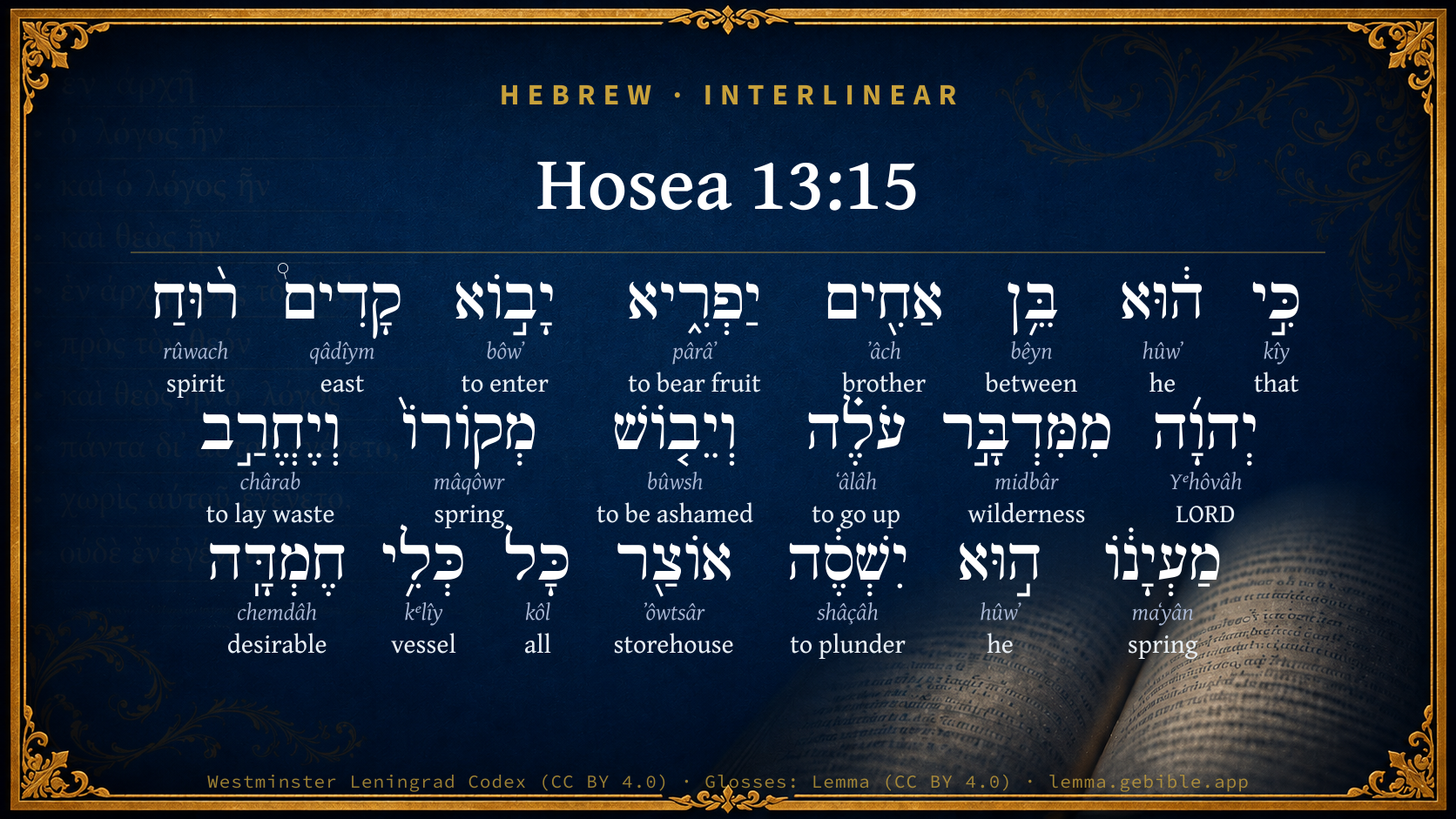
Hebrew (Westminster Leningrad Codex) Hosea 13:15 appears in the Hebrew Old Testament. The text above is from the Westminster Leningrad Codex. Each word links to its Strong’s number, a concise gloss, and parsing drawn from the Open Scriptures Hebrew Bible morphology. Click any word for its full Brown-Driver-Briggs (BDB) entry.
Download image
Cite this verse

Hosea 13:15 (World English Bible). Public Domain. Lemma interlinear Bible study tool, https://lemma.gebible.app/v/hosea/13/15.

Show BibTeX & RIS
BibTeX
RIS
English Translation
Though he is fruitful among his brothers, an east wind will come, The breath of Yahweh coming up from the wilderness; And his spring will become dry, And his fountain will be dried up. He will plunder the storehouse of treasure.
World English Bible · Public Domain
Highlights
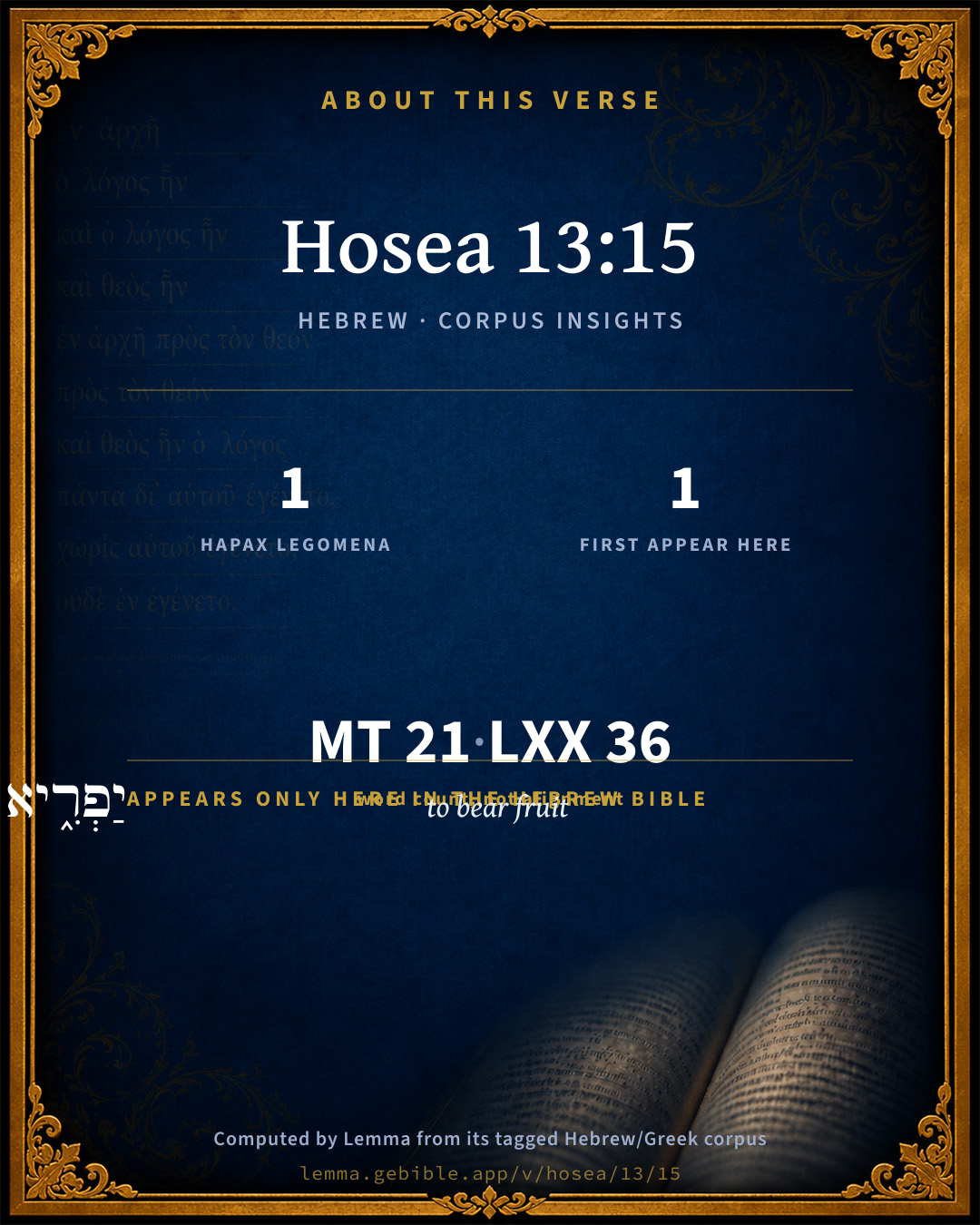
  • 1 hapax legomenon — only here in the Hebrew Bible
  • 1 first appearance in the Hebrew Bible
Full analysis ↓
Download a study sheet

One document with this verse’s original text, its word-by-word gloss line, the meaning frame, cross-references with their text, attributed commentary, and full source and license credits — printable, and it pastes into notes with its structure intact.

This verse Autodidact and up

Study sheet (.html) Plain text (.txt)

A passage Seminary Student

Up to 50 verses in one chapter. A passage sheet keeps up to 6 commentary sources and 12 cross-references per verse, in the order this page ranks them, and says so on the sheet whenever that leaves anything out. Ask for a single verse and you get the Autodidact verse sheet above.

Everything on this page stays free to read, with no account — the sheet is a download of what is already on screen, not access to it.

Want to remove ads? Support Godless Engineer
Compare translations 3

The same verse in 3 English versions, stacked beneath the original-language interlinear above. Click any original word for its lexicon entry.

Each is an independent rendering of the whole verse — the interlinear is not word-aligned to these translations.

Highlighted words mark where these versions differ — a whole-verse word diff, not a word-by-word alignment.

  • World English Bible Public Domain
    Though he is fruitful among his brothers, an east wind will come, The breath of Yahweh coming up from the wilderness; And his spring will become dry, And his fountain will be dried up. He will plunder the storehouse of treasure.
  • King James Version Public Domain
    Though he be fruitful among his brethren, an east wind shall come, the wind of the LORD shall come up from the wilderness, and his spring shall become dry, and his fountain shall be dried up: he shall spoil the treasure of all pleasant vessels.
  • unfoldingWord Literal Text CC BY-SA 4.0
    Although he, among brothers, he bears fruit, an easterly will come, the wind of Yahweh, coming up from the wilderness, and his fountain will be ashamed and his spring will dry up. It, it will plunder the treasury of every vessel of desire.

unfoldingWord Literal Text — © unfoldingWord, licensed CC BY-SA 4.0. Word-aligned USFM3 via Door43 (git.door43.org/unfoldingWord/en_ult).

Versions to compare (up to 4)

3 of 4 selected

Show all 18 translations

Every available English version of this verse, each an independent rendering of the whole verse.

  • World English Bible Public Domain
    Though he is fruitful among his brothers, an east wind will come, The breath of Yahweh coming up from the wilderness; And his spring will become dry, And his fountain will be dried up. He will plunder the storehouse of treasure.
  • Berean Standard Bible Public Domain
    Although he flourishes among his brothers, an east wind will come—a wind from the LORD rising up from the desert. His fountain will fail, and his spring will run dry. The wind will plunder his treasury of every precious article.
  • Majority Standard Bible Public Domain
    Although he flourishes among his brothers, an east wind will come—a wind from the LORD rising up from the desert. His fountain will fail, and his spring will run dry. The wind will plunder his treasury of every precious article.
  • King James Version Public Domain
    Though he be fruitful among his brethren, an east wind shall come, the wind of the LORD shall come up from the wilderness, and his spring shall become dry, and his fountain shall be dried up: he shall spoil the treasure of all pleasant vessels.
  • American Standard Version (1901) Public Domain
    Though he be fruitful among his brethren, an east wind shall come, the breath of Jehovah coming up from the wilderness; and his spring shall become dry, and his fountain shall be dried up: he shall make spoil of the treasure of all goodly vessels.
  • Revised Version (1885) Public Domain
    Though he be fruitful among his brethren, an east wind shall come, the breath of the LORD coming up from the wilderness, and his spring shall become dry, and his fountain shall be dried up: he shall spoil the treasure of all pleasant vessels.
  • Geneva Bible (1599) Public Domain
    Though he grewe vp among his brethren, an East winde shall come, euen the winde of the Lord shall come vp from the wildernesse, and drie vp his veine, and his fountaine shalbe dryed vp: he shall spoyle the treasure of all pleasant vessels.
  • Douay-Rheims (1899) Public Domain
    Because he shall make a separation between brothers: s the Lord will bring a burning wind that shall rise from the desert, and it shall dry up his springs, and shall make his fountain desolate, and he shall carry off the treasure of every desirable vessel.
  • Young's Literal Translation Public Domain
    Though he among brethren produceth fruit, Come in doth an east wind, a wind of Jehovah, From a wilderness it is coming up, And it drieth up his fountain, And become dry doth his spring, It -- it spoileth a treasure -- every desirable vessel.
  • Literal Standard Version CC BY-SA 4.0
    Though he produces fruit among brothers, || An east wind comes in, a wind of YHWH, || From a wilderness it is coming up, || And it dries up his fountain, || And his spring becomes dry, || It—it spoils a treasure—every desirable vessel.
  • Unlocked Literal Bible CC BY-SA 4.0
    Though Ephraim is prosperous among his brothers, an east wind will come; the wind of Yahweh will blow in from the wilderness. Ephraim's spring will dry up, and his well will have no water. His enemy will plunder his storehouse of every precious object.
  • unfoldingWord Literal Text CC BY-SA 4.0
    Although he, among brothers, he bears fruit, an easterly will come, the wind of Yahweh, coming up from the wilderness, and his fountain will be ashamed and his spring will dry up. It, it will plunder the treasury of every vessel of desire.
  • Darby Bible Public Domain
    Though he be fruitful among [his] brethren, an east wind shall come, a wind of Jehovah [that] cometh up from the wilderness, and his spring shall become dry, and his fountain shall be dried up: he shall spoil the treasure of all pleasant vessels.
  • World Messianic Bible Public Domain
    Though he is fruitful among his brothers, an east wind will come, the breath of the LORD coming up from the wilderness; and his spring will become dry, and his fountain will be dried up. He will plunder the storehouse of treasure.
  • Webster's Bible Public Domain
    Though he is fruitful among his brethren, an east wind shall come, the wind of the LORD shall come up from the wilderness, and his spring shall become dry, and his fountain shall be dried up: he shall pillage the treasure of all pleasant vessels.
  • Free Bible Version CC BY-SA 4.0
    Even though they flourish among the reeds, an east wind will come, a wind from the Lord that rises in the desert will dry up their springs and their wells will fail. It will rob from their treasury everything of value.
  • Bible in Basic English Public Domain
    Though he gives fruit among his brothers, an east wind will come, the wind of the Lord coming up from the waste land, and his spring will become dry, his fountain will be without water: it will make waste the store of all the vessels of his desire.
  • JPS Tanakh (1917) Public Domain
    For though he be fruitful among the reed-plants, an east wind shall come, the wind of the LORD coming up from the wilderness, and his spring shall become dry, and his fountain shall be dried up; he shall spoil the treasure of all precious vessels.

Literal Standard Version (2020), Covenant Press — licensed CC BY-SA 4.0. Text via the HelloAO Bible API (eBible.org). Unlocked Literal Bible (unfoldingWord) — licensed CC BY-SA 4.0. Text via the HelloAO Bible API (eBible.org). unfoldingWord Literal Text — © unfoldingWord, licensed CC BY-SA 4.0. Word-aligned USFM3 via Door43 (git.door43.org/unfoldingWord/en_ult). Free Bible Version, Dr. Jonathan Gallagher — licensed CC BY-SA 4.0. Text via the HelloAO Bible API (eBible.org).

Word by word

More ways to search: Search by grammar → Find every occurrence → Compare this word →

Practice this passage: Drill this verse → Learn its vocabulary →

יַפְרִ֑יא
pârâʼ
H6500
“to bear fruit”
Verb, Hiphil, Imperfect, 3rd Person, Masculine, Singular
Part of Speech
Verb
Stem
Hiphil
Form
Imperfect
Person
3rd Person
Gender
Masculine
Number
Singular
Full BDB Definition

Origin: a primitive root

TWOT: 1805

(Hiphil) to bear fruit, be fruitful
  1. כִּ֣י kîy H3588 “that” Conjunction
  2. ה֔וּא hûwʼ H1931 “he” Pronoun, Personal, 3rd Person, Masculine, Singular
  3. בֵּ֥ן bêyn H996 “between of” Noun, Common, Masculine, Singular, Construct
  4. אַחִ֖ים ʼâch H251 “brothers” Noun, Common, Masculine, Plural, Absolute
  5. יָב֣וֹא bôwʼ H935 “to enter” Verb, Qal, Imperfect, 3rd Person, Masculine, Singular
  6. קָדִים֩ qâdîym H6921 “east” Noun, Common, Masculine, Singular, Absolute
  7. ר֨וּחַ rûwach H7307 “spirit of” Noun, Common, Both, Singular, Construct
  8. יְהוָ֜ה Yᵉhôvâh H3068 “LORD” Noun, Proper
  9. מִמִּדְבָּ֣ר midbâr H4057 “from · wilderness” Preposition + Noun, Common, Masculine, Singular, Absolute
  10. עֹלֶ֗ה ʻâlâh H5927 “going up” Verb, Qal, Participle Active, Masculine, Singular, Absolute
  11. וְיֵב֤וֹשׁ bûwsh H954 “and · to be ashamed” Conjunction + Verb, Qal, Imperfect, 3rd Person, Masculine, Singular
  12. מְקוֹרוֹ֙ mâqôwr H4726 “spring · his” Noun, Common, Masculine, Singular, Construct + Suffix, Personal, 3rd Person, Masculine, Singular
  13. וְיֶחֱרַ֣ב chârab H2717 “and · to lay waste” Conjunction + Verb, Qal, Imperfect, 3rd Person, Masculine, Singular
  14. מַעְיָנ֔וֹ maʻyân H4599 “spring · his” Noun, Common, Masculine, Singular, Construct + Suffix, Personal, 3rd Person, Masculine, Singular
  15. ה֣וּא hûwʼ H1931 “he” Pronoun, Personal, 3rd Person, Masculine, Singular
  16. יִשְׁסֶ֔ה shâçâh H8154 “to plunder” Verb, Qal, Imperfect, 3rd Person, Masculine, Singular
  17. אוֹצַ֖ר ʼôwtsâr H214 “storehouse of” Noun, Common, Masculine, Singular, Construct
  18. כָּל kôl H3605 “all of” Noun, Common, Masculine, Singular, Construct
  19. כְּלִ֥י kᵉlîy H3627 “vessel of” Noun, Common, Masculine, Singular, Construct
  20. חֶמְדָּֽה chemdâh H2532 “desirable” Noun, Common, Feminine, Singular, Absolute

About this verse

These counts appear in no published source. They are computed here, from the morphology-tagged text and Lemma’s own curated glosses. What Lemma adds →

21
words
20
distinct lemmas
Prophets
section

Notable vocabulary

1 hapax legomenon — a word that appears only here in the entire Hebrew Bible:

  • יַפְרִ֑יא to bear fruit H6500

First appearance in Scripture

This word makes its first canonical appearance in the Hebrew Bible here:

  • יַפְרִ֑יא to bear fruit H6500

Shared distinctive vocabulary

יִשְׁסֶ֔ה to plunder H8154 occurs in 11 verses of the Hebrew Bible. Also found in:

Grammatical profile

  • 6 verbs
  • 12 nouns
  • 2 pronouns
  • 1 conjunction

Verb forms

  • יַפְרִ֑יא Hiphil · Imperfect
  • יָב֣וֹא Qal · Imperfect
  • עֹלֶ֗ה Qal · Participle Active
  • וְיֵב֤וֹשׁ Qal · Imperfect
  • וְיֶחֱרַ֣ב Qal · Imperfect
  • יִשְׁסֶ֔ה Qal · Imperfect

Repetition

A word recurs within this verse — often emphatic in Hebrew:

  • ה֔וּא he H1931 ×2

Hebrew & Septuagint length

In English translation the verse runs 41 words from the Hebrew and 45 from the Septuagint (LXX English) — closely comparable.

A rough comparison of the two English renderings, which tokenize alike — not a word-level alignment.

Word counts can differ between the Hebrew and the Greek without any difference in meaning — e.g. the Hebrew direct-object marker אֵת has no separate Greek word, and Greek often adds the article ὁ.

In the original languages it is 21 Hebrew tokens and 36 Greek tokens — but the two are counted differently (Hebrew bundles its prefixes and suffixes into one token; the Greek is in lemma form), so that isn’t a like-for-like length.

Cross-references

20

Topical passages linked to Hosea 13:15 in the Treasury of Scripture Knowledge — connected by theme and wording, ordered by reader-vote popularity; previews shown in the World English Bible.

  • Ezekiel 19:12 But it was plucked up in fury, it was cast down to the ground, and the east wind dried up its fruit: its strong rods were broken off and withered; the fire consumed them.
  • Ezekiel 17:10 Yes, behold, being planted, shall it prosper? shall it not utterly wither, when the east wind touches it? it shall wither in the beds where it grew.
  • Genesis 41:52 The name of the second, he called Ephraim: "For God has made me fruitful in the land of my affliction."
  • Genesis 48:19 His father refused, and said, "I know, my son, I know. He also will become a people, and he also will be great. However, his younger brother will be greater than he, and his seed will become a multitude of nations."
  • Genesis 49:22 "Joseph is a fruitful vine, A fruitful vine by a spring; His branches run over the wall.
  • Jeremiah 4:11 At that time shall it be said to this people and to Jerusalem, A hot wind from the bare heights in the wilderness toward the daughter of my people, not to winnow, nor to cleanse;
  • Deuteronomy 33:17 The firstborn of his herd, majesty is his; His horns are the horns of the wild-ox: With them he shall push the peoples all of them, [even] the ends of the earth: They are the ten thousands of Ephraim, They are the thousands of Manasseh.
  • Job 18:16 His roots shall be dried up beneath, Above shall his branch be cut off.
  • Psalms 1:4 The wicked are not so, But are like the chaff which the wind drives away.
  • Psalms 109:13 Let his posterity be cut off. In the generation following let their name be blotted out.
  • Isaiah 14:21 Prepare slaughter for his children for the iniquity of their fathers, that they not rise up, and possess the earth, and fill the surface of the world with cities.
  • Isaiah 17:13 The nations shall rush like the rushing of many waters: but he shall rebuke them, and they shall flee far off, and shall be chased as the chaff of the mountains before the wind, and like the whirling dust before the storm.
  • Isaiah 41:16 You shall winnow them, and the wind shall carry them away, and the whirlwind shall scatter them; and you shall rejoice in Yahweh, you shall glory in the Holy One of Israel.
  • Jeremiah 20:5 Moreover I will give all the riches of this city, and all the gains of it, and all the precious things of it, yes, all the treasures of the kings of Judah will I give into the hand of their enemies; and they shall make them a prey, and take them, and carry them to Babylon.
  • Jeremiah 51:36 Therefore thus says Yahweh: Behold, I will plead your cause, and take vengeance for you; and I will dry up her sea, and make her fountain dry.
  • Daniel 11:8 Also their gods, with their molten images, [and] with their goodly vessels of silver and of gold, shall he carry captive into Egypt; and he shall refrain some years from the king of the north.
  • Hosea 4:19 The wind has wrapped her up in its wings; And they shall be disappointed because of their sacrifices.
  • Hosea 9:11 As for Ephraim, their glory will fly away like a bird. There will be no birth, none with child, and no conception.
  • Hosea 10:1 Israel is a luxuriant vine that puts forth his fruit. According to the abundance of his fruit he has multiplied his altars. As their land has prospered, they have adorned their sacred stones.
  • Nahum 2:9 Take the spoil of silver. Take the spoil of gold, for there is no end of the store, the glory of all goodly furniture.

Cross-references courtesy of OpenBible.info (CC BY 4.0).

Hebrew and Greek witnesses Masoretic Hebrew ↔ Greek Septuagint

The same verse in the two great witnesses to the Old Testament, shown verse-for-verse.

These are two independent witnesses, not word-aligned to each other, and the Septuagint is shown in lemma (dictionary) form.

Hebrew Hosea 13:15 Masoretic · Westminster Leningrad Codex

כִּ֣י ה֔וּא בֵּ֥ן אַחִ֖ים יַפְרִ֑יא יָב֣וֹא קָדִים֩ ר֨וּחַ יְהוָ֜ה מִמִּדְבָּ֣ר עֹלֶ֗ה וְיֵב֤וֹשׁ מְקוֹרוֹ֙ וְיֶחֱרַ֣ב מַעְיָנ֔וֹ ה֣וּא יִשְׁסֶ֔ה אוֹצַ֖ר כָּל כְּלִ֥י חֶמְדָּֽה

Though he is fruitful among his brothers, an east wind will come, The breath of Yahweh coming up from the wilderness; And his spring will become dry, And his fountain will be dried up. He will plunder the storehouse of treasure.

World English Bible · Public Domain

Greek LXX Hosea 13:15 Septuagint · lemma form

διότι οὗτος ἀνά μέσος ἀδελφός διαστέλλω ἐπιἄγω ἄνεμος καύσων κύριος ἐκ ὁ ἔρημος ἐπί αὐτός καί ἀναξηραίνω ὁ φλέψ αὐτός ἐκἐρημόω ὁ πηγή αὐτός αὐτός καταξηραίνω ὁ γῆ αὐτός καί πᾶς ὁ σκεῦος ὁ ἐπιθυμητός αὐτός

Forasmuch as he will cause a division among his brethren, the Lord shall bring upon him an east wind from the desert, and shall dry up his veins and quite drain his fountains: he shall dry up his land, and spoil all his precious vessels.

LXX2012 (modern English Septuagint) · Public Domain

On this verse, The Pulpit Commentary discusses the Septuagint’s reading. Read the note in Commentary ↓

Hebrew: Westminster Leningrad Codex (CC BY 4.0). Greek: Septuagint (public domain); English from LXX2012 (modern English Septuagint) (Public Domain). How the Septuagint differs from the Hebrew →

Targum (Aramaic paraphrase)

1

The Targum is the ancient Jewish Aramaic paraphrase of the Hebrew Scriptures — an interpretive translation, not the Hebrew text itself. Onkelos (literal) and Pseudo-Jonathan (expansive) render the Torah, and Jonathan the Prophets. Coverage is partial: where no permissively-licensed English translation exists for a verse, only the Aramaic is shown. This is verse-level text, not a word-by-word alignment to the Hebrew.

  1. Targum Jonathan Prophets (Joshua–Malachi)
    אֲרֵי אִינוּן מִתְקְרָן בְּנִין וְעוֹבָדִין מְקַלְקְלִין אַסְגִיאוּ כְּעַן אַיְתֵי עֲלֵיהוֹן מְלַךְ תַּקִיף כְּרוּחַ קִדוּמָא בְּמֵימְרָא דַייָ מֵאוֹרַח מַדְבְּרָא יִסַק וְיֶחֱרַב בֵּית גִנְזוֹהִי וְיִצְרֵי קִרְיַת מַלְכוּתֵיהּ הוּא יִבּוֹז אוֹצְרִין כָּל מָנֵי חֶמְדָתָא:

    (no public-domain English translation for this verse)

    Targum Jonathan — Aramaic: “Mikraot Gedolot” (public domain). English: “Sefaria Community Translation” (CC0 1.0 (public-domain dedication)); “London "Chaldee Paraphrase," 1871” (public domain). Text via Sefaria.

Commentary

Notes on Hosea 13:15 from classic Christian and Jewish commentators (each source and its license shown beneath its notes). The classic Christian expositions comment on the surrounding passage and are grouped to its opening verse, so a note may address several verses; the Jewish commentaries on the Tanakh (Rashi and others) are per-verse, so they appear only where the commentator wrote on this verse.

Lemma curates 59 commentaries, every one of them public domain or Creative Commons licensed, each selected and text-cleaned for this edition rather than reprinted as found. About our sources →

Trapp's Complete Commentary

John Trapp

Hos 13:15 Though he be fruitful among [his] brethren, an east wind shall come, the wind of the LORD shall come up from the wilderness, and his spring shall become dry, and his fountain shall be dried up: he shall spoil the treasure of all pleasant vessels.

Ver. 15. Though he be fruitful among his brethren] In allusion to his name Ephraim, which signifieth fruitful and flourishing, Gen 41:52. Confer Gen 48:16; Gen 48:19-20; Gen 49:22. See the like allusions Amo 5:5 Mic 1:10.

An east wind shall come] Which is violent and hurtful to the fruits of the earth.

The wind of the Lord] A mighty strong wind, meaning that most merciless and impetuous enemy, the Assyrian, sent by the Lord to avenge the quarrel of his covenant.

Shall come up from the wilderness] Where the winds blow most fiercely, because they meet with no resistance.

And his spring shall become dry, &c.] This is a description of extreme desolation, and it is explained and amplified in the next words.

He shall spoil the treasure of all pleasant vessels] He, that is, the Assyrian, not Christ (as Jerome, Mercer, and Ribera will have it), who shall take away from death and hell all matter of glorying. Not the fire of the last day, as Lyra. No, nor Ephraim, as Pareus and Tarnovius carry it: as if it were a promise of their conquest in Christ over all their enemies, corporal and spiritual, dividing the spoil of the converted Gentiles, who shall come in to them with all their desirable things, as some read that text, Hag 2:7. Confer Amo 9:11-12 Oba 1:18 Zec 14:14; Zec 14:16; Zec 14:20-21. That this whole verse containeth a promise of Ephraim’s reduction to the Church of God I could easily yield; reading it especially, as many good interpreters do, "For he shall fructify among his brethren, after that an east wind coming, a wind of Jehovah coming up from the desert, his spring shall become dry, and his fountain shall dry up: the same shall spoil the treasure of all pleasant vessels." This is a similitude (say they) from a piece of ground all dried up and parched, that nothing is able to grow: notably expressing the miserable and distressed estate of this people; that, as an easterly wind, and a tempestuous storm, hath dried them quite and spoiled all their delightful treasures, made them the vilest and most contemptible of the earth. Marcellinus tells of an emperor, that, meeting with some of this nation, and annoyed with the sight and stench of them, cried out, O Marcommani, O Quadi, O Sarmatae, &c., O Mareomans, Quades, and Sarmatians, I have found at length a more loathsome and sordid people than you. All which notwithstanding, Ephraim shall flourish again, and hold up their heads among their brethren, sc. by the merit and spirit of him who ransometh them from the power of the grave, from the dint of death. This sense of the words is confirmed by that which follows in the next chapter, Hos 14:5-7.

John Trapp, A Commentary or Exposition upon All the Books of the Old and New Testament (1647–1656) — public domain. Text from a community e-Sword module.

The Biblical Illustrator

Joseph S. Exell

Hos_13:15

An east wind shall come.

Reverses of fortune in human life

This and the following verse set forth the devastation and destruction of the kingdom of the ten tribes which was to precede the deliverance promised in that which precedes.

I. Reverses in human fortune are sometimes very striking. Ephraim was fruitful among his brethren. The very name signifies fruitful ness. Its territory was most fertile; its people the most numerous.

1. Its riches would give way to poverty. Ephraim was at once a rich and a populous tribe; but see the change predicted: His spring shall become dry He shall spoil the treasure of all pleasant vessels. The enemy would invade the country, impoverish husbandry, check merchandise.

2. Its populousness would give way to paucity. The enemy would reduce its numbers, and almost depopulate it. Such reverses are frequent. They teach us to hold all worldly good with a light hand, and to settle our interests on the good that is permanent.

II. Reverses are generally brought about by secondary instrumentality. Nations, communities, and individuals may always trace their calamities to certain natural causes. This should teach us to study natural laws, and to be diligent in checking all elements inimical to human progress.

III. Reverses are under the direction of god. The change in the fortunes of Ephraim was under the superintendence of the Almighty. Both true philosophy and religion teach us to trace all the events of life to God. Learn to acquiesce in His dispensations, and to look to Him for all that is good. (Homilist.)

.

The Biblical Illustrator, edited by Joseph S. Exell (c. 1880s–1900s) — public domain. Text from a community e-Sword module.

Joseph Benson's Commentary

Hos 13:15. Though he be fruitful among his brethren — The name Ephraim denotes fruitfulness, and this tribe answered its name, being the most numerous of all the ten tribes. An east wind shall come — The east wind was often pestilent and destructive in Judea and the countries about it; therefore this expressed that destruction was coming upon Ephraim and likewise pointed out the quarter from whence it was to come, namely, from Assyria, which lay eastward of Judea. It is called the wind of the Lord, in the next words, because the destruction which the king of Assyria was to make of Ephraim was to be brought about by the divine will and providence. It is said to come up from the wilderness, because the way of the Assyrian army to Samaria lay through the desert part of Syria. His spring shall become dry, &c. The Assyrian king being spoken of as an east wind, which in those countries is very hot and drying; therefore the destruction, or desolation he was to make, is described by drying up the springs and fountains. He shall spoil the treasure — The same enemy shall plunder all their treasures and take away their rich and costly furniture, as the word כליis translated, Nah 2:9.

Joseph Benson's Commentary on the Old and New Testaments (1811–1818) — public domain. Text from a community e-Sword module.

Keil & Delitzsch

C. F. Keil & F. Delitzsch

"For he will bear fruit among brethren. East wind will come, a wind of Jehovah, rising up from the desert; and his fountain will dry up, and his spring become dried. He plunders the treasuries of all splendid vessels." The connection between the first clause and the previous verse has been correctly pointed out by Marck. "Hos 13:15," he says, "adduces a reason to prove that the promised grace of redemption would certainly stand firm." כּי cannot be either a particle of time or of condition here (when, or if); for neither of them yields a suitable thought, since Ephraim neither was at that time, nor could become, fruit-bearing among brethren. Ewald's hypothetical view, "Should Ephraim be a fruitful child," cannot be grammatically sustained, since kı̄ is only used in cases where a circumstance is assumed to be real. For one that is merely supposed to be possible, אם is required, as the interchange of אם and כּי, in Num 5:19-20, for example, clearly shows. The meaning of יפריא is placed beyond all doubt by the evident play upon the name Ephraim; and this also explains the writing with א instead of ה fo d, as well as the idea of the sentence itself: Ephraim will bear fruit among the brethren, i.e., the other tribes, as its name, double-fruitfulness, affirms (see at Gen 41:52). This thought, through which the redemption from death set before Israel is confirmed, is founded not only upon the assumption that the name must become a truth, but chiefly upon the blessing which the patriarch promised to the tribe of Ephraim on the ground of its name, both in Gen 48:4, Gen 48:20, and Gen 49:22. Because Ephraim possessed such a pledge of blessing in its very name, the Lord would not let it be overwhelmed for ever in the tempest that was bursting upon it. The same thing applies to the name Ephraim as to the name Israel, with which it is used as synonymous; and what is true of all the promises of God is true of this announcement also, viz., that they are only fulfilled in the case of those who adhere to the conditions under which they were given. Of Ephraim, those only will bear fruit which abides to everlasting life, who walk as true champions for God in the footsteps of faith and of their forefathers, wrestling for the blessing of the promises. On the other hand, upon the Ephraim that has turned into Canaan (Hos 12:8) an east wind will come, a tempest bursting from the desert (see at Hos 12:2), and that a stormy wind raised by Jehovah, which will dry up his spring, i.e., destroy not only the fruitful land with which God has blessed it (Deu 33:13-16), but all the sources of its power and stability. Like the promise in Hos 13:14, the threatening of the judgment, to which the kingdom of Israel is to succumb, is introduced quite abruptly with the word יבוא. The figurative style of address then passes in the last clause into a literal threat. הוּא, he, the hostile conqueror, sent as a tempestuous wind by the Lord, viz., the Assyrian, will plunder the treasure of all costly vessels, i.e., all the treasures and valuables of the kingdom. On kelı̄ chemdâh compare Nah 2:10 and Ch2 32:27. We understand by it chiefly the treasures of the capital, to which a serious catastrophe is more especially predicted in the next verse (Hos 14:1), which also belongs to this strophe, on account of its rebellion against God.

Keil & Delitzsch — Biblical Commentary on the Old Testament (1861–1891) — public domain (CC PDM 1.0). Text via the HelloAO Bible API. (Old Testament only.)

Jamieson, Fausset & Brown

Robert Jamieson, A. R. Fausset & David Brown

fruitful--referring to the meaning of "Ephraim," from a Hebrew root, "to be fruitful" (Gen 41:52). It was long the most numerous and flourishing of the tribes (Gen 48:19).

wind of the Lord--that is, sent by the Lord (compare Isa 40:7), who has His instruments of punishment always ready. The Assyrian, Shalmaneser, &c., is meant (Jer 4:11; Jer 18:17; Eze 19:12).

from the wilderness--that is, the desert part of Syria (Kg1 19:15), the route from Assyria into Israel.

he--the Assyrian invader. Shalmaneser began the siege of Samaria in 723 B.C. Its close was in 721 B.C., the first year of Sargon, who seems to have usurped the throne of Assyria while Shalmaneser was at the siege of Samaria. Hence, while Kg2 17:6 states, "the king of Assyria took Samaria," Kg2 18:10 says, "at the end of three years they took it." In Sargon's magnificent palace at Khorsabad, inscriptions mention the number--27,280--of Israelites carried captive from Samaria and other places of Israel by the founder of the palace [G. V. SMITH].

Jamieson, Fausset & Brown — Commentary Critical and Explanatory on the Whole Bible (1871) — public domain (CC PDM 1.0). Text via the HelloAO Bible API.

Adam Clarke's Commentary

Verse 15. Though he be fruitful] יפריא yaphri; a paronomasia on the word אפרים ephrayim, which comes from the same root פרה parah, to be fruitful, to sprout, to bud.

An east wind shall come] As the east wind parches and blasts all vegetation, so shall Shalmaneser blast and destroy the Israelitish state.

Adam Clarke's Commentary on the Bible (1810–1826) — public domain. Text from a community e-Sword/MySword module.

John Calvin's Commentaries

God again confirms what had been said that Israel in vain trusted in their strength and fortresses and that certain destruction was nigh them on account of their sins which they followed without any limits or restraint. But the Prophet begins with these words, He among brethren will increase He alludes, I doubt not, (as other interpreters have also noticed,) to the blessing of the tribe of Ephraim, which is mentioned in Genesis 48; for we know that though Ephraim was the younger, he was yet placed first by Jacob, so that he was preferred in honour to his brother, who was the firstborn: and further, the prophecy, we know, which Jacob then announced, was really fulfilled; for the tribe of Ephraim excelled, both in number and in other respects, all the rest, except only the tribe of Judah. Ephraim had evidently gained high eminence among the whole people. But when he ought to have ascribed all this to the gratuitous goodness of God, he became inflated with pride. This ingratitude the Prophet now reproves, He, he says, among his brethren will increase: but whence this increase? Whence was this so great a dignity, except that he was preferred to Manasseh, who by right of nature was the first? Now it was not enough for this wretched people to forget so great a favour of God, without at the same time abusing their wealth in fostering pride, and without hardening themselves in contempt of God. For whence came so great an audacity in their rebellion, whence so great stupidity and so great a madness as to despise the judgement of God, except from this — that they had increased among their brethren?

Though, then, he increases among his brethren, yet there shall come an east wind, the wind of Jehovah, which shall dry his spring, and his fountain shall be dried up Here God declares what had been before mentioned, that it was in his power to take away from the people of Israel what he had gratuitously bestowed, as he could dry up the fountains whenever he wished. And he applies a most suitable similitude. As the east wind, he says, dries and burns up, and if it long prevails, the fountains will be dried up; so will I, he says, dry up all the springs of Ephraim. Whether or not he thinks that he possesses more vigour than fountains, which have an exhaustless source, it is certain that fountains dry up whenever it so pleases me. I will then dry up the springs and fountains of Ephraim: though he thinks that he draws from a deep fountain, yet the wind, when it shall rise, will dry up his whole vigour and moisture. We now understand what the Prophet means.

Now as to the words, some render קדים, kodim, improperly, the south wind; for it means the east wind: and then others incorrectly explain the wind of Jehovah, as meaning a strong wind. I indeed allow that what is unusual is often said to be divine; but in this place the Prophet intended to express, that God has winds ever ready, by which he can dry up whatever vigour there may be or seem to be in men. Hence the name of Jehovah is set in opposition to natural causes or means. It shall not then be a fortuitous wind that shall dry up the springs of Ephraim, but one raised up by the counsel and certain purpose of God; as though he said, “This wind will be the scourge of God.”

We are then taught here, that when God for a time blesses us, we must beware lest we abuse his favour and entertain a false confidence, as we see that Ephraim had done: for he flourished among his brethren, and then raised up his head; and thus he obliterated God’s favour through his pride and haughtiness. We ought then, when prosperous, ever to fear, lest something like this should happen to us. The more kindly then God deals with us, the more constantly ought we to be roused up to pray to him, that he may be pleased to carry on his work to the end, lest we slumber in our enjoyments while God is indulgent to us. This, in the first place, we ought to bear in mind. Then we must also notice the warning of the prophet, that God can suddenly, and, as it were, in a moment, upset the prosperity of men, that there is nothing in this world which cannot be immediately changed whenever God withdraws from us his favour. This comparison then ought often to occur to us; when the air is tranquil, when the season is quiet, a wind will in a moment rise up, which will dry the earth, which will also make dry the fountains; and yet the vigour of fountains seems to be perpetual; what then may not happen to us? Cannot the Lord at any moment make us dry, since we have in ourselves no source of strength? He might indeed have said in this place what we find in the 40th chapter of Isaiah that man is like the flower that soon fadeth; but he intended to express something more profound; for this people, being deeply fixed in their own strength, thought that they were supplied by exhaustless fountains, and that their vigour could not be dried up: hence he says, “Though thou hast fountains and springs, yet God will dry thee up; for he will find a wind that has power, as experience proves, to dry up springs and fountains.”

But it follows, It will rob the treasure of every desirable vessel This may seem to be improperly applied to wind; but yet the meaning of the Prophet is sufficiently clear, even this, that nothing shall remain untouched in the tribe of Ephraim, when the Lord shall raise up his wind. “However hidden,” he seems to say, “your treasures may be, yet this wind shall penetrate into the inmost recesses, so that nothing shall be safe from its violence.” In short, the Prophet means, that the force of God’s vengeance would be so violent, that Ephraim could not be secure in any of his fortresses; for the wind of God would penetrate unto the very inmost springs of the earth. This is the meaning. It follows —

John Calvin's Commentaries (1540-1563) — public domain. Text from the Calvin Translation Society English edition (1840s-50s) via the Christian Classics Ethereal Library (ccel.org). Calvin's coverage is partial (roughly two-thirds of the Bible); uncommented books and verses are honest gaps, never fabricated. The 19th-century editor's footnotes and remarks are omitted so the notes are faithfully Calvin's own voice.

Ellicott's Commentary for English Readers

(15, 16) Fruitful.—Observe the play on Ephraim’s name.

Wind of the Lord stands in apposition to east wind. Render a wind of the Lord rising from the wilderness. The armies of Assyria are referred to.

Become desolate.—Or rather, suffer punishment. Thus rolls the thunder of Divine judgment in one last tremendous crash of doom, beyond which scarce anything worse can be thought or said. It is not until the awful silence is reached, after the blast of denunciation, that the prophet hopes that his appeal may not be in vain. In the last chapter, uttered in gentlest mood, he shows a bow of promise painted on the darkness of the storm-cloud.

A Bible Commentary for English Readers, edited by Charles John Ellicott (1878–1897) — public domain. Text from a community e-Sword module.

The Cambridge Bible for Schools and Colleges

gen. ed. J. J. S. Perowne

15. Though he be fruitful, &c.] Rather, For though he bear fruit, &c. Evidently there is an allusion to the meaning of the word Ephraim (‘fruitfulness’?); for another see Hos_14:8. The verse carries on the idea of the last clause of the previous verse. ‘In fact, though his name and his nature indicate fruitfulness, yet a remorselessly severe punishment shall come upon him.’ His ‘brethren’ are his fellow tribes, which are compared to trees. There is another reading (’âkhîm for ’akhîm) ‘among reed-plants’, comp. Gen_41:2; Gen_41:18. This is adopted by Delitzsch, and has considerable Rabbinic authority (e.g. that of Rashi and Abulwalîd), but is found in extremely few extant manuscripts. It certainly completes the figure, but is philologically difficult.

the wind of the Lord, &c.] Rather, a wind of Jehovah, coming up from the desert. The parching and destructive east or south-east wind is referred to, which blew from the desert (comp. Jer_4:11; Jer_13:24; Job_1:19). It is a figure for the Assyrian conqueror (somewhat as Isa_21:1), who at the end of the verse comes forward in his undisguised awfulness.

spring] Rather perhaps, reservoir.

he shall spoil] ‘He’ is emphatically expressed; ‘he’ whom the east wind figures ‘shall spoil’ (or, plunder).

pleasant vessels] Rather, precious vessels (whether jewels, or objects of worked gold or silver, or rarities of any kind).

The Cambridge Bible for Schools and Colleges (gen. ed. J. J. S. Perowne; Cambridge University Press, 1878–1918) — public domain. Text from a community e-Sword module.

John Gill's Exposition

Though he be fruitful among his brethren,.... This is not spoken of Christ, as some think, who take the words to be a continuation of the prophecy concerning the Redeemer, who should increase his brethren, and bring many to him; and be as noxious to hell and death as the east wind is to persons and things, and dry up the fountains and springs of hell and death; the sins of men he should abolish, and be victorious over all his enemies, and divide their spoils: but they are rather the words of Christ himself concerning Ephraim, in connection with Hos 13:13; expressing his character and state, and explaining the sorrows and calamities that should come upon him for his folly, in not staying the time of the breaking forth children; and to be understood either of his spiritual fruitfulness in the last days; when Israel shall return to the Lord by repentance, and believe in the true Messiah, and bring forth the fruit of good works, as an evidence of it, along with their brethren, those of the tribes of Judah and Benjamin, and so all Israel should be saved; which yet should not hinder the distresses and destruction that should come upon the ten tribes by the Assyrians, afterwards declared: or rather of his political fruitfulness, in allusion to his name; increasing in numbers, abounding in power and authority, in wealth and riches; either before the sin of the calves, as Kimchi, before he fell into idolatry; or afterwards, particularly in the times of Jeroboam the second, who enlarged the border of Israel; and in later times, when the kings of Israel entered into alliance with the Assyrians, and enjoyed peace and prosperity, and thought themselves secure of the continuance of it. Some render it, "because he is fierce" (s); or "like a wild ass's colt"; not only foolish and unwise, but fierce and unruly among his brethren, and would not stay the time of the breaking forth of children: therefore

an east wind shall come: which is very vehement, cold, blasting, and exceeding noxious and pernicious to fruit; meaning Shalmaneser king of Assyria, who came from the east; his kingdom, the land of Assyria, lying, as Kimchi observes, eastward to the land of Israel. So the Targum,

"now will I bring against him a king strong as a burning wind;''

so the king of Babylon and his army are compared to a strong and violent wind, Jer 4:11;

the wind of the Lord shall come up from the wilderness; the same is called the "wind of the Lord", partly to denote the strength and vehemency of it, as mountains of the Lord, and cedars of the Lord, signify great and mighty ones; and partly to show that this enemy would come at the call of the Lord, by his direction and appointment. So the Targum,

"by the word of the Lord, through the way of the wilderness shall he come up;''

this circumstance, "from the wilderness", is mentioned, not only because winds from thence usually blow more strongly and violently, but because the way from Assyria to the land of Israel lay through a wilderness;

and his spring shall become dry, and his fountain shall be dried up; his land wasted and destroyed; his fields, vineyards, and oliveyards, trodden down and ruined, which yielded a large increase; trade and commerce stopped, and so all the springs and fountains of wealth and riches dried up; as well as their wives and children destroyed, as often mentioned, which were the source and spring of their continuance as a people in ages to come;

he shall spoil the treasure of all pleasant vessels; not Christ, nor Ephraim, but the Assyrian; who, entering into their cities, would plunder them of all their "vessels of desire" (t), or desirable ones; their vessels of gold and silver; all their rich household goods and furniture of value; all their wealth and riches treasured up by them, their gold, silver, precious stones, rich garments, &c. So the Targum,

"he shall destroy the house of his treasures, and shall lay waste the city of his kingdom; he shall spoil the treasuries, all vessels of desire.''

(s) "ille fero modo aget", Cocceius; "ferox eat, notat ferum, vel ferocem esse sicut onagrum", Schmidt, Burkius. So R. Jonah in Ben Melech. (t) "omnium vasorum desiderii", Montanus; "omnis vasis desiderii", Schmidt.

John Gill's Exposition of the Whole Bible (1746–1763) — public domain (CC PDM 1.0). Text via the HelloAO Bible API.

Albert Barnes' Notes on the Bible

Though - (literally, “when”) he (shall) be fruitful among his brethren Fruitfulness was God’s promise to Ephraim, and was expressed in his name. It was fulfilled, abused, and, in the height of its fulfillment, was taken away. Ephraim is pictured as a fair and fruitful tree. An “East wind,” so desolating in the East, and that, no chance wind, but “the wind of the Lord,” a wind, sent by God and endued by God with the power to destroy, “shall come up from the wilderness,” parching, scorching, fiery, from the burning sands of “Arabia the desert,” from which it came, “and shall dry up the fountain” of his being. Deep were the roots of this fair and flourishing tree, great its vigor, ample and perpetual the fountain of its waters, over which it grew and by which it was sustained. He calls it “‘his’ spring, ‘his’ fountain,” as though this source of its life were made over to it, and made its own. It “was planted by the water side;” but it was not of God’s planting. “The East wind from the Lord” should dry up the deepest well-spring of its waters, and the tree should wither. Such are ungodly greatness and prosperity. While they are fairest in show, their life-fountains are drying up.

He shall spoil the treasure of all pleasant vessels - He, emphatically, the enemy whom the prophet had ever in his mind, as the instrument of God’s chastisement on His people, and who was represented by the East wind; the Assyrian, who came from the East, to whom, as to the East Wind, the whole country between lay open, for the whirlwinds of his armies to sweep over in one straight course from the seat of his dominion.

Albert Barnes' Notes on the Bible (1834–1885) — public domain. Text from a community e-Sword/MySword module.

Haydock's Catholic Bible Commentary

Springs of death; or the sins which Christ, born of a virgin, shall destroy, and liberate the vessels of election from hell. (St. Jerome) (Haydock)

George Leo Haydock (1774–1849), Haydock's Catholic Family Bible and Commentary, 1859 edition — public domain. Excludes Psalms (Douay-Rheims chapter numbering differs from Protestant) and Deuterocanonical books (Catholic canon only).

Matthew Poole's English Annotations

Though he, Ephraim,

be fruitful, at present, as a flourishing tree seems to be fruitful; things in the state seem to be well settled; peace at home, under Hoshea, and peace abroad with Assyria and Egypt.

Among his brethren; and all his brethren surround him, either the rest of the tribes, or the nations who by league are become as his brethren.

An east wind shall come; an enemy as pernicious to his estate as the east wind is to fruits shall certainly come; a mighty and violent enemy, called here,

the wind of the Lord, the usual superlative among the Hebrews.

From the wilderness, which lay south-east from Canaan; and so it speaks a more pernicious quality in these enemies as the southeast winds in that country were of all most hot and blasting, coming over those hot, dry, sandy deserts.

His spring, springs of water, which were most needful, and highly valued, shall become dry; shall fail and be cut off, dry up, that there shall be no waters in them.

His fountain shall be dried up; the same thing in different words, confirming the certainty hereof. This the resemblance of the Assyrian, and the mischief he shall do to Israel lie shall lay Ephraim desolate, and dry up all his fountains, which were the comfort of that land.

He, the Assyrian army, Shalmaneser,

shall spoil the treasure, shall rob their treasuries,

of all pleasant vessels, and carry away all desirable vessels and furniture, out of all their houses and wardrobes: thus all the glory of Ephraim shall wither whilst it is seemingly flourishing and well-rooted too.

Matthew Poole's English Annotations on the Holy Bible (1683–1685) — public domain. Text from a community e-Sword/MySword module.

The Pulpit Commentary

Though he be fruitful among his brethren. It should rather be, for he bear fruit among brethren. yKi, in this verse, is neither a particle of time, "when," nor a conditional particle, "if," but "for," adducing "a reason to prove that the promised grace of redemption would certainly stand firm." Ki is distinguished from by being "only used in cases where a circumstance is assumed to be real For one that is merely supposed to be pebble, is required," as may be inferred from the interchange of the two words in Num_5:19, Num_5:20. The name Ephraim, signifying "double-fruitfulness," shall be verified, confirming the promised redemption from death, and, by the pledge of blessing, which the name implies affording a guarantee that the coming storm would not quite overwhelm them. The play on the name Ephraim fixes the meaning of ayripy, the aleph taking the place of he. The Septuagint diastelei , equivalent to "shall cause a division," and Jerome"s divider, suppose dyripy or aylipy. But though fruitful among the other tribes, yet the abuse of that fruitfulness invited the instrument of destruction. There is an allusion to the patriarchal blessing, "Joseph is a fruitful bough by a well;" the source of his fruitfulness was that well or fountain; while the drying up of it would be the certain cause of barrenness. An east wind shall come, the wind of the Lord shall come up from the wilderness. Thus, while Ephraim presents the pleasing picture of a fair and fruitful tree, the element of destruction is already on the way. A wind, the east wind, with its rude vehemence, blighting heat, and desolating effect, was coming. It was a wind, not coming by chance, but commissioned by Jehovah as a minister of vengeance to execute his wrath. It was, moreover, a wind issuing forth from its home in the desert, and fraught with fiery heat from the scorching sands of the Arabian desert. And his spring shall become dry, and his fountain shall be dried up. This flourishing tree, planted by the living spring, to which it owed its vigor and verdure, was doomed soon to wither in consequence of the drying up of the waters, that nourished it, by the east wind. He shall spoil the treasure of all pleasant vessels. Here the figure merges in the fact. The Assyrian conqueror was the blustering east wind, that swept like a whirlwind with his armies from the east. He not only ravaged the country, but rifled the treasures of the capital The keli chemdah included all the valuables and treasures of Samaria referred to in the following verse. Kimchi explains the verse as follows: "For Ephraim was fruitful among brethren as long as he did not make calves. He became increasingly great and fruitful among his brethren, as Jacob said of him... And now that he has sinned, an east wind of the Lord shall come; and it is the King of Assyria that is meant. And he compares him to the east wind, because it is a wind from the east, for the land of Assyria lies to the east of the land of Israel; and further he says, "east wind," because it is a violent wind. And he says, "wind of Jehovah," to magnify the wind and emphasize it; and he says also, "spirit of Jehovah," because Jehovah the blessed stirred up his spirit (i.e. spirit of the King of Assyria) to come against Israel, "goeth up from the wilderness;" wind is always in the wilderness. Or the explanation is, because the wilderness is between the land of Israel and the land of Assyria; and before this wind, which is the King of Assyria, is dried up the fountain of Ephraim, which was at first like a tree flourishing by the waters." And now before this wind shall its spring become dry and its fountain dried up. The verb vwObye, as from vwOB, is an irregular formation for vybiwOh, as on the contrary we find the Hiph. vybiwOh, as if from vbey.

Reverses of fortune in human life.

"Though he be fruitful among his brethren, an east wind shall come, the wind of the Lord shall come up from the wilderness, and his spring shall become dry, and his fountain shall be dried up: he shall spoil the treasure of all pleasant vessels." "For he will hear fruit among brethren. East wind will come a wind of Jehovah, rising up from the desert; and his fountain will dry up, and his spring become dried. He plunders the treasuries of all splendid vessels" (Delitzsch). "This and the following verse set forth the devastation and destruction of the kingdom of the ten tribes, which was to precede the deliverance promised in that which precedes. While the promise was designed to afford consolation to the pious and encouragement to the penitent, the threatening was equally necessary for the refractory and the profane" (Henderson). We shall take the words as suggesting a few remarks on the reverses of fortune in human life.

I Reverses in human fortune are SOMETIMES VERY STRIKING. Ephraim was "fruitful among his brethren." The very name signifies fruitfulness. Its territory was most fertile, its people the most numerous.

(1) Its riches would give way to poverty. Ephraim was at once a rich and a Populous tribe; but see the change predicted: "His spring shall become dry.... He shall spoil the treasure of all pleasant vessels." The enemy would invade the country, impoverish husbandry, check merchandise.

(2) Its populousness would give way to paucity. The enemy would reduce its numbers and almost depopulate it. "His fountain shall be dried up." How great the reverse! and yet such reverses in human history are frequent. Saul, Herod, Nebuchadnezzar, Napoleon, are a few amongst millions of examples. Constantly do we see men hurled from the sunny mountain of opulence into the gloomy valley of poverty. Such reverses should teach us:

1. To hold all worldly good with a very light hand.

2. To settle our interests on the good that is permanent. "Labor not for the meat that perisheth.

II Reverses in human fortune are GENERALLY BROUGHT ABOUT BY SECONDARY INSTRUMENTALITY. "An east wind shall come, shall come from the wilderness." Nations, communities, and individuals may always trace their calamities to certain natural causes. If a kingdom decays, if a mercantile transaction breaks down, if a fortune is lost, man can generally trace the dispensation to some "east wind some secondary agent. This should teach us

(1) to study natural laws;

(2) to be diligent in checking all elements inimical to human progress.

III Reverses in human fortune are UNDER THE DIRECTION OF GOD. The change in the fortunes of Ephraim, although brought about by a variety of secondary agencies, was nevertheless under the superintendence of the Almighty. Though a country may be ruined by civil wars, or foreign invasions, or pestilential atmospheres, or unfruitful harvests bringing on famine, still Divine intelligence foresees all, and Divine power overrules all. Both true philosophy and religion teach us to trace all the events of life to him. Some come directly from him; all are directed by him. Friendship and bereavement, prosperity and adversity, sickness and health, sorrow and joy he is in all. "The Lord gave, the Lord hath taken away." Learn

(1) to acquiesce in his dispensations;

(2) to look to him for all that is good. D.T.

Vers. 15, 16. Figure and fact.

The end of the kingdom is first described in expressive figure; it is then foretold in plain terms, which give a fearful idea of its horrors.

I THE FIGURE ANSWERS TO THE FACTS. (Ver. 15) Ephraim was as a fruitful tree among his brethren. But:

1. The east wind would blight him. To this answers the statement that Samaria would become desolate. Ephraim fed on wind, and pursued the east wind; now its hot, scorching breath was his destruction.

2. His spring would become dry. To this answers the statement that mothers and children would be destroyed. These were the spring, the fountains of his fruitfulness. He would be dried up at his roots. The hope of revival through offspring would be cut off from him.

3. His treasures of goodly vessels would be plundered. This leaves the image of the tree. It returns to realism. Plundering would succeed victory. We may apply to sin. It blights the soul; robs it of its bloom and fruitfulness; dries up the springs of its life, which are in God; despoils it of its costly treasures of goodness, truth, holiness, affection, etc.

II THE FACT IS NOT LESS TERRIBLE THAN THE FIGURE. (Ver. 16) We are apt, in reading figurative descriptions of the doom of the sinner the worm, the fire, weeping and gnashing of teeth, etc. to break their force to our minds by the secret reflection that they are "only figures." "Only figures." But the figures surely mean something. And is the reality likely to be less terrible than the figures of it? The verse before us should warn us against this delusion. We have in ver. 15 the figure; we have the reality in plain terms here. Which is the more awful? The naked description of what will happen to Samaria greatly surpasses in terribleness all the figures that are employed to image it. And what was predicted actually occurred. J.O.

The Pulpit Commentary (1880–1919), ed. H.D.M. Spence-Jones & Joseph S. Exell — public domain. Text from a community e-Sword module.

John Wesley's Explanatory Notes

He - Ephraim. His brethren -- either the rest of the tribes, or the nations who by league are become as his brethren. An east- wind - An enemy as pernicious to his estate as the east-wind is to fruits. Of the Lord - A mighty enemy, called here the wind of the Lord, the usual superlative in Hebrew. The wilderness - Which lay southeast from Canaan. The southeast winds in that country were of all, most hot and blasting. He - The Assyrian army. Shall spoil - Shall carry away all desirable vessels and furniture.

John Wesley, Explanatory Notes Upon the Whole Bible (1754–1765) — public domain. Text via the GEBible commentary corpus.

unfoldingWord translationNotes

Door43 World Missions Community

General Information:

Hosea the prophet is speaking.

his brothers

This expression seems to stand for the nations around the northern kingdom, especially Judah, the southern kingdom. (See: Metaphor)

an east wind will come; the wind of Yahweh

A wind from the east was very hot and destructive. Here it refers to the armies from the east that Yahweh will send to destroy the people of Israel. (See: Metaphor)

Ephraim's spring will dry up, and his well will have no water

Hosea continues to describe how God will punish the people of Israel. Here water represents life, vitality, and strength. (See: Metaphor)

his storehouse

This refers to all of the peoples' possessions. (See: Metaphor)

translationWords

Ephraim

brother

Yahweh

desert

fountain

cistern

water

adversary

storehouse

precious

unfoldingWord translationNotes — © Distant Shores Media and the Door43 World Missions Community, licensed CC BY-SA 4.0. Source: git.door43.org/Door43/en_tn.

Rashi

Rabbi Shlomo Yitzchaki (Rashi)

For though he flourish among the marshes Heb. כִּי הוּא בֵּין אַחִים יַפְרִיא. Jonathan renders: For they are called sons, but they increased corrupt deeds. אַחִים An expression of an evil thing. Comp. (Ezekiel 21:20) “Woe! (אָח) It is made for a blade.” Also (ibid. 6:11) “And say, ‘Woe!’ (אָח) to all the... abominations.” יַפְרִיא An expression similar to (Deut. 29:17) פֹּרֶה רֹאשׁ וְלַעֲנָה, that hears (פֹּרַה) hemlock and wormwood.” But I say that אַחִים is an expression similar to (Gen. 41:2) “And they grazed in the marsh (בָּאָחוּ).”

For though he flourish among the marshes Heb. יַפְרִיא. Blossoms and grows in the marsh. Among the marshes, among those growing in the marshes, which always flourish. And, since He compares him to a marsh, He says: An east wind shall come... and his spring shall dry up. Another explanation: For he decreased among the brothers, i.e., Jeroboam. He was a son who decreased the brotherhood [other versions: the heritage] of Israel. Through him, they were divided into two kingdoms. Decreased יַפְרִיע. An expression similar to (Gen. 16:12) “One who decreases men (פֶּרֶא אָדָם).”

an east wind shall come A king, strong as the east wind, shall come up by the word of the Lord from the way of the desert.

he shall plunder That king shall plunder the treasures of all coveted vessels.

Rashi on the Tanakh — English translations: “The Judaica Press complete Tanach with Rashi, translated by A. J. Rosenberg” (CC BY 4.0); “Pentateuch with Rashi's commentary by M. Rosenbaum and A.M. Silbermann, 1929-1934” (public domain); “The Metsudah Tanach series, Lakewood, N.J” (CC BY 4.0); and “The Book of Joshua, Metsudah Publications, 1997” (CC BY 4.0). Text via Sefaria.

Lesson kit

Teaching starters — assembled from the data on this page, not authored interpretation. Every prompt links to the verse data it draws on. Edit before teaching.

Hosea, in the Prophets, opens this verse with 21 words (20 distinct Hebrew lemmas). Its most distinctive word is pârâʼ (“to bear fruit”). A historical commentator’s framing appears above. Read the whole chapter for the surrounding context.

Discussion questions

  1. How does “to bear fruit” (pârâʼ) shape what this verse is saying?
  2. This verse holds 1 word here found nowhere else in the Hebrew Bible. What might the rare word draw attention to?
  3. The word “to bear fruit” first appears here in Scripture. What is being introduced at this debut?
  4. Judges 2:14 shares the word «to plunder» with this verse. How do the two illuminate each other?
  5. “he” occurs 2× in this one verse. What is the effect of the repetition?
  6. The translations on this page render this verse differently — a whole-verse word diff, not a word-by-word alignment. What might account for the different wordings?
  7. The verb «יַפְרִ֑יא» is Hiphil Imperfect. How does its form color the action?
  8. Reading how Trapp's Complete Commentary and The Biblical Illustrator read this verse, where do the two commentators agree and where do they part?

Things to notice

  • 1 word in this verse appears nowhere else in the Hebrew Bible.
  • 1 word makes its first canonical appearance in Scripture here.
  • This verse counts 21 Hebrew ↔ 36 Greek words.
  • These translations choose different wording for 29 words in this verse.
  • “he” occurs 2× in this single verse.

Reading settings

Reading text

Shown beneath each verse's original-language words.

Old Testament
Old Testament edition

Read the OT as the Masoretic Hebrew (MT) or the Greek Septuagint (LXX).

English shown for the Greek Septuagint (in the Hebrew ↔ Greek comparison).

Comparing translations? Open the Compare panel on any verse page to stack up to four side by side.