Genesis 13:3

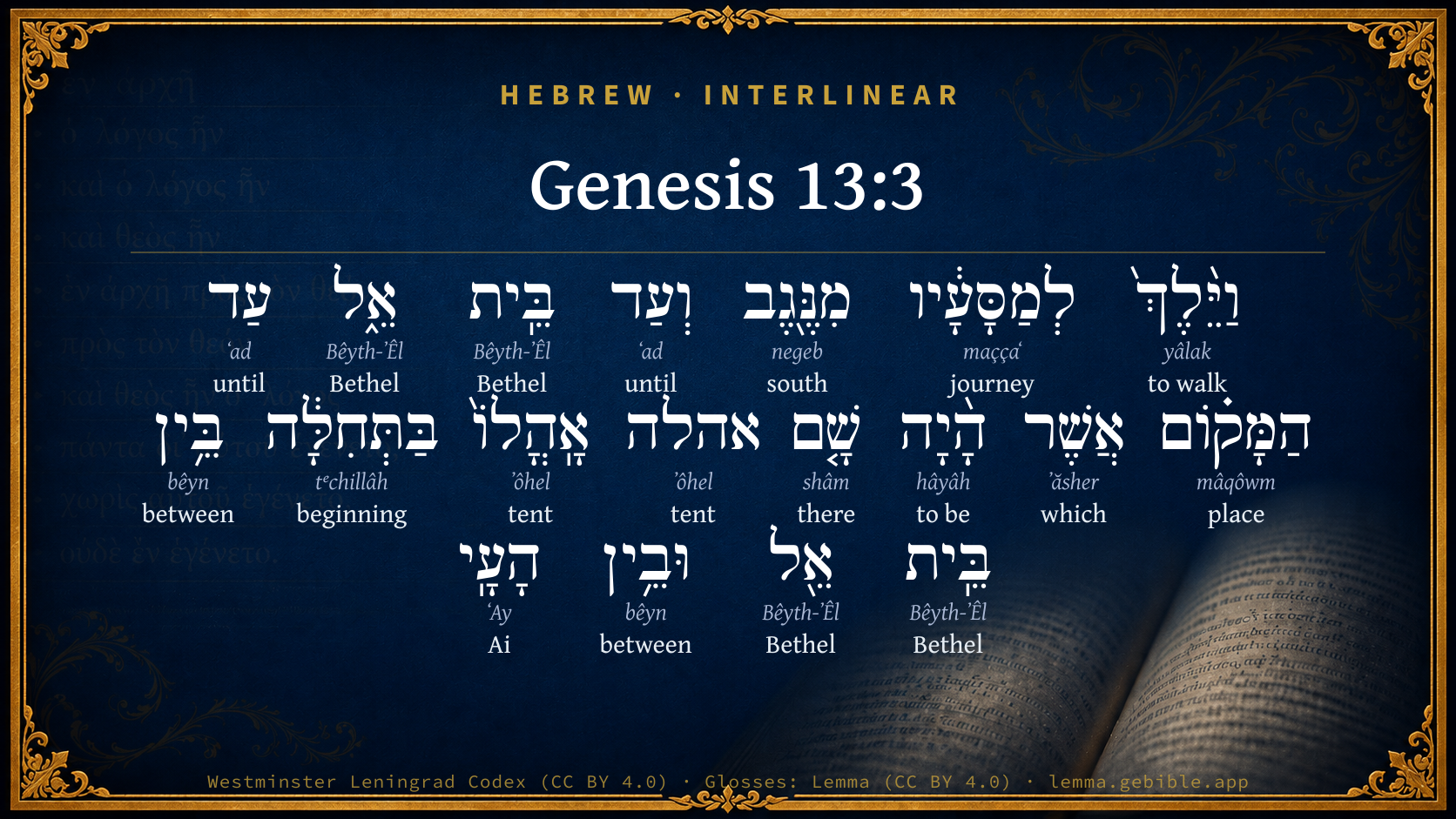
Hebrew (Westminster Leningrad Codex) Genesis 13:3 appears in the Hebrew Old Testament. The text above is from the Westminster Leningrad Codex. Each word links to its Strong’s number, a concise gloss, and parsing drawn from the Open Scriptures Hebrew Bible morphology. Click any word for its full Brown-Driver-Briggs (BDB) entry.
Download image
Cite this verse

Genesis 13:3 (World English Bible). Public Domain. Lemma interlinear Bible study tool, https://lemma.gebible.app/v/genesis/13/3.

Show BibTeX & RIS
BibTeX
RIS
English Translation
He went on his journeys from the South even to Bethel, to the place where his tent had been at the beginning, between Bethel and Ai,
World English Bible · Public Domain
Highlights
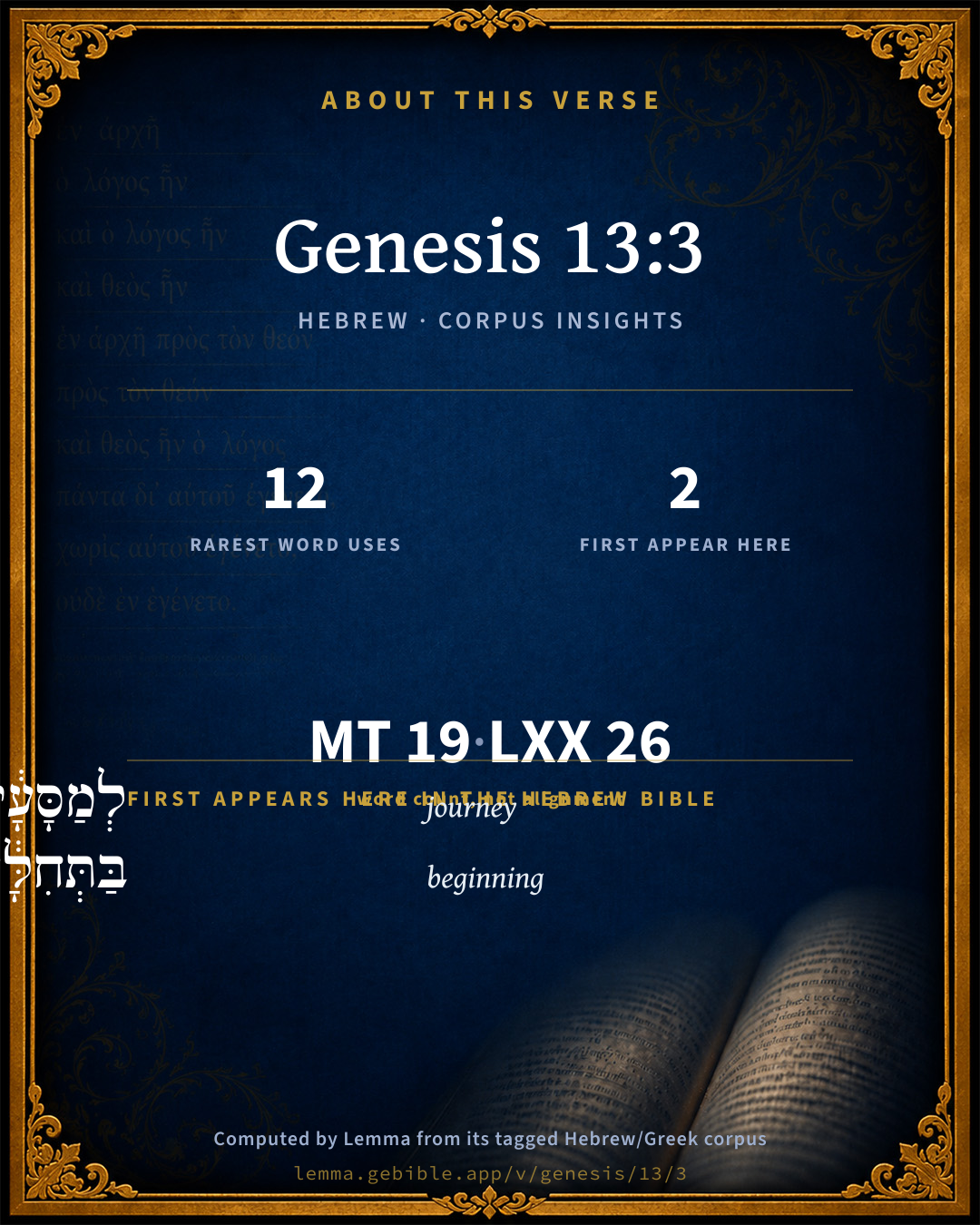
  • 2 first appearances in the Hebrew Bible
Full analysis ↓
Download a study sheet

One document with this verse’s original text, its word-by-word gloss line, the meaning frame, cross-references with their text, attributed commentary, and full source and license credits — printable, and it pastes into notes with its structure intact.

This verse Autodidact and up

Study sheet (.html) Plain text (.txt)

A passage Seminary Student

Up to 50 verses in one chapter. A passage sheet keeps up to 6 commentary sources and 12 cross-references per verse, in the order this page ranks them, and says so on the sheet whenever that leaves anything out. Ask for a single verse and you get the Autodidact verse sheet above.

Everything on this page stays free to read, with no account — the sheet is a download of what is already on screen, not access to it.

Want to remove ads? Support Godless Engineer
Compare translations 3

The same verse in 3 English versions, stacked beneath the original-language interlinear above. Click any original word for its lexicon entry.

Each is an independent rendering of the whole verse — the interlinear is not word-aligned to these translations.

Highlighted words mark where these versions differ — a whole-verse word diff, not a word-by-word alignment.

  • World English Bible Public Domain
    He went on his journeys from the South even to Bethel, to the place where his tent had been at the beginning, between Bethel and Ai,
  • King James Version Public Domain
    And he went on his journeys from the south even to Bethel, unto the place where his tent had been at the beginning, between Bethel and Hai;
  • unfoldingWord Literal Text CC BY-SA 4.0
    Then he went on his journeys from the Negev as far as Bethel, to the place where his tents had been at the beginning, between Bethel and Ai,

unfoldingWord Literal Text — © unfoldingWord, licensed CC BY-SA 4.0. Word-aligned USFM3 via Door43 (git.door43.org/unfoldingWord/en_ult).

Versions to compare (up to 4)

3 of 4 selected

Show all 18 translations

Every available English version of this verse, each an independent rendering of the whole verse.

  • World English Bible Public Domain
    He went on his journeys from the South even to Bethel, to the place where his tent had been at the beginning, between Bethel and Ai,
  • Berean Standard Bible Public Domain
    From the Negev he journeyed from place to place toward Bethel, until he came to the place between Bethel and Ai where his tent had formerly been pitched,
  • Majority Standard Bible Public Domain
    From the Negev he journeyed from place to place toward Bethel, until he came to the place between Bethel and Ai where his tent had formerly been pitched,
  • King James Version Public Domain
    And he went on his journeys from the south even to Bethel, unto the place where his tent had been at the beginning, between Bethel and Hai;
  • American Standard Version (1901) Public Domain
    And he went on his journeys from the South even to Beth-el, unto the place where his tent had been at the beginning, between Beth-el and Ai,
  • Revised Version (1885) Public Domain
    And he went on his journeys from the South even to Beth-el, unto the place where his tent had been at the beginning, between Beth-el and Ai;
  • Geneva Bible (1599) Public Domain
    And he went on his iourney from ye South toward Beth-el, to the place where his tent had bene at ye beginning, betweene Beth-el and Haai,
  • Douay-Rheims (1899) Public Domain
    And he returned by the way that he came, from the south to Bethel, to the place where before he had pitched his tent between Bethel and Hai:
  • Young's Literal Translation Public Domain
    And he goeth on his journeyings from the south, even unto Bethel, unto the place where his tent had been at the commencement, between Bethel and Hai --
  • Literal Standard Version CC BY-SA 4.0
    And he goes on his journeys from the south, even to Bethel, to the place where his tent had been at the commencement, between Bethel and Hai—
  • Unlocked Literal Bible CC BY-SA 4.0
    He continued on his journey from the Negev to Bethel, to the place where his tent had been before, between Bethel and Ai.
  • unfoldingWord Literal Text CC BY-SA 4.0
    Then he went on his journeys from the Negev as far as Bethel, to the place where his tents had been at the beginning, between Bethel and Ai,
  • Darby Bible Public Domain
    And he went on his journeys from the south as far as Bethel; as far as the place where his tent had been at the beginning, between Bethel and Ai;
  • World Messianic Bible Public Domain
    He went on his journeys from the South as far as Bethel, to the place where his tent had been at the beginning, between Bethel and Ai,
  • Webster's Bible Public Domain
    And he went on his journeys from the south even to Beth-el, to the place where his tent had been at the beginning, between Beth-el and Hai;
  • Free Bible Version CC BY-SA 4.0
    He left the Negev and traveled in stages to Bethel, back to the place where he'd camped before, between Bethel and Ai.
  • Bible in Basic English Public Domain
    And travelling on from the South, he came to Beth-el, to the place where his tent had been before, between Beth-el and Ai;
  • JPS Tanakh (1917) Public Domain
    And he went on his journeys from the South even to Beth-el, unto the place where his tent had been at the beginning, between Beth-el and Ai;

Literal Standard Version (2020), Covenant Press — licensed CC BY-SA 4.0. Text via the HelloAO Bible API (eBible.org). Unlocked Literal Bible (unfoldingWord) — licensed CC BY-SA 4.0. Text via the HelloAO Bible API (eBible.org). unfoldingWord Literal Text — © unfoldingWord, licensed CC BY-SA 4.0. Word-aligned USFM3 via Door43 (git.door43.org/unfoldingWord/en_ult). Free Bible Version, Dr. Jonathan Gallagher — licensed CC BY-SA 4.0. Text via the HelloAO Bible API (eBible.org).

Word by word

More ways to search: Search by grammar → Find every occurrence → Compare this word →

Practice this passage: Drill this verse → Learn its vocabulary →

לְמַסָּעָ֔יו
maççaʻ
H4550
“to/for · journeys · his”
Preposition + Noun, Common, Masculine, Plural, Construct + Suffix, Personal, 3rd Person, Masculine, Singular
Part of Speech
Preposition + Noun
Type
Common
Gender
Masculine
Number
Plural
State
Construct
Full BDB Definition

Origin: from H5265

TWOT: 1380a

a pulling up (of stakes), breaking camp, setting out, journey - pulling up, breaking camp - setting out - station, stage, journey
  1. וַיֵּ֨לֶךְ֙ yâlak H3212 “and · to walk” Conjunction + Verb, Qal, Sequential Imperfect, 3rd Person, Masculine, Singular
  2. מִנֶּ֖גֶב negeb H5045 “from · south” Preposition + Noun, Common, Masculine, Singular, Absolute
  3. וְעַד ʻad H5704 “and · until” Conjunction + Preposition
  4. בֵּֽית Bêyth-ʼÊl H1008 “Bethel” Noun, Proper
  5. אֵ֑ל Bêyth-ʼÊl H1008 “Bethel” Noun, Proper
  6. עַד ʻad H5704 “until” Preposition
  7. הַמָּק֗וֹם mâqôwm H4725 “the · place” Particle, Definite Article + Noun, Common, Masculine, Singular, Absolute
  8. אֲשֶׁר ʼăsher H834 “which” Particle, Relative
  9. הָ֨יָה hâyâh H1961 “to be” Verb, Qal, Perfect, 3rd Person, Masculine, Singular
  10. שָׁ֤ם shâm H8033 “there” Adverb
  11. אהלה ʼôhel H168 “tent · his” Noun, Common, Masculine, Singular, Construct + Suffix, Personal, 3rd Person, Masculine, Singular
  12. אָֽהֳלוֹ֙ ʼôhel H168 “tent · his” Noun, Common, Masculine, Singular, Construct + Suffix, Personal, 3rd Person, Masculine, Singular
  13. בַּתְּחִלָּ֔ה tᵉchillâh H8462 “in/at the · beginning” Preposition, Determined + Noun, Common, Feminine, Singular, Absolute
  14. בֵּ֥ין bêyn H996 “between” Preposition
  15. בֵּֽית Bêyth-ʼÊl H1008 “Bethel” Noun, Proper
  16. אֵ֖ל Bêyth-ʼÊl H1008 “Bethel” Noun, Proper
  17. וּבֵ֥ין bêyn H996 “and · between” Conjunction + Preposition
  18. הָעָֽי ʻAy H5857 “the · Ai” Particle, Definite Article + Noun, Proper

About this verse

These counts appear in no published source. They are computed here, from the morphology-tagged text and Lemma’s own curated glosses. What Lemma adds →

19
words
13
distinct lemmas
Pentateuch
section

Notable vocabulary

The rarest word here is לְמַסָּעָ֔יו journey H4550 — appearing just 12 times in the whole Hebrew Bible.

First appearance in Scripture

These words make their first canonical appearance in the Hebrew Bible here:

  • לְמַסָּעָ֔יו journey H4550
  • בַּתְּחִלָּ֔ה beginning H8462

Shared distinctive vocabulary

לְמַסָּעָ֔יו journey H4550 occurs in 11 verses of the Hebrew Bible. Also found in:

Grammatical profile

  • 2 verbs
  • 11 nouns
  • 4 prepositions
  • 1 adverb
  • 1 particle

Verb forms

  • וַיֵּ֨לֶךְ֙ Qal · Sequential Imperfect
  • הָ֨יָה Qal · Perfect

Repetition

Words recur within this verse — often emphatic in Hebrew:

  • בֵּֽית Bethel H1008 ×4
  • וְעַד until H5704 ×2
  • אהלה tent H168 ×2
  • בֵּ֥ין between H996 ×2

Hebrew & Septuagint length

In English translation the verse runs 26 words from the Hebrew and 30 from the Septuagint (LXX English) — closely comparable.

A rough comparison of the two English renderings, which tokenize alike — not a word-level alignment.

Word counts can differ between the Hebrew and the Greek without any difference in meaning — e.g. the Hebrew direct-object marker אֵת has no separate Greek word, and Greek often adds the article ὁ.

In the original languages it is 19 Hebrew tokens and 26 Greek tokens — but the two are counted differently (Hebrew bundles its prefixes and suffixes into one token; the Greek is in lemma form), so that isn’t a like-for-like length.

Cross-references

2

Topical passages linked to Genesis 13:3 in the Treasury of Scripture Knowledge — connected by theme and wording, ordered by reader-vote popularity; previews shown in the World English Bible.

  • Genesis 12:6 Abram passed through the land to the place of Shechem, to the oak of Moreh. The Canaanite was then in the land.
  • Genesis 12:8–9 He left from there to the mountain on the east of Bethel, and pitched his tent, having Bethel on the west, and Ai on the east. There he built an altar to Yahweh, and called on the name of Yahweh.

Cross-references courtesy of OpenBible.info (CC BY 4.0).

Hebrew and Greek witnesses Masoretic Hebrew ↔ Greek Septuagint

The same verse in the two great witnesses to the Old Testament, shown verse-for-verse.

These are two independent witnesses, not word-aligned to each other, and the Septuagint is shown in lemma (dictionary) form.

Hebrew Genesis 13:3 Masoretic · Westminster Leningrad Codex

וַיֵּ֨לֶךְ֙ לְמַסָּעָ֔יו מִנֶּ֖גֶב וְעַד בֵּֽית אֵ֑ל עַד הַמָּק֗וֹם אֲשֶׁר הָ֨יָה שָׁ֤ם אהלה אָֽהֳלוֹ֙ בַּתְּחִלָּ֔ה בֵּ֥ין בֵּֽית אֵ֖ל וּבֵ֥ין הָעָֽי

He went on his journeys from the South even to Bethel, to the place where his tent had been at the beginning, between Bethel and Ai,

World English Bible · Public Domain

Greek LXX Genesis 13:3 Septuagint · lemma form

καί πορεύομαι ὅθεν ἔρχομαι εἰς ὁ ἔρημος ἕως βαιθηλ ἕως ὁ τόπος οὗ εἰμί ὁ σκηνή αὐτός ὁ πρότερος ἀνά μέσος βαιθηλ καί ἀνά μέσος αγγαι

And he went to the place whence he came, into the wilderness as far as Baethel, as far as the place where his tent was before, between Baethel and Aggai,

LXX2012 (modern English Septuagint) · Public Domain

On this verse, The Pulpit Commentary discusses the Septuagint’s reading. Read the note in Commentary ↓

Hebrew: Westminster Leningrad Codex (CC BY 4.0). Greek: Septuagint (public domain); English from LXX2012 (modern English Septuagint) (Public Domain). How the Septuagint differs from the Hebrew →

Targum (Aramaic paraphrase)

2

The Targum is the ancient Jewish Aramaic paraphrase of the Hebrew Scriptures — an interpretive translation, not the Hebrew text itself. Onkelos (literal) and Pseudo-Jonathan (expansive) render the Torah, and Jonathan the Prophets. Coverage is partial: where no permissively-licensed English translation exists for a verse, only the Aramaic is shown. This is verse-level text, not a word-by-word alignment to the Hebrew.

  1. Targum Onkelos Torah (Genesis–Deuteronomy)
    וַאֲזַל לְמַטְלָנוֹהִי מִדָּרוֹמָא וְעַד בֵּית אֵל עַד אַתְרָא דִּי פְּרַס תַּמָּן מַשְׁכְּנֵהּ בְּקַדְמֵיתָא בֵּין בֵּית אֵל וּבֵין עָי

    and he proceeded according to his encampments from the south, and unto Bethel, unto the place where he had spread his tabernacle at the first, between Bethel and Ai;

    Targum Onkelos — Aramaic: “Onkelos Genesis” (public domain); “Onkelos Exodus” (public domain); “Onkelos Leviticus” (public domain); “Onkelos Numbers” (public domain); “Onkelos Deuteronomy” (public domain). English: “Sefaria Community Translation” (CC0 1.0 (public-domain dedication)); “J.W. Etheridge. The Targums of Onkelos and Jonathan Ben Uzziel on the Pentateuch. London: Longmans, Green, 1862” (public domain). Text via Sefaria.

  2. Targum Pseudo-Jonathan Torah (Genesis–Deuteronomy)
    וְאָזַל לְמַטְלוֹנוֹהִי מִדָרוֹמָא וְעַד בֵּית אֵל וְתַב עַד אַתְרָא דְפַרְסֵיהּ תַּמָן לְמַשְׁכְּנֵיהּ מִן אַוְולָא בֵּין בֵּית אֵל וּבֵין עָי

    And he proceeded in his journeyings from the south unto Bethel, and returned to the place where he had outspread his tabernacle at the first, between Bethel and Ai,

    Targum Pseudo-Jonathan — Aramaic: “Targum Jonathan on Genesis” (public domain); “Targum Jonathan on Exodus” (public domain); “Targum Jonathan on Leviticus” (public domain); “Targum Jonathan on Numbers” (public domain); “Targum Jonathan on Deuteronomy” (public domain). English: “The Targum of Jonathan ben Uzziel, trans. J. W. Etheridge, London, 1862” (public domain). Text via Sefaria.

Commentary

Notes on Genesis 13:3 from classic Christian and Jewish commentators (each source and its license shown beneath its notes). The classic Christian expositions comment on the surrounding passage and are grouped to its opening verse, so a note may address several verses; the Jewish commentaries on the Tanakh (Rashi and others) are per-verse, so they appear only where the commentator wrote on this verse.

Lemma curates 59 commentaries, every one of them public domain or Creative Commons licensed, each selected and text-cleaned for this edition rather than reprinted as found. About our sources →

Trapp's Complete Commentary

John Trapp

Gen 13:3 And he went on his journeys from the south even to Bethel, unto the place where his tent had been at the beginning, between Bethel and Hai;

Ver. 3. And he went on his journeys.] Many a weary step, and rested not till he came to his old altar at Bethel. Lo here a pattern of great piety and singular zeal, in father Abram. Egypt, with all her plenty and pleasure, had not stolen away his heart, so as not to hold his own in the promised land. Neither had he so laden himself with thick clay, but that he went "from strength to strength" (as those good souls did, Psa 84:7); he took long strides; perexit per profectiones suas , as it is here. He went journey after journey, till he appeared before God at his altar, there to sanctify that good he bad got in Egypt, and to give God thanks for it; yea, to consecrate all to him the bestower of it. Oh, let us show ourselves children of Abram indeed, by "walking in these steps of our father Abram" {Rom 4:12} Otherwise our outward profession and privileges will profit us no more than it did Dives in hell, that be could call Abraham, father. {Luk 16:30}

John Trapp, A Commentary or Exposition upon All the Books of the Old and New Testament (1647–1656) — public domain. Text from a community e-Sword module.

Joseph Benson's Commentary

Gen 13:3. He went on to Beth-el — Because there he had formerly had an altar, and although the altar had fallen down, as being probably built of earth, or had been taken down by Abram, lest it should be polluted by the idolatrous Canaanites; yet he came to the place of the altar, either to revive the remembrance of the communion he had had with God at that place, or perhaps to pay the vows he had there made to God, when he undertook his journey into Egypt. And there Abram, prevented by no legal restraints, deterred by no pains or penalties, or insurrection of the inhabitants, although idolaters, “called on the name of the Lord,” worshipped God by prayer and thanksgiving, by offering sacrifices, and instructing his family, Gen 18:19.

Joseph Benson's Commentary on the Old and New Testaments (1811–1818) — public domain. Text from a community e-Sword module.

MacLaren's Expositions of Holy Scripture

Alexander MacLaren

Genesis

THE IMPORTANCE OF A CHOICE

LIFE IN CANAAN

Gen 13:3.

These are the two first acts of Abram in the land of Canaan.

1. All life should blend earthly and heavenly.

They are not to be separated. Religion should run through everything and take the whole of life for its field. Where we cannot carry it is no place for us. It is a shame that heathenism should be more penetrated by its religion than Christendom is.

2. The family should be a church.

Domestic religion. New Testament households. Abram a priest. The decay of family religion, worship, and instruction.

3. The service to God should be more costly than to ourselves.

Pitching a tent cheaper than building an altar. Give God the best. We build ourselves ceiled houses and the ark dwells in curtains. Pagans build elaborate temples, but their houses are hovels. Too many Christians do the opposite.

4. Building for God lasts, for selves perishes.

A tent is stricken, and no trace remains but embers. The stones of Jacob’s altar may be standing yet. The Parthenon of Athens remains: where are the hovels of the people? ‘He that doeth the will of God abideth for ever.’ Permanent results of transitory deeds.

Alexander MacLaren, Expositions of Holy Scripture (1904–1910) — public domain. Text from a community e-Sword module.

Geneva Bible (1599)

Geneva Bible translators

He calleth the place by that name which was after given unto it, Gen. 28:19.

Geneva Bible (1599) marginal notes — public domain. Text via Bolls.life.

Jamieson, Fausset & Brown

Robert Jamieson, A. R. Fausset & David Brown

went on his journeys--His progress would be by slow marches and frequent encampments as Abram had to regulate his movements by the prospect of water and pasturage.

unto the place . . . between Beth-el and Hai--"a conspicuous hill--its topmost summit resting on the rocky slopes below, and distinguished by its olive groves--offering a natural base for the altar and a fitting shade for the tent of the patriarch" [STANLEY].

Jamieson, Fausset & Brown — Commentary Critical and Explanatory on the Whole Bible (1871) — public domain (CC PDM 1.0). Text via the HelloAO Bible API.

Adam Clarke's Commentary

Verse 3. Beth-el] See chap. 8.

Adam Clarke's Commentary on the Bible (1810–1826) — public domain. Text from a community e-Sword/MySword module.

John Calvin's Commentaries

3. And he went on his journeys. In these words Moses teaches us, that Abram did not rest till he had returned to Bethel. For although he pitched his tent in many places, yet he nowhere so fixed his foot, as to make it his permanent abode. He does not speak of the south in reference to Egypt; he merely means that he had come into the southern part of Judea; and that, therefore, he had, by a long and troublesome journey, arrived at the place where he had determined to remain. Moses next subjoins, that an altar had before been there erected by him and that he then also began anew to call upon the name of the Lord: whereby we may learn, that the holy man was always like himself in worshipping God, and giving evidence of his piety. The explanation given by some, that the inhabitants of the place had been brought to the pure worship of God, is neither probable, nor to be deduced from the words of Moses. And we have stated elsewhere what is the force of the expression, ‘To invoke in the name,’ or, ‘To call upon the name of the Lord;’ namely, to profess the true and pure worship of God. For Abram invoked God, not twelve times only, during the whole course of his life; but whenever he publicly celebrated him, and by a solemn rite, made it manifest that he had nothing in common with the superstitions of the heathen, then he is also said to have called upon God. Therefore, although he always worshipped God, and exercised himself in daily prayers; yet, because he did not daily testify his piety by outward profession before men, this virtue is here especially commended by Moses. It was therefore proper that invocation should be conjoined with the altar; because by the sacrifices offered, he plainly testified what God he worshipped in order that the Canaanites might know that he was not addicted to their common idolatries.

John Calvin's Commentaries (1540-1563) — public domain. Text from the Calvin Translation Society English edition (1840s-50s) via the Christian Classics Ethereal Library (ccel.org). Calvin's coverage is partial (roughly two-thirds of the Bible); uncommented books and verses are honest gaps, never fabricated. The 19th-century editor's footnotes and remarks are omitted so the notes are faithfully Calvin's own voice.

John Gill's Exposition

And he went on in his journeys from the south,.... He took the same tour, went the same road, stopping at the same resting places, as when he went down to Egypt; having learned, as Jarchi observes, the way of the earth, that a man should not change his host. Though some, as Ben Gersom, understand it of his taking his journeys as were suitable for his cattle, as they were able to bear them, and not overdrive them, lest he should kill them, but made short stages, and frequently stopped and rested. And thus he went on through the southern part of the land, until he came

even to Bethel; as it was afterwards called, though now Luz, Gen 28:19.

unto the place where his tent had been at the beginning; when he first came into the land of Canaan, to a mountain

between Bethel and Hai; afterwards called Mount Ephraim, and was four miles from Jerusalem on the north (t); see Gen 12:8.

(t) Bunting's Travels, &c. p. 59.

John Gill's Exposition of the Whole Bible (1746–1763) — public domain (CC PDM 1.0). Text via the HelloAO Bible API.

Matthew Poole's English Annotations

He went on his journey, or rather, according to his journeys, which he took as he came, going in the same road, and resting in the same place, of which he had experience.

Matthew Poole's English Annotations on the Holy Bible (1683–1685) — public domain. Text from a community e-Sword/MySword module.

Whedon's Commentary on the Bible

Daniel D. Whedon

3. On his journeys — An expression peculiar to the nomadic life — a pulling up of tent-pins, breaking up of camp, and moving onward. Comp. Gen_12:9, note.

Even to Beth-el — See on Gen_12:8.

At the beginning — Formerly. His first stop was then at Sichem. Gen_12:6.

Daniel D. Whedon (gen. ed.), Commentary on the Old and New Testaments (1874–1909) — public domain. Text from a community e-Sword module.

The Pulpit Commentary

Vers. 3, 4. And he went on his journeys. Literally, in his journeyings or stations!cf. (Gen_11:2; Exo_17:1; Num_10:6, Num_10:12) The renderings kaiqh oqen h+lqen (LXX) and reversus est per iter quo venerat (Vulgate) imply without warrant that he used the same camping grounds in his ascent which he had previously occupied in his descent. From the south even to Bethel, (vide Gen_12:8) unto the place where his tent had been at the beginning. Before his emigration into Egypt, i.e. not to Shechem, the site of his first altar, where probably he had not encamped for any length of time, if at all, but to a spot between Bethel and Ai (the exact situation being more minutely described as) unto the place of the altar, which he had made there at the first. After entering the promised land. In reality it was the second altar he had erected (Gen_12:7, Gen_12:8) And there Abram called on the name of the Lord. Professed the true and pure worship of God (Calvin); preached and taught his family and Canaanitish neighbors the true religion (Luther). Vide Gen_12:8 Gen_4:26.

The Pulpit Commentary (1880–1919), ed. H.D.M. Spence-Jones & Joseph S. Exell — public domain. Text from a community e-Sword module.

John Wesley's Explanatory Notes

He went on to Bethel - Thither he went, not only because he was willing to go among his old acquaintance; but because there he had formerly had his altar. and though the altar was gone, probably he himself having taking it down when he left the place, lest it should be polluted by the idolatrous Canaanites; yet he came to the place of the altar, either to revive the remembrance of the sweet communion he had had with God at that place, or, perhaps, to pay the vows he had there made to God when he undertook his journey into Egypt.

John Wesley, Explanatory Notes Upon the Whole Bible (1754–1765) — public domain. Text via the GEBible commentary corpus.

unfoldingWord translationNotes

Door43 World Missions Community

He continued on his journey

Abram and his family traveled by stages, going from place to place. This can be made explicit. AT: "They continued on their journey" (See: Assumed Knowledge and Implicit Information)

to the place where his tent had been before

Translators may add a footnote that says "See Genesis 12:8." The time of his travel can be made explicit. AT: "to the place where he had set up his tent before he went to Egypt" (See: Assumed Knowledge and Implicit Information)

called on the name of Yahweh

"prayed in the name of Yahweh" or "worshiped Yahweh." See how you translated this in Genesis 12:8.

translationWords

Negev

Bethel

Ai

altar

Yahweh

unfoldingWord translationNotes — © Distant Shores Media and the Door43 World Missions Community, licensed CC BY-SA 4.0. Source: git.door43.org/Door43/en_tn.

Rashi

Rabbi Shlomo Yitzchaki (Rashi)

וילך למסעיו AND HE WENT ON HIS JOURNEYS — When he returned from Egypt to the land of Canaan he went and lodged in the same inns as he had stayed when he travelled to Egypt. This teaches you good manners: that one should not change his inn (Arachin 16b); (where the reason is given that one who does this constantly brings discredit on himself and on others). Another interpretation: on his return he paid the debts he had previously incurred (Genesis Rabbah 41:3). (In both these comments emphasis is placed on “his” — he went on his journeys i.e. the routes he had taken before.)

מנגב FROM THE SOUTH — the land of Egypt lies to the South of the land of Canaan.

Rashi on the Tanakh — English translations: “The Judaica Press complete Tanach with Rashi, translated by A. J. Rosenberg” (CC BY 4.0); “Pentateuch with Rashi's commentary by M. Rosenbaum and A.M. Silbermann, 1929-1934” (public domain); “The Metsudah Tanach series, Lakewood, N.J” (CC BY 4.0); and “The Book of Joshua, Metsudah Publications, 1997” (CC BY 4.0). Text via Sefaria.

Radak

Rabbi David Kimhi (Radak)

וילך למסעיו, one journey after another; he traveled small distances each time, due to the enormous possessions he had. He continued from a southerly location. The word מנגב means that having already arrived in the south, i.e. Egypt, he now had to travel in a northerly direction to reach the place in the land of Canaan from which he had traveled to Egypt. He now resumed what we had already become familiar with as “his journeys, i.e. in a southerly direction. He continued as far as a place called Beyt El. Eventually, he came to the site of his altar where he gave thanks to G’d for his deliverance from Egypt. He had retraced his steps all the way to Beyt El.

Radak on the Tanakh — English translations: “Sefaria Community Translation” (CC0 1.0 (public-domain dedication)); “Eliyahu Munk, HaChut Hameshulash” (CC BY 4.0); “Rabbi Mike Feuer, Jerusalem Anthology” (CC BY 4.0); and “R. David Kimhi on the first book of Psalms, Translated by R.G. Finch, London, 1919” (public domain). Text via Sefaria.

Lesson kit

Teaching starters — assembled from the data on this page, not authored interpretation. Every prompt links to the verse data it draws on. Edit before teaching.

Genesis, in the Pentateuch, opens this verse with 19 words (13 distinct Hebrew lemmas). Its most distinctive word is maççaʻ (“journey”). A historical commentator’s framing appears above. Read the whole chapter for the surrounding context.

Discussion questions

  1. How does “journey” (maççaʻ) shape what this verse is saying?
  2. 2 words make their first appearance in Scripture here. What does this debut establish?
  3. How does Exodus 17:1, which shares the word «journey», read alongside this verse?
  4. What does the repetition of “Bethel” (4× in this one verse) do in this verse?
  5. These translations render this verse differently; the difference is in the English rendering, not the original. What questions does that raise?
  6. «וַיֵּ֨לֶךְ֙» is a Qal Sequential Imperfect verb. How does that grammatical form shape the action described?
  7. Compare how Trapp's Complete Commentary and Joseph Benson's Commentary read this verse. Where do they agree or differ?

Things to notice

Reading settings

Reading text

Shown beneath each verse's original-language words.

Old Testament
Old Testament edition

Read the OT as the Masoretic Hebrew (MT) or the Greek Septuagint (LXX).

English shown for the Greek Septuagint (in the Hebrew ↔ Greek comparison).

Comparing translations? Open the Compare panel on any verse page to stack up to four side by side.