
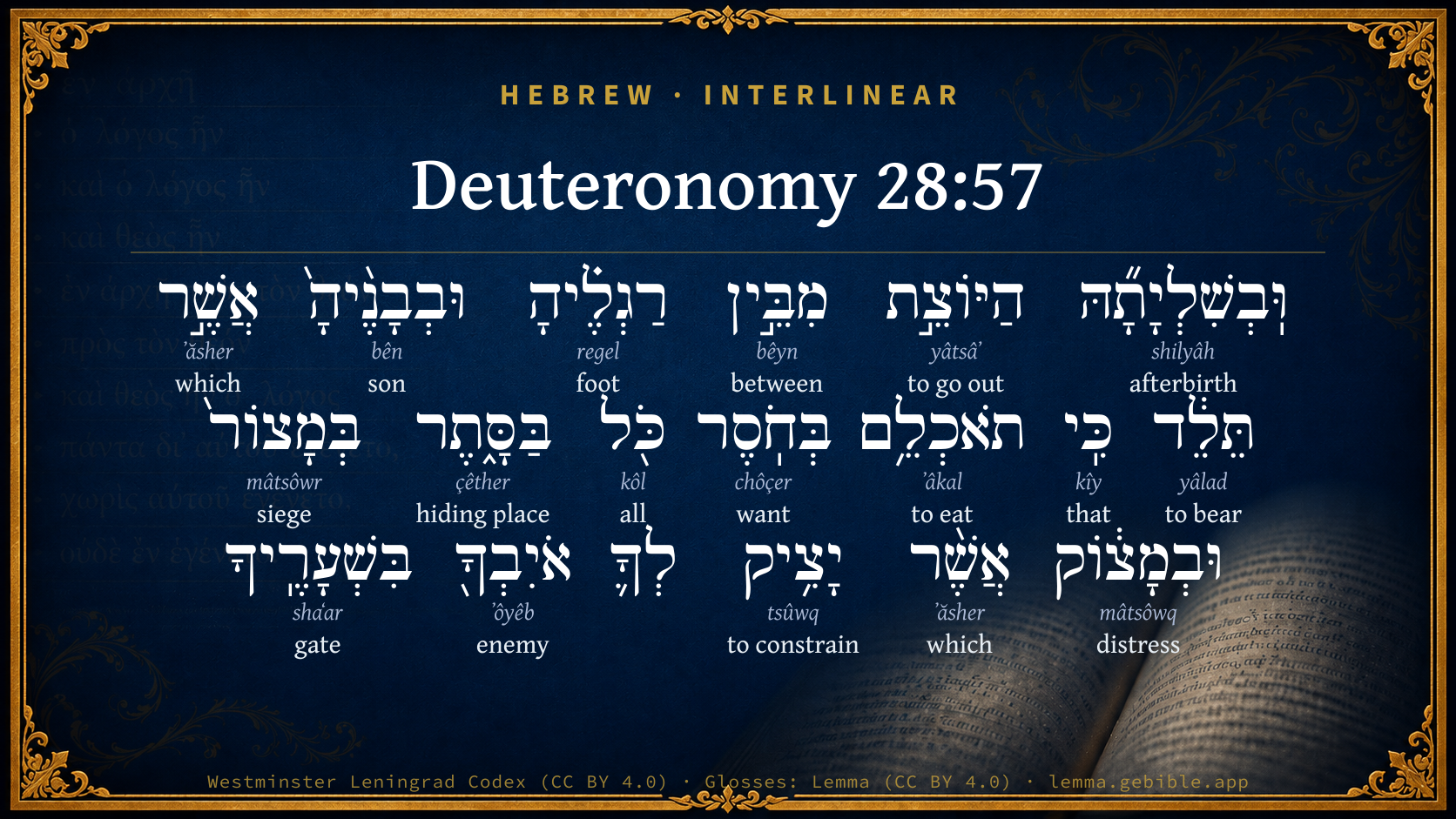
Deuteronomy 28:57

Hebrew (Westminster Leningrad Codex) Deuteronomy 28:57 appears in the Hebrew Old Testament. The text above is from the Westminster Leningrad Codex. Each word links to its Strong’s number, a concise gloss, and parsing drawn from the Open Scriptures Hebrew Bible morphology. Click any word for its full Brown-Driver-Briggs (BDB) entry.
Download image
Cite this verse

Deuteronomy 28:57 (World English Bible). Public Domain. Lemma interlinear Bible study tool, https://lemma.gebible.app/v/deuteronomy/28/57.

Show BibTeX & RIS
BibTeX
RIS
English Translation
and toward her young one who comes out from between her feet, and toward her children whom she shall bear; for she shall eat them for want of all things secretly, in the siege and in the distress with which your enemy shall distress you in your gates.
World English Bible · Public Domain
Highlights
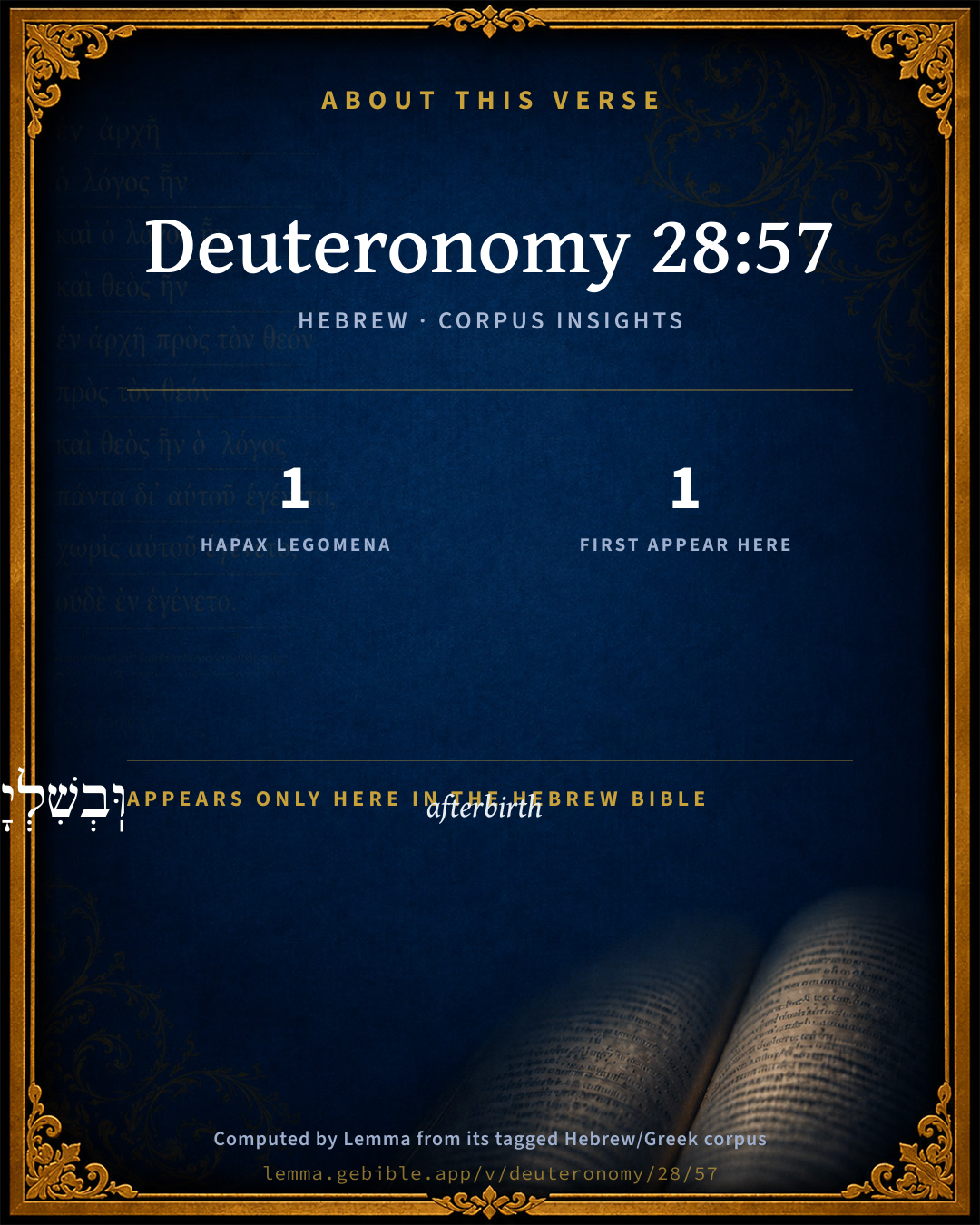
  • 1 hapax legomenon — only here in the Hebrew Bible
  • 1 first appearance in the Hebrew Bible
Full analysis ↓
Download a study sheet

One document with this verse’s original text, its word-by-word gloss line, the meaning frame, cross-references with their text, attributed commentary, and full source and license credits — printable, and it pastes into notes with its structure intact.

This verse Autodidact and up

Study sheet (.html) Plain text (.txt)

A passage Seminary Student

Up to 50 verses in one chapter. A passage sheet keeps up to 6 commentary sources and 12 cross-references per verse, in the order this page ranks them, and says so on the sheet whenever that leaves anything out. Ask for a single verse and you get the Autodidact verse sheet above.

Everything on this page stays free to read, with no account — the sheet is a download of what is already on screen, not access to it.

Want to remove ads? Support Godless Engineer
Compare translations 3

The same verse in 3 English versions, stacked beneath the original-language interlinear above. Click any original word for its lexicon entry.

Each is an independent rendering of the whole verse — the interlinear is not word-aligned to these translations.

Highlighted words mark where these versions differ — a whole-verse word diff, not a word-by-word alignment.

  • World English Bible Public Domain
    and toward her young one who comes out from between her feet, and toward her children whom she shall bear; for she shall eat them for want of all things secretly, in the siege and in the distress with which your enemy shall distress you in your gates.
  • King James Version Public Domain
    And toward her young one that cometh out from between her feet, and toward her children which she shall bear: for she shall eat them for want of all things secretly in the siege and straitness, wherewith thine enemy shall distress thee in thy gates.
  • unfoldingWord Literal Text CC BY-SA 4.0
    and against her afterbirth coming out from between her legs and against the children whom she will bear, for she will secretly eat them lack of anything else, in the siege and in the distress which your enemy will set upon you within your gates.

unfoldingWord Literal Text — © unfoldingWord, licensed CC BY-SA 4.0. Word-aligned USFM3 via Door43 (git.door43.org/unfoldingWord/en_ult).

Versions to compare (up to 4)

3 of 4 selected

Show all 18 translations

Every available English version of this verse, each an independent rendering of the whole verse.

  • World English Bible Public Domain
    and toward her young one who comes out from between her feet, and toward her children whom she shall bear; for she shall eat them for want of all things secretly, in the siege and in the distress with which your enemy shall distress you in your gates.
  • Berean Standard Bible Public Domain
    the afterbirth that comes from between her legs and the children she bears, because she will secretly eat them for lack of anything else in the siege and distress that your enemy will inflict on you within your gates.
  • Majority Standard Bible Public Domain
    the afterbirth that comes from between her legs and the children she bears, because she will secretly eat them for lack of anything else in the siege and distress that your enemy will inflict on you within your gates.
  • King James Version Public Domain
    And toward her young one that cometh out from between her feet, and toward her children which she shall bear: for she shall eat them for want of all things secretly in the siege and straitness, wherewith thine enemy shall distress thee in thy gates.
  • American Standard Version (1901) Public Domain
    and toward her young one that cometh out from between her feet, and toward her children whom she shall bear; for she shall eat them for want of all things secretly, in the siege and in the distress wherewith thine enemy shall distress thee in thy gates.
  • Revised Version (1885) Public Domain
    and toward her young one that cometh out from between her feet, and toward her children which she shall bear; for she shall eat them for want of all things secretly: in the siege and in the straitness, wherewith thine enemy shall straiten thee in thy gates.
  • Geneva Bible (1599) Public Domain
    And at her afterbirth (that shall come out from betweene her feete) and at her childre, which she shall beare: for when all things lacke, she shall eate them secretly, during the siege and straitnesse, wherewith thine enemie shall besiege thee in thy cities.
  • Douay-Rheims (1899) Public Domain
    And the filth of the afterbirths, that come forth from between her thighs, and the children that are born the same hour. For they shall eat them secretly for the want of all things, in the siege and distress, wherewith thy enemy shall oppress thee within thy gates.
  • Young's Literal Translation Public Domain
    and against her seed which cometh out from between her feet, even against her sons whom she doth bear, for she doth eat them for the lacking of all things in secret, in the siege and in the straitness with which thine enemy doth straiten thee within thy gates.
  • Literal Standard Version CC BY-SA 4.0
    and against her seed which comes out from between her feet, even against her sons whom she bears, for she eats them in secret, in the lacking of everything, in the siege and in the constriction with which your enemy constricts you within your gates.
  • Unlocked Literal Bible CC BY-SA 4.0
    and of her own newborn that comes out from between her legs, and of the children whom she will bear. She will eat them in private for lack of anything else, during the siege and in the distress which your enemy will put upon you within your city gates.
  • unfoldingWord Literal Text CC BY-SA 4.0
    and against her afterbirth coming out from between her legs and against the children whom she will bear, for she will secretly eat them lack of anything else, in the siege and in the distress which your enemy will set upon you within your gates.
  • Darby Bible Public Domain
    because of her afterbirth which hath come out between her feet, and her children whom she shall bear; for she shall secretly eat them for want of everything in the siege and in the straitness wherewith thine enemy shall distress thee in thy gates.
  • World Messianic Bible Public Domain
    toward her young one who comes out from between her feet, and toward her children whom she bears; for she will eat them secretly for lack of all things in the siege and in the distress with which your enemy will distress you in your gates.
  • Webster's Bible Public Domain
    And towards her young one, her own offspring, and towards her children which she shall bear: for she shall eat them for want of all things secretly in the siege and straitness with which thy enemy shall distress thee in thy gates.
  • Free Bible Version CC BY-SA 4.0
    She will even secretly eat the babies she gives birth to, as well as the afterbirth, since she doesn't have anything else because of the siege and the suffering your enemy has caused in all your towns,
  • Bible in Basic English Public Domain
    And to her baby newly come to birth, and to the children of her body; for having no other food, she will make a meal of them secretly, because of her bitter need and the cruel grip of your haters on all your towns.
  • JPS Tanakh (1917) Public Domain
    and against her afterbirth that cometh out from between her feet, and against her children whom she shall bear; for she shall eat them for want of all things secretly; in the siege and in the straitness, wherewith thine enemy shall straiten thee in thy gates.

Literal Standard Version (2020), Covenant Press — licensed CC BY-SA 4.0. Text via the HelloAO Bible API (eBible.org). Unlocked Literal Bible (unfoldingWord) — licensed CC BY-SA 4.0. Text via the HelloAO Bible API (eBible.org). unfoldingWord Literal Text — © unfoldingWord, licensed CC BY-SA 4.0. Word-aligned USFM3 via Door43 (git.door43.org/unfoldingWord/en_ult). Free Bible Version, Dr. Jonathan Gallagher — licensed CC BY-SA 4.0. Text via the HelloAO Bible API (eBible.org).

Word by word

More ways to search: Search by grammar → Find every occurrence → Compare this word →

Practice this passage: Drill this verse → Learn its vocabulary →

וּֽבְשִׁלְיָתָ֞הּ
shilyâh
H7988
“and · in/at · afterbirth · her”
Conjunction + Preposition + Noun, Common, Feminine, Singular, Construct + Suffix, Personal, 3rd Person, Feminine, Singular
Part of Speech
Conjunction + Preposition + Noun
Type
Common
Gender
Feminine
Number
Singular
State
Construct
Full BDB Definition

Origin: from H7953

TWOT: 2393a

afterbirth
  1. הַיּוֹצֵ֣ת yâtsâʼ H3318 “the · going out” Particle, Definite Article + Verb, Qal, Participle Active, Feminine, Singular, Absolute
  2. מִבֵּ֣ין bêyn H996 “from · between” Preposition + Preposition
  3. רַגְלֶ֗יהָ regel H7272 “feet · her” Noun, Common, Feminine, Dual, Construct + Suffix, Personal, 3rd Person, Feminine, Singular
  4. וּבְבָנֶ֨יהָ֙ bên H1121 “and · in/at · sons · her” Conjunction + Preposition + Noun, Common, Masculine, Plural, Construct + Suffix, Personal, 3rd Person, Feminine, Singular
  5. אֲשֶׁ֣ר ʼăsher H834 “which” Particle, Relative
  6. תֵּלֵ֔ד yâlad H3205 “to bear” Verb, Qal, Imperfect, 3rd Person, Feminine, Singular
  7. כִּֽי kîy H3588 “that” Conjunction
  8. תֹאכְלֵ֥ם ʼâkal H398 “to eat · them” Verb, Qal, Imperfect, 3rd Person, Feminine, Singular + Suffix, Personal, 3rd Person, Masculine, Plural
  9. בְּחֹֽסֶר chôçer H2640 “in/at · want of” Preposition + Noun, Common, Masculine, Singular, Construct
  10. כֹּ֖ל kôl H3605 “all” Noun, Common, Masculine, Singular, Absolute
  11. בַּסָּ֑תֶר çêther H5643 “in/at the · hiding place” Preposition, Determined + Noun, Common, Masculine, Singular, Absolute
  12. בְּמָצוֹר֙ mâtsôwr H4692 “in/at · siege” Preposition + Noun, Common, Masculine, Singular, Absolute
  13. וּבְמָצ֔וֹק mâtsôwq H4689 “and · in/at · distress” Conjunction + Preposition + Noun, Common, Masculine, Singular, Absolute
  14. אֲשֶׁ֨ר ʼăsher H834 “which” Particle, Relative
  15. יָצִ֥יק tsûwq H6693 “to constrain” Verb, Hiphil, Imperfect, 3rd Person, Masculine, Singular
  16. אֹיִבְךָ֖ ʼôyêb H341 “enemy · you” Verb, Qal, Participle Active, Masculine, Singular, Construct + Suffix, Personal, 2nd Person, Masculine, Singular
  17. בִּשְׁעָרֶֽיךָ shaʻar H8179 “in/at · gates · your” Preposition + Noun, Common, Masculine, Plural, Construct + Suffix, Personal, 2nd Person, Masculine, Singular

About this verse

These counts appear in no published source. They are computed here, from the morphology-tagged text and Lemma’s own curated glosses. What Lemma adds →

19
words
17
distinct lemmas
Pentateuch
section

Notable vocabulary

1 hapax legomenon — a word that appears only here in the entire Hebrew Bible:

  • וּֽבְשִׁלְיָתָ֞הּ afterbirth H7988

First appearance in Scripture

This word makes its first canonical appearance in the Hebrew Bible here:

  • וּֽבְשִׁלְיָתָ֞הּ afterbirth H7988

Shared distinctive vocabulary

בְּחֹֽסֶר want H2640 occurs in 3 verses of the Hebrew Bible. Also found in:

Grammatical profile

  • 5 verbs
  • 9 nouns
  • 2 prepositions
  • 1 conjunction
  • 2 particles

Verb forms

  • הַיּוֹצֵ֣ת Qal · Participle Active
  • תֵּלֵ֔ד Qal · Imperfect
  • תֹאכְלֵ֥ם Qal · Imperfect
  • יָצִ֥יק Hiphil · Imperfect
  • אֹיִבְךָ֖ Qal · Participle Active

Repetition

A word recurs within this verse — often emphatic in Hebrew:

  • אֲשֶׁ֣ר which H834 ×2

Hebrew & Septuagint length

In English translation the verse runs 48 words from the Hebrew and 46 from the Septuagint (LXX English) — closely comparable.

A rough comparison of the two English renderings, which tokenize alike — not a word-level alignment.

Word counts can differ between the Hebrew and the Greek without any difference in meaning — e.g. the Hebrew direct-object marker אֵת has no separate Greek word, and Greek often adds the article ὁ.

Cross-references

2

Topical passages linked to Deuteronomy 28:57 in the Treasury of Scripture Knowledge — connected by theme and wording, ordered by reader-vote popularity; previews shown in the World English Bible.

  • Genesis 49:10 The scepter will not depart from Judah, Nor the ruler's staff from between his feet, Until he comes to whom it belongs. To him will the obedience of the peoples be.
  • Isaiah 49:15 Can a woman forget her sucking child, that she should not have compassion on the son of her womb? yes, these may forget, yet I will not forget you.

Cross-references courtesy of OpenBible.info (CC BY 4.0).

Hebrew and Greek witnesses Masoretic Hebrew ↔ Greek Septuagint

The same verse in the two great witnesses to the Old Testament, shown verse-for-verse.

These are two independent witnesses, not word-aligned to each other, and the Septuagint is shown in lemma (dictionary) form.

Hebrew Deuteronomy 28:57 Masoretic · Westminster Leningrad Codex

וּֽבְשִׁלְיָתָ֞הּ הַיּוֹצֵ֣ת מִבֵּ֣ין רַגְלֶ֗יהָ וּבְבָנֶ֨יהָ֙ אֲשֶׁ֣ר תֵּלֵ֔ד כִּֽי תֹאכְלֵ֥ם בְּחֹֽסֶר כֹּ֖ל בַּסָּ֑תֶר בְּמָצוֹר֙ וּבְמָצ֔וֹק אֲשֶׁ֨ר יָצִ֥יק לְךָ֛ אֹיִבְךָ֖ בִּשְׁעָרֶֽיךָ

and toward her young one who comes out from between her feet, and toward her children whom she shall bear; for she shall eat them for want of all things secretly, in the siege and in the distress with which your enemy shall distress you in your gates.

World English Bible · Public Domain

Greek LXX Deuteronomy 28:57 Septuagint · lemma form

καί ὁ χόριον αὐτός ὁ ἐκἔρχομαι διά ὁ μηρός αὐτός καί ὁ τέκνον ὅς ἄν τίκτω καταἐσθίω γάρ αὐτός διά ὁ ἔνδεια πᾶς κρυφῇ ἐν ὁ στενοχωρία σύ καί ἐν ὁ θλῖψις σύ ὅς θλίβω σύ ὁ ἐχθρός σύ ἐν πᾶς ὁ πόλις σύ

and her offspring that comes out between her feet, and the child which she shall bear; for she shall eat them because of the lack of all things, secretly in your straitness, and in your affliction, with which your enemy shall afflict you in your cities.

LXX2012 (modern English Septuagint) · Public Domain

On this verse, Adam Clarke's Commentary discusses the Septuagint’s reading. Read the note in Commentary ↓

Hebrew: Westminster Leningrad Codex (CC BY 4.0). Greek: Septuagint (public domain); English from LXX2012 (modern English Septuagint) (Public Domain). How the Septuagint differs from the Hebrew →

Targum (Aramaic paraphrase)

2

The Targum is the ancient Jewish Aramaic paraphrase of the Hebrew Scriptures — an interpretive translation, not the Hebrew text itself. Onkelos (literal) and Pseudo-Jonathan (expansive) render the Torah, and Jonathan the Prophets. Coverage is partial: where no permissively-licensed English translation exists for a verse, only the Aramaic is shown. This is verse-level text, not a word-by-word alignment to the Hebrew.

  1. Targum Onkelos Torah (Genesis–Deuteronomy)
    וּבִזְעֵר בְּנָהָא דְיִפְּקוּן מִנַהּ וּבִבְנָהָא דִי תְלִיד אֲרֵי תֵיכְלִנוּן בַּחֲסֵירוּת כֹּלָא בְּסִתְרָא בִּצְיָרָא וּבְעַקְתָא דִי יָעֵק לָךְ סָנְאָךְ בְּקִרְוָיךְ

    (no public-domain English translation for this verse)

    Targum Onkelos — Aramaic: “Onkelos Genesis” (public domain); “Onkelos Exodus” (public domain); “Onkelos Leviticus” (public domain); “Onkelos Numbers” (public domain); “Onkelos Deuteronomy” (public domain). English: “Sefaria Community Translation” (CC0 1.0 (public-domain dedication)); “J.W. Etheridge. The Targums of Onkelos and Jonathan Ben Uzziel on the Pentateuch. London: Longmans, Green, 1862” (public domain). Text via Sefaria.

  2. Targum Pseudo-Jonathan Torah (Genesis–Deuteronomy)
    וּבִשְׁפִיר שִׁלְיְתָא דְתִיפּוֹק מִבֵּית תּוֹרְפָהּ בְּעִידָן מוֹלְדָהּ וּבִבְנָהּ דְתוֹלִיד אֲרוּם תֵּיכְלוּנוּן בְּחוֹסְרַן כָּל מִדַעַם בְּטוּמְרָא בְּצַעֲרוּ וּבְעָקָא דִי יְעִיקוּן לְכוֹן סַנְאֵיכוֹן בְּקִירְוֵיכוֹן

    and the offspring she hath borne; for she will eat them in secret, through the want of all things, by reason of the anguish and oppression with which your enemies shall oppress you in your cities.

    Targum Pseudo-Jonathan — Aramaic: “Targum Jonathan on Genesis” (public domain); “Targum Jonathan on Exodus” (public domain); “Targum Jonathan on Leviticus” (public domain); “Targum Jonathan on Numbers” (public domain); “Targum Jonathan on Deuteronomy” (public domain). English: “The Targum of Jonathan ben Uzziel, trans. J. W. Etheridge, London, 1862” (public domain). Text via Sefaria.

Commentary

Notes on Deuteronomy 28:57 from classic Christian and Jewish commentators (each source and its license shown beneath its notes). The classic Christian expositions comment on the surrounding passage and are grouped to its opening verse, so a note may address several verses; the Jewish commentaries on the Tanakh (Rashi and others) are per-verse, so they appear only where the commentator wrote on this verse.

Lemma curates 59 commentaries, every one of them public domain or Creative Commons licensed, each selected and text-cleaned for this edition rather than reprinted as found. About our sources →

Trapp's Complete Commentary

John Trapp

Deu 28:57 And toward her young one that cometh out from between her feet, and toward her children which she shall bear: for she shall eat them for want of all [things] secretly in the siege and straitness, wherewith thine enemy shall distress thee in thy gates.

Ver. 57. And toward her young one.] Heb., Her after birth, which she shall devour, and the child together with it.

John Trapp, A Commentary or Exposition upon All the Books of the Old and New Testament (1647–1656) — public domain. Text from a community e-Sword module.

Tyndale Open Study Notes

Tyndale Open Resources

28:57 afterbirth: This horrific scenario depicts a mother so hungry as to eat a human placenta and the new baby she has borne.

Tyndale Open Study Notes — © Tyndale Open Resources, licensed CC BY-SA 4.0. Text via the HelloAO Bible API.

Geneva Bible (1599)

Geneva Bible translators

Hunger shall so bite her, that she shall be ready to eat her child before it be delivered.

Geneva Bible (1599) marginal notes — public domain. Text via Bolls.life.

Adam Clarke's Commentary

Verse 57. Toward her young one - and toward her children which she shall bear] There seems to be a species of tautology in the two clauses of this verse, which may be prevented by translating the last word, שליתה shilyathah, literally, her secondines, which is the meaning of the Arabic [Arabic] sala, not badly understood by the Septuagint, χοριον αυτης, the chorion or exterior membrane, which invests the foetus in the womb; and still better translated by Luther, [Anglo-Saxon] the after-birth; which saying of Moses strongly marks the deepest distress, when the mother is represented as feeling the most poignant regret that her child was brought forth into such a state of suffering and death; and 2dly, that it was likely, from the favourable circumstances after the birth, that she herself should survive her inlaying. No words can more forcibly depict the miseries of those dreadful times. On this ground I see no absolute need for Kennicott's criticism, who, instead of ובשליתה ubeshilyathah, against her secondines, reads ובשלה ubashelah, and she shall boll, and translates the 56th and 57th verses as follows: "The tender and delicate woman among you, who would not adventure to set the sole of her foot upon the ground for delicateness and tenderness, her eye shall be evil toward the husband of her bosom, and toward her son, and toward her daughter. 57. And she shall boil that which cometh out from between her feet, even her children, which she shall bear, for she shall eat them, for want of all things, secretly." These words, says he, being prophetical, are fulfilled in 2Kg 6:29, for we read there that two women of Samaria having agreed to eat their own children, one was actually boiled, where the very same word, בשל bashal is used. See Kennicott's Dissertations, 1Ch 11:11, &c., p. 421.

Adam Clarke's Commentary on the Bible (1810–1826) — public domain. Text from a community e-Sword/MySword module.

The Cambridge Bible for Schools and Colleges

gen. ed. J. J. S. Perowne

57. young one] Rather as in R.V. marg. The objects in this v. are under the same predicate as those in Deu_28:56 but with a difference. To those she shall grudge a share of her awful food; these she shall devour.

The Cambridge Bible for Schools and Colleges (gen. ed. J. J. S. Perowne; Cambridge University Press, 1878–1918) — public domain. Text from a community e-Sword module.

John Gill's Exposition

Also every sickness and every plague which is not written in the book of this law,.... Which is not here mentioned or threatened; and it suggests, that whatsoever sickness or disease that could be thought of or named, or were at any time in any place among men, might be expected to come upon them for their disobedience:

them will the Lord bring upon thee until thou be destroyed; the Jews themselves (h) own this has been fulfilled on them.

(h) Shebet Judah, p. 318.

John Gill's Exposition of the Whole Bible (1746–1763) — public domain (CC PDM 1.0). Text via the HelloAO Bible API.

Haydock's Catholic Bible Commentary

And the filth, &c. They will eat the child just born, through extreme hunger, Lamentations ii. 20. The Chaldean, Septuagint, &c., agree with the Vulgate, which conveys an idea of the most horrible distress. (Calmet) --- Indeed it is so horrible and disgusting, that we find no vestiges in history of the completion of the prophecy, taken in this sense. Some, therefore, explain the original, "And her feast, or dressed meat, (shall be) between her feet, even of her own children, which she shall bring forth." (Bate, p. 71.; Parkhurst on itsoth.) Others believe that the Hebrew is corrupted by the insertion of b before another b, in children; and by the transposition or addition of i in the first word; so that to translate, with the generality of interpreters, "She shall grudge ever bit, or her eye shall be evil towards her husband, and towards her son, and towards her daughter, and towards her afterbirth....and towards her sons which she shall have brought forth," seems absurd enough. If the woman’s eye be evil towards her son, and towards her afterbirth, (which, however, is incapable of depriving her of food) what need of repeating, and towards her sons? Yet the present construction requires this translation; though it is obvious that the woman must have been actuated in a different manner, with respect to these different things, as all allow that she was afraid lest those who were grown up, how dear soever to her, might deprive her of her abominable food, while her eye was evil towards her afterbirth, (or secundines, if the word ssolithe can have this meaning) because she was designing to eat it privately. The Septuagint translate Korion, "the skin," or Chorion, "a little girl," (Houbigant) unless (Haydock) the former word may rather have this signification. Hill. --- The Arabic deviates a little from the Hebrew, "She will deny her husband, her son, and her daughter, her secundies, which fall from her." If, therefore, the two corrections proposed by Houbigant, and approved by Kennicott, (who produces for one of them (ubnie) the authority of the oldest Hebrew manuscript in England) be admitted, all will be clear and conformable to the event. "[Ver.] 56. Her eye shall be evil towards....her son, and towards her daughter. [Ver.] 57. And she shall boil, (ubossilthe, instead of ubossolithe) that which cometh out from between her feet, even her children, (ubnie, not ubobnie) which she shall bear; for she shall eat them, for want of all things, secretly." This prophetical and terrible denunciation was realized in the siege of Samaria, when two women agreed to eat their own children, one of whom was actually boiled, and the very word here in dispute is used, 4 Kings vi. 29. (Kennicott) --- And in the last siege of Jerusalem we read (Josephus, [Antiquities?] vii. 8) of a mother killing her own child, to satisfy the cravings of hunger and rage against the rioters who had repeatedly plundered her house. Her name was Mary. She also boiled her suckling infant, and actually devoured a part of it. (Haydock)

George Leo Haydock (1774–1849), Haydock's Catholic Family Bible and Commentary, 1859 edition — public domain. Excludes Psalms (Douay-Rheims chapter numbering differs from Protestant) and Deuterocanonical books (Catholic canon only).

Matthew Poole's English Annotations

Her young one, Heb. after-birth; that which was loathsome to behold, will now be pleasant to eat; and together with it she shall eat the child which was wrapt up in it, and may be included in this expression.

Which she shall bear, or, which she shall have born, i.e. her more grown children.

Matthew Poole's English Annotations on the Holy Bible (1683–1685) — public domain. Text from a community e-Sword/MySword module.

The Pulpit Commentary

Her young one; literally, her after-birth. The Hebrew suggests an extreme of horror beyond what the Authorized Version indicates.

The Pulpit Commentary (1880–1919), ed. H.D.M. Spence-Jones & Joseph S. Exell — public domain. Text from a community e-Sword module.

John Wesley's Explanatory Notes

Her young one - Hebrew. after-birth: that which was loathsome to behold, will now be pleasant to eat; and together with it she shall eat the child which was wrapt up in it, and may be included in this expression. Which she shall bear - Or, which she shall have born, that is, her more grown children. She shall eat them - This was fulfilled more than once, to the perpetual reproach of the Jewish nation. Never was the like done either by Greek or Barbarian. See the fruit of being abandoned by God!

John Wesley, Explanatory Notes Upon the Whole Bible (1754–1765) — public domain. Text via the GEBible commentary corpus.

Rashi

Rabbi Shlomo Yitzchaki (Rashi)

ובשליתה AND TOWARDS HER שליה — i.e. towards her little children; towards all these will her eye be evil when she eats one of them so that she will not give of the flesh to those that are still with her (to those that are still living).

Rashi on the Tanakh — English translations: “The Judaica Press complete Tanach with Rashi, translated by A. J. Rosenberg” (CC BY 4.0); “Pentateuch with Rashi's commentary by M. Rosenbaum and A.M. Silbermann, 1929-1934” (public domain); “The Metsudah Tanach series, Lakewood, N.J” (CC BY 4.0); and “The Book of Joshua, Metsudah Publications, 1997” (CC BY 4.0). Text via Sefaria.

Lesson kit

Teaching starters — assembled from the data on this page, not authored interpretation. Every prompt links to the verse data it draws on. Edit before teaching.

Deuteronomy, in the Pentateuch, opens this verse with 19 words (17 distinct Hebrew lemmas). Its most distinctive word is shilyâh (“afterbirth”). A historical commentator’s framing appears above. Read the whole chapter for the surrounding context.

Discussion questions

  1. What does “afterbirth” (shilyâh) contribute to the verse as a whole?
  2. 1 word here appears nowhere else in the Hebrew Bible. Why might the author reach for such rare wording?
  3. This is the first place “afterbirth” appears in Scripture (first appears here). What does its debut here establish?
  4. How does Deuteronomy 28:48, which shares the word «want», read alongside this verse?
  5. What does the repetition of “which” (2× in this one verse) do in this verse?
  6. The translations on this page render this verse differently — a whole-verse word diff, not a word-by-word alignment. What might account for the different wordings?
  7. «הַיּוֹצֵ֣ת» is a Qal Participle Active verb. How does that grammatical form shape the action described?
  8. Compare how Trapp's Complete Commentary and Tyndale Open Study Notes read this verse. Where do they agree or differ?

Things to notice

  • 1 word in this verse appears nowhere else in the Hebrew Bible.
  • 1 word makes its first canonical appearance in Scripture here.
  • These translations choose different wording for 26 words in this verse.
  • “which” occurs 2× in this single verse.
  • 17 distinct Hebrew lemmas span 19 words in this verse.

Reading settings

Reading text

Shown beneath each verse's original-language words.

Old Testament
Old Testament edition

Read the OT as the Masoretic Hebrew (MT) or the Greek Septuagint (LXX).

English shown for the Greek Septuagint (in the Hebrew ↔ Greek comparison).

Comparing translations? Open the Compare panel on any verse page to stack up to four side by side.