
Ezekiel 37:21

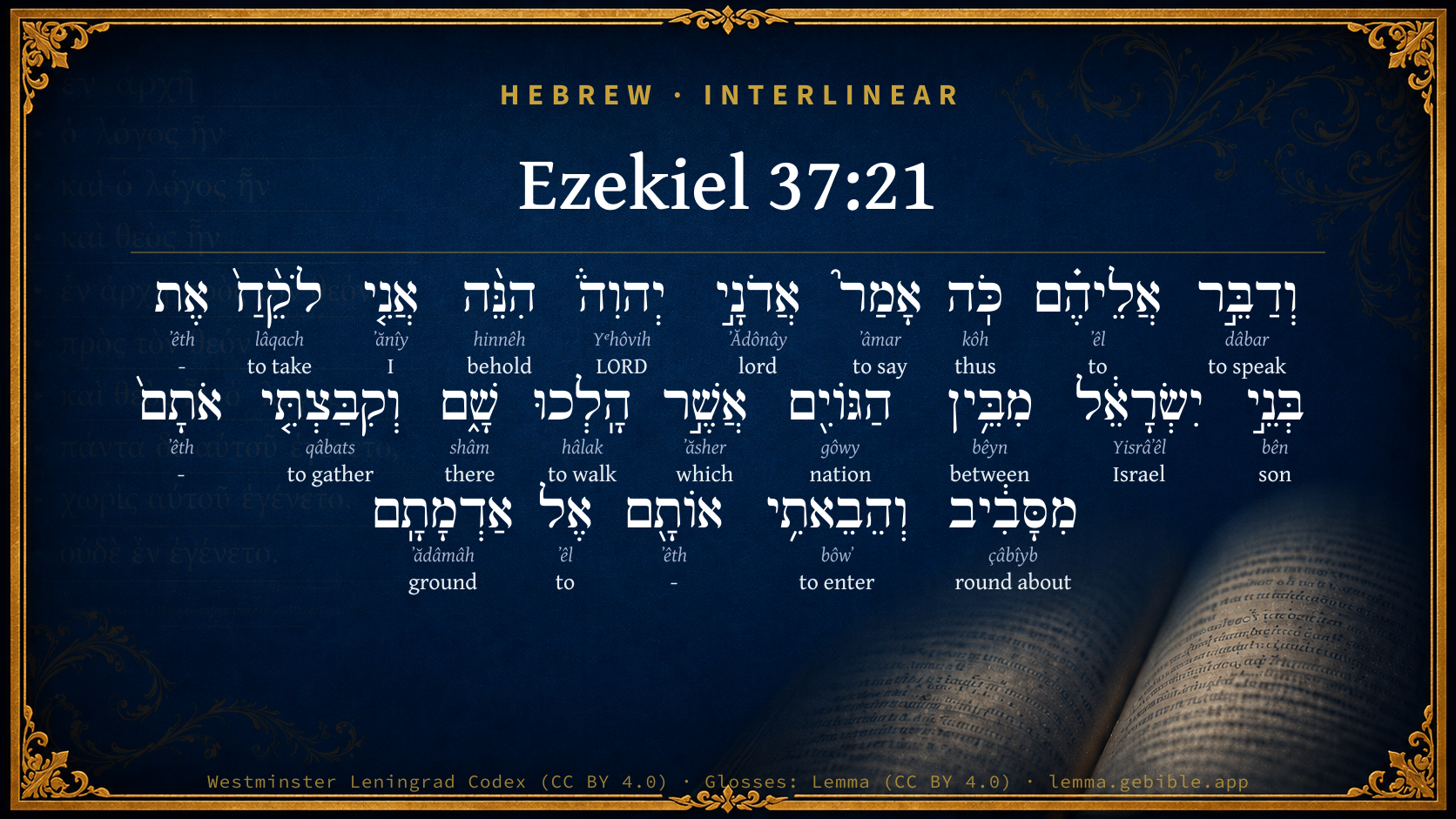
Hebrew (Westminster Leningrad Codex) Ezekiel 37:21 appears in the Hebrew Old Testament. The text above is from the Westminster Leningrad Codex. Each word links to its Strong’s number, a concise gloss, and parsing drawn from the Open Scriptures Hebrew Bible morphology. Click any word for its full Brown-Driver-Briggs (BDB) entry.
Download image
Cite this verse

Ezekiel 37:21 (World English Bible). Public Domain. Lemma interlinear Bible study tool, https://lemma.gebible.app/v/ezekiel/37/21.

Show BibTeX & RIS
BibTeX
RIS
English Translation
Say to them, Thus says the Lord Yahweh: Behold, I will take the children of Israel from among the nations, where they are gone, and will gather them on every side, and bring them into their own land:
World English Bible · Public Domain
Download a study sheet

One document with this verse’s original text, its word-by-word gloss line, the meaning frame, cross-references with their text, attributed commentary, and full source and license credits — printable, and it pastes into notes with its structure intact.

This verse Autodidact and up

Study sheet (.html) Plain text (.txt)

A passage Seminary Student

Up to 50 verses in one chapter. A passage sheet keeps up to 6 commentary sources and 12 cross-references per verse, in the order this page ranks them, and says so on the sheet whenever that leaves anything out. Ask for a single verse and you get the Autodidact verse sheet above.

Everything on this page stays free to read, with no account — the sheet is a download of what is already on screen, not access to it.

Want to remove ads? Support Godless Engineer
Compare translations 3

The same verse in 3 English versions, stacked beneath the original-language interlinear above. Click any original word for its lexicon entry.

Each is an independent rendering of the whole verse — the interlinear is not word-aligned to these translations.

Highlighted words mark where these versions differ — a whole-verse word diff, not a word-by-word alignment.

  • World English Bible Public Domain
    Say to them, Thus says the Lord Yahweh: Behold, I will take the children of Israel from among the nations, where they are gone, and will gather them on every side, and bring them into their own land:
  • King James Version Public Domain
    And say unto them, Thus saith the Lord GOD; Behold, I will take the children of Israel from among the heathen, whither they be gone, and will gather them on every side, and bring them into their own land:
  • unfoldingWord Literal Text CC BY-SA 4.0
    Declare to them, ‘The Lord Yahweh says this: Behold! I am about to take the people of Israel from among the nations where they went. I will gather them from the surrounding lands and I will bring them to their land.

unfoldingWord Literal Text — © unfoldingWord, licensed CC BY-SA 4.0. Word-aligned USFM3 via Door43 (git.door43.org/unfoldingWord/en_ult).

Versions to compare (up to 4)

3 of 4 selected

Show all 18 translations

Every available English version of this verse, each an independent rendering of the whole verse.

  • World English Bible Public Domain
    Say to them, Thus says the Lord Yahweh: Behold, I will take the children of Israel from among the nations, where they are gone, and will gather them on every side, and bring them into their own land:
  • Berean Standard Bible Public Domain
    you are to tell them that this is what the Lord GOD says: ‘I will take the Israelites out of the nations to which they have gone, and I will gather them from all around and bring them into their own land.
  • Majority Standard Bible Public Domain
    you are to tell them that this is what the Lord GOD says: ‘I will take the Israelites out of the nations to which they have gone, and I will gather them from all around and bring them into their own land.
  • King James Version Public Domain
    And say unto them, Thus saith the Lord GOD; Behold, I will take the children of Israel from among the heathen, whither they be gone, and will gather them on every side, and bring them into their own land:
  • American Standard Version (1901) Public Domain
    And say unto them, Thus saith the Lord Jehovah: Behold, I will take the children of Israel from among the nations, whither they are gone, and will gather them on every side, and bring them into their own land:
  • Revised Version (1885) Public Domain
    And say unto them, Thus saith the Lord GOD: Behold, I will take the children of Israel from among the nations, whither they be gone, and will gather them on every side, and bring them into their own land:
  • Geneva Bible (1599) Public Domain
    And say vnto them, Thus saith the Lord God, Beholde, I will take the children of Israel from among the heathen, whither they be gone, and wil gather them on euery side, and bring them into their owne land.
  • Douay-Rheims (1899) Public Domain
    And thou shalt say to them: Thus saith the Lord God: Behold, I will take the children of Israel from the midst of the nations whither they are gone: and I will gather them on every side, and will bring them to their own land.
  • Young's Literal Translation Public Domain
    and speak thou unto them: Thus said the Lord Jehovah: Lo, I am taking the sons of Israel, From among the nations whither they have gone, And have gathered them from round about, And I have brought them in unto their land.
  • Literal Standard Version CC BY-SA 4.0
    and speak to them, Thus said Lord YHWH: Behold, I am taking the sons of Israel, || From among the nations to where they have gone, || And have gathered them from all around, || And I have brought them into their land.
  • Unlocked Literal Bible CC BY-SA 4.0
    Declare to them, 'The Lord Yahweh says this: Behold! I am about to take the people of Israel from among the nations where they went. I will gather them from the surrounding lands and I will bring them to their land.
  • unfoldingWord Literal Text CC BY-SA 4.0
    Declare to them, ‘The Lord Yahweh says this: Behold! I am about to take the people of Israel from among the nations where they went. I will gather them from the surrounding lands and I will bring them to their land.
  • Darby Bible Public Domain
    And say unto them, Thus saith the Lord Jehovah: Behold, I will take the children of Israel from among the nations, whither they are gone, and will gather them from every side, and bring them into their own land:
  • World Messianic Bible Public Domain
    Say to them, ‘The Lord GOD says: “Behold, I will take the children of Israel from among the nations where they have gone, and will gather them on every side, and bring them into their own land.
  • Webster's Bible Public Domain
    And say to them, Thus saith the Lord GOD; Behold, I will take the children of Israel from among the heathen, whither they are gone, and will gather them on every side, and bring them into their own land:
  • Free Bible Version CC BY-SA 4.0
    tell them that this is what the Lord God says: I'm going to bring the Israelites back from the nations where they've gone. I will gather them from everywhere and take them back to their own country.
  • Bible in Basic English Public Domain
    And say to them, These are the words of the Lord: See, I am taking the children of Israel from among the nations where they have gone, and will get them together on every side, and take them into their land:
  • JPS Tanakh (1917) Public Domain
    And say unto them: Thus saith the Lord GOD: Behold, I will take the children of Israel from among the nations, whither they are gone, and will gather them on every side, and bring them into their own land;

Literal Standard Version (2020), Covenant Press — licensed CC BY-SA 4.0. Text via the HelloAO Bible API (eBible.org). Unlocked Literal Bible (unfoldingWord) — licensed CC BY-SA 4.0. Text via the HelloAO Bible API (eBible.org). unfoldingWord Literal Text — © unfoldingWord, licensed CC BY-SA 4.0. Word-aligned USFM3 via Door43 (git.door43.org/unfoldingWord/en_ult). Free Bible Version, Dr. Jonathan Gallagher — licensed CC BY-SA 4.0. Text via the HelloAO Bible API (eBible.org).

Word by word

More ways to search: Search by grammar → Find every occurrence → Compare this word →

Practice this passage: Drill this verse → Learn its vocabulary →

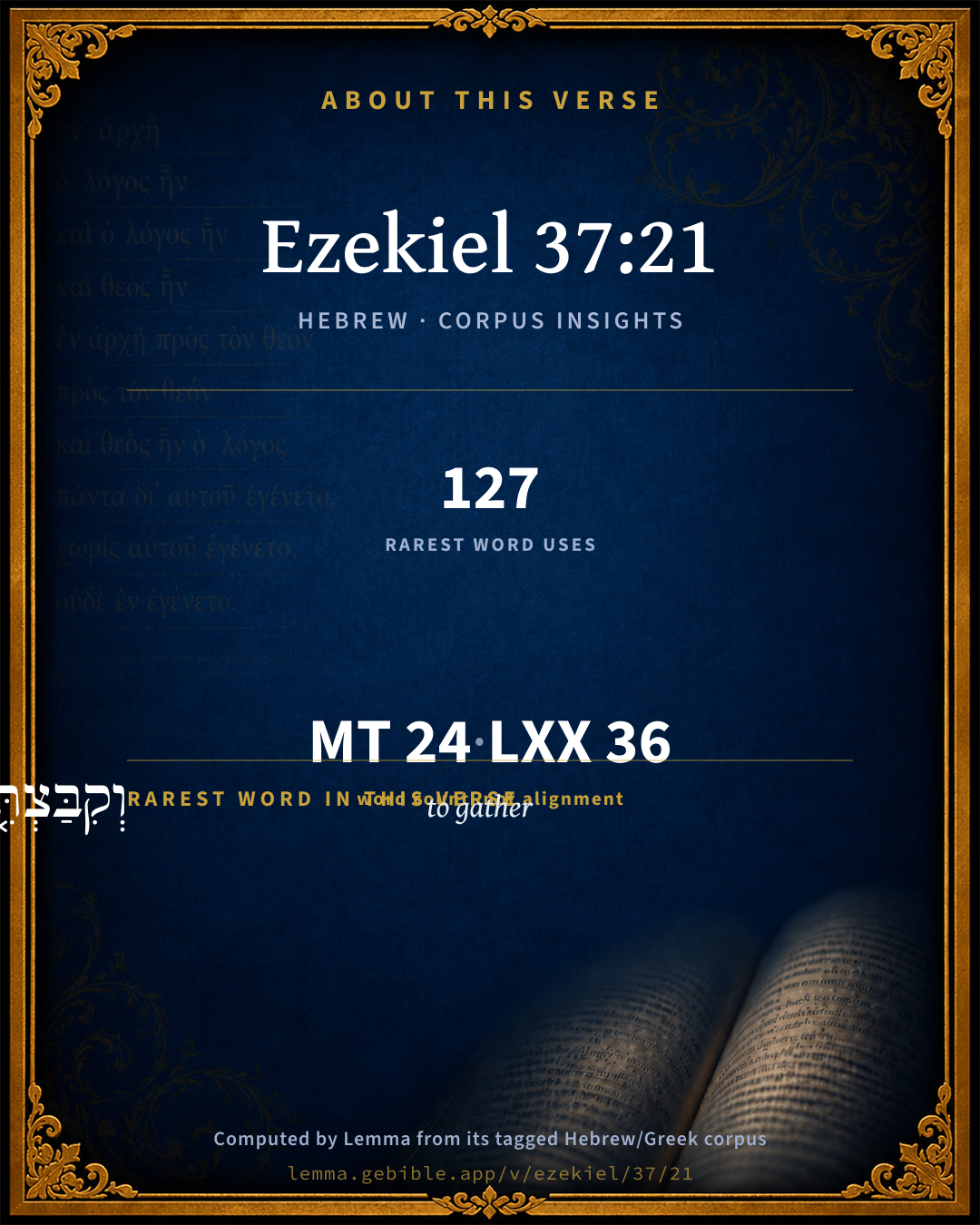
וְקִבַּצְתִּ֤י
qâbats
H6908
“and · to gather”
Conjunction + Verb, Piel, Sequential Perfect, 1st Person, Common, Singular
Part of Speech
Conjunction + Verb
Stem
Piel
Form
Sequential Perfect
Person
1st Person
Gender
Common
Number
Singular
Full BDB Definition

Origin: a primitive root

TWOT: 1983

to gather, assemble - (Qal) to gather, collect, assemble - (Niphal) - to assemble, gather - to be gathered - (Piel) to gather, gather together, take away - (Pual) to be gathered together - (Hithpael) to gather together, be gathered together
  1. וְדַבֵּ֣ר dâbar H1696 “and · speak” Conjunction + Verb, Piel, Imperative, 2nd Person, Masculine, Singular
  2. אֲלֵיהֶ֗ם ʼêl H413 “to · them” Preposition + Suffix, Personal, 3rd Person, Masculine, Plural
  3. כֹּֽה kôh H3541 “thus” Adverb
  4. אָמַר֮ ʼâmar H559 “to say” Verb, Qal, Perfect, 3rd Person, Masculine, Singular
  5. אֲדֹנָ֣י ʼĂdônây H136 “Lord · my” Noun, Common, Masculine, Plural, Construct + Suffix, Personal, 1st Person, Common, Singular
  6. יְהוִה֒ Yᵉhôvih H3069 “LORD” Noun, Proper
  7. הִנֵּ֨ה hinnêh H2009 “behold” Particle, Demonstrative
  8. אֲנִ֤י ʼănîy H589 “I” Pronoun, Personal, 1st Person, Common, Singular
  9. לֹקֵ֨חַ֙ lâqach H3947 “taking” Verb, Qal, Participle Active, Masculine, Singular, Absolute
  10. אֶת ʼêth H853 “-” Particle, Direct Object
  11. בְּנֵ֣י bên H1121 “sons of” Noun, Common, Masculine, Plural, Construct
  12. יִשְׂרָאֵ֔ל Yisrâʼêl H3478 “Israel” Noun, Proper
  13. מִבֵּ֥ין bêyn H996 “from · between” Preposition + Preposition
  14. הַגּוֹיִ֖ם gôwy H1471 “the · nations” Particle, Definite Article + Noun, Common, Masculine, Plural, Absolute
  15. אֲשֶׁ֣ר ʼăsher H834 “which” Particle, Relative
  16. הָֽלְכוּ hâlak H1980 “to walk” Verb, Qal, Perfect, 3rd Person, Common, Plural
  17. שָׁ֑ם shâm H8033 “there” Adverb
  18. אֹתָם֙ ʼêth H853 “- · them” Particle, Direct Object + Suffix, Personal, 3rd Person, Masculine, Plural
  19. מִסָּבִ֔יב çâbîyb H5439 “from · round about” Preposition + Noun, Common, Both, Singular, Absolute
  20. וְהֵבֵאתִ֥י bôwʼ H935 “and · to enter” Conjunction + Verb, Hiphil, Sequential Perfect, 1st Person, Common, Singular
  21. אוֹתָ֖ם ʼêth H853 “- · them” Particle, Direct Object + Suffix, Personal, 3rd Person, Masculine, Plural
  22. אֶל ʼêl H413 “to” Preposition
  23. אַדְמָתָֽם ʼădâmâh H127 “ground · their” Noun, Common, Feminine, Singular, Construct + Suffix, Personal, 3rd Person, Masculine, Plural

About this verse

These counts appear in no published source. They are computed here, from the morphology-tagged text and Lemma’s own curated glosses. What Lemma adds →

24
words
21
distinct lemmas
Prophets
section

Grammatical profile

  • 6 verbs
  • 7 nouns
  • 1 pronoun
  • 3 prepositions
  • 2 adverbs
  • 5 particles

Verb forms

  • וְדַבֵּ֣ר Piel · Imperative
  • אָמַר֮ Qal · Perfect
  • לֹקֵ֨חַ֙ Qal · Participle Active
  • הָֽלְכוּ Qal · Perfect
  • וְקִבַּצְתִּ֤י Piel · Sequential Perfect
  • וְהֵבֵאתִ֥י Hiphil · Sequential Perfect

Repetition

A word recurs within this verse — often emphatic in Hebrew:

  • אֲלֵיהֶ֗ם to H413 ×2

Hebrew & Septuagint length

In English translation the verse runs 38 words from the Hebrew and 54 from the Septuagint (LXX English) — the Septuagint runs noticeably longer here. See the side-by-side →

A rough comparison of the two English renderings, which tokenize alike — not a word-level alignment.

Word counts can differ between the Hebrew and the Greek without any difference in meaning — e.g. the Hebrew direct-object marker אֵת has no separate Greek word, and Greek often adds the article ὁ.

In the original languages it is 24 Hebrew tokens and 36 Greek tokens — but the two are counted differently (Hebrew bundles its prefixes and suffixes into one token; the Greek is in lemma form), so that isn’t a like-for-like length.

Cross-references

24

Topical passages linked to Ezekiel 37:21 in the Treasury of Scripture Knowledge — connected by theme and wording, ordered by reader-vote popularity; previews shown in the World English Bible.

  • Ezekiel 36:24 For I will take you from among the nations, and gather you out of all the countries, and will bring you into your own land.
  • Jeremiah 23:8 but, As Yahweh lives, who brought up and who led the seed of the house of Israel out of the north country, and from all the countries where I had driven them. They shall dwell in their own land.
  • Jeremiah 16:15 but, As Yahweh lives, who brought up the children of Israel from the land of the north, and from all the countries where he had driven them. I will bring them again into their land that I gave to their fathers.
  • Jeremiah 29:14 I will be found by you, says Yahweh, and I will turn again your captivity, and I will gather you from all the nations, and from all the places where I have driven you, says Yahweh; and I will bring you again to the place from where I caused you to be carried away captive.
  • Jeremiah 32:37 Behold, I will gather them out of all the countries, where I have driven them in my anger, and in my wrath, and in great indignation; and I will bring them again to this place, and I will cause them to dwell safely:
  • Amos 9:14–15 I will bring back the captivity of my people Israel, And they will rebuild the ruined cities, and inhabit them; and they will plant vineyards, and drink wine from them. They shall also make gardens, And eat the fruit of them.
  • Isaiah 11:11–16 It shall happen in that day, that the Lord will set his hand again the second time to recover the remnant of his people, who shall remain, from Assyria, and from Egypt, and from Pathros, and from Cush, and from Elam, and from Shinar, and from Hamath, and from the islands of the sea.
  • Jeremiah 23:3 I will gather the remnant of my flock out of all the countries where I have driven them, and will bring them again to their folds; and they shall be fruitful and multiply.
  • Jeremiah 30:3 For, behold, the days come, says Yahweh, that I will turn again the captivity of my people Israel and Judah, says Yahweh; and I will cause them to return to the land that I gave to their fathers, and they shall possess it.
  • Jeremiah 50:19 I will bring Israel again to his pasture, and he shall feed on Carmel and Bashan, and his soul shall be satisfied on the hills of Ephraim and in Gilead.
  • Ezekiel 34:13 I will bring them out from the peoples, and gather them from the countries, and will bring them into their own land; and I will feed them on the mountains of Israel, by the watercourses, and in all the inhabited places of the country.
  • Deuteronomy 30:3–4 that then Yahweh your God will turn your captivity, and have compassion on you, and will return and gather you from all the peoples, where Yahweh your God has scattered you.
  • Isaiah 43:5–6 Don't be afraid; for I am with you: I will bring your seed from the east, and gather you from the west;
  • Jeremiah 30:18 Thus says Yahweh: Behold, I will turn again the captivity of Jacob's tents, and have compassion on his dwelling-places; and the city shall be built on its own hill, and the palace shall be inhabited after its own manner.
  • Jeremiah 33:7 I will cause the captivity of Judah and the captivity of Israel to return, and will build them, as at the first.
  • Ezekiel 39:27 when I have brought them back from the peoples, and gathered them out of their enemies' lands, and am sanctified in them in the sight of many nations.
  • Obadiah 1:17–21 But in Mount Zion, there will be those who escape, and it will be holy. The house of Jacob will possess their possessions.
  • Isaiah 27:12–13 It shall happen in that day, that Yahweh will beat off [his fruit] from the flood of the River to the brook of Egypt; and you shall be gathered one by one, you children of Israel.
  • Isaiah 49:12 Behold, these shall come from far; and, behold, these from the north and from the west; and these from the land of Sinim.
  • Jeremiah 30:10 Therefore don't you be afraid, O Jacob my servant, says Yahweh; neither be dismayed, Israel: for, behold, I will save you from afar, and your seed from the land of their captivity; and Jacob shall return, and shall be quiet and at ease, and none shall make him afraid.
  • Jeremiah 33:11 the voice of joy and the voice of gladness, the voice of the bridegroom and the voice of the bride, the voice of those who say, Give thanks to Yahweh of Hosts, for Yahweh is good, for his loving kindness endures forever; [and of them] who bring [sacrifices of] thanksgiving into the house of Yahweh. For I will cause the captivity of the land to return as at the first, says Yahweh.
  • Jeremiah 31:8–10 Behold, I will bring them from the north country, and gather them from the uttermost parts of the earth, [and] with them the blind and the lame, the woman with child and her who travails with child together: a great company shall they return here.
  • Ezekiel 39:25 Therefore thus says the Lord Yahweh: Now will I bring back the captivity of Jacob, and have mercy on the whole house of Israel; and I will be jealous for my holy name.
  • Micah 7:11–12 A day to build your walls-- In that day, he will extend your boundary.

Cross-references courtesy of OpenBible.info (CC BY 4.0).

Hebrew and Greek witnesses Masoretic Hebrew ↔ Greek Septuagint

The same verse in the two great witnesses to the Old Testament, shown verse-for-verse.

Here the Septuagint runs noticeably longer than the Hebrew — LXX2012 (modern English Septuagint) 54 words vs World English Bible 38. A rough length comparison of the two English translations, not a word-level alignment — read both below.

These are two independent witnesses, not word-aligned to each other, and the Septuagint is shown in lemma (dictionary) form.

Hebrew Ezekiel 37:21 Masoretic · Westminster Leningrad Codex

וְדַבֵּ֣ר אֲלֵיהֶ֗ם כֹּֽה אָמַר֮ אֲדֹנָ֣י יְהוִה֒ הִנֵּ֨ה אֲנִ֤י לֹקֵ֨חַ֙ אֶת בְּנֵ֣י יִשְׂרָאֵ֔ל מִבֵּ֥ין הַגּוֹיִ֖ם אֲשֶׁ֣ר הָֽלְכוּ שָׁ֑ם וְקִבַּצְתִּ֤י אֹתָם֙ מִסָּבִ֔יב וְהֵבֵאתִ֥י אוֹתָ֖ם אֶל אַדְמָתָֽם

Say to them, Thus says the Lord Yahweh: Behold, I will take the children of Israel from among the nations, where they are gone, and will gather them on every side, and bring them into their own land:

World English Bible · Public Domain

Greek LXX Ezekiel 37:21 Septuagint · lemma form

καί εἶπον αὐτός ὅδε λέγω κύριος κύριος ἰδού ἐγώ λαμβάνω πᾶς οἶκος ἰσραήλ ἐκ μέσος ὁ ἔθνος ὅς εἰςἔρχομαι ἐκεῖ καί συνἄγω αὐτός ἀπό πᾶς ὁ περικύκλῳ αὐτός καί εἰςἄγω αὐτός εἰς ὁ γῆ ὁ ἰσραήλ

And you shall say to them, Thus says the Lord God; Behold, I will take the whole house of Israel out of the midst of the nations, among whom they have gone, and I will gather them from all that are round about them, and I will bring them into the land of Israel.

LXX2012 (modern English Septuagint) · Public Domain

Hebrew: Westminster Leningrad Codex (CC BY 4.0). Greek: Septuagint (public domain); English from LXX2012 (modern English Septuagint) (Public Domain). How the Septuagint differs from the Hebrew →

Targum (Aramaic paraphrase)

1

The Targum is the ancient Jewish Aramaic paraphrase of the Hebrew Scriptures — an interpretive translation, not the Hebrew text itself. Onkelos (literal) and Pseudo-Jonathan (expansive) render the Torah, and Jonathan the Prophets. Coverage is partial: where no permissively-licensed English translation exists for a verse, only the Aramaic is shown. This is verse-level text, not a word-by-word alignment to the Hebrew.

  1. Targum Jonathan Prophets (Joshua–Malachi)
    וְאִתְנַבֵּי לְהוֹן כִּדְנַן אֲמַר יְיָ אֱלֹהִים הָא אֲנָא מְקָרֵיב יַת בְּנֵי יִשְׂרָאֵל מִבֵּינֵי עַמְמַיָא דְאִתְגְלִיאוּ לְתַמָן וְאֶכְנוֹשׁ יַתְהוֹן מִסְחוֹר סְחוֹר וְאָעֵיל יַתְהוֹן לְאַרְעֲהוֹן:

    (no public-domain English translation for this verse)

    Targum Jonathan — Aramaic: “Mikraot Gedolot” (public domain). English: “Sefaria Community Translation” (CC0 1.0 (public-domain dedication)); “London "Chaldee Paraphrase," 1871” (public domain). Text via Sefaria.

Commentary

Notes on Ezekiel 37:21 from classic Christian and Jewish commentators (each source and its license shown beneath its notes). The classic Christian expositions comment on the surrounding passage and are grouped to its opening verse, so a note may address several verses; the Jewish commentaries on the Tanakh (Rashi and others) are per-verse, so they appear only where the commentator wrote on this verse.

Lemma curates 59 commentaries, every one of them public domain or Creative Commons licensed, each selected and text-cleaned for this edition rather than reprinted as found. About our sources →

Trapp's Complete Commentary

John Trapp

Eze 37:21 And say unto them, Thus saith the Lord GOD; Behold, I will take the children of Israel from among the heathen, whither they be gone, and will gather them on every side, and bring them into their own land:

Ver. 21. Behold, I will take the children of Israel,] This was fulfilled when the Jews, and with them many of the ten tribes also, returned to their own country under Zerubbabel and Ezra. As for the rest of the ten tribes that returned not, they degenerated into Gentiles. The Jews say that they were shut up by Alexander the Great in the Caspian mountains, and shall therehence break forth when the Messiah appeareth. Of the Jews in general Tacitus hath observed, that they are very kind to their own countrymen, but to all others very cruel. This might haply move Alexander to serve them in that kind. There are those who understand that text, {Rev 16:12} the kings of the East, concerning the ten tribes whom they place in China, which is called the "land of Sinim," as Junius conjectureth; {Isa 49:12} and who knows but that when all Israel shall be called, {Rom 11:26} raised from the dead, {Eze 37:14} joined into one stick, as here, many of those poor heathens in Asia and America may have part in the same resurrection?

John Trapp, A Commentary or Exposition upon All the Books of the Old and New Testament (1647–1656) — public domain. Text from a community e-Sword module.

Joseph Benson's Commentary

Eze 37:21-25. Behold, I will take the children of Israel from among the heathen — See the margin. I will make them one nation — They shall not be divided any more into separate kingdoms; the consequence of which was, their setting up separate ways of worship, and espousing separate interests: compare Isa 11:13. This promise was in a great degree fulfilled in the restoration of the Jews to their own land from their captivity in Babylon; for then many of the house of Israel returned with the house of Judah, and were united in one body with them, and were under one and the same governor, Zerubbabel; who, though he did not (lest it should give umbrage to the Persian kings) assume the title of king, yet executed the authority, and was looked upon as a king by the Jewish people: but the expressions here made use of seem to imply something further, and to refer, in their full sense, to the final restoration of the Jews, after their conversion to Christianity, when Christ, in a peculiar sense, shall be their king. The Messiah is described as King of the Jews in most of the prophecies in the Old Testament, beginning with that of Gen 49:10, concerning Shiloh. From David’s time he is commonly spoken of as the person in whom the promises relating to the perpetuity of David’s kingdom were to be accomplished. This was a truth unanimously owned by the Jews: see Joh 1:49, to which our Saviour bore testimony before Pontius Pilate, when the question being put to him, Art thou a king? he made answer, Thou sayest [the truth] for I am a king: thus these words should be translated, for St. Paul, alluding to them, calls them a good confession, 1Ti 6:13. The same truth Pontius Pilate himself asserted, in that inscription which he providentially ordered to be written upon the cross; (see Joh 19:19-22;) so that the chief priests impiously renounced their own avowed principles, when they told Pilate that they had no king but Cesar, Eze 37:15. Neither shall they defile themselves any more with their idols — Or, abominations, as the word שׁקוציםis elsewhere translated, and generally signifies idols: see the margin. But I will save them out of all their dwelling-places — I will bring them safe out of them; and will cleanse them — Both justify and sanctify them. And David my servant — That is, the son of David, who was also David’s Lord; shall be king over them — Shall reign over their hearts and lives; and they shall all have one shepherd — This king shall be their one chief shepherd; others that shall feed and rule the flock shall be shepherds by commission from him. And they shall dwell in the land that I have given unto Jacob — A promise often repeated in this prophecy: see Eze 37:12; Eze 37:21, and the note on Eze 28:25. Even they and their children for ever — The Jews, converted to Christ, shall inherit Canaan till Christ come to judgment at the end of the world.

Joseph Benson's Commentary on the Old and New Testaments (1811–1818) — public domain. Text from a community e-Sword module.

Ellicott's Commentary for English Readers

(21) Will gather them.—The restoration of Israel from their captivity among the heathen here, as often elsewhere, is the first step in the fulfilment of the Divine promises. This, however, like the other Divine promises, was fulfilled only to a “remnant,” a course which, as St. Paul shows in Romans 9, had been foreseen and foretold from the first. A fulfilment on a larger scale was perpetually prevented by the sins of the people; God did for them all that their obdurate disobedience would allow Him to do. Yet He did not wholly reject them, but allowed a remnant to keep alive His Church, and become the channel of those richer blessings of the new covenant, in which all who will accept His salvation are united in a holier bond, and led to a land of higher promise than Israel after the flesh could ever know.

A Bible Commentary for English Readers, edited by Charles John Ellicott (1878–1897) — public domain. Text from a community e-Sword module.

John Gill's Exposition

And say unto them, thus saith the Lord God,.... Or, as the Targum,

"thou shalt prophesy to them;''

for what follows is a prophecy of what shall be in the latter day:

behold, I will take the children of Israel from among the Heathen, whither they be gone, or, "from among the Gentiles" (b); not only the Chaldeans, where they were carried captives; but from among the nations where they are now dispersed, and among whom they go freely of their own accord from place to place, for the sake of traffic: and this phrase, "whither they be gone", or "are going" (c), travelling about from one country to another, better describes the present Jews, and their state, than those in the Babylonian captivity:

and will gather them on every side, or, "round about" (d); from the several parts of the world where they are:

and bring them into their own land; the land of Canaan, given by the Lord to their fathers, and to them their posterity, for an inheritance; though now in the possession of others, who, it seems, are not the right owners.

(b) "e medio ipsarum gentium", Junius & Tremellius; "ex gentibus", Starckius; "e vel medio gentium", Piscator, Cocceius. (c) "ambulant, vel ambulantes sunt". (d) "circumquaque", Junius & Tremellius, Polanus, Starckius.

John Gill's Exposition of the Whole Bible (1746–1763) — public domain (CC PDM 1.0). Text via the HelloAO Bible API.

Matthew Poole's English Annotations

See this explained Eze 36:24.

The children of Israel; the ten tribes, as well as Judah and Benjamin; at least, many of the ten tribes.

Whither they be gone: the expression seems to look to them that were gone among the heathen by a voluntary peregrination, whether before the captivity or after it I will not conjecture; but it is likely enough to me, that among the Jews carried away, and among their children, there were some that were uneasy where they were against their wills, who would ramble and range over countries, hoping to fare better; and perhaps these wanderers may be the persons meant by this gone, where they are who walked thither, as the Hebrew.

On every side; the wind was to come from the four coasts of heaven, Eze 37:9, thereby telling us they should, as here, be gathered on every side.

Matthew Poole's English Annotations on the Holy Bible (1683–1685) — public domain. Text from a community e-Sword/MySword module.

The Pulpit Commentary

Verses 21-28 explain how the unification of the two kingdoms should be brought about. The first step should be the bringing of the people home to their own land (vers. 21, 22); the second, their purification from idolatry (ver. 23); the third, the installation over them, thus united and purified, of one King, the ideal David of the future, or the Messiah (vers. 24, 25); the fourth, the establishment with them of Jehovah"s covenant of peace (ver. 26), and the permanent erection amongst them of Jehovah"s temple (vers. 27, 28).

Vers. 21, 22. I will take the children of Israel from among the heathen. That tills promise was intended to find an initial and partial fulfillment in the return from Babylon is undoubted. That it was also designed to look across the centuries towards the final ingathering of God"s spiritual Israel into their permanent inheritance, the heavenly Canaan, an examination of its terms shows. These clearly presuppose a wider dispersion of Israel than had then, i.e. in Ezekiel"s day, taken place; and that Israel has never yet been made one nation upon the mountains of Israel, is incontestable. Nor is there ground for expecting she ever will be. Not even after the exile closed did all Israel return to Palestine. Nor did it ever come true in their experience that one king was king to them all, since, in point of fact, they never afterwards had an earthly sore-reign at all who was properly independent. If, therefore, the prince who in the future should shepherd them was not to be a temporal monarch, but the Messiah, the probability is that the Israel he should shepherd was designed to be, not Israel after the flesh, but Israel after the spirit, who should walk in his judgments and observe his statutes, and who, in the fullness of the times, should develop out into the Christian Church. Hence it seems reasonable to conclude that their own land, into which they should eventually be brought, would be not so much the veritable soil from which their ancestors had been expelled, as the country or region in which the new, rejuvenated, reunited, and reformed Israel should dwell, which, again, should be n territory cleansed from sin and idolatry, so as to render it a fit abode for a people devoted to righteousness. Viewed in this light, their own land was first Canaan, in so far as after the exile it was cleansed from idolatry; now it is those portions of the earth in which the Christian Church has been planted, so far as these are influenced by the holy principles of religion; finally, it will be the new heavens and the new earth, wherein dwelleth righteousness. (Eze_34:24 Eze_36:24)

Vers. 21-28The blessed kingdom.

Understanding this Divine promise to find its true and complete fulfillment in the kingdom of Christ, we may recognize some of the features of that kingdom as it will one day be constituted.

I ITS ONE ACKNOWLEDGED HEAD. The ideal David" (vers. 24, 25) is found, not in any future ruler like Judas Maccabaeus, but in Jesus Christ; in him who is exalted "to be a Prince and a Savior," the Lord and Sovereign of his people everywhere. A far Greater than David is he. (see homily on Eze_34:23, Eze_34:24) He will have no rival in the day of the Lord, when all the Churches of Christ shall know and love the truth, and exalt him in the eyes of the world.

II ITS UNITY. (Vers. 21, 22.) The time will come when the Divine Head of the Church will look down upon a united people. There may be a great variety of organizations, but there wilt be no discord or disunion; none, because, while there will be no uniformity of method, but every order of spiritual life, there will be everywhere prevalent the spirit of a benignant charity, of Christ-like confidence, and love; all Churches and air hearts owning one Savior, teaching one redeeming truth, breathing one spirit, living one life, moving towards one goal, and looking for one prize.

III ITS HOLINESS. (Ver. 23.) There shall be nothing to defile. What the entire absence of idolatry signified in the case of Israel is realized by the Church in the absence of all worldliness and iniquity of every kind from its pale. It is "cleansed" by the truth and power of God, so that vice and violence, oppression and injustice, covetousness and selfishness, uncharitableness and inconsiderateness, are banished from its midst.

IV ITS GLORIOUS MAGNITUDE. "I will multiply them." If the largest promises made to Israel had been fulfilled to the letter, that fulfillment would have been small and slight indeed when compared with the realization they have had in the establishment and the growth of the Church of Christ. And it is extending its borders still, indeed much more rapidly now than in any century but the first. It has attained to a noble magnitude, and wilt "multiply and still increase," until that little stone of Nebuchadnezzar"s dream shall have rolled and grown till it "fills the whole earth.

V ITS JOY IN GOD. God"s "sanctuary is to be in the midst." His "tabernacle shall be with them." He will "be their God, and they shall be his people" (vers. 26, 27). The picture is one of happy, holy converse between God and man. It is a great thing for a nation to rejoice because the Holy One is near, is known and felt to be near. In the "glorious future time," when the kingdom of Christ shall be established on the earth, it will be the very near presence of God that will be felt to be the source of the deepest satisfaction, of the largest and truest enrichment. To be with him, coming into his nearer presence in all the ordinances of religion, to live in the spirit and habitude of devotion, to walk with God all the day long, to be guests at his table, to lift up the face unto him as unto the heavenly Father, to lean on Christ as on the unfailing Friend of the heart and life, this is the heritage of the good in the blessed kingdom of our Lord. C.

The Pulpit Commentary (1880–1919), ed. H.D.M. Spence-Jones & Joseph S. Exell — public domain. Text from a community e-Sword module.

unfoldingWord translationNotes

Door43 World Missions Community

General Information:

Yahweh continues speaking to Ezekiel.

Behold!

"Look!" or "Listen!" or "Pay attention to what I am about to tell you!"

they will be my people and I will be their God

See how you translated this in Ezekiel 11:20.

translationWords

nation

king

kingdom

defile

false god

sin

save

faithless

pure

unfoldingWord translationNotes — © Distant Shores Media and the Door43 World Missions Community, licensed CC BY-SA 4.0. Source: git.door43.org/Door43/en_tn.

Lesson kit

Teaching starters — assembled from the data on this page, not authored interpretation. Every prompt links to the verse data it draws on. Edit before teaching.

Ezekiel, in the Prophets, opens this verse with 24 words (21 distinct Hebrew lemmas). Its most distinctive word is qâbats (“to gather”). The Greek Septuagint runs longer here. A historical commentator’s framing appears above. Read the whole chapter for the surrounding context.

Discussion questions

  1. How does “to gather” (qâbats) shape what this verse is saying?
  2. Ezekiel 36:24 shares this passage’s theme. How do the two illuminate each other?
  3. “to” occurs 2× in this one verse. What is the effect of the repetition?
  4. Compared with the Hebrew, the Septuagint runs longer here. What questions does that raise?
  5. These translations render this verse differently; the difference is in the English rendering, not the original. What questions does that raise?
  6. The verb «וְדַבֵּ֣ר» is Piel Imperative. How does its form color the action?
  7. Reading how Trapp's Complete Commentary and Joseph Benson's Commentary read this verse, where do the two commentators agree and where do they part?

Things to notice

Reading settings

Reading text

Shown beneath each verse's original-language words.

Old Testament
Old Testament edition

Read the OT as the Masoretic Hebrew (MT) or the Greek Septuagint (LXX).

English shown for the Greek Septuagint (in the Hebrew ↔ Greek comparison).

Comparing translations? Open the Compare panel on any verse page to stack up to four side by side.