
2 Kings 25:4

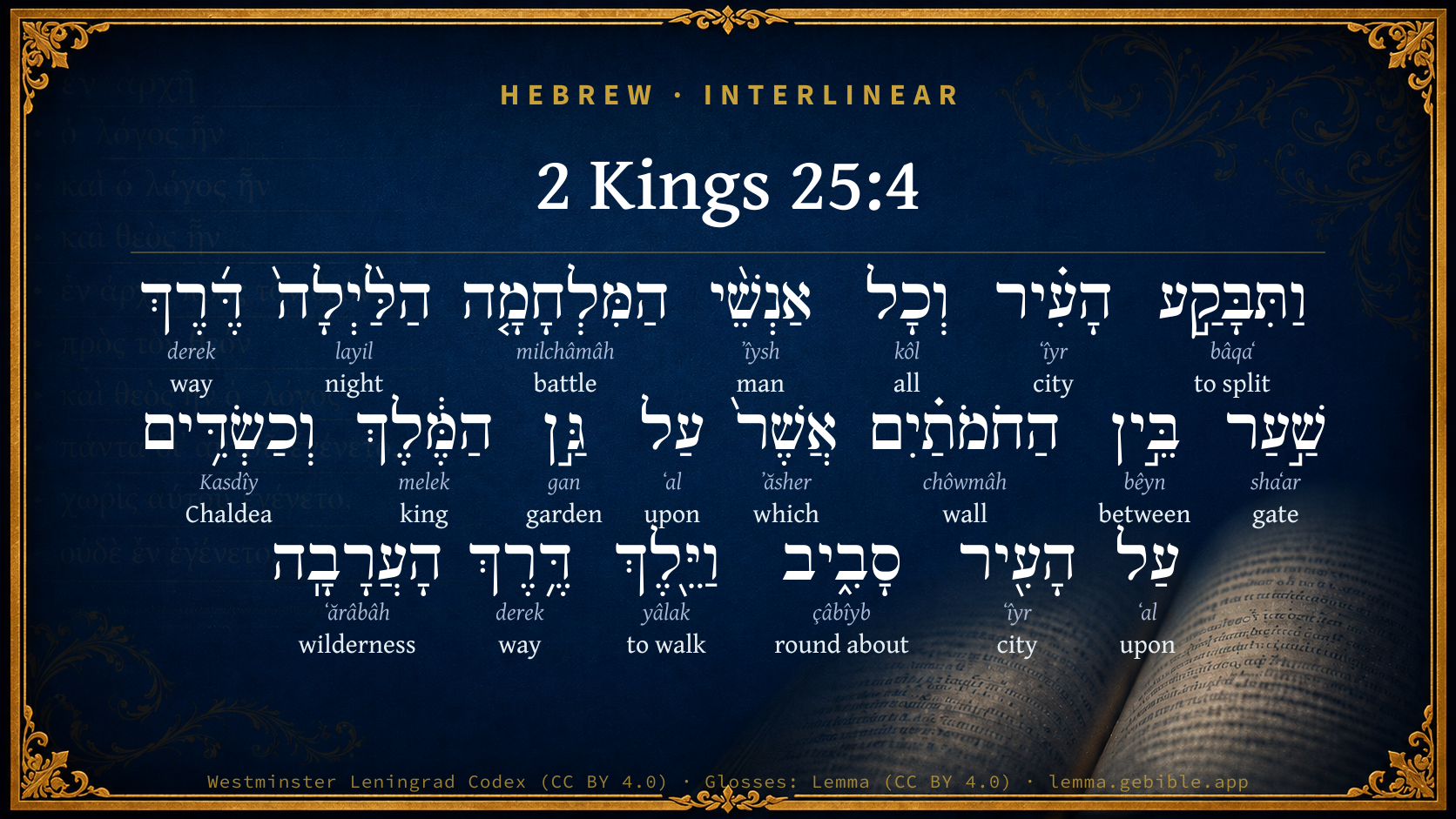
Hebrew (Westminster Leningrad Codex) 2 Kings 25:4 appears in the Hebrew Old Testament. The text above is from the Westminster Leningrad Codex. Each word links to its Strong’s number, a concise gloss, and parsing drawn from the Open Scriptures Hebrew Bible morphology. Click any word for its full Brown-Driver-Briggs (BDB) entry.
Download image
Cite this verse

2 Kings 25:4 (World English Bible). Public Domain. Lemma interlinear Bible study tool, https://lemma.gebible.app/v/2-kings/25/4.

Show BibTeX & RIS
BibTeX
RIS
English Translation
Then a breach was made in the city, and all the men of war [fled] by night by the way of the gate between the two walls, which was by the king's garden (now the Chaldeans were against the city round about); and [the king] went by the way of the Arabah.
World English Bible · Public Domain
Download a study sheet

One document with this verse’s original text, its word-by-word gloss line, the meaning frame, cross-references with their text, attributed commentary, and full source and license credits — printable, and it pastes into notes with its structure intact.

This verse Autodidact and up

Study sheet (.html) Plain text (.txt)

A passage Seminary Student

Up to 50 verses in one chapter. A passage sheet keeps up to 6 commentary sources and 12 cross-references per verse, in the order this page ranks them, and says so on the sheet whenever that leaves anything out. Ask for a single verse and you get the Autodidact verse sheet above.

Everything on this page stays free to read, with no account — the sheet is a download of what is already on screen, not access to it.

Want to remove ads? Support Godless Engineer
Compare translations 3

The same verse in 3 English versions, stacked beneath the original-language interlinear above. Click any original word for its lexicon entry.

Each is an independent rendering of the whole verse — the interlinear is not word-aligned to these translations.

Highlighted words mark where these versions differ — a whole-verse word diff, not a word-by-word alignment.

  • World English Bible Public Domain
    Then a breach was made in the city, and all the men of war [fled] by night by the way of the gate between the two walls, which was by the king's garden (now the Chaldeans were against the city round about); and [the king] went by the way of the Arabah.
  • King James Version Public Domain
    And the city was broken up, and all the men of war fled by night by the way of the gate between two walls, which is by the king's garden: (now the Chaldees were against the city round about:) and the king went the way toward the plain.
  • unfoldingWord Literal Text CC BY-SA 4.0
    And the city was breached, and all of the men of war at night the way of the gate between the two walls that near the garden of the king (now the Chaldeans against the city all around), and he went the way of the Arabah.

unfoldingWord Literal Text — © unfoldingWord, licensed CC BY-SA 4.0. Word-aligned USFM3 via Door43 (git.door43.org/unfoldingWord/en_ult).

Versions to compare (up to 4)

3 of 4 selected

Show all 18 translations

Every available English version of this verse, each an independent rendering of the whole verse.

  • World English Bible Public Domain
    Then a breach was made in the city, and all the men of war [fled] by night by the way of the gate between the two walls, which was by the king's garden (now the Chaldeans were against the city round about); and [the king] went by the way of the Arabah.
  • Berean Standard Bible Public Domain
    Then the city was breached; and though the Chaldeans had surrounded the city, all the men of war fled by night by way of the gate between the two walls near the king’s garden. They headed toward the Arabah,
  • Majority Standard Bible Public Domain
    Then the city was breached; and though the Chaldeans had surrounded the city, all the men of war fled by night by way of the gate between the two walls near the king’s garden. They headed toward the Arabah,
  • King James Version Public Domain
    And the city was broken up, and all the men of war fled by night by the way of the gate between two walls, which is by the king's garden: (now the Chaldees were against the city round about:) and the king went the way toward the plain.
  • American Standard Version (1901) Public Domain
    Then a breach was made in the city, and all the men of war `fled' by night by the way of the gate between the two walls, which was by the king's garden (now the Chaldeans were against the city round about); and `the king' went by the way of the Arabah.
  • Revised Version (1885) Public Domain
    Then a breach was made in the city, and all the men of war fled by night by the way of the gate between the two walls, which was by the king’s garden: (now the Chaldeans were against the city round about:) and the king went by the way of the Arabah.
  • Geneva Bible (1599) Public Domain
    Then the citie was broken vp, and all the men of warre fled by night, by the way of the gate, which is betweene two walles that was by the Kings garden: nowe the Caldees were by the citie round about: and the King went by the way of the wildernesse.
  • Douay-Rheims (1899) Public Domain
    And a breach was made into the city: and all the men of war fled in the night between the two walls by the king's garden, (now the Chaldees besieged the city round about,) and Sedecias fled by the way that leadeth to the plains of the wilderness.
  • Young's Literal Translation Public Domain
    then the city is broken up, and all the men of war `go' by night the way of the gate, between the two walls that `are' by the garden of the king, and the Chaldeans `are' against the city round about, and `the king' goeth the way of the plain.
  • Literal Standard Version CC BY-SA 4.0
    And the city is broken up, and all the men of war [go] by night the way of the gate, between the two walls that [are] by the garden of the king, and the Chaldeans [are] against the city all around, and [the king] goes the way of the plain.
  • Unlocked Literal Bible CC BY-SA 4.0
    Then the city was broken into, and all the fighting men fled at night by the way of the gate between the two walls, by the king's garden, although the Chaldeans were all around the city. The king went in the direction of the Arabah.
  • unfoldingWord Literal Text CC BY-SA 4.0
    And the city was breached, and all of the men of war at night the way of the gate between the two walls that near the garden of the king (now the Chaldeans against the city all around), and he went the way of the Arabah.
  • Darby Bible Public Domain
    And the city was broken into; and all the men of war [fled] by night, by the way of the gate between the two walls, which [leads] to the king's garden (now the Chaldeans were by the city round about); and they went the way toward the plain.
  • World Messianic Bible Public Domain
    Then a breach was made in the city, and all the men of war fled by night by the way of the gate between the two walls, which was by the king’s garden (now the Kasdim were against the city around it); and the king went by the way of the Arabah.
  • Webster's Bible Public Domain
    And the city was broken up, and all the men of war fled by night by the way of the gate between two walls, which is by the king's garden: (now the Chaldees were against the city on all sides:) and the king went the way towards the plain.
  • Free Bible Version CC BY-SA 4.0
    Then the city wall was broken through, and all the soldiers escaped at night through the gate between the two walls by the king's garden, even though the Babylonians had the city surrounded. They ran away in the direction of the Arabah,
  • Bible in Basic English Public Domain
    So an opening was made in the wall of the town, and all the men of war went in flight by night through the doorway between the two walls which was by the king's garden; (now the Chaldaeans were stationed round the town:) and the king went by the way of the Arabah.
  • JPS Tanakh (1917) Public Domain
    Then a breach was made in the city, and all the men of war fled by night by the way of the gate between the two walls, which was by the king's garden — now the Chaldeans were against the city round about — and the king went by the way of the Arabah.

Literal Standard Version (2020), Covenant Press — licensed CC BY-SA 4.0. Text via the HelloAO Bible API (eBible.org). Unlocked Literal Bible (unfoldingWord) — licensed CC BY-SA 4.0. Text via the HelloAO Bible API (eBible.org). unfoldingWord Literal Text — © unfoldingWord, licensed CC BY-SA 4.0. Word-aligned USFM3 via Door43 (git.door43.org/unfoldingWord/en_ult). Free Bible Version, Dr. Jonathan Gallagher — licensed CC BY-SA 4.0. Text via the HelloAO Bible API (eBible.org).

Word by word

More ways to search: Search by grammar → Find every occurrence → Compare this word →

Practice this passage: Drill this verse → Learn its vocabulary →

גַּ֣ן
gan
H1588
“garden of”
Noun, Common, Both, Singular, Construct
Part of Speech
Noun
Type
Common
Gender
Both
Number
Singular
State
Construct
Full BDB Definition

Origin: from H1598

TWOT: 367a

garden, enclosure (noun masculine or feminine) - enclosed garden - (figuratively of a bride) - garden (of plants) - Garden of Eden (noun proper locative)
  1. וַתִּבָּקַ֣ע bâqaʻ H1234 “and · to split” Conjunction + Verb, Niphal, Sequential Imperfect, 3rd Person, Feminine, Singular
  2. הָעִ֗יר ʻîyr H5892 “the · city” Particle, Definite Article + Noun, Common, Feminine, Singular, Absolute
  3. וְכָל kôl H3605 “and · all of” Conjunction + Noun, Common, Masculine, Singular, Construct
  4. אַנְשֵׁ֨י ʼîysh H376 “men of” Noun, Common, Masculine, Plural, Construct
  5. הַמִּלְחָמָ֤ה milchâmâh H4421 “the · battle” Particle, Definite Article + Noun, Common, Feminine, Singular, Absolute
  6. הַלַּ֨יְלָה֙ layil H3915 “the · night” Particle, Definite Article + Noun, Common, Masculine, Singular, Absolute
  7. דֶּ֜רֶךְ derek H1870 “way of” Noun, Common, Both, Singular, Construct
  8. שַׁ֣עַר shaʻar H8179 “gate” Noun, Common, Masculine, Singular, Absolute
  9. בֵּ֣ין bêyn H996 “between” Preposition
  10. הַחֹמֹתַ֗יִם chôwmâh H2346 “the · walls” Particle, Definite Article + Noun, Common, Feminine, Dual, Absolute
  11. אֲשֶׁר֙ ʼăsher H834 “which” Particle, Relative
  12. עַל ʻal H5921 “upon” Preposition
  13. הַמֶּ֔לֶךְ melek H4428 “the · king” Particle, Definite Article + Noun, Common, Masculine, Singular, Absolute
  14. וְכַשְׂדִּ֥ים Kasdîy H3778 “and · Chaldea” Conjunction + Noun, Proper
  15. עַל ʻal H5921 “upon” Preposition
  16. הָעִ֖יר ʻîyr H5892 “the · city” Particle, Definite Article + Noun, Common, Feminine, Singular, Absolute
  17. סָבִ֑יב çâbîyb H5439 “round about” Noun, Common, Both, Singular, Absolute
  18. וַיֵּ֖לֶךְ yâlak H3212 “and · to walk” Conjunction + Verb, Qal, Sequential Imperfect, 3rd Person, Masculine, Singular
  19. דֶּ֥רֶךְ derek H1870 “way of” Noun, Common, Both, Singular, Construct
  20. הָעֲרָבָֽה ʻărâbâh H6160 “the · wilderness” Particle, Definite Article + Noun, Common, Feminine, Singular, Absolute

About this verse

These counts appear in no published source. They are computed here, from the morphology-tagged text and Lemma’s own curated glosses. What Lemma adds →

21
words
18
distinct lemmas
Historical
section

Shared distinctive vocabulary

גַּ֣ן garden H1588 occurs in 37 verses of the Hebrew Bible. Also found in:

Grammatical profile

  • 2 verbs
  • 15 nouns
  • 3 prepositions
  • 1 particle

Verb forms

  • וַתִּבָּקַ֣ע Niphal · Sequential Imperfect
  • וַיֵּ֖לֶךְ Qal · Sequential Imperfect

Repetition

Words recur within this verse — often emphatic in Hebrew:

  • הָעִ֗יר city H5892 ×2
  • דֶּ֜רֶךְ way H1870 ×2
  • עַל upon H5921 ×2

Hebrew & Septuagint length

In English translation the verse runs 52 words from the Hebrew and 53 from the Septuagint (LXX English) — closely comparable.

A rough comparison of the two English renderings, which tokenize alike — not a word-level alignment.

Word counts can differ between the Hebrew and the Greek without any difference in meaning — e.g. the Hebrew direct-object marker אֵת has no separate Greek word, and Greek often adds the article ὁ.

In the original languages it is 21 Hebrew tokens and 38 Greek tokens — but the two are counted differently (Hebrew bundles its prefixes and suffixes into one token; the Greek is in lemma form), so that isn’t a like-for-like length.

Cross-references

12

Topical passages linked to 2 Kings 25:4 in the Treasury of Scripture Knowledge — connected by theme and wording, ordered by reader-vote popularity; previews shown in the World English Bible.

  • Ezekiel 33:21 It happened in the twelfth year of our captivity, in the tenth [month], in the fifth [day] of the month, that one who had escaped out of Jerusalem came to me, saying, The city has been struck.
  • Leviticus 26:17 I will set my face against you, and you will be struck before your enemies. Those who hate you will rule over you; and you will flee when no one pursues you.
  • Leviticus 26:36 "'As for those of you who are left, I will send a faintness into their hearts in the lands of their enemies: and the sound of a driven leaf will put them to flight; and they shall flee, as one flees from the sword; and they will fall when no one pursues.
  • Deuteronomy 28:25 Yahweh will cause you to be struck before your enemies; you shall go out one way against them, and shall flee seven ways before them: and you shall be tossed back and forth among all the kingdoms of the earth.
  • Deuteronomy 32:24–25 [They shall be] wasted with hunger, and devoured with burning heat Bitter destruction; The teeth of animals will I send on them, With the poison of crawling things of the dust.
  • Deuteronomy 32:30 How should one chase a thousand, Two put ten thousand to flight, Except their Rock had sold them, Yahweh had delivered them up?
  • 2 Kings 25:5 But the army of the Chaldeans pursued after the king, and overtook him in the plains of Jericho; and all his army was scattered from him.
  • Nehemiah 3:15 The spring gate repaired Shallun the son of Colhozeh, the ruler of the district of Mizpah; he built it, and covered it, and set up the doors of it, the bolts of it, and the bars of it, and the wall of the pool of Shelah by the king's garden, even to the stairs that go down from the city of David.
  • Jeremiah 5:10 Go up on her walls, and destroy; but don't make a full end: take away her branches; for they are not Yahweh's.
  • Jeremiah 39:2–7 in the eleventh year of Zedekiah, in the fourth month, the ninth day of the month, a breach was made in the city),
  • Jeremiah 52:6–11 In the fourth month, in the ninth day of the month, the famine was sore in the city, so that there was no bread for the people of the land.
  • Ezekiel 12:12 The prince who is among them shall bear on his shoulder in the dark, and shall go forth: they shall dig through the wall to carry out thereby: he shall cover his face, because he shall not see the land with his eyes.

Cross-references courtesy of OpenBible.info (CC BY 4.0).

Hebrew and Greek witnesses Masoretic Hebrew ↔ Greek Septuagint

The same verse in the two great witnesses to the Old Testament, shown verse-for-verse.

These are two independent witnesses, not word-aligned to each other, and the Septuagint is shown in lemma (dictionary) form.

Hebrew 2 Kings 25:4 Masoretic · Westminster Leningrad Codex

וַתִּבָּקַ֣ע הָעִ֗יר וְכָל אַנְשֵׁ֨י הַמִּלְחָמָ֤ה הַלַּ֨יְלָה֙ דֶּ֜רֶךְ שַׁ֣עַר בֵּ֣ין הַחֹמֹתַ֗יִם אֲשֶׁר֙ עַל גַּ֣ן הַמֶּ֔לֶךְ וְכַשְׂדִּ֥ים עַל הָעִ֖יר סָבִ֑יב וַיֵּ֖לֶךְ דֶּ֥רֶךְ הָעֲרָבָֽה

Then a breach was made in the city, and all the men of war [fled] by night by the way of the gate between the two walls, which was by the king's garden (now the Chaldeans were against the city round about); and [the king] went by the way of the Arabah.

World English Bible · Public Domain

Greek LXX 2 Kings 25:4 Septuagint · lemma form

καί ῥήγνυμι ὁ πόλις καί πᾶς ὁ ἀνήρ ὁ πόλεμος ἐκἔρχομαι νύξ ὁδός πύλη ὁ ἀνά μέσος ὁ τεῖχος οὗτος ὅς εἰμί ὁ κῆπος ὁ βασιλεύς καί ὁ χαλδαῖος ἐπί ὁ πόλις κύκλος καί πορεύομαι ὁδός ὁ ἀραβά

And the city was broken up, and all the men of war went forth by night, by the way of the gate between the walls, this is the gate of the king's garden: and the Chaldeans were set against the city round about: and the king went by the way of the plain.

LXX2012 (modern English Septuagint) · Public Domain

Hebrew: Westminster Leningrad Codex (CC BY 4.0). Greek: Septuagint (public domain); English from LXX2012 (modern English Septuagint) (Public Domain). How the Septuagint differs from the Hebrew →

Targum (Aramaic paraphrase)

1

The Targum is the ancient Jewish Aramaic paraphrase of the Hebrew Scriptures — an interpretive translation, not the Hebrew text itself. Onkelos (literal) and Pseudo-Jonathan (expansive) render the Torah, and Jonathan the Prophets. Coverage is partial: where no permissively-licensed English translation exists for a verse, only the Aramaic is shown. This is verse-level text, not a word-by-word alignment to the Hebrew.

  1. Targum Jonathan Prophets (Joshua–Malachi)
    וְאִתְרָעַת קַרְתָּא וְכָל גַבְרֵי עַבְדֵי קְרָבָא בְּלֵילְיָא בְּאוֹרַח תַּרְעָא בֵּין שׁוּרַיָא דִי עַל גִינְתָא דְמַלְכָּא וְכַסְדָאֵי שָׁרָן עַל קַרְתָּא סְחוֹר סְחוֹר וַאֲזַל בְּאוֹרַח מֵישְׁרָא:

    (no public-domain English translation for this verse)

    Targum Jonathan — Aramaic: “Mikraot Gedolot” (public domain). English: “Sefaria Community Translation” (CC0 1.0 (public-domain dedication)); “London "Chaldee Paraphrase," 1871” (public domain). Text via Sefaria.

Commentary

Notes on 2 Kings 25:4 from classic Christian and Jewish commentators (each source and its license shown beneath its notes). The classic Christian expositions comment on the surrounding passage and are grouped to its opening verse, so a note may address several verses; the Jewish commentaries on the Tanakh (Rashi and others) are per-verse, so they appear only where the commentator wrote on this verse.

Lemma curates 59 commentaries, every one of them public domain or Creative Commons licensed, each selected and text-cleaned for this edition rather than reprinted as found. About our sources →

Jamieson, Fausset & Brown

Robert Jamieson, A. R. Fausset & David Brown

ZEDEKIAH TAKEN. (2Ki. 25:4-30)

the city was broken up--that is, a breach was effected, as we are elsewhere informed, in a part of the wall belonging to the lower city (Ch2 32:5; Ch2 33:14).

the men of war fled by night by the way of the gate between two walls, which is by the king's garden--The king's garden was (Neh 3:15) at the pool of Siloam, that is, at the mouth of the Tyropæon. A trace of the outermost of these walls appears to be still extant in the rude pathway which crosses the mouth of the Tyropæon, on a mound hard by the old mulberry tree, which marks the traditional spot of Isaiah's martyrdom [ROBINSON]. It is probable that the besiegers had overlooked this pass.

the king went . . . toward the plain--that is, the Ghor, or valley of Jordan, estimated at five hours' distance from Jerusalem. The plain near Jericho is about eleven or twelve miles broad.

Jamieson, Fausset & Brown — Commentary Critical and Explanatory on the Whole Bible (1871) — public domain (CC PDM 1.0). Text via the HelloAO Bible API.

Trapp's Complete Commentary

John Trapp

2Ki 25:4 And the city was broken up, and all the men of war [fled] by night by the way of the gate between two walls, which [is] by the king’s garden: (now the Chaldees [were] against the city round about:) and [the king] went the way toward the plain.

Ver. 4. And the city was broken up] {a} By the besiegers, who had seized upon the middle gate. {Jer 39:3} Cajetan holdeth that it was broken up by the citizens, that by the breach they might escape. Hunger, we say, breaketh through stone walls.

And all the men of war … fled.] This word "fled" is not in the text, but supplied from Jer 39:4 ut intelligamus fugam fuisse praecipitem, saith Vatablus, to set forth the hastiness and headlongness of their flight: but in fleeing from death they fled to it.

By night.] All this was foretold. {Eze 12:12}

By the way towards the plain.] By a way underground, {b} say the Hebrews, into which the secret gate led them: by a deep valley between mountains, saith Josephus.

Now the Chaldees.] See on 2Ki 25:1.

{a} Crebris ictibus arietum. - Vat.

{b} φευδοθυρον.

John Trapp, A Commentary or Exposition upon All the Books of the Old and New Testament (1647–1656) — public domain. Text from a community e-Sword module.

Joseph Benson's Commentary

2Ki 25:4. The city was broken up — It was taken by storm, the besiegers having made a breach in the wall, at which they forced their way into it. All the men of war fled — Being unable any longer to defend the city, they endeavoured to quit it, which many of them found means to do by the way of the gate between the two walls — That is, between the inward and outward walls of the city, or between the wall and the outworks, by a private way, having the advantage of the darkness of the night, and possibly of some vault under the ground. Many however, no doubt, were put to the sword, the victorious army being much exasperated by their obstinacy. To account, in some degree, for the besieged making their escape, Josephus observes, that as the city was taken about midnight, the enemies’ captains, with the rest of the soldiers, went directly into the temple, which Zedekiah perceiving, took his wives, children, commanders, and friends, and they all slipped away together, by a narrow passage, toward the wilderness. But what this narrow passage was, is still a question. The Jews think there was a subterraneous passage from the palace to the plains of Jericho, and that the king and his courtiers might endeavour to make their escape that way. And we learn from Dion, that in the last siege of Jerusalem by the Romans, the Jews had covered ways, which lay under the walls of the city, to a considerable distance into the country, out of which they were wont to sally, and fall upon the Romans that were straggling from the camp: but since neither Josephus nor the sacred historian takes notice of any such subterraneous passage at this siege, it is most likely that the Chaldeans having made a breach in the wall, many of the besieged escaped through it, proceeding privately between the wall and the outworks, by a passage which the Chaldeans did not suspect. The king went toward the plain — Of Jericho, as it follows.

Joseph Benson's Commentary on the Old and New Testaments (1811–1818) — public domain. Text from a community e-Sword module.

Tyndale Open Study Notes

Tyndale Open Resources

25:4 Using battering rams (Ezek 4:2), the Babylonians broke down a section of Jerusalem’s wall and penetrated the city. At nightfall, King Zedekiah and the remaining troops escaped through the gate at the southeastern corner of the city into the Kidron Valley, attempting to reach the Jordan Valley.

Tyndale Open Study Notes — © Tyndale Open Resources, licensed CC BY-SA 4.0. Text via the HelloAO Bible API.

Geneva Bible (1599)

Geneva Bible translators

Which was a postern door, or some secret gate to issue out at.

Geneva Bible (1599) marginal notes — public domain. Text via Bolls.life.

Adam Clarke's Commentary

Verse 4. 2Kg 25:2.

Adam Clarke's Commentary on the Bible (1810–1826) — public domain. Text from a community e-Sword/MySword module.

Ellicott's Commentary for English Readers

(4) Broken up.—Comp. 2Ch_32:1. A breach was made in the wall with battering-rams, such as are depicted in the Assyrian sculptures. The Chaldæans forced their entry on the north side of the city, i.e., they took the Lower City (2Ki_22:14). This is clear from Jer_39:3, where it is said that, after effecting an entrance, their generals proceeded to assault “the middle gate,” i.e., the gate in the north wall of Zion, which separated the upper from the lower city. (See also 2Ki_14:13.)

All the men of war fled.—The Hebrew here is defective, for it wants a verb, and mention of the king is implied by what follows. (See Jer_39:4; Jer_52:7.) A comparison of these parallels suggests the reading: “And Zedekiah king of Judah and all the men of war fled, and went out of the city by night,” &c.

By the way of the gate between (the) two walls which is (was) by the king’s garden.—This gate lay at the south end of the Tyropœon, i.e., the glen between Ophel and Zion; and is the same as “the Gate of the Fountain” (Neh_3:15). The two walls were necessary for the protection of the Pool of Siloam and the water supply; besides which the point was naturally weak for purposes of defence. Whether “the king’s garden” was within or without the double wall is not clear, probably the latter, as Thenius supposes.

Now the Chaldees . . . round about.—An indication that even by this route the king and his warriors had to break through the enemy’s lines, as the city was completely invested. (Corap. Eze_12:12.)

And the king went.— Some MSS. and the Syriac, and they went. (So Jer_52:7; a correction, after the mention of the king had fallen out of the text.)

The way toward the plain.—The Arabah, or valley of the Jordan (Jos_11:2; 2Sa_2:29).

A Bible Commentary for English Readers, edited by Charles John Ellicott (1878–1897) — public domain. Text from a community e-Sword module.

The Cambridge Bible for Schools and Colleges

gen. ed. J. J. S. Perowne

4. And the city was broken up] R.V. Then a breach was made in the city. The old phrase ‘broken up’ was the same in sense as ‘broken through’. See 2Ch_24:7; Jer_39:7; Mic_2:13; Mat_24:43; Mar_2:4.

We have a more full account of the events here alluded to in Jer_39:2-7. There we learn that when the breach had been made the princes of the king of Babylon came in and sat in the middle gate, and when Zedekiah saw them he and his men of war fled.

the men of war fled by night] The verb is supplied, but appears in the text of Jer_39:4; Jer_52:7. The scribe in this passage has been much at fault.

by the way of the gate between two [R.V. the two] walls] This was a definite locality. The A.V. translates as R.V. in Jeremiah 39 From its proximity to the king’s garden, this gate must be the same which is called in Neh_2:14; Neh_3:15, ‘the gate of the fountain’. It was close to the pool of Siloam, and so the way through it would lead down to the Kidron valley.

which is [R.V. was] by the king’s garden] The past tense suits the narrative and its date better. Whether the king’s garden was outside or within the walls does not appear.

and the king went the way [R.V. by the way] toward the plain] R.V. of the Arabah. See note on 2Ki_14:25. The whole valley from the sea of Galilee southward to the desert was called by this name. On the character of this flight compare the words of Eze_12:12.

The Cambridge Bible for Schools and Colleges (gen. ed. J. J. S. Perowne; Cambridge University Press, 1878–1918) — public domain. Text from a community e-Sword module.

Albert Barnes' Notes on the Bible

The city was broken up - Rather, “broken into,” i. e., A breach was made about midnight in the northern wall Eze 9:2, and an entry effected into the second or lower city (see the 2Ki 22:14 note), which was protected by the wall of Manasseh 2Ch 33:14.

Precipitate flight followed on the advance of the Babylonians to the “middle gate,” or gate of communication between the upper and the lower cities. This position was only a little north of the royal palace, which the king therefore quitted. He escaped by the royal garden at the junction of the Hinnom and Kidron valleys, passing between the two walls which skirted on either side the valley of the Tyropoeon.

Toward the plain - “The Arabah” or the great depression which bounds Palestine Proper on the east (Num 21:4 note). The “way toward the Arabah” is here the road leading eastward over Olivet to Bethany and Jericho.

Albert Barnes' Notes on the Bible (1834–1885) — public domain. Text from a community e-Sword/MySword module.

Haydock's Catholic Bible Commentary

Walls, by a subterraneous passage, to the plains of Jericho; (Rabbins) or by the horse gate, which was the most private, and, it seems, had been walled up, Ezechiel xii. 12. (Menochius)

George Leo Haydock (1774–1849), Haydock's Catholic Family Bible and Commentary, 1859 edition — public domain. Excludes Psalms (Douay-Rheims chapter numbering differs from Protestant) and Deuterocanonical books (Catholic canon only).

Matthew Poole's English Annotations

The city was broken up by the Chaldeans, who broke and entered the gate, Jer 39:3.

The men of war fled; which word is fitly supplied out of the parallel place, Jer 39:4, or out of the following verb, went away.

Between two walls; between the outward and inward wall of the city, by a private way, having the advantage of the darkness of the night, and possibly of some vault under the ground. The king: this word also is necessarily to be understood; partly by its singular, which agrees not with the men of war; and partly out of the next verse, where it is expressed.

Toward the plain of Jericho, as it follows.

Matthew Poole's English Annotations on the Holy Bible (1683–1685) — public domain. Text from a community e-Sword/MySword module.

Whedon's Commentary on the Bible

Daniel D. Whedon

4. The city was broken up — Or, broken in. The breach was probably made in the northern wall, for, according to Jer_39:3, “all the princes of the king of Babylon came in and sat in the middle gate” — that is, the gate which led from the upper to the lower city. The sight of them in that position took from the king and his chief men all hope of defending the city, and they hastened to effect their escape, having no reason to expect mercy at the hands of their conquerors.

Fled by night — Hoping to escape unseen; but too many Chaldean eyes were watching.

The gate between two walls, which is by the king’s garden — According to Neh_3:15, the king’s garden was by the pool of Siloam, that is, at the mouth of the Tyropoean valley, and the gate between two walls is without doubt the same as “the gate of the fountain.” The two walls are perhaps the same as those mentioned in Isa_22:11, and were probably extensions of the city walls in this vicinity to guard the pools or cisterns in a time of danger. As the breach was made in the northern wall of the city, the fugitives would naturally make their escape from the southern or south-eastern gate. The

Chaldees… round about — This parenthetical remark is thrown in to show how impossible it was for the fugitives to escape unseen.

Toward the plain — The plain of Jericho.

Daniel D. Whedon (gen. ed.), Commentary on the Old and New Testaments (1874–1909) — public domain. Text from a community e-Sword module.

The Pulpit Commentary

And the city was broken up; rather, brown into; i.e. a breach was made in the walls. Probably the breach was on the north side of the city, where the ground is nearly level. (see Eze_9:2) According to Josephus ("Ant. Jud:," 10:8. the enemy entered through the breach about midnight. And all the men of wari.e. , all the soldiers who formed the garrison fled by night by the way of the gate between two walls; rather, between the two walls, as in Jer_52:7. As the enemy broke in on the north, the king and garrison quitted the city on the south by a gate which opened into the Tyropoeon valley, between the two walls that guarded the town on either side of it. Which is by the king"s garden. The royal gardens were situated near the Pool of Siloam, at the mouth of the Tyrepoeon, and near the junction of the Hinnom with the Kidron valley (see Josephus, "Ant. Jud:," 7:11). (Now the Chaldees were against the city round about.) The town, i.e. , was guarded on all sides by Chaldean troops, so that Zedekiah and his soldiers must either have attacked the line of guard, and broken through it, or have slipped between two of the blockading pests under cover of the darkness. As no collision is mentioned, either here or in Jeremiah, the latter seems the more probable supposition. And the king went the way toward the plain; literally, and he went. The writer supposes that his readers will understand that the king left the city with his troops; and so regards "he went" as sufficiently intelligible. Jer_52:7 has "they went. By "the plain" (literally, "the Arabsh the valley of the Jordan is intended, and by "the way" to it the ordinary road from Jerusalem to Jericho.

The Pulpit Commentary (1880–1919), ed. H.D.M. Spence-Jones & Joseph S. Exell — public domain. Text from a community e-Sword module.

Scofield Reference Notes

C. I. Scofield

And the city

Times of the Gentiles. 2Ki 25:1-21; Dan 2:29-45; Luk 21:24; Rev 16:19.

The Scofield Reference Bible (1917 edition), notes by C. I. Scofield — public domain. Text from a community e-Sword module.

unfoldingWord translationNotes

Door43 World Missions Community

Then the city was broken into

This can be translated in active form. AT: "Then the Babylonian army broke into the city" (See: Active or Passive)

all the fighting men

"all the warriors"

by the way of the gate

"by using the gate"

the Chaldeans

Some translations use "Chaldeans" and others use "Babylonians." Both terms refer to the same people group.

The king went in the direction of

"King Zedekiah also fled and he went toward"

All his army was scattered away from him

This can be translated in active form. AT: "His whole army ran away from him" or "The Chaldeans chased away his whole army" (See: Active or Passive)

translationWords

gate

Chaldea

Arabah

overtake

Jordan River

Jericho

unfoldingWord translationNotes — © Distant Shores Media and the Door43 World Missions Community, licensed CC BY-SA 4.0. Source: git.door43.org/Door43/en_tn.

Rashi

Rabbi Shlomo Yitzchaki (Rashi)

By way of the gate between the two walls. A cave went from his house until the Plains of Yericho, and he fled through the cave. The Holy One, Blessed Is He, ordained a deer walking on the roof of the cave. and the Kasdim pursued the deer, and when they reached the cave's entrance in the Plains of Yericho, they saw him and captured him. This is what [Scripture] states, ”And I will spread My net over him, and he shall be caught in My snare.”

Rashi on the Tanakh — English translations: “The Judaica Press complete Tanach with Rashi, translated by A. J. Rosenberg” (CC BY 4.0); “Pentateuch with Rashi's commentary by M. Rosenbaum and A.M. Silbermann, 1929-1934” (public domain); “The Metsudah Tanach series, Lakewood, N.J” (CC BY 4.0); and “The Book of Joshua, Metsudah Publications, 1997” (CC BY 4.0). Text via Sefaria.

Lesson kit

Teaching starters — assembled from the data on this page, not authored interpretation. Every prompt links to the verse data it draws on. Edit before teaching.

2 Kings, in the Historical, opens this verse with 21 words (18 distinct Hebrew lemmas). Its most distinctive word is gan (“garden”). A historical commentator’s framing appears above. Read the whole chapter for the surrounding context.

Discussion questions

  1. How does “garden” (gan) shape what this verse is saying?
  2. How does Genesis 2:8, which shares the word «garden», read alongside this verse?
  3. What does the repetition of “city” (2× in this one verse) do in this verse?
  4. The translations on this page render this verse differently — a whole-verse word diff, not a word-by-word alignment. What might account for the different wordings?
  5. «וַתִּבָּקַ֣ע» is a Niphal Sequential Imperfect verb. How does that grammatical form shape the action described?
  6. Compare how Jamieson, Fausset & Brown and Trapp's Complete Commentary read this verse. Where do they agree or differ?

Things to notice

Reading settings

Reading text

Shown beneath each verse's original-language words.

Old Testament
Old Testament edition

Read the OT as the Masoretic Hebrew (MT) or the Greek Septuagint (LXX).

English shown for the Greek Septuagint (in the Hebrew ↔ Greek comparison).

Comparing translations? Open the Compare panel on any verse page to stack up to four side by side.