1 Samuel 24:15

Hebrew (Westminster Leningrad Codex) 1 Samuel 24:15 appears in the Hebrew Old Testament. The text above is from the Westminster Leningrad Codex. Each word links to its Strong’s number, a concise gloss, and parsing drawn from the Open Scriptures Hebrew Bible morphology. Click any word for its full Brown-Driver-Briggs (BDB) entry.
Download image
Cite this verse

1 Samuel 24:15 (World English Bible). Public Domain. Lemma interlinear Bible study tool, https://lemma.gebible.app/v/1-samuel/24/15.

Show BibTeX & RIS
BibTeX
RIS
English Translation
Yahweh therefore be judge, and give sentence between me and you, and see, and plead my cause, and deliver me out of your hand.
World English Bible · Public Domain
Highlights
  • 1 first appearance in the Hebrew Bible
Full analysis ↓
Download a study sheet

One document with this verse’s original text, its word-by-word gloss line, the meaning frame, cross-references with their text, attributed commentary, and full source and license credits — printable, and it pastes into notes with its structure intact.

This verse Autodidact and up

Study sheet (.html) Plain text (.txt)

A passage Seminary Student

Up to 50 verses in one chapter. A passage sheet keeps up to 6 commentary sources and 12 cross-references per verse, in the order this page ranks them, and says so on the sheet whenever that leaves anything out. Ask for a single verse and you get the Autodidact verse sheet above.

Everything on this page stays free to read, with no account — the sheet is a download of what is already on screen, not access to it.

Want to remove ads? Support Godless Engineer
Compare translations 3

The same verse in 3 English versions, stacked beneath the original-language interlinear above. Click any original word for its lexicon entry.

Each is an independent rendering of the whole verse — the interlinear is not word-aligned to these translations.

Highlighted words mark where these versions differ — a whole-verse word diff, not a word-by-word alignment.

  • World English Bible Public Domain
    Yahweh therefore be judge, and give sentence between me and you, and see, and plead my cause, and deliver me out of your hand.
  • King James Version Public Domain
    The LORD therefore be judge, and judge between me and thee, and see, and plead my cause, and deliver me out of thine hand.
  • unfoldingWord Literal Text CC BY-SA 4.0
    And may Yahweh be the judge, and may he judge between me and between you. And may he see and conduct my case, and may he judge me out of your hand.”

unfoldingWord Literal Text — © unfoldingWord, licensed CC BY-SA 4.0. Word-aligned USFM3 via Door43 (git.door43.org/unfoldingWord/en_ult).

Versions to compare (up to 4)

3 of 4 selected

Show all 18 translations

Every available English version of this verse, each an independent rendering of the whole verse.

  • World English Bible Public Domain
    Yahweh therefore be judge, and give sentence between me and you, and see, and plead my cause, and deliver me out of your hand.
  • Berean Standard Bible Public Domain
    May the LORD be our judge and decide between you and me. May He take notice and plead my case and deliver me from your hand.”
  • Majority Standard Bible Public Domain
    May the LORD be our judge and decide between you and me. May He take notice and plead my case and deliver me from your hand.”
  • King James Version Public Domain
    The LORD therefore be judge, and judge between me and thee, and see, and plead my cause, and deliver me out of thine hand.
  • American Standard Version (1901) Public Domain
    Jehovah therefore be judge, and give sentence between me and thee, and see, and plead my cause, and deliver me out of thy hand.
  • Revised Version (1885) Public Domain
    The LORD therefore be judge, and give sentence between me and thee, and see, and plead my cause, and deliver me out of thine hand.
  • Geneva Bible (1599) Public Domain
    After whom is the King of Israel come out? after whome doest thou pursue? after a dead dog, and after a flea?
  • Douay-Rheims (1899) Public Domain
    After whom dost thou pursue? After a dead dog, after a flea.
  • Young's Literal Translation Public Domain
    And Jehovah hath been for judge, and hath judged between me and thee, yea, he seeth and pleadeth my cause, and doth deliver me out of thy hand.'
  • Literal Standard Version CC BY-SA 4.0
    And YHWH has been for judge, and has judged between me and you, indeed, He sees and pleads my cause, and delivers me out of your hand.”
  • Unlocked Literal Bible CC BY-SA 4.0
    May Yahweh be judge and give judgment between you and me, and see to it, and plead my cause and permit me to escape from your hand.”
  • unfoldingWord Literal Text CC BY-SA 4.0
    And may Yahweh be the judge, and may he judge between me and between you. And may he see and conduct my case, and may he judge me out of your hand.”
  • Darby Bible Public Domain
    Jehovah therefore shall be judge, and judge between me and thee, and see, and plead my cause, and do me justice [in delivering me] out of thy hand.
  • World Messianic Bible Public Domain
    May the LORD therefore be judge, and give sentence between me and you, and see, and plead my cause, and deliver me out of your hand.”
  • Webster's Bible Public Domain
    \\24:14\\After whom is the king of Israel come out? after whom dost thou pursue? after a dead dog, after a flea?
  • Free Bible Version CC BY-SA 4.0
    May the Lord decide and choose between you and me. May he pay attention to my case and support it; may he save me from you.”
  • Bible in Basic English Public Domain
    After whom has the king of Israel come out? for whom are you searching? for a dead dog, an insect.
  • JPS Tanakh (1917) Public Domain
    (24-16) The LORD therefore be judge, and give sentence between me and thee, and see, and plead my cause, and deliver me out of thy hand.'

Literal Standard Version (2020), Covenant Press — licensed CC BY-SA 4.0. Text via the HelloAO Bible API (eBible.org). Unlocked Literal Bible (unfoldingWord) — licensed CC BY-SA 4.0. Text via the HelloAO Bible API (eBible.org). unfoldingWord Literal Text — © unfoldingWord, licensed CC BY-SA 4.0. Word-aligned USFM3 via Door43 (git.door43.org/unfoldingWord/en_ult). Free Bible Version, Dr. Jonathan Gallagher — licensed CC BY-SA 4.0. Text via the HelloAO Bible API (eBible.org).

Word by word

More ways to search: Search by grammar → Find every occurrence → Compare this word →

Practice this passage: Drill this verse → Learn its vocabulary →

לְדַיָּ֔ן
dayân
H1781
“to/for · judge”
Preposition + Noun, Common, Masculine, Singular, Absolute
Part of Speech
Preposition + Noun
Type
Common
Gender
Masculine
Number
Singular
State
Absolute
Full BDB Definition

Origin: from H1777

TWOT: 426b

a judge
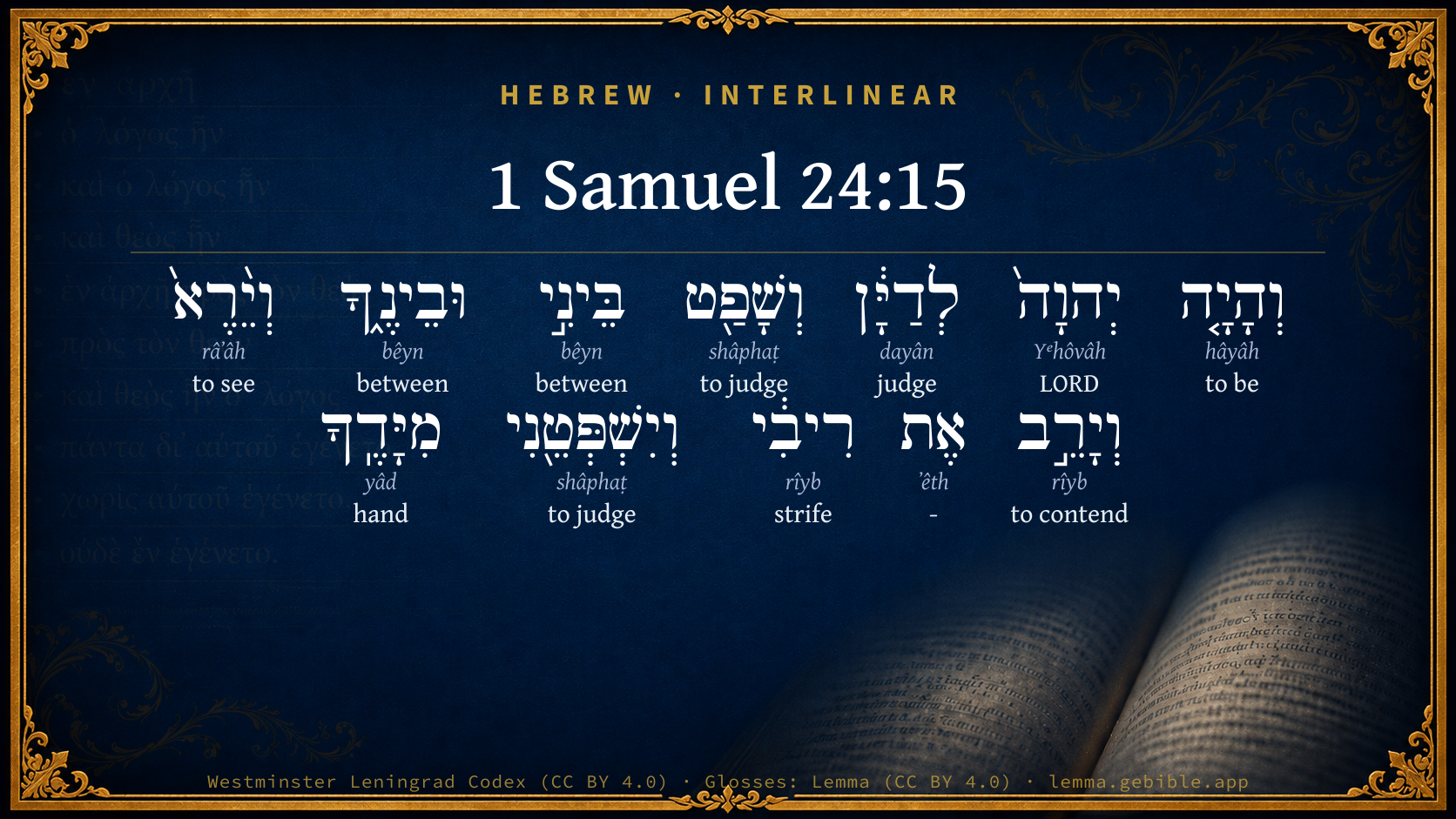
  1. וְהָיָ֤ה hâyâh H1961 “and · to be” Conjunction + Verb, Qal, Sequential Perfect, 3rd Person, Masculine, Singular
  2. יְהוָה֙ Yᵉhôvâh H3068 “LORD” Noun, Proper
  3. וְשָׁפַ֖ט shâphaṭ H8199 “and · to judge” Conjunction + Verb, Qal, Sequential Perfect, 3rd Person, Masculine, Singular
  4. בֵּינִ֣י bêyn H996 “between · me” Preposition + Suffix, Personal, 1st Person, Common, Singular
  5. וּבֵינֶ֑ךָ bêyn H996 “and · between · you” Conjunction + Preposition + Suffix, Personal, 2nd Person, Masculine, Singular
  6. וְיֵ֨רֶא֙ râʼâh H7200 “and · to see” Conjunction + Verb, Qal, Jussive, 3rd Person, Masculine, Singular
  7. וְיָרֵ֣ב rîyb H7378 “and · to contend” Conjunction + Verb, Qal, Jussive, 3rd Person, Masculine, Singular
  8. אֶת ʼêth H853 “-” Particle, Direct Object
  9. רִיבִ֔י rîyb H7379 “strife · my” Noun, Common, Both, Singular, Construct + Suffix, Personal, 1st Person, Common, Singular
  10. וְיִשְׁפְּטֵ֖נִי shâphaṭ H8199 “and · to judge · me” Conjunction + Verb, Qal, Imperfect, 3rd Person, Masculine, Singular + Suffix, Personal, 1st Person, Common, Singular
  11. מִיָּדֶֽךָ yâd H3027 “from · hand · your” Preposition + Noun, Common, Both, Singular, Construct + Suffix, Personal, 2nd Person, Masculine, Singular

About this verse

These counts appear in no published source. They are computed here, from the morphology-tagged text and Lemma’s own curated glosses. What Lemma adds →

12
words
10
distinct lemmas
Historical
section

Notable vocabulary

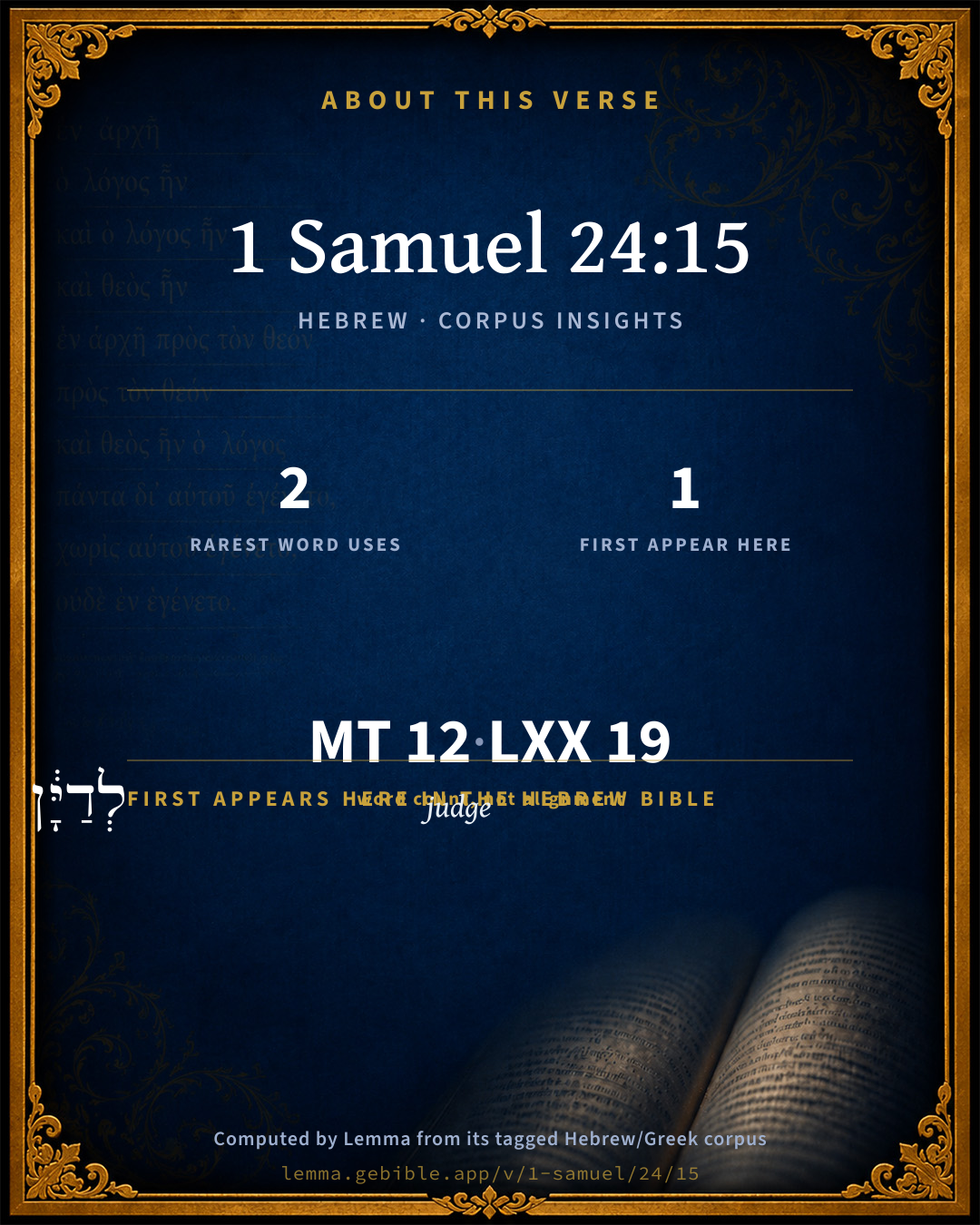
The rarest word here is לְדַיָּ֔ן judge H1781 — appearing just 2 times in the whole Hebrew Bible.

First appearance in Scripture

This word makes its first canonical appearance in the Hebrew Bible here:

  • לְדַיָּ֔ן judge H1781

Shared distinctive vocabulary

לְדַיָּ֔ן judge H1781 occurs in 2 verses of the Hebrew Bible. Also found in:

Grammatical profile

  • 5 verbs
  • 4 nouns
  • 2 prepositions
  • 1 particle

Verb forms

  • וְהָיָ֤ה Qal · Sequential Perfect
  • וְשָׁפַ֖ט Qal · Sequential Perfect
  • וְיֵ֨רֶא֙ Qal · Jussive
  • וְיָרֵ֣ב Qal · Jussive
  • וְיִשְׁפְּטֵ֖נִי Qal · Imperfect

Repetition

Words recur within this verse — often emphatic in Hebrew:

  • וְשָׁפַ֖ט to judge H8199 ×2
  • בֵּינִ֣י between H996 ×2

Hebrew & Septuagint length

In English translation the verse runs 24 words from the Hebrew and 25 from the Septuagint (LXX English) — closely comparable.

A rough comparison of the two English renderings, which tokenize alike — not a word-level alignment.

Word counts can differ between the Hebrew and the Greek without any difference in meaning — e.g. the Hebrew direct-object marker אֵת has no separate Greek word, and Greek often adds the article ὁ.

In the original languages it is 12 Hebrew tokens and 19 Greek tokens — but the two are counted differently (Hebrew bundles its prefixes and suffixes into one token; the Greek is in lemma form), so that isn’t a like-for-like length.

Cross-references

7

Topical passages linked to 1 Samuel 24:15 in the Treasury of Scripture Knowledge — connected by theme and wording, ordered by reader-vote popularity; previews shown in the World English Bible.

  • Psalms 43:1 Vindicate me, God, and plead my cause against an ungodly nation. Oh, deliver me from deceitful and wicked men.
  • Psalms 35:1 Contend, Yahweh, with those who contend with me. Fight against those who fight against me.
  • Psalms 119:154 Plead my cause, and redeem me! Revive me according to your promise.
  • 1 Samuel 24:12 Yahweh judge between me and you, and Yahweh avenge me of you; but my hand shall not be on you.
  • Micah 7:9 I will bear the indignation of Yahweh, Because I have sinned against him, Until he pleads my case, and executes judgment for me. He will bring me forth to the light. I will see his righteousness.
  • 2 Chronicles 24:22 Thus Joash the king didn't remember the kindness which Jehoiada his father had done to him, but killed his son. When he died, he said, Yahweh look on it, and require it.
  • Micah 1:2 Hear, you peoples, all of you. Listen, O earth, and all that is therein: And let the Lord Yahweh be witness against you, The Lord from his holy temple.

Cross-references courtesy of OpenBible.info (CC BY 4.0).

Hebrew and Greek witnesses Masoretic Hebrew ↔ Greek Septuagint

The same verse in the two great witnesses to the Old Testament, shown verse-for-verse.

These are two independent witnesses, not word-aligned to each other, and the Septuagint is shown in lemma (dictionary) form.

Hebrew 1 Samuel 24:15 Masoretic · Westminster Leningrad Codex

וְהָיָ֤ה יְהוָה֙ לְדַיָּ֔ן וְשָׁפַ֖ט בֵּינִ֣י וּבֵינֶ֑ךָ וְיֵ֨רֶא֙ וְיָרֵ֣ב אֶת רִיבִ֔י וְיִשְׁפְּטֵ֖נִי מִיָּדֶֽךָ

Yahweh therefore be judge, and give sentence between me and you, and see, and plead my cause, and deliver me out of your hand.

World English Bible · Public Domain

Greek LXX 1 Samuel 24:15 Septuagint · lemma form

καί νῦν ὀπίσω τίς σύ ἐκπορεύομαι βασιλεύς ἰσραήλ ὀπίσω τίς καταδιώκω σύ ὀπίσω κύων θνήσκω καί ὀπίσω ψύλλος εἷς

And now after whom do you come forth, O king of Israel? After whom do you pursue? After a dead dog, and after a flea?

LXX2012 (modern English Septuagint) · Public Domain

Hebrew: Westminster Leningrad Codex (CC BY 4.0). Greek: Septuagint (public domain); English from LXX2012 (modern English Septuagint) (Public Domain). How the Septuagint differs from the Hebrew →

Targum (Aramaic paraphrase)

1

The Targum is the ancient Jewish Aramaic paraphrase of the Hebrew Scriptures — an interpretive translation, not the Hebrew text itself. Onkelos (literal) and Pseudo-Jonathan (expansive) render the Torah, and Jonathan the Prophets. Coverage is partial: where no permissively-licensed English translation exists for a verse, only the Aramaic is shown. This is verse-level text, not a word-by-word alignment to the Hebrew.

  1. Targum Jonathan Prophets (Joshua–Malachi)
    בָּתַר מַן נְפַק מַלְכָּא דְיִשְׂרָאֵל בָּתַר מַן אַתְּ רָדִיף בָּתַר חֲלַשׁ חָד בָּתַר הֶדְיוֹט חָד:

    (no public-domain English translation for this verse)

    Targum Jonathan — Aramaic: “Mikraot Gedolot” (public domain). English: “Sefaria Community Translation” (CC0 1.0 (public-domain dedication)); “London "Chaldee Paraphrase," 1871” (public domain). Text via Sefaria.

Commentary

Notes on 1 Samuel 24:15 from classic Christian and Jewish commentators (each source and its license shown beneath its notes). The classic Christian expositions comment on the surrounding passage and are grouped to its opening verse, so a note may address several verses; the Jewish commentaries on the Tanakh (Rashi and others) are per-verse, so they appear only where the commentator wrote on this verse.

Lemma curates 59 commentaries, every one of them public domain or Creative Commons licensed, each selected and text-cleaned for this edition rather than reprinted as found. About our sources →

Trapp's Complete Commentary

John Trapp

1Sa 24:15 The LORD therefore be judge, and judge between me and thee, and see, and plead my cause, and deliver me out of thine hand.

Ver. 15. The Lord therefore be judge, and judge.] See 1Sa 24:12.

John Trapp, A Commentary or Exposition upon All the Books of the Old and New Testament (1647–1656) — public domain. Text from a community e-Sword module.

Adam Clarke's Commentary

Verse 15. The Lord therefore be judge] Let God determine who is guilty.

Adam Clarke's Commentary on the Bible (1810–1826) — public domain. Text from a community e-Sword/MySword module.

Ellicott's Commentary for English Readers

(15) The Lord therefore be judge, and judge between me and thee, and see, and plead my cause, and deliver me out of thine hand.—Shall I lay these hands on the Lord’s Anointed? God forbid. No; I will not do it for a kingdom. Such wicked feats I leave for wicked men to act. God can and will in His own due time make good His own promise without my sin. I shall be content to wait His leisure, and remain in the sad condition I now am in, till it shall please Him to bring me out of it.—Bishop Sanderson, in Wordsworth.

A Bible Commentary for English Readers, edited by Charles John Ellicott (1878–1897) — public domain. Text from a community e-Sword module.

The Cambridge Bible for Schools and Colleges

gen. ed. J. J. S. Perowne

15. plead my cause] Cp. Psa_35:1 ff.; possibly written about this time.

deliver me out of thy hand] Lit. judge me out of thy hand: give me my right, and set me free.

The Cambridge Bible for Schools and Colleges (gen. ed. J. J. S. Perowne; Cambridge University Press, 1878–1918) — public domain. Text from a community e-Sword module.

John Gill's Exposition

The Lord therefore be Judge, and judge between me and thee,.... Signifying he did not desire to be judge in his own cause, but leave it with God to determine it for him in his providence:

and see, and plead my cause; look with pity upon him, take his cause in his hand, plead it, and do him justice:

and deliver me out of thine hand: which was a prayer of faith, believing he would do it in due time, see Psa 7:6.

John Gill's Exposition of the Whole Bible (1746–1763) — public domain (CC PDM 1.0). Text via the HelloAO Bible API.

Haydock's Catholic Bible Commentary

Dog. This expression is still used to denote a contemptible person, 2 Kings xvi. 9. What honour can so great a king derive, from gaining the victory over a man unarmed? &c. (Calmet)

George Leo Haydock (1774–1849), Haydock's Catholic Family Bible and Commentary, 1859 edition — public domain. Excludes Psalms (Douay-Rheims chapter numbering differs from Protestant) and Deuterocanonical books (Catholic canon only).

Keil & Delitzsch

C. F. Keil & F. Delitzsch

As Saul had therefore no good ground for persecuting David, the latter could very calmly commit his cause to the Lord God, that He might decide it as judge, and deliver him out of the hand of Saul: "Let Him look at it, and conduct my cause," etc.

Keil & Delitzsch — Biblical Commentary on the Old Testament (1861–1891) — public domain (CC PDM 1.0). Text via the HelloAO Bible API. (Old Testament only.)

Lesson kit

Teaching starters — assembled from the data on this page, not authored interpretation. Every prompt links to the verse data it draws on. Edit before teaching.

1 Samuel, in the Historical, opens this verse with 12 words (10 distinct Hebrew lemmas). Its most distinctive word is dayân (“judge”). A historical commentator’s framing appears above. Read the whole chapter for the surrounding context.

Discussion questions

  1. What does “judge” (dayân) contribute to the verse as a whole?
  2. The word “judge” first appears here in Scripture. What is being introduced at this debut?
  3. Psalms 68:5 shares the word «judge» with this verse. How do the two illuminate each other?
  4. “to judge” occurs 2× in this one verse. What is the effect of the repetition?
  5. The translations on this page render this verse differently — a whole-verse word diff, not a word-by-word alignment. What might account for the different wordings?
  6. The verb «וְהָיָ֤ה» is Qal Sequential Perfect. How does its form color the action?
  7. Reading how Trapp's Complete Commentary and Adam Clarke's Commentary read this verse, where do the two commentators agree and where do they part?

Things to notice

Reading settings

Reading text

Shown beneath each verse's original-language words.

Old Testament
Old Testament edition

Read the OT as the Masoretic Hebrew (MT) or the Greek Septuagint (LXX).

English shown for the Greek Septuagint (in the Hebrew ↔ Greek comparison).

Comparing translations? Open the Compare panel on any verse page to stack up to four side by side.