
Genesis 31:37

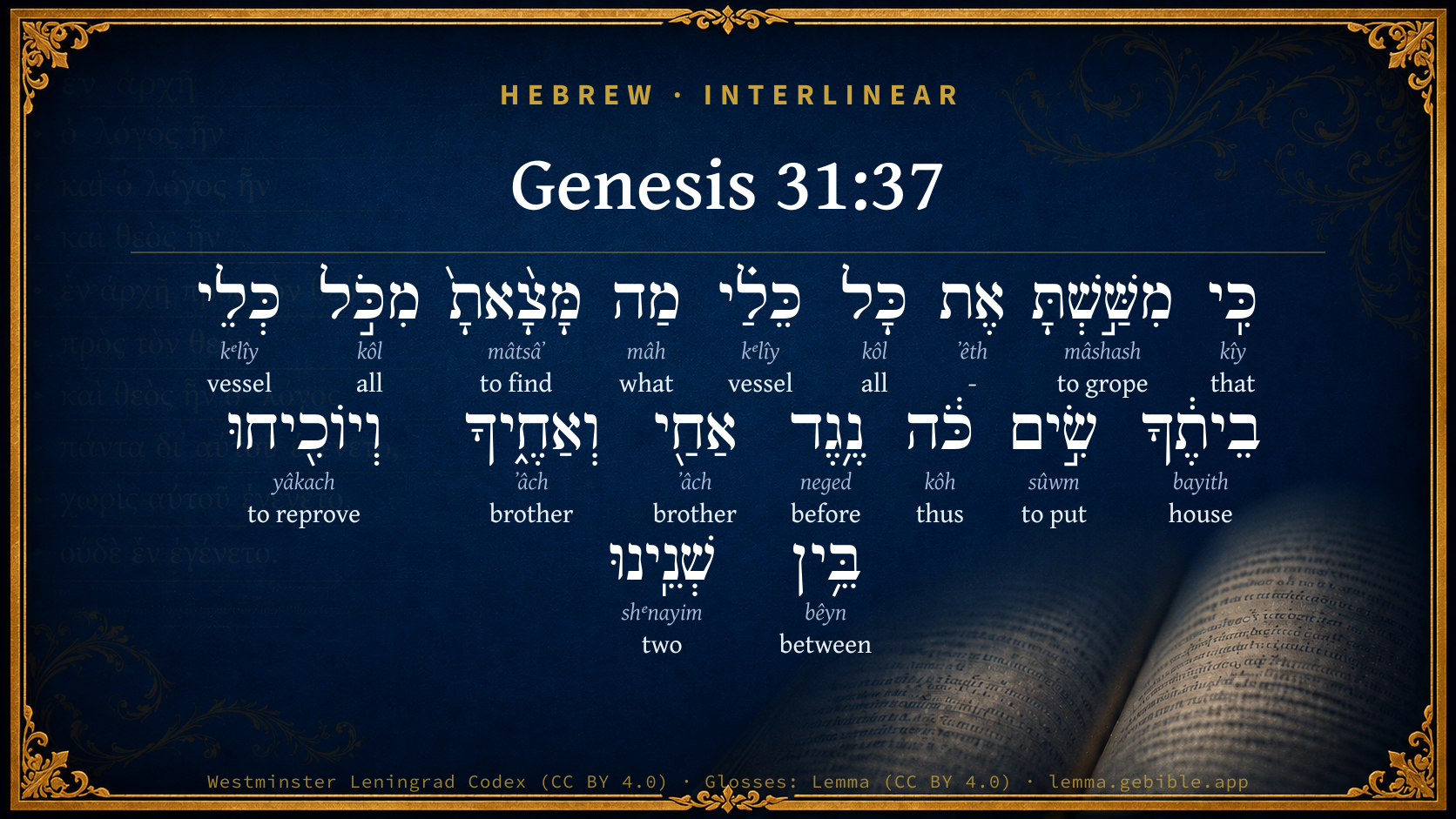
Hebrew (Westminster Leningrad Codex) Genesis 31:37 appears in the Hebrew Old Testament. The text above is from the Westminster Leningrad Codex. Each word links to its Strong’s number, a concise gloss, and parsing drawn from the Open Scriptures Hebrew Bible morphology. Click any word for its full Brown-Driver-Briggs (BDB) entry.
Download image
Cite this verse

Genesis 31:37 (World English Bible). Public Domain. Lemma interlinear Bible study tool, https://lemma.gebible.app/v/genesis/31/37.

Show BibTeX & RIS
BibTeX
RIS
English Translation
Now that you have felt around in all my stuff, what have you found of all your household stuff? Set it here before my relatives and your relatives, that they may judge between us two.
World English Bible · Public Domain
Download a study sheet

One document with this verse’s original text, its word-by-word gloss line, the meaning frame, cross-references with their text, attributed commentary, and full source and license credits — printable, and it pastes into notes with its structure intact.

This verse Autodidact and up

Study sheet (.html) Plain text (.txt)

A passage Seminary Student

Up to 50 verses in one chapter. A passage sheet keeps up to 6 commentary sources and 12 cross-references per verse, in the order this page ranks them, and says so on the sheet whenever that leaves anything out. Ask for a single verse and you get the Autodidact verse sheet above.

Everything on this page stays free to read, with no account — the sheet is a download of what is already on screen, not access to it.

Want to remove ads? Support Godless Engineer
Compare translations 3

The same verse in 3 English versions, stacked beneath the original-language interlinear above. Click any original word for its lexicon entry.

Each is an independent rendering of the whole verse — the interlinear is not word-aligned to these translations.

Highlighted words mark where these versions differ — a whole-verse word diff, not a word-by-word alignment.

  • World English Bible Public Domain
    Now that you have felt around in all my stuff, what have you found of all your household stuff? Set it here before my relatives and your relatives, that they may judge between us two.
  • King James Version Public Domain
    Whereas thou hast searched all my stuff, what hast thou found of all thy household stuff? set it here before my brethren and thy brethren, that they may judge betwixt us both.
  • unfoldingWord Literal Text CC BY-SA 4.0
    Since you have felt through all my things, what have you found from any of the things of your house? Put here in front of my relatives and your relatives, and let them judge between the two of us!

unfoldingWord Literal Text — © unfoldingWord, licensed CC BY-SA 4.0. Word-aligned USFM3 via Door43 (git.door43.org/unfoldingWord/en_ult).

Versions to compare (up to 4)

3 of 4 selected

Show all 18 translations

Every available English version of this verse, each an independent rendering of the whole verse.

  • World English Bible Public Domain
    Now that you have felt around in all my stuff, what have you found of all your household stuff? Set it here before my relatives and your relatives, that they may judge between us two.
  • Berean Standard Bible Public Domain
    You have searched all my goods! Have you found anything that belongs to you? Put it here before my brothers and yours, that they may judge between the two of us.
  • Majority Standard Bible Public Domain
    You have searched all my goods! Have you found anything that belongs to you? Put it here before my brothers and yours, that they may judge between the two of us.
  • King James Version Public Domain
    Whereas thou hast searched all my stuff, what hast thou found of all thy household stuff? set it here before my brethren and thy brethren, that they may judge betwixt us both.
  • American Standard Version (1901) Public Domain
    Whereas thou hast felt about all my stuff, what hast thou found of all thy household stuff? Set it here before my brethren and thy brethren, that they may judge betwixt us two.
  • Revised Version (1885) Public Domain
    Whereas thou hast felt about all my stuff, what hast thou found of all thy household stuff? Set it here before my brethren and thy brethren, that they may judge betwixt us two.
  • Geneva Bible (1599) Public Domain
    Seeing thou hast searched all my stuffe, what hast thou foud of all thine houshold stuffe? put it here before my brethren and thy brethren, that they may iudge betweene vs both.
  • Douay-Rheims (1899) Public Domain
    And searched all my household stuff? What hast thou found of all the substance of thy house? lay it here before my brethren, and thy brethren, and let them judge between me and thee.
  • Young's Literal Translation Public Domain
    for thou hast felt all my vessels: what hast thou found of all the vessels of thy house? set here before my brethren, and thy brethren, and they decide between us both.
  • Literal Standard Version CC BY-SA 4.0
    For you have felt all my vessels: what have you found of all the vessels of your house? Set here before my brothers, and your brothers, and they decide between us both.
  • Unlocked Literal Bible CC BY-SA 4.0
    For you have searched all my possessions. What have you found of all your household goods? Set them here before our relatives, so that they may judge between us two.
  • unfoldingWord Literal Text CC BY-SA 4.0
    Since you have felt through all my things, what have you found from any of the things of your house? Put here in front of my relatives and your relatives, and let them judge between the two of us!
  • Darby Bible Public Domain
    Whereas thou hast explored all my baggage, what hast thou found of all thy household stuff? Set [it] here before my brethren and thy brethren, and let them decide between us both.
  • World Messianic Bible Public Domain
    Now that you have felt around in all my stuff, what have you found of all your household stuff? Set it here before my relatives and your relatives, that they may judge between us two.
  • Webster's Bible Public Domain
    Whereas thou hast searched all my stuff, what hast thou found of all thy household-stuff? set it here before my brethren, and thy brethren, that they may judge betwixt us both.
  • Free Bible Version CC BY-SA 4.0
    You've searched through all my possessions. Did you find anything belonging to you? If you did, bring it out here before my relatives and yours so they can decide who's right!
  • Bible in Basic English Public Domain
    Now that you have made search through all my goods, what have you seen which is yours? Make it clear now before my people and your people, so that they may be judges between us.
  • JPS Tanakh (1917) Public Domain
    Whereas thou hast felt about all my stuff, what hast thou found of all thy household stuff? Set it here before my brethren and thy brethren, that they may judge betwixt us two.

Literal Standard Version (2020), Covenant Press — licensed CC BY-SA 4.0. Text via the HelloAO Bible API (eBible.org). Unlocked Literal Bible (unfoldingWord) — licensed CC BY-SA 4.0. Text via the HelloAO Bible API (eBible.org). unfoldingWord Literal Text — © unfoldingWord, licensed CC BY-SA 4.0. Word-aligned USFM3 via Door43 (git.door43.org/unfoldingWord/en_ult). Free Bible Version, Dr. Jonathan Gallagher — licensed CC BY-SA 4.0. Text via the HelloAO Bible API (eBible.org).

Word by word

More ways to search: Search by grammar → Find every occurrence → Compare this word →

Practice this passage: Drill this verse → Learn its vocabulary →

מִשַּׁ֣שְׁתָּ
mâshash
H4959
“to grope”
Verb, Piel, Perfect, 2nd Person, Masculine, Singular
Part of Speech
Verb
Stem
Piel
Form
Perfect
Person
2nd Person
Gender
Masculine
Number
Singular
Full BDB Definition

Origin: a primitive root

TWOT: 1262

to feel, grope - (Qal) to feel, grope - (Piel) to feel over or through, grope - to feel through - to grope - (Hiphil) to feel
  1. כִּֽי kîy H3588 “that” Conjunction
  2. אֶת ʼêth H853 “-” Particle, Direct Object
  3. כָּל kôl H3605 “all of” Noun, Common, Masculine, Singular, Construct
  4. כֵּלַ֗י kᵉlîy H3627 “vessels · my” Noun, Common, Masculine, Plural, Construct + Suffix, Personal, 1st Person, Common, Singular
  5. מַה mâh H4100 “what” Particle, Interrogative
  6. מָּצָ֨אתָ֙ mâtsâʼ H4672 “to find” Verb, Qal, Perfect, 2nd Person, Masculine, Singular
  7. מִכֹּ֣ל kôl H3605 “from · all of” Preposition + Noun, Common, Masculine, Singular, Construct
  8. כְּלֵי kᵉlîy H3627 “vessels of” Noun, Common, Masculine, Plural, Construct
  9. בֵיתֶ֔ךָ bayith H1004 “house · your” Noun, Common, Masculine, Singular, Construct + Suffix, Personal, 2nd Person, Masculine, Singular
  10. שִׂ֣ים sûwm H7760 “put” Verb, Qal, Imperative, 2nd Person, Masculine, Singular
  11. כֹּ֔ה kôh H3541 “thus” Adverb
  12. נֶ֥גֶד neged H5048 “before” Preposition
  13. אַחַ֖י ʼâch H251 “brothers · my” Noun, Common, Masculine, Plural, Construct + Suffix, Personal, 1st Person, Common, Singular
  14. וְאַחֶ֑יךָ ʼâch H251 “and · brothers · your” Conjunction + Noun, Common, Masculine, Plural, Construct + Suffix, Personal, 2nd Person, Masculine, Singular
  15. וְיוֹכִ֖יחוּ yâkach H3198 “and · to reprove” Conjunction + Verb, Hiphil, Jussive, 3rd Person, Masculine, Plural
  16. בֵּ֥ין bêyn H996 “between” Preposition
  17. שְׁנֵֽינוּ shᵉnayim H8147 “two · our” Adjective, Cardinal number, Masculine, Dual, Construct + Suffix, Personal, 1st Person, Common, Plural

About this verse

These counts appear in no published source. They are computed here, from the morphology-tagged text and Lemma’s own curated glosses. What Lemma adds →

18
words
15
distinct lemmas
Pentateuch
section

Notable vocabulary

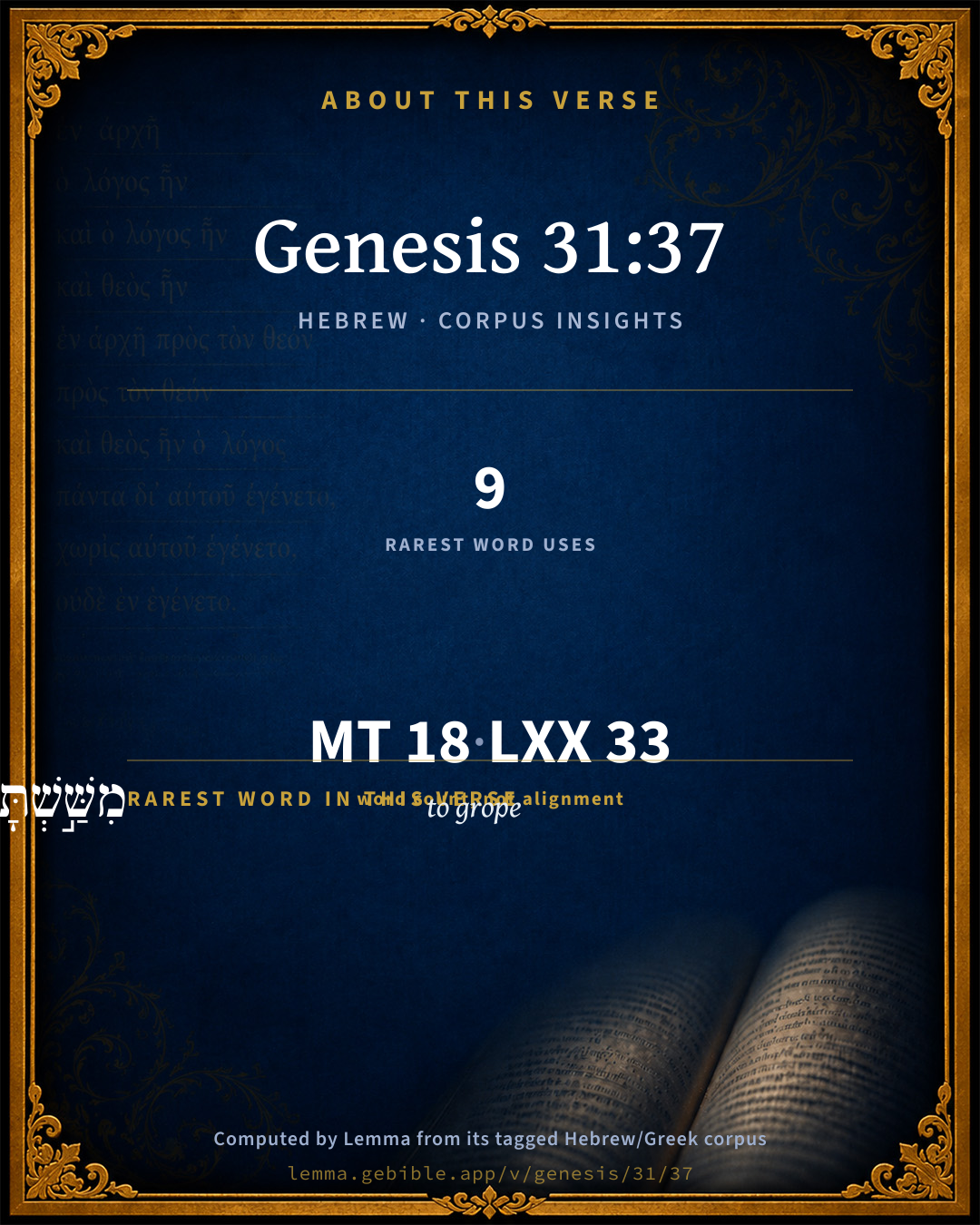
The rarest word here is מִשַּׁ֣שְׁתָּ to grope H4959 — appearing just 9 times in the whole Hebrew Bible.

Shared distinctive vocabulary

מִשַּׁ֣שְׁתָּ to grope H4959 occurs in 8 verses of the Hebrew Bible. Also found in:

Grammatical profile

  • 4 verbs
  • 7 nouns
  • 1 adjective
  • 2 prepositions
  • 1 conjunction
  • 1 adverb
  • 2 particles

Verb forms

  • מִשַּׁ֣שְׁתָּ Piel · Perfect
  • מָּצָ֨אתָ֙ Qal · Perfect
  • שִׂ֣ים Qal · Imperative
  • וְיוֹכִ֖יחוּ Hiphil · Jussive

Repetition

Words recur within this verse — often emphatic in Hebrew:

  • כָּל all H3605 ×2
  • כֵּלַ֗י vessel H3627 ×2
  • אַחַ֖י brother H251 ×2

Hebrew & Septuagint length

In English translation the verse runs 35 words from the Hebrew and 38 from the Septuagint (LXX English) — closely comparable.

A rough comparison of the two English renderings, which tokenize alike — not a word-level alignment.

Word counts can differ between the Hebrew and the Greek without any difference in meaning — e.g. the Hebrew direct-object marker אֵת has no separate Greek word, and Greek often adds the article ὁ.

In the original languages it is 18 Hebrew tokens and 33 Greek tokens — but the two are counted differently (Hebrew bundles its prefixes and suffixes into one token; the Greek is in lemma form), so that isn’t a like-for-like length.

Cross-references

9

Topical passages linked to Genesis 31:37 in the Treasury of Scripture Knowledge — connected by theme and wording, ordered by reader-vote popularity; previews shown in the World English Bible.

  • 1 Peter 2:12 having good behavior among the nations, so in that which they speak against you as evil-doers, they may by your good works, which they see, glorify God in the day of visitation.
  • Genesis 31:32 With whoever you find your gods, he shall not live. Before our relatives, discern what is yours with me, and take it." For Jacob didn't know that Rachel had stolen them.
  • Joshua 7:23 They took them from the midst of the tent, and brought them to Joshua, and to all the children of Israel; and they laid them down before Yahweh.
  • 1 Samuel 12:3–4 Here I am: witness against me before Yahweh, and before his anointed: whose ox have I taken? or whose donkey have I taken? or whom have I defrauded? whom have I oppressed? or of whose hand have I taken a ransom to blind my eyes therewith? and I will restore it you.
  • Matthew 18:16 But if he doesn't listen, take one or two more with you, that at the mouth of two or three witnesses every word may be established.
  • 1 Corinthians 6:4–5 If then, you have to judge things pertaining to this life, do you set them to judge who are of no account in the assembly?
  • 1 Thessalonians 2:10 You are witnesses with God, how holy, righteously, and blamelessly we behaved ourselves toward you who believe.
  • Hebrews 13:18 Pray for us, for we are persuaded that we have a good conscience, desiring to live honorably in all things.
  • 1 Peter 3:16 having a good conscience; that, while you are spoken against as evildoers, they may be disappointed who curse your good manner of life in Christ.

Cross-references courtesy of OpenBible.info (CC BY 4.0).

Hebrew and Greek witnesses Masoretic Hebrew ↔ Greek Septuagint

The same verse in the two great witnesses to the Old Testament, shown verse-for-verse.

These are two independent witnesses, not word-aligned to each other, and the Septuagint is shown in lemma (dictionary) form.

Hebrew Genesis 31:37 Masoretic · Westminster Leningrad Codex

כִּֽי מִשַּׁ֣שְׁתָּ אֶת כָּל כֵּלַ֗י מַה מָּצָ֨אתָ֙ מִכֹּ֣ל כְּלֵי בֵיתֶ֔ךָ שִׂ֣ים כֹּ֔ה נֶ֥גֶד אַחַ֖י וְאַחֶ֑יךָ וְיוֹכִ֖יחוּ בֵּ֥ין שְׁנֵֽינוּ

Now that you have felt around in all my stuff, what have you found of all your household stuff? Set it here before my relatives and your relatives, that they may judge between us two.

World English Bible · Public Domain

Greek LXX Genesis 31:37 Septuagint · lemma form

καί ὅτι ἐρευνάω πᾶς ὁ σκεῦος ἐγώ τίς εὑρίσκω ἀπό πᾶς ὁ σκεῦος ὁ οἶκος σύ τίθημι ὧδε ἐναντίον ὁ ἀδελφός ἐγώ καί ὁ ἀδελφός σύ καί ἐλέγχω ἀνά μέσος ὁ δύο ἐγώ

and that you have searched all the furniture of my house? what have you found of all the furniture of your house? set it here between your relations and my relations, and let them decide between us two.

LXX2012 (modern English Septuagint) · Public Domain

Hebrew: Westminster Leningrad Codex (CC BY 4.0). Greek: Septuagint (public domain); English from LXX2012 (modern English Septuagint) (Public Domain). How the Septuagint differs from the Hebrew →

Targum (Aramaic paraphrase)

2

The Targum is the ancient Jewish Aramaic paraphrase of the Hebrew Scriptures — an interpretive translation, not the Hebrew text itself. Onkelos (literal) and Pseudo-Jonathan (expansive) render the Torah, and Jonathan the Prophets. Coverage is partial: where no permissively-licensed English translation exists for a verse, only the Aramaic is shown. This is verse-level text, not a word-by-word alignment to the Hebrew.

  1. Targum Onkelos Torah (Genesis–Deuteronomy)
    אֲרֵי מַשִּׁשְׁתָּא יָת כָּל מָנַי מָה אַשְׁכַּחְתָּא מִכֹּל מָנֵי בֵיתָךְ שַׁוִּי הָכָא קֳדָם אַחַי וְאַחָיךְ וְיוֹכִיחוּן בֵּין תַּרְוָנָא

    (no public-domain English translation for this verse)

    Targum Onkelos — Aramaic: “Onkelos Genesis” (public domain); “Onkelos Exodus” (public domain); “Onkelos Leviticus” (public domain); “Onkelos Numbers” (public domain); “Onkelos Deuteronomy” (public domain). English: “Sefaria Community Translation” (CC0 1.0 (public-domain dedication)); “J.W. Etheridge. The Targums of Onkelos and Jonathan Ben Uzziel on the Pentateuch. London: Longmans, Green, 1862” (public domain). Text via Sefaria.

  2. Targum Pseudo-Jonathan Torah (Genesis–Deuteronomy)
    אֲרוּם פִּשְׁפַּשְׁתָּא יַת כָּל מָאנַי מַה אַשְׁכַּחְתָּ מִכָּל מָאנֵי בַיְיתָךְ שַׁוִי כְדוֹן דִינָךְ קֳבֵל אַחַי וְאַחָךְ וִידִינוּן קְשׁוֹט בֵּין תַּרְוֵינָן

    Having, therefore, searched all my vessels, what hast thou found of all the vessels of thy house? Lay now the matter before my brethren and thy brethren, and let them decide the truth between us two.

    Targum Pseudo-Jonathan — Aramaic: “Targum Jonathan on Genesis” (public domain); “Targum Jonathan on Exodus” (public domain); “Targum Jonathan on Leviticus” (public domain); “Targum Jonathan on Numbers” (public domain); “Targum Jonathan on Deuteronomy” (public domain). English: “The Targum of Jonathan ben Uzziel, trans. J. W. Etheridge, London, 1862” (public domain). Text via Sefaria.

Commentary

Notes on Genesis 31:37 from classic Christian and Jewish commentators (each source and its license shown beneath its notes). The classic Christian expositions comment on the surrounding passage and are grouped to its opening verse, so a note may address several verses; the Jewish commentaries on the Tanakh (Rashi and others) are per-verse, so they appear only where the commentator wrote on this verse.

Lemma curates 59 commentaries, every one of them public domain or Creative Commons licensed, each selected and text-cleaned for this edition rather than reprinted as found. About our sources →

Trapp's Complete Commentary

John Trapp

Gen 31:37 Whereas thou hast searched all my stuff, what hast thou found of all thy household stuff? set [it] here before my brethren and thy brethren, that they may judge betwixt us both.

Ver. 37. Set it here before my brethren.] See the confidence of a clear conscience! Happy is he that can be acquitted by himself in private; in public by others; in both by God. Lucrum in arca, saepe facit damnum in conscientia. But all such as conceive with guile, by that time they have reckoned their months aright, though they grow never so big, shall bring forth nothing but wind and vanity. Yea, they that "sow the wind, shall reap the whirlwind". {Hos 8:7} Let that thou hast be well gotten, and thou needest not care whom thou lookest in the face; thou shalt not be ashamed to "speak with thine enemies in the gate". {Psa 127:5}

John Trapp, A Commentary or Exposition upon All the Books of the Old and New Testament (1647–1656) — public domain. Text from a community e-Sword module.

John Gill's Exposition

That which was torn of beasts I brought not unto thee,.... To show what had befallen it; that so it might appear he had one the less to account for to him:

I bore the loss of it; took it upon himself, as if it had been somewhat blameworthy in him, as the word used signifies; and so made satisfaction for it; which, how he did, when he had no wages, is difficult to say: he might have some perquisites allowed him by Laban, though he had no settled salary; or he might lay himself under obligation to make it good whenever it was in his power, as follows:

of mine hand didst thou require it, whether stolen by day, or stolen by night; whether by men or beasts; or by men in the daytime, and by beasts in the night, as the Targums of Jonathan and Jerusalem distinguish: Laban was so rigorous and unjust as to require the restoration of them, or an equivalent for them at the hand of Jacob; all which were contrary to the law of God, Exo 22:10.

John Gill's Exposition of the Whole Bible (1746–1763) — public domain (CC PDM 1.0). Text via the HelloAO Bible API.

Rashi

Rabbi Shlomo Yitzchaki (Rashi)

ויוכיחו — means that they may decide who is right. old French eprouver; English prove.

Rashi on the Tanakh — English translations: “The Judaica Press complete Tanach with Rashi, translated by A. J. Rosenberg” (CC BY 4.0); “Pentateuch with Rashi's commentary by M. Rosenbaum and A.M. Silbermann, 1929-1934” (public domain); “The Metsudah Tanach series, Lakewood, N.J” (CC BY 4.0); and “The Book of Joshua, Metsudah Publications, 1997” (CC BY 4.0). Text via Sefaria.

Radak

Rabbi David Kimhi (Radak)

!כי מששת...שים כה, “please list all your complaints against me in front of all my family and your family. The people whom Yaakov referred to as אחי, “my brothers,” in this verse were the shepherds in his employ who were his brothers vocationally speaking, being members of the same guild.

Radak on the Tanakh — English translations: “Sefaria Community Translation” (CC0 1.0 (public-domain dedication)); “Eliyahu Munk, HaChut Hameshulash” (CC BY 4.0); “Rabbi Mike Feuer, Jerusalem Anthology” (CC BY 4.0); and “R. David Kimhi on the first book of Psalms, Translated by R.G. Finch, London, 1919” (public domain). Text via Sefaria.

Lesson kit

Teaching starters — assembled from the data on this page, not authored interpretation. Every prompt links to the verse data it draws on. Edit before teaching.

Genesis, in the Pentateuch, opens this verse with 18 words (15 distinct Hebrew lemmas). Its most distinctive word is mâshash (“to grope”). A historical commentator’s framing appears above. Read the whole chapter for the surrounding context.

Discussion questions

  1. What does “to grope” (mâshash) contribute to the verse as a whole?
  2. Genesis 27:12 shares the word «to grope» with this verse. How do the two illuminate each other?
  3. “all” occurs 2× in this one verse. What is the effect of the repetition?
  4. The translations on this page render this verse differently — a whole-verse word diff, not a word-by-word alignment. What might account for the different wordings?
  5. The verb «מִשַּׁ֣שְׁתָּ» is Piel Perfect. How does its form color the action?
  6. Reading how Trapp's Complete Commentary and John Gill's Exposition read this verse, where do the two commentators agree and where do they part?

Things to notice

Reading settings

Reading text

Shown beneath each verse's original-language words.

Old Testament
Old Testament edition

Read the OT as the Masoretic Hebrew (MT) or the Greek Septuagint (LXX).

English shown for the Greek Septuagint (in the Hebrew ↔ Greek comparison).

Comparing translations? Open the Compare panel on any verse page to stack up to four side by side.