
Numbers 9:5

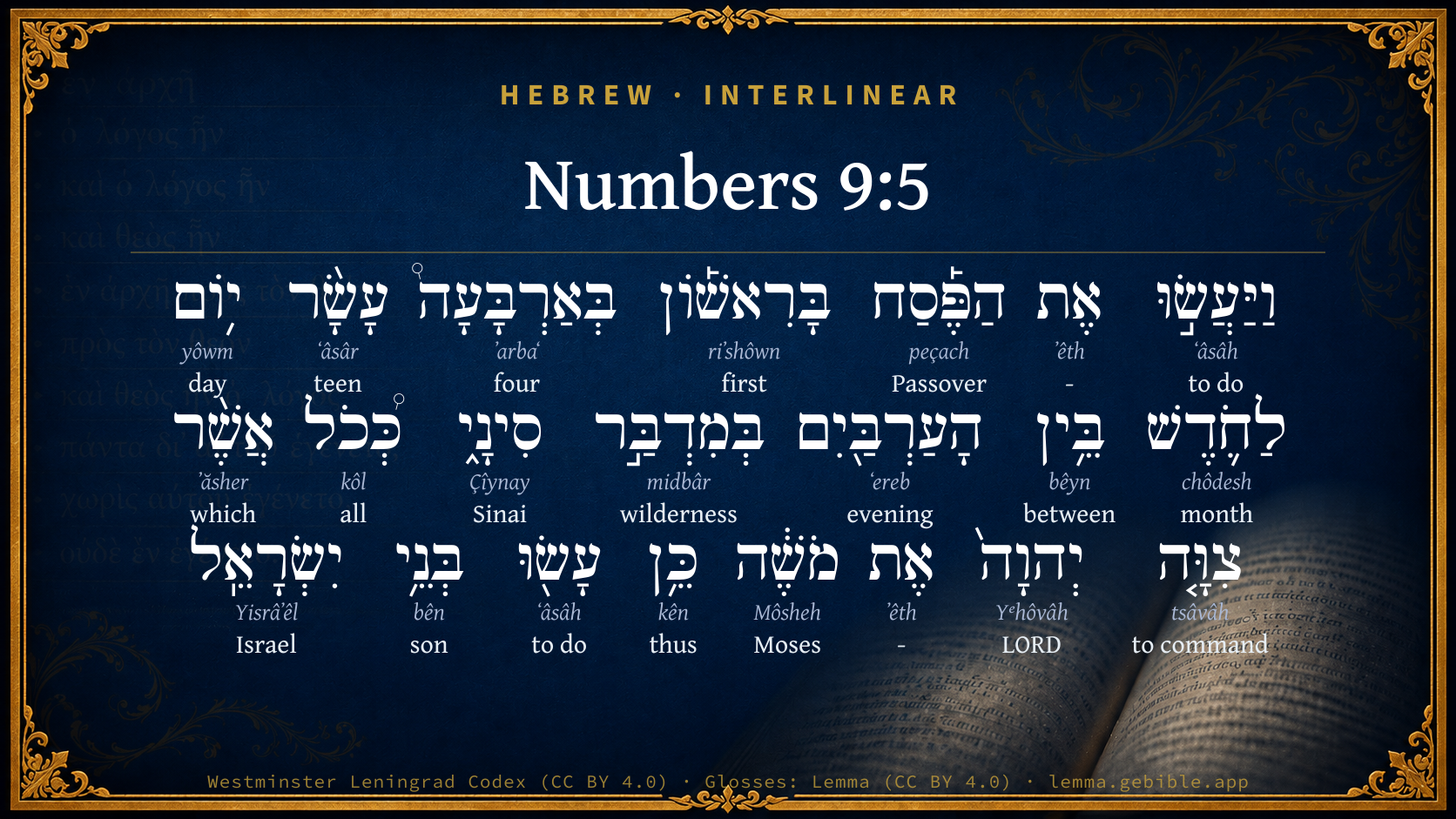
Hebrew (Westminster Leningrad Codex) Numbers 9:5 appears in the Hebrew Old Testament. The text above is from the Westminster Leningrad Codex. Each word links to its Strong’s number, a concise gloss, and parsing drawn from the Open Scriptures Hebrew Bible morphology. Click any word for its full Brown-Driver-Briggs (BDB) entry.
Download image
Cite this verse

Numbers 9:5 (World English Bible). Public Domain. Lemma interlinear Bible study tool, https://lemma.gebible.app/v/numbers/9/5.

Show BibTeX & RIS
BibTeX
RIS
English Translation
They kept the Passover in the first month, on the fourteenth day of the month, at evening, in the wilderness of Sinai. According to all that Yahweh commanded Moses, so the children of Israel did.
World English Bible · Public Domain
Download a study sheet

One document with this verse’s original text, its word-by-word gloss line, the meaning frame, cross-references with their text, attributed commentary, and full source and license credits — printable, and it pastes into notes with its structure intact.

This verse Autodidact and up

Study sheet (.html) Plain text (.txt)

A passage Seminary Student

Up to 50 verses in one chapter. A passage sheet keeps up to 6 commentary sources and 12 cross-references per verse, in the order this page ranks them, and says so on the sheet whenever that leaves anything out. Ask for a single verse and you get the Autodidact verse sheet above.

Everything on this page stays free to read, with no account — the sheet is a download of what is already on screen, not access to it.

Want to remove ads? Support Godless Engineer
Compare translations 3

The same verse in 3 English versions, stacked beneath the original-language interlinear above. Click any original word for its lexicon entry.

Each is an independent rendering of the whole verse — the interlinear is not word-aligned to these translations.

Highlighted words mark where these versions differ — a whole-verse word diff, not a word-by-word alignment.

  • World English Bible Public Domain
    They kept the Passover in the first month, on the fourteenth day of the month, at evening, in the wilderness of Sinai. According to all that Yahweh commanded Moses, so the children of Israel did.
  • King James Version Public Domain
    And they kept the passover on the fourteenth day of the first month at even in the wilderness of Sinai: according to all that the LORD commanded Moses, so did the children of Israel.
  • unfoldingWord Literal Text CC BY-SA 4.0
    And they did the Passover in the first, on day 14 of the month, between the evenings, in the wilderness of Sinai. According to all that Yahweh had commanded Moses, so the sons of Israel did.

unfoldingWord Literal Text — © unfoldingWord, licensed CC BY-SA 4.0. Word-aligned USFM3 via Door43 (git.door43.org/unfoldingWord/en_ult).

Versions to compare (up to 4)

3 of 4 selected

Show all 18 translations

Every available English version of this verse, each an independent rendering of the whole verse.

  • World English Bible Public Domain
    They kept the Passover in the first month, on the fourteenth day of the month, at evening, in the wilderness of Sinai. According to all that Yahweh commanded Moses, so the children of Israel did.
  • Berean Standard Bible Public Domain
    and they did so in the Wilderness of Sinai, at twilight on the fourteenth day of the first month. The Israelites did everything just as the LORD had commanded Moses.
  • Majority Standard Bible Public Domain
    and they did so in the Wilderness of Sinai, at twilight on the fourteenth day of the first month. The Israelites did everything just as the LORD had commanded Moses.
  • King James Version Public Domain
    And they kept the passover on the fourteenth day of the first month at even in the wilderness of Sinai: according to all that the LORD commanded Moses, so did the children of Israel.
  • American Standard Version (1901) Public Domain
    And they kept the passover in the first `month', on the fourteenth day of the month, at even, in the wilderness of Sinai: according to all that Jehovah commanded Moses, so did the children of Israel.
  • Revised Version (1885) Public Domain
    And they kept the passover in the first month, on the fourteenth day of the month, at even, in the wilderness of Sinai: according to all that the LORD commanded Moses, so did the children of Israel.
  • Geneva Bible (1599) Public Domain
    And they kept the Passeouer in the fouretenth day of the first moneth at euen in the wildernesse of Sinai: according to all that the Lord had comanded Moses, so did ye children of Israel.
  • Douay-Rheims (1899) Public Domain
    And they made it in its proper time: the fourteenth day of the month at evening, in mount Sinai. The children of Israel did according to all things that the Lord had commanded Moses.
  • Young's Literal Translation Public Domain
    and they prepare the passover in the first `month', on the fourteenth day of the month, between the evenings, in the wilderness of Sinai; according to all that Jehovah hath commanded Moses, so have the sons of Israel done.
  • Literal Standard Version CC BY-SA 4.0
    and they prepare the Passover in the first [month], on the fourteenth day of the month, between the evenings, in the wilderness of Sinai; according to all that YHWH has commanded Moses, so the sons of Israel have done.
  • Unlocked Literal Bible CC BY-SA 4.0
    So they kept the Passover in the first month, on the fourteenth day of the month, at evening, in the wilderness of Sinai. The people of Israel obeyed everything that Yahweh commanded Moses to do.
  • unfoldingWord Literal Text CC BY-SA 4.0
    And they did the Passover in the first, on day 14 of the month, between the evenings, in the wilderness of Sinai. According to all that Yahweh had commanded Moses, so the sons of Israel did.
  • Darby Bible Public Domain
    And they held the passover in the first [month] on the fourteenth day of the month, between the two evenings, in the wilderness of Sinai: according to all that Jehovah had commanded Moses, so did the children of Israel.
  • World Messianic Bible Public Domain
    They kept the Passover in the first month, on the fourteenth day of the month at evening, in the wilderness of Sinai. According to all that the LORD commanded Moses, so the children of Israel did.
  • Webster's Bible Public Domain
    And they kept the passover on the fourteenth day of the first month at evening in the wilderness of Sinai: according to all that the LORD commanded Moses, so did the children of Israel.
  • Free Bible Version CC BY-SA 4.0
    So they kept the Passover in the Sinai desert, beginning in the evening after sunset on the fourteenth day of the first month. The Israelites followed all the instructions the Lord had given to Moses.
  • Bible in Basic English Public Domain
    So they kept the Passover in the first month, on the fourteenth day of the month, at evening, in the waste land of Sinai: as the Lord gave orders to Moses, so the children of Israel did.
  • JPS Tanakh (1917) Public Domain
    And they kept the passover in the first month, on the fourteenth day of the month, at dusk, in the wilderness of Sinai; according to all that the LORD commanded Moses, so did the children of Israel.

Literal Standard Version (2020), Covenant Press — licensed CC BY-SA 4.0. Text via the HelloAO Bible API (eBible.org). Unlocked Literal Bible (unfoldingWord) — licensed CC BY-SA 4.0. Text via the HelloAO Bible API (eBible.org). unfoldingWord Literal Text — © unfoldingWord, licensed CC BY-SA 4.0. Word-aligned USFM3 via Door43 (git.door43.org/unfoldingWord/en_ult). Free Bible Version, Dr. Jonathan Gallagher — licensed CC BY-SA 4.0. Text via the HelloAO Bible API (eBible.org).

Word by word

More ways to search: Search by grammar → Find every occurrence → Compare this word →

Practice this passage: Drill this verse → Learn its vocabulary →

סִינָ֑י
Çîynay
H5514
“Sinai”
Noun, Proper
Part of Speech
Noun
Type
Proper
Full BDB Definition

Origin: of uncertain derivation

TWOT: 1488

Sinai = "thorny" - the mountain where Moses received the Law from Jehovah; located at the southern end of the Sinai peninsula between the horns of the Red Sea; exact site unknown
  1. וַיַּעֲשׂ֣וּ ʻâsâh H6213 “and · to do” Conjunction + Verb, Qal, Sequential Imperfect, 3rd Person, Masculine, Plural
  2. אֶת ʼêth H853 “-” Particle, Direct Object
  3. הַפֶּ֡סַח peçach H6453 “the · Passover” Particle, Definite Article + Noun, Common, Masculine, Singular, Absolute
  4. בָּרִאשׁ֡וֹן riʼshôwn H7223 “in/at the · first” Preposition, Determined + Adjective, Adjective, Masculine, Singular, Absolute
  5. בְּאַרְבָּעָה֩ ʼarbaʻ H702 “in/at · four” Preposition + Adjective, Cardinal number, Masculine, Singular, Absolute
  6. עָשָׂ֨ר ʻâsâr H6240 “teen” Adjective, Cardinal number, Masculine, Singular, Absolute
  7. י֥וֹם yôwm H3117 “day” Noun, Common, Masculine, Singular, Absolute
  8. לַחֹ֛דֶשׁ chôdesh H2320 “to/for the · month” Preposition, Determined + Noun, Common, Masculine, Singular, Absolute
  9. בֵּ֥ין bêyn H996 “between” Preposition
  10. הָעַרְבַּ֖יִם ʻereb H6153 “the · evenings” Particle, Definite Article + Noun, Common, Masculine, Dual, Absolute
  11. בְּמִדְבַּ֣ר midbâr H4057 “in/at · wilderness of” Preposition + Noun, Common, Masculine, Singular, Construct
  12. כְּ֠כֹל kôl H3605 “like/as · all” Preposition + Noun, Common, Masculine, Singular, Absolute
  13. אֲשֶׁ֨ר ʼăsher H834 “which” Particle, Relative
  14. צִוָּ֤ה tsâvâh H6680 “to command” Verb, Piel, Perfect, 3rd Person, Masculine, Singular
  15. יְהוָה֙ Yᵉhôvâh H3068 “LORD” Noun, Proper
  16. אֶת ʼêth H853 “-” Particle, Direct Object
  17. מֹשֶׁ֔ה Môsheh H4872 “Moses” Noun, Proper
  18. כֵּ֥ן kên H3651 “thus” Particle, Demonstrative
  19. עָשׂ֖וּ ʻâsâh H6213 “to do” Verb, Qal, Perfect, 3rd Person, Common, Plural
  20. בְּנֵ֥י bên H1121 “sons of” Noun, Common, Masculine, Plural, Construct
  21. יִשְׂרָאֵֽל Yisrâʼêl H3478 “Israel” Noun, Proper

About this verse

These counts appear in no published source. They are computed here, from the morphology-tagged text and Lemma’s own curated glosses. What Lemma adds →

22
words
20
distinct lemmas
Pentateuch
section

Shared distinctive vocabulary

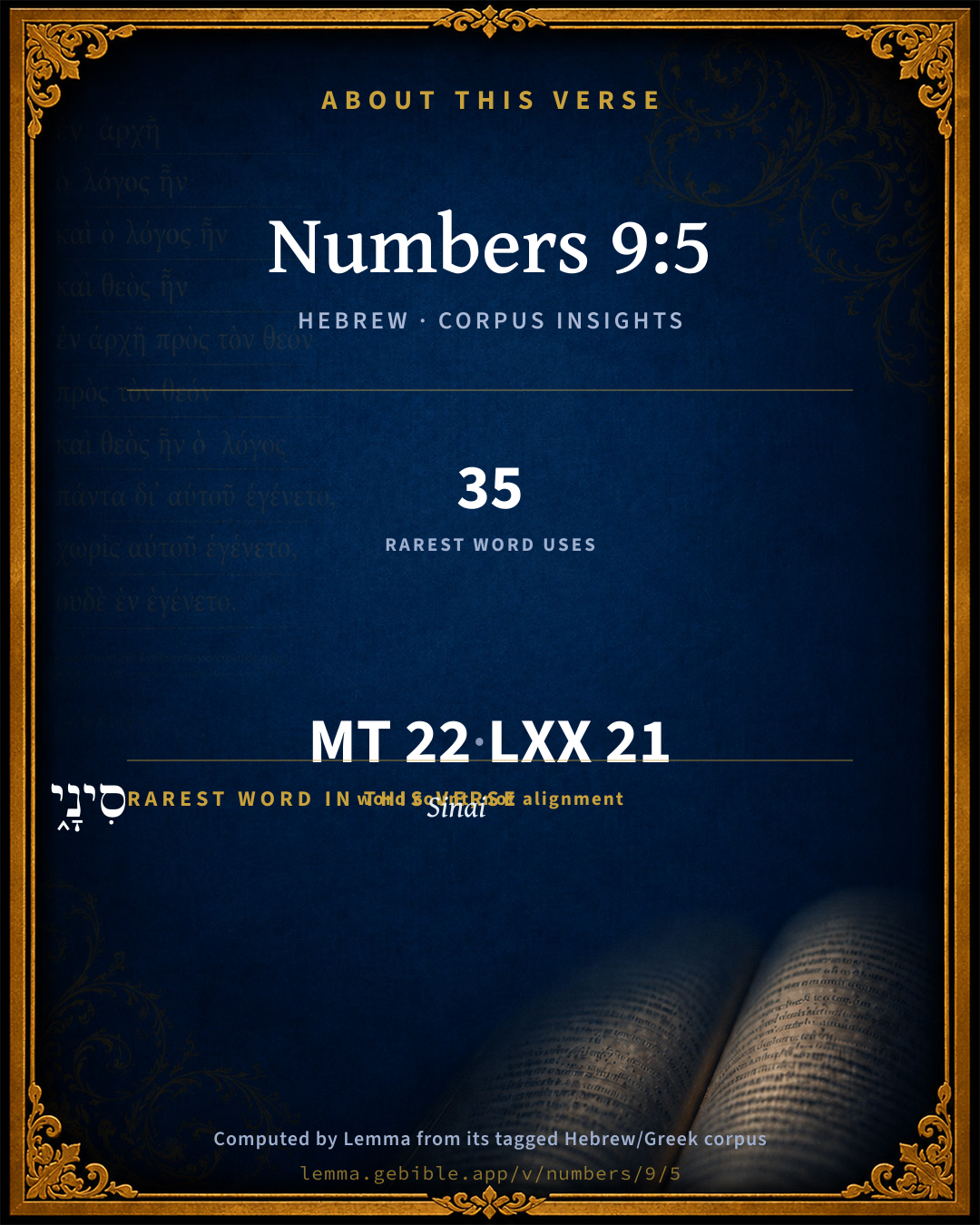
סִינָ֑י Sinai H5514 occurs in 34 verses of the Hebrew Bible. Also found in:

Grammatical profile

  • 3 verbs
  • 11 nouns
  • 3 adjectives
  • 1 preposition
  • 4 particles

Verb forms

  • וַיַּעֲשׂ֣וּ Qal · Sequential Imperfect
  • צִוָּ֤ה Piel · Perfect
  • עָשׂ֖וּ Qal · Perfect

Repetition

A word recurs within this verse — often emphatic in Hebrew:

  • וַיַּעֲשׂ֣וּ to do H6213 ×2

Hebrew & Septuagint length

In English translation the verse runs 35 words from the Hebrew and 24 from the Septuagint (LXX English) — the Septuagint runs noticeably shorter here. See the side-by-side →

A rough comparison of the two English renderings, which tokenize alike — not a word-level alignment.

Word counts can differ between the Hebrew and the Greek without any difference in meaning — e.g. the Hebrew direct-object marker אֵת has no separate Greek word, and Greek often adds the article ὁ.

In the original languages it is 22 Hebrew tokens and 21 Greek tokens — but the two are counted differently (Hebrew bundles its prefixes and suffixes into one token; the Greek is in lemma form), so that isn’t a like-for-like length.

Cross-references

15

Topical passages linked to Numbers 9:5 in the Treasury of Scripture Knowledge — connected by theme and wording, ordered by reader-vote popularity; previews shown in the World English Bible.

  • Joshua 5:10 The children of Israel encamped in Gilgal; and they kept the Passover on the fourteenth day of the month at even in the plains of Jericho.
  • Genesis 6:22 Thus Noah did. According to all that God commanded him, so he did.
  • Genesis 7:5 Noah did everything that Yahweh commanded him.
  • Exodus 12:1–13 Yahweh spoke to Moses and Aaron in the land of Egypt, saying,
  • Exodus 39:32 Thus all the work of the tent of the tent of meeting was finished. The children of Israel did according to all that Yahweh commanded Moses; so they did.
  • Exodus 39:42 According to all that Yahweh commanded Moses, so the children of Israel did all the work.
  • Numbers 8:20 Thus did Moses, and Aaron, and all the congregation of the children of Israel, to the Levites. According to all that Yahweh commanded Moses concerning the Levites, so the children of Israel did to them.
  • Numbers 29:40 Moses told the children of Israel according to all that Yahweh commanded Moses.
  • Deuteronomy 1:3 It happened in the fortieth year, in the eleventh month, on the first day of the month, that Moses spoke to the children of Israel, according to all that Yahweh had given him in commandment to them;
  • Deuteronomy 4:5 Behold, I have taught you statutes and ordinances, even as Yahweh my God commanded me, that you should do so in the midst of the land where you go in to possess it.
  • Matthew 28:20 teaching them to observe all things that I commanded you. Behold, I am with you always, even to the end of the age." Amen.
  • John 15:14 You are my friends, if you do whatever I command you.
  • Acts 26:19 "Therefore, King Agrippa, I was not disobedient to the heavenly vision,
  • Hebrews 3:5 Moses indeed was faithful in all his house as a servant, for a testimony of those things which were afterward to be spoken,
  • Hebrews 11:8 By faith, Abraham, when he was called, obeyed to go out to the place which he was to receive for an inheritance. He went out, not knowing where he went.

Cross-references courtesy of OpenBible.info (CC BY 4.0).

Hebrew and Greek witnesses Masoretic Hebrew ↔ Greek Septuagint

The same verse in the two great witnesses to the Old Testament, shown verse-for-verse.

Here the Septuagint runs noticeably shorter than the Hebrew — LXX2012 (modern English Septuagint) 24 words vs World English Bible 35. A rough length comparison of the two English translations, not a word-level alignment — read both below.

These are two independent witnesses, not word-aligned to each other, and the Septuagint is shown in lemma (dictionary) form.

Hebrew Numbers 9:5 Masoretic · Westminster Leningrad Codex

וַיַּעֲשׂ֣וּ אֶת הַפֶּ֡סַח בָּרִאשׁ֡וֹן בְּאַרְבָּעָה֩ עָשָׂ֨ר י֥וֹם לַחֹ֛דֶשׁ בֵּ֥ין הָעַרְבַּ֖יִם בְּמִדְבַּ֣ר סִינָ֑י כְּ֠כֹל אֲשֶׁ֨ר צִוָּ֤ה יְהוָה֙ אֶת מֹשֶׁ֔ה כֵּ֥ן עָשׂ֖וּ בְּנֵ֥י יִשְׂרָאֵֽל

They kept the Passover in the first month, on the fourteenth day of the month, at evening, in the wilderness of Sinai. According to all that Yahweh commanded Moses, so the children of Israel did.

World English Bible · Public Domain

Greek LXX Numbers 9:5 Septuagint · lemma form

ἐνἄρχω ὁ οςτεσσαρεσκαιδέκατ ἡμέρα ὁ μήν ἐν ὁ ἔρημος ὁ σινα καθά συντάσσω κύριος ὁ μωυσῆς οὕτως ποιέω ὁ υἱός ἰσραήλ

on the fourteenth day of the first month in the wilderness of Sina, as the Lord appointed Moses, so the children of Israel did.

LXX2012 (modern English Septuagint) · Public Domain

Hebrew: Westminster Leningrad Codex (CC BY 4.0). Greek: Septuagint (public domain); English from LXX2012 (modern English Septuagint) (Public Domain). How the Septuagint differs from the Hebrew →

Targum (Aramaic paraphrase)

2

The Targum is the ancient Jewish Aramaic paraphrase of the Hebrew Scriptures — an interpretive translation, not the Hebrew text itself. Onkelos (literal) and Pseudo-Jonathan (expansive) render the Torah, and Jonathan the Prophets. Coverage is partial: where no permissively-licensed English translation exists for a verse, only the Aramaic is shown. This is verse-level text, not a word-by-word alignment to the Hebrew.

  1. Targum Onkelos Torah (Genesis–Deuteronomy)
    וַעֲבָדוּ יָת פִּסְחָא בְּנִיסָן בְּאַרְבַּעַת עַשְׂרָא יוֹמָא לְיַרְחָא בֵּין שִׁמְשַׁיָא בְּמַדְבְּרָא דְסִינָי כְּכֹל דִי פַקִיד יְיָ יָת משֶׁה כֵּן עֲבָדוּ בְּנֵי יִשְׂרָאֵל

    (no public-domain English translation for this verse)

    Targum Onkelos — Aramaic: “Onkelos Genesis” (public domain); “Onkelos Exodus” (public domain); “Onkelos Leviticus” (public domain); “Onkelos Numbers” (public domain); “Onkelos Deuteronomy” (public domain). English: “Sefaria Community Translation” (CC0 1.0 (public-domain dedication)); “J.W. Etheridge. The Targums of Onkelos and Jonathan Ben Uzziel on the Pentateuch. London: Longmans, Green, 1862” (public domain). Text via Sefaria.

  2. Targum Pseudo-Jonathan Torah (Genesis–Deuteronomy)
    וַעֲבָדוּ יַת פִּסְחָא בְּאַרְבֵּיסַר יוֹמִין לְיַרְחָא בֵּינֵי שִׁמְשְׁתָא בְּמַדְבְּרָא דְסִינַי כְּכָל מַה דִי פַקֵיד יְיָ יַת משֶׁה הֵיכְדֵין עָבָדוּ בְּנֵי יִשְרָאֵל

    They performed the Pascha, therefore, on the fourteenth day of the month, between the suns in the wilderness of Sinai; after all that the Lord had commanded Mosheh, so did the children of Israel.

    Targum Pseudo-Jonathan — Aramaic: “Targum Jonathan on Genesis” (public domain); “Targum Jonathan on Exodus” (public domain); “Targum Jonathan on Leviticus” (public domain); “Targum Jonathan on Numbers” (public domain); “Targum Jonathan on Deuteronomy” (public domain). English: “The Targum of Jonathan ben Uzziel, trans. J. W. Etheridge, London, 1862” (public domain). Text via Sefaria.

Commentary

Notes on Numbers 9:5 from classic Christian and Jewish commentators (each source and its license shown beneath its notes). The classic Christian expositions comment on the surrounding passage and are grouped to its opening verse, so a note may address several verses; the Jewish commentaries on the Tanakh (Rashi and others) are per-verse, so they appear only where the commentator wrote on this verse.

Lemma curates 59 commentaries, every one of them public domain or Creative Commons licensed, each selected and text-cleaned for this edition rather than reprinted as found. About our sources →

Trapp's Complete Commentary

John Trapp

Num 9:5 And they kept the passover on the fourteenth day of the first month at even in the wilderness of Sinai: according to all that the LORD commanded Moses, so did the children of Israel.

Ver. 5. And they kept the passover.] {See Trapp on "Exo 12:1"} &c

John Trapp, A Commentary or Exposition upon All the Books of the Old and New Testament (1647–1656) — public domain. Text from a community e-Sword module.

Joseph Benson's Commentary

Num 9:5. They kept the passover — in the wilderness — Where they rested almost a whole year; but after they removed from thence, they were in so unsettled a condition that they did not even circumcise their children, (Jos 5:5,) who consequently could not eat the passover, Exo 12:48.

Joseph Benson's Commentary on the Old and New Testaments (1811–1818) — public domain. Text from a community e-Sword module.

Ellicott's Commentary for English Readers

(5) And they kept the passover on the fourteenth day . . . —There is no mention here of the observance of the feast of unleavened bread for seven days, as it was enjoined in Exo_12:18. It might not have been practicable to obtain a sufficient quantity of flour to last so large a number of people for seven days, though it may have been easy to procure from Midian or elsewhere a sufficient quantity for one meal.

A Bible Commentary for English Readers, edited by Charles John Ellicott (1878–1897) — public domain. Text from a community e-Sword module.

John Gill's Exposition

And there were certain men who were defiled by the dead body of a man,.... The Targum of Jonathan adds,"who died by them suddenly,''whereby pollution was contracted, see Num 6:9; though perhaps this was a whole house or family, one of which was dead, and so all were defiled, being in the place where the dead body was, or had touched it, or been concerned however in the burying of it, and on account of which were unclean seven days, and so might not eat of any holy things, as the passover; and though at the first institution there was no such law, yet since that time there was, which obliged them, see Lev 7:20; and it is said (z), that the section concerning the red heifer, and so of defilement by a dead body, was delivered on the day the tabernacle was erected, even on the first day of the first month; and though recorded in Num 19:1; yet was given out before this; and indeed otherwise it is not easy to conceive how these men should know that the dead body of a man was defiling:

that they could not keep the passover on that day; as others did, the fourteenth of Nisan, it being, according to the Targum of Jonathan, the seventh day of their defilement:

and they came before Moses, and before Aaron, on that day; on the selfsame day the passover was kept, and they were sensible of their pollution, which disqualified for it; and therefore it should rather seem to be the first day of their pollution than their last; since otherwise they would doubtless have inquired about this matter before the passover came; unless the time of their pollution was so near out, that they thought they might eat it safely, on which they desired advice.

(z) Chaskuni in loc.

John Gill's Exposition of the Whole Bible (1746–1763) — public domain (CC PDM 1.0). Text via the HelloAO Bible API.

Haydock's Catholic Bible Commentary

In Mount. Hebrew, "desert (or mountainous country) of Sinai," Exodus xiv. 3. (Calmet)

George Leo Haydock (1774–1849), Haydock's Catholic Family Bible and Commentary, 1859 edition — public domain. Excludes Psalms (Douay-Rheims chapter numbering differs from Protestant) and Deuterocanonical books (Catholic canon only).

The Pulpit Commentary

And they kept the passover. It is a question which inevitably arises here, how they obtained a sufficient number of lambs for the requirement of so many people, and how they were slain sacrificially within the appointed time. The first difficulty does not seem serious when we consider,

(1) that kids were available as well as lambs; (see on Exo_12:3)

(2) that the desert tribes would have abundance of lambs and kids for sale at this season, and that the Israelites certainly had money;

(3) that in view of their speedy departure they would be disposed to kill off the young of their own flocks. The second difficulty is more serious, and would be insurmountable if we had to believe that the ritual of this passover was the same which afterwards prevailed. Josephus tells us ("Bell. Jud:," 6:9, 3) that in his day 256, 000 Iambs were slain and their blood sprinkled upon the altar within the three hours "between the evenings." At that time, according to the same authority, a lamb was shared by ten, and

often by as many as twenty people. The number of males who would partake of the paschal meal in the wilderness may be set down as not more than 800, 000. If the women partook of it at all, (which is very doubtful; cf. Exo_12:44, Exo_12:48) they would doubtless content themselves with the scraps left by the men. Allowing twenty souls to each lamb, the number required would be not more than 40, 000. It is obvious at once that the three priests could not possibly kill 40, 000 lambs in three hours, much less sprinkle their blood upon the altar; indeed the same may be said for 10, 000, or even 5000, especially as they could not have acquired the extreme dexterity and dispatch which long practice taught to the later priests. Nor is it satisfactory to reply that the priests did the work "out of the hand of the Levites", (2Ch_30:16)

(1) because this passover took place before the Levites were formally separated for the service of God and of the priests; (see Num_8:22)

(2) because the smallness of the space about the altar would not allow of many people assisting;

(3) because the actual slaying and sprinkling, which was restricted to the priests (being distinctively sacrificial in nature), are the very things which we find impossible in the time. There are but two alternative conclusions, from one or other of which there is no honest escape: either

(a) the numbers of the people are greatly exaggerated, or

(b) the ritual of after days was not observed on this occasion.

As to (a), see what is said on the whole question of numbers in the Introduction. As to (b), it must be borne in mind that no direction whatever had been given, as far as we know, either that the lambs must be slain by the priests only, or that their blood must be poured upon the altar. If the Jews were left to follow the original institution as nearly as possible, they would have killed the lambs themselves, and sprinkled the blood around the doors of their tents. It is true that according to the Levitical ritual, now recently put into use, all other animals slain in sacrifice (or indeed for food) must be slain at the tabernacle by the priest, and the blood sprinkled on the altar; and it is true that this general rule was afterwards held especially binding in the case of the passover. But there is nothing to show that it was held binding then: the passover had been ordained before the establishment of the Levitical priesthood and law of sacrifice; and it might very well have been considered that it retained its primal character unaffected by subsequent legislation, and that the priesthood of the people (in other rites transferred to Aaron and his sons) was recalled and revived in the case of this special rite. If this was the case both at this passover and at that under Joshua, it is easy enough to understand why the later practice was so entirely different; the neglect or disuse of centuries obliterated the tradition of the passover, and when it was revived by the later kings, they naturally followed the analogy of all other sacrifices, and the apparently express command of Lev_17:3-6. They could not indeed obey this command in their daily life, but they could and did obey it in the striking and typical case of the paschal feast.

The Pulpit Commentary (1880–1919), ed. H.D.M. Spence-Jones & Joseph S. Exell — public domain. Text from a community e-Sword module.

Lesson kit

Teaching starters — assembled from the data on this page, not authored interpretation. Every prompt links to the verse data it draws on. Edit before teaching.

Numbers, in the Pentateuch, opens this verse with 22 words (20 distinct Hebrew lemmas). Its most distinctive word is Çîynay (“Sinai”). The Greek Septuagint runs shorter here. A historical commentator’s framing appears above. Read the whole chapter for the surrounding context.

Discussion questions

  1. The word Çîynay carries the sense “Sinai.” How does it shape the verse?
  2. Exodus 16:1 shares the word «Sinai» with this verse. How do the two illuminate each other?
  3. “to do” occurs 2× in this one verse. What is the effect of the repetition?
  4. Compared with the Hebrew, the Septuagint runs shorter here. What questions does that raise?
  5. The translations on this page render this verse differently — a whole-verse word diff, not a word-by-word alignment. What might account for the different wordings?
  6. The verb «וַיַּעֲשׂ֣וּ» is Qal Sequential Imperfect. How does its form color the action?
  7. Reading how Trapp's Complete Commentary and Joseph Benson's Commentary read this verse, where do the two commentators agree and where do they part?

Things to notice

Reading settings

Reading text

Shown beneath each verse's original-language words.

Old Testament
Old Testament edition

Read the OT as the Masoretic Hebrew (MT) or the Greek Septuagint (LXX).

English shown for the Greek Septuagint (in the Hebrew ↔ Greek comparison).

Comparing translations? Open the Compare panel on any verse page to stack up to four side by side.