Ezekiel 20:12

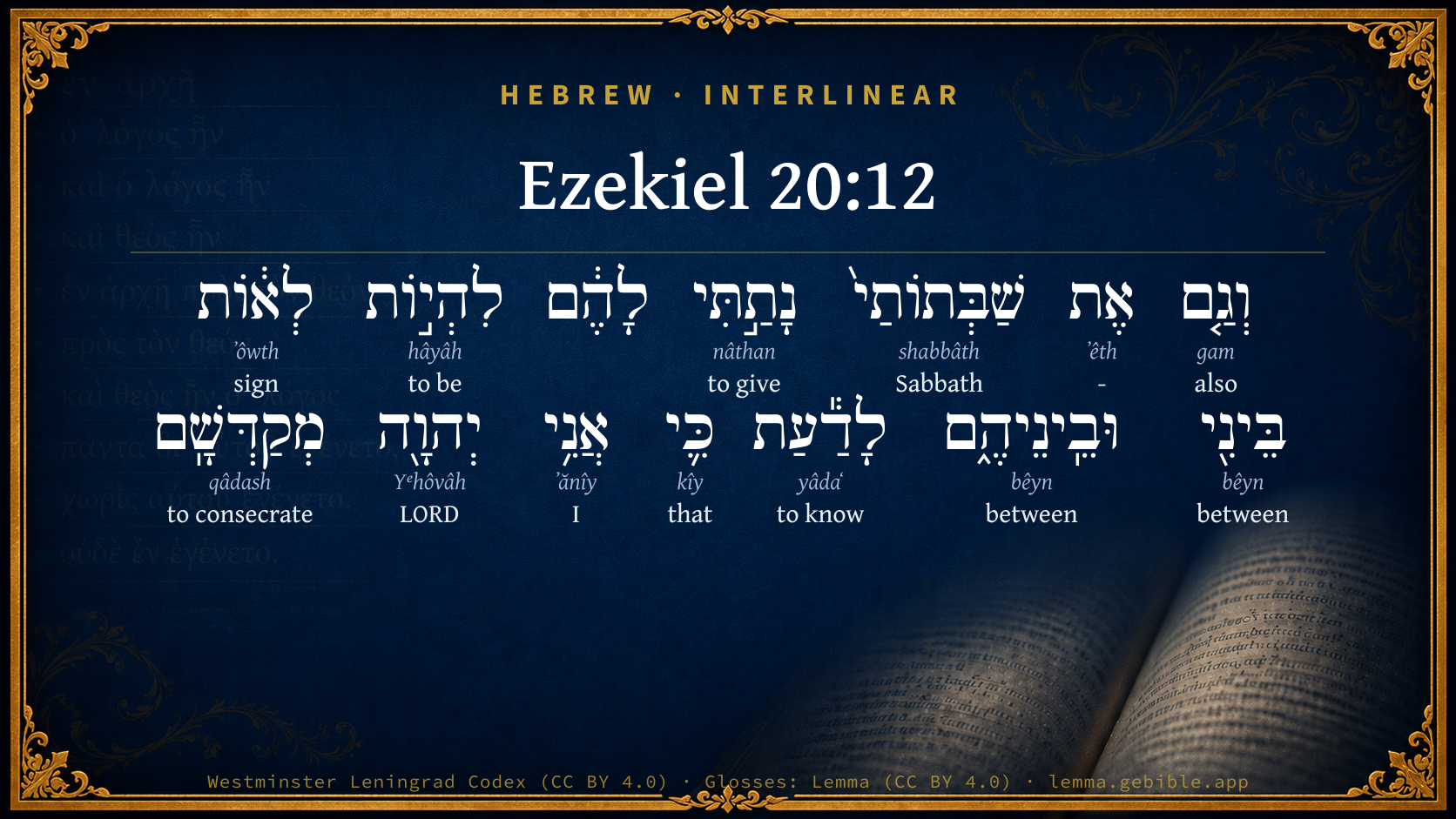
Hebrew (Westminster Leningrad Codex) Ezekiel 20:12 appears in the Hebrew Old Testament. The text above is from the Westminster Leningrad Codex. Each word links to its Strong’s number, a concise gloss, and parsing drawn from the Open Scriptures Hebrew Bible morphology. Click any word for its full Brown-Driver-Briggs (BDB) entry.
Download image
Cite this verse

Ezekiel 20:12 (World English Bible). Public Domain. Lemma interlinear Bible study tool, https://lemma.gebible.app/v/ezekiel/20/12.

Show BibTeX & RIS
BibTeX
RIS
English Translation
Moreover also I gave them my Sabbaths, to be a sign between me and them, that they might know that I am Yahweh who sanctifies them.
World English Bible · Public Domain
Download a study sheet

One document with this verse’s original text, its word-by-word gloss line, the meaning frame, cross-references with their text, attributed commentary, and full source and license credits — printable, and it pastes into notes with its structure intact.

This verse Autodidact and up

Study sheet (.html) Plain text (.txt)

A passage Seminary Student

Up to 50 verses in one chapter. A passage sheet keeps up to 6 commentary sources and 12 cross-references per verse, in the order this page ranks them, and says so on the sheet whenever that leaves anything out. Ask for a single verse and you get the Autodidact verse sheet above.

Everything on this page stays free to read, with no account — the sheet is a download of what is already on screen, not access to it.

Want to remove ads? Support Godless Engineer
Compare translations 3

The same verse in 3 English versions, stacked beneath the original-language interlinear above. Click any original word for its lexicon entry.

Each is an independent rendering of the whole verse — the interlinear is not word-aligned to these translations.

Highlighted words mark where these versions differ — a whole-verse word diff, not a word-by-word alignment.

  • World English Bible Public Domain
    Moreover also I gave them my Sabbaths, to be a sign between me and them, that they might know that I am Yahweh who sanctifies them.
  • King James Version Public Domain
    Moreover also I gave them my sabbaths, to be a sign between me and them, that they might know that I am the LORD that sanctify them.
  • unfoldingWord Literal Text CC BY-SA 4.0
    I also gave them my Sabbaths as a sign between myself and them, for them to know that I am Yahweh who makes them holy.

unfoldingWord Literal Text — © unfoldingWord, licensed CC BY-SA 4.0. Word-aligned USFM3 via Door43 (git.door43.org/unfoldingWord/en_ult).

Versions to compare (up to 4)

3 of 4 selected

Show all 18 translations

Every available English version of this verse, each an independent rendering of the whole verse.

  • World English Bible Public Domain
    Moreover also I gave them my Sabbaths, to be a sign between me and them, that they might know that I am Yahweh who sanctifies them.
  • Berean Standard Bible Public Domain
    I also gave them My Sabbaths as a sign between us, so that they would know that I am the LORD who sanctifies them.
  • Majority Standard Bible Public Domain
    I also gave them My Sabbaths as a sign between us, so that they would know that I am the LORD who sanctifies them.
  • King James Version Public Domain
    Moreover also I gave them my sabbaths, to be a sign between me and them, that they might know that I am the LORD that sanctify them.
  • American Standard Version (1901) Public Domain
    Moreover also I gave them my sabbaths, to be a sign between me and them, that they might know that I am Jehovah that sanctifieth them.
  • Revised Version (1885) Public Domain
    Moreover also I gave them my sabbaths, to be a sign between me and them, that they might know that I am the LORD that sanctify them.
  • Geneva Bible (1599) Public Domain
    Moreouer I gaue them also my Sabbaths to be a signe betweene me and them, that they might knowe that I am the Lord, that sanctifie them.
  • Douay-Rheims (1899) Public Domain
    Moreover I gave them also my sabbaths, to be a sign between me and them: and that they might know that I am the Lord that sanctify them.
  • Young's Literal Translation Public Domain
    And also My sabbaths I have given to them, To be for a sign between Me and them, To know that I `am' Jehovah their sanctifier.
  • Literal Standard Version CC BY-SA 4.0
    And I have also given My Sabbaths to them, || To be for a sign between Me and them, || To know that I [am] YHWH who is sanctifying them.
  • Unlocked Literal Bible CC BY-SA 4.0
    I also gave them my Sabbaths as a sign between myself and them, for them to know that I am Yahweh who makes them holy.
  • unfoldingWord Literal Text CC BY-SA 4.0
    I also gave them my Sabbaths as a sign between myself and them, for them to know that I am Yahweh who makes them holy.
  • Darby Bible Public Domain
    And I also gave them my sabbaths, to be a sign between me and them, that they might know that I [am] Jehovah that hallow them.
  • World Messianic Bible Public Domain
    Moreover also I gave them my Sabbaths, to be a sign between me and them, that they might know that I am the LORD who sanctifies them.
  • Webster's Bible Public Domain
    Moreover also I gave them my sabbaths, to be a sign between me and them, that they might know that I am the LORD that sanctify them.
  • Free Bible Version CC BY-SA 4.0
    I also gave them my Sabbaths to be a sign between me and them, so that they would acknowledge that I am the Lord who makes them holy.
  • Bible in Basic English Public Domain
    And further, I gave them my Sabbaths, to be a sign between me and them, so that it might be clear that I, who make them holy, am the Lord.
  • JPS Tanakh (1917) Public Domain
    Moreover also I gave them My sabbaths, to be a sign between Me and them, that they might know that I am the LORD that sanctify them.

Literal Standard Version (2020), Covenant Press — licensed CC BY-SA 4.0. Text via the HelloAO Bible API (eBible.org). Unlocked Literal Bible (unfoldingWord) — licensed CC BY-SA 4.0. Text via the HelloAO Bible API (eBible.org). unfoldingWord Literal Text — © unfoldingWord, licensed CC BY-SA 4.0. Word-aligned USFM3 via Door43 (git.door43.org/unfoldingWord/en_ult). Free Bible Version, Dr. Jonathan Gallagher — licensed CC BY-SA 4.0. Text via the HelloAO Bible API (eBible.org).

Word by word

More ways to search: Search by grammar → Find every occurrence → Compare this word →

Practice this passage: Drill this verse → Learn its vocabulary →

לְא֔וֹת
ʼôwth
H226
“to/for · sign”
Preposition + Noun, Common, Both, Singular, Absolute
Part of Speech
Preposition + Noun
Type
Common
Gender
Both
Number
Singular
State
Absolute
Full BDB Definition

Origin: probably from H225 (in the sense of appearing)

TWOT: 41a

sign, signal - a distinguishing mark - banner - remembrance - miraculous sign - omen - warning - token, ensign, standard, miracle, proof
  1. וְגַ֤ם gam H1571 “and · also” Conjunction + Particle, Accusative
  2. אֶת ʼêth H853 “-” Particle, Direct Object
  3. שַׁבְּתוֹתַי֙ shabbâth H7676 “Sabbaths · my” Noun, Common, Both, Plural, Construct + Suffix, Personal, 1st Person, Common, Singular
  4. נָתַ֣תִּי nâthan H5414 “to give” Verb, Qal, Perfect, 1st Person, Common, Singular
  5. לִהְי֣וֹת hâyâh H1961 “to be” Preposition + Verb, Qal, Infinitive Construct
  6. בֵּינִ֖י bêyn H996 “between · me” Preposition + Suffix, Personal, 1st Person, Common, Singular
  7. וּבֵֽינֵיהֶ֑ם bêyn H996 “and · between · them” Conjunction + Preposition + Suffix, Personal, 3rd Person, Masculine, Plural
  8. לָדַ֕עַת yâdaʻ H3045 “to know” Preposition + Verb, Qal, Infinitive Construct
  9. כִּ֛י kîy H3588 “that” Conjunction
  10. אֲנִ֥י ʼănîy H589 “I” Pronoun, Personal, 1st Person, Common, Singular
  11. יְהוָ֖ה Yᵉhôvâh H3068 “LORD” Noun, Proper
  12. מְקַדְּשָֽׁם qâdash H6942 “consecrating · them” Verb, Piel, Participle Active, Masculine, Singular, Construct + Suffix, Personal, 3rd Person, Masculine, Plural

About this verse

These counts appear in no published source. They are computed here, from the morphology-tagged text and Lemma’s own curated glosses. What Lemma adds →

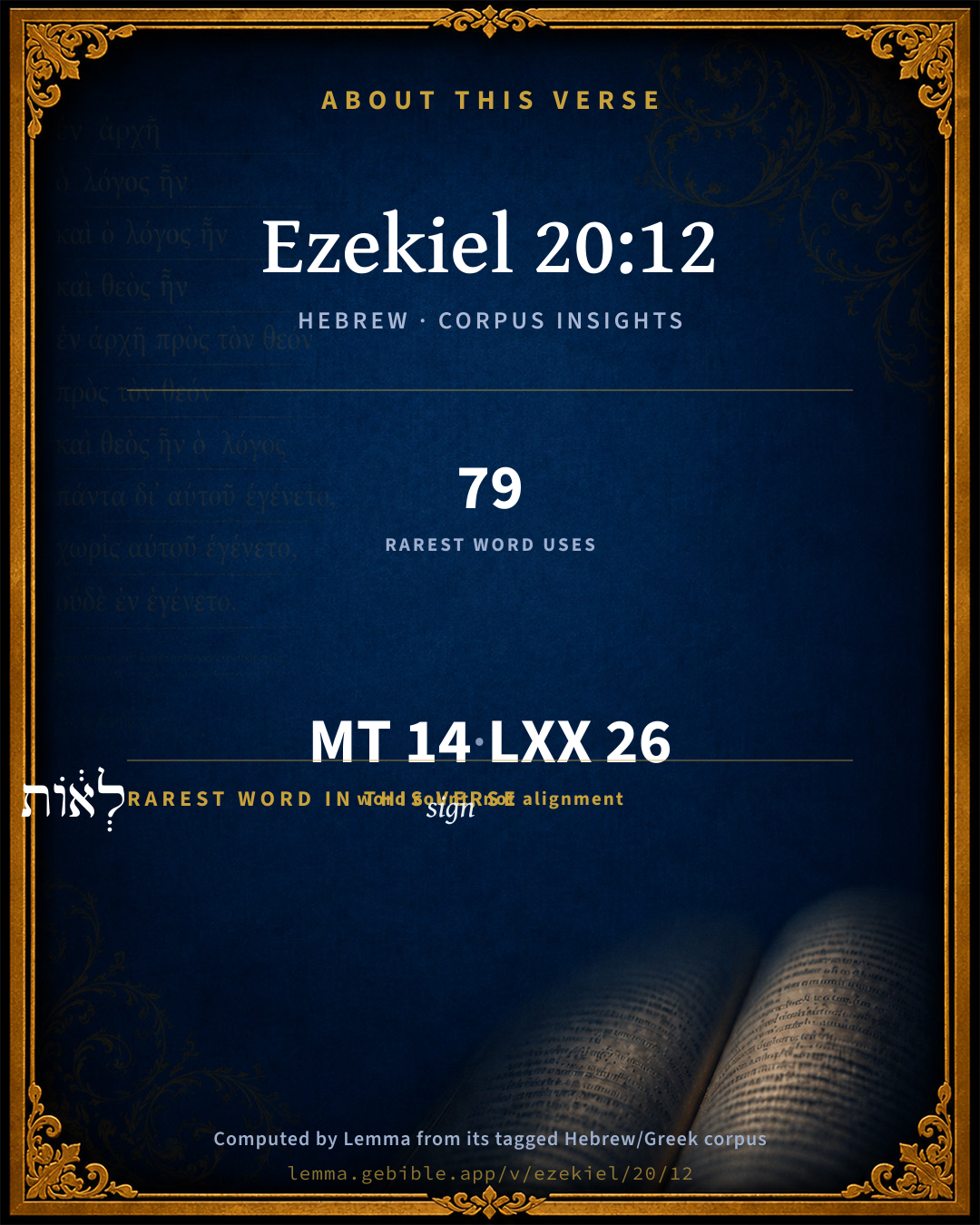
14
words
12
distinct lemmas
Prophets
section

Grammatical profile

  • 4 verbs
  • 3 nouns
  • 1 pronoun
  • 3 prepositions
  • 1 conjunction
  • 2 particles

Verb forms

  • נָתַ֣תִּי Qal · Perfect
  • לִהְי֣וֹת Qal · Infinitive Construct
  • לָדַ֕עַת Qal · Infinitive Construct
  • מְקַדְּשָֽׁם Piel · Participle Active

Repetition

A word recurs within this verse — often emphatic in Hebrew:

  • בֵּינִ֖י between H996 ×2

Hebrew & Septuagint length

In English translation the verse runs 26 words from the Hebrew and 29 from the Septuagint (LXX English) — closely comparable.

A rough comparison of the two English renderings, which tokenize alike — not a word-level alignment.

Word counts can differ between the Hebrew and the Greek without any difference in meaning — e.g. the Hebrew direct-object marker אֵת has no separate Greek word, and Greek often adds the article ὁ.

In the original languages it is 14 Hebrew tokens and 26 Greek tokens — but the two are counted differently (Hebrew bundles its prefixes and suffixes into one token; the Greek is in lemma form), so that isn’t a like-for-like length.

Cross-references

23

Topical passages linked to Ezekiel 20:12 in the Treasury of Scripture Knowledge — connected by theme and wording, ordered by reader-vote popularity; previews shown in the World English Bible.

  • Ezekiel 20:20 and make my Sabbaths holy; and they shall be a sign between me and you, that you may know that I am Yahweh your God.
  • Ezekiel 37:28 The nations shall know that I am Yahweh who sanctifies Israel, when my sanctuary shall be in the midst of them forevermore.
  • Leviticus 21:23 He shall not come near to the veil, nor come near to the altar, because he has a blemish; that he may not profane my sanctuaries, for I am Yahweh who sanctifies them.'"
  • 1 Thessalonians 5:23 May the God of peace himself sanctify you completely. May your whole spirit, soul, and body be preserved blameless at the coming of our Lord Jesus Christ.
  • Exodus 19:5–6 Now therefore, if you will indeed obey my voice, and keep my covenant, then you shall be my own possession from among all peoples; for all the earth is mine;
  • Exodus 20:8–11 "Remember the Sabbath day, to keep it holy.
  • Exodus 31:13–17 "Speak also to the children of Israel, saying, 'Most assuredly you shall keep my Sabbaths: for it is a sign between me and you throughout your generations; that you may know that I am Yahweh who sanctifies you.
  • Leviticus 23:3 "'Six days shall work be done: but on the seventh day is a Sabbath of solemn rest, a holy convocation; you shall do no manner of work. It is a Sabbath to Yahweh in all your dwellings.
  • Deuteronomy 5:12–15 "Observe the Sabbath day, to keep it holy, as Yahweh your God commanded you.
  • Mark 2:27–28 He said to them, "The Sabbath was made for man, not man for the Sabbath.
  • Genesis 2:3 God blessed the seventh day, and made it holy, because he rested in it from all his work which he had created and made.
  • Exodus 16:29 Behold, because Yahweh has given you the Sabbath, therefore he gives you on the sixth day the bread of two days. Everyone stay in his place. Let no one go out of his place on the seventh day."
  • Exodus 35:2 'Six days shall work be done, but on the seventh day there shall be a holy day for you, a Sabbath of solemn rest to Yahweh: whoever does any work in it shall be put to death.
  • Leviticus 20:8 You shall keep my statutes, and do them. I am Yahweh who sanctifies you.
  • Leviticus 21:8 You shall sanctify him therefore; for he offers the bread of your God: he shall be holy to you: for I Yahweh, who sanctify you, am holy.
  • Leviticus 21:15 He shall not profane his seed among his people: for I am Yahweh who sanctifies him.'"
  • Leviticus 23:24 "Speak to the children of Israel, saying, 'In the seventh month, on the first day of the month, shall be a solemn rest to you, a memorial of blowing of trumpets, a holy convocation.
  • Leviticus 23:39 "'So on the fifteenth day of the seventh month, when you have gathered in the fruits of the land, you shall keep the feast of Yahweh seven days: on the first day shall be a solemn rest, and on the eighth day shall be a solemn rest.
  • Leviticus 25:4 but in the seventh year there shall be a Sabbath of solemn rest for the land, a Sabbath to Yahweh. You shall not sow your field or prune your vineyard.
  • Nehemiah 9:14 and made known to them your holy Sabbath, and commanded them commandments, and statutes, and a law, by Moses your servant,
  • Leviticus 23:32 It shall be a Sabbath of solemn rest for you, and you shall deny yourselves. In the ninth day of the month at evening, from evening to evening, you shall keep your Sabbath."
  • John 17:17–19 Sanctify them in your truth. Your word is truth.
  • Jude 1:1 Jude, a servant of Jesus Christ, and brother of James, to those who are called, sanctified by God the Father, and kept for Jesus Christ:

Cross-references courtesy of OpenBible.info (CC BY 4.0).

Hebrew and Greek witnesses Masoretic Hebrew ↔ Greek Septuagint

The same verse in the two great witnesses to the Old Testament, shown verse-for-verse.

These are two independent witnesses, not word-aligned to each other, and the Septuagint is shown in lemma (dictionary) form.

Hebrew Ezekiel 20:12 Masoretic · Westminster Leningrad Codex

וְגַ֤ם אֶת שַׁבְּתוֹתַי֙ נָתַ֣תִּי לָהֶ֔ם לִהְי֣וֹת לְא֔וֹת בֵּינִ֖י וּבֵֽינֵיהֶ֑ם לָדַ֕עַת כִּ֛י אֲנִ֥י יְהוָ֖ה מְקַדְּשָֽׁם

Moreover also I gave them my Sabbaths, to be a sign between me and them, that they might know that I am Yahweh who sanctifies them.

World English Bible · Public Domain

Greek LXX Ezekiel 20:12 Septuagint · lemma form

καί ὁ σάββατον ἐγώ δίδωμι αὐτός ὁ εἰμί εἰς σημεῖον ἀνά μέσος ἐγώ καί ἀνά μέσος αὐτός ὁ γιγνώσκω αὐτός διότι ἐγώ κύριος ὁ ἁγιάζω αὐτός

And I gave them my sabbaths, that they should be for a sign between me and them, that they should know that I am the Lord that sanctify them.

LXX2012 (modern English Septuagint) · Public Domain

Hebrew: Westminster Leningrad Codex (CC BY 4.0). Greek: Septuagint (public domain); English from LXX2012 (modern English Septuagint) (Public Domain). How the Septuagint differs from the Hebrew →

Targum (Aramaic paraphrase)

1

The Targum is the ancient Jewish Aramaic paraphrase of the Hebrew Scriptures — an interpretive translation, not the Hebrew text itself. Onkelos (literal) and Pseudo-Jonathan (expansive) render the Torah, and Jonathan the Prophets. Coverage is partial: where no permissively-licensed English translation exists for a verse, only the Aramaic is shown. This is verse-level text, not a word-by-word alignment to the Hebrew.

  1. Targum Jonathan Prophets (Joshua–Malachi)
    וְאַף יַת יוֹמֵי שַׁבַּיָא דִילִי יְהָבֵית לְהוֹן לְמֶהֱוֵי לְאָת בֵּין מֵימְרִי וּבֵינֵיהוֹן לְמֵדַע אֲרֵי אֲנָא יְיָ מְקַדְשֵׁיהוֹן:

    (no public-domain English translation for this verse)

    Targum Jonathan — Aramaic: “Mikraot Gedolot” (public domain). English: “Sefaria Community Translation” (CC0 1.0 (public-domain dedication)); “London "Chaldee Paraphrase," 1871” (public domain). Text via Sefaria.

Commentary

Notes on Ezekiel 20:12 from classic Christian and Jewish commentators (each source and its license shown beneath its notes). The classic Christian expositions comment on the surrounding passage and are grouped to its opening verse, so a note may address several verses; the Jewish commentaries on the Tanakh (Rashi and others) are per-verse, so they appear only where the commentator wrote on this verse.

Lemma curates 59 commentaries, every one of them public domain or Creative Commons licensed, each selected and text-cleaned for this edition rather than reprinted as found. About our sources →

Trapp's Complete Commentary

John Trapp

Eze 20:12 Moreover also I gave them my sabbaths, to be a sign between me and them, that they might know that I [am] the LORD that sanctify them.

Ver. 12. Moreover also, I gave them my Sabbaths.] A sweet mercy, without which the best would even grow wild. What a wretch then was that Egyptian in Phagius, who said that those Jews, and after them the Christians, had a loathsome disease upon them, and were therefore fain to rest the seventh day!

To be a sign between me and them.] A distinctive sign of my distinguishing grace to Israel above others, who jeered them for sabbatising, as those that lost a seventh part of their precious time. To be also both a sign of a godly person - anciently, when the question was propounded, Servasti Dominicum? Hast thou kept the Lord’s-day? the answer was returned, I am a Christian, and can do no less - and a means of conveying more holiness into his heart.

John Trapp, A Commentary or Exposition upon All the Books of the Old and New Testament (1647–1656) — public domain. Text from a community e-Sword module.

The Biblical Illustrator

Joseph S. Exell

Eze_20:12

I gave them My Sabbaths.

The practical duties of the Christian Sabbath

Let two remarks be premised. We enforce not the duties of the Jewish but of the Christian Sabbath. Everything in the Christian Sabbath is tender and considerate on the one hand, everything is spiritual and elevated on the other; and is, in both views, adapted to the real state and exigencies of our nature, under the last and most perfect dispensation of religion. But then the determination of what is really spiritual, of what is really for the welfare of man, of what ale the real duties and employments of the day, must be taken from the Scriptures themselves, and not from the opinions, much less from the inclinations and fashions, of a corrupt world.

I. Keep ever in view the great end of the institution--which is to be a visible sign of the covenant between God and us, and a principal means of that sanctification which it is one object of that covenant to produce. What an exalted end and design of the institution! Sanctification is the work of Gods Holy Spirit by His secret but effectual influences upon the heart, separating man from the love and service of sin, and turning him to God and holiness. And how important is the thought, that the design of the Almighty in sanctifying and hallowing a day of Sabbath was that man, His moral and accountable creature, might be sanctified and dedicated by means of it--that the external consecration of the season ends in the internal consecration of the heart of man to his Creator and Redeemer! We awake to the true importance of the institution when we feel our fallen and sinful state, when we receive the covenant of grace as proposed in the Gospel, when we seek to be sanctified, body, soul, and spirit, to be the Lords. A Divine life infused into the soul of man--a perception of the nature and excellency of spiritual things--a view of the glory and majesty of the great Redeemer--a reliance upon His death and resurrection--a dependence upon the influence of His Holy Spirit--these bring the Sabbath and the human heart together.

II. The public and private duties of it.

1. The public exercise; of Gods worship, and the fellowship of Christians with each other in common acts of prayer and praise, are the leading business of this holy season.

2. The care of our families must not, however, be neglected, whilst we first discharge our public duties.

3. The private and personal duties must prepare for and succeed the public and domestic.

4. The duties of the Christian Sabbath extend to our dependents--to the stranger within our gates--to all over whom we have any natural influence--and even to the irrational creatures who subserve our comfort, and whose repose is commanded both for their own sakes and to render more completely practical the duty of religious rest enjoined upon man, their lord.

III. In order to keep holy the Lords day, we must carry the true spirit of the Christian dispensation into these duties. We must not celebrate a Jewish but a Christian festival. We must imbibe that spirit of rest and delight in God, that sense of refreshment and repose, in His more immediate service, which the liberty of the Gospel breathes, and without some degree of which we can never discharge these duties aright. Can any picture be more inviting than that of a family, a neighbourhood, a parish, honouring the day of God with cheerful and grateful hearts--meditating on that sanctification which is the great design of the day of rest--filling up its hours with the various and important exercises of public and private devotion--and imbuing every act of duty with the Christian temper, with the filial spirit--the spirit not of bondage again to fear, but the spirit of adoption, crying, Abba, Father?

IV. Especially glorify God for those mighty blessings which are appointed to be commemorated on the Lords day--Creation, Redemption, Heaven. (D. Wilson, M. A.)

The national observance of the Sabbath day; its deep importance and present peril

I. Its bearing on the health and the enjoyment of the community. Man was not made, even in Paradise, to be idle; and if even there wholesome toil contributed to keep his happiness from stagnating and corrupting, how much more is toil a merciful provision for man in his fallen lot! There is perhaps as much mercy in the institution that six days we shall labour and do all that we have to do, as in the institution that on the seventh day we shall do no manner of work. But whilst labour in moderation is thus beneficial for man, incessant toil would infallibly tend at once to break the spirit, to degrade the mind, to ruin the health, and to curtail the life. It would at the same time have a fearful and melancholy influence on social enjoyment, on the domestic circle, on the mutual endearments and reciprocal kindly sentiments that constitute so much of the stream of earthly happiness. How gracious, therefore, and how merciful, in its bearing merely on the physical strength and health, and upon the general individual and social and domestic enjoyment of the mass of the people, is that provision of a gracious Father, who, in giving us all our time for our daily labour, yet reserved a seventh to be kept holy to Himself, in which we should rest from every toil, and the master and the servant, and the sovereign and the subject, and the brute beast of the field that serves man, should all together, unyoked and disburdened from labour and from care, exult and rejoice in the freedom and the liberty with which God hath blessed them!

II. Its bearing upon the kindly feelings and the mutual charities of the nation in which it is observed. How much depends upon the internal magnetic attraction and influence of kindliness and benevolence and mutual good will! If you could take out from the community all that tends to soften mutual asperity and knit heart to heart, all that tends to make the poor man feel a sense of honest independence accompanied with unfeigned humility, and the rich man to feel that his external condition is as nothing in comparison with the moral distinction that differences one intelligent being from another--who can tell what would be the frightful result? But how beautifully does the Sabbath day prove the medium of the circulation of kindly and tender feelings! Much as the day is broken, and often as it is spent in savage and in sensual scenes, yet nevertheless it does wonderfully tend, with its balmy hebdomadal influence, to calm ruffled spirits, to allay feverish anxieties, and to soften petulant and foolish tempers.

III. Its bearing upon the morality and the religion of the people. Take away that one purchase, on which rests all the spiritual and moral machinery in the land--let that be gone, and the whole moral and religious machinery in the land falls rapidly to pieces, because it has no fixed ground, no standing point on which to be placed. It cannot go on; it must suffer disturbance, disorganisation, and rapid destruction. Let there be no national Sabbath; where were our Sabbath ceremonies? Let there be no national Sabbath; in vain almost would our houses of prayer be thrown open, and the bell that used to sweetly tell the day of rest was come send out its notes, drowned amid the din and the uproar of the never-checked deluge of worldly anxiety, tumult, conflict and struggle, gathering fresh force and fury because the only barrier that at all checked their onward progress was withdrawn, and rushing headlong on without an obstacle to impede their current.

IV. Its bearing on the favour of God towards a people. I look upon the Sabbath, in its national observance, as the most direct and plain and palpable index of a nations relationship towards God. It is (if we may so speak) the standard of heaven waving from the battlements of our national Zion, and telling that this great people recognise God, and in testimony and tribute of their loyalty they pay Him that which is His own, and give Him the seventh of their time, secured to Him by whom their sovereign reigns and on whom all their blessings depend. And as the observance of the Sabbath by the nation is an outward and visible sign of their fealty and fidelity to God, so is it an outward and visible sign of Gods gracious faithfulness and love towards them. While that broad seal, therefore, remains intact and unbroken, how confidently may the people rest upon God!

V. The growing difficulties of maintaining the observance of the sabbath day and at the same time the growing importance of maintaining it in our land.

1. We find in the spread of infidel sentiment and spirit in the land, a fearful source of difficulty to the maintenance of the due observance of the Sabbath day.

2. The latitudinarian and unhallowed speculation indulged in by many who bear the name of Christian, and sanctioned and smiled at by others, who ought to raise the voice of holy and wholesome reprobation.

3. The increasing excitements and the increasing facilities for the violation of the holy day.

4. The lamentable spiritual destitution of masses of our people, and the consequent spiritual ignorance, utter demoralisation, and absolute barbarism which exist throughout wildernesses of human beings in this baptized and nominally Christian country.

VI. The growing importance of maintaining the observance of the sabbath day in our land. (H. Stowell, M. A.)

The Sabbath day

I. The Sabbath is of universal and perpetual obligation.

II. It has its own peculiar employments: Hallow My Sabbaths. They are to be days of rest from labour, and refreshment for the soul. Let them be sacred days; devote them to the praise and cause and glory of God.

III. There was a most blessed design in its institution: Hallow My Sabbaths; and they shall be a sign, etc.

1. They were to be a sign between God and His people--a sign more frequently brought before them than the bow in the clouds. That told they should not be destroyed; but this tells of eternal life--is a type and symbol of the Sabbath of rest in His everlasting kingdom.

2. Another design mentioned is the edification and instruction of His people, that ye may know that I am the Lord. (G. Phillips, M. A.)

The Sabbath a sign between God and His people

I. How properly the sabbath is a sign of the true God.

II. The institution of it is of the greatest use and advantage to man, considered under what respect and circumstances soever.

III. What is meant by hallowing the sabbath, or in what manner we are to observe it, so as to answer the end of its institution, so as to reap the advantages which were proposed by it.

1. To hallow the Sabbath is to set it apart to Gods honour and service; and, of course, implies that we should abstain from all the ordinary employments of life, from all such things as would be apt to debase our minds, and hinder them from fixing upon heavenly objects.

2. We should, this day above all, make Him the constant subject of our thoughts and our desires, of our prayers and of our praises. We should meditate upon His nature and His attributes, His Word and His works; and particularly upon those two grand instances of the Divine power and goodness which the institution itself, more especially, directs us to commemorate--the creation of the world, and the redemption of mankind.

IV. To neglect paying God so easy a tribute as one day out of seven must at least imply a forgetfulness of our obligations; as that must, necessarily, imply ingratitude. Shall we grudge the seventh day to His use, when He hath, so freely, allowed us the other six for our own? Shall we refuse so small a part of our time to Him, who had so just a right to the whole? (D. Lloyd.)

The Sabbath needed by man

Those who have served a battery upon the battlefield tell us that, at intervals, they are forced to pause, that the guns may cool, and that the smoke may lift to furnish accurate aim; yes, and because ammunition is exhausted. No Christian can fight the battle of the week without the quiet Sabbath to cool off his guns. He needs repose of soul. He wants heavenly breezes to lift the earth-lowering shadows. He must replenish his store from the secret place of prayer and meditation. (E. J. Haynes.)

The Biblical Illustrator, edited by Joseph S. Exell (c. 1880s–1900s) — public domain. Text from a community e-Sword module.

Joseph Benson's Commentary

Eze 20:12. Moreover, I gave them my sabbaths — Including the weekly sabbaths, the sabbatical years, and all the solemn days of divine worship, in which no servile work was to be done: to be a sign between me and them — A sign of their being peculiarly my people, and to distinguish them from all other people, as the worshippers of me, Jehovah, who in six days made heaven and earth, and all things therein, and rested the seventh day; and also of my delivering them out of their state of bondage in Egypt. That they might know that I am the Lord that sanctifies them — That by their resting on those days from their usual employments, and their coming together to wait upon me in the ordinances of my worship, they might become more acquainted with me, and with my will concerning them, and might receive a larger measure of my sanctifying grace. Observe, reader, 1st, Sabbaths are privileges, and are to be considered and improved as such. 2d, They are signs: it is a sign men have a sense of religion, and that there is some correspondence between them and God, while they make conscience of keeping holy the sabbath day. 3d, Sabbaths, if duly sanctified, are the means of our sanctification: if we do the duty of the day, we shall find to our comfort; it is the Lord that sanctifies us; makes us holy, that is, truly happy, here; and prepares us to be happy, that is, perfectly holy, hereafter.

Joseph Benson's Commentary on the Old and New Testaments (1811–1818) — public domain. Text from a community e-Sword module.

Jamieson, Fausset & Brown

Robert Jamieson, A. R. Fausset & David Brown

sabbaths, . . . a sign between me and them--a kind of sacramental pledge of the covenant of adoption between God and His people. The Sabbath is specified as a sample of the whole law, to show that the law is not merely precepts, but privileges, of which the Sabbath is one of the highest. Not that the Sabbath was first instituted at Sinai, as if it were an exclusively Jewish ordinance (Gen 2:2-3), but it was then more formally enacted, when, owing to the apostasy of the world from the original revelation, one people was called out (Deu 5:15) to be the covenant-people of God.

sanctify them--The observance of the Sabbath contemplated by God was not a mere outward rest, but a spiritual dedication of the day to the glory of God and the good of man. Otherwise it would not be, as it is made, the pledge of universal sanctification (Exo 31:13-17; Isa 58:13-14). Virtually it is said, all sanctity will flourish or decay, according as this ordinance is observed in its full spirituality or not.

Jamieson, Fausset & Brown — Commentary Critical and Explanatory on the Whole Bible (1871) — public domain (CC PDM 1.0). Text via the HelloAO Bible API.

Adam Clarke's Commentary

Verse 12. I gave them my Sabbaths] The religious observance of the Sabbath was the first statute or command of God to men. This institution was a sign between God and them, to keep them in remembrance of the creation of the world, of the rest that he designed them in Canaan, and of the eternal inheritance among the saints in light. Of these things the Sabbath was a type and pledge.

Adam Clarke's Commentary on the Bible (1810–1826) — public domain. Text from a community e-Sword/MySword module.

John Calvin's Commentaries

Besides the law God here commends his Sabbaths, which we know to be only a part of His law: nay, whoever compares the commandments one by one, will at first sight perceive more weight in others than in the fourth. For what is the meaning of that commandment, You shall not have any strange god? You shall not make any idols? Afterwards, Do not take God’s name in vain? (Exodus 20:3, 4, 7; Deuteronomy 5:7, 8, 11.) I answer, that the Prophet takes one precept of the law the better to explain what I have already touched on before, namely, that the law was given to the Israelites to bind them more and more to their benefactor. For God was unwilling to cast them away after redeeming them: but he testified by his law that he would be the guide of their whole life. Still the Prophet looked further, meaning, that the law consisted not only of the commandments, but embraced the whole grace of God, on which the adoption of the nation depended. For if God had simply commanded either one thing or another, it would not have been easy to perceive and taste his goodness. Why so? because when he calls upon us to discharge a duty, every one, feels that a greater burden is imposed on him than he can bear. Even if the promise should entice us by its sweetness, — he who does these things shall live in them; yet when we try, we are deficient through being destitute of all power. But the Prophet means that something else was intended by the Sabbath, that the Israelites might acknowledge themselves separated by God, so as to experience him for their Father in all things. Hence, though the precepts of the law were somewhat distasteful; yet, as the fourth commandment has in it a gratuitous promise, it has a different savor, since the people thus recognizes itself as elected by God for a peculiar nation: and this the Prophet sufficiently expresses by the word sanctifying, for it means that the people were separated from the profane nations to be God’s peculiar inheritance. If any one wishes to render sanctify by one word it will be, “to separate.” But the meaning of separation ought to be explained. How, then, did God separate a certain people from the whole world? Why, by promising to Abraham that he would be a God to his seed. (Genesis 22:17.) Then he could not otherwise be their God than by gratuitously loving his elect, by regenerating them by his Spirit, and becoming propitious and easily entreated: and besides, a single people could not be separated from others without a mediator. For separation cannot last unless the people be united to God; and what bond of union is there without a mediator?

Now, therefor, we understand why the Prophet speaks of the Sabbath, since he had formerly commended the whole law, of which the Sabbath was a part, namely, because it displayed God’s gratuitous adoption; and at the same time the Israelites might acknowledge that the way of approach to God was open to them, and he was rendered placable; then that they were not adopted in vain, but were sought by God, that he should renew them by his Spirit, and rule the whole course of their life. It was, then, the greatest ingratitude to break the Sabbath, as will be said shortly afterwards. But this passage teaches that God was not pleased with the people’s quiet or ease when he commanded them to keep the seventh day holy, but he has another intention. Whence we gather that that precept was shadowy: for there are some things which please God of themselves, and must be performed; but others have a different object. For to worship one God, to abominate idols, to use God’s name reverently, these things are, as I have said, the simple duties of piety in themselves: so the honor which sons pay to their parents is a duty pleasing to God in itself, like chastity, abstinence, and such like. But Sabbaths do not please God simply and by themselves. We ought, therefore, to look for another purpose, if we wish to understand the reason of this precept. And hence Paul says, that Sabbaths were shadows of those things of which Christ is the substance. (Colossians 2:16, 17.) This, therefore, is one point. Ezekiel is not the first who says so, though he took it from Moses; for though he does not clearly say in so many words that the Sabbath was the symbol of sanctification, yet he afterwards shows this to be its object, (Exodus 31:13, 14,) and that God commanded the people to rest on the seventh day with this intent. Moses then himself shows that the command had another object, which Ezekiel interprets for us; but the matter is made much clearer in the Gospel, since in Christ the truth and substance of this precept is set forth, which Paul calls the body. I have, then, sufficiently explained this object., namely, that the Israelites might know God to be their sanctifier. But if we desire to understand the matter better, we ought first to lay it down that the Sabbath was the sign of mortification. God, therefore, sanctifies us; because when we remain in our natural state we are there mixed with others, and have nothing different from unbelievers: hence, therefore, it is necessary to begin by dying to ourselves and the world, and by exercising self-denial; and this depends on the grace of God. But I perceive that I cannot complete the subject today so I shall put it off till tomorrow.

John Calvin's Commentaries (1540-1563) — public domain. Text from the Calvin Translation Society English edition (1840s-50s) via the Christian Classics Ethereal Library (ccel.org). Calvin's coverage is partial (roughly two-thirds of the Bible); uncommented books and verses are honest gaps, never fabricated. The 19th-century editor's footnotes and remarks are omitted so the notes are faithfully Calvin's own voice.

Ellicott's Commentary for English Readers

(12) I gave them my sabbaths.—“Not because it is of Moses, but of the fathers” (Joh_7:22). The Sabbath, like circumcision, was an institution far older than the period here spoken of, but was now commanded anew, and made the especial pledge of the covenant between God and His people. The verse is a quotation from Exo_31:13; and every one must have remarked the great stress everywhere laid in the Old Testament upon the observance of the Sabbath, and the prominence given to it among the privileges of the Divine covenant. It is plain that the day is regarded not in its mere outward character, as a day of rest, but as “a sign” of the covenant, and a means of realising it in the study of God’s word, and the communion of the soul with Him. It is in these latter aspects also that the weekly day of rest still retains its inestimable value—that men “might know that I am the Lord that sanctify them.”

A Bible Commentary for English Readers, edited by Charles John Ellicott (1878–1897) — public domain. Text from a community e-Sword module.

The Cambridge Bible for Schools and Colleges

gen. ed. J. J. S. Perowne

12. my sabbaths] The plural refers to the stated recurrence of the day; other festivals are not included.

to be a sign] The prophet does not speak of the Sabbath as an older institution than the exodus, though his language does not decide the point, as he refers merely to the connexion into which the day was brought with Israel’s redemption (as Deu_5:15) and made a “sign” to them of their relation to Jehovah. The people were commanded to “sanctify” the Sabbath, i.e. to dedicate it and keep it to the Lord. This dedication of a part of their time or life to Jehovah had a similar significance to the dedication of the first-fruits of the ground and the firstlings of their cattle; it was an acknowledgment that they were the Lord’s. It was the response on their side to the operation of Jehovah on his side in “sanctifying” them, or making them his own possession (end of v.) Thus the Sabbath was a “sign” or visible token that he was their God and they his people (Eze_20:20); Exo_31:13-14; Isa_56:2; Isa_56:4. This meaning of the Sabbath as a symbol of the religion of Jehovah explains the importance attached to keeping it particularly in the exile; its observance sustained the feeling of the people among the heathen that they were the people of Jehovah, Isa_56:2 seq., Isa_58:13; Neh_13:19, cf. Jer_17:21; Lev_19:3; Lev_26:2.

The Cambridge Bible for Schools and Colleges (gen. ed. J. J. S. Perowne; Cambridge University Press, 1878–1918) — public domain. Text from a community e-Sword module.

John Gill's Exposition

Moreover, also, I gave them my sabbaths,.... The Targum is,

"the days of the sabbaths;''

or sabbath days, the seventh day sabbaths, which recurring throughout the year are many; but, besides these, there were the year of remission, for the seventh year sabbath; and the jubilee year, the great sabbath of all, once in fifty years; yea, Kimchi thinks the feasts, such as the passover, &c. are included: now these are distinguished from the statutes and judgments, or the precepts of the law, which were of a moral nature; these being ritual and ceremonial, and were peculiar to the Jews, and continued but for a while; however, they were gifts, and valuable ones, of considerable use and significance:

to be a sign between me and them; of his being their God, and they being his people; of his favour and good will to them, and of the, obligations they were under to him; of his having separated and distinguished them from all other nations of the world; these sabbaths being only given to them as a memorial of their deliverance out of Egypt, and as a pledge of their entering into the land of rest; and of the future rest to be enjoyed by Christ, and in heaven, to all eternity; for these were shadows of things to come, Col 2:16;

that they might know that I am the Lord that sanctify them; separate them from other nations, and, by such means and opportunities, begin and carry on the work of sanctification in them; for the sabbaths, and the services of them, were useful to such purposes; as Lord's days, and the work of them, are now.

John Gill's Exposition of the Whole Bible (1746–1763) — public domain (CC PDM 1.0). Text via the HelloAO Bible API.

Haydock's Catholic Bible Commentary

Sign, as also to promote piety and instruction.

George Leo Haydock (1774–1849), Haydock's Catholic Family Bible and Commentary, 1859 edition — public domain. Excludes Psalms (Douay-Rheims chapter numbering differs from Protestant) and Deuterocanonical books (Catholic canon only).

Matthew Poole's English Annotations

I gave; both commanded, and also sanctified, those portions of time to be holy rests.

My sabbaths; either the weekly sabbath, which, recurring every seventh day, soon multiplied into many, and was to be the commemoration of God’s rest from his labour, Israel’s delivery out of Egypt, Deu 5:15, and an awakening of their hopes of the eternal rest with God; or it may, as most like it doth, include all the solemn days of God’s worship, every of which was a sabbath, and no work to be done in it.

To be a sign of their being peculiarly my people, select from all other, to walk with me, to rest in me, and receive more grace from me.

That they might know: this was a teaching sign, they might by other ways know, and by this also.

I am the Lord; in this see my authority, and my holiness, who by such means do promote and attain such holy purposes and ends.

That sanctify them; that have withdrawn them from the profane and common herd of the heathen, and made them by this relatively holy; or else, that have changed the heart, and filled it with holy, pure, and gracious inclinations, and so made them really holy.

Matthew Poole's English Annotations on the Holy Bible (1683–1685) — public domain. Text from a community e-Sword/MySword module.

Whedon's Commentary on the Bible

Daniel D. Whedon

12. My sabbaths — The giving of a stated portion of the week, like the giving of a stated portion of cattle and fruit to the Lord, was an acknowledgment of their acceptance of the covenant of sanctification by which they were pledged to uttermost obedience, as the Lord’s possession, while he was pledged to them in all his fullness of protecting and sanctifying power. The Sabbath was the visible sign to the Hebrews and to the world that they were his, and that he was theirs (Eze_20:20). It was the sign of a covenant in which God separated himself to the people and the people separated themselves to God. The Hebrew Sabbath was not derived from the Babylonian. Indeed, there is no proof, notwithstanding the guesses of Assyriologists, that the Babylonians observed a weekly rest day. Even the existence of the seven-day week among them is not demonstrated (Muss-Arnoldt, Journal Biblical Literature, 1892, part 1).

Daniel D. Whedon (gen. ed.), Commentary on the Old and New Testaments (1874–1909) — public domain. Text from a community e-Sword module.

The Pulpit Commentary

I gave them my sabbaths, etc. As in Exo_31:12-17, the sabbath is treated as the central sign (we might almost say sacrament) of the Jewish Church, not only as a mark differencing them from other nations, but as between Jehovah and them, a witness of their ideal relation to each other, a means of making that ideal relation a reality.

The Pulpit Commentary (1880–1919), ed. H.D.M. Spence-Jones & Joseph S. Exell — public domain. Text from a community e-Sword module.

John Wesley's Explanatory Notes

A sign - Of their being peculiarly my people.

John Wesley, Explanatory Notes Upon the Whole Bible (1754–1765) — public domain. Text via the GEBible commentary corpus.

Rashi

Rabbi Shlomo Yitzchaki (Rashi)

to be for a sign It is a great sign for them, that I gave the day of My resting to them for a resting. Behold this is a phenomenal manifestation that I hallowed them to Myself.

Rashi on the Tanakh — English translations: “The Judaica Press complete Tanach with Rashi, translated by A. J. Rosenberg” (CC BY 4.0); “Pentateuch with Rashi's commentary by M. Rosenbaum and A.M. Silbermann, 1929-1934” (public domain); “The Metsudah Tanach series, Lakewood, N.J” (CC BY 4.0); and “The Book of Joshua, Metsudah Publications, 1997” (CC BY 4.0). Text via Sefaria.

Lesson kit

Teaching starters — assembled from the data on this page, not authored interpretation. Every prompt links to the verse data it draws on. Edit before teaching.

Ezekiel, in the Prophets, opens this verse with 14 words (12 distinct Hebrew lemmas). Its most distinctive word is ʼôwth (“sign”). A historical commentator’s framing appears above. Read the whole chapter for the surrounding context.

Discussion questions

  1. How does “sign” (ʼôwth) shape what this verse is saying?
  2. Ezekiel 20:20 shares this passage’s theme. How do the two illuminate each other?
  3. “between” occurs 2× in this one verse. What is the effect of the repetition?
  4. These translations render this verse differently. What is at stake in choosing one wording over another?
  5. The verb «נָתַ֣תִּי» is Qal Perfect. How does its form color the action?
  6. Reading how Trapp's Complete Commentary and The Biblical Illustrator read this verse, where do the two commentators agree and where do they part?

Things to notice

Reading settings

Reading text

Shown beneath each verse's original-language words.

Old Testament
Old Testament edition

Read the OT as the Masoretic Hebrew (MT) or the Greek Septuagint (LXX).

English shown for the Greek Septuagint (in the Hebrew ↔ Greek comparison).

Comparing translations? Open the Compare panel on any verse page to stack up to four side by side.