Jeremiah 7:5

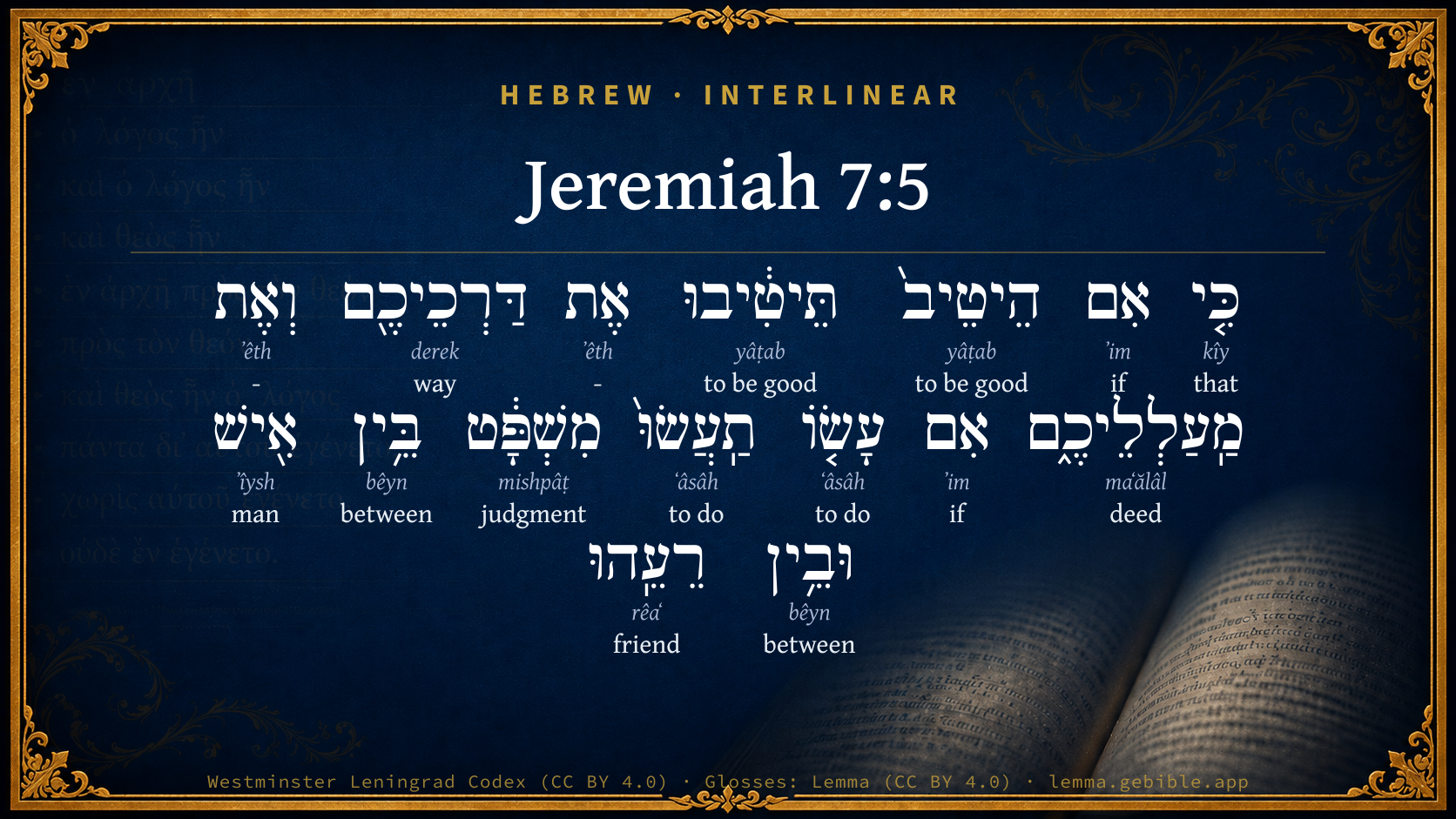
Hebrew (Westminster Leningrad Codex) Jeremiah 7:5 appears in the Hebrew Old Testament. The text above is from the Westminster Leningrad Codex. Each word links to its Strong’s number, a concise gloss, and parsing drawn from the Open Scriptures Hebrew Bible morphology. Click any word for its full Brown-Driver-Briggs (BDB) entry.
Download image
Cite this verse

Jeremiah 7:5 (World English Bible). Public Domain. Lemma interlinear Bible study tool, https://lemma.gebible.app/v/jeremiah/7/5.

Show BibTeX & RIS
BibTeX
RIS
English Translation
For if you thoroughly amend your ways and your doings; if you thoroughly execute justice between a man and his neighbor;
World English Bible · Public Domain
Download a study sheet

One document with this verse’s original text, its word-by-word gloss line, the meaning frame, cross-references with their text, attributed commentary, and full source and license credits — printable, and it pastes into notes with its structure intact.

This verse Autodidact and up

Study sheet (.html) Plain text (.txt)

A passage Seminary Student

Up to 50 verses in one chapter. A passage sheet keeps up to 6 commentary sources and 12 cross-references per verse, in the order this page ranks them, and says so on the sheet whenever that leaves anything out. Ask for a single verse and you get the Autodidact verse sheet above.

Everything on this page stays free to read, with no account — the sheet is a download of what is already on screen, not access to it.

Want to remove ads? Support Godless Engineer
Compare translations 3

The same verse in 3 English versions, stacked beneath the original-language interlinear above. Click any original word for its lexicon entry.

Each is an independent rendering of the whole verse — the interlinear is not word-aligned to these translations.

Highlighted words mark where these versions differ — a whole-verse word diff, not a word-by-word alignment.

  • World English Bible Public Domain
    For if you thoroughly amend your ways and your doings; if you thoroughly execute justice between a man and his neighbor;
  • King James Version Public Domain
    For if ye throughly amend your ways and your doings; if ye throughly execute judgment between a man and his neighbour;
  • unfoldingWord Literal Text CC BY-SA 4.0
    For if making good you make good your ways and your deeds, if doing you do justice between a man and between his neighbor—

unfoldingWord Literal Text — © unfoldingWord, licensed CC BY-SA 4.0. Word-aligned USFM3 via Door43 (git.door43.org/unfoldingWord/en_ult).

Versions to compare (up to 4)

3 of 4 selected

Show all 18 translations

Every available English version of this verse, each an independent rendering of the whole verse.

  • World English Bible Public Domain
    For if you thoroughly amend your ways and your doings; if you thoroughly execute justice between a man and his neighbor;
  • Berean Standard Bible Public Domain
    For if you really correct your ways and deeds, if you act justly toward one another,
  • Majority Standard Bible Public Domain
    For if you really correct your ways and deeds, if you act justly toward one another,
  • King James Version Public Domain
    For if ye throughly amend your ways and your doings; if ye throughly execute judgment between a man and his neighbour;
  • American Standard Version (1901) Public Domain
    For if ye thoroughly amend your ways and your doings; if ye thoroughly execute justice between a man and his neighbor;
  • Revised Version (1885) Public Domain
    For if ye throughly amend your ways and your doings; if ye throughly execute judgment between a man and his neighbour;
  • Geneva Bible (1599) Public Domain
    For if you amende and redresse your waies and your woorkes: if you execute iudgement betweene a man and his neighbour,
  • Douay-Rheims (1899) Public Domain
    For if you will order well your ways, and your doings: if you will execute judgement between a man and his neighbor,
  • Young's Literal Translation Public Domain
    For, if ye do thoroughly amend your ways and your doings, If ye do judgment thoroughly Between a man and his neighbour,
  • Literal Standard Version CC BY-SA 4.0
    For if you thoroughly amend your ways and your doings, || If you thoroughly do judgment || Between a man and his neighbor,
  • Unlocked Literal Bible CC BY-SA 4.0
    For if you actually make your ways and practices good; if you completely execute justice between a man and his neighbor—
  • unfoldingWord Literal Text CC BY-SA 4.0
    For if making good you make good your ways and your deeds, if doing you do justice between a man and between his neighbor—
  • Darby Bible Public Domain
    But if ye thoroughly amend your ways and your doings, if ye really do justice between a man and his neighbour,
  • World Messianic Bible Public Domain
    For if you thoroughly amend your ways and your doings, if you thoroughly execute justice between a man and his neighbor;
  • Webster's Bible Public Domain
    For if ye thoroughly amend your ways and your doings; if ye thoroughly execute judgment between a man and his neighbor;
  • Free Bible Version CC BY-SA 4.0
    If you sincerely change your ways and do what's right, if you treat each other fairly,
  • Bible in Basic English Public Domain
    For if your ways and your doings are truly changed for the better; if you truly give right decisions between a man and his neighbour;
  • JPS Tanakh (1917) Public Domain
    Nay, but if ye thoroughly amend your ways and your doings; if ye thoroughly execute justice between a man and his neighbour;

Literal Standard Version (2020), Covenant Press — licensed CC BY-SA 4.0. Text via the HelloAO Bible API (eBible.org). Unlocked Literal Bible (unfoldingWord) — licensed CC BY-SA 4.0. Text via the HelloAO Bible API (eBible.org). unfoldingWord Literal Text — © unfoldingWord, licensed CC BY-SA 4.0. Word-aligned USFM3 via Door43 (git.door43.org/unfoldingWord/en_ult). Free Bible Version, Dr. Jonathan Gallagher — licensed CC BY-SA 4.0. Text via the HelloAO Bible API (eBible.org).

Word by word

More ways to search: Search by grammar → Find every occurrence → Compare this word →

Practice this passage: Drill this verse → Learn its vocabulary →

מַֽעַלְלֵיכֶ֑ם
maʻălâl
H4611
“deeds · your”
Noun, Common, Masculine, Plural, Construct + Suffix, Personal, 2nd Person, Masculine, Plural
Part of Speech
Noun
Type
Common
Gender
Masculine
Number
Plural
State
Construct
Full BDB Definition

Origin: from H5953

TWOT: 1627e

deed, practice - practice (usually bad) - deeds - acts
  1. כִּ֤י kîy H3588 “that” Conjunction
  2. אִם ʼim H518 “if” Conjunction
  3. הֵיטֵיב֙ yâṭab H3190 “to be good” Verb, Hiphil, Infinitive Absolute
  4. תֵּיטִ֔יבוּ yâṭab H3190 “to be good” Verb, Hiphil, Imperfect, 2nd Person, Masculine, Plural
  5. אֶת ʼêth H853 “-” Particle, Direct Object
  6. דַּרְכֵיכֶ֖ם derek H1870 “ways · your” Noun, Common, Both, Plural, Construct + Suffix, Personal, 2nd Person, Masculine, Plural
  7. וְאֶת ʼêth H853 “and · -” Conjunction + Particle, Direct Object
  8. אִם ʼim H518 “if” Conjunction
  9. עָשׂ֤וֹ ʻâsâh H6213 “to do” Verb, Qal, Infinitive Absolute
  10. תַֽעֲשׂוּ֙ ʻâsâh H6213 “to do” Verb, Qal, Imperfect, 2nd Person, Masculine, Plural
  11. מִשְׁפָּ֔ט mishpâṭ H4941 “judgment” Noun, Common, Masculine, Singular, Absolute
  12. בֵּ֥ין bêyn H996 “between” Preposition
  13. אִ֖ישׁ ʼîysh H376 “man” Noun, Common, Masculine, Singular, Absolute
  14. וּבֵ֥ין bêyn H996 “and · between” Conjunction + Preposition
  15. רֵעֵֽהוּ rêaʻ H7453 “friend · his” Noun, Common, Masculine, Singular, Construct + Suffix, Personal, 3rd Person, Masculine, Singular

About this verse

These counts appear in no published source. They are computed here, from the morphology-tagged text and Lemma’s own curated glosses. What Lemma adds →

16
words
11
distinct lemmas
Prophets
section

Shared distinctive vocabulary

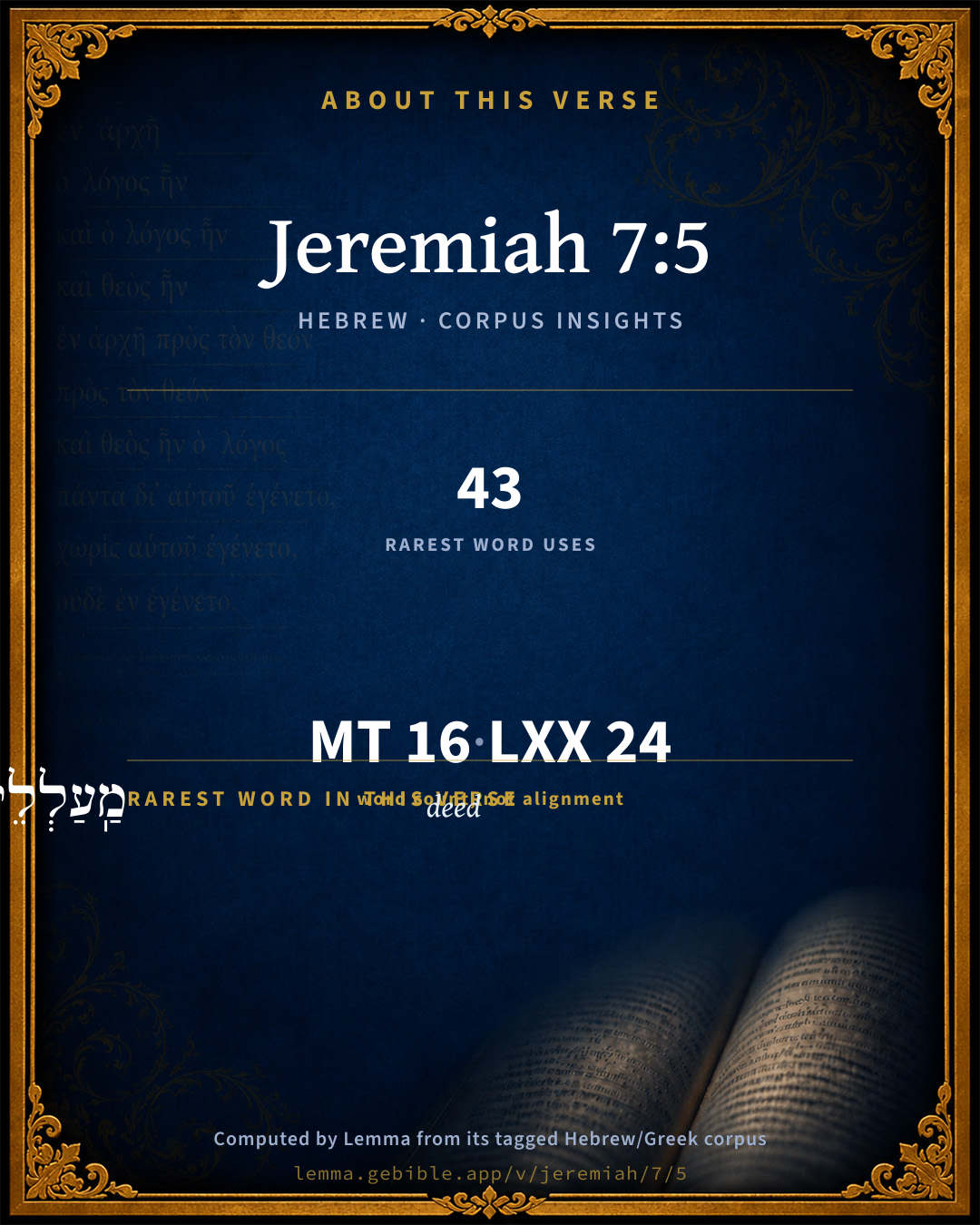
מַֽעַלְלֵיכֶ֑ם deed H4611 occurs in 41 verses of the Hebrew Bible. Also found in:

Grammatical profile

  • 4 verbs
  • 5 nouns
  • 2 prepositions
  • 3 conjunctions
  • 2 particles

Verb forms

  • הֵיטֵיב֙ Hiphil · Infinitive Absolute
  • תֵּיטִ֔יבוּ Hiphil · Imperfect
  • עָשׂ֤וֹ Qal · Infinitive Absolute
  • תַֽעֲשׂוּ֙ Qal · Imperfect

Repetition

Words recur within this verse — often emphatic in Hebrew:

  • הֵיטֵיב֙ to be good H3190 ×2
  • עָשׂ֤וֹ to do H6213 ×2
  • בֵּ֥ין between H996 ×2
  • אִם if H518 ×2

Hebrew & Septuagint length

In the original languages it is 16 Hebrew tokens and 24 Greek tokens — but the two are counted differently (Hebrew bundles its prefixes and suffixes into one token; the Greek is in lemma form), so that isn’t a like-for-like length.

Cross-references

9

Topical passages linked to Jeremiah 7:5 in the Treasury of Scripture Knowledge — connected by theme and wording, ordered by reader-vote popularity; previews shown in the World English Bible.

  • 1 Kings 6:12–13 Concerning this house which you are building, if you will walk in my statutes, and execute my ordinances, and keep all my commandments to walk in them; then will I establish my word with you, which I spoke to David your father.
  • Isaiah 1:19 If you are willing and obedient, You shall eat the good of the land;
  • Jeremiah 4:1–2 If you will return, Israel, says Yahweh, if you will return to me, and if you will put away your abominations out of my sight; then you shall not be removed;
  • Jeremiah 7:3 Thus says Yahweh of Hosts, the God of Israel, Amend your ways and your doings, and I will cause you to dwell in this place.
  • Isaiah 16:3 Give counsel, execute justice; make your shade as the night in the midst of the noonday; hide the outcasts; don't betray the fugitive.
  • Jeremiah 22:3 Thus says Yahweh: Execute you justice and righteousness, and deliver him who is robbed out of the hand of the oppressor: and do no wrong, do no violence, to the foreigner, the fatherless, nor the widow; neither shed innocent blood in this place.
  • Ezekiel 18:8 he who has not given forth on interest, neither has taken any increase, who has withdrawn his hand from iniquity, has executed true justice between man and man,
  • Ezekiel 18:17 who has withdrawn his hand from the poor, who has not received interest nor increase, has executed my ordinances, has walked in my statutes; he shall not die for the iniquity of his father, he shall surely live.
  • Judges 21:12 They found among the inhabitants of Jabesh Gilead four hundred young virgins, who had not known man by lying with him; and they brought them to the camp to Shiloh, which is in the land of Canaan.

Cross-references courtesy of OpenBible.info (CC BY 4.0).

Hebrew and Greek witnesses Masoretic Hebrew ↔ Greek Septuagint

The same verse in the two great witnesses to the Old Testament, shown verse-for-verse.

These are two independent witnesses, not word-aligned to each other, and the Septuagint is shown in lemma (dictionary) form.

Hebrew Jeremiah 7:5 Masoretic · Westminster Leningrad Codex

כִּ֤י אִם הֵיטֵיב֙ תֵּיטִ֔יבוּ אֶת דַּרְכֵיכֶ֖ם וְאֶת מַֽעַלְלֵיכֶ֑ם אִם עָשׂ֤וֹ תַֽעֲשׂוּ֙ מִשְׁפָּ֔ט בֵּ֥ין אִ֖ישׁ וּבֵ֥ין רֵעֵֽהוּ

For if you thoroughly amend your ways and your doings; if you thoroughly execute justice between a man and his neighbor;

World English Bible · Public Domain

Greek LXX Structure differs

In the Septuagint, Jeremiah is about an eighth shorter than the Hebrew and arranges its material differently — the Oracles Against the Nations (Hebrew chapters 46–51) appear in the middle of the Greek book, after 25:13. Because the chapter and verse boundaries do not line up, a verse-for-verse comparison with the Hebrew is not shown.

A verse-for-verse comparison isn’t shown here because the chapters and verses don’t line up. Switch to the LXX edition with the MT / LXX toggle above to read the Greek directly.

Hebrew: Westminster Leningrad Codex (CC BY 4.0). Greek: Septuagint (public domain); English from a public-domain English Septuagint. How the Septuagint differs from the Hebrew →

Targum (Aramaic paraphrase)

1

The Targum is the ancient Jewish Aramaic paraphrase of the Hebrew Scriptures — an interpretive translation, not the Hebrew text itself. Onkelos (literal) and Pseudo-Jonathan (expansive) render the Torah, and Jonathan the Prophets. Coverage is partial: where no permissively-licensed English translation exists for a verse, only the Aramaic is shown. This is verse-level text, not a word-by-word alignment to the Hebrew.

  1. Targum Jonathan Prophets (Joshua–Malachi)
    אֲרֵי אִם אַתְקְנָא תְּתַקְנוּן יַת אוֹרְחַתְכוֹן וְיַת עוֹבָדֵיכוֹן אִם מֶעְבַּד תַּעְבְּדוּן דִין דִקְשׁוֹט בֵּין גַבְרָא וּבֵין חַבְרֵיהּ:

    (no public-domain English translation for this verse)

    Targum Jonathan — Aramaic: “Mikraot Gedolot” (public domain). English: “Sefaria Community Translation” (CC0 1.0 (public-domain dedication)); “London "Chaldee Paraphrase," 1871” (public domain). Text via Sefaria.

Commentary

Notes on Jeremiah 7:5 from classic Christian and Jewish commentators (each source and its license shown beneath its notes). The classic Christian expositions comment on the surrounding passage and are grouped to its opening verse, so a note may address several verses; the Jewish commentaries on the Tanakh (Rashi and others) are per-verse, so they appear only where the commentator wrote on this verse.

Lemma curates 59 commentaries, every one of them public domain or Creative Commons licensed, each selected and text-cleaned for this edition rather than reprinted as found. About our sources →

Trapp's Complete Commentary

John Trapp

Jer 7:5 For if ye throughly amend your ways and your doings; if ye throughly execute judgment between a man and his neighbour;

Ver. 5. For if ye thoroughly amend your ways.] If ye thoroughly execute judgment; if ye be serious in the one, and sedulous in the other. See Jer 7:2.

John Trapp, A Commentary or Exposition upon All the Books of the Old and New Testament (1647–1656) — public domain. Text from a community e-Sword module.

Albert Barnes' Notes on the Bible

A summary of the conditions indispensable on man’s part, before he can plead the terms of the covenant in his favor.

Jer 7:6

In this place - i. e., in Jerusalem. The prophet refers to innocent blood shed there judicially. Of one such judicial murder Jehoiakim had already been guilty Jer 26:23.

Jer 7:7

Why then do not the Jews still possess a land thus eternally given them? Because God never bestows anything unconditionally. The land was bestowed upon them by virtue of a covenant Gen 17:7; the Jews had broken the conditions of this covenant Jer 7:5-6, and the gift reverted to the original donor.

Albert Barnes' Notes on the Bible (1834–1885) — public domain. Text from a community e-Sword/MySword module.

The Biblical Illustrator

Joseph S. Exell

Jer_7:5

If ye thoroughly amend.

Thorough amendment

1. Religion has to do with character and conduct. Religion is that which binds, and it has a tremendous grip. It has to do not only with creeds, and forms, and rites, but with character and conduct.

2. Religion makes little of mere emotion. Some persons delight in the excitation of the sensibilities. The Masters word is, If ye love Me, keep My commandments. This is the proof of genuine love. The mother takes her boys kiss as a sign of emotion, but sees in his obedience the proof of principle, which is more than mere feeling.

(1) The first characteristic of true religion is a right view of sin. Our prayer should be, Wash me thoroughly, even as the spotted robe was in Davids day cleansed in a vat with strong acid and alkali, mauled and bruised with mallet, till the stain was gone. God uses powerful methods to purify. Some dread to be born again, because they know that they will be required to thoroughly amend their ways, i.e., throughly, as the word was formerly spelled. True amendment goes through and through to the uttermost end--clear to the furthest limit.

(2) There must be not only right views, but a clean sweep of sin. The people of Israel found that those they spared of idolatrous nations were thorns in their sides and pricks in their eyes. If we do not drive sin out, sin will drive us out. What we call little sins accumulate, as do the snowflakes which stop a locomotive. We shall arrest the power and blessing of God by tolerating small transgressions.

(3) Thorough amendment comprehends character and conduct--what we are and what we do. It were useless to throw our prayers into a malarious swamp and leave the source, the well head, unclean. Pray that Gods Spirit may create a clean heart. Then follow conscience. The amendment enjoined in the text is a new life. Christ and the soul are firmly united, and He is the model. A little fibre, just enough to cling to the sacrament, is not enough. That Hamburg grapevine would not have yielded you those rich clusters if the branches had not been closely united to the vine. You are Christs. You will hate sin because He abhors it. You will also heed Christs demands on your time, your income, and your strength.

3. The text promises permanency; not merely a visit, but an abode where one can root and grow, work and worship, till transplanted to heaven. (T. L. Cuyler, D. D.)

Reformation must be thorough

Some men, when they attempt to reform their lives, reform those things for which they do not much care. They take the torch of Gods Word, and enter some indifferent chamber and the light blazes in, and they see that they are very sinful there; and then they look into another room, where they do not often stay, and are willing to admit that they are very sinful there; but they leave unexplored some cupboards and secret apartments where their life really is, and where they have stored up the things which are dearest to them, and which they will neither part with nor suffer rebuke for. (H. W. Beecher.)

The Biblical Illustrator, edited by Joseph S. Exell (c. 1880s–1900s) — public domain. Text from a community e-Sword module.

Joseph Benson's Commentary

Jer 7:5-7. For if ye thoroughly amend your ways, &c. — In these verses the prophet tells them particularly what the amendment was which was necessary that they might escape destruction. It must be a thorough amendment, a universal, continued, persevering reformation; not partial, but entire; not hypocritical, but sincere; not wavering, but constant. They must make the tree good, and so make the fruit good; must amend their hearts and thoughts, and so amend their ways and doings. In particular, 1st, They must be honest and just in all their dealings. They who had power in their hands must thoroughly execute judgment between a man and his neighbour, without partiality. They must not, either in judgment, or in matters of contract, oppress the stranger, the fatherless, or the widow — Nor countenance or protect those that did oppress them, nor refuse to do them right when they sought for it. They must not shed innocent blood — And with it defile the temple, the city, and the land wherein they dwelt. 2d, They must keep close to the worship of the true God only, neither walking after other gods, nor hearkening to those that would draw them into communion with idolaters. Then will I cause you to dwell in this place, &c. — Upon this condition I will establish and fix you in this land for ever and ever — That is, from age to age, and you shall possess it, as your fathers did before you, from the days of Joshua until now.

Joseph Benson's Commentary on the Old and New Testaments (1811–1818) — public domain. Text from a community e-Sword module.

Tyndale Open Study Notes

Tyndale Open Resources

7:5-7 Idol worship had harmed the people—spiritually, because idols were delusions; socially, because their behavior destroyed fellowship; and politically, because they did not think foreign armies could conquer them. Unless the people changed, they had no future in the Promised Land (Exod 22:21-24; Deut 4:40; 6:14-15).

Tyndale Open Study Notes — © Tyndale Open Resources, licensed CC BY-SA 4.0. Text via the HelloAO Bible API.

Jamieson, Fausset & Brown

Robert Jamieson, A. R. Fausset & David Brown

For--"But" [MAURER].

judgment--justice (Jer 22:3).

Jamieson, Fausset & Brown — Commentary Critical and Explanatory on the Whole Bible (1871) — public domain (CC PDM 1.0). Text via the HelloAO Bible API.

Adam Clarke's Commentary

Verse 5. If ye throughly amend your ways] Literally, If in making good ye fully make good your ways. God will no longer admit of half-hearted work. Semblances of piety cannot deceive him; he will not accept partial reformation; there must be a thorough amendment.

Adam Clarke's Commentary on the Bible (1810–1826) — public domain. Text from a community e-Sword/MySword module.

John Calvin's Commentaries

Interpreters do not agree as to the meaning of this passage. Some render כי אם, ki am, “But rather, “or, “But.” I indeed allow that it is so taken in many places; but they are mistaken who read כי אם, ki am, as one word; for the Prophet, on the contrary, repeats what he had said, and that is, that God would not be propitious to the Jews except their life proved that they had really repented. The words are sometimes taken as one in Hebrew, and mean “but;” yet in other places they are often taken as separate words, as we found in the second chapter, “Though thou washest thyself with nitre;” and for the sake of emphasis the particle “surely, “is put before “though.” But in this place the Prophet simply means, that the Jews were deceived in seeking to prescribe a law for God according to their own will, as it belongs only to him either to approve or to reject their works. And this meaning is confirmed by the latter part of the verse, for we read not there כי אם, ki am, but אם, am; “If by doing ye shall do judgment;” and then in the same form he adds, “If ye will not oppress the stranger, the orphan, and the widow;” and at last he adds, “Then (a copulative I allow is here, but it is to be taken as an adverb) I will make you to dwell in this place.”

The purport of the whole is, — that sacrifices are of no importance or value before God, unless those who offer them wholly devote themselves to God with a sincere heart. The Jews sought to bind God as it were by their own laws: he shews that he was thus impiously put under restraint. He therefore lays down a condition, as though he had said, “it belongs to me to prescribe to you what is right. Away, then, with your ceremonies, by which ye think to expiate your sins; for I regard them not, and esteem them as nothing.” What then is to be done? He now shews then, “If you will rightly order your life, ye shall dwell in this place.”

For yesterday the Prophet exhorted the people to repent; and he employed the sentiment which he now repeats. He commanded the people to come to God with an upright and pure mind; he afterwards added another sentence, “Trust not in words of falsehood, saying, The Temple of the Lord, “etc. He now again repeats what he had said, “If ye will make your ways good.” He shews now more clearly that no wrong was done to the people when God repudiated their ceremonies; for he required a pure heart, and external rites without repentance are vain and useless. This then is what the Prophet had in view: “Though God seems to treat you with great severity, he yet promises to be kind to you, if you order your lives according to his law: is this unjust? Can the condition which is proposed to you by God be liable to any calumnies, as though God treated you cruelly!” This then is the meaning of the Prophet.

If ye will make good your ways, that is, if your life be amended; and if ye will do judgment, etc. He now comes to particulars; and first he addresses the judges, whose duty it was to render to every one his right, to redress injuries, to pronounce what was just and right when any contention arose. If then, he says, ye will do justice between a man and his neighbor, that is, if your judgments be right, without favor or hatred, and if no bribes lead you from what is right and just, while pronouncing judgment on a case between a man and his brother.

John Calvin's Commentaries (1540-1563) — public domain. Text from the Calvin Translation Society English edition (1840s-50s) via the Christian Classics Ethereal Library (ccel.org). Calvin's coverage is partial (roughly two-thirds of the Bible); uncommented books and verses are honest gaps, never fabricated. The 19th-century editor's footnotes and remarks are omitted so the notes are faithfully Calvin's own voice.

Ellicott's Commentary for English Readers

(5) A man and his neighbour.—The Jewish idiom for the English “one man and another.”

A Bible Commentary for English Readers, edited by Charles John Ellicott (1878–1897) — public domain. Text from a community e-Sword module.

John Gill's Exposition

For if ye thoroughly amend your ways and your doings,.... Or, "if ye make your ways good, and do your works well", which is what is exhorted to Jer 7:3, and respects the duties of the moral law; which are more acceptable to God than legal sacrifices, when done from right principles, and with right views, from love, in faith, and to the glory of God; which is doing good works well; the particulars of which follow:

if you thoroughly execute judgment between a man and his neighbour; without respect to persons, without favour and affection, without bribery and corruption; passing a righteous sentence, and making an equitable decision of the case between them, according to the law of God, and the rules of justice and equity: this respects judges and civil magistrates.

John Gill's Exposition of the Whole Bible (1746–1763) — public domain (CC PDM 1.0). Text via the HelloAO Bible API.

Matthew Poole's English Annotations

He tells them, it is not their vain confidence in their privileges, and boasting of the temple, but only their serious and thorough repentance in turning to God, both in point of piety and equity, that can secure them.

Between a man and his neighbour, i.e. impartially among one another, between man and man, without favour or hatred.

Matthew Poole's English Annotations on the Holy Bible (1683–1685) — public domain. Text from a community e-Sword/MySword module.

Whedon's Commentary on the Bible

Daniel D. Whedon

5, 6. If ye thoroughly amend, etc. — If you shall, in experience and character, join yourself to the Almighty — if you shall become his spiritual habitation, and thus be endowed with the wealth of his attributes — then will you be safe in a sense in which no material thing, not even the temple of Jehovah, could make you so. The conditions which are here specified are doubtless suggestive of the crimes which prevailed among them. One of these is, the not shedding innocent blood; showing that the bloody rites of Moloch were practised among the people.

Daniel D. Whedon (gen. ed.), Commentary on the Old and New Testaments (1874–1909) — public domain. Text from a community e-Sword module.

The Pulpit Commentary

If ye thoroughly amend, etc.; a development of the ides of ver. 3. The true palladium of Judah would be the faithful performance of Jehovah"s moral laws, especially those referring to the conduct of the rulers. Observe the stress which all the prophets lay on the virtues of civil life.

Vers. 5-16. Strange church-goers.

I LOOK AT THEM AS JEREMIAH SAW THEM. Thieves (vers. 6, 9), most cruel oppressors, murderers, adulterers, etc. Yet they were all going into the temple to worship the Lord. Strange church-goers indeed.

II ASK IF THERE BE ANY SUCH NOW? What if some angel of God, unseen by us, were to mark on the foreheads of all who enter our churches now their true characters in the sight of God: would there be no fraudulent, no oppressors of the poor, none whose hearts, though not their hands, are chargeable with having shed innocent blood? Let us each one ask, "What name would be put upon me?

III INQUIRE WHAT POSSIBLE MOTIVES CAN ACTUATE THEM.

1. With some, no doubt, it is a cloak to cover up their real character.

2. Or a tribute paid to the demands of fashion, custom, society. What would be thought of them if they did not go to church?

3. Or a method of quieting conscience. They come away and think they have wiped off the score that was against them. They say (ver. 10), "We are delivered see Exposition to do," etc.

4. Or to set an example to those they are pleased to call "the lower orders;" like the philosophers of old, who, whilst they held all religions to be equally false, yet regarded them all as indispensably useful.

5. Or as a means for so many regarded such things of propitiating the Divine favor and securing a title to heaven by-and-by. But there is no end to the motives which lead such men to do that which, to more honest-hearted people, appears a mockery, an absurdity, and yet worse.

IV LISTEN TO THE LORD"S WORD TO SUCH. He tells them:

1. They were getting no good whatsoever from such worship (ver. 3).

2. They were completely declaring themselves (ver. 4).

3. They were neglecting that amendment of their ways which would save them (ver. 5).

4. They were grossly insulting nod (vers. 10, 11).

5. They were blind to notorious facts: e.g. Shiloh (ver. 12); Ephraim (ver. 15).

6. Thorough reformation was alone the way of life for them (vers. 3, 7). "Be not deceived; God is not mocked: for whatsoever a man soweth, that shall he also reap. For he that soweth to his flesh shall of the flesh reap corruption; but he that soweth to the Spirit shall of the Spirit reap life everlasting. C.

The Pulpit Commentary (1880–1919), ed. H.D.M. Spence-Jones & Joseph S. Exell — public domain. Text from a community e-Sword module.

unfoldingWord translationNotes

Door43 World Missions Community

Connecting Statement:

Yahweh continues giving Jeremiah his message to the people of Judah.

make your ways and practices good

"improve your ways and practices." See how you translated this in Jeremiah 7:3.

completely execute justice

The abstract noun "justice" can be translated using the verb "judge." AT: "judge rightly" (See: Abstract Nouns)

do not exploit the one

"treat fairly the foreigner"

orphan

child whose parents have died

pour out innocent blood

Here pouring out innocent blood represents killing those not deserving death. AT: "kill innocent people" (See: Metonymy)

walk after other gods

Here walking after is a metonym for following after with the intent to serve and obey. AT: "serve other gods" (See: Metonymy)

to your own harm

This is an idiom. AT: "for that will ruin you" (See: Idiom)

in this place

Here "this place" refers to the land of Judah.

will let you stay

"will let you continue to live"

from ancient times and forever

"from ancient times and continually." This means Yahweh gave the land to the people of Judah to be their permanent possession.

translationWords

good

just

neighbor

innocent

blood

walk

false god

eternity

unfoldingWord translationNotes — © Distant Shores Media and the Door43 World Missions Community, licensed CC BY-SA 4.0. Source: git.door43.org/Door43/en_tn.

Lesson kit

Teaching starters — assembled from the data on this page, not authored interpretation. Every prompt links to the verse data it draws on. Edit before teaching.

Jeremiah, in the Prophets, opens this verse with 16 words (11 distinct Hebrew lemmas). Its most distinctive word is maʻălâl (“deed”). A historical commentator’s framing appears above. Read the whole chapter for the surrounding context.

Discussion questions

  1. The word maʻălâl carries the sense “deed.” How does it shape the verse?
  2. How does Deuteronomy 28:20, which shares the word «deed», read alongside this verse?
  3. What does the repetition of “to be good” (2× in this one verse) do in this verse?
  4. These translations render this verse differently; the difference is in the English rendering, not the original. What questions does that raise?
  5. «הֵיטֵיב֙» is a Hiphil Infinitive Absolute verb. How does that grammatical form shape the action described?
  6. Compare how Trapp's Complete Commentary and Albert Barnes' Notes on the Bible read this verse. Where do they agree or differ?

Things to notice

Reading settings

Reading text

Shown beneath each verse's original-language words.

Old Testament
Old Testament edition

Read the OT as the Masoretic Hebrew (MT) or the Greek Septuagint (LXX).

English shown for the Greek Septuagint (in the Hebrew ↔ Greek comparison).

Comparing translations? Open the Compare panel on any verse page to stack up to four side by side.