Jeremiah 34:19

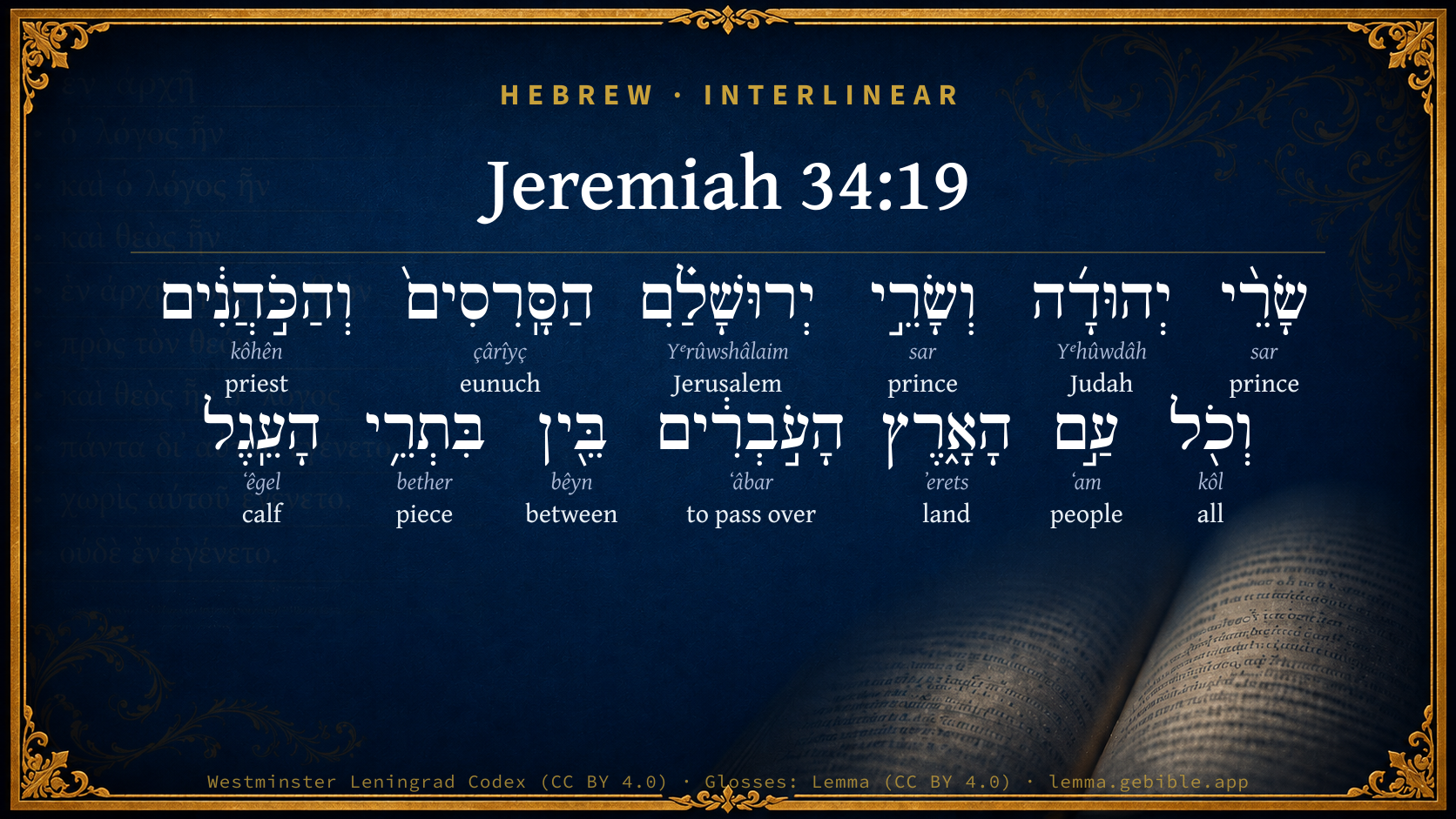
Hebrew (Westminster Leningrad Codex) Jeremiah 34:19 appears in the Hebrew Old Testament. The text above is from the Westminster Leningrad Codex. Each word links to its Strong’s number, a concise gloss, and parsing drawn from the Open Scriptures Hebrew Bible morphology. Click any word for its full Brown-Driver-Briggs (BDB) entry.
Download image
Cite this verse

Jeremiah 34:19 (World English Bible). Public Domain. Lemma interlinear Bible study tool, https://lemma.gebible.app/v/jeremiah/34/19.

Show BibTeX & RIS
BibTeX
RIS
English Translation
the princes of Judah, and the princes of Jerusalem, the eunuchs, and the priests, and all the people of the land, who passed between the parts of the calf;
World English Bible · Public Domain
Download a study sheet

One document with this verse’s original text, its word-by-word gloss line, the meaning frame, cross-references with their text, attributed commentary, and full source and license credits — printable, and it pastes into notes with its structure intact.

This verse Autodidact and up

Study sheet (.html) Plain text (.txt)

A passage Seminary Student

Up to 50 verses in one chapter. A passage sheet keeps up to 6 commentary sources and 12 cross-references per verse, in the order this page ranks them, and says so on the sheet whenever that leaves anything out. Ask for a single verse and you get the Autodidact verse sheet above.

Everything on this page stays free to read, with no account — the sheet is a download of what is already on screen, not access to it.

Want to remove ads? Support Godless Engineer
Compare translations 3

The same verse in 3 English versions, stacked beneath the original-language interlinear above. Click any original word for its lexicon entry.

Each is an independent rendering of the whole verse — the interlinear is not word-aligned to these translations.

Highlighted words mark where these versions differ — a whole-verse word diff, not a word-by-word alignment.

  • World English Bible Public Domain
    the princes of Judah, and the princes of Jerusalem, the eunuchs, and the priests, and all the people of the land, who passed between the parts of the calf;
  • King James Version Public Domain
    The princes of Judah, and the princes of Jerusalem, the eunuchs, and the priests, and all the people of the land, which passed between the parts of the calf;
  • unfoldingWord Literal Text CC BY-SA 4.0
    and then the leaders of Judah and Jerusalem, the eunuchs and the priests, and all the people of the land walked between the parts of the bull.

unfoldingWord Literal Text — © unfoldingWord, licensed CC BY-SA 4.0. Word-aligned USFM3 via Door43 (git.door43.org/unfoldingWord/en_ult).

Versions to compare (up to 4)

3 of 4 selected

Show all 18 translations

Every available English version of this verse, each an independent rendering of the whole verse.

  • World English Bible Public Domain
    the princes of Judah, and the princes of Jerusalem, the eunuchs, and the priests, and all the people of the land, who passed between the parts of the calf;
  • Berean Standard Bible Public Domain
    The officials of Judah and Jerusalem, the court officials, the priests, and all the people of the land who passed between the pieces of the calf,
  • Majority Standard Bible Public Domain
    The officials of Judah and Jerusalem, the court officials, the priests, and all the people of the land who passed between the pieces of the calf,
  • King James Version Public Domain
    The princes of Judah, and the princes of Jerusalem, the eunuchs, and the priests, and all the people of the land, which passed between the parts of the calf;
  • American Standard Version (1901) Public Domain
    the princes of Judah, and the princes of Jerusalem, the eunuchs, and the priests, and all the people of the land, that passed between the parts of the calf;
  • Revised Version (1885) Public Domain
    the princes of Judah, and the princes of Jerusalem, the eunuchs, and the priests, and all the people of the land, which passed between the parts of the calf;
  • Geneva Bible (1599) Public Domain
    The princes of Iudah, and the princes of Ierusalem, the Eunuches, and the Priestes, and all the people of the lande, which passed betweene the partes of the calfe,
  • Douay-Rheims (1899) Public Domain
    The princes of Juda, and the princes of Jerusalem, the eunuchs, and the priests, and all the people of the land that passed between the parts of the calf:
  • Young's Literal Translation Public Domain
    heads of Judah, and heads of Jerusalem, the officers, and the priests, and all the people of the land those passing through between the pieces of the calf --
  • Literal Standard Version CC BY-SA 4.0
    heads of Judah, and heads of Jerusalem, the officers, and the priests, and all the people of the land who had passed through between the pieces of the calf—
  • Unlocked Literal Bible CC BY-SA 4.0
    and then the leaders of Judah and Jerusalem, the eunuchs and the priests, and all the people of the land walked between the parts of the bull.
  • unfoldingWord Literal Text CC BY-SA 4.0
    and then the leaders of Judah and Jerusalem, the eunuchs and the priests, and all the people of the land walked between the parts of the bull.
  • Darby Bible Public Domain
    -- the princes of Judah and the princes of Jerusalem, the eunuchs, and the priests, and all the people of the land, that passed between the parts of the calf;
  • World Messianic Bible Public Domain
    the princes of Judah, the princes of Jerusalem, the eunuchs, the priests, and all the people of the land, who passed between the parts of the calf.
  • Webster's Bible Public Domain
    The princes of Judah, and the princes of Jerusalem, the eunuchs, and the priests, and all the people of the land, who passed between the parts of the calf;
  • Free Bible Version CC BY-SA 4.0
    I will hand them over to their enemies who are trying to kill them. This includes the leaders of Judah and Jerusalem, the court officials, the priests, and everyone else who passed between the pieces of the calf.
  • Bible in Basic English Public Domain
    The rulers of Judah and the rulers of Jerusalem, the unsexed servants and the priests and all the people of the land who went between the parts of the ox,
  • JPS Tanakh (1917) Public Domain
    the princes of Judah, and the princes of Jerusalem, the officers, and the priests, and all the people of the land, that passed between the parts of the calf;

Literal Standard Version (2020), Covenant Press — licensed CC BY-SA 4.0. Text via the HelloAO Bible API (eBible.org). Unlocked Literal Bible (unfoldingWord) — licensed CC BY-SA 4.0. Text via the HelloAO Bible API (eBible.org). unfoldingWord Literal Text — © unfoldingWord, licensed CC BY-SA 4.0. Word-aligned USFM3 via Door43 (git.door43.org/unfoldingWord/en_ult). Free Bible Version, Dr. Jonathan Gallagher — licensed CC BY-SA 4.0. Text via the HelloAO Bible API (eBible.org).

Word by word

More ways to search: Search by grammar → Find every occurrence → Compare this word →

Practice this passage: Drill this verse → Learn its vocabulary →

בִּתְרֵ֥י
bether
H1335
“pieces of”
Noun, Common, Masculine, Plural, Construct
Part of Speech
Noun
Type
Common
Gender
Masculine
Number
Plural
State
Construct
Full BDB Definition

Origin: from H1334

TWOT: 297a

part, piece - of the parts of an animal cut in half for a sacrifice
  1. שָׂרֵ֨י sar H8269 “princes of” Noun, Common, Masculine, Plural, Construct
  2. יְהוּדָ֜ה Yᵉhûwdâh H3063 “Judah” Noun, Proper
  3. וְשָׂרֵ֣י sar H8269 “and · princes of” Conjunction + Noun, Common, Masculine, Plural, Construct
  4. יְרוּשָׁלִַ֗ם Yᵉrûwshâlaim H3389 “Jerusalem” Noun, Proper
  5. הַסָּֽרִסִים֙ çârîyç H5631 “the · eunuchs” Particle, Definite Article + Noun, Common, Masculine, Plural, Absolute
  6. וְהַכֹּ֣הֲנִ֔ים kôhên H3548 “and · the · priests” Conjunction + Particle, Definite Article + Noun, Common, Masculine, Plural, Absolute
  7. וְכֹ֖ל kôl H3605 “and · all of” Conjunction + Noun, Common, Masculine, Singular, Construct
  8. עַ֣ם ʻam H5971 “people of” Noun, Common, Masculine, Singular, Construct
  9. הָאָ֑רֶץ ʼerets H776 “the · land” Particle, Definite Article + Noun, Common, Both, Singular, Absolute
  10. הָעֹ֣בְרִ֔ים ʻâbar H5674 “the · passing over” Particle, Definite Article + Verb, Qal, Participle Active, Masculine, Plural, Absolute
  11. בֵּ֖ין bêyn H996 “between” Preposition
  12. הָעֵֽגֶל ʻêgel H5695 “the · calf” Particle, Definite Article + Noun, Common, Masculine, Singular, Absolute

About this verse

These counts appear in no published source. They are computed here, from the morphology-tagged text and Lemma’s own curated glosses. What Lemma adds →

13
words
12
distinct lemmas
Prophets
section

Notable vocabulary

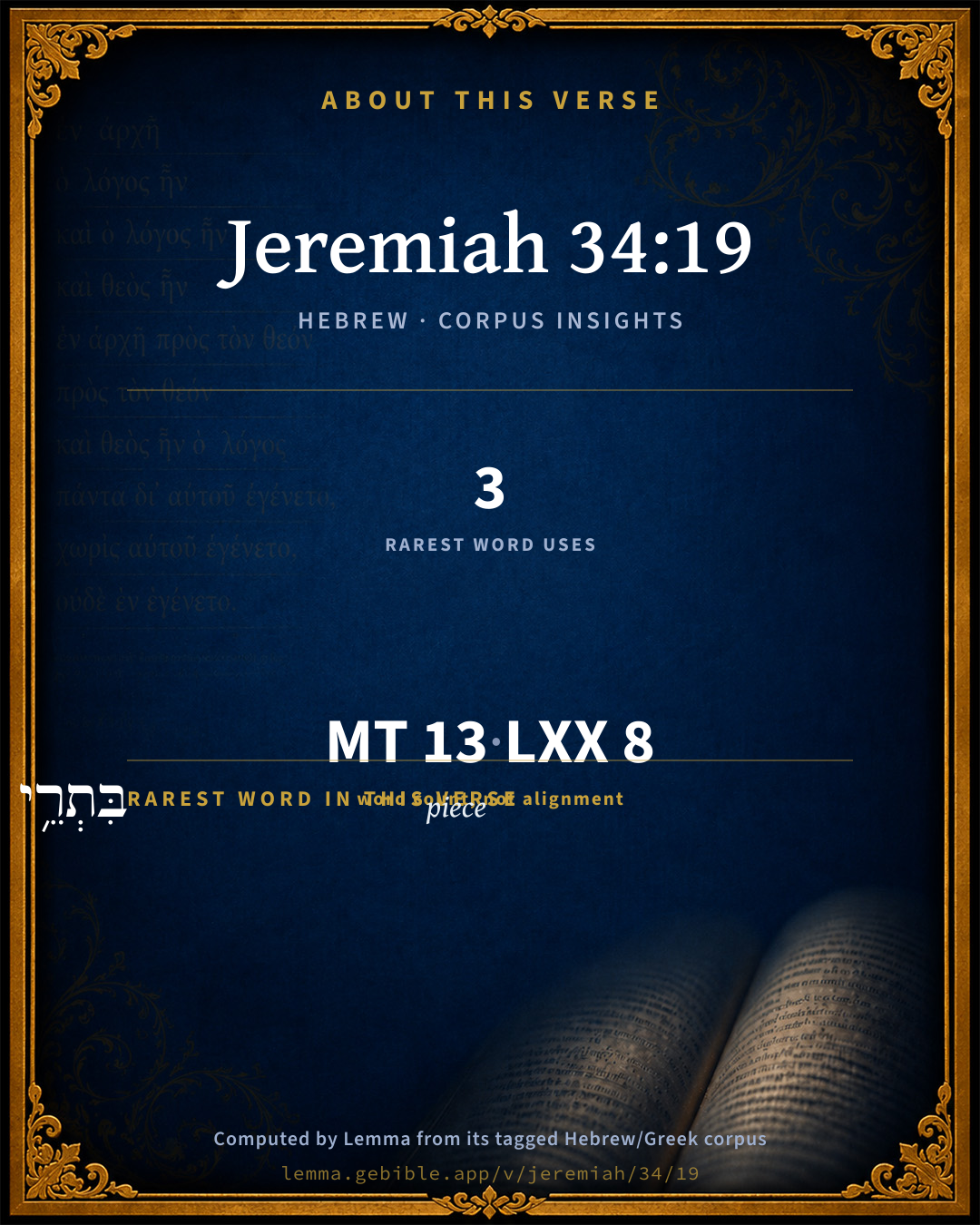
The rarest word here is בִּתְרֵ֥י piece H1335 — appearing just 3 times in the whole Hebrew Bible.

Shared distinctive vocabulary

בִּתְרֵ֥י piece H1335 occurs in 3 verses of the Hebrew Bible. Also found in:

Grammatical profile

  • 1 verb
  • 11 nouns
  • 1 preposition

Verb forms

  • הָעֹ֣בְרִ֔ים Qal · Participle Active

Repetition

A word recurs within this verse — often emphatic in Hebrew:

  • שָׂרֵ֨י prince H8269 ×2

Hebrew & Septuagint length

In the original languages it is 13 Hebrew tokens and 8 Greek tokens — but the two are counted differently (Hebrew bundles its prefixes and suffixes into one token; the Greek is in lemma form), so that isn’t a like-for-like length.

Cross-references

11

Topical passages linked to Jeremiah 34:19 in the Treasury of Scripture Knowledge — connected by theme and wording, ordered by reader-vote popularity; previews shown in the World English Bible.

  • Jeremiah 34:10 All the princes and all the people obeyed, who had entered into the covenant, that everyone should let his man-servant, and everyone his maid-servant, go free, that none should make bondservants of them any more; they obeyed, and let them go:
  • Zephaniah 3:3–4 Her princes in the midst of her are roaring lions. Her judges are evening wolves. They leave nothing until the next day.
  • 2 Kings 24:12 and Jehoiachin the king of Judah went out to the king of Babylon, he, and his mother, and his servants, and his princes, and his officers: and the king of Babylon took him in the eighth year of his reign.
  • 2 Kings 24:15 He carried away Jehoiachin to Babylon; and the king's mother, and the king's wives, and his officers, and the chief men of the land, carried he into captivity from Jerusalem to Babylon.
  • Jeremiah 29:2 (after that Jeconiah the king, and the queen-mother, and the eunuchs, [and] the princes of Judah and Jerusalem, and the craftsmen, and the smiths, were departed from Jerusalem),
  • Jeremiah 38:7 Now when Ebedmelech the Ethiopian, a eunuch, who was in the king's house, heard that they had put Jeremiah in the dungeon (the king then sitting in the gate of Benjamin),
  • Ezekiel 22:27–31 Her princes in the midst of it are like wolves ravening the prey, to shed blood, [and] to destroy souls, that they may get dishonest gain.
  • Daniel 9:6 neither have we listened to your servants the prophets, who spoke in your name to our kings, our princes, and our fathers, and to all the people of the land.
  • Daniel 9:12 He has confirmed his words, which he spoke against us, and against our judges who judged us, by bringing on us a great evil; for under the whole sky has not been done as has been done on Jerusalem.
  • Micah 7:1–5 Misery is mine! Indeed, I am like one who gathers the summer fruits, as gleanings of the vinyard: There is no cluster of grapes to eat. My soul desires to eat the early fig.
  • Daniel 9:8 Lord, to us belongs confusion of face, to our kings, to our princes, and to our fathers, because we have sinned against you.

Cross-references courtesy of OpenBible.info (CC BY 4.0).

Hebrew and Greek witnesses Masoretic Hebrew ↔ Greek Septuagint

The same verse in the two great witnesses to the Old Testament, shown verse-for-verse.

These are two independent witnesses, not word-aligned to each other, and the Septuagint is shown in lemma (dictionary) form.

Hebrew Jeremiah 34:19 Masoretic · Westminster Leningrad Codex

שָׂרֵ֨י יְהוּדָ֜ה וְשָׂרֵ֣י יְרוּשָׁלִַ֗ם הַסָּֽרִסִים֙ וְהַכֹּ֣הֲנִ֔ים וְכֹ֖ל עַ֣ם הָאָ֑רֶץ הָעֹ֣בְרִ֔ים בֵּ֖ין בִּתְרֵ֥י הָעֵֽגֶל

the princes of Judah, and the princes of Jerusalem, the eunuchs, and the priests, and all the people of the land, who passed between the parts of the calf;

World English Bible · Public Domain

Greek LXX Structure differs

In the Septuagint, Jeremiah is about an eighth shorter than the Hebrew and arranges its material differently — the Oracles Against the Nations (Hebrew chapters 46–51) appear in the middle of the Greek book, after 25:13. Because the chapter and verse boundaries do not line up, a verse-for-verse comparison with the Hebrew is not shown.

A verse-for-verse comparison isn’t shown here because the chapters and verses don’t line up. Switch to the LXX edition with the MT / LXX toggle above to read the Greek directly.

Hebrew: Westminster Leningrad Codex (CC BY 4.0). Greek: Septuagint (public domain); English from a public-domain English Septuagint. How the Septuagint differs from the Hebrew →

Targum (Aramaic paraphrase)

1

The Targum is the ancient Jewish Aramaic paraphrase of the Hebrew Scriptures — an interpretive translation, not the Hebrew text itself. Onkelos (literal) and Pseudo-Jonathan (expansive) render the Torah, and Jonathan the Prophets. Coverage is partial: where no permissively-licensed English translation exists for a verse, only the Aramaic is shown. This is verse-level text, not a word-by-word alignment to the Hebrew.

  1. Targum Jonathan Prophets (Joshua–Malachi)
    רַבְרְבֵי יְהוּדָה וְרַבְרְבֵי יְרוּשְׁלֵם וְרַבְרְבַיָא וְכַהֲנַיָא וְכָל עַמָא דְאַרְעָא דַעֲבָרוּ בֵּין פַּלְגֵי עֶגְלָא:

    (no public-domain English translation for this verse)

    Targum Jonathan — Aramaic: “Mikraot Gedolot” (public domain). English: “Sefaria Community Translation” (CC0 1.0 (public-domain dedication)); “London "Chaldee Paraphrase," 1871” (public domain). Text via Sefaria.

Commentary

Notes on Jeremiah 34:19 from classic Christian and Jewish commentators (each source and its license shown beneath its notes). The classic Christian expositions comment on the surrounding passage and are grouped to its opening verse, so a note may address several verses; the Jewish commentaries on the Tanakh (Rashi and others) are per-verse, so they appear only where the commentator wrote on this verse.

Lemma curates 59 commentaries, every one of them public domain or Creative Commons licensed, each selected and text-cleaned for this edition rather than reprinted as found. About our sources →

Trapp's Complete Commentary

John Trapp

Jer 34:19 The princes of Judah, and the princes of Jerusalem, the eunuchs, and the priests, and all the people of the land, which passed between the parts of the calf;

Ver. 19. The princes of Judah.] These were most of them cut in pieces by the King of Babylon, as the calf had been.

John Trapp, A Commentary or Exposition upon All the Books of the Old and New Testament (1647–1656) — public domain. Text from a community e-Sword module.

Joseph Benson's Commentary

Jer 34:19-22. The princes of Judah, &c., (see Jer 29:2,) the eunuchs — The officers belonging to the court; the priests and all the people which passed between the parts of the calf — Assenting to the solemn and awful imprecation, Let us in like manner be cut in pieces if we do not perform what we now promise. I will even give them into the hand of their enemies, &c. — God does not here threaten all the Jews, but those only who had first made, and then broken, this solemn covenant, and thereby falsified their engagements, and dealt treacherously with him. The king and nobles, and great courtiers, as well as the people, he would give into the hand of their enemies, who sought, not their wealth only, or their service, but their lives: and who should obtain what they sought; and, not content therewith, should leave their dead bodies lying unburied upon the face of the earth, a loathsome spectacle to all mankind, and an easy prey to the fowls of the heaven and the beasts of the earth. Thus doth the Lord execute justice, without respect of persons, on all that do wickedly, and who will neither be won by his mercies, nor be brought to obey him by a dread of his wrath. Behold, I will command, and cause them to return to this city — Namely, the king of Babylon’s army, which had departed for a season, having gone to meet the army of the king of Egypt. I will put it into their hearts to return, saith the Lord, to the siege, and they shall leave it no more till they have taken the city, and burned it with fire, and made the whole country desolate. The motions of armies are under the government of Divine Providence, they are all at God’s command; when he bids them come they come, and they shall certainly effect what he hath determined to be done. When we come to chapter 39. we shall read of the fulfilment of this prophecy. Observe here, reader, 1st, As an humble confidence in God is a hopeful presage of approaching deliverance, so security in sin is a sad omen of approaching destruction. 2d, When judgments are removed from a people before they have done their work, and leave them unhumbled and unreformed, they do but retreat to come on again with so much the greater force; for when God judges he will overcome. 3d, It is just with God to disappoint those expectations of mercy which his providence had excited, when we disappoint those expectations of duty which our professions, pretensions, and fair promises had given cause for. If we repent of the good we had promised, God will repent of the good he had purposed. The froward are an abomination to the Lord. With the froward he will show himself froward.

Joseph Benson's Commentary on the Old and New Testaments (1811–1818) — public domain. Text from a community e-Sword module.

John Calvin's Commentaries

He adds, The princes of Judah and the princes of Jerusalem, etc. He does not here name them as though they were different persons, but he speaks by way of amplifying. He then says that he would punish these chief men, lest they should think themselves to be exempted, because they were superior to others in rank and honor; for we know that those who are elevated in the world are so filled with pride, that they deem themselves as free from all laws. This, then, is the reason why God expressly names the princes and the eunuchs. But he does not mean by the eunuchs those who had been emasculated, as we have stated already in several places. The chief men were called by this name, סרסים serasim.

He mentions the princes of Jerusalem, because they were especially proud, on account of their privileges as citizens; for in Jerusalem was the royal residence and the sanctuary of God. But the Prophet declares that their lot would be nothing better than that of the common people, because God would not suffer his holy name to be a mockery and all equity to be violated, and especially the covenant made in his name to be deemed as nothing, and rendered wholly void. At length he names the whole people; whosoever, he says, have passed between the parts of the calf, shall be punished. It follows —

John Calvin's Commentaries (1540-1563) — public domain. Text from the Calvin Translation Society English edition (1840s-50s) via the Christian Classics Ethereal Library (ccel.org). Calvin's coverage is partial (roughly two-thirds of the Bible); uncommented books and verses are honest gaps, never fabricated. The 19th-century editor's footnotes and remarks are omitted so the notes are faithfully Calvin's own voice.

Ellicott's Commentary for English Readers

(19) The eunuchs.—See Note on Jer_29:2. They were for the most part, if not always, of alien birth (comp. Isa_56:3), as in the case of Ebed-melech (Jer_38:7), who had become proselytes on entering the king’s service. The prominence given to them indicates that in Judah as in Assyria, and we may add, in all Oriental monarchies, they held high position in the king’s court, and had probably, like the princes of Judah and Jerusalem, enriched themselves by lending money to the poorer Israelites, and then bringing them into bondage. It is significant that here they take precedence of the priests, as in Jer_29:2 of the princes.

A Bible Commentary for English Readers, edited by Charles John Ellicott (1878–1897) — public domain. Text from a community e-Sword module.

John Gill's Exposition

The princes of Judah, and the princes of Jerusalem,.... Here is a particular enumeration of the persons that had made the covenant, and transgressed it, and that should suffer for so doing; the princes of Judah, distinguished from the princes of Jerusalem, design such princes as lived without Jerusalem, in the cities of Judah, and presided over them, though now at Jerusalem, having fled thither, upon the invasion of the king of Babylon, for their safety; as the princes of Jerusalem, or the magistrates of that city, are distinguished from the princes of the blood, and from the courtiers, both in this and Jer 34:21;

the eunuchs, and the priests, and all the people of the land; that is, as many as had got into Jerusalem to secure themselves from the common enemy: the "priests" also were concerned herein, who had menservants, and maidservants, as well as others; and, besides, were persons doubtless concerned in drawing up the covenant and the form of an oath, as well as in slaying the sacrifice, and cutting it into pieces, and laying the parts in order: it is more surprising that there should be "eunuchs" here; that such should be in the court of the king of Judah, and have offices in it, and preside in them, as among the Gentiles. The Targum renders the word "princes":

which passed between the parts of the calf; signifying their assent to the covenant, and wishing they might be so used if they broke it.

John Gill's Exposition of the Whole Bible (1746–1763) — public domain (CC PDM 1.0). Text via the HelloAO Bible API.

Haydock's Catholic Bible Commentary

Eunuchs, chief officers. One was at the head of the army, 4 Kings xxv. 19.

George Leo Haydock (1774–1849), Haydock's Catholic Family Bible and Commentary, 1859 edition — public domain. Excludes Psalms (Douay-Rheims chapter numbering differs from Protestant) and Deuterocanonical books (Catholic canon only).

Lesson kit

Teaching starters — assembled from the data on this page, not authored interpretation. Every prompt links to the verse data it draws on. Edit before teaching.

Jeremiah, in the Prophets, opens this verse with 13 words (12 distinct Hebrew lemmas). Its most distinctive word is bether (“piece”). A historical commentator’s framing appears above. Read the whole chapter for the surrounding context.

Discussion questions

  1. What does “piece” (bether) contribute to the verse as a whole?
  2. Genesis 15:10 shares the word «piece» with this verse. How do the two illuminate each other?
  3. “prince” occurs 2× in this one verse. What is the effect of the repetition?
  4. The translations on this page render this verse differently — a whole-verse word diff, not a word-by-word alignment. What might account for the different wordings?
  5. The verb «הָעֹ֣בְרִ֔ים» is Qal Participle Active. How does its form color the action?
  6. Reading how Trapp's Complete Commentary and Joseph Benson's Commentary read this verse, where do the two commentators agree and where do they part?

Things to notice

Reading settings

Reading text

Shown beneath each verse's original-language words.

Old Testament
Old Testament edition

Read the OT as the Masoretic Hebrew (MT) or the Greek Septuagint (LXX).

English shown for the Greek Septuagint (in the Hebrew ↔ Greek comparison).

Comparing translations? Open the Compare panel on any verse page to stack up to four side by side.