
Leviticus 27:14

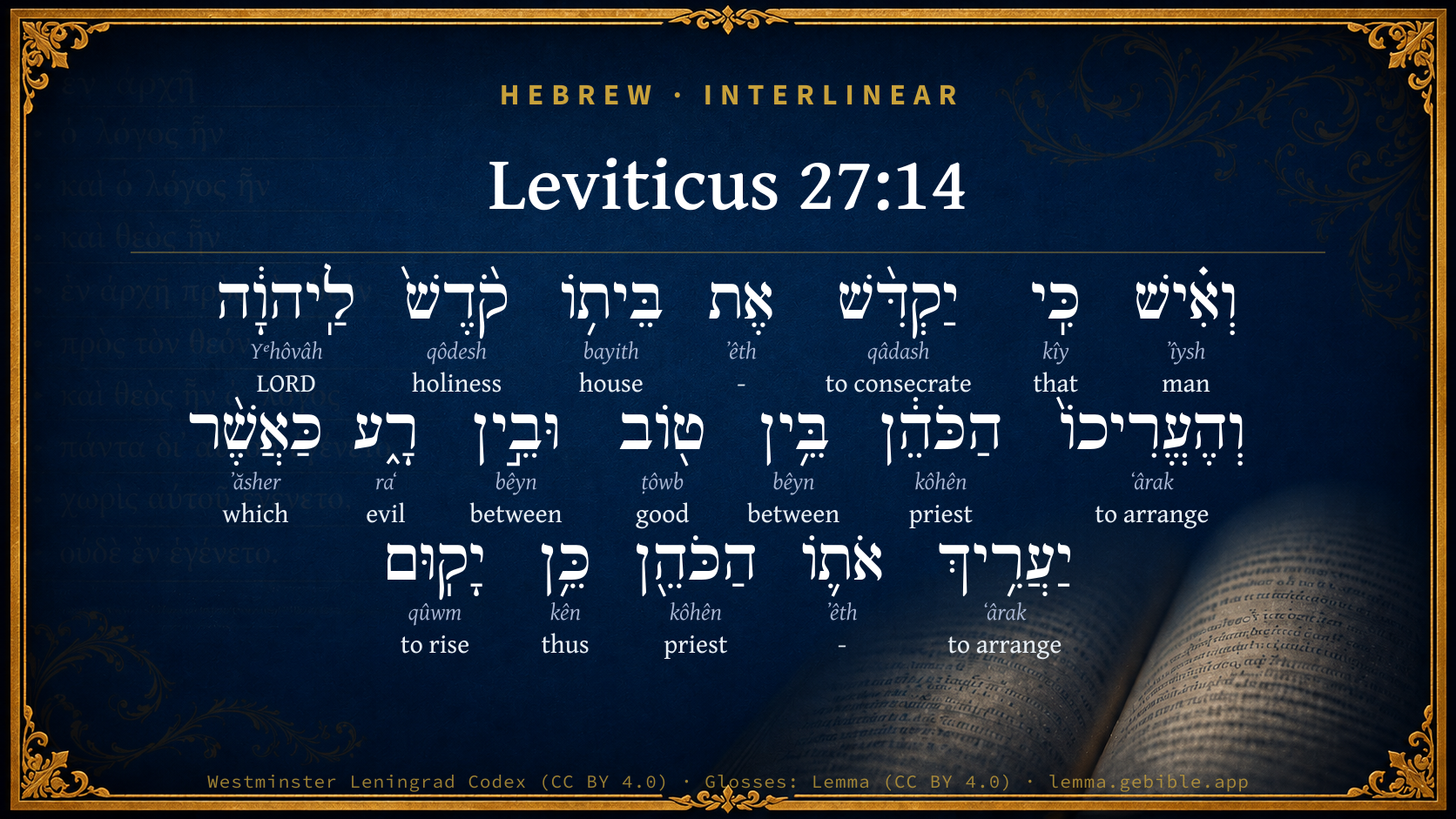
Hebrew (Westminster Leningrad Codex) Leviticus 27:14 appears in the Hebrew Old Testament. The text above is from the Westminster Leningrad Codex. Each word links to its Strong’s number, a concise gloss, and parsing drawn from the Open Scriptures Hebrew Bible morphology. Click any word for its full Brown-Driver-Briggs (BDB) entry.
Download image
Cite this verse

Leviticus 27:14 (World English Bible). Public Domain. Lemma interlinear Bible study tool, https://lemma.gebible.app/v/leviticus/27/14.

Show BibTeX & RIS
BibTeX
RIS
English Translation
"'When a man dedicates his house to be holy to Yahweh, then the priest shall evaluate it, whether it is good or bad: as the priest shall evaluate it, so shall it stand.
World English Bible · Public Domain
Download a study sheet

One document with this verse’s original text, its word-by-word gloss line, the meaning frame, cross-references with their text, attributed commentary, and full source and license credits — printable, and it pastes into notes with its structure intact.

This verse Autodidact and up

Study sheet (.html) Plain text (.txt)

A passage Seminary Student

Up to 50 verses in one chapter. A passage sheet keeps up to 6 commentary sources and 12 cross-references per verse, in the order this page ranks them, and says so on the sheet whenever that leaves anything out. Ask for a single verse and you get the Autodidact verse sheet above.

Everything on this page stays free to read, with no account — the sheet is a download of what is already on screen, not access to it.

Want to remove ads? Support Godless Engineer
Compare translations 3

The same verse in 3 English versions, stacked beneath the original-language interlinear above. Click any original word for its lexicon entry.

Each is an independent rendering of the whole verse — the interlinear is not word-aligned to these translations.

Highlighted words mark where these versions differ — a whole-verse word diff, not a word-by-word alignment.

  • World English Bible Public Domain
    "'When a man dedicates his house to be holy to Yahweh, then the priest shall evaluate it, whether it is good or bad: as the priest shall evaluate it, so shall it stand.
  • King James Version Public Domain
    And when a man shall sanctify his house to be holy unto the LORD, then the priest shall estimate it, whether it be good or bad: as the priest shall estimate it, so shall it stand.
  • unfoldingWord Literal Text CC BY-SA 4.0
    And a man when he consecrates his house holy to Yahweh, then the priest will value it between good and between bad. Just as the priest will value it, so it will stand.

unfoldingWord Literal Text — © unfoldingWord, licensed CC BY-SA 4.0. Word-aligned USFM3 via Door43 (git.door43.org/unfoldingWord/en_ult).

Versions to compare (up to 4)

3 of 4 selected

Show all 18 translations

Every available English version of this verse, each an independent rendering of the whole verse.

  • World English Bible Public Domain
    "'When a man dedicates his house to be holy to Yahweh, then the priest shall evaluate it, whether it is good or bad: as the priest shall evaluate it, so shall it stand.
  • Berean Standard Bible Public Domain
    Now if a man consecrates his house as holy to the LORD, then the priest shall value it either as good or bad. The price will stand just as the priest values it.
  • Majority Standard Bible Public Domain
    Now if a man consecrates his house as holy to the LORD, then the priest shall value it either as good or bad. The price will stand just as the priest values it.
  • King James Version Public Domain
    And when a man shall sanctify his house to be holy unto the LORD, then the priest shall estimate it, whether it be good or bad: as the priest shall estimate it, so shall it stand.
  • American Standard Version (1901) Public Domain
    And when a man shall sanctify his house to be holy unto Jehovah, then the priest shall estimate it, whether it be good or bad: as the priest shall estimate it, so shall it stand.
  • Revised Version (1885) Public Domain
    And when a man shall sanctify his house to be holy unto the LORD, then the priest shall estimate it, whether it be good or bad: as the priest shall estimate it, so shall it stand.
  • Geneva Bible (1599) Public Domain
    Also whe a man shall dedicate his house to be holy vnto the Lord, then the Priest shall value it, whether it be good or bad, and as ye Priest shall prise it, so shall the value be.
  • Douay-Rheims (1899) Public Domain
    If a man shall vow his house, and sanctify it to the Lord, the priest shall consider it, whether it be good or bad, and it shall be sold according to the price, which he shall appoint.
  • Young's Literal Translation Public Domain
    `And when a man sanctifieth his house, a holy thing to Jehovah, then hath the priest valued it, whether good or bad; as the priest doth value it so it standeth;
  • Literal Standard Version CC BY-SA 4.0
    And when a man sanctifies his house [as] a holy thing to YHWH, then the priest has valued it, whether good or bad; as the priest values it so it stands;
  • Unlocked Literal Bible CC BY-SA 4.0
    When a man sets apart his house as a holy gift to Yahweh, then the priest will set its value as either good or bad. Whatever the priest values it, so it will be.
  • unfoldingWord Literal Text CC BY-SA 4.0
    And a man when he consecrates his house holy to Yahweh, then the priest will value it between good and between bad. Just as the priest will value it, so it will stand.
  • Darby Bible Public Domain
    And when any one halloweth his house, that it may be holy to Jehovah, the priest shall value it, [judging] between good and bad: as the priest shall value it, so shall it stand.
  • World Messianic Bible Public Domain
    “‘When a man dedicates his house to be holy to the LORD, then the priest shall evaluate it, whether it is good or bad. As the priest evaluates it, so it shall stand.
  • Webster's Bible Public Domain
    And when a man shall sanctify his house to be holy to the LORD, then the priest shall estimate it, whether it is good or bad: as the priest shall estimate it, so shall it stand.
  • Free Bible Version CC BY-SA 4.0
    If you dedicate your house as holy to the Lord, then the priest will decide its value, whether high or low. Whatever value the priest places on it remains final.
  • Bible in Basic English Public Domain
    And if a man has given his house as holy to the Lord, then the priest will put a value on it, if it is good or bad; as the priest gives decision so will the value be fixed.
  • JPS Tanakh (1917) Public Domain
    And when a man shall sanctify his house to be holy unto the LORD, then the priest shall value it, whether it be good or bad; as the priest shall value it, so shall it stand.

Literal Standard Version (2020), Covenant Press — licensed CC BY-SA 4.0. Text via the HelloAO Bible API (eBible.org). Unlocked Literal Bible (unfoldingWord) — licensed CC BY-SA 4.0. Text via the HelloAO Bible API (eBible.org). unfoldingWord Literal Text — © unfoldingWord, licensed CC BY-SA 4.0. Word-aligned USFM3 via Door43 (git.door43.org/unfoldingWord/en_ult). Free Bible Version, Dr. Jonathan Gallagher — licensed CC BY-SA 4.0. Text via the HelloAO Bible API (eBible.org).

Word by word

More ways to search: Search by grammar → Find every occurrence → Compare this word →

Practice this passage: Drill this verse → Learn its vocabulary →

וְהֶעֱרִיכוֹ֙
ʻârak
H6186
“and · to arrange · him”
Conjunction + Verb, Hiphil, Sequential Perfect, 3rd Person, Masculine, Singular + Suffix, Personal, 3rd Person, Masculine, Singular
Part of Speech
Conjunction + Verb
Stem
Hiphil
Form
Sequential Perfect
Person
3rd Person
Gender
Masculine
Number
Singular
Full BDB Definition

Origin: a primitive root

TWOT: 1694

to arrange, set or put or lay in order, set in array, prepare, order, ordain, handle, furnish, esteem, equal, direct, compare - (Qal) - to arrange or set or lay in order, arrange, state in order, set forth (a legal case), set in place - to compare, be comparable - (Hiphil) to value, tax
  1. וְאִ֗ישׁ ʼîysh H376 “and · man” Conjunction + Noun, Common, Masculine, Singular, Absolute
  2. כִּֽי kîy H3588 “that” Conjunction
  3. יַקְדִּ֨שׁ qâdash H6942 “to consecrate” Verb, Hiphil, Imperfect, 3rd Person, Masculine, Singular
  4. אֶת ʼêth H853 “-” Particle, Direct Object
  5. בֵּית֥וֹ bayith H1004 “house · his” Noun, Common, Masculine, Singular, Construct + Suffix, Personal, 3rd Person, Masculine, Singular
  6. קֹ֨דֶשׁ֙ qôdesh H6944 “holiness” Noun, Common, Masculine, Singular, Absolute
  7. לַֽיהוָ֔ה Yᵉhôvâh H3068 “to/for · LORD” Preposition + Noun, Proper
  8. הַכֹּהֵ֔ן kôhên H3548 “the · priest” Particle, Definite Article + Noun, Common, Masculine, Singular, Absolute
  9. בֵּ֥ין bêyn H996 “between” Preposition
  10. ט֖וֹב ṭôwb H2896 “good” Adjective, Adjective, Masculine, Singular, Absolute
  11. וּבֵ֣ין bêyn H996 “and · between” Conjunction + Preposition
  12. רָ֑ע raʻ H7451 “evil” Adjective, Adjective, Masculine, Singular, Absolute
  13. כַּאֲשֶׁ֨ר ʼăsher H834 “like/as · which” Preposition + Particle, Relative
  14. יַעֲרִ֥יךְ ʻârak H6186 “to arrange” Verb, Hiphil, Imperfect, 3rd Person, Masculine, Singular
  15. אֹת֛וֹ ʼêth H853 “- · him” Particle, Direct Object + Suffix, Personal, 3rd Person, Masculine, Singular
  16. הַכֹּהֵ֖ן kôhên H3548 “the · priest” Particle, Definite Article + Noun, Common, Masculine, Singular, Absolute
  17. כֵּ֥ן kên H3651 “thus” Particle, Demonstrative
  18. יָקֽוּם qûwm H6965 “to rise” Verb, Qal, Imperfect, 3rd Person, Masculine, Singular

About this verse

These counts appear in no published source. They are computed here, from the morphology-tagged text and Lemma’s own curated glosses. What Lemma adds →

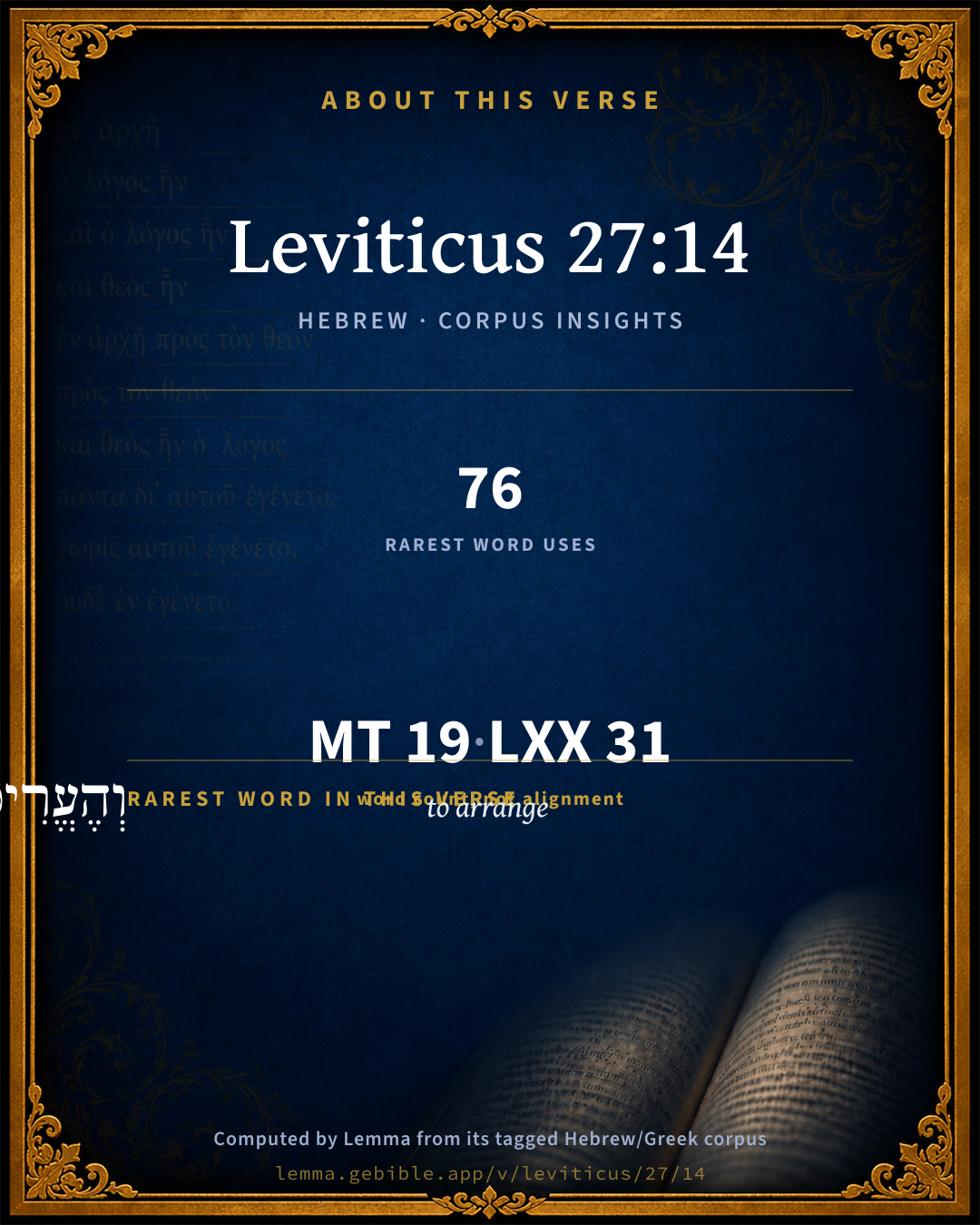
19
words
15
distinct lemmas
Pentateuch
section

Grammatical profile

  • 4 verbs
  • 6 nouns
  • 2 adjectives
  • 2 prepositions
  • 1 conjunction
  • 4 particles

Verb forms

  • יַקְדִּ֨שׁ Hiphil · Imperfect
  • וְהֶעֱרִיכוֹ֙ Hiphil · Sequential Perfect
  • יַעֲרִ֥יךְ Hiphil · Imperfect
  • יָקֽוּם Qal · Imperfect

Repetition

Words recur within this verse — often emphatic in Hebrew:

  • וְהֶעֱרִיכוֹ֙ to arrange H6186 ×2
  • הַכֹּהֵ֔ן priest H3548 ×2
  • בֵּ֥ין between H996 ×2

Hebrew & Septuagint length

In English translation the verse runs 33 words from the Hebrew and 36 from the Septuagint (LXX English) — closely comparable.

A rough comparison of the two English renderings, which tokenize alike — not a word-level alignment.

Word counts can differ between the Hebrew and the Greek without any difference in meaning — e.g. the Hebrew direct-object marker אֵת has no separate Greek word, and Greek often adds the article ὁ.

In the original languages it is 19 Hebrew tokens and 31 Greek tokens — but the two are counted differently (Hebrew bundles its prefixes and suffixes into one token; the Greek is in lemma form), so that isn’t a like-for-like length.

Cross-references

4

Topical passages linked to Leviticus 27:14 in the Treasury of Scripture Knowledge — connected by theme and wording, ordered by reader-vote popularity; previews shown in the World English Bible.

  • Leviticus 25:29–31 "'If a man sells a dwelling house in a walled city, then he may redeem it within a whole year after it has been sold. For a full year he shall have the right of redemption.
  • Leviticus 27:21 but the field, when it goes out in the Jubilee, shall be holy to Yahweh, as a field devoted; it shall be owned by the priests.
  • Numbers 18:14 Everything devoted in Israel shall be yours.
  • Psalms 101:2–7 I will be careful to live a blameless life. When will you come to me? I will walk within my house with a blameless heart.

Cross-references courtesy of OpenBible.info (CC BY 4.0).

Hebrew and Greek witnesses Masoretic Hebrew ↔ Greek Septuagint

The same verse in the two great witnesses to the Old Testament, shown verse-for-verse.

These are two independent witnesses, not word-aligned to each other, and the Septuagint is shown in lemma (dictionary) form.

Hebrew Leviticus 27:14 Masoretic · Westminster Leningrad Codex

וְאִ֗ישׁ כִּֽי יַקְדִּ֨שׁ אֶת בֵּית֥וֹ קֹ֨דֶשׁ֙ לַֽיהוָ֔ה וְהֶעֱרִיכוֹ֙ הַכֹּהֵ֔ן בֵּ֥ין ט֖וֹב וּבֵ֣ין רָ֑ע כַּאֲשֶׁ֨ר יַעֲרִ֥יךְ אֹת֛וֹ הַכֹּהֵ֖ן כֵּ֥ן יָקֽוּם

"'When a man dedicates his house to be holy to Yahweh, then the priest shall evaluate it, whether it is good or bad: as the priest shall evaluate it, so shall it stand.

World English Bible · Public Domain

Greek LXX Leviticus 27:14 Septuagint · lemma form

καί ἄνθρωπος ὅς ἄν ἁγιάζω ὁ οἰκία αὐτός ἅγιος ὁ κύριος καί τιμάω αὐτός ὁ ἱερεύς ἀνά μέσος καλός καί ἀνά μέσος πονηρός ὡς ἄν τιμάω αὐτός ὁ ἱερεύς οὕτως ἵστημι

And whatever man shall consecrate his house as holy to the Lord, the priest shall make a valuation of it between the good and the bad: as the priest shall value it, so shall it stand.

LXX2012 (modern English Septuagint) · Public Domain

Hebrew: Westminster Leningrad Codex (CC BY 4.0). Greek: Septuagint (public domain); English from LXX2012 (modern English Septuagint) (Public Domain). How the Septuagint differs from the Hebrew →

Targum (Aramaic paraphrase)

2

The Targum is the ancient Jewish Aramaic paraphrase of the Hebrew Scriptures — an interpretive translation, not the Hebrew text itself. Onkelos (literal) and Pseudo-Jonathan (expansive) render the Torah, and Jonathan the Prophets. Coverage is partial: where no permissively-licensed English translation exists for a verse, only the Aramaic is shown. This is verse-level text, not a word-by-word alignment to the Hebrew.

  1. Targum Onkelos Torah (Genesis–Deuteronomy)
    וּגְבַר אֲרֵי יַקְדֵשׁ יָת בֵּיתֵהּ קוּדְשָׁא קֳדָם יְיָ וְיִפְרְסִנֵהּ כַּהֲנָא בֵּין טַב וּבֵין בִּישׁ כְּמָא דִי יִפְרוֹס יָתֵהּ כַּהֲנָא כֵּן יְקוּם

    (no public-domain English translation for this verse)

    Targum Onkelos — Aramaic: “Onkelos Genesis” (public domain); “Onkelos Exodus” (public domain); “Onkelos Leviticus” (public domain); “Onkelos Numbers” (public domain); “Onkelos Deuteronomy” (public domain). English: “Sefaria Community Translation” (CC0 1.0 (public-domain dedication)); “J.W. Etheridge. The Targums of Onkelos and Jonathan Ben Uzziel on the Pentateuch. London: Longmans, Green, 1862” (public domain). Text via Sefaria.

  2. Targum Pseudo-Jonathan Torah (Genesis–Deuteronomy)
    וּגְבַר אַרוּם יִקְדַשׁ יַת בֵּיתֵיהּ קוּדְשָׁא קֳדָם יְיָ וְיַעֲלִינֵיהּ כַּהֲנָא בֵּין טַב לְבֵין בִּישׁ הֵיכְמָא דְמַעֲלֵי כַּהֲנָא הֵיכְדִין יְקוּם

    When a man would consecrate his house, as a consecrated thing before the Lord; the priest shall value it, whether good or bad; according as the priest shall estimate, so shall it stand.

    Targum Pseudo-Jonathan — Aramaic: “Targum Jonathan on Genesis” (public domain); “Targum Jonathan on Exodus” (public domain); “Targum Jonathan on Leviticus” (public domain); “Targum Jonathan on Numbers” (public domain); “Targum Jonathan on Deuteronomy” (public domain). English: “The Targum of Jonathan ben Uzziel, trans. J. W. Etheridge, London, 1862” (public domain). Text via Sefaria.

Commentary

Notes on Leviticus 27:14 from classic Christian and Jewish commentators (each source and its license shown beneath its notes). The classic Christian expositions comment on the surrounding passage and are grouped to its opening verse, so a note may address several verses; the Jewish commentaries on the Tanakh (Rashi and others) are per-verse, so they appear only where the commentator wrote on this verse.

Lemma curates 59 commentaries, every one of them public domain or Creative Commons licensed, each selected and text-cleaned for this edition rather than reprinted as found. About our sources →

Matthew Henry's Commentary

Here is the law concerning real estates dedicated to the service of God by a singular vow.

I. Suppose a man, in his zeal for the honour of God, should sanctify his house to God (Lev 27:14), the house must be valued by the priest, and the money got by the sale of it was to be converted to the use of the sanctuary, which by degrees came to be greatly enriched with dedicated things, Kg1 15:15. But, if the owner be inclined to redeem it himself, he must not have it so cheap as another, but must add a fifth part to the price, for he should have considered before he had vowed it, Lev 27:15. To him that was necessitous God would abate the estimation (Lev 27:8); but to him that was fickle and humoursome, and whose second thoughts inclined more to the world and his secular interest than his first, God would rise in the price. Blessed be God, there is a way of sanctifying our houses to be holy unto the Lord, without either selling them or buying them. If we and our houses serve the Lord, if religion rule in them, and we put away iniquity far from them, and have a church in our house, holiness to the Lord is written upon it, it is his, and he will dwell with us in it.

II. Suppose a man should sanctify some part of his land to the Lord, giving it to pious uses, then a difference must be made between land that came to the donor by descent and that which came by purchase, and accordingly the case altered.

1. If it was the inheritance of his fathers, here called the field of his possession, which pertained to his family from the first division of Canaan, he might not give it all, no, not to the sanctuary; God would not admit such a degree of zeal as ruined a man's family. But he might sanctify or dedicate only some part of it, Lev 27:16. And in that case, (1.) The land was to be valued (as our countrymen commonly compute land) by so many measures' sowing of barley. So much land as would take a homer, or chomer, of barley, which contained ten ephahs, Eze 45:11 (not, as some have here mistaken it, an omer, which was but a tenth part of an ephah, Exo 16:36), was valued at fifty shekels, a moderate price (Lev 27:16), and that if it were sanctified immediately from the year of jubilee, Lev 27:17. But, if some years after, there was to be a discount accordingly, even of that price, Lev 27:18. And, (2.) When the value was fixed, the donor might, if he pleased, redeem it for sixty shekels the homer's sowing, which was with the addition of a fifth part: the money then went to the sanctuary, and the land reverted to him that had sanctified it, Lev 27:19. But if he would not redeem it, and the priest sold it to another, then at the year of jubilee, beyond which the sale could not go, the land came to the priests, and was theirs for ever, Lev 27:20, Lev 27:21. Note, What is given to the Lord ought not to be given with a power of revocation; what is devoted to the Lord must be his for ever, by a perpetual covenant.

2. If the land was his own purchase, and came not to him from his ancestors, then not the land itself, but the value of it was to be given to the priests for pious uses, Lev 27:22, Lev 27:24. It was supposed that those who, by the blessing of God, had grown so rich as to become purchasers would think themselves obliged in gratitude to sanctify some part of their purchase, at least (and here they are not limited, but they might, if they pleased, sanctify the whole), to the service of God. For we ought to give as God prospers us, Co1 16:2. Purchasers are in a special manner bound to be charitable. Now, forasmuch as purchased lands were by a former law to return at the year of jubilee to the family from which they were purchased, God would not have that law and the intentions of it defeated by making the lands corban, a gift, Mar 7:11. But it was to be computed how much the land was worth for so many years as were from the vow to the jubilee; for only so long it was his own, and God hates robbery for burnt-offerings. We can never acceptably serve God with that of which we have wronged our neighbour. And so much money he was to give for the present, and keep the land in his own hands till the year of jubilee, when it was to return free of all encumbrances, even that of its being dedicated to him of whom it was bought. The value of the shekel by which all these estimations were to be made is here ascertained (Lev 27:25); it shall be twenty gerahs, and every gerah was sixteen barley-corns. This was fixed before (Exo 30:13); and, whereas there had been some alterations, it is again fixed in the laws of Ezekiel's visionary temple (Eze 45:12), to denote that the gospel should reduce things to their ancient standard.

Matthew Henry's Commentary on the Whole Bible (1708–1710) — public domain (CC PDM 1.0). Text via the HelloAO Bible API.

Trapp's Complete Commentary

John Trapp

Lev 27:14 And when a man shall sanctify his house [to be] holy unto the LORD, then the priest shall estimate it, whether it be good or bad: as the priest shall estimate it, so shall it stand.

Ver. 14. Sanctify his house.] Consecrate it, or any thing in it, by vow to the Lord. Lev 27:15; Lev 27:13

John Trapp, A Commentary or Exposition upon All the Books of the Old and New Testament (1647–1656) — public domain. Text from a community e-Sword module.

Joseph Benson's Commentary

Lev 27:14. When a man shall sanctify his house — By a vow; for of that way and manner of sanctification he speaks in this whole chapter. This is the third case, and was to be regulated by the same law as the last- mentioned. It was to be justly valued by the priest; and if the party chose rather to pay the price than part with the house, he was to submit to the law made in the foregoing case.

Joseph Benson's Commentary on the Old and New Testaments (1811–1818) — public domain. Text from a community e-Sword module.

Whedon's Commentary on the Bible

Daniel D. Whedon

HOUSES AND FIELDS VOWED, Lev_27:14-25.

Since religious considerations may prompt a person in the greatness of his joy for his deliverance or the extremity of his distress to pledge as an offering to God the substantial interests of life, as houses and lands, the statutes must regulate the manner of executing such a vow.

14. Sanctify his house — Sanctification, when predicated of a thing, signifies to consecrate or set apart to a holy use. The devotion of the heart to the Giver of all good finds expression in acts of self-denial and sacrifice, especially in divesting ourselves of worldly goods, to which we so tenaciously cling. The use of property is a touchstone of character.

As the priest shall estimate — A delicate duty is here laid upon the priest, requiring in him not only a good judgment and an acquaintance with values, but also the qualities of impartiality and freedom from avarice, since his decision involves his own financial interests. A conscientious priest would naturally incline to an under estimate, since the money paid as the redemption of the object vowed is in reality a free will offering which might have been innocently withheld by abstaining from the vow.

Daniel D. Whedon (gen. ed.), Commentary on the Old and New Testaments (1874–1909) — public domain. Text from a community e-Sword module.

The Expositor's Bible

OF THE VOWING OF HOUSES AND FIELDS

Lev_27:14-25

"And when a man shall sanctify his house to be holy unto the Lord, then the priest shall estimate it, whether it be good or bad: as the priest shall estimate it, so shall it stand. And if he that sanctified it will redeem his house, then he shall add the fifth part of the money of thy estimation unto it, and it shall be his. And if a man shall sanctify unto the Lord part of the field of his possession, then thy estimation shall be according to the sowing thereof: the sowing of a homer of barley shall be valued at fifty shekels of silver. If he sanctify his field from the year of jubilee, according to thy estimation it shall stand. But if he sanctify his field after the jubilee, then the priest shall reckon unto him the money according to the years that remain unto the year of jubilee, and an abatement shall be made from thy estimation. And if he that sanctified the field will indeed redeem it, then he shall add the fifth part of the money of thy estimation unto it, and it shall be assured to him. And if he will not redeem the field, or if he have sold the field to another man, it shall not be redeemed any more: but the field, when it goeth out in the jubilee, shall be holy unto the Lord, as a field devoted; the possession thereof shall be the priests. And if he sanctify unto the Lord a field which he hath bought, which is not of the field of his possession; then the priest shall reckon unto him the worth of thy estimation unto the year of jubilee: and he shall give thine estimation in that day, as a holy thing unto the Lord. In the year of jubilee the field shall return unto him of whom it was bought, even to him to whom the possession of the land belongeth. And all thy estimations shall be according to the shekel of the sanctuary: twenty gerahs shall be the shekel."

The law regarding the consecration of a mans house unto the Lord by a vow (Lev_27:14-15) is very simple. The priest is to estimate its value, without right of appeal. Apparently, the man might still live in it, if he desired, but only as one living in a house belonging to another; presumably, a rental was to be paid, on the basis of the priests estimation of value, into the sanctuary treasury. If the man wished again to redeem it, then, as in the case of the beast that was vowed, he must pay into the treasury the estimated value of the house, with the addition of one fifth. In the case of the "sanctifying" or dedication of a field by a special vow two cases might arise, which are dealt with in succession. The first case (Lev_27:16-21) was the dedication to the Lord of a field which belonged to the Israelite by inheritance; the second (Lev_27:22-24), that of one which had come to him by purchase. In the former case, the priest was to fix a price upon the field on the basis of fifty shekels for so much land as would be sown with a homer - about eight bushels-of barley. In case the dedication took effect from the year of jubilee, this full price was to be paid into the Lords treasury for the field; but if from a later year in the cycle, then the rate was to be diminished in proportion to the number of years of the jubilee period which might have already passed at the date of the vow. Inasmuch as in the case of a field which had been purchased, it was ordered that the price of the estimation should be paid down to the priest "in that day" (Lev_27:23) in which the appraisal was made, it would appear as if, in the present case, the man was allowed to pay it annually, a shekel for each year of the jubilee period, or by instalments otherwise, as he might choose, as a periodic recognition of the special claim of the Lord upon that field, in consequence of his vow. Redemption of the field from the obligation of the vow was permitted under the condition of the fifth added to the priests estimation, e.g., on the payment of sixty instead of fifty shekels (Lev_27:19).

If, however, without having thus redeemed the field, the man who vowed should sell it to another man, it is ordered that the field, which otherwise would revert to him again in full right of usufruct when the jubilee year came round, should be forfeited; so that when the jubilee came the exclusive right of the field would henceforth belong to the priest, as in the case of a field devoted by the ban. The intention of this regulation is evidently penal; for the field, during the time covered by the vow, was in a special sense the Lords; and the man had the use of it for himself only upon condition of a certain annual payment; to sell it, therefore, during that time, was, in fact, from the legal point of view, to sell property, absolute right in which he had by his vow renounced in favour of the Lord. The case of the dedication in a vow of a field belonging to a man, not as a paternal inheritance, but by purchase (Lev_27:22-24), only differed from the former in that, as already remarked, immediate payment in full of the sum at which it was estimated was made obligatory; when the jubilee year came, the field reverted to the original owner, according to the law. {Lev_25:28} The reason for thus insisting on full immediate payment, in the case of the dedication of a field acquired by purchase, is plain, when we refer to the Lev_25:25, according to which the original owner had the right of redemption guaranteed to him at any time before the jubilee. If, in the case of such a dedicated field, any part of the amount due to the sanctuary were still unpaid, obviously this, as a lien upon the land, would stand in the way of such redemption. The regulation of immediate payment is therefore intended to protect the original owners right to redeem the field.

Lev_27:25 lays down the general principle that in all these estimations and commutations the shekel must be "the shekel of the sanctuary," twenty gerahs to the shekel; -words which are not to be understood as pointing to the existence of two distinct shekels as current, but simply as meaning that the shekel must be of full weight, such as only could pass current in transactions with the sanctuary.

THE "VOW" IN NEW TESTAMENT ETHICS

Not without importance is the question whether the vow, as brought before us here, in the sense of a voluntary promise to God of something not due to Him by the law, has, of right, a place in New Testament ethics and practical life. It is to be observed in approaching this question, that the Mosaic law here simply deals with a religious custom which it found prevailing, and while it gives it a certain tacit sanction, yet neither here or elsewhere ever recommends the practice; nor does the whole Old Testament represent God as influenced by such a voluntary promise, to do something which otherwise He would not have done. At the same time, inasmuch as the religious impulse which prompts to the vow, howsoever liable to lead to an abuse of the practice, may be in itself right, Moses takes the matter in hand, as in this chapter and elsewhere, and deals with it simply in an educational way. If a man will vow, while it is not forbidden, he is elsewhere {Deu_23:22} reminded that there is no special merit in it; if he forbear, he is no worse a man.

Further, the evident purpose of these regulations is to teach that, whereas it must in the nature of the case be a very serious thing to enter into a voluntary engagement of anything to the holy God, it is not to be done hastily and rashly; hence a check is put upon such inconsiderate promising, by the refusal of the law to release from the voluntary obligation, in some cases, upon any terms; and by its refusal, in any case, to release except under the condition of a very material fine for breach of promise. It was thus taught clearly that if men made promises to God, they must keep them. The spirit of these regulations has been precisely expressed by the Preacher: {Ecc_5:5-6} "Better is it that thou shouldst not vow, than thou shouldst vow and not pay. Suffer not thy mouth to cause thy flesh to sin; neither say thou before the messenger [of God], that it was an error: wherefore should God be angry at thy voice, and destroy the work of thine hands?" Finally, in the careful guarding of the practice by the penalty attached also to change or substitution in a thing vowed, or to selling that which had been vowed to God, as if it were ones own; and, last of all, by insisting that the full-weight shekel of the sanctuary should be made the standard in all the appraisals involved in the vow, -the law kept steadily and uncompromisingly before the conscience the absolute necessity of being strictly honest with God.

But in all this there is nothing which necessarily passes over to the new dispensation, except the moral principles which are assumed in these regulations. A hasty promise to God, in an inconsiderate spirit, even of that which ought to be freely promised Him, is sin, as much now as then; and, still more, the breaking of any promise to Him when once made. So we may take hence to ourselves the lesson of absolute honesty in all our dealing with God, -a lesson not less needed now than then.

Yet this does not touch the central question: Has the vow, in the sense above defined-namely, the promise to God of something not due to Him in the law-a place in New Testament ethics? It is true that it is nowhere forbidden; but as little is it approved. The reference of our Lord {Mat_15:5-6} to the abuse of the vow by the Pharisees to justify neglect of parental claims does not imply the propriety of vows at present; for the old dispensation was then still in force. The vows of Paul {Act_18:18, Act_21:24-26} apparently refer to the vow of a Nazarite, and in no case present a binding example for us, inasmuch as they are but illustrations of his frequent conformity to Jewish usages in things involving no sin, in which he became a Jew that he might gain the Jews. On the other hand, the New Testament conception of Christian life and duty seems clearly to leave no room for a voluntary promise to God of what is not due, seeing that, through the transcendent obligation of grateful love to the Lord for His redeeming love, there is no possible degree of devotement of self or of ones substance which could be regarded as not already Gods due. "He died for all, that they which live should no longer live unto themselves, but unto Him who for their sakes died and rose again." The vow, in the sense brought before us in this chapter, is essentially correlated to a legal system such as the Mosaic, in which dues to God are prescribed by rule. In New Testament ethics, as distinguished from those of the Old, we must therefore conclude that for the vow there is no logical place.

The question is not merely speculative and unpractical. In fact, we here come upon one of the fundamental points of difference between Romish and Protestant ethics. For it is the Romish doctrine that, besides such works as are essential to a state of salvation, which are by God made obligatory upon all, there are other works which, as Rome regards the matter, are not commanded, but are only made matters of Divine counsel, in order to the attainment, by means of their observance, of a higher type of Christian life. Such works as these, unlike the former class, because not of universal obligation, may properly be made the subject of a vow. These are, especially, the voluntary renunciation of all property, abstinence from marriage, and the monastic life. But this distinction of precepts and counsels, and the theory of vows, and of works of super-erogation, which Rome has based upon it, all Protestants have with one consent rejected, and that with abundant reason. For not only do we fail to find any justification for these views in the New Testament, but the history of the Church has shown, with what should be convincing clearness, that, howsoever we may gladly recognise in the monastic communities of Rome, in all ages, men and women living under special vows of poverty, obedience, and chastity, whose purity of life and motive, and sincere devotion to the Lord, cannot be justly called in question, it is none the less clear that, on the whole, the tendency of the system has been toward either legalism on the one hand, or a sad licentiousness of life on the other. In this matter of vows, as in so many things, it has been the fatal error of the Roman Church that, under the cover of a supposed Old Testament warrant, she has returned to "the weak and beggarly elements" which, according to the New Testament, have only a temporary use in the earliest childhood of religious life.

William Robertson Nicoll, ed., The Expositor's Bible (London: Hodder & Stoughton, 1887–1910) — public domain. 65 of 66 books (1 Corinthians is not separately keyed, as that volume carries no machine-parseable verse references); section-level commentary keyed to the opening verse. Introductory and overview sections not keyed to a specific passage are excluded.

Tyndale Open Study Notes

Tyndale Open Resources

27:14-15 The Hebrew term translated as dedicates is quite strong and means “declares holy.” • This ruling would apply only to a house in a walled town. Other houses, whether in unwalled villages or on open land, reverted to the owner in the Year of Jubilee (25:29-31). If the owner decided to redeem it, he had to pay a surcharge of 20 percent. If the house was not redeemed in the first year, it became the property of the sanctuary and priests, and it could be used however they wished.

Tyndale Open Study Notes — © Tyndale Open Resources, licensed CC BY-SA 4.0. Text via the HelloAO Bible API.

Geneva Bible (1599)

Geneva Bible translators

Hebrew, so shall it stand.

Geneva Bible (1599) marginal notes — public domain. Text via Bolls.life.

Jamieson, Fausset & Brown

Robert Jamieson, A. R. Fausset & David Brown

when a man shall sanctify his house to be holy unto the Lord, &c.--In this case, the house having been valued by the priest and sold, the proceeds of the sale were to be dedicated to the sanctuary. But if the owner wished, on second thought, to redeem it, he might have it by adding a fifth part to the price.

Jamieson, Fausset & Brown — Commentary Critical and Explanatory on the Whole Bible (1871) — public domain (CC PDM 1.0). Text via the HelloAO Bible API.

Adam Clarke's Commentary

Verse 14. Shall sanctify his house] The yearly rent of which, when thus consecrated, went towards the repairs of the tabernacle, which was the house of the Lord.

Adam Clarke's Commentary on the Bible (1810–1826) — public domain. Text from a community e-Sword/MySword module.

Ellicott's Commentary for English Readers

(14) And when a man shall sanctify his house.—That is, devotes it to the service of God by a vow, when it has to be sold and the money used by the authorities for the maintenance and repair of the sanctuary, unless it is required as a dwelling for the priests, or for some other purpose connected with the duties of the Temple. The sale, however, can only take place after the priest has carefully examined it, ascertained and fixed its value, according to the condition of the house. It then can be bought by any one at the price so fixed. The expression “house” the authorities during the second Temple interpreted to mean not only the building itself but anything belonging to it, or any article of furniture in it which the owner could vow to the sanctuary separately, whilst from the expression “his house” they concluded that the house or the things therein must be absolutely his own, and that he has the exclusive right of disposal. Hence any house or property obtained by fraud neither the defrauder nor the defrauded could vow to the sanctuary, since the property was not properly in the possession of either, and could not be called his. Moreover, if anyone vowed a thing by mistake, it could not be claimed for the sanctuary, the vow under such circumstances was regarded as null and void. From these considerations, as well as from the fact that any article that was vowed could be redeemed, it is evident that the Mosaic vow of consecration to the sanctuary imparted no sacramental and inalienable sanctity to the objects themselves in our ecclesiastical sense of consecration. It is not the gift, but its money value which had to be devoted to the holy cause.

A Bible Commentary for English Readers, edited by Charles John Ellicott (1878–1897) — public domain. Text from a community e-Sword module.

The Cambridge Bible for Schools and Colleges

gen. ed. J. J. S. Perowne

14, 15. The case of houses 16–25. The case of lands

The vow, as regards its duration, is thus limited to a maximum of 50 years, being determined by the distance of the year of Jubile. When that year arrives, the field shall return to the owner, to be disposed of as he pleases. But even in the meantime, on payment of a defined sum of redemption-money, the field shall remain in the enjoyment of the owner, and the estimate for the purpose shall be at the rate of fifty shekels of silver for the amount of land (about 3 8/4 acres, according to Kennedy, ad loc.) which would yield one homer (about eleven bushels) of barley, with an abatement in proportion to the number of years to run before the next Jubile. In order to obtain the enjoyment of the field, however, the owner must pay a further sum amounting to one-fifth of the redemption-money. In case the owner do not desire to redeem, or have alienated the land by selling it to another, the law of Jubile is not to operate; the land shall become the possession of the priest. In the case of a man’s vowing land which is his by purchase and not by inheritance, that purchase shall not hold good beyond the Jubile, the purchaser redeeming it in the meantime by a payment calculated on the same principle as above.

The Cambridge Bible for Schools and Colleges (gen. ed. J. J. S. Perowne; Cambridge University Press, 1878–1918) — public domain. Text from a community e-Sword module.

John Gill's Exposition

And if he that sanctifieth it will redeem his house,.... An house set apart for holy uses might be redeemed, either by another paying the price set upon it by the priest, or by the original owner of it paying a fifth part more; and this was the case, whether of houses in walled cities or in villages: so Maimonides says,"he that sanctifies his house, whether it be one of those in walled cities, or of those in villages, it may be always redeemed; he that redeems one out of the hand of holiness (or which has been sanctified), if it is a house in a walled city, and remains in the possession of the redeemer twelve months, it is absolutely his; but if it is a house in the villages, and the jubilee comes, and it is in the possession of the redeemer, it returns to its owner in the jubilee (b):''but if the owner of it had a mind to redeem it after he had devoted it:

then he shall add the fifth part of the money of thy estimation unto it, and it shall be his; that is, he was to give a fifth part more for the house than it was valued at by the priest, or than another might have it for; the reason of which was, to make men careful how they sanctified or vowed their houses or goods, and that it might be certain that the full value was given for it, the worth of which the priest might not know so well as the owner, and the latter, being willing to give the price set by the former, might give suspicion of it; wherefore, in order to have the full price of it with certainty, and to set an high value on things devoted, the owner was to give a fifth part more than the estimation of it: thus, for instance, if an house thus devoted was valued by the priest at the price of an hundred pounds, the owner was obliged, if he would redeem it, to give an hundred twenty pounds.

(b) Hilchot Eracin, c. 5. sect. 3, 4.

John Gill's Exposition of the Whole Bible (1746–1763) — public domain (CC PDM 1.0). Text via the HelloAO Bible API.

Albert Barnes' Notes on the Bible

Sanctify - i. e. vow to devote. This law relates to houses in the country Lev 25:31, which were under the same general law as the land itself, with a right of redemption for the inheritor until the next Jubilee. See Lev 27:17-19. For houses in walled towns the right of redemption lasted for only one year Lev 25:29.

Albert Barnes' Notes on the Bible (1834–1885) — public domain. Text from a community e-Sword/MySword module.

Matthew Poole's English Annotations

Sanctify his house, to wit, by a vow, for of that way and manner of sanctification he speaks in this whole chapter.

Holy uno the Lord; in which case the benefit of it redounded either to the priests, for their maintenance, Num 18:4, or to the sanctuary, for its reparations or expenses.

So shall it stand; supposing that the priest’s estimation doth not notoriously swerve from the rules of valuation prescribed by God. For if the priest determined most unrighteously and unreasonably, as suppose a hundred times more than the true value of it, I presume no man is so void of sense as to say they were all bound to stand to the priest’s determination in that case. Even as in case a man’s leprosy was notorious and unquestionable, if a priest should through partiality pronounce him clean, this did not make him clean. And therefore all those passages of Scripture which leave things to, and command men to acquiesce in, the determination of the priest or priests, are to be understood with this exception, that their determinations be not evidently contrary to the revealed will of God, to whom priests are subject and accountable. Otherwise, if the priests had commanded men to profane the sabbath, this would have acquitted them from the obligation of God’s command of keeping it holy, which is impious and absurd to affirm. And this consideration will give light to many scriptures.

Matthew Poole's English Annotations on the Holy Bible (1683–1685) — public domain. Text from a community e-Sword/MySword module.

The Pulpit Commentary

Vers. 14, 15. The rule as to the redemption of houses is the same as that regarding the redemption of unclean animals. The ordinary practice was to redeem.

The Pulpit Commentary (1880–1919), ed. H.D.M. Spence-Jones & Joseph S. Exell — public domain. Text from a community e-Sword module.

John Wesley's Explanatory Notes

Sanctify his house - By a vow, for of that way and manner of sanctification he speaks in this whole chapter.

John Wesley, Explanatory Notes Upon the Whole Bible (1754–1765) — public domain. Text via the GEBible commentary corpus.

Keil & Delitzsch

C. F. Keil & F. Delitzsch

When a house was vowed, the same rules applied as in the case of unclean cattle. Knobel's supposition, that the person making the vow was to pay the valuation price if he did not wish to redeem the house, is quite a groundless supposition. The house that was not redeemed was sold, of course, for the good of the sanctuary.

Keil & Delitzsch — Biblical Commentary on the Old Testament (1861–1891) — public domain (CC PDM 1.0). Text via the HelloAO Bible API. (Old Testament only.)

Kretzmann's Popular Commentary

Paul E. Kretzmann

Of Houses, Fields, and Firstlings

v. 14. And when a man shall sanctify his house to be holy unto the Lord, in a vow devoting its value to the service of Jehovah, then the priest shall estimate it, whether it be good or bad; as the priest shall estimate it, so shall it stand, his medium valuation should be final.

v. 15. And if he that sanctified it will redeem his house, desiring to have it back for his own use, then he shall add the fifth part of the money of thy estimation unto it, and it shall be his.

v. 16. And if a man shall sanctify unto the Lord some part of a field of his possession, the price of its valuation being intended for the use of the Sanctuary, as a gift, then thy estimation shall be according to the seed thereof, according to the amount of seed used in putting the field to grain; an homer (a little over eight bushels) of barley-seed shall be valued at fifty shekels of silver (about $32. 40).

v. 17. If he sanctify his field from the Year of Jubilee, immediately after its close, when the land was again cultivated, according to thy estimation it shall stand. The valuation once fixed would hold good till the nest Tear of Jubilee, and the one that made the vow would be obliged to make his yearly payments accordingly.

v. 18. But if he sanctify his field after the Jubilee, after some years had elapsed, then the priest shall reckon unto him the money according to the years that remain, even unto the year of the Jubilee, and it shall be abated from thy estimation. In the case of a field of barley, for instance, if twenty years still remained till the nest Tear of Jubilee, then the person concerned would have twenty shekels to pay, plus the one-fifth which was added for the sake of compensation, if it was so arranged.

v. 19. And if he that sanctified the field will in any wise redeem it, then he shall add the fifth part of the money of thy estimation unto it, and it shall be assured to him.

v. 20. And if he will not redeem the field, by the regular payment of the price of valuation, or if he have sold the field to another man, it shall not be redeemed any more; if a person lapsed in his payments, he forfeited his ownership of the field.

v. 21. But the field, when it goeth out in the Jubilee, out of the hands of the man that bought it in the mean time, shall be holy unto the Lord, as a field devoted, and thus the property of the Sanctuary; the possession thereof shall be the priest’s.

v. 22. And if a man sanctify unto the Lord a field which he hath bought, which is not of the fields of his possession, does not belong to the land which is the perpetual inheritance of his family,

v. 23. then the priest shall reckon unto him the worth of thy estimation, even unto the Year of the Jubilee, the total sum due as the price of redemption; and he shall give thine estimation in that day, make payment of the required sum at once, as a holy thing unto the Lord. This provision obviated the possibility of the land’s being devoted to the Sanctuary and thus being lost to the original owner, who was to regain possession of it in the year of the Jubilee.

v. 24. In the year of the jubilee the field shall return unto him of whom it was bought, even to him to whom the possession of the land did belong, and who could not dispose of it absolutely, but only until the year of redemption.

v. 25. And all thy estimations shall be according to the shekel of the Sanctuary, the standard of weight for all money transactions; twenty gerahs shall be the shekel.

v. 26. Only the firstling of the beasts, which should be the Lord’s firstling, Exo 13:2-12, no man shall sanctify it: these animals could not be used in the event of vows; whether it be ox or sheep; it is the Lord’s.

v. 27. And if it be of an unclean beast, one that could be used neither for sacrifices nor as food for the priests, then he shall redeem it according to thine estimation, and shall add a fifth part of it there to; or if it be not redeemed, then it shall be sold according to thy estimation, for the benefit of the Sanctuary.

v. 28. Notwithstanding, no devoted thing that a man shall devote unto the Lord of all that he hath, both of man and beast, and of the field of his possession, shall be sold or redeemed, while it is under the vow;every devoted thing is most holy unto the Lord, a gift which cannot be redeemed, surrendered to the Lord to be disposed of at His will, irrevocably cut off from all common use.

v. 29. None devoted, which shall be devoted of men, dedicated to the Lord in this special sense, shall be redeemed, but shall surely be put to death; the person was irredeemable, and Jehovah’s sentence of destruction was sure to be carried out.

v. 30. And all the tithe of the land, whether of the seed of the land or of the fruit of the tree, is the Lord’s; it is holy unto the Lord, absolutely at His disposal, and Jehovah executed the ban.

v. 31. And if a man will at all redeem aught of his tithes, he shall add there to the fifth part thereof, as a penalty or compensation.

v. 32. And concerning the tithe of the herd or of the flock, even of whatsoever passeth under the rod, that is, under the staff of the shepherd, who keeps a careful record of the animals in his care, the tenth shall be holy unto the Lord, the tenth part of the annual increase was set apart for the use of the Lord and His Sanctuary.

v. 33. He shall not search whether it be good or bad, neither shall he change it, v. 10; and if he change it at all, then both it and the change thereof shall be holy; it shall not be redeemed.

v. 34. These are the commandments which the Lord commanded Moses for the children of Israel in Mount Sinai, this last Chapter on vows being an appendix to the Book of Leviticus, the types of whose sacrifices point forward to the Lord, our Righteousness; for they were prescribed to the Jews of the Old Covenant because of transgressions, until the promised Seed should come.

Paul E. Kretzmann, Popular Commentary of the Bible (1921–1924) — public domain. Text from a community e-Sword module.

unfoldingWord translationNotes

Door43 World Missions Community

he must add a fifth of its value to its redemption price

A "fifth" is a part of something that is divided into five equal parts. AT: "he must divide the value of the house into five equal parts, add the amount equal to one of those parts, and pay all of it" (See: Fractions)

translationWords

set apart

redeem

unfoldingWord translationNotes — © Distant Shores Media and the Door43 World Missions Community, licensed CC BY-SA 4.0. Source: git.door43.org/Door43/en_tn.

Lesson kit

Teaching starters — assembled from the data on this page, not authored interpretation. Every prompt links to the verse data it draws on. Edit before teaching.

Leviticus, in the Pentateuch, opens this verse with 19 words (15 distinct Hebrew lemmas). Its most distinctive word is ʻârak (“to arrange”). A historical commentator’s framing appears above. Read the whole chapter for the surrounding context.

Discussion questions

  1. How does “to arrange” (ʻârak) shape what this verse is saying?
  2. Leviticus 25:29–31 shares this passage’s theme. How do the two illuminate each other?
  3. “to arrange” occurs 2× in this one verse. What is the effect of the repetition?
  4. These translations render this verse differently. What is at stake in choosing one wording over another?
  5. The verb «יַקְדִּ֨שׁ» is Hiphil Imperfect. How does its form color the action?
  6. Reading how Matthew Henry's Commentary and Trapp's Complete Commentary read this verse, where do the two commentators agree and where do they part?

Things to notice

Reading settings

Reading text

Shown beneath each verse's original-language words.

Old Testament
Old Testament edition

Read the OT as the Masoretic Hebrew (MT) or the Greek Septuagint (LXX).

English shown for the Greek Septuagint (in the Hebrew ↔ Greek comparison).

Comparing translations? Open the Compare panel on any verse page to stack up to four side by side.